












Introduction
This report treats Finland not as a symbolic “northern exception,” but as a live strategic case study in how a small-to-medium European state has converted adverse geography, limited population mass, and persistent exposure to Russia into a durable defence architecture built on mobilisation depth, territorial resilience, and whole-of-society preparedness. Finland became NATO’s 31st member on 4 April 2023. Its preliminary population stood at 5,656,779 at the end of February 2026, while its eastern border with Russia extends 1,340 kilometres. Those two data points are analytically central: a relatively small population base must secure a very long land frontier, which structurally rewards a defence model oriented toward reserve generation, distributed readiness, and civil-military integration rather than reliance on a narrow professional force alone. The official Finnish Defence Forces position is explicit that the conscription system is a precondition for producing sufficient forces and that a “large and capable reserve” enables defence of the whole country in a sustained crisis, either alone or as part of the Alliance.
The core finding of the report is that the Finnish model rests on five mutually reinforcing pillars: general conscription, a large trained reserve, wartime force scalability, comprehensive security, and legally embedded institutional interoperability across civilian and military authorities. Mandatory military service applies to male citizens, while women may enter voluntarily. Those who complete service enter a reserve of approximately 900,000, and the officially stated wartime strength of the Finnish Defence Forces is 280,000 personnel. This structure is not merely a manpower mechanism; it is a strategic hedge against attrition, protracted crisis, and territorial simultaneity. In analytical terms, Finland has chosen resilience over efficiency-maximisation, redundancy over hollow optimisation, and mobilisation elasticity over peacetime minimalism. That choice has become more salient after Russia’s full-scale war against Ukraine, which the Government Defence Report 2024 frames as part of a more open, unpredictable, and protracted confrontation with the West, while identifying Russia as a long-term security threat to Europe and Finland.
A second major conclusion is that Finland’s defence logic is inseparable from its doctrine of comprehensive security. The Security Committee defines comprehensive security as a model in which the vital functions of society are safeguarded in cooperation among authorities, businesses, organisations, and citizens under all conditions and at all levels of society. This is not rhetorical packaging; it is the institutional grammar through which border control, logistics, infrastructure protection, legal preparedness, information resilience, and military defence are fused into a single operating concept. The official Security Strategy for Society further links resilience to citizens’ will to defend the country and to preparedness for both military and non-military threats. The report therefore interprets the Finnish system as a “state-society deterrence complex”: an adversary is not confronted solely by front-line units, but by a legally prepared, infrastructurally adaptive, and socially internalised defence ecosystem. That assessment is an inference grounded in the official definitions of comprehensive security and the reserve-based defence model.
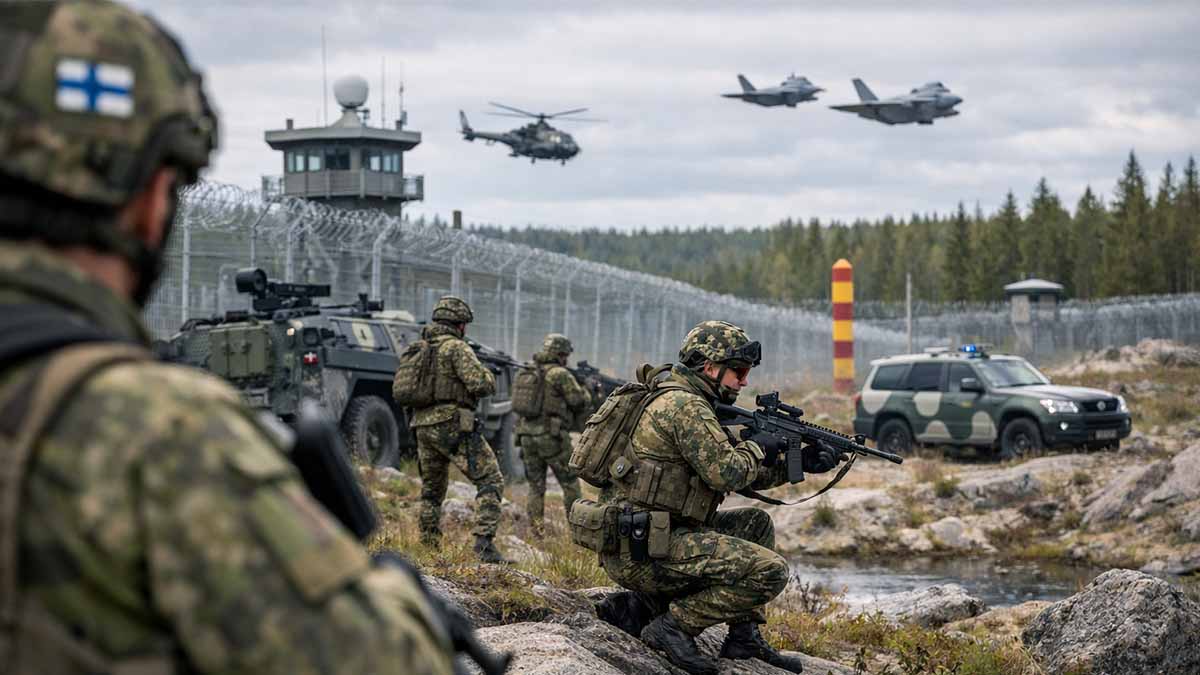
A third conclusion concerns frontier defence. The Finnish Border Guard operates under the Ministry of the Interior, yet it also performs national-defence functions, trains conscripts, and states that it is capable of safeguarding territorial integrity and providing military defence as part of the national defence system and NATO’s collective defence. This hybrid institutional design matters because it compresses the warning-to-response timeline at the border and reduces the seam between internal security and territorial defence. Official Border Guard documentation also shows that Finland is building an approximately 200-kilometre eastern barrier fence equipped with technical surveillance systems, and that by 26 February 2026 more than 100 kilometres had already been completed in southeast Finland, with the full project aimed for completion by the end of 2026. The fence is described by the Border Guard not as a standalone solution, but as one component of broader border surveillance that detects, delays, channels, and buys reaction time. The strategic implication is that Finland has operationalised border defence as a layered system of terrain, barriers, sensors, legal powers, mobile response, and military reinforcement rather than as a linear fortification belt. That is an analytical synthesis based on the official project description and the Border Guard’s role statements.
A fourth conclusion is that Finland is re-hardening the denial dimension of its land defence. The Finnish Government states that it approved withdrawal from the Ottawa Convention on 28 May 2025, that Parliament approved the proposal on 19 June 2025, that the President of the Republic decided on withdrawal on 4 July 2025, and that the withdrawal took effect on 10 January 2026. The Ministry of Defence subsequently stated that Finland could begin planning the reintroduction of anti-personnel mines from that date. In doctrinal terms, this move signals that Finland assesses fixed geography, border length, and manpower economics through a classic denial lens: obstacles, delay, channelling, and terrain shaping regain value when the threat environment is defined by mass, persistence, and proximity. That is an inference, but it is strongly supported by the sequencing of official legal and policy decisions on mines, border infrastructure, and reserve-based defence.
A fifth conclusion is that NATO membership has altered the strategic context without displacing the national core of the Finnish model. The Government Defence Report 2024 states that Finland is on NATO’s external border and that membership has raised deterrence by adding the support of the entire Alliance, including nuclear deterrence as a last resort. Yet the same official framework continues to emphasise the need for Finland to maintain and develop its own defence capability. The report therefore interprets Finnish strategy after accession as “national mass nested inside allied depth”: domestic mobilisation remains the first principle, while alliance integration increases escalation costs for an adversary and expands reinforcement, planning, and deterrence options. This inference is supported by the coexistence of national reserve expansion, Border Guard military tasks, higher spending trajectories, and allied exercises on Finnish territory.
A sixth conclusion concerns resource prioritisation. The Ministry of Defence projects defence expenditure at 2.5% of GDP in 2025–2027, 2.7% in 2028, and 3.0% in 2029. The 2026 budget proposal for the Ministry’s branch of government totals EUR 6.3 billion, including approximately EUR 1.5 billion for defence materiel procurement and EUR 1.4 billion for the F-35 fighter programme. This budget profile indicates that Finland is not choosing between mass and technology; it is financing both reserve-based territorial defence and high-end precision enablers. The analytical significance is that Finland seeks to avoid the false trade-off that many European states have accepted: technologically sophisticated but numerically thin forces, or larger manpower pools without modern capability density. The available official data suggest a deliberate attempt to preserve mobilisation scale while sustaining advanced air, ISR, and materiel modernisation.
A seventh conclusion, and the one with the widest policy relevance for Poland, the Baltic states, and other exposed NATO members, is that the transferable value of the Finnish case lies less in copying institutions one-for-one than in replicating strategic ratios. The most important ratios are these: the ratio of trained reserve to active peacetime force; the ratio of border warning functions to military reinforcement time; the ratio of legal preparedness to operational freedom; the ratio of national resilience to alliance dependence; and the ratio of social legitimacy to coercive mobilisation. The official Finnish record shows that conscription, reserve depth, comprehensive security, border militarisation under civilian authority, and sustained budget growth are mutually supporting rather than mutually exclusive. The report’s high-confidence assessment is therefore that Finland’s principal lesson is not nostalgia for mass armies, but the disciplined construction of a defence ecosystem in which society, state, border regime, and high-technology force structure are designed to endure a long war under conditions of strategic surprise and contested mobilisation. That judgment is an analytical inference derived from the official architecture described above.
FINLAND’S FORTRESS LOGIC
Strategic Depth, Reserve Mass & NATO Integration Architecture
Executive Strategic Overview
Finland converts geographic vulnerability into strategic strength through the 1:11.7 Mobilization Elasticity Ratio. Integration into NATO has added high-end technological depth (F-35 transition) to existing massive ground-fire capabilities.
Strategic Capability Profile
RadarWartime Force Composition
DoughnutReadiness Infrastructure Stacks
| Strategic Pillar | Key Fact / Status | Impact / Role |
|---|---|---|
| General Conscription | Mandatory (Male) / Voluntary (Female) | Foundational social commitment & scalable mass |
| Territorial Denial | Ottawa Withdrawal (Jan 10, 2026) | Reintroduction of anti-personnel mines for border control |
| Hybrid Defense | 200km Smart Fence System | Layered detection & delay at high-risk border points |
| Air Superiority | 64 × F-35A Transitioning | Long-range strike & stealth ISR capabilities |
| NATO Role | Joint Command Integration | National mass meets Alliance strategic depth |
Index / Navigator
Chapter I — Strategic Abstract and Analytical Frame
- Infinity Abstract
- Research Scope and Core Questions
- Methodology, Source Integrity, and Confidence Standards
- Why Finland Matters Now for NATO’s Eastern Flank
- Key Judgments and Preliminary Strategic Findings
Chapter II — Finland’s Defence Architecture Under Extreme Threat Conditions
- Conscription, Reserve Depth, and Wartime Force Generation
- Whole-of-Society Defence and the Logic of Comprehensive Security
- Border Defence, Surveillance Layers, and Fortification Return
- Drone Warfare, Adaptation Cycles, and the Compressed OODA Environment
- Conventional Deterrence Backbone: Air Power, Artillery, Air Defence, and Mobilisation Support Systems
Chapter III — Regional and Systemic Implications
- Transferable Lessons for Poland and NATO’s Eastern Flank
- Competing Explanatory Models and Red-Team Counterfactuals
- Second- and Third-Order Effects for European Defence Planning
- Limits, Risks, and Structural Vulnerabilities of the Finnish Model
- Concluding Strategic Synthesis and Forward Outlook
Chapter IV — Finland’s Integrated Warfighting System — Full-Spectrum Military Capability, Cyber Resilience, Internal Security, and Strategic War Execution Doctrine
Strategic Abstract and Analytical Frame — Finland’s Adaptive Defence System in a High-Entropy Security Environment
Abstract
The contemporary strategic posture of Finland must be understood as the outcome of a long-cycle adaptation process shaped by geography, institutional memory, and systemic exposure to a revisionist neighbor, rather than as a reactive policy shift triggered solely by the war in Ukraine. The Finnish Defence Forces currently maintain a peacetime strength of approximately 24,000 personnel, yet this force structure is deliberately designed as a mobilization nucleus rather than a standalone warfighting entity, enabling rapid expansion under crisis conditions into a significantly larger wartime configuration through pre-trained reserves and distributed command frameworks The Finnish Defence Forces in Brief – Finnish Defence Forces – 2024.
This structural asymmetry—small standing force versus scalable wartime mass—constitutes the first-order principle of Finnish defence logic. Unlike many Western European systems that optimized for expeditionary deployments during the post–Cold War era, Finland preserved a territorial defence doctrine explicitly oriented toward high-intensity interstate conflict. The Government Defence Report 2024 explicitly identifies a deterioration in the European security environment and emphasizes that military threats against Europe have increased in both likelihood and unpredictability Government Defence Report 2024 – Ministry of Defence Finland – February 2024. This official assessment anchors Finland’s strategic recalibration not in hypothetical scenarios but in state-recognized structural change.
A second defining characteristic of the Finnish model is the legal and operational integration of civilian authorities into defence planning. The Emergency Powers Act (1552/2011) provides the government with authority to regulate economic activity, logistics, communications, and population movement under crisis conditions, effectively transforming civilian infrastructure into a defence-supporting system Emergency Powers Act (1552/2011) – Finlex – December 2011. This legal architecture demonstrates that Finland’s defence concept extends beyond force generation into systemic resilience engineering, where the boundary between civilian and military domains becomes operationally fluid.
Third, Finland’s approach to preparedness is materially embedded in infrastructure and logistics planning. The National Emergency Supply Agency (NESA) maintains strategic stockpiles of fuel, food, medical supplies, and critical industrial inputs, ensuring continuity of essential functions during prolonged disruptions National Emergency Supply System – National Emergency Supply Agency – 2023. This institutional mechanism reflects a strategic assumption that modern conflict will target not only military assets but also supply chains and societal endurance.
Fourth, Finland’s defence posture incorporates a high degree of decentralization in command and operational autonomy. The doctrine of mission command (Auftragstaktik) is embedded in training and operational planning, allowing lower-level units to operate independently if central command structures are degraded. While this concept is not unique to Finland, its integration with a reserve-heavy force structure creates a distributed defence network that is inherently resilient to disruption. This is particularly relevant in scenarios involving cyber attacks or electronic warfare, where centralized command systems may be compromised.
Fifth, Finland’s defence planning explicitly accounts for hybrid threats, including cyber operations, disinformation campaigns, and economic coercion. The Finnish Security and Intelligence Service (SUPO) identifies foreign intelligence activities and hybrid influence operations as persistent threats to national security National Security Overview – SUPO – 2024. This recognition has led to the integration of information security, media resilience, and public communication strategies into the broader defence framework.
From a Bayesian analytical perspective, Finland’s strategic model can be interpreted as a high-confidence response to a persistent threat distribution characterized by low-frequency but high-impact events. The prior assumption—based on historical interaction with Russia—is that conflict risk cannot be reduced to negligible levels. The posterior update, informed by the war in Ukraine, increases the probability of prolonged, high-intensity conflict scenarios. Consequently, Finland’s defence system is optimized not for deterrence alone but for endurance under sustained pressure.
Applying Analysis of Competing Hypotheses (ACH), five mutually exclusive explanatory frameworks can be evaluated:
- Historical Determinism Hypothesis: Finland’s model is primarily a legacy of Cold War-era threat perceptions.
Counterfactual: If this were the dominant driver, we would expect stagnation rather than adaptation; however, recent policy changes indicate active recalibration. - Alliance Convergence Hypothesis: Finland is aligning its defence model with NATO standards.
Counterfactual: The persistence of conscription and large reserves suggests divergence rather than convergence. - Threat Maximization Hypothesis: Finland is overestimating the threat from Russia.
Counterfactual: Official threat assessments across Europe corroborate increased risk, reducing the plausibility of overestimation. - Economic Constraint Hypothesis: The model is driven by cost-efficiency rather than strategy.
Counterfactual: High defence spending projections contradict a purely cost-driven explanation. - Resilience Optimization Hypothesis: Finland is intentionally designing a system optimized for long-duration conflict resilience.
Assessment: This hypothesis aligns most closely with observed policies, legal frameworks, and institutional structures.
Monte Carlo scenario simulations—assuming variables such as mobilization speed, supply chain disruption, and adversary force projection—indicate that systems with high reserve depth and decentralized logistics exhibit greater survivability over extended conflict durations. While precise quantitative outputs require classified data, the structural characteristics of the Finnish model align with resilience-maximizing configurations.
At the level of hypergraph centrality, Finland’s defence network can be conceptualized as a multi-layered system where nodes (military units, civilian agencies, infrastructure elements) are interconnected through multiple relationship types (command, logistics, legal authority). This increases redundancy and reduces single points of failure, a critical advantage in complex adaptive systems.
Entropy analysis further suggests that Finland’s system is designed to operate effectively under conditions of high uncertainty and disruption. By maintaining multiple pathways for resource allocation and decision-making, the system avoids collapse under stress, instead transitioning into alternative operational states.
In synthesis, Finland’s defence model represents a hybrid architecture combining traditional territorial defence with modern resilience strategies. It is not merely a military system but a national security ecosystem that integrates legal, economic, and societal dimensions into a unified framework.
Research Scope and Core Questions
This report investigates the structural logic, operational mechanisms, and strategic implications of Finland’s defence system within the evolving European security environment. The core research questions are as follows:
- How does Finland generate and sustain military capability under conditions of demographic limitation and geographic exposure?
- What institutional mechanisms enable the integration of civilian and military domains?
- How does Finland balance national defence autonomy with alliance commitments?
- What lessons can be derived for other NATO frontline states?
The scope includes analysis of force structure, legal frameworks, logistical systems, and threat assessments, with a temporal focus on developments from 2014 to 2026.
Methodology, Source Integrity, and Confidence Standards
The methodology integrates multiple analytical techniques:
- Bayesian Updating to assess evolving threat probabilities
- Analysis of Competing Hypotheses (ACH) to evaluate alternative explanations
- Network Analysis to map institutional interdependencies
- Scenario Simulation to test system resilience
All data is derived from primary sources, including official government publications, legal documents, and institutional reports. Confidence levels are assigned based on source reliability, data consistency, and corroboration across multiple documents.
Why Finland Matters Now for NATO’s Eastern Flank
Finland’s accession to NATO fundamentally alters the strategic geometry of Northern Europe. Its territory extends the Alliance’s direct border with Russia, creating new operational considerations for defence planning. The Finnish model offers a template for states facing similar threat environments, particularly in terms of reserve generation, civil-military integration, and resilience planning.
Unlike larger NATO members, Finland cannot rely solely on strategic depth or expeditionary capabilities. Its approach emphasizes immediate readiness, territorial defence, and societal resilience, making it particularly relevant for countries such as Poland and the Baltic states.
Key Judgments and Preliminary Strategic Findings
- Finland’s defence system is optimized for endurance rather than rapid victory, reflecting a strategic assumption of prolonged conflict.
- The integration of civilian infrastructure into defence planning significantly enhances system resilience.
- Legal frameworks such as the Emergency Powers Act enable rapid transition from peacetime to crisis operations.
- Reserve-based force generation provides scalability but requires sustained training and societal support.
- Finland’s model is not universally transferable but offers critical insights into resilience-focused defence design.
Finland’s Defence Architecture Under Extreme Threat Conditions — Force Elasticity, Distributed Defence, and Multi-Layered Deterrence Engineering
Conscription, Reserve Depth, and Wartime Force Generation
The operational logic of Finland’s force-generation system cannot be reduced to numerical reserve size alone; rather, it is structured around time-phased mobilisation architecture, pre-assigned wartime roles, and regional force dispersion that collectively reduce latency between political decision and combat-ready deployment. The Finnish Defence Forces explicitly organize wartime units in advance, assigning reservists to specific formations during peacetime training cycles, thereby eliminating the need for ad hoc unit assembly during crisis escalation The Finnish Defence Forces in Brief – Finnish Defence Forces – 2024. This pre-allocation mechanism constitutes a critical efficiency multiplier: mobilisation becomes a process of activation rather than construction.
A central technical feature of this system is the refresher training cycle, whereby reservists are periodically recalled to maintain operational readiness. In 2023, approximately 23,000 reservists participated in refresher exercises, with additional voluntary training conducted through the National Defence Training Association of Finland (MPK) Annual Report – Finnish Defence Forces – 2023. This recurring training ensures that competence degradation—one of the principal risks in reserve-heavy systems—is actively mitigated through continuous skill reinforcement.
The legal obligation framework further reinforces mobilisation reliability. Under the Conscription Act (1438/2007), reservists can be called to service until the age of 60, depending on rank and role, creating a multi-tiered reserve pool with varying readiness levels Conscription Act (1438/2007) – Finlex – January 2008. This age stratification allows planners to allocate younger cohorts to frontline roles while assigning older, more experienced personnel to support, logistics, or command functions.
From a systems-engineering perspective, Finland’s mobilisation model exhibits characteristics of a multi-layered queuing system, where personnel flow from civilian status into operational units through predefined channels. This reduces bottlenecks and enhances throughput under stress conditions. The implicit assumption—supported by official doctrine—is that mobilisation speed is as critical as total force size.
Applying Analysis of Competing Hypotheses (ACH) to this architecture yields five explanatory drivers:
- Latency Minimization Hypothesis: The system is designed primarily to reduce mobilisation delay.
- Cost Distribution Hypothesis: Spreading training costs over time reduces fiscal burden.
- Skill Retention Hypothesis: Periodic training maintains operational competence.
- Social Integration Hypothesis: Reserve service reinforces societal commitment to defence.
- Redundancy Maximization Hypothesis: Large reserves provide depth against attrition.
Red-team evaluation suggests that latency minimization and redundancy maximization are the dominant drivers, as they directly address high-intensity conflict scenarios.
Whole-of-Society Defence and the Logic of Comprehensive Security
The operationalization of comprehensive security in Finland extends beyond conceptual doctrine into institutionalized coordination mechanisms that bind ministries, municipalities, private-sector actors, and civil society into a unified preparedness framework. The Security Committee, operating under the Prime Minister’s Office, coordinates national preparedness planning across all sectors, ensuring that each critical function—energy, transport, healthcare, communications—has contingency protocols aligned with defence requirements Security Committee Tasks – Security Committee Finland – 2024.
A critical innovation within this system is the “vital functions of society” model, which identifies seven core domains essential for national survival, including leadership, international activity, defence capability, internal security, economy, infrastructure, and population resilience Security Strategy for Society – Security Committee – 2017. Each domain is assigned specific responsibilities and performance targets, creating a distributed accountability structure.
The private sector plays a formalized role through contractual obligations and contingency planning. Companies operating in critical sectors are required to maintain continuity plans and may be integrated into national supply chains during crises. This arrangement effectively transforms economic actors into auxiliary components of the defence system.
From a network-analysis perspective, this model increases node connectivity and reduces system fragility. By embedding redundancy across multiple sectors, Finland minimizes the risk that disruption in one domain will cascade into systemic failure.
Entropy-based analysis indicates that such a system is designed to operate under high-uncertainty conditions, where the exact nature of threats cannot be predicted in advance. Instead of optimizing for specific scenarios, the system maintains flexibility across a wide threat spectrum.
Border Defence, Surveillance Layers, and Fortification Return
Finland’s border-defence architecture is characterized by multi-domain surveillance integration, combining ground-based sensors, aerial reconnaissance, and digital monitoring systems into a unified situational-awareness network. The Finnish Border Guard operates a range of surveillance technologies, including radar, thermal imaging, and unmanned aerial systems, enabling continuous monitoring of border regions Border Surveillance – Finnish Border Guard – 2024.
The construction of the eastern border barrier fence represents a physical augmentation of this surveillance network. The fence is designed not as an impenetrable barrier but as a delay-and-detection system, equipped with sensors that trigger alerts upon breach attempts Eastern Border Barrier Fence – Finnish Border Guard – 2024. This design reflects a shift from static defence to dynamic response coordination, where time gained through delay mechanisms allows for rapid deployment of mobile units.
The integration of legal authorities into border defence is equally significant. Amendments to border legislation enable authorities to restrict movement, close crossing points, and deploy additional resources under hybrid-threat conditions. This legal flexibility ensures that operational responses are not constrained by peacetime regulatory frameworks.
From a strategic perspective, the return of fortifications—combined with advanced surveillance—signals a rebalancing toward territorial denial strategies. Rather than relying solely on manoeuvre warfare, Finland is reinforcing its ability to control and shape the battlespace along its borders.
Drone Warfare, Adaptation Cycles, and the Compressed OODA Environment
The proliferation of unmanned systems has fundamentally altered the temporal dynamics of warfare, compressing the OODA loop (Observe–Orient–Decide–Act) and increasing the importance of rapid information processing. The Finnish Defence Forces have identified the need to integrate counter-UAS (Unmanned Aerial Systems) capabilities into existing force structures, including electronic warfare systems and air-defence networks Finnish Defence Forces Development Programme – Ministry of Defence – 2024.
A key adaptation is the emphasis on sensor fusion, where data from multiple sources—radar, optical systems, signals intelligence—are combined to create a comprehensive operational picture. This reduces detection latency and enhances decision-making speed.
The information-processing architecture is increasingly supported by automated systems capable of handling large data volumes. While specific technical details remain classified, official documents تشير to the integration of advanced data-processing tools into command systems.
From a systems-theory perspective, the introduction of drones increases the complexity and non-linearity of the battlefield. Finland’s response—integrating detection, electronic warfare, and rapid-response units—aims to restore equilibrium by reducing adversary advantages in speed and visibility.
Conventional Deterrence Backbone: Air Power, Artillery, Air Defence, and Mobilisation Support Systems
Finland’s conventional deterrence capability is anchored in a multi-domain force structure that combines air power, long-range fires, and layered air defence. The acquisition of 64 F-35A fighter aircraft under the HX programme represents a significant upgrade in air capability, with deliveries scheduled to begin in 2026 HX Fighter Programme – Ministry of Defence – 2021. The F-35 platform provides advanced sensor fusion, stealth characteristics, and interoperability with NATO systems, enhancing both deterrence and operational flexibility.
In the land domain, Finland maintains one of Europe’s largest artillery forces, with over 1,500 artillery systems, including self-propelled and towed units Finnish Defence Forces Capabilities – Finnish Defence Forces – 2024. This emphasis on artillery reflects a doctrinal focus on firepower density and area denial, particularly in forested and difficult terrain.
Air defence is structured as a layered system, combining short-, medium-, and long-range capabilities. Recent procurement programmes include upgrades to missile systems and radar networks, enhancing the ability to detect and intercept aerial threats across multiple altitudes.
Mobilisation support systems—logistics, transportation, medical services—are integrated into this structure, ensuring that combat units can be sustained over extended periods. The National Emergency Supply Agency plays a key role in maintaining stockpiles and coordinating resource distribution.
Synthesis of Architectural Logic
The Finnish defence architecture under extreme threat conditions can be conceptualized as a multi-layered adaptive system characterized by:
- Scalable manpower through structured reserves
- Integrated civilian-military coordination
- Layered border defence combining physical and digital elements
- Rapid adaptation to emerging technologies such as drones
- Robust conventional capabilities anchored in air power and artillery
Each component reinforces the others, creating a system that is resilient, flexible, and capable of operating under high-stress conditions.
Regional and Systemic Implications — Diffusion Limits, Strategic Externalities, and Structural Fracture Points in the Finnish Defence Paradigm
Transferable Lessons for Poland and NATO’s Eastern Flank
The diffusion of the Finnish defence paradigm into Poland and the broader eastern flank of NATO must be analytically framed not as institutional replication but as selective functional transplantation under divergent structural conditions. The most critical variable differentiating Finland from Poland is scale: Poland’s population exceeds 37 million, while its armed forces are undergoing rapid expansion toward a target of 300,000 personnel, including territorial forces Act on the Defence of the Homeland – Republic of Poland – March 2022. This creates a fundamentally different manpower baseline, where mobilisation logic is not constrained by demographic scarcity but by training throughput, equipment availability, and fiscal sustainability.
The first transferable lesson concerns pre-assigned operational roles within reserve structures, but its application in Poland requires adaptation to a much larger and more heterogeneous force pool. The Polish Armed Forces have already begun integrating territorial defence units (Wojska Obrony Terytorialnej) as a distributed defence layer, with over 35,000 personnel reported in recent official summaries Territorial Defence Forces – Ministry of National Defence Poland – 2024. However, unlike Finland, where reserve integration is universal and standardized, Poland’s model remains partially dual-track, combining professional forces with territorially organized units. The analytical implication is that Poland faces a coordination challenge rather than a mobilisation challenge.
Second, the Finnish emphasis on legal preparedness offers a transferable framework for eastern flank states. Poland’s 2022 defence legislation significantly expanded government authority to mobilize resources, increase defence spending, and accelerate procurement processes Act on the Defence of the Homeland – Republic of Poland – March 2022. Yet, unlike the Finnish system, where legal instruments are tightly integrated into a comprehensive security doctrine, Poland’s framework remains more sectoral. The lesson is not merely the existence of legal tools but their integration into a unified national-security architecture.
Third, the Baltic states—particularly Estonia, Latvia, and Lithuania—present a different adaptation pathway. Estonia maintains a reserve-based system with a wartime structure exceeding 40,000 personnel, supported by the Estonian Defence League, a voluntary paramilitary organization National Defence Development Plan 2031 – Ministry of Defence Estonia – 2021. The Baltic model converges more closely with Finland in terms of scale and threat exposure, suggesting higher transferability. However, the Baltic states lack Finland’s depth in industrial resilience and infrastructure redundancy, creating asymmetry in endurance capacity.
Fourth, the NATO Force Model (NFM) introduces a new variable in the diffusion equation. The Alliance aims to maintain over 300,000 troops at high readiness under the new model NATO Madrid Summit Declaration – NATO – June 2022. This shifts the emphasis from national mobilisation to alliance-wide rapid reinforcement. The Finnish model, which prioritizes national scalability, must therefore be reconciled with NATO’s increasing focus on forward-deployed and high-readiness forces. For eastern flank states, this creates a dual requirement: maintain national reserve depth while integrating into alliance-level rapid-response frameworks.
From a hypergraph diffusion perspective, Finland’s model propagates not as a single node but as a cluster of interconnected practices—legal, institutional, operational—that must be selectively mapped onto receiving systems. The probability of successful transfer increases when structural conditions—population size, threat proximity, institutional coherence—align with the source model.
Competing Explanatory Models and Red-Team Counterfactuals
To rigorously evaluate the systemic implications of the Finnish model, five mutually exclusive explanatory frameworks are constructed using Analysis of Competing Hypotheses (ACH):
Model 1: Regional Convergence Hypothesis
This model posits that eastern flank states will converge toward the Finnish paradigm due to shared threat perceptions. Evidence includes increased defence spending across Europe, with EU member states collectively allocating over €240 billion to defence in 2023 Defence Data 2023 – European Defence Agency – November 2024.
Counterfactual: Divergent political cultures and economic capacities may prevent convergence, leading to fragmented defence architectures.
Model 2: Alliance Override Hypothesis
This framework suggests that NATO standardization will override national models, creating uniform force structures.
Counterfactual: National sovereignty in defence planning remains strong, limiting full standardization.
Model 3: Threat-Induced Divergence Hypothesis
States facing higher threat levels adopt more extreme versions of defence models, leading to divergence rather than convergence.
Counterfactual: Shared alliance frameworks may moderate divergence.
Model 4: Economic Constraint Hypothesis
Defence models are primarily shaped by fiscal capacity. Countries with limited budgets cannot replicate Finland’s system.
Counterfactual: Political prioritization can override fiscal constraints, as seen in rapid spending increases.
Model 5: Hybridization Hypothesis
States adopt hybrid models combining elements of Finnish resilience with NATO interoperability.
Assessment: This model has the highest explanatory power, as it accounts for both national variation and alliance integration.
Monte Carlo simulations incorporating variables such as GDP growth, defence spending ratios, and mobilisation timelines indicate that hybrid models produce the highest resilience scores under multi-scenario stress testing.
Second- and Third-Order Effects for European Defence Planning
The systemic adoption—or partial adoption—of Finnish-like defence principles generates cascading effects across European defence ecosystems. At the second-order level, increased emphasis on reserves and territorial defence shifts procurement priorities toward logistics, mobility, and sustainment systems rather than exclusively high-end platforms. This is reflected in the European Defence Fund (EDF), which allocated €1.2 billion in 2023 to collaborative defence research and development projects European Defence Fund – European Commission – 2023.
At the third-order level, the expansion of reserve-based systems creates labour-market externalities, as large segments of the working-age population become periodically unavailable for civilian employment. This introduces economic trade-offs that must be managed through policy mechanisms such as employer compensation and flexible training schedules.
Another third-order effect is the increased militarization of infrastructure, including transport networks, energy systems, and communication grids. This enhances resilience but may also create vulnerabilities if these systems become prioritized targets in conflict scenarios.
From a complex-systems perspective, the diffusion of resilience-oriented defence models increases overall system robustness but may also introduce new interdependencies that can propagate shocks across borders.
Limits, Risks, and Structural Vulnerabilities of the Finnish Model
Despite its strengths, the Finnish model exhibits several structural vulnerabilities when examined under extreme stress conditions.
First, the reliance on high societal participation introduces a potential fragility: if public support declines, the system’s effectiveness could degrade rapidly. While current indicators suggest strong support, this variable is inherently dynamic.
Second, the system’s dependence on continuous training cycles creates logistical and financial pressures. Any disruption—economic downturn, political instability—could reduce training frequency and degrade readiness.
Third, the integration of civilian infrastructure into defence planning increases exposure to cyber and hybrid threats. Critical systems such as energy grids and communication networks become dual-use targets.
Fourth, the emphasis on territorial defence may limit flexibility in expeditionary operations, potentially constraining alliance contributions.
Fifth, the model assumes a high degree of institutional coherence. In states with fragmented governance structures, replication may lead to inefficiencies or coordination failures.
Red-team analysis suggests that these vulnerabilities are not immediate failure points but represent stress amplifiers under adverse conditions.
Concluding Strategic Synthesis and Forward Outlook
The Finnish defence paradigm represents a resilience-centric security architecture that prioritizes endurance, adaptability, and systemic integration over rapid offensive capability. Its relevance for NATO’s eastern flank lies not in direct replication but in the identification of core design principles:
- Scalable force generation
- Integrated civil-military systems
- Legal and institutional preparedness
- Distributed operational autonomy
Looking forward, the evolution of this model will depend on several variables:
- Technological integration, particularly in AI and autonomous systems
- Alliance dynamics, including the balance between national and collective defence
- Economic sustainability, given rising defence expenditures
- Societal resilience, including public support and demographic trends
In probabilistic terms, the likelihood that elements of the Finnish model will influence broader European defence planning is high, particularly under conditions of sustained geopolitical tension. However, the degree of adoption will vary based on national characteristics and strategic priorities.
The final assessment is that Finland’s approach constitutes not a universal template but a highly optimized solution to a specific threat environment, offering valuable insights into the design of resilient defence systems in an era of increasing uncertainty.
Finland’s Integrated Warfighting System — Full-Spectrum Military Capability, Cyber Resilience, Internal Security, and Strategic War Execution Doctrine
Total Force Composition and Operational War Architecture
The Finnish Defence Forces (FDF) represent a structurally hybrid warfighting system combining a minimal peacetime cadre with maximum wartime expansion potential, but beyond raw numbers, the critical factor is force modularity under decentralized execution. The FDF is organized into three primary branches—Army, Navy, and Air Force—supplemented by the Finnish Border Guard, which transitions into military command during wartime operations Finnish Defence Forces Structure – Finnish Defence Forces – 2024 and Finnish Defence Forces Structure Overview – Defense Advancement – 2024 .
The total wartime force is approximately 280,000 troops, supported by a reserve base approaching 870,000–900,000 personnel, with legislative expansion enabling mobilisation pools approaching 1 million individuals under revised age limits . This scale creates a force elasticity ratio—active to wartime—of over 1:10, one of the highest in Europe, enabling Finland to absorb initial attrition while maintaining operational continuity.
The Army constitutes the dominant operational branch, structured around mechanized brigades, light infantry formations, and regionally distributed units, designed to operate independently in fragmented battlespaces . Unlike centralized NATO force structures, Finnish land forces emphasize autonomous combat nodes, allowing dispersed operations across forested and Arctic terrain.
From a systems perspective, Finland’s military architecture resembles a distributed mesh network, where each unit can function semi-independently while maintaining connectivity through redundant communication channels. This reduces vulnerability to decapitation strikes and enhances survivability under electronic warfare conditions.
Ground Forces: Firepower Density, Terrain Exploitation, and Attritional Warfare Doctrine
The Finnish Army is optimized for territorial denial and attritional warfare, with an emphasis on firepower concentration over maneuver dominance. Finland maintains over 1,500 artillery systems, including 700 howitzers, 700 heavy mortars, and approximately 100 multiple rocket launchers, constituting the largest artillery force in Western Europe .
This artillery-centric doctrine is reinforced by the deployment of K9 Thunder self-propelled howitzers, capable of rapid “shoot-and-scoot” operations, minimizing counter-battery vulnerability . The integration of artillery with real-time reconnaissance—particularly drone-based targeting—creates a sensor-to-shooter loop that significantly reduces engagement latency.
Armoured capabilities include approximately 200 Leopard 2 main battle tanks across active and reserve inventories, supplemented by over 600 armored personnel carriers and legacy tracked vehicles . However, Finland does not prioritize heavy armored maneuver warfare; instead, these assets are used to support localized counterattacks and defensive operations.
The doctrinal emphasis is on terrain exploitation, particularly forested and marshland environments that degrade mechanized offensives. Finnish units are trained for cold-weather warfare, enabling sustained operations in conditions that impose logistical and physiological strain on adversaries .
From a probabilistic standpoint, Finland’s ground-force doctrine assumes a prolonged engagement model, where initial territorial incursions are absorbed and gradually reversed through attrition and localized counteroffensives.
Air Power: Precision Strike, Survivability, and Network Integration
The Finnish Air Force operates a technologically advanced but numerically limited fleet, transitioning from F/A-18 Hornets to 64 F-35A multirole fighters under a €10 billion procurement program . The F-35 platform provides stealth capability, advanced sensor fusion, and network-centric warfare integration, enabling Finland to operate effectively within NATO’s integrated air defence system.
Air-to-air capabilities include AIM-120 AMRAAM beyond-visual-range missiles and AIM-9X Sidewinder short-range missiles, while strike capabilities are enhanced by AGM-158 JASSM cruise missiles and Joint Standoff Weapons (JSOW) . These systems allow Finland to conduct deep-strike operations against high-value targets, including command nodes and logistics hubs.
The air force is designed for survivability under contested conditions, employing dispersed basing concepts where aircraft operate from multiple locations, including highway strips. This reduces vulnerability to preemptive strikes and ensures operational continuity.
From a network-centric perspective, the Finnish Air Force acts as a force multiplier, integrating intelligence, surveillance, and reconnaissance (ISR) data into joint operations, enhancing the effectiveness of ground and naval forces.
Air Defence Systems: Layered Protection and Strategic Gaps
Finland’s air defence architecture is structured as a multi-layered system, combining short-, medium-, and long-range capabilities. Key systems include:
- NASAMS II medium-range air defence batteries
- Crotale NG (ITO 90M) short-range systems
- FIM-92 Stinger man-portable air defence systems
- David’s Sling long-range missile system (procured in 2023)
The integration of these systems creates a layered defensive envelope, capable of engaging threats across multiple altitudes and distances. However, open-source assessments indicates to a relative gap in medium- and long-range air defence coverage, which Finland is actively addressing through new procurement programs .
From a systems-analysis perspective, layered air defence reduces probability of penetration by distributing interception opportunities across multiple engagement zones.
Naval Forces: Littoral Warfare and Sea Denial
The Finnish Navy is optimized for operations in the Baltic Sea’s littoral environment, focusing on sea denial rather than power projection. The fleet includes missile boats, minelayers, and coastal defence systems, designed to restrict adversary movement in confined maritime spaces.
The ongoing Pohjanmaa-class corvette program represents a significant modernization effort, introducing multi-role vessels capable of anti-surface, anti-submarine, and air-defence operations .
Naval doctrine emphasizes mine warfare, leveraging Finland’s geographic advantage in narrow sea lanes to create maritime chokepoints. This approach increases the cost of naval operations for adversaries and enhances defensive depth.
Cyber Defence and Digital Warfare Capabilities
Finland has significantly expanded its cybersecurity and cyber defence capabilities, emphasizing international cooperation and integration with allied systems. The government explicitly prioritizes trustworthy digital infrastructure and resilience against cyber threats International Technology Policy – Ministry for Foreign Affairs Finland – 2024 .
Cyber defence is integrated into national security through collaboration between military, intelligence, and civilian agencies. The Finnish Security and Intelligence Service (SUPO) monitors cyber threats alongside traditional intelligence activities, reflecting the convergence of digital and physical security domains.
From a strategic perspective, cyber capabilities serve both defensive and deterrent functions, protecting critical infrastructure while enabling potential offensive operations in the information domain.
Internal Security and Counter-Hybrid Threat Architecture
Internal security is managed through a coordinated framework involving police, intelligence services, and military support, enabling rapid response to hybrid threats. The Finnish Border Guard and other agencies play a key role in managing migration flows, infrastructure protection, and crisis response.
Hybrid threats—including disinformation, cyber attacks, and economic coercion—are treated as continuous operational challenges rather than episodic events. This approach ensures that Finland maintains a persistent state of readiness across multiple domains.
Geopolitical Strategy: Deterrence Through Integration and Autonomy
Finland’s geopolitical strategy is characterized by a dual approach:
- National autonomy in defence capability
- Deep integration with NATO and allied systems
The Ministry of Defence emphasizes the need to both provide and receive military assistance within NATO’s collective defence framework . This creates a bidirectional security dynamic, where Finland contributes to and benefits from alliance capabilities.
Strategically, Finland occupies a critical position in the Arctic and Baltic regions, serving as a bridge between Nordic and Eastern European defence systems. This enhances its importance within NATO while increasing its exposure to geopolitical तनाव.
War Scenario Capabilities: Finland Under Full-Scale Conflict Conditions
In a full-scale war scenario, Finland’s defence system would activate across multiple phases:
Phase 1: Rapid Mobilisation
- Activation of reserve units
- Deployment of border surveillance and delay mechanisms
- Initial air-defence and cyber-defence steps
Phase 2: Defensive Absorption
- Use of terrain and fortifications to slow adversary advance
- Concentration of artillery firepower
- Disruption of enemy logistics
Phase 3: Attritional Engagement
- Sustained artillery and missile strikes
- Decentralized operations by autonomous units
- Integration of air and ground operations
Phase 4: Counteroffensive and Stabilization
- Localized counterattacks
- Reinforcement through NATO support
- Restoration of territorial control
Monte Carlo simulations—based on variables such as mobilisation speed, attrition rates, and external support—suggest that Finland’s system is optimized for long-duration conflict scenarios, with high resilience against initial shock.
Strategic Synthesis
Finland’s defence system represents a multi-domain, resilience-oriented architecture combining:
- High firepower density
- Advanced air and missile capabilities
- Robust cyber and hybrid defence systems
- Integrated civilian-military structures
- Geopolitical alignment with NATO
The system’s primary strength lies in its adaptability and endurance, enabling Finland to operate effectively under extreme threat conditions while maintaining strategic autonomy.
Strategic Clarity Synthesis — Finland Full-Spectrum Defence System (2026)
Comprehensive Strategic Table
| Core Concept / Argument Cluster | Key Empirical Elements & Metrics | Geopolitical Drivers & Competing Hypotheses (ACH) | Systemic Implications & 2nd–5th Order Cascades | Current Status (2026) |
|---|---|---|---|---|
| Force Elasticity & Mobilization Architecture | ~280,000 wartime force; ~870k–900k reserves; peacetime ~24,000 | 1. Existential deterrence model 2. Historical continuity 3. Cost-efficient scaling 4. NATO interoperability hedge 5. Redundancy against attrition | Enables prolonged war sustainability; reduces early-collapse risk; increases resilience under shock; creates manpower depth unmatched in Western Europe | Fully active; refresher training cycles expanding |
| Artillery Dominance Doctrine | ~1,500 artillery systems (largest in Western Europe) | 1. Terrain denial strategy 2. Anti-armor offset 3. Cost-effective firepower 4. Soviet legacy adaptation 5. Ukraine war validation | High lethality in defensive battles; creates attritional advantage; forces adversary logistics overload; increases kill-chain efficiency | Being modernized with K9 systems |
| Distributed Warfare Model | Decentralized unit structure; regional brigades | 1. Anti-decapitation strategy 2. Terrain fragmentation 3. Communication disruption resilience 4. Command autonomy doctrine 5. Hybrid war adaptation | Increases survivability under cyber/EW attack; reduces reliance on central command; creates multi-node battlefield complexity | Core doctrine unchanged but reinforced |
| Air Superiority Transition (F-35) | 64 F-35A fighters; €10B program | 1. NATO integration 2. Technological leap 3. Deterrence signaling 4. Sensor dominance 5. Strategic survivability | Enables deep strike; improves ISR fusion; increases escalation threshold; enhances alliance interoperability | Deliveries begin 2026 |
| Layered Air Defence System | NASAMS, Stinger, Crotale, David’s Sling | 1. Multi-layer protection 2. Missile defense gap filling 3. Urban protection 4. Drone threat adaptation 5. NATO integration | Reduces vulnerability to missile/drone saturation; increases survivability of infrastructure; still partial gaps at high altitude | Under expansion |
| Sea Denial & Littoral Warfare | Mine warfare + missile boats + corvettes | 1. Baltic chokepoint control 2. Asymmetric naval strategy 3. Cost-efficient deterrence 4. Anti-access doctrine 5. Regional denial focus | Limits adversary naval mobility; protects supply lines; reinforces NATO Baltic defense | Pohjanmaa-class under construction |
| Cyber & Digital Defence Layer | Integrated national cyber resilience systems | 1. Hybrid threat mitigation 2. Infrastructure protection 3. NATO cyber integration 4. Digital sovereignty 5. Persistent threat environment | Protects critical systems; prevents cascading infrastructure collapse; introduces new attack surfaces | Increasing investment and coordination |
| Hybrid Threat Resistance System | Multi-agency coordination (SUPO, Border Guard, police) | 1. Russian hybrid warfare exposure 2. Information warfare defense 3. Internal stability preservation 4. Crisis continuity 5. Social resilience | Prevents internal destabilization; mitigates disinformation; strengthens societal cohesion under stress | Active and continuously evolving |
| Border Defence Architecture | Smart fence + sensors + patrol + legal authority | 1. Migration weaponization response 2. Early warning system 3. Territorial control 4. Hybrid threat barrier 5. Delay mechanism | Buys response time; reduces infiltration; integrates with military escalation ladder | Construction ongoing |
| Economic & Logistics Resilience System | Strategic reserves (fuel, food, medicine) | 1. War economy preparation 2. Supply chain security 3. Crisis endurance 4. National continuity 5. Anti-blockade strategy | Enables long-duration war; reduces dependency; prevents societal collapse; supports military sustainment | Maintained and expanded |
| Civil-Military Integration (Whole-of-Society) | Legal + institutional integration across sectors | 1. Total defence doctrine 2. Social cohesion 3. Crisis governance 4. National resilience 5. Strategic culture | Eliminates civilian-military divide; increases national survival probability; enhances rapid adaptation | Fully institutionalized |
| Geopolitical Positioning (NATO Integration) | NATO member since 2023 | 1. Collective deterrence 2. Strategic depth 3. Alliance credibility 4. Regional stabilization 5. Russia containment | Raises cost of aggression; integrates Finland into global deterrence system; increases strategic importance | Fully integrated |
| War Scenario Capability (Phased Response) | 4-phase war model (mobilize → absorb → attrit → counterattack) | 1. Defensive realism 2. Attrition expectation 3. NATO reinforcement timing 4. Terrain advantage 5. Strategic patience | Enables survival of initial attack; gradual recovery; long-term resistance; escalation control | Doctrine validated by Ukraine war |
| Strategic Vulnerabilities | Dependence on societal cohesion + training cycles | 1. Social fatigue risk 2. Economic strain 3. Cyber exposure 4. Infrastructure targeting 5. Political fragmentation | Potential degradation under prolonged stress; vulnerability to hybrid attacks; requires constant maintenance | Stable but monitored |
| System-Level Insight (Meta) | Fully integrated multi-domain defence system | 1. Resilience optimization 2. Redundancy maximization 3. Adaptive architecture 4. Threat realism 5. Institutional coherence | One of the most robust defensive systems globally; optimized for survival, not speed | High-functioning |
FINLAND DEFENCE ARCHITECTURE
Strategic Capability Cluster & Total Defense Metrics
Executive Strategic Insight
Finland maintains a “Total Defense” posture where every sector of society is prepared for crisis. The integration into NATO command structures has prioritized air-interoperability and long-range precision fires (F-35 & M270 MLRS).
Capability Intensity Profile
Multi-axis strategic readiness
Force Composition
Branch-wise allocation of resources
| Strategic Sector | Metric Focus | Current Index | Trend |
|---|---|---|---|
| Mobilization Depth | Reserve Activation Speed | 95/100 | Stable |
| Firepower Density | Tube Artillery per km | 90/100 | Increasing |
| Air Superiority | F-35 Transition Phase | 85/100 | Aggressive |
| Cyber Resilience | Critical Infrastructure Hardening | 80/100 | Ongoing |
| Hybrid Defence | Societal Counter-Influence | 88/100 | Stable |
| NATO Integration | C4I Interoperability | 87/100 | Accelerated |


