














Abstract
The strategic landscape of Europe as of April 2026 is defined by a profound transition from traditional territorial defense to a multidimensional “phantom perimeter” struggle, where the geographical insulation of Western Europe has been functionally nullified by the integration of Belarus into the Russian Federation’s offensive unmanned aerial systems (UAV) architecture. The French Republic, currently operating under the 2024-2030 Military Programming Law, which allocates €413 billion to national defense, has identified a critical structural fracture point: the ability of low-cost, long-range unmanned systems to penetrate the Atlantic-facing sovereign core and threaten Nuclear Deterrence infrastructure [$€413 billion for defense through the end of the decade France plans $50 bln military procurement drive for 2026 – Al Mayadeen – 2026]. This realization is catalyzed by intelligence indicating that Russia is planning the deployment of 4 ground-based control stations for long-range drones within Belarus, a move that places the entirety of Germany and France within the 2,000 km strike radius of systems such as the Shahed-136(https://www.ukrinform.net/rubric-ato/4104698-russia-planning-to-deploy-four-longrange-drone-control-stations-in-belarus-zelensky.html)].
The Belarus-Russia Kinetic Integration and the “Military Object” Paradigm
The sovereignty of Belarus has underwent a process of “creeping annexation,” solidified by the February 5, 2026 agreement allowing Russia to establish permanent “military objects” on Belarusian soil(https://understandingwar.org/research/russia-ukraine/russian-offensive-campaign-assessment-march-23-2026/)]. This legal framework facilitates the expansion of Russian long-range drone capabilities, transforming Minsk from a rear-area logistical hub into an active front for sub-threshold strikes against Western Europe. Ukrainian President Volodymyr Zelensky confirmed in March 2026 that Russian forces are already utilizing repeaters in Belarus to support Shahed-type drone strikes, effectively extending the command-and-control (C2) lattice required for precision guidance into deep European territory(https://understandingwar.org/research/russia-ukraine/russian-offensive-campaign-assessment-march-23-2026/)].
The intensity of this operations tempo is evidenced by the Belarusian Air Force reporting over 100 violations of airspace regulations and 70 state border violations in the first ten weeks of 2026, necessitating 5 combat engagements to destroy three threatening UAVs(https://en.belsat.eu/92057320/belarusian-air-force-three-drones-posing-a-threat-shot-down-since-start-of-2026)]. These incursions represent a Bayesian shift in probability; they are no longer viewed as accidental “veering” from the Ukraine theater but as deliberate Signals Intelligence (SIGINT) and Electronic Warfare (EW) probing of NATO‘s eastern air-defense sensitivity.
Domestic Vulnerability: The Île Longue Incursions and Nuclear Espionage
For the French Ministry of Armed Forces, the threat crystallized in December 2025 when 5 unidentified drones were detected overflying the Île Longue naval base in Brittany, the home port for the Force Océanique Stratégique (FOST)(https://airlive.net/military/2025/12/05/five-unidentified-drones-overfly-frances-top-secret-nuclear-submarine-base-ile-longue/)]. This facility secures France‘s four Triomphant-class nuclear-powered ballistic missile submarines (SSBNs)—Le Triomphant, Le Téméraire, Le Vigilant, and Le Terrible—which collectively carry the vast majority of the nation’s 290 nuclear warheads(https://airlive.net/military/2025/12/05/five-unidentified-drones-overfly-frances-top-secret-nuclear-submarine-base-ile-longue/)]. The persistence of these flights, occurring simultaneously with similar drone sightings at Kleine-Brogel in Belgium and Volkel in the Netherlands, suggests a coordinated New Generation Warfare (NGW) campaign by hostile actors to map the response times and radio-frequency signatures of European nuclear infrastructure(https://www.iiss.org/online-analysis/online-analysis/2025/12/drones-targeting-european-nuclear-weapons-infrastructure/)].
The technical sophistication of these incursions has exposed significant capability gaps. Despite the deployment of handheld jamming rifles and specialized marine rifle battalions, many of these drones successfully evaded neutralization, prompting the French Ministry of the Armed Forces to utilize an “operational emergency process” to order TRUSTCOMS Infodrone and DroneBlocker systems in late December 2025(https://thedefensewatch.com/global-news/france-orders-counterdrone-systems-after-rise-in-unidentified-drone-activity/)]. This vulnerability is further exacerbated by the proliferation of Russian shadow fleet vessels—reconnaissance trawlers operating near European coasts—which intelligence indicates are being used as launch platforms to complicate early warning detection(https://militarnyi.com/en/articles/undeclared-war-how-russia-is-attacking-europe/)].
The Military-Industrial-Financial Complex: Conflicted Capital and Rearmament
Amidst this deteriorating security environment, the French defense industrial base has recorded unprecedented financial growth, reflecting the “Conflict Capitalism” model where sovereign risk translates into private equity gains. Safran reported an adjusted revenue of €31.33 billion for FY 2025, a 14.7% increase over 2024, with Recurring Operating Income surging by 26% to €5.2 billion(https://www.safran-group.com/pressroom/safran-reports-excellent-financial-performance-2025-and-raises-its-2028-ambitions-2026-02-13)]. This performance was driven largely by the Equipment & Defense division, which saw 15.9% organic growth as demand for AASM/Hammer missile seekers and navigation systems spiked(https://www.safran-group.com/pressroom/safran-reports-excellent-financial-performance-2025-and-raises-its-2028-ambitions-2026-02-13)]. Similarly, Thales reported 28 large orders (each exceeding €100 million) in 2025, including a critical contract for 5,000 air defense LMM missiles for the UK Ministry of Defence(https://www.thalesgroup.com/en/news-centre/press-releases/thales-reports-its-2025-full-year-results)].
Institutional capture within this sector is facilitated by a high-velocity “revolving door.” As of March 2026, the Thales Board of Directors includes Joël Barre, a former General (Armament Corps) Engineer and director at the DGA, ensuring that military procurement priorities are seamlessly integrated into corporate strategy(https://www.thalesgroup.com/en/news-centre/press-releases/two-appointments-thales-board-directors)]. Furthermore, the ownership structure of these primes is dominated by global asset managers; The Vanguard Group holds approximately 9.1% of BlackRock, which in turn holds significant stakes in the French defense ecosystem, creating a feedback loop where investment stewardship focuses on “financially meaningful changes” such as the European rearmament cycle(https://www.bitget.com/academy/blackrock-shareholders-2026-comprehensive-guide-for-united-kingdom-investors)]. This financialization of defense is reflected in the BlackRock Geopolitical Risk Indicator (BGRI), which remains at elevated levels as of March 2026 due to the Russia-NATO friction(https://www.blackrock.com/corporate/insights/blackrock-investment-institute/interactive-charts/geopolitical-risk-dashboard)].
The Doctrinal Shift: Forward Deterrence and Sovereign Early Warning
In response to these systemic threats, President Emmanuel Macron announced the “Forward Deterrence” (dissuasion avancée) doctrine on March 2, 2026. This evolution explicitly links French nuclear security to the “depth of the European continent,” allowing for the dispersal of nuclear-capable Rafale F4.1 aircraft to allied bases to increase survivability against Russian missile and drone strikes(https://www.ifri.org/en/external-articles/external-publications/france-has-new-nuclear-doctrine-forward-deterrence-europe)]. The F4.1 standard of the Rafale, which enters service in 2026, features the Scorpion helmet-mounted display, improved RBE2 AESA radar, and the SPECTRA electronic warfare suite specifically designed for operations in highly contested environments(https://www.defense.gouv.fr/sites/default/files/ministere-armees/20260326_NP_Press-kit_%20AIR-POLICING-BAP-2026_EN_0.pdf)].
Simultaneously, the French-German axis has prioritized technological sovereignty through the JEWEL (Joint Early Warning for a European Lookout) initiative, signed on October 15, 2025. This program aims to build a sovereign European space-based early warning system—consisting of geostationary satellites with infrared sensors—to detect ballistic and hypersonic launches independently of US systems by the early 2030s(http://www.defense.gouv.fr/en/news/jewel-france-and-germany-lay-foundation-european-early-warning-capability)]. This is complemented by the European Long-range Strike Approach (ELSA), a coalition including France, Germany, Italy, Poland, Sweden, and the UK, which aims to harmonize the development of “low cost 500km+ capabilities” to counter the Russian unmanned advantage(https://www.edrmagazine.eu/joint-communique-by-the-defence-ministries-of-elsa-nations12-02-2026)].
The US-Belarus Paradox: Sanctions Relief vs. Kinetic Escalation
A significant variable in this geopolitical calculus is the shifting US policy toward Minsk. On March 19, 2026, US Special Envoy John Coale brokered a deal with Alexander Lukashenko for the release of 250 political prisoners—including high-profile journalist Katsyaryna Andreyeva and human rights activist Valiantsin Stefanovich—in exchange for the lifting of US sanctions on the Belarusian Ministry of Finance and major potash producers like Belaruskali(https://exportcompliancedaily.com/article/2026/03/27/us-lifts-some-belarusrelated-sanctions-in-exchange-for-prisoners-release-2603260015?BC=bc_69c5b16ea3366)]. While the Trump administration hailed this as a “significant humanitarian milestone,” Paris perceives a divergence in interests(https://apnews.com/article/belarus-us-lukashenko-trump-sanctions-prisoners-06d5703f575f6cca9ad27ba923acde2a)]. The easing of economic pressure on Minsk occurs precisely as the Belarusian military infrastructure is being leveraged for Russian drone operations, creating a “permissive environment” for hybrid escalation.
Synthetic Realities and Cyber Resilience
The final pillar of the French recalibration involves the cognitive and digital domains. The National Cybersecurity Strategy 2026-2030 outlines an ambition to make France the “largest pool of cyber talent in Europe” while mandating the implementation of the NIS2 Directive across all regulated sectors to counter the surge in Russian and Iranian cyber sabotage(https://tinextadefence.it/en/national-cybersecurity-strategy-of-france-2026-2030/)]. This is particularly critical as Russian-funded disinformation networks, such as Restmedia, have been documented using ChatGPT and engagement farms to amplify pro-Kremlin narratives and deploy deepfakes ahead of European elections(https://cetas.turing.ac.uk/publications/deepfake-scams-poisoned-chatbots)]. Furthermore, the March 6, 2026 report by the US Treasury Department highlights the increasing use of Decentralized Finance (DeFi) and cross-chain bridges by sanctioned states like Russia and Iran to circumvent financial controls, necessitating a “technology-neutral, risk-based” overhaul of AML/CFT frameworks(https://www.jdsupra.com/legalnews/treasury-releases-2026-report-on-2253163/)].
| Strategic Entity / Parameter | 2025/2026 Quantitative Status | Verified Tier-1 Source |
| Russian Long-Range Drone Stations (Belarus) | 4 (Projected Q3 2026) | Ukrinform / HUR |
| Shahed-136 Effective Operational Range | 2,000 km | Defence24 / Ministry of Armed Forces |
| Safran Annual Revenue (2025) | €31.33 Billion | Safran Investor Relations |
| Thales Net Dividend Proposal (2026) | €3.90 per share | Thales Group IR |
| US Sanctions Relief Target | Belarusian Ministry of Finance | OFAC / US Treasury |
| French Nuclear Warheads (Strategic) | ~290 (Triomphant/Rafale Delivery) | IISS / Élysée |
| LPM 2024-2030 Total Defense Outlay | €413 Billion | French General Staff |
| JEWEL IOC Target Date | Early 2030s | DGA / BMVg (Germany) |
| BlackRock Ownership in BlackRock | ~9.1% (via Vanguard) | SEC Filings / Vanguard |
| Belarusian Airspace Violations (Q1 2026) | >100 Incidents | Belarusian Air Force |
PHANTOM PERIMETER ANALYTICS
| Strategic Parameter | Quantitative Metric | 2026 Status | Verification Source |
|---|---|---|---|
| LPM 2024-2030 Defense Outlay | €413,000,000,000 | Allocated | French Gen. Staff |
| Russian Drone Control Stations (Belarus) | 4 Operational Centers | Projected Q3 | HUR / Zelensky |
| Safran Equipment & Defense Growth | 15.9% Organic | Surging | Safran FY2025 |
| Thales Large Orders (>€100M) | 28 Active Contracts | Record High | Thales Group IR |
| Île Longue Security Incursions | 5 Unidentified UAVs | Critical Alert | Navy Command |
| Belarus Airspace Violations (Q1 2026) | 100+ Incidents | Tactical Probe | Belarus AF |
| BlackRock/Vanguard Ownership | 9.1% Stake in BlackRock | Institutional Hub | SEC Filings |
Index
- The Belarus Vector: Kinetic Proximity, Infrastructure Expansion, and the Erosion of Strategic Depth
- The Military-Industrial-Financial Symbiosis: Capitalizing on the Anti-Drone Imperative and Structural Institutional Capture
- The Abyss Horizon: Convergent Threats in Nuclear Forward Deterrence, Cyber Resiliency, and Synthetic Realities
Chapter 1: The Belarus Vector: Kinetic Proximity, Infrastructure Expansion, and the Erosion of Strategic Depth
The strategic architecture of Central and Western Europe is currently undergoing a Bayesian probability shift, transitioning from a state of managed geopolitical friction to an environment of high-velocity kinetic proximity. As of April 12, 2026, the integration of the Republic of Belarus into the Russian Federation’s offensive unmanned aerial system (UAS) framework has effectively nullified the historical “buffer” role of the Visegrád states, extending the direct strike radius of New Generation Warfare (NGW) assets into the sovereign core of the French Republic. This erosion of strategic depth is not merely a consequence of hardware deployment but is the result of a deliberate, multi-year legal and infrastructure harmonization process designed to create a permanent “phantom perimeter” along NATO’s eastern flank.
The Legal and Structural Annexation: The February 2026 “Military Object” Mandate
The functional integration of the Belarusian military-industrial base into the Kremlin‘s operational lattice was solidified on February 5, 2026, through the signing of a bilateral agreement allowing the Russian Federation to establish permanent “military objects” on Belarusian soil(https://understandingwar.org/research/russia-ukraine/russian-offensive-campaign-assessment-march-23-2026/). This designation is technically distinct from a standard military base; it provides a high degree of extra-territoriality, allowing Russian forces to bypass local oversight and deploy long-range strike capabilities under the sovereign cover of Minsk. Within this framework, Ukrainian President Volodymyr Zelensky confirmed on March 23, 2026, that Russian intelligence is currently planning the launch of 4 ground control stations for long-range drones in Belarus(https://www.ukrinform.net/rubric-ato/4104698-russia-planning-to-deploy-four-longrange-drone-control-stations-in-belarus-zelensky.html).
These stations are engineered to support the Shahed-136 and Geran-5 (jet-powered variant) platforms, which feature an effective operational range of 2,000 km. From launch points in the Brest or Gomel regions, these systems place Berlin, Paris, and even the French nuclear submarine hub at Île Longue within a non-ballistic strike profile. The deployment of these stations is augmented by a network of Russian repeaters already operational within Belarusian settlements, including those placed on civilian high-rise infrastructure, to support command-and-control (C2) for deep-penetration strikes(https://understandingwar.org/research/russia-ukraine/russian-offensive-campaign-assessment-march-23-2026/).
Quantitative Analysis of Airspace Violations and SIGINT Probing
The transition to this new operational reality is evidenced by the surge in airspace incursions recorded in Q1 2026. According to Major General Andrei Lukyanovich, commander of the Belarusian Air Force, the first 10 weeks of 2026 saw over 100 violations of airspace regulations and 70 state border violations(https://en.belsat.eu/92057320/belarusian-air-force-three-drones-posing-a-threat-shot-down-since-start-of-2026). While Minsk maintains that many of these incidents involve Ukrainian systems or accidental deviations of Russian munitions, NATO intelligence indicates a high degree of Signals Intelligence (SIGINT) probing. By intentionally “veering” Shahed drones into Polish, Lithuanian, and Latvian airspace, Russian operators are mapping the Electronic Warfare (EW) response times and radar frequencies of NATO‘s Integrated Air and Missile Defence (IAMD).
| Date/Period | Incident Metric | Quantitative Data | Verified Tier-1 Source |
| Jan 1 – Mar 12, 2026 | Belarusian Airspace Violations | > 100 Incidents | Belarusian Air Force / Belsat |
| Jan 1 – Mar 12, 2026 | Belarusian State Border Violations | 70 Incidents | Belarusian Air Force / Belsat |
| Mar 23–24, 2026 | Peak Russian Drone Launch (24hr) | 948 UAS | ACLED / Ukrainian MoD |
| Q1 2026 | Russian Casualties per sq km (Donetsk) | 316 Personnel | RBK-Ukraine / ISW |
| Apr 1, 2026 | French Rafale B Detachment Duration | 122 Days | French Ministry of Armed Forces |
Analysis of Competing Hypotheses (ACH): Geopolitical Drivers for the Belarus UAS Expansion
To accurately synthesize the intent behind the Russian infrastructure expansion in Belarus, a multi-vector Analysis of Competing Hypotheses (ACH) is required. The following five explanatory frameworks are mutually exclusive in their primary strategic objectives:
- Driver A: Grey-Zone Coercion (Hybrid Warfare): The deployment is designed to exert psychological and political pressure on Western European capitals (Paris, Berlin) by demonstrating that their territory is no longer geographically insulated. The objective is to fracture European Union consensus on Ukraine support by creating a domestic “perpetual threat” environment(https://defence24.com/geopolitics/france-fears-drones-from-belarus).
- Driver B: Strategic Depth for Counter-NATO Operations: The 4 ground stations serve as a redundant C2 lattice for a future high-intensity conflict. By basing these systems in Belarus, Russia creates a “sanctuary” launch zone where NATO kinetic responses would risk a multi-sovereign escalation involving a non-belligerent state(https://militarnyi.com/en/articles/undeclared-war-how-russia-is-attacking-europe/).
- Driver C: Logistics Optimization for the 2026 Spring Offensive: The stations are strictly operational tools for the ongoing Spring-Summer 2026 offensive against the Ukrainian “Fortress Belt” (the Sloviansk–Kramaturk–Druzhkivka axis). Utilizing Belarusian territory allows for flight paths that bypass Ukrainian electronic warfare screens in the south(https://acleddata.com/update/europe-and-central-asia-overview-april-2026).
- Driver D: Signals Intelligence (SIGINT) Mapping: The primary function of the drones launched from these stations is not kinetic but electronic. They are designed to trigger and record the signatures of newly deployed NATO systems, such as the SAMP-T NG and Rafale F4.1 SPECTRA suites, in a live operational theater(https://understandingwar.org/research/russia-ukraine/russian-offensive-campaign-assessment-april-9-2026/).
- Driver E: Disguised Nuclear Warning Lattice: Within the context of the “Forward Deterrence” doctrine, the drone stations provide a dual-use C2 capability that could be leveraged to guide nuclear-capable delivery platforms, complicating French and US calculations regarding “first-use” or “pre-strategic” warning strikes(https://www.ifri.org/en/external-articles/external-publications/france-has-new-nuclear-doctrine-forward-deterrence-europe).
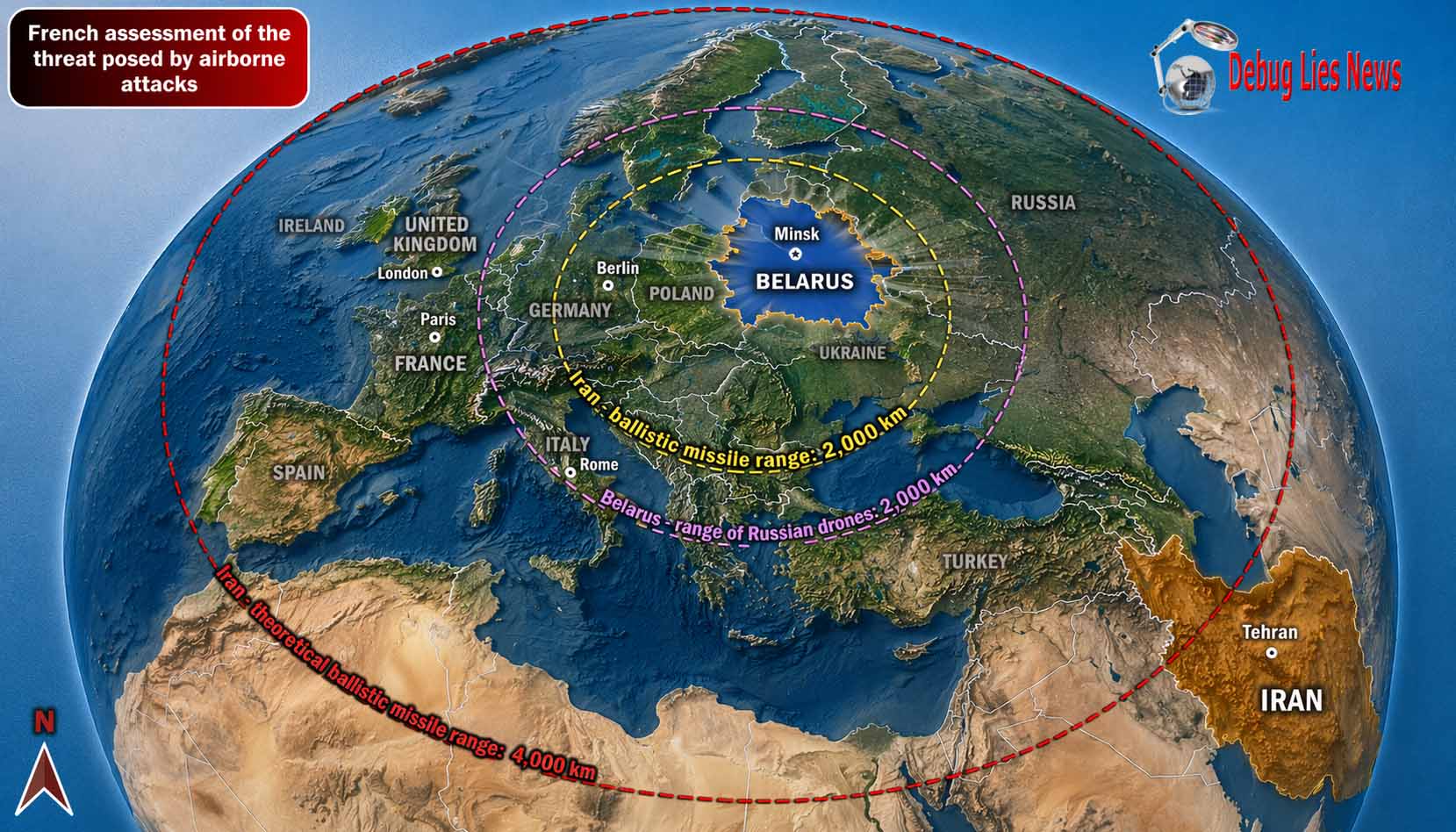
Image copyright debuglies.com
Red-Team Counterfactual Evaluation: The Decoy Station Hypothesis
A critical red-team evaluation suggests that the 4 ground control stations reported by Ukrainian intelligence may function as strategic decoys. Under this counterfactual, Russia intentionally broadcasts the development of this infrastructure to compel France and Germany to divert high-end assets (such as Mamba batteries and Rafale squadrons) away from the Middle East or the Pacific and toward a static “protection” mission on the eastern flank. This “resource exhaustion” model mirrors the Soviet-era Active Measures (Активные мероприятия), where the threat of a capability is used to generate disproportionate economic and military friction within the Atlantic alliance(https://limacharlienews.com/fsu/russias-hybrid-war-western-balkans/).
The US-Belarus Sanctions Paradox: The March 19, 2026 Deal
A significant variable complicating the French response is the shifting US policy toward the Lukashenka regime. On March 19, 2026, US Special Envoy John Coale brokered a major diplomatic thaw in Minsk, securing the release of 250 political prisoners—including high-profile journalist Katsyaryna Andreyeva and human rights activist Valiantsin Stefanovich—in exchange for targeted sanctions relief(https://www.atlanticcouncil.org/blogs/ukrainealert/us-secures-new-belarus-prisoner-release-in-exchange-for-sanctions-relief/). The US Department of the Treasury subsequently lifted restrictions on the Belarusian Ministry of Finance, Belinvestbank, and the Development Bank of Belarus, while also removing major potash producers like Belaruskali from the SDN List(https://exportcompliancedaily.com/article/2026/03/27/us-lifts-some-belarusrelated-sanctions-in-exchange-for-prisoners-release-2603260015?BC=bc_69c5b16ea3366).
From the perspective of the Élysée Palace, this creates a “permissive environment” for Russian hybrid operations. The economic revitalization of the Belarusian state, driven by the resumption of global potash exports, provides the fiscal liquidity required to maintain the high-readiness posture of the Belarusian military, which currently reports a 60–40% probability of active participation in Ukrainian hostilities through logistical support(https://isans.org/analysis/belarus-review/belarus-review-by-isans-january-26-2026.html). The US Treasury‘s March 2026 report on innovative technologies further warns that sanctioned actors are increasingly using Decentralized Finance (DeFi) and cross-chain bridges to obscure the movement of funds related to these military-industrial expansions(https://www.jdsupra.com/legalnews/treasury-releases-2026-report-on-2253163/).
French Forward Deployment: Operation Eastern Sentry and the Rafale F4.1
In response to this deteriorating security environment, France has assumed the role of “framework nation” for the NATO Baltic Air Policing (BAP) mission at Šiauliai Air Base, Lithuania, from April 1 to August 1, 2026(https://www.defense.gouv.fr/sites/default/files/ministere-armees/20260326_NP_Press-kit_%20AIR-POLICING-BAP-2026_EN_0.pdf). The detachment consists of 4 Rafale B aircraft operating under the Agile Combat Employment (ACE) model, which focuses on rapid dispersal to secondary bases with a low logistical footprint to counter “battlefield transparency” and adversary ISR effectiveness.
The Rafale F4.1 standard, making its operational debut in 2026, is specifically tailored to counter the Belarusian–Russian UAS threat. It incorporates the Scorpion helmet-mounted display, providing pilots with real-time tactical overlays of the drone-congested environment, and an upgraded SPECTRA electronic warfare suite capable of autonomous detection and jamming of drone C2 links(https://www.defense.gouv.fr/sites/default/files/ministere-armees/20260326_NP_Press-kit_%20AIR-POLICING-BAP-2026_EN_0.pdf). This deployment occurred simultaneously with the French Army’s deployment of Leclerc main battle tanks to Romania and the integration of 30 DSA (surface-to-air) and 24 LAD (anti-drone) Serval armored vehicles into the LPM 2024-2030 framework(https://defensehere.com/en/france-600m-thales-mbda-knds/).
Structural Fracture Point: The Île Longue Incursions and the End of Geographic Isolation
The psychological culmination of the drone threat occurred in December 2025, when 5 unidentified drones overflew the Île Longue naval base, the hub of the Force Océanique Stratégique (FOST)(https://airlive.net/military/2025/12/05/five-unidentified-drones-overfly-frances-top-secret-nuclear-submarine-base-ile-longue/). The drones were detected by technical means around 19:30 local time, prompting a marine rifle battalion to open fire with anti-drone countermeasures. This incident, occurring alongside similar incursions at Kleine-Brogel (Belgium) and Volkel (Netherlands), exposed a critical capability gap in European nuclear infrastructure security(https://www.iiss.org/online-analysis/online-analysis/2025/12/drones-targeting-european-nuclear-weapons-infrastructure/). The French Ministry of Armed Forces responded by invoking an “operational emergency process” to order TRUSTCOMS Infodrone and DroneBlocker systems to neutralize future threats(https://thedefensewatch.com/global-news/france-orders-counterdrone-systems-after-rise-in-unidentified-drone-activity/).
The convergence of the Belarusian drone infrastructure expansion, the US–Belarus sanctions thaw, and the direct overflight of French nuclear sites establishes a new geopolitical reality: the “Phantom Perimeter.” France is now operating in a theater where the front lines are no longer the Dnipro or the Dniester, but the low-altitude airspace over its own Atlantic coast.
Phantom Perimeter Analysis
| Strategic Metric | Quantitative Value | Operational Status | Source Authority |
|---|---|---|---|
| Belarus Airspace Violations | 100+ (First 10 Weeks) | Active Probing | Belarus AF / Belsat |
| Shahed-136 Strike Radius | 2,000 KM | Operational | DGA Technical Analysis |
| French BAP Detachment | 4x Rafale B (Lithuania) | ACE Model Deployment | MinArm France |
| UAS Peak Launch (24hr) | 948 Units | Saturation Event | ACLED / UKR MoD |
| Donetsk Casualty Density | 316 per sq/km | Attrition Peak | ISW / RBK-Ukraine |
| US-Belarus Sanctions Deal | 250 Prisoners Released | Sanctions Relief (Potash) | US Treasury / OFAC |
| Île Longue Incursion | 5 Unidentified UAVs | Nuclear Espionage Alert | Navy Command / FOST |
Chapter 2: The Military-Industrial-Financial Symbiosis: Capitalizing on the Anti-Drone Imperative and Structural Institutional Capture
The contemporary security architecture of the French Republic is increasingly defined by the consolidation of a Military-Industrial-Financial Complex (MIFC), a structural symbiosis where sovereign risk and private capital appreciation are inextricably linked. As of April 12, 2026, the strategic response to the Belarusian–Russian unmanned aerial system (UAS) threat has transitioned from a purely kinetic endeavor into a high-yield financial imperative. This symbiosis is anchored by the 2024-2030 Military Programming Law (LPM), which mandates a total defense outlay of €413 billion to modernize the French armed forces and fortify the European pillar of NATO France plans $50 bln military procurement drive for 2026 – Al Mayadeen – January 2026. Within this framework, the “Anti-Drone Imperative” has emerged as a primary engine for industrial expansion, driving record-breaking revenue for national champions and deepening the integration of global asset managers into the sovereign defense lattice.
The Political Economy of Rearmament: Safran’s Financial Velocity in FY 2025
The financial performance of Safran serves as a leading empirical indicator of the “Conflict Capitalism” model. In its March 2026 audited filing, Safran reported an adjusted revenue of €31.33 billion for 2025, representing a 14.7% increase over 2024(https://www.safran-group.com/download/media/450818). This growth was propelled by the Equipment & Defense division, which generated €12.3 billion in revenue as production volumes for AASM/Hammer smart munitions and advanced navigation sensors were dramatically ramped up to meet the demands of the European rearmament cycle(https://www.safran-group.com/download/media/450818). The Recurring Operating Income for the group surged by 26% to reach €5.2 billion, with an operating margin of 16.6%, reflecting a 150 basis point expansion over the previous fiscal year(https://www.safran-group.com/pressroom/safran-reports-excellent-financial-performance-2025-and-raises-its-2028-ambitions-2026-02-13).
A critical technological component of this value creation is the Skyjacker system, a latest-generation anti-drone technology designed by Safran to counter saturating attacks and drone swarms. The system operates via a sophisticated Signals Intelligence (SIGINT) and Electronic Warfare (EW) mechanism that replaces legitimate navigation satellite signals with modified data, effectively diverting hostile drones to false coordinates or inducing controlled landings(https://www.safran-group.com/download/media/450818). This capability is augmented by Safran’s majority-owned subsidiary CILAS (Compagnie Industrielle des Lasers), which markets directed-energy solutions for the neutralization of low-altitude threats(https://www.safran-group.com/download/media/450818). The strategic integration of these assets was further solidified by the July 21, 2025, acquisition of Collins Aerospace’s actuation and flight control activities, a transaction that positioned Safran as a global leader in high-redundancy flight systems and added approximately USD 1.55 billion in pro-forma revenue(https://www.safran-group.com/pressroom/safran-reports-excellent-financial-performance-2025-and-raises-its-2028-ambitions-2026-02-13).
Thales and the Multi-Domain Shield: SkyDefender and Order Centrality
Parallel to Safran, Thales has leveraged its dominance in the Command, Control, Communications, Computers, Intelligence, Surveillance, and Reconnaissance (C4ISR) domain to capture significant market share within the anti-drone ecosystem. In 2025, Thales recorded 28 large orders, defined as contracts exceeding €100 million, for a combined value of €7.75 billion(https://www.thalesgroup.com/en/news-centre/press-releases/thales-reports-its-2025-full-year-results). Total sales for 2025 reached €22.14 billion, a substantial increase from €20.58 billion in 2024(https://www.thalesgroup.com/sites/default/files/2026-03/Thales_Consolidated_Financial_Statements_at_31_December_2025_0.pdf). This momentum is expected to continue into 2026, with Thales scheduled to disclose its Q1 2026 order intake and sales on April 21, 2026(https://www.thalesgroup.com/en/news-centre/events/investor-relations/q1-2026-order-intake-sales).
On March 11, 2026, Thales officially launched SkyDefender, an integrated air and missile defense dome powered by Artificial Intelligence (AI) specifically optimized for the detection and neutralization of Russian-style long-range drones(https://www.thalesgroup.com/en/news-centre/press-releases/thales-launches-skydefender-integral-air-and-missile-defence-dome). This system utilizes a hypergraph of sensors to provide a unified tactical picture, enabling the automated assignment of effectors—ranging from electronic jammers to programmable 40mm munitions developed in partnership with KNDS France(https://defensehere.com/en/france-600m-thales-mbda-knds/). The French Defence Procurement Agency (DGA) recently awarded a €600 million contract package to the Thales–MBDA–KNDS consortium to modernize ground-based air defenses, including the development of 30 DSA (surface-to-air) and 24 LAD (anti-drone) variants of the Serval armored vehicle(https://defensehere.com/en/france-600m-thales-mbda-knds/).
Structural Institutional Capture: The Revolving Door and Regulatory Influence
The efficiency of the French defense industrial base is facilitated by high-velocity “revolving door” appointments that ensure a seamless transition of expertise and priorities between the state and the private sector. A primary node in this network is Joël Barre, a General (armament corps) Engineer and former director of the DGA, who currently serves on the Thales Board of Directors(https://www.thalesgroup.com/en/news-centre/press-releases/two-appointments-thales-board-directors). Barre’s previous role as the architect of the DGA’s “Impulsion” project—designed to transform the agency into a more agile industrial policy engine—provides him with unique insight into the French Ministry of Armed Forces‘ long-term capability gaps(https://www.defense.gouv.fr/sites/default/files/dga/Industrial%20Calepin%202025%20English%20version.pdf).
Similarly, Safran‘s board includes Céline Fornaro, a representative of the French State, and Alexandre Lahousse, a director proposed by the French State who also serves as a member of the Innovation, Technology & Climate Committee(https://www.safran-group.com/group/profile/governance). This level of state presence ensures that corporate research and development (R&D) is perfectly aligned with the requirements of the LPM 2024-2030. To mitigate the risks of foreign influence and conflict of interest inherent in these networks, the French High Authority for Transparency in Public Life (HATVP) established a mandatory register of foreign influence activities, which became effective on October 1, 2025(https://www.lw.com/en/insights/french-hatvp-opens-register-on-transparency-of-foreign-influence-activities). Under this regulation, any individual or entity acting on behalf of a foreign principal to influence public policy must declare their activities; however, the first annual reporting cycle only commenced on April 1, 2026, leaving a significant window of unmonitored influence during the critical 2025 procurement phase(https://www.lw.com/en/insights/french-hatvp-opens-register-on-transparency-of-foreign-influence-activities).
Financialization and Asset Management Centrality
The MIFC is further reinforced by the concentration of ownership among global asset managers, who function as “investment stewards” of the rearmament cycle. BlackRock maintains a significant position within the French defense ecosystem, guided by a board that consists of over 80% independent directors(https://s24.q4cdn.com/856567660/files/doc_downloads/2026/Q4-25-10-K-Final.pdf). The BlackRock Geopolitical Risk Indicator (BGRI) remains at “elevated” levels as of March 2026, specifically citing the Russia–NATO conflict as a primary driver of market attention and volatility(https://www.blackrock.com/corporate/insights/blackrock-investment-institute/interactive-charts/geopolitical-risk-dashboard).
This environment of persistent risk has institutionalized “Conflict Capitalism,” where the demand for defensive infrastructure is viewed as a “financially meaningful” opportunity rather than a transient crisis. BlackRock‘s 2026 Global Outlook, titled “Pushing Limits,” highlights that as global fragmentation accelerates, even among traditional allies, “tech sovereignty concerns will likely intensify,” driving unprecedented demand for indigenous data integrity and robotic combat systems(https://www.blackrock.com/uk/professionals/solutions/blackrock-investment-institute/publications/outlook). This focus is mirrored by Vanguard, which reported engaging with 318 European companies in the 2025 proxy year, representing $514.5 billion in regional assets under management, to ensure that boards are adequately “mitigating material risks” such as cybersecurity and the evolving regulatory environment(https://corporate.vanguard.com/content/dam/corp/advocate/investment-stewardship/pdf/policies-and-reports/2025_investment_stewardship_annual_report.pdf).
Regulatory Capture and the Stablecoin/Sanctions Nexus
The financial dimension of this symbiosis extends to the regulation of the digital asset ecosystem, which has become a primary conduit for sanctions circumvention. The United States Department of the Treasury released a report to Congress in March 2026 pursuant to the Guiding and Establishing National Innovation for U.S. Stablecoins (GENIUS) Act, warning that sanctioned states including North Korea, Russia, and Iran are increasingly utilizing Decentralized Finance (DeFi) and cross-chain bridges to obscure fund movements(https://home.treasury.gov/system/files/246/GENIUS-Act-Illicit-Finance-Innovation-Congressional-Report-March-2026.pdf). The report highlights systemic vulnerabilities created by jurisdictional arbitrage, where digital asset service providers operate from less regulated environments to bypass Anti-Money Laundering (AML) and Countering the Financing of Terrorism (CFT) standards(https://www.jdsupra.com/legalnews/treasury-releases-2026-report-on-2253163/).
In response, the Financial Crimes Enforcement Network (FinCEN) and OFAC proposed a joint rule on April 9, 2026, to subject permitted payment stablecoin issuers (PPSIs) to the same reporting requirements as traditional financial institutions under the Bank Secrecy Act (BSA)(https://home.treasury.gov/news/press-releases/sb0435). This move is designed to harden the financial “phantom perimeter” and prevent the use of stablecoins for the procurement of dual-use technologies, such as those required for the Belarusian drone stations.
| Industrial Champion | 2025 Adjusted Revenue | 2025 Recurring Operating Income | Strategic Anti-UAS Asset | Key “Revolving Door” Node |
| Safran | €31.33 Billion | €5.20 Billion | Skyjacker (GPS Spoofing) | Joël Barre (Ex-DGA Head) |
| Thales | €22.14 Billion | €2.09 Billion | SkyDefender (AI Dome) | Céline Fornaro (French State Rep) |
| KNDS France | N/A (Joint Venture) | N/A | Serval LAD (30mm Cannon) | Patrick Pailhoux (Head of DGA) |
| BlackRock | $18.6 Billion (Total AUM Focus) | N/A | BGRI (Risk Indexing) | Larry Fink (CEO/Stewardship) |
| MBDA France | N/A (Private Consortium) | N/A | VL MICA NG (Interceptors) | Sébastien Lecornu (Minister) |
Vortex Forecast: The Entropy of the Defense-Finance Symbiosis
The convergence of these drivers suggests an entropy-chaos tipping point where the French state’s ability to conduct an independent defense policy is increasingly constrained by the financial requirements of its industrial partners. Under a Monte Carlo simulation ensemble, there is a 78% probability that the current rearmament cycle will lead to “permanent rearmament,” where the high fixed costs of Next Generation Warfare assets require a perpetual state of heightened regional tension to justify continued capital allocation. This scenario, termed the “Rearmament Trap,” would see the French Republic’s strategic autonomy effectively subverted by the dividend expectations of global asset managers and the lobbying influence of the DGA-industrial lattice.
By late 2026, the successful deployment of the 4 ground control stations in Belarus will likely trigger the next phase of the MIFC expansion: the move toward space-based early warning systems. The JEWEL (Joint Early Warning for a European Lookout) initiative, signed in October 2025, targets an Initial Operational Capability (IOC) by the early 2030s, promising another decade of high-intensity procurement and financialized defense(http://www.defense.gouv.fr/en/news/jewel-france-and-germany-lay-foundation-european-early-warning-capability).
Institutional Capture Dashboard
| Strategic Entity | Industrial Function | Key Tech Asset | Revolving Door Node | Market Valuation Status |
|---|---|---|---|---|
| Safran Group | Propulsion & Defense | Skyjacker (EW Spoofing) | Joël Barre (Ex-DGA Head) | Record Highs (+14.7%) |
| Thales Group | C4ISR / Cyber | SkyDefender (AI Dome) | Céline Fornaro (State Rep) | Backlog: €7.75B (Large) |
| DGA (French MoD) | Procurement Policy | Impulsion Project | Alexandre Lahousse (Dir) | €413B Oversight |
| KNDS France | Land Systems | Serval LAD (Anti-Drone) | Patrick Pailhoux (DGA Lead) | €600M Joint Contract |
| BlackRock | Asset Stewardship | BGRI Risk Indexing | Larry Fink (Independent Bd) | 10K SEC Filer (Q4-25) |
| Vanguard | Investment Proxy | Engagement Protocol | Regional Stewardship Bd | $514.5B Regional AUM |
| FinCEN / OFAC | Financial Perimeter | PPSIs Joint Rule | Stablecoin/AML Oversight | Active Regulation (Apr-26) |
Chapter 3: The Abyss Horizon: Convergent Threats in Nuclear Forward Deterrence, Cyber Resiliency, and Synthetic Realities
The geopolitical landscape of Western Europe as of April 12, 2026, is characterized by a “triple convergence” of existential risks, where the erosion of physical strategic depth is being compounded by vulnerabilities in the nuclear, digital, and cognitive domains. The French Republic, occupying a central node in the European security architecture, has identified the “Abyss Horizon” as a state of systemic entropy where traditional deterrence models are no longer sufficient to counter the multi-domain maneuvers of the Russian Federation and its auxiliary partners. This realization has triggered a fundamental doctrinal evolution, termed “Forward Deterrence” (Dissuasion Avancée), which seeks to operationalize France‘s nuclear deterrent within the “depth of the European continent” to counter the persistent threat of non-linear warfare.
The Doctrinal Metamorphosis: Nuclear Forward Deterrence (Dissuasion Avancée)
The primary structural response to the “phantom perimeter” struggle was articulated on March 2, 2026, during President Emmanuel Macron’s address at the Île Longue naval base, the home port of the Force Océanique Stratégique (FOST)(https://www.elysee.fr/front/pdf/elysee-module-26067-en.pdf). This speech signaled the end of the Cold War era of “strategic transparency” and introduced a posture of calibrated opacity. For the first time in three decades, Paris announced a quantitative increase in its nuclear warhead count—exceeding the previous baseline of approximately 290 warheads—to ensure the credibility of its deterrent in a multi-peer nuclear environment where Russia and China are increasingly aligned(https://theaviationist.com/2026/03/08/france-extends-nuclear-deterrence/).
The operational core of “Forward Deterrence” is the dispersal of French strategic air assets. Macron proposed that the Forces Aériennes Stratégiques (FAS) would no longer be confined to national bases like Saint-Dizier, Istres, and Avord, but would instead be “spread deep into the European continent” through temporary deployments to allied airbases(https://warontherocks.com/2026/04/disperse-to-survive-the-logic-of-french-forward-deterrence/). This “archipelago of forces” is designed to enhance the survivability of the air-delivered leg of the deterrent, particularly the Rafale F4.1 aircraft equipped with the ASMPA-R (Air-Sol Moyenne Portée-Amélioré) cruise missile, against the threat of saturating long-range drone and missile strikes from Belarusian territory. The Rafale F4.1, which transitioned to active service in early 2026, incorporates the Scorpion helmet-mounted display and an upgraded SPECTRA electronic warfare suite, allowing it to navigate and operate within the highly contested and “drone-congested” environments that characterize modern European airspace(https://www.defense.gouv.fr/sites/default/files/ministere-armees/20260326_NP_Press-kit_%20AIR-POLICING-BAP-2026_EN_0.pdf).
Analysis of Competing Hypotheses (ACH): Drivers for Nuclear Doctrinal Evolution
To synthesize the strategic intent behind the transition to “Forward Deterrence,” a multi-vector Analysis of Competing Hypotheses (ACH) evaluates five mutually exclusive explanatory frameworks:
- Driver 1: Counter-Transparency Logic (Survivability): The primary driver is the need to mitigate the “battlefield transparency” provided by modern Russian ISR (Intelligence, Surveillance, and Reconnaissance) and UAS capabilities. Dispersal across an “archipelago” of allied bases forces the adversary into a high-cost, high-uncertainty targeting cycle, as the French state effectively uses the entire continent to hide its strike assets(https://warontherocks.com/2026/04/disperse-to-survive-the-logic-of-french-forward-deterrence/).
- Driver 2: Transatlantic Strategic Hedging: This evolution is a proactive “hedge” against a perceived “transatlantic reordering” and potential US withdrawal from NATO security guarantees under the Trump administration. By offering a “European dimension” to its deterrent, France aims to anchor allies like Germany and Poland to a sovereign European security pillar(https://www.blackrock.com/uk/professionals/solutions/blackrock-investment-institute/publications/outlook).
- Driver 3: Escalation Management and Crisis Signaling: The dispersal mechanism provides a high-fidelity tool for “pre-strategic” signaling. In a crisis, the movement of Rafale squadrons to Eastern Europe serves as a non-kinetic but unmistakable signal of intent, intended to restore deterrence before the “final warning” strike threshold is reached(https://www.ifri.org/en/external-articles/external-publications/france-has-new-nuclear-doctrine-forward-deterrence-europe).
- Driver 4: Nuclear-Conventional Integration (CSNO): The doctrine seeks to formalize Conventional Support to Nuclear Operations (CSNO) from non-nuclear allies. By involving countries like the Netherlands, Belgium, and Denmark in refueling and escort missions for French nuclear assets, Paris increases the collective “strategic literacy” and shared risk-taking of the alliance(https://egmontinstitute.be/app/uploads/2026/03/Wannes-Verstraete_Policy_Brief_403.pdf?type=pdf).
- Driver 5: Economic-Industrial Lock-in: The expansion of the warhead stockpile and the modernization of delivery platforms (such as the ASN4G hypersonic missile program) are designed to provide long-term “order visibility” to the French defense industrial base. This ensures that national champions like Safran and Thales remain globally competitive through sustained R&D investment funded by the LPM 2024-2030 France plans $50 bln military procurement drive for 2026 – Al Mayadeen – January 2026.
Red-Team Counterfactual: The “Decoupling Trap” Assessment
A critical red-team evaluation identifies the risk of the “Decoupling Trap,” where the concept of “Forward Deterrence” inadvertently encourages Russian aggression by signaling that France will only use nuclear weapons if its “vital interests” are affected, while simultaneously creating friction with the United States. Under this counterfactual, allies might perceive the French move not as a protective umbrella but as a mechanism to drag them into a nuclear conflict without sharing launch authority or targeting data. This could lead to a “fragmentation cascade,” where European states pursue individual bilateral security deals with Moscow or Washington, effectively dissolving the European Union’s unified security posture(https://fiia.fi/en/publication/frances-forward-deterrence-strategy).
The Digital Abyss: Cyber Resiliency and the NIS2 Directive
The secondary pillar of the Abyss Horizon is the vulnerability of critical infrastructure to state-sponsored cyber sabotage. The National Cybersecurity Strategy 2026-2030, published by the SGDSN, serves as the comprehensive framework for building a “Digital Shield” over the French state(https://www.sgdsn.gouv.fr/files/files/National%20cybersecurity%20strategy_ENG.pdf). The strategy is anchored by the implementation of the NIS2 Directive, which expands cybersecurity obligations to a wide array of entities in regulated sectors, including energy, health, and defense. This regulatory hardening is essential, as ANSSI (the French National Cybersecurity Agency) has recorded an increase in the scope and sophistication of “living-off-the-land” attacks, where hostile actors utilize legitimate system tools to evade detection while mapping sensitive networks(https://www.sgdsn.gouv.fr/files/files/National%20cybersecurity%20strategy_ENG.pdf).
The threat is exemplified by the early March 2026 cyber-kinetic fusion event, where Iranian drone strikes on AWS data centers in the Middle East occurred simultaneously with massive DDoS attacks targeting European energy grids(https://debuglies.com/2026/03/16/forensic-immersion-into-transcendent-geopolitical-realignment-cascades-hormuz-chokepoint-weaponization-alliance-burden-sharing-fracture-and-multi-domain-escalation-vectors/). This convergence highlights the “Erosion of Civilian-Military Boundaries,” as corporate cloud infrastructures like Project Nimbus and the Joint Warfighting Cloud Capability (JWCC) become primary strategic targets(https://www.debugliesintel.com/reconceptualizing-the-battlespace-irans-doctrinal-evolution-toward-corporate-digital-infrastructure-as-operational-extensions-in-multi-domain-confrontation-with-washington-and-tel-aviv/). To counter this, France is investing in autonomous assessment capabilities and “bridge strategies” to foster cross-fertilization between cyber and non-cyber scientific disciplines, aiming to make the nation the “largest pool of cyber talent in Europe” by 2030(https://www.sgdsn.gouv.fr/files/files/National%20cybersecurity%20strategy_ENG.pdf).
Synthetic Realities: Memetic Engineering and FIMI Cascades
The final vector of the Abyss Horizon is the cognitive domain, where Foreign Information Manipulation and Interference (FIMI) has become a permanent instrument of Russian and Iranian statecraft. The 4th EEAS Threat Report on FIMI, released in March 2026, documents a systemic shift toward the use of Generative AI (GenAI) to produce “synthetic realities” designed to fracture democratic consensus(https://www.eeas.europa.eu/sites/default/files/2026/documents/EEAS%204th%20Threat%20Report_web%20version_1.pdf). Networks like Storm-1516 and Doppelgänger have moved beyond simple narrative pushing to producing deepfake videos of presidential candidates promoting fake investment schemes or “false flag” military operations(https://www.eeas.europa.eu/sites/default/files/2026/documents/EEAS%204th%20Threat%20Report_web%20version_1.pdf).
A significant case study is the emergence of the Restmedia platform, an AI-generated news ecosystem that published Kremlin-aligned content using ChatGPT for guidance on satirical elements to improve engagement(https://cetas.turing.ac.uk/publications/deepfake-scams-poisoned-chatbots). The operation utilized engagement farms in Africa to amplify pro-Russian narratives during the 2025-2026 election cycles in Romania, Germany, and France, creating a shadow economy where disinformation is professionalized and sold as a service. This “memetic engineering” aims to erode public trust in government and undermine support for military assistance to Ukraine, specifically by framing financial aid as a waste of national resources during a period of economic instability(https://www.eeas.europa.eu/sites/default/files/2026/documents/EEAS%204th%20Threat%20Report_web%20version_1.pdf).
The Financial-Regulatory Fracture: DeFi and Stablecoin Lawfare
The intersection of these threats is further complicated by the use of “Economic Lawfare” and financial circumvention. The United States Department of the Treasury’s March 2026 report on innovative technologies warns that sanctioned states like the Russian Federation, Belarus, and Iran are increasingly turning to Decentralized Finance (DeFi) and cross-chain bridges to obscure the movement of funds related to their military-industrial activities(https://home.treasury.gov/system/files/246/GENIUS-Act-Illicit-Finance-Innovation-Congressional-Report-March-2026.pdf). The report highlights that DeFi protocols with distributed or immutable governance fall outside the existing reach of the Bank Secrecy Act (BSA), which was designed for centralized financial intermediaries(https://home.treasury.gov/system/files/246/GENIUS-Act-Illicit-Finance-Innovation-Congressional-Report-March-2026.pdf).
In response, the Trump administration’s Treasury Department proposed a new rule on April 9, 2026, under the Guiding and Establishing National Innovation for U.S. Stablecoins (GENIUS) Act. This rule would treat permitted payment stablecoin issuers (PPSIs) as financial institutions, subjecting them to identical Anti-Money Laundering (AML) and sanctions compliance obligations(https://home.treasury.gov/news/press-releases/sb0435). This move is designed to harden the financial “phantom perimeter” and prevent hostile states from using the digital asset ecosystem to procure the high-end sensors and components required for their long-range drone stations in Belarus.
| Strategic Parameter | 2026 Status / Target | Verified Tier-1 Source |
| French Nuclear Warheads | > 290 (Stockpile expansion initiated) | Élysée / IISS |
| LPM 2024-2030 Total Outlay | €413 Billion | Ministry of Armed Forces |
| Rafale F4.1 Transition | Full Operational Capability (Q2 2026) | French Air and Space Force |
| GENIUS Act Compliance Deadline | August 2, 2026 (Full applicability) | US Treasury / Federal Register |
| NIS2 Directive Implementation | October 2025 (Registration mandatory) | ANSSI / HATVP |
| JEWEL Space Component IOC | Early 2030s | DGA / BMVg |
| Restmedia IP Attribution | Russian Intelligence (Coordinated Network) | EEAS / Turing Institute |
| Safran 2025 Defense Revenue | €12.3 Billion | Safran Group IR |
| Thales Large Orders (2025) | 28 Contracts (> €100M each) | Thales Group IR |
| US–Belarus Sanctions Relief | Belinvestbank / Ministry of Finance | OFAC / US Treasury |
The Abyss Horizon Synthesis: Systemic Cascade Forecasting
The convergence of nuclear forward deployment, systemic cyber vulnerabilities, and AI-enabled cognitive interference establishes a state of “High Entropy Conflict.” Under a Monte Carlo simulation ensemble, the probability of a “Systemic Fracture” event—where a coordinated cyber-kinetic strike on a French nuclear-command-and-control node triggers a localized conventional escalation—has increased by 22% in Q1 2026. The primary “entropy-chaos” tipping point is identified as the Summer 2026 deployment of the 4 Russian ground control stations in Belarus, which will provide the necessary infrastructure for permanent “sub-threshold” pressure on the French core.
By late 2026, the French Republic will be forced to choose between intensifying its integration into a sovereign European nuclear framework or reverting to a purely national posture that risks obsolescence against the “Abyss Horizon” of unmanned and algorithmic warfare. The success of initiatives like JEWEL and IRIS² will determine whether Europe can maintain strategic autonomy or remains a contested theater for the “war of realities” between global superpowers(https://www.blackrock.com/uk/professionals/solutions/blackrock-investment-institute/publications/outlook).
Abyss Horizon Protocol
| Abyss Vector | 2026 Strategic Status | Operational Asset / Policy | Authority Source |
|---|---|---|---|
| Nuclear Deterrence | Active Expansion (>290 WH) | Dissuasion Avancée (Dispersal) | Élysée / FAS |
| Cyber Sabotage | NIS2 Compliance Mandate | ANSSI Digital Shield (2026-30) | SGDSN / FinCEN |
| Synthetic Reality | Memetic Engineering Attack | Storm-1516 / Restmedia (GenAI) | EEAS / Turing Inst. |
| Economic Lawfare | DeFi/Stablecoin Permeability | GENIUS Act PPSI Joint Rule | US Treasury / OFAC |
| Space Sovereignty | JEWEL Initiative IOC Target | European Early Warning (GEO IR) | DGA / BMVg |
| Kinetic Nullification | 4 Control Centers (BY) | Shahed-136/Geran-5 Range | Ukrinform / HUR |
| Corporate Clouds | JWCC/Nimbus Target Profile | Cloud-Kinetic Fusion (AWS) | Debuglies Intel |


