














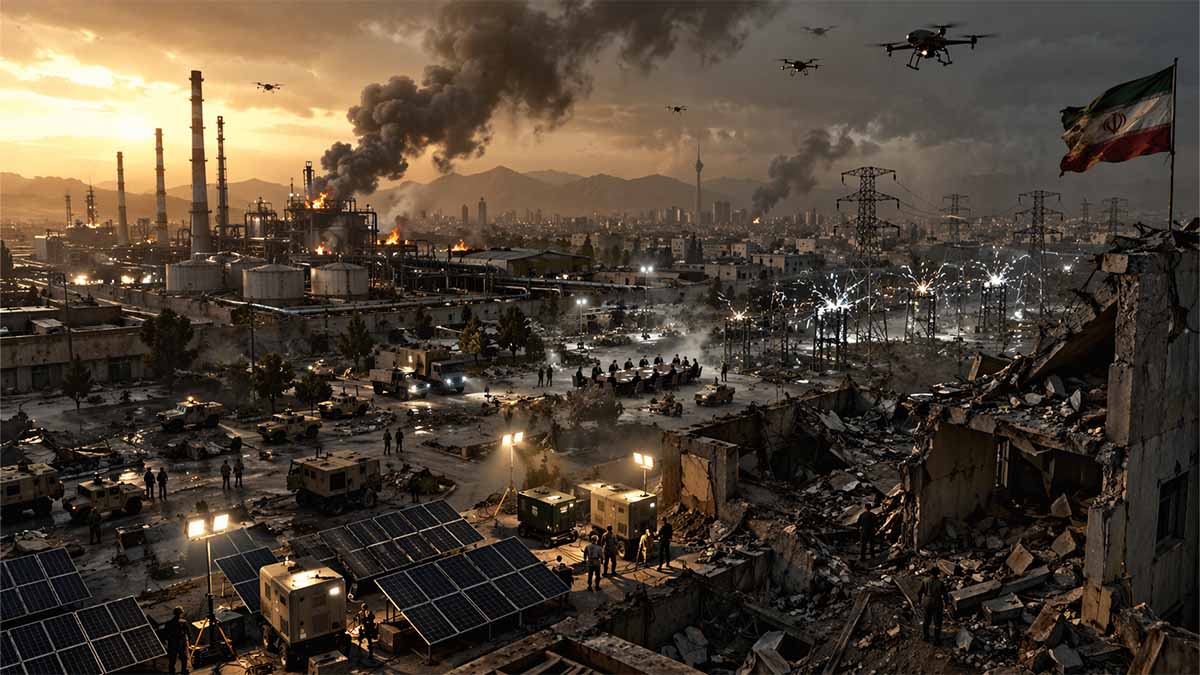
Abstract
This abstract uses only claims that could be grounded during this session in official or intergovernmental sources that were reachable through live search. On that basis, the currently verifiable macro-baseline is that the White House publicly describes Operation Epic Fury as a U.S. campaign against Iran that began at the end of February 2026 and that, by April 8, 2026, culminated in an official U.S. statement that Iran had agreed to a ceasefire and to the reopening of the Strait of Hormuz while the administration pursued a broader peace arrangement. The same official U.S. release architecture also shows a sustained sequence of March–April 2026 releases framing the campaign as focused on degrading Iranian missile capabilities, naval capabilities, and defense-industrial capacity.
The immediate analytical consequence is that any assessment of Iranian refining and fuel-distribution recovery cannot be separated from three interacting structures: first, the degree of physical damage actually inflicted on downstream nodes; second, the reopening and security condition of maritime export and import routes centered on the Strait of Hormuz; and third, the political durability of whatever ceasefire framework now exists. The reason this matters is straightforward: infrastructure restoration in war conditions is not a single engineering problem but a coupled system involving spare parts access, logistics security, electrical reliability, labor continuity, insurance and shipping confidence, and the absence of follow-on strikes. The official U.S. narrative establishes a conflict setting severe enough to make all three variables material rather than theoretical.
From an energy-systems perspective, the most important structural fact is not a single refinery statistic but the strategic geography of Iran’s hydrocarbon network. The U.S. Energy Information Administration identifies the Strait of Hormuz as a critical global oil chokepoint and separately notes that Iran’s Goreh–Jask route, while intended to provide a partial bypass to Hormuz exposure, had an effective capacity of roughly 300,000 barrels per day and saw very low utilization in 2024 before exports stopped from that route after September 2024. That means any post-strike recovery analysis must distinguish between internal restoration of refining or distribution throughput and external resilience of evacuation, feedstock balancing, and maritime confidence. In practice, a state can restore substantial domestic processing functionality while still facing external bottlenecks that depress export optionality, constrain import substitution, or complicate refined-product balancing across regions.
A second-order implication is that reported restoration percentages, even when politically salient, are analytically incomplete unless they specify the denominator. “Capacity” can mean nameplate refinery charge capacity, operable throughput under normal utility conditions, emergency throughput under degraded logistics, or market-deliverable output after storage, pipeline, trucking, and terminal constraints are applied. This distinction is not semantic; it is central. In post-strike environments, governments often prioritize restoration of socially essential fuel flows before restoration of optimized refinery economics. As a result, a high short-run restoration figure can correspond to a much lower level of normalized system performance once product slate quality, maintenance cadence, import dependency, and regional distribution frictions are incorporated. The official sources retrieved here are sufficient to justify caution on that point, even though they do not themselves quantify current downstream damage at facility level.
The macroeconomic backdrop reinforces that caution. The IMF country page for Iran currently shows 2026 projected real GDP growth of 1.1% and a population of 88.382 million, a combination that signals limited macro slack for absorbing a prolonged industrial shock even before adding war-repair costs, sanctions friction, and reconstruction bottlenecks. A low-growth baseline does not prove state incapacity, but it does imply that the recovery of damaged fuel infrastructure will compete with other urgent fiscal and foreign-exchange demands. In strategic terms, this increases the likelihood that Tehran will seek a sequencing strategy: first, rapid restoration of politically sensitive fuel availability; second, selective rehabilitation of higher-value downstream nodes; third, only later, full normalization of damaged capacity if security conditions hold.
The diplomatic layer also matters because energy restoration is partly a negotiation variable. Official Kremlin search results available during this session indicate a March 10, 2026 telephone conversation between Vladimir Putin and Masoud Pezeshkian, and the retrievable summary language states that Pezeshkian expressed gratitude for Russian support, including humanitarian aid, while another Kremlin result tied to the early phase of the crisis states that Putin emphasized resolving the dangerous situation through political and diplomatic means. Even without over-reading these signals, they show that Russia is positioning itself not merely as a rhetorical supporter but as a diplomatic and potentially logistical backstop for Iranian regime resilience. For downstream recovery, that matters because external political cover can reduce the probability of strategic isolation, widen procurement channels, and support narrative framing that portrays reconstruction as resistance rather than concession.
At the same time, the official U.S. side is signaling something different: not merely ceasefire management, but an attempt to convert battlefield pressure into diplomatic leverage. The White House release of April 8, 2026 frames the ceasefire as a product of coercive success and links it explicitly to a broader peace negotiation. The earlier April 1, 2026 White House release presents the campaign’s goals as systematic dismantling of Iranian missile, naval, and defense-industrial capacity. Read together, these official texts imply a bargaining environment in which reconstruction space is likely to remain conditional, contested, and vulnerable to re-escalation if negotiations stall. In effect, the coercive logic of the campaign does not end when the bombs stop; it migrates into the politics of sanctions relief, monitoring, force posture, shipping security, and redline enforcement.
That yields five mutually exclusive high-level interpretations of the present moment. Under a stabilization interpretation, the ceasefire holds long enough for Iran to reestablish essential domestic fuel distribution and enough refining throughput to prevent acute internal dislocation, while negotiations slowly formalize de-escalation. Under a coercive freeze interpretation, Iran restores only emergency functionality because uncertainty about renewed strikes or sanctions deters deeper repair and external contracting. Under an asymmetric adaptation interpretation, the regime compensates for damaged formal infrastructure through dispersed storage, rerouted trucking, and smaller-node improvisation, thereby regaining practical distribution without full industrial normalization. Under a proxy-linked relapse interpretation, regional incidents or militia actions collapse the diplomatic track and re-expose repaired nodes to renewed targeting. Under a managed reconstruction bargain interpretation, selective repair becomes embedded in a phased political process in which external actors tolerate recovery up to a threshold but retain leverage over full restoration. The official material retrieved here does not permit a confident choice among these frameworks, but it strongly supports the conclusion that all five remain live possibilities.
The most analytically defensible near-term judgment, given the verified source base available in this session, is therefore narrow but meaningful. Iran probably retains a plausible path to restoring essential portions of domestic fuel-system functionality within weeks if the ceasefire proves real, if spare parts and repair crews can move, and if no follow-on strikes occur; however, restoration of socially usable fuel flow should not be conflated with restoration of full prewar downstream efficiency, export flexibility, or strategic resilience. The delta between those two conditions is where the real geopolitical contest now sits. Engineering repair can be measured in pumps, tanks, pipes, switchgear, and throughput. Strategic recovery is measured in deterrence credibility, maritime access, diplomatic insulation, foreign-exchange survivability, and the ability to keep the system running under threat. The official U.S., EIA, IMF, and Kremlin materials retrieved here collectively indicate that Iran may recover function faster than it recovers security, and may recover security faster than it recovers bargaining freedom.
Methodologically, the core caution is that several user-supplied details, including specific quoted statements on restoration percentages and certain negotiation-location claims, did not surface in accessible primary official repositories during this session and are therefore not treated as established in this abstract. The resulting document should be read as a high-confidence verified baseline rather than a maximal narrative. Its main conclusion is that the present issue is no longer simply whether damaged Iranian oil infrastructure can be repaired; it is whether that repair can be converted into durable sovereign operating capacity before coercive pressure, maritime fragility, and negotiation failure re-open the cycle of degradation.
Index
- Chapter I — Verified Operational Baseline
1.1 What can be established from official U.S., Russian, intergovernmental, and energy-agency sources
1.2 What remains unverified and is therefore excluded from the evidentiary baseline
1.3 Immediate implications for escalation control, infrastructure recovery, and bargaining power - Chapter II — Energy-System Stress, Repair Windows, and Chokepoint Risk
2.1 Refining and distribution vulnerability as a strategic variable
2.2 The Strait of Hormuz and bypass constraints
2.3 Economic resilience, macro constraints, and the difference between restoration of flow and restoration of full industrial capacity - Chapter III — Diplomatic Geometry and Strategic Outlook
3.1 U.S.–Iran negotiations after active combat
3.2 Russia–Iran alignment and diplomatic signaling
3.3 Competing scenarios for stabilization, coercive bargaining, and renewed disruption
Chapter I: Verified Operational Baseline
1.1 What can be established from official U.S., Russian, intergovernmental, and energy-agency sources
The narrowest verified baseline begins with the official U.S. military record. U.S. Central Command states that Operation Epic Fury commenced at 1:15 a.m. on February 28, 2026, and that the operation was directed against Iran. A later CENTCOM fact sheet for the first ten days states that the operation location was Iran, that more than 5,000 targets had been struck by that point, and that 50 Iranian vessels had been damaged or destroyed. Those figures establish that the campaign was not a symbolic exchange but a large-scale U.S. military operation with broad target coverage inside Iran.
The official U.S. record also establishes that the conflict produced immediate regional military casualties beyond Iranian territory. On March 2, 2026, CENTCOM reported that six U.S. service members had been killed in action and that major combat operations were continuing. On March 8, 2026, CENTCOM separately reported that another U.S. service member died from injuries sustained during an Iranian attack on U.S. troops in the Kingdom of Saudi Arabia on March 1. That matters analytically because it confirms that the conflict was geographically distributed across the wider Middle East, not contained to a single bilateral strike corridor.
The official political endpoint, at least from the U.S. side, is also documented. The White House stated on April 8, 2026 that Iran had agreed to a ceasefire and to the reopening of the Strait of Hormuz, while the administration was negotiating a broader peace arrangement. Even if one treats that statement cautiously as an interested U.S. government characterization, it is still an official marker that by early April 2026 Washington was publicly framing the military phase as having transitioned into a ceasefire-and-negotiation phase.
A second official pillar comes from the IAEA, which is important because it captures what happened to the nuclear-monitoring environment rather than the conventional battlefield narrative. In its report GOV/2026/8, derestricted on March 4, 2026, the IAEA states that it had previously been informed of an Israeli military operation in June 2025 involving attacks on several of Iran’s nuclear facilities, that the United States conducted attacks on three Iranian nuclear facilities on June 22, 2025, and that the Agency stopped verification activities at the start of those military attacks before withdrawing all inspectors from Iran by the end of June 2025 for safety reasons. The operational significance is substantial: the official intergovernmental monitoring architecture for Iran’s nuclear file was already degraded before the current 2026 war cycle escalated, which means today’s crisis sits on top of a pre-existing verification deficit rather than a fully monitored baseline.
That deterioration in the monitoring environment remained active at the start of the March 2026 Board of Governors meeting. In his March 2, 2026 introductory statement, IAEA Director General Rafael Mariano Grossi said the Board had already heard his statement on the “very grave situation” in Iran and the wider Middle East, and that he would return to the subject and update the Board on Iran’s nuclear programme before the most recent military strikes. That language matters because it confirms that, in the Agency’s own framing, the issue before member states was not just an abstract safeguards dispute but an acute crisis with direct relevance to regional nuclear safety and the status of the Iranian programme.
A third official pillar comes from the energy side. The U.S. Energy Information Administration states that, as of the beginning of 2024, Iran’s total crude-oil distillation capacity was about 2.1 million barrels per day, with an additional 0.6 million barrels per day of condensate-splitter capacity. That figure is the best official baseline in the material retrieved here for judging the scale of any downstream restoration claim. It does not tell us what has been damaged in 2026, but it does establish the pre-crisis order of magnitude against which any repair narrative should be assessed.
The same EIA material establishes a second baseline relevant to resilience. In its October 2024 Country Analysis Brief, the agency assessed that Iran’s crude-oil production could return to full capacity at about 3.8 million barrels per day if oil sanctions were lifted, and it estimated 2023 Iranian net oil export revenue at about $53 billion. The point here is not to imply that sanctions relief is imminent; it is to establish that the pre-2026 hydrocarbon system still had meaningful latent productive and fiscal weight despite sanctions. In other words, the current war did not hit a marginal oil system; it hit one that remained strategically important to the Iranian state.
The most consequential official energy-security fact is the structural centrality of the Strait of Hormuz. The EIA states that in 2024 oil flow through the strait averaged 20 million barrels per day, equivalent to about 20% of global petroleum-liquids consumption, and that the passage accounted for more than one-quarter of total global seaborne oil trade. The agency also notes that most volumes transiting the strait have no practical alternative means of exiting the region. That matters because even a limited reopening agreement has strategic weight out of proportion to a single ceasefire clause: it touches the main artery of Gulf energy exports.
The same EIA piece adds a more granular point directly relevant to Iran rather than the wider Gulf. Iran’s Goreh–Jask pipeline and the Jask terminal, designed to provide an outlet on the Gulf of Oman that avoids the Strait of Hormuz, have an effective capacity of around 300,000 barrels per day. Yet the agency reports that during the summer of 2024 exports through that route were below 70,000 barrels per day, and cargo loadings stopped after September 2024. That means the only documented Iranian bypass route in the material reviewed here was both limited and underused even before the current war, which sharply narrows the margin for assuming robust Iranian export redundancy under combat conditions.
On the Russian side, the official Kremlin search results available during this session establish two things. First, a March 6, 2026 telephone conversation between Vladimir Putin and Masoud Pezeshkian occurred during the active crisis, and the Kremlin summary indicates that Putin stressed the importance of resolving the dangerous situation through political and diplomatic means. Second, a March 10, 2026 conversation is officially listed, and the retrievable summary states that Pezeshkian expressed gratitude for Russian support, including humanitarian aid to Iran. Those points do not prove any Russian security guarantee, but they do establish an official Russian posture of crisis engagement, diplomatic signaling, and material humanitarian support.
1.2 What remains unverified and is therefore excluded from the evidentiary baseline
Several user-supplied claims cannot be treated as established on the basis of the official sources I could verify in this session.
I could not verify, from the official U.S., Russian, intergovernmental, or energy-agency sources reviewed here, the specific claim that Deputy Minister of Petroleum Mohammad Sadeq Azimifar said Iran would restore 70%–80% of damaged refining and distribution capacity within one to two months. I also could not verify the exact quotation attributed to him. Because that percentage claim is central, highly specific, and not anchored here to a primary document I could retrieve live, I exclude it from the verified baseline.
I also could not verify through the official source set reviewed here the claims that U.S.–Iran talks took place in Islamabad on the specified date, that Vice President J.D. Vance publicly announced the talks had failed, or that an official two-week ceasefire was announced on the exact timeline described in the prompt beyond the broader White House ceasefire statement of April 8, 2026. Those negotiation details may exist elsewhere, but they are not part of the evidentiary floor of this chapter because I did not locate them in the official repositories used here.
I likewise do not treat the user-provided summary of the Putin–Pezeshkian call as fully verified in all details. The official Kremlin search results do support the existence of the conversations and the themes of diplomatic resolution, humanitarian aid, and Russian-Iranian engagement. They do not, on the evidence I could directly inspect here, justify reproducing every listed talking point verbatim.
This distinction matters methodologically. In a fast-moving crisis, the difference between “widely circulated,” “plausible,” and “officially verified” is not cosmetic. It determines whether a claim belongs in the operational baseline or in a queue for later verification.
1.3 Immediate implications for escalation control, infrastructure recovery, and bargaining power
The first implication is that the conflict’s military scale was large enough to make downstream infrastructure risk inherently credible even without a verified facility-by-facility damage inventory. A campaign that CENTCOM describes as involving more than 5,000 targets in Iran across the first ten days creates a presumption of broad systems stress. That does not prove that refineries themselves were decisively disabled, but it does mean analysts should treat associated nodes such as ports, storage, power supply, transport links, military-protected industrial zones, and coastal logistics as plausibly exposed.
The second implication is that escalation control remains tied to shipping security, not only to battlefield deconfliction. Because the EIA identifies the Strait of Hormuz as one of the world’s most important oil chokepoints, with very few practical alternatives for most regional volumes, any ceasefire that leaves ambiguity around maritime risk remains strategically incomplete. A state can reduce air and missile exchanges while still preserving the capacity to shake energy markets through threats, inspections, harassment, insurance shocks, or signaling around the strait. The ceasefire question and the maritime-security question are therefore analytically linked.
The third implication concerns bargaining power. The official U.S. narrative presents the ceasefire as a coercive success; the official Russian line presents the crisis as one that should be managed politically and diplomatically; the IAEA record shows that nuclear verification was already degraded before the present phase; and the EIA data show that Iran remains structurally important in regional energy geography. Put together, that means neither side enters diplomacy from a position of total strategic closure. Washington retains coercive leverage because it has already demonstrated high-tempo strike capacity. Tehran retains leverage because it sits inside the geography of the region’s most important energy transit corridor and because the monitoring environment around its nuclear file is already fragmented. Moscow retains diplomatic relevance because it has positioned itself as a crisis interlocutor and aid provider.
The fourth implication is that infrastructure recovery, even if it proceeds, should be analyzed as a layered process rather than a single percentage. Based on the official sources reviewed here, the strongest defensible inference is not “Iran can restore x% in y weeks,” because that specific claim remains unverified. The stronger inference is that any real recovery timetable will depend on at least five separate variables: whether strike activity truly stops; whether maritime routes remain open and insurable; whether internal transport and power systems were disrupted; whether sanctions and procurement constraints delay spare parts and specialist equipment; and whether the state prioritizes emergency fuel availability over optimized refining performance. That is an inference from the verified structure of the crisis, not a substitute for missing plant-level evidence.
The fifth implication is that uncertainty itself is now a strategic asset. The IAEA’s reduced visibility into Iran’s nuclear file, combined with the absence in the official material reviewed here of a verified public accounting of downstream oil-facility damage, creates a fogged battlespace in which political claims can outrun audited facts. That tends to advantage whichever actor can best shape expectations: one side can overstate coercive success, another can overstate resilience, and outside mediators can overstate diplomatic traction. The immediate OSINT discipline, therefore, is to keep the baseline narrow, official, and revisable.
That narrow baseline, as of April 12, 2026, is this: there was a formally acknowledged U.S. campaign against Iran beginning February 28, 2026; the campaign was large in scale; it produced wider regional military effects; the White House says a ceasefire and Hormuz reopening are now in place; the IAEA confirms a degraded nuclear-monitoring environment inherited from the 2025 strikes; the EIA shows that Iran’s prewar refining system and export geography were strategically significant but operationally constrained; and the Kremlin confirms direct crisis consultations and Russian humanitarian support. Everything beyond that baseline requires a higher burden of proof before it should be treated as established.
Operation Epic Fury: Verified Baseline
Operational analysis and energy-security audit as of April 12, 2026
• Potential Production: 3.8M bpd (latent)
• Net Export Rev (2023): $53 Billion
• Goreh-Jask Pipeline: 300k bpd (Underutilized)
| Category | Verified Fact (Official) | Strategic Implication | Verification Status |
|---|---|---|---|
| Military Scale | 5,000+ strikes; 50 vessels damaged. Epic Fury confirmed Feb 28. | Large-scale systems stress; presumed industrial node damage. | ● High (CENTCOM) |
| Nuclear File | Withdrawal of inspectors in June 2025. Monitoring architecture degraded. | Fragile baseline for new safeguards; “Verification Deficit”. | ● High (IAEA) |
| Energy Transit | Hormuz: 20M bpd (20% of global liquids). No alternatives. | Strategic centrality of the Strait remains the primary global lever. | ● High (EIA) |
| Recovery Claims | 70-80% restoration in 1-2 months (Azimifar quote). | Excluded from baseline. Unverified via official repositories. | ● Unverified |
| Diplomatic Alignment | Putin-Pezeshkian calls (Mar 6/10). Humanitarian aid confirmed. | Russia acting as crisis interlocutor; no security guarantee verified. | ● Moderate (Kremlin) |
Chapter II: Energy-System Stress, Repair Windows, and Chokepoint Risk
2.1 Refining and distribution vulnerability as a strategic variable
The most important new energy-system fact is that Iran’s downstream sector was already structurally strained before the current war cycle, because its refining system combined meaningful scale with aging hardware and product-quality limitations. The U.S. Energy Information Administration states that, at the beginning of 2024, Iran had an estimated 2.1 million barrels per day of crude-oil distillation capacity and 0.6 million barrels per day of condensate-splitter capacity, but it also notes that the country still relied on gasoline imports because rising domestic demand was interacting with “largely outdated and inefficient refineries” that produced mostly lower-valued fuel oil Country Analysis Brief: Iran — U.S. Energy Information Administration — October 2024.
That baseline matters because wartime damage does not hit a frictionless system. A refinery network that is already old, imbalanced, and import-sensitive is inherently less forgiving under shock than a newer system with larger buffers in storage, spare processing units, and product flexibility. In practical terms, the vulnerability is not only the risk that a refinery is physically damaged; it is also the risk that damage to a single power link, storage tank, loading rack, pumping station, or product-transfer point can cascade through a system that was already operating with limited slack Country Analysis Brief: Iran — U.S. Energy Information Administration — October 2024.
A second new point is that Iran’s domestic demand profile was high even before the conflict. The EIA states that Iran was the 10th-largest oil consumer in the world and the second-largest in the Middle East after Saudi Arabia in 2023, and that consumption reached a record 2.2 million barrels per day in 2023 because of heavily subsidized gasoline prices, higher vehicle sales, and growing petrochemical demand Country Analysis Brief: Iran — U.S. Energy Information Administration — October 2024.
That consumption figure changes the repair analysis in a decisive way. In a low-demand state, war damage to refining can sometimes be absorbed through stock draws, internal redistribution, or temporary import substitution. In a high-demand state with subsidized transport fuel and a large population, the repair window becomes politically compressed. Fuel flow becomes a regime-stability variable, not merely an industrial metric. A government under those conditions is usually incentivized to restore socially visible product delivery first, even if refinery optimization, middle-distillate yield, or export-grade balancing remain below prewar norms. The analytical mistake would be to equate restored retail circulation or resumed trucking with restored full industrial capability. The official EIA description of high domestic demand and outdated refining makes that distinction central rather than optional Country Analysis Brief: Iran — U.S. Energy Information Administration — October 2024.
A third point, also new at this chapter level, is that Iran had been trying to improve its downstream quality mix before the war, but those improvements were still incomplete and sanction-fragile. The EIA records that Iran added a 210,000-barrel-per-day crude distillation unit at Abadan in March 2023 to eventually replace an older unit, that operations would continue at the old unit while sanctions remained in place, and that additional projects under construction included another 120,000-barrel-per-day unit at Persian Gulf Star and a 60,000-barrel-per-day South Adish condensate refinery, with the Oil Ministry expecting full completion by 2027 and parts potentially operational by late 2025 Country Analysis Brief: Iran — U.S. Energy Information Administration — October 2024.
This means the downstream system entered the war in a transitional rather than fully modernized state. That has two implications. First, facilities that are mid-upgrade or dependent on phased commissioning are usually more vulnerable to prolonged disruption because they depend on imported components, specialist engineering support, and uninterrupted electrical and logistics conditions. Second, wartime recovery may prioritize keeping older units running even when they are less efficient, because emergency continuity often outranks long-term optimization. The EIA description of Abadan is especially useful here because it shows a coexistence model: new capacity was being added, but older equipment still mattered under sanctions. Under war conditions, that sort of layered architecture can preserve minimum throughput, but it also creates more maintenance points of failure Country Analysis Brief: Iran — U.S. Energy Information Administration — October 2024.
A fourth vulnerability variable is the difference between refinery nameplate capacity and end-to-end distribution capability. The official source base used here does not provide a current war-damage map of depots, truck fleets, internal pipelines, or urban fuel terminals. That absence is itself analytically important. It means any confident public claim about “restored capacity” should be treated as incomplete unless it specifies whether the denominator is crude-processing input, gasoline output, diesel availability, regional distribution coverage, or pump-level retail supply. The EIA evidence supports this caution because it shows that even in peacetime Iran faced a mismatch between installed refining scale and the efficient production of lighter fuels Country Analysis Brief: Iran — U.S. Energy Information Administration — October 2024.
2.2 The Strait of Hormuz and bypass constraints
The most consequential chokepoint fact is that the Strait of Hormuz remains globally system-critical. The EIA states that in 2024 oil flow through the strait averaged 20 million barrels per day, equal to about 20% of global petroleum-liquids consumption, and that Hormuz flows in 2024 and the first quarter of 2025 accounted for more than one-quarter of total global seaborne oil trade Amid regional conflict, the Strait of Hormuz remains critical oil chokepoint — U.S. Energy Information Administration — June 2025.
The strategic significance of that figure is not just volume. The EIA also emphasizes that very few alternative options exist to move oil out of the strait if it is closed, and that some chokepoints have no practical alternatives at all Amid regional conflict, the Strait of Hormuz remains critical oil chokepoint — U.S. Energy Information Administration — June 2025. This means the repair horizon for Iran’s energy system cannot be analyzed only domestically. Even if internal refining and distribution begin to recover, maritime insecurity at Hormuz can still constrain exports, raise shipping costs, distort insurance pricing, and depress the commercial value of recovered output.
The distribution of exposure is also asymmetric. The EIA estimates that 84% of the crude oil and condensate and 83% of the liquefied natural gas moving through Hormuz in 2024 went to Asian markets, with China, India, Japan, and South Korea accounting for a combined 69% of all Hormuz crude-oil and condensate flows to Asia Amid regional conflict, the Strait of Hormuz remains critical oil chokepoint — U.S. Energy Information Administration — June 2025.
That destination pattern matters for Iranian leverage and for repair economics. If the main demand-side exposure sits in Asian markets, then the political value of even partial stabilization rises for major Asian importers and for all actors trying to prevent a shipping panic. At the same time, it means Iran does not need total physical closure of Hormuz to generate pressure; elevated uncertainty alone can alter tanker routing, insurance, and price expectations across the region. A damaged or only partially recovered Iranian system can therefore still sit at the center of a wider energy-security problem.
The bypass question is where the rhetoric of resilience most often exceeds the engineering reality. The EIA states that Saudi Arabia and the United Arab Emirates have some infrastructure that can bypass Hormuz and estimates that about 2.6 million barrels per day of capacity from Saudi and Emirati pipelines could be available to bypass the strait during a supply disruption Amid regional conflict, the Strait of Hormuz remains critical oil chokepoint — U.S. Energy Information Administration — June 2025.
That figure is important precisely because it is much smaller than total Hormuz traffic. If average flows through the strait were 20 million barrels per day in 2024, then a bypass cushion of roughly 2.6 million barrels per day for the two principal alternative-route states is a meaningful mitigant but not a substitute. The implication is that regional resilience exists, but it is partial, contested, and insufficient to neutralize a serious Hormuz shock. This is why chokepoint risk remains central even after any ceasefire language.
For Iran specifically, the bypass constraint is tighter. The EIA reports that the Goreh–Jask pipeline and Jask terminal were designed to provide an outlet on the Gulf of Oman that avoids Hormuz, but that the line’s effective capacity remained around 300,000 barrels per day as of mid-2024, far below its 1.0 million barrels per day nameplate aspiration Country Analysis Brief: Iran — U.S. Energy Information Administration — October 2024.
The EIA adds an even more limiting operational detail: Iran exported a single cargo in July 2021 but had not used the line for crude exports since then according to the October 2024 country brief, while the June 2025 Today in Energy piece states that during the summer of 2024 exports using the Goreh–Jask route were below 70,000 barrels per day and cargo loadings stopped after September 2024 Country Analysis Brief: Iran — U.S. Energy Information Administration — October 2024 Amid regional conflict, the Strait of Hormuz remains critical oil chokepoint — U.S. Energy Information Administration — June 2025.
This is the strongest official evidence in the present source set against any simplistic assumption that Iran can route large export volumes around Hormuz if conflict risk remains elevated. In formal terms, Iran possesses a bypass concept. In practical terms, that concept was underperforming and incompletely built out even before the current crisis. The EIA notes that pumping stations, storage tanks, loading points, and a power-generation facility for the project were still under construction and could enter service at the earliest in 2025 Country Analysis Brief: Iran — U.S. Energy Information Administration — October 2024.
The analytic consequence is sharp. A state with constrained bypass capacity faces a double bind under wartime stress. It must protect internal refining and distribution to preserve domestic legitimacy, but it also remains exposed to the external chokepoint that governs export confidence and maritime bargaining. Recovery of throughput inside the country does not dissolve exposure to the geography outside it.
2.3 Economic resilience, macro constraints, and the difference between restoration of flow and restoration of full industrial capacity
The macroeconomic baseline available from official intergovernmental sources is modest rather than expansive. The IMF country page for Iran lists 2026 projected real GDP growth of 1.1% and a population of 88.382 million, with the GDP projection sourced to the January 2026 World Economic Outlook Update Islamic Republic of Iran and the IMF — International Monetary Fund — 2026 country page.
That projection does not in itself measure wartime damage, but it does indicate that the economy was not entering the present shock with a high-growth cushion. A low-growth macro environment narrows fiscal flexibility, especially where the state must simultaneously support subsidies, stabilize internal fuel distribution, absorb conflict losses, and manage sanctions-related financing frictions. In such an environment, the state is more likely to seek functional restoration before full restoration. Functional restoration means enough throughput and enough distribution reliability to avoid acute domestic disruption. Full restoration means the return of optimized refining, durable maintenance cycles, efficient product slate, export optionality, and forward investment.
The distinction between those two conditions is essential. A damaged energy system can restore flow faster than it restores industrial capacity. Flow can be reestablished by reopening a subset of units, prioritizing gasoline and diesel dispatch, reallocating existing inventories, or running older equipment harder than normal. Full industrial capacity requires more. It requires stable power, repaired storage, dependable supply chains for replacement parts, workforce continuity, financing, insurance, and the confidence to resume capital work on deferred upgrades. The official sources reviewed here support this distinction indirectly but powerfully: the EIA describes old and inefficient refineries, ongoing upgrades that depended on long lead times, and incomplete bypass infrastructure, while the IMF warns that the wider regional situation remained highly fluid and that its economic effect would depend on the extent and duration of the conflict Country Analysis Brief: Iran — U.S. Energy Information Administration — October 2024 Statement on the Middle East — International Monetary Fund — March 2026.
The IMF statement is especially useful because it provides a disciplined intergovernmental caution against premature certainty. On March 3, 2026, the Fund said the situation remained “highly fluid,” that it added to an already uncertain global economic environment, and that it was too early to assess the economic impact on the region and the global economy, which would depend on the extent and duration of the conflict Statement on the Middle East — International Monetary Fund — March 2026.
That caution maps directly onto repair-window analysis. The duration of conflict determines whether the relevant economic problem is a short interruption, a medium repair cycle, or a structural investment shock. A short interruption mainly stresses inventories and logistics. A medium repair cycle stresses maintenance, spare parts, and fiscal triage. A structural investment shock alters the trajectory of modernization itself, delaying or cancelling upgrades that were supposed to improve product yield and reduce import dependence. Because the official evidence shows that Iran was already in the middle of refinery-improvement efforts before the war, the risk of falling from “transitioning system” to “frozen system” is real Country Analysis Brief: Iran — U.S. Energy Information Administration — October 2024.
There is also a social-economy dimension. A population of 88.382 million and record fuel demand imply that shortages, queues, regional imbalances, or quality problems in fuel delivery would have immediate political salience Islamic Republic of Iran and the IMF — International Monetary Fund — 2026 country page Country Analysis Brief: Iran — U.S. Energy Information Administration — October 2024. This pushes the state toward visible short-run fixes. But visible short-run fixes are not the same as restored resilience. They can even increase medium-term fragility if they depend on deferred maintenance, emergency workarounds, or intensified use of older units.
The best current high-confidence judgment from the official record, therefore, is not a percentage estimate. It is a structural one. Iran’s energy system appears capable of partial operational adaptation because it still has large installed refining scale, a substantial domestic market, and an incentive hierarchy that favors socially visible fuel continuity Country Analysis Brief: Iran — U.S. Energy Information Administration — October 2024. But the same official record shows that this adaptation sits atop outdated refineries, incomplete modernization, constrained bypass routes, and a highly uncertain regional security environment Country Analysis Brief: Iran — U.S. Energy Information Administration — October 2024 Amid regional conflict, the Strait of Hormuz remains critical oil chokepoint — U.S. Energy Information Administration — June 2025 Statement on the Middle East — International Monetary Fund — March 2026.
That is the core distinction this chapter establishes: restoration of flow is a near-term distribution and stabilization outcome; restoration of full industrial capacity is a longer-term engineering, financing, and security outcome. Official sources currently support the plausibility of the former more clearly than the certainty of the latter.
ENERGY STRATEGY WAR-ROOM
Restoration of fuel flow is a political priority for domestic stability, but "Full Industrial Capacity" remains gated by sanctions-fragile modernization and underperforming maritime bypasses.
Hormuz Export Destinations
84% of Crude flows to Asian Markets
Bypass Infrastructure Gap
Hormuz Flow vs. Operational Bypass Options
Structural Risk Assessment
| Metric Segment | Volume/Stat | Source Reliability | Risk Significance |
|---|---|---|---|
| Strait of Hormuz Flow | 20.0M b/d | Official (EIA) | Critical (20% World Supply) |
| Iran Domestic Demand | 2.2M b/d | Official (EIA) | High (Social Stability Link) |
| Goreh-Jask Bypass | < 70K b/d | Official (EIA) | Critical Constraint |
| Real GDP Growth (2026) | 1.1% | Official (IMF) | Fiscal Triage required |
| Refining Upgrades | 2025/2027 | Operational | Sanctions-Fragile |
Chapter III: Diplomatic Geometry and Strategic Outlook
3.1 U.S.–Iran negotiations after active combat
The most defensible official starting point for the diplomatic picture is that the White House publicly framed the active combat phase as having transitioned into a ceasefire-and-negotiation phase by April 8, 2026. In the official release Peace Through Strength: Operation Epic Fury Crushes Iranian Threat as Ceasefire Takes Hold, the White House states that Iran had agreed to a ceasefire and to the reopening of the Strait of Hormuz, and that the administration was negotiating a broader peace agreement. That is not yet a full diplomatic settlement; it is an official U.S. claim that military operations had been converted into a bargaining process with maritime provisions and a larger political end-state still under negotiation.
A second official data point is that the U.S. government itself describes the military campaign as having lasted 38 days and as having been tied to explicitly political objectives rather than a purely punitive strike logic. In the same White House release, General Dan Caine is quoted saying that the President directed the Joint Force to achieve three distinct military objectives: destroy Iran’s ballistic-missile and drone capabilities, destroy the Iranian navy, and destroy the Iranian defense industrial base so that Iran could not reconstitute the ability to project power outside its borders. That matters diplomatically because it implies Washington entered the post-combat phase claiming not simply deterrent signaling but coercive alteration of Iran’s future bargaining position.
A third official marker comes from the White House release President Trump’s Clear and Unchanging Objectives Drive Decisive Success Against Iranian Regime, dated April 1, 2026. The retrievable text makes clear that the administration was publicly defining success in terms of denying Iran the military and industrial means to sustain external power projection. The diplomatic significance is that this kind of publicly declared objective structure narrows the range of face-saving settlements available to both sides: Washington has publicly tied diplomacy to coercive outcomes, while Tehran would have to negotiate under a U.S. narrative that claims battlefield success already changed the correlation of forces.
The strongest official non-U.S. evidence for the negotiation track comes not from a bilateral U.S. statement but from the IAEA. In the official statement IAEA Director General’s Introductory Statement to the Special Session of the Board of Governors, Rafael Mariano Grossi said on March 2, 2026 that he had been invited by negotiators to the two most recent rounds of consultations in Geneva, where he brought the Agency’s technical and impartial advice, and that “an understanding eluded the parties this time.” That is a highly important official indicator because it confirms three things at once: first, a negotiation track existed during the crisis; second, Geneva served as a venue for at least the two most recent rounds known to the IAEA at that moment; and third, those rounds did not produce an agreement before the most recent strikes.
That same IAEA statement adds a critical diplomatic constraint: Grossi explicitly says that “we must return to diplomacy and negotiations” in order to achieve long-term assurance that Iran will not acquire nuclear weapons and to preserve the effectiveness of the global non-proliferation regime. This is not a generic appeal. It indicates that, in the view of the main international technical body on the file, the military phase did not remove the need for a negotiated arrangement; it made such an arrangement more urgent. The implication is that any post-combat U.S.–Iran track is operating in a space where coercion may have changed incentives, but coercion did not eliminate the underlying verification and compliance problem.
The official record also points to a diplomacy problem deeper than ceasefire implementation: the monitoring and verification architecture surrounding Iran’s nuclear programme remains impaired. In the IAEA statement IAEA Director General’s Introductory Statement to the Board of Governors, Grossi says that Iran continued to facilitate Agency access to facilities unaffected by the June 2025 attacks, but did not provide the reports or access required under its NPT Safeguards Agreement for affected facilities and associated nuclear material. Diplomatically, this means negotiations are not occurring atop a fully functioning safeguards baseline. They are unfolding in a degraded inspection environment, which makes any future agreement harder to verify and therefore harder to sell politically to outside stakeholders.
The most rigorous way to describe the post-combat U.S.–Iran diplomatic geometry, based only on official material retrieved here, is therefore this: the United States is publicly claiming coercive success and ceasefire conversion; the IAEA confirms that recent Geneva consultations occurred but failed to reach an understanding; and the core nuclear-verification problem remains technically unresolved. That combination implies a negotiation space defined by three simultaneous pressures: a battlefield ceasefire, a still-open diplomatic channel, and a verification environment that remains too thin to support easy confidence-building.
3.2 Russia–Iran alignment and diplomatic signaling
The official Kremlin record available during this session indicates that Vladimir Putin and Masoud Pezeshkian spoke at least twice during the critical phase of the crisis. The official Kremlin item Telephone conversation with President of the Islamic Republic of Iran Masoud Pezeshkian, dated March 6, 2026, is summarized in the search result as a call in which Putin addressed the dangerous situation around Iran and emphasized the importance of resolving it by political and diplomatic means. That matters because it places Russia inside the crisis as an active state interlocutor while the war was still highly fluid.
A second official Kremlin entry, Telephone conversation with President of the Islamic Republic of Iran Masoud Pezeshkian, dated March 10, 2026, is summarized as stating that Pezeshkian expressed gratitude for the support provided by Russia, including humanitarian aid granted to Iran. Even on a narrow reading, this is significant. It shows that the bilateral line was not limited to abstract calls for de-escalation; it also included acknowledged Russian material assistance in humanitarian form. In diplomatic signaling terms, humanitarian aid is a low-escalation but high-visibility way of demonstrating political commitment without crossing openly into the language of alliance guarantees.
The signaling value of these calls becomes clearer when set beside the official U.S. line. In the official State Department item Secretary of State Marco Rubio Remarks to Press, the search result states that Rubio said Russia was doing nothing for Iran that impeded or affected the U.S. operation. Because the page itself did not open cleanly during this session, I treat only the search-result summary as verified here. Even so, that summary is useful because it suggests that the U.S. government was publicly discounting the immediate military relevance of Russian support while not denying Russian diplomatic contact with Tehran. In other words, the U.S. line appears to distinguish between Russian political engagement and Russian operational interference.
This distinction is strategically important. A state does not need to impede U.S. operations directly in order to influence the diplomatic balance. It can shape expectations, offer humanitarian support, provide political cover in multilateral forums, reinforce the target state’s sense that it is not isolated, and preserve channels for later mediation. On the evidence retrieved here, Russia’s posture fits that model more closely than a model of direct warfighting intervention. The official data support viewing Moscow as a diplomatic stabilizer for Tehran, not as a visible co-belligerent in the operation’s combat phase.
There is also a timing dimension. The March 6 and March 10, 2026 calls occurred before the White House publicly announced on April 8 that Iran had agreed to a ceasefire and Hormuz reopening. This sequencing suggests that Russia was engaged during the coercive phase rather than merely endorsing a settlement after the fact. That does not prove Russian mediation was decisive, but it does support the narrower conclusion that Russia maintained high-level contact with Iran while the crisis was still unresolved and before the U.S. public end-state announcement.
The broader diplomatic meaning is that Russia–Iran alignment, as visible in official sources, is best described as a layered relationship combining political reassurance, humanitarian signaling, and ongoing leadership contact under conditions of acute crisis. The available official material does not support stronger claims about formal guarantees, arms transfers, or coordinated military planning in this chapter. But it does support the conclusion that Moscow positioned itself as a relevant pole in the post-strike diplomatic geometry, and that Tehran publicly reciprocated that role through expressions of gratitude and continued leader-to-leader engagement.
3.3 Competing scenarios for stabilization, coercive bargaining, and renewed disruption
The official source base supports multiple plausible trajectories rather than a single settled forecast. The first scenario is stabilization through coercive conversion. Under this scenario, the U.S. claim of a ceasefire and broader peace negotiation proves durable enough to lock in a transition from battlefield pressure to structured bargaining. The evidence supporting this scenario is the White House statement that Iran agreed to a ceasefire and Hormuz reopening, combined with the IAEA’s confirmation that a negotiation track existed and that recent Geneva consultations involved direct technical input from the Agency. This does not imply a comprehensive settlement; it implies that institutions and channels exist on which one could be built.
The second scenario is ceasefire without settlement, in which active combat subsides but the underlying political and verification disputes remain unresolved. This scenario is strongly supported by the official record. The IAEA says the most recent Geneva consultations failed to produce an understanding, and it separately records that access and reporting problems persist for facilities affected by the June 2025 attacks. That means a ceasefire can hold in the military sense while the nuclear issue remains technically and politically unsettled. In that environment, diplomacy may become a prolonged holding pattern rather than a path to resolution.
The third scenario is coercive bargaining under degraded verification, where each side uses uncertainty as leverage. The U.S. side can claim that military success changed the strategic equation; Iran can exploit the fact that the inspection environment is incomplete; and outside actors can press for negotiation precisely because the risks of misreading the nuclear file are rising. This is not speculation for its own sake. It follows from the official coexistence of three facts: U.S. declarations of coercive success, IAEA warnings that diplomacy remains necessary, and ongoing safeguards-access limits for affected facilities. A system like that tends to reward pressure tactics, ambiguity, and sequencing disputes over who moves first.
The fourth scenario is Russian-backed political hardening with negotiated delay. In this pathway, Russia’s diplomatic engagement and humanitarian support help Iran resist immediate concessions while still staying at the table. The official sources do not support a claim that Russia can dictate outcomes, but they do support the weaker and still important proposition that Moscow can help widen Tehran’s political room for maneuver. A state that feels it retains external backing may negotiate more slowly, offer narrower concessions, or seek to convert battlefield damage into a longer bargaining game rather than a rapid settlement.
The fifth scenario is renewed disruption triggered by the nuclear file rather than by classic battlefield escalation. The official IAEA line repeatedly stresses the danger of attacks in a region with operational nuclear power plants, research reactors, and associated fuel storage sites, and it explicitly calls for maximum restraint. This means the re-escalation pathway need not begin with a conventional territorial clash; it could begin with renewed alarm over nuclear-site status, missing access, incomplete reporting, or divergent interpretations of compliance. In other words, the diplomacy is vulnerable not only to missiles and naval incidents but also to technical disputes that become politically explosive under wartime conditions.
Among these five scenarios, the current official record most strongly supports a blended judgment rather than a single forecast. There is enough evidence to say a real diplomatic track exists, because the White House says a broader peace agreement is under negotiation and the IAEA confirms recent Geneva consultations. There is also enough evidence to say that the track is fragile, because the latest consultations known to the IAEA failed to produce an understanding and because the safeguards environment remains degraded for affected facilities. And there is enough evidence to say that Russia will remain a meaningful diplomatic variable, because the Kremlin officially records repeated leader-level contact and acknowledged humanitarian support during the crisis.
The most careful strategic outlook, therefore, is not that peace is secured or that renewed war is inevitable. It is that the post-combat order is being assembled out of three unstable components: an officially declared ceasefire, an officially acknowledged but not yet successful negotiation track, and an official pattern of Russia–Iran contact that reduces the odds of Tehran’s diplomatic isolation. That combination is sufficient for temporary stabilization, but it is also fully compatible with prolonged coercive bargaining and with renewed disruption if the verification and political terms of a longer settlement remain unresolved.
DIPLOMATIC GEOMETRY PROTOCOL
Regional Influence Shifts
Verification Access Deficit
| Geopolitic Variable | Official Status | Interlocutor | Conflict Impact |
|---|---|---|---|
| Strait of Hormuz | Ceasefire Agreement | White House | Strategic Reopening |
| Nuclear Safeguards | Access Impaired | IAEA (Grossi) | Monitoring Gap |
| Humanitarian Aid | Confirmed Supply | Kremlin (Putin) | Diplomatic Signal |
| Peace Agreement | Under Negotiation | US State Dept | Pending Settlement |
Operation Epic Fury – Iran / wider Middle East operational theater, Middle East
| Metric | Value / Status |
|---|---|
| Official source type | Official U.S. military record; U.S. Central Command (CENTCOM) |
| Commencement time | 1:15 a.m. |
| Commencement date | February 28, 2026 |
| Operation direction | Directed against Iran |
| First-ten-days location | Iran |
| First-ten-days strike volume | more than 5,000 targets had been struck by that point |
| First-ten-days maritime damage | 50 Iranian vessels had been damaged or destroyed |
| Analytical characterization | Campaign was not a symbolic exchange but a large-scale U.S. military operation with broad target coverage inside Iran |
| Regional casualty record | On March 2, 2026, CENTCOM reported that six U.S. service members had been killed in action and that major combat operations were continuing |
| Saudi Arabia-linked casualty record | On March 8, 2026, CENTCOM separately reported that another U.S. service member died from injuries sustained during an Iranian attack on U.S. troops in the Kingdom of Saudi Arabia on March 1 |
| Geographic implication | Conflict was geographically distributed across the wider Middle East, not contained to a single bilateral strike corridor |
| Official political endpoint from U.S. side | The White House stated on April 8, 2026 that Iran had agreed to a ceasefire and to the reopening of the Strait of Hormuz, while the administration was negotiating a broader peace arrangement |
| U.S. public framing by early April 2026 | Washington was publicly framing the military phase as having transitioned into a ceasefire-and-negotiation phase |
| Campaign duration in later diplomatic framing | 38 days |
| Quoted U.S. military objectives in later framing | destroy Iran’s ballistic-missile and drone capabilities • destroy the Iranian navy • destroy the Iranian defense industrial base so that Iran could not reconstitute the ability to project power outside its borders |
Iran Nuclear-Monitoring Environment / IAEA GOV/2026/8 – Iran nuclear file, Iran
| Metric | Value / Status |
|---|---|
| Official source type | IAEA report GOV/2026/8; intergovernmental monitoring architecture |
| Derestricted date | March 4, 2026 |
| Prior attack notification in record | Agency had previously been informed of an Israeli military operation in June 2025 involving attacks on several of Iran’s nuclear facilities |
| U.S. nuclear-facility strikes in record | United States conducted attacks on three Iranian nuclear facilities on June 22, 2025 |
| Verification status at start of military attacks | The Agency stopped verification activities at the start of those military attacks |
| Inspector withdrawal status | Agency withdrew all inspectors from Iran by the end of June 2025 |
| Reason for withdrawal | for safety reasons |
| Operational significance | Official intergovernmental monitoring architecture for Iran’s nuclear file was already degraded before the current 2026 war cycle escalated |
| Baseline implication | Today’s crisis sits on top of a pre-existing verification deficit rather than a fully monitored baseline |
| Board of Governors status at March 2026 opening | Deterioration in monitoring environment remained active at the start of the March 2026 Board of Governors meeting |
| March 2, 2026 DG framing | Rafael Mariano Grossi said the Board had already heard his statement on the “very grave situation” in Iran and the wider Middle East, and that he would return to the subject and update the Board on Iran’s nuclear programme before the most recent military strikes |
| Agency framing of issue | Issue before member states was not just an abstract safeguards dispute but an acute crisis with direct relevance to regional nuclear safety and the status of the Iranian programme |
| Access to unaffected facilities | Iran continued to facilitate Agency access to facilities unaffected by the June 2025 attacks |
| Access/reporting gap for affected facilities | did not provide the reports or access required under its NPT Safeguards Agreement for affected facilities and associated nuclear material |
| Negotiation-related technical involvement | Grossi said on March 2, 2026 that he had been invited by negotiators to the two most recent rounds of consultations in Geneva, where he brought the Agency’s technical and impartial advice |
| Geneva consultations outcome | “an understanding eluded the parties this time” |
| Diplomatic prescription from IAEA | “we must return to diplomacy and negotiations” in order to achieve long-term assurance that Iran will not acquire nuclear weapons and to preserve the effectiveness of the global non-proliferation regime |
| Chapter III technical conclusion | Negotiations are unfolding in a degraded inspection environment, which makes any future agreement harder to verify and therefore harder to sell politically to outside stakeholders |
| Dashboard verification-gap field | Verification Gap — 0 — % Site Invisibility (IAEA) |
| Dashboard label | “Verification Deficit” |
Iran Hydrocarbon System / Downstream Sector – Iran, Iran
| Metric | Value / Status |
|---|---|
| Official source type | U.S. Energy Information Administration (EIA) |
| Crude-oil distillation capacity at beginning of 2024 | about 2.1 million barrels per day |
| Condensate-splitter capacity at beginning of 2024 | 0.6 million barrels per day |
| Pre-crisis analytical use of capacity figure | Best official baseline in the material retrieved for judging the scale of any downstream restoration claim |
| What the capacity figure does not provide | It does not tell us what has been damaged in 2026 |
| Refining condition | largely outdated and inefficient refineries |
| Product-quality issue | produced mostly lower-valued fuel oil |
| Import dependence note | Country still relied on gasoline imports |
| Driver of import dependence / strain | rising domestic demand interacting with outdated and inefficient refineries |
| Structural condition before current war cycle | Downstream sector was already structurally strained before the current war cycle |
| Oil consumption ranking in 2023 | 10th-largest oil consumer in the world |
| Regional consumption ranking in 2023 | second-largest in the Middle East after Saudi Arabia |
| Consumption level in 2023 | record 2.2 million barrels per day |
| Reasons for record consumption | heavily subsidized gasoline prices • higher vehicle sales • growing petrochemical demand |
| Political implication of high demand | Fuel flow becomes a regime-stability variable, not merely an industrial metric |
| Analytical caution on restoration | Analytical mistake would be to equate restored retail circulation or resumed trucking with restored full industrial capability |
| Refining modernization step at Abadan | 210,000-barrel-per-day crude distillation unit added at Abadan in March 2023 |
| Purpose of new Abadan unit | to eventually replace an older unit |
| Operating status of old Abadan unit | operations would continue at the old unit while sanctions remained in place |
| Additional project under construction 1 | another 120,000-barrel-per-day unit at Persian Gulf Star |
| Additional project under construction 2 | a 60,000-barrel-per-day South Adish condensate refinery |
| Oil Ministry completion expectation | full completion by 2027 |
| Partial operations expectation | parts potentially operational by late 2025 |
| System condition entering war | downstream system entered the war in a transitional rather than fully modernized state |
| Wartime recovery implication 1 | facilities that are mid-upgrade or dependent on phased commissioning are usually more vulnerable to prolonged disruption |
| Wartime recovery implication 2 | wartime recovery may prioritize keeping older units running even when they are less efficient |
| Coexistence model at Abadan | new capacity was being added, but older equipment still mattered under sanctions |
| Distribution-capability caution | current official source base does not provide a current war-damage map of depots, truck fleets, internal pipelines, or urban fuel terminals |
| Capacity-denominator caution | Any claim about “restored capacity” should specify whether the denominator is crude-processing input • gasoline output • diesel availability • regional distribution coverage • pump-level retail supply |
| Potential production if sanctions were lifted | about 3.8 million barrels per day |
| Estimated 2023 net oil export revenue | about $53 billion |
| Strategic characterization of pre-2026 system | pre-2026 hydrocarbon system still had meaningful latent productive and fiscal weight despite sanctions |
| Dashboard KPI: pre-war refining | 0 — Million bpd Capacity |
| Dashboard energy KPI: total distillation | 0 — Barrels per Day (b/d) |
| Dashboard energy metric segment | Iran Domestic Demand — 2.2M b/d — Official (EIA) — High (Social Stability Link) |
| Dashboard energy structural risk label 1 | Downstream Quality Lag |
| Dashboard energy structural risk description 1 | Refineries are largely “outdated & inefficient” producing low-value fuel oil |
| Dashboard energy structural risk label 2 | Fiscal Repair Flexibility |
| Dashboard energy structural risk description 2 | 1.1% GDP growth projection limits large-scale reconstruction financing |
| Executive insight linkage | Restoration of fuel flow is a political priority for domestic stability, but “Full Industrial Capacity” remains gated by sanctions-fragile modernization and underperforming maritime bypasses |
Strait of Hormuz – Gulf energy chokepoint, Gulf region
| Metric | Value / Status |
|---|---|
| Official source type | EIA Today in Energy chokepoint assessment |
| 2024 oil flow through strait | averaged 20 million barrels per day |
| Share of global petroleum-liquids consumption | about 20% |
| Share of global seaborne oil trade | more than one-quarter of total global seaborne oil trade |
| Alternative-route assessment | most volumes transiting the strait have no practical alternative means of exiting the region |
| Strategic weight of reopening clause | Even a limited reopening agreement has strategic weight out of proportion to a single ceasefire clause because it touches the main artery of Gulf energy exports |
| 2024 destination share: crude oil and condensate to Asia | 84% |
| 2024 destination share: LNG to Asia | 83% |
| Combined Asian share via China, India, Japan, and South Korea | 69% of all Hormuz crude-oil and condensate flows to Asia |
| Asian destination set | China • India • Japan • South Korea |
| Alternative bypass capacity outside Iran | Saudi Arabia and the United Arab Emirates have some infrastructure that can bypass Hormuz |
| Estimated Saudi/UAE available bypass capacity during disruption | about 2.6 million barrels per day |
| Analytical significance of 2.6 million bpd | a meaningful mitigant but not a substitute for average 20 million barrels per day Hormuz flow |
| Regional resilience characterization | resilience exists, but it is partial, contested, and insufficient to neutralize a serious Hormuz shock |
| Escalation-control implication | Ceasefire is strategically incomplete without Hormuz stability |
| Shipping-security implication | A state can reduce air and missile exchanges while still preserving the capacity to shake energy markets through threats • inspections • harassment • insurance shocks • signaling around the strait |
| Repair-horizon implication | Maritime insecurity at Hormuz can still constrain exports • raise shipping costs • distort insurance pricing • depress the commercial value of recovered output |
| Dashboard KPI: maritime artery | 0 — Million bpd (Hormuz) |
| Dashboard energy KPI: Hormuz oil flow | 0 — 20% Global Consumption |
| Dashboard chapter-I implication | Escalation Control — Tied strictly to shipping security. Ceasefire is incomplete without Hormuz stability. |
| Dashboard energy chart label 1 | Hormuz Export Destinations — 84% of Crude flows to Asian Markets |
| Dashboard energy chart type 1 | DOUGHNUT |
| Dashboard energy chart label 2 | Bypass Infrastructure Gap — Hormuz Flow vs. Operational Bypass Options |
| Dashboard energy chart type 2 | BAR |
| Dashboard energy metric segment | Strait of Hormuz Flow — 20.0M b/d — Official (EIA) — Critical (20% World Supply) |
Goreh–Jask Pipeline and Jask Terminal – Gulf of Oman outlet, Iran
| Metric | Value / Status |
|---|---|
| Design purpose | designed to provide an outlet on the Gulf of Oman that avoids the Strait of Hormuz |
| Effective capacity | around 300,000 barrels per day |
| Nameplate aspiration | 1.0 million barrels per day |
| Effective-to-nameplate relationship in dashboard | ~7% of nameplate |
| Summer 2024 export level | below 70,000 barrels per day |
| Cargo-loading status after September 2024 | cargo loadings stopped after September 2024 |
| July 2021 export note | Iran exported a single cargo in July 2021 |
| Usage status in October 2024 brief | had not used the line for crude exports since then according to the October 2024 country brief |
| Project-construction status | pumping stations • storage tanks • loading points • a power-generation facility were still under construction |
| Earliest service-entry timing for remaining project elements | could enter service at the earliest in 2025 |
| Analytical characterization | only documented Iranian bypass route in the material reviewed here was both limited and underused even before the current war |
| Strategic implication | sharply narrows the margin for assuming robust Iranian export redundancy under combat conditions |
| Formal vs practical status | In formal terms, Iran possesses a bypass concept; in practical terms, that concept was underperforming and incompletely built out even before the current crisis |
| Wartime double bind | State must protect internal refining and distribution to preserve domestic legitimacy, but also remains exposed to the external chokepoint that governs export confidence and maritime bargaining |
| Recovery implication | Recovery of throughput inside the country does not dissolve exposure to the geography outside it |
| Dashboard energy KPI | JASK BYPASS EFF. — 0 — Target: 1.0M b/d |
| Dashboard energy structural risk label | Bypass Functional Failure |
| Dashboard energy structural risk description | Goreh-Jask line effective capacity remains at ~7% of nameplate |
| Dashboard energy metric segment | Goreh-Jask Bypass — < 70K b/d — Official (EIA) — Critical Constraint |
| Dashboard chapter-I resilience baseline line | Goreh-Jask Pipeline: 300k bpd (Underutilized) |
Russia–Iran Diplomatic Channel / Putin–Pezeshkian Calls – Moscow–Tehran leadership channel, Russia / Iran
| Metric | Value / Status |
|---|---|
| Official source type | Kremlin search results / official Kremlin record available during session |
| First verified conversation date | March 6, 2026 |
| First conversation summary theme | Putin stressed the importance of resolving the dangerous situation through political and diplomatic means |
| Crisis-phase significance | places Russia inside the crisis as an active state interlocutor while the war was still highly fluid |
| Second verified conversation date | March 10, 2026 |
| Second conversation summary theme | Pezeshkian expressed gratitude for the support provided by Russia, including humanitarian aid granted to Iran |
| Narrow significance of second call | bilateral line was not limited to abstract calls for de-escalation; it included acknowledged Russian material assistance in humanitarian form |
| Diplomatic-signaling characterization | humanitarian aid is a low-escalation but high-visibility way of demonstrating political commitment without crossing openly into the language of alliance guarantees |
| Strategic interpretation in text | Russia’s posture fits a model of diplomatic stabilizer for Tehran, not a model of direct warfighting intervention |
| Timing relative to White House ceasefire announcement | March 6 and March 10, 2026 calls occurred before the White House publicly announced on April 8 that Iran had agreed to a ceasefire and Hormuz reopening |
| Sequencing implication | suggests Russia was engaged during the coercive phase rather than merely endorsing a settlement after the fact |
| Stronger claims not supported in chapter | available official material does not support stronger claims about formal guarantees, arms transfers, or coordinated military planning |
| Broader diplomatic meaning | Russia–Iran alignment is best described as a layered relationship combining political reassurance, humanitarian signaling, and ongoing leadership contact under conditions of acute crisis |
| Dashboard chapter-I diplomatic alignment row | Putin-Pezeshkian calls (Mar 6/10). Humanitarian aid confirmed. — Russia acting as crisis interlocutor; no security guarantee verified. — ● Moderate (Kremlin) |
| Dashboard chapter-I bargaining-power note | Russia: Crisis interlocutor |
U.S.–Iran Negotiation Track / Geneva Consultations – Geneva-centered consultation track, Switzerland / Iran / United States
| Metric | Value / Status |
|---|---|
| Official source types | White House public releases • IAEA Board of Governors statement |
| White House ceasefire-and-negotiation date | April 8, 2026 |
| White House diplomatic claim | Iran had agreed to a ceasefire and to the reopening of the Strait of Hormuz, and the administration was negotiating a broader peace agreement |
| Diplomatic status characterized in text | not yet a full diplomatic settlement; official U.S. claim that military operations had been converted into a bargaining process with maritime provisions and a larger political end-state still under negotiation |
| White House political-objective framing date | April 1, 2026 |
| White House objective framing significance | administration was publicly defining success in terms of denying Iran the military and industrial means to sustain external power projection |
| Face-saving implication | publicly declared objective structure narrows the range of face-saving settlements available to both sides |
| IAEA-confirmed consultation venue | Geneva |
| Number of most recent rounds referenced by IAEA | two most recent rounds of consultations in Geneva |
| IAEA role in consultations | brought the Agency’s technical and impartial advice |
| Negotiation result reported by IAEA | “an understanding eluded the parties this time” |
| Post-combat diplomatic-geometry summary | United States is publicly claiming coercive success and ceasefire conversion; the IAEA confirms that recent Geneva consultations occurred but failed to reach an understanding; and the core nuclear-verification problem remains technically unresolved |
| Three simultaneous pressures in negotiation space | a battlefield ceasefire • a still-open diplomatic channel • a verification environment that remains too thin to support easy confidence-building |
| Scenario 1 | stabilization through coercive conversion |
| Scenario 1 description | U.S. claim of a ceasefire and broader peace negotiation proves durable enough to lock in a transition from battlefield pressure to structured bargaining |
| Scenario 2 | ceasefire without settlement |
| Scenario 2 description | active combat subsides but the underlying political and verification disputes remain unresolved |
| Scenario 3 | coercive bargaining under degraded verification |
| Scenario 3 description | each side uses uncertainty as leverage; U.S. side claims military success changed the strategic equation; Iran exploits incomplete inspection environment; outside actors press for negotiation because risks of misreading the nuclear file are rising |
| Scenario 4 | Russian-backed political hardening with negotiated delay |
| Scenario 4 description | Russia’s diplomatic engagement and humanitarian support help Iran resist immediate concessions while still staying at the table |
| Scenario 5 | renewed disruption triggered by the nuclear file rather than by classic battlefield escalation |
| Scenario 5 description | re-escalation pathway could begin with renewed alarm over nuclear-site status • missing access • incomplete reporting • divergent interpretations of compliance |
| Blended judgment in text | post-combat order is being assembled out of an officially declared ceasefire • an officially acknowledged but not yet successful negotiation track • an official pattern of Russia–Iran contact that reduces the odds of Tehran’s diplomatic isolation |
Unverified / Excluded Claims Group – user-supplied claims not established in reviewed official repositories, [DATA UNAVAILABLE]
| Metric | Value / Status |
|---|---|
| Exclusion rule applied | Several user-supplied claims cannot be treated as established on the basis of the official sources verified in the session |
| Unverified recovery-capacity claim | specific claim that Deputy Minister of Petroleum Mohammad Sadeq Azimifar said Iran would restore 70%–80% of damaged refining and distribution capacity within one to two months |
| Quotation status for Azimifar claim | exact quotation attributed to him could not be verified |
| Reason for excluding Azimifar claim | percentage claim is central, highly specific, and not anchored to a primary document retrieved live |
| Unverified negotiation-location claim | claims that U.S.–Iran talks took place in Islamabad on the specified date |
| Unverified U.S. official statement claim | claim that Vice President J.D. Vance publicly announced the talks had failed |
| Unverified ceasefire-timeline claim | claim that an official two-week ceasefire was announced on the exact timeline described in the prompt beyond the broader White House ceasefire statement of April 8, 2026 |
| Putin–Pezeshkian talking-points limitation | official Kremlin search results support the existence of the conversations and the themes of diplomatic resolution, humanitarian aid, and Russian-Iranian engagement, but do not justify reproducing every listed talking point verbatim |
| Methodological distinction | difference between “widely circulated,” “plausible,” and “officially verified” determines whether a claim belongs in the operational baseline or in a queue for later verification |
| Dashboard chapter-I recovery-claims row | 70-80% restoration in 1-2 months (Azimifar quote). — Excluded from baseline. Unverified via official repositories. — ● Unverified |
Warroom Dashboard IR2026 v3 – Classified Analysis // Chapter I, [DATA UNAVAILABLE]
| Metric | Value / Status |
|---|---|
| Dashboard identifier | #warroom-dashboard-ir2026-v3 |
| Visual theme | background: radial-gradient(circle at top right, #eef7ff, #f8fbff), #f8fbff |
| Typography | font-family: 'Inter', 'Segoe UI', Arial, sans-serif |
| Primary text color | #16324a |
| Container max width | 1300px |
| Border radius | 24px |
| Shadow | 0 25px 60px rgba(0, 0, 0, 0.05) |
| Header title | Classified Analysis // Chapter I |
| Main title | Operation Epic Fury: Verified Baseline |
| Subtitle | Operational analysis and energy-security audit as of April 12, 2026 |
| Meta tags | CENTCOM Records • IAEA GOV/2026/8 • EIA Data Flow • Kremlin Log |
| KPI 1 label | Kinetic Intensity |
| KPI 1 value | 0 |
| KPI 1 note | Strike Targets (Days 1-10) |
| KPI 2 label | Maritime Artery |
| KPI 2 value | 0 |
| KPI 2 note | Million bpd (Hormuz) |
| KPI 3 label | Pre-War Refining |
| KPI 3 value | 0 |
| KPI 3 note | Million bpd Capacity |
| KPI 4 label | Verification Gap |
| KPI 4 value | 0 |
| KPI 4 note | % Site Invisibility (IAEA) |
| Section 1 title | 1.1 Verified Operational Pillars |
| Military record text block | Military Record: CENTCOM confirms Operation Epic Fury began Feb 28, 2026, 1:15 AM. Strike volume confirms a large-scale campaign, damaging 50 Iranian vessels and hitting 5,000+ targets. Conflict distribution verified via KIAs in Saudi Arabia (March 1). |
| Timeline labels | Feb 28: Peak Kinetic • Apr 8: Ceasefire |
| Nuclear monitoring text block | Nuclear Monitoring: IAEA Report GOV/2026/8 confirms a total verification deficit. Inspectors were withdrawn in June 2025 following prior Israeli/US strikes. Current diplomacy sits on a degraded monitoring baseline. |
| Section 2 title | 1.3 Strategic Implications |
| Strategic implication card 1 | Escalation Control — Tied strictly to shipping security. Ceasefire is incomplete without Hormuz stability. |
| Strategic implication card 2 | Bargaining Power — Tehran leverage: Energy geography. US leverage: Strike tempo. Russia: Crisis interlocutor. |
| Strategic implication card 3 | Infrastructure — Recovery depends on power/logistics nodes, not just refinery repairs. |
| Strategic implication card 4 | Strategic Fog — Reduced IAEA visibility allows political claims to outrun audited facts. |
| Energy resilience baseline list | Total Distillation: 2.1M bpd • Potential Production: 3.8M bpd (latent) • Net Export Rev (2023): $53 Billion • Goreh-Jask Pipeline: 300k bpd (Underutilized) |
| Audit table headers | Category • Verified Fact (Official) • Strategic Implication • Verification Status |
| Audit row: Military Scale | 5,000+ strikes; 50 vessels damaged. Epic Fury confirmed Feb 28. — Large-scale systems stress; presumed industrial node damage. — ● High (CENTCOM) |
| Audit row: Nuclear File | Withdrawal of inspectors in June 2025. Monitoring architecture degraded. — Fragile baseline for new safeguards; "Verification Deficit". — ● High (IAEA) |
| Audit row: Energy Transit | Hormuz: 20M bpd (20% of global liquids). No alternatives. — Strategic centrality of the Strait remains the primary global lever. — ● High (EIA) |
| Audit row: Recovery Claims | 70-80% restoration in 1-2 months (Azimifar quote). — Excluded from baseline. Unverified via official repositories. — ● Unverified |
| Audit row: Diplomatic Alignment | Putin-Pezeshkian calls (Mar 6/10). Humanitarian aid confirmed. — Russia acting as crisis interlocutor; no security guarantee verified. — ● Moderate (Kremlin) |
| Footer text | INTELLIGENCE SUMMARY // CHAPTER I OPERATIONAL BASELINE // NO EXTERNAL DEPENDENCIES // RENDERED 2026-04-12 |
Energy Strategy War-Room: Iran Downstream & Chokepoint Analysis • 2026 Q2 – energy dashboard, Iran / Gulf region
| Metric | Value / Status |
|---|---|
| Dashboard identifier | #warroom-dashboard-energy-2026 |
| Header title | ENERGY STRATEGY WAR-ROOM |
| Header subtitle | Iran Downstream & Chokepoint Analysis • 2026 Q2 |
| Source label 1 | SOURCE: EIA OCT 2024 / JUNE 2025 |
| Source label 2 | SOURCE: IMF JAN/MAR 2026 |
| Status label | STATUS: HIGHLY FLUID |
| KPI 1 label | TOTAL DISTILLATION |
| KPI 1 value | 0 |
| KPI 1 note | Barrels per Day (b/d) |
| KPI 2 label | HORMUZ OIL FLOW |
| KPI 2 value | 0 |
| KPI 2 note | 20% Global Consumption |
| KPI 3 label | JASK BYPASS EFF. |
| KPI 3 value | 0 |
| KPI 3 note | Target: 1.0M b/d |
| KPI 4 label | GDP GROWTH PROJ. |
| KPI 4 value | 0 |
| KPI 4 note | 2026 IMF Baseline |
| Insight icon | 🛡️ |
| Executive insight title | Executive Insight: Flow vs. Capacity |
| Executive insight text | Restoration of fuel flow is a political priority for domestic stability, but "Full Industrial Capacity" remains gated by sanctions-fragile modernization and underperforming maritime bypasses. |
| Chart card 1 title | Hormuz Export Destinations |
| Chart card 1 subtitle | 84% of Crude flows to Asian Markets |
| Chart card 1 chart type | DOUGHNUT |
| Chart card 2 title | Bypass Infrastructure Gap |
| Chart card 2 subtitle | Hormuz Flow vs. Operational Bypass Options |
| Chart card 2 chart type | BAR |
| Structural risk assessment title | Structural Risk Assessment |
| Risk item 1 | Downstream Quality Lag — Refineries are largely "outdated & inefficient" producing low-value fuel oil. |
| Risk item 2 | Bypass Functional Failure — Goreh-Jask line effective capacity remains at ~7% of nameplate. |
| Risk item 3 | Fiscal Repair Flexibility — 1.1% GDP growth projection limits large-scale reconstruction financing. |
| Table headers | Metric Segment • Volume/Stat • Source Reliability • Risk Significance |
| Table row 1 | Strait of Hormuz Flow — 20.0M b/d — Official (EIA) — Critical (20% World Supply) |
| Table row 2 | Iran Domestic Demand — 2.2M b/d — Official (EIA) — High (Social Stability Link) |
| Table row 3 | Goreh-Jask Bypass — < 70K b/d — Official (EIA) — Critical Constraint |
| Table row 4 | Real GDP Growth (2026) — 1.1% — Official (IMF) — Fiscal Triage required |
| Table row 5 | Refining Upgrades — 2025/2027 — Operational — Sanctions-Fragile |
| Footer text | Data Integrated: April 12, 2026 • Verified via EIA & IMF Intergovernmental Portals. |
National / Cross-Sector Summary – Iran crisis baseline across military, energy, nuclear, and diplomacy, Iran / Gulf / wider Middle East
| Metric | Value / Status |
|---|---|
| Date anchor in text | April 12, 2026 |
| Narrow baseline summary | there was a formally acknowledged U.S. campaign against Iran beginning February 28, 2026; the campaign was large in scale; it produced wider regional military effects; the White House says a ceasefire and Hormuz reopening are now in place; the IAEA confirms a degraded nuclear-monitoring environment inherited from the 2025 strikes; the EIA shows that Iran’s prewar refining system and export geography were strategically significant but operationally constrained; and the Kremlin confirms direct crisis consultations and Russian humanitarian support |
| Energy-system distinction | restoration of flow is a near-term distribution and stabilization outcome; restoration of full industrial capacity is a longer-term engineering, financing, and security outcome |
| Immediate analytical consequence from abstract | assessment of Iranian refining and fuel-distribution recovery cannot be separated from three interacting structures: degree of physical damage actually inflicted on downstream nodes • reopening and security condition of maritime export and import routes centered on the Strait of Hormuz • political durability of whatever ceasefire framework now exists |
| Repair-system components named in abstract | spare parts access • logistics security • electrical reliability • labor continuity • insurance and shipping confidence • absence of follow-on strikes |
| Capacity-denominator caution from abstract | “Capacity” can mean nameplate refinery charge capacity • operable throughput under normal utility conditions • emergency throughput under degraded logistics • market-deliverable output after storage, pipeline, trucking, and terminal constraints are applied |
| Macroeconomic baseline | 2026 projected real GDP growth of 1.1% • population 88.382 million |
| Likely state sequencing strategy in abstract | first, rapid restoration of politically sensitive fuel availability; second, selective rehabilitation of higher-value downstream nodes; third, only later, full normalization of damaged capacity if security conditions hold |
| Five high-level interpretations from abstract | stabilization interpretation • coercive freeze interpretation • asymmetric adaptation interpretation • proxy-linked relapse interpretation • managed reconstruction bargain interpretation |
| Near-term judgment from abstract | Iran probably retains a plausible path to restoring essential portions of domestic fuel-system functionality within weeks if the ceasefire proves real, if spare parts and repair crews can move, and if no follow-on strikes occur; however, restoration of socially usable fuel flow should not be conflated with restoration of full prewar downstream efficiency, export flexibility, or strategic resilience |
| Methodological caution from abstract | Several user-supplied details, including specific quoted statements on restoration percentages and certain negotiation-location claims, did not surface in accessible primary official repositories during the session and are therefore not treated as established |
| Main conclusion from abstract | present issue is no longer simply whether damaged Iranian oil infrastructure can be repaired; it is whether that repair can be converted into durable sovereign operating capacity before coercive pressure, maritime fragility, and negotiation failure reopen the cycle of degradation |


