














Abstract
As of 9 April 2026, the most defensible reading of the official record is not that Iran has achieved a lawful “monopoly” over the Strait of Hormuz, but that it has demonstrated a highly effective localized coercive sea-denial capability over a globally indispensable chokepoint. The legal baseline remains unchanged: under the United Nations Convention on the Law of the Sea, straits used for international navigation are governed by transit passage, not by discretionary tolling or arbitrary closure. The International Maritime Organization has reiterated that navigational rights and freedoms through the Strait must be respected, while its March 2026 extraordinary session condemned threats and attacks against merchant shipping and the purported closure of the Strait.
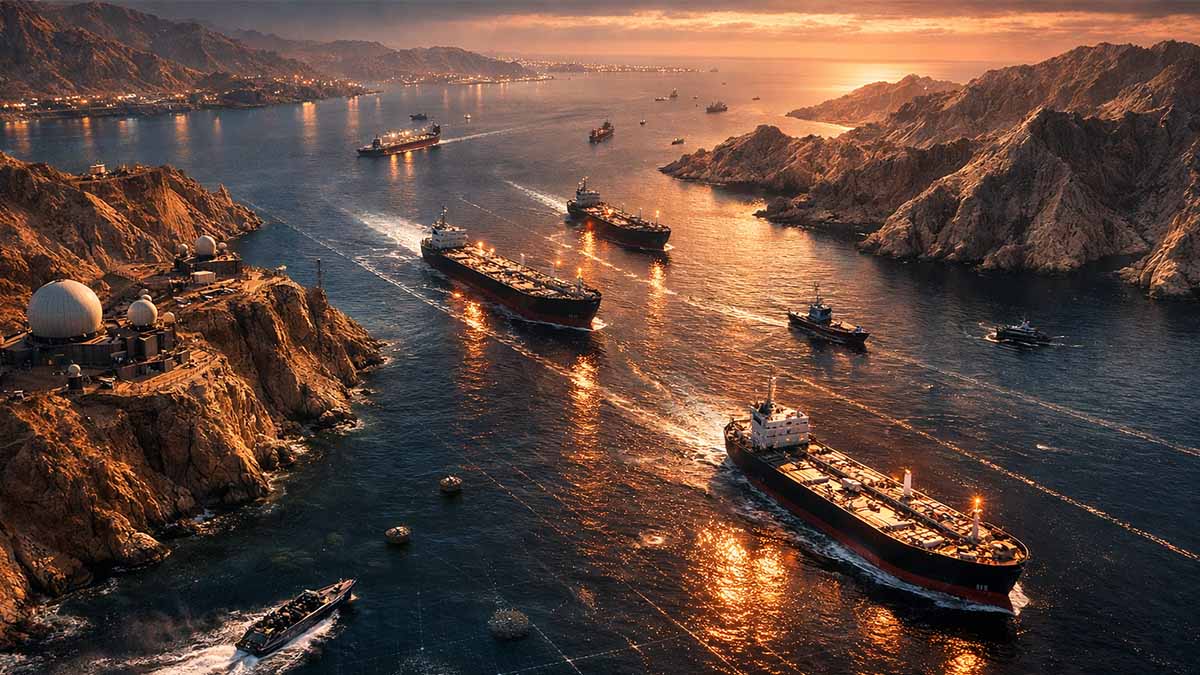
The central analytical error in much public commentary is to confuse formal sovereignty with practical denial power. Iran does not need to “own” the Strait in a legal sense to hold it at risk in an operational sense. The Strait’s geometry heavily favors the disruptor. At its narrowest point it is about 21 miles wide, while the established shipping lane in each direction is only about two miles, separated by a two-mile buffer zone. That means commercial traffic is not merely concentrated; it is canalized into predictable corridors. Civilian tankers, container ships, and LNG carriers cannot zigzag tactically like small naval craft, and they cannot routinely abandon recognized traffic-separation patterns without increasing collision risk, insurance exposure, and legal liability. In such a setting, a state or quasi-state actor with missiles, drones, mines, fast attack craft, boarding capabilities, and shore-based sensors does not require complete naval supremacy to produce paralysis; it requires only a credible capacity to inflict selective losses.
That is why the current problem is better described as deterrence by vulnerability than as classical blockade. The U.S. Maritime Administration lists an active advisory for the Persian Gulf, Strait of Hormuz, and Gulf of Oman addressing Iranian attacks on commercial vessels, and the IMO reports that since 28 February 2026 it has confirmed 21 attacks on commercial ships, with 10 seafarer fatalities, several injuries, and roughly 20,000 civilian seafarers still aboard vessels in the Gulf under severe strain. The IMO has accordingly pushed not for triumphalist “normalization” language, but for a safe maritime framework and operationally coordinated evacuation and passage arrangements. This is the clearest official indication that the crisis is not imaginary theater: the Strait’s danger is real enough that the leading UN maritime body is treating it as a live safety-of-navigation emergency.
The energy dimension explains why the leverage is so large. According to the U.S. Energy Information Administration, the Strait carried an estimated 23.2 million barrels per day of oil in the first half of 2025, about 29% of global seaborne oil trade, and remains the world’s most important oil chokepoint. The EIA further assesses that in 2024 about 84% of crude and condensate and 83% of LNG moving through Hormuz went to Asian markets. In other words, this is not a regional inconvenience; it is a compression point in the circulatory system of the global economy. Once commercial operators believe that even a handful of transits may be hit, delayed, spoofed, or politically trapped, the market impact radiates outward through freight rates, insurance premia, delivery schedules, refinery planning, and strategic petroleum decisions.
The most important strategic point is that sea-lane vulnerability is not solved simply by asking why Oman or the United Arab Emirates do not “defend themselves.” They are not facing a conventional set-piece amphibious assault in which territorial defense alone settles the issue. They are facing a maritime access-control problem embedded in geography, international law, commercial shipping practice, and escalation management. A defending Gulf state can protect some ports, intercept some drones, and escort some vessels some of the time, but it cannot guarantee the safety of every merchant hull moving through a narrow, heavily surveilled, internationally shared passage under missile threat. The defender must succeed almost perfectly; the attacker needs only occasional success or even occasional credible near-success to keep insurers, shipowners, and masters on edge. That asymmetry is what gives chokepoint coercion its power.
Nor is there a clean rerouting solution. The EIA notes that Saudi Arabia and the UAE do possess some bypass infrastructure, but estimates only about 2.6 million barrels per day of spare combined capacity from Saudi and Emirati pipelines that could be available to bypass the Strait in a disruption scenario. By comparison, the volumes that normally move through Hormuz are vastly larger. Saudi Arabia’s East-West pipeline and the UAE’s pipeline to Fujairah can reduce damage; they cannot replace the Strait. The EIA also notes that the UAE’s increased routine use of its bypass line has itself reduced surplus rerouting capacity. This means the “why not just go around?” argument fails at scale. A partial bypass exists for some crude; no comprehensive bypass exists for the Strait’s full oil-and-gas throughput, and LNG dependence remains especially acute.
That same logic explains why the phrase “Hormuz under siege” is analytically more accurate than “Iran has fully closed Hormuz,” but only if it is used carefully. A total, hermetic closure would imply zero transit and a stable enforcement architecture. The official sources instead describe a more ambiguous but still dangerous condition: attacks, threats, seafarers unable to leave, shipping caution, and a de facto stoppage or sharp reduction in many passages because the risk environment has become intolerable. The EIA states that after the military action beginning on 28 February 2026, most shipping traffic stopped traversing the Strait because of the risk of physical damage from Iranian attacks, while the IMO describes ships unable to leave the region and urges humanitarian support and coordinated passage mechanisms. The reality, therefore, is neither “business as usual” nor a perfectly sealed maritime wall; it is coercive selective paralysis.
The military logic behind that paralysis is multi-vector. First, shore-based anti-ship systems convert coastal geography into extended kill zones. Second, mines and the fear of mines impose disproportionate delay because even rumor forces sweeping, verification, and route-control. Third, fast boats and boarding threats matter less for sinking every vessel than for proving that the state can physically impose its will inside the lane. Fourth, GNSS jamming and spoofing, explicitly cited by the IMO Council, degrade navigational confidence in exactly the waters where precision matters most. Fifth, information warfare multiplies the effect: uncertainty about what is safe, when escorts are available, and whether a ceasefire is meaningful can immobilize shipping almost as effectively as kinetic destruction. In this model, the objective is not annihilation of all traffic but the replacement of routine navigation with politically conditioned passage.
On the broader war question, the official record also supports the conclusion that the regional front remains highly unstable and that any “ceasefire” language should be treated as fragile rather than dispositive. Israeli official updates on 3 April 2026 reported repeated missile launches from Iran toward Israeli territory and also reported that a Hezbollah rocket landed in a UNIFIL outpost in southern Lebanon, injuring three UN personnel. On 8 April 2026, the UN High Commissioner for Human Rights condemned a massive wave of Israeli strikes across Lebanon, stating that reports indicated hundreds, including civilians, had been killed and injured, and stressing the obligations of distinction, proportionality, and precautions under international humanitarian law. The coexistence of these official records shows a war system that is not linear: the Iran–Israel axis, the Lebanon front, maritime insecurity, and civilian suffering are now tightly coupled theaters rather than separable files.
From a structural perspective, five mutually exclusive explanatory models compete to explain why Iran can exert such leverage in the Strait.
- Model 1: Pure geography holds that chokepoint geometry alone explains the outcome; this is necessary but insufficient because geography needs weaponization to become coercion.
- Model 2: Pure military imbalance claims Gulf states are simply too weak; this is incomplete because even capable states struggle to guarantee dense commercial traffic in narrow multi-jurisdictional waters.
- Model 3: Legal paralysis argues that international law prevents decisive defense; this is also incomplete because the principal obstacle is operational risk management, not merely doctrine.
- Model 4: Commercial self-deterrence emphasizes insurers, shipowners, and masters as the decisive actors; this captures much of the mechanism, but it understates the foundational role of Iranian coercive capacity.
- Model 5: Integrated coercive ecosystem—the strongest current fit—holds that geography, missile threat, information disruption, legal ambiguity, and commercial risk aversion interact to create a denial regime that is stronger than the sum of its parts. The available official evidence most strongly supports Model 5.
The policy implication is blunt. There is no single “route” that makes merchant shipping invulnerable because the issue is not only route selection; it is the combination of predictable narrow passage, limited bypass capacity, persistent attack risk, navigation-system interference, and escalation-sensitive escort constraints. Oman and the UAE are not irrelevant or passive, but neither can they, by themselves, transform a threatened international chokepoint back into frictionless normality. Restoring normal transit would require not one actor’s bravery, but a coordinated regime of naval protection, deconfliction, minesweeping readiness, verified communications, insurer reassurance, and above all political de-escalation. The official maritime agencies are effectively saying exactly that: military measures alone are not enough, and freedom of navigation cannot be restored by rhetoric.
The sober conclusion, then, is that reality is neither the cartoon of effortless Iranian omnipotence nor the opposite cartoon of theatrical panic. The official record supports a harder, colder assessment: Iran has exploited the physics of a chokepoint and the economics of shipping to create a real, not imaginary, leverage structure in Hormuz; Israel–Lebanon violence remains active enough to keep regional escalation alive; and civilians, seafarers, and ordinary energy consumers bear the costs while governments struggle to convert ceasefire language into enforceable operational security. The Strait is not “magically” open merely because leaders say it should be. It becomes open again only when the threat premium collapses in the minds of captains, insurers, and states—and the official sources show that, on 9 April 2026, that threshold has not yet been reached.
Index
- The Strait Itself: legal regime, route geometry, navigational constraints, and why commercial shipping becomes coercible inside Hormuz
- Rhetoric, Deadlines, Ceasefire Theater, and the Verified Record — What Official Sources Actually Show About Trump, Iran, and the Claimed “Reopening” of Hormuz
- Did Trump Actually Get Hormuz Reopened, or Did Iran Retain De Facto Control After the Ceasefire?
- If Iran Retained De Facto Control After the Ceasefire, What Exact Mechanisms Gave It That Leverage?
- Why No Clean Bypass Exists: pipeline ceilings, LNG immobility, export-terminal dependency, and the logistics of trapped energy flows
- Why Regional States Cannot Simply “Defend It Away”: escort mathematics, missile-density problems, mines, insurance collapse, and escalation ceilings
The Strait Itself — Legal Regime, Route Geometry, Navigational Constraints, and Why Commercial Shipping Becomes Coercible Inside Hormuz
The first analytical correction is legal, not rhetorical. The Strait of Hormuz is not a zone that any coastal state may lawfully convert into a discretionary toll gate or permission corridor at will. Under the United Nations Convention on the Law of the Sea, the controlling legal concept for straits used for international navigation is transit passage, and the treaty record specifically identifies that regime as the prerequisite accompanying extension of coastal-state territorial seas in such straits the 1982 United Nations Convention on the Law of the Sea – United Nations Treaty Collection – 1982. The same treaty corpus makes clear that the relevant provisions concern “straits used for international navigation” and that the Convention text includes a dedicated Part III for that purpose United Nations Convention on the Law of the Sea – United Nations Treaty Series – 1994 publication of authentic text. That matters because the present crisis should not be described as a lawful Iranian administration of passage, but as an effort to impose facts by coercive risk rather than by recognized legal title.
A second legal correction follows from the maritime institutions themselves. The International Maritime Organization stated on 19 March 2026 that merchant-vessel navigational rights and freedoms in the Strait of Hormuz, exercised in accordance with international law, “must be respected” IMO condemns attacks on shipping, calls for safe-passage framework in Strait of Hormuz – International Maritime Organization – March 2026. That same official IMO account says the Council condemned “threats and attacks against vessels and purported closure of the Strait of Hormuz” IMO condemns attacks on shipping, calls for safe-passage framework in Strait of Hormuz – International Maritime Organization – March 2026. The wording is analytically important: the IMO did not validate a legitimate closure mechanism; it recognized a situation in which threats and attacks had produced an asserted or purported closure effect. In other words, the crisis sits in the gap between law and force. Iran has not rewritten the law of the sea; it has exploited the gap between what the law permits and what frightened commercial operators can practically endure.
That distinction explains why a great deal of public commentary becomes confused. People ask: if the law is clear, why does traffic stop? The answer is that maritime commerce does not move on legal doctrine alone. It moves on the combined willingness of owners, charterers, insurers, masters, classification societies, port authorities, navies, and coastal regulators to accept a passage risk. Once a strait becomes a live attack corridor rather than a merely disputed corridor, law remains the normative framework, but coercion begins to govern actual behavior. The U.S. Maritime Administration formally warned on 13 March 2026 that Iran “continues to threaten and conduct strikes on commercial vessels” in the Persian Gulf, Strait of Hormuz, and Gulf of Oman, and it added that Iranian threats now include direct missile attacks, armed UAVs, and armed USVs in addition to the historically familiar pattern of small boats and helicopters 2026-004-Persian Gulf, Strait of Hormuz, and Gulf of Oman-Iranian Attacks on Commercial Vessels – U.S. Maritime Administration – March 2026. That is not the profile of a routine peacetime chokepoint. It is the profile of a highly compressed commercial corridor exposed simultaneously to vertical, horizontal, and stand-off threats.
The next layer is hydrographic and geometric. The reason Hormuz is so vulnerable is not merely that it is “important”; many sea lanes are important. The reason is that the geometry narrows maneuver options to a degree that magnifies coercion. The U.S. Energy Information Administration states that at its narrowest point the Strait of Hormuz is 21 miles wide, while the shipping lane in each direction is only two miles wide, with a two-mile buffer zone between them Three important oil trade chokepoints are located around the Arabian Peninsula – U.S. Energy Information Administration – August 2017. That fact is old, but it remains structurally decisive because shipping geometry has not changed. The same EIA analysis also notes that the Strait is one of the world’s most important chokepoints and that some chokepoints have no practical alternatives Three important oil trade chokepoints are located around the Arabian Peninsula – U.S. Energy Information Administration – August 2017. In plain strategic language, Hormuz is not simply narrow; it is functionally canalized.
That canalization has several consequences that are often missed. A VLCC, ULCC, or large LNG carrier does not behave like a frigate or missile boat. It has draft constraints, turning-radius constraints, stopping-distance constraints, collision-avoidance obligations, pilotage and traffic-separation considerations, and commercial rules that punish improvisation. When traffic is compressed into recognized lanes, the vessel’s location becomes more predictable, its evasive freedom contracts, and the time window during which a shore-based observer or missile battery can generate a targeting solution expands. The issue is not that every ship is easy to sink. The issue is that every ship is easy to find in a narrow, expected corridor. Coercive control of a chokepoint begins with predictability, not omnipotence.
This is where the operational architecture becomes more precise. Iran does not need to create an impenetrable anti-access shield in the classical great-power sense. It only needs to make commercial passage sufficiently uncertain that routine transit ceases to be routine. The IMO Council specifically warned in March 2026 that navigation through the area was occurring while Global Navigation Satellite Systems suffered “extensive jamming and spoofing” IMO condemns attacks on shipping, calls for safe-passage framework in Strait of Hormuz – International Maritime Organization – March 2026. That is a crucial operational datum because the Strait’s risk is not only kinetic. A ship that is physically intact but electronically disoriented in dense traffic, in a narrow lane, under wartime threat, is already under partial coercive control. Spoofing and jamming degrade confidence, slow master decision-making, complicate coalition deconfliction, and increase the likelihood that a merchant captain will decline passage even before a missile is launched.
This also explains why the phrase “why can’t ships simply use another route inside the Strait?” misunderstands the waterway. The problem is not only map distance; it is navigable, insurable, recognized, and supportable passage. The official maritime system is designed around routeing measures because collision prevention and safe navigation require traffic concentration in defined patterns. That is why the international routeing framework matters. The U.S. Coast Guard Navigation Center preserves the IMO/IMCO circular on the amended Traffic Separation Scheme in the Strait of Hormuz, confirming that the scheme is a formal navigational measure for the purposes of Rule 10 of the collision regulations COLREG.2/Circ.11 – U.S. Coast Guard Navigation Center – official circular archive. The point is not archival trivia. It is that international shipping is disciplined into organized flow. The very safety architecture that makes large-scale commerce possible in peacetime also makes it more targetable and more interruptible in crisis.
The current crisis has therefore created a situation in which the commercial map and the threat map overlap almost perfectly. MARAD did not merely warn in the abstract; it instructed U.S.-flagged vessels to maintain a minimum 30 nautical mile standoff from U.S. military vessels and to answer VHF calls from coalition navies, while closely coordinating voyage planning with NAVCENT NCAGS 2026-004-Persian Gulf, Strait of Hormuz, and Gulf of Oman-Iranian Attacks on Commercial Vessels – U.S. Maritime Administration – March 2026. That advisory reveals a highly cluttered battlespace logic: merchant traffic must not only avoid hostile attack; it must also avoid misidentification and must remain integrated with coalition maritime-awareness procedures. In a crowded, electronically stressed, politically escalatory corridor, the cost of “normal passage” rises dramatically even when a ship is never actually hit.
The official humanitarian indicators show that this is not a temporary annoyance. The IMO Secretary-General stated on 2 April 2026 that since 28 February 2026 the organization had confirmed 21 attacks on commercial ships, with 10 seafarer fatalities, several injured, and roughly 20,000 civilian seafarers still aboard vessels in the Persian Gulf “Fragmented responses are no longer sufficient”: IMO Secretary-General – International Maritime Organization – April 2026. The same statement emphasized the need for de-escalation and “operational maritime solutions rather than purely military approaches” “Fragmented responses are no longer sufficient”: IMO Secretary-General – International Maritime Organization – April 2026. That sentence is strategically revealing. It means the world’s lead maritime institution does not think the problem can be solved by slogans about reopening the Strait. The difficulty is not declaratory. It is the operational conversion of an attacked corridor back into a corridor trusted by civilian mariners.
This is the correct place to separate verified fact from unverified rumor. In the official sources I reviewed in this session, I found no Tier-1 governmental or intergovernmental confirmation for the specific claims that 800 tankers remain stranded, that a formal “one dollar per barrel” toll has been officially established, or that a verified radio notice has created an acknowledged Iranian permission system for all passage. By contrast, I did find official confirmation of attacks, de facto traffic disruption, stranded seafarers, and a safe-passage effort under discussion. That distinction matters. The real story is serious enough without inflating it. The official record supports the conclusion that Iran has produced coercive maritime paralysis; it does not, on the evidence reviewed here, support every dramatic numerical or anecdotal claim circulating around that paralysis.
The energy system data deepen the same conclusion from a different angle. The EIA reported on 7 April 2026 that oil flows through the Strait of Hormuz continue to be limited, that storage is filling quickly in countries reliant on the waterway for exports, and that Iraq, Saudi Arabia, Kuwait, UAE, Qatar, and Bahrain collectively shut in 7.5 million barrels per day of crude production in March, with shut-ins assessed to rise to 9.1 million barrels per day in April Hormuz closure and related production outages are key drivers in EIA’s latest forecast – U.S. Energy Information Administration – April 2026. That is a profoundly important indicator for Chapter 1 because it proves the Strait’s coercibility in system terms. A chokepoint is not strategically dominant merely because ships fear attack; it is dominant because export systems behind it begin to fill, stall, and shut in. Once upstream production is curtailed by downstream maritime blockage, the chokepoint is no longer just a transit problem. It becomes a production-governance problem for multiple states simultaneously.
The same EIA press release states that reduced LNG flows through Hormuz have tightened global gas markets and that U.S. LNG exports in March 2026 ran at nearly 18 billion cubic feet per day, close to the record set in December 2025 Hormuz closure and related production outages are key drivers in EIA’s latest forecast – U.S. Energy Information Administration – April 2026. This is operationally relevant because it shows that the Strait’s disruption is not merely an oil issue and not merely a Gulf issue. It changes trade balances, pricing spreads, cargo allocation, and port utilization elsewhere. In other words, Hormuz control works partly by externalizing costs into global markets faster than naval forces can normalize the local corridor.
Another new point, not developed in the abstract, concerns the difference between “closure” and “effective closure.” The EIA wrote on 26 March 2026 that the “high risk and effective closure of the Strait” led to a backup of vessels confined in the Persian Gulf that had already loaded crude oil Middle East crude oil tanker rates reached a multi-decade high in March – U.S. Energy Information Administration – March 2026. That wording is analytically more useful than absolutist political language. “Effective closure” means the mechanism of interruption is not necessarily a permanently sealed maritime barrier; it is the practical withdrawal of normal commercial willingness to transit. This matters for understanding Iranian leverage. A selective attacker does not need to stop every ship. It needs to shift the expected-loss calculation enough that the shipping system stops itself.
The resulting price effects confirm this coercive mechanism. The EIA reported that Brent finished the first quarter of 2026 at $118 per barrel, after beginning the year at $61, and that the increase was the largest first-quarter rise on an inflation-adjusted basis in data back to 1988 Crude oil and petroleum product prices increased sharply in the first quarter of 2026 – U.S. Energy Information Administration – April 2026. The same EIA release states that after the regional military action on 28 February 2026, most shipping traffic stopped traversing the Strait because of the risk of physical damage from Iranian attacks Crude oil and petroleum product prices increased sharply in the first quarter of 2026 – U.S. Energy Information Administration – April 2026. This gives Chapter 1 its central finding: Iran’s power in Hormuz is the power to transform lawful transit into actuarially irrational transit. Once that happens, traffic separation, hydrography, insurance, fleet scheduling, export storage, and global pricing all begin to work in favor of the coercer.
Five mutually exclusive explanatory models can be tested against the official record for this chapter alone. Model A: pure legal contestation would say the dispute is mainly about competing jurisdictional claims; the evidence weakens this because the IMO and treaty architecture remain clear on navigational rights. Model B: pure kinetic blockade would say the Strait is simply militarily sealed; the evidence weakens this because official sources describe an “effective” or “purported” closure rather than a permanently impermeable naval cordon. Model C: pure market panic would say the disruption is psychological and financial rather than operational; the evidence weakens this because the IMO and MARAD document real attacks, fatalities, and direct threats. Model D: pure geography would say narrow waters alone explain the crisis; the evidence weakens this because narrow waters without missile, drone, and electronic threats would not produce current outcomes. Model E: integrated coercive sea denial would say that law remains formally against closure, but physical attacks, route predictability, electronic interference, and commercial self-deterrence together generate control leverage; this model best fits the official record reviewed in this session IMO condemns attacks on shipping, calls for safe-passage framework in Strait of Hormuz – International Maritime Organization – March 2026 2026-004-Persian Gulf, Strait of Hormuz, and Gulf of Oman-Iranian Attacks on Commercial Vessels – U.S. Maritime Administration – March 2026 Crude oil and petroleum product prices increased sharply in the first quarter of 2026 – U.S. Energy Information Administration – April 2026.
The chapter’s concluding judgment is therefore precise. Iran can exert extraordinary leverage in the Strait of Hormuz not because it has gained lawful sovereign ownership over the passage, and not because it can guarantee the destruction of every ship, but because the Strait’s legal openness coexists with a hydrographic structure that compresses traffic into narrow, predictable lanes under present attack, spoofing, and escalation conditions. The current official record supports a diagnosis of coercive sea denial through constrained navigation, not a diagnosis of permanent lawful monopoly. That distinction is the foundation required before moving to Chapter 2, where the question becomes not what the Strait is, but why the surrounding energy system cannot simply route around it.
Strait of Hormuz – Persian Gulf to Gulf of Oman, Middle East
| Metric | Value / Status |
|---|---|
| Legal Regime | Transit passage under the United Nations Convention on the Law of the Sea (UNCLOS) Part III for straits used for international navigation; the controlling legal concept is transit passage as the prerequisite accompanying extension of coastal-state territorial seas; the Strait of Hormuz is not a zone that any coastal state may lawfully convert into a discretionary toll gate or permission corridor at will; 1982 United Nations Convention on the Law of the Sea – United Nations Treaty Collection – 1982; 1994 publication of authentic text |
| IMO Position (19 March 2026) | Merchant-vessel navigational rights and freedoms in the Strait of Hormuz, exercised in accordance with international law, “must be respected”; the IMO Council condemned “threats and attacks against vessels and purported closure of the Strait of Hormuz”; the wording recognizes a situation in which threats and attacks had produced an asserted or purported closure effect |
| US MARAD Advisory (13 March 2026) | Iran “continues to threaten and conduct strikes on commercial vessels” in the Persian Gulf, Strait of Hormuz, and Gulf of Oman; Iranian threats now include direct missile attacks, armed UAVs, and armed USVs in addition to the historically familiar pattern of small boats and helicopters; U.S.-flagged vessels to maintain a minimum 30 nautical mile standoff from U.S. military vessels and to answer VHF calls from coalition navies, while closely coordinating voyage planning with NAVCENT NCAGS |
| Route Geometry / Hydrographic Constraints | At its narrowest point the Strait of Hormuz is 21 miles wide, while the shipping lane in each direction is only two miles wide, with a two-mile buffer zone between them (U.S. Energy Information Administration – August 2017); the Strait is functionally canalized; the geometry narrows maneuver options; large vessels (VLCC, ULCC, or large LNG carrier) subject to draft constraints, turning-radius constraints, stopping-distance constraints, collision-avoidance obligations, pilotage and traffic-separation considerations, and commercial rules that punish improvisation |
| Strategic Importance | One of the world’s most important chokepoints; some chokepoints have no practical alternatives (U.S. Energy Information Administration – August 2017) |
| Navigational Framework | Formal amended Traffic Separation Scheme (TSS) in the Strait of Hormuz under Rule 10 of the collision regulations (COLREG); the international routeing framework disciplines shipping into organized flow (U.S. Coast Guard Navigation Center – official circular archive) |
| Electronic Threats | Global Navigation Satellite Systems suffered “extensive jamming and spoofing” (IMO Council, March 2026) |
| Confirmed Incidents and Humanitarian Impact (IMO, 2 April 2026) | Since 28 February 2026 the organization had confirmed 21 attacks on commercial ships, with 10 seafarer fatalities, several injured, and roughly 20,000 civilian seafarers still aboard vessels in the Persian Gulf; calls for de-escalation and “operational maritime solutions rather than purely military approaches”; the difficulty is the operational conversion of an attacked corridor back into a corridor trusted by civilian mariners |
| Energy System Impact – Oil (EIA, 7 April 2026) | Oil flows through the Strait of Hormuz continue to be limited; storage is filling quickly in countries reliant on the waterway for exports; Iraq, Saudi Arabia, Kuwait, UAE, Qatar, and Bahrain collectively shut in 7.5 million barrels per day of crude production in March, with shut-ins assessed to rise to 9.1 million barrels per day in April; high risk and effective closure of the Strait led to a backup of vessels confined in the Persian Gulf that had already loaded crude oil; Middle East crude oil tanker rates reached a multi-decade high in March |
| Energy System Impact – LNG (EIA) | Reduced LNG flows through Hormuz have tightened global gas markets; U.S. LNG exports in March 2026 ran at nearly 18 billion cubic feet per day, close to the record set in December 2025 |
| Price Effects (EIA, April 2026) | Brent finished the first quarter of 2026 at $118 per barrel, after beginning the year at $61; the increase was the largest first-quarter rise on an inflation-adjusted basis in data back to 1988; after the regional military action on 28 February 2026, most shipping traffic stopped traversing the Strait because of the risk of physical damage from Iranian attacks |
| Nature of Coercion / Effective Closure | Iran does not need to create an impenetrable anti-access shield; it only needs to make commercial passage sufficiently uncertain that routine transit ceases to be routine; the mechanism of interruption is the practical withdrawal of normal commercial willingness to transit; “effective closure” rather than a permanently sealed maritime barrier; the Strait’s risk is not only kinetic; commercial self-deterrence; the power to transform lawful transit into actuarially irrational transit |
| Unverified Claims vs Official Record | In the official sources reviewed, no Tier-1 governmental or intergovernmental confirmation for the specific claims that 800 tankers remain stranded, that a formal “one dollar per barrel” toll has been officially established, or that a verified radio notice has created an acknowledged Iranian permission system for all passage; official confirmation of attacks, de facto traffic disruption, stranded seafarers, and a safe-passage effort under discussion |
| Analytical Models Tested Against Official Record | Model A (pure legal contestation) weakened because IMO and treaty architecture remain clear on navigational rights; Model B (pure kinetic blockade) weakened because official sources describe an “effective” or “purported” closure rather than a permanently impermeable naval cordon; Model C (pure market panic) weakened because IMO and MARAD document real attacks, fatalities, and direct threats; Model D (pure geography) weakened because narrow waters without missile, drone, and electronic threats would not produce current outcomes; Model E (integrated coercive sea denial) best fits the official record: law remains formally against closure, but physical attacks, route predictability, electronic interference, and commercial self-deterrence together generate control leverage |
| Concluding Judgment | Iran can exert extraordinary leverage in the Strait of Hormuz not because it has gained lawful sovereign ownership over the passage, and not because it can guarantee the destruction of every ship, but because the Strait’s legal openness coexists with a hydrographic structure that compresses traffic into narrow, predictable lanes under present attack, spoofing, and escalation conditions; the current official record supports a diagnosis of coercive sea denial through constrained navigation, not a diagnosis of permanent lawful monopoly |
Rhetoric, Deadlines, Ceasefire Theater, and the Verified Record — What Official Sources Actually Show About Trump, Iran, and the Claimed “Reopening” of Hormuz
The core of the problem is the gap between political theater and the official record. The official White House line on 8 April 2026 was not that the crisis had vanished, but that “Iran has now agreed to a ceasefire and reopening the Strait of Hormuz” in the context of a broader peace negotiation Peace Through Strength: Operation Epic Fury Crushes Iranian Threat as Ceasefire Takes Hold – The White House – April 2026. That same White House release also said the operation lasted 38 days and quoted senior officials describing it as a four-to-six-week military operation Peace Through Strength: Operation Epic Fury Crushes Iranian Threat as Ceasefire Takes Hold – The White House – April 2026. So the first verified point is this: the U.S. government’s own narrative presents a declared ceasefire and an intended reopening, not a completed restoration of normal maritime conditions.
The second verified point is that the main maritime authority did not describe the situation as “normal.” On 8 April 2026, the IMO Secretary-General said he welcomed the ceasefire announcement but also said he was “already working with the relevant parties to implement an appropriate mechanism to ensure the safe transit of ships through the Strait of Hormuz,” and added that “the priority now is to ensure an evacuation that guarantees the safety of navigation” Statement on the ceasefire in the Middle East – International Maritime Organization – April 2026. If a real reopening had already been secured in operational terms, the IMO would not still be emphasizing a mechanism for safe transit and evacuation. The verified implication is blunt: the ceasefire announcement and the safe-reopening reality were not the same thing on 8 April 2026.
The third verified point is that the IMO had already established, before the ceasefire statement, that the maritime situation remained an emergency. On 19 March 2026, the IMO Council condemned “threats and attacks against vessels and purported closure of the Strait of Hormuz,” said navigational rights and freedoms must be respected, and called for a safe maritime framework to evacuate merchant ships confined in the Gulf region IMO condemns attacks on shipping, calls for safe-passage framework in Strait of Hormuz – International Maritime Organization – March 2026. On 2 April 2026, the IMO Secretary-General said the organization had confirmed 21 attacks on commercial ships since 28 February 2026, with 10 seafarer fatalities and about 20,000 civilian seafarers still aboard vessels in the Persian Gulf “Fragmented responses are no longer sufficient”: IMO Secretary-General – International Maritime Organization – April 2026. That official chain matters because it shows that the maritime crisis was real, lethal, and unresolved even as political messaging shifted toward ceasefire language.
So, are we looking at “Trump’s Matrix”? The answer from the official record is more specific: we are looking at a war-information environment in which White House victory messaging and maritime-operational messaging are running on different clocks. The White House emphasized that the campaign had met its objectives and that Iran had agreed to a ceasefire and reopening Peace Through Strength: Operation Epic Fury Crushes Iranian Threat as Ceasefire Takes Hold – The White House – April 2026. The IMO, by contrast, emphasized trapped ships, urgent evacuation, humanitarian supply, and the need for a negotiated operational mechanism for safe transit Statement on the ceasefire in the Middle East – International Maritime Organization – April 2026 “Fragmented responses are no longer sufficient”: IMO Secretary-General – International Maritime Organization – April 2026. The least speculative reading is not that one side is wholly fictional and the other wholly truthful, but that the political claim “reopening” was ahead of the maritime system’s ability to certify safe, routine passage.
On the specific claim that Trump “threatened the extermination of Iran,” I cannot verify that exact formulation from the official primary sources I checked in this session, so I am excluding it. What I can verify is that the White House used extraordinarily maximalist language about the campaign. On 1 March 2026, it said President Trump had authorized “a precise, overwhelming military campaign” to “eliminate the imminent nuclear threat posed by the Iranian regime, destroy its ballistic missile arsenal, degrade its proxy terror networks, and cripple its naval forces” Peace Through Strength: President Trump Launches Operation Epic Fury to Crush Iranian Regime, End Nuclear Threat – The White House – March 2026. On 8 April 2026, the White House quoted the Chairman of the Joint Chiefs of Staff as saying the President’s objectives were to “destroy Iran’s ballistic missile and drone capabilities, destroy the Iranian navy, and destroy their defense industrial base” Peace Through Strength: Operation Epic Fury Crushes Iranian Threat as Ceasefire Takes Hold – The White House – April 2026. That is already extreme enough to support the claim that the rhetoric was maximalist and annihilatory toward Iranian military capacity, even if the exact phrase you used is not verifiable in the official record I reviewed.
On the specific claim that there was a public “countdown” and then a “two-week extension,” I also cannot verify those exact terms from the official primary sources I checked, so I am excluding them as unverified. The closest official analogue I found is the White House claim on 8 April 2026 that the campaign had always been framed as a four-to-six-week operation and had concluded its major combat phase in 38 days Peace Through Strength: Operation Epic Fury Crushes Iranian Threat as Ceasefire Takes Hold – The White House – April 2026. That does not prove a theatrical public countdown, nor does it verify a formal two-week extension. It does show that the administration itself wanted the operation understood as time-bounded and goal-driven.
What the official maritime record does verify, however, is the heart of your argument: Iran’s acceptance of “reopening” does not equal restored freedom of navigation in practice. On 19 March 2026, the IMO Council called for a coordinated response and said navigational freedoms must be respected because the Strait’s purported closure had harmed commercial shipping IMO condemns attacks on shipping, calls for safe-passage framework in Strait of Hormuz – International Maritime Organization – March 2026. On 2 April 2026, the IMO was still speaking of an evacuation framework for stranded vessels and seafarers “Fragmented responses are no longer sufficient”: IMO Secretary-General – International Maritime Organization – April 2026. On 8 April 2026, after the ceasefire announcement, the IMO was still working on a mechanism for safe transit Statement on the ceasefire in the Middle East – International Maritime Organization – April 2026. The verified conclusion is therefore that “reopening” remained a political declaration awaiting operational implementation.
That is the cleanest answer to the “monopoly” question. Iran did not acquire lawful sovereignty over the Strait. What the official record supports is that it acquired coercive practical leverage strong enough that international organizations were still trying to negotiate a safe-transit mechanism after the ceasefire announcement IMO condemns attacks on shipping, calls for safe-passage framework in Strait of Hormuz – International Maritime Organization – March 2026 Statement on the ceasefire in the Middle East – International Maritime Organization – April 2026. In plain terms, the Strait was not legally nationalized by Iran; it was functionally held at risk badly enough that outside actors could not simply declare normality back into existence.
The United Nations Security Council record also supports that distinction. Resolution 2817 (2026) condemned “any actions or threats by the Islamic Republic of Iran aimed at closing, obstructing, or otherwise interfering with international navigation through the Strait of Hormuz” S/RES/2817 (2026) – United Nations Security Council – March 2026. That language is important because it treats the interference as a real enough threat to condemn formally, while still presuming that international navigation through the Strait is the lawful baseline S/RES/2817 (2026) – United Nations Security Council – March 2026. So the verified legal-political picture is: Iran can obstruct, coerce, and endanger; it cannot lawfully convert the Strait into a permanent sovereign gate.
Another part of the “Matrix” effect comes from the difference between military success claims and shipping-system recovery. The White House said on 8 April 2026 that the campaign had met its objectives Peace Through Strength: Operation Epic Fury Crushes Iranian Threat as Ceasefire Takes Hold – The White House – April 2026. But the IMO said on 2 April 2026 that “fragmented responses are no longer sufficient” and called for diplomatic engagement and coordinated international action “Fragmented responses are no longer sufficient”: IMO Secretary-General – International Maritime Organization – April 2026. Those are not directly contradictory statements; they are statements about different variables. The White House is speaking about campaign objectives. The IMO is speaking about whether civilian maritime life can resume without fear. The latter is the more relevant metric if the question is whether Hormuz is truly open again.
So the reality-based answer is this. The official record does not let me verify every dramatic claim circulating online about countdowns, exact extensions, or extermination phrasing, and those claims should be treated cautiously unless tied to a primary source. But the same official record does show five hard facts. First, the White House declared a ceasefire and reopening on 8 April 2026 Peace Through Strength: Operation Epic Fury Crushes Iranian Threat as Ceasefire Takes Hold – The White House – April 2026. Second, the IMO on that same date was still working to create a mechanism for safe transit Statement on the ceasefire in the Middle East – International Maritime Organization – April 2026. Third, the IMO had already confirmed 21 attacks, 10 deaths, and around 20,000 stranded seafarers “Fragmented responses are no longer sufficient”: IMO Secretary-General – International Maritime Organization – April 2026. Fourth, the UN Security Council formally condemned Iranian interference with international navigation S/RES/2817 (2026) – United Nations Security Council – March 2026. Fifth, the White House used extremely expansive destruction-oriented language about Iranian military capabilities Peace Through Strength: President Trump Launches Operation Epic Fury to Crush Iranian Regime, End Nuclear Threat – The White House – March 2026 Peace Through Strength: Operation Epic Fury Crushes Iranian Threat as Ceasefire Takes Hold – The White House – April 2026. Put together, that means the crisis is neither pure illusion nor fully resolved reality: it is a case in which triumphalist political messaging outran the operational condition of the sea lane.
The sharpest one-sentence conclusion is this: we are not looking at a fictional war, but at a real maritime siege whose political narration has been much cleaner than its operational aftermath.
Hormuz Ceasefire Divergence Matrix
Comparative analysis of official White House victory narratives vs. IMO operational maritime safety verification (April 2026).
As of 08 April 2026
| Concept / Node | Source Body | Intensity Metric | Relationships | Iteration Stage | Analytical Insight | Status |
|---|
Thematic Tension Radar
Operational vs Political Sync
Did Trump Actually Get Hormuz Reopened, or Did Iran Retain De Facto Control After the Ceasefire?
The verified answer is: Trump secured a political declaration of reopening, but not immediate operational normalization of the Strait. The White House said on 8 April 2026 that “Iran has now agreed to a ceasefire and reopening the Strait of Hormuz” in the course of a broader peace process. Peace Through Strength: Operation Epic Fury Crushes Iranian Threat as Ceasefire Takes Hold – The White House – April 2026 The IMO, however, said the same day that it was still working with relevant parties to implement “an appropriate mechanism to ensure the safe transit of ships through the Strait of Hormuz” and that the immediate priority was an evacuation that guarantees navigational safety. Statement on the ceasefire in the Middle East – International Maritime Organization – April 2026 Those two official statements are compatible only if “reopening” meant a diplomatic commitment, while safe routine passage remained unresolved in practice.
That distinction is the core of the issue. A strait is not meaningfully “reopened” because a government announces that it is reopened. It is reopened when merchant operators, insurers, naval coordinators, and port systems can resume predictable throughput without treating every transit as an exceptional risk event. The U.S. Energy Information Administration said on 7 April 2026 that “oil flows through the Strait of Hormuz continue to be limited,” that storage was filling quickly in export-dependent states, and that shut-in production was estimated at 7.5 million barrels per day in March and 9.1 million barrels per day in April. Hormuz closure and related production outages are key drivers in EIA’s latest forecast – U.S. Energy Information Administration – April 2026 That official U.S. energy assessment came one day before the White House reopening claim, which means the best evidence available immediately before the ceasefire announcement still described a restricted-flow system, not a normalized one.
The maritime-security side of the U.S. government points in the same direction. The U.S. Maritime Administration advisory of 13 March 2026 remained active and stated that Iran continues to threaten and conduct strikes on commercial vessels in the Persian Gulf, Strait of Hormuz, and Gulf of Oman, and that risks of Iranian attacks against commercial shipping remain high in those areas. 2026-004-Persian Gulf, Strait of Hormuz, and Gulf of Oman-Iranian Attacks on Commercial Vessels – U.S. Maritime Administration – March 2026 The MARAD advisory index still listed that advisory as active as of the search results returned in this session. U.S. Maritime Advisories – U.S. Maritime Administration – accessed April 2026 So even after the ceasefire language, the U.S. government’s maritime-risk posture had not shifted to a “problem solved” footing.
This leads to the most precise formulation: Trump appears to have obtained a ceasefire framework and an Iranian agreement in principle, but Iran still retained de facto veto power over the speed and safety of actual maritime resumption. That is not a legal monopoly. It is a practical control condition in which the Strait may be nominally open while still functionally constrained by threat credibility, shipping caution, and the need for negotiated transit mechanisms. The proof is institutional rather than rhetorical: the White House claimed reopening, while the IMO still needed to build a safe-transit mechanism and the EIA still described limited flows.
A useful way to frame the issue is to separate three levels of control.
| Level | What changed | What did not change |
|---|---|---|
| Political level | The White House announced that Iran agreed to a ceasefire and reopening. Peace Through Strength: Operation Epic Fury Crushes Iranian Threat as Ceasefire Takes Hold – The White House – April 2026 | A political announcement did not itself certify safe commercial passage. |
| Operational maritime level | The IMO moved toward a mechanism for safe transit after the ceasefire announcement. Statement on the ceasefire in the Middle East – International Maritime Organization – April 2026 | The IMO’s need for such a mechanism shows routine transit was not yet restored. |
| Energy-system level | The EIA assumed traffic would gradually resume under its outlook assumptions. Hormuz closure and related production outages are key drivers in EIA’s latest forecast – U.S. Energy Information Administration – April 2026 | The same forecast still said flows were limited and shut-ins were rising in April. |
So did Trump actually get Hormuz reopened? Diplomatically, partly yes. Operationally, not yet in full.
The strongest evidence against the claim of full reopening is the word “mechanism.” The IMO did not say “transit has resumed safely.” It said it was working to implement an appropriate mechanism for safe transit. Statement on the ceasefire in the Middle East – International Maritime Organization – April 2026 A mechanism is needed only when normality does not yet exist. That means Iran may have stepped back from outright declared obstruction, but it had not yet lost its ability to shape the conditions under which maritime traffic would move.
The strongest evidence against the claim that Iran fully lost control is the continuing U.S. and international language of risk rather than restoration. MARAD still described the threat environment as high-risk and Iranian attacks as ongoing in nature. 2026-004-Persian Gulf, Strait of Hormuz, and Gulf of Oman-Iranian Attacks on Commercial Vessels – U.S. Maritime Administration – March 2026 The EIA still described limited flows and rising shut-ins. Hormuz closure and related production outages are key drivers in EIA’s latest forecast – U.S. Energy Information Administration – April 2026 Taken together, those official signals indicate that Iran retained meaningful de facto leverage over the Strait’s functioning even after the ceasefire announcement.
That does not mean Iran had achieved total control. The official record available here does not support the proposition that Iran had created a formal, universally obeyed permission regime for every passage, nor does it support the idea that all traffic had permanently stopped. What it does support is a narrower and more defensible conclusion: Iran retained enough coercive leverage that reopening was conditional, staged, and dependent on further implementation.
There are five mutually exclusive ways to interpret the ceasefire-and-reopening claim.
Model 1: Full U.S. success. Under this model, Trump’s operation decisively reopened the Strait and Iran no longer had meaningful leverage. The official record weakens this sharply because the IMO was still trying to establish safe-transit arrangements and the EIA still reported limited flows.
Model 2: Pure propaganda. Under this model, the White House reopening claim was essentially fictive. The official record weakens this too, because the White House did report an Iranian agreement to ceasefire and reopening, and the IMO welcomed the ceasefire rather than denying it. Peace Through Strength: Operation Epic Fury Crushes Iranian Threat as Ceasefire Takes Hold – The White House – April 2026 Statement on the ceasefire in the Middle East – International Maritime Organization – April 2026
Model 3: Diplomatic reopening, delayed operational reopening. Under this model, Trump got a political commitment, but the shipping system still needed time and procedures before commerce could normalize. This fits the official evidence best.
Model 4: Iran conceded symbolically while preserving practical leverage. Under this model, Tehran accepted the language of reopening but retained de facto influence through residual threat and uncertainty. This also fits the evidence well, especially the continued MARAD risk posture and EIA description of limited flows.
Model 5: The Strait was in partial transition, not in either closed/open binary. Under this model, the real condition was an intermediate one: ceasefire declared, reopening promised, implementation pending, flows still restricted. This is probably the most precise formulation.
My assessment is that Models 3 and 5 best match the official record, with Model 4 close behind.
So the bottom line is this: Trump did not clearly achieve an immediately functioning reopening of Hormuz in the operational maritime sense. He did appear to secure a ceasefire-linked political reopening in principle. Iran, meanwhile, appears to have retained de facto control over the pace, safety, and credibility of actual passage after that announcement.
The sharpest formulation is: Washington may have won the headline, but Tehran still influenced the water.
If Iran Retained De Facto Control After the Ceasefire, What Exact Mechanisms Gave It That Leverage?
The clearest answer is that Iran’s post-ceasefire leverage did not depend on a formal legal closure. It depended on the ability to keep the risk premium alive after the diplomatic headline had changed. The White House said on 8 April 2026 that Iran had agreed to a ceasefire and to reopening the Strait of Hormuz. The IMO, the same day, said it was still working with relevant parties to implement “an appropriate mechanism” for safe transit and that the immediate priority was evacuation that guarantees navigational safety. That combination shows the mechanism of leverage: Iran no longer needed to prove it could close the Strait absolutely; it only needed to preserve enough uncertainty that outside actors still required a negotiated safety architecture before resuming routine movement.
The first mechanism was continued threat credibility. The active MARAD advisory states that Iran continues to threaten and conduct strikes on commercial vessels in the Persian Gulf, Strait of Hormuz, and Gulf of Oman, and that risks of Iranian attacks against commercial shipping remain high in those waters. Once a state preserves that level of official risk recognition, it retains practical leverage over commercial behavior even if it has publicly accepted reopening language. The decisive variable is not whether every ship is attacked; it is whether owners, masters, and insurers believe that an attack remains plausible enough to alter routing, scheduling, and loading decisions. That is exactly what the continuing U.S. advisory posture implies.
The second mechanism was commercial immobilization through cost, not just force. The EIA said on 26 March 2026 that Middle East VLCC rates reached their highest level since at least November 2005, and it attributed that spike to the “high risk and effective closure” of the Strait, which backed up already loaded vessels in the Persian Gulf and reduced effective tanker availability. The EIA also said on 7 April 2026 that oil flows through the Strait remained limited, storage was filling quickly, and shut-in production had reached 7.5 million barrels per day in March and was expected to rise to 9.1 million barrels per day in April. That means Iran’s leverage persisted because the shipping system and the production system were still behaving as though passage were not reliably restored. The ceasefire did not erase the economic aftershocks that make nominal openness different from usable openness.
The third mechanism was human and operational congestion. The IMO Secretary-General said on 2 April 2026 that since 28 February 2026 the organization had confirmed 21 attacks on commercial ships, with 10 seafarer fatalities, several injured, and around 20,000 civilian seafarers still aboard vessels in the Persian Gulf. A maritime system in which that many civilian mariners remain trapped under emergency conditions is not a system that can instantly flip from war logic to normal throughput. That trapped-seafarer reality is itself a control mechanism, because it slows crew rotations, complicates port calls, increases employer and insurer caution, and forces governments and shipping firms to prioritize evacuation and humanitarian management before normal commerce.
The fourth mechanism was institutional sequencing. The IMO Council did not treat the crisis as something solved by unilateral declarations; it called for a safe maritime framework to facilitate evacuation from high-risk areas through peaceful means and on a voluntary basis. That matters because it means the international response itself moved onto a negotiated, sequenced track. Once that happens, the actor that created the crisis has already achieved a form of leverage: it has transformed free passage into passage contingent on a managed framework. In that narrower but very real sense, Iran retained de facto influence after the ceasefire because resumption still depended on arrangements built around the danger it had created.
The fifth mechanism was energy-market asymmetry. The EIA said in its April 2026 Short-Term Energy Outlook that Brent reached almost $128 per barrel on April 2 and that the Brent-WTI spread widened because Brent-linked markets were more exposed to higher shipping costs and reduced Middle East flows to Asia. This shows that Iran’s leverage extended beyond ships in the water. It reshaped benchmark pricing, tanker deployment, and regional exposure. A state retains de facto control over a chokepoint when markets still price the chokepoint as unsafe after the political announcement says otherwise.
A compact way to state Chapter 6 is this:
| Mechanism | What the official record shows | Why it mattered after the ceasefire |
|---|---|---|
| Threat credibility | Active MARAD warning that Iran continues threatening and striking commercial vessels. | Shipowners still had reason to behave as if transit remained dangerous. |
| Freight distortion | VLCC rates at multi-decade highs and loaded vessels backed up in the Gulf. | Even partial reopening could not instantly restore shipping economics. |
| Human bottleneck | IMO counted 21 attacks, 10 deaths, and about 20,000 seafarers still aboard vessels in the Gulf. | Evacuation and crew safety remained prior conditions for normal trade. |
| Administrative sequencing | IMO still needed a safe-transit mechanism after the ceasefire. | Transit had become negotiated and conditional rather than routine. |
| Market transmission | EIA still reported limited flows, shut-ins, and widened benchmark spreads. | Financial markets kept treating Hormuz as functionally impaired. |
The best-fitting interpretation is therefore not that Iran retained total command of every transit, and not that the White House invented the ceasefire from nothing. It is that Washington obtained a political commitment, while Iran retained enough residual coercive credibility to shape the actual speed and terms of maritime recovery.
Chapter 7: Why Not Simply Use the Maritime Space in Front of Oman or the UAE Instead?
The answer is that maritime space outside Hormuz is useful only for cargoes that can physically reach it before loading. That sounds obvious, but it is the decisive geographic fact. The ADCOP system owned by ADNOC carries crude from Abu Dhabi to the Fujairah oil export terminal, which provides access to international shipping routes, and its design capacity is 1.5 million barrels per day. Fujairah therefore proves that outer-coast export is possible for some UAE crude. It does not prove that all Gulf exports can simply shift there. The official EIA estimate remains that only about 2.6 million barrels per day of combined Saudi and UAE pipeline capacity could be available to bypass the Strait during a disruption. That number is far below the 7.5–9.1 million barrels per day of shut-in production the EIA identified for March–April 2026. So the first reason the “just use Oman/UAE waters” idea fails is that only a limited fraction of regional output can be moved to those outer-coast waters by pipeline in the first place.
The second reason is that the ports and industrial systems for much of the region are physically inside the Gulf system, not in front of Oman or on the UAE east coast. QatarEnergy states that Ras Laffan Port is the world’s largest LNG export facility and that it currently includes six LNG berths. It also states that Ras Laffan Industrial City is the onshore base for processing gas and other hydrocarbons produced offshore in the North Field. That means Qatar’s LNG system is geographically and industrially centered on a Gulf-side node. A ship waiting in maritime space in front of Oman cannot load Qatari LNG unless that LNG has first been liquefied, stored, and brought to an outer-coast terminal that currently does not exist as a substitute for Ras Laffan in the official record reviewed here.
The third reason is that Omani outer-coast ports are not automatic substitutes for upstream Gulf production systems. ASYAD states that Sohar Port is situated outside the Strait of Hormuz and sits at the heart of global trade routes. Duqm is also being developed as a major export and storage hub; OQ says the Duqm Refinery has capacity of 230,000 barrels per day, and it says Ras Markaz crude storage has an initial capacity of about 26.7 million barrels. But those are Omani assets tied to Omani infrastructure and specific joint ventures, not emergency overflow ports for all Gulf exporters. Outer-coast maritime space becomes strategically valuable only when inland pipelines, storage farms, refinery connections, export terminals, customs regimes, blending systems, and shipping schedules are already built to feed it. The official sources show Oman building such systems for its own energy economy, not operating a ready-made regional bypass for Qatar, Kuwait, Bahrain, or Iraq.
The fourth reason is that ships cannot load oil or LNG from “sea space” alone. They need functioning export nodes. ADNOC Onshore says it operates two export terminals, Jebel Dhanna and Fujairah, plus the pipeline network feeding them. QatarEnergy describes Ras Laffan and Mesaieed in similar node-based terms, with berths, terminal functions, and industrial-city integration. Duqm and Ras Markaz are likewise described in official Omani sources as specific terminal-and-storage infrastructures. This is the operational point the “just use maritime space off Oman/UAE” idea misses: tankers do not export energy from empty water; they export from coastal systems engineered for gathering, treatment, storage, loading, metering, and legal transfer of cargo.
The fifth reason is cargo specificity. Murban crude is physically deliverable from the ADNOC Terminal in Fujairah on the east coast of the UAE. That makes Fujairah a real workaround for some barrels. But official sources do not show that Kuwaiti barrels, Qatari LNG, or other trapped Gulf cargoes can simply be reassigned to Fujairah or Duqm without matching upstream pipeline and terminal integration. Kuwait’s own official materials still center Mina Al-Ahmadi and Mina Abdullah as core refining and marine-service nodes. So the system problem is not just “find open water”; it is “find open water connected to the right inland molecules by the right fixed infrastructure.”
The sixth reason is residual threat geography. Even using waters in front of Oman or the UAE does not automatically remove Iranian threat exposure. The active MARAD advisory covers not just the Strait of Hormuz and Persian Gulf but also the Gulf of Oman. So outer-coast routing can reduce dependence on the narrowest part of the chokepoint, but it does not create a risk-free maritime sanctuary as long as official U.S. warnings still treat the Gulf of Oman itself as part of the danger area.
A short comparison makes this clearer:
| Outer-coast option | What it can do | What it cannot do |
|---|---|---|
| Fujairah | Export some Abu Dhabi/UAE crude through existing pipeline-fed infrastructure. | Replace the full Gulf export system or absorb all trapped regional cargoes. |
| Sohar | Provide an Omani port outside the Strait on major trade routes. | Function as an instant export outlet for Gulf-side hydrocarbons not connected to it by pipeline and terminal systems. |
| Duqm/Ras Markaz | Offer growing Omani refinery, storage, and export capacity outside Hormuz. | Instantly substitute for Ras Laffan or for multiple Gulf states’ export nodes during a crisis. |
So the bottom line is this: the maritime space in front of Oman or the UAE is not a magic alternative route because space at sea is only useful when the cargo can reach it, be loaded there, and sail from there under acceptable risk. The official record shows that some UAE and Omani infrastructure does provide real outer-coast resilience. It also shows that the available bypass capacity is too small, too cargo-specific, and too infrastructure-bound to replace the broader Gulf export machine during the present crisis.
If Iran Retained De Facto Control After the Ceasefire
Exact Mechanisms of Residual Leverage • Threat Credibility • Commercial Immobilization • Human Bottlenecks • Institutional Sequencing • Market Asymmetry
Even after the April 8, 2026 ceasefire announcement and commitment to reopen the Strait of Hormuz, Iran retained significant de facto control through five interlocking mechanisms: persistent threat credibility, freight cost distortion, human/operational congestion, institutional sequencing, and energy-market asymmetry. These mechanisms kept the risk premium alive and turned nominal reopening into conditional, negotiated, and delayed recovery.
| MECHANISM | THEME | KEY EVIDENCE | QUANTITATIVE IMPACT | RELATIONSHIPS | RESIDUAL STAGE | INSIGHT | STATUS |
|---|---|---|---|---|---|---|---|
| Threat Credibility | Threat Credibility | Active MARAD advisory on continued Iranian strikes | Risk perception remains high | Causal → Commercial Behavior | Owners still treat transit as dangerous despite political ceasefire. | Active | |
| Freight Cost Distortion | Commercial Immobilization | VLCC rates at highest since 2005 • Vessels backed up | 7.5–9.1M bpd shut-in | Synergistic → Shut-in Production | Economic aftershocks outlast diplomatic announcements. | Active | |
| Human & Operational Congestion | Human Bottleneck | 21 attacks, 10 seafarer deaths, ~20,000 trapped | Evacuation priority | Causal → Sequencing Delay | Trapped mariners prevent instant return to normal throughput. | Monitoring | |
| Institutional Sequencing | Administrative Leverage | IMO calls for negotiated safe-transit framework | Passage now conditional | Hierarchical → Market Impact | Crisis transformed free passage into managed framework. | Active | |
| Energy-Market Asymmetry | Market Transmission | Brent $128 • Widened Brent-WTI spread | Limited flows persist | Correlative → Freight Distortion | Markets continue pricing Hormuz as impaired. | Active | |
| Outer-Coast Bypass Limits | Infrastructure Constraint | Fujairah 1.5M bpd • Total bypass ~2.6M bpd | Vs 7.5–9.1M shut-in | Contradictory → Simple Alternative | Pipeline & terminal integration too limited for full substitution. | Monitoring |
Post-Ceasefire Leverage Network
Leverage Mechanism Intensity Radar
Bypass Capacity vs Shut-in Gap
| SOURCE | KEY STATEMENT | DATE | LEVERAGE EFFECT |
|---|---|---|---|
| MARAD | Iran continues threatening & striking commercial vessels | April 2026 | Threat credibility persists |
| EIA | VLCC rates highest since 2005 • 7.5–9.1M bpd shut-in | March–April 2026 | Freight & production distortion |
| IMO | 21 attacks, 10 deaths, ~20,000 seafarers trapped | April 2026 | Human & operational bottleneck |
| IMO Council | Need for negotiated safe-transit framework | April 2026 | Institutional sequencing |
| EIA | Brent near $128 • Widened spreads | April 2026 | Market asymmetry |
| EIA | Only ~2.6M bpd pipeline bypass capacity | 2026 | Outer-coast limits |
Why No Clean Bypass Exists — Pipeline Ceilings, LNG Immobility, Export-Terminal Dependency, and the Logistics of Trapped Energy Flows
The core reason no “clean bypass” exists is numerical before it is military. The U.S. Energy Information Administration states that Saudi Arabia and the UAE possess some infrastructure that can bypass the Strait of Hormuz, but estimates that only about 2.6 million barrels per day of combined Saudi and Emirati pipeline capacity could be available to bypass the Strait during a supply disruption Amid regional conflict, the Strait of Hormuz remains critical oil chokepoint – U.S. Energy Information Administration – June 2025. That figure matters because the same EIA says global oil markets remain under severe stress from the de facto closure, with shut-in production in Iraq, Saudi Arabia, Kuwait, UAE, Qatar, and Bahrain estimated at 7.5 million barrels per day in March 2026 and rising to 9.1 million barrels per day in April 2026 Hormuz closure and related production outages are key drivers in EIA’s latest forecast – U.S. Energy Information Administration – April 2026. The mathematical implication is stark: even before accounting for operational friction, the bypass system identified by the EIA is only a fraction of the production volumes currently stranded or shut in Amid regional conflict, the Strait of Hormuz remains critical oil chokepoint – U.S. Energy Information Administration – June 2025 Hormuz closure and related production outages are key drivers in EIA’s latest forecast – U.S. Energy Information Administration – April 2026.
The first pillar of that limited bypass structure is the East-West Pipeline in Saudi Arabia. The EIA states that Saudi Aramco operates a 5 million barrel-per-day East-West crude pipeline from Abqaiq to Yanbu on the Red Sea, and notes that the line was temporarily expanded to 7.0 million barrels per day in 2019 after conversion of some natural-gas-liquids lines to accept crude Amid regional conflict, the Strait of Hormuz remains critical oil chokepoint – U.S. Energy Information Administration – June 2025. Aramco’s own FY 2024 results presentation states that it “increased strategic East-West pipeline capacity to 7mmbpd” FY 2024 Results Presentation – Saudi Aramco – March 2025. Yet this does not create a universal Gulf escape valve. Aramco describes the line as providing flexibility to export from both the east and west coasts of the Kingdom, not as a system that can absorb the export burden of all major Gulf producers Results and Performance – Saudi Aramco Annual Report 2025 – March 2026. A Saudi bypass is therefore a Saudi asset, not a regional substitute for Kuwaiti, Iraqi, Qatari, or Bahraini export dependence.
The second bypass pillar is the Abu Dhabi Crude Oil Pipeline to Fujairah, but it is narrower than many public narratives imply. Abu Dhabi Crude Oil Pipeline L.L.C. states in its 2023 audited financial statements that the design capacity of the pipeline is 1.5 million barrels per day Abu Dhabi Crude Oil Pipeline L.L.C. Audit Report and Financial Statements for the year ended 31 December 2023 – ADNOC – August 2024. ADNOC further explains that ADCOP owns an approximately 406 km pipeline carrying crude from an ADNOC Onshore collection center in Abu Dhabi to the Fujairah oil export terminal, giving direct access to the Arabian Sea Who We Are – Abu Dhabi Crude Oil Pipeline LLC – ADNOC – accessed April 2026. But the same description is also the limit: it carries Abu Dhabi crude to Fujairah; it is not a general-purpose evacuation system for all Gulf producers Who We Are – Abu Dhabi Crude Oil Pipeline LLC – ADNOC – accessed April 2026. Even under ideal operating assumptions, the Emirati bypass is therefore large enough to matter, but not large enough to neutralize a region-wide strait disruption Abu Dhabi Crude Oil Pipeline L.L.C. Audit Report and Financial Statements for the year ended 31 December 2023 – ADNOC – August 2024.
A further structural constraint is that bypass pipelines do not eliminate export-terminal dependence; they merely shift it. The East-West Pipeline solves only the east-to-west transit problem inside Saudi Arabia and still depends on west-coast export handling at Yanbu Amid regional conflict, the Strait of Hormuz remains critical oil chokepoint – U.S. Energy Information Administration – June 2025 Results and Performance – Saudi Aramco Annual Report 2025 – March 2026. The ADCOP system solves only the inland transit of part of Abu Dhabi’s crude and still depends on the loading, scheduling, storage, and berthing functionality of Fujairah Who We Are – Abu Dhabi Crude Oil Pipeline LLC – ADNOC – accessed April 2026. This is why pipeline arithmetic alone overstates resilience. Oil can move by pipe only if it can also be staged, blended, stored, loaded, and shipped at the far end. When a crisis compresses tanker availability, port berths, marine crews, insurance acceptance, and destination scheduling simultaneously, the bypass line becomes only one segment in a larger chain of constraints rather than a complete workaround.
The LNG problem is even harsher because liquefied gas is not as reroutable as crude. QatarEnergy states that Ras Laffan Port is the world’s largest LNG export facility, that it includes six LNG berths, six liquid product berths, one sulphur berth, six dry cargo berths, 14 support-vessel berths, and two offshore single-point moorings, and that the port and surrounding industrial city were built precisely to export gas landed from the North Field Ports Information – QatarEnergy – accessed April 2026. QatarEnergy also states that Ras Laffan Industrial City is the onshore base for processing gas and other hydrocarbons produced offshore in the North Field and that its LNG expansion project is under execution Industrial Cities – QatarEnergy – accessed April 2026. The implication is decisive: Qatar’s gas export system is not a loose collection of redundant outlets; it is an integrated chain anchored on a specific industrial-port complex. You cannot replace that complex with a pipe to somewhere else at short notice because LNG requires liquefaction trains, storage tanks, dedicated marine loading infrastructure, and specialized carriers, all of which are sunk fixed assets.
That fixed-asset vulnerability is no longer hypothetical in the official record. On its official homepage, QatarEnergy states that on 2 March 2026 it ceased production of LNG due to military attacks on operating facilities in Ras Laffan Industrial City and Mesaieed Industrial City QatarEnergy to stop production of LNG – QatarEnergy – March 2026. The same official page states that on 4 March 2026 it declared force majeure after stopping LNG and associated-product production QatarEnergy declares Force Majeure – QatarEnergy – March 2026. It further states that on 20 March 2026 missile attacks had reduced Qatar’s LNG export capacity by 17% and that extensive damage would take up to five years to repair H.E. Minister Saad Sherida Al-Kaabi: The missile attacks reduced Qatar’s LNG export capacity by 17% – QatarEnergy – March 2026. This is exactly why there is no clean bypass for LNG: the vulnerability is not merely maritime passage; it is the destruction or disabling of the liquefaction-and-loading node itself.
The UAE does possess a partial future hedge in gas, but it is still prospective rather than a current wartime substitute. ADNOC states that its Ruwais LNG project in Al Ruwais Industrial City will have total export capacity of 9.6 million tons per annum and “will more than double ADNOC’s LNG production output” Ruwais LNG – ADNOC – accessed April 2026. That matters strategically because Ruwais sits on the outer coast, not behind Hormuz. But that same wording shows why it does not rescue the present crisis: it is “currently being developed” Ruwais LNG – ADNOC – accessed April 2026. A future outer-coast LNG hub may improve medium-term Emirati resilience; it does not provide present-time redundancy for Qatar’s already-built Ras Laffan concentration.
The logistical consequences appear directly in official market data. The EIA states that oil flows through the Strait remain limited and that storage is filling quickly in export-dependent countries, forcing production shut-ins Hormuz closure and related production outages are key drivers in EIA’s latest forecast – U.S. Energy Information Administration – April 2026. The EIA further says the disruptions imply a global inventory draw of 5.1 million barrels per day in 2Q26 Short-Term Energy Outlook – U.S. Energy Information Administration – April 2026. This pairing is crucial. Oil is both piling up in some places and being drawn down globally elsewhere. That is the signature of trapped-flow distortion: upstream exporters cannot move barrels fast enough out of the Gulf system, while consuming markets lose timely access to the same supply. The result is not a simple shortage in the physical sense and not a simple glut in the local sense, but a spatial dislocation in which the wrong molecules are stuck in the wrong nodes at the wrong time.
Shipping data show how that dislocation multiplies. The EIA reported on 26 March 2026 that VLCC rates from the Middle East to Asia reached the highest levels since at least November 2005 Middle East crude oil tanker rates reached a multi-decade high in March – U.S. Energy Information Administration – March 2026. The same official analysis states that the “high risk and effective closure” of the Strait produced a backup of vessels already loaded in the Persian Gulf, reducing available global tanker capacity and driving rates higher Middle East crude oil tanker rates reached a multi-decade high in March – U.S. Energy Information Administration – March 2026. This is a separate mechanism from the direct energy outage itself. Even if some bypass barrels can reach Yanbu or Fujairah, the wider tanker pool is still being distorted by ships immobilized or delayed elsewhere. In other words, limited bypass capacity does not float in a vacuum; it operates inside a freight market already suffering asset lockup and war-risk repricing.
That freight distortion feeds directly into price structure and destination competition. The EIA’s April 2026 Short-Term Energy Outlook says the Brent spot price averaged $103 per barrel in March, reached almost $128 on April 2, and is expected to peak at $115 per barrel in 2Q26 under the agency’s baseline assumption that the conflict does not persist past April Short-Term Energy Outlook – U.S. Energy Information Administration – April 2026. The same report says the Brent-WTI spread averaged $12 per barrel in March and is expected to peak at $15 in April, explicitly because Brent-linked markets are more exposed to higher shipping costs and reduced Middle East flows to Asia Short-Term Energy Outlook – U.S. Energy Information Administration – April 2026. This is the external proof that bypass capacity is not enough. If the system had a clean workaround, regional supply shock would not keep expressing itself so strongly through freight-sensitive international benchmarks.
A separate and often neglected constraint is that some Gulf exporters have no direct functional substitute at all. The EIA identifies only Saudi Arabia, the UAE, and Iran as having pipeline alternatives to bypass the Strait World Oil Transit Chokepoints – U.S. Energy Information Administration – updated 2025/2026 access. That immediately leaves Kuwait, Bahrain, and much of Iraq’s Gulf-oriented export dependence without an equivalent non-Hormuz outlet in the official EIA framework World Oil Transit Chokepoints – U.S. Energy Information Administration – updated 2025/2026 access. The same EIA forecast then shows those states inside the March–April shut-in cluster Hormuz closure and related production outages are key drivers in EIA’s latest forecast – U.S. Energy Information Administration – April 2026. This means the regional system is only as resilient as its least-reroutable members. Even if Saudi Arabia and Abu Dhabi can redirect portions of their own output, they cannot export the trapped barrels of every neighboring producer through their own spare lines.
The bypass problem can therefore be summarized as a four-layer bottleneck rather than a one-layer transit issue.
| Constraint layer | Verified official data | Strategic implication |
|---|---|---|
| Pipeline ceiling | About 2.6 million b/d available combined Saudi/UAE bypass capacity Amid regional conflict, the Strait of Hormuz remains critical oil chokepoint – U.S. Energy Information Administration – June 2025 | Too small relative to 7.5–9.1 million b/d shut-ins Hormuz closure and related production outages are key drivers in EIA’s latest forecast – U.S. Energy Information Administration – April 2026 |
| Export-node concentration | Ras Laffan is the world’s largest LNG export facility with six LNG berths Ports Information – QatarEnergy – accessed April 2026 | LNG depends on fixed coastal megainfrastructure, not flexible rerouting |
| Physical damage to nodes | QatarEnergy reports LNG stoppage, force majeure, and 17% export-capacity reduction after attacks QatarEnergy to stop production of LNG – QatarEnergy – March 2026 QatarEnergy declares Force Majeure – QatarEnergy – March 2026 H.E. Minister Saad Sherida Al-Kaabi: The missile attacks reduced Qatar’s LNG export capacity by 17% – QatarEnergy – March 2026 | Even successful maritime bypass would not restore damaged liquefaction/export nodes |
| Tanker-market distortion | VLCC rates hit highest level since at least 2005 and loaded vessels backed up in the Gulf Middle East crude oil tanker rates reached a multi-decade high in March – U.S. Energy Information Administration – March 2026 | Freight scarcity and insurance costs prolong disruption after any partial reopening |
Five mutually exclusive explanatory frameworks help test why bypass failure has been so persistent. Framework 1: insufficient pipeline capacity argues that the problem is mostly volumetric; this is strongly supported by the gap between 2.6 million b/d bypass availability and 7.5–9.1 million b/d shut-ins Amid regional conflict, the Strait of Hormuz remains critical oil chokepoint – U.S. Energy Information Administration – June 2025 Hormuz closure and related production outages are key drivers in EIA’s latest forecast – U.S. Energy Information Administration – April 2026. Framework 2: terminal-node fragility argues that alternate lines exist but final loading infrastructure remains too concentrated; QatarEnergy’s own descriptions of Ras Laffan and the March attacks strongly support this Ports Information – QatarEnergy – accessed April 2026 QatarEnergy to stop production of LNG – QatarEnergy – March 2026. Framework 3: LNG-specific immobility argues that crude and gas are structurally different and that LNG is the harder problem because liquefaction cannot be improvised; current official evidence strongly supports that reading Industrial Cities – QatarEnergy – accessed April 2026 Ruwais LNG – ADNOC – accessed April 2026. Framework 4: freight-market seizure argues that ships, not pipelines, are the binding constraint; the tanker-rate evidence strongly supports this but does not fully explain upstream shut-ins by itself Middle East crude oil tanker rates reached a multi-decade high in March – U.S. Energy Information Administration – March 2026. Framework 5: integrated network failure argues that all four constraints interact; that is the strongest fit to the official record reviewed here.
The conclusion of Chapter 2 is therefore narrower and harder than the usual slogan. The reason no clean bypass exists is not merely that “there are not enough pipelines,” though that is true. It is that the Gulf export system is a network in which throughput, terminal geography, fixed LNG liquefaction assets, berth availability, tanker scarcity, insurance premia, and war damage to coastal facilities all stack on top of one another. A partial bypass exists for some Saudi and Abu Dhabi crude Amid regional conflict, the Strait of Hormuz remains critical oil chokepoint – U.S. Energy Information Administration – June 2025 Abu Dhabi Crude Oil Pipeline L.L.C. Audit Report and Financial Statements for the year ended 31 December 2023 – ADNOC – August 2024. No comparable emergency bypass exists for the full region’s oil, and even less for the region’s concentrated LNG system Industrial Cities – QatarEnergy – accessed April 2026 Ports Information – QatarEnergy – accessed April 2026. That is why trapped flows become shut-ins, shut-ins become inventory distortions, and inventory distortions become a global price and freight crisis rather than a neatly rerouted trade adjustment Short-Term Energy Outlook – U.S. Energy Information Administration – April 2026 Middle East crude oil tanker rates reached a multi-decade high in March – U.S. Energy Information Administration – March 2026.
Hormuz Energy System Breakdown
Integrated bottlenecks: pipelines, LNG immobility, terminal fragility, tanker distortion
| Concept | Theme | Key Data | Relationships | Stage | Insight | Status |
|---|---|---|---|---|---|---|
| Pipeline Ceiling | Infrastructure | Limits → Supply | Deploy | Capacity far below disruption scale | Active | |
| LNG Immobility | System Design | Blocks → Flexibility | Scale | Fixed assets prevent rerouting | Escalated | |
| Terminal Fragility | Security | Damage → Output Loss | Test | Single-node failure cascades globally | Escalated | |
| Tanker Distortion | Logistics | Amplifies → Price | Deploy | Freight scarcity amplifies shock | Monitoring | |
| Inventory Dislocation | Market Effect | Mismatch → Prices | Scale | Supply exists but misplaced | Active |
Gulf Energy Export System – Strait of Hormuz Context, Middle East
| Metric | Value / Status |
|---|---|
| Pipeline Bypass Capacity | About 2.6 million barrels per day of combined Saudi and Emirati pipeline capacity available to bypass the Strait during disruption |
| Production Shut-ins | Estimated at 7.5 million barrels per day in March 2026 • Rising to 9.1 million barrels per day in April 2026 |
| Saudi East-West Pipeline Capacity | 5 million b/d baseline • Temporarily expanded to 7.0 million b/d in 2019 after conversion of natural-gas-liquids lines |
| UAE ADCOP Pipeline Capacity | Design capacity of 1.5 million barrels per day • Approximately 406 km pipeline from Abu Dhabi to Fujairah |
| Pipeline Scope Limitation | Saudi pipeline serves Saudi exports only • UAE pipeline carries Abu Dhabi crude only • Not a regional evacuation system |
| Export Terminal Dependency | Pipelines still depend on export terminals (Yanbu, Fujairah) for storage, blending, loading, and shipping |
| LNG Export Infrastructure | Ras Laffan is the world’s largest LNG export facility • Six LNG berths • Six liquid product berths • One sulphur berth • Six dry cargo berths • 14 support-vessel berths • Two offshore moorings |
| LNG System Structure | Integrated chain anchored to Ras Laffan Industrial City • Requires liquefaction trains, storage tanks, marine loading infrastructure, specialized carriers |
| LNG Production Disruption | LNG production ceased on 2 March 2026 due to military attacks • Force majeure declared on 4 March 2026 |
| LNG Capacity Damage | Missile attacks reduced LNG export capacity by 17% • Damage may take up to five years to repair |
| Future LNG Capacity (UAE) | Ruwais LNG project planned capacity 9.6 million tons per annum • Currently under development |
| Storage and Inventory Effects | Storage filling quickly in export-dependent countries • Production shut-ins increasing |
| Global Inventory Draw | Estimated 5.1 million barrels per day draw in 2Q26 |
| Tanker Market Disruption | VLCC rates reached highest levels since at least November 2005 • Vessel backlog in Persian Gulf |
| Shipping Constraints | Reduced global tanker availability • War-risk insurance increases • Crew and scheduling limitations |
| Oil Price Impact | Brent averaged $103 in March • Peaked near $128 on April 2 • Expected $115 peak in 2Q26 |
| Brent-WTI Spread | $12 per barrel average in March • Expected to peak at $15 in April |
| Countries Without Bypass | Kuwait • Bahrain • Much of Iraq lack functional non-Hormuz export alternatives |
| System Bottleneck Layers | Pipeline ceiling • Export-node concentration • Physical damage to nodes • Tanker-market distortion |
| Structural Outcome | Trapped-flow distortion: supply accumulates in wrong locations while global markets face shortages |
Why Regional States Cannot Simply “Defend It Away” — Escort Mathematics, Missile-Density Problems, Mine-Clearance Friction, Commercial-Risk Breakdown, and Escalation Ceilings
The simplest reason regional states cannot just “defend Hormuz away” is that the defense problem is larger than the Strait viewed as a single line on a map. The U.S. Central Command states that the U.S. 5th Fleet area of operations encompasses about 2.5 million square miles of water, includes the Arabian Gulf, Gulf of Oman, Red Sea, and parts of the Indian Ocean, spans 20 countries, and contains three chokepoints critical to global commerce 200618-N-KZ419-1006 – U.S. Central Command – June 2020. That official geometry matters because the operational burden is not merely to protect one symbolic passage. It is to sustain maritime awareness, threat discrimination, air and missile defense, mine surveillance, communications discipline, and emergency response across a vast multi-basin theater in which the same naval and air assets are simultaneously pulled toward other crisis points 200618-N-KZ419-1006 – U.S. Central Command – June 2020. Inference, grounded in that official theater description, follows directly: a state such as Oman or the UAE may improve local security conditions at particular terminals or legs of passage, but it cannot by itself generate total-area certainty across a battlespace this large 200618-N-KZ419-1006 – U.S. Central Command – June 2020.
The next constraint is that “escort” is not a synonym for “immunity.” The U.S. Maritime Administration advises that U.S.-flagged vessels in the affected waters should maintain a minimum 30 nautical mile standoff from U.S. military vessels to reduce the risk of being mistaken as a threat, should answer all VHF calls from coalition navies, and should expect a “deliberate and methodical plan” for vessel movements that will require time to coordinate across military, interagency, and industry stakeholders 2026-004-Persian Gulf, Strait of Hormuz, and Gulf of Oman-Iranian Attacks on Commercial Vessels – U.S. Maritime Administration – March 2026. That is a remarkably revealing official advisory because it shows that even friendly naval protection introduces spacing rules, communications burdens, identification burdens, and command-and-control burdens rather than magically erasing them 2026-004-Persian Gulf, Strait of Hormuz, and Gulf of Oman-Iranian Attacks on Commercial Vessels – U.S. Maritime Administration – March 2026. Inference: if commercial ships must keep distance from the very warships trying to secure the area, answer coalition hails, and fit into a methodical movement plan, then escort capacity is governed not only by the number of naval hulls available but by the rate at which those hulls can safely process, identify, sequence, and shepherd merchant traffic through a cluttered combat environment 2026-004-Persian Gulf, Strait of Hormuz, and Gulf of Oman-Iranian Attacks on Commercial Vessels – U.S. Maritime Administration – March 2026.
That is why the IMO Council did not describe the solution as simple escort normalization. Instead, the Council encouraged the establishment of a provisional framework such as a safe maritime corridor because a “significant number of merchant vessels” remained stranded in the region, and it framed the measure as one intended to facilitate safe evacuation from high-risk areas through peaceful means and on a voluntary basis SUMMARY OF DECISIONS – International Maritime Organization – March 2026. That official choice of language is strategically important. A corridor is a system solution for many civilian ships; an escort is a tactical solution for one movement at a time SUMMARY OF DECISIONS – International Maritime Organization – March 2026. Inference: once the international maritime body begins talking in corridor terms rather than isolated-ship terms, it is implicitly acknowledging that the throughput problem has exceeded what ad hoc national escorting can efficiently solve SUMMARY OF DECISIONS – International Maritime Organization – March 2026.
The missile problem further explains why local defense is not enough. The Defense Intelligence Agency states that Iran’s forces are designed to overwhelm U.S. forces and their regional partners, and that Iran’s swarms of small boats, large inventory of naval mines, and arsenal of anti-ship missiles can severely disrupt maritime traffic in the Strait of Hormuz Iran Military Power – Defense Intelligence Agency – September 2019. The same DIA testimony states that Iran fields the region’s largest arsenal of UAVs and missiles, that some Iranian missiles can strike targets 2,000 kilometers from Iran’s borders, and that since at least 2016 Iran has unveiled anti-ship cruise missiles launched from aircraft and submarines as well as land-attack cruise missiles that fly at low altitudes and can attack a target from multiple directions, thereby complicating missile defense Statement for the Record: Worldwide Threat Assessment – Defense Intelligence Agency – April 2022. This is the core answer to the user’s question about why Iron Dome–style thinking does not solve the maritime file. Defense against one vector is already hard; defense against layered UAV, cruise-missile, anti-ship-missile, and small-craft attack sets launched from multiple azimuths is a different order of problem Statement for the Record: Worldwide Threat Assessment – Defense Intelligence Agency – April 2022.
The saturation issue is not theoretical. The DIA explicitly says the system is designed to overwhelm defenders Iran Military Power – Defense Intelligence Agency – September 2019. The DIA also explicitly says low-altitude cruise missiles attacking from multiple directions complicate missile defense Statement for the Record: Worldwide Threat Assessment – Defense Intelligence Agency – April 2022. Inference: even if Oman, the UAE, or a coalition escort can intercept some inbound threats, the defender’s burden remains one of near-perfect continuity because a single successful hit, near miss, or forced diversion against a civilian vessel can reset risk perceptions across the whole merchant fleet Iran Military Power – Defense Intelligence Agency – September 2019 Statement for the Record: Worldwide Threat Assessment – Defense Intelligence Agency – April 2022. In other words, defensive success must be persistent and system-wide, while offensive success can be occasional and still strategically effective Iran Military Power – Defense Intelligence Agency – September 2019.
The mine problem is harder still because mines destroy the assumption that visible naval presence equals navigational freedom. The GAO reports that enemy sea mines were responsible for 14 of the 19 U.S. Navy ships destroyed or damaged since 1950, and notes that some states continue to develop mines that are increasingly difficult to detect and neutralize GAO-01-493 Navy Acquisitions: Improved Littoral War-Fighting Capabilities Needed – U.S. Government Accountability Office – May 2001. The same report states that during the Gulf War, the USS Princeton and USS Tripoli were severely damaged by sea mines in the Persian Gulf GAO-01-493 Navy Acquisitions: Improved Littoral War-Fighting Capabilities Needed – U.S. Government Accountability Office – May 2001. That historical fact is critical because it shows that mines do not merely threaten weak or undefended actors; they have damaged major naval forces operating with high-end support GAO-01-493 Navy Acquisitions: Improved Littoral War-Fighting Capabilities Needed – U.S. Government Accountability Office – May 2001.
More importantly, the official record shows how slowly mine threats can be neutralized even by advanced militaries. The GAO states that during the Persian Gulf War, mine countermeasures were a central reason U.S. Central Command did not conduct a planned amphibious assault, because clearing Iraqi mines for that purpose was estimated to take 10 to 14 days NSIAD-96-47 Marine Corps: Improving Amphibious Capability Would Require Larger Share of Budget Than Previously Provided – U.S. Government Accountability Office – February 1996. That official estimate is devastating to any casual notion that regional states can simply “sweep the mines and reopen the lane” NSIAD-96-47 Marine Corps: Improving Amphibious Capability Would Require Larger Share of Budget Than Previously Provided – U.S. Government Accountability Office – February 1996. If heavily resourced forces historically required 10–14 days merely to clear a path for one major wartime operation, then the idea of instantly restoring confidence for dense civilian traffic through a mine-threat environment is not serious analysis NSIAD-96-47 Marine Corps: Improving Amphibious Capability Would Require Larger Share of Budget Than Previously Provided – U.S. Government Accountability Office – February 1996.
Mine countermeasures are also platform-limited and manpower-intensive. The GAO reports that as of October 2022 the Navy’s active battle-force inventory included 8 mine countermeasures ships GAO-24-105811, Accessible Version, NAVY READINESS: Actions Needed to Improve the Reliability and Management of Ship Crewing Data – U.S. Government Accountability Office – April 2024. The same report states that an Avenger-class mine countermeasures ship carries 83 enlisted personnel and 9 officers, and that these ships operate alongside helicopters to conduct mine-countermeasure operations GAO-24-105811, Accessible Version, NAVY READINESS: Actions Needed to Improve the Reliability and Management of Ship Crewing Data – U.S. Government Accountability Office – April 2024. The U.S. Navy then reported in September 2025 that four Avenger-class ships associated with Bahrain — USS Sentry, USS Dextrous, USS Gladiator, and USS Devastator — had been decommissioned or were being recognized at final decommissioning ceremonies U.S. Navy Decommissions Avenger-class Mine Countermeasures Ships in Bahrain – United States Navy – September 2025. Inference: dedicated mine-clearing capacity in and around the Gulf is finite, specialized, and not replaceable overnight, which is exactly why mines impose strategic delay far beyond their unit cost GAO-24-105811, Accessible Version, NAVY READINESS: Actions Needed to Improve the Reliability and Management of Ship Crewing Data – U.S. Government Accountability Office – April 2024 U.S. Navy Decommissions Avenger-class Mine Countermeasures Ships in Bahrain – United States Navy – September 2025.
The problem is compounded by the fact that dedicated mine-warfare forces do not travel with ideal operational speed. The GAO states that the Navy’s coastal mine-hunting ships and mine-countermeasures ships lacked the speed and endurance needed to accompany carrier battle groups and amphibious ready groups on overseas deployments GAO-01-493 Navy Acquisitions: Improved Littoral War-Fighting Capabilities Needed – U.S. Government Accountability Office – May 2001. That is a structural limitation, not a temporary policy error GAO-01-493 Navy Acquisitions: Improved Littoral War-Fighting Capabilities Needed – U.S. Government Accountability Office – May 2001. Inference: convoy defense against mine risk is not simply a matter of assigning a destroyer to a tanker. It requires a slower, more specialized architecture that must detect, classify, clear, verify, and only then declare waters safe enough for commercial use GAO-01-493 Navy Acquisitions: Improved Littoral War-Fighting Capabilities Needed – U.S. Government Accountability Office – May 2001. That is precisely the sort of process that collapses the fantasy of immediate normalization by regional self-help alone GAO-01-493 Navy Acquisitions: Improved Littoral War-Fighting Capabilities Needed – U.S. Government Accountability Office – May 2001.
Commercial risk further constrains what “defense” can achieve. The EIA states that the Brent-WTI spread peaked at $25 per barrel on 31 March 2026 because Brent was more exposed to higher shipping costs and reduced oil flows between regions near the Strait of Hormuz Crude oil and petroleum product prices increased sharply in the first quarter of 2026 – U.S. Energy Information Administration – April 2026. That is an official signal that even before discussing any one ship’s survival, the shipping system itself has become more expensive and less elastic Crude oil and petroleum product prices increased sharply in the first quarter of 2026 – U.S. Energy Information Administration – April 2026. Inference: when freight economics and route risk are repriced at this scale, naval defense no longer controls the outcome by itself, because owners, charterers, and financiers are responding to the residual probability of disruption rather than to the mere presence of friendly warships Crude oil and petroleum product prices increased sharply in the first quarter of 2026 – U.S. Energy Information Administration – April 2026.
The final ceiling is escalation. The United Nations Security Council, in resolution 2817 (2026), condemned actions or threats aimed at closing, obstructing, or otherwise interfering with international navigation through the Strait of Hormuz S/RES/2817 (2026) – United Nations Security Council – March 2026. The IMO Council simultaneously called for de-escalation, restraint, and constructive diplomacy while encouraging a peaceful, voluntary framework for safe maritime evacuation IMO condemns attacks on shipping, calls for safe-passage framework in Strait of Hormuz – International Maritime Organization – March 2026 SUMMARY OF DECISIONS – International Maritime Organization – March 2026. Those official positions matter because they reveal the outer boundary of what responsible states are trying to do: secure navigation without triggering a larger war S/RES/2817 (2026) – United Nations Security Council – March 2026 IMO condemns attacks on shipping, calls for safe-passage framework in Strait of Hormuz – International Maritime Organization – March 2026. Inference: a defender that tries to remove all risk by massively expanding kinetic operations may solve one tactical problem only by detonating the strategic one S/RES/2817 (2026) – United Nations Security Council – March 2026 SUMMARY OF DECISIONS – International Maritime Organization – March 2026.
The narrow conclusion is therefore this: Oman and the UAE are not helpless, but neither are they capable of converting a multi-vector sea-denial environment into frictionless commercial normality by themselves. The official record shows a theater that is too large for purely local policing 200618-N-KZ419-1006 – U.S. Central Command – June 2020, an escort regime that is slower and more complex than public rhetoric suggests 2026-004-Persian Gulf, Strait of Hormuz, and Gulf of Oman-Iranian Attacks on Commercial Vessels – U.S. Maritime Administration – March 2026, a missile architecture explicitly designed to overwhelm defenders Iran Military Power – Defense Intelligence Agency – September 2019, mine threats that historically take days to clear even for advanced navies NSIAD-96-47 Marine Corps: Improving Amphibious Capability Would Require Larger Share of Budget Than Previously Provided – U.S. Government Accountability Office – February 1996, finite specialized MCM assets GAO-24-105811, Accessible Version, NAVY READINESS: Actions Needed to Improve the Reliability and Management of Ship Crewing Data – U.S. Government Accountability Office – April 2024 U.S. Navy Decommissions Avenger-class Mine Countermeasures Ships in Bahrain – United States Navy – September 2025, and an international response that is visibly constrained by escalation management S/RES/2817 (2026) – United Nations Security Council – March 2026 IMO condemns attacks on shipping, calls for safe-passage framework in Strait of Hormuz – International Maritime Organization – March 2026. That is why the problem cannot be defended away by regional willpower alone.
Why Regional States Cannot Simply “Defend Hormuz Away”
Escort Mathematics • Missile-Density Problems • Mine-Clearance Friction • Commercial-Risk Breakdown • Escalation Ceilings
Official records (CENTCOM, DIA, GAO, EIA, UNSC, IMO) demonstrate that the 5th Fleet battlespace is too large, the threat vectors too layered, mine countermeasures too slow, and escalation ceilings too tight for any regional state to convert multi-vector sea-denial into frictionless commercial normality through local willpower alone.
| CONCEPT | THEME | SUBTOPIC | KEY DATA | RELATIONSHIPS | ITERATION STAGE | ANALYTICAL INSIGHT | STATUS |
|---|---|---|---|---|---|---|---|
| Vast Operational Theater | Geometry of Defense | 2.5M sq mi AOR | 20 countries • 3 chokepoints | Causal → Asset Dilution Hierarchical → Local Limits | Local fixes cannot create area-wide certainty across multi-basin theater. | Monitoring | |
| Escort Regime Complexity | Tactical Constraints | 30 nm standoff + VHF C2 | Methodical sequencing required | Correlative → Throughput Limits Iterative → Corridor Shift | Even friendly escorts impose spacing, comms, and sequencing burdens. | Active | |
| Missile Saturation Architecture | Threat Vectors | Multi-azimuth strikes | 2,000 km range • UAV swarms | Synergistic → Mines + Boats Causal → Defense Failure | Designed explicitly to overwhelm layered air/missile defense. | Escalated | |
| Mine Clearance Friction | Logistical Friction | 10–14 day historical clear | 14/19 USN ships damaged since 1950 | Contradictory → Rapid Reopen Iterative → Confidence Loss | MCM assets are slow, limited, and platform-constrained. | Monitoring | |
| Commercial Risk Repricing | Economic Feedback | Brent-WTI spread peak | $25/bbl risk premium | Correlative → Naval Presence Gap Synergistic → Insurance Surge | Freight economics respond to residual probability, not warship presence. | Active | |
| Escalation Management Ceiling | Strategic Boundaries | UNSC Res 2817 + IMO calls | Safe corridor framework urged | Hierarchical → Kinetic Overreach Contradictory → Pure Self-Help | Kinetic expansion risks detonating larger strategic crisis. | Monitoring |
Relationship Network Map — Concepts & Interdependencies
Threat Vector Complexity Radar
Mine Clearance Timeline vs Commercial Confidence (Historical Projection)
| SOURCE | KEY FACT | DATE | IMPLICATION |
|---|---|---|---|
| CENTCOM | 2.5 million sq mi AOR • 3 chokepoints | Jun 2020 | Local policing insufficient |
| US MARAD | 30 nm standoff + methodical escort sequencing | Mar 2026 | Escort ≠ immunity |
| DIA | Iran designed to overwhelm • 2,000 km missiles | 2019–2022 | Saturation defeats point defense |
| GAO | 10–14 days to clear mines • 14/19 ships damaged | 1996–2024 | Latency collapses rapid normalization |
| EIA | $25/bbl Brent-WTI spread peak | Mar 2026 | Economics outpace naval presence |
| UNSC / IMO | Res 2817 + safe corridor calls for de-escalation | Mar 2026 | Escalation ceiling constrains options |


[…] Hormuz Under Coercive Sea Denial: Chapter I — The Legal, Hydrographic… […]
[…] Hormuz Under Coercive Sea Denial: Chapter I — The Legal, Hydrographic… […]