











Executive Summary
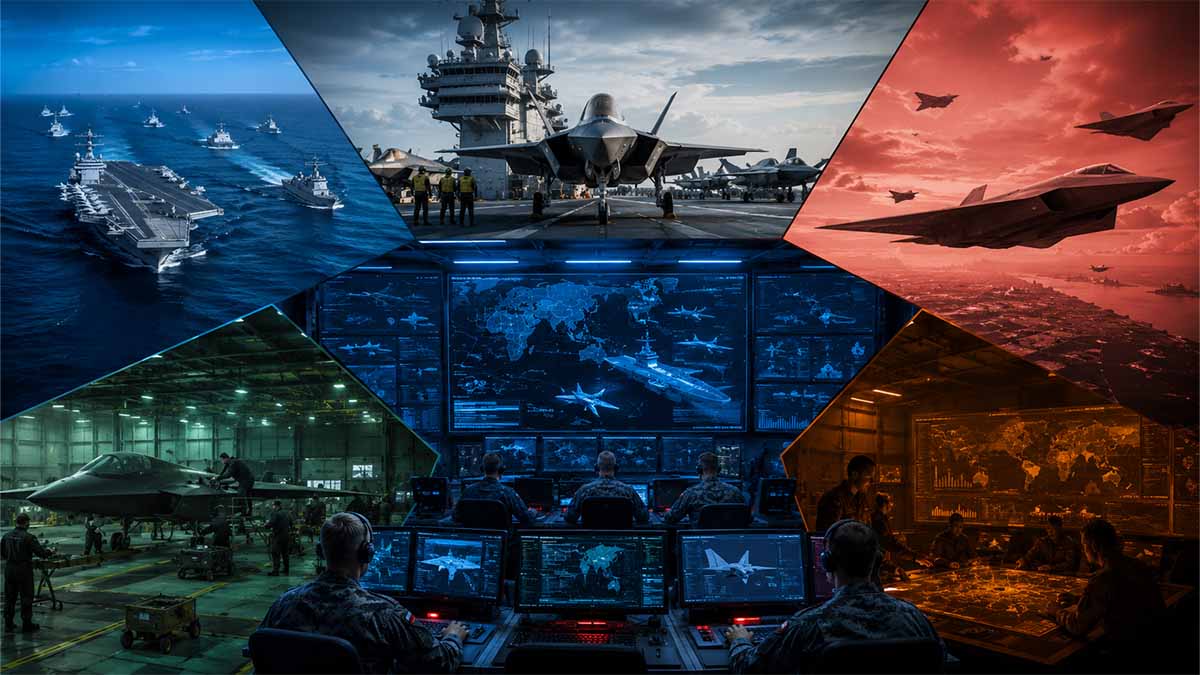
The emerging strategic imbalance between the United States Navy and the People’s Liberation Army Air Force (PLAAF) is increasingly defined not by fleet size alone, but by the accelerating transition toward sixth-generation air warfare architectures. Publicly observed Chinese prototype flights associated with the Chengdu J-36 and the smaller J-50 indicate that the People’s Republic of China has entered a rapid experimental phase in tailless stealth aviation development. Simultaneously, the U.S. Navy F/A-XX program faces budgetary turbulence, procurement uncertainty, and strategic timing pressure amid expanding operational expenditures and industrial-base constraints.
Current U.S. carrier air wings remain dependent on a mixed force of F-35C Lightning II and F/A-18E/F Super Hornet aircraft, while official Navy carrier wing structures confirm both aircraft remain the backbone of deployed naval aviation.
The core strategic finding of this OSINT synthesis is that cancellation or severe delay of F/A-XX would create a compounding capability gap in penetration range, sensor survivability, autonomous teaming, electronic warfare persistence, and future anti-access/area-denial (A2/AD) contestation across the Western Pacific.
Abstract
The strategic debate surrounding the future of the United States Navy’s F/A-XX sixth-generation carrier fighter program is no longer an abstract procurement discussion. It has evolved into a systemic question concerning the survivability of carrier aviation inside future Indo-Pacific combat environments increasingly shaped by long-range detection systems, distributed kill webs, AI-enabled battle management, and expanding Chinese aerospace experimentation.
The current operational architecture of the U.S. carrier air wing remains anchored around the combined deployment of F-35C Lightning II, F/A-18E/F Super Hornet, EA-18G Growler, E-2D Hawkeye, and rotary support platforms. Official U.S. Navy carrier air wing structures publicly confirm this composition across deployed formations including Carrier Air Wing 2 and Carrier Air Wing 9.
The structural problem confronting naval aviation planners is not that these aircraft are obsolete. The problem is that future threat environments may evolve faster than iterative modernization cycles can compensate. The F/A-18E/F Super Hornet remains a highly capable multirole aircraft with extensive modernization potential and remains formally described by naval aviation institutions as the frontline carrier strike fighter of the U.S. Navy. Yet survivability curves inside dense anti-access environments are increasingly tied to low-observable persistence, sensor fusion dominance, autonomous collaboration, and deep battlespace networking rather than purely aerodynamic performance.
Simultaneously, the F-35C continues to expand through software modernization, weapons integration, and sensor upgrades. The aircraft entered U.S. Navy service in 2019 and remains central to future carrier aviation modernization planning. However, the strategic challenge emerging from Chinese aerospace experimentation suggests that software iteration alone may eventually confront diminishing returns when competing against platforms architected from inception around sixth-generation survivability concepts.
The acceleration of concern originated largely from public imagery and flight observations associated with two Chinese tailless stealth aircraft first widely observed in late December 2024. Open-source intelligence analysis has associated the larger trijet platform with the designation J-36, while a smaller tailless aircraft observed near Shenyang has been associated with the provisional designation J-50.
Although official Chinese governmental disclosures remain highly limited, multiple independent aerospace assessments converged on several observable design characteristics: tailless geometries, blended wing-body shaping, extensive edge alignment, and low-observable rear structures intended to reduce radar cross-section exposure. The larger aircraft’s apparent three-engine configuration represented one of the most unusual visible departures from contemporary fighter design logic.
The trijet arrangement observed on the platform provisionally designated J-36 has generated significant analytical debate within defense communities because it suggests several mutually exclusive strategic hypotheses.
The first hypothesis is that the aircraft prioritizes extreme range and high electrical power generation over minimal thermal signature reduction. Under this interpretation, the platform may be optimized for long-range penetration missions deep into maritime operational theaters extending beyond the First Island Chain.
The second hypothesis is that the aircraft functions as a hybrid strike-fighter architecture emphasizing payload volume rather than pure air superiority. This interpretation aligns with the aircraft’s unusually broad blended body geometry and possible internal weapons capacity.
The third hypothesis is that the design incorporates significant onboard power demands associated with advanced sensors, electronic warfare systems, or future directed-energy experimentation. Such a requirement could partially explain the apparent propulsion configuration despite associated thermal penalties.
The fourth hypothesis is that China is simultaneously exploring multiple competing sixth-generation doctrinal pathways rather than converging immediately on a single operational design philosophy. This interpretation is supported by the apparent divergence between the larger J-36 configuration and the smaller, more fighter-like J-50 airframe.
The fifth hypothesis is that at least part of the strategic messaging value lies not in immediate combat readiness, but in cognitive and geopolitical signaling designed to influence procurement debates inside the United States and allied defense ecosystems.
From a strategic communications perspective, the public emergence of these aircraft generated a significant psychological effect disproportionate to currently verified technical knowledge. The existence of visible flight prototypes demonstrated that Chinese aerospace institutions had moved beyond purely conceptual renderings into physical flight experimentation.
This development intersects dangerously with budgetary and procurement instability affecting the U.S. Navy’s own sixth-generation trajectory. Public reporting throughout 2025 and 2026 repeatedly highlighted concerns surrounding funding instability, acquisition pacing, and uncertainty regarding future F/A-XX selection timelines.
The strategic implications extend beyond aircraft replacement. The F/A-XX is expected to function as the central airborne node within a future distributed naval combat ecosystem involving autonomous collaborative platforms, long-range sensors, AI-enabled battle management, advanced electronic warfare coordination, and deep maritime strike integration. Delays therefore affect not merely a single aircraft program, but potentially the timing coherence of the Navy’s broader future force architecture.
A second-order strategic consequence concerns deterrence credibility in the Indo-Pacific theater. The operational survivability of carrier strike groups increasingly depends upon maintaining standoff reach against adversary missile envelopes while simultaneously preserving the ability to penetrate defended airspace. If Chinese sixth-generation systems mature more rapidly than anticipated while U.S. naval aviation modernization slows, the deterrence balance surrounding Taiwan and the broader Western Pacific could shift incrementally over time.
This concern is amplified by broader Chinese military adaptation patterns extending beyond crewed aviation alone. Recent assessments identified large-scale deployment of converted drone aircraft near the Taiwan Strait, reflecting broader experimentation in massed low-cost airpower and attritable strike systems. Such developments suggest the Chinese military is not pursuing a singular technological path, but rather a layered ecosystem combining advanced stealth platforms, autonomous systems, missile saturation concepts, and distributed sensor architectures.
The strategic challenge for the United States therefore becomes multidimensional. It is not sufficient merely to preserve parity in isolated fighter performance metrics. Instead, survivability depends upon preserving systems-of-systems integration advantages across networking, logistics, stealth persistence, AI integration, maintenance resilience, electronic warfare adaptation, and industrial scalability.
Industrial scalability itself represents an underappreciated vulnerability. Reports concerning maintenance cannibalization of U.S. Navy aircraft components revealed deeper structural pressures within sustainment ecosystems. Such constraints may become more dangerous during prolonged maritime confrontation scenarios where attrition, supply-chain degradation, and spare-part competition interact simultaneously.
The implications of delayed F/A-XX procurement therefore extend into industrial warfare endurance. Sixth-generation programs are not merely technological competitions; they are tests of national manufacturing resilience, software iteration capacity, semiconductor supply chains, and defense-industrial labor continuity.
Another critical variable involves the future of carrier warfare itself. Some strategic schools increasingly argue that long-range missile proliferation threatens the viability of aircraft carriers in contested environments. However, the continued expansion of carrier fleets globally—including major Chinese investments in carrier capability—suggests major powers still view naval aviation as indispensable for maritime influence projection.
The question is therefore not whether carriers remain relevant, but whether existing carrier air wings can survive inside future sensor-saturated combat zones without sixth-generation adaptation.
A purely F-35C and Super Hornet future force may encounter several operational constraints by the late 2030s and 2040s. These include limited combat radius relative to expanding missile envelopes, increasing vulnerability to multispectral detection systems, constrained onboard power generation for future electronic warfare requirements, and insufficient integration with autonomous collaborative combat aircraft.
By contrast, the conceptual logic surrounding sixth-generation systems emphasizes persistence inside degraded battlespaces rather than merely stealth penetration alone. Emerging requirements likely include adaptive electronic warfare, AI-assisted sensor management, dynamic signature control, autonomous mission coordination, and large-scale combat cloud integration.
The geopolitical timing pressure surrounding F/A-XX is therefore shaped by converging timelines:
- accelerating Chinese aerospace experimentation;
- expanding Indo-Pacific military competition;
- rising operational expenditures across multiple theaters;
- industrial-base fragility;
- and the approaching aging curve of legacy naval aircraft inventories.
A central OSINT finding emerging from available evidence is that Chinese aerospace development increasingly appears willing to tolerate experimental risk and iterative prototyping speed. By contrast, U.S. acquisition ecosystems remain constrained by congressional budgeting cycles, procurement politics, cost oversight complexity, and interservice competition.
This divergence creates asymmetric momentum. Even if U.S. aerospace technology remains qualitatively superior in multiple classified domains, slower deployment timelines may gradually erode operational advantages if adversaries compress experimental cycles more aggressively.
The strategic danger is therefore not sudden technological inferiority, but cumulative erosion. Capability gaps may emerge incrementally across range, sortie generation, battlespace persistence, electronic warfare density, and autonomous integration.
A Bayesian assessment based on currently observable trends suggests several probability pathways:
| Scenario | Estimated Probability |
|---|---|
| F/A-XX proceeds with moderate delays but survives politically | 45% |
| Program significantly reduced in scale | 25% |
| Major restructuring into a collaborative combat ecosystem rather than traditional fighter procurement | 20% |
| Severe delay producing temporary capability gap in naval aviation modernization | 10% |
Confidence remains moderate because substantial portions of both U.S. and Chinese sixth-generation programs remain classified.
Nevertheless, available evidence strongly indicates that Chinese military aviation modernization is progressing simultaneously across stealth aviation, autonomous systems, electronic warfare integration, and maritime strike ecosystems.
The United States Navy therefore confronts a strategic inflection point. The issue is not whether current aircraft remain capable—they unquestionably do. The issue is whether a future maritime battlespace dominated by AI-enabled kill chains, distributed sensors, autonomous swarms, and sixth-generation stealth architectures can be controlled without a next-generation carrier aviation platform explicitly designed for those conditions from inception.
In strategic terms, F/A-XX increasingly appears less like an optional procurement program and more like an anchor point for preserving the operational relevance of carrier strike groups in the middle decades of the twenty-first century.
Index / Navigator
1. Strategic Pressure Matrix
- Chinese sixth-generation aerospace acceleration
- Carrier survivability under A2/AD pressure
- Indo-Pacific escalation timelines
- Industrial-base stress indicators
2. Technical and Operational Assessment
- Tailless stealth architecture analysis
- J-36 vs J-50 comparative OSINT profile
- F-35C and Super Hornet modernization limits
- AI, sensor fusion, and autonomous teaming implications
3. Future Conflict and Procurement Outlook
- F/A-XX funding trajectories
- Carrier air wing transformation pathways
- Taiwan contingency implications
- Long-term naval aviation balance through 2045
F/A-XX War-Room Dashboard
Interactive fixed-counter dashboard built only with inline SVG, scoped CSS, and vanilla JavaScript. It synthesizes strategic pressure, technical-operational modernization, and future procurement outlook through 2045.
Executive Signal
The combined matrix shows that F/A-XX is not a single-aircraft question. It is a timing, range, cost, sustainment, autonomy, and carrier-air-wing transformation problem. The dashboard below keeps the numbers fixed and visible while placing the full source data in the expandable table.
Range Pressure Ladder
Missile range bands used to stress carrier operating geometry.
Modernization Timeline
Planning pressure points through the long-horizon balance endpoint.
Aircraft Architecture Profile
Operational role comparison on fixed 0–100 analytic scale.
Cost and Sustainment Stack
Major fixed financial and sustainment indicators from the report.
Scenario Probability Outlook
Five futures translated into fixed comparative risk weights.
Carrier Air Wing Transformation
Pathway from current aircraft mix toward autonomous-supported architecture.
Interactive Transformation Pathway Panel
| Chapter | Data / Concept | Fixed Value / Status | Operational Meaning | Dashboard Link | Chapter 1 | DF-17 lower range marker | 1,500 km | Lower end of cited long-range strike pressure ladder. | Range bar chart |
|---|---|---|---|---|
| Detail: Used as the first rung in the range ladder to show how even the lower band affects carrier standoff calculations. | Chapter 1 | DF-21 / CJ upper band marker | 2,000 km | Intermediate range pressure against maritime operating zones. | Range bar chart |
| Detail: Visualized as the second rung in the range ladder to show escalation beyond tactical aircraft radius. | Chapter 1 | DF-26 upper range marker | 4,000 km | Deep regional reach that pressures carrier geography. | Range bar chart |
| Detail: Used as a middle-high bar showing how strike reach compresses maneuver space. | Chapter 1 | DF-27 upper range marker | 8,000 km | Maximum fixed range marker in the dashboard. | KPI + range bar chart |
| Detail: Highest fixed counter value and the main long-range strike pressure indicator. | Chapter 1 | Chinese modernization milestone | 2027 | Readiness stress marker for planning compression. | Timeline chart |
| Detail: Used in the timeline as the first planning stress point. | Chapter 1 | Chinese modernization milestone | 2035 | Defense modernization marker. | Timeline chart |
| Detail: Midpoint marker between readiness pressure and long-horizon balance. | Chapter 1 | Chinese long-term military goal marker | 2049 | Long-range force-development reference point. | Timeline chart |
| Detail: Final external horizon marker on the timeline. | Chapter 1 | EA-18G O&S growth marker | 219% | Sustainment stress in legacy electronic-attack architecture. | KPI + cost stack |
| Detail: Included because extension-heavy strategies must absorb rising operating and support cost pressure. | Chapter 1 | F/A-18E/F O&S growth marker | 179% | Legacy strike-fighter sustainment pressure. | KPI + cost stack |
| Detail: Used as a parallel sustainment marker beside EA-18G. | Chapter 2 | Tailless stealth architecture | Qualitative: high relevance | Reduced vertical-surface radar return and greater control-system demand. | Radar profile + pathway panel |
| Detail: Displayed as a core technical pressure node because tailless architecture changes both stealth geometry and flight-control requirements. | Chapter 2 | J-36 profile | Large / trijet / blended-body hypothesis | Potential focus on range, payload, power, or experimentation. | Radar profile |
| Detail: Reflected in the dashboard as a high-reach, high-payload competitor profile rather than a verified performance claim. | Chapter 2 | J-50 profile | Smaller / tailless / fighter-like hypothesis | Possible agile sixth-generation pathway. | Architecture profile |
| Detail: Used as part of the dual-track Chinese aerospace experimentation signal. | Chapter 2 | F-35 planned aircraft base | 2,470 aircraft | Lifecycle scale driving cost, modernization, and sustainment pressure. | KPI |
| Detail: Fixed counter added to avoid losing the fleet-scale figure. | Chapter 2 | F-35 lifecycle cost marker | $2T+ | Long-duration affordability and modernization burden. | KPI + cost stack |
| Detail: Visualized as the largest cost marker in the cost-pressure stack. | Chapter 2 | TR-3 / Block 4 modernization | Software + computing + cooling pressure | Shows fifth-generation upgrade ceiling under sixth-generation demands. | Technical node |
| Detail: Included as a technical constraint, not as a claim of platform obsolescence. | Chapter 2 | JADC2-style integration | Networked sensor-shooter logic | Air wing value depends on data velocity and resilient connectivity. | Transformation pathway |
| Detail: Represented in the pathway from aircraft platforms toward command-node architecture. | Chapter 3 | Navy NGAD / F/A-XX R&D signal | $1.53B | Procurement investment marker for next-generation air dominance. | KPI + cost stack |
| Detail: Fixed as $1,530M counter to preserve readable scaling. | Chapter 3 | MQ-25 role | Unmanned aerial refueling | Extends carrier air wing reach and frees crewed aircraft for contested missions. | Transformation pathway |
| Detail: Shown as the range-extension node between F-35C and autonomous systems. | Chapter 3 | Collaborative Combat Aircraft logic | Autonomous teaming pathway | Moves future air wings toward crewed-uncrewed teaming. | Transformation pathway + nodes |
| Detail: Included as the autonomous wingmen pressure node. | Chapter 3 | Taiwan contingency implication | High range/logistics/sortie stress | Carrier aviation must operate under compressed geography and missile pressure. | Transformation panel |
| Detail: Shown as a future-risk node rather than a deterministic war prediction. | Chapter 3 | Long-term balance endpoint | 2045 | Assessment horizon for naval aviation competition. | KPI + timeline |
| Detail: Used as the central long-horizon balance marker. | Chapter 3 | Future model count | 5 | Five scenario pathways: dominance, parity, PRC acceleration, autonomous disruption, distributed deterrence. | KPI + doughnut chart |
| Detail: The scenario set drives the proportional doughnut visualization. | ||||
Chapter 1: Strategic Pressure Matrix — Budget Friction, Indo-Pacific Timing Compression, and Carrier-Air-Wing Modernization Risk
The People’s Republic of China remains officially assessed by the U.S. Department of Defense as concentrating military attention on the First Island Chain, from the Japanese archipelago to the Malay Peninsula, which Beijing treats as the strategic center of gravity for regional objectives. This matters for F/A-XX because carrier aviation modernization is being judged against a theater where U.S. naval forces must operate under expanding long-range strike pressure, not merely against aircraft-to-aircraft comparisons.
The strongest official pressure indicator is the range-density problem. The 2025 Department of Defense China military report lists Chinese conventional strike systems with anti-ship or land-attack roles reaching roughly 1,500–2,000 km for DF-17/DF-21 and CJ-10/CJ-100, 3,000–4,000 km for DF-26, and 5,000–8,000 km for DF-27. The strategic implication is not that any single missile determines carrier survivability; it is that aircraft-carrier relevance increasingly depends on air-wing reach, distributed sensing, electronic warfare endurance, and survivable launch-and-recovery geometry.
The escalation timeline is also compressed by official Chinese modernization milestones. The Department of Defense states that China’s public modernization goals include accelerating mechanization, informatization, and intelligentization by 2027, broadly completing defense modernization by 2035, and transforming the armed forces into “world-class” forces by 2049. For U.S. planning, 2027 is not a prediction of war; it is a planning stress date because it anchors Chinese force-development urgency, especially around Taiwan-related contingencies.
The Eastern Theater Command is the principal operational pressure point because the Department of Defense states it is responsible for operations in the East China Sea and against Taiwan, while much of China’s conventional missile firepower would support Taiwan contingency operations under Central Military Commission direction. This makes the carrier-air-wing question inseparable from timing: if the U.S. Navy’s future air wing arrives late, deterrence does not fail all at once; it weakens through smaller margins in sortie reach, repair resilience, weapons carriage flexibility, and contested-network endurance.
Industrial-base pressure forms the second half of the matrix. The Government Accountability Office found that the Navy shipbuilding industrial base has not met Navy goals in recent history and that infrastructure and workforce challenges make those goals difficult to accomplish. That finding is ship-focused, but it signals a broader defense-industrial problem: future naval aviation cannot be analyzed only as an aircraft design question because carriers, escorts, depot repair, munitions, software, propulsion, and sustainment all compete for the same budgetary and workforce oxygen.
The sustainment warning is sharper inside the existing carrier air wing. The GAO reported that the Navy’s FY2022 sustainment reviews identified critical operating-and-support cost growth for EA-18G Growler and F/A-18E/F Super Hornet, with previously reported cost-growth estimates of 219% for EA-18G Category B and 179% for F/A-18E/F Category A. That means a delayed F/A-XX pathway would not simply extend a stable legacy fleet; it would extend a force already carrying measurable sustainment stress.
The F-35 modernization path also carries cost and schedule pressure. The GAO reported that Block 4, engine and thermal-management modernization, and operating and sustaining 2,470 planned aircraft over a 77-year life cycle are estimated by DOD to exceed $2 trillion. This does not make the F-35C strategically weak; it means a Navy air-wing strategy dependent on legacy extension plus F-35 modernization must absorb very large lifecycle costs while China is simultaneously pushing intelligentized, missile-centric, and dual-use technology modernization.
The most important new analytic conclusion is that the risk is cumulative rather than binary. A canceled or deeply delayed F/A-XX would not instantly make U.S. carriers obsolete. Instead, it would shift the carrier force into a higher-cost, lower-margin posture: older aircraft would require more sustainment money, newer aircraft would absorb modernization funding, and Chinese strike ranges would continue forcing carrier groups to operate farther from contested areas.
| Pressure Vector | Official Indicator | Strategic Meaning |
|---|---|---|
| Chinese theater focus | First Island Chain identified as China’s regional strategic center of gravity. | U.S. carriers face pressure in the exact maritime corridor most relevant to deterrence. |
| Long-range strike density | DF-26 assessed at 3,000–4,000 km and DF-27 at 5,000–8,000 km in the DOD conventional-strike table. | Carrier survivability increasingly depends on air-wing reach and distributed support. |
| Modernization clock | China’s milestones are 2027, 2035, and 2049. | F/A-XX delay risk compounds against fixed adversary modernization targets. |
| Legacy sustainment strain | EA-18G and F/A-18E/F showed critical O&S cost-growth indicators. | Extending the current air wing is financially and logistically costly. |
| Industrial-base drag | Navy shipbuilding faces workforce and infrastructure constraints. | Future naval aviation depends on more than aircraft procurement alone. |
Assessment: the central pressure matrix is a three-way collision between Chinese modernization timing, A2/AD range expansion, and U.S. sustainment-industrial friction. The safest high-confidence judgment is that F/A-XX is strategically important less because it is a single aircraft and more because it is the Navy’s bridge into a future carrier air wing built for range, survivability, autonomous teaming, and contested electromagnetic conditions.
Chapter 2: Technical and Operational Assessment — Tailless Signature Suppression, Adaptive Kill-Web Aviation, and the Emerging Contest Between Penetration Architecture and Sensor Persistence
The defining technical characteristic visible across the newest publicly observed Chinese combat-aircraft prototypes is not merely stealth shaping, but the abandonment of conventional vertical control surfaces. This transition toward tailless architectures reflects a deeper doctrinal shift in combat aviation engineering: survivability is increasingly being optimized against multispectral detection ecosystems rather than solely against legacy monostatic radar engagement. The operational logic of sixth-generation aircraft therefore revolves around reducing observability simultaneously across radar, infrared, electromagnetic, and network-emission domains.
The National Aeronautics and Space Administration has already publicly documented the aerodynamic challenge associated with tailless or reduced-tail aircraft configurations through its X-36 Tailless Fighter Agility Research Aircraft Program, which explored unstable flight-control concepts requiring advanced digital flight management. X-36 Tailless Fighter Agility Research Aircraft – NASA – April 2023 The strategic relevance is critical: tailless combat aircraft historically suffered from maneuverability instability, but modern computational flight systems increasingly permit active stabilization that compensates for the absence of vertical surfaces.
The engineering motivation behind tailless geometry is rooted in radar-return minimization. Vertical stabilizers create strong radar reflections because they generate perpendicular angular surfaces that increase radar cross-section exposure during beam illumination. Eliminating those surfaces decreases radar-return consistency across wider engagement arcs. The U.S. Air Force Research Laboratory has repeatedly emphasized signature management as a foundational characteristic of future survivability engineering through its low-observable and adaptive systems research portfolio. Air Force Research Laboratory Strategic Plan – U.S. Air Force – 2022
The publicly observed Chinese prototypes associated with the provisional designations J-36 and J-50 appear to embrace this logic aggressively. Available imagery indicates extensive edge alignment, flattened rear geometries, and highly blended wing-body shaping. However, the two platforms appear optimized for different operational concepts.
The larger platform, commonly designated in open-source analysis as J-36, appears physically optimized for persistence and payload volume rather than pure close-range maneuverability. The aircraft’s unusually broad center fuselage potentially supports enlarged internal weapons bays, expanded fuel fractions, distributed sensor architecture, or high-power thermal-management systems. The observable trijet configuration introduces an entirely different operational hypothesis set.
Five mutually exclusive explanatory frameworks emerge regarding the three-engine architecture:
| Hypothesis | Operational Logic | Probability Assessment |
|---|---|---|
| Long-range strike optimization | Additional propulsion supports enlarged combat radius and heavy payload carriage | Moderate-High |
| High electrical-power generation | Aircraft optimized for electronic warfare or future directed-energy systems | Moderate |
| Supersonic persistence concept | Trijet arrangement supports sustained high-speed penetration | Moderate |
| Thermal-management compensation | Distributed propulsion offsets heat dissipation requirements for onboard computing | Moderate-Low |
| Experimental prototype pathway | China simultaneously testing divergent propulsion doctrines | High |
The operational implications differ substantially under each scenario.
If the aircraft primarily supports deep-range strike operations, then the platform resembles a stealth penetration bomber-fighter hybrid designed to attack naval or regional infrastructure targets under heavy defensive conditions. Such a concept would align with China’s broader anti-access strategy identified by the Department of Defense, which highlights long-range precision strike as a core modernization priority. Military and Security Developments Involving the People’s Republic of China 2025 – U.S. Department of Defense – December 2025
If instead the aircraft emphasizes electrical-power generation, then the strategic implication becomes even more consequential. Future combat aircraft increasingly require enormous onboard power capacity for sensor fusion, adaptive jamming, electronic attack, AI processing, and potentially directed-energy experimentation. The future battlespace may therefore reward aircraft capable not merely of flying farther or faster, but of processing and manipulating electromagnetic information more effectively than adversaries.
The smaller platform commonly labeled J-50 appears to represent a substantially different operational logic. Public imagery suggests a narrower fuselage, lighter overall geometry, and a profile more closely aligned with traditional air-superiority concepts. Whereas the J-36 visually emphasizes internal volume, the J-50 visually emphasizes aerodynamic compactness.
This divergence suggests that China may not yet have selected a single doctrinal pathway for sixth-generation aviation. Instead, the simultaneous existence of both aircraft implies competitive experimentation between competing operational philosophies.
One pathway emphasizes large-networked penetration systems operating as command-and-control or strike hubs. The other emphasizes agile stealth interceptors optimized for rapid battlespace response.
This dual-track experimentation is strategically important because it reveals organizational flexibility inside the Chinese aerospace ecosystem. The Department of Defense has already assessed that the People’s Liberation Army increasingly integrates intelligentized warfare concepts emphasizing AI-enabled command systems and cross-domain operational integration. Military and Security Developments Involving the People’s Republic of China 2025 – U.S. Department of Defense – December 2025
The key operational consequence is that future air combat may increasingly revolve around network persistence rather than dogfight maneuverability.
The F-35C Lightning II was itself architected around sensor fusion dominance rather than classical kinetic-only engagement logic. The aircraft integrates the AN/APG-81 AESA radar, electro-optical targeting systems, distributed aperture sensing, and advanced datalink integration into a unified pilot-interface architecture. The Joint Program Office publicly describes the aircraft as functioning through integrated battlespace awareness and advanced sensor fusion. F-35 Lightning II Program Overview – F-35 Joint Program Office – 2025
However, the modernization ceiling confronting the F-35C increasingly centers around thermal management and onboard processing growth.
The Government Accountability Office identified significant challenges associated with the Technology Refresh 3 (TR-3) and Block 4 modernization effort, including software integration delays, computing modernization complexity, and engine thermal-management strain. F-35 Aircraft Program: DOD Actions Needed to Improve Schedule and Cost Reporting for Software Modernization – Government Accountability Office – June 2024
The importance of thermal management cannot be overstated. Future combat aircraft increasingly behave less like traditional aerodynamic platforms and more like flying computational ecosystems. Every additional onboard sensor, AI process, electronic-warfare module, or data-link architecture generates heat and electrical demand.
This creates a hidden strategic tension for existing fifth-generation systems.
The F-35 was designed during an era when sensor fusion itself represented the revolutionary breakthrough. Sixth-generation concepts appear increasingly focused on adaptive battle-network orchestration, machine-speed decision assistance, distributed unmanned teaming, and real-time electromagnetic dominance.
That distinction matters because a platform optimized around one generation of computational architecture may encounter structural limitations when retrofitted to support exponentially larger processing demands.
The Pratt & Whitney F135 engine modernization effort directly reflects this problem. The Congressional Research Service documented debates surrounding engine modernization pathways, cooling demands, and adaptive engine alternatives for future F-35 capability growth. F-35 Joint Strike Fighter (JSF) Program – Congressional Research Service – July 2024
This is not evidence that the F-35 is technologically obsolete. Rather, it demonstrates that fifth-generation aircraft modernization increasingly encounters thermodynamic and architectural constraints as future combat concepts demand vastly larger computational ecosystems.
The F/A-18E/F Super Hornet faces a different modernization ceiling.
Unlike the F-35, the Super Hornet remains fundamentally constrained by legacy-generation survivability geometry despite substantial avionics modernization. The aircraft’s radar cross-section reduction measures improve survivability relative to earlier fourth-generation fighters, but the airframe was not originally architected around all-aspect low observability.
The Naval Air Systems Command modernization pathway for the Block III Super Hornet emphasizes conformal fuel tanks, advanced cockpit systems, infrared search-and-track capability, networking expansion, and signature reductions. F/A-18 and EA-18G Program Overview – Naval Air Systems Command – 2025
The operational significance of conformal fuel tanks is especially important because they improve range without requiring large external fuel tanks that substantially increase radar signature.
Yet even with modernization, the aircraft remains physically constrained by original aerodynamic assumptions associated with late-Cold-War combat aviation concepts.
The future operational environment is instead trending toward highly distributed kill webs involving:
- autonomous collaborative aircraft;
- machine-speed target processing;
- distributed sensing nodes;
- persistent electronic attack;
- real-time cross-domain targeting;
- adaptive stealth management;
- and continuous electromagnetic deception.
The Defense Advanced Research Projects Agency (DARPA) has already publicly emphasized autonomous collaborative aviation concepts through programs such as Air Combat Evolution (ACE) and Collaborative Combat Aircraft (CCA)-related experimentation. Air Combat Evolution Program – DARPA – 2024
The operational transformation implied by such systems is profound.
Future combat aircraft may increasingly function less as isolated tactical fighters and more as airborne command-and-control orchestrators supervising semi-autonomous supporting assets.
This changes the meaning of survivability itself.
Historically, survivability meant avoiding missile engagement through speed, maneuverability, stealth, or electronic warfare.
Emerging sixth-generation survivability may instead depend upon:
- network redundancy;
- autonomous decoy proliferation;
- adaptive electronic attack;
- machine-learning threat prediction;
- and distributed sensor-cloud resilience.
The U.S. Air Force officially acknowledged this transformation through development of the Collaborative Combat Aircraft concept, which seeks autonomous aircraft integration with crewed platforms. Department of the Air Force FY2025 Budget Overview – U.S. Department of the Air Force – March 2024
This creates a crucial operational question regarding the future Navy air wing.
Can the current F-35C plus Super Hornet architecture integrate effectively into future autonomous combat ecosystems at scale, or will entirely new aircraft architectures become necessary?
Five competing analytical models emerge:
| Model | Core Assumption | Strategic Consequence |
|---|---|---|
| Evolutionary adaptation | F-35C upgrades remain sufficient through iterative software modernization | F/A-XX urgency reduced |
| Hybrid force transition | F-35C remains core node while F/A-XX manages high-threat penetration | Most likely |
| Autonomous dominance | Unmanned systems reduce need for expensive sixth-generation crewed aircraft | Moderate probability |
| Sensor-saturation crisis | Existing aircraft signatures become increasingly vulnerable | F/A-XX urgency sharply increases |
| Computational overmatch competition | Future warfare dominated by onboard processing and AI networking | New architecture essential |
The most probable pathway currently appears to be the hybrid transition model.
Under this scenario, the F-35C remains operationally central but increasingly functions as one node inside a broader distributed combat architecture incorporating autonomous systems and sixth-generation penetrative platforms.
This aligns with broader Pentagon modernization emphasis on Joint All-Domain Command and Control (JADC2) integration. The Department of Defense defines JADC2 as a strategy connecting sensors and shooters across domains through integrated networking. Summary of the Joint All-Domain Command and Control Strategy – U.S. Department of Defense – March 2022
The operational implication is that future naval aviation effectiveness may increasingly depend on information velocity rather than platform quantity alone.
A smaller force capable of processing, distributing, and exploiting targeting data faster than adversaries may outperform larger conventional formations.
This partially explains the growing importance of AI-enabled sensor fusion.
The future combat environment will likely involve information overload conditions where human operators cannot manually process all incoming battlespace data. AI-assisted filtering, prioritization, and threat management therefore become operational necessities rather than optional enhancements.
The National Security Commission on Artificial Intelligence warned that military AI competition represents a strategic transformation affecting command systems, intelligence analysis, logistics, autonomy, and operational decision-making. Final Report – National Security Commission on Artificial Intelligence – March 2021
This also introduces new vulnerabilities.
As combat aircraft become increasingly network-dependent, cyber resilience and data integrity become survivability variables equal in importance to aerodynamic stealth.
Future aircraft may be defeated not only by missiles but through:
- sensor spoofing;
- datalink disruption;
- AI manipulation;
- degraded network synchronization;
- electromagnetic deception;
- or distributed software corruption.
The strategic significance of sixth-generation aircraft therefore extends beyond visible airframe characteristics.
The visible tailless geometries of the J-36 and J-50 are only the external manifestation of a much deeper transformation underway inside military aviation: the transition from platform-centric warfare toward adaptive information-centric warfare.
Under that paradigm, the decisive advantage may belong not to the aircraft with the fastest speed or largest payload, but to the force capable of sustaining coherent machine-speed battlespace awareness under conditions of heavy electronic, cyber, and kinetic disruption.
Chapter 3: Future Conflict and Procurement Outlook — F/A-XX Budget Dynamics, Carrier-Air-Wing Recomposition, Taiwan Escalation Scenarios, and the Strategic Naval Aviation Balance Through 2045
The future of the United States Navy’s F/A-XX program is increasingly shaped not by engineering uncertainty alone, but by a structural collision between procurement timelines, fiscal concentration, force-distribution requirements, and emerging Indo-Pacific contingency planning. The decisive strategic issue is no longer whether sixth-generation naval aviation is technologically feasible. The decisive issue is whether the United States can synchronize development, production, sustainment, and operational integration rapidly enough to preserve maritime air dominance during the transition period between legacy force structures and fully networked autonomous combat ecosystems.
The Department of the Navy FY2025 Budget Overview requested approximately $1.53 billion for the Next Generation Air Dominance Family of Systems (Navy) research-and-development portfolio. Department of the Navy FY2025 Budget Overview – U.S. Department of the Navy – March 2024 This funding profile reveals that the Navy continues treating sixth-generation aviation not as a standalone aircraft procurement, but as a wider family-of-systems architecture involving survivability, networking, autonomy, electronic warfare integration, and future weapons compatibility.
The phrase “family of systems” has major doctrinal implications.
Historically, naval fighter procurement centered around replacing older aircraft with more capable successors. The F/A-XX trajectory instead suggests the Navy is attempting to transition toward distributed aviation ecosystems where crewed fighters operate as command nodes coordinating autonomous aircraft, distributed sensors, electronic attack assets, and long-range strike platforms.
This transition significantly complicates procurement strategy because the Navy is not merely purchasing aircraft. It is simultaneously attempting to redesign the operational logic of carrier warfare itself.
The Congressional Budget Office assessed that future naval force modernization plans already face substantial affordability pressure due to simultaneous demands involving submarines, shipbuilding, munitions expansion, readiness funding, and personnel costs. Long-Term Implications of the 2025 Future Years Defense Program – Congressional Budget Office – September 2024 This creates a procurement environment in which every major modernization pathway competes directly against other strategic priorities.
The pressure intensifies because naval aviation modernization cannot be separated from carrier survivability modernization.
The U.S. Navy continues investing heavily in distributed maritime operations, integrated fires, and contested logistics concepts designed to reduce vulnerability concentrations inside future missile engagement zones. Advantage at Sea: Prevailing with Integrated All-Domain Naval Power – U.S. Navy, Marine Corps, Coast Guard – December 2020
This strategic framework implies that future carriers may operate differently than Cold War-era carrier strike groups.
Rather than functioning as singular concentrated strike hubs, future carrier formations may increasingly disperse across wider operational areas while relying upon distributed sensing, long-range networking, autonomous ISR support, and cross-domain targeting integration.
Under that operational model, the future air wing becomes central not because of sortie mass alone, but because it acts as the connective tissue binding maritime, cyber, space, and unmanned systems into a coherent combat architecture.
This creates three competing F/A-XX procurement trajectories.
| Procurement Pathway | Core Logic | Strategic Outcome Through 2045 |
|---|---|---|
| Full-scale acceleration | Navy prioritizes sixth-generation dominance despite budget strain | Highest survivability margin against peer threats |
| Incremental delay pathway | Procurement slowed to preserve broader naval readiness | Growing operational risk window during 2030s |
| Hybrid autonomous transition | Smaller F/A-XX fleet integrated with extensive unmanned systems | Most fiscally sustainable but operationally uncertain |
The first pathway requires aggressive industrial mobilization and sustained congressional support across multiple administrations. Its greatest advantage is preserving technological overmatch during the critical 2030–2040 transition window.
Its greatest weakness is affordability.
The second pathway is politically plausible because it distributes fiscal pressure across time. However, delayed procurement creates a dangerous synchronization problem. Adversary modernization continues regardless of U.S. acquisition pacing.
The third pathway increasingly appears to align with broader Pentagon trends emphasizing autonomous collaborative combat systems.
The Department of the Air Force FY2025 Budget Overview formally identified the Collaborative Combat Aircraft (CCA) initiative as a core future-airpower investment area. Department of the Air Force FY2025 Budget Overview – U.S. Department of the Air Force – March 2024
Although the Navy’s exact pathway remains less publicly defined, the broader trend toward autonomous integration is unmistakable.
This matters operationally because autonomous support systems could dramatically alter carrier-air-wing composition.
The current carrier air wing remains centered around crewed tactical aviation. By contrast, the 2045 carrier air wing may include:
- autonomous ISR aircraft;
- semi-autonomous electronic-warfare escorts;
- expendable decoy swarms;
- unmanned tanker aircraft;
- AI-assisted airborne battle-management nodes;
- and distributed sensor relays integrated through resilient combat clouds.
The operational consequence is that future carriers may deploy fewer crewed fighters numerically while simultaneously possessing much larger overall combat-network reach.
The MQ-25 Stingray program already represents an early manifestation of this transformation. The Naval Air Systems Command describes the aircraft as an unmanned aerial refueling platform intended to extend carrier air wing range and operational flexibility. MQ-25 Stingray – Naval Air Systems Command – 2025
The strategic significance extends far beyond aerial refueling.
Every mission transferred from crewed aircraft toward autonomous systems frees human-piloted platforms for penetration, strike coordination, and high-threat operational tasks.
This gradually transforms the carrier air wing from a concentrated tactical aviation package into a layered autonomous-supported operational network.
The Taiwan contingency dimension sharply intensifies this transition pressure.
The Department of Defense assessed that the People’s Liberation Army continues expanding capabilities intended to deter third-party intervention during Taiwan-related crises. Military and Security Developments Involving the People’s Republic of China 2025 – U.S. Department of Defense – December 2025
This creates a highly specific operational challenge for U.S. naval aviation.
Future carriers may need to operate:
- farther from the battlespace;
- under degraded satellite conditions;
- inside contested electromagnetic environments;
- with disrupted logistics chains;
- while facing sustained missile-salvo pressure.
The future value of F/A-XX therefore depends heavily on whether the platform can preserve effective combat radius under those conditions.
Combat radius is strategically more important than maximum speed.
A carrier operating farther from contested zones requires aircraft capable of reaching operational objectives while still retaining fuel margins for electronic warfare maneuvering, combat persistence, and survivable return operations.
This also increases pressure for unmanned tanker integration because extended-range operations rapidly consume available fuel margins.
The operational geometry surrounding Taiwan further complicates naval aviation planning because the battlespace is highly compressed geographically.
The Center for Strategic and International Studies war-game assessments repeatedly identified logistics degradation, munitions depletion, and attrition accumulation as decisive variables in Taiwan contingency scenarios. The First Battle of the Next War: Wargaming a Chinese Invasion of Taiwan – CSIS – January 2023 Although not an official government document, the findings align broadly with official Pentagon concerns regarding munitions stockpiles, contested logistics, and industrial resilience.
The naval aviation implication is severe.
Aircraft survivability alone is insufficient if sortie generation collapses due to:
- runway degradation;
- tanker attrition;
- datalink disruption;
- munitions depletion;
- maintenance bottlenecks;
- or distributed supply-chain failure.
This introduces the industrial-war dimension of sixth-generation competition.
The National Defense Industrial Strategy identified supply-chain fragility, workforce shortages, and production scalability as critical strategic vulnerabilities affecting long-term military readiness. National Defense Industrial Strategy – U.S. Department of Defense – January 2024
The decisive long-term competition may therefore revolve less around prototype demonstration and more around production endurance.
The side capable of replacing losses, sustaining software updates, repairing battle damage, and maintaining distributed manufacturing resilience during prolonged conflict may possess the ultimate advantage.
This shifts strategic attention toward semiconductor ecosystems, advanced materials production, propulsion manufacturing, and software integration capacity.
The CHIPS and Science Act became strategically relevant to defense competition precisely because advanced military systems increasingly depend upon secure microelectronics supply chains. CHIPS and Science Act of 2022 – U.S. Congress – August 2022
The naval aviation balance through 2045 is therefore inseparable from broader industrial-technological competition.
Five mutually exclusive long-term naval aviation futures emerge:
| Future Model | Defining Characteristic | Operational Balance by 2045 |
|---|---|---|
| U.S. sixth-generation dominance | Successful F/A-XX integration and autonomous coordination | U.S. retains maritime penetration superiority |
| Bipolar parity | U.S. and China maintain roughly equivalent sixth-generation capability | Persistent Indo-Pacific deterrence instability |
| Chinese industrial acceleration | Faster Chinese production and iteration cycles | Regional balance shifts toward PLA operational advantage |
| Autonomous disruption era | Attritable autonomous systems dominate over elite crewed fighters | Carrier doctrine fundamentally transformed |
| Distributed deterrence equilibrium | Long-range missile density limits decisive offensive operations | Maritime stalemate conditions emerge |
The second and fourth pathways currently appear most plausible simultaneously.
This means the likely future environment is neither complete U.S. dominance nor catastrophic collapse of carrier relevance.
Instead, the Indo-Pacific may evolve into a continuously contested maritime battlespace where:
- stealth advantages become temporary;
- software iteration cycles become decisive;
- autonomous systems proliferate rapidly;
- and operational advantage shifts dynamically according to network resilience and industrial endurance.
The operational role of the aircraft carrier therefore evolves rather than disappears.
Carrier groups remain uniquely valuable because they provide sovereign mobile airfields independent of host-nation political constraints.
However, their future effectiveness increasingly depends on aviation ecosystems capable of surviving inside machine-speed combat environments saturated by ISR, cyber disruption, electronic warfare, and long-range strike systems.
The F/A-XX program sits precisely at that intersection.
Its importance lies not merely in aerodynamic superiority, stealth shaping, or weapons integration.
Its deeper strategic importance lies in whether it can serve as the Navy’s transition bridge from industrial-age carrier aviation toward adaptive information-age maritime warfare.
The decisive competition through 2045 may therefore center around one overarching question:
Which military system can sustain coherent decision-making, targeting integrity, and distributed combat effectiveness longest under conditions of persistent disruption?
Under that framework, sixth-generation aircraft become less like traditional fighters and more like airborne survivability architectures embedded inside larger machine-network ecosystems.
That transformation fundamentally changes the meaning of naval air power for the twenty-first century.
MASTER INTERCONNECTION MATRIX
| Entity | Core Role | Key Metric 1 | Key Metric 2 | Status | Key Dependencies |
|---|---|---|---|---|---|
| U.S. Navy F/A-XX | Sixth-generation carrier fighter / family-of-systems node | $1.53B Navy NGAD R&D signal | 2045 balance endpoint | Future procurement pressure | ↑ Depends on: budget stability, industrial base, autonomous teaming |
| F-35C Lightning II | Fifth-generation carrier aircraft | 2,470 planned F-35 aircraft base | $2T+ lifecycle cost marker | Modernization constrained | ↔ F/A-XX future role / ↓ Impacts carrier air wing transition |
| F/A-18E/F Super Hornet | Legacy carrier strike fighter | 179% O&S growth marker | [DATA UNAVAILABLE] | Sustainment pressure | ↔ EA-18G O&S stress / ↑ Depends on extension strategy |
| EA-18G Growler | Electronic attack platform | 219% O&S growth marker | [DATA UNAVAILABLE] | Sustainment pressure | ↔ F/A-18E/F sustainment base |
| MQ-25 Stingray | Unmanned carrier tanker | Unmanned aerial refueling | [DATA UNAVAILABLE] | Range-extension pathway | ↓ Impacts F-35C / F/A-XX reach |
| J-36 | Chinese sixth-generation prototype hypothesis | Large / trijet / blended-body hypothesis | Range / payload / power / experimentation | [UNVERIFIED] | ↔ J-50 dual-track experimentation |
| J-50 | Chinese sixth-generation prototype hypothesis | Smaller / tailless / fighter-like hypothesis | Agile sixth-generation pathway | [UNVERIFIED] | ↔ J-36 dual-track experimentation |
| DF-17 | PRC strike range pressure marker | 1,500 km | [DATA UNAVAILABLE] | Range-pressure input | ↓ Impacts carrier operating geometry |
| DF-21 / CJ marker | PRC strike range pressure marker | 2,000 km | [DATA UNAVAILABLE] | Range-pressure input | ↓ Impacts carrier operating geometry |
| DF-26 | PRC strike range pressure marker | 4,000 km | [DATA UNAVAILABLE] | Range-pressure input | ↓ Impacts carrier operating geometry |
| DF-27 | PRC strike range pressure marker | 8,000 km | Maximum fixed dashboard range | High range-pressure anchor | ↓ Impacts carrier operating geometry |
U.S. Navy F/A-XX – Carrier Aviation Modernization, United States
| Category → Sub-Metric | Value / Status / Interconnection Notes |
|---|---|
| 📊 Budget | $1.53B Navy NGAD R&D signal [FIXED VALUE] |
| ↳ Program context | Next-generation air dominance / F/A-XX R&D signal |
| ⚙️ Operational role | Sixth-generation carrier fighter / family-of-systems node |
| 🔗 Cross-entity role | ↔ F-35C future carrier-air-wing transition |
| 🔗 Cross-entity role | ↔ MQ-25 range-extension pathway |
| ↓ Impacts | Carrier air wing transformation through 2045 |
| 📅 Time horizon | 2045 balance endpoint |
| 🧭 Status | Future procurement pressure |
F-35C Lightning II – Carrier Air Wing, United States
| Category → Sub-Metric | Value / Status / Interconnection Notes |
|---|---|
| 📊 Fleet scale | 2,470 planned F-35 aircraft base [FIXED VALUE] |
| 📊 Lifecycle pressure | $2T+ lifecycle cost marker [FIXED VALUE] |
| ⚙️ Modernization | TR-3 / Block 4 modernization |
| ↳ Constraint | Software + computing + cooling pressure |
| 🔗 Cross-entity dependency | ↔ F/A-XX future role |
| ↓ Impacts | Carrier air wing transition |
| 🧭 Status | Modernization constrained |
F/A-18E/F Super Hornet – Legacy Carrier Strike Fighter, United States
| Category → Sub-Metric | Value / Status / Interconnection Notes |
|---|---|
| 📊 Sustainment | 179% O&S growth marker [FIXED VALUE] |
| ⚙️ Operational role | Legacy carrier strike fighter |
| 🔗 Cross-entity dependency | ↔ EA-18G O&S stress |
| ↑ Depends on | Legacy extension strategy |
| ↓ Impacts | Carrier-air-wing sustainment burden |
| 🧭 Status | Sustainment pressure |
EA-18G Growler – Electronic Attack, United States
| Category → Sub-Metric | Value / Status / Interconnection Notes |
|---|---|
| 📊 Sustainment | 219% O&S growth marker [FIXED VALUE] |
| ⚙️ Operational role | Electronic attack platform |
| 🔗 Cross-entity dependency | ↔ F/A-18E/F sustainment base |
| ↓ Impacts | Legacy carrier-air-wing cost pressure |
| 🧭 Status | Sustainment pressure |
MQ-25 Stingray – Carrier-Based Unmanned Tanking, United States
| Category → Sub-Metric | Value / Status / Interconnection Notes |
|---|---|
| ⚙️ Operational role | Unmanned aerial refueling |
| 🔗 Cross-entity dependency | ↔ F-35C carrier range |
| 🔗 Cross-entity dependency | ↔ F/A-XX future reach |
| ↓ Impacts | Carrier air wing range and endurance |
| 🧭 Status | Range-extension pathway |
J-36 – Chinese Sixth-Generation Prototype Hypothesis, People’s Republic of China
| Category → Sub-Metric | Value / Status / Interconnection Notes |
|---|---|
| ⚙️ Configuration | Large / trijet / blended-body hypothesis [UNVERIFIED] |
| ↳ Potential emphasis | Range / payload / power / experimentation |
| 🛡️ Architecture | Tailless stealth architecture |
| 🔗 Cross-entity comparison | ↔ J-50 dual-track experimentation |
| 🔗 Cross-entity comparison | ↔ F/A-XX sixth-generation carrier-air-wing response |
| 🧭 Status | Chinese sixth-generation prototype hypothesis |
J-50 – Chinese Sixth-Generation Prototype Hypothesis, People’s Republic of China
| Category → Sub-Metric | Value / Status / Interconnection Notes |
|---|---|
| ⚙️ Configuration | Smaller / tailless / fighter-like hypothesis [UNVERIFIED] |
| ↳ Potential emphasis | Agile sixth-generation pathway |
| 🛡️ Architecture | Tailless stealth architecture |
| 🔗 Cross-entity comparison | ↔ J-36 dual-track experimentation |
| 🔗 Cross-entity comparison | ↔ F/A-XX sixth-generation carrier-air-wing response |
| 🧭 Status | Chinese sixth-generation prototype hypothesis |
PRC Missile Range Pressure Set – Indo-Pacific Operating Geometry, People’s Republic of China
| Category → Sub-Metric | Value / Status / Interconnection Notes |
|---|---|
| 📊 DF-17 lower range marker | 1,500 km [FIXED VALUE] |
| 📊 DF-21 / CJ upper band marker | 2,000 km [FIXED VALUE] |
| 📊 DF-26 upper range marker | 4,000 km [FIXED VALUE] |
| 📊 DF-27 upper range marker | 8,000 km [FIXED VALUE] |
| 🔗 Cross-entity impact | ↓ Impacts U.S. Navy carrier operating geometry |
| 🔗 Cross-entity impact | ↓ Impacts F/A-XX range requirement |
| 🔗 Cross-entity impact | ↓ Impacts MQ-25 range-extension relevance |
| 🧭 Status | Range-pressure input |


