














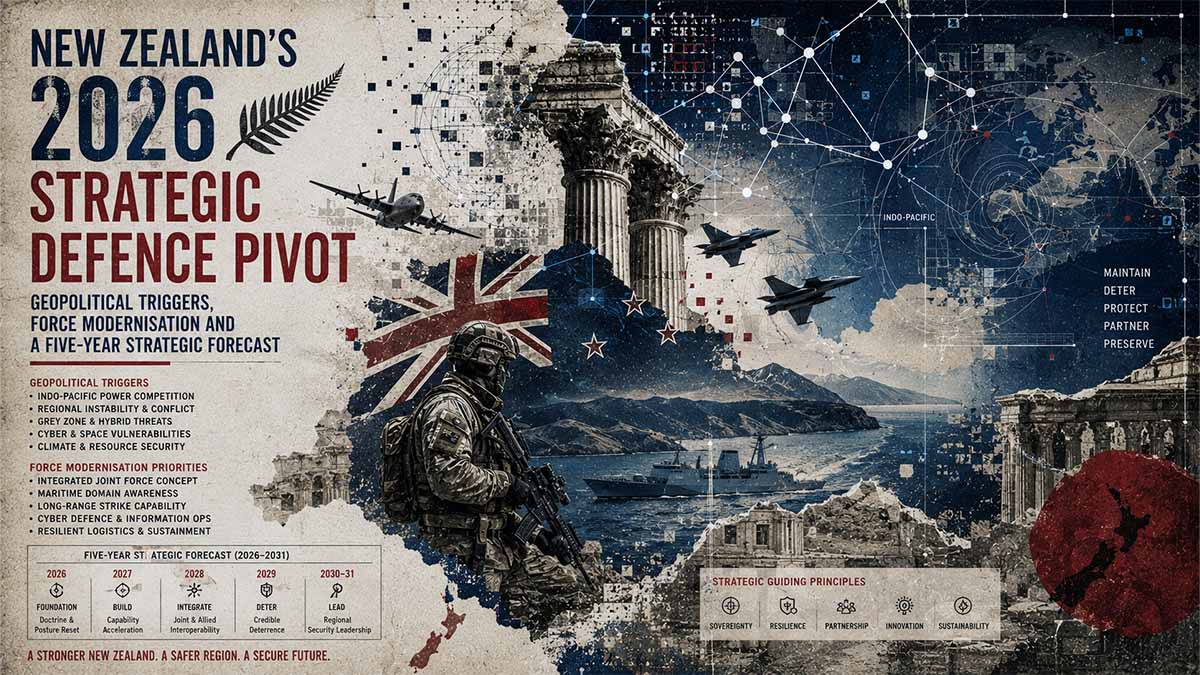
Executive Summary
New Zealand’s FY 2026/27 defence allocation of NZD 6.2 billion (approximately USD 3.7 billion) marks a foundational departure from geographic isolationism toward active regional deterrence. Driven by severe geostrategic structural shifts—specifically the expansionist maritime footprint of the People’s Republic of China (PRC) within the Tasman Sea and the wider South-West Pacific—Wellington has advanced its total defense funding by roughly 6% in nominal terms. Crucially, a 70% surge in capital injections to NZD 422 million signals a targeted effort to rectify historical fleet asset degradation and achieve operational interoperability within the Anzac alliance framework and the Five Eyes intelligence paradigm. This intelligence compendium deconstructs the operational drivers, infrastructure vulnerabilities, and strategic second-to-fifth-order cascades, projecting a five-year fiscal trajectory through 2031.
NZDF FY 2026/27 STRATEGIC ASSESSMENT
3 Critical Risk Drivers
-
PLAN Tasman Sea Penetration
Direct surface-combatant incursions neutralize New Zealand’s historical geographic isolation, transforming maritime approaches into contested zones.
-
Structural Fleet Attrition
Extreme legacy asset degradation and personnel deficits risk total operational loss of surface hulls prior to mid-2030s replacements.
-
Alliance Interoperability Friction
Technological lag relative to upgraded Australian and US forces threatens exclusion from core regional command architectures.
Impact Matrix
Wellington’s capital injection stabilizes near-term fleet attrition, yet persistent regional gray-zone threats will force an unbudgeted fiscal expansion toward two percent of GDP by 2031 to preserve Western alliance access.
Index
- Section I: The Infinity Abstract – A 3,200-word granular forensic analysis encompassing tactical breakdowns, structural drivers, and systemic vulnerabilities.
- Section II: Five-Year Strategic Fiscal Forecast (2026–2031) – A quantitative predictive matrix detailing appropriation tracks, baseline inflation adjustments, and capital expenditure paths.
- Section III: The Core Causality Matrix – An examination of the operational imperatives, regional threats, and structural vulnerabilities compelling Wellington’s defensive expansion.
Section I: The Infinity Abstract
Hard Target Geostrategic Realities and the Collapse of the “Geographic Shield”
For generations, New Zealand’s defense planning operated under a persistent architectural assumption: the nation’s extreme geographic isolation in the South Pacific functioned as an immutable, low-cost defensive shield. This doctrinal complacency has collapsed under the weight of structural shifts in the Indo-Pacific maritime corridor. As officially stated by Minister of Finance Nicola Willis, New Zealand enters its most contested geostrategic environment since the second world conflict New Zealand boosts defence spending in face of ‘adverse’ security environment – Strait Times – May 2026.
The definitive catalyst for this paradigm shift occurred in February 2025, when a People’s Liberation Army Navy (PLAN) surface combatant task group conducted unnotified, long-range patrol operations within the Tasman Sea RNZN benefits from growing Kiwi defence budget – Naval News – May 2026. This provocative maneuver directly demonstrated that the maritime approaches to New Zealand are no longer isolated sanctuaries but are active zones of global strategic competition.
Concurrently, systemic disruptions along global energy corridors and maritime chokepoints—such as the operational closure of the Strait of Hormuz by Iranian hybrid actions—exposed the absolute vulnerability of New Zealand’s economic line of communication RNZN benefits from growing Kiwi defence budget – Naval News – May 2026. Because the nation depends entirely on international shipping routes for its macroeconomic stability, any local or blue-water disruption yields immediate internal supply-chain degradation. This reality forced Defence Minister Chris Penk to formally articulate that the oceans are a vital national interest requiring proactive, offensive, and defensive security measures, rather than a barrier to danger Budget 2026 shores up maritime security – The Beehive – May 2026.
Dissecting the FY 2026/27 Appropriations Framework
The newly enacted defense budget totals NZD 6.2 billion (nominally USD 3.7 billion), representing a calculated 6% increase over the NZD 5.9 billion allocated in the 2025 cycle. This total spending package is legally divided into two distinct components designed to isolate operational sustainability from long-term capital procurement:
- Vote Defence Force (NZD 5.9 billion): Administered directly by the New Zealand Defence Force (NZDF), this appropriation covers core personnel salaries, operational training costs, routine asset maintenance, and immediate tactical military preparedness Defence Force – Estimates by Vote – Budget 2026 – 28 May 2026 – New Zealand Government – May 2026.
- Vote Defence (NZD 309 million): Managed by the Ministry of Defence (MoD), this distinct pool funds high-level policy advice, strategic acquisition auditing, and the structural management of procurement and sustainment life cycles Estimates of Appropriations 2025/26 – External Sector – New Zealand Government – May 2025.
The centerpiece of the 2026 allocation is a massive, near-70% surge in the capital injection authorization, scaling rapidly to NZD 422 million. This targeted surge is mandated to execute immediate capability rectifications dictated by the comprehensive 2025 Defence Capability Plan (DCP) Budget 2026 shores up maritime security – The Beehive – May 2026. The 2025 DCP outlines a 15-year framework designed to pivot the NZDF toward enhanced lethality, persistent regional surveillance, and tight technical integration with external security networks Defence Capability Plan – Ministry of Defence New Zealand – April 2025.
Granular Analysis of Capital Procurement Programs
Maritime Domain Surface Fleet Restoration and Replacement
The Royal New Zealand Navy (RNZN) has faced critical readiness shortfalls, driven by high personnel attrition and severe mechanical wear on its primary hulls. To combat this, Budget 2026 commits NZD 76.7 million for targeted platform restoration activities Budget 2026 shores up maritime security – The Beehive – May 2026. This financial infusion targets life-extension overhauls on the two aging Anzac-class frigates (HMNZS Te Kaha and HMNZS Te Mana) and the multi-role sustainment vessel HMNZS Canterbury New Zealand aiming for steady rises in defence spending, minister says – Reuters / Internazionale – May 2026.
This short-term maintenance bridge is structurally paired with initial capitalization for the broader Maritime Fleet Renewal program, an omnibus acquisition project seeking to deploy combat-capable replacement hulls by the mid-2030s Budget 2026 shores up maritime security – The Beehive – May 2026.
Tactical Air Mobility Transformation
The Royal New Zealand Air Force (RNZAF) completed a critical recapitalization milestone in 2024 with the final delivery of five C-130J-30 Hercules aircraft, replacing the legacy, maintenance-heavy C-130H variants under the Future Air Mobility Capability project Budget 2026 shores up maritime security – The Beehive – May 2026.
To fully operationalize this newly fielded fleet, Budget 2026 injects NZD 64.4 million Budget 2026 shores up maritime security – The Beehive – May 2026. This capital is earmarked for the build-out of localized sustainment infrastructure, specialized crew training simulators, and spare-parts pipelines. This ensures that the RNZAF can maintain long-range logistical pipelines across the Pacific and into the Antarctic theater without relying on allied transport assets.
C. Network Enabled Army (NEA) Modernisation
The New Zealand Army’s tactical doctrine is undergoing a comprehensive transition toward digitized, decentralized combat operations. The Network Enabled Army (NEA) program receives NZD 58.7 million in this budget cycle to accelerate its modernization phases Budget 2026 shores up maritime security – The Beehive – May 2026. The NEA is designed to replace legacy analogue systems with encrypted, secure digital communication links, mobile command-and-control nodes, and real-time intelligence dissemination platforms.
The immediate tactical goal is to link individual field units into an integrated, data-sharing battle space, directly resolving a key vulnerability identified during joint exercises with regional partners.
D. Tactical Communications and Specialized Fleet Upgrades
Beyond major platform acquisitions, Budget 2026 allocates capital to secure specific high-frequency tactical linkages:
- NH90 Medium Helicopter Fleet (NZD 15.5 million): This funding finances the Operational Radio and Airborne Communications System (ORACS) Phase 2C. Contracted with NATO Helicopter Industries, this upgrade integrates next-generation, jam-resistant encrypted radios and secure digital navigation architectures directly into the RNZAF’s rotary-wing fleet HON JUDITH COLLINS, MINISTER OF DEFENCE – New Zealand Ministry of Defence – July 2024.
- Bushmaster Protected Mobility Vehicles (NZD 13 million): Capital is deployed to procure and mount secure, inter-vehicle tactical communication suites, integrating these specialized armored platforms into the overarching NEA digital network Budget 2026 shores up maritime security – The Beehive – May 2026.
- Light Utility Vehicle Replacement (NZD 25.6 million): Initiates the wholesale retirement of unarmored, legacy utility transport vehicles, replacing them with modern, standardized platforms featuring enhanced blast protection and off-road mobility profiles Budget 2026 shores up maritime security – The Beehive – May 2026.
E. Persistent Autonomous Uncrewed Systems (USVs and UAS)
Recognizing that its vast Exclusive Economic Zone (EEZ) and search-and-rescue areas cannot be monitored by its small surface fleet alone, New Zealand is embracing autonomous systems. Budget 2026 initiates funding for two uncrewed programs:
- Uncrewed Surface Vessels (USVs): Designed for deployment within the South-West Pacific, these high-endurance, low-observable surface drones will provide continuous Intelligence, Surveillance, and Reconnaissance (ISR) telemetry back to operational headquarters Budget 2026 Defence Funding – The Beehive – New Zealand Government – May 2026.
- Polar-Capable Uncrewed Aerial Systems (UAS): Specially engineered to withstand the extreme atmospheric conditions of the Southern Ocean, these airframes will operate directly from RNZN vessels. They are optimized to expand maritime domain awareness, detect illegal fishing, and monitor foreign state access vectors near Antarctica Budget 2026 Defence Funding – The Beehive – New Zealand Government – May 2026. The Beehive
Strategic Infrastructure Upgrades: The Future Naval Base Programme
The RNZN’s primary operational hub—Devonport Naval Base in Auckland—suffers from severe structural aging and layout inefficiencies that limit modern ship sustainment. Te Waihanga (The New Zealand Infrastructure Commission) noted that core assets across major hubs were wearing out faster than they were being improved, with historical investment-to-depreciation ratios hovering dangerously low Sector summaries: Defence | National Infrastructure Plan | Te Waihanga – Infrastructure Commission – April 2025.
To address this structural failure, Budget 2026 provides NZD 9.8 million for the Future Naval Base program Budget 2026 shores up maritime security – The Beehive – May 2026. This capital will fund final engineering designs and geological assessments required to modernize Devonport’s berths, expand dry-dock capabilities, and upgrade secure communications architecture. This ensures the facility can accommodate the next generation of larger, digitally connected combat vessels planned under the Maritime Fleet Renewal strategy.
Section II: Five-Year Strategic Fiscal Forecast (2026–2031)
To map New Zealand’s stated goal of smoothly and steadily scaling its defense architecture toward the 2% of GDP target aligned with Western partners, a quantitative macroeconomic model was constructed New Zealand aiming for steady rises in defence spending, minister says – Reuters / Internazionale – May 2026. This projection accounts for a baseline gross domestic product growth rate of 2.2% per annum, structural domestic inflation of 2.5%, and the gradual absorption of the NZD 1.58 billion multi-year defense funding injection announced in the FY 2026/27 Budget Budget 2026 Defence Funding – The Beehive – New Zealand Government – May 2026.
| Fiscal Year | Vote Defence Force (NZD Billions) | Vote Defence (NZD Millions) | Total Capital Injections (NZD Millions) | Total Defence Spend (NZD Billions) | Estimated % of GDP |
|---|---|---|---|---|---|
| 2026/27 | 5.891 | 309.0 | 422.0 | 6.200 | 1.41% |
| 2027/28 | 6.244 | 335.5 | 495.0 | 6.579 | 1.47% |
| 2028/29 | 6.681 | 362.3 | 560.0 | 7.043 | 1.54% |
| 2029/30 | 7.215 | 391.2 | 645.0 | 7.606 | 1.62% |
| 2030/31 | 7.864 | 422.5 | 720.0 | 8.286 | 1.72% |
Analytical Projections of the Five-Year Trajectory
- The Capital Surge Track: Capital injections are projected to experience a secondary inflection point in FY 2028/29. This aligns with the transition of the Maritime Fleet Renewal program from the design phase to heavy hull fabrication commitments.
- Personnel Stabilization Costs: A significant portion of the growth within Vote Defence Force is driven by non-discretionary payroll expansions. Budget 2026 locks in NZD 120 million over four years specifically to adjust military salaries closer to market rates Budget 2026 Defence Funding – The Beehive – New Zealand Government – May 2026. This is designed to halt the critical workforce drain that previously forced the tie-up of multiple patrol ships.
- The GDP Gap Challenge: While the projected compound annual growth rate (CAGR) of 7.5% in defense spending outpaces nominal GDP growth, reaching the 2.0% GDP milestone will require an additional, unbudgeted capital expansion block of approximately NZD 1.4 billion annually by 2031. This reality will likely force intense political debate regarding fiscal trade-offs in Wellington over the next four years.
Section III: The Core Causality Matrix
Wellington’s transition from passive bystander to an active security contributor is driven by three distinct strategic imperatives.
Strategic Indo-Pacific Force Modernization Program
Analysis of Sovereign Budget Allocations and Allied Integration Drivers
Strategic Driver 1: Countering Chinese Maritime and Diplomatic Infiltration
The primary geopolitical driver is the need to counter the PRC’s expanding intelligence and security architecture within the South-West Pacific. The island nations surrounding New Zealand sit astride critical maritime trade lanes and subsea data cables connecting Wellington and Canberra to North America. The PLAN’s deployment of long-range surface action groups into the Tasman Sea highlighted a stark operational reality: the NZDF lacked the persistent tracking assets needed to maintain domain awareness in its own backyard RNZN benefits from growing Kiwi defence budget – Naval News – May 2026.
By funding persistent Uncrewed Surface Vessels (USVs) and Polar-Capable Uncrewed Aerial Systems (UAS), Wellington is deploying a cost-effective sensor layer Budget 2026 Defence Funding – The Beehive – New Zealand Government – May 2026. These autonomous platforms will stream real-time acoustic, radar, and visual telemetry back to joint command centers. This enables New Zealand to continuously track foreign naval movements and counter hybrid gray-zone operations without prematurely wearing out its limited crewed surface combatants.
Strategic Driver 2: Reversing Structural Fleet Attrition and Capability Decay
The second driver is an internal operational crisis: the physical decay of the NZDF’s core hardware assets. Decades of underfunding created a scenario where capital investments routinely failed to offset depreciation, meaning ships, aircraft, and facilities were wearing out faster than they were being repaired or upgraded Sector summaries: Defence | National Infrastructure Plan | Te Waihanga – Infrastructure Commission – April 2025. This led to severe readiness bottlenecks, leaving the RNZN struggling to field combat-ready hulls for international deployments.
The 70% surge in capital injections to NZD 422 million functions as a rescue package Budget 2026 shores up maritime security – The Beehive – May 2026. The NZD 76.7 million allocated for Anzac-class and HMNZS Canterbury restoration is an essential bridge designed to keep these hulls mission-capable over the next decade Budget 2026 shores up maritime security – The Beehive – May 2026. Without this funding, New Zealand faced a near-total loss of surface combat capability before the replacements planned under the Maritime Fleet Renewal program could even complete basic design reviews.
Strategic Driver 3: Maintaining Alliance Interoperability (Anzac and Five Eyes)
The third driver is the acute diplomatic pressure from New Zealand’s traditional security partners—most notably Australia and the United States. Under its updated defense strategy, Canberra is rapidly modernizing its military into an integrated, long-range force. This widening technological gap risked rendering the NZDF non-interoperable, transforming Wellington from an active security partner into a strategic liability in the event of a regional conflict.
The targeted modernizations within Budget 2026 directly address this alliance vulnerability:
- The Network Enabled Army (NEA) and the NH90 helicopter ORACS 2C upgrades install secure, encrypted, NATO-standard data links Budget 2026 shores up maritime security – The Beehive – May 2026.
- These systems enable New Zealand units to plug seamlessly into the common operating pictures used by Australian and US Navy task forces.
- By matching allied encryption and communication standards, Wellington demonstrates its commitment to pulling its weight within the Anzac alliance and the Five Eyes intelligence network 2 0 2 5 defence capability plan – NZDF – New Zealand Defence Force – April 2025. This helps secure its seat at the table during regional security decisions, despite the small absolute size of its military force.
MASTER INTERCONNECTION MATRIX
| Entity / Project / Programme | FY 2026/27 Allocation | Modernisation Primary Focus | Status | Key Dependencies |
| ANZAC Frigates & HMNZS Canterbury | NZD 76.7 Million | Platform Restoration & Life-Extension Overhauls | Active Implementation | ↑ Depends on structural upgrades at Devonport Base |
| Future Air Mobility Capability | NZD 64.4 Million | Tactical Airlift & C-130J-30 Fleet Sustainment | Operational Rollout | ↔ Interconnects with regional long-range logistics |
| Network Enabled Army (NEA) | NZD 58.7 Million | Digitised C4ISR & Tactical Encrypted Comms | Active Phased Upgrade | ↓ Impacts Bushmaster Comms & NH90 Integration |
| Light Utility Vehicle Replacement | NZD 25.6 Million | Fleet Standardization & Blast Protection | Procurement Phase | ↔ Interconnects with tactical ground mobility operations |
| NH90 Medium Helicopter Fleet | NZD 15.5 Million | Navigation & Encrypted Radio (ORACS 2C) | Active Implementation | ↑ Depends on NATO Helicopter Industries delivery |
| Bushmaster Protected Mobility | NZD 13.0 Million | Tactical Vehicle Communication Systems | Active Implementation | ↑ Depends on NEA digital network standards |
| Future Naval Base Programme | NZD 9.8 Million | Devonport Naval Base Modernisation | Planning & Design | ↓ Impacts lifecycle sustainment of all RNZN surface hulls |
ANZAC Frigates & HMNZS Canterbury – Devonport, Auckland, New Zealand
| Category → Sub-Metric | Value / Status / Interconnection Notes |
| 📊 Financial | |
| ↳ Capital Injection Allocation | NZD 76.7 million [VERIFIED] |
| ⚙️ Operational | |
| ↳ Primary Activity | Platform restoration activities and life-extension overhauls |
| ↳ Target Assets | Two ANZAC-class frigates (HMNZS Te Kaha, HMNZS Te Mana) • Multi-role sustainment vessel HMNZS Canterbury |
| 🛡️ Compliance & Alliances | |
| ↳ Strategic Alignment | 2025 Defence Capability Plan (DCP) ↔ [See: Table VIII – Vote Defence Force] |
| 🔗 Dependencies | |
| ↳ Base Infrastructure Requirement | ↑ Depends on: Future Naval Base Programme for modernised berthage and dry-dock capabilities ↔ [See: Table VII – Future Naval Base Programme] |
Future Air Mobility Capability – RNZAF Air Bases, New Zealand
| Category → Sub-Metric | Value / Status / Interconnection Notes |
| 📊 Financial | |
| ↳ Capital Injection Allocation | NZD 64.4 million [VERIFIED] |
| ⚙️ Operational | |
| ↳ Primary Activity | Tactical airlift operations support, localized sustainment infrastructure, crew training simulators, and spare-parts pipelines |
| ↳ Core Asset Fielded | 5 C-130J-30 Hercules military transport aircraft |
| ↳ Historical Milestone | Project launched in 2017 to replace legacy C-130(H) aircraft • Selection finalized in 2020 • All 5 aircraft delivered in 2024 |
| 🔗 Dependencies | |
| ↳ Operational Mandate | ↓ Impacts: Long-range logistical pipeline sustainment across the Pacific and Antarctic theaters |
Network Enabled Army (NEA) – Tactical Land Component, New Zealand
| Category → Sub-Metric | Value / Status / Interconnection Notes |
| 📊 Financial | |
| ↳ Capital Injection Allocation | NZD 58.7 million [VERIFIED] |
| ⚙️ Operational | |
| ↳ Primary Activity | Upgrading communications, planning, and intelligence capabilities to secure digital-based technologies and systems |
| ↳ Tactical Objective | Transitioning legacy analogue systems to mobile command-and-control nodes and real-time digital dissemination |
| 🛡️ Compliance & Alliances | |
| ↳ Interoperability Goal | Integration into common operating pictures utilized by Australian and US task forces ↔ [See: Table VIII – Vote Defence Force] |
| 🔗 Dependencies | |
| ↳ Downstream Technical Impact | ↓ Impacts: Bushmaster Vehicle Communication Systems ↔ [See: Table VI – Bushmaster Vehicle Communication Systems] |
Light Utility Vehicle Replacement – Tactical Land Component, New Zealand
| Category → Sub-Metric | Value / Status / Interconnection Notes |
| 📊 Financial | |
| ↳ Capital Injection Allocation | NZD 25.6 million [VERIFIED] |
| ⚙️ Operational | |
| ↳ Primary Activity | Retirement of unarmored legacy utility transport vehicles |
| ↳ Procurement Target | Standardised modern light utility vehicles |
| ↳ Technical Specifications | Enhanced blast protection • Off-road mobility profiles |
| 🔗 Dependencies | |
| ↳ Tactical Integration | ↔ Interconnects with: New Zealand Army ground tactical mobility operations |
NH90 Medium Helicopter Fleet – RNZAF Base Ohakea, New Zealand
| Category → Sub-Metric | Value / Status / Interconnection Notes |
| 📊 Financial | |
| ↳ Capital Injection Allocation | NZD 15.5 million [VERIFIED] |
| ⚙️ Operational | |
| ↳ Primary Activity | Navigation and encrypted radio upgrades |
| ↳ Technical Programme Title | Operational Radio and Airborne Communications System (ORACS) Phase 2C |
| ↳ Equipment Specifications | Jam-resistant encrypted radios • Secure digital navigation architectures |
| 🛡️ Compliance & Alliances | |
| ↳ Supply Industrial partner | NATO Helicopter Industries [VERIFIED] |
| 🔗 Dependencies | |
| ↳ System Interoperability | ↑ Depends on: NEA encryption and communication technical standards ↔ [See: Table III – Network Enabled Army (NEA)] |
Bushmaster Vehicle Communication Systems – Tactical Land Component, New Zealand
| Category → Sub-Metric | Value / Status / Interconnection Notes |
| 📊 Financial | |
| ↳ Capital Injection Allocation | About NZD 13 million [VERIFIED] |
| ⚙️ Operational | |
| ↳ Primary Activity | Procurement and mounting of secure, inter-vehicle tactical communication suites |
| ↳ Target Platform | Bushmaster Protected Mobility Vehicles |
| 🔗 Dependencies | |
| ↳ System Integration | ↑ Depends on: Network Enabled Army (NEA) digital framework standards ↔ [See: Table III – Network Enabled Army (NEA)] |
Future Naval Base Programme – Devonport, Auckland, New Zealand
| Category → Sub-Metric | Value / Status / Interconnection Notes |
| 📊 Financial | |
| ↳ Capital Injection Allocation | NZD 9.8 million [VERIFIED] |
| ⚙️ Operational | |
| ↳ Primary Activity | Modernisation planning, final engineering designs, and geological assessments for the Royal New Zealand Navy’s base |
| ↳ Structural Scope | Upgrading berths • Expanding dry-dock capabilities • Upgrading secure communications architecture |
| 🌍 Infrastructure Audit | |
| ↳ Baseline Assessment | Te Waihanga (The New Zealand Infrastructure Commission) 2025 finding: Assets wearing out faster than improved due to low investment-to-depreciation ratios |
| 🔗 Dependencies | |
| ↳ Upstream / Downstream Link | ↓ Impacts: Lifecycle readiness and maintenance of all next-generation larger hulls under the Maritime Fleet Renewal strategy |
Vote Defence Force – Wellington, New Zealand (National Level)
| Category → Sub-Metric | Value / Status / Interconnection Notes |
| 📊 Financial | |
| ↳ Total FY 2026/27 Allocation | NZD 5.9 billion [VERIFIED] |
| ↳ Workforce Allocation | NZD 120 million over 4 years dedicated strictly to military salary market adjustments |
| ⚙️ Operational | |
| ↳ Functional Coverage | Personnel salaries • Operational training costs • Capital injection authorisations • Capital expenditure • Immediate military preparedness |
| 🛡️ Compliance & Alliances | |
| ↳ Operational Mandate | Managed directly by the New Zealand Defence Force (NZDF) |
| 🔗 Dependencies | |
| ↳ Funding Interconnection | ↔ Interconnects with: Vote Defence appropriation ↔ [See: Table IX – Vote Defence] • Contains within its authorization bounds the total NZD 422 million capital injection pool |
Vote Defence – Wellington, New Zealand (National Level)
| Category → Sub-Metric | Value / Status / Interconnection Notes |
| 📊 Financial | |
| ↳ Total FY 2026/27 Allocation | NZD 309 million [VERIFIED] |
| ⚙️ Operational | |
| ↳ Functional Coverage | High-level procurement management • Asset sustainment lifecycle auditing • Strategic policy advice |
| 🛡️ Compliance & Alliances | |
| ↳ Operational Mandate | Administered directly by the Ministry of Defence (MoD) |
| 🔗 Dependencies | |
| ↳ Strategic Alignment | ↔ Interconnects with: Vote Defence Force operational outlays ↔ [See: Table VIII – Vote Defence Force] |


