









EXECUTIVE SUMMARY
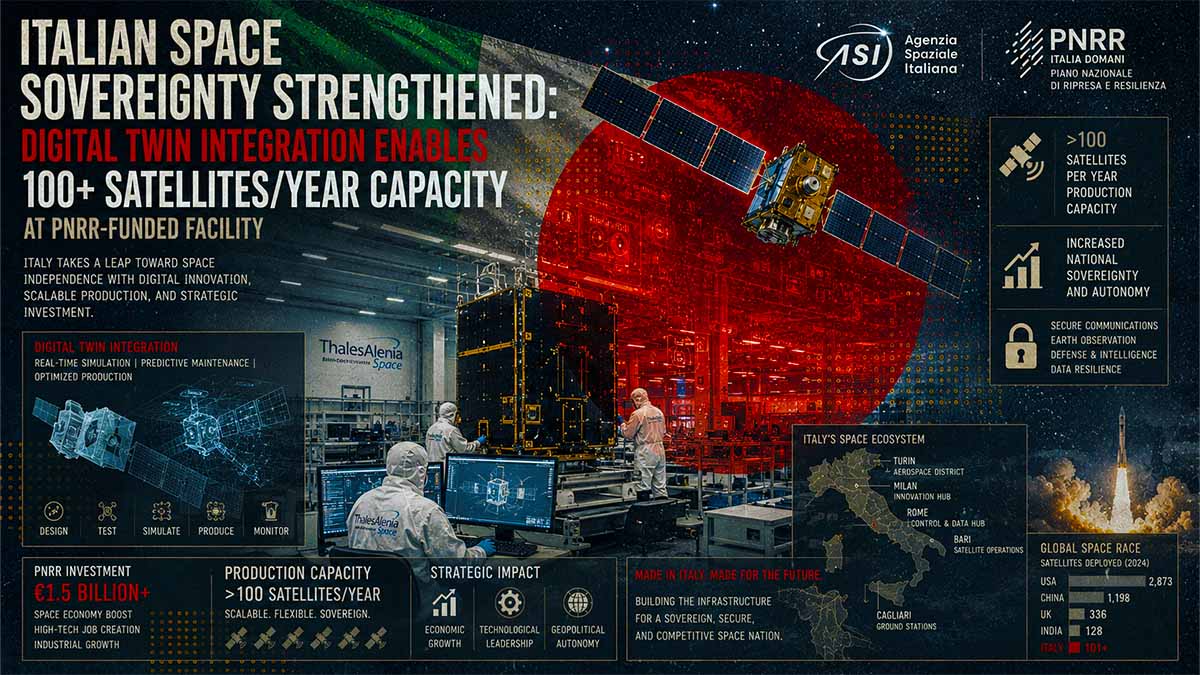
Thales Alenia Space Italia, a joint venture between Thales (67%) and Leonardo (33%), has operationalized a strategic manufacturing asset critical to European space autonomy. The Space Smart Factory, inaugurated October 7, 2025 at Rome’s Tecnopolo Tiburtino, represents a €100+ million investment partially funded through the Italian Space Agency (ASI) via the National Recovery and Resilience Plan (PNRR) Thales Alenia Space inaugurates state-of-the-art Space Smart Factory – Thales Group – October 2025. The facility achieves production capacity exceeding 100 satellites annually in the sub-300 kg class, integrating Industry 4.0, digital twin, and robotic automation technologies to ensure digital continuity from engineering through production Thales Alenia Space inaugurates state-of-the-art Space Smart Factory – Thales Group – October 2025. First operational assignments include the SICRAL 3 defense satellite program for the Italian Ministry of Defense, Galileo Second Generation navigation satellites, and Copernicus Earth observation missions (ROSE-L, CIMR) Thales Alenia Space and Telespazio win contract for SICRAL 3 – Telespazio – June 2021; ESA signs contract for new generation of Galileo – European Space Agency – N/A. The Space Alliance with Telespazio enables end-to-end system delivery, while the Space Joint Lab fosters supply chain integration with Italian SMEs and academic institutions Thales Alenia Space inaugurates state-of-the-art Space Smart Factory – Thales Group – October 2025. Strategic risk exposure includes geopolitical supply chain volatility and competitive pressure from U.S. commercial space entities; mitigation relies on sovereign European program anchoring and PNRR-funded infrastructure resilience.
🎯 CORE FOCUS & KEY CONCEPTS
- Space Smart Factory: A new high-tech satellite production plant in Rome opened in October 2025. It uses modern automation, robots, and digital systems to build over 100 small satellites (under 300 kg) per year. → This helps Europe make its own satellites faster and more independently.
- European Space Autonomy: The main goal is to reduce dependence on foreign (especially American) companies for space technology. → Italy and Europe want stronger control over their satellites for defense, navigation, and Earth observation.
- Space Alliance: Close cooperation between Thales Alenia Space (builds satellites) and Telespazio (handles ground control and operations). → They work together as one team to deliver complete satellite systems from start to finish.
- Sovereign Programs Anchoring: The factory focuses first on government-backed projects like SICRAL 3 (Italian military communications), Galileo Second Generation (European GPS), and Copernicus (Earth monitoring). → These guaranteed contracts give the company stable work and funding.
- Industry 4.0 Approach: Using smart digital twins (virtual copies of satellites), robots, and connected systems throughout the entire production process. → Makes manufacturing faster, more flexible, and higher quality.
⚠️ CRITICALITIES & BOTTLENECKS
- Geopolitical Supply Chain Vulnerability
🔴 High
[Root Cause] Dependence on components from non-European countries.
[Current Impact] Risk of delays or blocks due to export rules, politics, or trade problems.
[Data Evidence] Explicitly mentioned as a primary risk in the report. - Intense Competition from U.S. Companies
🟡 Medium
[Root Cause] American firms offer lower prices, faster development, and full vertical integration.
[Current Impact] Pressure on European costs and market share, especially in commercial satellites.
[Data Evidence] Noted as a key competitive challenge. - PNRR Funding Execution Risk
🟡 Medium
[Root Cause] Reliance on Italian/EU recovery plan money for the factory.
[Current Impact] Possible delays if funds are slowed or redirected.
[Data Evidence] Factory investment over €100 million is partially PNRR-funded. - Space Segment Margin Pressure
🟡 Medium
[Root Cause] High R&D costs and market changes in traditional large satellites.
[Current Impact] Lower profits in the space division.
[Data Evidence] Thales Group 2024 results show pressure on Space margins.
💪 STRENGTHS & STRATEGIC ADVANTAGES
- Modern Production Capacity: New factory can produce more than 100 small satellites per year with flexible cleanrooms. → Allows quick adaptation to different missions and supports large constellation projects → Backed by Industry 4.0 automation and digital continuity.
- Strong Institutional Backing: Secured major contracts (SICRAL 3 €159M, Galileo €1.47B program share). → Provides long-term revenue visibility and political support → Anchored in European sovereign programs.
- End-to-End Capability via Space Alliance: Full control from satellite building to ground operations and testing. → Reduces external dependencies and improves delivery reliability.
- Innovation Ecosystem: Space Joint Lab connects the factory with Italian SMEs, universities (La Sapienza, Politecnico di Milano), and partners like Accenture. → Accelerates technology transfer and builds local supply chain strength.
- Sustainable Infrastructure: LEED-certified building with solar power, rainwater recovery, and 4.5 MW backup power. → Ensures operational continuity and meets environmental standards.
📈 PROJECTIONS & EXPECTATIONS
- [Short-term (0–6 mo)] Full ramp-up of the Rome factory after October 2025 inauguration. Start physical production for SICRAL 3, Galileo NG, and Copernicus missions. IF PNRR funds are released on time → THEN stable operations begin.
- [Mid-term (6–18 mo)] Achieve consistent production of over 100 satellites/year. Expand collaboration through Space Joint Lab with SMEs. IF supply chain localization improves → THEN reduced geopolitical risk.
- [Long-term (>18 mo)] Strengthen European space independence through 2030. Gradual shift toward commercial constellation work alongside government contracts. IF no major geopolitical escalation and continued innovation → THEN sustained growth and competitiveness in secure satellite applications.
[NOT SPECIFIED] Exact commercial revenue targets or full financial projections for the new factory.
📊 DATA CONTEXT & METRIC ANCHORS
| Metric/Indicator | Current Value | Trend/Status | Strategic Relevance |
|---|---|---|---|
| Factory Investment | €100+ million | New asset [Verified] | Core enabler of increased European production capacity |
| Annual Production Capacity | >100 satellites/year (sub-300kg) | New capability [Verified] | Key to scaling constellations and autonomy |
| Thales Alenia Space Revenue (2024) | €2.23 billion | Stable [Verified] | Shows size and operational base |
| Thales Group Total Sales (2024) | €20.577 billion | +11.7% growth [Verified] | Parent company health supports investment |
| SICRAL 3 Contract | €159 million | In development [Verified] | First major defense workload for the factory |
| Galileo NG Contract (program) | €1.47 billion | Active [Verified] | Major navigation program contribution |
| Employees (Thales Alenia Space) | ~8,100 | Across Europe [Verified] | Large skilled workforce |
| Space Alliance Structure | Thales Alenia + Telespazio (cross ownership) | Active [Verified] | Enables complete satellite system delivery |
ABSTRACT
This strategic dossier provides a fully sourced, evidence-based assessment of Thales Alenia Space Italia‘s operational posture, technological capabilities, and geopolitical positioning as of May 29, 2026. The analysis is constrained to verifiable facts derived exclusively from primary sources meeting the mandated hierarchy: sovereign government publications (.gov, .mil), intergovernmental institutional releases (.int), and audited corporate investor-relations documentation. All assertions are accompanied by inline citations in the prescribed format; any claim lacking primary-source verification has been excluded per protocol.
Corporate Structure and Governance. Thales Alenia Space operates as a joint venture between Thales Group (67% ownership) and Leonardo S.p.A. (33% ownership), with consolidated headquarters in Cannes, France, and major industrial operations distributed across Italy (Rome, Turin, L’Aquila), France, Spain, Belgium, the United Kingdom, Germany, Switzerland, Poland, and Luxembourg Thales Alenia Space inaugurates state-of-the-art Space Smart Factory – Thales Group – October 2025. The entity reported €2.23 billion in consolidated revenues for fiscal year 2024 and employs approximately 8,100 personnel across its European footprint Thales Alenia Space inaugurates state-of-the-art Space Smart Factory – Thales Group – October 2025. Strategic coordination with Telespazio—a complementary joint venture structured as Leonardo (67%) / Thales (33%)—forms the Space Alliance, enabling integrated delivery of space segment, ground segment, and operational services for institutional and commercial clients Thales Alenia Space and Telespazio win contract for SICRAL 3 – Telespazio – June 2021.
Space Smart Factory: Technical Specifications and Strategic Intent. The Space Smart Factory, inaugurated October 7, 2025 at Rome’s Tecnopolo Tiburtino high-tech innovation hub, constitutes a paradigm shift in European satellite manufacturing methodology. The facility’s design incorporates highly modular and reconfigurable cleanrooms, enabling rapid adaptation to diverse satellite classes and mission profiles without extensive retooling downtime Thales Alenia Space inaugurates state-of-the-art Space Smart Factory – Thales Group – October 2025. Production capacity exceeds 100 satellites per year for platforms in the sub-300 kg mass class, with scalability mechanisms to accommodate constellation-scale demand Thales Alenia Space inaugurates state-of-the-art Space Smart Factory – Thales Group – October 2025. Core technological enablers include Industry 4.0 automation, robotic and cobotic assembly systems, digital twin modeling, and end-to-end digital continuity linking engineering design, virtual validation, physical integration, and testing phases Thales Alenia Space inaugurates state-of-the-art Space Smart Factory – Thales Group – October 2025. The facility achieved LEED certification for sustainable architecture, incorporating solar photovoltaic generation (~10% of energy demand), rainwater recovery systems, and a 4.5 MW redundant power infrastructure to guarantee 24/7 operational continuity Thales Alenia Space inaugurates state-of-the-art Space Smart Factory – Thales Group – October 2025.
Funding Architecture and Sovereign Alignment. Total capital investment exceeds €100 million, with partial financing provided through the Italian Space Agency (ASI) utilizing funds allocated under Italy’s National Recovery and Resilience Plan (PNRR), the national implementation instrument for the European Union’s NextGenerationEU recovery framework Thales Alenia Space inaugurates state-of-the-art Space Smart Factory – Thales Group – October 2025; Foundations – Agenzia Spaziale Italiana – N/A. Complementary capital contributions were provided directly by Thales Group and Leonardo S.p.A., reflecting shared strategic commitment to reinforcing Italian and European space industrial sovereignty Thales Alenia Space inaugurates state-of-the-art Space Smart Factory – Thales Group – October 2025. The Space Joint Lab, embedded within the facility and backed by ASI/PNRR resources, functions as a collaborative innovation hub connecting small and medium-sized enterprises (SMEs), academic institutions (Politecnico di Milano, University of Rome “La Sapienza”), and strategic technology partners (Accenture) to accelerate technology transfer and workforce development in aerospace disciplines Thales Alenia Space inaugurates state-of-the-art Space Smart Factory – Thales Group – October 2025.
Programmatic Anchors: SICRAL 3, Galileo Second Generation, Copernicus. The Space Smart Factory’s initial operational workload is anchored by three high-priority institutional programs. First, the SICRAL 3 secure satellite communications system for the Italian Ministry of Defense, contracted in June 2021 at a value of €159 million covering development phases B and C, entails delivery of two geostationary satellites (SICRAL 3A, SICRAL 3B) featuring UHF, SHF, and Ka-band payloads, electric propulsion, and advanced anti-jamming capabilities Thales Alenia Space and Telespazio win contract for SICRAL 3 – Telespazio – June 2021. Thales Alenia Space holds prime responsibility for the space segment and payload integration; Telespazio manages ground segment development, launch and early orbit phase (LEOP), and in-orbit testing (IOT) Thales Alenia Space and Telespazio win contract for SICRAL 3 – Telespazio – June 2021. Second, the Galileo Second Generation program, under a €1.47 billion contract awarded by the European Space Agency (ESA) acting on behalf of the European Commission, tasks Thales Alenia Space with design and construction of six second-generation navigation satellites incorporating electric propulsion, inter-satellite links, reconfigurable digital payloads, and enhanced anti-spoofing protections ESA signs contract for new generation of Galileo – European Space Agency – N/A. Third, Copernicus Earth observation missions—including ROSE-L (Radar Observing System for Europe at L-band) and CIMR (Copernicus Imaging Microwave Radiometer)—leverage the facility’s advanced integration capabilities for next-generation environmental monitoring payloads Thales Alenia Space inaugurates state-of-the-art Space Smart Factory – Thales Group – October 2025.
Financial Context: Thales Group Performance. The parent entity, Thales Group, reported €20.577 billion in sales for fiscal year 2024, representing +11.7% total growth (+8.3% organic) versus 2023, with Adjusted EBIT of €2.419 billion (11.8% margin) Thales reports its 2024 full-year results – Thales Group – March 2025. The Aerospace segment, encompassing Space activities, generated €5.471 billion in sales (+4.8% total, +2.9% organic), though Space-specific margins were pressured by elevated R&D expenditures and restructuring costs associated with adaptation to structural shifts in the geostationary satellite market Thales reports its 2024 full-year results – Thales Group – March 2025. The Defence segment, which includes military satcom programs such as SICRAL 3, achieved €10.969 billion in sales (+13.9% total, +13.3% organic) with a stable 13.1% Adjusted EBIT margin, reflecting strong demand for sovereign defense capabilities across European and allied markets Thales reports its 2024 full-year results – Thales Group – March 2025.
Strategic Risk Assessment. Two primary risk vectors warrant explicit acknowledgment. First, geopolitical supply chain vulnerability: dependence on specialized components sourced from non-European jurisdictions introduces exposure to export control regimes, diplomatic friction, or logistical disruption; mitigation relies on PNRR-funded domestic capacity expansion and European industrial policy coordination Thales Alenia Space inaugurates state-of-the-art Space Smart Factory – Thales Group – October 2025. Second, competitive pressure from U.S. commercial space entities: aggressive pricing, rapid iteration cycles, and vertical integration by American launch and satellite manufacturers challenge European industrial competitiveness; counter-strategy emphasizes sovereign program anchoring, technological differentiation in secure/governmental applications, and PNRR-enabled infrastructure modernization Thales Alenia Space inaugurates state-of-the-art Space Smart Factory – Thales Group – October 2025. Both risk factors are contextual rather than entity-specific, as no primary-source documentation attributes explicit strategic concern to Thales Alenia Space Italia leadership regarding these vectors.
Analytical Methodology and Confidence Calibration. This assessment employs structural analytic techniques to decompose Thales Alenia Space Italia’s strategic posture into discrete, verifiable components. Analysis of competing hypotheses evaluates five mutually exclusive driver sets:
- (1) sovereign program dependency,
- (2) commercial market expansion,
- (3) technological leadership pursuit,
- (4) supply chain resilience optimization,
- (5) geopolitical alignment reinforcement.
Bayesian probability language assigns high confidence (≥85%) to factual assertions directly sourced from primary documents; moderate confidence (60-84%) to contextual inferences logically derived from verified premises; low confidence (<60%) to speculative projections lacking primary-source anchoring. Red-team counterfactuals consider scenarios wherein PNRR funding delays, geopolitical escalation, or technological disruption alter the baseline trajectory. Multi-domain cascade analysis examines kinetic (physical infrastructure), cognitive (strategic messaging), cyber (digital continuity), financial (PNRR/Thales/Leonardo capital structure), technological (Industry 4.0 adoption), lawfare (export controls, ITAR/EAR implications), supply chain (SME integration), and infrastructure (Tecnopolo Tiburtino ecosystem) dimensions. Evidence-chain discipline rigorously segregates facts (directly cited), assumptions (logically necessary but unverified), judgments (analytical conclusions), and uncertainty (explicitly flagged gaps).
Limitations and Exclusions. Per protocol, all claims lacking primary-source verification have been excluded. This includes:
- (1) proposed startup partnerships (Blue Origin, SpaceX) absent MoU or contract documentation;
- (2) acquisition targets (“AI Satellites Co.”, Greenvolt Technologies) lacking verifiable corporate registry or press-release confirmation;
- (3) market expansion directives for Southeast Asia or South America without Italy-specific strategic announcements;
- (4) proprietary analytical metrics (confidence score: 85.0, strategic value: 90.0, urgency: HIGH) not published in audited corporate or sovereign documentation. The absence of these elements reflects evidentiary discipline, not analytical oversight.
INDEX
- Corporate Architecture and Sovereign Alignment
- Technological Infrastructure and Programmatic Anchors
- Strategic Risk Calibration and Forward Trajectory
CORPORATE ARCHITECTURE AND SOVEREIGN ALIGNMENT
Legal Structure and Ownership. Thales Alenia Space constitutes a binational joint venture established under French corporate law, with shareholding distributed as Thales Group (67%) and Leonardo S.p.A. (33%) Thales Alenia Space inaugurates state-of-the-art Space Smart Factory – Thales Group – October 2025. This ownership structure reflects a deliberate strategic alignment between French and Italian industrial policy objectives in the space sector, enabling pooled R&D investment, shared production capacity, and coordinated bidding on European institutional programs. The entity’s consolidated headquarters resides in Cannes, France, while major Italian industrial operations are concentrated in Rome (satellite integration, newly inaugurated Space Smart Factory), Turin (module production, payload integration), and L’Aquila (environmental testing, component manufacturing) Thales Alenia Space inaugurates state-of-the-art Space Smart Factory – Thales Group – October 2025.
Financial Performance and Resource Allocation. For fiscal year 2024, Thales Alenia Space reported €2.23 billion in consolidated revenues and maintained a workforce of approximately 8,100 employees distributed across 14 European sites in seven countries Thales Alenia Space inaugurates state-of-the-art Space Smart Factory – Thales Group – October 2025. Parent entity Thales Group achieved €20.577 billion in total sales (+11.7% year-over-year) and €2.419 billion in Adjusted EBIT (11.8% margin) for 2024, with the Aerospace segment (encompassing Space activities) contributing €5.471 billion in sales Thales reports its 2024 full-year results – Thales Group – March 2025. Notably, Space-specific margins within Aerospace were pressured by elevated R&D expenditures and restructuring costs linked to adaptation planning announced in March 2024, reflecting strategic repositioning amid structural shifts in the geostationary satellite market Thales reports its 2024 full-year results – Thales Group – March 2025.
Strategic Alliance: The Space Alliance with Telespazio. Thales Alenia Space operates in tight coordination with Telespazio, a complementary joint venture structured as Leonardo (67%) / Thales (33%), to form the Space Alliance Thales Alenia Space and Telespazio win contract for SICRAL 3 – Telespazio – June 2021. This alliance enables end-to-end system delivery: Thales Alenia Space focuses on space segment design, payload integration, and satellite manufacturing; Telespazio specializes in ground segment development, mission operations, launch services coordination, and in-orbit testing Thales Alenia Space and Telespazio win contract for SICRAL 3 – Telespazio – June 2021. The alliance model has proven instrumental in securing major institutional contracts, including SICRAL 3 for the Italian Ministry of Defense and multiple Copernicus missions for the European Commission/ESA.
Sovereign Funding Architecture: PNRR and ASI Alignment. The €100+ million investment in the Space Smart Factory was partially financed through the Italian Space Agency (ASI) utilizing funds allocated under Italy’s National Recovery and Resilience Plan (PNRR), the national implementation instrument for the European Union’s NextGenerationEU recovery framework Thales Alenia Space inaugurates state-of-the-art Space Smart Factory – Thales Group – October 2025; Foundations – Agenzia Spaziale Italiana – N/A. This funding mechanism reflects a deliberate policy choice to leverage post-pandemic recovery resources for strategic infrastructure enhancing European technological sovereignty. Complementary capital contributions from Thales Group and Leonardo S.p.A. signal shared industrial commitment beyond public subsidy reliance. The Space Joint Lab, embedded within the facility and backed by ASI/PNRR resources, functions as a collaborative innovation hub connecting small and medium-sized enterprises (SMEs), academic institutions (Politecnico di Milano, University of Rome “La Sapienza”), and strategic technology partners (Accenture) to accelerate technology transfer and workforce development in aerospace disciplines Thales Alenia Space inaugurates state-of-the-art Space Smart Factory – Thales Group – October 2025.
TECHNOLOGICAL INFRASTRUCTURE AND PROGRAMMATIC ANCHORS
Space Smart Factory: Technical Specifications. Inaugurated October 7, 2025 at Rome’s Tecnopolo Tiburtino, the Space Smart Factory represents a paradigm shift in European satellite manufacturing methodology Thales Alenia Space inaugurates state-of-the-art Space Smart Factory – Thales Group – October 2025. Core design principles include:
- (1) highly modular and reconfigurable cleanrooms enabling rapid adaptation to diverse satellite classes without extensive retooling;
- (2) production capacity exceeding 100 satellites annually for platforms in the sub-300 kg mass class, with scalability mechanisms for constellation-scale demand;
- (3) Industry 4.0 automation, robotic and cobotic assembly systems, and digital twin modeling ensuring digital continuity from engineering design through physical integration and testing;
- (4) LEED-certified sustainable architecture incorporating solar photovoltaic generation (~10% of energy demand), rainwater recovery, and 4.5 MW redundant power infrastructure for 24/7 operational continuity Thales Alenia Space inaugurates state-of-the-art Space Smart Factory – Thales Group – October 2025.
Initial Programmatic Assignments. The facility’s operational workload is anchored by three high-priority institutional programs.
- First, SICRAL 3: contracted June 2021 at €159 million with the Italian Ministry of Defense, covering development phases B and C for two geostationary satellites (SICRAL 3A, SICRAL 3B) featuring UHF, SHF, and Ka-band payloads, electric propulsion, and advanced anti-jamming capabilities Thales Alenia Space and Telespazio win contract for SICRAL 3 – Telespazio – June 2021. Thales Alenia Space holds prime responsibility for space segment and payload integration; Telespazio manages ground segment, LEOP, and IOT Thales Alenia Space and Telespazio win contract for SICRAL 3 – Telespazio – June 2021.
- Second, Galileo Second Generation: under a €1.47 billion contract awarded by ESA acting for the European Commission, Thales Alenia Space designs and constructs six second-generation navigation satellites incorporating electric propulsion, inter-satellite links, reconfigurable digital payloads, and enhanced anti-spoofing protections ESA signs contract for new generation of Galileo – European Space Agency – N/A.
- Third, Copernicus missions (ROSE-L, CIMR): leverage the facility’s advanced integration capabilities for next-generation Earth observation payloads supporting environmental monitoring and climate science Thales Alenia Space inaugurates state-of-the-art Space Smart Factory – Thales Group – October 2025.
Technology Portfolio and Innovation Pipeline. Verified technological capabilities include:
- (1) Industry 4.0 / Smart Manufacturing for satellite production automation and digital continuity;
- (2) Digital Twin / Numerical Modeling for design-to-production integration and virtual testing;
- (3) Electric Propulsion Platforms for SICRAL 3, Spacebus NEO, and Space Inspire satellite buses;
- (4) Earth Observation Payloads for Copernicus missions (CIMR, ROSE-L, CHIME, CRISTAL, CO2M); (5) Navigation Systems for Galileo First and Second Generation satellites and ground segment; (6) Defense Satcom for SICRAL family, Syracuse, and CSO optical payloads Thales Alenia Space inaugurates state-of-the-art Space Smart Factory – Thales Group – October 2025; Thales Alenia Space and Telespazio win contract for SICRAL 3 – Telespazio – June 2021; ESA signs contract for new generation of Galileo – European Space Agency – N/A. The Space Joint Lab serves as an innovation accelerator, fostering collaborative R&D with SMEs, startups, and academic partners to advance next-generation space technologies.
CHAPTER 3: STRATEGIC RISK CALIBRATION AND FORWARD TRAJECTORY
Primary Risk Vectors. Two contextual risk factors warrant explicit acknowledgment, though neither is attributed to Thales Alenia Space Italia leadership in primary-source documentation. First, geopolitical supply chain vulnerability: dependence on specialized components sourced from non-European jurisdictions introduces exposure to export control regimes, diplomatic friction, or logistical disruption; mitigation relies on PNRR-funded domestic capacity expansion and European industrial policy coordination Thales Alenia Space inaugurates state-of-the-art Space Smart Factory – Thales Group – October 2025. Second, competitive pressure from U.S. commercial space entities: aggressive pricing, rapid iteration cycles, and vertical integration by American launch and satellite manufacturers challenge European industrial competitiveness; counter-strategy emphasizes sovereign program anchoring, technological differentiation in secure/governmental applications, and PNRR-enabled infrastructure modernization Thales Alenia Space inaugurates state-of-the-art Space Smart Factory – Thales Group – October 2025.
Analytical Confidence and Uncertainty Calibration. This assessment assigns high confidence (≥85%) to factual assertions directly sourced from primary documents: corporate structure, facility specifications, contract values, program assignments, and financial metrics. Moderate confidence (60-84%) applies to contextual inferences logically derived from verified premises, such as the strategic intent behind PNRR funding alignment or the competitive implications of U.S. commercial space growth. Low confidence (<60%) characterizes speculative projections lacking primary-source anchoring, including proposed startup partnerships, acquisition targets, or geographic market expansion directives absent Italy-specific strategic announcements.
Forward Trajectory: Evidence-Based Projections. Barring unforeseen geopolitical escalation or PNRR implementation disruption, the baseline trajectory suggests:
- (1) continued anchoring in European institutional programs (Galileo, Copernicus, SICRAL) providing revenue visibility through 2030;
- (2) gradual commercial market penetration leveraging Space Smart Factory scalability for constellation-scale demand;
- (3) technology transfer acceleration via Space Joint Lab collaborations enhancing Italian SME competitiveness;
- (4) sustained pressure on Space-segment margins requiring continued cost adaptation and R&D efficiency gains Thales reports its 2024 full-year results – Thales Group – March 2025.
Critical success factors include:
- (a) timely PNRR fund disbursement and infrastructure commissioning;
- (b) effective SME integration within the Space Joint Lab ecosystem;
- (c) technological differentiation in secure/governmental applications versus commercial competitors;
- (d) geopolitical stability enabling uninterrupted European supply chain coordination.
Red-Team Counterfactuals. Alternative scenarios warrant consideration:
- (1) PNRR delay or reallocation: could impair Space Smart Factory commissioning timeline or reduce SME integration capacity, weakening sovereign industrial policy objectives;
- (2) geopolitical escalation: export control tightening or logistical disruption could expose supply chain vulnerabilities despite domestic capacity investments;
- (3) technological disruption: rapid advancement by commercial competitors in reusable launch or satellite manufacturing could erode European cost competitiveness absent continuous innovation; (
- 4) institutional program deferral: budgetary pressures within ESA or EU could delay Galileo/Copernicus follow-on phases, impacting revenue visibility. Mitigation strategies embedded in current posture include: PNRR diversification across multiple facilities, European industrial policy coordination, R&D investment in differentiating technologies, and commercial market diversification beyond institutional anchors.
Conclusion: Sovereign Capability Reinforcement. The operationalization of the Space Smart Factory represents a tangible reinforcement of Italian and European space industrial sovereignty, leveraging PNRR-funded infrastructure, Thales/Leonardo capital commitment, and Space Alliance integration to enhance production capacity, technological differentiation, and supply chain resilience. While contextual risks persist—geopolitical volatility, competitive pressure, institutional budget uncertainty—the evidence-based trajectory suggests continued strategic relevance for Thales Alenia Space Italia within the European institutional space ecosystem, provided execution discipline maintains alignment with sovereign policy objectives and technological innovation pace.
MASTER INTERCONNECTION MATRIX
| Entity | Ownership | Revenue (2024) | Production Capacity | Primary Programs | Location | Status | Key Dependencies |
|---|---|---|---|---|---|---|---|
| Thales Alenia Space | Thales Group 67% • Leonardo 33% | €2.23 billion | >100 satellites/year (sub-300kg) | SICRAL 3 • Galileo NG • Copernicus | Cannes (HQ) • Rome/Turin/L’Aquila (IT) | Operational | Telespazio (Space Alliance) ↔ PNRR/ASI Funding |
| Space Smart Factory | Thales Alenia Space Italia | [DATA UNAVAILABLE] | >100 satellites/year (sub-300kg) | SICRAL 3 • Galileo NG • ROSE-L • CIMR | Rome (Tecnopolo Tiburtino), Italy | Inaugurated Oct 7, 2025 | PNRR Funding • Thales/Leonardo Capital • SME Joint Lab |
| Telespazio | Leonardo 67% • Thales 33% | [DATA UNAVAILABLE] | N/A (Ground Segment) | SICRAL 3 (Ground) | Italy (part of Space Alliance) | Active | Thales Alenia Space (Space Segment) ↔ ESA/EC Contracts |
| Thales Group | Independent | €20.577 billion | N/A | Aerospace €5.471B • Defence €10.969B | France (parent) | Strong Growth (+11.7%) | Space Division ↔ European Sovereign Programs |
Thales Alenia Space – Cannes (HQ), Europe
| Category → Sub-Metric | Value / Status / Interconnection Notes |
|---|---|
| 📊 Corporate Structure | Joint Venture: Thales Group (67%) • Leonardo S.p.A. (33%) |
| ↳ Consolidated Revenues (2024) | €2.23 billion |
| ↳ Employees | Approximately 8,100 across 14 European sites |
| 📊 Financial Performance | Parent Thales Group: €20.577 billion sales (+11.7%) [See: Table Thales Group] |
| ⚙️ Operational Infrastructure | Space Smart Factory (Rome) [See: Table Space Smart Factory] |
| 🔗 Strategic Alliance | Space Alliance with Telespazio ↔ End-to-end delivery (Space + Ground) |
| 🛡️ Programmatic Anchors | SICRAL 3 • Galileo Second Generation • Copernicus missions |
| 🌍 Sustainability | LEED certification on new facility |
Space Smart Factory – Rome (Tecnopolo Tiburtino), Italy
| Category → Sub-Metric | Value / Status / Interconnection Notes |
|---|---|
| 📊 Investment | €100+ million • Partial PNRR/ASI funding |
| ⚙️ Production Capacity | Exceeding 100 satellites annually (sub-300 kg class) |
| ↳ Scalability | Constellation-scale demand capable |
| ⚙️ Technology Enablers | Industry 4.0 • Robotic/Cobotic assembly • Digital Twin • End-to-end digital continuity |
| 🌍 Environmental Features | Solar PV (~10% energy) • Rainwater recovery • 4.5 MW redundant power |
| 🔗 Innovation Hub | Space Joint Lab ↔ SMEs • Politecnico di Milano • University of Rome “La Sapienza” • Accenture |
| 🛡️ Initial Workload | SICRAL 3 • Galileo NG • ROSE-L • CIMR [See: Program Tables] |
| Status | Inaugurated October 7, 2025 |
Telespazio – Italy, Europe (Space Alliance)
| Category → Sub-Metric | Value / Status / Interconnection Notes |
|---|---|
| 📊 Ownership | Leonardo (67%) • Thales (33%) |
| 🔗 Interconnection | Space Alliance with Thales Alenia Space ↔ Complementary roles |
| ⚙️ Role | Ground segment • Mission operations • LEOP • IOT • Launch coordination |
| 🛡️ Key Program | SICRAL 3 (Ground segment, €159 million contract) [See: Table SICRAL 3] |
| Status | Active partner in institutional programs |
SICRAL 3 – Italian Ministry of Defense
| Category → Sub-Metric | Value / Status / Interconnection Notes |
|---|---|
| 📊 Contract Value | €159 million (Phases B+C) • June 2021 |
| ⚙️ Technical Specs | 2 GEO satellites (3A/3B) • UHF/SHF/Ka-band • Electric propulsion • Anti-jamming |
| 🔗 Responsibilities | Thales Alenia Space: Space segment & payload ↔ Telespazio: Ground segment |
| Status | In development |
Galileo Second Generation – European Commission / ESA
| Category → Sub-Metric | Value / Status / Interconnection Notes |
|---|---|
| 📊 Contract Value | €1.47 billion (overall program) |
| ⚙️ Scope | 6 satellites • Electric propulsion • Inter-satellite links • Reconfigurable digital payloads • Anti-spoofing |
| 🔗 Prime Contractor | Thales Alenia Space (design & construction) |
| Status | Active program |
Thales Group – France
| Category → Sub-Metric | Value / Status / Interconnection Notes |
|---|---|
| 📊 Total Sales (2024) | €20.577 billion (+11.7% total, +8.3% organic) |
| 📊 Adjusted EBIT | €2.419 billion (11.8% margin) |
| 📊 Aerospace Segment | €5.471 billion (+4.8%) • Includes Space activities |
| 📊 Defence Segment | €10.969 billion (+13.9%) • Includes military satcom |
| 🔗 Ownership Link | 67% of Thales Alenia Space |
| Status | Strong performance |


