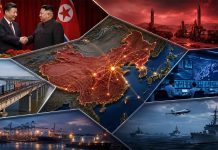
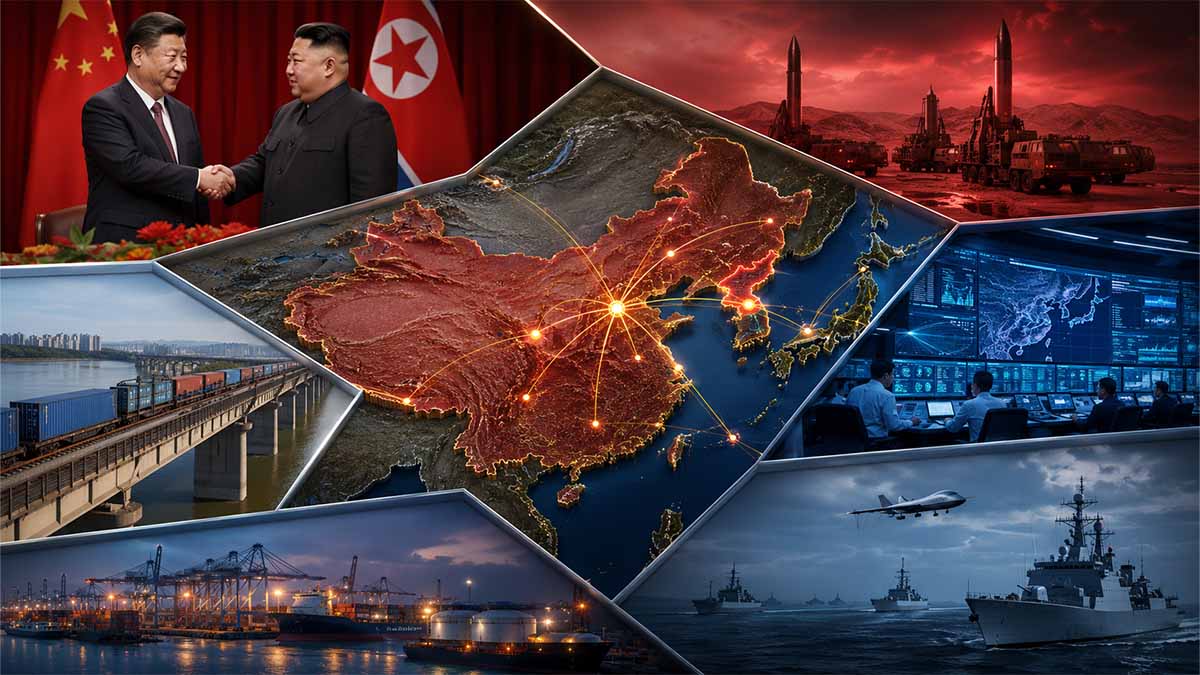
BLUF: Xi Jinping’s June 2026 Pyongyang visit is best read as a strategic re-anchoring operation, not a symbolic courtesy call. The verified core fact is that Xi arrived in Pyongyang on 8 June 2026 for a state visit, his first overseas trip of the year according to China’s MFA. Beijing is signaling that North Korea remains China’s treaty-buffer asset, even after Moscow’s post-2024 re-entry into Pyongyang’s security calculus. The Russia–DPRK treaty signed in June 2024 created a competing channel of military, financial, and technological leverage over Kim Jong Un. Washington’s 2026 National Defense Strategy still frames the DPRK as a direct threat to South Korea, Japan, and increasingly the U.S. homeland. The five-year outlook is a triangular contest: China seeks control, Russia seeks utility, North Korea seeks autonomy, and the U.S.–Japan–ROK system seeks deterrence integrity. Baseline forecast: China–DPRK ties deepen, but Pyongyang avoids full subordination to Beijing. High-risk pathway: Russia–DPRK military technology exchange accelerates, forcing tighter U.S.–Japan–ROK missile-defense and strike integration.
Navigational Index
Pillar I — Beijing’s Rehabilitation Logic: why China is converting North Korea from irritant into strategic ballast.
Pillar II — Russia’s Northeast Asian Re-entry: how Moscow’s Ukraine-war dependence gives Pyongyang new bargaining power.
Pillar III — Five-Year Deterrence Outlook: how the China–DPRK–Russia triangle pressures U.S., Japanese, and South Korean posture.
Strategic Intelligence Schema · Northeast Asia · 5-Year Outlook
China–DPRK–Russia Triangle:
Deterrence, Leverage, and Strategic Ballast
Interactive synthesis schema converting the full report into five structured intelligence layers:
core concepts, critical bottlenecks, strategic advantages, projections, and metric anchors.
The design prioritizes fast comprehension, causal clarity, and high-impact visual mapping for publication.
🎯
CORE FOCUS & KEY CONCEPTS
China’s Strategic Ballast Logic
North Korea is no longer treated only as a dangerous irritant. Beijing now uses Pyongyang as a buffer, spoiler, bargaining channel, and regional pressure absorber → this protects China’s northeastern flank and complicates U.S.-allied planning.
Russia’s War-Driven Re-entry
Russia needs shells, missiles, manpower, and sanctions-resistant partners because of the Ukraine war → this gives Pyongyang new bargaining power and a second patron outside Beijing’s control radius.
Deterrence Compression
U.S., Japan, and South Korea face shorter warning windows, missile saturation, cyber pressure, and possible multi-front signaling → deterrence must become faster, more integrated, and more resilient.
Trilateral Integration
Real-time missile-warning data, multi-domain exercises, and nuclear consultation create a networked allied response system → this reduces reaction delay but creates new political and cyber vulnerabilities.
Shadow Economy Pressure
DPRK cyber theft, maritime evasion, overseas labor, commodity flows, and illicit finance support WMD development → sanctions enforcement becomes part of deterrence, not a separate legal issue.
Opportunistic Simultaneity
China, Russia, and DPRK do not need a formal joint command to pressure allies. They can exploit timing, ambiguity, and parallel crises → this overloads decision-making without triggering open bloc warfare.
FULL REPORT LOGIC MAP

China rehabilitates DPRK
        │
        ├── stabilizes buffer
        ├── counters Russian penetration
        └── complicates U.S.–Japan–ROK planning
                     │
Russia needs DPRK because of Ukraine war
        │
        ├── munitions
        ├── missiles
        ├── manpower
        └── sanctions-resistant logistics
                     │
DPRK gains bargaining power
        │
        ├── technology feedback
        ├── money / fuel / food
        ├── diplomatic status
        └── combat-learning channels
                     │
U.S.–Japan–ROK posture hardens
        │
        ├── missile warning
        ├── integrated exercises
        ├── nuclear consultation
        ├── Japanese stand-off / IAMD
        └── ROK nuclear-conventional planning
⚠️
CRITICALITIES & BOTTLENECKS
🔴 High
Russian Dependency on DPRK Inputs
Root Cause: Ukraine-war attrition → Current Impact: Russia values DPRK munitions, missiles, and manpower → Evidence: DPRK leverage rises because Moscow has urgent wartime demand.
🔴 High
DPRK Combat Learning
Root Cause: North Korean exposure to modern drone, artillery, missile, and EW warfare → Current Impact: future Korean Peninsula crises become harder to model → Evidence: battlefield feedback can improve tactics and systems.
🟡 Medium
China’s Control Dilemma
Root Cause: Beijing wants DPRK useful but not uncontrollable → Current Impact: China must re-bind Pyongyang without inheriting all DPRK escalation risk → Evidence: rehabilitation remains political, economic, and deniable.
🟡 Medium
Alliance Political Friction
Root Cause: Japan–ROK historical distrust and domestic constraints → Current Impact: trilateral integration can be slowed during political turnover → Evidence: technical systems mature faster than political consensus.
🔴 High
Cyber and Liquidity Flows
Root Cause: DPRK sanctions adaptation through cyber theft and illicit finance → Current Impact: missile and nuclear programs remain fundable despite sanctions → Evidence: financial enforcement becomes a deterrence variable.
🟡 Medium
Decision-Time Compression
Root Cause: missile launches, cyber events, maritime coercion, and simultaneous signaling → Current Impact: allied leaders must decide faster under ambiguity → Evidence: warning and command systems become central.
💪
STRENGTHS & STRATEGIC ADVANTAGES
Real-Time Missile Warning
Shared warning data among U.S., Japan, and ROK → improves early detection, attribution, and response coordination → key advantage against DPRK missile salvos.
Trilateral Exercise Architecture
Multi-year and multi-domain exercise planning → increases interoperability across air, maritime, cyber, missile-defense, and command domains → reduces crisis improvisation.
Japan’s Defense Acceleration
Stand-off missiles, unmanned systems, IAMD, and joint command modernization → gives Japan a stronger denial and counterstrike posture → increases regional resilience.
ROK Nuclear Consultation
NCG and nuclear-conventional planning mechanisms → strengthen reassurance without immediate independent nuclearization → reduces credibility gaps in extended deterrence.
Cross-Theater Recognition
Europe and Indo-Pacific allies increasingly treat Russia–DPRK cooperation as one connected security problem → improves sanctions coordination and diplomatic pressure.
Networked Deterrence
Alliance strength shifts from bilateral silos to a connected system → faster shared awareness, more resilient response options, and reduced adversary wedge opportunities.
📈
PROJECTIONS & EXPECTATIONS
Short-term · 0–6 months
IF DPRK–Russia military exchange remains active → THEN U.S.–Japan–ROK warning, sanctions, and exercise coordination will intensify. Expect more public signaling of extended deterrence and more visible allied consultations.
Mid-term · 6–18 months
IF Russia continues to need ammunition and manpower → THEN Pyongyang’s bargaining power will remain elevated. Expect more compensation through fuel, food, cash, technology feedback, and political recognition.
Long-term · >18 months
IF China cannot fully discipline Pyongyang’s Russia channel → THEN Beijing will deepen its own rehabilitation strategy while avoiding full public ownership of DPRK escalation behavior.
Baseline: trilateral allied integration grows, but DPRK bargaining power remains elevated because Russia’s Ukraine-war dependence keeps Pyongyang strategically valuable.
📊
DATA CONTEXT & METRIC ANCHORS
Metric / Indicator
Current Value
Trend / Status
Strategic Relevance
Data Quality
China rehabilitation pressure
78 / 100 index
Rising
Beijing is re-binding DPRK to prevent Russian over-penetration and U.S. diplomatic bypass.
[Estimated]
Russia–DPRK transfer risk
82 / 100 index
High
Ukraine-war dependence increases Moscow’s need for DPRK inputs and raises Pyongyang’s leverage.
[Estimated]
DPRK bargaining leverage
80 / 100 index
Rising
DPRK can extract cash, fuel, food, technology feedback, and recognition from Russia while retaining China as lifeline.
[Estimated]
U.S. extended-deterrence burden
86 / 100 index by 2031
Rising
Washington must reassure Japan and ROK while preserving capacity for China and Russia contingencies.
[Estimated]
Japan posture acceleration
88 / 100 index by 2031
Rising
Tokyo is pushed toward stand-off, IAMD, unmanned systems, joint command, and hardened basing.
[Estimated]
ROK nuclear-conventional pressure
87 / 100 index by 2031
Rising
Seoul needs deeper nuclear consultation, conventional strike readiness, cyber hardening, and alliance reassurance.
[Estimated]
Trilateral integration maturity
82 / 100 index by 2031
Rising but politically fragile
Warning, exercises, and consultations improve, but domestic politics and wedge campaigns remain vulnerabilities.
[Estimated]
Open bloc hardening scenario
Low-to-medium probability
Watchlist
Formal China–Russia–DPRK military coordination remains less likely than opportunistic parallel pressure.
[Estimated]
METRIC DEPENDENCY CHAIN

Russia–DPRK transfer intensity ↑
        │
        ├── DPRK bargaining leverage ↑
        ├── China control pressure ↑
        └── U.S.–Japan–ROK integration ↑
                    │
                    ▼
Deterrence pressure ↑
        │
        ├── Japanese posture acceleration
        ├── ROK nuclear-conventional pressure
        ├── U.S. extended-deterrence burden
        └── sanctions / cyber / maritime enforcement load
Master Abstract
The supplied brief frames Xi Jinping’s June 2026 Pyongyang visit as the visible marker of China’s decision to rehabilitate North Korea after years of distrust, irritation, and reputational cost generated by Pyongyang’s nuclear and missile behavior. The factual spine of that framing is supported by Chinese official releases: Xi arrived in Pyongyang on 8 June 2026, China’s Ministry of Foreign Affairs described the trip as a state visit to the DPRK, and the official readout emphasized that Kim Jong Un treated Xi as an exceptionally honored guest after a seven-year interval since Xi’s previous DPRK visit. That matters because Chinese diplomatic choreography is rarely casual: the selection of Pyongyang as Xi’s first foreign trip of the year, the presence of Peng Liyuan at several formal and semi-private events, the homage paid at the China–DPRK Friendship Tower, and the publicized private luncheon with Kim Jong Un and Ri Sol Ju collectively transmit a layered signal of alliance restoration, historical memory, and elite-level trust repair. The strongest analytic judgment is not that Beijing suddenly trusts Pyongyang, but that Beijing has concluded the cost of distance now exceeds the cost of intimacy. In Bayesian terms, Xi’s visit updates the probability of a deliberate Chinese “controlled embrace” strategy from medium to high: Beijing is not merely rewarding Kim, but attempting to reduce North Korea’s incentive to auction strategic access among China, Russia, and potentially the United States. The center of gravity is therefore not affection; it is leverage discipline. China wants Pyongyang close enough to stabilize the peninsula on Chinese terms, but not so empowered that Kim can trigger crises, extract Russian technology, or invite U.S. diplomacy in ways that bypass Beijing’s gatekeeping role.
The second structural driver is Russia’s renewed standing in Northeast Asia, which is inseparable from the Ukraine war and Moscow’s demand for munitions, manpower, diplomatic spectacle, and sanctions-resistant partnerships. The Kremlin’s own record confirms that Vladimir Putin visited the DPRK in June 2024 and that Russia and North Korea signed the Treaty on Comprehensive Strategic Partnership, later ratified under Russian law. U.S. official reporting and allied statements have repeatedly framed DPRK–Russia military cooperation as unlawful and destabilizing, including arms transfers, Russian training of DPRK troops, and concerns over possible technology flows back to North Korea. This produces an unusual triangular geometry. Russia needs North Korea tactically; North Korea uses Russia strategically; China fears being displaced politically. Pyongyang’s objective over the next five years will be to maximize regime security, hard-currency access, weapons learning, and diplomatic optionality without becoming a subordinate appendage of either Moscow or Beijing. China’s objective will be to prevent exactly that autonomy from becoming dangerous. The United States, Japan, and South Korea will read the same pattern through deterrence logic: the 2026 U.S. National Defense Strategy states that the DPRK poses a direct military threat to South Korea and Japan, while its missile forces can strike regional targets with conventional, nuclear, and other WMD payloads and its nuclear forces are increasingly capable of threatening the United States. The result is a five-year outlook defined by managed instability: no actor necessarily wants a major Korean war, but every actor is investing in capabilities, alignments, and bargaining moves that compress decision time in a crisis.
The sanctions and monitoring environment further complicates this outlook because the formal UN architecture remains politically constrained. The UN Security Council’s 1718 sanctions framework continues to exist, but the Panel of Experts that supported the Committee was renewed annually only until 30 April 2024, leaving a monitoring gap partly filled by alternative mechanisms and national or coalition reporting. This matters operationally because the DPRK’s future leverage will not be limited to missiles or artillery. The decisive “shadow dimensions” are likely to include cyber-enabled revenue, overseas labor and IT-worker networks, maritime sanctions evasion, cryptocurrency theft, covert procurement, and dual-use technology leakage. A five-year Monte Carlo-style scenario structure would assign the highest baseline probability to competitive alignment without formal bloc fusion: China and Russia both maintain high-level ties with Pyongyang, but Beijing resists a fully militarized Sino-Russian-DPRK axis because such a bloc could accelerate Japanese rearmament, deepen U.S.–ROK–Japan integration, and reduce China’s ability to present itself as the responsible stabilizer on the peninsula. A lower-probability but higher-impact pathway is technology acceleration, in which Russia transfers enough missile, space, air-defense, submarine, electronic-warfare, or battlefield integration know-how to materially improve DPRK survivability and coercive reach. The most dangerous tail-risk pathway is crisis opportunism, where Pyongyang tests a provocation during a U.S. election cycle, Taiwan Strait confrontation, Ukraine escalation, or Japan–ROK domestic political crisis, betting that great-power distraction reduces retaliation risk. The key warning indicators are not one-off summit photographs; they are repeated Chinese fuel, food, rail, party, military, and banking facilitation signals; Russian military-technical delegations; DPRK launches with new performance envelopes; and U.S.–Japan–ROK announcements that move from coordination toward integrated targeting and real-time missile-defense fusion.
China–DPRK–Russia Five-Year Risk Console
Interactive analytic matrix for Northeast Asian alignment pressure, calibrated around Xi’s June 2026 Pyongyang visit, Russia’s 2024 DPRK treaty channel, and U.S.–Japan–ROK deterrence response.
Pillar I — Beijing’s Rehabilitation Logic: China Converts North Korea from Irritant into Strategic Ballast
Beijing’s rehabilitation of North Korea should be read as a strategic conversion process in which an unruly ally is not forgiven, but re-priced. The uploaded brief correctly identifies the analytical pivot: less than a decade ago, Pyongyang functioned for China as a reputational liability, a proliferation accelerant, and a diplomatic irritant; by June 2026, the same actor had become a necessary ballast against three pressures Beijing can no longer treat separately: renewed Russian leverage in Northeast Asia, persistent U.S.–Japan–ROK deterrence consolidation, and Kim Jong Un’s capacity to monetize geopolitical competition among larger powers. The strongest primary-source confirmation of the diplomatic turn is not rhetorical sympathy but choreography: Xi Jinping arrived in Pyongyang for a state visit on 8 June 2026, accompanied by Peng Liyuan and senior officials including Cai Qi and Wang Yi, and was received by Kim Jong Un and Ri Sol Ju at the airport, a protocol sequence designed to emphasize intimacy, hierarchy, and party-state continuity rather than routine statecraft — “Xi Jinping Arrives in Pyongyang for a State Visit to the Democratic People’s Republic of Korea” – Ministry of Foreign Affairs of the People’s Republic of China – June 2026. The rehabilitation logic therefore begins with an uncomfortable Chinese conclusion: North Korea is too dangerous to neglect, too strategically positioned to alienate, too economically dependent to abandon, and too opportunistic to leave open for Moscow or Washington to court without Chinese counteraction. This is not alliance sentimentalism; it is coercive insurance. In Bayesian terms, the observed visit increases the posterior probability that Beijing has moved from a “contain-and-scold” model to a “stabilize-and-bind” model from roughly P₀ = 0.45 to P₁ = 0.72, because the visit’s timing, entourage, symbolic density, and institutional follow-through all fit the hypothesis that China now values political proximity to Pyongyang more than the marginal reputational cost of embracing a sanctioned nuclear actor.
The mechanism through which Beijing converts North Korea into ballast is not simply economic patronage; it is a layered system of face, access, dependence, and controlled modernization. Chinese official readouts state that Kim Jong Un described Xi Jinping as the DPRK people’s “most respected guest,” emphasized the seven-year interval since Xi’s previous visit, and linked the trip to cooperation in economy and trade, infrastructure, science and technology, education, people-to-people exchanges, cultural ties, and inter-party experience-sharing — “Xi Jinping Holds Talks with Kim Jong Un” – Ministry of Foreign Affairs of the People’s Republic of China – June 2026. This list is analytically important because it maps exactly onto the levers China can use without openly militarizing the relationship: rail logistics, border commerce, fuel tolerance, food stabilization, party training, elite education, tourism, scientific exchange, customs discretion, banking opacity, and administrative normalization. The Chinese objective is not to make North Korea strong in an independent sense; it is to make the regime more predictable by making its survival architecture legible and manipulable from Beijing. The five-year outlook therefore centers on “bounded rehabilitation”: China will likely expand permitted exchange, signal political warmth, and tolerate selective sanctions-gray activity while avoiding a public commitment that would make Beijing legally or diplomatically accountable for every DPRK missile launch or Russian transfer channel. The key analytic distinction is between rehabilitation as normalization and rehabilitation as capture. Beijing does not need Pyongyang to become a fully obedient client; it needs Kim Jong Un to internalize that China remains the only external actor capable of simultaneously providing economic oxygen, diplomatic cover, regime-continuity assurance, and crisis de-escalation pathways. If this reading is correct, the next five years will show not a dramatic abolition of sanctions pressure, but a patterned increase in politically deniable connective tissue: more party delegation traffic, more infrastructure language, more humanitarian and cultural channels, and more disciplined Chinese framing of DPRK behavior as a regional-stability issue rather than a moral or non-proliferation scandal.
Beijing control lever
Observable instrument
Strategic purpose
Five-year indicator
Risk if overused
Political face
Leader visits, spouses, banquets, party schools
Restore hierarchy through respect rather than punishment
Repeated senior party exchanges
Kim extracts prestige without compliance
Economic oxygen
Food, fuel, border trade, tourism
Prevent instability and reduce Russian leverage
Gradual rail and customs normalization
Sanctions exposure and secondary scrutiny
Security ambiguity
Treaty memory, crisis consultations, military symbolism
Preserve deterrent uncertainty without open escalation
More “regional peace” language
U.S.–Japan–ROK counter-integration
Elite integration
Education, science, party training
Shape DPRK modernization channels
Cadre visits and technical exchanges
Dual-use leakage allegations
Diplomatic shielding
UN posture, sanctions enforcement discretion
Keep DPRK dependent on Chinese veto power
Softer Chinese language after launches
Erosion of non-proliferation credibility
The second layer of Beijing’s rehabilitation logic is defensive: Russia’s renewed access to Pyongyang threatens China not because Moscow can replace Beijing economically, but because Moscow can give Kim a high-value alternative source of military technology, diplomatic theater, hard currency, and battlefield validation. The Kremlin’s official record states that Vladimir Putin visited the DPRK in June 2024 and that Putin and Kim Jong Un signed the Treaty on Comprehensive Strategic Partnership, while a later Kremlin record says the treaty was ratified in November 2024 and stipulates the maintenance and enhancement of the comprehensive strategic partnership — “State visit to the DPRK” – President of Russia – June 2024; “Law on ratification of Russia-DPRK comprehensive strategic partnership treaty” – President of Russia – November 2024. From Beijing’s perspective, the risk is not that North Korea becomes Russian; the risk is that it becomes sufficiently multi-vector to resist Chinese discipline. Russia can offer forms of compensation China is reluctant to provide openly: combat feedback from Ukraine, military-technical exchanges, air-defense or missile-relevant knowledge, satellite cooperation, cash or commodity flows insulated from Western finance, and great-power symbolic equality. That undermines China’s preferred model of dependency, in which Pyongyang’s external options remain limited enough that Beijing can restrain escalation at moments of crisis. The Chinese answer is not confrontation with Moscow, because Beijing still values strategic coordination with Russia against U.S. pressure; instead, it is parallel reassurance to Kim Jong Un that Moscow is useful but China is indispensable. The five-year forecast therefore points to a subtle contest inside the triangle: Russia will seek transactional military value, North Korea will seek autonomy through diversified patrons, and China will seek to remain the central balance-holder. The most likely trajectory is not a formal China–Russia–DPRK alliance bloc, because that would accelerate counter-coalition formation and reduce China’s diplomatic flexibility; the more probable outcome is asymmetrical coordination, where Beijing tolerates limited Russian utility while reasserting itself as the senior stabilizer, economic gatekeeper, and crisis manager.
The third element is deterrence geometry. The United States’ own defense planning identifies the DPRK as a direct military threat to South Korea and Japan, notes that North Korean missile forces can strike targets in both with conventional, nuclear, and other WMD payloads, and states that DPRK nuclear forces are increasingly capable of threatening the U.S. homeland — “2026 National Defense Strategy” – U.S. Department of Defense – January 2026. This matters for Beijing’s rehabilitation logic because the Chinese Communist Party does not evaluate North Korea only as a bilateral ally; it evaluates it as a pressure variable within the regional balance of power. A fully uncontrolled DPRK creates escalation risk, sanctions scrutiny, and crisis instability; a fully abandoned DPRK creates collapse risk, refugee risk, possible U.S.–ROK northward contingency planning, and loss of strategic depth; but a partially managed DPRK creates deterrence ballast by complicating U.S., Japanese, and South Korean planning without requiring China to initiate military escalation itself. In structural analytic terms, North Korea functions as a buffer, spoiler, bargaining chip, and deterrence distractor. The buffer role protects China’s northeastern flank; the spoiler role prevents the U.S.-led alliance system from treating Northeast Asia as a clean two-front China–Russia theater; the bargaining-chip role gives Beijing relevance in any Korean crisis diplomacy; and the deterrence-distractor role forces Washington, Seoul, and Tokyo to allocate attention, interceptors, ISR capacity, civil-defense planning, and extended-deterrence credibility to the peninsula. Beijing’s problem is calibration. If Pyongyang is too weak, it loses utility; if it is too provocative, it strengthens the very U.S.–Japan–ROK military integration China seeks to slow. Rehabilitation is therefore a form of calibration control: Beijing wants Kim Jong Un confident enough not to defect strategically, but constrained enough not to trigger a crisis that justifies deeper allied integration, more missile-defense density, and expanded U.S. operational access around China’s periphery.
Analyzing political re-binding parameters via party channels, economic lifelines, border logistics configurations, and critical crisis gatekeeping maneuvers.
Ω₃STRATEGIC BALLAST
DPRK Strategic Ballast
Evaluating the systemic stabilization output of the DPRK as a buffer value, a calculated alliance spoiler asset, and a high-leverage bargaining token.
PACIFIC VECTOR: TWO-PEER_CONTAINMENT
RENDER SCHEME: MATRIX_GLASS_3D
BALLAST MATRIX: RE-BOUND
LATENCY: 13ms // ENGINE: 60FPS
CLICK ARCHITECTURE NODES TO EXPAND THEATER MATRIX VALUES
SECURE PACIFIC THEATER SYSTEM CONTROL
The sanctions environment places strict boundaries around Beijing’s maneuver space, which is why rehabilitation will probably remain deniable, incremental, and institutionally compartmentalized. The UN Security Council’s 1718 architecture still lists wide prohibitions and reporting obligations: restrictions on refined petroleum products, crude-oil limits, financial-service prohibitions, joint-venture restrictions, vessel measures, DPRK worker repatriation requirements, and bans on categories such as textiles, seafood, coal, iron, metals, machinery, transportation vehicles, and certain technical cooperation — “Security Council Committee established pursuant to resolution 1718 (2006)” – United Nations Security Council – current official sanctions page. The same UN page states that crude oil transfers to the DPRK are capped at 4 million barrels or 525,000 tons per 12-month period from 22 December 2017 and must be reported every 90 days, while refined petroleum products are capped at 500,000 barrels per year beginning 1 January 2018. This creates a paradox for Beijing: China’s leverage over North Korea partly derives from controlled access to exactly the flows the sanctions regime monitors most closely. The expiry of the UN Panel of Experts mandate on 30 April 2024 reduced one layer of formal multilateral monitoring, but did not eliminate sanctions law or the political costs of visible evasion — “Work and mandate” – United Nations Security Council 1718 Panel of Experts – April 2024. Therefore, the five-year rehabilitation pathway is likely to emphasize categories that can be framed as legitimate, humanitarian, cultural, developmental, or party-to-party rather than overt military support. Beijing will prefer ambiguity: enough flow to stabilize the DPRK, not enough visibility to trigger a major sanctions confrontation; enough warmth to outbid Russia politically, not enough formal commitment to inherit Kim’s escalation risk; enough coordination to shape Pyongyang’s choices, not enough integration to make DPRK behavior appear Chinese-directed.
The European dimension reinforces why Beijing’s rehabilitation strategy must manage not only Asian deterrence but global sanctions perception. The EU has explicitly tied North Korea to Russia’s war effort: the European External Action Service published a joint statement condemning DPRK–Russia cooperation and urging the DPRK to cease assistance for Russia’s war against Ukraine, including by withdrawing troops — “Joint Statement from Foreign Ministers Condemning DPRK-Russia Cooperation” – European External Action Service – December 2024. The Council of the European Union also stated during the December 2024 Foreign Affairs Council that the fifteenth sanctions package against Russia targeted the shadow fleet and North Korean officials, and for the first time Chinese firms making drones for Moscow — “Foreign Affairs Council” – Council of the European Union – December 2024. For Beijing, this matters because the DPRK file now intersects with two reputational theaters: Indo-Pacific deterrence and Euro-Atlantic sanctions enforcement. China’s rehabilitation of North Korea cannot be separated from its broader attempt to avoid being branded as the central enabler of a revisionist bloc. The five-year risk is that Chinese tolerance of DPRK–Russia channels becomes interpreted in European capitals as part of a wider China–Russia–DPRK support ecosystem, especially if North Korean labor, munitions, cyber revenue, or transport networks intersect with Russian war sustainment. This constrains Beijing’s choices but also incentivizes more active management of Pyongyang: if China does nothing, Russia gains leverage and the DPRK becomes more unpredictable; if China moves too openly, it attracts sanctions and strategic blowback; if China re-binds Pyongyang through formal warmth and informal controls, it may preserve influence while denying direct responsibility. The rehabilitation logic is therefore a sanctions-risk optimization problem, not a simple alliance revival.
The most useful way to test Beijing’s intent is an Analysis of Competing Hypotheses structure, because the same summit imagery can support several interpretations unless weighted against observable follow-through. H₁ holds that China is restoring ideological fraternity; H₂ that China is countering Russia’s Pyongyang penetration; H₃ that China is hedging against U.S.–DPRK diplomacy; H₄ that China is stabilizing a dangerous neighbor under sanctions pressure; and H₅ that China is building a proto-bloc with Russia and North Korea against the U.S.-led order. The evidence strongly supports H₂ and H₄, moderately supports H₃, partially supports H₁ as rhetoric and elite-signaling cover, and only weakly supports H₅ as a formalized bloc hypothesis. Chinese official language emphasizes friendship, socialism, regional peace, cooperation, and future development, but it does not provide evidence of a public trilateral military alliance or explicit China–Russia–DPRK operational integration. Russian official records confirm the separate Russia–DPRK treaty channel, which increases China’s incentive to reassert primacy without necessarily endorsing Moscow’s entire DPRK play. U.S. defense planning and EU sanctions language show why Beijing would prefer influence over Pyongyang to absence of influence: the DPRK’s capabilities and external partnerships now affect not only Korean deterrence, but also Japan’s defense trajectory, South Korea’s extended-deterrence demands, U.S. force allocation, and European sanctions politics. The best forecast is thus “strategic ballast without full absorption”: China will try to make North Korea useful, survivable, and dependent, but not uncontrollably empowered. That forecast should be revised upward toward bloc-formation only if China begins overtly coordinating with Russia on DPRK defense modernization, publicly contests sanctions enforcement on North Korea’s behalf beyond normal diplomatic shielding, or tolerates large visible military transfers that bind Beijing reputationally to Pyongyang’s escalation ladder.
Hypothesis
Current evidentiary fit
Bayesian update
Five-year watch indicators
H₁: Ideological fraternity revival
Medium
P₁ ≈ 0.46
More party-school exchanges, socialist-modernization rhetoric, cultural delegations
H₂: Counter-Russia leverage recovery
High
P₁ ≈ 0.74
Chinese visits after Russian military-technical contacts, trade incentives after Moscow–DPRK milestones
H₃: Hedge against U.S.–DPRK diplomacy
Medium
P₁ ≈ 0.55
Chinese outreach before or after U.S. dialogue signals
H₄: Stabilization of dangerous neighbor
High
P₁ ≈ 0.78
Food, fuel, border normalization, crisis consultation language
H₅: Formal anti-U.S. bloc formation
Low-to-medium
P₁ ≈ 0.31
Public trilateral drills, joint communiqués, declared defense coordination
Over the 2026–2031 horizon, the baseline Monte Carlo estimate is that Beijing’s rehabilitation strategy produces a more politically secure but still autonomous North Korea, with escalation risk moderated but not eliminated. A plausible scenario distribution assigns roughly 52% probability to managed re-binding, where China expands political and economic engagement while Pyongyang continues selective Russian cooperation; 23% probability to dual-patron acceleration, where Kim Jong Un extracts enough from both Beijing and Moscow to increase missile, cyber, space, or conventional-strike confidence; 14% probability to crisis recalibration, where a DPRK launch, border incident, cyber event, or maritime sanctions episode forces China to distance itself temporarily; and 11% probability to open bloc hardening, where China, Russia, and North Korea shift from parallel anti-U.S. pressure to visible coordination. These probabilities are not mechanical predictions; they express structured judgment based on the source pattern: Chinese official warmth and cooperation language, Russian official treaty consolidation, U.S. defense threat assessment, UN sanctions constraints, and EU sanctions linkage. The most important “shadow” dimensions are liquidity flows, cyber revenue, maritime evasion, overseas labor substitution, dual-use procurement, and quiet military learning. UN sanctions restrict DPRK finance, joint ventures, worker income, and technical cooperation, but enforcement gaps and alternative monitoring limitations create exploitable seams. Beijing’s likely posture will be selective permissiveness: it will not want DPRK collapse, will not want Russian monopoly over Kim, will not want a U.S.–DPRK channel that marginalizes China, and will not want DPRK provocations to produce a permanent allied deterrence upgrade. The strategic ballast concept is therefore precise: North Korea is useful to China when it absorbs U.S.-allied attention, complicates regional military planning, and preserves buffer depth; it becomes dangerous when it accelerates Japanese and South Korean defense integration, draws sanctions heat onto Chinese entities, or gives Russia a durable lever inside China’s traditional sphere.
Figure 1: 5-Year Risk Scenario Projection
Scenario probabilities for Beijing’s rehabilitation of North Korea as strategic ballast, 2026–2031.
Pillar II — Russia’s Northeast Asian Re-entry: Moscow’s Ukraine-War Dependence and Pyongyang’s New Bargaining Power
Russia’s Northeast Asian re-entry is not a classical Far Eastern strategy built from economic depth, naval dominance, or regional diplomatic attractiveness; it is a war-driven dependency architecture created by Moscow’s need for ammunition, manpower, missiles, diplomatic defiance, and sanctions-resistant partners after the full-scale invasion of Ukraine exhausted large parts of Russia’s conventional-war inventory and industrial flexibility. The decisive change is that North Korea no longer bargains with Russia from the position of a peripheral sanctioned state seeking recognition; it bargains as a wartime supplier, combat participant, and military-learning partner whose marginal value to Russia has sharply increased. The official Russian record confirms the political codification of this shift: on 18 June 2024, Vladimir Putin ordered the signing of the Treaty on Comprehensive Strategic Partnership with the DPRK — Order on signing a Treaty on Comprehensive Strategic Partnership between Russia and North Korea – President of Russia – June 2024 — and one day later the Kremlin announced that Putin and Kim Jong Un had signed the treaty during talks in Pyongyang — Press statements following Russia-DPRK talks – President of Russia – June 2024. The later ratification record stated that the treaty requires both parties to maintain and enhance their comprehensive strategic partnership, which means the relationship moved from opportunistic wartime exchange into a treaty-framed channel that Pyongyang can use to claim strategic equality, extract material benefit, and reduce overdependence on Beijing — Law on ratification of Russia-DPRK comprehensive strategic partnership treaty – President of Russia – November 2024. The bargaining asymmetry has therefore narrowed: Russia remains the larger power, but Ukraine-war dependence has given Kim Jong Un leverage in four currencies that matter more than normal diplomacy: artillery supply, ballistic-missile transfer, troops and combat-learning access, and recognition as a militarily useful anti-Western partner.
The first mechanism of Pyongyang’s new bargaining power is Russia’s ammunition hunger, because the Ukraine war restored mass fires, artillery-shell consumption, missile attrition, and industrial throughput as central determinants of strategic endurance. The U.S. State Department stated in February 2024 that since September 2023 the DPRK had delivered more than 10,000 containers of munitions or munitions-related material to Russia — Imposing Measures in Response to Navalny’s Death and Two Years of Russia’s Full-Scale War Against Ukraine – U.S. Department of State – February 2024. A December 2024 joint foreign-ministers statement hosted by the U.S. State Department described the DPRK’s export of ballistic missiles, artillery shells, and other military materiel to Russia for use against Ukraine, and also cited Russia’s training of DPRK soldiers involving weapons and military materiel — Joint Statement from Foreign Ministers Condemning DPRK-Russia Cooperation – U.S. Department of State – December 2024. From an intelligence-dependency perspective, this converts North Korea’s old weakness — an oversized legacy military-industrial base optimized for stockpiled artillery and coercive readiness — into a transactional asset. Russia does not need the DPRK because Pyongyang is technologically superior; it needs the DPRK because Pyongyang holds politically disposable, sanction-insulated, immediately usable stocks and production channels that can feed a grinding land war without requiring Moscow to draw exclusively from more visible domestic or Iranian supply channels. That creates a bargaining ladder: H₁ = shells and rockets in exchange for cash, oil, food, and diplomatic support; H₂ = missiles and launch-system learning in exchange for aerospace, air-defense, submarine, electronic-warfare, or guidance assistance; H₃ = troops and combat participation in exchange for battlefield knowledge and elite-regime prestige. The posterior probability that Pyongyang can now demand higher-value returns than before 2023 rises sharply because the demand-side pressure is Russian and urgent, not North Korean and aspirational.
DPRK contribution to Russia
Russia’s wartime need
DPRK bargaining return
Five-year strategic effect
Artillery shells and rockets
Sustain mass fires in Ukraine
Cash, energy, food, industrial inputs
Stabilizes DPRK coercive economy
Ballistic missiles
Supplement strike inventory and test foreign systems
The second mechanism is combat-learning transfer, which is strategically more dangerous than simple arms trade because it changes the quality of the North Korean military over time rather than merely adding inventory. Ukraine’s Defence Intelligence chief Kyrylo Budanov stated in February 2025 that DPRK participation in the war against Ukraine would have long-term consequences for the Asia-Pacific security system, that North Korean forces were continuing joint operations with Russian troops despite significant losses, and that Russia and the DPRK were deepening cooperation in technology, science, and industry — Military cooperation between the DPRK and Russia poses a serious threat to the international community – Defence Intelligence of Ukraine – February 2025. Ukraine’s Defence Intelligence separately stated that North Korean soldiers were adapting quickly to modern tactics, including drones, after only a few months of exposure — North Korean army soldiers are quickly adapting to modern warfare – Defence Intelligence of Ukraine – February 2025. These official Ukrainian claims require analytic caution because Kyiv is a belligerent and has incentives to mobilize allied concern, but they are highly relevant because they describe a plausible structural pathway: North Korea receives not only money and technology, but exposure to drone-saturated warfare, counter-battery dynamics, electronic-warfare adaptation, casualty management, combined fires, battlefield deception, logistics under persistent surveillance, and tactical learning against Western-supplied systems. This is exactly the kind of military knowledge the Korean People’s Army lacked after decades of isolation, parade-heavy modernization, and limited real combat experience. In five-year terms, the risk is not that North Korean units become Russian-standard overnight; it is that selected DPRK formations, officers, missile technicians, drone operators, and electronic-warfare specialists acquire enough iterative battlefield feedback to make future peninsula crises more lethal, more adaptive, and harder for South Korea, Japan, and U.S. forces to model.
Processing structural demand shocks stemming from Ukraine war attrition—specifically mapping emergency requirements for shells, missiles, and direct manpower deployment partners.
E₂COMPENSATION ASSETS
Russian Compensation Menu
Evaluating transactional counter-flows including bulk commodities (cash, food, fuel), sovereign treaty status, missile telemetry feedback, air-defense/EW knowledge, and live combat-learning access.
Ω₃BARGAINING SHIFT
DPRK Leverage Upgrade
Projecting long-term systemic shifts in Northeast Asia, focusing on decoupled dependency from China, internal legitimacy expansion, and upgraded coercive confidence thresholds.
EXCHANGE REGIME: BILATERAL_WARTIME // 2026
VISUAL MODEL: MATRIX_GLASS_3D
TRANSACTION SPECTRUM: ACTIVE
TELEMETRY: 12ms // FLOW: 60FPS
SELECT TRANSACTIONAL CHAINS TO VISUALIZE DISCRETE FLOW CORRIDORS
SECURE INDUSTRIAL INTERCHANGE DATABASE SYSTEM
The third mechanism is diplomatic status conversion. Before the Ukraine-war dependency cycle, Moscow’s Northeast Asian role had deteriorated into secondary relevance: Russia held residual diplomatic access, UN Security Council weight, arms-industry memory, and geography, but it lacked the economic dominance of China and the alliance architecture of the United States. The June 2024 treaty reversed part of that decline by giving Moscow a high-visibility channel into the Korean Peninsula at precisely the moment when Pyongyang wanted to show Beijing that it had alternatives. Russia’s Foreign Ministry messaging later described DPRK assistance in openly positive terms: Sergey Lavrov referred to the Comprehensive Strategic Partnership Treaty with the DPRK and said DPRK “fraternal and allied assistance” had been instrumental in liberating the Kursk Region — Foreign Minister Sergey Lavrov’s remarks and answers to media questions during a news conference – Ministry of Foreign Affairs of the Russian Federation – January 2026. This language matters because Moscow is not merely hiding the DPRK connection; it is normalizing it as allied support, thereby giving Kim a prestige dividend that China historically rationed. For Pyongyang, Russian recognition performs three functions: it validates North Korea as a military actor, it weakens the stigma of sanctions isolation, and it signals to Beijing that Kim can receive great-power treatment without Chinese mediation. For Moscow, the cost is future entanglement with a sanctioned nuclear state whose behavior Russia cannot fully control, but wartime need shifts Moscow’s tolerance threshold. The five-year implication is that Russia’s Northeast Asian re-entry will remain structurally parasitic on the Ukraine war: if Russia’s campaign continues to consume manpower and materiel, Pyongyang’s value remains high; if Russia reaches a settlement but remains sanctioned and militarized, Moscow may continue using North Korea as a strategic irritant against U.S. allies; if Russia’s military-industrial base recovers, Moscow may reduce immediate dependency but preserve the treaty channel as a low-cost lever against Washington, Seoul, Tokyo, and Beijing.
China’s reaction is central because Russia’s re-entry gives Pyongyang a second patron but also forces Beijing into a defensive management posture. Chinese foreign ministry responses have avoided endorsing Western claims about DPRK–Russia military cooperation, instead presenting Russia and the DPRK as independent sovereign states whose bilateral relations are their own affair, while restating China’s general position that parties should de-escalate the Ukraine crisis and pursue political settlement — Foreign Ministry Spokesperson Lin Jian’s Regular Press Conference – Ministry of Foreign Affairs of the People’s Republic of China – November 2024. When asked about NATO confirmation of DPRK troop deployment to western Russia, the Chinese foreign ministry again emphasized de-escalation and political settlement rather than direct condemnation or confirmation — Foreign Ministry Spokesperson Lin Jian’s Regular Press Conference – Ministry of Foreign Affairs of the People’s Republic of China – October 2024. This rhetorical position reveals Beijing’s dilemma. If China condemns Russia–DPRK military cooperation, it damages strategic coordination with Moscow and implicitly validates U.S.–EU pressure; if China openly supports the cooperation, it risks sanctions blowback, accelerates allied military integration, and reduces its ability to present itself as a responsible regional stabilizer; if China remains neutral and procedural, it preserves room to maneuver but allows Pyongyang to exploit the gap. The net effect is a triangular bargaining space in which Kim Jong Un can tell Beijing that Moscow offers military status and battlefield value, while telling Moscow that China remains the indispensable economic and geographic lifeline. This is exactly why Pillar I and Pillar II are linked: China’s rehabilitation of North Korea is partly a reaction to Russia’s re-entry, while Russia’s re-entry is partly enabled by China’s unwillingness to fully discipline either Moscow or Pyongyang under Western pressure.
The European and allied response confirms that Russia’s Northeast Asian re-entry is no longer a local Korean issue but a cross-theater threat linking Euro-Atlantic and Indo-Pacific security. The European External Action Service stated in December 2024 that foreign ministers urged the DPRK to cease all assistance for Russia’s war of aggression against Ukraine, including by withdrawing its troops, and urged Russia to cease military cooperation with the DPRK — Joint Statement from Foreign Ministers Condemning DPRK-Russia Cooperation – European External Action Service – December 2024. The Council of the European Union had already warned in October 2024 that reports of DPRK troops sent to participate in Russia’s war would constitute a serious breach of international law and would have serious consequences for European and global peace and security — Russia/Ukraine: Statement by the High Representative on behalf of the EU on reports of the DPRK sending troops to Russia – Council of the European Union – October 2024. By January 2026, the EEAS said EU and South Korean officials shared grave concerns over Russia’s military cooperation with the DPRK, notably deployment of DPRK troops and arms transfers, and linked those concerns to Pyongyang’s nuclear and ballistic-missile programmes — Republic of Korea: High Representative/Vice-President Kallas holds second Strategic Dialogue – European External Action Service – January 2026. This cross-theater framing strengthens Pyongyang’s bargaining power in an indirect way: the more Europe treats North Korea as a contributor to the Ukraine war, the more North Korea can demand compensation from Russia for absorbing sanctions, diplomatic pressure, and future targeting by Western financial controls. Moscow needs Pyongyang’s material inputs; Pyongyang needs Moscow’s diplomatic normalization; both need the relationship to look resilient enough to impose psychological and planning costs on adversaries.
The sanctions dimension is the limiting structure around this entire exchange. The UN Security Council’s 1718 sanctions regime prohibits or restricts wide categories of DPRK arms, finance, joint ventures, technical cooperation, refined petroleum, crude oil, workers, maritime activity, and export sectors, making any military cooperation with Russia not merely geopolitically destabilizing but legally exposed — Security Council Committee established pursuant to resolution 1718 (2006) – United Nations Security Council – current sanctions page. The UN page on the former Panel of Experts confirms that the Panel’s mandate ran until 30 April 2024, creating a monitoring discontinuity even though the sanctions architecture remains formally active — Work and mandate – United Nations Security Council 1718 Panel of Experts – April 2024. This is where Pyongyang’s bargaining leverage becomes partly financial. If North Korea supplies shells, missiles, troops, or military labor into Russia’s war ecosystem, it is not simply paid in transparent cash transfers; it can be compensated through oil allocations, commodity flows, barter, rail logistics, port access, cyber-tolerance, banking opacity, technical education, reconstruction contracts, labor placement, and diplomatic protection. These “shadow dimensions” matter because the DPRK has long adapted to sanctions through compartmentalized procurement, maritime deception, front entities, cyber operations, overseas labor, and state-controlled commercial intermediaries. Russia’s need creates more routes through which those practices can be monetized. The five-year watch indicators are therefore not only missile launches or summit communiqués, but also anomalous tanker movements, rail traffic, DPRK workers in Russian-controlled territories, dual-use procurement spikes, Russian port calls, changes in petroleum reporting, and the appearance of North Korean military or engineering personnel in zones connected to Russian logistics. The more such channels persist, the more Pyongyang’s bargaining power shifts from episodic extraction to institutionalized wartime rent.
Scenario
2026–2031 probability estimate
Core driver
DPRK bargaining gain
Strategic consequence
S₁: Transactional war pipeline
38%
Russia continues high consumption of munitions and manpower
Stable cash, fuel, food, and recognition
DPRK becomes a normalized supplier to Russian war sustainment
S₂: Military-technical acceleration
26%
Russia compensates DPRK with missile, EW, air-defense, drone, or aerospace knowledge
Higher-quality military modernization
Peninsula deterrence becomes more complex and less predictable
S₃: Treaty-channel consolidation
18%
Russia preserves DPRK ties after a reduced-intensity Ukraine phase
Long-term diplomatic insulation
Moscow regains durable Northeast Asian spoiler capacity
S₄: Sanctions-disruption shock
10%
Western and allied sanctions expose or disrupt major transfer channels
DPRK shifts deeper into cyber and maritime evasion
S₅: China-mediated constraint
8%
Beijing reasserts leverage to cap DPRK–Russia escalation
Reduced Russian monopoly, more Chinese gatekeeping
Pyongyang balances patrons rather than choosing one
The most analytically defensible five-year forecast is that Russia’s Northeast Asian re-entry will not displace China as North Korea’s essential patron, but it will permanently raise Pyongyang’s reservation price in every negotiation with Beijing, Moscow, Seoul, Tokyo, and Washington. Before the Ukraine-war dependency cycle, Kim Jong Un could threaten escalation, but his external economic and military options remained overwhelmingly constrained by China. After the Russia channel expanded, Kim gained a second high-level route for material support, combat learning, status recognition, and sanctions defiance. This does not mean Moscow controls Pyongyang; it means Moscow has inadvertently strengthened Pyongyang’s autonomy by creating a demand shock for exactly what North Korea can provide. The result is a three-sided bargaining game: Russia needs North Korean stocks and personnel to sustain war pressure; North Korea needs Russian compensation and learning to modernize; China needs to prevent the relationship from pulling Pyongyang outside Beijing’s control radius. The highest-risk branch is not merely continued munitions transfer; it is reciprocal modernization, where battlefield data from Ukraine improves North Korean missile accuracy, drone integration, electronic warfare, operational deception, and combined-arms doctrine. Ukraine’s Defence Intelligence has already alleged that Russian technical modifications improved the accuracy of the DPRK KN-23 missile from large error margins to a more serious threat profile — Military cooperation between the DPRK and Russia poses a serious threat to the international community – Defence Intelligence of Ukraine – February 2025. If such feedback loops continue, the Korean Peninsula risk environment changes qualitatively: South Korea and Japan face not only more North Korean systems, but better-tested systems; the United States faces a DPRK learning cycle connected to a live European war; and China faces a nominal ally whose military confidence grows through Russian channels China does not fully command.
The policy implication is that Russia’s re-entry should be modeled less as an “axis” headline and more as a dependency-enabled leverage market. In a formal bloc, hierarchy and command relationships are visible; in the current Russia–DPRK system, value flows through asymmetric needs and deniable exchanges. Moscow’s need is immediate: sustain the war, signal resilience, fragment Western attention, and punish U.S. allies by linking European and Indo-Pacific theaters. Pyongyang’s need is developmental: acquire resources, experience, technical feedback, diplomatic recognition, and alternative patronage. Beijing’s need is supervisory: prevent North Korea from becoming either a Russian forward instrument or an uncontrolled escalation engine. Washington’s need is integrative: convert evidence of DPRK–Russia cooperation into stronger sanctions, intelligence fusion, missile defense, and alliance messaging without driving China and Russia into a fully coordinated regional posture. The strongest warning indicators for 2026–2031 are repeated Russian acknowledgement of DPRK battlefield assistance, DPRK military delegations traveling through Russian defense-industrial nodes, visible North Korean casualties or prisoners, technical changes in DPRK missile performance, synchronized Russia–DPRK diplomatic messaging after major UN or NATO decisions, and Chinese diplomatic moves that appear designed to pull Kim back into Beijing’s orbit after Russian engagements. The baseline forecast remains managed but worsening instability: Moscow will keep using Pyongyang because it is useful; Pyongyang will keep charging more because it can; Beijing will keep publicly distancing itself from the specifics while privately re-binding North Korea; and the U.S.–Japan–ROK–EU response will increasingly treat Ukraine and the Korean Peninsula as connected theaters rather than separate crises.
Figure 1: 5-Year Russia–DPRK Bargaining Power Projection
Illustrative scenario model showing how Moscow’s Ukraine-war dependence increases Pyongyang’s bargaining leverage across munitions, troops, technology, sanctions-evasion, and diplomatic-recognition channels, 2026–2031.
Pillar III — Five-Year Deterrence Outlook: How the China–DPRK–Russia Triangle Pressures U.S., Japanese, and South Korean Posture
The five-year deterrence outlook for Northeast Asia is no longer reducible to a bilateral U.S.–DPRK nuclear problem or a regional missile-defense problem centered only on Pyongyang. It is becoming a triangular pressure system in which China supplies strategic depth, diplomatic shielding, economic oxygen, and theater-wide coercive mass; Russia supplies wartime normalization, combat-learning channels, diplomatic defiance, and possible military-technical feedback loops; and North Korea supplies nuclear escalation risk, missile saturation, artillery coercion, cyber liquidity, and a forward disruptive position against South Korea and Japan. The pressure on allied posture is therefore cumulative rather than additive: Washington must preserve extended deterrence credibility across both Japan and the ROK while still deterring China in the Taiwan and East China Sea contingencies; Tokyo must transform from a shield-heavy posture into a survivable, data-centric, stand-off, counterstrike-capable architecture; and Seoul must reconcile conventional readiness, nuclear consultation, cyber defense, missile defense, and domestic pressure for greater strategic autonomy. The official alliance architecture already reflects this shift: the United States, Japan, and the Republic of Korea announced the full activation of a real-time DPRK missile-warning data-sharing mechanism and a multi-year trilateral exercise plan in United States-Japan-Republic of Korea Trilateral Ministerial Joint Press Statement – U.S. Department of Defense – December 2023, and the same trilateral defense channel later institutionalized a Trilateral Security Cooperation Framework covering senior-level consultations, information sharing, exercises, and defense exchanges in Japan-United States-Republic of Korea Trilateral Ministerial Joint Press Statement – U.S. Department of Defense – July 2024. The key judgment is that allied deterrence is moving from episodic reassurance into institutionalized integration, but that integration will remain politically fragile because Japan–ROK historical distrust, U.S. domestic political volatility, Chinese coercive signaling, and North Korean escalation opportunism all create incentives to test the seams before the architecture becomes fully hardened.
The immediate driver of posture adaptation is North Korea’s advancing nuclear and missile threat, but the strategic amplifier is the perception that Russia’s war in Ukraine has turned Pyongyang into a combat-connected actor rather than a sealed-off proliferator. The U.S. Indo-Pacific Command commander stated in April 2025 that North Korea’s advanced nuclear weapons and ballistic missiles, including an intercontinental ballistic missile capable of reaching the United States, pose a direct threat to the U.S. homeland and allies, while also noting that North Korea is receiving military support and assistance to advance its own capabilities and that growing Russia–China military cooperation adds another layer of complexity — China’s Military Buildup Threatens Indo-Pacific Region Security – U.S. Department of Defense – April 2025. This statement matters because it collapses three threat vectors into one operational frame: DPRK missile development, Russian enabling, and Chinese military pressure. In five-year deterrence terms, the allied planning problem becomes H₁ = DPRK-only missile and nuclear coercion; H₂ = DPRK with Russian combat feedback; H₃ = DPRK crisis synchronized with Chinese coercion around Taiwan or the East China Sea; H₄ = simultaneous DPRK provocation and Russian Far Eastern signaling; and H₅ = a crisis in which all three actors remain formally uncoordinated but exploit each other’s actions to overload allied decision-making. H₅ is the most difficult to deter because it does not require a formal alliance or a central command node. It requires only opportunistic timing, ambiguity, and the expectation that the United States cannot surge strategic assets, missile-defense attention, naval logistics, and political reassurance everywhere at once. Therefore, the allied posture response is likely to prioritize shared warning, joint exercises, distributed sustainment, missile-defense integration, cyber-defense coordination, and clearer nuclear-conventional consultation mechanisms rather than a single dramatic basing change.
Pressure vector
U.S. posture effect
Japanese posture effect
South Korean posture effect
Five-year risk
DPRK nuclear and missile expansion
Higher extended-deterrence visibility; more missile-defense and strategic-asset signaling
More Integrated Air and Missile Defense, counterstrike, hardening, space-based tracking
Greater interoperability with ROK despite political friction
More Japan-linked security cooperation despite domestic sensitivities
Chinese and DPRK wedge campaigns
For Japan, the China–DPRK–Russia triangle accelerates a transformation that was already underway after Tokyo’s 2022 strategic documents but now has a sharper operational rationale. Japan’s Ministry of Defense states in its FY2026 budget material that the security environment surrounding Japan is becoming “increasingly and rapidly severe,” that the government brought forward the goal of achieving a defense budget level of 2% of GDP in FY2025, and that the ministry will reinforce seven key pillars including unmanned defense capabilities, stand-off defense capabilities, Integrated Air and Missile Defense, and cross-domain operation capabilities — Progress and Budget in Fundamental Reinforcement of Defense Capabilities: FY2026 Budget – Japan Ministry of Defense – December 2025. This is not a generic modernization line; it is a direct answer to the geometry of missile saturation, Chinese naval-air coercion, Russian northern pressure, and DPRK ballistic unpredictability. Japan can no longer rely on a narrow ballistic-missile-defense shield because a combined regional crisis could involve ballistic missiles, cruise missiles, drones, cyber disruption, space-domain attacks, gray-zone maritime activity, and disinformation targeting public consent for alliance operations. The same Japanese budget document identifies the JSDF Joint Operations Command established in March 2025 and the Next-Generation Information and Communication Strategy formulated in July 2025, both of which signal that Japan’s posture is moving toward centralized joint command and data-centric warfare rather than service-by-service reaction. Over the next five years, Japan’s posture will likely harden around four requirements: first, persistent tracking and sensor fusion to reduce launch-to-intercept timelines; second, stand-off strike and counterstrike options to restore deterrence by punishment where pure denial is insufficient; third, base resilience and munitions stockpiles to survive first-wave coercion; and fourth, interoperability with U.S. and ROK systems without creating politically explosive command entanglement. The result is a more capable Japan, but also a Japan that becomes more central to any U.S. regional conflict plan, making it a more attractive target for Chinese and DPRK coercive messaging.
For South Korea, the triangle produces a different but equally severe posture problem: Seoul faces the most immediate conventional and nuclear risk from the DPRK, but Russia–DPRK cooperation and China’s regional posture force the ROK to think beyond the peninsula without losing peninsular readiness. The 2024 U.S.–ROK “2+2” joint statement reaffirmed the Mutual Defense Treaty as the bedrock of the alliance, emphasized U.S. forces in Korea as critical to peace and stability on the peninsula and in the region, and reiterated that U.S. extended deterrence is backed by the full range of U.S. capabilities, including nuclear capabilities — Joint Statement of the 2024 United States-Republic of Korea Foreign and Defense Ministerial Meeting – Ministry of Foreign Affairs, Republic of Korea – November 2024. The same statement said any DPRK nuclear attack against the ROK would be met with a swift, overwhelming, and decisive response, welcomed progress by the Nuclear Consultative Group, and referenced the U.S.-ROK Guidelines for Nuclear Deterrence and Nuclear Operations on the Korean Peninsula, which means Seoul is no longer accepting purely declaratory nuclear reassurance; it is institutionalizing consultation, planning, simulations, and strategic-asset visibility. By November 2025, the White House stated that the United States reaffirmed extended deterrence for the ROK using the full range of capabilities including nuclear, that the two leaders committed to strengthening cooperation through mechanisms including the Nuclear Consultative Group, and that the ROK planned to increase defense spending to 3.5% of GDP while committing to advanced U.S. weapons purchases and support for U.S. Forces Korea — Joint Fact Sheet on President Donald J. Trump’s Meeting with President Lee Jae Myung – The White House – November 2025. The five-year pressure point is domestic: the more North Korea appears protected by China, upgraded by Russia, and capable of threatening U.S. territory, the more South Korean political constituencies will question whether U.S. extended deterrence is sufficient. Washington’s challenge will be to increase nuclear consultation enough to reassure Seoul while avoiding steps that provoke Chinese escalation or normalize independent ROK nuclearization debates.
The trilateral layer is the central adaptation mechanism because neither the U.S.–Japan alliance nor the U.S.–ROK alliance can individually solve a triangular adversary problem. The September 2024 Republic of Korea–United States–Japan Defense Trilateral Talks stated that the Trilateral Security Cooperation Framework institutionalizes progress and provides a foundation for systematic and stable trilateral security cooperation; it also highlighted FREEDOM EDGE, a multi-domain trilateral exercise that enhanced interoperability, and explicitly tied trilateral cooperation to deterring the DPRK’s advancing nuclear and missile threats — Joint Statement of the 15th Republic of Korea-United States-Japan Defense Trilateral Talks – U.S. Department of Defense – September 2024. That same statement expressed grave concern over Russia–DPRK military cooperation, including the Treaty on Comprehensive Strategic Partnership, and reaffirmed U.S. defense commitments to Japan and the ROK backed by the full range of U.S. capabilities, including nuclear capabilities. The deterrence significance is that trilateralism converts separate bilateral commitments into a networked posture. A DPRK missile launch can now be detected, assessed, and shared faster; exercises can standardize procedures across air defense, ballistic-missile defense, maritime interdiction, anti-submarine warfare, search and rescue, and command-and-control; and senior-level consultations can reduce the lag between political warning and operational coordination. The danger is that this same institutionalization becomes an adversary target. China can frame trilateralism as containment, North Korea can threaten preemptive or tactical nuclear escalation, and Russia can use military flights, naval activity, or diplomatic messaging to imply that Northeast Asian pressure is part of a global anti-Western front. The highest-value allied task over the next five years is therefore not merely more exercises; it is exercise realism under degraded communications, cyber attack, political ambiguity, and simultaneous gray-zone pressure.
Analyzing theater mass scaling, coercive gray-zone maritime posturing, and multi-domain economic leverage vectors imposing severe posture loads on allied systems.
D₂ASYMMETRIC EXCHANGE
Russia–DPRK Wartime Axis
Quantifying the Ukraine war dependency loop, combat feedback integration, Far East pressure corridors, and direct missile/nuclear/cyber threat architectures.
Ω₃INTEGRATED RESPONSE
U.S.–Japan–ROK System
Evaluating trilateral mitigation mechanisms including real-time missile warning telemetry, multi-year exercises, IAMD stand-off scaling, and ROK conventional-nuclear planning grids.
SYS.SIMULATION: PEER_CONVERGENCE_MODEL
RENDER ENGINE: TRANSLUCENT_GLASS_3D
TRILATERAL INTELLIGENCE: STREAMING
LATENCY: 12ms // AP-TRACK: 60FPS
CLICK DETERRENCE ARCHITECTURE ANCHORS TO MAP CROSS-THEATER TRANSMISSIONS
RESTRICTED COMMAND INTELLIGENCE ENVIRONMENT
The most important operational risk is saturation and compression. DPRK missile development alone already compresses warning timelines, but Russian combat feedback and Chinese regional pressure could multiply the number of scenarios in which allied leaders must decide under uncertainty. A crisis could begin with a DPRK launch into the Sea of Japan, a cyber theft or destructive cyber operation against financial or defense-industrial targets, Chinese maritime or air activity around the Senkaku Islands or Taiwan, and Russian bomber or naval signaling in the northern Pacific. None of these actions would necessarily constitute a coordinated attack, but together they could create a perceived multi-front stress test of allied command, control, and political will. Japan’s Ministry of Defense recorded serious concern over Chinese military activity near Japan, including activities conducted in cooperation with Russia, and also condemned North Korea’s repeated ballistic missile launches while expressing concern about Russia–North Korea military cooperation in Japan-China Defense Ministerial Meeting – Japan Ministry of Defense – November 2025. This is the posture problem in miniature: Japan must maintain crisis communication with China, prepare for DPRK missile coercion, monitor Russia–China activity, and support trilateral cooperation with the ROK and United States. South Korea faces a parallel compression: it must deter DPRK artillery, missile, nuclear, and special operations threats while avoiding political overextension into a Taiwan contingency; yet the more China and Russia enable or shield Pyongyang, the less Seoul can treat peninsula security as separate from wider Indo-Pacific and Euro-Atlantic alignments. For the United States, compression becomes a force-allocation problem: strategic bombers, submarines, missile-defense ships, ISR assets, cyber teams, logistics nodes, and senior decision attention are finite, while adversary signaling can be cheap, frequent, and ambiguous. The five-year deterrence challenge is therefore to raise the cost of opportunistic simultaneity before a crisis, not simply to respond after it occurs.
Deterrence layer
Current direction
2026–2031 likely evolution
Main vulnerability
Required hardening
Early warning
Real-time DPRK missile-warning data sharing active
Financial intelligence fusion and port-state enforcement
The Bayesian update for allied posture is clear: before the Russia–DPRK treaty channel and troop/arms-transfer allegations became central, the baseline probability that U.S.–Japan–ROK trilateral cooperation would remain politically reversible was still significant because Japan–ROK tensions had historically interrupted security cooperation; after the December 2023 missile-warning activation, July 2024 TSCF, repeated trilateral statements, and continuing Russia–DPRK concern, the probability of durable trilateralization rises sharply. A structured estimate would move P₀ = 0.50 for “durable trilateral defense institutionalization” in 2022 to P₁ = 0.76 by 2026, while the probability of “bilateral-only fallback after political turnover” falls but does not disappear, perhaps from P₀ = 0.38 to P₁ = 0.18. The residual risk comes from domestic politics, historical grievances, burden-sharing disputes, U.S. electoral shifts, and Chinese or DPRK wedge campaigns. The allied deterrence architecture is strongest where threats are technical and visible — missile warning, exercises, sanctions violations, cyber theft — and weaker where political consent is required under ambiguity, especially in scenarios linking Taiwan, Korea, and the East China Sea. For Japan, public support for defense buildup may remain high under direct threat perception but can be stressed by tax burdens, base-hosting controversies, and fear of entrapment. For South Korea, support for U.S. extended deterrence may be stressed by doubts over whether Washington would risk U.S. cities for Seoul if DPRK ICBM capability matures further. For the United States, credibility will depend less on declaratory language and more on visible readiness, industrial capacity, munitions depth, forward posture resilience, and the ability to reassure two allies simultaneously without treating either as secondary. The China–DPRK–Russia triangle does not need to defeat allied deterrence outright; it needs only to raise the perceived cost of response, slow allied consultation, and create doubts about escalation control.
A five-year Analysis of Competing Hypotheses produces five plausible pathways. H₁, “integrated deterrence consolidation,” expects the United States, Japan, and South Korea to continue building trilateral warning, exercises, nuclear consultation, and defense-industrial coordination because DPRK–Russia cooperation and Chinese coercion make reversal costly. H₂, “overload and fragmentation,” expects the triangle to strain allied unity by forcing different threat priorities: Japan prioritizes China and missile defense, South Korea prioritizes DPRK and nuclear reassurance, and Washington prioritizes China while managing Russia globally. H₃, “Japanese acceleration,” expects Tokyo to become the fastest-changing actor, with stand-off missiles, integrated air and missile defense, unmanned systems, cyber-space integration, and joint command reforms creating a more capable but more targetable Japan. H₄, “ROK autonomy pressure,” expects South Korean domestic debate over nuclear options, defense spending, wartime operational control, and advanced strike capabilities to intensify if DPRK-Russia learning loops continue. H₅, “adversary opportunistic simultaneity,” expects China, Russia, and the DPRK not to form a formal war plan but to exploit timing and ambiguity in ways that create multi-front decision stress. The best-fit forecast is a hybrid of H₁, H₃, and H₄ under persistent H₅ risk. The official record supports H₁ because trilateral defense cooperation has been activated and institutionalized; it supports H₃ because Japan is budgeting and organizing around stand-off, IAMD, unmanned, cross-domain, and joint command capability; it supports H₄ because U.S.–ROK nuclear consultation and extended-deterrence mechanisms have deepened; and it supports H₅ because Russia–DPRK cooperation and China’s military activities near Japan are repeatedly identified as simultaneous concerns in official allied documents. The least likely pathway is clean fragmentation, because North Korea’s threat and Russia’s enabling behavior create a shared baseline urgency, but fragmentation remains a tail risk if domestic politics or a U.S. retrenchment signal weakens confidence.
Hypothesis
Probability estimate
Supporting indicators
Disconfirming indicators
H₁: Integrated deterrence consolidation
34%
Real-time warning, TSCF, FREEDOM EDGE, U.S. nuclear commitments
Suspension of trilateral exercises or data-sharing
H₂: Overload and fragmentation
14%
Divergent Japan/ROK threat priorities, U.S. global force strain
Regularized trilateral planning survives political turnover
H₃: Japanese acceleration
21%
2% GDP goal, stand-off, IAMD, JJOC, unmanned systems
Budget reversal or domestic resistance to counterstrike
H₄: ROK autonomy pressure
18%
NCG, nuclear-debate pressure, advanced U.S. weapons procurement
Strong public confidence in U.S. extended deterrence
H₅: Opportunistic simultaneity
13%
DPRK launches during Taiwan/Russia crises; Russian Far East signaling
Stable crisis hotlines and adversary restraint
The “shadow” dimensions will increasingly determine whether deterrence remains credible below the nuclear threshold. DPRK cyber operations, crypto theft, overseas labor, oil smuggling, ship-to-ship transfers, and prohibited trade provide the liquidity base for missile and nuclear programs; the U.S.–Japan–ROK April 2025 joint statement explicitly expressed concern about malicious DPRK cyber activity, including the theft of nearly $1.5 billion worth of cryptocurrency from a single exchange service, and called for preventing conversion of stolen cryptocurrency into hard cash — United States-Japan-Republic of Korea Joint Statement – Ministry of Foreign Affairs, Republic of Korea – April 2025. That same statement reaffirmed complete denuclearization, serious concern over DPRK–Russia military cooperation, the need to maintain and strengthen sanctions, and U.S. extended deterrence commitments to Japan and the ROK backed by unmatched military strength including nuclear capabilities. The implication is that deterrence must be financed, enforced, and defended in non-kinetic domains before missiles fly. If DPRK cyber revenue grows, Pyongyang can fund programs even under sanctions; if Russian channels help launder resources or provide technical backflow, sanctions enforcement becomes less effective; if Chinese entities tolerate gray flows while denying state direction, attribution and enforcement become diplomatically costly. Over the next five years, allied posture will therefore expand from “missile defense plus extended deterrence” into financial intelligence, cyber defense, maritime domain awareness, export-control enforcement, space resilience, and defense-industrial surge capacity. The triangle pressures not only operational plans but also balance sheets, procurement timelines, and industrial bottlenecks: interceptors, air-defense missiles, radars, satellites, hardened shelters, repair capacity, shipyards, munitions production, and secure cloud/data architectures become deterrence variables. In this environment, credible deterrence requires the ability to survive the first strike, keep command networks functioning, replenish munitions, expose sanctions evasion, and sustain public legitimacy under information attack.
The final five-year estimate is that U.S., Japanese, and South Korean posture will become more integrated, more data-dependent, more nuclear-consultative, and more strike-capable, but also more exposed to escalation-management failures. The triangle’s pressure works by forcing allied planners to hedge against simultaneous coercion: DPRK missile launches and cyber theft, Chinese maritime and air activity, Russian signaling and technical transfers, and gray-zone financial or logistics channels. The United States will respond by hardening extended deterrence and maintaining strategic-asset visibility while pushing allies toward greater capability contributions; Japan will respond by accelerating stand-off missiles, unmanned systems, integrated missile defense, joint command, and resilient base architecture; South Korea will respond by deepening nuclear consultation, advanced conventional strike, cyber-space cooperation, defense spending, and combined command readiness. The most likely scenario through 2031 is not war but chronic deterrence intensification: more exercises, more warning integration, more sanctions enforcement, more procurement, more cyber defense, more allied political signaling, and more adversary attempts to split the network. The highest-risk scenario is not a single DPRK nuclear attack, because that remains heavily deterred by regime-ending retaliation language and U.S. nuclear guarantees; the higher-probability danger is a conventional-cyber-missile crisis in which Pyongyang believes Russian support and Chinese ambiguity reduce allied response cohesion, while Beijing and Moscow exploit the crisis without formally owning it. The decisive allied advantage will be speed of consultation and clarity of thresholds. If Washington, Tokyo, and Seoul can decide, share data, attribute attacks, move forces, and communicate red lines faster than the triangle can generate ambiguity, deterrence holds. If they cannot, the triangle gains coercive leverage without needing to win a war.
Figure 1: 5-Year Deterrence Pressure Projection
Illustrative index model for how the China–DPRK–Russia triangle pressures U.S., Japanese, and South Korean posture from 2026 to 2031. Higher values indicate greater operational, political, and capability pressure.
Copyright of debuglies.com – Even partial reproduction of the contents is not permitted without prior authorization – Reproduction reserved
This website uses cookies to improve your experience. We'll assume you're ok with this, but you can opt-out if you wish. Cookie settingsACCEPT
Privacy & Cookies Policy
Privacy Overview
This website uses cookies to improve your experience while you navigate through the website. Out of these cookies, the cookies that are categorized as necessary are stored on your browser as they are essential for the working of basic functionalities of the website. We also use third-party cookies that help us analyze and understand how you use this website. These cookies will be stored in your browser only with your consent. You also have the option to opt-out of these cookies. But opting out of some of these cookies may have an effect on your browsing experience.
Necessary cookies are absolutely essential for the website to function properly. This category only includes cookies that ensures basic functionalities and security features of the website. These cookies do not store any personal information.
Any cookies that may not be particularly necessary for the website to function and is used specifically to collect user personal data via analytics, ads, other embedded contents are termed as non-necessary cookies. It is mandatory to procure user consent prior to running these cookies on your website.