










Fuel-cells are electro-chemical energy converters.
The advantage of a fuel-cell system aboard submarines is their air independent operation.
They use an energy carrier (e.g. hydrogen or methanol) and an oxidation agent (liquid oxygen/ LOx), all of which are stored on board.
In the fuel cells hydrogen and oxygen are combined to water, thus giving off electricity (DC).
Thanks to a very high efficiency, the amount of waste heat is very low.
The electric energy produced is then fed to the submarine’s main switchboard. The amount of stored reactants combined with the excellent efficiency of the energy converting fuel cells provide the submarine with a zero-emission, pollution free alternative power source.
Renewable Hydrogen At Sea, From Seawater
CleanTechnica first noticed the Navy’s hydrogen and carbon capture system back in 2012, when the Naval Research Laboratory was working on a way to scavenge jet fuel for its aircraft carriers while at sea.
Aside from the climate benefit of using less petroleum in aircraft, the logistical benefits include reducing the need to conduct risky refueling operations while at sea.
Fast forward to January 2015, and we had this to say about the system’s carbon capture capability:
The real beauty of the device, dubbed the Electrolytic Cation Exchange Module, is that the whole process takes place without requiring additional chemicals or creating toxic byproducts. That’s a huge advantage compared to the conventional processes forrecovering CO2 from seawater.
In the latest development, earlier this month the lab announced that it has received a patent for the system, making it the first such system that simultaneously extracts both carbon dioxide and hydrogen from seawater.
With all the ingredients for making synthetic fuel at hand, the Navy anticipates being able to produce practically any kind of fuel it needs from seawater. Aside from JP-5 jet fuel, that includes LNG and CNG, as well as the multi-purpose fuel F-76.
Renewable Energy To Rule The Seas
The logistical and strategic advantages of seagoing energy harvesting are significant. Here is one of the system’s inventors, US Naval Reserve Comdr. Felice DiMascio, on that topic:
A ship’s ability to produce a significant fraction of the battle group’s fuel for operations at sea could reduce the mean time between refueling, and increase the operational flexibility and time on station. Reducing the logistics tail on fuel delivery with the potential to increase the Navy’s energy security and independence, with minimal impact on the environment, were key factors in the development of this program.
So far, the system is still in the proof-of-concept stage, as demonstrated at the lab’s Marine Corrosion Facility at Key West in Florida on a scaled-up version of the initial module.
The earlier versions of the module captured enough carbon dioxide and hydrogen to produce a fraction of a gallon of fuel daily. The next step is to increase the scale and efficiency 40 times over to achieve a one gallon-per-day goal.
That’s a lot of scaling up to do, but by the end of this year the lab expects to have both systems up and running — one for recovering carbon dioxide and hydrogen, and the other for creating hydrocarbon fuels.
For that matter, one gallon per day is pretty small potatoes, but it’s a start.
How About Some Renewable Hydrogen For That Fuel Cell
In case there’s any leftover hydrogen from all that activity, no worries about what to do with that.
The Navy has been collaborating with General Motors on an underwater unmanned vehicle — aka an autonomous mini-submarine — powered by a hydrogen fuel cell that GM developed.
Just last week, the Office of Naval Research and GM announced that the Naval Research Laboratory has evaluated the prototype version of the mini-sub, and it passed with flying colors. The test took place at the Naval Surface Warfare Center in Maryland.
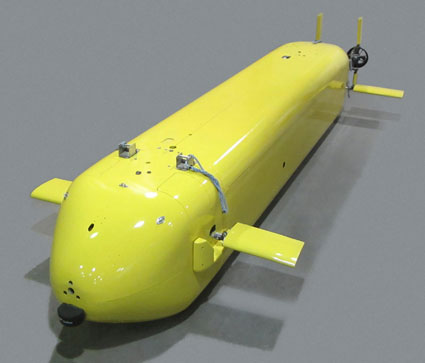
The US Navy is using General Motor’s (GM) hydrogen fuel cell technology to power its latest underwater vessel.
Hydrogen fuel cells convert high-energy hydrogen efficiently into electricity, resulting in vehicles with greater range and endurance than those powered with batteries. Under the ONR’s Innovative Naval Prototype program for Large Displacement UUVs (LDUUV), energy is a core technology in the Navy’s goals for vehicles with more than 60 days endurance. Besides the GM fuel cell, the Navy has evaluated alternative power generation solutions fromGeneral Atomics, Lynntech and NexTech Materials.
The Naval Research Laboratory recently concluded an evaluation of a prototype UUV equipped with a GM fuel cell at the heart of the vehicle powertrain.
The tests, a key step in the development of an at-sea prototype, were conducted in pools at the Naval Surface Warfare Center in Carderock, Md.
The Navy plans to test the LDUUV in the open sea this year and could field a first squadron of the robotic submarines by 2020.
“Our in-water experiments with an integrated prototype show that fuel cells can be game changers for autonomous underwater systems,” said Frank Herr, ONR’s department head for Ocean Battlespace Sensing.
“Reliability, high energy, and cost-effectiveness — all brought to us via GM’s partnering — are particularly important as Navy looks to use UUVs as force multipliers.”
Hydrogen fuel cell propulsion technology helps address two major automotive environmental challenges: petroleum use and carbon dioxide emissions.
Fuel cell vehicles can operate on renewable hydrogen from sources like wind and biomass stored for later use. Once converted to electricity, water vapor is the only emission. Recharging takes only minutes.
GM’s fuel cells are compact and lightweight and have high reliability and performance. Lower cost is achievable through volume production supporting automotive applications. These attributes match the goals of the Navy to develop reliable, affordable systems.
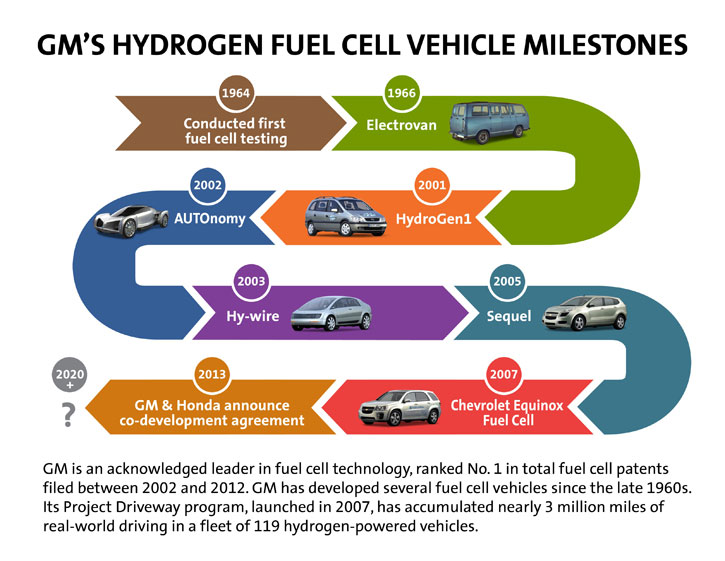
“The collaboration with the Navy leveraged what we learned in amassing more than 3 million miles of real-world experience with our Project Driveway fuel cell program,” said Charlie Freese, executive director of GM Global Fuel Cell Activities. “Our customers will benefit from additional lessons we learn about the performance of fuel cells in non-automotive applications that will be useful in GM’s drive to offer fuel cells across consumer markets.”