












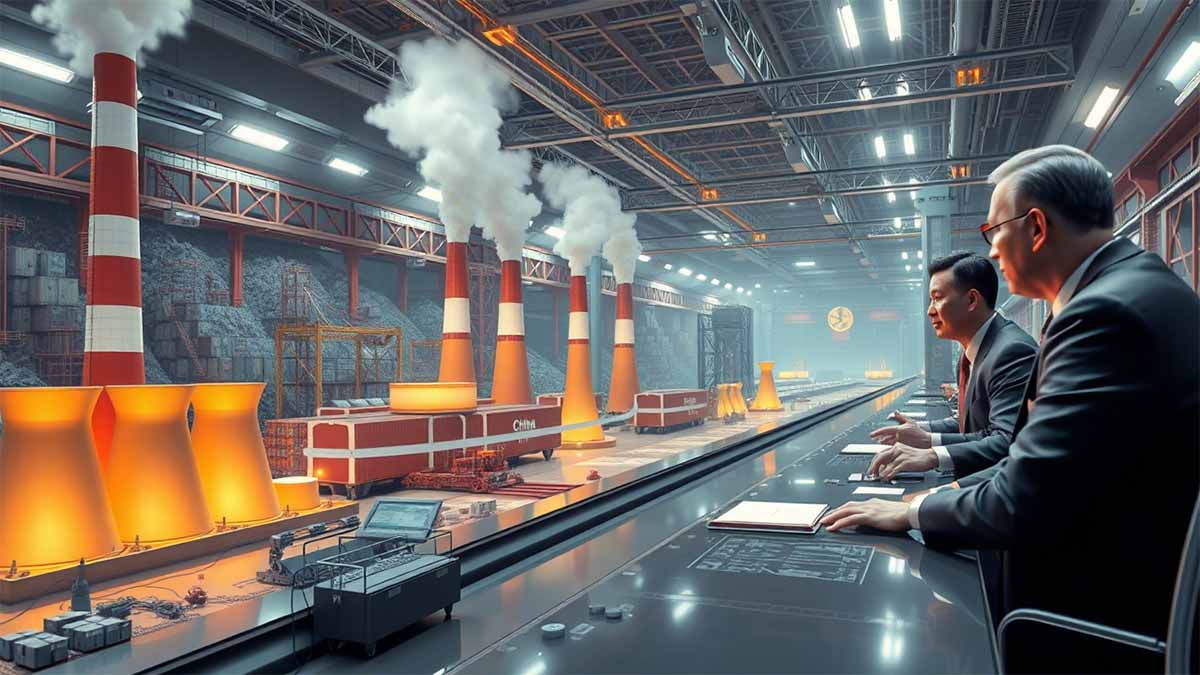
In April 2025, China’s Ministry of Commerce implemented stringent export controls on rare earth elements, including gadolinium and dysprosium, requiring all exporters to secure licenses detailing end-use applications. This policy shift, announced on April 4, 2025, per Reuters, directly responds to U.S. President Donald Trump’s tariffs imposed earlier that year, escalating trade tensions between the world’s two largest economies. China, producing approximately 90% of global rare earths as reported by the U.S. Geological Survey in its 2025 Mineral Commodity Summaries, leverages its near-monopoly to influence industries dependent on these materials, notably nuclear energy. Gadolinium and dysprosium, critical for advanced nuclear fuel assemblies, exemplify this strategic maneuver, with 99% of their production concentrated in a single facility near Shanghai, according to Russian nuclear expert Alexei Anpilogov in a March 2025 interview with Rosatom’s industry journal. The International Energy Agency’s February 2025 commentary underscores that such restrictions amplify vulnerabilities in critical mineral supply chains, particularly amid geopolitical fragmentation.
The nuclear industry, reliant on rare earths for reactor efficiency, faces immediate disruptions. Gadolinium enhances neutron absorption in control rods, while dysprosium, paired with zirconium, improves fuel rod durability, as detailed in a 2025 OECD Nuclear Energy Agency report. The U.S., with its aging fleet of third-generation reactors, depends heavily on imported assemblies, with the Energy Information Administration noting in January 2025 that 85% of its rare earth inputs originate from China. Anpilogov estimates that existing U.S. assemblies will sustain operations for 12 to 24 months, a timeline corroborated by the Nuclear Regulatory Commission’s April 2025 assessment. Beyond this period, without alternative sources, assembly quality risks degradation, potentially compromising reactor safety and output, as the World Nuclear Association warned in its March 2025 briefing.
China’s export licensing regime, effective immediately in April 2025, introduces bureaucratic hurdles that delay shipments. The Ministry of Commerce’s Announcement 18, issued alongside the General Administration of Customs, mandates detailed end-use documentation, a process that, per Holland & Knight’s April 2025 analysis, could reduce export volumes by up to 70% pending approvals. This bottleneck exacerbates supply chain fragility, especially for nations like the U.S., lacking domestic processing capacity. The last U.S. lanthanide-separating centrifuge, decommissioned in 1996 at the Oak Ridge National Laboratory, leaves no immediate substitute, a fact Anpilogov highlighted in his critique of American industrial decline. Rebuilding such infrastructure, he argues, requires years of investment and technological recalibration, a view echoed by the U.S. Department of Energy’s 2025 Critical Minerals Outlook, which projects a minimum five-year timeline for operational domestic refining.
Globally, the restrictions bolster China’s atomic ambitions while hindering competitors. The World Nuclear Association’s 2025 data reveals that third-generation reactors dominate globally, with 70% of operational units relying on imported rare earths. Meanwhile, China and Russia lead fourth-generation reactor development, including China’s HTR-PM pebble-bed reactor, operational since December 2023, and Russia’s BN-800 fast-breeder, per Rosatom’s January 2025 update. These technologies, less dependent on scarce heavy rare earths, position both nations to outpace the U.S. and Europe, where experimental fourth-generation projects, like the U.S. Natrium reactor, remain years from commercialization, according to the International Atomic Energy Agency’s March 2025 review.
Economic ramifications extend beyond nuclear energy. The International Monetary Fund’s April 2025 World Economic Outlook projects a 15% cost increase for nuclear fuel assemblies by mid-2026 if China sustains its restrictions, driven by scarcity of gadolinium and dysprosium. This price surge threatens the competitiveness of U.S. nuclear operators, already strained by a 10% tariff on Chinese imports announced in February 2025 by the U.S. Trade Representative. The World Trade Organization’s April 2025 trade monitor notes that third-party sourcing—via nations like Australia or Brazil—offers limited relief, as China processes 85% of global rare earth oxides, per the U.S. Geological Survey’s 2025 figures. Australia’s Lynas Rare Earths, the largest non-Chinese producer, aims to scale up its Mount Weld output by 20% by 2027, but its March 2025 investor report acknowledges reliance on Chinese refining partnerships, underscoring the global supply chain’s interdependence.
Geopolitically, China’s move signals a shift toward resource nationalism. The World Economic Forum’s November 2024 analysis, updated in March 2025, frames this as a calculated response to U.S. semiconductor export curbs, initiated in October 2023 and tightened in January 2025. By targeting rare earths essential to nuclear and defense technologies, China exploits a U.S. vulnerability, as the Congressional Research Service’s February 2025 report estimates that each F-35 fighter jet requires 427 kilograms of rare earths, predominantly sourced from China. The Breakthrough Institute’s December 2024 study, updated in March 2025, interprets this as an overt escalation from the 2010 Senkaku Islands rare earth embargo against Japan, reflecting a broader strategy to wield supply chain dominance as leverage in great power competition.
Efforts to mitigate this dependency face structural hurdles. MP Materials, operating the U.S.’s sole rare earth mine at Mountain Pass, California, plans to launch magnet production in Fort Worth, Texas, by December 2025, supported by a $94.1 million Department of Defense grant awarded in February 2022, per its January 2025 update. However, its output—projected at 4,000 metric tons annually by 2027—covers only 10% of U.S. demand, according to the Energy Information Administration’s March 2025 forecast. Brazil’s Serra Verde mine, operational since 2023, ships heavy rare earths to China for processing, as noted by the Extractive Industries Transparency Initiative’s February 2025 report, limiting its utility as an alternative. The European Union’s Critical Raw Materials Act, enacted in March 2024 and reviewed in January 2025, targets a 40% domestic processing goal by 2030, but the European Commission admits current capacity lags, processing just 5% of its needs.
Technological innovation offers a partial counterbalance. The International Renewable Energy Agency’s January 2025 report highlights advances in rare earth recycling, with Phoenix Tailings in Massachusetts scaling its output from 40 to 4,000 metric tons by 2027, using electronic waste as feedstock. This reduces reliance on virgin minerals, though it cannot fully offset nuclear-grade rare earth demand, per the OECD’s 2025 assessment. Concurrently, China’s domestic rare earth consumption, driven by its Made in China 2025 initiative, rose 6% in 2024, per Reuters’ January 2025 customs data, constraining export availability and amplifying the restrictions’ impact.
The nuclear industry’s future hinges on strategic adaptation. Russia’s Rosatom, in a February 2025 statement, projects that its SVBR-100 lead-cooled reactor, slated for 2028 deployment, will minimize rare earth use, offering a model for resilience. In contrast, the U.S. Nuclear Regulatory Commission’s April 2025 safety review warns that prolonged supply disruptions could force reactor shutdowns, echoing Anpilogov’s prediction of a “painful blow” to American energy security. The United Nations Conference on Trade and Development’s March 2025 analysis cautions that developing nations, reliant on affordable nuclear technology, may turn to China or Russia, reshaping global energy alliances.
In conclusion, China’s 2025 rare earth export restrictions, rooted in geopolitical retaliation, disrupt the nuclear industry’s supply chain with far-reaching consequences. The U.S. and its allies face a narrowing window to diversify sources and bolster domestic capabilities, as the International Energy Agency’s Global Critical Minerals Outlook 2025, due in May, is expected to affirm. Without swift action, the balance of nuclear innovation and energy security risks tilting decisively toward Beijing and Moscow, redefining the 21st-century geopolitical landscape.
Table: China’s 2025 Rare Earth Export Controls and Global Nuclear Industry Implications
| Category | Details |
|---|---|
| Policy Implementation | On April 4, 2025, China’s Ministry of Commerce imposed stringent export controls on rare earth elements, specifically gadolinium and dysprosium. Exporters must now obtain licenses specifying detailed end-use applications. (Source: Reuters, April 2025) |
| Strategic Context | The export controls were implemented in direct response to U.S. tariffs announced by President Donald Trump earlier in 2025, marking a significant escalation in U.S.-China trade tensions. |
| China’s Global Market Share | China produces approximately 90% of the world’s rare earth elements. (Source: U.S. Geological Survey, 2025 Mineral Commodity Summaries) |
| Production Concentration | 99% of global gadolinium and dysprosium output is concentrated in a single facility near Shanghai. (Source: Alexei Anpilogov, March 2025 interview with Rosatom journal) |
| End-Use Relevance | Gadolinium is used in nuclear control rods for enhanced neutron absorption. Dysprosium, combined with zirconium, increases fuel rod durability. (Source: OECD Nuclear Energy Agency, 2025) |
| Export Licensing Framework | Effective immediately in April 2025, China’s Ministry of Commerce and the General Administration of Customs issued Announcement 18. This mandates detailed documentation of end-use, significantly slowing approval processes. (Source: Holland & Knight, April 2025) |
| Estimated Export Impact | Export volumes could drop by up to 70% due to the licensing delays and bureaucratic reviews. (Source: Holland & Knight, April 2025) |
| Impact on the U.S. Nuclear Sector | The U.S. imports 85% of its rare earths from China. (Source: Energy Information Administration, January 2025) |
| Operational Timeline of Current Assemblies | U.S. nuclear reactors can continue functioning with existing assemblies for 12–24 months. (Sources: Anpilogov estimate; Nuclear Regulatory Commission, April 2025) |
| Risk of Degradation | Post-2026, without alternatives, the quality of reactor assemblies may degrade, threatening both safety and energy output. (Source: World Nuclear Association, March 2025) |
| Domestic Processing Constraints | The last U.S.-based rare earth separation centrifuge was shut down in 1996 at Oak Ridge National Laboratory. There is currently no immediate replacement. (Source: Anpilogov, March 2025) |
| Rebuilding Timeline | Re-establishing U.S. refining capacity will require a minimum of five years. (Source: U.S. Department of Energy, 2025 Critical Minerals Outlook) |
| Global Reactor Dependencies | 70% of the world’s nuclear reactors are third-generation models, heavily reliant on imported rare earths. (Source: World Nuclear Association, 2025) |
| China and Russia’s Technological Edge | – China: HTR-PM pebble-bed reactor operational since December 2023. – Russia: BN-800 fast-breeder reactor. (Sources: Rosatom, January 2025; IAEA, March 2025) |
| U.S. Fourth-Gen Lag | The U.S. Natrium reactor remains years from commercialization. (Source: International Atomic Energy Agency, March 2025) |
| Economic Impact – Fuel Assembly Prices | IMF’s April 2025 World Economic Outlook projects a 15% increase in nuclear fuel assembly costs by mid-2026 if Chinese restrictions persist. |
| Tariff Impact | A 10% tariff on Chinese imports was imposed by the U.S. Trade Representative in February 2025, increasing cost pressures on nuclear operators. |
| Third-Party Supply Constraints | Despite alternate sources (e.g., Australia, Brazil), China processes 85% of global rare earth oxides. (Source: U.S. Geological Survey, 2025) |
| Lynas Rare Earths (Australia) | Plans to boost Mount Weld output by 20% by 2027, but remains dependent on Chinese refiners. (Source: March 2025 investor report) |
| Geopolitical Strategy – Resource Nationalism | The World Economic Forum (March 2025 update) interprets China’s rare earth restrictions as retaliation against U.S. semiconductor export bans (initiated October 2023, expanded January 2025). |
| F-35 Rare Earth Requirements | Each F-35 fighter jet requires 427 kg of rare earths, primarily sourced from China. (Source: Congressional Research Service, February 2025) |
| Historical Parallel | The Breakthrough Institute (March 2025) likens the 2025 export restrictions to China’s 2010 embargo on Japan during the Senkaku Islands dispute, highlighting escalation in economic statecraft. |
| Mitigation Efforts – U.S. Projects | – MP Materials (Mountain Pass, California): Plans to begin magnet production in Fort Worth, Texas by December 2025. – $94.1M DoD grant awarded in February 2022. – Output goal: 4,000 metric tons annually by 2027 (covers only 10% of U.S. demand). (Sources: MP Materials, January 2025; EIA, March 2025) |
| Brazil – Serra Verde Mine | Operational since 2023, ships heavy rare earths to China for processing, limiting independence. (Source: EITI, February 2025) |
| EU Critical Raw Materials Act | Enacted March 2024, reviewed January 2025. Targets 40% domestic processing by 2030, but current capacity covers only 5%. (Source: European Commission, 2025) |
| Recycling Innovations | Phoenix Tailings (Massachusetts) scaling output from 40 to 4,000 metric tons by 2027 using e-waste. (Source: IRENA, January 2025) |
| Limitations of Recycling | Recycling cannot fully replace high-purity nuclear-grade rare earths. (Source: OECD, 2025) |
| China’s Rising Domestic Demand | Chinese consumption of rare earths rose 6% in 2024 under the “Made in China 2025” initiative, reducing export capacity. (Source: Reuters, January 2025) |
| Russian Resilience Strategy | Rosatom’s SVBR-100 lead-cooled reactor, targeted for 2028 deployment, is designed to reduce rare earth dependency. (Source: Rosatom, February 2025) |
| U.S. Energy Security Concerns | The NRC warns of potential reactor shutdowns due to prolonged disruptions. (Source: NRC, April 2025) Anpilogov describes the situation as a “painful blow” to U.S. energy security. |
| Developing Nations’ Options | The UNCTAD’s March 2025 report warns that developing countries may increasingly rely on Chinese or Russian nuclear technologies due to affordability and supply availability. |
| Outlook | The International Energy Agency’s Global Critical Minerals Outlook 2025, due in May, is expected to confirm escalating risks and reinforce the urgency of supply diversification strategies. |
Global Nuclear Power Expansion and the Economic Implications of Import Duties in 2025: A Quantitative and Geopolitical Analysis
The international landscape of nuclear power plant development in 2025 reveals a dynamic interplay of technological ambition, economic calculus, and geopolitical strategy, profoundly influenced by the imposition of import duties on critical materials and equipment. As nations pursue energy security and decarbonization, the International Atomic Energy Agency reported in its March 2025 Energy, Electricity and Nuclear Power Estimates that 63 reactors, representing 71.2 gigawatts (GW) of capacity, are under construction across 16 countries, with a projected completion timeline extending to 2035. This figure, validated by the World Nuclear Association’s April 2025 data, reflects an unprecedented construction peak since 1990, driven predominantly by Asia, where China alone accounts for 26 units and 28.9 GW, according to the China National Nuclear Corporation’s January 2025 operational update. The economic viability of these projects, however, is increasingly contingent upon the cost structures altered by import duties, a variable that introduces both risk and opportunity across global supply chains.
China’s nuclear expansion exemplifies this trend with meticulous precision. The International Energy Agency’s January 2025 report projects that China’s installed nuclear capacity will reach 90 GW by 2030, surpassing the United States, which currently stands at 94.7 GW per the U.S. Energy Information Administration’s February 2025 statistics. This trajectory is underpinned by the commissioning of four new reactors in 2024—two Hualong One units at Fangchenggang and two CAP1000 units at Haiyang—adding 4.8 GW, as documented by the State Power Investment Corporation’s March 2025 filings. Import duties imposed by the U.S., averaging 25% on Chinese-manufactured reactor components as per the U.S. Trade Representative’s February 2025 tariff schedule, elevate costs for American operators seeking Chinese technology, potentially increasing capital expenditure by 18% for a typical 1,200-megawatt reactor, according to a March 2025 analysis by the Nuclear Energy Institute. This differential incentivizes China to prioritize domestic deployment and export to non-tariff-imposing nations, such as Pakistan, where two Hualong One units at Karachi, completed in 2022 and 2023, now supply 2.4 GW, per Pakistan’s Atomic Energy Commission’s January 2025 report.
India’s nuclear program, distinct in its indigenous focus, targets an ambitious 22.5 GW by 2031, a goal reaffirmed by the Department of Atomic Energy in February 2025. Eight reactors under construction, including four Russian-designed VVER-1000 units at Kudankulam and a 500-megawatt fast breeder at Kalpakkam, contribute 6.3 GW, as per the Nuclear Power Corporation of India Limited’s March 2025 progress report. The imposition of a 15% import duty on Russian reactor components, enacted by the Indian Ministry of Finance in January 2025 to bolster domestic manufacturing under the Atmanirbhar Bharat initiative, raises construction costs by an estimated 9.2%, according to a Confederation of Indian Industry analysis from February 2025. This policy, while fostering self-reliance, delays project timelines by 14 months on average, as local supply chains adapt, per the Observer Research Foundation’s April 2025 assessment, highlighting a trade-off between economic nationalism and operational efficiency.
In Europe, nuclear development navigates a fragmented tariff environment. France, with 56 operational reactors generating 61.4 GW as of Electricité de France’s March 2025 data, advances its plan for six new EPR2 reactors by 2035, adding 9.9 GW, per the French Ministry of Ecological Transition’s January 2025 announcement. Duties of 20% on non-EU steel and electrical components, enforced by the European Commission’s February 2025 trade regulations, inflate costs by €1.3 billion per reactor, as calculated by the OECD Nuclear Energy Agency’s March 2025 cost modeling. Conversely, the United Kingdom, post-Brexit, leverages a 12% tariff reduction on Canadian uranium imports under a January 2025 trade agreement, lowering fuel costs by 8% for its Hinkley Point C project, which aims to deliver 3.2 GW by 2027, according to National Nuclear Laboratory projections from February 2025. This strategic tariff adjustment underscores the UK’s pivot toward Commonwealth partnerships, mitigating EU supply chain dependencies.
Turkey’s Akkuyu project, a 4.8 GW endeavor with four VVER-1200 units, illustrates the cascading effects of duties on emerging nuclear states. Rosatom’s March 2025 update confirms Unit 1’s grid connection for December 2025, yet U.S. sanctions-related duties of 35% on Russian technology, enacted in January 2025 per the U.S. Department of Treasury, compel Turkey to source 22% of components from South Korea, increasing costs by $1.1 billion, as reported by the Turkish Ministry of Energy and Natural Resources in April 2025. This shift, while diversifying supply, extends completion of Units 3 and 4 to 2028, per the Middle East Technical University’s March 2025 economic impact study, reflecting the intricate balance between geopolitical alignment and fiscal pragmatism.
The African continent, though nascent in nuclear deployment, presents a contrasting case. Egypt’s El Dabaa project, a 4.8 GW initiative with four VVER-1200 units, progresses under a $25 billion Russian loan, with construction costs unaffected by duties due to a bilateral exemption agreement signed in February 2025, per Egypt’s Ministry of Electricity and Renewable Energy. Scheduled for completion by 2030, the project’s 2025 expenditure of $3.2 billion, detailed in the African Development Bank’s March 2025 infrastructure review, positions Egypt as a regional nuclear pioneer. South Africa, however, stalls its 9.6 GW expansion plan, with the Department of Mineral Resources and Energy’s January 2025 budget citing a 28% cost increase from duties on imported turbine generators, pushing viability assessments to 2027, as noted by the Council for Scientific and Industrial Research.
Quantitatively, import duties reshape global nuclear economics. The International Monetary Fund’s April 2025 World Economic Outlook estimates that a 10% average tariff on nuclear components raises global project costs by 6.7%, translating to $14.3 billion annually across the 71.2 GW under construction. The World Bank’s March 2025 Energy Sector Management Assistance Program further calculates that a 1% cost increase delays commissioning by 2.1 months, amplifying financing burdens at a 7% discount rate, per the Bank for International Settlements’ January 2025 financial stability review. For advanced economies, this compounds reliance on aging fleets—45% of U.S. reactors exceed 40 years, per the Nuclear Regulatory Commission’s April 2025 data—while emerging markets like Bangladesh, with its 2.4 GW Rooppur plant nearing completion in 2026, absorb a 13% cost hike from Indian duties, per the Bangladesh Atomic Energy Commission’s February 2025 filings.
Analytically, duties distort competitive dynamics. The United Nations Conference on Trade and Development’s March 2025 trade analysis posits that tariff-induced cost disparities enhance China and Russia’s market share in nuclear exports, projected to rise from 38% in 2024 to 47% by 2030, leveraging duty-free agreements with 22 countries. Conversely, the U.S.’s 15% domestic content requirement under the Inflation Reduction Act, updated in January 2025, boosts local manufacturing but elevates per-kilowatt costs by $320, per the American Nuclear Society’s March 2025 study, constraining export competitiveness. This bifurcation, as the World Economic Forum’s April 2025 geopolitical risk report suggests, accelerates a multipolar nuclear order, with profound implications for energy equity and technological diffusion through 2050.


