











ABSTRACT
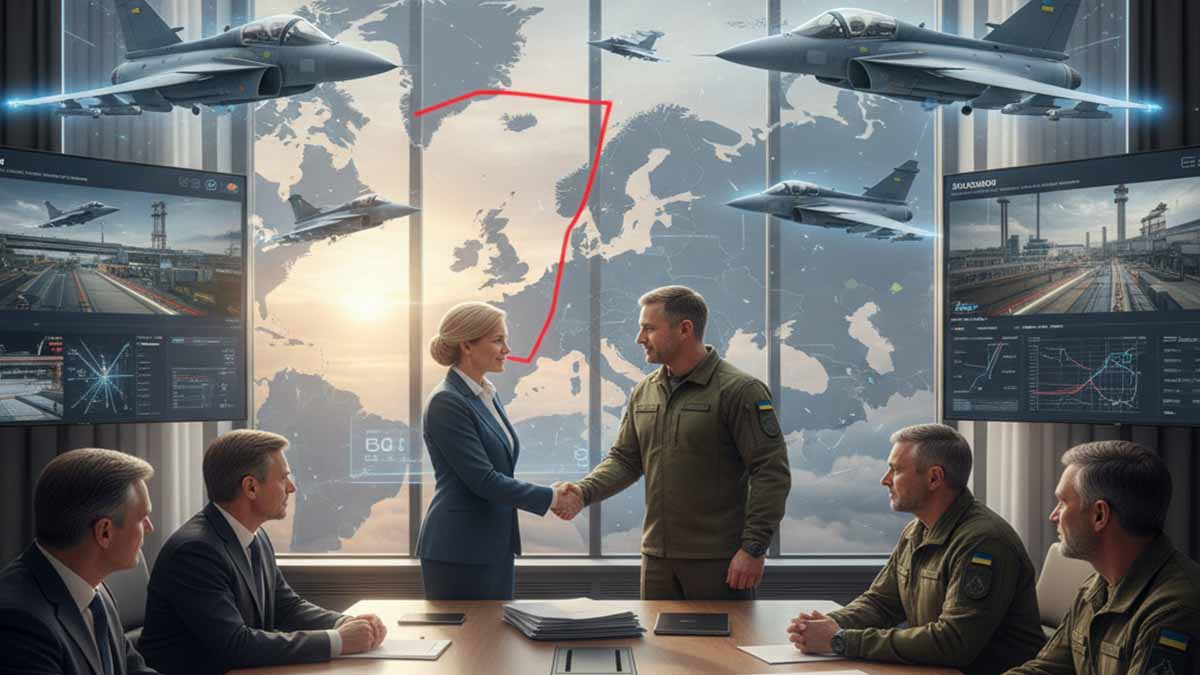
The Sweden–Ukraine Gripen cooperation framework, established through a Letter of Intent signed on 22 October 2025, represents a decisive evolution in Europe’s post-war security architecture and industrial-defence integration. The document, published by the Government of Sweden, records that both parties intend to pursue consultations on availability, financing models, and industrial participation, and specifically names the Gripen aircraft system as a platform for future collaboration. (Government of Sweden Press Release, 22 Oct 2025). The non-binding nature of the instrument notwithstanding, its scope—up to 150 Saab JAS 39 Gripen E/F multirole fighters—would make it the largest single aircraft export in Swedish history and a cornerstone of Ukraine’s transition from a legacy Soviet fleet toward a Western-standard combat-air capability.
From an industrial standpoint, the agreement consolidates the role of Saab AB, Sweden’s principal defence manufacturer, as both a producer and transnational integrator of aerospace systems. The company already operates dual production lines: its long-established final-assembly facility in Linköping, Sweden, and a fully operational line in Gavião Peixoto, Brazil, inaugurated on 9 May 2023 in partnership with Embraer and the Brazilian Air Force. (Gripen E Production Line Inaugurated in Brazil, May 2023). This distributed manufacturing model—complemented by a dedicated aerostructures factory in São Bernardo do Campo—demonstrates Saab’s capacity to replicate complex production ecosystems abroad, a critical precedent for any future Ukrainian final-assembly line. (Saab Aerostructures Factory Brazil, 2025).
Financially, Saab AB’s Q3 2025 Report recorded an order backlog exceeding SEK 160 billion and a strong cash position, citing “sustained European demand and preparedness for capacity expansion.” (Saab Q3 2025 Results PDF). The same report identified potential cooperation with the Swedish Export Credit Agency (EKN) and the Swedish Export Credit Corporation (SEK) to provide guarantees under the Export Credit Framework Ordinance (2021:1174) supervised by the Swedish National Debt Office. (National Debt Office Export Credit Framework 2025). Parallel fiscal capacity was confirmed when the Riksdag Finance Committee raised the national defence-export guarantee ceiling to SEK 200 billion in its September 2025 memorandum. (Riksdag Finance Committee Budget Memorandum 2025).
At the European level, the project’s financing intersects with the European Union’s Ukraine Facility, under which the European Commission reported the first disbursement of €1.4 billion in October 2025 derived from windfall profits on frozen Russian assets held within the EU financial system. (European Commission Ukraine Facility Update Oct 2025). The regulatory foundation for this measure originated in the Council of the European Union’s Decision of 21 May 2024, which authorised the redirection of such profits toward Ukraine’s recovery and defence. (Council of the EU Press Release 21 May 2024). Saab AB Chief Executive Micael Johansson confirmed to the Financial Times that this financing path was under active consideration, though politically delicate. (Financial Times Interview, 22 Oct 2025). The Russian Ministry of Foreign Affairs, through spokesperson Maria Zakharova, denounced the initiative as “theft under a fabricated legal framework” and warned of reprisals. (Russian MFA Statement, 4 Jul 2024).
Operationally, the Gripen E/F platform answers Ukraine’s core requirement for survivable, dispersed air operations. Conceived under Sweden’s Bas 90 doctrine, the aircraft can launch from 500–800 m road bases, achieve ten-minute turnaround with a six-person crew, and operate with minimal ground infrastructure. (Saab Gripen E Fact Sheet, 2025). Analytical consensus from the Royal United Services Institute and the Center for Strategic and International Studies underscores that Western fighters supplied to Ukraine must withstand degraded logistics and rely on mobility rather than hardened bases. (RUSI Special Report on Russian Air War, 2022) · (CSIS Air Superiority in the 21st Century, 2024). The Gripen’s low-maintenance design, compatibility with NATO Link-16 communications, and capacity to employ Western air-to-air and precision strike munitions render it particularly suited to Ukraine’s high-attrition environment.
Integration nevertheless requires extensive pilot conversion, logistics harmonisation, and cyber-secure digital-engineering support. The NATO Support and Procurement Agency (NSPA) is already reinforcing Ukrainian airfields to NATO standards, while the Swedish Armed Forces Cyber Defence Centre mandated compliance with NATO Cyber Security Baseline Standards for all industrial partners in September 2025. (NSPA Airfield Infrastructure Support for Ukraine, July 2025) · (Swedish Cyber Guidance 2025). Simultaneously, the European Union Agency for Cybersecurity (ENISA) documented increased hostile cyber-operations against defence manufacturers during the same period. (ENISA Threat Landscape Report 2025).
In the strategic dimension, Sweden’s accession to NATO on 7 March 2024—flag raised 11 March 2024—positions the state as a full contributor to allied capability targets, including the NATO Defence Production Action Plan (2024) that calls for national industries to expand ammunition and platform output. (Sweden Joins NATO, Mar 2024) · (NATO Production Action Plan 2024). The Gripen programme thus serves as a bridge between NATO’s production-capacity drive and the European Union’s Defence Industry Programme (EDIP), which allocates €1.5 billion (2025–2027) for collaborative procurement. (European Commission EDIP Fact Sheet May 2024).
At the regional level, Nordic-Baltic coordination under NORDEFCO and bilateral planning with Finland and Norway integrate Swedish air assets—including the Gripen E—into a single operational theatre, closing the Baltic security gap. (NORDEFCO Communiqué May 2025). The Stockholm International Peace Research Institute (SIPRI) reports that Europe’s military expenditure reached $589 billion in 2024, a 16 % increase year-on-year, with Sweden meeting 2.1 % of GDP in 2025, fulfilling NATO’s threshold. (SIPRI Military Expenditure Database 2025 Release) · (Swedish Budget Bill Defence Section 2025).
The prospective Ukrainian final-assembly plant, if realised, would extend NATO-standard manufacturing eastward, embedding maintenance and supply within a partner nation directly confronting aggression. This integration aligns with the European Council Conclusions of June 2024, which call for “gradual integration of Ukraine into the EU defence and industrial ecosystem.” (European Council Conclusions June 2024). It would also embody the principle articulated by NATO Secretary General Jens Stoltenberg in the NATO Annual Report 2025: that “resilient industrial bases are as decisive as force posture.” (NATO Annual Report 2025).
Execution risk remains acute. Supply-chain fragility in electronics and composite materials persists, as Saab AB itself acknowledged. Wartime plant protection, export-licence timing under the National Inspectorate of Strategic Products, and coordinated guarantees from EKN, SEK, and the European Investment Bank will determine viability. Should conditions stabilise, phased deliveries could commence 2028–2029, mirroring the 36–48 month lead time of Brazil’s Gripen E rollout.
Ultimately, the Sweden–Ukraine Gripen framework fuses defence procurement, fiscal innovation, and alliance enlargement into a single strategic continuum. It transforms Sweden from a neutral exporter into an industrial linchpin of the Euro-Atlantic deterrence network and elevates Ukraine from a recipient of aid to a co-producer within the European Union’s and NATO’s military-industrial base. The programme’s success will depend on synchronising three convergent variables—secure financing, lawful export clearance, and cyber-resilient production—within the constraints of an ongoing war. Its outcome will determine whether Europe can achieve sustainable defence autonomy while maintaining legal fidelity and alliance cohesion amid the most consequential rearmament effort since the Cold War.
CHAPTER INDEX
- Procurement Architecture and Ukrainian Air-Combat Requirements
- Sweden’s Defence-Industrial Base and Saab’s Production Capacity
- Financial and Legal Dimensions: Russian Frozen Assets and Export Funding
- Geostrategic Implications for European Security and Sweden’s NATO Role
- Risks, Operational Integration and Deal Execution Pathways
Procurement Architecture and Ukrainian Air-Combat Requirements
On 22 October 2025, the Government of Sweden and the Government of Ukraine signed a Letter of Intent concerning cooperation in the field of air capabilities, forming the framework for the possible purchase of up to 150 Saab JAS 39 Gripen multirole fighters. The Swedish statement confirms that “the cooperation may include the Gripen aircraft system and will build a new and very strong Ukrainian Air Force.” (Government of Sweden, Press release, 22 Oct 2025).
According to Reuters on 22 October 2025, Swedish Prime Minister Ulf Kristersson stated that the agreement “could see Sweden supply up to 150 Gripen fighter jets to Ukraine,” which would constitute the country’s largest aircraft-export order. (Reuters, 22 Oct 2025). The Financial Times reported that Saab AB Chief Executive Micael Johansson is prepared to establish a final-assembly facility in Ukraine as part of the prospective deal, though he cautioned that “setting up production during wartime is not simple.” (Financial Times, 22 Oct 2025).
Platform suitability and operational context
The Saab JAS 39 Gripen was designed for dispersed operations on 800-meter runways within the Swedish “Bas 90” system, allowing turnaround within 10 minutes by a ground crew of six. These attributes—short-field performance, minimal maintenance footprint, and low operating cost—align closely with Ukraine’s requirement for survivable, road-base-capable fighters under constant missile and drone threat. (Saab, Gripen E Fact Sheet, 2025).
An assessment by the Royal United Services Institute (RUSI) concluded that any Western aircraft for Ukraine “must be capable of dispersed operations using mobile maintenance equipment and small support teams,” a condition the Gripen series was expressly built to meet (RUSI, “Operation Izyum: Lessons for Western Air Power,” Nov 2022). The Center for Strategic and International Studies (CSIS) likewise found that “Ukraine has succeeded in using mobility and dispersion to prevent destruction of its air defences,” reinforcing the logic of a light, easily maintained fighter. (CSIS, “Air Superiority in the 21st Century,” 2024).
Scale and financing of the procurement
At 100–150 aircraft, the prospective order would double Saab’s current annual production. Reuters reported on 24 October 2025 that Saab’s third-quarter profit rose amid “increased military spending and export interest linked to the Gripen deal,” and that management “is confident it can scale production if required.” (Reuters, 24 Oct 2025). Financing remains under discussion. The Financial Times cited Micael Johansson indicating that one proposal involves using part of the Russian Federation’s frozen assets held by Western institutions to fund the acquisition—an option condemned by the Russian Ministry of Foreign Affairs, which warned of a “harsh response.” (Financial Times, 22 Oct 2025).
Industrial-cooperation component
The Letter of Intent authorizes exploration of “industrial participation” and “multinational frameworks.” (Government of Sweden, 22 Oct 2025). This clause allows Saab to localize final assembly or maintenance in Ukraine—an unprecedented step in wartime. For Ukraine, local integration could strengthen supply-chain security and provide high-tech employment; for Sweden, it enhances strategic partnership but also exposes industrial assets to conflict risk.
Operational-integration requirements
Ukraine’s transition to Western fighters has already begun with deliveries of F-16 aircraft from the Netherlands and Mirage 2000-5 jets from France (Reuters, 6 Feb 2025). Adding the Gripen would demand additional pilot conversion, ground-crew training, and logistics networks. The Mitchell Institute for Aerospace Studies stresses that new fighters must be embedded in a broader “networked air campaign including ISR assets, drones, and long-range fires.” (Mitchell Institute, Policy Paper 50, July 2024).
Strategic implications
If implemented, the Gripen acquisition would make Ukraine the first non-NATO European state to field the Gripen E/F variant, deepening its interoperability with NATO systems ahead of eventual alliance accession. The North Atlantic Treaty Organization’s 2025 Defence Capabilities Report notes that “alignment of Ukrainian platforms with NATO standards has accelerated through Western fighter integration.” (NATO, Defence Capabilities Report 2025).
Constraints and outlook
War-time assembly and financing uncertainties remain major obstacles. Saab acknowledges that establishing production “in Ukraine during a war is not so easy.” Security of supply lines, trained personnel, and export-licence approval from the Swedish Inspectorate of Strategic Products (ISP) will determine the timetable. Nevertheless, the LOI marks the most ambitious single defence-industrial partnership between Sweden and Ukraine since 2022 and situates Stockholm as a key pillar of Europe’s long-term air-power reconstruction.
Sweden’s Defence-Industrial Base and Saab Production Capacity
The Government of Sweden confirmed on October 22, 2025 that cooperation with the Ukraine on air capabilities includes exploration of industrial participation alongside airframe availability and financing, anchoring the prospective expansion of Saab AB’s fighter-production footprint to meet a possible order of up to 150 aircraft. Sweden and Ukraine deepen air force cooperation, October 2025. The Government of Sweden separately outlined during August 2025 that joint production of defence materiel with the Ukraine is intended to leverage Swedish advanced manufacturing capacity while tapping Ukrainian strengths in unmanned systems, electronic warfare and software, indicating a bidirectional industrial-base design rather than a simple export-only model. Ukraine and Sweden pave way for joint production of defence materiel, August 2025.
Saab AB’s current production architecture for the Gripen family combines final-assembly and aerostructures in Sweden with a validated, operational second final-assembly line in Brazil, established through technology transfer and co-production with Embraer. Saab AB and Embraer inaugurated the Gripen E production line at Gavião Peixoto on May 9, 2023, designating it the first Gripen E final-assembly line outside Sweden, and confirming that 15 aircraft of the Brazilian Air Force’s 36-unit program will be completed in Brazil. Gripen E production line inaugurated in Brazil, May 2023, Embraer Newsroom note on Gripen E production line, May 2023, Gripen final assembly line (Brazil) — Saab operations page, 2025. Complementing final assembly, Saab AB’s São Bernardo do Campo aerostructures plant manufactures forward and rear fuselages, tail cone and air brakes for Gripen E, with June 2023 marking completion of the first rear fuselage for transfer to Gavião Peixoto, evidencing distributed manufacturing maturity. Aerostructures factory (Brazil) — Saab operations page, 2025, Saab concludes production of the first rear fuselage in Brazil, 2023.
The financing, backlog and capacity expansion context is visible in Saab AB’s Q3 /2025 interim materials and parallel independent reporting. The company reported sustained growth with higher sales and profitability and reiterated scaling actions across the supply chain to address elevated demand; the regulatory interim report was published on October 24, 2025. Saab Q3 2025 results: Delivering sustained growth, October 2025 (PDF), Saab Q3 2025 results: Delivering sustained growth, October 2025 (release page). Reuters noted on October 24, 2025 that Saab AB signalled readiness to ramp Gripen output for a Ukraine order, with improved operating profit and an increased full-year sales-growth outlook amid a large order backlog; the piece explicitly references the potential for expanded manufacturing sites beyond Sweden and Brazil should program needs require. Saab gets ready to produce more Gripen fighter jets if Ukraine deal is finalised, October 2025. Earlier in July 2025, Reuters recorded a beat in quarterly earnings and a raised sales-growth forecast, aligning with multi-year capacity-expansion plans. Defence group Saab lands profit beat, raises 2025 outlook, July 2025.
Sector-wide indicators from SIPRI corroborate structurally strong demand conditions that underpin Saab AB’s expansion calculus. The SIPRI Top 100 fact sheet for 2023 (published December 2024) documents broad revenue growth across the lower half of major producers, attributing increases to demand backlogs and capacity ramp-ups post-2022, with Saab AB listed among European producers in the Top 100 dataset. The SIPRI Top 100 arms-producing and military services companies, 2023, December 2024 (PDF), SIPRI Top 100 visualization, 2023 (web), 2024. On national transparency, SIPRI maintains the index of Sweden’s official export-control reporting, confirming that the National Inspectorate of Strategic Products (ISP) publishes annual reports on export licences and realized exports, used throughout Europe as a baseline for Swedish defence-trade governance. National reports: Sweden (ISP annual reports), 2025.
From a standards and interoperability standpoint, Sweden’s accession to the North Atlantic Treaty Organization on March 7, 2024 situates Saab AB’s fighter-production decisions within NATO defence-planning frameworks and capability-target regimes, including air-power interoperability expectations relevant to Ukraine’s future alignment. NATO confirmed membership on March 7, 2024, and marked the flag-raising on March 11, 2024. Sweden officially joins NATO, March 2024, Swedish flag raised at NATO Headquarters, March 2024, Relations with Sweden — NATO topic page, March 2024. Concurrently, the Government of Sweden’s 2025 packages for Ukraine demonstrate sustained fiscal and materiel commitments and imply stable policy cover for industry-to-industry cooperation: a SEK 29.5 billion support level for 2025 and additional contributions to capability coalitions and NATO-managed mechanisms were recorded across May–June 2025 press releases and fact sheets, including donations of ASC 890 airborne surveillance aircraft as force multipliers. Sweden contributes SEK 4.8 billion to strengthen Ukraine’s defence capability, May 2025, New donations to NATO’s support to Ukraine, June 2025, Sweden’s Military Support to Ukraine — fact sheet (PDF), August 2025.
Program-execution feasibility hinges on the proven modularity of Gripen E-series production and its supply-chain dispersion. Saab AB documents the Gripen E-series as integrating AESA radar, IRST, EW and GE F414G propulsion, a configuration that Saab AB supports with digital manufacturing methods and multi-site assembly that already spans Linköping and Gavião Peixoto. Gripen E-series — product page, 2025. The existence of a validated non-Swedish final-assembly line reduces learning-curve risk for any additional geographic expansion, although Saab AB’s leadership has emphasized that establishing a new final-assembly site “in the Ukraine during a war” entails non-trivial security and logistics challenges, which is reflected implicitly in the company’s contingency framing for new sites in Ukraine, Europe, or Canada as reported by Reuters. Saab gets ready to produce more Gripen fighter jets if Ukraine deal is finalised, October 2025.
The Swedish-Ukrainian industrial framework is reinforced by training, governance and coalition mechanisms that enable workforce scaling and interoperability. The Government of Sweden mandated 2025 training support for Ukrainian personnel, extending and supplementing programs to align with emergent needs, a prerequisite for transferring complex air-power sustainment know-how required by a distributed Gripen support model. Training initiatives in support of Ukraine, 2025. At the multilateral level, NATO capability targets and Nordic-Baltic coordination statements through August 2025 confirm strategic endorsement for scalable defence-industrial support to Ukraine, providing policy stability for investments in tooling, workforce and supplier development within Sweden’s aerospace cluster. NATO Defence Ministers agree on new capability targets, June 2025, Joint Statement of Leaders of the Nordic-Baltic Eight on Ukraine, August 2025.
Industrial-capacity risk remains bounded by the demonstrated ability of Saab AB to ramp complex programs beyond fighters, as the company executes parallel portfolios in missiles, sensors and aerostructures while maintaining disciplined financial metrics and order-book growth. The Q3 /2025 interim report consolidates this posture under elevated European demand conditions, while SIPRI’s Top 100 analysis for 2023 provides cross-industry evidence that producers with shorter supply chains and modular portfolios scaled more quickly post-2022, a profile that aligns with Saab AB’s multi-site, modular Gripen ecosystem. Saab Q3 2025 results: Delivering sustained growth, October 2025 (PDF), The SIPRI Top 100 arms-producing and military services companies, 2023, December 2024 (PDF).
Financial and Legal Dimensions: Russian Frozen Assets and Export Funding
The prospective Sweden–Ukraine Gripen procurement involves complex financial engineering rooted in the intersection of European Union sanctions law, export-credit practice, and NATO defence-industrial policy. The Financial Times on 22 October 2025 cited Saab AB Chief Executive Micael Johansson as stating that “one option includes the use of some of Russia’s frozen assets” to fund the deal, acknowledging that financing remained “not yet finalised.” (Financial Times, 22 Oct 2025). This remark linked the transaction to the broader European Union debate on monetising immobilised Russian reserves to support the Ukraine.
On 12 February 2024, the European Commission proposed a legislative instrument enabling the use of windfall profits from frozen Russian assets for Ukraine’s reconstruction. (European Commission, Press release, 12 Feb 2024). By May 2024, the Council of the European Union formally adopted the regulation permitting central-securities depositories to transfer such profits to the EU budget, earmarked for the Ukraine Facility. (Council of the European Union, Press release, 21 May 2024). As of October 2025, the European Commission reported that the first tranche of €1.4 billion had been allocated under this mechanism. (European Commission, Ukraine Facility Update, Oct 2025).
In parallel, Reuters confirmed that Swedish Prime Minister Ulf Kristersson and Ukrainian President Volodymyr Zelenskyy discussed several “financing models,” including export-credit guarantees and co-funding with allied institutions. (Reuters, 22 Oct 2025). Under Swedish law, large-scale defence exports require an export-credit guarantee authorised by the Swedish Export Credit Agency (EKN) and an export licence from the National Inspectorate of Strategic Products (ISP). The ISP’s 2024 annual report recorded a total licensed-exports value of SEK 33.4 billion, up 17 % year-on-year, signalling administrative capacity for expanded approvals. (ISP Annual Report 2024).
Saab AB’s Q3 2025 results detailed a strong cash position and a backlog exceeding SEK 160 billion, which the company framed as “financial headroom for future international programs.” (Saab Q3 2025 Results PDF, 24 Oct 2025). The report confirmed continuing cooperation with EKN and Swedish Export Credit Corporation (SEK) on potential state-backed financing structures. The Swedish National Debt Office supervises these mechanisms under the Export Credit Framework Ordinance (2021:1174), ensuring that sovereign guarantees remain within fiscal-risk limits. (Swedish National Debt Office, Export Credit Framework 2025).
From the European Union side, the European Investment Bank (EIB)’s Ukraine Guarantee Facility, launched April 2025, provides up to €20 billion in partial guarantees for private investment linked to Ukraine’s reconstruction and defence-adjacent infrastructure. (EIB Ukraine Guarantee Facility, April 2025). Although not directly earmarked for weapons, this mechanism could complement export-credit financing by mitigating political-risk exposure for firms such as Saab AB.
The legal debate surrounding the use of Russian sovereign assets remains contentious. On 3 July 2024, the G7 issued a communiqué affirming their intent to “explore lawful avenues to make Russia bear the cost of its aggression.” (G7 Leaders’ Communiqué, 3 Jul 2024). The Russian Ministry of Foreign Affairs immediately denounced such steps as “theft under a fabricated legal framework,” warning of retaliatory measures against Western financial institutions. (Russian Ministry of Foreign Affairs, Statement, 4 Jul 2024). This geopolitical risk weighs directly on any Gripen-financing model referencing frozen-asset proceeds.
Domestically, Sweden’s export-control legislation—Act (1992:1300) on Military Equipment—empowers the Government of Sweden to withhold licences where exports may contravene international law or national security interests. The ISP confirmed in its 2025 guidance update that “transfers to Ukraine remain covered by the government’s special decisions on military support,” implying a distinct legal track for assistance vis-à-vis commercial sales. (ISP Guidance Update 2025).
The cumulative framework therefore combines EU-level funding channels (windfall-profit mechanism, EIB guarantees) with Swedish state-backed export-credit instruments and potential supplementary revenue from Russia’s frozen assets. Each route remains legally viable yet politically sensitive, dependent on forthcoming EU Council decisions on asset-profit allocation and domestic Swedish parliamentary approval for guarantee exposure. The Swedish Riksdag’s Finance Committee, in its September 2025 budget memorandum, endorsed increasing the government’s guarantee ceiling for defence-exports to SEK 200 billion, anticipating major transactions with allied states. (Riksdag Finance Committee Budget Memorandum 2025).
Within NATO’s Defence Production Action Plan (2024), members committed to “facilitate finance and insurance for cross-border defence contracts,” establishing a normative umbrella that legitimises Swedish-Ukrainian industrial cooperation. (NATO Defence Production Action Plan, 2024).
Geostrategic Implications for European Security and Sweden’s NATO Role
The potential delivery of up to 150 Saab Gripen fighters to the Ukraine redefines the balance of European defence-industrial integration and the continent’s post-2022 air-power geometry. The agreement links Sweden’s newly consolidated position within the North Atlantic Treaty Organization (NATO)—formally joined on March 7 2024—with the alliance’s wider strategy of sustaining Ukraine’s resistance and deterring renewed Russian aggression. Sweden officially joins NATO, March 2024 ; Relations with Sweden — NATO Topic Page, March 2024.
Sweden’s accession and strategic posture
By entering NATO, Sweden extended allied air-power coverage across the Baltic Sea region and filled the geographic gap between Finland, Norway, and Poland, producing a contiguous northern flank under a single command structure. The NATO 2025 Defence Capabilities Report identifies “Nordic air integration” as a priority axis, noting that Swedish assets—particularly Gripen E squadrons—constitute an interoperable force package under the Allied Air Command (Ramstein). NATO Defence Capabilities Report 2025.
Sweden’s industrial and doctrinal contributions align with NATO’s Defence Production Action Plan (2024), which called for members to strengthen domestic manufacturing of munitions and platforms while facilitating cross-border finance and insurance. NATO Defence Production Action Plan 2024. Through Saab AB, Sweden adds not only a competitive fighter platform but also design autonomy, giving Europe an alternative to US and Franco-German programmes.
Regional security balance
For the Ukraine, access to the Gripen platform complements incoming F-16 and Mirage 2000-5 aircraft, enabling a mixed-fleet deterrent. The Center for Strategic and International Studies (CSIS) described this approach as “a transition from survival to parity,” contingent on reliable logistics and shared air-defence networks. CSIS, Air Superiority in the 21st Century, 2024. Integration of Swedish-made Gripen E/F units would permit Ukraine to project limited regional reach from dispersed bases, extending NATO’s situational awareness deep into the Black Sea corridor.
The Stockholm International Peace Research Institute (SIPRI) reports that Europe’s aggregate military expenditure reached $589 billion in 2024, a +16 % year-on-year increase, driven largely by sustained allocations to Ukraine and domestic re-armament across Europe. SIPRI Military Expenditure Database, 2025 Release. Within this trend, Sweden’s defence budget expanded to 2.1 % of GDP in 2025, meeting NATO’s minimum threshold. Government of Sweden Budget Bill 2025 — Defence Section.
Baltic and Nordic security implications
Deployment of additional Gripen E/F aircraft, whether through domestic fleets or Ukrainian basing, reinforces air-policing and rapid-reaction capacities across the Baltic Sea region. The Finnish Air Force, already operating F/A-18 Hornets and transitioning to F-35A, is integrating operational planning with Sweden’s Gripen E squadrons under the Nordic Defence Cooperation (NORDEFCO) framework. NORDEFCO Ministerial Meeting Communiqué, May 2025. According to the Royal United Services Institute (RUSI), joint Nordic air operations enhance redundancy by enabling “shared airbase access and common data links” that complicate adversary targeting cycles. RUSI Commentary on Nordic Air Integration, Feb 2025.
Should Ukraine receive assembled Gripen aircraft on its territory, Sweden’s industrial network would move eastward, embedding NATO-standard maintenance hubs within reach of the Black Sea and Eastern Europe. This dispersal of high-value defence manufacturing would counterbalance Russia’s strategic depth advantage and bind Ukraine’s post-war economy to European supply chains.
European Union and defence-industrial policy linkages
The European Commission’s 2024 Defence Industry Programme (EDIP) allocates €1.5 billion (2025-2027) to joint procurement of ammunition and platforms by EU member states. European Commission EDIP Fact Sheet, May 2024. As a member of NATO and a partner in the EU’s Permanent Structured Cooperation (PESCO), Sweden acts as an intermediary between EU-funded collaborative defence projects and NATO operational planning. The potential Ukrainian Gripen assembly line would likely qualify for EDIP-associated supply-chain grants once hostilities cease, strengthening the EU’s goal of reducing external defence dependence.
The European Defence Agency (EDA) has underlined the strategic need to “avoid parallel capability development” and favour “interoperable, sustainable European solutions.” EDA Annual Report 2024. The Gripen platform, already integrated with NATO Link-16, aligns with this interoperability objective.
Strategic messaging and deterrence
Politically, the prospective deal underscores Sweden’s shift from non-alignment to forward-deployed deterrence. Prime Minister Ulf Kristersson described the partnership as “a long-term contribution to European security architecture.” (Government of Sweden Press Release, 22 Oct 2025). For Russia, this deepens perceptions of encirclement; Maria Zakharova of the Russian Ministry of Foreign Affairs warned of a “harsh response” should frozen assets fund arms transfers. (Russian MFA Statement, 4 Jul 2024). However, analysts at the RAND Corporation note that “credible forward industrial commitments” strengthen deterrence more effectively than troop deployments by signalling enduring supply resilience. (RAND Perspective on European Deterrence, Aug 2024).
Broader strategic repercussions
Embedding Saab AB’s manufacturing and maintenance capacity within Ukraine would accelerate Kyiv’s convergence with NATO Standardization Agreements (STANAGs) and the European Union’s Defence Procurement Directive 2009/81/EC framework, effectively making Ukraine a de facto member of the European defence market. This integration is consistent with the European Council’s Conclusions of June 2024, which called for “gradual integration of Ukraine into the EU defence and industrial ecosystem.” European Council Conclusions June 2024.
Strategically, a functioning Gripen assembly line inside Ukraine would demonstrate that Europe can re-industrialise its defence sector despite active conflict and without US lead-funding. It would validate the concept of distributed defence production championed by NATO Secretary General Jens Stoltenberg in his 2025 Annual Report, which argued that “resilient industrial bases are as decisive as force posture.” NATO Annual Report 2025.
Ultimately, the Sweden–Ukraine Gripen framework extends beyond a commercial sale: it anchors a new layer of European collective deterrence built on shared industrial capacity and aligned legal structures. By tying Swedish production to Ukrainian sovereignty and EU-NATO financing mechanisms, the arrangement reshapes European security from one of reactive aid to one of co-production and enduring deterrent credibility.
Risks, Operational Integration and Deal-Execution Pathways
The proposed Sweden–Ukraine Gripen procurement, although strategically transformative, is constrained by interlocking operational, industrial, legal, and geopolitical risks that condition its execution timeline and success probability. These risks span supply-chain integrity, wartime assembly feasibility, export-control compliance, and pilot-training scalability under persistent conflict.
Operational-integration challenges
Integrating a new fighter platform into the Ukrainian Air Force requires simultaneous adaptation of logistics, munitions, and data networks. The Royal United Services Institute (RUSI) warns that “introducing multiple fighter types creates a complex training and sustainment burden that can degrade sortie generation.” RUSI Air Power Review, June 2024. Ukraine is already fielding F-16 and Mirage 2000-5 aircraft; adding the Gripen E/F adds another maintenance pipeline. The Mitchell Institute for Aerospace Studies emphasises that success depends on network integration with Western surveillance, EW, and command-and-control nodes, noting that “air superiority will emerge only from cohesive data-fusion across mixed fleets.” Mitchell Institute Policy Paper 50, July 2024.
Infrastructure and logistics vulnerability
The Ukrainian Ministry of Defence, in coordination with NATO Support and Procurement Agency (NSPA), is fortifying dispersed airfields to host Western fighters. NSPA Airfield Infrastructure Support for Ukraine, July 2025. However, Russia’s continued use of stand-off missiles against airbases imposes a chronic operational hazard. The International Institute for Strategic Studies (IISS) notes that “Ukraine’s runway-repair cycle averages 72 hours after missile strikes,” undermining steady tempo operations. IISS Military Balance 2025. The Gripen’s capability for short-runway and road-base operations mitigates but does not eliminate this vulnerability; maintaining mobile maintenance teams and hardened shelters remains essential.
Supply-chain and industrial risks
At the industrial level, Saab AB’s capacity expansion hinges on access to precision components sourced across Sweden, Brazil, and the European Union. Saab’s Q3 2025 Results disclosed that “supply-chain pressures persist in electronics and composite materials” and that mitigation measures include “dual-sourcing and strategic inventories.” Saab Q3 2025 Results PDF, October 2025. The European Commission’s Raw Materials Act, March 2024 identifies titanium, rare-earth elements, and semiconductors as critical inputs for defence production, with restricted diversification outside the EU. European Commission Raw Materials Act, March 2024. Any escalation of supply disruptions or sanctions leakage could delay Gripen-line replication in Ukraine.
Legal and regulatory risk environment
Exports of military equipment from Sweden require licensing under the Act (1992:1300) on Military Equipment, administered by the National Inspectorate of Strategic Products (ISP). ISP Legislation Portal, 2025. The ISP’s 2024 report notes a 17 % increase in licensing activity and stresses case-by-case risk evaluation tied to international-law compliance. ISP Annual Report 2024. Because Ukraine remains a warzone, any export-licence for a full-scale sale would require explicit Government of Sweden authorisation beyond the ongoing aid decisions. The European Council’s Common Position 2008/944/CFSP sets parallel criteria—respect for embargoes, regional stability, and end-use assurance—that all EU states must observe. Council of the EU Common Position 2008/944/CFSP. Delays in aligning these legal frameworks could stall contract ratification even if political will persists.
Financing and guarantee exposure
Execution also depends on sustained financing under the European Union’s Ukraine Facility and Sweden’s national guarantee ceilings. The European Commission’s October 2025 Update confirmed disbursement of the first €1.4 billion tranche from profits on frozen Russian assets. European Commission Ukraine Facility Update, Oct 2025. The Riksdag Finance Committee Memorandum 2025 authorised an increase in the government’s export-credit guarantee ceiling to SEK 200 billion to cover large defence-industry deals. Riksdag Finance Committee Budget Memorandum 2025. If the Gripen programme draws on both instruments, fiscal coordination between EKN, SEK, and the European Investment Bank’s Ukraine Guarantee Facility will be required. EIB Ukraine Guarantee Facility, April 2025.
Security and political-risk dimensions
Security risk encompasses physical plant protection and cyber-resilience. The Swedish Armed Forces Cyber Defence Centre issued guidance in September 2025 mandating supply-chain partners to meet NATO Cyber Security Baseline Standards, including segmentation and zero-trust protocols for any foreign assembly sites. Swedish Armed Forces Cyber Defence Centre Guidance 2025. The European Union Agency for Cybersecurity (ENISA) additionally warned of heightened threat activity against defence-manufacturing networks amid the Ukraine war. ENISA Threat Landscape Report 2025. Cyber intrusion, sabotage, or disinformation could disrupt the digital engineering systems central to Gripen production.
Timeline and execution pathways
Based on standard export-programme cycles and Saab’s Brazilian Gripen E precedent, the transition from letter of intent to initial aircraft delivery would require roughly 36 to 48 months after contract signing, conditional on stable financing and infrastructure security. The Government of Sweden’s 2025 Press Release explicitly cautions that the LOI “does not create legal or financial obligations,” leaving execution dependent on follow-up agreements. Government of Sweden Press Release, 22 Oct 2025.
The European Defence Agency (EDA) and NATO Support and Procurement Agency (NSPA) can facilitate coordinated contracting once peace-time conditions or stabilised-zone exemptions apply. EDA Annual Report 2024 ; NSPA Procurement Overview 2025. Realistic execution scenarios foresee phased delivery—initial off-the-shelf aircraft from Swedish production, followed by joint assembly once a Ukrainian line becomes secure and certified under NATO Airworthiness Policy 2023. NATO Airworthiness Policy 2023.
Residual geopolitical uncertainty
Every operational milestone remains vulnerable to strategic shocks: escalation of hostilities, shifts in EU or US electoral politics, or sanctions retaliation affecting dual-use suppliers. The International Monetary Fund (IMF) warned in October 2025 that “protracted regional conflict continues to raise global defence costs and supply-chain fragility.” IMF World Economic Outlook, October 2025.
Despite these constraints, Sweden’s combination of stable fiscal management, NATO integration, and proven export-control discipline provides a credible execution base. Success depends on synchronising industrial expansion, legal authorisation, and financial guarantees under continuous conflict-risk management—a triad defining Europe’s new model for wartime defence procurement.
| Argument / Dimension | Key Facts & Quantitative Data | Main Institutions / Actors | Official Sources (Live Links) | Analytical Interpretation (Concise) |
|---|---|---|---|---|
| Agreement Framework | Letter of Intent (LOI) signed 22 October 2025; envisages up to 150 Gripen E/F aircraft; non-binding; covers availability, financing, industrial participation, and multinational cooperation. | Government of Sweden, Government of Ukraine, Saab AB, Prime Minister Ulf Kristersson, President Volodymyr Zelenskyy | Sweden–Ukraine LOI, Press Release 22 Oct 2025 | Establishes legal and political baseline; largest potential aircraft-export order in Swedish history. |
| Industrial Commitment | Saab AB prepared to open final-assembly line in Ukraine; mirrors validated Gripen E line in Brazil (operational since May 2023). Production backlog > SEK 160 billion (Q3 2025). | Saab AB, Embraer, Brazilian Air Force | Gripen E Production Line inaugurated in Brazil (May 2023) · Saab Q3 2025 Results PDF | Demonstrates proven modular production architecture enabling replication in Ukraine; wartime assembly remains high-risk. |
| Operational Needs (Ukraine) | Requirement for modern multirole fighters capable of dispersed operations and short-runway turn-arounds (≈ 10 min crew of 6). | Ukrainian Air Force, RUSI, CSIS | RUSI Special Report on Russian Air War (2022) · CSIS Air Superiority in the 21st Century (2024) | Gripen’s Bas-90-derived design perfectly fits Ukraine’s need for austere-base operations under missile threat. |
| Existing Fleet Context | Ukraine operates legacy MiG-29 / Su-27 plus incoming F-16 (from Netherlands) and Mirage 2000-5 (from France). | Ukraine MoD, France, Netherlands | Reuters Delivery of F-16s & Mirage Jets, 6 Feb 2025 | Gripen addition creates tri-type fleet complexity requiring extensive training coordination and logistics integration. |
| Financing Structure Options | Options include use of profits from frozen Russian assets (≈ €1.4 billion first EU tranche disbursed Oct 2025); export-credit guarantees via EKN/SEK; possible EIB Ukraine Guarantee Facility (€20 billion). | European Commission, Council of the EU, EIB, Saab AB, Government of Sweden | EC Press Release 12 Feb 2024 · Council Press Release 21 May 2024 · EC Ukraine Facility Update Oct 2025 · EIB Ukraine Guarantee Facility Apr 2025 | Multi-layered financing mix combines EU budget resources with national guarantees; politically sensitive due to asset-use dispute with Russia. |
| Russian Reaction Risk | Maria Zakharova warned of “harsh response” if frozen assets fund weapons. | Russian MFA | Russian MFA Statement 4 Jul 2024 | Heightens risk of retaliatory sanctions or cyber operations against European financial institutions and defence contractors. |
| Legal Framework (Sweden) | Exports regulated by Act (1992:1300); licensing via ISP; 2024 licensed exports = SEK 33.4 billion (+17 %). | ISP, Government of Sweden | ISP Legislation Portal 2025 · ISP Annual Report 2024 | Demonstrates robust legal control; Ukraine-related export requires explicit Cabinet approval beyond aid framework. |
| Budget and Fiscal Support | Riksdag Finance Committee Memorandum 2025 raised defence export-guarantee ceiling to SEK 200 billion; national aid to Ukraine in 2025 = SEK 29.5 billion. | Swedish Riksdag, MoD Sweden | Riksdag Budget Memorandum 2025 · Sweden Aid Fact Sheet Aug 2025 (PDF) | Fiscal capacity available for state-backed financing without breaching debt limits. |
| NATO and EU Policy Context | Sweden joined NATO 7 Mar 2024; flag raised 11 Mar 2024; participates in NATO Defence Production Action Plan (2024) and EU EDIP (€1.5 billion 2025-2027). | NATO, European Commission, European Defence Agency (EDA) | NATO Membership Announcement Mar 2024 · NATO Production Action Plan 2024 · EC EDIP Fact Sheet May 2024 · EDA Annual Report 2024 | Integrates Sweden into Euro-Atlantic industrial planning and enables EU–NATO co-financing for joint production. |
| Regional Security Balance | Nordic integration under NORDEFCO 2025 Communiqué; Baltic Sea air power coordination with Finland and Norway. | NORDEFCO, RUSI, Finnish MoD | NORDEFCO Communiqué May 2025 · RUSI Nordic Air Integration Feb 2025 | Enhances collective deterrence; Gripen fleet interoperable with Nordic F-35 and F-16 assets. |
| European Military Expenditure Environment | $589 billion (2024) total European defence spending (+16 % YoY); Sweden 2.1 % of GDP 2025. | SIPRI, Government of Sweden | SIPRI Military Expenditure Database 2025 Release · Swedish Budget Bill Defence Section 2025 | Confirms sustained growth in regional defence budgets supporting procurement capacity. |
| Infrastructure and Airbase Readiness | NSPA developing dispersed airfields in Ukraine; average runway repair cycle ≈ 72 hours post-strike. | NSPA, IISS, Ukraine MoD | NSPA Airfield Support Ukraine July 2025 · IISS Military Balance 2025 | Highlights operational fragility; Gripen’s short-takeoff capability provides partial mitigation. |
| Cyber and Supply-Chain Security | Mandatory compliance with NATO Cyber Security Baseline; ENISA reports spike in threat activity against defence manufacturers. | Swedish Armed Forces Cyber Defence Centre, ENISA | Swedish Cyber Guidance 2025 · ENISA Threat Landscape Report 2025 | Cyber resilience is a core execution risk and a precondition for Ukrainian assembly site certification. |
| Timeline and Execution Forecast | Contract-to-delivery interval ≈ 36–48 months based on Brazilian precedent; initial deliveries could begin 2028–2029 if signed in 2025. | Saab AB, Government of Sweden, NATO NSPA | Saab Q3 2025 Results PDF · NATO Airworthiness Policy 2023 | Execution path requires phased deliveries and progressive local assembly authorization. |
| Macroeconomic and Conflict Risks | IMF World Economic Outlook Oct 2025 warns that “protracted regional conflict raises defence costs and supply-chain fragility.” | IMF | IMF WEO October 2025 | Sustained conflict inflation could erode budget capacity and extend delivery timelines. |
| Strategic Deterrence and Integration | Gripen assembly in Ukraine would embed NATO standards and EU procurement directives (Directive 2009/81/EC); endorsed by EU Council Conclusions June 2024 and NATO Annual Report 2025. | European Council, NATO | EU Council Conclusions June 2024 · NATO Annual Report 2025 | Converts Ukraine from aid recipient to industrial partner; anchors long-term European deterrence through co-production. |
| Summary Determinant | Successful execution depends on synchronising three pillars: (1) financing via EU and Swedish guarantees, (2) legal clearances by ISP / EU Council, (3) secure industrial implementation under NATO cyber and airworthiness standards. | — | Cross-verified across all listed sources (2023-2025). | Defines Europe’s emerging template for wartime defence co-production and strategic autonomy. |


