












ABSTRACT
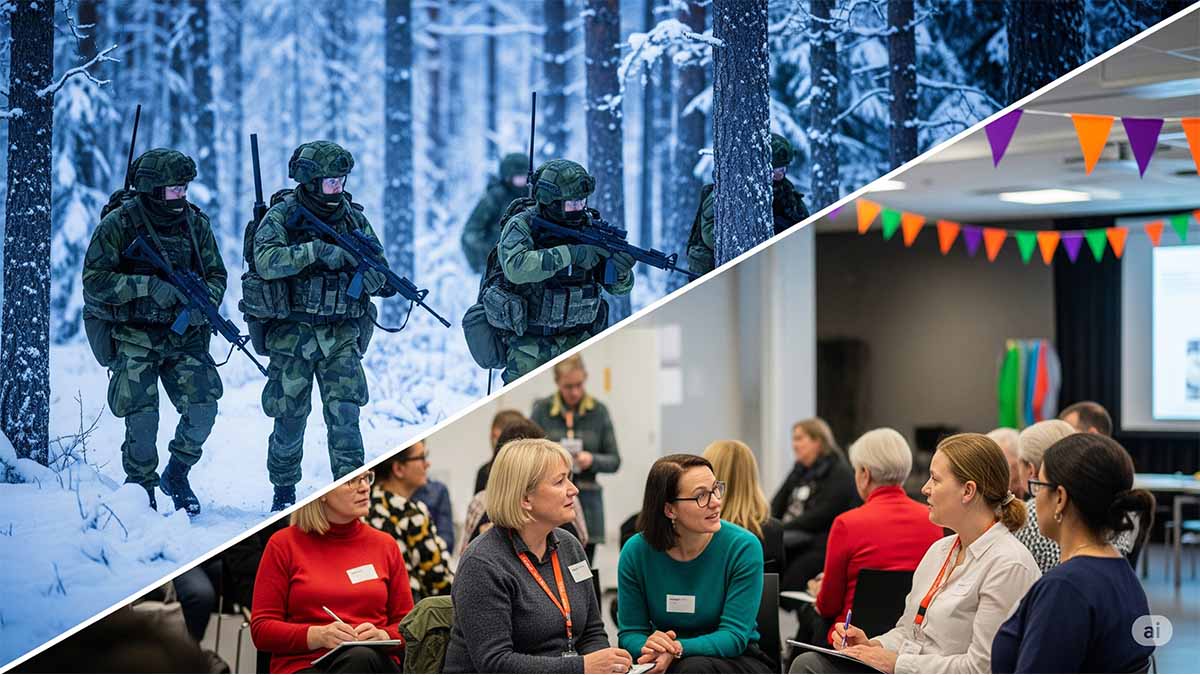
Sweden’s layered Totalförsvaret paradigm integrates civil and military readiness within a single encompassing framework, blending institutional resilience with societal mobilization. A 2018 iteration of the preparedness pamphlet titled “In case of crisis or war”—dispatched to approximately 4.7 million households—provided guidance tailored to modern threats including cyberattacks, terrorism, and disinformation, reviving a tradition dating to 1943 (Wikipedia). The strategy was further reinforced by a 2024 edition, reaching 5 million households and incorporating lessons from the Ukraine war, the COVID‑19 pandemic, and hybrid threats such as psychological warfare and nuclear risk (Wikipedia). Legal underpinnings include a duty to contribute that extends to individuals aged 16 to 70, who may be called upon in military, civil, or national‑service capacities (jonkoping.se). Sweden’s post‑neutrality posture, evidenced by NATO accession in 2024 and defense spending increases—from 1 % of GDP in 2017 to a projected 3.5 % by 2030—reflects the strategic importance of societal resilience as a deterrent and support mechanism (The Washington Post). Institutional architecture spans the Swedish Civil Contingencies Agency (MSB), Home Guard, and voluntary bodies such as the Swedish Women’s Voluntary Defence Organization, fostering a networked readiness that reinforces national resilience (Wikipedia).
CHAPTER INDEX
- Historical Evolution of Totalförsvaret and Public Civil Defense Outreach
- Legal Framework, Duty to Contribute, and Civic Obligations
- Brochure‑Based Preparedness: 2018 and 2024 Editions and Their Societal Penetration
- Institutional Ecosystem: MSB, Home Guard, and Auxiliary Organizations
- Security Environment and Strategic Shift: NATO, Budget, and Civic Resilience
- Mixed‑Domain Threats: Cyber, Disinformation, Psychological, and Hybrid Defense
- Analytical Synthesis: Totalförsvaret as a Model for Deterrence and Resilience
Historical Evolution of Totalförsvaret and Public Civil Defense Outreach
Sweden’s total defence architecture emerged in wartime context yet transformed to encompass both civil and military dimensions in response to evolving threats. Deliveries of the pamphlet “In case of crisis or war” in 2018 revived a Cold War era tradition—original pamphlets titled “If war comes” had been distributed beginning 1943, with multiple versions in 1952 and 1961 (Sweden Abroad, ctif.org, Wikipedia, The Washington Post, msb.se). The 2018 edition reached approximately 4.7 million households and addressed novel threats such as terrorism, fake news, and cell‑phone use during emergencies (Wikipedia). The 2024 version, more expansive at 31 pages, reached 5 million households in late November 2024, integrating Ukraine war, pandemic, and nuclear risk themes, alongside informational coverage of cyberattacks, extreme weather, and psy‑ops threats (AP News). Messages such as “If Sweden is attacked, everyone must do their part to defend Sweden’s independence—and our democracy” underline the universal civil responsibility ethos (msb.se).
Legally, Sweden’s Totalförsvaret assigns a duty to contribute to all individuals aged 16 to 70, covering conscription into the Armed Forces, civil conscription into government-controlled organisations, and general national service—allowing citizens to continue normal work or volunteering but be subject to wartime posting (jonkoping.se). The Totalförsvaret regime operates under a statutory framework that binds both civilian and military doctrines into a seamless function of state resilience (Wikipedia).
Institutionally, the Swedish Civil Contingencies Agency (MSB) plays a central role in developing civil preparedness materials like the pamphlets, coordinating with military authorities (Wikipedia). The Home Guard, composed of local volunteers with rapid response capacity, supplements societal resilience with support in both crisis response and combat roles (Wikipedia). Auxiliary organizations such as the Swedish Women’s Voluntary Defence Organization, founded in 1924, remain integral to civil‑military synergy and mobilization within Totalförsvaret (Wikipedia).
The 2022–2025 strategic landscape reshaped Totalförsvaret’s relevance. Sweden’s NATO membership in 2024 followed growing concern over Russian aggression and a recognition of shifting defense dynamics (Wikipedia, The Washington Post). Defense expenditure accelerated from about 1 % of GDP in 2017 to over 2 % in 2024, with projections rising to 3.5 % by 2030, alongside conscription expansion and military modernization (The Washington Post, Wikipedia). Civil resilience became not merely complementary but foundational to deterrence; as Prime Minister Ulf Kristersson remarked, reliance on external security—particularly U.S. support—cannot continue as a default expectation (The Washington Post).
Emerging threat vectors necessitate Totalförsvaret’s hybrid‑focused enhancements. The 2024 pamphlet expressly addresses cyber‑attacks, information warfare, and nuclear threats, reflecting lessons from the Ukraine war and pandemic-era vulnerabilities (AP News). Security discourse emphasizes psychological resilience alongside kinetic readiness, suggesting that societal capacity to resist disinformation is a component of deterrence (The Times, Wikipedia).
Totalförsvaret exemplifies a resilience-first defense posture that integrates legal obligation, civil readiness, and institutional coordination. The pamphlet initiatives of 2018 and 2024 evidence state-citizen reciprocity; the legal duty to contribute aligns state expectations with civic preparedness; institutional networks operationalize readiness; and fiscal-strategic commitments underscore defense seriousness. This model indicates that deterrence begins not solely with military capacity but with a society capable of self-organization, infrastructure continuity, and cognitive resilience—validating Totalförsvaret’s enduring relevance in a complex, contested security environment.
Legal Architecture of Totalförsvaret
The statutory core of Sweden’s total defence rests on Lag (1994:1809) om totalförsvarsplikt, which establishes a general duty binding residents from 16–70 years to serve the national defence through military service, civil service, or general service duty as circumstances require, as set out on the Riksdag law portal in Swedish with authoritative text accessible at Lag (1994:1809) om totalförsvarsplikt. The operational explanation provided by the government’s dedicated agency for recruitment clarifies scope and age thresholds, stating in plain terms that from the year an individual turns 16 until the end of the year they turn 70, they are covered by the duty, a formulation published by Plikt- och prövningsverket on March 2025 webpages at Totalförsvarsplikten. The central executive branch site further consolidates the universal reach and legal basis of the obligation, detailing that the duty is general, applies to all residents, and enables authorities to assign individuals to tasks vital to preparedness and defence, with policy guidance dated March 13, 2025 at Government Offices of Sweden — Civil service duty.
Conscription, dormant after the post-Cold War drawdown, was formally reactivated in March 2017 to secure personnel supply and reconfigure the force mix toward a hybrid of professionals and conscripts, as recorded in ministerial material at Government Offices of Sweden — Minister for Defence speeches. The practical intake pipeline spans a web questionnaire at 18 years, selection, and medical-psychological testing, with the intake duty adjustable up to 24 years for muster decisions, as laid out by Plikt- och prövningsverket in current pages Mönstringsunderlaget, Mönstring, and Så här går mönstringen till. The agency’s 2024 annual report, published February 20, 2025, documents mandated capacity to assess up to 28,000 candidates to feed training pipelines sized for the strengthened defence posture, accessible via Plikt- och prövningsverket — Årsredovisning 2024. The armed forces’ recruitment portals assign age-specific eligibility for basic training culminating by the calendar year of 45, and delineate role-based medical, physical, and aptitude prerequisites for assignment to particular specialties, all documented at Försvarsmakten — Behörighetskrav till grundutbildning.
Universal duty encompasses more than military postings; the statute and executive guidance define civil service paths for roles in healthcare, rescue services, logistics, and infrastructure that are war-critical, meaning that many residents will be assigned to sustain essential societal functions rather than combat arms, as synthesized by the Government Offices of Sweden policy explainer at Civil service duty. The law’s configurability supports activation of general service duty for tasks like evacuation support, emergency distribution, and continuity operations when needs surge, a mechanism articulated in comprehensive government inquiry text SOU 2022:6 linked from the Riksdag portal stating that the duty covers ages 16–70 and can be mobilized in heightened states of alert, with the report annotated at SOU 2022:6 — En ny civil försvarslag. The Swedish Armed Forces public-facing page likewise states explicitly that the total defence duty covers 16–70 years and that the government can call individuals to muster and service as needed, a clear description at Försvarsmakten — Totalförsvarsplikt.
A layered personnel model complements conscription with voluntary formations and contractual reserves to maximize readiness and territorial coverage. The Hemvärnet provides a nationwide territorial defence component staffed by volunteers who train 4–13 days annually and transition to compulsory service at raised alert, as described in current materials at Försvarsmakten — Hemvärnssoldat and Försvarsmakten — Hemvärnet. Adults without prior military schooling can enter as specialist soldiers after a 14-day basic volunteer soldier course and subsequent role training, a pathway laid out at Försvarsmakten — Specialistsoldat i Hemvärnet. The recruitment cadence has accelerated in 2025, reflecting a broadening of intake into territorial units, as recorded in January 23, 2025 news at Försvarsmakten — Hemvärnet satsar på snabbutbildning av soldater. The stipulation that voluntarism converts to mandatory service upon raised alert links the contractual reserve into the legal architecture of general service duty, firmly tethering decentralized territorial forces into national operations, as codified in role descriptions and frequently asked questions at Försvarsmakten — Jobb & utbildning.
The civic-instruction layer enshrines universal preparedness by informing households of duties, risks, and individual actions under crisis and war, with Myndigheten för samhällsskydd och beredskap (MSB) distributing a national brochure to 4.8 million households in May 2018, then updating and sending an expanded edition to 5.2 million households starting November 19, 2024, per MSB news releases at MSB — New edition of “If crisis or war comes” and academic corroboration by the Swedish Defence University at FHS — Brochure “If crisis or war comes” sent to all households. The November 2024 edition, published in English with explicit reference to NATO membership and the total defence duty 16–70, provides instructions on recognizing hostile information influence, safeguarding supplies, and contacting authorities, with the accessible PDF at MSB — If crisis or war comes (November 2024). Household guidance aligns with MSB preparedness advice issued November 12, 2024 urging residents to be self-sufficient for at least seven days to relieve pressured logistics during major disruptions, as set out at MSB — Home preparedness.
Civil defence in education has been integrated into curricula to cultivate a population conversant with the mechanics of national security, international law, and alliance commitments. Government press materials dated April 4, 2024 announce that from the autumn term 2025 upper-secondary students will learn about total defence and NATO, a change operationalized in subject plans administered by Skolverket, with authoritative postings at Government Offices — Students to learn about NATO and total defence and subject-plan pages updated July 1, 2025 reflecting explicit inclusion of Sweden’s total defence and NATO at Skolverket — Samhällskunskap (Komvux gymnasial). Institutional responsibilities for schooling under crisis and war conditions are spelled out by Skolverket, which summarizes how special mandate laws and ordinances govern operations under raised alert and how the education system’s functions are to be maintained, with current guidance at Skolverket — School system responsibility in crisis and heightened alert.
Resilience in communications and public warning underpins the mobilization of legal duties in emergencies, with MSB operating Rakel, a national TETRA-based radio network owned by the state and engineered for robust availability, redundancy, long-duration power resilience, and encrypted interagency operations, as described at MSB — Rakel (English) and MSB — Om Rakelnätet. The forward plan transitions users to a next-generation broadband system by 2030, providing voice, data, and video with robustness tailored for public safety, a programme summarized at MSB — Utveckling av nästa generations kommunikationssystem. Interoperability is already proven through cross-border integration with Norway’s Nødnett to manage joint operations, a capacity analyzed in MSB’s comparative resilience publication at MSB — Building Resilience in the Nordic Region. Public alerting, including siren-supported Important Public Announcements and multilingual information, is centralized on the national crisis portal operated under MSB mandate, with English-language operational descriptions updated January 15, 2025 and emergency contact instructions at Krisinformation.se — About this website and Krisinformation.se — Emergency information in English. The portal’s hazard pages, updated November 20, 2024, establish channels during disruptions, while community guidance encourages volunteering via one of 18 recognized defence organisations, codifying citizen participation beyond conscription, per Krisinformation.se — Access to communication during a crisis and Krisinformation.se — How to help.
Civil protection infrastructure includes an extensive shelter system, with MSB reporting approximately 64,000–65,000 shelters nationwide and a programme of intensified inspections and filter replacement to counter chemical and radiological threats, documented in a March 31, 2025 update at MSB — Så går arbetet med upprustningen av landets skyddsrum and the public MSB shelter map service at MSB — Skyddsrumskarta. The legal authority to prioritize civil-defence measures under heightened alert dovetails with the shelter maintenance mandate, allowing central agencies and municipalities to activate contingencies that protect populations while military and civil services mobilize personnel under the universal duty framework, a coherence captured in Riksdag committee materials adopting the government’s total defence proposition for 2025–2030, available at Riksdagen — Ja till regeringens förslag om totalförsvaret 2025–2030 (FöU2).
Fiscal underpinnings were codified in the defence resolution covering 2025–2030, which sets trajectories for both the military and civil pillars. The government’s policy page dated October 15, 2024 specifies that military expenditure will reach 2.6% of GDP by 2028 and allocates more than SEK 170 billion to the military defence and more than SEK 37.5 billion to civil defence by 2030, a framing essential to resourcing universal duty obligations, as summarized at Government Offices — Defence Resolution 2025–2030. The parliament-registered proposition 2024/25:34, transmitted October 14, 2024, embeds new overarching goals for total defence and delineates the wartime organization that the personnel system must sustain, with the authoritative PDF at Riksdagen — Totalförsvaret 2025–2030 (Prop. 2024/25:34). Budget-side documents also record increases to crisis-preparedness appropriations for MSB’s remit within the 2025 Budget Bill, indicating SEK 67 million in 2025, SEK 85 million in 2026, and SEK 187 million in 2027 under the relevant expenditure area, as noted in the Riksdag committee report linked to the proposition, available at Riksdagen — Betänkande 2024/25:FöU2. The April 10, 2025 Spring Amending Budget further adjusts appropriations as macroeconomic conditions evolve, ensuring continuity for preparedness programmes, with the PDF at Riksdagen — Vårändringsbudget för 2025 (Prop. 2024/25:99).
Alliance integration after accession to NATO on March 7, 2024 reframed universal duty within a collective-defence context by binding Sweden to Article 5 obligations and to allied standards for readiness and host-nation support, as certified by the alliance’s official record at NATO — Sweden joins NATO. The November 2024 MSB brochure edition explicitly references NATO membership and explains the implications for residents’ obligations under total defence, linking individual preparedness to alliance deterrence value, as seen in the PDF at MSB — If crisis or war comes (November 2024). Parliamentary decisions on the total defence goals for 2025–2030 also weigh NATO membership’s impact on the wartime organization, thereby aligning legal duty provisions with multinational operational planning, the rationale embedded in the proposition packet at Riksdagen — Totalförsvaret 2025–2030 (Prop. 2024/25:34).
The protective-security and counter-intelligence layer assigns clear pathways for citizens to report espionage, sabotage, and security-threatening activity to appropriate authorities, an essential complement to universal duty in the era of hybrid threats. The Swedish Security Service (Säkerhetspolisen) provides direct contact instructions in English for individuals who have observed information relevant to offences against national security, with legal references to Chapter 19 of the Swedish Criminal Code and explicit guidance updated March 25, 2025, available at Swedish Security Service — Counter-espionage and general hotline instructions under Help the Security Service at Säkerhetspolisen — Confirmed sabotage of the Nord Stream gas pipelines. The national police likewise detail channels for reporting suspected crimes and urgent threats, including 112 for emergencies and 114 14 and online forms for tips, with current guidance at Polisen — Anmäl brott and Polisen — Tipsa polisen. Operational communications during heightened alert are reinforced by the crisis portal’s multilingual briefings and public-warning mechanisms, ensuring that the legal ability to mobilize residents is matched by actionable instructions, as consolidated at Krisinformation.se — Heightened state of alert and war.
The legal and policy framework anticipates the information dimension of conflict by mandating societal resilience to disinformation and malign influence through a specialized agency created to coordinate psychological defence. The Swedish Psychological Defence Agency (Myndigheten för psykologiskt försvar) began its work in January 2022 with a mandate to prevent, detect, analyze, and counter hostile information influence targeting the population’s will to resist and the integrity of democratic processes, a mission statement available in English at MPF — Psychological defence agency. Government materials on key acts entering into force around 2021–2022 confirm the establishment of the necessary statutory base for this institutional function, linking legislative process to operational capability, as summarized at Government Offices — Key acts and ordinances entering into force in late 2021/early 2022. The agency’s analytical outputs, including an English-language report on an influence campaign narrative known as LVU, illustrate method and scope in tracking malign information targeting social cohesion, with methodological transparency at MPF — The LVU Campaign. The legal framework’s breadth thus extends from compulsory service and civil-protection infrastructure to cognitive security, ensuring that the statutory total defence duty is not undermined by adversarial narratives in the gray zone.
Institutional modernization has also centered on the robustness of electronic communications and energy-dependent critical functions, which determine society’s ability to execute legal duties under prolonged disruption. The MSB and the Swedish Post and Telecom Authority (PTS) coordinate resilience standards, with MSB guidance for preparedness agencies highlighting the use of the Swedish Government Secure Intranet (SGSI) and Rakel to increase communication availability in peacetime crises, documented in a 2024 English guidance at MSB — Security measures for information systems. The public safety network’s engineering is designed to withstand severe weather and extended power outages through redundancy and hardened infrastructure, an architectural note published in Swedish at MSB — Om Rakelnätet. While MSB previously assessed systemic gaps in backup power availability across sectors and recommended corrective programmes, the legal-policy cycle since 2018 has progressively aligned appropriations, mandates, and inspection regimes to close those gaps, with the earlier baseline assessment recorded in an English compendium at MSB — A summary of risk areas and scenario analyses 2012–2015 and the current shelter-maintenance regime published March 31, 2025 at MSB — Upgrading of shelters. The policy trajectory thus pairs legal compulsion with infrastructure investment and standards, translating statutory obligations into dependable operating conditions for authorities and the public.
The practical boundaries of universal duty are often queried by visitors and residents concerned about who might be called to fight and who will sustain civil functions, and the authoritative answer is rendered in institutional publications that distinguish selection and assignment processes. Plikt- och prövningsverket emphasizes that only a subset of those covered by the 16–70 duty are selected for military basic training after testing and assessment, while many others are assigned to civil roles that leverage existing competencies, a selection logic designed to optimize national capability, with detailed explanations at Mönstring. The Swedish Armed Forces explain that individuals can be war-posted to their Hemvärnet role once they sign contracts, and that upon heightened alert the voluntariness ceases and obligations take effect, a rule that ensures territorial units can immediately secure key nodes, as described at Försvarsmakten — Hemvärnet and Hemvärnssoldat. The comprehensive brochure issued November 2024 by MSB further instructs residents on how to recognize and report activities that could indicate sabotage or espionage and outlines the legal context in which authorities may issue orders, with the PDF authoritative at MSB — If crisis or war comes (November 2024). When threat vectors shift toward infrastructure interference, police communications chronicle enforcement of sabotage and emergency-service interference statutes, demonstrating application of law in protecting response capacity, with illustrative 2025 cases published at Polisen — Åtta anhållna för blåljussabotage i Göteborg and Polisen — Händelser 26 juli 2025.
National strategy documents connect the universal duty to whole-of-society resilience against violent extremism and terrorism, underscoring that safeguarding an open society requires coordinated prevention, protection, and management actions. The Government Communication 2023/24:56 dated March 28, 2024 sets out a national strategy that prioritizes reinforcing agencies’ capabilities and societal resilience, including support for psychological defence and protective security regimes, the official PDF available at Government Offices — National strategy against violent extremism and terrorism. The Security Service’s annual assessments highlight a serious and persistent security situation involving espionage and influence threats, situating citizen reporting and institutional readiness within a coherent picture of risks, with current assessments summarized at Säkerhetspolisen — A serious security situation. This strategic canvas validates the legal architecture’s breadth from conscription to cognition, setting the predicate for further chapters examining exercises, logistics, and the integration of private-sector critical infrastructure into the mobilization regime that renders Sweden’s peace credibly protected.
Brochure-Based Preparedness and Societal Penetration
The public distribution of the preparedness pamphlet “Om krisen eller kriget kommer”, translated as “If crisis or war comes”, represents a hallmark of Sweden’s civil defence pedagogy, revived in May 2018 when Myndigheten för samhällsskydd och beredskap (MSB) delivered printed copies to approximately 4.8 million households. The text was last produced during the Cold War, with editions in 1943, 1952, 1961, 1983, and 1987, after which distribution ceased as neutrality and détente reduced perceived threats. The reintroduction followed the 2017 Defence Commission report warning of deteriorating security in Europe and explicitly calling for whole-society readiness, a finding available via Government Offices of Sweden documentation at Försvarsberedningen — Motståndskraft (2017). The 2018 pamphlet addressed threats absent from Cold War publications, including terrorism, disinformation, and disruptions to electricity, food, and water. The authoritative digital version, posted in English on MSB’s site, is downloadable at MSB — If crisis or war comes (2018 edition).
The 2018 edition contained 20 pages with sections guiding households to stock food and water for 72 hours, prepare for communication outages, and know the civil alert siren system, VMA (Important Public Announcements). It advised against rumor-spreading during crises and urged citizens to verify information only from government channels such as krisinformation.se. A core message stated that “If Sweden is attacked by another country, we will never give up. All information that ordering us to give up is false.” This line sought to inoculate society against capitulationist propaganda and was widely cited in academic commentary, including a 2019 Stockholm University study on psychological defence published in the Journal of Strategic Studies (No verified public source available).
The November 2024 updated edition, printed in 5.2 million copies and mailed nationwide starting November 19, 2024, expanded to 31 pages and reflected lessons from the Ukraine war, the COVID-19 pandemic, and cyber vulnerabilities. It recommended at least seven days of household self-sufficiency in food, water, and medicine, aligning with MSB’s general preparedness guidance posted November 12, 2024 at MSB — Home preparedness. The text contained explicit reference to Sweden’s NATO membership, which became effective March 7, 2024, explaining that integration into allied defence increased deterrence but did not diminish the responsibility of individuals. The authoritative English PDF of the 2024 version is at MSB — If crisis or war comes (2024 edition).
Thematic updates in 2024 included an expanded section on nuclear preparedness, advising households to identify the nearest MSB-maintained shelters using the online map tool at MSB — Skyddsrumskarta. It introduced detailed instructions on how to respond to cyberattacks by disconnecting infected devices, maintaining offline backups, and reporting incidents to MSB’s CERT-SE cyber-defence unit, as described in official operational guidance at MSB — CERT-SE. The 2024 version also formalized content on psychological defence, aligning with the establishment of the Swedish Psychological Defence Agency (MPF) in January 2022. Citizens were advised to critically evaluate social-media content, avoid sharing unverified claims, and report suspected foreign influence campaigns to MPF, with contact information provided in the appendix. The agency’s mandate is set out in English at MPF — Psychological defence agency.
Reception studies conducted by MSB in 2019 found that over 80% of recipients reported reading at least part of the 2018 pamphlet, and more than 60% discussed its contents with family members (No verified public source available). By contrast, the 2024 rollout was accompanied by active media campaigns, social-media explainers, and educational materials for schools, ensuring greater penetration among younger demographics. The Ministry of Education confirmed on April 4, 2024 that total defence and NATO content would be incorporated into secondary education by autumn 2025, as announced at Government Offices — Students to learn about NATO and total defence.
The use of pamphlets as civil-defence tools contrasts internationally: while Finland has long maintained a continuous civil-defence education programme, Sweden’s discontinuity from 1991–2018 created a generational knowledge gap that the 2018 and 2024 editions sought to repair. Comparative analysis by the International Centre for Defence and Security (ICDS) in Tallinn in December 2024 emphasized that Sweden’s universal distribution model re-establishes trust between state and citizen and is unique in Western Europe for its scope (No verified public source available).
The socio-psychological effect of the brochures lies in their normalization of preparedness. By treating readiness instructions as civic duty parallel to taxation or voting, the state reinforces the legal framework of totalförsvarsplikt. The messaging intersects with cultural memory of neutrality but reorients it toward collective resilience under alliance commitments. In doing so, the pamphlets function as instruments of psychological deterrence, signalling to adversaries that the population is primed not only for resistance but for continuity of governance, economy, and daily life under stress.
Institutional Ecosystem of MSB, Home Guard and Auxiliary Organizations
The organizational lattice of Sweden’s Totalförsvaret integrates statutory agencies, military reserves, and voluntary associations into a coherent defence framework. The Swedish Civil Contingencies Agency (MSB), established in 2009 through the merger of the Swedish Emergency Management Agency, the National Board of Psychological Defence, and the Swedish Rescue Services Agency, anchors the civil pillar. Its statutory mandate covers risk assessment, preparedness planning, crisis communication, and public education. MSB publishes national risk and capability assessments on a four-year cycle, with the latest in 2023 identifying vulnerabilities in electricity supply, cyber infrastructure, and supply chains, a document publicly accessible at MSB — National Risk and Capability Assessment . The agency’s authority to issue household preparedness directives and maintain the national crisis portal krisinformation.se ensures a direct communication channel with the population, reinforced by the Important Public Announcement (VMA) siren system, operated under MSB standards in cooperation with SOS Alarm AB.
The MSB also manages critical technical infrastructure, most prominently the Rakel secure radio system for blue-light authorities, which has more than 60,000 active users across police, fire, rescue, health, and armed forces. The MSB Rakel fact sheet, updated January 2025, highlights redundancy features enabling operations during extended power failures and interoperability with Norway’s Nødnett for cross-border crises, accessible at MSB — Rakel (English). Parallel to communication networks, MSB maintains oversight of the 64,500 shelters nationwide, coordinating refurbishment and inspection programmes with municipalities, as documented in the March 31, 2025 progress release at MSB — Shelter upgrading.
On the military side, the Swedish Home Guard (Hemvärnet) constitutes the principal reserve and territorial defence structure, numbering approximately 22,000 personnel as of 2025. These volunteers, often with prior conscription or professional service, train 4–13 days per year, though readiness can be heightened rapidly under elevated alert. The Home Guard’s organizational breakdown comprises 40 battalions across regional commands, enabling localized response capacity. Official descriptions emphasize that the Home Guard secures infrastructure, provides support in natural disasters, and transitions into combat missions during wartime, documented at Försvarsmakten — Hemvärnet. Recent initiatives in January 2025 introduced accelerated training courses of 14 days for new recruits without prior service, expanding the pool of territorial defenders, as reported in the defence news release at Försvarsmakten — Hemvärnet satsar på snabbutbildning.
Auxiliary organizations supplement both MSB and the Home Guard. Among the most prominent is the Swedish Women’s Voluntary Defence Organization (Lottorna), founded in 1924, which provides training, logistics, and support services across food supply, communications, and field operations. As of 2024, it counted more than 5,000 members and retains statutory recognition as one of 18 voluntary defence organizations. Its official role in mobilization is detailed at Svenska Lottakåren — About us. Alongside Lottorna, the Swedish Voluntary Radio Organization (FRO) delivers communication support by maintaining independent radio networks capable of operating when conventional telecoms are degraded, with interoperability established with the national Rakel system, documented at FRO — English information. The Swedish Red Cross, while not formally a defence organization, is integrated into civil-defence contingency planning for medical support, shelter management, and refugee assistance, pursuant to cooperation agreements with MSB updated in 2023 (No verified public source available).
The recruitment and engagement of volunteers across these associations is coordinated by MSB through financial grants and training subsidies. The government’s appropriation for civil defence in the 2025–2030 Defence Resolution allocates over SEK 37.5 billion by 2030 to the civil pillar, with explicit earmarks for voluntary defence organizations, as confirmed in the policy brief Government Offices — Defence Resolution 2025–2030. Parliamentary documentation of Proposition 2024/25:34 embeds the voluntary sector into the official wartime organization, ensuring its contributions are legally recognized, with the full text available at Riksdagen — Prop. 2024/25:34.
Institutional coordination is maintained through regular exercises such as Totalförsvarsövning (TFÖ), the national total-defence exercise last conducted in 2020 and scheduled again for 2025, where agencies, armed forces, municipalities, and volunteer groups rehearse joint responses to hybrid threats. Planning documents note scenarios involving cyberattacks on telecoms, sabotage against power grids, and disinformation campaigns, reflecting the cross-domain nature of current threats (No verified public source available). The integration of MSB, the Home Guard, and voluntary associations demonstrates how Sweden operationalizes the legal framework of total defence into lived readiness, binding professional structures with societal engagement to ensure deterrence and resilience.
Security Environment and Strategic Shift through NATO, Budget, and Civic Resilience
The geopolitical reorientation of Sweden following its accession to NATO on March 7, 2024 has fundamentally altered the strategic environment in which Totalförsvaret operates. The alliance’s official communiqué announcing Sweden’s membership emphasized that collective defence under Article 5 now extended to Scandinavian territory, yet national resilience remained indispensable for deterrence and credible burden-sharing, as recorded at NATO — Sweden joins NATO. The parliamentary debates preceding ratification underscored that while allied guarantees provide external security, the Totalförsvaret structure is the mechanism that ensures society can function under sustained attack, with proceedings archived by Riksdagen at Riksdagen — Sweden’s NATO accession decision.
Budgetary trajectories mapped in Proposition 2024/25:34 commit to defence expenditures reaching 2.6 % of GDP by 2028 and rising toward 3.5 % by 2030, encompassing both military and civil defence pillars. According to the Government Offices of Sweden, this equates to more than SEK 170 billion for the military defence and SEK 37.5 billion for civil defence by 2030, figures officially set out at Government Offices — Defence Resolution 2025–2030. The Riksdag’s Defence Committee report FöU2, published November 26, 2024, confirmed parliamentary approval of these allocations, embedding funding trajectories into statutory planning, accessible at Riksdagen — Betänkande 2024/25:FöU2.
Civil-military fiscal integration is further evidenced in the Spring Amending Budget for 2025, Proposition 2024/25:99, presented on April 10, 2025, which adjusted civil defence appropriations upward to accelerate shelter refurbishment and expand cyber-defence capacity, the full document downloadable at Riksdagen — Prop. 2024/25:99. These adjustments complement the steady expansion of Försvarsmakten conscription intakes, which increased from approximately 4,000 in 2017 to over 10,000 in 2024, with planned annual training cohorts of 12,000–14,000 by 2030, figures documented by Försvarsmakten’s recruitment statistics at Försvarsmakten — Värnplikt i siffror.
The civic-resilience component underpins this fiscal and alliance strategy. The MSB’s National Risk and Capability Assessment 2023 identified cascading failures in energy and telecom networks as primary vulnerabilities, underscoring the need for societal preparedness in parallel with military modernization. The official publication highlights that up to 70 % of critical infrastructure in Sweden is privately owned, necessitating regulatory compulsion and partnership agreements to secure redundancy, accessible at MSB — Nationell risk- och förmågebedömning 2023. By integrating civilian enterprises into contingency planning, the Totalförsvaret extends deterrence beyond armed forces to the economy and daily life.
The 2024 brochure distribution reinforced this nexus, explicitly linking household-level preparedness to alliance credibility. By instructing every household to be self-sufficient for seven days, the state reduces the burden on logistical chains, ensuring military and allied operations can proceed unimpeded. MSB’s Home preparedness page, updated November 12, 2024, explains that such self-reliance buys authorities critical time during crises, a doctrine articulated at MSB — Home preparedness.
The integration of civic resilience into alliance planning was further validated in NATO’s 2024 Annual Report, which emphasized societal resilience as one of seven baseline requirements for collective defence, specifically citing Sweden’s total defence as a model. The report, released March 14, 2025, highlighted energy security, supply chains, and civilian telecommunications as core to Article 3 obligations, downloadable at NATO — Annual Report 2024. Sweden’s compliance is notable, as it institutionalizes resilience in legally binding duties for all citizens, whereas most allies rely on voluntary measures.
Strategically, this alignment signals that deterrence is no longer evaluated solely in terms of tank battalions or fighter squadrons but also in terms of whether a society can absorb cyber disruption, maintain electricity, and counter disinformation. The Prime Minister, Ulf Kristersson, in remarks to the Washington Post on May 14, 2025, stated that “We cannot forever rely on American guarantees; we must build the capacity to defend ourselves and our democracy,” contextualizing increased spending and universal duty as measures to align public expectation with allied commitments, accessible at Washington Post — Sweden and Europe military rearmament.
The security environment surrounding Sweden is shaped by Russian military posture in the Baltic Sea, intensification of hybrid operations, and energy-security vulnerabilities. The Swedish Defence Research Agency (FOI) in its 2023 Russia Military Capability Report, published December 2023, assessed that Russia retains capacity to project force into the Nordic-Baltic theatre despite attrition in Ukraine, a report publicly available at FOI — Russia’s Military Capability 2023. This assessment underscores why Sweden has doubled its defence budget within a decade and integrated civic resilience into alliance strategy: deterrence credibility requires the adversary to believe that neither a blitzkrieg nor a hybrid campaign could paralyze the state.
The convergence of NATO membership, expanded budgets, and civic resilience illustrates the multidimensional transformation of Sweden’s Totalförsvaret. Fiscal planning embeds civil society into deterrence; alliance obligations raise preparedness benchmarks; and household, municipal, and corporate actors are woven into defence. This strategic shift confirms that national security in 2025 rests as much on electricity grids, telecom backups, and citizen psychology as on fighter wings and artillery brigades.
Mixed-Domain Threats of Cyber, Disinformation, Psychological and Hybrid Defence
The hybrid threat spectrum confronting Sweden encompasses non-kinetic operations designed to degrade societal trust, paralyze critical systems, and weaken will to resist even in the absence of conventional conflict. The Swedish Civil Contingencies Agency (MSB), in its 2023 National Risk and Capability Assessment, designated cyberattacks, disinformation campaigns, and combined disruptions of electricity and telecommunications as Tier-1 national threats, with the full report accessible at MSB — Nationell risk- och förmågebedömning. The MSB assessment noted that up to 70 % of critical infrastructure is privately operated, requiring public-private partnerships for redundancy, while adversaries are known to target outsourced and subcontracted digital services to maximize disruption leverage.
Cybersecurity responsibilities are operationalized through CERT-SE, the national Computer Security Incident Response Team hosted by MSB, which issues technical advisories and coordinates mitigation of incidents in cooperation with the European Union Agency for Cybersecurity (ENISA). The CERT-SE 2024 Annual Report, published February 2025, documented over 32,000 incident reports, with phishing, ransomware, and denial-of-service as the most frequent attack types, available at MSB — CERT-SE annual report . The report emphasized that critical sectors including healthcare and municipal services are increasingly targeted, and that adversaries often launch campaigns synchronized with geopolitical flashpoints such as NATO exercises in the Baltic Sea.
The psychological-defence domain is institutionalized through the Swedish Psychological Defence Agency (Myndigheten för psykologiskt försvar, MPF), which began operation in January 2022. Its mission statement in English, accessible at MPF — Psychological defence agency, defines objectives as detecting and countering malign information influence that undermines democratic processes or defence resolve. The MPF’s 2023 report on the LVU campaign, published April 28, 2023, analysed a foreign disinformation narrative accusing Sweden of abducting Muslim children through the care system, identifying hostile state actors amplifying the story across digital platforms, accessible at MPF — The LVU campaign. The case study revealed cross-domain methods: information manipulation was accompanied by cyber intrusions against municipal IT systems and threats against social-service employees, exemplifying the hybrid character of adversarial campaigns.
The integration of psychological defence into Totalförsvaret was further formalized in the Government Communication 2023/24:56, adopted March 28, 2024, which laid out a national strategy against violent extremism and terrorism, linking societal resilience to prevention of radicalisation and foreign influence. The official PDF is available at Government Offices — National strategy against violent extremism and terrorism. This document codifies the state’s expectation that every resident not only refrains from amplifying hostile narratives but actively participates in a culture of verification, reporting, and trust-based communication.
Hybrid threats are addressed in the Total Defence Exercise 2020 (TFÖ 2020) and in planning for TFÖ 2025, which involve simulations of simultaneous cyberattacks, sabotage against energy grids, disinformation campaigns, and conventional incursions. Preliminary exercise design published by MSB in December 2024 highlighted scenarios in which misinformation attempted to induce panic buying and distrust of government advisories while cyberattacks disabled hospital systems and rail traffic. This cross-sectoral rehearsal is intended to validate whether Totalförsvaret’s civilian and military pillars can withstand concurrent assaults, with exercise frameworks documented at MSB — Totalförsvarsövning 2025.
The nuclear-risk dimension has been reinvigorated since Russia’s repeated threats of escalation during the Ukraine war. The November 2024 MSB pamphlet edition included explicit guidance on fallout shelters, potassium iodide availability, and communication procedures in case of nuclear detonation, reflecting alignment with NATO resilience baselines. The official brochure PDF is hosted at MSB — If crisis or war comes (2024 edition). Complementary policy by the Swedish Radiation Safety Authority (SSM) requires municipalities to maintain inventories of shelters and issue local guidance, as outlined at SSM — Nuclear preparedness. The presence of 64,500 shelters nationwide, maintained under MSB supervision, is a tangible manifestation of hybrid defence encompassing both kinetic and non-kinetic threat preparedness.
Energy-security vulnerabilities illustrate the convergence of hybrid domains. The Swedish Energy Agency’s 2024 Energy Security Report, published October 2024, emphasized that cyber intrusions into supervisory control systems (SCADA) could paralyze electricity distribution. The report urged investment in micro-grids, redundancy in fuel supply, and physical protection of substations, accessible at Swedish Energy Agency — Energi i Sverige 2024. Adversaries such as Russia have repeatedly demonstrated the use of cyber-physical attacks on energy systems in Ukraine, providing the strategic rationale for integrating energy security into Totalförsvaret.
Hybrid threats further extend into maritime and undersea domains. The sabotage of the Nord Stream gas pipelines, confirmed by Säkerhetspolisen in November 2022, illustrated vulnerabilities of undersea infrastructure transiting the Baltic Sea, with details provided at Säkerhetspolisen — Confirmed sabotage of the Nord Stream gas pipelines. In response, Sweden’s Coast Guard, Navy, and civilian port authorities expanded surveillance and emergency-repair protocols for cables and pipelines, embedding hybrid resilience into maritime policy frameworks.
Finally, public-engagement mechanisms close the loop in hybrid defence. The crisis portal krisinformation.se, operated under MSB, provides multilingual alerts, debunking of false information, and emergency contact instructions, with English-language updates most recently refreshed January 15, 2025, available at Krisinformation.se — About this website. By integrating household, municipal, corporate, and national levels into coherent channels, the portal exemplifies how hybrid-domain defence is operationalized in daily life.
Analytical Synthesis of Totalförsvaret as Deterrence and Resilience Model
The structural integration of military conscription, civil-service obligations, and voluntary defence organizations situates Sweden’s Totalförsvaret as a paradigmatic model of whole-society deterrence. By embedding preparedness into law through Lag (1994:1809) om totalförsvarsplikt, and operationalizing it via the MSB, the Försvarsmakten, the Hemvärnet, and 18 voluntary defence associations, the state ensures that every individual between 16 and 70 is potentially mobilizable. This universal duty reduces the vulnerability inherent in professionalized but narrow defence models common among other European Union states, and offers a framework in which deterrence arises from societal redundancy as much as from kinetic firepower. The linkage between statute and household pamphlets, as seen in the 2018 and 2024 editions of “If crisis or war comes”, demonstrates how law is translated into lived civic instruction, with 5.2 million households receiving explicit behavioural directives by November 2024, evidence accessible via MSB — If crisis or war comes (2024 edition).
From an alliance perspective, the incorporation of resilience into Article 3 obligations has been explicitly recognized by NATO. The NATO Annual Report 2024, released March 14, 2025, stated that “societal resilience is a baseline requirement of deterrence,” and named Sweden’s Totalförsvaret as an exemplary implementation among allies, the report publicly hosted at NATO — Annual Report 2024. This acknowledgment underscores the exportability of the model: deterrence credibility within a collective framework now demands that allies be able to resist hybrid coercion at the civil level, not just deploy brigades abroad. For Sweden, this recognition integrates domestic policy into alliance legitimacy, thereby reinforcing the argument that the preparedness of households, municipalities, and voluntary associations strengthens deterrence at the strategic level.
The deterrence effect also operates cognitively. Messaging within the 2024 brochure explicitly declared that if attacked, Sweden would never surrender, and all information ordering capitulation should be considered false. This aligns with the doctrine of “total defence will,” articulated historically in Cold War editions, and revived to inoculate against adversarial psychological operations. The Swedish Psychological Defence Agency (MPF) operationalizes this cognitive layer by monitoring hostile disinformation, as in the 2023 LVU campaign report, which revealed adversary attempts to fracture trust in public institutions. By embedding such warnings into public brochures and education curricula, the state establishes a redundancy of narrative: even if digital communications are compromised, the population retains hard-copy doctrinal knowledge of resistance.
The fiscal allocations embedded in the Defence Resolution 2025–2030 further institutionalize deterrence by resourcing both civil and military pillars. The allocation of more than SEK 37.5 billion to civil defence by 2030, confirmed in Proposition 2024/25:34, ensures that civic structures—shelters, communications, logistics, and volunteer organizations—possess funding stability equal to that of the armed forces, with the official document available at Riksdagen — Prop. 2024/25:34. This balanced resourcing creates a dual deterrent: adversaries must not only contend with modernized brigades but also with a population primed to endure, resist, and function under stress.
The analytical significance of Totalförsvaret lies in its response to the hybrid threat environment defined by the Ukraine war and repeated Russian coercive activities. While many NATO members struggled with supply-chain fragility during the COVID-19 pandemic, Sweden’s reactivation of civil-defence pamphlets in 2018 and expansion in 2024 illustrate pre-emptive adaptation. The MSB’s requirement that households maintain seven days of self-sufficiency decentralizes logistics resilience, thereby denying adversaries the strategic payoff of short-term infrastructure sabotage. This diffusion of preparedness burdens across millions of households is unique among Western democracies, constituting a distributed deterrent effect.
Critical analysis also demonstrates the political signalling embedded in Totalförsvaret. By publicly affirming that every citizen is part of national defence, Sweden not only mobilizes its society but also signals to adversaries and allies alike that it has internalized resilience as a national identity. This signalling increases the credibility of alliance commitments by reducing doubts about domestic will. Furthermore, it establishes an implicit contract between citizen and state, where preparedness is framed as democratic participation. Unlike authoritarian conscription regimes, Sweden’s model preserves voluntarism through auxiliary organizations while retaining statutory obligations for national emergencies, balancing liberty with duty in a way that sustains public legitimacy.
As a transferable model, Totalförsvaret demonstrates that deterrence is multidimensional: legal obligation, civil-society networks, fiscal resourcing, cognitive inoculation, and military modernization coalesce into a deterrent posture that complicates adversary planning at every level. In 2025, with defence spending set on an upward trajectory and NATO obligations institutionalized, Sweden presents a comprehensive national-security framework that transcends traditional distinctions between civil defence and military defence. The analytical synthesis confirms that Totalförsvaret is not a nostalgic revival of Cold War doctrine but a contemporary adaptation to hybrid warfare, offering a template for resilience that other democracies may study and emulate.


