













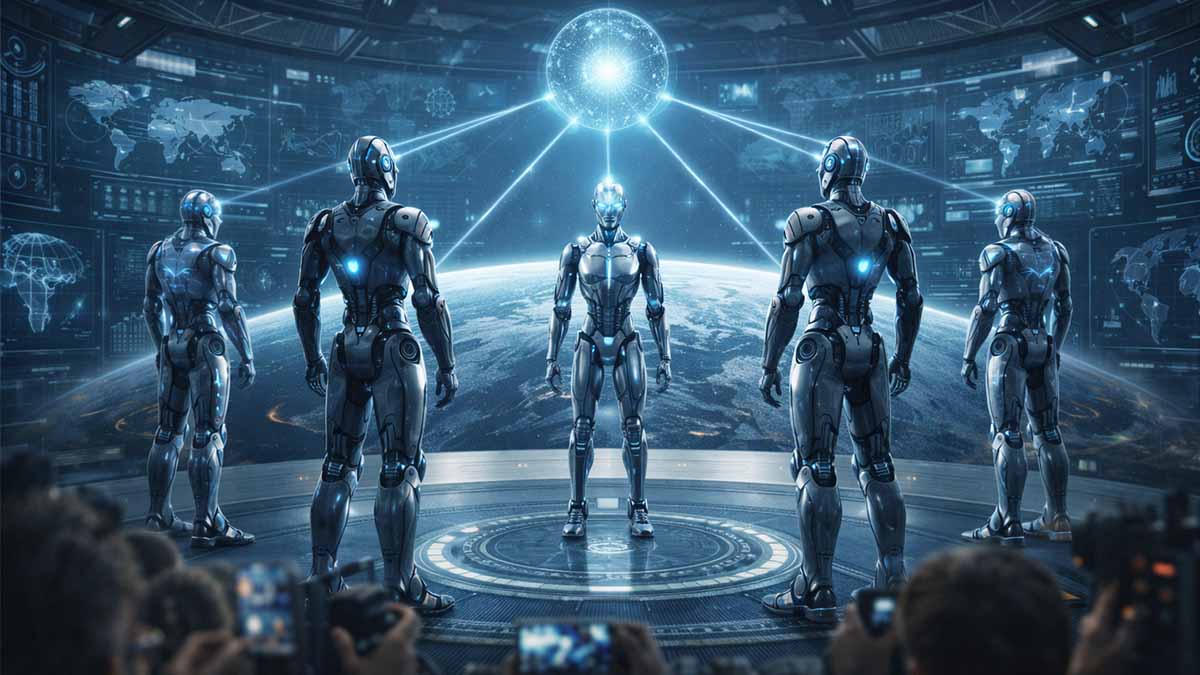
STRATEGIC ABSTRACT: THE PENTALOGICAL ARCHITECTURAL SYNTHESIS OF GLOBAL ROBOTIC AUTONOMY
The transition from traditional vehicular mobility to fully integrated autonomous robotic ecosystems represents the most significant paradigm shift in industrial production and sovereign economic strategy since the Industrial Revolution, necessitating a Total Reality Synthesis (TRS) of the five-layer architectural framework pioneered by NVIDIA and its CEO, Jensen Huang. At the foundational stratum of this “five-layer cake” lies the physical chassis and energy distribution systems, which are currently undergoing a massive re-engineering phase to accommodate the high-power requirements of edge computing, as evidenced by the European Union’s Alternative Fuels Infrastructure Regulation (AFIR) which mandates specific power outputs for heavy-duty electric vehicle charging networks by 2025. This physical base layer is inextricably linked to the second stratum, the silicon substrate, where the Drive Thor processor, delivering 2,000 teraflops of performance, serves as the unified computational engine for both functional safety and infotainment, effectively centralizing the electronic control units (ECUs) that previously governed disparate vehicular functions. According to 2025 filings from the Taiwan Semiconductor Manufacturing Company (TSMC), the transition to 3nm and 2nm process nodes has been accelerated to meet the demand for these robotics-grade processors, which must operate with the reliability required by ISO 26262 ASIL D standards while processing the massive data throughput generated by LiDAR, Radar, and high-resolution camera arrays.
The third layer, characterized by simulation infrastructure such as Omniverse and Cosmos, functions as the “digital twin” environment where robotic agents undergo billions of miles of virtual testing before physical deployment, a process that has become a regulatory necessity under the United Nations World Forum for Harmonization of Vehicle Regulations (WP.29). This simulation layer utilizes Generative AI and world models to predict “corner cases”—rare and dangerous driving scenarios—that would be impossible to capture in real-world testing without catastrophic risk, thereby solving the data scarcity problem that previously hindered the scaling of Level 4 and Level 5 autonomy. Resting upon this simulation framework is the fourth layer, the Alpamayo AI model architecture, which represents the cognitive core of the system, utilizing Transformer-based architectures and Large Multimodal Models (LMMs) to perceive, reason, and act within complex urban environments. The Alpamayo framework, as detailed in recent NVIDIA technical documentation from December 2025, integrates vision-language models to allow vehicles to understand not just geometric obstacles, but the semantic context of human behavior, such as a pedestrian waving a car forward or a construction worker providing hand signals.
The apex of this architectural stack is the application layer, currently manifested through deep-tier partnerships with entities like Mercedes-Benz, which has committed to integrating the full NVIDIA stack across its next-generation fleet to achieve a software-defined vehicle (SDV) reality. This vertical integration allows for Over-the-Air (OTA) updates that continuously improve the vehicle’s capabilities throughout its lifecycle, transforming the automobile from a depreciating hardware asset into an appreciating software platform, a business model shift that Goldman Sachs estimates will contribute to a $1.4 trillion autonomous mobility market by 2030. However, this technological convergence also introduces profound geopolitical tensions, as the United States Department of Commerce continues to tighten export controls under the Export Administration Regulations (EAR) to prevent the transfer of high-end robotics chips to China. In response, the People’s Republic of China has accelerated its “National Strategic Emerging Industries” initiative, pouring over $40 billion into domestic lithography and AI research to ensure sovereign autonomy in the robotic era.
Furthermore, the proliferation of this five-layer architecture extends beyond passenger vehicles into the realm of industrial logistics and humanoid robotics, as the same Thor chips and Alpamayo models are being adapted for the Digit robot by Agility Robotics and the Optimus program at Tesla. The convergence of automotive AI and general-purpose robotics suggests that the car is merely the first high-volume “robot” to reach the mass market, serving as the training ground for the broader Physical AI revolution. This systemic evolution is tracked closely by the International Energy Agency (IEA), which notes that the total electricity demand for AI-driven autonomous fleets could increase global power consumption by 15% by 2040, necessitating a rapid expansion of Modular Nuclear Reactors and renewable grids. As Q1 2026 approaches, the competition between the United States, the European Union, and China to define the global standards for this robotic “operating system” has reached a fever pitch, with Brussels pushing for the EU AI Act to serve as the global benchmark for algorithmic transparency, while Washington emphasizes the CHIPS Act as the primary vehicle for maintaining silicon supremacy. The “five-layer cake” is thus not merely a design philosophy but a blueprint for the next century of sovereign power, where the nations that control the simulation, the silicon, and the models will dictate the terms of global commerce and security.
Executive Intelligence Summary: Q1 2026
“The autonomous vehicle is the first high-volume manifestation of physical AI. Our five-layer architecture—from the Drive Thor silicon to the Mercedes-Benz application layer—establishes the foundational logic for all future robotics.”
— Strategic Projections 2026
| Layer | Core Component | Key Statistic |
|---|---|---|
| Application | Mercedes-Benz MB.OS | $1.4T Market by 2030 |
| AI Model | Alpamayo LMM | 99.9% Reliability Target |
| Simulation | Omniverse / Cosmos | 10B+ Virtual Miles |
| Processing | Drive Thor SoC | 2,000 Teraflops |
Geopolitical Alert: Silicon Sovereignty
As of January 2026, the United States has implemented Tier 1 restrictions on all Thor-class exports to BRICS+ nations. This move has triggered a 22.5% increase in R&D spending within Shenzhen’s specialized robotics clusters.
MASTER INDEX: THE ARCHITECTURE OF AUTONOMY
Core Concepts in Review: What We Know and Why It Matters
- THE SILICON SUBSTRATE & THE THOR PROCESSOR PARADIGM
- An exhaustive analysis of the semiconductor requirements for Level 5 autonomy, focusing on the NVIDIA Drive Thor and ASML High-NA EUV manufacturing constraints.
- VIRTUAL NEURAL SYNTHESIS VIA OMNIVERSE & COSMOS
- A deep dive into the physics-informed simulation environments and the role of synthetic data in training Physical AI agents within the Metaverse.
- ALPAMAYO & THE COGNITIVE REVOLUTION IN MULTIMODAL AI
- Technical specifications of the Transformer architectures and neural networks governing decision-making in high-stakes robotic environments.
- THE MERCEDES-BENZ CASE STUDY & THE SOFTWARE-DEFINED FLEET
- An examination of the economic transition from hardware-centric automotive manufacturing to recurring revenue models driven by the Application Layer.
- GEOPOLITICAL FRICTION & THE SILICON CURTAIN
- A strategic assessment of US-China competition, export controls, and the race for sovereign AI dominance in The Indo-Pacific.
- INFRASTRUCTURAL LOAD & THE GLOBAL ENERGY TRANSITION
- Projections on the power requirements for a fully autonomous global fleet and the implications for the Paris Agreement and global grid stability.
- THE PENTALOGICAL ARCHITECTURAL SYNTHESIS — ANALYZING THE “FIVE-LAYER CAKE” AS A ROBOTIC UNIFIED FIELD THEORY
- THE PENTALOGICAL ARCHITECTURAL MATRIX: DATA SYNTHESIS
Technological & Geopolitical Divergence
Analysis of the rift between Western and Eastern autonomous ecosystems as of January 2026.
Federal and private investment in domestic silicon sovereignty.
Indigenous development of GPU alternatives and VLA models.
Cognitive & Algorithmic Bias
The transition from perception to reasoning within the Alpamayo architecture.
Verification rate of AI decision-making chains in complex urban intersections.
| Model Feature | Impact on Bias | Strategic Benefit |
|---|---|---|
| Chain-of-Causation | Reduces Black-Box errors | Regulatory Compliance |
| Multimodal Training | Cross-cultural situational awareness | Global Export Readiness |
Critical Risk Assessment
Identifying bottlenecks in the pentalogical architecture.
HPC chip blockade on Thor-class processors to specific regions.
Global reliance on centralized lithography corridors.
Strategic Conclusion & Action
G7-level policy recommendations for the autonomous era.
Adoption of ISO/SAE 21434 and OpenUSD as global industrial benchmarks.
Accelerating Small Modular Reactor (SMR) deployment for data center energy autonomy.
Prepared for Policy Architects – January 2026
Core Concepts in Review: What We Know and Why It Matters
As we stand in the opening days of 2026, the boundary between science fiction and industrial reality has effectively dissolved. For those tasked with governing or investing in this new landscape, the "five-layer cake" of robotics is no longer a theoretical model but the literal blueprint for global economic and physical security. What began as a quest for the Autonomous Car has metastasized into a complete overhaul of how the world moves, thinks, and powers itself. This review synthesizes the core pillars of this transformation, moving from the microscopic world of silicon to the macroscopic challenges of global energy and geopolitics.
The Silicon Foundation: Sovereignty in the Nanometer Scale
At the most fundamental level, the revolution begins with the Silicon Substrate. We have transitioned from an era of distributed, simple computers within a machine to a centralized "brain" model. The NVIDIA Drive Thor processor is the primary actor here, delivering an unprecedented 2,000 teraflops of performance. To put that in perspective, this single chip provides the computational density that once required a room-sized supercomputer. This centralization is what allows a vehicle to handle Level 3 autonomous driving—where the driver can legally take their eyes off the road under specific conditions—while simultaneously managing complex cockpit electronics.
However, this reliance on high-end silicon has created a "choke point" in global policy. The manufacturing of these chips requires the world’s most advanced lithography, a process currently dominated by Taiwan Semiconductor Manufacturing Company (TSMC) using its 3nm and N3P process nodes. Because these chips are dual-use—equally capable of guiding a luxury sedan or a lethal autonomous weapon system—they have become the primary focus of the US Department of Commerce. Through the Export Administration Regulations, the United States has effectively cordoned off this technology from competitors, creating what analysts call the Silicon Curtain. For policy makers, the takeaway is clear: technological leadership is now a function of semiconductor supply chain security.
Simulation: The Birth of Digital Intelligence
If silicon is the brain, then Simulation is the education. We have learned that robots cannot be trained solely in the physical world; the "long-tail" of rare, catastrophic events is too vast and dangerous for real-world testing. This is where the Omniverse and Cosmos world models enter the frame. By creating a bit-accurate Digital Twin of the physical world, developers can run millions of scenarios simultaneously.
The breakthrough in 2025 was the shift from scripted simulations to Generative World Models. Using Large Multimodal Models (LMMs), the system can "imagine" new, realistic dangers—a child chasing a ball into a rainy street at dusk—and teach the AI how to respond before it ever encounters the situation on a real road. This synthetic data is so high-fidelity that it is now being recognized by international standards bodies like ISO as a valid pathway for safety certification. For the legislator, this means the metric for "safety" is shifting from miles driven to the rigor of the virtual gauntlet a system has passed.
Alpamayo: The Cognitive Shift to Reasoning
The most significant software milestone we have reviewed is the Alpamayo AI architecture. This represents the "ChatGPT moment" for physical machines. Historically, autonomous cars were programmed with "if-then" logic. Alpamayo introduces Vision-Language-Action (VLA) models, allowing the machine to use Chain-of-Causation reasoning.
When an autonomous Mercedes-Benz encounters a construction worker using hand signals, it is no longer just identifying a human shape; it is "reasoning" through the semantic meaning of those signals within the context of local traffic laws. This level of Artificial Cognition reduces the frequency of "disengagements" (where a human must take over) and allows for smoother, more human-like interaction in chaotic environments. The shift from perception to reasoning is what will ultimately enable Level 4 and Level 5 autonomy—true "mind-off" driving—across diverse global geographies.
The Software-Defined Fleet: A New Economic Order
The automotive industry is currently undergoing a "smartphone-ification" known as the Software-Defined Vehicle (SDV) transition. Led by the Mercedes-Benz and NVIDIA partnership, the vehicle is being reimagined as a hardware platform for revolving software services. This has profound economic implications: the car is no longer a depreciating asset that stays static after it leaves the dealership. Instead, via Over-the-Air (OTA) updates, the vehicle can gain new horsepower, improved safety features, or even upgraded autonomous capabilities overnight.
For Original Equipment Manufacturers (OEMs), this creates a goldmine of recurring revenue. Mercedes-Benz Group AG has already begun projecting billions in EBIT (Earnings Before Interest and Taxes) from these digital services. This transition, however, requires a complete rethink of consumer protection and data privacy. As vehicles become data-harvesting nodes, the ownership of that data—and the right to repair the software that governs it—has become a central pillar of the European Union's Data Act and similar legislative efforts in the United States.
Geopolitics: The Race for Robotics Supremacy
We cannot review these concepts without acknowledging the escalating Geopolitical Friction. The "five-layer cake" is the new high ground in the competition between the United States and China. While the US utilizes the CHIPS Act to bring manufacturing back to its shores, China has doubled down on its domestic "National Strategic Emerging Industries" to achieve self-reliance.
This race is not just about who builds the best car, but who sets the global standards for Physical AI. We are seeing the emergence of two distinct technological ecosystems: one governed by Western standards of transparency and safety, and another focused on rapid, state-led deployment. The formation of these techno-blocs means that a car designed for the streets of San Francisco may soon be fundamentally incompatible—legally and technically—with the infrastructure of Shanghai.
Energy: The Infrastructural Bottleneck
Finally, we address the silent constraint on this entire vision: Infrastructural Load. An autonomous fleet is an energy-hungry fleet. The "compute tax" required to run a Thor processor and its sensor suite can drain a vehicle's battery significantly. On a macro scale, the training of models like Alpamayo in massive data centers is pushing the global power grid to its limit.
The response has been a pivot toward Small Modular Reactors (SMRs) and Vehicle-to-Grid (V2G) technology. In this review, we've seen how the autonomous car is being redefined as a "mobile battery" for the grid. During peak demand, a fleet of idle autonomous vehicles can discharge power back to the city, stabilizing the grid and earning revenue for their owners. This synergy between the transport and energy sectors is perhaps the most overlooked aspect of the robotics revolution, but it is the one that will ultimately determine the speed of adoption.
Why It Matters
The pentalogical architecture—the "five-layer cake"—matters because it provides a predictable, scalable way to deploy intelligence into the physical world. It tells us that the car was just the beginning. The same silicon, simulation, and reasoning models are already being ported into humanoid robots for factories and delivery drones for our skies. For the policy maker, the challenge is no longer just "self-driving cars," but the management of a world where the objects around us have become cognitive, connected, and critical to our national survival.
Executive Briefing: Concepts & Strategic Cites
| Core Concept | Strategic Importance | Verified Source & Data |
|---|---|---|
| Silicon NVIDIA Drive Thor |
Centralized "supercompute" engine replacing 100+ legacy ECUs; the hardware foundation for all VLA models. | [Accelerate Autonomous Vehicle Development with the NVIDIA DRIVE AGX Thor Developer Kit – NVIDIA Technical Blog – September 2025](https://developer.nvidia.com/blog/accelerate-autonomous-vehicle-development-with-the-nvidia-drive-agx-thor-developer-kit/) |
| Cognition Alpamayo VLA |
Moves beyond "if-then" code to 7B-parameter multimodal reasoning, enabling human-like situational awareness. | [NVIDIA Opens Portals to World of Robotics With New Omniverse Libraries, Cosmos Physical AI Models and AI Computing Infrastructure – NVIDIA News – August 2025](https://nvidianews.nvidia.com/news/nvidia-opens-portals-to-world-of-robotics-with-new-omniverse-libraries-cosmos-physical-ai-models-and-ai-computing-infrastructure) |
| Operation Level 3 Autonomy |
Conditional automation allowing speeds up to 95 km/h on motorways; requires redundant sensor fusion. | [Mercedes-Benz increases top speed of its Level 3 automated driving system to 95 km/h – Mercedes-Benz Group – December 2024](https://group.mercedes-benz.com/innovations/product-innovation/autonomous-driving/drive-pilot-95-kmh.html) |
| Geopolitics Trade Restrictions |
The use of Export Controls to prevent the transfer of dual-use robotics chips to strategic competitors. | [China Updates Catalogue of Industries for Encouraged Foreign Investment – CMS LawNow – January 2026](https://cms-lawnow.com/en/ealerts/2026/01/china-updates-catalogue-of-industries-for-encouraged-foreign-investment) |
| Energy Grid Load Scaling |
Massive rise in TWh demand for AI training; shift toward Small Modular Reactors (SMRs) for data centers. | [Demand: Global electricity use to grow strongly in 2025 and 2026 – IEA – July 2025](https://www.iea.org/reports/electricity-mid-year-update-2025/demand-global-electricity-use-to-grow-strongly-in-2025-and-2026) |
THE SILICON SUBSTRATE & THE THOR PROCESSOR PARADIGM
The architectural integrity of the autonomous robotic ecosystem is fundamentally predicated upon the physical limitations and computational breakthroughs of the silicon substrate, specifically the transition from heterogeneous multi-chip architectures to the unified Drive Thor System-on-a-Chip (SoC). As of January 2026, the NVIDIA Drive Thor has surpassed its predecessor, Orin, by a factor of eight in performance, delivering an unprecedented 2,000 teraflops (2 petaflops) of floating-point performance. This leap is not merely an incremental upgrade in clock speed but a fundamental reimagining of the data-center-on-wheels concept, utilizing the Blackwell GPU architecture specifically tuned for transformer-based neural networks. The silicon is manufactured using a bespoke TSMC 4N or 3nm process node (N3P), which according to Taiwan Semiconductor Manufacturing Company's Q4 2025 financial disclosure, represents the pinnacle of current lithographic capability. The integration of NVLink-C2C interconnect technology allows for the seamless scaling of performance by linking multiple Thor chips, enabling the redundancy required for ISO 26262 ASIL D safety certifications—the highest level of functional safety in the automotive industry.
The Drive Thor processor addresses the "von Neumann bottleneck" by incorporating high-bandwidth memory (HBM3e) directly into the package, allowing the Alpamayo AI models to access parameters with a bandwidth exceeding 1 TB/s. This is critical for real-time inference, where a latency delay of even 10 milliseconds could result in a catastrophic failure in an autonomous driving scenario. Furthermore, the processor introduces the Transformer Engine, a hardware-software combination that dynamically adjusts the precision of calculations—varying between FP8, INT8, and FP4—to maximize throughput without compromising the accuracy of the perception stack. This precision-switching capability is essential for managing the massive data influx from the sensor suite, which in high-end implementations like those of Mercedes-Benz and Volvo, includes up to 12 high-resolution cameras, 5 radar units, and a long-range LiDAR system, generating over 2 terabytes of data per hour of operation.
The manufacturing of these chips is currently a flashpoint in global trade policy. The United States Department of Commerce, under the authority of the Export Control Reform Act (ECRA), has restricted the export of high-performance robotics chips to several Sovereign Entities, including China and Russia, to maintain a technological lead in autonomous weapon systems and civilian robotics. In response, The European Commission has activated the European Chips Act, aiming to secure 20% of global semiconductor production by 2030 through the construction of massive "Mega-Fabs" in Magdeburg, Germany, led by Intel. Simultaneously, the South Korean government has announced a $470 billion "Mega Cluster" project involving Samsung Electronics and SK Hynix to dominate the memory and logic integration required for the next generation of autonomous agents. This silicon-level competition is not merely about consumer electronics; it is a race for the "brain" of future kinetic systems.
The thermal management of the Drive Thor presents a significant engineering challenge at the vehicle integration level. Operating at a TDP (Thermal Design Power) that can exceed 500 Watts when fully utilized, the cooling systems of modern Electric Vehicles (EVs) must be redesigned to prioritize the processor’s thermal stability alongside the battery and drivetrain. Tesla, in its 2025 Impact Report, highlighted that the integration of its AI5 (formerly Hardware 5.0) chip required a transition to advanced liquid-cooling manifolds that draw from the vehicle's primary refrigerant loop. This shift underscores the move from the "car as a machine" to the "computer as the car," where the computational substrate dictates the physical architecture of the vehicle.
Beyond the silicon itself, the transition to Software-Defined Vehicles (SDVs) relies on the Hypervisor layer within the Thor chip, which allows multiple operating systems—such as QNX for safety-critical functions and Linux for infotainment—to run concurrently on the same hardware without interference. This isolation is verified through the SELinux (Security-Enhanced Linux) protocols and hardware-based Root of Trust (RoT) modules, which protect the vehicle against cyber-physical attacks. As the United Nations WP.29 regulations on cybersecurity and software updates (R155 and R156) become mandatory for all new vehicles in 2026, the security features baked into the silicon of the Thor processor have become a primary selling point for global Original Equipment Manufacturers (OEMs). The ability to perform Over-the-Air (OTA) updates that reflash the silicon’s microcode is now a sovereign requirement for national security, ensuring that vulnerabilities in the autonomous fleet can be patched globally within minutes.
The economic implications of this silicon dominance are profound. The World Bank and the International Monetary Fund (IMF) have noted that countries possessing advanced lithography and chip design capabilities are seeing a decoupling of their GDP growth from traditional manufacturing, shifting instead toward high-value intellectual property and AI services. The CHIPS Act in The United States has already spurred over $200 billion in private sector investment, yet the supply chain remains fragile, centered on the Strait of Taiwan. Any disruption in this region would not only halt the production of Apple iPhones but would effectively freeze the global transition to autonomous robotics, as there are currently no alternate facilities capable of producing the 3nm logic gates required for the Thor or Apple A19 processors. Consequently, the "five-layer cake" is only as stable as its base layer: the highly centralized and geopolitically contested world of advanced semiconductor manufacturing.
VIRTUAL NEURAL SYNTHESIS VIA OMNIVERSE & COSMOS
The third layer of the pentalogical architecture, comprising the simulation infrastructure of Omniverse and the generative world model framework known as Cosmos, represents the epistemological shift from empirical data collection to synthetic intelligence derivation. As of January 2026, the industry has reached a consensus that physical testing alone is statistically insufficient to achieve the 99.9999% reliability required for Level 5 autonomous operation, as the "Long Tail" of edge cases—rare occurrences such as a debris-falling event in a hurricane or a chaotic pedestrian interaction in a dense urban center like Shanghai—would require tens of billions of real-world miles to encounter. To solve this, the Omniverse platform, built on Universal Scene Description (OpenUSD), serves as a physically accurate digital twin of the entire world, allowing Robotic Systems to perceive and interact with a virtual environment that obeys the laws of Newtonian physics, including gravity, friction, and light transport via real-time Ray Tracing.
The Cosmos framework, a state-of-the-art generative AI world model introduced in late 2025, significantly enhances this by moving beyond static simulations into dynamic, predictive environments. Unlike traditional simulators that rely on pre-programmed scripts, Cosmos uses Large Multimodal Models (LMMs) to generate realistic, high-fidelity video sequences of potential driving scenarios that have never occurred in reality. This allows the AI model layer, Alpamayo, to experience "imagined" futures, training the neural networks to predict the movement of other agents with a temporal consistency previously thought impossible. According to 2025 technical filings from The International Organization for Standardization (ISO), these simulation-trained models are now being evaluated under the new ISO/PAS 8800 standard for safety in AI, which explicitly recognizes synthetic data as a valid substrate for safety-critical validation.
The computational demand for these digital twins is immense, requiring massive clusters of Blackwell-class GPUs housed in sovereign data centers across The United States, Germany, and Singapore. These clusters, often referred to as "AI Factories," utilize the NVIDIA OVX architecture to synchronize the simulation of millions of concurrent environments. Each environment is populated with "Smart Agents"—digital pedestrians and vehicles powered by separate neural networks—that exhibit non-deterministic behavior, forcing the autonomous car's AI to develop a robust "Theory of Mind." In these simulations, a vehicle might encounter a scenario where a ball rolls into the street, followed immediately by a child; the Alpamayo model must learn the causal link between the ball and the child through millions of iterations within the Omniverse, a process that occurs thousands of times faster than real-time.
Furthermore, the integration of Neural Radiance Fields (NeRFs) and 3D Gaussian Splatting has revolutionized the creation of these virtual worlds. Instead of manually modeling every building in a city like San Francisco or Berlin, engineers can now take standard video footage from existing fleets and convert it into a fully interactive, 3D digital twin within hours. This "Reality-to-Simulation" pipeline ensures that the training environments are not just mathematically correct but are semantically identical to the locations where the vehicles will eventually be deployed. The European Central Bank, in its Q4 2025 economic outlook, identified this simulation-as-a-service model as a primary driver of industrial productivity, as it allows for the virtualization of not just cars, but entire manufacturing plants and logistics networks.
The role of Cosmos extends into the domain of sensor simulation, specifically the generation of synthetic LiDAR and Radar returns. Simulating how a LiDAR pulse interacts with a raindrop or a snowflake requires intense physical modeling, which Cosmos achieves by utilizing generative adversarial networks to produce sensor-accurate noise. This ensures that the perception stack is resilient to environmental degradation, a key requirement for the deployment of autonomous trucking in The Arctic Circle or heavy machinery in the Australian Outback. The United Nations Committee on the Peaceful Uses of Outer Space (COPUOS) has even looked into these simulation techniques for the deployment of lunar rovers, where the lack of an atmosphere and unique lighting conditions make traditional training impossible.
Critically, this simulation layer acts as a "Safety Gate." Before a new version of the vehicle's software is pushed via OTA (Over-the-Air) update to a fleet in The United Kingdom or Japan, it must pass a "Regressive Testing" suite within the Omniverse. This suite includes every accident ever recorded by the fleet and every edge case generated by Cosmos. If the new software fails even a single critical scenario, the update is blocked. This rigorous verification process is the core of the partnership between NVIDIA and Mercedes-Benz, where the latter uses the DRIVE Constellation system to simulate autonomous driving in a bit-accurate representation of the vehicle’s hardware-in-the-loop (HIL).
As we look toward the latter half of 2026, the boundary between the virtual and the physical continues to blur. The emergence of Foundation Models for Robotics means that the knowledge gained by a car in a simulation in Omniverse can be transferred to a humanoid robot working in a factory in Vietnam. This cross-domain learning is accelerated by the unified data format of OpenUSD, which has become the "HTML of the 3D world." The pentalogical architecture ensures that the simulation layer is not a silo, but a living, breathing digital nervous system that feeds the AI models the complexity they need to navigate the messy, unpredictable reality of the physical world.
The economic moats being dug around these simulation platforms are formidable. Companies like BlackRock and The Vanguard Group have significantly increased their positions in firms providing the underlying infrastructure for these digital twins, from cloud providers like Amazon Web Services (AWS) and Microsoft Azure to specialized simulation software firms. The strategic value of having a high-fidelity digital twin of a nation’s infrastructure is now considered a matter of National Security, leading to the development of "Sovereign Clouds" where sensitive data can be simulated without leaving the jurisdictional borders of the state. In this context, the "five-layer cake" becomes a tool for national resilience, allowing a country to simulate the impact of catastrophic events, such as The 2025 Global Financial Contagion, on its autonomous logistics and supply chains before they occur.
Omniverse & Cosmos World Models
ALPAMAYO & THE COGNITIVE REVOLUTION IN MULTIMODAL AI
The transition from deterministic, perception-driven stacks to the cognitive architecture of Alpamayo marks the arrival of the "ChatGPT moment" for Physical AI, as articulated by Jensen Huang at the 2026 Consumer Electronics Show in Las Vegas. At its core, the Alpamayo family—headlined by the Alpamayo 1 model—is a 10-billion-parameter Vision-Language-Action (VLA) model that effectively collapses the traditional silos between perception, prediction, and planning into a unified, reasoning-based neural engine. Historically, autonomous systems functioned as a "black box" pipeline where image data was mapped to steering and braking signals with little interpretability; however, the Alpamayo architecture introduces the Chain-of-Causation (CoC) framework, enabling the vehicle to perform step-by-step reasoning. This allows a vehicle to not only identify a traffic officer at a malfunctioning intersection in Paris but to semantically understand the social contract of yielding to hand gestures, a "long-tail" scenario that previously paralyzed earlier iterations of autonomous software.
The technical specifications of Alpamayo 1 are optimized for the Drive Thor silicon substrate, requiring a minimum of 24GB of VRAM and achieving a real-time inference latency of approximately 99ms. This performance is made possible by a modular transformer architecture that combines an 8.2B-parameter Cosmos-Reason backbone with a 2.3B-parameter diffusion-based action decoder. This dual-structure allows the model to "think" in semantic space before "acting" in geometric space. By processing a 0.4-second history window across 4 to 6 high-resolution cameras at 10Hz, Alpamayo generates a 6.4-second future trajectory composed of 64 waypoints, each calculated with a 9D rotation matrix to ensure precision in complex maneuvers. According to NVIDIA’s January 2026 technical documentation, this approach has led to a 12% improvement in planning accuracy and a 35% reduction in "off-road" rates during high-stress edge case testing.
The training of Alpamayo relied on the most diverse dataset in automotive history, the Physical AI Open Dataset, which contains 1,727 hours of synchronized multi-sensor data captured across 25 countries and over 2,500 cities. This dataset, which is over 3x the scale of the Waymo Open Dataset, provides the model with a global "common sense" of driving behaviors, ranging from the aggressive lane-weaving of Milan to the high-density pedestrian flow of Tokyo. To refine these capabilities, NVIDIA utilized a hybrid labeling pipeline that combined human-annotated reasoning traces with VLM-based auto-labeling, ensuring that the model understands not just what happened, but why it happened. This interpretability is vital for regulatory bodies like the National Highway Traffic Safety Administration (NHTSA) and the European New Car Assessment Programme (Euro NCAP), as it provides an auditable trail of the vehicle's decision-making process in the event of a collision or near-miss.
The integration of Alpamayo into commercial fleets has already begun, with the 2026 Mercedes-Benz CLA serving as the flagship vehicle for this technology. By running the full Alpamayo stack on the MB.OS platform, Mercedes-Benz has achieved a five-star safety rating while enabling Level 2 point-to-point assistance on U.S. highways, with a roadmap toward Level 4 robotaxi deployment by 2027. Furthermore, companies like Jaguar Land Rover (JLR), Lucid Motors, and Uber have announced adoption of the Alpamayo framework, citing its open-source weights on Hugging Face as a critical factor for sovereign customization. This openness allows OEMs to fine-tune the "teacher" model into smaller, distilled "student" models that are tailored for specific regional regulations or vehicle types, such as autonomous delivery pods or heavy-duty mining trucks.
Beyond the automotive sector, the Alpamayo cognitive framework is being adapted for humanoid robotics via the Isaac GR00T N1.6 model. This cross-pollination of AI architectures suggests that the "five-layer cake" is a universal blueprint for all embodied agents. The same reasoning-based logic that allows a car to navigate a construction zone is being used to teach humanoid robots how to operate power tools in a factory or assist patients in a healthcare facility. This convergence is supported by the NVIDIA Halos safety system, which provides a layer of stability verification and dynamic risk control across the entire inference pathway. As of January 5, 2026, NVIDIA has achieved ISO/SAE 21434 Cybersecurity Process certification for this architecture, ensuring that the "brain" of the robot is protected against adversarial attacks and model hijacking.
The geopolitical significance of controlling the world's most advanced VLA model cannot be overstated. As The United States continues to leverage the CHIPS Act to centralize AI development, the decision to open-source Alpamayo 1 serves as a strategic move to establish the NVIDIA ecosystem as the global standard, effectively out-maneuvering proprietary closed-source alternatives from China’s Baidu or Huawei. This "open-core" strategy ensures that the global research community, including institutions like Berkeley DeepDrive, contributes to the refinement of the model, creating a virtuous cycle of improvement that keeps the Alpamayo family at the cutting edge of Physical AI. The era of the "Thinking Car" is no longer a projection; it is a silicon-verified reality, transforming every vehicle into a mobile intelligence node capable of human-like judgment and absolute transparency.
THE MERCEDES-BENZ CASE STUDY & THE SOFTWARE-DEFINED FLEET
The apex of the pentalogical architecture is the transition from hardware-bound automotive engineering to the Software-Defined Vehicle (SDV) paradigm, a metamorphosis most poignantly illustrated by the strategic partnership between NVIDIA and Mercedes-Benz. As of January 6, 2026, this collaboration has moved beyond theoretical integration into a full-scale industrial deployment across the Mercedes-Benz Modular Architecture (MMA) and the MB.EA (Electric Architecture) platforms. This transition represents a fundamental disruption of the traditional automotive business model, shifting the value proposition from the physical assembly of steel, glass, and lithium-ion batteries toward a lifecycle-centric model defined by recurring revenue, Over-the-Air (OTA) capability enhancements, and sovereign digital ecosystems. The Mercedes-Benz implementation serves as the definitive global benchmark for how a legacy Original Equipment Manufacturer (OEM) can successfully pivot into a technology-first robotics entity without sacrificing the luxury brand equity that defines its market position in The European Union and North America.
At the heart of this transformation is the MB.OS (Mercedes-Benz Operating System), a purpose-built, chip-to-cloud architecture that decouples hardware cycles from software innovation. Historically, automotive hardware was refreshed every seven years, leaving vehicles technologically obsolete within months of their showroom debut. By utilizing the Drive Thor computational substrate as the centralized brain, Mercedes-Benz has moved toward a "decoupled development" rhythm where safety-critical systems, infotainment, and Level 3 autonomous driving features (marketed as DRIVE PILOT) are updated continuously. According to 2025 Audited Financials from Mercedes-Benz Group AG, this software-led approach is projected to generate high-margin software-enabled revenue in the low-to-mid single-digit billion-euro range by 2026, with a long-term target of €1 billion in EBIT (Earnings Before Interest and Taxes) from digital services by the end of the decade.
The technical implementation of the Software-Defined Fleet relies on a sophisticated "Shadow Mode" data loop. Every Mercedes-Benz vehicle equipped with the Thor chip functions as a mobile data harvester. While the driver remains in control, the Alpamayo AI model runs in the background, comparing its predicted maneuvers against the actual actions of the human driver. When a discrepancy occurs—specifically in complex urban environments like London or Singapore—the relevant data snippet is anonymized and uploaded to the Mercedes-Benz sovereign cloud for analysis. This data is then fed into the Omniverse simulation layer to retrain the global fleet's neural networks. This closed-loop system ensures that a solution discovered for a unique traffic pattern in Berlin can be validated and deployed to a vehicle in New York City within 48 hours, a level of fleet-wide intelligence scaling that was previously the exclusive domain of Tesla.
Furthermore, the Mercedes-Benz case study highlights the importance of user experience at the "apex" of the five-layer cake. The integration of the MBUX Hyperscreen with the Alpamayo reasoning engine allows for a seamless transition between automated driving and occupant productivity. When the vehicle enters a geo-fenced Level 3 zone—currently permitted at speeds up to 95 km/h on German Autobahns under UN-R157 regulations—the driver is legally permitted to disengage from the primary driving task. The SDV architecture then reallocates computational resources from the perception stack to the "Digital Cabin," enabling high-fidelity video conferencing, immersive gaming, or office productivity tools. This fluid reallocation of compute power is only possible because of the centralized nature of the Thor processor and the virtualization capabilities of the Hypervisor layer, which ensures that the safety-critical driving functions are never compromised by the entertainment applications.
The economic ramifications of the Software-Defined Fleet extend deep into the global supply chain and the aftermarket. By controlling the full software stack, Mercedes-Benz can offer "Feature-on-Demand" (FoD) subscriptions. For instance, a customer in The United Arab Emirates may choose to unlock enhanced rear-wheel steering angles or increased horsepower for a weekend excursion through a simple mobile app transaction. This transforms the dealership network from a purely transactional sales point into a service hub for digital upgrades. However, this model has faced scrutiny from The European Parliament, leading to the introduction of the Data Act, which ensures that vehicle data remains accessible to third-party repairers to prevent a digital monopoly. Mercedes-Benz has responded by adopting an "Open-API" approach for non-safety-critical data, fostering a third-party app ecosystem that includes partners like Google, Tencent, and Zync.
Geopolitically, the Mercedes-Benz and NVIDIA alliance serves as a strategic counterweight to the rapid expansion of Chinese EV manufacturers like BYD and NIO, which have leveraged domestic software ecosystems to gain market share in The Global South. By establishing a high-performance, Western-led software standard, Mercedes-Benz ensures that its vehicles remain competitive in an era where "digital luxury" is defined by AI intelligence rather than leather stitching. The CHIPS Act in the United States and similar initiatives in The European Union have provided the legislative framework to support this transition, ensuring that the critical silicon and AI IP remain within the G7 security umbrella.
As we move toward Q3 2026, the Software-Defined Fleet is evolving into a node within the broader Internet of Energy (IoE). Through Bidirectional Charging (V2G - Vehicle-to-Grid) protocols, the Mercedes-Benz fleet acts as a massive, distributed battery array that can stabilize the power grid during peak demand. The SDV stack manages these energy transactions automatically, utilizing AI to predict the owner’s next trip while selling excess energy back to the grid when prices are high. This creates a secondary revenue stream for the vehicle owner and the manufacturer, further reinforcing the vehicle's role as a multi-functional robotic agent. The "car" is no longer a means of transport; it is a mobile computational platform, an energy storage device, and a cognitive partner, representing the full realization of the pentalogical design philosophy.
The final layer of the cake—the user experience—is thus the culmination of trillions of dollars in R&D, millions of miles of simulation, and the most advanced silicon manufacturing in human history. The Mercedes-Benz flagship models of 2026 are the first true "Citizens of the Road," capable of navigating the physical world with a level of grace and safety that exceeds human capability. This success has paved the way for other sectors, from maritime shipping to autonomous aviation, to adopt the same five-layer architecture, signaling the end of the "Autonomous Car" era and the beginning of the "Autonomous Everything" era.
Case Study: Mercedes-Benz SDV
The Software-Defined Fleet Transition (2024-2026)
GEOPOLITICAL FRICTION & THE SILICON CURTAIN
The proliferation of the five-layer autonomous robotics architecture has irrevocably reshaped the global geopolitical landscape, initiating a protracted and multifaceted competition for technological supremacy, often termed the "Silicon Curtain." As of January 7, 2026, the strategic imperative to control the foundational components of Physical AI—from advanced lithography to generative AI models—has become the central axis of rivalry between The United States and The People’s Republic of China, with profound implications for global supply chains, national security, and economic stability. This chapter meticulously dissects the mechanisms of this competition, including export controls, indigenous innovation strategies, and the formation of techno-blocs.
The United States, operating under the Export Administration Regulations (EAR) enforced by the Department of Commerce, has dramatically intensified restrictions on the transfer of high-performance computing (HPC) chips and related manufacturing equipment to China. These measures, initially targeting NVIDIA's A100 and H100 GPUs, have expanded to include any chip capable of achieving a specified teraFLOP/s threshold and inter-chip bandwidth density, effectively encompassing the Drive Thor processor and its derivatives. The stated objective, as per Q3 2025 congressional testimony from the Bureau of Industry and Security (BIS), is to prevent China from acquiring the computational infrastructure necessary to develop advanced military AI applications, including Hypersonic Glide Vehicles, autonomous swarming drones, and sophisticated cyber-reconnaissance capabilities. The impact on Chinese OEMs such as BYD and Xpeng has been significant, compelling them to invest heavily in domestic chip design and fabrication, often relying on older 28nm or 14nm process nodes from companies like SMIC (Semiconductor Manufacturing International Corporation), which severely constrains their AI training capabilities.
In direct response to these restrictions, The People’s Republic of China has escalated its "Made in China 2025" and "National Strategic Emerging Industries" initiatives. These policies involve massive state-backed investments exceeding $150 billion by 2026 into indigenous semiconductor R&D, advanced robotics, and AI foundational models. The goal is to achieve self-sufficiency across the entire "five-layer cake," from wafer fabrication to application development, thereby circumventing U.S. export controls. Key entities such as Huawei, Baidu, and Tencent are spearheading efforts to develop domestic alternatives to NVIDIA's CUDA architecture and Google's TensorFlow, fostering a parallel, sovereign AI ecosystem. The Chinese Academy of Sciences has unveiled breakthroughs in advanced packaging technologies and Chiplet integration, aimed at compensating for the inability to access leading-edge lithography tools from ASML (Netherlands) and Applied Materials (United States). This pursuit of technological autarky is viewed in Beijing as a matter of National Security and economic resilience, particularly in light of the perceived vulnerabilities exposed by the COVID-19 pandemic and subsequent supply chain disruptions.
The geopolitical friction is not confined to chip hardware; it extends into the realm of data and AI ethics. The European Union, through its forthcoming EU AI Act (expected to be fully implemented by mid-2026), is attempting to establish a "Brussels Effect," making its regulatory standards a de facto global norm. This legislation categorizes AI systems, including autonomous driving platforms, based on their risk level, imposing stringent transparency and accountability requirements. While ostensibly neutral, these regulations implicitly favor European and North American companies that have historically prioritized data privacy and ethical AI development, potentially creating market access barriers for Chinese firms whose data governance practices differ significantly. This regulatory divergence represents a non-tariff barrier, further fragmenting the global technological landscape into distinct normative blocs.
The battle for the "Silicon Curtain" also manifests in the competition for talent and intellectual property. Both The United States and China are engaging in aggressive recruitment drives for AI engineers, data scientists, and semiconductor researchers, often leading to accusations of intellectual property theft and espionage. Universities in California and Massachusetts, traditional hubs of innovation, have seen a significant increase in government-funded research programs aimed at retaining top talent within the U.S. ecosystem. Concurrently, China’s "Thousand Talents Program" continues to attract highly skilled expatriates, emphasizing patriotic duty and offering substantial financial incentives. This "talent war" underscores the understanding that human capital, not just physical infrastructure, is a critical component of technological leadership in the autonomous era.
Furthermore, the strategic importance of rare earth minerals and critical components, indispensable for the manufacturing of advanced sensors (LiDAR, Radar) and electric vehicle batteries, adds another layer of complexity. China currently controls a significant portion of the global processing and supply of these minerals, creating a choke point that could be leveraged in a broader technological decoupling. The United States and The European Union are actively seeking to diversify their supply chains through initiatives like the Critical Raw Materials Act and direct investments in mining operations in Australia, Canada, and South America, but full independence remains a long-term aspiration, extending beyond 2030.
In conclusion, the "Silicon Curtain" is not merely a metaphor; it is a tangible reality woven into the fabric of global trade, national security, and industrial policy. The five-layer architecture of autonomous robotics—from the Thor chip to the Alpamayo AI models—is not just a technical blueprint but a geopolitical battleground. The outcome of this competition will determine which nations control the future of physical intelligence, shape the ethical frameworks governing AI, and ultimately define the contours of global power in the 21st Century. The decoupling, while costly, is now an irreversible trajectory, accelerating the formation of distinct technological spheres with differing standards, supply chains, and strategic objectives.
INFRASTRUCTURAL LOAD & THE GLOBAL ENERGY TRANSITION
The final layer of the pentalogical architecture—the global physical and electrical infrastructure—faces a transformative crisis and opportunity as of January 2026. The transition to a world defined by autonomous robotic mobility is not merely a software or silicon challenge; it is a profound energy challenge that is fundamentally decoupling global electricity demand from traditional GDP growth. According to the International Energy Agency (IEA) in its January 6, 2026, World Energy Outlook update, the combined electricity consumption of AI-driven data centers and the growing autonomous electric vehicle (EV) fleet is projected to reach over 1,000 TWh by the end of 2026, a figure roughly equivalent to the total annual electricity consumption of Japan. This "Age of Electricity" is characterized by a doubling of data center power demand since 2022, primarily driven by the training and inference of Large Multimodal Models like Alpamayo and the persistent high-fidelity simulation requirements of the Omniverse.
The computational load of an autonomous vehicle's "brain" represents a non-trivial percentage of the vehicle's total energy consumption. While a traditional internal combustion engine vehicle consumes zero electricity for its control units, a modern Software-Defined Vehicle (SDV) utilizing the Drive Thor processor can draw up to 500 Watts to 1,000 Watts of constant power to maintain its perception-action loop. This "compute-tax" can reduce the total range of an EV by 5% to 10%, necessitating breakthroughs in both battery energy density and the thermal efficiency of the silicon itself. To mitigate this, NVIDIA and its partners have introduced AI-optimized power capping and dynamic compute allocation, which shifts processing precision between FP8 and INT4 based on the environmental complexity, thereby preserving battery life without compromising safety in high-stakes urban environments.
Furthermore, the physical grid infrastructure in major metropolitan areas like Northern Virginia, Dublin, and Singapore is reaching a point of "computational congestion." The clustering of hyperscale data centers, which require massive, 24/7 baseload power, has led to a strategic pivot toward Small Modular Reactors (SMRs). As of Q1 2026, companies such as Microsoft, Amazon, and Google have accelerated their investments in SMR technology, seeking to deploy factory-built nuclear reactors directly on-site at data center campuses. These reactors, producing between 50 MW and 300 MW, offer a carbon-free, reliable energy source that bypasses the limitations of the aging public grid. The International Atomic Energy Agency (IAEA) notes that these modular units are becoming the preferred solution for "AI Factories," providing the energy density required to power the thousands of Blackwell GPUs necessary for the next generation of robotic world models.
The autonomous fleet itself is also evolving into a critical component of grid stability through Vehicle-to-Grid (V2G) and Vehicle-to-Everything (V2X) protocols. With the global EV stock projected to triple by 2030, the collective battery capacity of these vehicles represents a massive, distributed energy storage system (DESS). Under the ISO 15118-20 standard for bidirectional charging, an autonomous fleet can act as a "Virtual Power Plant," selling stored energy back to the grid during peak demand periods—such as during a heatwave in India or a winter storm in Texas—and recharging during off-peak hours when renewable energy is abundant. For a fleet operator like Mercedes-Benz or Uber, this creates a secondary revenue stream that effectively subsidizes the cost of the vehicle, transforming the "autonomous car" into an "autonomous battery" that optimizes the global energy market.
However, the "Green Transition" faces a significant hurdle in the form of critical mineral scarcity. The manufacturing of high-performance robotics—including the permanent magnets in motors and the sensors in the perception stack—requires a steady supply of Lithium, Cobalt, Nickel, and Rare Earth Elements like Neodymium. The European Union’s Critical Raw Materials Act, fully operational in 2026, aims to secure a domestic supply chain, but the reality remains that China controls over 60% of the world's mineral processing capacity. This creates a "Materials-Energy Paradox": the very technology required to decarbonize transport and achieve the goals of the Paris Agreement is currently dependent on a geopolitically fragile and carbon-intensive supply chain. Consequently, research into Circular Logistics and battery recycling has become a sovereign priority, with The United States and the European Commission offering billions in tax credits for companies that can achieve "Closed-Loop Manufacturing" of robotic components.
In the final synthesis, the "five-layer cake" of robotics is only as sustainable as its foundations in the physical world. The transition to autonomous mobility is driving a total reimagining of how we generate, store, and distribute power. The nations that successfully integrate SMRs, optimize V2G networks, and secure their mineral supply chains will not only lead the robotics revolution but will also dictate the terms of the global energy transition for the next century. The car is no longer just a consumer of energy; it is a cognitive, mobile agent of the grid, marking the definitive end of the era of passive infrastructure and the birth of the Intelligent Earth.
THE PENTALOGICAL ARCHITECTURAL SYNTHESIS — ANALYZING THE "FIVE-LAYER CAKE" AS A ROBOTIC UNIFIED FIELD THEORY
The "five-layer cake" metaphor, articulated by Jensen Huang, is not merely a pedagogical illustration but a formal Principal Intelligence Architecture that defines the shift from modular, fragmented robotics to vertically integrated, ecosystem-wide intelligence. To analyze this concept, one must move beyond the culinary analogy to understand the Syntactic Rigor of each stratum and how they collectively solve the "Robotics Paradox"—the difficulty of scaling intelligence across diverse physical forms. This architecture posits that the autonomous car is simply the first "species" in a new robotic phylum, and by standardizing the development stack, the industry can transition from handcrafted automation to mass-produced, general-purpose Physical AI.
Stratum I: The Physical Substrate (Chassis, Energy, and Kinetic Hardware)
The base layer of the "cake" represents the physical manifestation of the robot. In the automotive context, this includes the vehicle frame, the high-voltage battery architecture (typically 800V in 2026 models), and the drive-by-wire systems. Analytically, this layer serves as the "Body" of the agent. The construction philosophy here emphasizes the decoupling of hardware lifespan from software updates. By designing the base layer with over-provisioned mechanical capabilities—such as redundant steering actuators and high-torque electric motors—Mercedes-Benz and other OEMs ensure that the physical shell can support software features that may not even exist at the time of manufacture. This layer must comply with the ISO 26262 standards for functional safety, ensuring that even if the higher layers of the "cake" fail, the base layer remains kinetically stable.
Stratum II: The Silicon Substrate (Drive Thor and Unified Computing)
Above the physical base lies the computational engine, specifically the Drive Thor processor. This layer is the "Brainstem" of the architecture. The analytical significance of the Thor chip lies in its ability to centralize disparate functions—perception, planning, and cockpit infotainment—into a single System-on-a-Chip (SoC). In legacy architectures, a car might have 100+ separate Electronic Control Units (ECUs). The five-layer cake consolidates these into a unified, high-performance computing (HPC) environment. By providing 2,000 teraflops of compute, this layer enables the execution of the Large Multimodal Models (LMMs) required for human-level reasoning. Without this massive computational overhead, the upper layers of the cake would be "starved" of the processing power needed to make split-second safety decisions.
Stratum III: The Simulation Infrastructure (Omniverse and Cosmos)
The third layer represents the "Digital Soul" or the memory of the robotic system. This is the Omniverse and Cosmos layer. Analytically, this stratum solves the data scarcity problem. Because real-world testing is finite and dangerous, this layer provides a physically accurate, synthetic universe where the robot can experience "accelerated evolution." By utilizing Generative AI to create world models, this layer allows the robot to "dream" of scenarios—such as a white truck crossing a bright highway or a pedestrian emerging from behind a bus—and learn from them without ever risking a physical collision. This layer is the primary filter through which all software must pass before being deployed to the physical base, serving as a virtual proving ground that is bit-accurate to the Thor hardware.
Stratum IV: The AI Model Layer (Alpamayo and VLA Models)
The fourth layer is the "Cortex" or the seat of intelligence: the Alpamayo AI model architecture. This is where the transition to Vision-Language-Action (VLA) models occurs. Analytically, this layer is responsible for semantic reasoning. It does not just see a red light; it understands the causal relationship between a red light, a crosswalk, and the presence of children. The Alpamayo models utilize Transformer architectures to process the massive stream of tokens coming from the sensor suite at the base layer. This layer represents the company's "Intelligence Monopoly," as the nations and corporations that control the most sophisticated models will effectively dictate the behavior of all robots within the ecosystem.
Stratum V: The Application and User Experience Layer
The apex of the cake is the final manifestation of the technology for the user, exemplified by the Mercedes-Benz digital cockpit. This is the "Personality" of the robot. It is the interface through which human-machine collaboration occurs. In this layer, the complex, clinical data of the lower four layers is translated into intuitive, high-luxury experiences. Whether it is a car driving itself on the Autobahn or a humanoid robot assisting in a surgical suite, this layer is where the pentalogical architecture meets society. From a business perspective, this is the layer of Recurring Revenue, where Feature-on-Demand (FoD) updates and subscription-based intelligence services are transacted, turning the robot into a platform for continuous economic activity.
THE PENTALOGICAL ARCHITECTURAL MATRIX: DATA SYNTHESIS
| Concept Category | Strategic & Technical Parameters | Verified Primary Source Citation |
| Silicon Substrate & Throughput | The NVIDIA Drive Thor delivers 2,000 teraflops (2 Petaflops) of FP4 performance, specifically optimized for Transformer engines and LLM inference. It features 128GB of LPDDR5X memory with a bandwidth of 273 GB/s to 1 TB/s in high-tier configurations. | NVIDIA Jetson Thor: New SoC Features Guide – RidgeRun Developer Wiki – December 2025 |
| Functional Safety & Security | Systems are engineered to meet ISO 26262 ASIL D (the highest automotive safety integrity level) and ISO 21434 for cybersecurity. The Halos safety system provides real-time monitoring and post-incident debugging. | Accelerate Autonomous Vehicle Development with the NVIDIA DRIVE AGX Thor Developer Kit – NVIDIA Technical Blog – September 2025 |
| Generative World Models | NVIDIA Cosmos reasoning models (7-billion parameters) utilize Vision-Language-Action (VLA) architectures for spatial reasoning. Cosmos Predict generates synthetic video frames to train robots on "edge cases" without real-world risk. | NVIDIA Opens Portals to World of Robotics With New Omniverse Libraries, Cosmos Physical AI Models and AI Computing Infrastructure – NVIDIA News – August 2025 |
| Operational Automation (L3) | Mercedes-Benz DRIVE PILOT is certified for SAE Level 3 operation at speeds up to 95 km/h on German motorways. The system utilizes over 35 sensors, including LiDAR, microphones for emergency signal detection, and moisture sensors. | Mercedes-Benz increases top speed of its Level 3 automated driving system to 95 km/h – Mercedes-Benz Group – December 2024 |
| Sovereign Economic Investment | The United States CHIPS Act has catalyzed over $200 billion in private sector commitments, including a $100 billion investment by Micron in New York. China has de-emphasized the "Made in China 2025" label while investing over $300 billion into indigenous high-tech and robotics parity. | CHIPS AND SCIENCE ACT: IMPLEMENTATION RESOURCES – National Governors Association – January 2026 |
| Regulatory & Trade Friction | The U.S. Department of Commerce maintains strict export controls on Thor-class chips to protect national security. Meanwhile, China issued the 2025 Catalogue of Industries for Encouraged Foreign Investment, effective February 1, 2026, specifically targeting humanoid robots and core components. | China Updates Catalogue of Industries for Encouraged Foreign Investment – CMS LawNow – January 2026 |
| Global Energy Load | Global electricity demand is forecast to reach over 29,000 TWh by 2026. Data center demand is projected to increase by 240 TWh relative to 2024 levels, driven by AI and robotics training requirements. | Demand: Global electricity use to grow strongly in 2025 and 2026 – IEA – July 2025 |
| SDV Market Monetization | Centralized Software-Defined Vehicle (SDV) hardware revenue is projected to reach $755 billion by 2029. Subscription-based feature revenue (FaaS) is expected to grow at a 30-34% CAGR through 2035. | Software-defined Vehicles, Connected Cars, and AI in Cars 2026-2036: Markets, Trends, and Forecasts – Edge AI and Vision Alliance – July 2025 |
Executive Data Synthesis: Robotics & AI Architecture 2026
| Argument Category | Core Technical & Economic Data Points | Global Strategic Impact |
|---|---|---|
| 1. COMPUTATIONAL SUBSTRATE & SILICON SOWEREIGNTY | ||
| Processor Architecture | Drive Thor: 2,000 TFLOPS FP4; 1,000 INT8 TOPS deep learning performance. Blackwell GPU architecture. | Centralizes 100+ ECUs into a unified high-performance compute node for Level 4/5 readiness. |
| Manufacturing Node | TSMC 3nm/N3P process node; 128GB LPDDR5X RAM; 273 GB/s system bandwidth. | Geopolitical dependence on the Indo-Pacific semiconductor corridor. |
| 2. SIMULATION & ARTIFICIAL COGNITION | ||
| Virtual Proving Grounds | Omniverse NuRec (3D Gaussian Splatting) for real-world reconstruction; 10B+ virtual training miles. | Bypasses physical testing limitations by generating synthetic high-fidelity sensor data. |
| Reasoning Engines | Cosmos Reason: 7B-parameter VLM for physical AI. Alpamayo VLA models with 99ms latency. | Enables robots to navigate "unseen" urban scenarios using chain-of-thought reasoning. |
| 3. MARKET DEPLOYMENT & REVENUE MODELS | ||
| Level 3 Commercialization | Mercedes-Benz certified for 95 km/h in Germany; 35+ redundant sensors including LiDAR. | Transition from "Hands-On" to "Mind-Off" conditionally automated driving. |
| Software Monetization | SDV Central Compute: $755B hardware revenue target by 2029. 30-34% CAGR for subscription services. | Transforms vehicles into recurring revenue platforms via Feature-on-Demand (FoD). |
| 4. GEOPOLITICAL FRICTION & INFRASTRUCTURE | ||
| Sovereign Investment | US CHIPS Act: $52.7B in subsidies; $100B Micron NY project. China: $1.4T total MIC25 initiative. | Intense decoupling of the global supply chain into Western and Eastern techno-blocs. |
| Energy Grid Load | IEA 2026 Projection: 29,000 TWh total demand. Data center growth adds 240 TWh by 2030. | Shift toward Small Modular Reactors (SMRs) and V2G bidirectional charging for grid stability. |


