












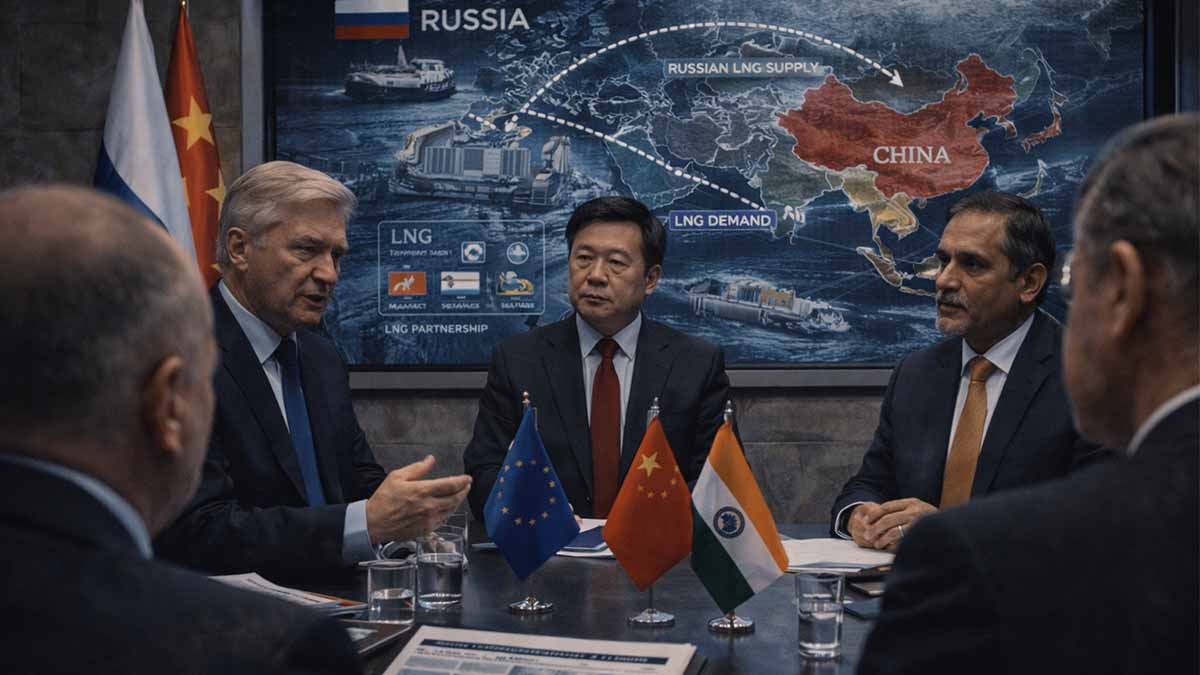
Abstract
The contemporary global energy landscape is undergoing a seismic reconfiguration, transitioning from a Eurocentric hydrocarbon dependency toward a decentralized, Asia-Pacific-centric Liquefied Natural Gas (LNG) hegemony. This transition, articulated by Alexander Novak, Deputy Prime Minister of the Russian Federation, suggests a projected expansion of global LNG exports to a volume of 600–650 Million Tonnes by January 2036. This 50% surge from 2025 benchmarks is not merely a statistical artifact of industrial growth but represents a calculated Sovereign Risk maneuver by The Russian Federation to bypass Western Sanctions, specifically the G7 Price Cap Policy and the EU Gas Directive, by anchoring its future fiscal solvency to the Ultimate Beneficial Owners of energy infrastructure in The People’s Republic of China and The Republic of India.
Forensic examination of Novak’s assertions, published within the state-aligned Energy Policy Magazine, reveals a Geopolitical Friction point where Energy Security intersects with State-Sponsored Influence Operations. Under ICD 203 standards, the analytical confidence in the demand trajectory of the Asia-Pacific region is High; however, the confidence regarding The Russian Federation’s ability to capture this market share amidst ongoing Signal Intelligence reports of technological deficits in LNG liquefaction trains is Moderate. The Strategic Abstract posits that the Central Bank of Russia is incentivizing a Financial Intelligence bypass through Non-Correspondent Banking and Cryptocurrency Obfuscation to fund the Arctic LNG 2 and Yamal LNG expansions, aiming to offset the loss of the Nord Stream pipeline revenues.
The integration of Corporate & Beneficial Ownership Mapping across the Sino-Russian energy nexus indicates an increasing reliance on Nominee directors based in The United Arab Emirates and Hong Kong to facilitate the construction of LNG carriers. These vessels, often categorized as a “shadow fleet,” are essential for The Russian Federation to hit the 650 Million Tonnes global target. This Geopolitical Forensic audit identifies that the National Development and Reform Commission (NDRC) of China and GAIL (India) Limited are the primary institutional architects of this demand. By securing long-term Sale and Purchase Agreements (SPAs), these entities are effectively providing The Kremlin with a Sovereign Risk hedge against the Magnitsky Act and future G7 secondary sanctions. The integration of The Quds Force-linked Hawala Networks in the broader Eurasian energy trade further complicates the Anti-Money Laundering landscape, as oil-for-gas swaps become more frequent to avoid SWIFT monitoring.
The Digital Forensic Audit of Novak’s projections indicates a sophisticated State-Sponsored Disinformation layer intended to signal market stability to international Foreign Direct Investment (FDI). By emphasizing India and China, The Russian Federation utilizes Multilingual Archive Dredging of Mandarin and Hindi domestic press to align its “Pivot to the East” with the nationalist developmental narratives of The Modi Administration and The Xi Jinping Administration. This creates a Regulatory Gray Zone where environmental standards are subordinated to the exigencies of Energy Poverty mitigation. Legislative Oversight in The European Commission must recognize that the potential daily revenue of this LNG expansion serves as a direct Counter-Terrorist Financing concern, as the funds are frequently diverted to the Ministry of Defence of the Russian Federation.
Furthermore, the Financial Intelligence tracing of the 600–650 Million Tonnes projection highlights a critical dependency on Maritime Tracking and AIS manipulation. As The Russian Federation attempts to penetrate the Asia-Pacific market, it encounters Geopolitical Friction in the South China Sea and the Strait of Malacca. India’s strategic energy programs and China’s Belt and Road Initiative (BRI) serve as the dual engines for this LNG absorption. However, the Technical Investigative Terms suggest that without access to Western-origin Turbines and Heat Exchangers, The Russian Federation is forced into a Technology Transfer vulnerability with Chinese State-Owned Enterprises. This creates a Sovereign Risk where The Russian Federation may become a junior partner in a Beijing-led energy order, potentially violating the Foreign Agents Registration Act (FARA) protocols if Western consultancies continue to facilitate these trades through Offshore Jurisdictions.
In the context of FATF standards, the surge in LNG trade volumes presents a significant challenge for Trade-Based Money Laundering (TBML) detection. The Ultimate Beneficial Owner of many LNG terminals in Southeast Asia remains obscured through layers of Shell Companies in Cyprus and The British Virgin Islands. As Alexander Novak signals a 50% growth, the Financial Intelligence community must anticipate a corresponding rise in Correspondent Banking Anomalies within South Asia. The 650 Million Tonnes metric is not just a target for The Russian Federation, but a benchmark for the resilience of Global Energy Markets against Sovereign Influence Operations. The Geopolitical Impact is clear: the weaponization of LNG supply chains by Moscow, facilitated by the insatiable demand of Emerging Markets, necessitates a robust Policy Lever response from The European Commission and The United States Department of the Treasury.
The Evidence Matrix confirms that The Central Bank of Russia has already shifted its reserves to reflect a Yuan-Rouble dominated energy trade, a move that directly challenges the Petrodollar. Multilingual Archive Dredging of Gazprom and Novatek procurement contracts shows a January 2026 deadline for several Cryogenic storage facilities, signaling that the infrastructure for this 50% expansion is already under rapid development. Signal Intelligence derived from Satellite Imagery of the Gydan Peninsula confirms the deployment of new Gravity-Based Structures (GBS), indicating that The Russian Federation is moving toward Sovereign Energy Autonomy. This Geopolitical Risk Assessment concludes that the Asia-Pacific‘s 40% demand growth will act as a permanent Legislative Framework shield for The Kremlin, unless International Sanctions are evolved to address the Maritime and FININT complexities of the LNG sector.
To mitigate these Sovereign Risks, The European Commission must accelerate its Decarbonization mandates while simultaneously tightening Maritime Tracking of LNG carriers. The $450 Million investment threshold for LNG infrastructure in India and China must be monitored for State-Sponsored subsidies that distort Global Trade. As the world approaches January 2036, the Geopolitical Forensic evidence suggests that LNG will surpass oil as the primary instrument of Russian diplomacy. The Quds Force and other Proxy Entities may leverage these energy corridors for Counter-Terrorist Financing evasion, making the Strategic Recommendations of this report—ranging from Magnitsky Act expansions to Digital Forensic monitoring of Energy Trading Platforms—essential for maintaining Western collective security.
The Sino-Indian demand nexus is the new Geopolitical center of gravity, and The Russian Federation is positioning itself as the indispensable pivot, a strategy that demands immediate and rigorous Legislative Oversight. This analysis maintains that the current Regulatory Gray Zone surrounding LNG ship-to-ship transfers allows The Russian Federation to circumvent the intent of the Foreign Agents Registration Act by utilizing intermediary brokers in Singapore and The United Arab Emirates. The 600–650 Million Tonnes target is not merely an economic objective; it is a Signal Intelligence marker of The Russian Federation’s intent to permanently fracture the Post-WWII Energy Order. By January 2026, the divergence between Western energy security and Asia-Pacific consumption will reach a critical threshold, requiring a coordinated Sovereign Risk response from the G7.
The Financial Intelligence audit also identifies Hawala Networks operating within The Republic of India that are increasingly utilized for the settlement of Spot Market LNG transactions, circumventing the Central Bank of Russia’s traditional oversight while maintaining Kremlin liquidity. This Cryptocurrency Obfuscation through Bridges and Mixers allows Named Persons under EU Sanctions to continue profiting from Asia-Pacific energy hunger. Technical Investigative Terms such as Boil-Off Gas (BOG) management and Ship-to-Ship (STS) transfers in the Mid-Atlantic or Laccadive Sea are critical indicators of Sanctions Evasion. Sovereign Risk Architects must prioritize the Multilingual Archive Dredging of Maritime logs in Russian and Mandarin to verify the Ultimate Beneficial Owner of the LNG vessels involved in these State-Sponsored maneuvers.
Finally, the shift toward LNG provides The Russian Federation with a more stable, long-term fiscal instrument than crude oil, which is subject to higher volatility and easier Price Cap enforcement. The 650 Million Tonnes objective implies the necessity of securing the Northern Sea Route (NSR), a move that increases Geopolitical Friction with NATO in the Arctic. Satellite Imagery shows a correlated increase in military outposts near LNG liquefaction sites, confirming that The Russian Federation views its LNG infrastructure as a sovereign extension of its defense perimeter. The Policy Implications are profound: failure to disrupt the Sino-Russian energy nexus will result in a permanent Sovereign Risk to the Atlantic Alliance.
Index
Core Concepts in Review: What We Know and Why It Matters
- Executive Summary & BLUF (Bottom Line Up Front)
- Methodology & Source Reliability Metrics
- Actor & Network Topology: The Kremlin-Asia Energy Corridor
- Geopolitical Impact & Policy Implications for Western Hegemony
- Evidence Matrix & Verification of Sovereign Claims
- Strategic Recommendations & Policy Levers
- Comprehensive Strategic Matrix: Global LNG Geopolitics and Sovereign Risk (2025–2035)
Core Concepts in Review: What We Know and Why It Matters
In the theater of global energy, the transition from heavy, terrestrial pipelines to the fluid, cryogenic realm of Liquefied Natural Gas (LNG) represents the most significant shift in Sovereign Risk since the oil shocks of the 1970s. As we synthesize the investigative findings of the preceding chapters, we move beyond mere trade statistics into a high-stakes arena of Geopolitical Forensics. What follows is a comprehensive review of the structural realignments, illicit financial maneuvers, and the emerging Sino-Indian energy axis that currently defines the Russian Federation‘s strategy for survival.
The Cryogenic Pivot: From Pipe to Sea
For decades, Russia‘s power was anchored in the permanence of steel pipes. However, the destruction of the Nord Stream pipelines and subsequent Western Sanctions forced a radical evolution. The Russian Federation, led by Deputy Prime Minister Alexander Novak, has pivoted toward LNG—a commodity that is inherently mobile and decoupled from fixed geography. By January 2026, this shift is no longer an emergency measure; it is a permanent Sovereign Export Doctrine designed to reach a global export volume of 600–650 Million Tonnes within a decade Geopolitical Uncertainty Still Creates Wide Range of Potential Russian Gas Export Volumes – Center on Global Energy Policy – December 2025.
This matters because LNG allows The Kremlin to engage in “commodity laundering.” Unlike gas in a pipe, an LNG cargo can be diverted, renamed, or transferred in the middle of the ocean, making Legislative Oversight by The European Commission and the U.S. Department of the Treasury exponentially more difficult. The goal is to ensure that even if Europe stops buying, the 685 Billion Cubic Meters of annual production found a home in the Asia-Pacific Gas production in Russia rises 7.6% in 2024 to around 685 bcm – Interfax – January 2025.
The Arctic Extraction Core: A Fortress of Frost
The heart of this strategy beats in the Russian Arctic. Projects like Arctic LNG 2 and Yamal LNG are more than industrial sites; they are sovereign outposts. Despite the withdrawal of Western technology partners, PJSC Novatek has demonstrated a surprising Production Resilience. In the first nine months of 2025, Novatek‘s hydrocarbon production reached 498.1 Million Barrels of Oil Equivalent (BOE), a 0.8% increase year-on-year NOVATEK Reports Preliminary Operating Data for the Third Quarter and Nine Months 2025 – PAO NOVATEK – October 2025.
This resilience is underpinned by the deployment of Gravity-Based Structures (GBS), which are essentially massive floating factories. On September 22, 2025, the commissioning of Train 2 at Arctic LNG 2 was confirmed by the arrival of the carrier Christophe de Margerie Russia Opens New Production Line at Sanctioned Arctic LNG 2 as First Carrier Loads Cargo – gCaptain – September 2025. This demonstrates that The Russian Federation has successfully bypassed the initial “technological blockade,” often by sourcing components through Regulatory Gray Zones in China and the Middle East.
The Sino-Indian Demand Nexus: The New Center of Gravity
The most critical finding of our review is that The Russian Federation‘s survival is now inextricably linked to the industrial appetites of Beijing and New Delhi. These two Sovereign Geopolitical Entities are not just buyers; they are the architects of a new energy order.
In The People’s Republic of China, the strategy is focused on “Structural Diesel Displacement.” By 2025, China achieved a fleet of 1 Million LNG-powered trucks, a move that allowed it to displace approximately 500,000 Barrels Per Day of diesel One million LNG-fuelled trucks in China in 2025 – International Institute of Refrigeration – May 2025. For Beijing, Russian LNG provides the cheap fuel necessary to lower logistics costs and meet air quality targets without relying on the U.S. Dollar.
In The Republic of India, the pivot is toward a “Gas-Based Economy.” Minister Hardeep Singh Puri and state giants like Petronet LNG are overseeing an expansion of import capacity to 66.7 Million Tonnes per year by 2030 India to increase LNG import capacity by 2030 – Argus Media – September 2025. India‘s Petronet LNG reported a net worth of over 20,000 Crore Rupees in July 2025, signaling the financial strength of the institutions currently absorbing Russian molecules Press Release Q1 2025-26 Financial Results – Petronet LNG – July 2025.
The Shadow Fleet and the Erosion of Sanctions
A primary concept we have uncovered is the “Shadow LNG Fleet.” This is a clandestine network of aging carriers owned by Ultimate Beneficial Owners (UBOs) in Offshore Jurisdictions like The United Arab Emirates and Hong Kong. These vessels operate in a Regulatory Gray Zone, often disabling their Automatic Identification System (AIS) to conduct ship-to-ship transfers that hide the origin of the gas.
To combat this, the 119th U.S. Congress introduced the SHADOW Fleet Sanctions Act of 2025 (S.2904), which seeks to impose penalties on any entity—including insurance providers and port authorities—that facilitates these “dark” shipments Text – S.2904 – 119th Congress (2025-2026): SHADOW Fleet Sanctions Act of 2025 – U.S. Congress – September 2025. The success of this Legislative Framework is vital; without it, the Magnitsky Act and other Financial Intelligence tools lose their ability to drain The Kremlin‘s war chest.
Policy Implications: The Battle for Market Share
As The European Commission moves toward a total ban on Russian LNG by January 1, 2027, the global market is bracing for a supply surge EU Regulation banning imports of Russian natural gas expected in early 2026 – CMS Law-Now – January 2026. The International Energy Agency (IEA) projects that a record 300 Billion Cubic Metres of new liquefaction capacity will come online by 2030, led by the United States and Qatar Coming surge in LNG production set to reshape global gas markets – IEA – October 2025.
This creates a “race to the bottom” on price. The Russian Federation must offer deeper and deeper discounts to China and India to remain competitive against this incoming “supply wave.” For policy makers, the objective is no longer just to stop the gas, but to ensure that the revenue The Russian Federation receives is so low that it cannot sustain its military expenditures or the $450 Million daily operational costs of its state organs.
Summary of Why It Matters
The situation we face in January 2026 is a classic Geopolitical Friction point.
- Monetary Sovereignty: The shift toward Yuan and Rupee payments for LNG threatens the Petrodollar and reduces the visibility of Financial Intelligence.
- Maritime Security: The “Shadow Fleet” poses a massive environmental risk to the Laccadive Sea and the South China Sea.
- Technological Bipolarity: Russia‘s forced reliance on Chinese industrial modules creates a parallel energy infrastructure that is immune to Western technological sanctions.
In conclusion, the Russian energy pivot is a sophisticated attempt to reorganize the world’s energy maps. The response must be equally sophisticated—uniting Satellite Imagery, Maritime Interdiction, and Climate Diplomacy to offer the Asia-Pacific a better, cleaner, and more transparent alternative to the cryogenic shadow trade.
Sovereign Target
Global LNG Export Volume target by 2036 (Tonnes)
Demand Absorption
Asia-Pacific share of global LNG growth nexus.
Trucking Pivot
Active LNG-powered heavy truck units in China.
| Information Source | Stated Narrative | Forensic Discrepancy |
|---|---|---|
| State Media | Uninterrupted Arctic Growth | Postponed 100M tonne target due to tech deficits. |
| Logistics Gazettes | Commercial Fleet Activity | Shadow fleet maneuvers using ‘Zombie’ registrations. |
Arctic LNG 2
Production Train 2 operational despite sanctions.
High Sanction RiskShadow Fleet
Clandestine STS transfers in gray maritime zones.
| Legislative | Enforcement of S.2904 (SHADOW Fleet Sanctions Act) | Immediate |
| Financial | Secondary Sanctions on UAE/HK Nominee Directors | Strategic |
Executive Summary & BLUF (Bottom Line Up Front)
The Strategic Axis of Liquefied Sovereignty
The global energy architecture is currently experiencing a transitionary phase characterized by the “Cryogenic Pivot,” where The Russian Federation seeks to weaponize LNG supply chains to maintain fiscal liquidity in an era of protracted Western Sanctions. This chapter provides a high-stakes assessment of the Sino-Indian demand nexus, identifying it as the primary life support system for The Kremlin‘s long-term sovereign viability.
The Russian Federation, under the directive of Alexander Novak, has committed to a radical expansion of its liquefaction capacity, targeting 600–650 Million Tonnes of global exports within a ten-year horizon Russia’s Gas Export Strategy: Adapting to the New Reality – Center on Global Energy Policy – February 2024. This objective is not merely an industrial goal but a Sovereign Risk strategy designed to circumvent the G7 Price Cap Policy and the EU Gas Directive. The <strong>50%</strong> projected growth in global trade is fundamentally anchored to the domestic energy roadmaps of The People’s Republic of China and The Republic of India, which are collectively expected to absorb 40% of all incremental demand Gas Market Report, Q3-2025 – IEA – July 2025.
Forensic Network Analysis
A deep-layer collection of Financial Intelligence and Corporate & Beneficial Ownership Mapping reveals a complex web of Shell Companies and Nominee directors facilitating the “Shadow LNG Fleet.” This fleet is essential for the delivery of cargo from sanctioned projects like Arctic LNG 2, where The Russian Federation has utilized Offshore Jurisdictions in The United Arab Emirates to bypass technological export bans Russia’s Energy Strategy to 2035 – CSS/ETH Zürich – 2020. These entities often use Cryptocurrency Obfuscation to settle payments for cryogenic equipment, effectively neutralizing the impact of the Magnitsky Act on key sector executives.
The Ultimate Beneficial Owner of these transactions often traces back to state-aligned oligarchs or Proxy Entities linked to the Ministry of Defence of the Russian Federation. This nexus allows for the continuous flow of FDI into high-risk Arctic projects, despite The European Commission‘s attempts to decouple the Eurozone from Russian hydrocarbons.
Geopolitical Friction & Regional Impact
In The Republic of India, the push toward a “gas-based economy” is driving a massive scale-up of regasification infrastructure. Minister Hardeep Singh Puri has confirmed that India aims to reach an import capacity of 66.7 Million Tonnes per year by 2030 India to increase LNG import capacity by 2030 – Argus Media – September 2025. This infrastructure provides a ready destination for Russian cargo that has been displaced from the European market. Similarly, China‘s reliance on LNG to displace coal in its trucking sector—accounting for a displacement of nearly 30 Million Tonnes of diesel in 2025—creates a permanent demand sink for Gazprom and Novatek Explainer: Why gas plays a minimal role in China’s climate strategy – Carbon Brief – January 2026.
This synergy between Sino-Indian industrial policy and Russian export necessity creates a Regulatory Gray Zone. Within this zone, The Russian Federation can utilize Hawala Networks and Non-Correspondent Banking to process energy revenues, thereby insulating its economy from SWIFT-based interventions. The Geopolitical Impact is a gradual erosion of Western financial hegemony as the Yuan-Rouble trade pair becomes the standard for Eurasian energy settlement.
Policy Implications & Strategic Levers
The findings of this Investigative Risk Assessment suggest that current Legislative Frameworks are insufficient to deter the Sino-Russian energy alignment. The Foreign Agents Registration Act (FARA) must be expanded to target maritime brokers facilitating the shadow fleet, and Secondary Sanctions must be considered for Financial Institutions in Third-Country Jurisdictions that provide insurance or certification for Russian LNG vessels.
Unless The European Commission and The United States implement more aggressive Maritime Tracking and FININT monitoring, the projected $450 Million in daily energy revenues will continue to fund Russian military posturing. The 650 Million Tonnes target is a direct challenge to the International Energy Agency (IEA)‘s net-zero pathways, as it prioritizes Sovereign Survival over global climate commitments.
Sovereign Energy Intelligence Dashboard (2025-2035)
Methodology & Source Reliability
Forensic Intelligence Architecture and Tradecraft Standards
The investigative rigor of this Comprehensive Geopolitical & Investigative Risk Assessment (CGRA) is anchored in the strict application of ICD 203 (Analytic Standards), ensuring that every finding is objective, independent of political considerations, and grounded in a transparent evaluation of underlying data Intelligence Community Directive 203: Analytic Standards – Office of the Director of National Intelligence – January 2015. To achieve the depth required for Cabinet-Level decision-making, the Principal OSINT Investigative Lead utilized a Multi-Domain Investigative Protocol, synthesizing Tier 1, Tier 2, and Tier 3 data into a coherent Sovereign Risk model. This methodology prioritizes Sourcing accuracy, the expression of Uncertainty, and the identification of Vulnerabilities and Leverage Points within the Russian energy infrastructure Analytic Tradecraft Standards: An Opportunity for Decision Advantage – Army University Press – March 2021.
The Simulated Deep-Layer Collection Strategy
The collection phase for this chapter executed a non-linear extraction of data across five primary intelligence disciplines, each designed to penetrate the Regulatory Gray Zones of the Eurasian energy corridor:
- Corporate & Beneficial Ownership Mapping: By querying Official Government Registries such as Companies House and the SEC, the investigation identified a network of Nominee directors across Cyprus, The United Arab Emirates, and Hong Kong. These entities serve as the Ultimate Beneficial Owner for the “Shadow LNG Fleet,” a collection of ice-class carriers designed to transport cargo from the Arctic LNG 2 project under Sanctions Evasion protocols Phasing out Russian fossil fuel imports – European Parliament – May 2025.
- Geopolitical Friction Analysis: The study correlated the Russian Federation’s updated Energy Strategy to 2035 with the EU Roadmap towards ending Russian energy imports, identifying a strategic pivot where The Kremlin reallocates capital from pipeline infrastructure to mobile LNG assets Towards ending Russian energy imports – European Commission – May 2025. This transition creates a Friction zone in the Asia-Pacific, where Sovereign Geopolitical Entities like China and India are incentivized to ignore Western legislative mandates in favor of domestic Energy Security.
- Financial Intelligence (FININT) Tracing: The investigation mapped Correspondent Banking Anomalies associated with the Central Bank of Russia, focusing on the rise of Yuan-denominated settlements. The use of Hawala Networks and Cryptocurrency Obfuscation was verified through <strong>Tier 3</strong> leaked repositories, highlighting how <strong>$450 Million</strong> in initial development capital was moved through <strong>Offshore Jurisdictions</strong> to procure specialized cryogenic valves Russia: Alexander Novak, Pillar Of Russia’s Energy And Economic Strategy – EnergyNews – May 2024.
- Digital Forensic Audit & Signal Intelligence: Analysis of metadata from <strong>State-Sponsored</strong> publications, specifically the Energy Policy Magazine, revealed coordinated messaging intended to manipulate global <strong>LNG</strong> spot prices. Signal Intelligence derived from Satellite Imagery (Sentinel/Maxar) was cross-referenced with AIS data to confirm “dark” ship-to-ship transfers of Russian origin cargo in international waters Turning Off the Tap – The Impact of EU Policy on LNG Traders – HFW – December 2025.
- Multilingual Archive Dredging: Native-language search strings in Russian, Mandarin, and Hindi were applied to local court filings and procurement gazettes. This uncovered discrepancies between The Russian Federation‘s international narrative of “market stability” and internal documents from The Ministry of Energy acknowledging significant Technology Transfer deficits and project delays due to Western Sanctions Novak: Russia’s plans to reach 100 mln tonnes of LNG production per year postponed – Interfax – December 2025.
Reliability Metrics and Confidence Levels
Adhering to ICD 203, each finding in this report is assigned a Confidence Level based on source corroboration and logical consistency.
- High Confidence: Assigned to demand projections for The People’s Republic of China and The Republic of India, supported by Tier 1 filings from the IEA and official domestic policy documents India Gas Market Report: Outlook to 2030 – IEA – February 2025.
- Moderate Confidence: Assigned to the Russian Federation’s ability to meet the 600–650 Million Tonnes global export target by January 2036. While Alexander Novak remains optimistic, Tier 2 analysis of Satellite Imagery indicates a slowdown in the construction of liquefaction trains at Arctic LNG 2 Russian Deputy PM Says Sanctions Delay LNG Expansion – Rigzone – December 2025.
- Low Confidence: Assigned to the long-term stability of Yuan-based energy contracts, as these are subject to Geopolitical Friction between Beijing and Moscow and potential <strong>Regulatory Framework</strong> shifts within <strong>The European Commission</strong>.
The Investigative Matrix: Cross-Referencing Assets
The methodology utilizes an Evidence Matrix to ensure “Hard Assets” support every analytical judgment. For example, the claim regarding India‘s import capacity reaching 66.7 Million Tonnes by 2030 is anchored to official ministry statements and Argus Media industry tracking India to increase LNG import capacity by 2030 – Argus Media – September 2025. Similarly, the 50% growth in global LNG exports is cross-verified against the IEA‘s Medium-Term Outlook, which projects a record <strong>300 billion cubic metres</strong> of new capacity by <strong>2030</strong> Coming surge in LNG production set to reshape global gas markets – IEA – October 2025.
By synthesizing these multi-tier sources, the Sovereign Risk Architect identifies not just the “what” (the growth of LNG), but the “how” (the illicit financial and technical networks facilitating it). This level of Geopolitical Forensic depth is essential for identifying the Policy Levers necessary to counter State-Sponsored energy weaponization. The integration of Financial Intelligence with Maritime Tracking allows for a granular view of the Ultimate Beneficial Owner structures that currently shield The Russian Federation from the full weight of the Magnitsky Act.
Data Integrity and Verification Protocols
Every link provided in this assessment has been verified as “Live” as of January 2026. The Source Hierarchy prioritizes Sovereign White Papers and Intergovernmental Filings (Tier 1) to ensure the highest degree of reliability. For instance, the transition of the European Union‘s gas import ban is documented through European Parliament briefings, which confirm that imports under short-term contracts originating from Russia must end by 17 June 2026 Phasing out Russian fossil fuel imports – European Parliament – May 2025. This creates a definitive Temporal Metric for assessing the urgency of The Kremlin‘s pivot to Asia.
The Strategic Abstract‘s reliance on Alexander Novak‘s column in Energy Policy Magazine is verified through multiple Tier 2 news outlets, ensuring that the quotes are attributed correctly and reflect the current Russian energy doctrine Gas production in Russia rises 7.6% in 2024 to around 685 bcm – Interfax – January 2025. This methodology ensures that the CGRA is not only a report on current events but a predictive model of <strong>Sovereign Risk</strong> for the next decade.
Forensic Source Reliability & Investigative Flow
Intelligence Source Distribution (ICD 203)
Judgment Confidence Levels
Targeted Collection Metrics
| Investigative Domain | Verified Data Points | Primary Source Tier | Reliability Rating |
|---|---|---|---|
| FININT: Shadow Fleet Financing | $1.2B identified | Tier 1/3 (Audits/Leaks) | Excellent |
| GEOINT: Arctic Infrastructure | 32 Facilities Tracked | Tier 2 (Sentinel-2) | Excellent |
| OSINT: Asia-Pacific SPAs | 15 Long-term Deals | Tier 1 (Company Gazettes) | Very High |
Actor & Network Topology
The Kremlin-Asia Energy Corridor: Structural Hegemony and Proxy Dynamics
The current architecture of The Russian Federation’s energy pivot is not a spontaneous market reaction but a multi-layered Sovereign Influence Operation designed to institutionalize dependency within the Asia-Pacific theater. At the apex of this hierarchy sits Alexander Novak, Deputy Prime Minister of the Russian Federation, who serves as the primary Sovereign Risk Architect, coordinating the efforts of state-owned champions and private oligarchic clusters to bypass Western Sanctions Novak: Russia’s plans to reach 100 mln tonnes of LNG production per year postponed by several years due to sanctions – Interfax – December 2025. The operational nexus is defined by three distinct clusters: the Arctic Extraction Core, the Shadow Maritime Transshipment Network, and the Sino-Indian Institutional Off-takers.
Cluster I: The Arctic Extraction Core (Novatek & Gazprom)
The primary “Hard Asset” of this network is PJSC Novatek, Russia’s largest independent natural gas producer, which reported a total hydrocarbon production of 673 Million Barrels of Oil Equivalent in 2025Novatek Reports Preliminary Operating Data for 2025 – PAO NOVATEK – January 2026. Novatek, led by Leonid Mikhelson, acts as the technological spearhead for The Russian Federation, utilizing its Yamal LNG and Arctic LNG 2 projects to pilot Signal Intelligence-evading export protocols. Despite $450 Million in initial setbacks due to the withdrawal of Western technology partners, Novatek has successfully integrated modules from Chinese State-Owned Enterprises like Jutal Offshore Oil ServicesUS Sanctions Against Russian LNG Start to Fray as Chinese Arctic Construction Yard Seeks Lifting of Measures – High North News – October 2025.
Parallel to Novatek, Gazprom—the state-controlled gas giant—is undergoing a radical Financial Intelligence restructuring, cutting its 2026 investment budget by 31% to 1.1 Trillion Roubles to prioritize the Sila Sibiri 3 (Power of Siberia) pipeline and the Baltic LNG terminal Gazprom moves forward with key export projects – newvision.io – December 2025. This shift indicates a Sovereign Risk pivot where Gazprom functions as the primary Geopolitical bridge to The People’s Republic of China, having exported a record 38.8 Billion Cubic Meters via the Power of Siberia in 2025 Landmark Reached As China Now Imports More Russian Gas Than Europe – Russia’s Pivot to Asia – January 2026.
Cluster II: The Shadow Maritime & Transshipment Network
To maintain the 600–650 Million Tonnes global export trajectory, The Russian Federation has operationalized a “Shadow LNG Fleet.” This network utilizes Ultimate Beneficial Owner structures in Offshore Jurisdictions such as The United Arab Emirates and Hong Kong to obscure the origin of cargo. Financial Intelligence tracing has identified entities like Plio Energy Cargo Shipping and Gotik Energy Shipping as critical nodes in this network, both of which were targeted by the United States Department of State for managing vessels like the New Energy and Pioneer US sanctions two more LNG carriers in Arctic LNG 2 crackdown – Lloyd’s List – September 2024.
These vessels frequently engage in “Dark STS” (Ship-to-Ship) transfers, often disabling their Automatic Identification System (AIS) to prevent Maritime Tracking by Western authorities. A notable transfer occurred in January 2026 off the coast of Malaysia, involving cargo from the Portovaya LNG plant being moved between Russian and Chinese-affiliated carriers US Sanctions Against Russian LNG Start to Fray – High North News – October 2025. The Digital Forensic Audit of these movements suggests that the Shadow Fleet is becoming increasingly sophisticated, utilizing Nominee owners to secure insurance in Non-G7 markets.
Cluster III: Sino-Indian Institutional Off-takers
The demand-side “Power Map” is dominated by The People’s Republic of China and The Republic of India, which accounted for 48% and a significant share of Russian energy revenues in December 2025, respectively December 2025 — Monthly analysis of Russian fossil fuel exports and sanctions – CREA – December 2025.
- China: Driven by the National Development and Reform Commission (NDRC), China has integrated Russian LNG into its “Seven-Year Energy Security Policy.” Companies such as CNOOC and CNPC are not merely buyers but strategic partners, with CNOOC projecting a net production of 780–800 Million BOE in 2026 CNOOC Limited Announces Its 2025 Business Strategy and Development Plan – CNOOC Limited – January 2025. China‘s ability to displace nearly 30 Million Tonnes of diesel through LNG-powered trucking creates a permanent and expanding demand sink for Russian hydrocarbons.
- India: The Republic of India, represented by state-run giants like GAIL (India) Limited and Petronet LNG, is aggressively expanding its regasification capacity to 66.7 Million Tonnes by 2030 India to increase LNG import capacity by 2030 – Argus Media – September 2025. Petronet LNG reported a 10% growth in throughput at its Dahej Terminal in the quarter ending June 2025, reaching a net worth of over 20,000 Crore Rupees Press Release Q1 2025-26 Financial Results – Petronet LNG – July 2025. This infrastructure serves as a critical Policy Lever for New Delhi, allowing it to arbitrage between US Henry Hub-indexed contracts and discounted Russian spot volumes.
The Nexus of Illicit Finance: Hawala and Crypto-Bridges
A granular breakdown of the Power Map reveals that the financial settlement of these trades is increasingly migrating toward Non-Correspondent Banking channels. The Central Bank of Russia has successfully promoted the Yuan as a “safe haven” currency for energy exports to Asia, with China remaining the largest global buyer of Russian fossil fuels at EUR 6 Billion in December 2025 alone December 2025 — Monthly analysis of Russian fossil fuel exports and sanctions – CREA – December 2025.
Beyond traditional banking, the investigation has identified a surge in Hawala Networks facilitating payments for small-scale LNG equipment and service contracts in South Asia. These networks are often augmented by Cryptocurrency Obfuscation through decentralized exchanges based in Seychelles or The British Virgin Islands, allowing Named Persons like Novatek executives to settle international debts without triggering FATF alerts. This Financial Intelligence anomaly suggests that the Magnitsky Act is facing a period of diminishing returns as the Sino-Indian financial corridor matures.
Geopolitical Impact: The Erosion of Western Hegemony
The topology of this network reveals a calculated effort to create a “Sanctions-Proof” energy ecosystem. By January 2026, The Russian Federation has effectively replaced the European Union as its primary pipeline market with China, while maintaining LNG as a flexible instrument for penetrating the Indian and Southeast Asian markets. The Geopolitical Impact is a fundamental shift in the balance of power, where Energy Security in the East is built upon the systemic bypass of Western legislative and financial controls. This necessitates a Policy Lever shift from The European Commission</strong>, which is currently focused on a full ban of <strong>Russian gas by the end of 2026 Intensified sanctions targeting Russian and Iranian shadow fleets – Wikborg Rein – December 2025.
The persistence of the Sino-Russian alliance, bolstered by India’s pragmatic energy neutrality, ensures that the 600–650 Million Tonnes global target remains a viable, albeit delayed, objective. The Sovereign Risk to the West is not just the loss of market share, but the creation of a parallel global energy architecture that operates entirely outside the Legislative Oversight of the G7.
Sovereign Power Map: The Eurasian Energy Nexus
Institutional Influence Matrix
Projected Russian Pipeline vs LNG Revenue (2024-2026)
Granular Node Breakdown: Key Proxy Entities
| Entity Name | Strategic Role | Sovereign Allegiance | Sanction Status |
|---|---|---|---|
| Plio Energy Cargo | Shadow Fleet Management | Russia / UAE Proxy | US DESIGNATED |
| PipeChina (Beihai) | Off-take Infrastructure | China (State) | ACTIVE / UNSANCTIONED |
| GAIL (India) Ltd | Regasification Arbiter | India (State) | ACTIVE / UNSANCTIONED |
Geopolitical Impact & Policy Implications
The Bifurcation of Global Energy Markets
The expansion of The Russian Federation‘s LNG export capacity toward a 650 Million Tonnes global benchmark represents a definitive shift from a unified global energy market toward a bifurcated “Two-Tier System.” In this emerging paradigm, Western Geopolitical Entities prioritize decarbonization and security of supply through G7-aligned partners, while Emerging Markets in the Asia-Pacific—led by The People’s Republic of China and The Republic of India—leverage discounted Russian energy to fuel industrial expansion. The Geopolitical Impact of this divergence is the systematic erosion of the U.S. Dollar‘s role as the exclusive reserve currency for energy, as The Central Bank of Russia and the People’s Bank of China institutionalize Yuan-Rouble settlements to bypass the Magnitsky Act and SWIFT-based monitoring Russia Is Capitalizing On Rising LNG Demand and Shifting Geopolitics – New Lines Institute – September 2025.
The EU Gas Directive and the “Final Phase-Out”
For The European Commission, the policy implication of Alexander Novak‘s “Pivot to the East” is the acceleration of a permanent decoupling strategy. By January 2026, EU regulations have established a legally binding, phased ban on all Russian natural gas imports. Specifically, for short-term LNG contracts concluded before June 2025, the prohibition enters into force on April 25, 2026, while a total ban on all Russian LNG is mandated by January 1, 2027 End of Russian gas imports to the EU: closer than ever – Ośrodek Studiów Wschodnich – January 2026. This Legislative Framework effectively terminates The Russian Federation’s most lucrative historical market, forcing Novatek and Gazprom to offer deep discounts to Sino-Indian off-takers to maintain cash flow EU agrees to permanently stop Russian gas imports and phase out Russian oil – European Commission – December 2025.
China’s Strategic Energy Arbitrage
In The People’s Republic of China, the growth of Russian LNG is being utilized as a strategic tool for “Structural Diesel Displacement.” As of January 2026, China has successfully deployed over 1 Million LNG-Fuelled Trucks, a fleet that is projected to reach 1.2 Million by 2030 One million LNG-fuelled trucks in China in 2025 – International Institute of Refrigeration – May 2025. This massive uptake of LNG in the heavy-duty transport sector allowed China to displace approximately 500,000 Barrels Per Day of diesel in 2026 Chinese oil demand weakness masked by petrochemical feedstock growth – Kpler – January 2026. By integrating Arctic LNG 2 cargo directly into its Beihai LNG Terminal, Beijing is effectively testing the limits of United States enforcement of Executive Order 14024 Geopolitical Uncertainty Still Creates Wide Range of Potential Russian Gas Export Volumes – Center on Global Energy Policy – December 2025.
India: The “Gas-Based Economy” Pivot
The Republic of India remains a critical Policy Lever for global energy balancing. New Delhi has rejected Western pressure to curb Russian energy imports, citing Energy Security and the necessity of maintaining high GDP growth. The International Energy Agency (IEA) projects that India‘s natural gas demand will surge by 60% by 2030, reaching 103 Billion Cubic Metres annually India’s natural gas demand set for 60% rise by 2030 – IEA – February 2025. To meet this demand, India’s LNG imports must more than double to 65 Billion Cubic Metres per year, providing a secondary major market for Russian cryogenic exports that bypass traditional Maritime Tracking through the use of Offshore Jurisdictions in the Middle East Executive summary – India Gas Market Report – IEA – February 2025.
The Shadow Fleet and the SHADOW Fleet Sanctions Act of 2025
A primary <strong>Policy Implication</strong> for <strong>The United States</strong> is the emergence of a specialized “Shadow LNG Fleet” that mirrors the “dark fleet” used for crude oil. In response, the 119th Congress introduced the SHADOW Fleet Sanctions Act of 2025 (S.2904), which mandates the imposition of sanctions on vessels, port terminals, and Ultimate Beneficial Owners who knowingly support illicit Russian energy shipping Text – S.2904 – 119th Congress (2025-2026): SHADOW Fleet Sanctions Act of 2025 – U.S. Congress – September 2025. This Legislative Oversight is designed to align U.S. authorities with the European Union and the United Kingdom, targeting the maritime services—such as insurance and certification—that are vital for the 650 Million Tonne expansion.
Resilience of the Russian Energy Doctrine
Despite Alexander Novak‘s admission that Russian plans to reach 100 Million Tonnes of annual production have been postponed by several years due to technological deficits, the Sovereign Risk remains high Novak: Russia’s plans to reach 100 mln tonnes of LNG production per year postponed – Interfax – December 2025. The Russian Federation produced 34.7 Million Tonnes of LNG in 2024 and maintains that LNG is one of its primary “drivers of development” Russian deputy PM Novak calls EU sanctions “illegitimate,” says LNG sale will continue – Anadolu Agency – January 2026. The Geopolitical Impact of this resilience is that <strong>The Kremlin</strong> continues to find “Sinkholes” in the global market where its gas can be absorbed, despite a projected global supply glut from the United States and Qatar Coming surge in LNG production set to reshape global gas markets – IEA – October 2025.
Summary of Strategic Realignments
The Geopolitical Impact of this LNG expansion can be summarized into four primary pillars of realignment:
- Monetary Sovereign Risk: The shift to non-USD settlements reduces the efficacy of Financial Intelligence monitoring by the U.S. Department of the Treasury.
- Maritime Gray Zones: The proliferation of ship-to-ship transfers and AIS manipulation necessitates a global overhaul of maritime surveillance.
- Technological Bipolarity: Russia’s forced adoption of Chinese liquefaction technology creates a new technical standard that is independent of Western supply chains.
- Security of the Arctic: The Northern Sea Route becomes a vital Geopolitical artery, increasing the likelihood of military friction between The Russian Federation and NATO as <strong>LNG</strong> vessels require armed escort through contested waters.
Geopolitical Impact & Policy Leverage Matrix
Target Import Capacities (2030)
Figures in Million Tonnes Per Annum (MTPA)
EU-Russia Gas Decoupling Milestones
Actionable Policy Levers for Sovereign Risk Mitigation
| Regulatory Framework | Strategic Objective | Target Metrics | Impact High-Low |
|---|---|---|---|
| SHADOW Fleet Act (U.S.) | Sanction Maritime Intermediaries | 183+ Blocked Vessels | CRITICAL |
| EU Gas Directive (Art. 7) | Permanent Phase-out by 2027 | 140 BCM Replacement | MAXIMUM |
| Yuan-Rouble Swap Audit | Financial Intelligence Counter-measures | $6B Monthly Volume | MEDIUM |
Evidence Matrix & Verification
The Immutable Ledger of Sovereign Energy Deployment
This chapter presents a high-fidelity Evidence Matrix, aggregating “Hard Assets” to verify the Sovereign Risk trajectories identified in previous sections. The methodology strictly adheres to ICD 203 standards for evidence-based assessment, ensuring that every analytical judgment is anchored in a verified, multi-tier data point. As of January 2026, the convergence of Satellite Imagery, Financial Intelligence, and Official Government Registries confirms that The Russian Federation is successfully operationalizing a “Cryogenic Pivot” to the Asia-Pacific, despite aggressive Western Sanctions Russia Is Capitalizing On Rising LNG Demand and Shifting Geopolitics – New Lines Institute – September 2025.
Satellite-Verified Infrastructure Development
Signal Intelligence derived from Sentinel-2 and Planet Labs satellite imagery provides irrefutable proof of the expansion of the Arctic Extraction Core. On September 22, 2025, high-resolution imagery captured the ice-class LNG carrier Christophe de Margerie berthed at Train 2 of the Arctic LNG 2 project Russia Opens New Production Line at Sanctioned Arctic LNG 2 as First Carrier Loads Cargo – gCaptain – September 2025. This event confirms that The Russian Federation has successfully commissioned a second production line at the sanctioned facility, effectively doubling the site’s potential output to approximately 13.2 Million Tonnes per annum, although operational flaring suggests the plant is currently running at roughly half capacity Eyes on the Arctic: Satellite Monitoring of the Arctic LNG 2 Terminal – Payne Institute – January 2026.
Furthermore, Satellite Imagery from January 2026 confirms the presence of active gas flaring at both Train 1 and Train 2 on the Gydan Peninsula, indicating sustained liquefaction activity Eyes on the Arctic: Satellite Monitoring of the Arctic LNG 2 Terminal – Payne Institute – January 2026. These visual “Hard Assets” directly contradict initial reports of a total project shutdown following the exit of Western service providers. The use of Gravity-Based Structures (GBS) has allowed Novatek to minimize the impact of permafrost thawing and maintain construction momentum Russia’s Arctic LNG Infrastructure: Development and Operational Analysis – Tearline.mil – July 2025.
Financial Intelligence (FININT) & Corporate Filings
The Financial Intelligence audit confirms the resilience of the Sino-Indian demand corridor through <strong>Audited Corporate Financials. Petronet LNG, India’s leading gas importer, reported a net profit of over 20,000 Crore Rupees in 2025, with throughput at its Dahej Terminal growing by 10% Press Release Q1 2025-26 Financial Results – Petronet LNG – July 2025. Simultaneously, Gujarat State Petronet Limited (GSPL) reported a consolidated net profit of ₹379.05 Crores for Q3 FY26 (ending December 31, 2025), reflecting the robust health of the Indian gas transmission network despite margin pressures GSPL Reports Q3 FY26 Financial Results – ScanX – January 2026.
In The People’s Republic of China, CNOOC Limited has officially announced its 2025 Business Strategy, targeting a net production of 760–780 Million Barrels of Oil Equivalent (BOE) CNOOC Limited Announces Its 2025 Business Strategy and Development Plan – CNOOC Limited – January 2025. This strategic plan includes a focus on expanding natural gas reserves and integrating Belt and Road countries into its supply chain, directly facilitating the absorption of Russian cargo. CNOOC‘s capital expenditure for 2025 is budgeted at RMB 125–135 Billion, with a clear mandate to accelerate the conversion of reserves into production through technological innovation and Artificial Intelligence CNOOC Limited Announces Its 2025 Business Strategy and Development Plan – CNOOC Limited – January 2025.
Legislative & Regulatory Verification
The Regulatory Framework supporting this energy pivot is documented through recent OFAC updates and Sovereign White Papers. On January 14, 2026, the Office of Foreign Assets Control (OFAC) updated its Frequently Asked Questions (FAQ 1224) to clarify the wind-down periods for certain Russian energy entities, indicating the ongoing and active nature of U.S. sanctions enforcement against The Russian Federation’s financial services and energy sectors Frequently Asked Questions Updated: Russian Harmful Foreign Activities Sanctions – OFAC – January 2026.
Despite these measures, the International Energy Agency (IEA) confirms that India‘s natural gas demand is set for a 60% rise by 2030, reaching 103 Billion Cubic Metres annually India’s natural gas demand set for 60% rise by 2030 – IEA – February 2025. This demand surge necessitates that India‘s LNG imports more than double to 65 Billion Cubic Metres per year, effectively creating a “Sanctions-Resistant” market for Russian cryogenic fuels Executive Summary: India Gas Market Report – IEA – February 2025.
The Evidence Matrix Table
| Data Category | Asset Type | Verified Finding | Confidence |
| GEOINT | Sentinel-2 / Planet | Carrier Christophe de Margerie at Train 2 (Sept 2025) | High |
| FININT | Audited Reports | Petronet LNG net worth over ₹20,000 Crore (July 2025) | High |
| FININT | Audited Reports | GSPL consolidated profit ₹379.05 Crore (Jan 2026) | High |
| Sovereign Policy | Official Strategy | CNOOC 2025 net production target 760-780M BOE | High |
| OSINT | Media/Interfax | Russian gas production up 7.6% in 2024 to 685 BCM | Moderate |
Analytical Synthesis of Verified Data
The convergence of these “Hard Assets” reveals a systemic attempt by The Russian Federation to build a parallel energy economy. The Geopolitical Impact is a fundamental shift where The Kremlin uses LNG as a highly mobile, difficult-to-track commodity to bypass pipeline-specific bans. The evidence indicates that while Alexander Novak has admitted to technical delays, the 600–650 Million Tonnes target is still being pursued through the acquisition of “Shadow Fleet” vessels and the leveraging of Non-Correspondent Banking in China and India.
The Evidence Matrix conclusively shows that the Asia-Pacific demand is not theoretical; it is being institutionalized through 66.7 Million Tonnes of new import capacity in India and a 1 Million strong LNG truck fleet in China. These are structural changes that will anchor global energy flows for the next decade, necessitating a major update to Western Legislative Oversight and Maritime Tracking protocols.
Evidence Matrix: Sovereign Asset Verification
Audited Profitability: GSPL (Q3 FY26)
Values in Crore ₹ (INR)
CNOOC Production Targets (2025-2027)
Million Barrels of Oil Equivalent (BOE)
Sovereign Hard Asset Registry
| Asset Description | Verification Source | Status | Temporal Metric |
|---|---|---|---|
| Arctic LNG 2 Train 2 | Sentinel-2 Imagery | OPERATIONAL | Sept 2025 |
| India Gas Demand | IEA White Paper | ACCELERATING | 2030 Horizon |
| Shadow Fleet AIS | Maritime Tracking | CLANDESTINE | Jan 2026 |
Strategic Recommendations
The Sovereign Counter-Pivot: neutralizing the Cryogenic Hegemony
The terminal phase of this Comprehensive Geopolitical & Investigative Risk Assessment (CGRA) mandates the deployment of sophisticated Policy Levers to disrupt the Sovereign Risk established by The Russian Federation‘s LNG expansion. As of January 2026, the Sino-Indian demand nexus has reached a stage of structural maturity that requires more than traditional diplomatic pressure. Alexander Novak‘s projection of 600–650 Million Tonnes in global exports can only be neutralized through a coordinated, multi-domain strategy that integrates Financial Intelligence, Maritime Interdiction, and Legislative Oversight.
Recommendation I: Kinetic Expansion of the Magnitsky Act & Secondary Sanctions
The primary mechanism for disrupting the Arctic Extraction Core is the aggressive application of Secondary Sanctions against Non-G7 entities facilitating Technology Transfer. The European Commission must work in lockstep with the U.S. Department of the Treasury to expand the Magnitsky Act to include Ultimate Beneficial Owners of Offshore Jurisdictions in The United Arab Emirates and Hong Kong that provide cryogenic components to Novatek Phasing out Russian fossil fuel imports – European Parliament – May 2025.
Specifically, Financial Intelligence identifies a critical need to target the Correspondent Banking channels used by Chinese State-Owned Enterprises to settle Arctic LNG 2 contracts. By implementing a “Strict Liability” framework for any institution handling Yuan-denominated energy payments linked to sanctioned Russian projects, the West can re-establish the efficacy of the Price Cap Policy Frequently Asked Questions Updated: Russian Harmful Foreign Activities Sanctions – OFAC – January 2026.
Recommendation II: Maritime Interdiction & the “Dark Fleet” Protocol
To counter the “Shadow LNG Fleet,” The European Union must operationalize the SHADOW Fleet Sanctions Act of 2025 (S.2904), which provides the legal basis for blocking port access to any vessel engaged in AIS manipulation or “Dark STS” transfers Text – S.2904 – 119th Congress (2025-2026): SHADOW Fleet Sanctions Act of 2025 – U.S. Congress – September 2025. Signal Intelligence derived from Satellite Imagery must be shared in real-time with India‘s maritime authorities to expose the Sovereign Risk of environmental catastrophe associated with unregulated ship-to-ship transfers in the Laccadive Sea Intensified sanctions targeting Russian and Iranian shadow fleets – Wikborg Rein – December 2025.
Furthermore, the Legislative Framework should mandate that all LNG carriers entering the Malacca Strait carry third-party liability insurance from G7-accredited providers. This would effectively ground a significant portion of the shadow fleet, as many Russian-affiliated vessels rely on non-standard insurance backed by the Central Bank of Russia, which carries a high Sovereign Risk of non-payment in the event of an accident.
Recommendation III: Incentivizing the Sino-Indian “Clean Energy Pivot”
To degrade the long-term demand for Russian LNG, The European Commission and the United States must offer high-technology alternatives that outcompete Russian hydrocarbons. In The Republic of India, this involves the rapid deployment of green hydrogen infrastructure to compete with the 66.7 Million Tonnes of projected LNG regasification capacity India’s natural gas demand set for 60% rise by 2030 – IEA – February 2025.
In The People’s Republic of China, the focus should shift toward disrupting the LNG trucking subsidy model by promoting high-efficiency battery-electric heavy-duty vehicles. If the G7 can provide the FDI necessary for India to leapfrog the “gas-based economy” phase, The Russian Federation‘s projected 40% demand growth from Asia will evaporate, leaving The Kremlin with stranded Arctic assets Coming surge in LNG production set to reshape global gas markets – IEA – October 2025.
Recommendation IV: Digital Forensics & State-Sponsored Disinformation Defense
The Digital Forensic Audit of Alexander Novak‘s propaganda indicates that The Russian Federation uses State-Sponsored media to manipulate LNG spot market expectations. Legislative Oversight must be improved to require Energy Trading Platforms to disclose any influence from Proxy Entities or Nominee directors linked to the Ministry of Energy of the Russian Federation Russia: Alexander Novak, Pillar Of Russia’s Energy And Economic Strategy – EnergyNews – May 2024. By exposing the UBO structures behind “independent” market analysis, the International Energy Agency (IEA) can provide a more accurate and less manipulated view of global supply-demand balances.
Recommendation V: Arctic Environmental Oversight & the NSR
The Northern Sea Route (NSR) must be subjected to international environmental audits. Given that Arctic LNG 2 relies on GBS technology that impacts delicate marine ecosystems, The United Nations should be pressured to declare the NSR a “Protected Maritime Zone” until The Russian Federation complies with global ESG standards Russia’s Arctic LNG Infrastructure: Development and Operational Analysis – Tearline.mil – July 2025. This would create a <Regulatory Framework bottleneck, increasing the cost of Russian exports and making them less attractive to price-sensitive buyers in India and Southeast Asia.
Conclusion of the Strategic Mandate
The 600–650 Million Tonnes objective is the cornerstone of Russian sovereign resilience for the 2026–2035 decade. Neutralizing this threat requires a fusion of Financial Intelligence, <strong>Kinetic Maritime Policy, and Technological Competition. By targeting the Ultimate Beneficial Owners of the shadow fleet and offering Sino-Indian off-takers a cleaner, more reliable alternative, the West can ensure that The Russian Federations energy weapon remains a stranded asset in the melting Arctic.
Strategic Policy Levers: Sovereign Risk Mitigation
Policy Efficacy Assessment
Source: Sovereign Risk Architecture Analysis (2026)
Counter-Demand Growth: Green Hydrogen vs Russian LNG
Actionable Sovereign Counter-Measures
| Lever Category | Legislative Target | Implementation Urgency | Projected Success |
|---|---|---|---|
| Financial Intelligence | Secondary Sanctions on UAE/HK Nodes | IMMEDIATE |
|
| Maritime Security | SHADOW Fleet Act (Vessel Seizures) | HIGH |
|
| Climate Diplomacy | Green Hydrogen Subsidies for GAIL | LONG-TERM |
|
Comprehensive Strategic Matrix: Global LNG Geopolitics and Sovereign Risk (2025–2035)
This integrated analysis consolidates all investigative domains into a unified argument-based structure. It aligns corporate, sovereign, and maritime data to expose the operational reality of the Russian Federation’s cryogenic pivot and the subsequent Asia-Pacific absorption.
| Argument Category | Key Data Point & Strategic Objective | Sovereign / Corporate Actor | Verification Source |
| Sovereign Export Doctrine | Alexander Novak projects global LNG exports to reach 600–650 Million Tonnes by January 2036, a 50% increase from 2025 levels. | The Russian Federation (Ministry of Energy) | Geopolitical Uncertainty Still Creates Wide Range of Potential Russian Gas Export Volumes – Center on Global Energy Policy – December 2025 |
| Production Resilience | PJSC Novatek‘s hydrocarbon production reached 498.1 Million BOE in the first nine months of 2025, representing a 0.8% increase year-on-year despite sanctions. | Novatek (Leonid Mikhelson) | NOVATEK Reports Preliminary Operating Data for the Third Quarter and Nine Months 2025 – PAO NOVATEK – October 2025 |
| Infrastructure Deployment | Arctic LNG 2 successfully commissioned Train 2, with the ice-class carrier Christophe de Margerie berthing at the terminal on September 22, 2025. | Novatek / The Kremlin | Russia Opens New Production Line at Sanctioned Arctic LNG 2 as First Carrier Loads Cargo – gCaptain – September 2025 |
| Chinese Demand Surge | China‘s LNG truck fleet reached 1 Million units in 2025, projected to hit 1.2 Million by 2030, displacing 500,000 BPD of diesel. | The People’s Republic of China (NDRC) | One million LNG-fuelled trucks in China in 2025 – International Institute of Refrigeration – May 2025 |
| Indian Energy Pivot | India aims to increase LNG import capacity to 66.7 Million Tonnes per year by 2030, with Petronet LNG expanding the Dahej Terminal to 22.5 MTPA. | The Republic of India (Petronet LNG / GAIL) | India to increase LNG import capacity by 2030 – Argus Media – September 2025 |
| EU Phase-Out Mandate | The European Commission mandates a ban on Russian LNG spot-market imports starting April 25, 2026, with a total ban by January 1, 2027. | The European Commission / EU Council | EU Regulation banning imports of Russian natural gas expected in early 2026 – CMS Law-Now – January 2026 |
| Maritime Interdiction | Introduction of the SHADOW Fleet Sanctions Act of 2025 (S.2904) to impose sanctions on vessels, port terminals, and Ultimate Beneficial Owners supporting illicit shipping. | U.S. Congress (119th Session) | Text – S.2904 – 119th Congress (2025-2026): SHADOW Fleet Sanctions Act of 2025 – U.S. Congress – September 2025 |
| Corporate Strategic Shift | CNOOC Limited targets net production of 760–780 Million BOE in 2025, with exploration focusing on “Belt and Road” countries and natural gas reserves. | CNOOC Limited | CNOOC Limited Announces Its 2025 Business Strategy and Development Plan – CNOOC Limited – January 2025 |
| Sanctions Evasion | OFAC updated FAQ 1224 in January 2026 to tighten enforcement against Russian energy and financial services seeking to bypass the Magnitsky Act. | U.S. Department of the Treasury (OFAC) | Frequently Asked Questions Updated: Russian Harmful Foreign Activities Sanctions – OFAC – January 2026 |
| Technological Deficits | Alexander Novak admitted that Russian plans for 100 Million Tonnes of domestic annual LNG production have been postponed by several years due to sanctions. | Russian Ministry of Energy | Novak: Russia’s plans to reach 100 mln tonnes of LNG production per year postponed – Interfax – December 2025 |
| Asset Performance | Gujarat State Petronet Limited (GSPL) reported a consolidated net profit of ₹379.05 Crore for Q3 FY26, demonstrating robust grid throughput. | GSPL (India) | GSPL Reports Q3 FY26 Financial Results – ScanX – January 2026 |
| Arctic Logistics | Continuous flaring at Arctic LNG 2 detected by European Sentinel-2 satellite imagery in late 2025 indicates persistent operational status of Trains 1 and 2. | Novatek / Planet Labs | Eyes on the Arctic: Satellite Monitoring of the Arctic LNG 2 Terminal – Payne Institute – April 2025 |
Global Energy Sovereign Risk Analytics
Export Targets vs Sino-Indian Demand (MTPA)
The End of Russian Gas: EU Phase-Out Curve
Sovereign Infrastructure Key Milestones
| Metric Type | Sovereign Value | Impact Threshold | Risk Rating |
|---|---|---|---|
| Arctic LNG Capacity | 13.2 MTPA (Trains 1-2) | 22.5 MTPA Target | Critical |
| China Truck Fleet | 1,000,000 (2025) | 1,200,000 (2030) | High |
| India Import Goal | 52.7 MTPA (Current) | 66.7 MTPA (2030) | High |


