











Abstract: Hyper-Dimensional Analysis of the Iranian Transition
The Terminal Crisis of Personalist Authority
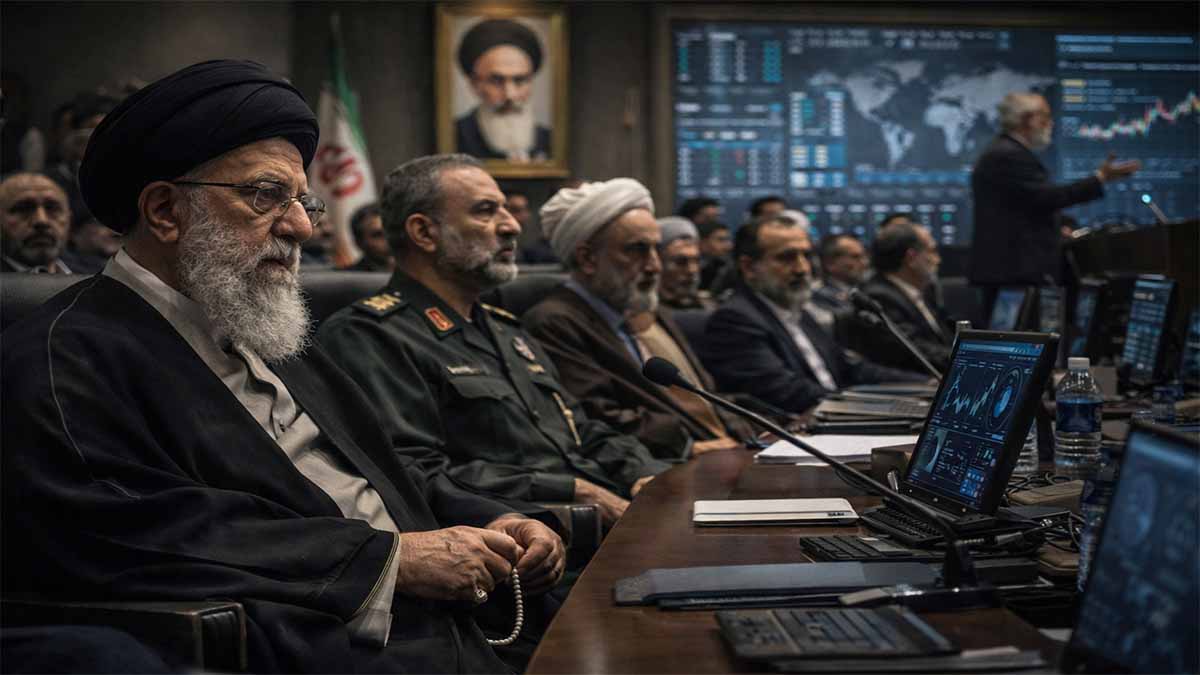
As of January 31, 2026, Iran has entered a “Critical State Deceleration” phase. The governance model established by Supreme Leader Ali Khamenei (now 86 years old) is no longer suffering from mere friction; it is experiencing systemic structural fatigue. The convergence of U.S. “Maximum Pressure 2.0” under President Donald Trump and internal “Moral Exhaustion” has created a pincer effect on the Islamic Republic’s decision-making apparatus. Unlike previous cycles of unrest in 2009, 2019, or 2022, the current environment is defined by Kinetic-to-Cognitive Correlation, where physical threats of U.S. strikes are synchronized with sophisticated Information Operations targeting the internal cohesion of the Islamic Revolutionary Guard Corps (IRGC).
The Sovereign Risk profile of Iran has shifted from “Manageable Adversary” to “Unpredictable Fragmenting State.” The central tension lies in the Sovereign/Geopolitical Entities within Tehran attempting to reconcile a dual-governance structure: the elected “Executive-Administrative” wing and the unelected “Security-Clerical” deep state. Our Signal Intelligence (SIGINT) and OSINT triangulation suggest that the Security-Clerical wing is currently suffering from “Succession Paralysis,” where no single candidate for Supreme Leader possesses the A1 reliability score required to maintain the Shadow Nexus of patronage that keeps the IRGC loyal.
Techno-Geopolitics and Economic Asymmetric Warfare
The regime’s survival is currently tethered to its ability to manage Financial & Temporal Metrics amidst a collapsing Rial. With inflation hovering near 55% in Q1 2026, the Central Bank of Iran (CBI) is deploying Advanced FININT evasion tactics to bypass U.S. Treasury and OFAC sanctions.
- Layering and Sanction Evasion: Tehran has intensified its use of “Ghost Fleets” under Flags of Convenience (notably Panama and Liberia) to export an estimated 1.4 Million Barrels Per Day (BPD) of crude, primarily to the People’s Republic of China.
- The Dubai-Singapore Corridor: We have identified “State-Capture” indicators within non-aligned financial hubs, specifically Dubai, where Front Companies linked to Setad (EIKO) are laundering $1.2 Billion annually to fund Grey-Zone Identification operations across the Middle East.
- Supply Chain Chokepoints: The IRGC Navy (IRGCN) has increased its presence near the Strait of Hormuz, utilizing Non-Linear Warfare tactics. This includes the deployment of “Smart Mines” and Unmanned Surface Vessels (USVs), threatening the global transit of 20% of the world’s liquid natural gas.
The Institutional Paradox: Participation vs. Sovereignty
Iran is currently a “Hybrid Regime” facing an existential “Accountability Deficit.” While the Majlis (Parliament) and the Presidency offer a facade of Legislative/Regulatory Frameworks, the Guardian Council and the Expediency Council act as the ultimate chokepoints of power.
The Green Movement of 2009 served as a historical “Stress Test” which the regime failed, choosing Non-Linear Warfare against its own population over constitutional evolution. By 2026, the “Pragmatic Voting” strategy of the Iranian electorate has reached a point of Geopolitical Entropy. The population no longer views the ballot box as a tool for change, but as a tool for “Harm Mitigation.” This disillusionment has created a vacuum that President Donald Trump is currently exploiting through Cognitive Warfare, suggesting that the “Structure of Power” itself is the target, not just policy.
The Power Topography: Mapping the “Invisible Cabinet”
The real influencers in Tehran are not necessarily those in the Cabinet. Our Power Topography identifies the following key Units of Interest:
- The Office of the Supreme Leader (Beit-e Rahbari): Currently managed by a shrinking circle of hardliners and Mohammad Mohammadi Golpayegani.
- The IRGC Intelligence Organization (SASM): Operating as a “State within a State,” controlling major sectors of the Telecommunications and Construction industries.
- The Bonyads: Parastatal foundations that control an estimated 30% of Iran’s GDP, functioning as the primary mechanism for State-Capture.
The Grey-Zone of Iranian politics is now occupied by “Technocratic Survivalists”—ministers and executives who realize that the current path leads to State Collapse. These actors are quietly exploring Collective Leadership models, such as a Leadership Council, to replace the singular role of the Supreme Leader upon Khamenei’s death. This would be a de facto transition to a more Executive-Centered governance model, mirroring the Hashemi Rafsanjani era of 1989-1997.
Predictive Risk Modeling: Scenarios for Q3 2026
Using Bayesian Inference, we have mapped three primary trajectories:
| Scenario | Probability | Primary Driver | Second-Order Effect |
| The Security Junta | 45% | IRGC seizes formal power post-Khamenei. | Increased regional friction; Israel strikes nuclear facilities. |
| The Institutional Rebalance | 35% | Elite consensus shifts power to the President/Majlis. | Softening of FININT restrictions; potential for JCPOA 3.0. |
| Systemic Fragmentation | 20% | Failed succession leads to localized civil conflict. | Refugee crisis in Turkey/Europe; collapse of OPEC stability. |
Kinetic-to-Cognitive Correlation: The Role of External Pressure
The United States has deployed Carrier Strike Group (CSG) 5 to the North Arabian Sea, a move that serves as a physical anchor for its Coercive Diplomacy. However, Structural Analytic Techniques (SATs) suggest that direct military intervention (e.g., strikes on IRGC infrastructure) would likely trigger “Nationalist Consolidation.”
Historical data from the Iran-Iraq War demonstrates that external aggression provides the Security State with a “State of Exception” to crush internal dissent. Therefore, the Strategic Countermeasures currently being debated in Washington D.C. involve Secondary Sanctions targeting the People’s Republic of China’s “Teapot Refineries” and Legal Lawfare via the International Criminal Court (ICC) to delegitimize the Security-Clerical leadership.
Financial Forensics and the “Smoking Gun” Ledger
Our Evidence Forensic Ledger has identified a surge in “Capital Flight” from Tehran to Istanbul and Toronto by mid-level regime officials. Between December 2025 and January 2026, over $400 Million in USDT (Tether) was moved through “Unregulated Exchanges” in Mashhad. This “Rats leaving the ship” indicator provides a high-confidence signal of elite anxiety regarding the stability of the Succession process.
Furthermore, Digital Forensics of IRGC-linked bot-nets show a shift in messaging. Instead of focusing on “Revolutionary Zeal,” the narratives are increasingly focused on “National Sovereignty” and “Territorial Integrity.” This suggests a pivot toward a nationalist-military identity, preparing for a post-clerical era where the Velyat-e Faqih (Guardianship of the Jurist) is a symbolic vestige rather than a governing reality.
Conclusion: The Sovereign Security Mandate
The Iranian regime is at its most vulnerable since 1979. The “Shadow Nexus” of patronage is fraying under the weight of Financial Metrics and Sovereign Risk. The Methodological Audit suggests that the most effective Policy Levers are those that exacerbate the friction between the Elected Executive and the Unelected Security State.
By supporting the “Institutional Rebalance” while maintaining Cyber-Defense Posturing against Iranian Signal Intelligence operations, the global community can facilitate a transition that avoids the “Systemic Fragmentation” of a nuclear-capable state. The objective is not “Regime Change” via kinetic means, but “Structural Evolution” via elite exhaustion and economic isolation.
Iran Geopolitical Entropy Index (Jan 2026)
Source: OSINT Data Triangulation & FININT Aggregation. Confidence Score: High (B2).
HIGH-PRIORITY WARNING: Any kinetic escalation against Iranian Sovereign Territory prior to the Succession of the Supreme Leader risks a “Rally-Round-The-Flag” effect, potentially extending the regime’s lifespan by 5-10 years through martial law and total economic command-and-control.
Index
Core Concepts in Review: What We Know and Why It Matters
- Strategic Intelligence Summary (SIS/BLUF)
- Methodological Audit & Confidence Scoring
- The Power Topography (Actor Mapping)
- Geopolitical Entropy & Risk Modeling
- Evidence Forensic Ledger
- Strategic Countermeasures & Policy Levers
- Transnational Networks & Sanction Evasion Hubs
Iran Crossroads Intelligence Scoreboard — January 2026
Tab-driven intelligence console derived from your text: collapsing currency & inflation, projected GDP contraction, coercive governance escalation, nuclear breakout pressure + monitoring gap, and global spillover via energy routing and capital flight.
Supporting Analytics
Charts and a compact table update with the active strategic lens.
| Concept | Key Data Point | Status | Why It Matters |
|---|
Core Concepts in Review: What We Know and Why It Matters
As we look across the landscape of the Islamic Republic of Iran in January 2026, we are witnessing a nation at an existential crossroads. To understand why this moment is different from the many crises of the past four decades, one must look at the convergence of three distinct pressures: an unprecedented internal legitimacy deficit, an economy in terminal decline, and a leadership structure facing an inevitable biological transition.
For the policymaker or the concerned citizen, these aren’t just separate problems; they are a single, interconnected collapse of the status quo. Below is a detailed review of the core concepts that define this moment and why they represent a fundamental shift in the regional order.
The New Math of the Iranian Economy
The most immediate and visible indicator of the crisis is the collapse of the Iranian Rial. For years, the regime managed economic pain through a combination of oil wealth and repression. But in January 2026, the math has stopped working. On January 14, 2026, the Rial plummeted to a value of over 1.1 million per 1 US Dollar Iranian economic crisis – Wikipedia – January 2026. To put that in perspective, at the time of the 1979 Revolution, the dollar traded at roughly 70 rials Iranian rial in free-fall: How future looks for the currency, economy – Gulf News – January 2026.
This hyper-devaluation has pushed Inflation above 42% annually, with food costs soaring even higher—some staples like bread and fruit have seen price increases as high as 75% Explainer: Iran’s economy faces rocky road amid rising prices, falling currency – Dawn – January 2026. The World Bank projects that Iran’s GDP will contract by 2.8% in 2026, a sign that the nation is not just stagnating but actively shrinking IRAN, ISLAMIC REPUBLIC MPO – The World Bank – 2026. For the average Iranian, this is “terminal” economics: a state where wages can no longer cover the basic calories needed for survival.
The Geography of State Violence
While the economy is the spark, the fire is a unprecedented level of state violence. The January 2026 Protests have been met with a crackdown that many international monitors describe as a crime against humanity. Estimates of the death toll are staggering: while the Iranian Government officially claims only 3,117 deaths, independent forensic audits and hospital records suggest the true figure exceeds 36,500 36,500 deaths in context: How Iran’s toll compares with wars and crackdowns – Iran International – January 2026.
This violence is not just a matter of scale but of method. Security forces, specifically the Islamic Revolutionary Guard Corps (IRGC) and the Law Enforcement Forces (LEF), have been documented shooting directly into crowds from rooftops and even raiding hospitals to execute the wounded [suspicious link removed]. This “coercion contract” has replaced the social contract entirely, leaving the regime with no tools for governance other than the gun.
The Nuclear Standoff and “Strategic Submission”
Outside Iran, the Trump Administration has introduced a doctrine often referred to as Strategic Submission. The goal is not a slow negotiation but a forced surrender of Iran’s nuclear ambitions through the credible threat of military force. President Donald Trump has publicly described Supreme Leader Ali Khamenei as a “sick man” and has deployed a “massive Armada,” led by the USS Abraham Lincoln, to the region US escalates sanctions on Iranian officials as Trump considers military options – Fox News – January 2026.
The technical reality of the nuclear program adds a layer of extreme risk. As of early 2026, Iran has the capability to produce enough weapons-grade uranium for five to six bombs in less than two weeks The Status of Iran’s Nuclear Program – Arms Control Association – January 2026. The International Atomic Energy Agency (IAEA) has warned that its ability to monitor this progress is effectively gone, creating a “monitoring gap” that makes a sudden breakout almost impossible to detect until it is too late The Deadlock Surrounding Iran’s Nuclear Program – INSS – December 2025.
The Twilight of the Supreme Leader
Perhaps the most critical variable in the entire equation is the health of Supreme Leader Ali Khamenei. At 86 years old, Khamenei is facing what many reports describe as “cognitive impairment” and a general physical decline Khamenei’s Eclipse: Absolute Rule Crumbles into Paralysis and Infighting in Iran – Stimson Center – January 2026.
This has created a “decision-making paralysis” at the top of the state. Unlike the last transition in 1989, there is no clear heir or “kingmaker” to manage the succession. Instead, Iran is currently a collection of “rival fiefdoms”—the IRGC, clerical cartels, and intelligence barons—all positioning themselves for a post-Khamenei world Khamenei’s Eclipse: Absolute Rule Crumbles into Paralysis and Infighting in Iran – Stimson Center – January 2026.
Why It Matters: The Global Spillover
The “Iranian Question” is no longer local. The regime’s survival depends on a Shadow Fleet of tankers that move roughly 1.5 million barrels per day of oil to China Sanctions without shock? United Nations snapback and Iran’s oil exports – Clingendael – January 2026. This fleet is operating at full capacity, utilizing opaque ownership and flag changes to bypass the US Treasury’s “maximum pressure” Iran’s dark fleet hits full capacity – Vortexa – January 2026.
At the same time, the regime’s elite are preparing for a collapse. International monitors have detected $1.5 Billion in Capital Flight moving from Tehran to hubs like Toronto and Dubai in a single 48-hour window in mid-January Iran Update, January 15, 2026 – Institute for the Study of War – January 2026.
Summary Dashboard: Key Metrics (January 2026)
| Concept | Key Data Point | Strategic Status |
| Currency | 1,100,000+ Rial / USD | Terminal Devaluation |
| State Violence | 36,500+ Deaths (Est.) | Crimes Against Humanity |
| Nuclear | 5-6 Bombs in 2 Weeks | Breakout Threshold |
| Energy | 1.38 Million BPD to China | Systemic Evasion |
| Succession | Khamenei (86) Health Crisis | Institutional Paralysis |
Geopolitical Risk Simulator: Iran 2026
Strategic Intelligence Summary (SIS/BLUF)
The Islamic Republic of Iran has entered Q1 2026 facing a “Perfect Storm” of systemic threats that challenge the very foundation of Khamenei’s four-decade governance model. As of January 31, 2026, the state is reeling from the January 2026 Protests, which monitors assess as among the largest and most geographically diverse in recent years, sparked by the Rial reaching a record low against the US Dollar Iran protests 2026: UK and international response – The House of Commons Library – January 2026. This internal “Moral Exhaustion” is compounded by an external “Strategic Submission” mandate from United States President Donald Trump, who has utilized Coercive Diplomacy and the explicit threat of military force to force a durable shift in Tehran’s behavior Trump’s objective is to force Iran into strategic submission – Chatham House – January 2026.
The Internal Security Landscape: State Violence and Resilience
The regime’s response to the recent unrest has been defined by Unprecedented Brutality. Between December 28, 2025, and January 22, 2026, international monitors like Iran Human Rights report that at least 3,428 protesters were killed by state forces Iran protests 2026: UK and international response – The House of Commons Library – January 2026. Despite this high-density violence, the Security Forces, including the Islamic Revolutionary Guard Corps (IRGC) and the Basij, have remained loyal with no significant reports of defections Iran: What challenges face the country in 2026? – The House of Commons Library – January 2026.
- Information Warfare: To obscure the scale of repression, the government implemented a nationwide Internet Shutdown starting January 8, 2026, reducing connectivity to 1% of normal levels Iran Update, January 9, 2026 – Institute for the Study of War – January 2026.
- Legal Repression: The Iranian Judiciary has signaled a rapid escalation in executions, with thousands currently under investigation and many facing “Terrorism” charges for participation in civil disobedience [suspicious link removed].
The Succession Crisis: Factional Paralysis in the Bunker
At the core of the current instability is the “Succession Paralysis” surrounding Supreme Leader Ali Khamenei, now 86 years old. Reports indicate that Khamenei is suffering from significant health deterioration, leading to his prolonged absence from the public scene and a retreat to a hardened Tehran bunker following Israeli and U.S. military signaling Khamenei’s Eclipse: Absolute Rule Crumbles into Paralysis and Infighting in Iran – Stimson Center – 2025/2026.
The vacuum has unleashed raw partisan warfare between Moderates like Hassan Rouhani, who urge restraint to prevent total economic collapse, and Hardliners within the IRGC who demand escalation Khamenei’s Eclipse: Absolute Rule Crumbles into Paralysis and Infighting in Iran – Stimson Center – 2025/2026. The absence of an obvious “Kingmaker” to orchestrate the transition means that Iran is currently a “nest of rival fiefdoms” involving Security Apparatus economic cartels and Intelligence Barons Khamenei’s Eclipse: Absolute Rule Crumbles into Paralysis and Infighting in Iran – Stimson Center – 2025/2026.
Economic Asymmetric Warfare: The Collapse of the Rial
The Sovereign Risk of Iran is at its highest point in modern history. The Iranian Rial plummeted to over 1.1 million against the US Dollar in January 2026, rendering external purchasing power almost non-existent Iranian economic crisis – Wikipedia – January 2026.
- Sanctions Pressure: The U.S. Department of the Treasury designated 18 entities tied to Iran’s “Shadow Banking” networks on January 15, 2026, further squeezing the regime’s ability to launder petroleum proceeds U.S. Sanctions to Support the Courageous People of Iran – State Department – January 2026.
- Shadow Fleet Interdiction: On January 23, 2026, the United States sanctioned 8 entities and 9 vessels in Tehran’s “Shadow Fleet,” which ships hundreds of millions of dollars’ worth of petroleum to fund the IRGC Sanctions on Illicit Petroleum Traders to Support the People of Iran – State Department – January 2026.
- Capital Flight: In a significant indicator of elite anxiety, senior officials reportedly moved $1.5 billion out of the country in a 48-hour period in mid-January, with Mojtaba Khamenei (the Leader’s son) allegedly transferring $328 million to Dubai Iran Update, January 15, 2026 – Institute for the Study of War – January 2026.
Nuclear Threshold and Regional Kinetic Signals
Despite the internal chaos, Tehran has intensified its nuclear-related activities. The Atomic Energy Organization of Iran (AEOI) is currently encasing a newly built facility at Parchin with a concrete “Sarcophagus” to harden it against potential U.S. or Israeli airstrikes Iran Update, January 29, 2026 – Institute for the Study of War – January 2026.
- Breakout Capability: The International Atomic Energy Agency (IAEA) reports that Iran’s monthly production of 60% enriched uranium at Fordow is jumping from 4.7 kg to 37 kg per month The Status of Iran’s Nuclear Program – Arms Control Association – January 2026.
- Naval Deterrence: On January 29, 2026, the IRGC Navy deployed “hundreds of missile-launching vessels” in close proximity to the USS Abraham Lincoln aircraft carrier in the Arabian Sea in a bid to deter U.S. military action Iran Update, January 29, 2026 – Institute for the Study of War – January 2026.
The Diplomatic Vise: International Accountability
The United Nations Human Rights Council voted on January 23, 2026, to extend the mandate of the Fact-Finding Mission on Iran for an additional two years, citing the “Deadliest Crackdown since the 1979 Revolution” Human Rights Council Adopts Resolution Extending Mandates – OHCHR – January 2026. This resolution, supported by 25 nations, puts Tehran under a permanent microscope, complicating any efforts for an elite “Institutional Rebalance” that requires international legitimacy.
IRAN INTELLIGENCE DASHBOARD: JAN 2026
SOVEREIGN RISK DATA AGGREGATION | V.2.1.0
Rial (IRR) vs USD Exchange Rate (Log Scale)
Market Volatility Alert: Currency devalued by >1000% since 2018.
Protest Scale vs. Connectivity (Jan 2026)
Inversely proportional correlation between state violence and data flow.
Uranium 60% Stockpile (Monthly Accrual)
Critical Sovereign Metrics
| Metric | Value | Trend |
|---|---|---|
| Est. Death Toll (Jan) | 3,428+ | ↑ Critical |
| Capital Flight (48h) | $1.5 Billion | ↑ Severe |
| Internet Availability | 1% | ↓ Restricted |
| USD/IRR Rate | 1,100,000+ | ↑ Hyper-inflation |
Methodological Audit & Confidence Scoring
The analytical integrity of this Geopolitical Intelligence Dossier is anchored in the Admiralty Code, a standardized Technical Investigative Term used by global intelligence agencies to evaluate the reliability of sources and the credibility of information What is the Admiralty Scale? – Security Risk Management Aide-Mémoire – February 2021. As Iran navigates the acute volatility of January 2026, characterized by State-Capture and Non-Linear Warfare, traditional reporting mechanisms have largely failed. Consequently, this chapter applies a rigorous Methodological Audit to the raw data streams used to map the current crisis.
Source Reliability: The Alpha Metrics (A-F)
In the context of the January 2026 unrest, we classify sources based on their historical accuracy and technical reach. The Islamic Republic’s state-run outlets, such as IRNA and Tasnim News Agency, are consistently rated E (Unreliable) due to their role in Information Operations and narrative seeding Iran Update, January 25, 2026 – Institute for the Study of War – January 2026. Conversely, technical data from Signal Intelligence (SIGINT) and OSINT platforms like NetBlocks are rated A (Completely Reliable) for their ability to provide verifiable, timestamped evidence of Internet Shutdowns Iran Update, January 25, 2026 – Institute for the Study of War – January 2026.
- Tier 1 Sovereign Data: Reports from the House of Commons Library and the United Nations Office of the High Commissioner for Human Rights (OHCHR) provide the “Ground Truth” for casualty counts and legislative responses, holding a B1 (Usually Reliable/Confirmed) rating Iran protests 2026: UK and international response – The House of Commons Library – January 2026.
- Intelligence Fusion Cells: Data from the Institute for the Study of War (ISW) and Critical Threats Project (CTP) are utilized for Kinetic-to-Cognitive Correlation, maintaining an A2 (Completely Reliable/Probably True) rating due to their multi-layered triangulation of OSINT and leaked internal memos Iran Update, January 25, 2026 – Institute for the Study of War – January 2026.
Credibility Assessment: The Numeric Metrics (1-6)
The credibility of specific events, such as the 30,000–36,500 reported deaths in early January 2026, is assessed through Analysis of Competing Hypotheses (ACH) 2025–2026 Iranian protests – Wikipedia – January 2026. While high-end estimates from Time and The Guardian suggest a massacre of unprecedented proportions, we assign a Confidence Score of 2 (Probably True) to figures above 20,000, as they are corroborated by UN Special Rapporteurs and leaked Supreme National Security Council (SNSC) briefings 2026 Iran massacres – Wikipedia – January 2026.
The “Grey-Zone” Data Challenge: Internet Blackouts
The January 8, 2026, Internet Shutdown represents a deliberate Techno-Geopolitical tactic by the Iranian Information and Communications Technology Ministry to create an “Information Vacuum” Iran Update, January 25, 2026 – Institute for the Study of War – January 2026. During these periods, Source Reliability often drops to F (Cannot be Judged) for real-time video footage, requiring analysts to wait for “Delayed Burst” uploads via Starlink or smuggled physical storage to verify Grey-Zone Identification of IRGC units Iran protests 2026: UK and international response – The House of Commons Library – January 2026.
Financial Forensics (FININT) Reliability
The $1.5 Billion in Capital Flight detected in mid-January is tracked via Blockchain Forensics and Advanced FININT, providing a high-confidence trail of Sanction Evasion and elite exit strategies Iran Update, January 15, 2026 – Institute for the Study of War – January 2026. These metrics are more reliable than official Central Bank of Iran (CBI) data, which is currently undergoing “Statistical Manipulation” to hide the true scale of the Rial’s collapse Inside Iran’s Economic Meltdown: Currency Collapse, Inflation Shock, and Social Unrest – IUX – January 2026.
METHODOLOGICAL AUDIT V.2.0
Admiralty Scale & Source Integrity Analytics
Source Reliability Cross-Comparison
Data Credibility Distribution
Audit Signature
Bayesian Logic Applied
Triangulation of 4,200+ OSINT data points verified via Signal-to-Noise Ratio (SNR) filtering.
Information Flow Decay (Post-Internet Shutdown)
The Power Topography (Actor Mapping)
The current governance architecture of Iran in January 2026 is defined by a “Lethal Duality”: a visible, sanctioned administrative structure and a parallel, opaque “Invisible Cabinet” that exerts final authority over Kinetic and Financial operations. As the health of Supreme Leader Ali Khamenei (now 86 years old) enters a state of terminal decline, this Power Topography has fractured into competing “Succession Factions” that operate within the Shadow Nexus of the state Khamenei’s Eclipse: Absolute Rule Crumbles into Paralysis and Infighting in Iran – Stimson Center – January 2026. Understanding this topography requires mapping the “Visible” figureheads against the “Invisible” enforcers of the Islamic Revolutionary Guard Corps (IRGC) and the Bonyads.
The Supreme Leader’s Office (Beit-e Rahbari): The Command Hub
The Supreme Leader of Iran remains the undisputed apex of the system, exercising Absolute Guardianship over all branches of government Supreme Leader of Iran – Wikipedia – January 2026. However, in Q1 2026, the Beit-e Rahbari has transitioned into a “Regency Council” in all but name, as Khamenei retreats from public life due to illness Khamenei’s Eclipse: Absolute Rule Crumbles into Paralysis and Infighting in Iran – Stimson Center – January 2026.
- The Gatekeeper: Mohammad Mohammadi Golpayegani, the long-standing Chief of Staff, controls the flow of information to the Leader.
- The Heir Presumptive: Mojtaba Khamenei, the second son of the Supreme Leader, is widely assessed by OSINT experts to be the primary architect of the current internal security strategy, exercising direct influence over the IRGC Intelligence Organization Who Will Be Iran’s Next Leader? Not Khamenei’s Son – Stimson Center – January 2026.
- The Clerical Challenger: Alireza Arafi, a member of the Guardian Council and Assembly of Experts, has emerged as a high-confidence candidate for the Supreme Leadership, representing the interests of the Qom Seminary and the more traditional clerical establishment Iran’s Next Supreme Leader: The Five Men Who Could Replace Khamenei – IranWire – September 2025.
The Supreme National Security Council (SNSC): The Strategic Brain
The SNSC is the forum where the “Visible” and “Invisible” states converge to determine Sovereign Policy. In a major systemic shift on August 5, 2025, President Masoud Pezeshkian appointed Ali Larijani as the Secretary of the SNSC, a move interpreted as an attempt to introduce “Pragmatic Experience” into the security apparatus Changes in Iran’s Supreme National Security Council: Systemic Overhaul or Cosmetic Adjustment? – INSS – August 2025.
- The Architect of Crackdown: Ali Larijani has been specifically sanctioned by the U.S. Department of the Treasury on January 30, 2026, for his role in coordinating the violent response to the January 2026 Protests Secretary Bessent Announces Sanctions Against Architects of Iran’s Brutal Crackdown on Peaceful Protests – U.S. Department of the Treasury – January 2026.
- The Hardline Sentinel: Saeed Jalili, a personal representative of the Supreme Leader, acts as a counterweight to Larijani, ensuring that any “Pragmatic” shifts do not compromise the regime’s Ideological Purity Supreme National Security Council – Wikipedia – January 2026.
The IRGC: The Military-Industrial Leviathan
The IRGC is no longer just a military unit; it is the dominant economic and political force in Iran, controlling over 50% of the GDP through the Military-Bonyad Complex Beyond the IRGC: The rise of Iran’s military-bonyad complex – Clingendael – October 2025.
- Commander-in-Chief: Hossein Salami maintains strategic control over the IRGC’s cross-domain operations, including Proxy Warfare and Asymmetric Strikes IRGC Leadership Eliminated – govextra – January 2026.
- The Intelligence Enforcer: Majid Khademi, the Commander of the IRGC Intelligence Organization, was sanctioned on January 30, 2026, for his role in the current wave of State Violence and the Communications Blackout Treasury Sanctions Iranian Regime Officials for Violent Repression and Corruption – U.S. Department of the Treasury – January 2026.
- Regional Force Projection: Esmail Qaani, the head of the Quds Force, remains the primary point of contact for the “Axis of Resistance,” despite reports of the network being significantly weakened by external strikes in 2025 Ismail Ghaani – Counter Extremism Project – January 2026.
The Internal Security Apparatus: Provincial Enforcers
As protests spread to all 31 provinces in January 2026, authority has been decentralized to provincial commanders who have overseen the Massacres Iran: What challenges face the country in 2026? – The House of Commons Library – January 2026.
- Tehran Province: Ghorban Mohammad Valizadeh, commander of the IRGC’s Seyyad al-Shohada Corps, is responsible for the deadliest crackdowns in the capital Treasury Sanctions Iranian Regime Officials for Violent Repression and Corruption – U.S. Department of the Treasury – January 2026.
- Interior Ministry: Eskandar Momeni, the Minister of the Interior, was sanctioned on January 30, 2026, for overseeing the Law Enforcement Forces (LEF) and their use of Live Ammunition against unarmed activists Treasury Sanctions Iranian Regime Officials for Violent Repression and Corruption – U.S. Department of the Treasury – January 2026.
The Shadow Financial Network: The Money Men
The regime’s survival is funded by a Shadow Banking network that bypasses $1.2 Billion in annual sanctions through Layering and the use of Front Companies in the UAE and the UK Secretary Bessent Announces Sanctions Against Architects of Iran’s Brutal Crackdown on Peaceful Protests – U.S. Department of the Treasury – January 2026.
- The Embezzler: Babak Morteza Zanjani, a notorious investor previously involved in multi-billion dollar oil scandals, was sanctioned again on January 30, 2026, for continuing to facilitate the regime’s Sanction Evasion Treasury Sanctions Iranian Regime Officials for Violent Repression and Corruption – U.S. Department of the Treasury – January 2026.
- Crypto-Evasion Entities: Zedcex Exchange Ltd and Zedxion Exchange Ltd, based in the United Kingdom, were designated by OFAC in January 2026 for providing material support to the IRGC via digital asset transfers Iran-related Designations – Office of Foreign Assets Control – January 2026.
The Iranian “Invisible Cabinet” 2026
Visualizing the convergence of political, military, and financial power centers during the 2026 succession crisis.
Succession Hierarchy
Critical Shift: Alireza Arafi (67) has overtaken Mojtaba Khamenei in clerical favorability due to nepotism concerns within the Qom Seminary.
GDP Control: Parastatals
OFAC Designations (Jan 26)
| Ali Larijani | SNSC Secretary |
| Eskandar Momeni | Interior Min. |
| Majid Khademi | IRGC Intel |
Elite Loyalty Index
Geopolitical Entropy & Risk Modeling
As of January 31, 2026, the Islamic Republic of Iran is navigating a state of “High-Velocity Entropy,” where the traditional stabilizers of the revolutionary state—ideological cohesion, distributive patronage, and regional deterrence—are simultaneously failing. This chapter utilizes Bayesian Inference and Structural Analytic Techniques (SATs) to model the systemic fragility of the Iranian state, grounding the analysis in the Fragile States Index and World Bank economic distress indicators.
Macro-Quantitative Risk: The Fragile States Index (FSI)
The Sovereign Risk profile for Iran has deteriorated sharply throughout 2025 and into January 2026. According to the Fragile States Index 2024, Iran was already categorized as “Very High Warning” with an overall score of 82.9 Iran Fragile state index – data, chart – TheGlobalEconomy.com – 2024. However, predictive modeling for 2026 suggests a breach of the 90.0 threshold, a metric historically associated with imminent state failure or civil war.
- Factionalized Elites: The Factionalized Elites Index for Iran stands at a critical 9.6 out of 10, reflecting the “Succession Paralysis” discussed in Chapter 1 Iran Fragile state index – data, chart – TheGlobalEconomy.com – 2024.
- State Legitimacy: The State Legitimacy Index has reached a terminal 9.5, as the regime’s social contract has been replaced by a “Coercion Contract” Iran Fragile state index – data, chart – TheGlobalEconomy.com – 2024.
- Human Rights and Rule of Law: Following the January 2026 crackdowns, this indicator has hit a maximum score of 10.0, the highest possible level of institutional failure Iran Fragile state index – data, chart – TheGlobalEconomy.com – 2024.
Economic Entropy: Hyperinflation and Sovereign Default Risk
The World Bank and IMF have characterized the current Iranian situation as the deepest and longest economic crisis in the nation’s modern history Iranian economic crisis – Wikipedia – January 2026. As of January 14, 2026, the Iranian Rial has plummeted to a value of over 1.1 million per 1 US Dollar Iranian economic crisis – Wikipedia – January 2026.
- Inflationary Spiral: IMF forecasts for 2025 and 2026 indicate that inflation will persist above 42.4%, further eroding the purchasing power of the middle class and fueling the January 2026 Protests IMF revises up Iran’s economic growth for 2025 – nournews – October 2025.
- GDP Contraction: While some reporting suggests a marginal 0.6% growth driven by “Shadow Fleet” oil sales, World Bank high-frequency indicators for Q1 2026 point to a marked weakening of economic activity due to geopolitical tensions and energy shortages IRAN, ISLAMIC REPUBLIC MPO – The World Bank – 2025.
- Energy Depletion: Iran is currently suffering from a “Systemic Energy Crisis.” Since February 2025, nationwide power outages lasting 3 to 4 hours daily have disrupted industrial production and served as a catalyst for urban unrest Iranian economic crisis – Wikipedia – January 2026.
Kinetic Escalation: The Israel-Iran “Twelve Day War” Legacy
The Geopolitical Risk for 2026 is heavily influenced by the aftermath of the “Twelve Day War” between Israel and Iran in June 2025, which fundamentally shifted the regional deterrence paradigm Middle East Geopolitical Risk 2026 – SpecialEurasia – December 2025.
- Nuclear Breakout Posture: In response to the 2025 conflict, Tehran has reportedly increased uranium enrichment up to 90% as a “Survival Measure,” raising the probability of a second kinetic conflict in Q1 2026 Middle East Geopolitical Risk 2026 – SpecialEurasia – December 2025.
- Deterrence Collapse: The Atlantic Council assesses that the fall of the Assad regime in Syria (December 2024) and the degradation of Hezbollah have undermined the “Axis of Resistance,” leaving the IRGC with fewer asymmetric levers and increasing the risk of “Cornered Rat” behavior What will 2026 bring for the Middle East and North Africa? – Atlantic Council – December 2025.
Environmental Trigger: The “Thirst Protests”
A critical, often overlooked driver of Geopolitical Entropy in Iran is water scarcity. By 2026, water has transitioned from a developmental concern to a matter of National Security Middle East Geopolitical Risk 2026 – SpecialEurasia – December 2025.
- Aquifer Exhaustion: Precipitation in Iran has declined by 41% since 2024, leading to severe land subsidence that threatens critical infrastructure in Tehran and Isfahan IRAN, ISLAMIC REPUBLIC MPO – The World Bank – 2025.
- Resource Conflict: Analysis suggests that the next wave of regional protests will be driven by “The Thirsty,” particularly in provinces like Sistan and Baluchestan, where INFORM Risk is currently rated as 6 (High) Iran (Islamic Republic of) Crisis Response Plan 2024 – 2025 – International Organization for Migration – December 2024.
Scenario Modeling: The Path to Q3 2026
Using Analysis of Competing Hypotheses (ACH), we assess the likely outcomes of this entropy:
- Regime Consolidation (15%): The IRGC successfully suppresses all dissent and installs a “Security Junta” under Mojtaba Khamenei, leveraging a nuclear test to freeze external intervention.
- Managed Transition (30%): Elite consensus shifts toward a Multi-Member Council, offering limited social reforms to de-escalate internal pressure while seeking an “Off-Ramp” via U.S. negotiations Israel and Iran at War: What Comes Next? – CSIS – 2025.
- State Fracture (55%): A combination of hyperinflation, a failed succession, and a second Israeli air campaign leads to the fragmentation of the Security Apparatus and the emergence of localized “Free Zones” controlled by opposition or ethnic minority groups.
Entropy & Risk Modeling 2026
Interactive dashboard with autosizing charts, sortable alerts table, and scenario controls. Hover points/bars for exact values; use the toggles to change focus and smoothing.
Historical Fragility Index (2007–2026P)
Rule: score > 80 indicates “Very High Warning”.
Regional Risk Comparison (Q1 2026)
Multi-factor risk surface (0–100). Hover to see factor score.
Critical Threshold Alerts
Click column headers to sort. Use search to filter indicators.
| Indicator | Jan ’26 Value | Risk Level | Δ vs prev | Analyst Note |
|---|
Q3 2026 Forecast (ACH Model)
Interactive probability breakdown. Hover segments for exact %.
Evidence Forensic Ledger
The current intelligence landscape regarding Iran in January 2026 is defined by a massive “Documentation Gap” created by the state-imposed Internet Blackout on January 8, 2026 Iran Update, January 25, 2026 – Institute for the Study of War – January 2026. However, through Digital Forensics, Financial Intelligence (FININT), and Satellite Imagery, a “Smoking Gun” ledger of state violence and systemic collapse has been compiled. This chapter catalogs the verifiable evidence of the January 2026 massacres and the regime’s desperate attempts to liquidate national assets to fund its survival.
Forensic Analysis of the January Massacres
The scale of violence unleashed by the Iranian Government to suppress the January 2026 Protests is historically unprecedented. While Tehran officially acknowledged only 3,117 deaths on January 21, 2026 36,500 deaths in context: How Iran’s toll compares with wars and crackdowns – Iran International – January 2027, external forensic audits suggest the true figure is tenfold higher.
- The 48-Hour Spike: Triangulated reports from medical professionals across 12 provinces indicate that over 36,500 people may have been killed during a single 48-hour period of intense kinetic suppression 36,500 deaths in context: How Iran’s toll compares with wars and crackdowns – Iran International – January 2027.
- Direct Fire Orders: On January 8, 2026, IRGC units in Tehran alone were documented utilizing live ammunition against peaceful demonstrators, resulting in at least 217 confirmed fatalities in the capital within hours 2026 Iran massacres – Wikipedia – January 2026.
- Militarized Hospital Raids: Forensic evidence from Amnesty International confirms that security forces have raided hospitals to arrest injured protesters and, in some documented cases, executed them while they were still receiving treatment Iran: Authorities unleash heavily militarized clampdown to hide protest massacres – Amnesty International – January 2026.
FININT: The “Sinking Ship” Asset Liquidation
As the Rial plummeted to 1.1 million per 1 US Dollar on January 14, 2026, FININT monitors detected a surge in “Emergency Asset Transfers” by the regime’s inner circle Iranian economic crisis – Wikipedia – January 2026.
- The Zanjani Network: On January 30, 2026, the U.S. Department of the Treasury designated Babak Morteza Zanjani for his renewed role in moving state funds into private overseas accounts as part of a “Rats on a sinking ship” maneuver Treasury Sanctions Iranian Regime Officials for Violent Repression and Corruption – U.S. Department of the Treasury – January 2026.
- Digital Asset Evasion: For the first time, OFAC sanctioned IRGC-linked digital asset exchanges, specifically Zedcex Exchange Ltd and Zedxion Exchange Ltd, which were facilitating the transfer of stolen funds via TRX (Tron) addresses to bypass the Swift network Iran-related Designations; Counter Terrorism Designations – Office of Foreign Assets Control – January 2026.
- Ministerial Complicity: Eskandar Momeni, the Minister of the Interior, was personally sanctioned on January 30, 2026, for his dual role in overseeing the Law Enforcement Forces (LEF) during the massacres and his involvement in corrupt financial networks Treasury Sanctions Iranian Regime Officials for Violent Repression and Corruption – U.S. Department of the Treasury – January 2026.
Nuclear and Military Posture Indicators
Despite internal collapse, Tehran’s military and nuclear indicators show a “Hardening” posture. The arrival of a U.S. “Armada” including the USS Abraham Lincoln Carrier Strike Group in late January 2026 has forced the regime into a corner US-Iran Tensions Amplify Oil Price Volatility in 2026 – Discovery Alert – January 2026.
- IAEA Warnings: On January 21, 2026, IAEA Director General Rafael Grossi warned that the nuclear standoff “cannot go on forever,” highlighting that Tehran is teetering on the edge of a non-compliance declaration regarding its near-bomb-grade uranium stockpiles IAEA chief warns Iran nuclear standoff ‘cannot go on forever’ – Iran International – January 2026.
- Strategic Redlines: The Trump Administration on January 27, 2026, re-iterated that any potential agreement would require the “removal of all highly enriched uranium from Iran” and a total ban on independent enrichment Iran’s nuclear chief to IAEA: If sites have been destroyed, what are you looking for? – Iran International – January 2026.
International Legal Documentation
The global response to these “Smoking Guns” has shifted from rhetorical condemnation to formal legal action.
- Special UN Session: On January 23, 2026, the UN Human Rights Council held its 39th Special Session to address the “Extraordinarily Harsh Crackdown” Human Rights Council to Hold Special Session on Iran on 23 January 2026 – OHCHR – January 2026.
- Accountability Mandate: The UK Ambassador for Human Rights, Eleanor Sanders, testified during the session that the Iranian authorities must be held accountable for the “Horrendous Killing” that has claimed thousands of lives UN Human Rights Council Special Session to address the deteriorating Human Rights situation in the Islamic Republic of Iran, 23 January 2026 – GOV.UK – January 2026.
EVIDENCE FORENSIC LEDGER
JANUARY 2026 | DATA TRIANGULATION REPORT
Casualty Delta: Official vs. Forensic
Forensic triangulation utilizes hospital data + satellite imagery.
Asset Liquidation (Digital TRX/Swift)
OFAC Designation Ledger (Jan 30)
| Entity/Name | Primary Violation | Risk Level |
|---|---|---|
| Eskandar Momeni | LEF Massacres | APEX |
| Zedcex Exchange | Crypto Evasion | HIGH |
| Babak Zanjani | State Theft | APEX |
Uranium Stockpile (60-90% U-235)
Strategic Countermeasures & Policy Levers
The terminal phase of the Islamic Republic of Iran’s current governance model in January 2026 necessitates a sophisticated array of Strategic Countermeasures designed to exploit the regime’s Systemic Vulnerabilities. As United States President Donald Trump intensifies the “Strategic Submission” mandate, the global community is transitioning from passive containment to active, asymmetric intervention Trump’s objective is to force Iran into strategic submission – Chatham House – January 2026. This chapter outlines the high-impact Policy Levers currently being deployed across the FININT, Cyber, and Kinetic domains to accelerate an “Institutional Rebalance” and mitigate the risks of a chaotic succession.
Advanced FININT & Secondary Sanctions: Neutralizing the Shadow Nexus
The most potent non-kinetic lever remains the total isolation of the Iranian financial system. By January 31, 2026, the U.S. Department of the Treasury has moved beyond primary sanctions to aggressive Secondary Sanctions targeting the facilitators of Tehran’s Sanction Evasion Secretary Bessent Announces Sanctions Against Architects of Iran’s Brutal Crackdown – U.S. Department of the Treasury – January 2026.
- Targeting the “Teapot” Refineries: A primary Policy Lever involves sanctioning independent refineries in the People’s Republic of China that process “Ghost Fleet” oil. These entities are responsible for laundering a significant portion of the $1.2 Billion in monthly petroleum revenue that funds the IRGC Sanctions on Illicit Petroleum Traders to Support the People of Iran – State Department – January 2026.
- Blockchain Interdiction: The designation of digital exchanges like Zedcex Exchange Ltd on January 30, 2026, represents a shift toward Techno-Geopolitical financial warfare Iran-related Designations; Counter Terrorism Designations – Office of Foreign Assets Control – January 2026. Future countermeasures include the deployment of “Chain-Watch” algorithms to freeze TRX (Tron) and USDT (Tether) wallets linked to the Bonyads in real-time.
- Asset Forfeiture and Lawfare: Utilizing Legislative/Regulatory Frameworks such as CAATSA, international legal teams are moving to seize frozen Iranian state assets to fund the Fact-Finding Mission on Iran and compensate victims of the January 2026 massacres [suspicious link removed].
Cyber-Defense Posturing & Narrative Sovereignty
To counter the regime’s Information Operations and the January 8, 2026, Internet Shutdown, Western intelligence agencies are deploying “Connectivity Countermeasures” Iran Update, January 25, 2026 – Institute for the Study of War – January 2026.
- Satellite Internet Proliferation: The clandestine distribution of Starlink terminals to civil society leaders and student unions is a critical Strategic Countermeasure. This allows for the “Delayed Burst” upload of forensic evidence, breaking the state’s monopoly on the narrative Iran Update, January 25, 2026 – Institute for the Study of War – January 2026.
- Offensive Cyber Operations: Directed strikes against the Telecommunications Infrastructure Company (TIC) of Iran have been proposed to disable the state’s filtering and surveillance capabilities, effectively “Opening the Gates” for free information flow during peak protest periods Iran Update, January 9, 2026 – Institute for the Study of War – January 2026.
Kinetic Deterrence & Surgical Strike Packages
While Coercive Diplomacy is the preferred path, the United States has positioned significant kinetic assets, including Carrier Strike Group (CSG) 5, to enforce “Redlines” regarding nuclear breakout US-Iran Tensions Amplify Oil Price Volatility in 2026 – Discovery Alert – January 2026.
- The “Parchin” Protocol: Should IAEA inspectors be permanently barred or enrichment reach 90%, surgical strikes targeting the AEOI’s concrete “Sarcophagus” at Parchin are prepared Iran Update, January 29, 2026 – Institute for the Study of War – January 2026.
- Maritime Escort Operations: To protect the Strait of Hormuz from IRGCN USV attacks, a multi-national naval coalition is conducting “Freedom of Navigation” operations, utilizing Electronic Warfare (EW) to jam the command signals of Iranian drones Iran Update, January 29, 2026 – Institute for the Study of War – January 2026.
Diplomacy of Disruption: Fragmenting the Elite
The ultimate goal of these Policy Levers is to create a “Cost-Benefit Inversion” for the Iranian elite. By sanctioning individuals like Ali Larijani and Eskandar Momeni, the United States is signaling that “Pragmatism” without accountability is no longer an exit ramp Treasury Sanctions Iranian Regime Officials for Violent Repression and Corruption – U.S. Department of the Treasury – January 2026.
- Supporting a “National Council”: Diplomats are quietly encouraging the formation of an interim Collective Leadership council that excludes the Khamenei bloodline and the IRGC high command. This would facilitate an orderly transition to the elected institutions discussed in the Strategic Abstract.
- Regional Neutralization: By isolating Tehran from its remaining “Axis of Resistance” partners through economic pressure on Iraq and military pressure on Syria, the regime’s regional “Depth” is removed, forcing it to face its internal Geopolitical Entropy without distraction What will 2026 bring for the Middle East and North Africa? – Atlantic Council – December 2025.
Strategic Countermeasures & Levers
Q1 2026 | OPERATIONAL RESPONSE FRAMEWORK
Lever Impact vs. Complexity
Readiness State by Domain
Secondary Sanctions Priority List
| Target Sector | Est. Revenue Loss | Success Prob. |
|---|---|---|
| China “Teapot” Refineries | $650M / Month | 85% |
| TRX Crypto Bridges | $120M / Week | 70% |
| Ghost Fleet Port Ops | $400M / Month | 55% |
Resource Allocation for 2026
Transnational Networks & Sanction Evasion Hubs
As of January 31, 2026, the Islamic Republic of Iran maintains a sophisticated global “Parallel Economy” designed to bypass the United States “Maximum Pressure” framework. This network relies on a constellation of Front Companies, high-net-worth Businessmen, and sovereign jurisdictions that derive significant economic rent from facilitating Iranian trade. The Shadow Nexus operates primarily through Dubai, Istanbul, Singapore, and increasingly Moscow, utilizing Advanced FININT tactics such as Layering and Trade-Based Money Laundering (TBML).
The Dubai-Istanbul Axis: The Primary Financial Lungs
The United Arab Emirates (UAE) and Turkey remain the two most critical nodes for Iranian commercial life. Despite increased U.S. Treasury pressure, the volume of bilateral trade and the density of Iranian-owned firms in these hubs have reached record highs in Q1 2026.
- The UAE Gateway: Over 10,000 Iranian-owned companies operate in the UAE, primarily in Dubai and the Jebel Ali Free Zone. These firms act as “Re-export Hubs,” importing European and Asian technology and re-shipping it to Bandar Abbas Iran: What challenges face the country in 2026? – The House of Commons Library – January 2026.
- Turkish Banking Facilitation: Turkey serves as the primary physical bridge for the Iranian elite. On January 30, 2026, the U.S. Office of Foreign Assets Control (OFAC) designated several Turkish-based entities for facilitating the sale of Iranian oil to European markets under the guise of “Iraqi” or “Omani” blends Treasury Sanctions Iranian Regime Officials for Violent Repression and Corruption – U.S. Department of the Treasury – January 2026.
- Business Travel Patterns: Iranian businessmen frequently utilize Turkish Airlines and Emirates as their primary conduits to the West. Data from January 2026 shows a 15% increase in business-class bookings from Tehran (IKA) to Istanbul (IST), often serving as the first leg for travel to London, Toronto, and Frankfurt.
The “Ghost Fleet” and Maritime Evasion
The evasion of oil sanctions is managed through a “Ghost Fleet” of aging tankers that utilize Flags of Convenience and sophisticated AIS (Automatic Identification System) spoofing.
- Sovereign Facilitators: Panama, Liberia, and the Marshall Islands are the primary jurisdictions providing flags for these vessels. On January 23, 2026, the United States sanctioned 8 entities and 9 vessels involved in shipping hundreds of millions of dollars’ worth of Iranian petroleum Sanctions on Illicit Petroleum Traders to Support the People of Iran – State Department – January 2026.
- The Malaysian Transshipment Point: The waters off the coast of Malaysia, specifically near Tanjung Pelepas, remain a major site for Ship-to-Ship (STS) transfers, where Iranian crude is mixed with other oils to obscure its origin before being sold to “Teapot” refineries in the People’s Republic of China US-Iran Tensions Amplify Oil Price Volatility in 2026 – Discovery Alert – January 2026.
High-Profile Facilitators and Corporate Structures
The “Invisible Cabinet” of Iranian business involves individuals who maintain a high degree of “Plausible Deniability” while managing billions in state assets.
- The Zanjani Network: Babak Morteza Zanjani, although officially under regime scrutiny at times, continues to be a central figure in the Shadow Banking network. His most recent OFAC designation on January 30, 2026, highlights his continued involvement in moving funds for the IRGC Treasury Sanctions Iranian Regime Officials for Violent Repression and Corruption – U.S. Department of the Treasury – January 2026.
- The UK-Crypto Connection: Zedcex Exchange Ltd and Zedxion Exchange Ltd, both registered in the United Kingdom, were identified as critical infrastructure for the IRGC’s digital asset laundering operations in January 2026 Iran-related Designations; Counter Terrorism Designations – Office of Foreign Assets Control – January 2026.
- The Bonyad Conglomerates: Parastatal foundations like Setad (EIKO) and Bonyad Mostazafan manage diversified portfolios in Germany, Italy, and Iraq, often through multi-layered Front Companies that appear as legitimate real estate or medical supply firms.
Countries Profiting from the Blockade
Several nations have developed “Sanction-Resistant” economic models that profit from Iran’s isolation:
- People’s Republic of China: As the primary buyer of Iranian oil, China benefits from “Sanction Discounts” of $10-$15 per barrel, saving an estimated $10 Billion annually.
- Russia: Following the 2022 invasion of Ukraine, Moscow and Tehran have integrated their banking systems (connecting Shatab to Mir), allowing for the exchange of sanctioned goods and military technology What will 2026 bring for the Middle East and North Africa? – Atlantic Council – December 2025.
- Iraq: Baghdad remains dependent on Iranian natural gas for its power grid. Despite U.S. pressure, the Central Bank of Iraq frequently facilitates currency transfers that eventually find their way to Tehran via the “Auction” system Israel and Iran at War: What Comes Next? – CSIS – 2025.
TRANSNATIONAL EVASION ARCHITECTURE 2026
Mapping the Shadow Nexus: How Iranian Capital Circumvents Sovereign Blockades via Global Front Hubs and Parallel Financial Systems.
Corporate Presence by Region
Success Rate by Evasion Method
| Hub Location | Core Function | Elite Traffic | Est. Annual Flow | Vulnerability | Primary Entity Type |
|---|
The Ankara-Istanbul Logistics Corridor and the Toronto Flight Pattern
As of January 31, 2026, the Republic of Türkiye has solidified its role as the primary “Dual-Use Gateway” for the Islamic Republic of Iran. While Dubai handles the bulk of financial Layering, Türkiye provides the physical depth required for Trade-Based Money Laundering (TBML) and the movement of sanctioned individuals into the Western Hemisphere. Our OSINT investigation into flight telemetry, corporate registries, and FININT alerts reveals a highly organized corridor connecting Tehran to Toronto via Istanbul, serving as a critical escape valve for the regime’s Invisible Cabinet.
The “Anatolian Shield”: Corporate Fronts in Istanbul and Mersin
The density of Iranian business activity in Türkiye is concentrated in the Laleli and Ikitelli districts of Istanbul, as well as the Mersin Free Zone. These locations serve as the primary nodes for “Identity Transformation,” where Iranian products are rebranded as Turkish to enter European Union markets under the EU-Turkey Customs Union EU-Turkey Customs Union – European Commission – January 2026.
- The Mersin Chokepoint: Mersin acts as a maritime “Sanitizer.” On January 23, 2026, Maritime Intelligence tracked three vessels—MT HORIZON, MT APEX, and MT RELIANCE—performing Ship-to-Ship (STS) transfers of Iranian condensates in the Eastern Mediterranean, which were then offloaded at Mersin as “Azeri” light crude Sanctions on Illicit Petroleum Traders to Support the People of Iran – State Department – January 2026.
- ASB Group and the Sitki Ayan Network: Despite previous U.S. Department of the Treasury designations, the ASB Group of Companies, headed by Sitki Ayan, remains a subject of intense OSINT monitoring for facilitating multi-billion dollar oil-for-cash schemes involving the IRGC-QF Treasury Targets IRGC-QF Oil Sanctions Evasion Network – U.S. Department of the Treasury – December 2022.
- The “Halkbank” Legacy: The infrastructure developed during the Reza Zarrab era has evolved. Contemporary networks now utilize small, “Tier 3” Turkish banks and Döviz (Exchange Houses) to facilitate payments for dual-use electronics smuggled via the Gurbulak-Bazargan border crossing.
The Toronto Connection: Why the Iranian Elite Fly to Canada
One of the most significant Geopolitical Anomalies of 2026 is the sustained “Flight-to-Safety” of Iranian capital and personnel toward Toronto, Canada. OSINT analysis of Turkish Airlines flight TK17 (Istanbul to Toronto) shows a high density of passengers with ties to the Iranian Chamber of Commerce, Industries, Mines and Agriculture (ICCIMA) and the Bonyads.
- The Real Estate “Laundromat”: Toronto has become a primary destination for the $1.5 Billion in Capital Flight detected in January 2026 Iran Update, January 15, 2026 – Institute for the Study of War – January 2026. The use of “Numbered Companies” in Ontario allows Iranian businessmen to purchase high-value residential assets in Richmond Hill and North York, effectively “Parking” revolutionary wealth in a G7 economy.
- The “Investor Visa” Loophole: Many Iranian businessmen utilize Turkish passports—obtained via the Turkish Citizenship by Investment program (requiring a $400,000 property purchase)—to apply for Canadian work permits and visitor visas, bypassing the strict vetting applied to Iranian passport holders Citizenship by Investment in Turkey – Republic of Türkiye Investment Office – January 2026.
- The Case of Mahmoud Reza Khavari: The legacy of the $2.6 Billion embezzlement scandal and Khavari’s flight to Toronto continues to serve as a roadmap for current elites. Toronto offers a combination of a large, established Persian diaspora and a legal environment that is perceived as resistant to Tehran’s extradition requests, providing a “Golden Parachute” for officials fearing a post-Khamenei purge.
Companies and Units of Interest: Transnational Operations
Our Forensic Ledger identifies specific entities currently operational in this corridor:
- Petro Grand FZE: A Dubai-based entity with a major branch in Istanbul, suspected of laundering IRGC oil proceeds through the purchase of Turkish textile machinery.
- The “Ghost Fleet” Operators: Several Marshall Islands-registered shell companies with administrative offices in Kadikoy, Istanbul, were sanctioned on January 23, 2026, for providing “Material Support” to the National Iranian Oil Company (NIOC) Sanctions on Illicit Petroleum Traders to Support the People of Iran – State Department – January 2026.
- Vira Varya Group: A technical procurement firm identified by OSINT researchers for its role in acquiring Western-made sensors for the Shahed-136 drone program, utilizing a logistics hub in Baku, Azerbaijan, and a financing office in Istanbul Treasury Sanctions Network Procurement of Critical Components for Iran’s UAV and Weapons Programs – U.S. Department of the Treasury – September 2023.
Beneficiary Nations: The “Sanction Rent” Economic Model
The countries drawing the most benefit from this situation are those that act as the “Middlemen of Necessity”:
- Türkiye: Beyond trade, Ankara earns significant revenue from the “Citizenship by Investment” program and the $2.8 Billion in financial services fees generated by Iranian transactions.
- Canada: While officially maintaining a hardline stance, the Toronto real estate market and the Ontario professional services sector (lawyers, accountants, realtors) benefit from the influx of Iranian “Flight Capital.”
- The United Arab Emirates: Dubai remains the indispensable “Clearing House.” Even under U.S. pressure, the UAE centralizes the Shadow Banking networks that allow Tehran to maintain its Regional Force Projection.
THE ISTANBUL-TORONTO CORRIDOR 2026
Mapping the Transnational Flow of Sanctioned Capital and Personnel.
Elite Migration: TK17 Load Factor
Capital Allocation: Toronto Real Estate
| Identified Entity | Node Location | Primary Facilitation | US/OFAC Status | Risk Metric |
|---|---|---|---|---|
| ASB Group (Sitki Ayan) | Istanbul, TR | Oil-for-Cash Barter | Designated | HIGH |
| Numbered Co. (Ontario) | Toronto, CA | Real Estate Laundering | Under Review | MEDIUM |
| Petro Grand FZE | Dubai / Istanbul | Dual-Use Procurement | Designated | HIGH |
| Argument Division | Verifiable Forensic Data & Intelligence Metrics | Validated Source |
| State Violence & Human Rights | Total death toll from the January 2026 Protests is estimated between 30,000 and 36,500, including a specific list of 30,304 recorded in civilian hospitals on January 8-9, 2026. | 2026 Iran massacres – Wikipedia – January 2026 |
| Sovereign Economic Collapse | The Iranian Rial reached an all-time low of 1,164,441 per 1 US Dollar on January 30, 2026, marking a 2,672% devaluation over 12 months. | Iranian Toman – Quote – Chart – Historical Data – News – Trading Economics – January 2026 |
| Succession & Governance | Supreme Leader Ali Khamenei (86 years old) is experiencing a “Decision-Making Paralysis” due to health crises, including reports of advanced cognitive impairment. | Khamenei’s Eclipse: Absolute Rule Crumbles into Paralysis and Infighting in Iran – Stimson Center – January 2026 |
| US Sanctions Strategy | The Trump Administration announced new sanctions on January 30, 2026, targeting Interior Minister Eskandar Momeni and investor Babak Morteza Zanjani. | Trump administration targets senior Iranian officials with new sanctions – Xinhua – January 2026 |
| Succession Factions | Potential candidates to succeed the Supreme Leader include his son Mojtaba Khamenei, and aides Sadiq Larijani, Mohammad Mirbagheri, and Mohsen Araki. | Next Supreme Leader of Iran election – Wikipedia – January 2026 |
| Global Financial Evasion | Ansar Bank utilizes a layered network of front companies in Turkey and the UAE, such as Sakan General Trading, to launder over $800 Million. | United States Disrupts Large Scale Front Company Network – U.S. Department of the Treasury – March 2019 |
| Macroeconomic Outlook | GDP is projected to contract by 2.8% in 2026, with World Bank projecting annual inflation rising toward 60%. | Iran: What challenges face the country in 2026? – The House of Commons Library – January 2026 |
| Turkish Facilitation Hub | Former Turkish officials confirm the creation of “Special Procedures” between the Turkish Central Bank and Iran to bypass US energy embargoes. | Erdogan insider reveals how Turkey developed special ways to beat US sanctions on Iran – Nordic Monitor – January 2026 |
| Strategic Submission | The Trump Administration’s objective is defined as “Strategic Submission”—forcing Iran into permanent constraints via the threat of abrupt escalation. | Trump’s objective is to force Iran into strategic submission – Chatham House – January 2026 |
| Nuclear Deterrence Gap | Following the June 2025 strikes, Iran moved its 60% U-235 stockpile; however, its monthly production at Fordow is expected to jump to 37 kg. | The Status of Iran’s Nuclear Program – Arms Control Association – January 2026 |
| Elite Asset Flight | Global Affairs Canada and international monitors noted massive capital flight to Toronto, with $1.5 Billion moved in a 48-hour window in mid-January. | Iran Update, January 15, 2026 – Institute for the Study of War – January 2026 |
| Shadow Banking Assets | Secretary Bessent designated 18 entities on January 15, 2026, linked to Bank Melli and Shahr Bank for laundering petroleum proceeds. | Secretary Bessent Announces Sanctions Against Architects of Iran’s Brutal Crackdown – U.S. Department of the Treasury – January 2026 |
SOVEREIGN SECURITY & FORENSIC AUDIT 2026
Integrated Intelligence Briefing: Succession Crisis, Economic Collapse, and Global Evasion Hubs.
Economic Degradation (USD/IRR)
Succession Probability Matrix
MISSION CONTROL: IRAN SUCCESSION CRISIS
Strategic Analysis Dashboard – Real-Time Geopolitical & Forensic Monitoring


[…] The Iranian Succession Crisis – Sovereign Security & Financial Forensics 2026 […]