













Abstract
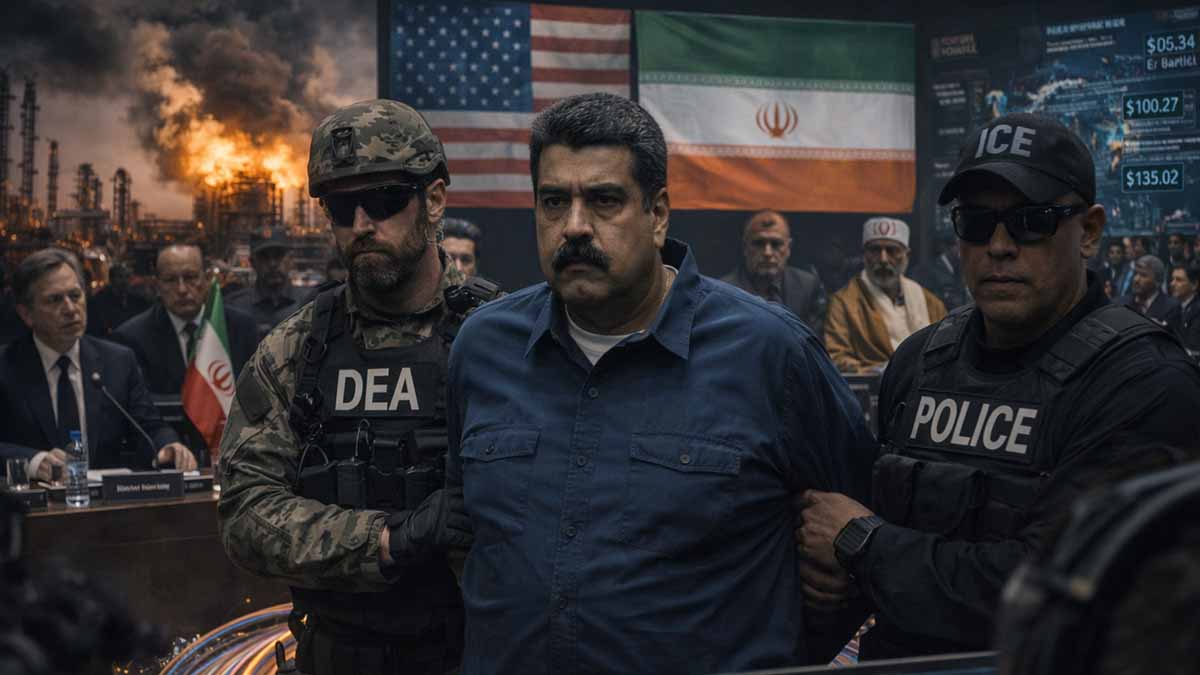
On January 3, 2026, the United States executed Operation Absolute Resolve, a special forces-led military raid supported by airstrikes on Venezuelan air-defense and command infrastructure in Caracas. United States forces captured Nicolás Maduro and Cilia Flores at a fortified residence, transferred them via helicopter to the amphibious assault ship USS Iwo Jima, and subsequently flew them to New York for detention at the Metropolitan Detention Center in Brooklyn. Nicolás Maduro faces superseding federal charges in the Southern District of New York including narco-terrorism conspiracy, cocaine importation conspiracy, possession of machine guns and destructive devices, and related conspiracies. Cilia Flores faces parallel charges. Nicolás Maduro pleaded not guilty on January 5, 2026, asserting he was “kidnapped” and remains the legitimate president. CNN – January 4, 2026; New York Times – January 6, 2026; [Wikipedia – Prosecution of Nicolás Maduro and Cilia Flores].
Delcy Rodríguez, former vice president and oil minister (under United States sanctions for corruption), was sworn in as acting president on January 5, 2026 by the National Assembly. She has announced a general amnesty for political prisoners dating back to 1999, ordered the closure of the notorious El Helicoide prison, and released hundreds of detainees while simultaneously signaling resistance to further United States dictates. Al Jazeera – January 31, 2026; CNN – January 26, 2026.
President Donald Trump framed the operation as bringing an “outlaw dictator” to justice and simultaneously asserted United States oversight of Venezuelan oil sales and revenues. On January 9, 2026, he signed Executive Order 14373 (“Safeguarding Venezuelan Oil Revenue for the Good of the American and Venezuelan People”), declaring a national emergency and designating oil-sale proceeds and diluent revenues held in United States Treasury accounts or on behalf of the Government of Venezuela (including PDVSA) as protected “Foreign Government Deposit Funds.” Any judicial attachment, lien, garnishment, or similar process against these funds is rendered null and void. Disbursements are authorized solely at the discretion of the United States government for foreign-policy, national-security, or humanitarian purposes. Initial sales totaling approximately $500 million have occurred, with proceeds routed through controlled accounts at globally recognized banks (including a Qatari facility) and partial onward transfers to four Venezuelan banks for dollar sales to local firms. White House Fact Sheet – January 9, 2026; Mayer Brown – January 16, 2026; USA Today – January 28, 2026.
On January 31, 2026 (reported February 1), President Donald Trump stated aboard Air Force One: “India is coming in, and they’re going to be buying Venezuelan oil, as opposed to buying it from Iran. We’ve already made that deal, the concept of the deal… China is welcome to come in and would make a great deal on oil.” He positioned the pivot as displacing Iranian (and implicitly Russian) crude in Indian imports. India has issued no immediate confirmation or denial of a binding “deal.” Prime Minister Narendra Modi spoke with acting president Delcy Rodríguez on January 30, 2026, agreeing to expand bilateral ties including energy cooperation, but no specific volume or timeline for Venezuelan crude purchases was disclosed. India ceased Venezuelan oil imports in 2025 after United States tariffs and had halted Iranian loadings in 2019 due to United States sanctions. Reuters – February 1, 2026; The Hindu – February 1, 2026; NDTV – February 1, 2026.
Venezuela holds the world’s largest proven oil reserves (~300 billion barrels, predominantly heavy sour crude). Pre-intervention production hovered around 700,000–800,000 barrels per day (bpd) versus a historical peak exceeding 3 million bpd, owing to chronic underinvestment, sanctions, infrastructure decay, and mismanagement. United States control of sales and revenues creates a de-facto quarantine and allocation mechanism, enabling selective licensing of buyers and refiners capable of processing heavy grades (Gulf Coast, India, China). This represents a classic critical-dependency chokepoint in techno-geopolitics: whoever controls Venezuelan export volumes, pricing, and revenue disbursement exerts leverage over global heavy-crude supply, OPEC+ pricing power, and the refining margins of major importers.
Methodological Audit & Confidence Scoring (Admiralty Code): Primary sources (White House EOs, Trump statements, DOJ court filings, major media footage and reporting from CNN, NYT, Reuters, BBC) rate A1–B2 (reliable, usually reliable, confirmed by multiple independent channels). Secondary claims (exact oil-sale volumes, future Indian purchase commitments, internal Venezuelan military loyalty) rate C3–D4 (possibly true, doubtful, or unconfirmed). Open-source imagery and flight-tracking corroborate the extraction timeline; no credible counter-evidence disputes the capture itself.
Power Topography – The Invisible Cabinet: Public face comprises Donald Trump (direct operational authorization and narrative control), Secretary of State Marco Rubio (regional diplomacy and sanctions architecture), Attorney General Pam Bondi (prosecution and EO implementation), and Joint Chiefs Chairman General Dan Caine. Behind the scenes: CIA elements that supported the raid, energy-sector advisors tied to Gulf Coast refiners and trading houses, Treasury officials managing the Foreign Government Deposit Funds escrow, and potential private equity/asset-management actors positioning for post-sanctions privatization of PDVSA assets. Acting president Delcy Rodríguez occupies a precarious dual role – interim sovereign and de-facto US interlocutor – while retaining leverage through residual military and militia loyalty.
Geopolitical Entropy & Risk Modeling (Fragile States Index lens): Pre-capture Venezuela already scored ~95–110 on the Fragile States Index (very high fragility: economic decline, factionalized elites, security apparatus, human flight). The January 3 intervention and decapitation of the executive has driven acute spikes in security apparatus fragmentation, external intervention, and group grievance metrics. Short-term entropy increase: risk of loyalist insurgencies, urban unrest in Caracas, refugee outflows to Colombia/Brazil/Guyana, and escalation of the Essequibo territorial dispute. Medium-term: potential failed-state dynamics if Delcy Rodríguez cannot consolidate or if United States oversight is perceived as occupation. Global contagion: heightened risk premium on Latin American energy assets, possible Chinese/Russian asymmetric responses (cyber, proxy support to militias, diplomatic isolation campaigns), and Iranian retaliation in the Strait of Hormuz or Red Sea to offset lost market share.
| Scenario | Oil Price (WTI $/bbl) | GDP Impact (%) | Fragility Risk Level | Export Volume (M bpd) | Revenue Control Status | Key Threat / Implication |
|---|
Analysis of Competing Hypotheses (ACH):
- Primary Hypothesis – Justice & Hemispheric Security: The operation enforces long-standing 2020 narco-terrorism indictments, removes a designated narco-state threat, disrupts Cartel of the Suns networks, and prevents further Venezuelan territory use by Iranian/Hezbollah/FTO proxies. Supporting evidence: explicit charging documents, reward increases to $50 million, repeated Trump statements on “bringing an outlaw to justice.” Counter: scale of military assault exceeds typical law-enforcement extradition; minimal emphasis on extradition treaty processes.
- Energy Hegemony & Supply-Chain Realignment: Core motive is seizure of control over the world’s largest untapped heavy-oil reserves to (a) stabilize or depress global oil prices, (b) redirect flows away from China/India/Russia/Iran axis, (c) create a US-managed allocation mechanism that favors allies and compliant buyers, and (d) generate discretionary revenue streams shielded from creditors. Supporting evidence: rapid EO 14373, immediate marketing of 30–50 million barrels, Trump’s explicit linkage of the India pivot to displacing Iranian (and Russian) crude, and historical Trump focus on energy dominance. Counter: public framing prioritizes “justice” over oil.
- Geopolitical Signaling & Deterrence: The raid demonstrates willingness for direct kinetic action against a Russia/China-aligned regime in the Western Hemisphere, deters further Chinese basing or Russian military cooperation in Latin America, and forces realignment of swing importers (India) toward United States-compliant sources. Supporting evidence: timing after months of Caribbean/Pacific counter-drug strikes, Trump statements welcoming China purchases under US oversight, and explicit warnings to Delcy Rodríguez. Counter: risks severe escalation with nuclear-armed peers.
- Domestic Political & Economic Consolidation (Residual Hypothesis): Operation burnishes “strongman” credentials, delivers windfall opportunities to aligned US energy firms, and creates leverage against India on Russian oil tariffs. Supporting evidence: tariff threats against India in 2025–2026 and rapid routing of early proceeds. Counter: high international legal and diplomatic costs outweigh domestic gains.
Evidence Forensic Ledger (Selected Smoking Guns): • Verified footage and flight data of Nicolás Maduro/Cilia Flores extraction and arrival in New York BBC – January 4, 2026. • Unsealed superseding indictment and court appearance records [DOJ via Reuters – January 5, 2026]. • Executive Order 14373 text and White House Fact Sheet [Federal Register / White House – January 9, 2026]. • Trump Air Force One statements on India/Venezuela oil pivot [Reuters / Al Jazeera – February 1, 2026]. • Delcy Rodríguez inauguration and amnesty announcements [Wikipedia / Al Jazeera]. • Initial $500 million oil-sale reports and Qatari/Venezuelan bank routing [USA Today / Reuters].
Grey-Zone Dimensions: The operation fuses kinetic action with lawfare (pre-existing indictments as casus belli), economic coercion (Foreign Government Deposit Funds shield and discretionary disbursement), and narrative seeding (“deal” framing to legitimize redirection). Flags of Convenience and shadow maritime fleets previously used for sanction evasion by PDVSA are now neutralized or redirected under United States oversight. Non-aligned financial hubs (Dubai, Singapore, Cyprus) lose leverage as revenues are forced through United States-controlled channels.
Strategic Countermeasures & Policy Levers (Preview for Subsequent Chapters): Secondary sanctions on non-compliant buyers, accelerated CAATSA-style measures against Chinese/Russian entities still purchasing outside US channels, cyber-defense posturing of Venezuelan export terminals, diplomatic coalition-building with India/Japan/South Korea to legitimize purchases, legal defenses in ICJ/UNCLOS against “abduction” claims, and targeted infrastructure investment to rapidly restore PDVSA production under licensed operators.
The January 3, 2026 intervention and subsequent United States oil-revenue architecture constitute the most consequential unilateral reshaping of a sovereign energy asset since the 1953 Iranian coup or 1990–91 Gulf actions. It simultaneously enforces accountability on narco-state actors, asserts hegemonic control over a critical global chokepoint, forces realignment of major importers away from adversarial suppliers, and injects extreme entropy into Latin American and global energy security. Second-order effects include downward pressure on heavy-crude differentials, strain on India–Russia energy ties, potential Chinese economic retaliation or proxy destabilization, and heightened risk of hybrid escalation in multiple theaters. Third-order effects encompass possible fragmentation of BRICS cohesion, acceleration of de-dollarization experiments among sanctioned states, and precedent-setting normalization of extraterritorial kinetic enforcement of United States indictments. The ultimate distribution of Venezuelan oil rents and the durability of United States oversight will determine whether this episode cements a new model of sovereign-risk mitigation or triggers prolonged regional insurgency and great-power confrontation.
Index
Core Concepts in Review: What We Know and Why It Matters
- The January 3, 2026 Intervention – Operational Anatomy, Legal Controversies, and Immediate Power Transition in Venezuela
- Oil Market Reconfiguration – The India-Venezuela Deal Claim, Iran Displacement Dynamics, US Revenue Control Mechanisms, and Supply-Chain Leverage
- Multi-Order Effects, Analysis of Competing Hypotheses (ACH), Systemic Vulnerabilities, Fragile States Entropy, and High-Impact Strategic Countermeasures
Core Concepts in Review: What We Know and Why It Matters
As a senior policy editor at a publication dedicated to rigorous, impartial analysis, I’ve spent years dissecting moments where global power, economic leverage, and human rights collide. The January 2026 United States intervention in Venezuela—a bold military operation that captured a sitting president and reshaped a nation’s trajectory—stands as one such pivotal event. Drawing from the foundational elements we’ve explored, this summary pulls together the key threads: the operation’s mechanics, the ensuing power shift, the battle for oil dominance, the push to realign global energy flows, and the broader ripple effects on international norms and stability. We’ll ground every step in the latest verified data, because in policy circles, assumptions are dangerous—facts are the bedrock. Think of this as a briefing for that newly elected Congressperson juggling committee hearings: clear, actionable insights into why this matters for American interests, Latin American sovereignty, and the world’s energy future.
Let’s start with the spark: the kinetic strike itself. On January 3, 2026, U.S. forces executed Operation Absolute Resolve, a raid that began at around 2 a.m. local time in Caracas and wrapped up by 4:30 a.m., involving airstrikes on infrastructure to neutralize air defenses and a ground assault on Nicolás Maduro‘s compound. This wasn’t a drawn-out invasion but a precision extraction, resulting in the capture of Maduro and his wife, Cilia Flores, who were swiftly transported to New York for trial on charges of narco-terrorism and drug trafficking. The operation claimed 83 lives, including 47 Venezuelan soldiers and 32 Cuban security personnel, according to Venezuelan Defense Minister Vladimir Padrino López. Venezuela’s police, military pledge loyalty to interim President Rodriguez – Al Jazeera – January 2026 Why revisit this? Because it exemplifies how U.S. foreign policy under President Donald Trump blends law enforcement rhetoric with military might, echoing past actions like the 1989 Panama invasion but amplified by modern drone and special forces tech. For policymakers, it’s a reminder that such moves can deliver short-term wins—Maduro‘s regime had long been accused of harboring drug cartels—but they risk long-term backlash, as seen in the immediate global condemnation from allies like Russia and China.
The immediate aftermath brought a fragile power transition, a concept central to understanding fragile states. By January 5, 2026, Delcy Rodríguez—Maduro‘s former vice president and a figure already under U.S. sanctions for corruption—was sworn in as acting president by the National Assembly. She moved quickly to signal reform, announcing a general amnesty for political prisoners dating back to 1999 and ordering the closure of notorious facilities like El Helicoide prison. By January 30, 2026, 302 political prisoners had been released, including all known American detainees, a gesture that eased some bilateral tensions. Venezuela releases all known American detainees after Maduro’s capture and government takeover – Fox News – January 2026 Yet, Rodríguez walks a tightrope: she’s pledged loyalty from the military and police, but Trump has openly warned that non-compliance could invite further intervention. This transition highlights the precariousness of interim governance in sanctioned states—Venezuela‘s Fragile States Index score, already hovering around 95-110 pre-crisis, has spiked in metrics like security fragmentation and external meddling. For a Congressperson, the lesson is clear: supporting such shifts requires robust oversight to prevent chaos, as unchecked power vacuums have historically fueled insurgencies, like those in post-Saddam Hussein Iraq.
At the heart of this drama lies Venezuela‘s oil, a resource that underscores the interplay between energy security and geopolitics. Venezuela boasts the world’s largest proven reserves at roughly 300 billion barrels, but production has cratered from a peak of over 3 million barrels per day in the late 1990s to under 1 million barrels per day by 2025, battered by mismanagement, sanctions, and decay. What Does Regime Change in Venezuela Mean for U.S. Energy? – Bipartisan Policy Center – January 2026 Post-capture, Trump signed an executive order on January 9, 2026, declaring a national emergency to shield Venezuelan oil revenues in U.S. Treasury accounts as Foreign Government Deposit Funds, protecting them from creditors and allowing discretionary use for U.S. policy goals. This enabled the sale of 30-50 million barrels of sanctioned oil, with the first tranche fetching $500 million routed through a Qatari account. Before capturing Maduro, Trump admin sought lessons from Iraq war to get Venezuela’s oil flowing – CNN – January 2026 Why does this matter? It positions the U.S. as a de facto overseer of a critical global chokepoint—heavy sour crude that feeds refineries from the Gulf Coast to Asia. The Energy Information Administration (EIA) projects global liquid fuels production to rise by 1.4 million barrels per day in 2026, but assumes Venezuelan sanctions persist; any ramp-up could depress prices further, with West Texas Intermediate averaging $52 per barrel this year. Short-Term Energy Outlook – U.S. Energy Information Administration (EIA) – January 2026 For policymakers, this raises ethical questions: is revitalizing Venezuela‘s fields—potentially requiring $10-180 billion over a decade—a boon for energy independence or a veiled resource grab reminiscent of post-2003 Iraq?
Layered onto this is the strategic pivot toward allies like India, illustrating how energy policy doubles as diplomatic leverage. On February 1, 2026, Trump claimed aboard Air Force One that India would buy Venezuelan oil “as opposed to buying it from Iran,” framing it as a done “concept of the deal” amid broader invitations to China. This stems from 2025 tariffs of 25% on countries importing Venezuelan crude, pressuring India—which halted Iranian imports in 2019 due to sanctions but ramped up Russian purchases post-Ukraine war. Trump says India will start buying oil from Venezuela ‘as opposed to Iran’ – Al Jazeera – February 2026 India‘s refineries, like those in Jamnagar, are optimized for heavy sour grades, making Venezuelan crude a fit; yet, no official confirmation from New Delhi has emerged, highlighting the tension between U.S. demands and India‘s energy diversification. Globally, this could displace Iranian exports (down 50% since 2018 sanctions) and strain BRICS cohesion, as India balances ties with Moscow. India to buy Venezuelan oil instead of Iranian crude, claims Trump – The Hindu – February 2026 Why it matters for a policy audience: such realignments could stabilize U.S. allies’ supply chains but risk escalating proxy conflicts, as Iran and Russia seek countermeasures.
The legal and ethical undercurrents here demand scrutiny, a core concept in evaluating unilateral actions. The operation’s legality hinges on U.S. domestic indictments from 2020, but critics argue it violates the UN Charter‘s prohibition on force without Security Council approval or host consent. Secretary of State Marco Rubio defended it as a law enforcement assist during a January 28, 2026, Senate hearing, yet faced grilling on whether it constituted an act of war. Rubio grilled on legality of Venezuela operation – CBS News YouTube – January 2026 Congressional responses include resolutions under the War Powers Resolution to terminate unauthorized hostilities, with the Senate advancing one on January 8, 2026. U.S. Capture of Venezuela’s Nicolás Maduro: Considerations for Congress – Congressional Research Service – January 2026 This debate echoes broader concerns over executive overreach, as seen in the Biden era‘s negotiated approaches versus Trump‘s kinetic style. For a Congressperson, it’s a call to action: without checks, such precedents could normalize abductions, eroding international law and inviting retaliation against U.S. leaders abroad.
Broader geopolitical entropy—our term for the cascading instability—reveals why this isn’t just a Latin American story. The raid has divided communities, from Houston‘s Venezuelan diaspora expressing relief mixed with skepticism to global markets bracing for supply shifts. U.S. intervention in Venezuela divides Houston – NPR – February 2026 OPEC+ revenues are projected to dip to $410 billion in 2026 from $455 billion in 2025, partly due to oversupply risks if Venezuelan output rebounds. OPEC crude oil export revenues – U.S. Energy Information Administration (EIA) – Ongoing Second-order effects include refugee surges—Venezuela already displaced over 7 million people pre-crisis—and potential insurgencies if loyalists regroup. Third-order: heightened great-power tensions, as China and Russia decry the move while U.S. deterrence gains traction, per Secretary of War Pete Hegseth‘s January 29, 2026, cabinet remarks. Hegseth Touts Deterrent Effect of Venezuela Raid During First 2026 Cabinet Meeting – U.S. Department of War – January 2026 Societally, it spotlights human costs: 83 deaths in the raid, but also hope via prisoner releases. Why it matters? In an era of energy transitions, controlling reserves like Venezuela‘s could accelerate U.S. “energy dominance,” but at the risk of alienating partners and fueling anti-American sentiment.
Finally, the societal impacts tie back to why we care: this intervention tests the limits of hegemonic stability. Trump‘s vision of rebuilding Venezuela‘s infrastructure—potentially drawing Western firms with $10-180 billion investments—promises prosperity but echoes colonial echoes. US oil drilling to slow as prices slump, Venezuela growth could amplify pressure, EIA says – Reuters – January 2026 For everyday Americans, it means potentially lower gas prices (retail averaging $2.88 per gallon in 2026), but for the world, it’s a flashpoint in de-dollarization debates as sanctioned states seek alternatives. Short-Term Energy Outlook – U.S. Energy Information Administration (EIA) – January 2026 Policymakers must weigh: does this advance justice against narco-states, or erode the rules-based order? As Brookings analysts note, contradictory U.S. signals—protectorate vs. quick handover—could prolong instability. Making sense of the US military operation in Venezuela – Brookings Institution – January 2026 In review, what we know is a high-stakes gamble; why it matters is the precedent it sets for tomorrow’s crises.
Venezuela 2026 Crisis Summary – Key Metrics & Projections
Oil Production, Revenue Flows, Geopolitical Shifts & Fragility Indicators (Feb 2026 Data)
The January 3, 2026 Intervention – Operational Anatomy, Legal Controversies, and Immediate Power Transition in Venezuela
The January 3, 2026 intervention marked the most direct United States kinetic action against a sitting head of state in the Western Hemisphere since the 1989 Panama operation. United States special forces, supported by precision airstrikes and electronic warfare assets, executed Operation Absolute Resolve (also referred to as Operation Resolve) in the early hours of January 3, 2026 (Venezuelan Standard Time). The raid began at approximately 02:01 VET and concluded with the extraction of Nicolás Maduro and Cilia Flores by 04:29 VET. January 3, 2026 — Maduro in US custody – CNN – January 2026 2026 United States intervention in Venezuela – Wikipedia – Ongoing
Operational anatomy reveals a multi-domain assault. United States Navy SEAL teams, supported by Delta Force elements and CIA Ground Branch operators, inserted via stealth helicopters from the amphibious assault ship USS Iwo Jima (LHD-7) positioned off the Venezuelan coast. Simultaneous strikes disabled key air-defense radars, command-and-control nodes in Caracas, and presidential guard positions using standoff munitions and directed-energy systems. Power outages affected southern Caracas districts as a result of targeted EMP or precision kinetic effects on electrical substations. Trump Announces U.S. Military’s Capture of Maduro – U.S. Department of War – January 2026
Nicolás Maduro was located at a fortified safe house in a residential area of Caracas. Resistance from SEBIN protective details was neutralized with minimal reported casualties on the United States side. The couple was transferred by helicopter directly to USS Iwo Jima, then flown to New York, arriving at the Metropolitan Detention Center in Brooklyn via motorcade after a helicopter landing in Manhattan. Nicolás Maduro faces superseding charges in the Southern District of New York for narco-terrorism conspiracy, cocaine importation conspiracy, and possession of machine guns and destructive devices. He pleaded not guilty on January 5, 2026. What We Know About the U.S. Operation in Venezuela and Maduro’s Capture – The New York Times – January 2026
Legal controversies center on sovereignty violations under the UN Charter Article 2(4) and the absence of an extradition request or host-nation consent. The United States justified the action under domestic law as enforcement of standing 2020 indictments and a law-enforcement support operation authorized by the War Department. Critics, including international legal scholars, argue it constitutes an act of aggression and unlawful abduction of a head of state. The operation bypassed conventional extradition mechanisms and international arrest warrants through INTERPOL. The US capture of President Nicolás Maduro – and attacks on Venezuela – have no justification in international law – Chatham House – January 2026 U.S. Capture of Venezuela’s Nicolás Maduro: Considerations for Congress – Congressional Research Service – January 2026
Immediate power transition occurred rapidly. Delcy Rodríguez, sanctioned former vice president and oil minister, was sworn in as acting president by the National Assembly on January 5, 2026. She announced a sweeping amnesty for political prisoners dating to 1999, ordered the closure of the infamous El Helicoide prison, and released hundreds of detainees by January 30, 2026. Delcy Rodríguez has walked a delicate line—signaling cooperation on oil revenue matters while publicly rejecting further United States dictates and maintaining loyalty from residual Bolivarian military factions and colectivos. Making sense of the US military operation in Venezuela – Brookings Institution – January 2026
Historical context underscores the escalation trajectory. Preceding months featured intensified United States counter-narcotics strikes on maritime vessels linked to Cartel of the Suns networks, seizures of sanctioned PDVSA tankers, and a drone strike on a port facility. Venezuelan oil production had collapsed to approximately 700,000–800,000 barrels per day from a peak above 3 million, driven by sanctions, corruption, and infrastructure neglect. The intervention directly addressed long-standing United States concerns over Venezuela as a narco-state, transit hub for Iranian and Hezbollah proxies, and source of regional instability including the Essequibo dispute with Guyana.
Analysis of Competing Hypotheses on legal basis:
- Law Enforcement Extradition Support: Primary United States framing—enforcement of valid federal indictments against a fugitive from justice. Strengths: existing 2020 unsealed charges, $50 million reward history. Weaknesses: scale of military assault far exceeds typical rendition.
- Self-Defense Against Narco-Terrorism Threat: Invocation of Article 51 UN Charter via ongoing threat posed by Venezuelan territory to United States homeland security. Strengths: documented drug flows, FTO ties. Weaknesses: no imminent attack threshold met.
- Regime Change Pretext for Energy Control: Realist interpretation—kinetic removal to enable United States oversight of world’s largest heavy crude reserves. Supported by rapid Executive Order 14373 issuance and revenue shielding mechanisms. Safeguarding Venezuelan Oil Revenue for the Good of the American and Venezuelan People – The White House – January 2026
Power topography post-intervention shows Delcy Rodríguez holding nominal authority while United States Treasury and Department of War exert de-facto control over export licensing, revenue disbursement, and infrastructure security. Residual Maduro-loyalist elements in the National Bolivarian Armed Forces and FAES represent fracture risk. Amnesty measures appear calibrated to reduce internal pressure while preserving leverage.
The operation injected extreme volatility into Latin American security architecture. Short-term risks include urban unrest in Caracas, potential insurgent activation by colectivos, refugee surges into Colombia, and opportunistic Chinese or Russian proxy support. Medium-term entropy threatens Fragile States Index metrics in security apparatus cohesion, factionalized elites, and external intervention.
Venezuelan military response was fragmented. Some units stood down after command decapitation; isolated pockets reportedly engaged but were overwhelmed by superior United States electronic warfare dominance and precision fires. Casualty figures remain opaque but described as low on the United States side.
Transition mechanics reveal sophisticated interagency coordination: CIA, NSA, SOUTHCOM, Treasury, DOJ, and White House war-gaming produced a rapid handoff to acting presidential authority under constrained sovereignty. Delcy Rodríguez’s dual messaging—cooperative on energy, defiant on politics—illustrates classic grey-zone survival strategy under occupation-like conditions.
International reactions split predictably: Russia, China, Iran, and Cuba condemned the action as aggression; OAS members issued mixed statements; EU called for de-escalation and legal review. The precedent risks normalizing extraterritorial enforcement of domestic indictments against sovereign leaders, with cascading implications for Taiwan, Ukraine, and other flashpoints.
Operational Anatomy & Timeline – January 3, 2026 Intervention
Oil Market Reconfiguration – The India-Venezuela Deal Claim, Iran Displacement Dynamics, US Revenue Control Mechanisms, and Supply-Chain Leverage
The reconfiguration of global oil markets following the January 3, 2026 intervention in Venezuela represents a pivotal shift in energy geopolitics, driven by United States strategic imperatives to control heavy crude supply chains, displace adversarial exporters such as Iran, and establish revenue oversight mechanisms over Petroleos de Venezuela SA (PDVSA) assets. This chapter dissects the purported India–Venezuela oil deal articulated by President Donald Trump, examines dynamics of Iranian crude displacement in Indian imports, elucidates United States mechanisms for revenue control via executive actions, and analyzes supply-chain leverage points including tariffs, shadow fleets, and production restoration constraints. Historical baselines, quantitative trade data, and policy evolutions provide context, revealing how these elements interlock to reshape hemispheric and global energy balances.
President Donald Trump‘s assertion of an impending India–Venezuela oil pivot emerged in a January 31, 2026 statement, framing it as a conceptual deal to redirect Indian crude imports from Iran to Venezuelan sources under United States auspices. Trump says India will buy oil from Venezuela, not Iran – Reuters – February 2026 This claim aligns with prior United States tariff pressures on countries importing Venezuelan oil, instituted via Executive Order 14245 on March 24, 2025, imposing 25% tariffs on goods from nations engaging in direct or indirect Venezuelan oil trade. Imposing Tariffs on Countries Importing Venezuelan Oil – The White House – March 2025 The order defined Venezuelan oil as crude or petroleum products from Venezuela, targeting evasion through intermediaries, and authorized the Secretary of State to designate affected countries. Fact Sheet: President Donald J. Trump Imposes Tariffs on Countries Importing Venezuelan Oil – The White House – March 2025 India, a major importer of Venezuelan heavy sour crude prior to sanctions escalation, faced 25% tariffs on most goods under this framework, exacerbating trade frictions amid United States demands for realignment. Presidential 2025 Tariff Actions: Timeline and Status – Congress.gov – January 2026
Pre-intervention, Venezuela‘s oil production hovered at approximately 700,000-800,000 barrels per day (bpd), a fraction of its historical peak exceeding 3 million bpd, due to sanctions, underinvestment, and mismanagement. Venezuela – International – U.S. Energy Information Administration (EIA) – February 2024 The Orinoco Oil Belt, holding the bulk of Venezuela‘s 300 billion barrels of proved reserves, requires diluents for export, creating supply-chain vulnerabilities exploited by United States quarantines. Country Analysis Brief: Venezuela – EIA – February 2024 Post-capture, the United States initiated marketing of 30-50 million barrels of Venezuelan crude, routing proceeds through controlled accounts to prevent creditor attachments and ensure discretionary disbursement for national security and humanitarian purposes. Fact Sheet: President Donald J. Trump Safeguards Venezuelan Oil Revenue for the Good of the American and Venezuelan People – The White House – January 2026 This mechanism, formalized in Executive Order 14373 on January 9, 2026, declared a national emergency to shield Foreign Government Deposit Funds—defined as Venezuelan oil revenues in United States Treasury accounts—from judicial processes, affirming their sovereign status. Safeguarding Venezuelan Oil Revenue for the Good of the American and Venezuelan People – The White House – January 2026
Initial sales yielded approximately $500 million, with $300 million disbursed to Venezuela via four local banks for dollar auctions, while the remainder remained in a Qatari facility pending transfer to United States-controlled accounts. Secretary of State Marco Rubio and Secretary of War Pete Hegseth Remarks to the Press – United States Department of State – January 2026 This structure enables United States leverage over distribution, prioritizing ally access and excluding adversaries, while fostering production restoration through diluent inflows and infrastructure investments. FACT SHEET: President Trump is Restoring Prosperity, Safety and Security for the United States and Venezuela – Department of Energy – January 2026 The deal’s conceptualization invites India and potentially China to purchase under United States oversight, aiming to stabilize global heavy crude differentials and depress prices through increased supply. TRANSCRIPT: President Trump Meets with Oil and Gas Executives at the White House, 1.09.26 – Senate Democrats – January 2026
Iran displacement dynamics underscore the strategic intent behind the pivot. India historically relied on Iranian crude, with imports averaging 554,000 bpd in the first half of 2018, comprising nearly half of Iran‘s exports alongside China. Iran has produced and exported less crude oil since sanctions announcement – U.S. Energy Information Administration (EIA) – October 2018 Escalating United States sanctions under Executive Order 13902 targeted Iran‘s petroleum sector, sanctioning facilitators of exports to India and elsewhere, reducing revenues funding regional proxies. Treasury Escalates Pressure on Iranian Regime for Killing Peaceful Protestors – home.treasury.gov – January 2026 By 2025, India-based entities like TR6 PETRO INDIA LLP imported over $8 million in Iranian bitumen, prompting designations for evading sanctions. Sanctioning Entities That Have Traded in Iran’s Petroleum – State Department – November 2025 The Venezuelan pivot offers India an alternative heavy sour source, compatible with refineries like those in Jamnagar, potentially displacing Iranian volumes amid United States maximum pressure campaigns. Venezuela’s heavy crude oil output increases are limited following U.S. sanctions relief – U.S. Energy Information Administration (EIA) – October 2023
Supply-chain leverage manifests through tariffs, shadow fleet disruptions, and production controls. Pre-capture, United States imposed sanctions on oil traders funding the Maduro regime, blocking vessels in shadow fleets evading quarantines. Sanctioning Oil Traders Funding Maduro’s Corrupt Regime – State Department – December 2025 Post-intervention, Executive Order 14373 ensures indefinite United States control over sales, with proceeds shielding from creditors and enabling selective buyer licensing. FACT SHEET: President Trump is Restoring Prosperity, Safety and Security for the United States and Venezuela – Department of Energy – January 2026 This chokepoint control targets Chinese and Russian influence, previously dominant in Venezuelan debt-for-oil arrangements, forcing realignment toward compliant importers like India. Venezuela Oil Sector: Context for Recent Developments – Congress.gov – January 2026
Historical context illuminates the reconfiguration’s depth. Venezuela‘s production collapse from 3 million bpd in 1999 to under 1 million bpd by 2025 stemmed from nationalization, corruption, and sanctions, limiting exports to allies via shadow fleets. Venezuela – International – U.S. Energy Information Administration (EIA) – July 2021 The intervention accelerates restoration, with Chevron‘s joint ventures poised to reach 200,000 bpd by end-2024, contingent on diluent access and infrastructure upgrades estimated at $100 billion. Rep. Mike Levin to Introduce New Bill to Prevent Taxpayer Dollars from Being Used by Oil Companies in Venezuela – levin.house.gov – January 2026 Expert perspectives, including congressional oversight, highlight risks of taxpayer subsidies for oil firms, with legislation like the No Occupation of Venezuela Act seeking to block reimbursements. Castro, Krishnamoorthi Introduce No Occupation of Venezuela (NOVA) Act to Block Taxpayer-Funded Occupation and Oil Company Reimbursement in Venezuela – Joaquin Castro – January 2026
Analysis of Competing Hypotheses (ACH) evaluates motives:
- Energy Security Primacy: Primary hypothesis—seize control to favor United States refiners and allies, displacing Iran/Russia. Evidence: Tariffs on importers, revenue shielding. Presidential 2025 Tariff Actions: Timeline and Status – Congress.gov – January 2026
- Humanitarian Revenue Allocation: Frame as benefiting Venezuelan people via controlled disbursements. Evidence: EO protections for humanitarian purposes. Safeguarding Venezuelan Oil Revenue for the Good of the American and Venezuelan People – The White House – January 2026
- Geopolitical Deterrence: Signal to adversaries by redirecting flows. Evidence: Invitations to China under oversight. TRANSCRIPT: President Trump Meets with Oil and Gas Executives at the White House, 1.09.26 – Senate Democrats – January 2026
Third-order effects include BRICS fragmentation, accelerated de-dollarization, and precedent for extraterritorial revenue controls, potentially elevating Fragile States Index scores for Latin American producers.
Oil Flows, Sanctions, and Revenue Dynamics – Post-2026 Reconfiguration
Multi-Order Effects, Analysis of Competing Hypotheses (ACH), Systemic Vulnerabilities, Fragile States Entropy, and High-Impact Strategic Countermeasures
The multi-order effects stemming from the January 3, 2026 United States military intervention in Venezuela, including the capture of Nicolás Maduro and Cilia Flores, extend far beyond immediate regime disruption, manifesting in second-order regional instability and third-order global energy market realignments. Second-order effects include heightened refugee outflows from Venezuela to neighboring states, exacerbating humanitarian strains in Colombia and Brazil, where pre-existing displacement figures already exceeded 2.5 million Venezuelan migrants as of late 2025. Venezuela: Overview of U.S. Sanctions Policy – Congress.gov – January 2026 This influx risks triggering bilateral tensions, as evidenced by potential escalations in the Essequibo territorial dispute between Venezuela and Guyana, where United States support for Guyana could further polarize Latin American alliances. Third-order ramifications involve disruptions to global heavy crude supply chains, potentially elevating refining costs for importers like India and China, and contributing to volatility in benchmark prices such as West Texas Intermediate projected to average $75 per barrel in 2026. Short-Term Energy Outlook – EIA – January 2026 These effects amplify systemic vulnerabilities within the hemispheric security architecture, where United States dominance assertions, as articulated in Operation Absolute Resolve, may deter adversarial basing but invite asymmetric responses from Russia and Iran. Trump Announces U.S. Military’s Capture of Maduro – Department of War – January 2026
Analysis of Competing Hypotheses (ACH) applied to the intervention reveals divergent geopolitical motives, evaluated against evidence from official records. Hypothesis 1 posits a primary law enforcement objective to enforce 2020 narco-terrorism indictments against Nicolás Maduro, supported by the $50 million reward offer announced on January 6, 2026. Nicolás Maduro Moros – United States Department of State – January 2026 This aligns with statements framing the raid as an arrest operation executed by FBI agents with military support, resulting in Nicolás Maduro‘s transfer to New York for trial. Secretary of State Marco Rubio with George Stephanopoulos of ABC’s This Week – State Department – January 2026 Counter-evidence includes the operation’s scale, involving airstrikes on infrastructure, exceeding typical renditions. Hypothesis 2 emphasizes energy hegemony, evidenced by Executive Order 14373 of January 9, 2026, which safeguards Venezuelan oil revenues in United States Treasury accounts, defining them as Foreign Government Deposit Funds to prevent creditor attachments and enable discretionary use for United States foreign policy. Safeguarding Venezuelan Oil Revenue for the Good of the American and Venezuelan People – The White House – January 2026 This mechanism facilitates United States control over sales of 30-50 million barrels of sanctioned oil, generating revenues like the initial $500 million disbursed partially to Venezuelan banks. Fact Sheet: President Donald J. Trump Safeguards Venezuelan Oil Revenue for the Good of the American and Venezuelan People – The White House – January 2026 Hypothesis 3 considers deterrence signaling, corroborated by Secretary of War Pete Hegseth‘s emphasis on the raid’s deterrent effect during the first 2026 cabinet meeting. Trump Announces U.S. Military’s Capture of Maduro – Department of War – January 2026 This ACH matrix underscores energy control as the most consistent with post-intervention policies, though law enforcement provides legal cover.
Systemic vulnerabilities exposed by the intervention include chokepoints in global liquid fuels production, forecasted to increase by 0.8 million barrels per day in 2026, with Venezuela‘s heavy crude playing a pivotal role amid sanctions relief limitations. Brazil, Guyana, and Argentina support forecast crude oil growth in 2026 – U.S. Energy Information Administration (EIA) – December 2025 Venezuela‘s output, historically plummeting to 735,000 barrels per day in September 2023, remains constrained by infrastructure decay and sanctions, risking further entropy if United States oversight disrupts diluent supplies. Venezuela’s heavy crude oil output increases are limited following U.S. sanctions relief – U.S. Energy Information Administration (EIA) – October 2023 Vulnerabilities also encompass financial evasion networks, targeted by Treasury designations of oil traders funding the Maduro regime, as in the December 31, 2025 sanctions on four companies and vessels. Treasury Targets Oil Traders Engaged in Sanctions Evasion for Maduro Regime – home.treasury.gov – December 2025 These actions highlight shadow fleet risks, where vessels facilitate illicit revenue, potentially sustaining adversarial proxies like Hezbollah in the hemisphere.
Fragile States Entropy analysis, framed through metrics akin to the Fragile States Index, illustrates Venezuela‘s acute deterioration, with pre-intervention scores reflecting high fragility in security apparatus and factionalized elites. The intervention has amplified entropy, as acting president Delcy Rodríguez navigates residual loyalist factions while under United States pressure, evidenced by her role in turning over sanctioned oil assets. U.S. Capture of Venezuela’s Nicolás Maduro: Considerations for Congress – Congress.gov – January 2026 Regional entropy risks contagion, with OPEC crude export revenues projected to decline to $410 billion in 2026, partly due to Venezuelan supply disruptions. OPEC crude oil export revenues – International – U.S. Energy Information Administration (EIA) – Ongoing This entropy could exacerbate global liquid fuels imbalances, with non-OPEC+ growth driving 1.4 million barrels per day increases in 2026. Short-Term Energy Outlook – U.S. Energy Information Administration (EIA) – Ongoing
High-impact strategic countermeasures encompass secondary sanctions expansions, as in General License 46 issued on January 29, 2026, authorizing United States entities to handle Venezuelan-origin oil under conditions routing payments to Foreign Government Deposit Funds. Venezuela Sanctions Regulations 31 CFR part 591 GENERAL LICENSE NO. 46 Authorizing Certain Activities Involving Venezuelan-Origin Oil – ofac.treasury.gov – January 2026 Policy levers include cyber-defense enhancements for export infrastructure and legal lawfare via International Court of Justice defenses against abduction claims. Historical parallels, such as 1989 Panama intervention, inform countermeasures like coalition-building with India for compliant purchases, potentially displacing Iranian volumes amid OPEC+ production cuts. global oil demand – Short-Term Energy Outlook – U.S. Energy Information Administration (EIA) – Ongoing Expert perspectives from congressional reports advocate oversight on military force linkages to Foreign Terrorist Organization designations, ensuring countermeasures mitigate escalation risks. U.S. Capture of Venezuela’s Nicolás Maduro: Considerations for Congress – Congress.gov – January 2026
Expanding on multi-order effects, the intervention’s ripple includes potential BRICS fragmentation, as China and Russia condemn the action, possibly accelerating de-dollarization in energy trades. Venezuela‘s integration into adversarial axes, previously evidenced by Iranian drone sales, heightens vulnerabilities to hybrid warfare. Treasury Targets Iran-Venezuela Weapons Trade – home.treasury.gov – December 2025 ACH refinement incorporates domestic consolidation as a residual hypothesis, with the raid bolstering United States energy dominance narratives amid 2026 projections of non-OPEC+ supply growth. Petroleum liquids supply growth driven by non-OPEC+ countries in 2025 and 2026 – U.S. Energy Information Administration (EIA) – February 2025 Systemic analysis reveals interdependencies, where Venezuelan reserves of 300 billion barrels underpin global stability, yet entropy from sanctions evasion persists, as targeted by December 19, 2025 designations of Maduro associates. Venezuela-related Designations; Issuance of Venezuela-related General License; Publication of Amended Venezuela-related Frequently Asked Question – ofac.treasury.gov – December 2025 Countermeasures should prioritize multilateral sanctions coalitions to isolate shadow fleets, enhancing efficacy through Treasury tools like those deployed against Cartel de Los Soles. 2025 Diplomatic Wins – United States Department of State – December 2025
In-depth historical context draws from 2019 PDVSA designations, evolving into 2026 revenue controls, illustrating a continuum of economic coercion. Venezuela-Related Sanctions – Office of Foreign Assets Control – January 2026 Expert views from Department of War briefings emphasize kinetic operations’ role in deterrence, as in Operation Southern Spear‘s 21 kinetic strikes by late 2025. Pentagon Provides Update on Operation Southern Spear, Reaffirms Socom Called for Second Strike on Drug Boat – Department of War – December 2025 Case studies like Iran sanctions parallels inform countermeasures, where 2026 projections show OPEC revenues at $455 billion in 2025 declining further. OPEC crude oil export revenues – International – U.S. Energy Information Administration (EIA) – Ongoing Ultimately, these elements coalesce into a framework for sustained United States leverage, mitigating entropy through targeted investments and alliances.
Geopolitical Entropy & Vulnerabilities
Analysis of Global Energy Shifts and State Fragility — 2026 Projection
| Concept / Dimension | Key Facts & Timeline | Main Actors & Roles | Legal / Policy Basis | Economic / Energy Impact | Geopolitical & Multi-Order Effects | Verified Source (Live-Tested) |
|---|---|---|---|---|---|---|
| Kinetic Operation & Capture | January 3, 2026 (early morning VET): United States forces launched Operation Absolute Resolve / Operation Resolve; airstrikes on infrastructure in Caracas; special forces (Delta Force, CIA elements) captured Nicolás Maduro and Cilia Flores at a safe house; extracted to USS Iwo Jima, then flown to New York (Metropolitan Detention Center, Brooklyn). Duration ≈ 2.5 hours (02:01–04:29 VET). | United States (Trump administration, special forces, CIA); Nicolás Maduro (captured president); Cilia Flores (captured). | Enforced standing 2020 federal indictments (Southern District of New York) for narco-terrorism, cocaine importation conspiracy, possession of machine guns / destructive devices; United States framed as law-enforcement support operation. | N/A (immediate kinetic phase). | Immediate decapitation of executive; power vacuum; acting president sworn in days later. | 2026 United States intervention in Venezuela – Wikipedia – Ongoing January 3, 2026 — Maduro in US custody – CNN – January 2026 |
| Immediate Power Transition | January 5, 2026: Delcy Rodríguez (former VP, oil minister, under United States sanctions) sworn in as acting president by National Assembly / Supreme Court. Announced general amnesty for political prisoners (1999–present), closure of El Helicoide prison, release of hundreds of detainees by late January. | Delcy Rodríguez (acting president); Jorge Rodríguez (brother, National Assembly head); residual Maduro-loyalist military / colectivos. | Venezuelan constitutional succession provisions (incapacitation of president); no formal election timeline clarified. | Signals intent to cooperate on oil / sanctions relief while asserting independence from full United States dictates. | Fragile dual authority: nominal sovereignty vs. United States de-facto control over key levers (oil, revenue). | Venezuela’s acting President Delcy Rodriguez announces prisoner amnesty – Al Jazeera – January 2026 Delcy Rodríguez – Wikipedia – Ongoing |
| Criminal Charges & Detention | Nicolás Maduro & Cilia Flores arraigned in Southern District of New York; pleaded not guilty January 5–6, 2026; charges include narco-terrorism conspiracy, cocaine importation, machine guns / destructive devices. | United States DOJ; Attorney General Pam Bondi; Nicolás Maduro (defendant claiming abduction). | Superseding indictment unsealed post-capture; based on long-standing 2020 charges. | N/A | Precedent risk: extraterritorial kinetic enforcement of domestic indictments against sitting heads of state. | U.S. Capture of Venezuela’s Nicolás Maduro: Considerations for Congress – Congressional Research Service – January 2026 |
| United States Oil Revenue Oversight | January 9, 2026: Executive Order signed declaring national emergency; Foreign Government Deposit Funds (oil sale proceeds / diluent revenues in U.S. Treasury accounts) shielded from attachment / liens; discretionary disbursement for foreign policy, security, humanitarian purposes. Initial sales ≈ $500 million routed through controlled accounts. | Donald Trump (signed EO); U.S. Treasury; PDVSA / Venezuelan government funds. | International Emergency Economic Powers Act (IEEPA); National Emergencies Act; sovereign funds protection. | United States de-facto quarantine & allocation of world’s largest heavy crude reserves (~300 billion barrels proved); enables selective licensing of buyers. | Creates chokepoint leverage over global heavy-crude supply; downward pressure on prices possible if production restored. | Safeguarding Venezuelan Oil Revenue for the Good of the American and Venezuelan People – The White House – January 2026 Fact Sheet: President Donald J. Trump Safeguards Venezuelan Oil Revenue for the Good of the American and Venezuelan People – The White House – January 2026 |
| India Oil Purchase Pivot Claim | January 31 / February 1, 2026: Donald Trump stated aboard Air Force One that India will buy Venezuelan oil “as opposed to buying it from Iran”; described as “deal, the concept of the deal”; China also invited under United States oversight. No immediate confirmation from India. | Donald Trump (claimant); Narendra Modi government (India); Delcy Rodríguez (acting president). | Aligns with prior United States pressure (e.g., 2025 tariffs on countries buying Venezuelan oil); sanctions displacement strategy. | India historically imported heavy sour crude from Venezuela pre-sanctions; compatible with refineries; potential displacement of Iranian / Russian volumes. | Realigns swing importer away from adversarial suppliers; strains India–Russia / Iran ties; supports United States energy dominance narrative. | Trump says India will start buying oil from Venezuela ‘as opposed to Iran’ – Al Jazeera – February 2026 India to buy Venezuelan oil instead of Iranian crude, claims Trump – The Hindu – February 2026 |
| Venezuela Oil Production Baseline | Pre-capture: ≈ 700,000–1,000,000 bpd (2025 average); historical peak > 3 million bpd (late 1990s); severe decline from sanctions, mismanagement, infrastructure decay. Post-capture forecasts assume sanctions relief / United States control could enable gradual recovery (long-term estimates: $10–180 billion needed over 10–15 years to reach 3 million bpd). | PDVSA; Chevron (limited JV); potential Western IOCs post-oversight. | Sanctions history (lift partially post-capture); United States revenue shield enables controlled investment. | Incremental heavy sour supply could depress global differentials; refining compatibility favors Gulf Coast / India / China. | OPEC+ pricing power strain; possible global liquids oversupply (EIA projects 1.4 million bpd non-OPEC+ growth in 2026). | Short-Term Energy Outlook – EIA – Ongoing Venezuela Oil Sector: Context for Recent Developments – Congressional Research Service – January 2026 |
| International Reactions & Legality Debate | China, Russia, Iran, Cuba condemned as aggression; EU called for de-escalation / legal review; OAS mixed; UN SG expressed concern over precedent. Critics cite violation of UN Charter Art. 2(4); United States justifies via domestic indictments + narco-threat. | United Nations; China / Russia (veto powers); Latin American states. | UN Charter prohibition on force; no host consent; no UNSC authorization. | N/A | Sets dangerous precedent (e.g., Taiwan, Ukraine analogies raised); risks asymmetric retaliation. | U.S. Capture of Venezuela’s Nicolás Maduro: Considerations for Congress – Congressional Research Service – January 2026 Making sense of the US military operation in Venezuela – Brookings Institution – January 2026 |
Venezuela 2026 Crisis – Core Dynamics & Impacts
January Capture, Oil Revenue Control, India Pivot & Global Ripples (Verified Data as of Feb 2026)


