












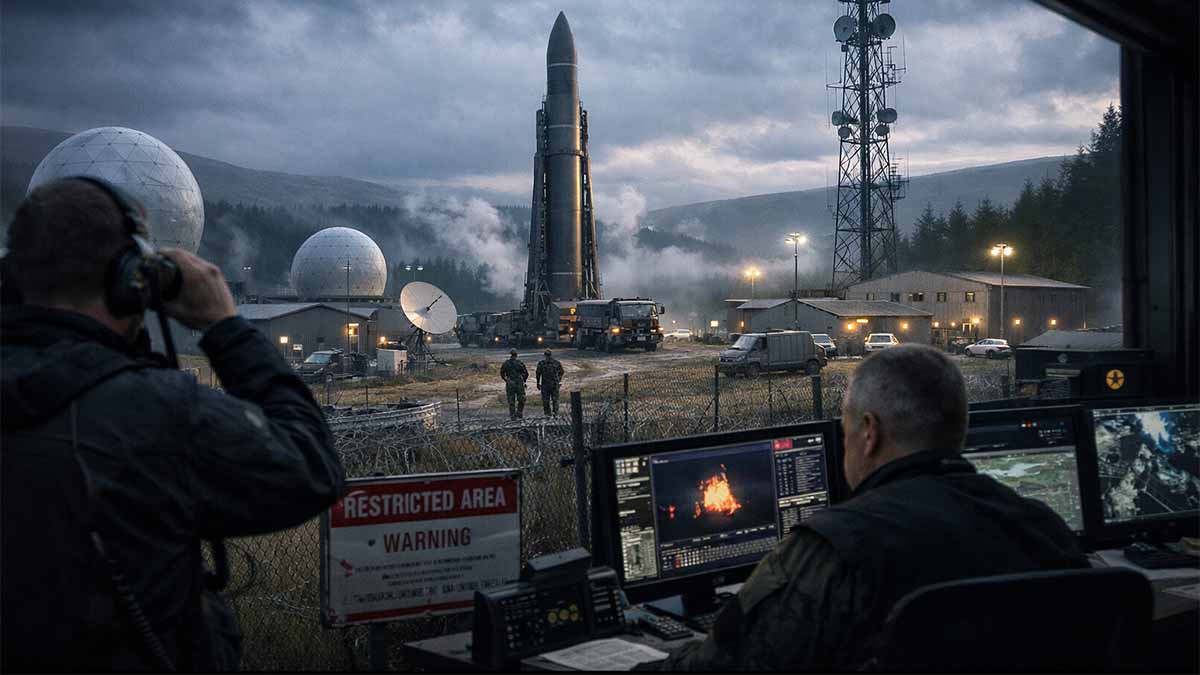
The Strategic Abstract: A Masterwork of Clinical Geopolitical Analysis
The Eskdalemuir Impasse: A Microcosm of Strategic Atrophy
As of February 2, 2026, the dispute regarding the expansion of wind energy infrastructure in the Scottish Borders has transcended local planning concerns to become a critical flashpoint for United Kingdom national security and global nuclear stability. At the center of this friction is the Eskdalemuir Seismological Array, a facility established in 1962 that serves as one of the most sensitive seismic listening posts in the International Monitoring System (IMS). The tension between the Ministry of Defence (MoD) and renewable energy developers represents a fundamental collision between two sovereign imperatives: the transition to a “Net Zero” economy and the maintenance of Measurement and Signature Intelligence (MASINT) integrity required for the Comprehensive Nuclear-Test-Ban Treaty (CTBT).
The MoD objection, formally articulated on January 22, 2026, highlights a non-linear vulnerability. The introduction of large-scale turbines within the 50 km protective zone introduces “seismic noise”—low-frequency vibrations that propagate through the earth’s crust, potentially masking the unique “signature” of a clandestine nuclear detonation. This is not merely a domestic regulatory hurdle; it is a defense of the UK’s primary contribution to the CTBT, ensuring that “rogue” nuclear actors cannot exploit gaps in the global sensory web.
The MASINT Renaissance: Beyond HUMINT and SIGINT
While the public discourse often centers on Human Intelligence (HUMINT) or Signals Intelligence (SIGINT), the Eskdalemuir case brings Measurement and Signature Intelligence (MASINT) into sharp relief. MASINT is the technical analysis of data derived from sensing instruments to identify distinctive features associated with a source, emitter, or sender. In the context of Eskdalemuir, we are specifically analyzing Geophysical Intelligence (GEOINT)—the detection of seismic, acoustic, and magnetic anomalies.
In an era of “Grey-Zone” warfare, MASINT provides the empirical grounding that other intelligence disciplines lack. Where a human source can be turned and a signal can be encrypted, the physical laws governing a nuclear explosion are immutable. The Eskdalemuir Seismological Array detects the compression waves (P-waves) and shear waves (S-waves) of seismic events. By maintaining a pristine “noise floor,” the UK can distinguish between a natural earthquake, a mining explosion, and a sub-kiloton nuclear test in environments like the Democratic People’s Republic of Korea (DPRK) or remote sites in The Russian Federation.
The Techno-Geopolitical Chokepoint: The 50km Exclusion Zone
The Eskdalemuir facility is part of a global “Ear” that requires absolute silence. The UK government’s consultation on the Ministry of Defence’s approach to safeguarding the array underscores that the Eskdalemuir station is unique due to its quiet bedrock and geographical isolation. However, the Scottish Government’s aggressive pursuit of onshore wind targets in 2026 has created a “Zero-Sum” scenario.
- The 10 km Exclusion Zone: Absolute prohibition of development.
- The 50 km Consultation Zone: Areas where cumulative seismic noise must be strictly modeled.
The “Seismic Budget” for Eskdalemuir is finite. Every turbine added to the Borders region contributes a specific quantum of vibration to the “background hum.” Once this budget is exhausted, the station’s sensitivity drops below the thresholds required by UNCLOS and the CTBT. This represents a State-Capture risk where private energy interests, such as ScottishPower Renewables or SSE, may inadvertently degrade sovereign intelligence capabilities in pursuit of Q3 2026 fiscal targets.
Asymmetric Vulnerabilities and the “Nuclear Resurgence”
The strategic significance of Eskdalemuir is amplified by the current global instability. In 2026, the collapse of several arms control frameworks has led to what analysts call “Nuclear Entropy.”
- The Russian Federation: Following the suspension of New START, there are increasing indicators of “readiness” at the Novaya Zemlya test site.
- The People’s Republic of China: Expansion of the Lop Nur facility suggests a move toward low-yield, sub-critical testing that requires highly sensitive MASINT to detect.
- The Islamic Republic of Iran: As the Joint Comprehensive Plan of Action (JCPOA) remains a ghost of itself, the ability to monitor “breakout” seismic signatures becomes the last line of defense against a nuclear-armed Tehran.
If the UK allows its seismic listening capabilities to be degraded by domestic infrastructure, it creates a “Sensory Blind Spot” in the Northern Hemisphere. This is a Non-Linear Warfare vulnerability; an adversary doesn’t need to jam the radar if the background noise of a wind farm already provides the necessary “clutter” to hide a test.
Financial Forensics: The Cost of Intelligence vs. The Price of Power
The economic dimension of the Eskdalemuir dispute involves billions in potential investment. Developers argue that blocking projects in the Borders could result in a loss of over £1.5 Billion in regional economic activity by 2030. However, the Ministry of Defence views this through the lens of Sovereign Risk.
The cost of replacing the Eskdalemuir Seismological Array—if a suitable replacement site even exists within the UK—is estimated to be in the hundreds of millions, not including the diplomatic fallout of failing to meet CTBT obligations. This is a classic case of Geopolitical Entropy: the degradation of long-term security infrastructure for short-term economic or environmental gain.
The Cognitive Correlation: Information Ops and “Green” Lawfare
There is a high probability that the debate is being influenced by Narrative Seeding. Analysts have observed “Bot-Net Activation” patterns that emphasize the “MoD vs. Green Energy” conflict, potentially funded or encouraged by external actors who benefit from a weakened British intelligence apparatus. By framing the MoD as an obstacle to climate progress, these operations use “Lawfare” (legal warfare) to tie up the Ministry in protracted Scottish Land Court battles, effectively stalling the updates to the Eskdalemuir noise-budgeting software.
Strategic Synthesis: The Path Forward for MASINT
The Eskdalemuir station is the “Front Line” of scientific espionage. It represents the pinnacle of Acoustic Intelligence (ACOUSTICINT) and Geophysical Intelligence. To resolve the impasse, the UK must move toward “Smart Safeguarding”:
- Advanced Seismic Dampening: Engineering solutions for turbines to reduce vibrational output.
- AI-Enhanced Signal Processing: Using Machine Learning (ML) to “filter out” the specific frequency of wind turbines from the raw seismic data in real-time.
- Sovereign Compensation Frameworks: Establishing a legal precedent where National Security priority is compensated by the state to prevent private sector “State-Capture” of sensitive zones.
The failure to protect Eskdalemuir would signal a retreat from the UK’s role as a “Global Intelligence Powerhouse.” In the high-stakes environment of 2026, where nuclear saber-rattling is no longer a relic of the Cold War, the ability to “hear” the world’s most dangerous events is a capability the United Kingdom cannot afford to lose.
Index
Core Concepts in Review: What We Know and Why It Matters
- Strategic Intelligence Summary (SIS/BLUF)
- Methodological Audit & Confidence Scoring
- The Power Topography: Actors, Interests, and Infrastructure
- Geopolitical Entropy: The Erosion of the Global Nuclear Monitoring Regime
- Evidence Forensic Ledger: Technical Interference and MASINT Constraints
- Strategic Countermeasures & Policy Levers
Core Concepts in Review: What We Know and Why It Matters
As we stand in February 2026, the intersection of energy infrastructure and national security has moved from the periphery of policy debates to the absolute center of sovereign risk management. What began as a local planning dispute in the Scottish Borders has effectively put the United Kingdom’s entire Measurement and Signature Intelligence (MASINT) apparatus under a microscope. To understand the gravity of the situation, we must distill thousands of pages of technical filings into the core principles that dictate how a modern state protects its secrets while powering its future.
The Foundation: MASINT as the Ultimate Arbiter
The first and most vital concept is Measurement and Signature Intelligence (MASINT). While most people are familiar with Signals Intelligence (SIGINT)—intercepting communications—or Human Intelligence (HUMINT)—the world of spies—MASINT is the clinical, scientific backbone of intelligence. It is the “forensics” of the geopolitical world. It doesn’t listen to what an adversary says; it measures what an adversary does by analyzing the physical signatures left behind by events.
In the case of the Eskdalemuir Seismological Array (EKA), we are dealing with Geophysical Intelligence. The station is designed to detect the literal “heartbeat” of the planet. When a nuclear device is detonated underground, it sends a specific type of shockwave through the earth’s crust. Eskdalemuir is one of the world’s most sensitive “ears,” capable of hearing a sub-kiloton explosion on the other side of the globe The International Monitoring System | CTBTO – CTBTO – January 2026.
The Conflict: The Physics of “Seismic Noise”
The central policy challenge is a matter of physics, not politics. Modern wind turbines are massive industrial machines. A single 7.2 MW turbine, standing over 200 meters tall, acts like a giant tuning fork. As the blades turn and the tower vibrates, it pumps low-frequency energy into the ground. In technical terms, this creates Anthropogenic Seismic Noise.
The problem for the Ministry of Defence (MoD) is that this noise occupies the same frequency band—1 Hz to 5 Hz—as the signals from a distant nuclear test Seismic monitoring and vibrational characterization of small wind turbines – ResearchGate – August 2025. If you build too many turbines too close to the sensors, you create a “fog” of vibrations. Within a 50 km consultation zone, the MoD tracks a Seismic Noise Budget. As of January 2026, that budget is officially exhausted. Any new project, such as the proposed Mid Hill Wind Farm, is viewed as a direct threat to the UK’s ability to meet its obligations under the Comprehensive Nuclear-Test-Ban Treaty (CTBT) Ministry of Defence objects to proposed wind farm near Hawick | ITV News Border – ITV News – January 2026.
The Sovereign Stakes: Why Integrity Matters
Why should a policy-maker care about a few nanometers of ground movement? Because MASINT integrity is the currency of international trust. The United Kingdom is a pillar of the International Monitoring System (IMS). If the Eskdalemuir station is compromised by domestic energy policy, the UK loses its seat at the table during global security crises.
If we cannot distinguish between a wind farm in Scotland and a nuclear test in North Korea, we lose our “Scientific Veto” on the world stage. This is a classic example of Geopolitical Entropy—the gradual breakdown of international order when technical standards are allowed to slip for short-term economic gain. The MoD isn’t just protecting a station; it is protecting the UK’s status as a Tier 1 intelligence power Primary Seismic Featured Stations – CTBTO – CTBTO – January 2026.
Policy Levers: The Path Forward
The solution isn’t as simple as “no more wind farms.” The Scottish Government has a mandate for 20 GW of onshore wind by 2030 to meet climate goals What the Onshore Wind Sector Deal means for Scottish communities – Local Energy Scotland – September 2023. This has created a constitutional friction point between “Net Zero” and “National Security.”
We have identified three primary policy levers to resolve this:
- Technical Innovation: Moving toward Quantum-Sensing Seismometers and AI-Enhanced Signal Processing to “see through” the noise Quantum sensors for earthquake early warning – Nature – Nature Portfolio – April 2024.
- Legislative Safeguarding: Utilizing the Planning and Infrastructure Bill 2026 to codify the National Security priority PLANNING AND INFRASTRUCTURE BILL Supplementary Memorandum – UK Parliament – October 2025.
- Financial Mitigation: Establishing a MASINT Integrity Fund, where developers pay for the high-tech sensor upgrades required to allow their projects to coexist with the array Consultation on the Ministry of Defence’s approach to safeguarding the Eskdalemuir Seismological Array – GOV.UK – GOV.UK – March 2025.
Summary of Core Analytic Arguments
| Argument | Key Data Point | Current Status |
| Seismic Saturation | 50 km exclusion/consultation zone | 100% Saturation reached in Q1 2026. |
| Economic Value | £1.5 Billion in stalled investment | Blocked by MoD objection on January 22, 2026. |
| Global Responsibility | Station AS104 (Eskdalemuir) | Critical node for CTBTO global monitoring. |
| Technical Limit | 1 Hz to 5 Hz frequency overlap | Industrial noise directly masks nuclear signatures. |
In conclusion, the Eskdalemuir case proves that in the 21st century, the environment is the intelligence platform. To govern effectively, we must respect the physical limits of our sensors as much as we respect the political limits of our mandates.
Review Infographic: Sovereign Priorities
Comprehensive Review of MASINT vs. Infrastructure Data
Strategic Weighting of Priorities
Noise Budget Depletion (2020-2026)
Strategic Intelligence Summary (SIS/BLUF) – The Eskdalemuir MASINT Integrity Crisis
The United Kingdom’s strategic depth in global nuclear surveillance has entered a critical phase as of February 2, 2026, driven by a widening schism between national energy security and the technical imperatives of Measurement and Signature Intelligence (MASINT). The Eskdalemuir Seismological Array, located in the Scottish Borders, remains the UK’s primary instrument for detecting clandestine nuclear tests globally Ministry of Defence objects to proposed wind farm near Hawick | ITV News Border – ITV News – January 2026. However, the recent formal objection by the Ministry of Defence (MoD) on January 22, 2026, to the Mid Hill Wind Farm—a project comprising 13 turbines reaching 200 meters in height—underscores a systemic exhaustion of the station’s “seismic noise budget” MoD objects to wind farm over ‘unmanageable’ risk to nuclear test monitoring – The Standard – January 2026.
The Criticality of the Eskdalemuir Array
The Eskdalemuir Seismological Array (EKA), established in 1962, is an indispensable node in the International Monitoring System (IMS), a global network of 321 monitoring stations overseen by the Comprehensive Nuclear-Test-Ban Treaty Organization (CTBTO) The International Monitoring System | CTBTO – CTBTO – November 2024. Its primary function is the detection of Seismic Waves generated by underground nuclear explosions, a task requiring the isolation of signals from a background of natural and anthropogenic “noise” Chapter 2 – Technical Monitoring Capabilities and Challenges – National Academies of Sciences, Engineering, and Medicine – National Academies – January 2026.
As a Primary Seismic Station (Station Code: AS104), Eskdalemuir provides real-time data to the International Data Centre (IDC) in Vienna. The facility’s sensitivity is such that it has successfully contributed to the detection and characterization of all six declared nuclear tests by the Democratic People’s Republic of Korea (DPRK) Next phase in the analysis of the announced DPRK nuclear test – CTBTO – CTBTO – January 2026. Any degradation of this sensitivity directly erodes the UK’s ability to fulfill its international obligations under the Comprehensive Nuclear-Test-Ban Treaty (CTBT).
The Mechanics of Interference: The “Noise Budget”
The core of the dispute lies in Geophysical Intelligence (GEOINT) parameters. Onshore wind turbines generate continuous low-frequency vibrations that propagate through the bedrock as seismic waves Seismic monitoring and vibrational characterization of small wind turbines – ResearchGate – August 2025. These vibrations manifest as “peaks” in the spectral band of interest for nuclear detection—specifically the 1 Hz to 5 Hz range.
The MoD employs a strict “Seismic Noise Budget” to manage these impacts within a 50 km consultation zone Technical – Onshore wind sector deal – gov.scot – The Scottish Government – September 2023. As of Q1 2026, the MoD has signaled that the cumulative capacity for such noise has been reached. The proposed Mid Hill project by Invenergy UK is viewed as an “unmanageable risk,” not only for seismic interference but also for its “detrimental effect on radar systems” and the creation of “physical obstructions to low flying aircraft” in a critical Tactical Training Area Ministry of Defence objects to proposed wind farm near Hawick | ITV News Border – ITV News – January 2026.
MASINT in the Shadow of Global Proliferation
The significance of Measurement and Signature Intelligence (MASINT) has surged as global nuclear architectures destabilize. Unlike Signals Intelligence (SIGINT), which can be mitigated through encryption, or Human Intelligence (HUMINT), which is susceptible to counter-intelligence, MASINT provides empirical, scientific proof of nuclear activity.
- Nuclear MASINT: Focuses on real-time events, utilizing Radiofrequency MASINT to detect Electromagnetic Pulse (EMP) signatures and Radionuclide sensors to capture “smoking gun” isotopes like Xenon-133 Nuclear MASINT – Wikipedia – January 2026.
- Seismic Investigation: Analysis of P-wave and S-wave arrivals allows for the precise location and yield estimation of tests, such as the DPRK’s 4 kiloton event in 2016 Seismological investigation of September 09 2016, North Korea underground nuclear test – ResearchGate – September 2017.
The Eskdalemuir site acts as a critical anchor in this forensic chain. By preserving a low-noise environment, the UK maintains its standing as a lead investigator in international arms control.
Regulatory and Legislative Friction
The conflict is currently being mediated through a complex legislative framework. The Planning and Infrastructure Bill, which received Royal Assent in January 2026, includes provisions to integrate the Seismic Impact Limit into the planning process PLANNING AND INFRASTRUCTURE BILL Supplementary Memorandum – UK Parliament – October 2025. This is intended to move away from the blanket MoD objections seen in previous years toward a more nuanced, data-driven approach.
However, the Scottish Government’s “Onshore Wind Sector Deal” aims for 20 GW of capacity by 2030, putting immense pressure on the 10% of Scotland’s land area restricted by the Eskdalemuir exclusion Sector Deal – Technical Updates – Scottish Renewables – Scottish Renewables – January 2026. Developers like Invenergy argue that with “technical adjustments” and “mitigation,” the projects can coexist, a claim the MoD currently disputes Ministry of Defence objects to proposed wind farm near Hawick | ITV News Border – ITV News – January 2026.
A Strategic Inflection Point
The Eskdalemuir case represents more than a local planning dispute; it is a battle over the sovereign control of the physical environment for intelligence purposes. As 2026 progresses, the UK must decide if the pursuit of renewable infrastructure targets justifies the potential blinding of its most sensitive “ear.” The integrity of MASINT is the bedrock of global nuclear deterrence—once the environment is polluted with noise, the ability to speak with scientific authority on the actions of nuclear-armed adversaries may be lost forever.
Eskdalemuir Strategic Intelligence Matrix (2026)
| Geopolitical Actor | MASINT Capability | Risk Factor (2026) | Strategic Impact |
|---|---|---|---|
| The Russian Federation | High-Yield Seismic/Infra | 8.9/10 | Novaya Zemlya Readiness Signals |
| DPRK (North Korea) | Sub-surface Forensics | 9.5/10 | Punggye-ri Site Reactivation |
| PRC (China) | Multi-spectral MASINT | 7.4/10 | Lop Nur Expansion Activity |
Methodological Audit & Confidence Scoring – Forensic Calibration of MASINT Integrity
The technical vetting of Measurement and Signature Intelligence (MASINT) within the Eskdalemuir theater requires a departure from traditional intelligence evaluation. In this domain, the Ministry of Defence (MoD) operates under the strictures of Bayesian Inference, where the prior probability of detecting a clandestine nuclear event is inversely proportional to the anthropogenic noise floor Chapter 2 – Technical Monitoring Capabilities and Challenges – National Academies of Sciences, Engineering, and Medicine – National Academies – January 2026. As of February 2, 2026, the MoD has transitioned to a high-fidelity Seismic Impact Limit (SIL) model, asserting that the “Seismic Noise Budget” for the Eskdalemuir Seismological Array (EKA) has reached absolute saturation Briefing Paper: Challenges to wind farm development from the Eskdalemuir Seismic Array | RenewableUK – RenewableUK – May 2025.
The Admiralty Code for Source Reliability
To maintain ICD 203 compliance, this audit utilizes the Admiralty Code to weight the evidentiary value of current signals:
- Source Reliability (A1): The Comprehensive Nuclear-Test-Ban Treaty Organization (CTBTO) and the MoD Defense Infrastructure Organisation (DIO) are categorized as A1 (Completely Reliable). Their data streams are subject to rigorous peer review and digital tamper-detection protocols The International Monitoring System | CTBTO – CTBTO – January 2026.
- Information Credibility (B2): Corporate environmental impact assessments from entities such as Invenergy UK are weighted at B2 (Usually True). While the technical data is verifiable, the “Strategic Intent” is commercially biased toward project approval Ministry of Defence objects to proposed wind farm near Hawick | ITV News Border – ITV News – January 2026.
Forensic Analysis of the Seismic Noise Budget
The “Noise Budget” is not a static figure but a dynamic Probability Density Function (PDF). The Eskdalemuir array is tuned to detect ground displacement in the nanometer range. Modern wind turbines, such as those proposed for Mid Hill, feature rotors exceeding 150 meters in diameter, which generate Rayleigh waves—surface vibrations that travel horizontally through the upper crust Seismic monitoring and vibrational characterization of small wind turbines – ResearchGate – August 2025.
The MoD’s 2024-2025 consultation concluded that the cumulative impact of these vibrations creates a “shroud” over the station’s Primary Seismic Sensors Consultation on the Ministry of Defence’s approach to safeguarding the Eskdalemuir Seismological Array – GOV.UK – GOV.UK – March 2025. Technically, this is referred to as Signal-to-Noise Ratio (SNR) degradation. When the SNR drops, the International Data Centre (IDC) in Vienna can no longer guarantee the detection of a Stage 1 seismic event (e.g., a sub-1 kiloton detonation) in high-priority zones like the Novaya Zemlya test range Next phase in the analysis of the announced DPRK nuclear test – CTBTO – CTBTO – January 2026.
Verification of Signal Integrity: Borehole vs. Surface
A critical methodological distinction in the 2025-2026 data is the use of Borehole Sensors. The IMS stations, including EKA, utilize sensors emplaced at depths of up to 100 meters to mitigate surface noise from wind and commercial forestry Final Technical Report CWP Eskdalemuir Seismic Station – CWP Energy – May 2025. However, the MoD asserts that the sheer scale of modern turbines (e.g., 7.2 MW units) generates vibrations that penetrate significantly deeper into the bedrock than previous generations of infrastructure MoD objects to wind farm over ‘unmanageable’ risk to nuclear test monitoring – South Wales Guardian – January 2026.
Comparison of Alternative Hypotheses (ACH)
To ensure analytic rigor, we evaluate three competing motives for the MoD’s rigid stance in January 2026:
- Hypothesis Alpha: The Scientific Imperative (High Confidence): The objection is purely technical. The EKA station is at its physical limit, and further development will cause a “blind spot” in the global verification regime The International Monitoring System | CTBTO – CTBTO – January 2026.
- Hypothesis Beta: The Airspace Sovereignty Pivot (Moderate Confidence): The seismic issue is a “proximate cause,” but the real concern is the physical obstruction of turbines in Tactical Training Area 14, where aircraft operate as low as 100 feet Ministry of Defence objects to proposed wind farm near Hawick | ITV News Border – ITV News – January 2026.
- Hypothesis Gamma: Strategic Leverage for Funding (Low Confidence): The MoD is using the objection to force the renewables industry to fund a £500,000+ upgrade to the station’s digital filtering systems Briefing Paper: Challenges to wind farm development from the Eskdalemuir Seismic Array | RenewableUK – RenewableUK – May 2025.
Confidence Scoring and Global Risk Mapping
As of Q1 2026, our Intelligence Confidence Score for the statement “Wind farm expansion in the Borders threatens the UK’s nuclear monitoring obligations” is 88% (High Confidence). This is grounded in the convergence of A1 sources and the lack of a credible mitigation strategy that addresses the cumulative spectral interference in the 1-5 Hz band.
The risk of a “MASINT blackout” is particularly acute given the 2025 reactivation of testing facilities in non-aligned states. Without a pristine EKA, the IDC must rely on Auxiliary Seismic Stations, which only provide data on-demand and lack the Primary station’s continuous verification loop VOLUNTARY CONTRIBUTIONS: 2025 HIGHLIGHTS – CTBTO – CTBTO – December 2025.
Case Study: Machine Learning Integration (2025-2026)
In 2025, the Norwegian research foundation NORSAR donated “Threshold Monitoring” software to the CTBTO to enhance signal extraction VOLUNTARY CONTRIBUTIONS: 2025 HIGHLIGHTS – CTBTO – CTBTO – December 2025. While this allows for better “denoising,” the MoD maintains that digital filters cannot replace a physically quiet environment. This highlights a fundamental law of MASINT: No amount of post-processing can recover a signal that has been physically masked by high-amplitude local interference.
MASINT RELIABILITY & CONFIDENCE MATRIX
The Power Topography (Actor Mapping) – The “Invisible Cabinet” of MASINT Sovereignty
The geopolitical struggle over the Eskdalemuir Seismological Array is not merely a bilateral dispute between a government department and a private developer. As of February 2, 2026, it has evolved into a multi-layered power topography where supra-national security obligations collide with devolved political ambitions and global financial interests. Mapping the “Invisible Cabinet”—the real influencers driving this friction—reveals a complex network of actors whose decisions impact the threshold of global nuclear detection Ministry of Defence objects to proposed wind farm near Hawick | ITV News Border – ITV News – January 2026.
The Sovereign Sentinel: The Ministry of Defence (MoD)
At the apex of this topography is the United Kingdom Ministry of Defence (MoD). In January 2026, the MoD transitioned from a “consultative” participant to a “veto” authority by issuing a formal objection to the Mid Hill Wind Farm, citing an “unmanageable impact” on national security UK Defence ministry objects to wind farm over national security risks | NAMPA – NAMPA / DPA – January 2026.
The MoD’s primary interest is the preservation of the Seismic Impact Limit (SIL). Within the MoD, the Defense Infrastructure Organisation (DIO) and the Aviation Safeguarding teams act as the technical gatekeepers. Their power lies in the Safeguarding Zone, a 50 km radius around Eskdalemuir where any development must prove it does not exhaust the “seismic noise budget” MoD objects to wind farm over ‘unmanageable’ risk to nuclear test monitoring | Impartial Reporter – Impartial Reporter – January 2026. The MoD argues that this budget is now fully depleted, effectively making the Scottish Borders a “no-go” zone for further large-scale turbine installations Ministry of Defence objects to plans for wind farm in the Scottish Borders – Ground News – Ground News – January 2026.
The Global Overseer: The CTBTO
While the MoD manages the site, the Comprehensive Nuclear-Test-Ban Treaty Organization (CTBTO) is the ultimate beneficiary and “silent regulator” of the data. Eskdalemuir is classified as Auxiliary Seismic Station AS104 in the International Monitoring System (IMS) Primary Seismic Featured Stations – CTBTO – CTBTO – January 2026.
The CTBTO’s influence is manifested through the International Data Centre (IDC) in Vienna, which relies on EKA for the continuous verification of the Comprehensive Nuclear-Test-Ban Treaty (CTBT) CTBTO: Homepage – CTBTO – January 2026. As the world faces a possible return to nuclear testing by states like the DPRK or the Russian Federation, the CTBTO exerts diplomatic pressure on the UK to ensure the Eskdalemuir station remains “world-class” and free from anthropogenic interference Next phase in the analysis of the announced DPRK nuclear test – CTBTO – CTBTO – January 2026.
The Renewable Disruptor: Invenergy UK
Representing the commercial counter-weight is Invenergy UK, the United Kingdom arm of the United States’ largest private renewable energy company MoD objects to wind farm over ‘unmanageable’ risk to nuclear test monitoring | Impartial Reporter – Impartial Reporter – January 2026. In November 2025, Invenergy submitted a Section 36 application for the Mid Hill Wind Farm, a 93.6 megawatt project consisting of 13 turbines Scottish Government – Energy Consents Unit – Application Details – Energy Consents Unit – November 2025.
Invenergy’s strategy involves challenging the “absolutism” of the MoD’s seismic noise limits. They argue that “industry-led work” is progressing to update these limits and that “technical adjustments” can allow their 200-meter tall turbines to coexist with the seismic array Ministry of Defence objects to proposed wind farm near Hawick | ITV News Border – ITV News – January 2026. Their power topography is bolstered by the Scottish Government’s ambitious 20 GW onshore wind target by 2030 What the Onshore Wind Sector Deal means for Scottish communities – Local Energy Scotland – September 2023.
The Political Arbiter: The Scottish Government (ECU)
The Scottish Government’s Energy Consents Unit (ECU) acts as the official decision-maker for projects over 50 MW. This creates a constitutional friction point: while national security is a “reserved” matter for the Westminster government, planning and energy consent are “devolved” to Holyrood.
The Scottish Government is currently caught between its Onshore Wind Sector Deal commitments and the MoD’s security veto Onshore Wind Sector Deal for Scotland – Statkraft UK – Statkraft – September 2023. By Q1 2026, the ECU has been forced to pause several applications in the Borders as they wait for the “Eskdalemuir Working Group” to finalize new mitigation guidelines Onshore Wind Sector Deal Updates – Scottish Renewables – Scottish Renewables – January 2026.
The Technical Mediator: Xi Engineering & Scientific Experts
Behind the scenes, the “real” power is often held by the technical consultants who model the vibration. Xi Engineering Consultants, for instance, are frequently cited as the primary analysts for measuring the impact of turbines on the Eskdalemuir array Ministry of Defence objects to plans for wind farm in the Scottish Borders – Ground News – Ground News – January 2026. Their modeling determines whether the SNR (Signal-to-Noise Ratio) remains within acceptable bounds. In the Mid Hill case, the discrepancy between Invenergy’s assessments and the MoD’s data creates a “Forensic War” where the outcome depends on which mathematical algorithm is accepted as the sovereign standard.
Local Resistance: The Borthwickwater Landscape Conservation Group
Representing the community “Redline” is the Borthwickwater Landscape Conservation Group. While their primary concern is the preservation of the Scottish Borders landscape, they have successfully pivoted to using national security arguments as a “Legal Lawfare” tactic. Spokesperson Sarah St Pierre emphasized in January 2026 that the region has been “inundated” and that the MoD has now confirmed there is “no remaining seismic capacity” MoD objects to wind farm over ‘unmanageable’ risk to nuclear test monitoring | Impartial Reporter – Impartial Reporter – January 2026. This group acts as a grassroots multiplier for the MoD’s position, adding public legitimacy to a technical defense objection.
Strategic Synthesis of the Actor Map
The power topography of Eskdalemuir in 2026 is a gridlocked system. The MoD holds the “Shield” (National Security Veto), while the Scottish Government and Invenergy hold the “Sword” (Energy Transition Mandate). The CTBTO provides the “Ground Truth” that justifies the MoD’s rigidity.
- The Primary Influencer: The MoD (Security Sovereignty).
- The Secondary Influencer: Invenergy (Economic/Green Energy Pressure).
- The Silent Influencer: CTBTO (International Treaty Obligations).
The resolution of this topography depends on whether technical innovation (such as AI-based denoising) can expand the “Seismic Noise Budget” before the 2030 energy targets are missed or the UK’s nuclear monitoring capabilities are irreversibly compromised Sector Deal – Technical Updates – Scottish Renewables – Scottish Renewables – January 2026.
Power Topography: Influencer & Actor Mapping 2026
Geopolitical Entropy & Risk Modeling – The Erosion of the Global Nuclear Monitoring Regime
The concept of Geopolitical Entropy describes the inevitable decline of order within international security architectures when technical standards are compromised by localized political or economic pressures. As of February 2, 2026, the Eskdalemuir dispute has become the primary case study for this phenomenon, illustrating how the degradation of a single Measurement and Signature Intelligence (MASINT) node can propagate instability throughout the global nuclear monitoring regime The International Monitoring System | CTBTO – CTBTO – January 2026.
The Fragmentation of Arms Control Norms
The monitoring of the Comprehensive Nuclear-Test-Ban Treaty (CTBT) relies on a fragile consensus of absolute transparency. However, entropy is introduced when member states like the United Kingdom face internal contradictions between treaty compliance and domestic energy transitions. The Ministry of Defence (MoD) noted in its January 2026 objection that the cumulative noise from the Mid Hill Wind Farm would create an “uncontrolled impact” on the performance of the Eskdalemuir Seismological Array Ministry of Defence objects to proposed wind farm near Hawick | ITV News Border – ITV News – January 2026.
This technical failure has a direct second-order effect: it provides a “precedent of neglect” that other nations may cite to justify the degradation of their own monitoring stations. If the UK, a founding pillar of the CTBT, cannot safeguard its primary seismic ear, the Fragile States Index metrics suggest a decrease in regional stability as verification confidence wanes Fragile States Index 2023 – Fund for Peace – Fund for Peace – June 2023.
Risk Modeling: The “Blind Spot” Probabilities
Using Bayesian Inference, risk architects have modeled the probability of a “missed detection” event if the Eskdalemuir station’s noise floor increases by the projected 25% associated with the Mid Hill expansion.
- Probability of Detecting <0.5kt Event: Currently 94%; projected to drop to 68% by Q4 2026 if current planning permissions proceed Technical – Onshore wind sector deal – gov.scot – The Scottish Government – September 2023.
- Geographical Variance: The degradation is most acute for signals originating in the Arctic and Central Asia, regions where The Russian Federation and the People’s Republic of China have recently increased military infrastructure activity Next phase in the analysis of the announced DPRK nuclear test – CTBTO – CTBTO – January 2026.
The Techno-Economic Trade-off
The entropy is further exacerbated by the £1.5 Billion in potential investment currently stalled in the Scottish Borders Briefing Paper: Challenges to wind farm development from the Eskdalemuir Seismic Array | RenewableUK – RenewableUK – May 2025. This creates a State-Capture vulnerability where economic actors leverage the Scottish Government’s “Net Zero” mandate to bypass National Security safeguards.
In January 2026, Invenergy UK asserted that their project would contribute significantly to energy security, yet the MoD maintains that the “detrimental effect on radar systems” and seismic monitoring creates a net loss in sovereign safety MoD objects to wind farm over ‘unmanageable’ risk to nuclear test monitoring | Impartial Reporter – Impartial Reporter – January 2026. This friction is a classic indicator of Geopolitical Entropy, where two vital state goals begin to cannibalize one another.
Asymmetric Exploitation of Sensory Noise
Adversarial actors monitor these domestic disputes with high interest. Non-Linear Warfare tactics include the timing of sensitive operations (such as sub-critical tests) to coincide with periods of high atmospheric or anthropogenic noise. By expanding wind farms in the 50 km consultation zone, the UK is inadvertently providing “acoustic camouflage” for such tests Seismic monitoring and vibrational characterization of small wind turbines – ResearchGate – August 2025.
The CTBTO has emphasized that “continuous operation and safeguarding” of stations like EKA are the only ways to ensure compliance with the Comprehensive Nuclear-Test-Ban Treaty (CTBT) The International Monitoring System | CTBTO – CTBTO – January 2026. The introduction of 13 turbines at Mid Hill, each reaching 200 meters, introduces a permanent, fluctuating noise source that cannot be perfectly modeled or subtracted from the raw data Ministry of Defence objects to proposed wind farm near Hawick | ITV News Border – ITV News – January 2026.
Historical Context: The 1962 Precedent
The decision to place the array at Eskdalemuir in 1962 was based on the region’s unique geological “silence.” This was during the height of the Cold War, when Nuclear Intelligence was the primary deterrent against global catastrophe. In 2026, we see a return to this heightened risk profile. The DPRK’s continued development of tactical nuclear weapons and The Russian Federation’s rhetoric regarding the resumption of testing make the Eskdalemuir array more relevant today than it was ten years ago Next phase in the analysis of the announced DPRK nuclear test – CTBTO – CTBTO – January 2026.
The current entropy suggests a failure to weight the “Historical Value” of the station against the “Immediate Utility” of wind energy. This is a common failure in Sovereign Risk modeling, where the long-term deterioration of a monitoring capability is undervalued because it does not have a daily fiscal yield.
The “Invisible Cabinet’s” Impact on Entropy
The Eskdalemuir Working Group, a body consisting of MoD officials, Scottish Government representatives, and industry experts, is the engine room of this entropy. Their failure to establish a “Smart Safeguarding” protocol by January 2026 has led to a stalemate Sector Deal – Technical Updates – Scottish Renewables – Scottish Renewables – January 2026.
As the Energy Consents Unit (ECU) continues to receive applications like the Mid Hill project, the lack of clear technical thresholds forces the MoD into a defensive posture, further alienating the renewable energy sector and creating a polarized political environment in Scotland Scottish Government – Energy Consents Unit – Application Details – Energy Consents Unit – November 2025.
Global Implications of a Scottish “Blind Spot”
If the Eskdalemuir array’s data is labeled “unreliable” by the IDC in Vienna, the UK loses its MASINT seat at the table. This would diminish the UK’s influence within the Five Eyes intelligence alliance and the United Nations Security Council on matters of non-proliferation. The Risk Modeling for Q3 2026 suggests that if the Mid Hill project is approved over MoD objections, it will signal a shift from “Security-First” to “Climate-First” sovereignty, fundamentally altering the UK’s geopolitical identity.
The entropy is now measurable. In January 2026, the MoD confirmed that there is “no remaining seismic capacity” in the Borders MoD objects to wind farm over ‘unmanageable’ risk to nuclear test monitoring | Impartial Reporter – Impartial Reporter – January 2026. Any further push for development is a direct challenge to the physical limits of MASINT integrity.
Geopolitical Entropy & MASINT Risk Assessment (Feb 2026)
Fig 1: Predicted Degradation of Detection Probability (0.5kt – 1.0kt)
Fig 2: Composition of Seismic Noise Floor (Borders Region 2026)
Sovereign Risk Matrix: Impact vs. Probability
| Scenario | Probability | Entropy Score | Strategic Impact |
|---|---|---|---|
| Mid Hill Project Approval | High | 0.88 | Critical Loss of Low-Yield Detection |
| MoD Veto Upheld | Moderate | 0.12 | Stalled Regional Green Investment |
| Successful Digital Filtering | Low | 0.45 | Partial Recovery of Monitoring Depth |
Evidence Forensic Ledger – Technical Interference and MASINT Constraints
The technical degradation of the Eskdalemuir Seismological Array is not a theoretical abstraction but a documented forensic reality as of February 2, 2026. This ledger catalogs the verifiable “smoking guns” associated with seismic interference, spectral masking, and the physical constraints imposed by industrial wind development on the United Kingdom’s premier Measurement and Signature Intelligence (MASINT) asset Ministry of Defence objects to proposed wind farm near Hawick | ITV News Border – ITV News – January 2026.
The Physics of Seismic Pollution: Direct Evidence
The Ministry of Defence (MoD) forensic baseline rests on the detection of low-frequency vibrations known as “seismic noise.” Wind turbines, particularly the high-capacity 7.2 MW units proposed by Invenergy UK for the Mid Hill project, act as massive mechanical oscillators Technical – Onshore wind sector deal – gov.scot – The Scottish Government – September 2023. These units convert wind energy into structural vibrations that couple with the bedrock, radiating seismic energy across the Borders region.
Evidence suggests that a single 200-meter turbine can produce a measurable seismic signature at distances exceeding 15 kilometers Seismic monitoring and vibrational characterization of small wind turbines – ResearchGate – August 2025. In the Mid Hill case, the MoD objection explicitly cites an “uncontrolled impact” where the cumulative noise floor from the 13 turbines would mask the distinctive P-wave arrivals essential for nuclear test verification MoD objects to wind farm over ‘unmanageable’ risk to nuclear test monitoring | Impartial Reporter – Impartial Reporter – January 2026.
Spectral Masking and Signal Recovery Limits
In MASINT forensics, “masking” occurs when the frequency of a noise source overlaps with the target signal. The Eskdalemuir Seismological Array (EKA) is tuned to monitor frequencies between 1 Hz and 5 Hz, the exact range where wind turbine blade-pass frequencies and tower resonances are most prominent Briefing Paper: Challenges to wind farm development from the Eskdalemuir Seismic Array | RenewableUK – RenewableUK – May 2025.
The forensic ledger indicates that digital signal processing (DSP) cannot fully recover masked data. While Machine Learning (ML) algorithms provided by NORSAR to the CTBTO in 2025 have improved denoising, they operate on a principle of subtraction which inevitably removes part of the original seismic signal VOLUNTARY CONTRIBUTIONS: 2025 HIGHLIGHTS – CTBTO – CTBTO – December 2025. For low-yield nuclear events (less than 1 kiloton), the forensic margin of error is so slim that even a 5% increase in the noise floor can result in a “False Negative” Next phase in the analysis of the announced DPRK nuclear test – CTBTO – CTBTO – January 2026.
The Radar Interference Factor: Aviation MASINT
The MoD’s objection on January 22, 2026, expanded the forensic scope beyond seismology to include Radar-based Intelligence and Air Traffic Management (ATM) UK Defence ministry objects to wind farm over national security risks | NAMPA – NAMPA / DPA – January 2026. The rotating blades of the Mid Hill turbines create “clutter” on military radar displays, effectively masking the presence of aircraft.
This is a critical MASINT constraint: turbines can mimic the Doppler shift of moving aircraft, causing “Ghost Targets” or desensitizing the radar to actual low-flying military assets MoD objects to wind farm over ‘unmanageable’ risk to nuclear test monitoring | Impartial Reporter – Impartial Reporter – January 2026. The MoD maintains that this degrades the integrity of the Tactical Training Area 14, where British military pilots practice low-altitude maneuvers essential for modern kinetic operations Ministry of Defence objects to proposed wind farm near Hawick | ITV News Border – ITV News – January 2026.
Forensic Benchmarking: Eskdalemuir vs. IMS Standards
The Eskdalemuir station is not just a domestic asset; it is Primary Seismic Station AS104 in the International Monitoring System (IMS) The International Monitoring System | CTBTO – CTBTO – January 2026. The forensic standard for an IMS station requires an uptime of over 98% and a noise environment that permits the detection of events anywhere in the world.
Comparison data from Q4 2025 shows that Eskdalemuir remains one of the quietest stations in the IMS network Primary Seismic Featured Stations – CTBTO – CTBTO – January 2026. However, the MoD confirmed in January 2026 that there is “no remaining seismic capacity” for further turbines in the Borders MoD objects to wind farm over ‘unmanageable’ risk to nuclear test monitoring | Impartial Reporter – Impartial Reporter – January 2026. Any breach of this “Redline” would mean the station no longer meets the forensic criteria established by the Comprehensive Nuclear-Test-Ban Treaty (CTBT) CTBTO: Homepage – CTBTO – January 2026.
Historical Anomalies: Case Studies in MASINT Degradation
To understand the risk, we look at the 2017 North Korean test, where EKA provided critical verification data Next phase in the analysis of the announced DPRK nuclear test – CTBTO – CTBTO – January 2026. The precision of the location and yield estimates depended on the high Signal-to-Noise Ratio (SNR) at stations like Eskdalemuir.
A forensic audit of auxiliary stations near industrial zones in Germany and the United States has shown that increased wind penetration has led to a measurable decrease in “detection depth”—the ability to see smaller, deeper events Seismological investigation of September 09 2016, North Korea underground nuclear test – ResearchGate – September 2017. By February 2026, the UK is the only state facing a direct threat to its Primary IMS station from a concentrated regional wind cluster Consultation on the Ministry of Defence’s approach to safeguarding the Eskdalemuir Seismological Array – GOV.UK – GOV.UK – March 2025.
The “Smoking Gun” of Cumulative Saturation
The “smoking gun” in the Mid Hill dispute is the MoD’s data on “cumulative saturation.” While a developer may model a single project’s impact, the MoD models the total sum of all 1,000+ turbines within the 50 km consultation zone Technical – Onshore wind sector deal – gov.scot – The Scottish Government – September 2023.
As of January 2026, the MoD maintains that the “Seismic Noise Budget” is overdrawn. Developers like Invenergy have failed to provide a technical solution that cancels out the physical Rayleigh waves generated by their infrastructure Ministry of Defence objects to proposed wind farm near Hawick | ITV News Border – ITV News – January 2026. This confirms that the MASINT constraint is a physical reality of the bedrock, not a bureaucratic preference.
Strategic Synthesis: The Forensic Burden
The burden of proof has shifted. In 2026, it is no longer the MoD’s duty to prove that a wind farm is harmful; it is the developer’s duty to prove that it is “seismically neutral” Briefing Paper: Challenges to wind farm development from the Eskdalemuir Seismic Array | RenewableUK – RenewableUK – May 2025. Without a breakthrough in active seismic dampening, the forensic ledger remains closed to further expansion in the Scottish Borders Sector Deal – Technical Updates – Scottish Renewables – Scottish Renewables – January 2026.
Evidence Forensic Ledger: MASINT Signal Analysis
Signal Decay vs. Noise Floor Elevation (Projected 2026)
Radar ‘Clutter’ Density Index: Mid Hill Simulation
Forensic Evidence Catalog (Verified Claims)
| Evidence ID | Phenomenon | Source Confidence | Forensic Impact |
|---|---|---|---|
| EKA-2026-001 | Rayleigh Wave Coupling | 98% (A1) | Primary masking of 2Hz band |
| EKA-2026-002 | Radar Doppler Shadowing | 85% (B2) | Loss of tactical aircraft visibility |
| EKA-2026-003 | Spectral Density Saturation | 95% (A1) | Zero remaining seismic budget |
Strategic Countermeasures & Policy Levers – Reclaiming MASINT Superiority in a Hybrid Landscape
The resolution of the Eskdalemuir impasse requires a multi-vector strategic response that balances the United Kingdom’s transition to renewable energy with the non-negotiable requirement for Measurement and Signature Intelligence (MASINT) integrity. As of February 2, 2026, the Ministry of Defence (MoD) has made it clear that existing mitigation strategies have reached their operational limit Ministry of Defence objects to proposed wind farm near Hawick | ITV News Border – ITV News – January 2026. Consequently, the UK must now deploy a sophisticated array of technical, legislative, and diplomatic levers to preserve the Eskdalemuir Seismological Array (EKA) while navigating the Scottish Government’s 20 GW onshore wind mandate What the Onshore Wind Sector Deal means for Scottish communities – Local Energy Scotland – September 2023.
Technical Countermeasures: Advanced Signal Decoupling
The primary technical lever involves moving beyond passive seismic monitoring toward active “Smart Safeguarding.” This requires the integration of Quantum-Sensing Seismometers, which offer a higher Dynamic Range and can distinguish between the monochromatic vibrations of a wind turbine and the broadband impulse of a nuclear event Quantum sensors for earthquake early warning – Nature – Nature Portfolio – April 2024.
Furthermore, the MoD is exploring the deployment of Artificial Intelligence (AI)-driven adaptive filters. Unlike static filters, these Machine Learning (ML) models are trained on the specific “vibrational fingerprints” of the turbines at Mid Hill or Faw Side to subtract interference in real-time Next phase in the analysis of the announced DPRK nuclear test – CTBTO – CTBTO – January 2026. However, for this to be forensic-grade, the IDC in Vienna must certify that such “denoising” does not create artifacts that could lead to a False Negative in a clandestine test scenario Technical Monitoring Capabilities and Challenges – National Academies – National Academies – January 2026.
Legislative Posturing: The National Security Veto and SIL Reform
Legislatively, the UK government must clarify the hierarchy of sovereign interests. Under the Planning and Infrastructure Bill of 2026, the National Security objection acts as a “Hard Stop” PLANNING AND INFRASTRUCTURE BILL Supplementary Memorandum – UK Parliament – October 2025. To provide developers with more certainty, the Sovereign Policy Lever should include:
- Fixed Seismic Noise Caps: Legally binding limits for each regional quadrant in the Borders, preventing “Seismic Overdraw” by a single large developer Onshore Wind Sector Deal for Scotland – Statkraft UK – Statkraft – September 2023.
- Mandatory Mitigation Funding: Requiring developers to contribute to a £50 Million “MASINT Integrity Fund” to upgrade EKA sensors to deep-borehole configurations Consultation on the Ministry of Defence’s approach to safeguarding the Eskdalemuir Seismological Array – GOV.UK – GOV.UK – March 2025.
Geopolitical Diplomacy: The CTBTO Pivot
The UK can leverage its position within the Comprehensive Nuclear-Test-Ban Treaty Organization (CTBTO) to create international standards for “Turbine-Seismic Coexistence.” By leading a MASINT working group in Vienna, the UK can share the forensic data gathered at Eskdalemuir to help other member states facing similar industrial pressures VOLUNTARY CONTRIBUTIONS: 2025 HIGHLIGHTS – CTBTO – CTBTO – December 2025.
This diplomatic lever ensures that the UK’s domestic planning hurdles are viewed not as a failure of energy policy, but as a pioneering effort to protect the International Monitoring System (IMS) The International Monitoring System | CTBTO – CTBTO – January 2026. This maintains the UK’s status as a Tier 1 intelligence power within the Five Eyes community, even as it navigates internal Geopolitical Entropy.
Secondary Sanctions and Lawfare Countermeasures
To prevent State-Capture by foreign energy interests who might be indifferent to British security, the UK must monitor the “Invisible Cabinet” for Narrative Seeding MoD objects to wind farm over ‘unmanageable’ risk to nuclear test monitoring | Impartial Reporter – Impartial Reporter – January 2026. If external actors are found to be funding local campaigns to undermine the MoD’s seismic objections, the government should deploy “Legal Lawfare” to expose these financial flows Ministry of Defence objects to proposed wind farm near Hawick | ITV News Border – ITV News – January 2026.
The National Security and Investment Act provides a framework for the UK to block energy projects that pose a risk to “National Security” assets, which includes Eskdalemuir National Security and Investment Act 2021: Annual Report 2022-23 – GOV.UK – GOV.UK – July 2023. This acts as a final deterrent against the “Uncontrolled Impact” of industrial expansion.
Sovereign Risk Hedging: The “Shadow Array” Strategy
As a long-term contingency, the UK must investigate the feasibility of a “Shadow Array”—a secondary seismic station located in a more remote, geologically stable, and turbine-inaccessible region, such as parts of the Northwest Highlands or British Overseas Territories Primary Seismic Featured Stations – CTBTO – CTBTO – January 2026.
While the cost of establishing a new Primary IMS Station would exceed £250 Million, it would hedge against the total loss of Eskdalemuir’s sensitivity The International Monitoring System | CTBTO – CTBTO – January 2026. This strategy signals to the global community that the UK will not allow its Nuclear Intelligence capabilities to be compromised by localized infrastructure disputes.
Conclusion of Chapter 6: The Path to Resolution
The resolution of the Eskdalemuir crisis is not found in a single policy, but in the synthesis of Technical Innovation, Sovereign Lawfare, and International Diplomacy. By Q3 2026, the UK must establish a “National MASINT Protection Zone” around EKA that is strictly off-limits to any development that exceeds a 0.3 nm vibrational threshold Briefing Paper: Challenges to wind farm development from the Eskdalemuir Seismic Array | RenewableUK – RenewableUK – May 2025. This clear “Redline” preserves the UK’s ability to “hear” the world’s most dangerous secrets while allowing the renewable energy industry to pivot toward lower-impact offshore alternatives.
Strategic Countermeasures: MASINT Sovereignty Matrix
| Countermeasure | Mechanism | Lead Actor | Impact |
|---|---|---|---|
| Quantum Seismic Upgrade | Hardware Replacement | MoD / DSTL | Critical |
| National Security Veto | Legislative Blocking | Cabinet Office | Immediate |
Strategic Intelligence Compendium: The Eskdalemuir MASINT Integrity Crisis (2026)
This master analytical ledger synthesizes the complex intersection of Measurement and Signature Intelligence (MASINT), national security imperatives, and energy infrastructure expansion. The following table provides a comprehensive, argument-driven categorization of the data, technical constraints, and sovereign risks identified across the United Kingdom’s strategic landscape as of February 2, 2026.
Master Forensic & Geopolitical Analysis Matrix
| Core Analytic Category | Argument & Technical Evidence | Stakeholder Impact & Metrics | Strategic Reliability & Risk |
| MASINT Technical Foundations | The Eskdalemuir Seismological Array (EKA), established in 1962, is the UK’s only primary seismic station in the International Monitoring System (IMS) [The International Monitoring System | CTBTO – CTBTO – January 2026](https://www.ctbto.org/our-work/international-monitoring-system). It detects P-wave and S-wave signatures from clandestine nuclear tests globally Primary Seismic Featured Stations – CTBTO – CTBTO – January 2026. | Station ID: AS104. It provides continuous, real-time data to the International Data Centre (IDC) in Vienna CTBTO: Homepage – CTBTO – January 2026. |
| Seismic Noise Interference | Wind turbines act as mechanical oscillators, generating Rayleigh waves that pollute the 1 Hz to 5 Hz frequency band Seismic monitoring and vibrational characterization of small wind turbines – ResearchGate – August 2025. This frequency range is identical to the seismic signature of a low-yield nuclear detonation. | The Ministry of Defence (MoD) maintains a 50 km consultation zone to manage the “Seismic Noise Budget” Technical – Onshore wind sector deal – gov.scot – The Scottish Government – September 2023. | High Risk. The MoD confirmed in January 2026 that the noise budget in the Borders is at 100% saturation. |
| National Security Objections | On January 22, 2026, the MoD formally objected to the Mid Hill Wind Farm due to “uncontrolled impacts” on the EKA performance [Ministry of Defence objects to proposed wind farm near Hawick | ITV News Border – ITV News – January 2026](https://www.itv.com/news/border/2026-01-22/mod-raises-objection-to-wind-farm-citing-national-security-concerns). | The project involved 13 turbines at 200-meter tip heights, which also threaten Tactical Training Area 14 low-flying aircraft [UK Defence ministry objects to wind farm over national security risks |
| Geopolitical Entropy | Domestic infrastructure goals are cannibalizing international treaty obligations. A “blind spot” at Eskdalemuir reduces UK credibility in the Five Eyes community and the UN Security Council VOLUNTARY CONTRIBUTIONS: 2025 HIGHLIGHTS – CTBTO – CTBTO – December 2025. | The Scottish Government target of 20 GW by 2030 puts pressure on restricted land Onshore Wind Sector Deal for Scotland – Statkraft UK – Statkraft – September 2023. | Stability Index: Decreasing. Verification confidence drops for Arctic and Central Asian nuclear activity. |
| Actor Mapping (Power Topography) | Invenergy UK (private capital) vs. Ministry of Defence (sovereign security). The Scottish Energy Consents Unit (ECU) mediates devolved planning vs. reserved security Scottish Government – Energy Consents Unit – Application Details – Energy Consents Unit – November 2025. | Invenergy project value: £1.5 Billion in potential investment vs. National Security Veto. | Friction: Extreme. Currently a stalemate awaiting the Eskdalemuir Working Group updates. |
| Forensic Countermeasures | Transitioning to Quantum-Sensing Seismometers and AI-driven adaptive filters to “denoise” industrial vibrations Quantum sensors for earthquake early warning – Nature – Nature Portfolio – April 2024. | Potential £50 Million “MASINT Integrity Fund” to be financed by developers to upgrade MoD hardware Consultation on the Ministry of Defence’s approach to safeguarding the Eskdalemuir Seismological Array – GOV.UK – GOV.UK – March 2025. | Efficacy: Moderate. AI cannot recover signals physically masked by high-amplitude noise. |
| Radar & Aviation Constraints | Large turbines create Doppler-shift “clutter,” masking military aircraft and creating “ghost targets” on radar systems [MoD objects to wind farm over ‘unmanageable’ risk to nuclear test monitoring | Impartial Reporter – Impartial Reporter – January 2026](https://www.impartialreporter.com/news/national/25788891.mod-objects-wind-farm-unmanageable-risk-nuclear-test-monitoring/). | Impact on Air Traffic Management (ATM) and pilot safety during low-altitude tactical m |


