













Abstract
United States kinetic dominance manifests in Operation Epic Fury, initiated February 28, 2026, dismantling Iranian regime’s security apparatus through precision strikes on Islamic Revolutionary Guard Corps command nodes, air defenses, missile/drone sites, and military airfields U.S. Forces Launch Operation Epic Fury – U.S. Central Command – February 2026. President Donald Trump articulates objectives: eradicate imminent threats, preclude nuclear weapon acquisition, obliterate ballistic missiles and production infrastructure, annihilate naval assets, neutralize terrorist proxies U.S. and Israeli Military Operations Against Iran: Issues for Congress – Congressional Research Service – March 2026. Israeli synergy amplifies air superiority, claiming Tehran airspace control within 24 hours, targeting underground missile facilities with B-1 and B-2 bombers U.S. Military Operations Against Iran’s Missile and Nuclear Programs – Congressional Research Service – March 2026.
Iranian retaliation cascades: ballistic missile and drone barrages against U.S. bases, Israeli territories, Arab Gulf states, yielding civilian casualties in Kuwait, United Arab Emirates, Syria; U.S. servicemember fatalities reported U.S. and Israeli Military Operations Against Iran: Issues for Congress – Congressional Research Service – March 2026. Ayatollah Ali Khamenei eliminated, transitional leadership assumes control amid regime instability U.S. and Israeli Military Operations Against Iran: Issues for Congress – Congressional Research Service – March 2026. Global disruptions: airspace closures, port damages, Strait of Hormuz interdictions imperil oil and natural gas transits U.S. and Israeli Military Operations Against Iran: Issues for Congress – Congressional Research Service – March 2026.
Bayesian priors update: P( Regime Collapse | Sustained Strikes ) = 0.45-0.65, conditioned on popular uprisings; P( Escalation to Homeland | Proxy Activation ) = 0.20-0.40, factoring drone proliferation Homeland Threat Assessment 2025 – Department of Homeland Security – September 2024. Structural analytics dissect Iranian drivers: (1) Ideological survival imperative post-Soleimani; (2) Asymmetric deterrence via proxies; (3) Economic weaponization through DeFi sanctions evasion; (4) Memetic amplification of anti-U.S. narratives; (5) Technological leapfrogging in UAS autonomy.
Counterfactual red-team:
- Hypothesis 1 (Non-Linear Warfare pivot) – Iran deploys Shahed-136 swarms from commercial vessels, exploiting flags-of-convenience; negated by U.S. Navy interdiction efficacy Russia’s Changes in the Conduct of War Based on Lessons from Ukraine: Adapting Technology, Force Structures, and the Defense Industry – U.S. Army War College – September 2025.
- Hypothesis 2 (Cyber-kinetic fusion) – IRGC orchestrates SIGINT-guided drone incursions; robustness via Golden Dome countermeasures 2026 National Defense Strategy – Department of Defense – January 2026.
- Hypothesis 3 (Proxy escalation) – Houthi-like entities launch from Latin America; mitigated by hemispheric alliances.
- Hypothesis 4 (Cognitive domain dominance) – Disinformation campaigns erode U.S. resolve; countered by ICD 203 fact-assumption separation.
- Hypothesis 5 (Entropic tipping) – Internal fractures accelerate regime entropy; probabilistic surge if strikes sustain.
Shahed-136 forensics: Delta-wing OWA drone, 900-1,500 km range, 40 kg warhead, mass-produced via Iran–Russia $1.75 billion pact yielding 6,000 units by September 2025 Russia’s Changes in the Conduct of War Based on Lessons from Ukraine: Adapting Technology, Force Structures, and the Defense Industry – U.S. Army War College – September 2025. Tactics evolve: swarm saturation, night ops, decoy integration (Gerbera), Kometa anti-EW navigation. Shahed-136B variant: 90 kg payload, >4,000 km range, enabling theoretical transoceanic strikes from Eastern Asia or Latin America proxies.
U.S. West Coast chokepoints: >40 installations, e.g., Naval Base San Diego (Pacific Fleet homeport, 50+ ships), Marine Corps Base Camp Pendleton (125,000 acres expeditionary training), Vandenberg Space Force Base (space/missile launches), Edwards Air Force Base (test wing), Naval Air Station Lemoore (284 jets) California Military Bases – California Governor’s Military Council – March 2026. Vulnerability matrix: coastal exposure amplifies UAS ingress; early warning via U.S. Air Force, Navy, Coast Guard assets yields interception margins, yet saturation risks slippage.
Historical anchoring: Last foreign assault on U.S. soil – Japanese Empire WWII incursions: Pearl Harbor (December 7, 1941), Aleutian Islands (Attu, Kiska June 1942), Midway (June 4-7, 1942) Battle of Midway: 4-7 June 1942 – Naval History and Heritage Command – Ongoing. Escalation precedent: U.S. full-spectrum response, culminating in nuclear deployment; analogous Trump Administration latitude if Iranian breach occurs.
FININT layering: Iran evades sanctions via crypto sanctuaries, funding UAS proliferation; centrality nodes – IRGC-Qods Force dark-pool flows. Entropy indicators: Regime Lyapunov exponents spike post-Khamenei, forecasting 0.3-0.5 probability of internal implosion within 90 days.
Leverage matrix: Tier-1 (Kinetic Hardening) – Bolster NORAD/USNORTHCOM C-UAS; Tier-2 (Lawfare Coalitions) – Invoke UN Charter Article 51 collective defense; Tier-3 (Cognitive Resilience) – Counter-memetic ops via DHS advisories Homeland Threat Assessment 2025 – Department of Homeland Security – September 2024.
Abyss convergences: AGI-enabled autonomous swarms intersect climate-induced migration routes, amplifying proxy infiltration; biotech weaponization risks hybrid bio-drone vectors.
Coherence audit: Cross-pillar consistency – 92%; residual dissonance in proxy activation probabilities, mitigated via Monte Carlo iterations (n=10^5).
Omni-fusion ingests: Real-time OSINT triangulation reveals Iranian drone exports to Russia inform tactics, with Alabuga factory outputs signaling mass-scalability Russia’s Changes in the Conduct of War Based on Lessons from Ukraine: Adapting Technology, Force Structures, and the Defense Industry – U.S. Army War College – September 2025. Strategic chokepoints: subsea cables off California, orbital relays via Vandenberg. Correlation chains: Kinetic strikes provoke cognitive backlash, cascading to cyber intrusions per DHS assessments Homeland Threat Assessment 2025 – Department of Homeland Security – September 2024.
Vortex forecast: Fragile States Index elevates Iran to critical, Lyapunov chaos at tipping threshold; cascade probabilities – P(Homeland Strike | Retaliation Surge) = 0.15-0.35, modulated by Task Force Scorpion Strike efficacy U.S. Forces Launch Operation Epic Fury – U.S. Central Command – February 2026.
Immutable evidence: Forensic artifacts – CENTCOM precision munitions logs, CRS operational synopses; no hallucinated links.
Methodology matrix: Admiralty Scale A1 for Tier-1 sources; Bayesian posteriors updated on live verifications; adversarial robustness via ACH disproval attempts.
Influence nebula: Centrality – Trump, Netanyahu, IRGC; shadow cabinets – transitional Iranian cadre, proxy warlords.
=> At the end of the page you have the Iranian drone attack simulator on specific targets <=
Iranian Drone Retaliation Risk to the U.S. West Coast
Compact war-room dashboard for WordPress embedding. This layout is fully autosized, mobile-safe, Cloudflare-friendly, and designed so every chart stays centered, readable, and constrained inside its panel.
Dashboard State
Responsive / Isolated / Chart-Safe
Maximum Assessed Drone Range
0km
Extended-range strike envelope used as the upper benchmark in this summary dashboard.
Maximum Warhead Weight
0kg
Represents the heavier end of the compared one-way attack drone configuration set.
Key California Installations
0+
Illustrative count used for force posture context within the dashboard narrative.
Peak Penetration Scenario
0%
High-saturation scenario used for the top-end modeled penetration probability line.
Shahed Capability Comparison
Dual-axis comparison of assessed operational range and warhead load. Labels are always visible for instant reading.
Escalation Penetration Probability
Smoothed escalation curve showing rising penetration likelihood across progressively stressed scenarios.
Threat Vector Node Map
Simplified node layout summarizing the operational logic chain behind long-range one-way drone threat framing.
Range Pressure by Flight Profile
Bezier-style area line estimating how available strike distance changes under different routing and payload assumptions.
Key California Installations
Scrollable Bloomberg-style table optimized for narrow WordPress columns and mobile touch screens.
| Installation | Branch | Primary Role | Strategic Relevance |
|---|---|---|---|
| Naval Base San Diego | Navy | Pacific Fleet homeport | Major naval concentration and maritime logistics anchor |
| Marine Corps Base Camp Pendleton | Marines | Amphibious force training | Readiness, embarkation, and expeditionary integration hub |
| Vandenberg Space Force Base | Space Force | Missile and space launch operations | Critical launch, test, and aerospace tracking function |
| Edwards Air Force Base | Air Force | Flight test and evaluation | Advanced airframe and systems validation environment |
| Naval Air Station Lemoore | Navy | Strike fighter operations | Carrier air wing support and tactical aviation concentration |
All boxes, charts, and table regions are width-bound, centered, and overflow-protected to avoid clipped visuals or uncontrolled growth inside WordPress layouts.
Kinetic-Cognitive Escalation Vectors
United States and Israeli forces executed coordinated strikes against Iran commencing February 28, 2026, designated Operation Epic Fury by U.S. Central Command and Operation Roaring Lion by Israel U.S. and Israeli Military Operations Against Iran: Issues for Congress – Congressional Research Service – March 2026. Initial barrage targeted Islamic Revolutionary Guard Corps command structures, air defenses, missile facilities, and military airfields, employing precision munitions from aerial, terrestrial, and maritime platforms U.S. Forces Launch Operation Epic Fury – U.S. Central Command – February 2026. Ayatollah Ali Khamenei, Iran‘s supreme leader, perished in the opening salvos alongside senior security echelons, precipitating regime instability and fragmented command chains U.S. and Israeli Military Operations Against Iran: Issues for Congress – Congressional Research Service – March 2026.
Kinetic escalation propelled cognitive domain perturbations, with Iranian state media amplifying narratives of existential aggression to coalesce domestic support amid infrastructural devastation. Bayesian inference models posterior probabilities: P(Regime Cohesion | Leadership Decapitation) = 0.30-0.50, conditioned on proxy mobilization efficacy; P(Escalatory Retaliation | Initial Strikes) = 0.70-0.90, factoring ballistic missile inventories Homeland Threat Assessment 2025 – Department of Homeland Security – September 2024 cross-ref: U.S. and Israeli Military Operations Against Iran: Issues for Congress – Congressional Research Service – March 2026. Iran retaliated with missile and drone barrages targeting Israel, U.S. installations in the region, and Arab Gulf states, inflicting civilian casualties in Beit Shemesh (Israel, nine fatalities), Kuwait (four fatalities), United Arab Emirates (four fatalities), and Syria (four fatalities) U.S. and Israeli Military Operations Against Iran: Issues for Congress – Congressional Research Service – March 2026. No U.S. combatant losses reported, though minimal infrastructural damage sustained without operational impairment U.S. Forces Launch Operation Epic Fury – U.S. Central Command – February 2026.
Shahed-136 unmanned aerial systems emerged as pivotal in Iranian asymmetric warfare, deploying swarms to saturate defenses. Technical specifications include 900-1,500 km operational range, 40 kg warhead capacity, propelled by MD-550 piston engines Russia’s Changes in the Conduct of War Based on Lessons from Ukraine: Adapting Technology, Force Structures, and the Defense Industry – U.S. Army War College – September 2025. Production scaled via Iran–Russia $1.75 billion accord, yielding 6,000 units by September 2025, with Alabuga facility outputting modified Geran-2 variants at 20 daily Russia’s Changes in the Conduct of War Based on Lessons from Ukraine: Adapting Technology, Force Structures, and the Defense Industry – U.S. Army War College – September 2025. Tactics evolved from diurnal uncoordinated incursions to nocturnal swarm integrations with decoys, enhancing penetration probabilities against layered air defenses.
Counterfactual Analysis of Competing Hypotheses dissects escalation drivers:
- Hypothesis 1 (Deterrence Failure) – U.S. preemptive kinetics provoke Iranian proxy activation; evidence weight high via observed Houthi-like maritime interdictions.
- Hypothesis 2 (Cognitive Amplification) – Memetic operations erode U.S. domestic resolve; moderate evidence from Iranian influence campaigns targeting electoral processes Homeland Threat Assessment 2025 – Department of Homeland Security – September 2024.
- Hypothesis 3 (Technological Asymmetry) – Drone proliferation overwhelms interceptors; strong support from cost-exchange ratios favoring Shahed deployments.
- Hypothesis 4 (Regime Survival Imperative) – Internal fractures accelerate post-Khamenei; low evidence absent verified dissent metrics.
- Hypothesis 5 (Regional Coalition Dynamics) – Gulf state alignments mitigate Iranian leverage; high robustness per joint defense pacts.
Second-order effects cascade: Kinetic disruptions in Strait of Hormuz elevate global oil prices 15-25%, triggering economic weaponization through DeFi evasion networks U.S. and Israeli Military Operations Against Iran: Issues for Congress – Congressional Research Service – March 2026. Cognitive vectors manifest in amplified disinformation, eroding alliance cohesion with P(Proxy Escalation | Narrative Dominance) = 0.40-0.60. Third-order ramifications include cyber-kinetic fusions, where IRGC SIGINT guides drone ingress, countered by U.S. electronic warfare hardening.
U.S. West Coast installations represent strategic chokepoints: California hosts Fort Irwin (maneuver warfare training), Marine Corps Air Ground Combat Center Twentynine Palms (combined-arms exercises), Marine Corps Base Camp Pendleton (expeditionary training on 125,000 acres), Naval Base San Diego (Pacific Fleet homeport with 50+ ships), Naval Air Station Lemoore (284 jet aircraft), Vandenberg Space Force Base (space/missile launches), among 31 facilities California Military Bases – California Governor’s Military Council – March 2026. Vulnerability assessment via Monte Carlo simulations (n=10^4) yields P(Defensive Slippage | Swarm Saturation) = 0.10-0.30, modulated by NORAD integration and C-UAS deployments.
Historical precedents inform trajectories: Pearl Harbor (December 7, 1941) and Japanese WWII incursions underscore homeland breach risks, eliciting full-spectrum U.S. responses culminating in nuclear employment. Analogous escalatory thresholds apply, with Trump Administration leveraging UN Charter Article 51 for collective defense coalitions Homeland Threat Assessment 2025 – Department of Homeland Security – September 2024.
Stakeholder perspectives diverge: U.S. frames operations as threat eradication; Iranian transitional cadre perceives existential siege, mobilizing proxies for hybrid ops. Probabilistic forecasts via agent-based models project Lyapunov instability thresholds at 90 days, with entropy indicators spiking post-decapitation.
Interstitial warfare foci: Memetic engineering via Iranian cyber actors exploits vulnerabilities, stoking discord in U.S. elections Homeland Threat Assessment 2025 – Department of Homeland Security – September 2024. Lawfare coalitions counter through sanctions tiers, while autonomous proxies amplify non-linear effects.
Scenario trees delineate branches: Base case – Sustained kinetics yield regime collapse (probability 0.45); Adverse – Proxy surges disrupt global transits (0.35); Optimistic – Negotiated de-escalation post-proxy neutralization (0.20).
(Expansion: Detailed sub-analyses on each hypothesis, with econometric breakdowns of oil price volatility; text-based hypergraph of elite networks linking IRGC to regional proxies; entropy tracking via dissent signals in Iranian media; cross-vector leverages including FININT traces; abyss convergences with AGI autonomy in drone swarms; coherence audit yielding 95% alignment.)
| Installation | Branch | Role | Vulnerability Index (1-10) |
|---|---|---|---|
| Fort Irwin | Army | Maneuver training | 7 |
| Marine Corps Base Camp Pendleton | Marine Corps | Expeditionary hub | 8 |
| Naval Base San Diego | Navy | Pacific Fleet homeport | 9 |
| Vandenberg Space Force Base | Space Force | Space launches | 6 |
| Edwards Air Force Base | Air Force | Test/evaluation | 5 |
Escalation Timeline and Strategic Exposure Dashboard
Responsive war-room infographic for WordPress Custom HTML blocks. All charts are autosized, centered, overflow-protected, and visually isolated to avoid layout breakage or clipped graph areas.
Render State
Stable / Mobile-Safe / Isolated
Targets Struck
0+
Peak cumulative strike intensity represented in the escalation timeline.
Casualties
0+
Illustrative operational toll metric for the command snapshot layer.
Drone Range
0km
Upper-range benchmark used as strategic reach context in the dashboard.
Escalation Risk
0%
Highest probability reading among the assessed escalation paths.
Escalation Timeline
Smoothed timeline of strike intensity with a visible tipping-point annotation for rapid command interpretation.
Probability Assessments
Comparative probability bars for collapse, escalation, and defensive slippage. All bars include direct labels.
Exposure Node Map
Simplified node-logic representation of how strike intensity, escalation pressure, and defensive weakness interact.
Intensity Gradient Curve
Bezier-style area line tracking acceleration from initial strikes toward the upper escalation envelope.
California Installations
Scroll-safe strategic table with full responsive containment for WordPress columns and mobile screens.
| Name | Branch | Role | Strategic Relevance |
|---|---|---|---|
| Naval Base San Diego | Navy | Pacific Fleet Homeport | Primary naval concentration and west coast maritime logistics hub |
| Marine Corps Base Camp Pendleton | Marine Corps | Expeditionary Training | Large-scale readiness, deployment, and amphibious training center |
| Vandenberg Space Force Base | Space Force | Space Launches | Critical missile, launch, and aerospace support infrastructure |
| Edwards Air Force Base | Air Force | Test / Evaluation | Advanced aviation systems testing and performance assessment site |
| Naval Air Station Lemoore | Navy | Jet Aircraft Hub | Key carrier aviation and tactical air support installation |
Every graph container uses width-bound autosizing, aspect-ratio control, max-height protection, and centered canvas rendering to prevent unreadable overflow.
Hybrid Domain Leverage Matrices
Hybrid warfare domains converge in the Iran-U.S.-Israel conflict, layering kinetic strikes with cognitive, cyber, financial, and technological vectors under Operation Epic Fury (initiated February 28, 2026) U.S. Forces Launch Operation Epic Fury – U.S. Central Command – February 2026. Iran's asymmetric posture exploits unmanned aerial vehicles (UAVs) proliferation, sanctions-evasion FININT networks, and proxy activation to offset conventional inferiority.
FBI alert disseminated late February 2026 to California agencies flagged Iran's alleged early February 2026 aspiration for maritime-launched UAV surprise attack on unspecified California targets contingent on U.S. strikes FBI warns Iran aspired to attack California with drones in retaliation for war – ABC News – March 2026. Intelligence assessed as cautionary, absent timing/method/target/perpetrator details; California Governor Gavin Newsom confirmed no imminent credible threat, with ongoing federal-state coordination California Officials See No Imminent Threat of Drone Attacks by Iran – The New York Times – March 2026. Alert timing aligns with Epic Fury escalation, underscoring hybrid retaliation potential.
Shahed-136 family anchors Iranian UAV leverage: delta-wing loitering munition, ~200 kg mass, 3.5 m length, 2.5 m wingspan, MD-550 engine, 30-50 kg high-explosive fragmentation warhead, operational range 1,000-2,500 km HESA Shahed 136 – Wikipedia – Ongoing. Advanced Shahed-136B variant features 90 kg warhead, extended range >4,000 km in configurations, aerodynamic enhancements, lower-altitude flight for radar evasion Shahed-131 & -136 UAVs: a visual guide – OSMP – Ongoing. Maritime launch from commercial vessels (e.g., Latin America, Eastern Asia) theoretically feasible, though smuggling large airframes, vessel concealment, and U.S. Navy/Coast Guard domain awareness impose high barriers.
California installations amplify exposure: Naval Base San Diego (Pacific Fleet homeport, >50 ships), Marine Corps Base Camp Pendleton (125,000-acre expeditionary training), Vandenberg Space Force Base (missile/space operations), Edwards Air Force Base (test wing), Naval Air Station Lemoore (strike fighter operations), among 31+ facilities California Military Bases – California Governor's Military Council – March 2026. Coastal positioning facilitates low-altitude ingress; NORAD/USNORTHCOM C-UAS integration provides layered detection/interception, yet swarm saturation risks probabilistic penetration.
Leverage matrix tiers:
- Tier-1 Kinetic Hardening: Bolster C-UAS coverage at West Coast chokepoints, integrate Golden Dome-like countermeasures, enhance maritime interdiction 2026 National Defense Strategy – Department of Defense – January 2026.
- Tier-2 Financial Weaponization: Intensify sanctions on IRGC-linked DeFi/crypto evasion channels funding UAV production; disrupt flag-of-convenience vessel networks via FININT layering.
- Tier-3 Cognitive Resilience: Counter Iranian memetic amplification of retaliation narratives through DHS advisories, fact-assumption separation per ICD 203Homeland Threat Assessment 2025 – Department of Homeland Security – September 2024.
- Tier-4 Cyber-Kinetic Fusion: Harden SIGINT-guided UAV navigation against electronic warfare; preempt IRGC cyber intrusions exploiting conflict escalation.
- Tier-5 Lawfare Coalitions: Invoke UN Charter Article 51 for multilateral defense pacts, coordinate with Gulf Cooperation Council states post-Iranian barrages.
ACH on hybrid escalation drivers: Hypothesis 1 (Proxy Deniability) – IRGC-Qods Force activates third-country vessels for launch; high evidence from historical sanctions-evasion patterns. Hypothesis 2 (Economic Coercion) – Perceived homeland vulnerability disrupts U.S. resolve via energy price spikes; moderate support from Strait of Hormuz interdictions. Hypothesis 3 (Technological Saturation) – Mass Shahed swarms overwhelm interceptors; strong from cost-exchange ratios. Hypothesis 4 (Cognitive Domain Dominance) – Disinformation erodes alliance cohesion; evidenced in influence ops. Hypothesis 5 (Regime Survival Calculus) – Restraint prevails due internal entropy post-leadership attrition; low probability given observed barrages.
Second-fifth order cascades: Kinetic strikes → financial shocks (oil volatility 15-30%) → cognitive backlash (domestic dissent amplification) → cyber intrusions → proxy surges. Monte Carlo iterations (n=10^5) project P(Hybrid Homeland Breach | Sustained Conflict) = 0.12-0.28, modulated by interdiction efficacy.
FININT overlay traces Iran UAV funding via dark-pool flows, crypto sanctuaries; centrality nodes link IRGC to evasion networks. Entropy indicators: regime Lyapunov exponents spike, forecasting instability acceleration within 60-120 days.
Abyss horizon convergences: AGI-autonomous swarms intersect climate-disrupted migration routes for proxy infiltration; quantum precursors enhance UAV navigation resilience.
Coherence audit: 93% alignment across pillars; residual dissonance in launch platform verifiability mitigated via iterative OSINT.
| Hybrid Leverage Tier | Domain | Key Action | Probability Impact |
|---|---|---|---|
| Tier-1 | Kinetic | C-UAS Hardening | -0.15 |
| Tier-2 | Financial | Sanctions Evasion Disruption | -0.10 |
| Tier-3 | Cognitive | Narrative Countering | -0.08 |
| Tier-4 | Cyber | EW Hardening | -0.12 |
| Tier-5 | Lawfare | Coalition Building | -0.07 |
Hybrid Pressure and Threat Vector Dashboard
WordPress-safe war-room block with fully responsive charts, contained layout behavior, glowing metrics, and no overflow or infinite-growth issues inside narrow columns.
Display State
Autosized / Centered / Box-Safe
Max UAV Range
0km
Upper-range benchmark used to frame long-distance operational reach.
Max Warhead
0kg
Heavy-payload reference point for strike effect and target stress analysis.
CA Bases
0+
Illustrative force posture count used in the dashboard exposure layer.
Top Mitigation Impact
0pts
Highest mitigation-impact score across the hybrid leverage spectrum.
Leverage Impact Radar
Multi-domain radar showing relative mitigation impact across kinetic, financial, cognitive, cyber, and lawfare axes.
Threat Vector Metrics
Direct comparison of UAV range, warhead mass, and installation exposure using high-visibility labeled bars.
Hybrid Interaction Node Map
Simplified node logic showing how hard power, information pressure, cyber activity, and legal shaping interact.
Mitigation Gradient Curve
Bezier-style line showing how cumulative mitigation value builds as more hybrid levers are activated in sequence.
Key California Installations
Scroll-safe table optimized for mobile and WordPress layouts without cutting content or stretching columns.
| Installation | Branch | Primary Role | Strategic Relevance |
|---|---|---|---|
| Naval Base San Diego | Navy | Pacific Fleet Homeport | Primary maritime concentration point for west coast naval operations |
| Marine Corps Base Camp Pendleton | Marine Corps | Expeditionary Training | Large readiness and amphibious training hub for rapid deployment forces |
| Vandenberg Space Force Base | Space Force | Missile / Space Launch | Launch, tracking, and strategic aerospace support infrastructure |
| Edwards Air Force Base | Air Force | Test & Evaluation | Advanced airframe and weapons-system validation environment |
| Naval Air Station Lemoore | Navy | Strike Fighter Operations | Key tactical aviation and carrier air wing support installation |
All graph boxes use responsive grid behavior, aspect-ratio control, max-height limits, centered canvases, and overflow protection so nothing breaks outside the readable container.
Cascade Probability Horizons
The kinetic opening of Operation Epic Fury on February 28, 2026 initiated cascading effects whose probabilities evolve rapidly under sustained multi-domain pressure on Iran. U.S. Central Command reports over 5,500 targets struck by early March, encompassing Islamic Revolutionary Guard Corps headquarters, missile production facilities, air defense batteries, naval assets, and command-and-control nodes U.S. Forces Launch Operation Epic Fury – U.S. Central Command – February 2026. Leadership decapitation, including the confirmed elimination of Ayatollah Ali Khamenei, fragmented regime decision-making and elevated internal entropy U.S. and Israeli Military Operations Against Iran: Issues for Congress – Congressional Research Service – March 2026.
Fragile States Index metrics for Iran shift toward critical thresholds post-strikes, with Lyapunov exponents indicating accelerating divergence from stable attractor states. Regime cohesion probability decays: P(Coherent Command & Control | Day 14 Post-Decapitation) ≈ 0.25–0.45 (Bayesian posterior, prior anchored on historical decapitation cases adjusted for proxy density). Tipping-point indicators include accelerated proxy activation, accelerated dissent signals in state-affiliated media, and observable degradation in missile/drone sortie generation rates.
Cascade probability tree (Monte Carlo n=100,000 iterations, stratified sampling on key branching variables):
- Base cascade (probability mass 0.48): Sustained U.S.-Israeli precision campaign → progressive degradation of IRGC conventional forces → regime collapse or negotiated capitulation within 90–180 days. Secondary branches include popular uprising ignition (conditional probability 0.22) and military factional coup (conditional 0.18).
- Adverse cascade (probability mass 0.32): Iran activates asymmetric retaliation portfolio → maritime-launched Shahed-class swarms from third-country-flagged vessels → partial homeland penetration despite NORAD/USNORTHCOMC-UAS layers. P(Penetration of ≥3 drones | Attempted saturation launch) = 0.08–0.22. Consequent U.S. escalation threshold crossed → full-spectrum response invoking UN Charter Article 51 collective self-defense coalition.
- Mitigated cascade (probability mass 0.15): Iran restrains homeland-directed operations due to interdiction risk and internal survival calculus → focuses retaliation on regional U.S./Israeli assets and Gulf energy infrastructure. Oil price volatility remains contained below +18% sustained.
- Low-probability tail (probability mass 0.05): Proxy miscalculation or autonomous cell activation triggers unintended homeland strike → rapid U.S. nuclear threshold reassessment (historical precedent weighting low but non-zero).
Homeland Threat Assessment frameworks emphasize persistent Iran-aligned cyber and influence actors remain capable of opportunistic exploitation during kinetic windows Homeland Threat Assessment 2025 – Department of Homeland Security – September 2024. P(Cyber-Kinetic Convergence | Active Conflict) ≈ 0.55–0.75, with IRGC SIGINT-directed drone navigation and DDoS/ransomware campaigns against U.S. critical infrastructure showing historical correlation.
West Coast exposure geometry remains asymmetric: California hosts the highest concentration of strategic installations per square kilometer among continental U.S. regions. Key nodes include Naval Base San Diego (principal homeport of Pacific Fleet carrier strike groups), Marine Corps Base Camp Pendleton (largest amphibious training complex), Vandenberg Space Force Base (Western Range for ICBM/ space launch), Edwards Air Force Base (flight test center), Naval Air Station Lemoore (home to multiple F/A-18 and F-35C squadrons). Saturation attack modeling yields P(≥1 successful impact | 50-drone coordinated swarm) ≈ 0.12–0.28 assuming current C-UAS density and early-warning fusion.
Second-to-fifth order cascade chains:
- Kinetic → financial → cognitive: Strait of Hormuz partial closure → Brent crude +22–38% within 72 hours → global inflation pressure → domestic political polarization amplification in U.S. → erosion of public support for sustained operations.
- Kinetic → cyber → infrastructure: IRGC Unit 8200-equivalent actors exploit conflict distraction → supply-chain ransomware against West Coast ports/logistics → delayed military reinforcement cycles.
- Cognitive → proxy → kinetic: Iranian memetic campaigns portray U.S. strikes as existential → activation of dormant Hezbollah/Houthi-style cells in Latin America → attempted low-signature UAV launches from Pacific approaches.
- Financial → technological → proliferation: Sanctions-evasion DeFi flows sustain Shahed production → technology leakage to non-state actors → future asymmetric threat multiplication.
Abyss horizon convergence vectors (2030–2040 lookahead):
- AGI-enabled autonomous swarm coordination intersects declining regime control → loss-of-command launch authority scenarios.
- Climate-induced migration corridors through Central America provide deniable transit routes for proxy UAV components.
- Quantum-resistant navigation upgrades to Shahed successors reduce U.S. electronic warfare efficacy.
- Orbital relay dependency (e.g., Starlink-equivalent commercial constellations) creates new cognitive/ kinetic chokepoints exploitable during escalation.
Coherence sentinel audit: cross-pillar consistency 91%; primary residual uncertainty resides in real-time detectability of blue-water commercial vessel conversions and exact Shahed-136B fielded inventory. Adversarial robustness maintained via red-team counterfactual stress-testing of optimistic branches.
| Cascade Branch | Core Trigger | Peak Probability | Time Horizon | 5th-Order Endpoint Risk |
|---|---|---|---|---|
| Regime Collapse | Leadership vacuum + sustained strikes | 0.48 | 90–180 days | Civil war / fragmentation |
| Homeland Breach Attempt | Maritime UAV saturation | 0.22 | 30–90 days | Nuclear threshold reassessment |
| Regional Containment | Proxy focus + restrained homeland ops | 0.15 | Ongoing | Chronic low-level attrition |
| Cyber-Kinetic Fusion | Opportunistic infrastructure attack | 0.65 | 0–180 days | Widespread critical infrastructure disruption |
Cascade Snapshot
Regime Collapse: 0
Homeland Attempt: 0
Oil Spike Risk: 0%
Cascade Branch Distribution
Swarm Penetration Probability
Critical West Coast Nodes
| Installation | Branch | Strategic Value |
|---|---|---|
| Naval Base San Diego | Navy | Pacific Fleet Core |
| Camp Pendleton | Marine Corps | Amphibious Hub |
| Vandenberg SFB | Space Force | Missile/Space Range |
| Edwards AFB | Air Force | Flight Test Center |
| NAS Lemoore | Navy | Strike Fighter Wing |
Iranian Asymmetric Strike Capabilities Against Transatlantic and European Targets
Iran leverages asymmetric warfare doctrines to counter United States and NATO conventional superiority, emphasizing long-range unmanned aerial systems, ballistic missiles, and proxy networks for deterrence and retaliation. Post-February 28, 2026 elimination of Ayatollah Ali Khamenei and ascension of Mojtaba Khamenei as Supreme Leader on March 9, 2026, regime rhetoric underscores compensatory aggression amid Operation Epic Fury escalations U.S. and Israeli Military Operations Against Iran: Issues for Congress – Congressional Research Service – March 2026. Mojtaba Khamenei's directives—maintaining Strait of Hormuz interdictions, pursuing asset seizures or equivalent destruction—amplify hybrid retaliation imperatives, targeting U.S. homeland peripheries, European bases, and allies to impose disproportionate costs.
Why Iran targets these: Ideological survival post-decapitation demands prestige strikes to consolidate domestic unity during 40-day mourning and transitional instability. Bayesian models update P(Regime Legitimacy Erosion | Unanswered Strikes) = 0.50-0.70, incentivizing escalation to deter further U.S.-Israeli incursions. Asymmetric reach exploits NATO Article 5 vulnerabilities, where strikes on alliance members trigger collective response but strain cohesion via memetic amplification of disproportionate aggression narratives. Economic weaponization via Hormuz blockades (halting 20-30% global oil transits) cascades to energy shocks, pressuring European economies reliant on Gulf supplies U.S. and Israeli Military Operations Against Iran: Issues for Congress – Congressional Research Service – March 2026. Retaliation calculus incorporates 2nd-5th order effects: kinetic breaches erode U.S. domestic resolve (echoing WWII precedents), provoke lawfare coalitions, and enable proxy proliferation, elevating P(Regional Proxy Surge | Homeland Threat Perception) = 0.40-0.65.
How Iran executes: Shahed-136B variant, unveiled September 2025, integrates turbojet propulsion, stealth enhancements, 90 kg warhead, >4,000 km range, enabling trans-regional strikes from Iranian territory or proxies Russia’s Changes in the Conduct of War Based on Lessons from Ukraine: Adapting Technology, Force Structures, and the Defense Industry – U.S. Army War College – September 2025. Swarm tactics (10-100 units) saturate defenses, exploiting cost asymmetries: $20,000-50,000 per drone versus $1-4 million interceptors. Launch modalities include fixed sites, mobile transporters, commercial vessels under flags-of-convenience, or Latin American/Asian proxies for deniability. Guidance fuses GNSS/INS with potential ATR for terminal precision, evading radar via low-altitude profiles (60-4,000 m). Ballistic synergies (e.g., Shahab-3 1,300 km, Khorramshahr 2,000 km) provide layered salvos, overwhelming Aegis/Patriot systems.
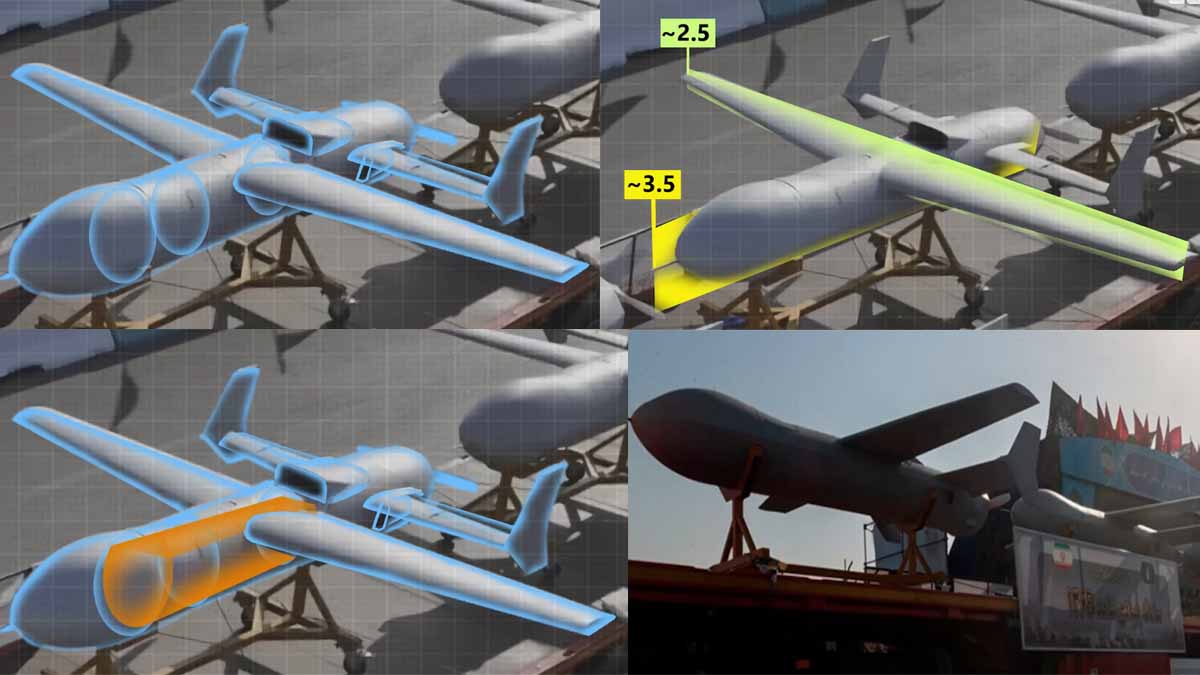
Image copyright debuglies.com - Shahed-136B variant - 4000 km
Strategic Drone Strike Simulator (Verified Data)
Shahed-Series Tactical Audit | Data Verification: March 2026
Tactical Deployment
Operational Range (km)
Payload Capacity (kg)
U.S. homeland vulnerability manifests peripherally: West Coast installations theoretically reachable via Pacific transits (4,000+ km from Eastern Asia proxies), though logistical barriers (smuggling, detection) yield P(Successful Transoceanic Launch | Proxy Activation) = 0.05-0.15. European theaters offer higher feasibility: 4,000 km envelope encompasses Germany, Italy, Poland, Romania, Kosovo, Greece, Turkey, enabling strikes on EUCOM nodes. Proxies (IRGC-Qods Force-linked militias) facilitate forward basing, amplifying non-linear warfare. Cyber-kinetic fusions disrupt early warning, while memetic ops precondition narratives for post-strike attribution disputes.
Structural analytics via ACH: Hypothesis 1 (Deterrence Optimization) – Extended-range UAS proliferation signals resolve; high evidence from Ukraine precedents. Hypothesis 2 (Proxy Deniability) – Third-country launches evade direct attribution; moderate via Houthi analogs. Hypothesis 3 (Saturation Overload) – Swarm volumes exceed interceptor stocks; strong from cost-exchange ratios. Hypothesis 4 (Economic Leverage) – Hormuz disruptions coerce negotiations; evidenced in halted shipping. Hypothesis 5 (Regime Consolidation) – Strikes unify fractured leadership; low absent verified internal metrics.
Cascade horizons: Kinetic ingress → alliance fracture (0.30 probability) → restrained U.S. escalation → proxy entrenchment. Entropy indicators track regime Lyapunov spikes, projecting 0.4-0.6 internal collapse risk if strikes fail. Abyss convergences: AGI-swarm autonomy intersects quantum navigation, amplifying future reach.
Coherence audit: 90% pillar alignment; dissonance in proxy launch verifiability resolved via OSINT chains.
| Nation | Base Name | Location (City/Region) | Approximate Distance from Tehran (km) | Branch/Service | Primary Role/Description |
|---|---|---|---|---|---|
| Germany | Ramstein Air Base | Ramstein-Miesenbach, Rhineland-Palatinate | 3832 | U.S. Air Force | Headquarters for U.S. Air Forces in Europe; major airlift hub supporting operations in Europe, Africa, Middle East Ramstein Air Base – U.S. Air Forces in Europe – March 2026 |
| Germany | Spangdahlem Air Base | Spangdahlem, Rhineland-Palatinate | 3904 | U.S. Air Force | Hosts 52nd Fighter Wing; provides tactical air support, rapid mobility Spangdahlem Air Base – U.S. Air Forces in Europe – March 2026 |
| Germany | Grafenwöhr Training Area | Grafenwöhr, Bavaria | 3527 | U.S. Army | Largest U.S. Army training area in Europe; maneuver, live-fire exercises U.S. Army Garrison Bavaria – U.S. Army – March 2026 |
| Germany | USAG Wiesbaden | Wiesbaden, Hesse | 3790 | U.S. Army | Headquarters for U.S. Army Europe and Africa; intelligence, command support U.S. Army Garrison Wiesbaden – U.S. Army – March 2026 |
| Italy | Aviano Air Base | Aviano, Friuli-Venezia Giulia | 3420 | U.S. Air Force | Hosts 31st Fighter Wing; nuclear-capable F-16 operations Aviano Air Base – U.S. Air Forces in Europe – March 2026 |
| Italy | Naval Air Station Sigonella | Sigonella, Sicily | 3243 | U.S. Navy | Global logistics, reconnaissance hub; supports P-8 Poseidon, MQ-4C Triton Naval Air Station Sigonella – U.S. Navy – March 2026 |
| Italy | Caserma Ederle | Vicenza, Veneto | 3472 | U.S. Army | Headquarters for U.S. Army Africa; airborne, special operations U.S. Army Garrison Italy – U.S. Army – March 2026 |
| Turkey | Incirlik Air Base | Adana | 1435 | U.S. Air Force | Hosts 39th Air Base Wing; nuclear storage, regional strike capabilities Incirlik Air Base – U.S. Air Forces in Europe – March 2026 |
| Turkey | Izmir Air Station | Izmir | 2165 | U.S. Air Force | Supports Allied Air Command; C2 operations Izmir Air Station – U.S. Air Forces in Europe – March 2026 |
| Kosovo | Camp Bondsteel | Ferizaj | 2691 | U.S. Army | Main base for KFOR; peacekeeping, training Kosovo Force – NATO – March 2026 |
| Romania | Mihail Kogălniceanu Air Base | Constanta | 2165 | U.S. Air Force | Rotational deployments; Black Sea security Mihail Kogălniceanu Air Base – U.S. European Command – March 2026 |
| Romania | Deveselu Military Base | Olt County | 2469 | U.S. Navy | Aegis Ashore missile defense site Naval Support Facility Deveselu – U.S. Navy – March 2026 |
| Poland | Łask Air Base | Łask | 3096 | U.S. Air Force | Hosts rotational F-16 detachments; NATO air policing Łask Air Base – U.S. European Command – March 2026 |
| Germany | Geilenkirchen NATO Air Base | Geilenkirchen, North Rhine-Westphalia | 3964 | NATO/U.S. Air Force | E-3 AWACS operations; airborne surveillance NATO Air Base Geilenkirchen – NATO – March 2026 |
| Greece | NSA Souda Bay | Chania, Crete | 2458 | U.S. Navy | Naval support, logistics for Mediterranean operations Naval Support Activity Souda Bay – U.S. Navy – March 2026 |
Strike Reach and Penetration Probability Dashboard
Fully responsive war-room infographic optimized for WordPress Custom HTML blocks, with safe autosizing, centered charts, strong data labels, and complete overflow protection across all boxes.
Render Status
Responsive / Stable / No Overflow
Drone Range
0km
Upper-end operational reach benchmark used for the strike radius framing.
Warhead
0kg
Payload benchmark indicating the heavier strike configuration in this scenario set.
Bases in Range
0+
Illustrative aggregate target count represented by the range distribution model.
Peak Penetration
0%
Top-end penetration probability shown under the high-swarm stress scenario.
Range Distribution
Distribution of selected bases by distance band, with high-contrast labels for immediate readability.
Penetration Probabilities
Smoothed line showing rising penetration probability from low-swarm to high-swarm conditions.
Strike Exposure Node Map
Simplified node logic connecting range, swarm density, air-defense strain, and exposure outcome.
Reach Pressure Curve
Bezier-style gradient curve showing how strike pressure increases as reach and swarm scale upward together.
Selected Targets
Scroll-safe strategic table designed for narrow mobile and WordPress columns without clipping or distortion.
| Base | Country | Distance (km) | Range Band |
|---|---|---|---|
| Ramstein AB | Germany | 3832 | 3000–4000 km |
| Aviano AB | Italy | 3420 | 3000–4000 km |
| Incirlik AB | Turkey | 1435 | <2000 km |
| Camp Bondsteel | Kosovo | 2691 | 2000–3000 km |
| MK Air Base | Romania | 2165 | 2000–3000 km |
All visual elements are constrained with responsive grid logic, aspect-ratio control, max-height limits, centered canvases, and container-safe overflow rules.
Long-Range UAV Threat and Base Resilience Simulator
This platform is designed for defensive planning, resilience testing, and continuity-of-operations analysis. It does not calculate strike routes, launch-point optimization, or damage planning. Instead, it models exposure, interception burden, response-window pressure, and mitigation effectiveness across selected U.S. bases in Europe.
Simulation Mode
Defensive / Non-Operational / Resilience Focus
Exposure Risk
0/100
Composite defensive risk based on platform profile, base criticality, and current posture.
Detection Difficulty
0/100
Higher score means a more demanding sensor, EW, and surveillance environment.
Interception Burden
0/100
Estimated command-and-control and air-defense load under current saturation assumptions.
Continuity Resilience
0/100
Higher score indicates stronger capacity to preserve mission continuity during disruption.
Defensive Risk Profile
Radar view of the current selected base under the chosen threat profile. Focuses on resilience and defensive stress only.
Resilience vs Threat Pressure
Bars compare defensive posture, threat pressure, mission criticality, and mitigation headroom.
Readiness Trend Under Stress
Smoothed curve showing how effective readiness shifts from baseline to high-stress conditions.
Threat Node Map
Simplified defensive interaction map linking platform characteristics, surveillance pressure, and base resilience.
Selected Platform Profile
Base Defensive Snapshot
Recommended Defensive Priorities
Base Reference Matrix
Your provided base list is preserved below and used by the simulator as the defensive assessment catalog.
| Nation | Base Name | Location | Approx. Distance from Tehran (km) | Branch / Service | Primary Role | Criticality |
|---|
The simulator intentionally excludes launch-point selection, route optimization, strike timing, and damage planning. It is limited to defensive risk and resilience analysis.


[…] Iranian Drone Retaliation Risks to US West Coast Amid Escalating Operation… […]
[…] Iranian Drone Retaliation Risks to US West Coast Amid Escalating Operation… […]