












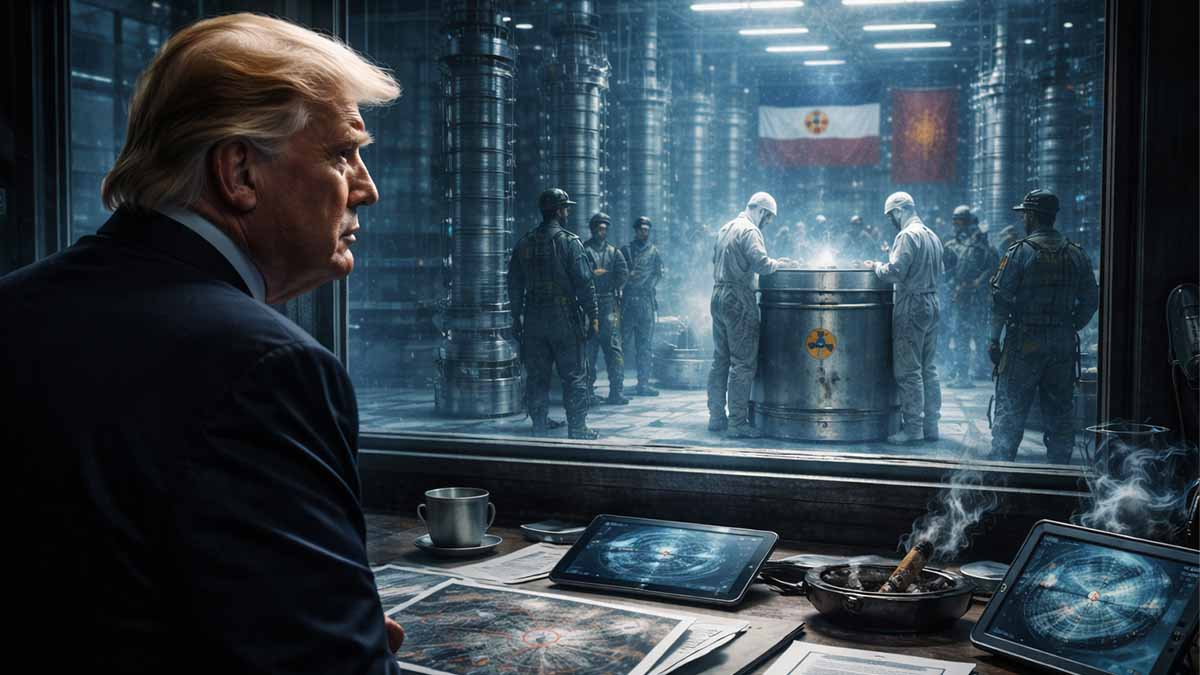
Abstract
The central paradox of the ongoing US-Israel military campaign against Iran — formally initiated on 28 February 2026 — is not tactical but epistemic: the stated casus belli is the neutralisation of Iran’s nuclear capability, yet the most strategically decisive element of that capability, its stockpile of highly enriched uranium (HEU), remains physically intact, geographically dispersed, and functionally inaccessible to both the attacking forces and the international community’s verification architecture.
The magnitude of the problem. Prior to Israel’s opening strikes on 13 June 2025, the International Atomic Energy Agency (IAEA) had verified that Iran held 440.9 kilograms of uranium enriched to 60% U-235 — a purity level representing the sharpest near-weapons-grade threshold reached by any non-nuclear-weapon state in history. By the IAEA‘s own proliferation yardstick, approximately 92.5 pounds (roughly 42 kg) of 60%-enriched uranium is sufficient, upon further enrichment to 90%, to produce a single nuclear weapon. Iran’s stockpile, therefore, represented enough fissile feedstock for approximately ten nuclear devices if further processed. Before last June’s US strikes, Iran had amassed a stockpile of uranium enriched to 60% purity, with the IAEA estimating the total at approximately 972 pounds, enough for around ten nuclear weapons if enriched further to weapons-grade. WTOP
What the June 2025 strikes did — and did not — accomplish. The US bombing campaign on 22 June 2025 targeted the Fordow and Natanz enrichment facilities and a research installation near Isfahan. President Trump subsequently declared that the strikes had “obliterated” Iran’s nuclear programme. The IAEA was more circumspect: Director-General Rafael Mariano Grossi characterised the damage as severe but explicitly not total. The critical distinction — systematically elided in White House communications — is between enrichment infrastructure and fissile material stockpiles. Israeli and US strikes in June 2025 appear to have severely damaged Iran’s two operating uranium enrichment facilities at Natanz and Fordow, likely rendering them inoperable and therefore unable to enrich uranium to weapons-grade levels. However, there is no evidence to suggest that Iran is resuming proliferation-sensitive nuclear activities, such as uranium enrichment, that would be necessary to produce nuclear material for a bomb. Arms Control Association Centrifuge halls can be bombed. HEU, buried underground in hardened tunnel complexes, is far more resistant to conventional munitions.
The Isfahan problem — the strategic crux. The beating heart of the uranium dilemma is the Isfahan Nuclear Technology Centre and its associated underground tunnel network. The IAEA has said that Iran stored most of its highly enriched uranium at an underground tunnel complex at its Isfahan facility, while the tunnel complex near Isfahan appears largely undamaged and continues to draw scrutiny. Al Jazeera As of 9 March 2026, Grossi publicly confirmed what diplomatic channels had long suspected: almost half of Iran’s uranium enriched to up to 60% purity was stored in a tunnel complex at Isfahan and is probably still there, with IAEA chief Rafael Grossi estimating that Isfahan held until the last inspection a bit more than 200 kilograms of the 60% material. The National Additional quantities are believed to remain at Natanz, the entrance buildings of which sustained further damage in March 2026 strikes while the underground plant itself remained structurally intact.
The Isfahan tunnel architecture presents a physics problem that no existing conventional munition has solved. According to CNN reporting on a classified briefing for members of Congress after the June strikes, Chairman of the Joint Chiefs of Staff, General Dan Caine, said that the underground storage areas at Isfahan are too deeply buried for even the Massive Ordnance Penetrator (MOP) to destroy, so the United States did not try to destroy them and focused on the tunnel entrances instead. Arms Control Association The MOP, the GBU-57A/B, is the largest conventional bunker-buster in the US arsenal, weighing approximately 30,000 lbs and capable of penetrating roughly 60 metres of reinforced concrete. It was not sufficient. The uranium is therefore untouched not by political timidity, but by the physical limits of non-nuclear conventional weaponry against deeply hardened geological formations.
The ground-force option — scope and risk. If air power cannot reach the uranium, logic compels consideration of a ground operation to retrieve or destroy it. Recovering Iran’s remaining highly enriched uranium stockpile, believed to be sitting in a storage facility deep underground, would require a significant number of US ground troops beyond a small special operations footprint, according to seven current and former officials familiar with military planning. A mission to physically infiltrate the tunnels would require dozens if not hundreds of additional troops on the ground to support the core special operations team, particularly given the Iranian military’s continued control over the sites and surrounding area. CNN The analogy to the 2011 Operation Neptune Spear (the Bin Laden raid in Abbottabad) is instructive only in its limits: that operation involved a single high-value human target in a residential compound. Retrieving metric quantities of radioactive nuclear material from hardened military tunnels in an active war zone is a categorically different undertaking — logistically, tactically, and politically.
President Trump is acutely sensitive to historical precedent here. The spectre of Operation Eagle Claw — the failed Delta Force mission of April 1980 to rescue American hostages from Tehran, which contributed materially to President Carter’s electoral defeat — remains a powerful inhibitor against committing ground forces to Iranian territory. That sensitivity must be weighed against a countervailing pressure: without the outright collapse of the regime, some level of diplomatic engagement rather than just sheer military power will likely be required to eliminate Iran’s enriched uranium stockpile, according to multiple sources. CNN
The transport and custody problem. Even if a special operations team successfully penetrated the Isfahan tunnels and secured the HEU, the problem does not end there. Highly enriched uranium is not an object that can be loaded onto a helicopter. It is a radiologically dangerous, chemically reactive material requiring specialised containment vessels, radiation shielding, trained nuclear handlers, dedicated transport aircraft, and a receiving jurisdiction with both technical capacity and political willingness to accept it. This “where does it go?” problem remained formally unresolved as of this writing.
The most serious diplomatic track for resolving the custody issue — transfer to Russia — has now been explicitly rejected by Trump. In a phone call with President Trump, Russian President Vladimir Putin proposed moving Iran’s enriched uranium to Russia as part of a deal to end the war, but Trump turned him down. Securing Iran’s roughly 450 kilograms of 60%-enriched uranium — enough for more than 10 nuclear bombs — is one of the US and Israel’s key war objectives, and while Russia is already a nuclear power and previously stored Iran’s low-enriched uranium under the 2015 nuclear deal, the US position is that the uranium needs to be secured but a Russian transfer is not the accepted mechanism. Axios The JCPOA-era precedent — in which low-enriched uranium was shipped to Russia as part of the 2015 framework — is therefore not replicable in the current diplomatic climate, as the geopolitical trust architecture that made that transaction possible no longer exists.
Iran’s own access difficulties. A paradox of the current military situation is that Iran itself may be unable to access its own stockpile. Al Jazeera correspondent Ali Hashem noted that even the Iranians aren’t able to get into those facilities, with satellite imagery showing a lot of work around the facilities but no indication of successful access by Iranian forces. Al Jazeera US strikes targeted the tunnel entrance structures rather than the underground chambers themselves, creating a situation in which the material is simultaneously undestroyed and physically inaccessible to both sides. The uranium at Isfahan is accessible to the Iranians, who had been working for months after the US military strikes last year to clear the rubble of the facility’s aboveground structures and access the underground tunnels where the uranium was hidden. CNN
The verification collapse. Underlying all of the above is a fundamental epistemic crisis: the IAEA — the international community’s designated inspector and verifier — has been unable to access any of the three bombed nuclear sites since June 2025. The IAEA cannot verify whether Iran has suspended all enrichment-related activities, nor can it provide information on the current size, composition, or whereabouts of the stockpile of enriched uranium in Iran, stressing that the loss of continuity of knowledge needs to be addressed with the utmost urgency. PBS The agency has been reduced to monitoring commercial satellite imagery for vehicular activity near tunnel entrances — a far cry from the intrusive monthly verification visits that characterised the pre-2021 regime. This verification blackout creates a compounding strategic problem: in the absence of confirmed knowledge, each actor (US, Israel, Iran, Russia, China) operates on assumptions that may diverge materially from physical reality.
Trump’s rhetorical inconsistency — the strategic signal. Trump launched the February 2026 campaign explicitly citing the prevention of Iranian nuclear weapons as primary justification, then stated days later that he was “not focused on that goal at all.” The White House has documented 74 separate instances in which Trump stated that Iran cannot have a nuclear weapon, spanning from February 2025 through March 2026, with statements including “they can’t have nuclear weapons” and “you can’t have peace in the Middle East if they have a nuclear weapon.” The White House The pivot away from that stated goal in public communications likely reflects one or more of three dynamics:
- (a) recognition that the goal is not achievable through available means on the current timeline,
- (b) a negotiating posture designed to lower Iranian expectations before a deal,
- (c) the emergence of secondary war objectives — regime change, Hormuz leverage, domestic political rally effects — that have effectively displaced the nuclear question.
The Pickaxe Mountain dimension. Beyond the Isfahan stockpile question, a new site has entered the strategic calculus. Trump himself acknowledged on 10 March 2026 that Iran had “started work at another site, a different site protected by granite.” The “different site” Trump mentioned was likely the facility at Pickaxe Mountain, which is under construction near the Natanz nuclear complex and buried up to 100 meters below a mountain of granite — a facility the United States and Israel did not target during the June 2025 strikes, likely because it was not yet nearing completion. FDD A facility buried 100 metres beneath a granite mountain represents a hardening benchmark that exceeds even the Isfahan challenge. It also represents Iran’s forward posture: the regime, anticipating continued military pressure, has been architecturally migrating its nuclear programme to depth profiles that current and foreseeable conventional munitions cannot penetrate.
Strategic conclusion. The uranium question is not a discrete tactical problem awaiting a surgical solution. It is a convergence of physical constraints (geological depth, material radiological properties), intelligence limitations (IAEA access denial, dispersed material), operational risks (force protection in hostile territory, nuclear material handling), diplomatic failures (Russia transfer rejected, JCPOA framework collapsed), and political toxicity (historical Vietnam/Eagle Claw trauma, congressional war powers tensions). The ongoing attacks cannot, as Trump claims, ensure that Iran does not develop nuclear weapons. Iran still possesses a nuclear weapons capability and will at the end of this current conflict, with the survival of the 60% enriched uranium underscoring the limits of conventional military strikes against Iran’s nuclear program. Arms Control Association Senator Chris Murphy identified the irreducible core: you cannot destroy Iran’s nuclear knowledge from the air. The human capital — the scientists, engineers, and weaponisation-relevant expertise accumulated over three decades — is not located in any tunnel. It is distributed, redundant, and ineradicable by conventional means.
Iran HEU Strategic Status · 15 March 2026
| Site | Status | HEU stored |
|---|---|---|
| Natanz (FEP) | Entrance destroyed | ~200 kg (est.) |
| Isfahan tunnels | Intact underground | >200 kg (est.) |
| Fordow (FFEP) | Severely damaged | Unknown |
| Pickaxe Mountain | Under construction | None confirmed |
| Obstacle | Type | Severity |
|---|---|---|
| Isfahan depth (~100m+) | Physical | |
| MOP penetration limit | Physical | |
| IAEA access denial | Verification | |
| Ground force risk | Operational | |
| HEU transport logistics | Logistical | |
| Russia transfer rejected | Diplomatic | |
| Eagle Claw political toxicity | Political |
Index
| Chapter | Title | Core Analytical Focus |
|---|---|---|
| I | The Physical Architecture of Inaccessibility | Isfahan tunnel geology, MOP limitations, Pickaxe Mountain, enrichment facility damage assessment |
| II | The Diplomatic-Custodial Impasse | Putin-Trump uranium transfer rejection, JCPOA precedent failure, third-country custody options, IAEA verification collapse |
| III | Scenarios and Force Calculus | Ground operation logistics, ACH++ matrix across five strategic endpoints, Monte Carlo probability distribution of HEU resolution pathways |
Chapter I — The Physical Architecture of Inaccessibility: Geology, Ordnance, and the Limits of Airpower
I.1 — The Pre-War Nuclear Infrastructure: What Was Being Protected
To understand why the HEU stockpile remains untouched, one must first reconstruct the physical architecture Iran built to protect it — a generational engineering enterprise conducted in full knowledge of Israeli and American targeting intentions.
Iran’s enrichment programme, as it stood on the eve of the June 2025 Twelve-Day War, rested on three declared operational pillars. The Natanz Fuel Enrichment Plant (FEP) — Iran’s largest — hosted thousands of gas centrifuges across both surface and deeply buried underground halls, enriching uranium primarily to low-level civilian grades, with some cascades operating at 60%. The Fordow Fuel Enrichment Plant (FFEP), constructed covertly beginning circa 2006–2007 inside a mountain near the city of Qom and only publicly disclosed after Western intelligence revealed its existence in 2009, had been repurposed under Iran’s post-JCPOA expansion to produce uranium enriched specifically to 60% U-235 — a level that has no credible civilian application. Fordow is lodged an estimated 260 feet below rock and soil, surrounded by Iranian and Russian missile defense systems, and is widely considered critical to Iran’s nuclear weapons programme — which is why it was placed at the centre of Israel and the United States’ stated objective to destroy Iran’s nuclear capabilities. Council on Foreign Relations The Isfahan Nuclear Technology Centre, meanwhile, served as the upstream feedstock processor — converting natural uranium into the UF₆ gas that enters centrifuges — but also hosted a critical underground tunnel complex used for the storage of enriched uranium in gaseous form. Isfahan was identified by IAEA Director-General Grossi as the most likely site for Iran’s future third uranium enrichment facility that Tehran hinted at on 12 June 2025, one day before Israeli strikes began. Center for Strategic and International Studies
The strategic logic of Iran’s site architecture was not accidental. After Israel destroyed Iraq’s Osirak reactor in 1981 and Syria’s Al-Kibar reactor in 2007, Tehran drew the operational lesson with precision: disperse, bury, and harden. The resulting nuclear geography — facilities separated by hundreds of kilometres across Iran’s vast interior, each with underground chambers at different depths and geological compositions — was specifically engineered to survive a conventional air campaign. The IAEA, whose inspectors had access to these sites until mid-June 2025, confirmed the basic outline of the physical picture. What they could not confirm — and still cannot — is the precise current status of the material inside.
I.2 — Operation Midnight Hammer: What the Bombs Actually Did
On the evening of 22 June 2025, the United States Air Force executed the most consequential non-nuclear strike in its history. Seven B-2 Spirit bombers of the 509th Bomb Wing departed from Whiteman Air Force Base in Missouri and flew eastward for approximately 18 hours, refueling mid-air three times. At 2:10 am local Iranian time, six B-2s began dropping 12 GBU-57A/B MOP bombs on the Fordow facility, and the seventh B-2 dropped two MOPs on Natanz. A submarine simultaneously fired 30 Tomahawk missiles at Natanz and Isfahan. Wikipedia
The execution of the Fordow strike deserves particular analytical attention, as it reveals both the extraordinary capability the MOP represents and the limits it nonetheless encountered. At Fordow, the 12 bunker-buster bombs were dropped sequentially on two ventilation shafts to penetrate deeply into the mountain. According to Chairman of the Joint Chiefs of Staff General Dan Caine: “The cap was forcibly removed by the first weapon and the main shaft was uncovered. Weapons two, three, four, and five were tasked to enter the main shaft, move down into the complex at greater than 1,000 feet per second and explode in the mission space.” Wikipedia This sequential “drill-hole” technique — each subsequent bomb boring deeper into the cavity excavated by its predecessor — represents the outer edge of American conventional strike engineering. The Defence Threat Reduction Agency (DTRA) had spent over 15 years studying the Fordow target specifically: a DTRA officer was brought into a vault in 2009, shown classified intelligence of what looked like a major construction project in the Iranian mountains, and then lived and breathed that single target — Fordow — for more than 15 years, studying its geology, ultimately concluding that the existing arsenal had no weapon capable of adequately striking it, which is what prompted the GBU-57’s development in the first place. The War Zone
And yet the Isfahan tunnel complex — the primary HEU storage site — was not struck with any MOP at all. It was hit only with Tomahawk cruise missiles, which are sea-launched subsonic weapons designed for surface and shallow sub-surface targets, not deeply buried underground storage chambers. The reason is unambiguous: the US military did not use a GBU-57 bunker-buster MOP on Iran’s Isfahan nuclear facility because the site is so deep that the MOP would have been ineffective, according to General Dan Caine in a classified briefing to US senators — the first known reason shared by the military for not using the GBU-57 at Isfahan, a site where US officials believe nearly 60% of Iran’s enriched uranium stockpile is stored. EURASIAN TIMES
This is the central military fact of the entire campaign that subsequent White House triumphalism systematically obscured: the most powerful non-nuclear weapon in the American arsenal was explicitly assessed as incapable of reaching the primary target. The Tomahawks destroyed Isfahan’s surface buildings — the conversion plant, the fuel fabrication facility, several support structures — but left the underground tunnel complex, and the HEU stored within it, physically intact. Satellite imagery confirmed that the Tomahawk strikes at Isfahan dealt significant damage to several above-ground buildings at the nuclear complex, while the underground tunnel complex — where the enriched uranium is stored — was not targeted with penetrating munitions. Center for Strategic and International Studies
I.3 — The MOP Penetration Physics: Why the Geology Wins
The GBU-57A/B Massive Ordnance Penetrator is an engineering achievement of extraordinary scale. It weighs 30,000 pounds — comparable to a city bus — compressed into a cylinder approximately 20 feet long and 2.5 feet thick. When dropped from the B-2’s cruising altitude of 50,000 feet, it impacts at an estimated velocity exceeding Mach 1, delivering 800 to 900 megajoules of kinetic energy, and its 5,300-pound explosive charge then detonates deep underground. Scientific American The warhead employs high-performance explosives — AFX-757 and PBXN-114 — contained in a BLU-127 family casing engineered from high-strength steel specifically to resist fracture during penetration. Its adaptive fuze detects structural voids during penetration and times detonation for maximum effect. The weapon’s first confirmed combat use came on 22 June 2025 during Operation Midnight Hammer, when the Air Force reportedly dropped 12 bombs on the Fordow nuclear site alone. Army Recognition
And yet physics imposes immutable constraints. According to a 2012 Congressional Research Service briefing, the GBU-57/B has been reported to burrow through 200 feet of concrete or bedrock with a compressive strength of 5,000 pounds per square inch — comparable to the strength of bridge decks or parking-garage slabs. Scientific American The key phrase is “comparable to bridge decks”: granite, which composes the geological overburden at both Fordow and Pickaxe Mountain, has a compressive strength of 20,000 to 30,000 pounds per square inch — four to six times denser than the benchmark material in the MOP’s performance specification. At those densities and at depths exceeding 60–80 metres, the weapon’s penetration envelope is functionally exhausted before it reaches the target chamber. Estimates suggest Fordow could be 80 metres beneath the surface, capped with layers of reinforced concrete and soil. The MOP is believed to be able to penetrate up to 60 metres below ground in the right conditions — meaning that even the world’s largest conventional bunker-buster is operating at or beyond its physical design limit against the deepest Iranian sites. The Conversation
This penetration gap — the distance between what the bomb can reach and where the target actually is — is the single most important technical fact in the uranium recovery problem. It explains why General Caine told senators that the MOP was simply not used against Isfahan: deploying the weapon there would have consumed irreplaceable munitions (the US is believed to hold only approximately 20 MOPs in total) against a target it could not reach, while leaving visible impact craters that would mislead both the public and adversary analysts about what had actually been achieved.
The Next Generation Penetrator (NGP), the MOP’s successor currently in development, promises deeper penetration and a reduced weight profile, with improved guidance redundancy against GPS denial. Unlike the GBU-57, the NGP will not exceed 22,000 pounds, and its guidance system will remain effective even if the enemy jams or disables GPS, while incorporating advanced fuzing to increase effectiveness against previously untested environments. Iran International The NGP is not yet operational. Iran’s tunnel engineers know this. The construction pace at Pickaxe Mountain is calibrated accordingly.
I.4 — The Isfahan Tunnel Complex: Anatomy of the Problem
The Isfahan Nuclear Technology Centre and its associated underground tunnels represent the convergence of every obstacle described above. The surface complex — a sprawling campus housing chemical laboratories, a uranium conversion facility, and fuel fabrication infrastructure — was substantially destroyed by Tomahawk missiles in June 2025. But the relevant target, the tunnel complex where HEU is stored, lies beneath and adjacent to these surface structures, insulated by geology that no available munition can penetrate reliably.
The geometry of the access problem is as follows. The tunnel entrances — the only vectors through which people, equipment, or weapons can reach the underground chambers — were sealed by US Tomahawk strikes, which destroyed the entrance buildings and collapsed rubble over the access points. This was a deliberate strategy: without being able to destroy the material itself, the next-best option was to deny access to it, trapping the HEU in situ and preventing Iranian engineers from recovering it for further enrichment or weaponisation. The underground storage areas at Isfahan are too deeply buried for even the MOP to destroy, so the United States did not try to destroy them and instead focused on the tunnel entrances. Arms Control Association
The result is a strategic paradox: the uranium is simultaneously protected from US destruction and effectively inaccessible to Iranian engineers. IAEA correspondent reporting noted that even the Iranians aren’t able to get into those facilities, with satellite imagery showing extensive work around the facilities but no indication of successful access by Iranian forces — suggesting that Tehran’s own engineers face significant engineering challenges in clearing the rubble from the sealed tunnel entrances while operating under threat of further US or Israeli strikes. Al Jazeera
Iranian engineers have nonetheless been actively attempting to restore access. The uranium at Isfahan is accessible to the Iranians, who had been working for months after the US military strikes last year to clear the rubble of the facility’s aboveground structures and access the underground tunnels where the uranium was hidden. CNN Satellite imagery through early March 2026 confirmed regular vehicular activity around the tunnel complex entrances, consistent with an ongoing engineering effort to re-establish access, though not with the scale of activity that would indicate the HEU had been successfully relocated. The IAEA observed regular vehicular activity around the entrance to the tunnel complex at Isfahan in which uranium enriched up to 20% and 60% U-235 was stored, stressing the importance of being able to carry out inspections in Iran without further delay. PBS
There is an additional and underreported complication. Iran stated that unexploded bombs remain at nuclear facilities hit by US strikes in June 2025, which Iranian Foreign Minister Abbas Araghchi cited as a physical hazard preventing inspections — noting that no existing international rules address inspections at bombed nuclear sites, especially as the US used a total of fourteen GBU-57A/B MOP bunker-buster bombs. Army Recognition The presence of potentially unexploded ordnance in or near the tunnel complex adds a kinetic hazard layer to the already formidable engineering challenge of accessing the HEU. From Iran’s perspective, an unexploded MOP recovered intact would also represent a significant intelligence windfall: physical inspection of such a weapon could allow measurement of casing thickness, alloy composition, structural reinforcement, and fuze assembly characteristics — information highly relevant for understanding penetration mechanics. Army Recognition
I.5 — Pickaxe Mountain: Iran’s Forward Posture Against Future Strikes
While the Isfahan tunnel complex represents the immediate HEU custody problem, Kūh-e Kolang Gaz Lā — “Pickaxe Mountain” to Western analysts — represents Iran’s strategic posture for the post-conflict nuclear future. Located approximately one mile south of the Natanz complex, this site was first identified by the Institute for Science and International Security (ISIS) in 2023 after satellite imagery revealed the beginnings of a significant underground construction project. It was not targeted in the June 2025 strikes — almost certainly because it was not yet operational and its precise purpose had not been definitively confirmed by American targeting analysts.
Since June 2025, construction has dramatically accelerated. Satellite imagery shows that tunnel entrances leading into the original tunnel complex dating from 2007, as well as recently built alcoves, are being reinforced with slabs of thick concrete and then buried in soil — an apparent effort to harden the entrances from any potential airstrike or sabotage operation. A multi-level security perimeter has been completed around the site. Institute for Science and International Security A Washington Post and PBS Frontline joint investigation confirmed three major changes since the June strikes: near-completion of the security perimeter, reinforcement of tunnel entrances, and a noticeable increase in excavated material indicating continued underground construction. Ali Larijani, secretary of Iran’s Supreme National Security Council, confirmed that Iran was still using the Pickaxe Mountain site. Iranian officials have said it is intended for centrifuge manufacturing, though analysts say the site could be used for uranium enrichment or storage of enriched uranium. Iran Watch
The depth parameter is the critical engineering specification. The facility is being excavated at an estimated depth of approximately 80 to 100 metres under hard granite rock, out of an Iranian understanding that this depth might provide immunity against the American GBU-57 bomb. Alma Research and Education Center More recent intelligence assessments have revised this estimate upward: the facility is buried roughly 330 feet below the mountain itself — a depth that is between 30 to 70 feet deeper than Fordow, and said to exceed the striking depth of the most powerful bunker-busting weapons in the US arsenal. Jewish Insider
This is Iran’s explicit counter-move to the MOP. Having observed the depth parameters of the June 2025 strikes and assessed their penetration achievements through damage surveys conducted at the Fordow ventilation shafts, Iranian engineers recalibrated their hardening benchmark and are constructing the next generation of nuclear infrastructure at depths explicitly designed to be immune to the current American conventional strike envelope. Before the United States and Israel end major combat operations against Iran, they must complete two urgent tasks: neutralising Pickaxe Mountain and recovering or eliminating HEU stocks. If special forces raids or longer-term HEU recovery efforts are more effective than utilising MOPs, these should occur when the security situation permits and the military is confident it can limit casualties. FDD
President Trump himself acknowledged the Pickaxe Mountain problem on 10 March 2026, stating that Iran had been “starting work at another site, a different site, protected by granite — they wanted to go a lot deeper and they started the process.” Western assessments indicate Iran relocated roughly 400–450 kg of 60% enriched uranium following US and allied strikes in 2025, with satellite imagery showing accelerated construction and hardening at Pickaxe Mountain since mid-2025, including reinforced tunnel entrances, security perimeters, and burial efforts to shield access points. Zambian Observer If this transfer has occurred or is in progress, it would represent a fundamental shift in the tactical problem: from an inaccessible but known location to a site of uncertain operational status beneath granite of a depth profile that no current munition can penetrate.
I.6 — The Centrifuge Destruction Paradox: Capability vs. Material
The June 2025 strikes were broadly assessed to have effectively destroyed Iran’s installed centrifuge capacity. Overall, Israel’s and US attacks effectively destroyed Iran’s centrifuge enrichment programme, with the attacks destroying or rendering inoperable all of Iran’s nearly 22,000 centrifuges. For the first time in over 15 years, Iran had no identifiable route to produce weapon-grade uranium in its centrifuge plants. Institute for Science and International Security IAEA Director-General Grossi testified that it was “extremely unlikely” that centrifuges survived at the three struck sites, given the equipment’s vibration sensitivity and the explosive payloads utilised.
This is a genuine and significant setback for the Iranian programme. But it does not solve the HEU problem — it reshapes it. The 441 kilograms of uranium already enriched to 60% U-235 does not require centrifuges to maintain its current enrichment level. It is fissile material that already exists. The question is not whether Iran can currently enrich uranium — it cannot, at any declared facility — but whether it can enrich the existing stockpile from 60% to the ~90% weapons-grade threshold if and when it regains enrichment capacity. Iran still possesses the centrifuges manufactured but not yet installed, and these non-destroyed parts pose a threat as they can be used in the future to produce weapon-grade uranium. Prior to the June attack, Iran had the capacity to produce more centrifuges than it installed, and likely stored machines at hardened facilities. Arms Control Association
The weapons timeline before and after the strikes is therefore asymmetric. Before June 2025, the US Defense Intelligence Agency estimated Iran could produce enough weapons-grade uranium for a single bomb in “probably less than one week” — because the enrichment infrastructure was fully operational and the 60% feedstock merely required further centrifuge passes. After the strikes, that pathway has been dramatically lengthened — but not permanently closed. It would take Iran years to fully rebuild its enrichment plants, and it is possible Iran may have a very small number of operational centrifuges somewhere undisclosed, though it would still take months for a smaller number of centrifuges to accomplish what thousands of centrifuges at the major facilities could have done — and longer still to fashion a nuclear explosive device. FactCheck.org
The distinction between “setback in months” and “setback in years” is contested by competing institutional actors with different methodological approaches and political incentives. The DIA leaked preliminary assessment of a “months” setback provoked fury from the White House and Pentagon. CIA Director John Ratcliffe offered a more optimistic read, stating the strikes had destroyed Iran’s lone metal conversion facility and that “the vast majority of Iran’s amassed enriched uranium most likely remains buried under the rubble at Isfahan and Fordow” — a framing that simultaneously acknowledged the material’s survival while characterising burial as an acceptable outcome. The analytical tension between these positions has not been formally resolved. Differences between US, Israeli, and IAEA initial assessments may stem from prioritisation of certain data types and assumptions about how Iran would resume its nuclear programme, with US intelligence appearing to treat the strikes as temporary setbacks assuming Iran will return to and repair the sites, while Israeli assessments assume Iran will abandon the struck facilities and shift to new sites. Nuclear Network
I.7 — The Knowledge Problem: What Cannot Be Bombed
The most consequential analytical insight of the entire campaign was articulated, with characteristic directness, by Democratic Senator Chris Murphy in congressional testimony: “You can’t destroy Iran’s nuclear programme from the air. You can’t destroy with missiles every single Iranian scientist who knows how to build a nuclear reactor.”
This is not a political argument — it is a technical one. Iran’s nuclear weapons-relevant knowledge base, accumulated over four decades of enrichment programme operation, is distributed across thousands of scientists, engineers, and technicians. It exists in institutional memory, in documented procedures, in material science expertise, in weaponisation-relevant understanding of implosion dynamics. Ali Vaez, director of the International Crisis Group’s Iran Project, stated that intelligence estimates suggest a successful US attack would likely set Iran’s nuclear programme back by a year or two, not stop it for good — because “even if Fordow is fully destroyed, Iran still has the know-how and the capability to reconstitute its nuclear programme.” NPR
The IAEA itself, as early as May 2025, had confirmed that three previously undeclared sites were part of a structured weaponisation programme conducted until the early 2000s. At Lavisan-Shian, inspectors assessed that undeclared uranium metal was used in 2003 to produce neutron initiators for scaled implosion tests. This represents weapons-design knowledge of the most sensitive kind — knowledge that no bomb can erase, that survived the 2003 programme suspension intact, and that has been refined by a generation of engineers who have continued working in Iran’s nuclear complex in the years since.
The operational implication is stark: even a theoretically successful physical elimination of the HEU stockpile — through ground operations, diplomatic transfer, or some not-yet-invented technical means — would not eliminate Iran’s nuclear weapons capability. It would eliminate the current fastest pathway to a weapon while leaving intact the human infrastructure capable of reconstituting that pathway. The June 2025 US attacks severely damaged Iran’s major uranium enrichment facilities, but not its resolve to retain a nuclear programme or its nuclear know-how. Nor did the operation remove or help account for 440 kilograms of uranium enriched to 60% U-235 that Iran already had stockpiled. Arms Control Association
This is the irreducible strategic reality that the physical architecture of inaccessibility ultimately serves: Iran has built its nuclear programme to survive conventional military assault not merely through geological hardening, but through epistemic distribution. The mountains are the most visible manifestation of a dispersal logic that extends from centrifuge manufacturing to nuclear design knowledge to enriched material storage. Destroying any one node — even the most important node — does not destroy the network.
| Site | Depth | MOP used? | HEU status | Verdict |
|---|---|---|---|---|
| Fordow | ~80 m | Yes (×12) | Unknown / buried | Degraded |
| Natanz FEP | ~8 m concrete | Yes (×2) | ~200 kg (est.) | Entrance sealed |
| Isfahan tunnels | >100 m | No — MOP ineffective | >200 kg intact | Untouched |
| Pickaxe Mtn. | 100 m+ granite | Not targeted | Possible transfer | Beyond reach |
| Parchin/Taleghan 2 | Unknown | Not targeted | Unknown | Unverified |
| Weapon | Weight | Penetration | Carrier |
|---|---|---|---|
| GBU-57 MOP | 13,600 kg | ~60 m (earth) | B-2 Spirit only |
| GBU-28 | 2,268 kg | ~30 m | F-15E, F-111 |
| BGM-109 Tomahawk | 1,315 kg | Surface only | Submarine / ship |
| NGP (in dev.) | <10,000 kg | >60 m (est.) | TBD |
Chapter II — The Diplomatic-Custodial Impasse: Sovereignty, Trust Architecture, and the Collapse of Every Transfer Pathway
II.1 — The Structural Anatomy of the Impasse
The custodial problem for Iran’s HEU stockpile is not, at its core, a logistics challenge. It is a layered political and legal collapse: the simultaneous failure of the diplomatic architecture that once provided a credible transfer pathway, the breakdown of the verification regime that could have given any new arrangement its teeth, and the irreconcilable divergence between Iranian definitions of sovereign legitimacy and American definitions of acceptable security outcomes. Each layer reinforces the others. Understanding the impasse requires disaggregating all three.
Begin with the foundational legal question that the current crisis has forced into acute relief: does Iran have the right to enrich uranium at all?
Tehran’s position, articulated with unwavering consistency across factional lines from reformists to hardliners, is that domestic uranium enrichment is an “inalienable right” conferred by Article IV of the Nuclear Non-Proliferation Treaty (NPT), which Iran ratified in February 1970. From the perspective of the Islamic Republic, the possession of a full nuclear fuel cycle — including domestic enrichment — is not merely a technical aspiration but an inherent sovereign right enshrined in Article IV of the NPT. Within Iran’s political consciousness, this right transcends legalistic interpretation; it has become a symbolic pillar of national autonomy and a manifestation of defiance against what is perceived as Western hegemony. Habtoorresearch Iranian Foreign Ministry spokesman Esmaeil Baghaei stated explicitly in February 2026 that “Iran’s right to the peaceful use of nuclear energy is an inherent and inalienable right, and no form of pressure or political stance can undermine this right.” Foreign Minister Abbas Araghchi framed enrichment as inseparable from sovereignty itself, declaring that no outside power could dictate what Iran may or may not possess.
The American legal counter-position is equally categorical. The United States has long maintained that Article IV of the NPT does not speak to the right of enrichment at all. As former US Undersecretary of State Wendy Sherman told a Senate committee: “The United States has always believed that Article IV of the Nuclear Non-Proliferation Treaty does not speak about the right of enrichment at all, and doesn’t speak to enrichment, period. So we do not believe there is an inherent right by anyone to enrichment.” Iran Watch The American view holds that Iran’s decades of safeguards violations — undeclared enrichment facilities, covert construction of Natanz and Fordow, assistance received from A.Q. Khan’s Pakistan network, and nuclear trigger testing at Lavisan-Shian — have in any case forfeited whatever rights Iran might otherwise have claimed under the treaty.
This legal disagreement is not a footnote. It is the structural foundation of every negotiating impasse since 2003. Iran, like other NPT members, interprets Article IV as inclusive of uranium enrichment and maintains that it will not give up its right to enrich under any nuclear agreement. The NPT declares it is the “inalienable right” of all states to develop nuclear programs for peaceful purposes under IAEA safeguards, though the NPT does not specify whether uranium enrichment and plutonium reprocessing are included within the rights specified under Article IV. Arms Control Association Every American president since George W. Bush has eventually confronted this impasse and been forced to find some accommodation with it — except Trump, who in both terms has attempted to resolve the ambiguity by eliminating enrichment entirely rather than capping it. That maximalist position, as this chapter will demonstrate, is the primary driver of the current diplomatic collapse.
II.2 — The Diplomatic Sequence: From Muscat to Geneva to War
The series of Omani-mediated negotiations conducted between February 6 and February 26, 2026 represent the last diplomatic effort to resolve the HEU custody question before the outbreak of the current war. Their collapse — or more precisely, their interruption by military action two days after the final session — is the immediate proximate cause of the present impasse.
The first round of 2026 talks was held in Muscat, Oman on 6 February, the first negotiating contact since the June 2025 ceasefire following the Twelve-Day War. For the first time at talks between the nations, America brought its top military commander in the Middle East to the table — US Navy Admiral Brad Cooper, head of US Central Command, appearing in dress uniform alongside Witkoff and Kushner, serving as a reminder that the aircraft carrier USS Abraham Lincoln and other warships were positioned off Iran’s coast. The Times of Israel The deliberate inclusion of a uniformed CENTCOM commander in diplomatic negotiations was itself a coercive signal: this was not a conventional diplomatic exchange but an ultimatum-adjacent process, conducted with kinetic leverage made visible at the table.
The Iranian side, led by Araghchi, characterised the Muscat talks as taking place “in a positive atmosphere” and said they would decide next steps after consultations in Tehran. Iran’s state-run IRIB TV reported that Omani Foreign Minister Sayyid Badr bin Hamad al-Busaidi held several meetings with the Iranian and US delegations, facilitating the exchange of viewpoints — though the “very deep distrust” between Washington and Tehran was identified as posing a very big challenge to the negotiations that the parties would first have to overcome. CGTN
The second round convened in Geneva, Switzerland on 26 February, structurally the most significant session. Less than 48 hours before the US and Israeli coordinated strikes on Iran began on 28 February, US Special Envoy Steve Witkoff and Jared Kushner met with Iranian Foreign Minister Araghchi in Geneva for a third round of Omani-mediated talks. Despite Omani Foreign Minister Badr bin Hamad al-Busaidi’s assessment that the United States and Iran made “substantial progress” toward a nuclear deal and the agreement to meet again on 2 March for technical talks, Trump said he was “not happy” with the progress or the way they were negotiating. The following day, the United States and Israel attacked Iran. Arms Control Association
The timing of the military operation — launched less than 48 hours after the Omani mediator publicly described “substantial progress” and the parties had agreed on a follow-up session — is the most consequential fact in the recent diplomatic history. It strongly suggests that the decision to go to war had been made before the Geneva talks concluded, and that the diplomatic process was functioning not as a genuine last-resort alternative to military action but as either a good-faith effort derailed by presidential impatience or, more troublingly, as political cover for a war already decided. By the time the third round of talks ended in Geneva, Trump had likely already made the decision to go to war. Arms Control Association
The positions of the two sides at the Geneva table were clearly defined, though far from reconciled. The US came into the talks with demands that Iran agree any future nuclear deal will remain in effect indefinitely — with no sunset clauses — and that Iran give up on its stockpile of 10,000 kg of enriched uranium across all enrichment levels. The US was willing to show a degree of flexibility on Iran’s demand to retain the right to enrich uranium, but only if Tehran could prove there was no path to a bomb. A senior Iranian official told Al Jazeera that Iran had rejected the idea of permanently abandoning uranium enrichment, dismantling its nuclear facilities, and moving its uranium stockpiles out of the country. CNBC
Iran’s own proposals at Geneva were more nuanced than the standard Western framing of them suggests. In the latest round of talks through the Omani intermediary, Iran had offered to suspend enrichment for the next three years — that is, for as long as Trump is president. After then, it would limit enrichment to purity levels of 1.5 percent and allow international inspectors to verify the pledge. Slate Additionally, Iranian Deputy Foreign Minister Majid Takht-Ravanchi had confirmed in a BBC interview that Tehran was prepared to discuss curbing its programme, including measures related to its roughly 400 kg HEU stockpile, in exchange for sanctions relief — explicitly offering to dilute its most highly enriched uranium in exchange for the removal of financial sanctions. Iran’s atomic energy chief indicated Tehran could dilute its most highly enriched uranium in exchange for removal of all financial sanctions. However, Takht-Ravanchi was explicit that the idea of zero enrichment was not on the negotiating table from Iran’s perspective. Iran International
The White House’s characterisation of Iran’s position as a rejection of peace is technically accurate in the narrowest sense — Iran did not accept zero enrichment — but analytically misleading about the negotiating space that existed. A deal capping enrichment at civilian levels, with an HEU dilution commitment, intrusive IAEA verification, and sanctions relief was a plausible framework. It was also exactly what the JCPOA represented. Trump’s refusal to consider any arrangement resembling the JCPOA — which he has repeatedly characterised as the worst deal in history — foreclosed the most obvious available solution.
II.3 — The JCPOA Precedent: What Worked, Why It Failed, and Why It Cannot Be Simply Replicated
The Joint Comprehensive Plan of Action, finalised in Vienna on 14 July 2015 between Iran and the P5+1 — the five permanent UN Security Council members plus Germany — remains the most comprehensive nuclear custodial framework ever negotiated with a threshold state. Understanding its architecture, its genuine achievements, and its ultimate failure is essential context for evaluating whether any analogous arrangement can now be constructed under conditions dramatically more hostile than those that produced the original deal.
Under the JCPOA, Iran agreed to a sweeping set of constraints. Over 15 years, Iran would reduce its stockpile of low-enriched uranium by 97%, from 10,000 kg to 300 kg, and limit enrichment to 3.67%, sufficient for civilian nuclear power and research but not for weaponry. Key facilities at Fordow, Natanz, and Arak were repurposed for civilian uses. Iran agreed to accept more intrusive IAEA monitoring measures of its fuel-cycle related activities. Wikipedia The agreement extended to the plutonium pathway as well: the Arak IR-40 heavy water reactor’s core was removed and filled with concrete, physically foreclosing that alternative route to fissile material.
Crucially for the current HEU custody crisis, the JCPOA established a precedent for uranium transfer to a third country. Excessive quantities of low-enriched uranium — over 9 tons — would be diluted to the natural uranium level or exported to another state, specifically Russia, in exchange for natural uranium imported by Iran. Russia agreed to provide Iran low-enriched uranium fuel and to take back the spent fuel under agreements dating back to 2005. Carnegie Endowment for International Peace Russia was thus the established custodial precedent for Iranian nuclear material, technically capable of receiving and safeguarding the material, operating as a guarantor power under a framework validated by the entire UN Security Council.
The verification architecture was equally impressive. The deal expanded IAEA monitoring to an unprecedented level of intrusiveness, providing daily access to Natanz and Fordow, implementing the Additional Protocol allowing snap inspections at undeclared sites, and requiring continuous surveillance of declared facilities. The IAEA verification regime was effective at providing transparency into Iran’s nuclear program, which allowed Iran to raise confidence that it was not producing nuclear weapons. The JCPOA blocked the two paths to accumulate weapons-grade fissile material for a nuclear weapon: enriching uranium-235 to 90% purity or higher, and separating plutonium. Center for Arms Control and Non-Proliferation
What the JCPOA did not do — and this is the fault line Trump exploited — was permanently resolve the enrichment question. The deal contained sunset clauses: limits on enrichment levels would expire after 15 years, limits on centrifuge numbers after 10 years. Critics, particularly in Israel and among Republican hawks in the US Senate, argued that the deal merely delayed the problem rather than solved it. Key provisions of the JCPOA included reduction in centrifuges, capping uranium enrichment, monitoring by the IAEA, and lifting of nuclear-related sanctions, but Trump withdrew because he believed the deal’s sunset provisions were unacceptable and feared a nuclear arms race in the Middle East. Encyclopedia Britannica
Trump’s withdrawal from the JCPOA on 8 May 2018 — despite the IAEA confirming Iranian compliance — initiated a chain of compounding disasters that directly produced the current crisis. Iran, stripped of sanctions relief without receiving compensating benefits from the remaining signatories, began a stepwise reescalation of its enrichment programme from July 2019 onward: first exceeding the LEU stockpile cap, then enriching beyond 3.67%, then reaching 20%, then 60%. Each step was a deliberate, calibrated provocation designed to maintain diplomatic leverage while stopping short of the 90% weapons-grade threshold. The JCPOA’s abandonment did not prevent Iran from accumulating the very stockpile that now constitutes the strategic crisis — it created the conditions for that accumulation.
On 18 October 2025 — ten years after the deal’s adoption day — Iran officially declared the JCPOA terminated. Ten years after adoption day, the option to reimpose previous UN sanctions using the snapback mechanism expired with the termination of Resolution 2231. Arms Control Association Russia and China separately declared that they viewed the JCPOA as legally void and the UN sanctions reimposed under the European snapback mechanism in August-September 2025 as legally invalid. The institutional framework that once provided the legal and logistical foundation for Iranian HEU transfer to Russia has therefore been formally dissolved by all parties simultaneously.
II.4 — The Russia Transfer Option: Architecture of a Dead Channel
The Putin-Trump exchange of 13 March 2026 crystallises the custodial impasse with extraordinary precision. In a phone call with President Trump, Russian President Putin proposed moving Iran’s enriched uranium to Russia as part of a deal to end the war. Trump turned him down. Securing Iran’s roughly 450 kilograms of 60%-enriched uranium is one of the US and Israel’s key war objectives, and while Russia is already a nuclear power and previously stored Iran’s low-enriched uranium under the 2015 nuclear deal, the US position is that the uranium needs to be secured — but a Russian transfer is not the accepted mechanism. “This is not the first time it was offered. It hasn’t been accepted. The US position is we need to see the uranium secured,” a US official said. Axios
This rejection deserves careful structural analysis, because on its surface the Russian option appears genuinely attractive as a technical solution to the physical custody problem.
Russia’s technical credentials for custodial receipt are beyond question. It is one of the world’s major nuclear powers, home to the Rosatom state nuclear corporation — the largest civil nuclear company on the planet, operator of Bushehr under a fuel supply and spent fuel return agreement that predates the JCPOA. Russia has the metallurgical expertise, radiation handling infrastructure, storage facilities, and international legal standing to receive, safeguard, and either down-blend or re-export the material. The JCPOA itself validated this arrangement for Iran’s LEU: Russia had already been providing Iran low-enriched uranium fuel and taking back spent fuel under agreements dating to 2005 before the reactor was even completed. Carnegie Endowment for International Peace The precedent exists, the technical infrastructure exists, and Russia raised the same proposal repeatedly — during the May 2025 pre-war negotiating round, in the weeks before the February 28 offensive, and again on 13 March 2026.
But the geopolitical trust calculus that made the 2015 transfer credible has been comprehensively destroyed by three intervening developments. First, Russia’s strategic alliance with Iran has deepened dramatically since 2022, with IRGC-supplied Shahed drones constituting a primary attrition weapon in Russia’s war in Ukraine — a conflict in which Tehran is functionally a co-belligerent on Moscow’s side. Second, Russia itself has declared the JCPOA void and the subsequent UN sanctions invalid, explicitly aligning itself with Iran and China against the Western sanctions architecture. Third, American strategic decision-making in the current conflict is operating on the premise — stated explicitly by Trump on 13 March 2026 — that Russia is actively “helping [Iran] a little bit” through intelligence provision. Placing the material that constitutes the war’s primary stated objective under the control of a country simultaneously characterised as an intelligence partner to the adversary would not merely fail the political test — it would make the war’s nuclear objective operationally incoherent.
The Kremlin’s offer, in this analytical frame, reads less as a genuine conflict-resolution mechanism and more as a strategic positioning move: a proposal that Moscow knew would be rejected, designed to demonstrate Russia’s potential role as indispensable mediator while simultaneously exposing what critics of the war argue is its actual objective — something other than the uranium. Iran had previously rejected the option of transferring its uranium abroad during the last round of negotiations before the war. Instead, Tehran proposed reducing the enrichment level of the material inside its own facilities under the supervision of the IAEA. It remains unclear whether Iran would now consider the proposal. Africa Eye The circularity is complete: the one power with the physical infrastructure to receive the material is trusted by neither the United States nor Iran; and Iran itself pre-rejected external transfer before the war began.
II.5 — The American Negotiating Position: Maximalism and Its Costs
The Trump administration’s negotiating posture across the three rounds of 2026 talks displayed a structural rigidity that Arms Control Association analysts described as “ill-prepared for serious negotiations.” Witkoff said he concluded from Araghchi’s rejection of a US offer that Iran was “angry for another reason” and was trying to “divert our attention away from the fact that all they really wanted to do was enrich.” Iran’s rejection of free nuclear fuel and emphasis on fueling its own reactors should not have been a surprise to Witkoff, since Iran views enrichment as an issue of national sovereignty — a right conferred by Article IV of the NPT. It is consistent with Iran’s past positions to reject any nuclear agreement if the price was zero enrichment. Arms Control Association
The US negotiating demand package as it stood entering Geneva comprised four elements: (a) permanent and total elimination of all Iranian uranium enrichment, with no sunset clauses; (b) dismantlement of the three primary nuclear facilities at Fordow, Natanz, and Isfahan; (c) physical removal of all enriched uranium stockpiles to a non-Iranian location; and (d) the entire arrangement to be permanent and legally binding in perpetuity. The US team had tough demands for the Iranians, including that they destroy the three main nuclear sites at Fordow, Natanz, and Isfahan, deliver all of their remaining enriched uranium to the US, and any nuclear deal must last forever and not have sunset clauses. CNBC
Simultaneously, the White House was offering, as inducements: lifting nuclear-related sanctions on Iran, supplying nuclear fuel for peaceful purposes, and supporting a joint civil nuclear programme backed by American investment. US negotiators offered to lift sanctions on Iran, supply nuclear fuel for peaceful purposes, and support a joint civil nuclear program backed by American investment. In return, Iran would have been required to permanently dismantle its enrichment facilities. Iran International
The fundamental problem with this framework is not that it seeks ambitious outcomes — limiting Iran’s nuclear capability is a legitimate and important objective — but that it demands Iran permanently surrender the primary instrument through which it exercises strategic deterrence without providing a credible guarantee against future American policy reversals. Trump withdrew from the JCPOA in 2018 despite Iranian compliance. The lesson Iran draws from that experience is categorical: no agreement with the United States, however multilaterally endorsed, can be trusted to survive a change of administration. An arrangement requiring Iran to permanently and irrevocably dismantle its enrichment capability — its most important strategic leverage — in exchange for sanctions relief that a subsequent US president could unilaterally reimpose is not a deal; it is a surrender instrument. Furthermore, why would Iran trust the United States to follow through? Trump withdrew from the JCPOA in May 2018 despite Iran’s compliance, and participated in Israel’s strikes against Iran in June while diplomacy was ongoing. Arms Control Association
Iranian negotiators did not fail to negotiate. They offered a structured package: a three-year enrichment suspension covering the Trump presidency, subsequent enrichment limited to 1.5% — well below the 3.67% permitted under the JCPOA — with intrusive IAEA verification, and HEU dilution in exchange for sanctions relief. In the early stages of the talks that led to the 2014 deal, Obama and others pressed Iran for an enrichment ban but then realised that it was impractical given the NPT’s talk of an inalienable right to enrich, and unnecessary as long as inspectors could verify that Iran’s enrichment levels stayed low. Slate The same logic applied in 2026. The Trump team’s insistence on zero enrichment as a non-negotiable condition was not a reflection of optimal proliferation strategy — it was a domestic political position shaped by Trump’s need to differentiate his approach from Obama’s, and by Israeli pressure for a maximalist outcome.
II.6 — The IAEA Verification Collapse and the Epistemic Crisis
Underlying every element of the custodial impasse is a verification catastrophe. The IAEA — the institution that would be required to certify any transfer, monitor any dilution, and provide the international community with confidence that any agreement is being upheld — has been progressively denied access to Iran’s nuclear infrastructure since 2021, and comprehensively since June 2025.
The timeline of degradation is systematic. In February 2021, Iran halted implementation of the Additional Protocol, eliminating snap inspections and continuous surveillance. The IAEA was already operating with reduced visibility. In June 2025, following the Israeli strikes that began Operation Rising Lion, Iran suspended cooperation with the agency entirely and refused access to the three bombed facilities. In November 2025, the IAEA confirmed it had been unable to inspect any of the targeted facilities. By February 2026, the situation had reached the level of a formal epistemic emergency: The IAEA cannot verify whether Iran has suspended all enrichment-related activities, nor can it provide any information on the current size, composition, or whereabouts of the stockpile of enriched uranium in Iran, stressing that the loss of continuity of knowledge needs to be addressed with the utmost urgency. PBS
The IAEA had been reduced to monitoring vehicular activity via commercial satellite imagery — the equivalent of trying to understand the contents of a bank vault by watching cars park outside it. And yet, paradoxically, the agency confirmed that its inspectors were still present in Iran as of early March 2026. Director-General Grossi stated that inspectors are inside the country and he remains “in constant contact” with Foreign Minister **Araghchi” — but was explicit that this does not constitute cooperation at the level Iran’s NPT obligations require. Grossi said it would be incorrect to say Iran is denying access entirely, but equally wrong to assume that everything is fine. PBS
The verification collapse creates a compounding strategic problem that directly affects every custodial option. Any transfer or dilution arrangement requires a baseline verification of what is being transferred or diluted — the size, composition, and enrichment level of the stockpile. The IAEA currently cannot certify those parameters, having lost “continuity of knowledge” since June 2025. A transfer agreement negotiated in ignorance of the actual stockpile status would be legally and technically hollow. Moreover, Iran itself has added a further complicating layer: Foreign Minister Araghchi stated publicly that Iran’s enriched uranium is under the rubble of facilities destroyed by the US strikes and can only be extracted under IAEA supervision. This formulation — which may or may not accurately describe the physical situation — simultaneously invokes IAEA legitimacy for any extraction operation while implicitly conditioning extraction on a cessation of hostilities and a return to inspection access.
The radiological dimension further constrains options. Iran warned in February 2026 that unexploded MOP bunker-busters remain inside the struck nuclear facilities, creating physical safety hazards that must be resolved before any inspection regime can be re-established. Iran stated that unexploded bombs remain at nuclear facilities hit by US strikes in June 2025, and cited them as a physical hazard preventing inspections, noting that no existing international rules address inspections at bombed nuclear sites. Foreign Minister Araghchi said inspections can only proceed after agreement on safety, security, and access protocols. Army Recognition The absence of international legal frameworks for conducting inspections at active or recently active military targets is not a minor procedural issue — it is a genuine legal vacuum that would require novel multilateral negotiation to resolve even if all parties were acting in good faith.
II.7 — Iran’s Own Proposals and the Dilution Question
Iran’s pre-war diplomatic offer — diluting the HEU inside its own facilities under IAEA supervision — merits analytical treatment, because it represents the Iranian position that was closest to providing a practically workable solution and was nonetheless rejected by the US side.
Dilution of uranium from 60% to below 5% — the standard civilian power reactor fuel level — is a well-understood technical process. It does not require moving the material from its current location: the uranium remains in Iran, under IAEA cameras, and is chemically down-blended using natural or low-enriched uranium as a dilutant. The resulting product is civilian-grade LEU that cannot be rapidly re-enriched to weapons-grade without reinstalling centrifuge infrastructure — which would be observable. Under the JCPOA framework, Iran had diluted its LEU stockpile from approximately 10,000 kg to 300 kg using precisely this process, under IAEA verification.
The American objection to in-country dilution was threefold. First, dilution is technically reversible: a country with functioning centrifuges can re-enrich civilian-grade LEU to weapons-grade faster than it can produce HEU from natural uranium. Second, US intelligence analysts and Israeli strategic planners argued that leaving any enriched material on Iranian soil — even at civilian grades — under the current regime’s control was an unacceptable residual risk given the post-2025 breakdown of the verification architecture. Third, and most politically decisive, Trump and Netanyahu had both publicly committed to ensuring that Iran “will not have a nuclear weapon” — a formulation interpreted in both Washington and Jerusalem as requiring physical removal of the material from Iranian jurisdiction, not merely chemical alteration of its properties.
The dilution option’s rejection therefore reflects a political judgment rather than a technical one. Dilution under IAEA supervision, combined with the elimination of enrichment infrastructure, would have substantially reduced Iran’s near-term pathway to a weapon. It would not have eliminated it permanently — and permanent elimination, in the form of zero enrichment and zero enriched material, is precisely the objective that no Iranian government of any political character will accept, because it represents the complete and unilateral surrender of the country’s primary strategic deterrent.
II.8 — The Third-Country Custody Problem: Who Else Could Take It?
If Russia is politically disqualified as a custodian and Iran will not permit external transfer, who else could theoretically accept custody of 450 kilograms of 60%-enriched HEU?
The technical requirements for a receiving state are demanding: an established nuclear industry with enriched material handling capabilities, radiation shielding infrastructure, trained nuclear metallurgists, secure storage compliant with IAEA safeguards, and diplomatic standing that would allow the transfer to be recognised as a legitimate non-proliferation measure rather than a covert redistribution of weapons-relevant material. Globally, this narrows the field sharply: United States, Russia, France, United Kingdom, China, Canada (via AECL’s Chalk River infrastructure), and arguably Japan (with technical capability but constitutional complications).
The United States — the stated objective’s natural custodian — faces its own legal and logistical barriers. American domestic law, specifically the Atomic Energy Act, imposes strict requirements on the import of foreign nuclear material that would require congressional authorisation. More fundamentally, importing Iranian HEU to American soil would require Iran’s consent to transfer, which presupposes exactly the kind of negotiated agreement that has repeatedly failed to materialise. The US does not have the ability to unilaterally seize and transport 450 kg of HEU from deep Iranian tunnels without precisely the ground force operation that Chapter I established as extraordinarily risky.
France and the United Kingdom, both legitimate candidates on technical grounds, are operating within the E3 diplomatic framework that triggered the snapback sanctions mechanism in August 2025 — a move that permanently poisoned their relationship with Tehran and rendered them non-credible as neutral custodians. China, which has declared the UN sanctions legally void alongside Russia and Iran, is operating in strategic alignment with Tehran on most dimensions of the current conflict and has no incentive to serve American strategic objectives by removing the uranium to Chinese control.
The custodial void is therefore complete. Every technically capable state has been geopolitically disqualified by the current conflict’s alignment dynamics, and the one option with genuine precedent — Russia — has been rejected by the United States on 13 March 2026. The Hegseth formulation — that the US “has options” for securing the uranium — covers this void with deliberate ambiguity, declining to specify what those options are while maintaining the threat of further military action.
II.9 — The Sovereignty Equation: Why Iran Cannot Accept What the US Demands
The deepest structural obstacle to any diplomatic resolution of the custodial question is not logistical, legal, or even technical. It is the fundamental incompatibility between what Iran’s political system can accept and what the American security community defines as an acceptable outcome.
For Iran, the enrichment programme and its accumulated HEU stockpile is the primary instrument of what the country’s strategic planners describe as “deterrence by capability” — a posture in which the latent ability to build a nuclear weapon, demonstrated through weapons-relevant enrichment without crossing the final weaponisation threshold, provides a measure of protection against regime change that no conventional military capability can match. In the domestic political discourse, indigenous enrichment has come to symbolize scientific independence, national pride, and resistance to what is widely perceived as a Western-imposed technological apartheid. This narrative has been institutionalized within Iran’s political system, transcending factional divisions. Reformists and hardliners alike have defended the programme as a matter of national dignity. Western demands for “zero enrichment” are interpreted in Tehran not as neutral proliferation safeguards but as an attempt to strip Iran of its primary deterrent. Habtoorresearch
The nuclear programme’s function as a deterrence instrument explains the paradox that arms control analysts have struggled to articulate: Iran has consistently maintained that it does not want a nuclear weapon while simultaneously refusing to permanently foreclose its ability to build one. This is not hypocrisy — it is rational deterrence theory applied to the specific security environment of a state that is permanently threatened by two nuclear-armed adversaries (the United States and Israel, which has an undeclared arsenal estimated at 200–400 warheads) while possessing no nuclear weapons of its own.
Trump’s demands — permanent dismantlement, zero enrichment, physical removal of all material — ask Iran to unilaterally disarm its primary deterrent capacity in exchange for sanctions relief that one presidential term can undo, from an administration that has twice launched military operations against it within 12 months. By the time Trump tore up the JCPOA, Iran was abiding by it according to IAEA inspectors — which means that from Tehran’s perspective, compliance with the deal offered no protection against American unilateral action. Any future deal must therefore include not just technical constraints but credible guarantees against American policy reversal, which a non-treaty executive agreement cannot provide. Slate
The impasse is therefore structurally stable: the US position requires Iran to accept an arrangement whose credibility depends on American trustworthiness, which the JCPOA episode comprehensively destroyed; and Iran’s position requires retaining enrichment rights that American political constraints — shaped by Israeli pressure and domestic hawkish opinion — cannot permit any American president to concede without domestic political consequences. Neither party can move to the other’s acceptable zone without ceasing to be the party capable of making that move.
II.10 — Residual Diplomatic Tracks and Their Limitations
Three residual diplomatic frameworks remain theoretically operative as of 15 March 2026, though each is severely constrained.
Oman mediation has been the most productive channel of the recent period, but its utility depends on both parties believing that diplomacy can produce an outcome preferable to continued warfare — a condition that becomes harder to maintain as the military conflict deepens, Iranian civilian casualties mount, and the political pressure on both Tehran and Washington to demonstrate resolve intensifies. The Omani government’s leverage derives entirely from its credibility as a neutral interlocutor, which depends on its continued relations with both the US and Iran. That neutrality is increasingly difficult to maintain as the conflict expands.
IAEA mediation through Grossi has also been available: the Director-General participated directly in the Geneva talks as an observer and has maintained communication with Iranian Foreign Minister Araghchi throughout the conflict. Grossi’s consistent public position — that “the only solution to Iran’s nuclear programme is diplomacy” — provides moral cover for a negotiated outcome. But the IAEA’s institutional authority depends on Iranian cooperation with its inspection mandate, which Iran has suspended, and on Security Council backing, which is now paralysed by Russian and Chinese veto threats on any Iran-related resolution.
Chinese interposition represents perhaps the most underexplored option. Beijing has deep economic interests in both Iran (as an oil customer, a Belt and Road partner, and a strategic ally) and the United States (as its primary trading relationship). China has not declared public support for the military campaign, has not provided military assistance to Iran equivalent to Russia’s intelligence contributions, and has incentives to prevent a prolonged conflict that disrupts regional oil flows and generates refugee pressures. The possibility of a Chinese-mediated diplomatic framework — leveraging Beijing’s unique combination of IAEA membership, P5 status, Iran economic partnership, and interest in a stable Gulf — has not been systematically explored. Whether Trump would accept a Chinese-mediated outcome when the alternative is a prolonged war with no exit ramp is a question that current reporting cannot answer.
What all three tracks share is the same fundamental constraint: the custodial question for 450 kilograms of 60%-enriched uranium buried in inaccessible tunnels cannot be resolved diplomatically unless both parties trust the mechanism delivering the resolution — and trust, across every dimension of this relationship, is at its lowest point since the Iranian hostage crisis of 1979.
| Issue | US demand | Iran offer | Gap |
|---|---|---|---|
| Enrichment level | Zero enrichment | 1.5% cap post-3 yr pause | Fundamental |
| HEU stockpile | Remove from Iran | Dilute in-country / IAEA | Fundamental |
| Facilities | Dismantle Natanz/Fordow/Isfahan | Convert/repurpose | Fundamental |
| Deal duration | Permanent, no sunset | 3–10 yr with review | Large |
| Sanctions relief | Conditional & phased | Full upfront relief | Large |
| Missiles | Include in deal | Scope refused | Fundamental |
| Proxies | Include in deal | Scope refused | Fundamental |
| IAEA access | Additional Protocol + snap | CSA-level resumption | Large |
| Guarantees vs US reversal | Not offered | Treaty-level guarantee sought | Fundamental |
| State | Technical capacity | Legal standing (IAEA) | Geopolitical alignment | Iran consent likely? | US acceptance | Overall viability |
|---|---|---|---|---|---|---|
| Russia | Yes (Rosatom) | P5 + IAEA Member | Iran ally, Ukraine conflict | Prior offer rejected | Rejected Mar 13, 2026 | Eliminated |
| United States | Yes (DOE) | IAEA + P5 | Belligerent party | Would not consent | Preferred if Iran agrees | Iran veto |
| China | Yes (CNNC) | P5 + IAEA Member | Iran trade partner; declared sanctions void | Possible | Geopolitical mistrust | Low-moderate |
| France | Yes (CEA/Orano) | P5 + IAEA Member | Triggered snapback sanctions | Iran refuses | Yes | Iran veto |
| UK | Yes (AWE/NNL) | P5 + IAEA Member | Snapback co-signatory | Iran refuses | Yes | Iran veto |
| Oman/UAE | No nuclear industry | NPT member, no safeguards | Neutral mediator | Possible in principle | Possibly tolerated | Technical barrier |
| Japan | Yes (JAEA) | IAEA Model Protocol | US ally; no Iran sanctions | Unknown | Probably yes | Unexplored |
Chapter III — Scenarios and Force Calculus: Endpoint Architectures, Ground Operations, and the Cascade Horizon
III.1 — The Decision Space: Five Mutually Exclusive Endpoints
The uranium custody problem, as established across Chapters I and II, cannot be resolved through the means most readily available: air power cannot penetrate the relevant geology; diplomacy has collapsed under the weight of structurally incompatible demands; the primary third-country custodian has been rejected; and the IAEA verification architecture that could have certified any alternative arrangement has been operating blind for nine months. What remains is a decision space defined by five mutually exclusive strategic endpoints, each carrying distinct probability weights, second-order cascades, and irreversible consequences. This chapter applies ACH++ analytical methodology — five competing hypotheses, red-team counterfactuals, Bayesian probability intervals, and Monte Carlo scenario modelling — to map what the uranium question looks like at each potential terminus.
The five endpoints, in ascending order of escalatory risk, are:
Endpoint I: Negotiated diplomatic framework — a structured agreement between the United States and Iran (or a successor Iranian government) that results in verified dilution, transfer, or monitored containment of the HEU stockpile under IAEA or multilateral oversight.
Endpoint II: JSOC ground operation — a special operations mission by US Joint Special Operations Command, possibly in coordination with Israeli commando units, to penetrate the Isfahan tunnels and/or other storage sites and either extract, dilute in situ, or render inert the HEU material.
Endpoint III: Regime collapse and material dispersal — the political disintegration of the Islamic Republic, through military defeat, popular uprising, or institutional collapse, creating a power vacuum in which the HEU stockpile becomes physically inaccessible, contested among successor factions, or potentially seized by IRGC hardliners or Iranian proxies.
Endpoint IV: Indefinite military stalemate and strategic burial — neither side achieves its decisive objective; the uranium remains inaccessible under rubble and geology; Iran retains the knowledge and the material but cannot currently access either; a frozen conflict hardens into a new regional strategic equilibrium.
Endpoint V: Iranian nuclear breakout — either under the current IRGC-dominated Mojtaba Khamenei government or a successor power structure, Iran achieves sufficient clandestine enrichment capacity and material access to produce weapons-grade fissile material, potentially triggering a proliferation cascade across the Middle East.
Each endpoint is analytically distinct, though real-world trajectories will likely combine elements of multiple scenarios and transition between them as the conflict evolves.
III.2 — Endpoint I: The Negotiated Framework — Probability, Conditions, and Architecture
Bayesian prior probability (as of 15 March 2026): 22–30%
The negotiated framework endpoint is simultaneously the most analytically attractive outcome and the one facing the most immediate structural barriers. It is the only pathway that resolves the HEU custody problem without either military casualties or proliferation risk, and the only one consistent with international law and the NPT framework. It is also, on current evidence, the outcome neither party is currently pursuing with genuine urgency.
The conditions necessary for a negotiated framework to materialise are: (a) a ceasefire that creates enough operational breathing room to conduct serious diplomacy; (b) an Iranian government willing and politically able to accept HEU dilution or transfer as part of a broader package; (c) a Trump administration willing to accept an arrangement that does not mandate zero enrichment; and (d) a verification mechanism credible enough to give both parties confidence in compliance.
None of these conditions is currently met, but none is permanently foreclosed either.
The most plausible pathway to Endpoint I runs through the new supreme leadership of Mojtaba Khamenei and the specific institutional pressures on the IRGC — paradoxically the faction least associated with diplomatic moderation but most acutely aware of the military situation. If there is a prospect of a ceasefire, Iran could make more concessions on the nuclear file, but this war will reinforce its belief that it cannot give up its missile capabilities. Whether Iran’s new leadership will show pragmatism to make further concessions to try and end the conflict remains unclear — Tehran believes it made significant concessions in recent Oman-mediated talks and Trump’s rejection shows he is intent on Iran’s complete capitulation. European Council on Foreign Relations
The IRGC‘s calculus is instructive. Its strategic interest is regime survival, not ideological purity on enrichment. Mojtaba Khamenei’s selection as supreme leader can be read as a rejection of potential off-ramps, suggesting Iran has chosen instead to double down on its commitment to a sustained campaign. His selection consolidates the influence of the IRGC at a watershed moment, with Ali Larijani, Mohammad Bagher Ghalibaf, and Mojtaba all serving in the IRGC and maintaining close ties with the organisation — making the security apparatus the dominant force in crisis governance. RAND A revolutionary guards corps that controls the new supreme leader, manages the missiles, and operates the nuclear programme is not an institution likely to negotiate from weakness — but it is an institution that, unlike some of the clerical establishment’s hardliners, understands the operational mathematics of its own military position.
The Venezuela model offers an instructive historical parallel that circulates within Trump’s inner circle: a rapid JSOC operation producing regime change as a precondition for a negotiated settlement with a compliant successor government. The critical difference is that Venezuela had no nuclear material, and Maduro’s government capitulated without sustained conventional warfare. Iran has a surviving and functional IRGC, ballistic missiles capable of regional destruction, proxies across multiple countries, and the ability to close the Strait of Hormuz — a closure that would affect global energy markets far more severely than any Venezuelan disruption. The coercive leverage dynamics are categorically different in scale.
The architecture of a credible negotiated framework would require, at minimum: a temporary ceasefire of at least 60 days; resumption of IAEA access to the Isfahan tunnel complex to verify the stockpile’s current status; agreement on a dilution protocol supervised by IAEA technical teams; and a sanctions relief package sufficient to give the Iranian government political cover for the concession domestically. A US official laid out two options under discussion: removing the material from Iran entirely, or bringing in nuclear experts to dilute it on-site. The mission would likely involve special operators alongside scientists, possibly from the IAEA. Axios The in-situ dilution option — Iran’s own pre-war proposal, which the US rejected but which remains technically sound — may therefore find its way back to the table under military pressure as the most practically achievable outcome.
The negotiated framework endpoint is strengthened by the European Council position: On 28 February 2026, in a joint statement with the leaders of France and Germany, Prime Minister Starmer condemned the Iranian counter-strikes and called for a resumption of diplomacy. The leaders reiterated their shared positions that Iran should end its nuclear programme, curtail its ballistic missile programme, end repression, and stop its support for armed groups abroad. House of Commons Library European diplomatic capital, deployed through the E3 channel with American backing, could provide the institutional framework for resumed negotiations — particularly if Oman continues its mediation role and China can be persuaded to apply economic pressure on Tehran toward moderation.
Red-team counterfactual: The primary red-team challenge to Endpoint I is that a negotiated agreement faces terminal credibility problems from Iran’s perspective. The lesson of the JCPOA — compliance rewarded with unilateral American withdrawal — is not a historical abstraction; it is the lived experience of the current Iranian diplomatic corps. Any agreement that does not include treaty-level guarantees or multilateral enforcement mechanisms will be perceived by Tehran’s strategic planners as reversible by the next American administration. The structural incentive for Iran to accept a deal is therefore limited unless the cost of continued conflict exceeds the cost of perpetual strategic uncertainty — a calculation that shifts with military pressure and domestic instability.
III.3 — Endpoint II: The JSOC Ground Operation — Force Calculus, Sequencing, and Constraints
Bayesian prior probability (as of 15 March 2026): 18–25%
The JSOC ground operation is the endpoint that has received the most operational planning attention within the American military apparatus, the most public signalling from senior officials, and simultaneously the most analytical scepticism from independent military experts. Understanding why requires decomposing the mission into its constituent phases, each of which presents a distinct and potentially disqualifying obstacle.
Phase 0 — Intelligence confirmation: Before any ground element can be inserted, the location of the HEU must be confirmed with a precision that current intelligence cannot provide. The IAEA last verified the stockpile’s location in June 2025. Nine months of verification blackout means that the material could have been dispersed, partially moved to Pickaxe Mountain or another hardened site, partially buried more deeply by Iranian engineering efforts, or it could be exactly where the IAEA last saw it. US and Israeli officials are actively searching for the highly enriched material and have contingency plans that include deploying special forces if its location is confirmed. The challenge is that even before any operation, they first need to find it. Fortune A ground operation launched against coordinates established nine months ago, without current verification, risks either a failed mission or action against a site that no longer contains the primary stockpile.
Phase 1 — Air supremacy and perimeter establishment: Any ground insertion requires first degrading Iranian air defences in the target area to a level consistent with survivable helicopter operations, and establishing a secure aerial perimeter against Iranian ground force response. An operation would likely begin with an airborne force seizing the area to establish a protective cordon, enabling a sizable assault force of elite units from Joint Special Operations Command to secure the facilities, potentially followed by insertion of military engineers to exploit the scene and locate the uranium. ABC News The IRGC maintains significant ground force presence around the Isfahan nuclear complex. Establishing a protected perimeter in active contested territory while simultaneously conducting a complex nuclear materials handling operation represents an operational tempo challenge of considerable severity.
Phase 2 — Tunnel penetration: The Isfahan tunnels, as Chapter I established, have no ventilation shafts usable as access vectors — the characteristic that made them impervious to air attack also complicates ground infiltration. Entry requires clearing the rubble from sealed tunnel entrances, a process that Iranian engineers had been working on for months with limited success. Delta Force and SEAL Team 6 operators receive training in countering weapons of mass destruction, and US Special Operations Command has been the lead group for the Pentagon’s counter-WMD mission for nearly a decade. Several elements of the US government also have teams designated as “render safe units” that can handle radiological material. JSOC also has contingency plans to either “render safe” the material underground and/or render the facility unusable. CNN The existence of those plans does not, however, resolve the physical access problem: if Iranian engineers with heavy machinery and months of effort could not reliably clear the tunnel entrances, special operations forces operating under fire with limited equipment face even more constrained conditions.
Phase 3 — Material handling: Assuming successful tunnel penetration, the team then faces the handling problem. The logistical support required would be overwhelming, given the challenges of working with nuclear material deep underground. CNN HEU in UF₆ gas form — the most likely storage format for material awaiting further enrichment — is both radiologically hazardous and chemically reactive with moisture. Handling it requires sealed containment vessels, radiation shielding, and trained nuclear metallurgists. It cannot be loaded onto a helicopter in standard military equipment. Removal to an extraction point requires specialised transport infrastructure that is essentially incompatible with a clandestine special operations profile.
Phase 4 — Extraction and custody transfer: A senior Trump administration official confirmed on 3 March 2026 that the US had discussed two options: physical removal from Iran, or in-situ dilution by experts who would need to be brought to the site. Secretary of State Rubio was asked whether Iran’s enriched uranium would be secured, and responded: “People are going to have to go and get it,” without specifying who. An Israeli defence official said Trump and his team are seriously considering sending special operations units into Iran for specific missions. A US official laid out the two options: removing the material from Iran entirely, or bringing in nuclear experts to dilute it on-site. Axios The in-situ dilution option — chemical down-blending to below 5% using a dilutant carried in with the insertion team — is operationally simpler than physical removal but requires the team to remain on-site for an extended period while the dilution process is completed, dramatically extending exposure time in contested territory.
The “boots on the ground” political constraint: Trump’s public messaging has carefully avoided committing to a full ground force deployment while leaving the door open to special operations action. Trump said late on Saturday during a briefing aboard Air Force One: “They haven’t been able to get to it and at some point, maybe we will. We haven’t gone after it, but it’s something we can do later on. We wouldn’t do it now.” A senior US official said: “Boots on the ground for Trump is not the same as what it means for the media. Small special ops raids — not a big force going in.” Another source added: “What has been discussed hasn’t been thought of in terms of boots on the ground. People think Fallujah.” Fortune
This semantic negotiation — “special ops raids” vs. “boots on the ground” — reflects a genuine political constraint. The 1980 Eagle Claw trauma operates as a hard ceiling on presidential willingness to commit ground forces in Iran. But the mission’s physical requirements, as independent military analysts uniformly assess, exceed what a small special operations footprint can accomplish. Former Assistant Secretary of Defense for the Middle East Mick Mulroy assessed that an attempt to secure the entire uranium stockpile would require US special operators to be on the ground for some time — initially with an airborne force seizing the area to establish a protective cordon for a sizable assault force of elite units from JSOC to secure the facilities, followed by military engineers to locate the uranium. ABC News “Sizable assault force” and “protective cordon” are not consistent with “small special ops raids.”
The force sizing estimates in open-source reporting converge on a range that makes the political constraint binding. A mission to retrieve the uranium would require dozens if not hundreds of additional troops on the ground to help support the core special operations team tasked with finding the uranium, particularly given the Iranian military’s continued control over the sites and surrounding area. CNN Trump’s stated condition — that he would not deploy ground forces until Iranian defences were “so decimated that they wouldn’t be able to fight on the ground level” — suggests a sequencing in which the ground operation is a late-stage option contingent on a level of military degradation the current campaign has not yet achieved.
Red-team counterfactual: The case against Endpoint II is not that it is impossible — special operations forces have executed extraordinarily complex missions in denied environments — but that the specific combination of requirements (nuclear material handling + contested underground environment + no ventilation shaft access + extended on-site dwell time + extraction under fire) creates a mission profile unlike any previously attempted. The operational risk of catastrophic failure — either in the form of casualties, material dispersal, or radiological release — may exceed the risk calculus even of an administration with demonstrated appetite for unconventional military action.
III.4 — The Mojtaba Khamenei Succession: How the Leadership Variable Changes Nuclear Risk
Before completing the scenario analysis, the single most significant recent variable — the ascension of Mojtaba Khamenei as Iran’s new Supreme Leader — demands dedicated analytical treatment, because it restructures the institutional governance of the nuclear programme in ways that existing scenario models have not fully integrated.
Mojtaba Khamenei, 56, was announced as Ali Khamenei’s successor by the Assembly of Experts on 9 March 2026 — ten days after his father’s assassination in the February 28 strikes. The succession was driven by the IRGC’s urgency and leverage, overriding resistance inside the clerical-political establishment. IRGC commanders pressured Assembly of Experts members to vote for Mojtaba Khamenei with “repeated contacts and psychological and political pressure,” leading to an accelerated online session that formalised the appointment. Wikipedia
This succession dynamic carries multiple implications for the HEU question. First, a Supreme Leader installed by the IRGC under military duress, rather than by clerical consensus under normal succession procedures, is institutionally dependent on the Guards corps in a way his father — who maintained a complex balance between clerical, military, and political institutions — was not. The entity that controls the Quds Force, the ballistic missile arsenal, and the operational elements of the nuclear programme is now effectively the political guarantor of the new Supreme Leader’s position. If the IRGC becomes even more decisive inside the political system, it becomes more plausible that the faction which most benefits from a maximal deterrent posture — and controls the tools to implement it — gains influence over nuclear risk-taking. Defconwarningsystem
Second, the dynastic character of the succession — a son inheriting a father’s theocratic position in a republic founded on the explicit rejection of monarchical hereditary rule — creates a legitimacy deficit that makes the new Supreme Leader’s political survival more dependent on demonstrating strength against foreign aggression than on making pragmatic accommodations. That is why the regime’s hereditary gamble had to end with the ruler’s son, and it is why the man now installed to preserve continuity may be remembered as Iran’s last supreme leader — because the open conversion of Velayat-e Faqih into hereditary rule represents a crisis of the revolutionary system’s foundational legitimacy. NCRI
Third, Trump has publicly questioned whether Mojtaba Khamenei is still alive, stating he is “hearing he’s not alive” and that reports of his status are “credible.” Iranian leaders reject those claims: Foreign Minister Araghchi said there is “no problem” with the supreme leader and insisted Mojtaba is carrying out his role. Still, there have been no verified public appearances, and speculation about whether he is in a coma or in hiding continues to grow. VOR News If Mojtaba Khamenei is incapacitated, the IRGC effectively governs Iran directly — a development that would remove the clerical legitimation layer from decision-making on nuclear posture and make the guards corps the sole institutional actor controlling access to the HEU stockpile.
The proliferation implications of direct IRGC governance are severe. The deterrence argument is the strongest because it aligns with observed shifts in Iranian elite discourse, US intelligence assessments that pressure to reconsider has been building inside the system, and the war experience itself — especially if leaders perceive that non-nuclear deterrents did not prevent devastating attacks. If the IRGC becomes the dominant political actor, the faction most invested in a maximum deterrent posture controls nuclear risk-taking decisions. Defconwarningsystem
III.5 — Endpoint III: Regime Collapse and Material Dispersal — The Proliferation Nightmare
Bayesian prior probability (as of 15 March 2026): 12–20%
Regime collapse has been an explicit ambition of the Trump administration’s communications if not always its formal stated policy. Trump explicitly called for the Iranian people to “seize control of your destiny” in his February 28 video statement. The question for strategic analysis is not whether regime collapse would be desirable from an American perspective but what would actually happen to the HEU stockpile if it occurred.
The answer, based on historical analogues and current institutional analysis, is: almost certainly worse than the status quo.
The relevant precedent is the post-Soviet denuclearisation effort following the USSR’s collapse in 1991 — but the differences are as instructive as the parallels. The Soviet successor states that inherited nuclear weapons (Ukraine, Kazakhstan, Belarus) were functioning states with identified command structures, territorial integrity, and international interlocutors capable of negotiating the Budapest Memorandum and subsequent transfer arrangements. Iran’s potential successor states — various IRGC factions, provincial military commanders, ethnically distinct population centres, or an entirely new political dispensation — would exist in a context of active war, international sanctions, and physical inaccessibility of the material itself.
IAEA chief Rafael Grossi warned that an Iranian nuclear weapon could trigger broad nuclear proliferation, as other countries, particularly in the Middle East, may seek similar capabilities in response. Concerns also exist that Iran’s nuclear assets could fall into the hands of extremist factions due to internal instability or regime change. Wikipedia The “extremist factions” scenario is not merely theoretical — the IRGC Quds Force, whose primary mission is the export of the Iranian revolution through proxy networks, has precisely the ideological motivation and operational capability to treat the HEU stockpile as a strategic asset to be preserved, moved, or transferred under collapse conditions.
The structural instability of the Mojtaba Khamenei succession further elevates this risk. The selection of Mojtaba is surprising, as it represents a direct contradiction of one of the founding principles of the Islamic Republic — the rejection of the Pahlavi dynasty and hereditary succession. Though the decision was likely made to offer continuity and stability in the face of an existential threat, it is likely to be unpopular with many in Iran. RAND A hereditary ruler installed by the security apparatus, in wartime, in a republic founded on anti-monarchical principles, faces structural legitimacy challenges that could accelerate exactly the fragmentation that the selection was designed to prevent.
Three dispersal sub-scenarios are analytically distinguishable:
Sub-scenario III-A (IRGC controlled dispersal): Under institutional collapse, the IRGC treats the HEU as a strategic reserve — maintaining physical control, dispersing it across multiple hardened and undeclared sites, and using its existence as a deterrent bargaining chip with whatever political authority eventually emerges. This is the least catastrophic of the three sub-scenarios, but it also creates the greatest long-term verification challenge: material in multiple undeclared sites, controlled by a military organisation with no incentive to cooperate with IAEA inspectors, represents a permanent proliferation overhang.
Sub-scenario III-B (factional competition for access): Under more severe institutional breakdown, competing factions within the IRGC or between the IRGC and regular army units contest physical control of the Isfahan tunnel complex and other nuclear storage sites. Contested physical control creates two distinct catastrophic risks: first, the risk of radiological release if military action damages the storage structures; second, the risk that a losing faction attempts to transfer nuclear material to external actors — proxies, ideologically aligned states, or non-state networks — to deny it to the winning faction.
Sub-scenario III-C (revolutionary government breakthrough and weaponisation): Under a scenario in which a new revolutionary Islamic government — more extreme than the current IRGC-dominated system — gains control following collapse, the leadership makes a deliberate decision to enrich the remaining 60% HEU to weapons-grade and produce nuclear devices. This scenario is the least probable of the three sub-scenarios but the most consequential. It is hard not to share the assumption that, for Iran, ballistic missiles with nuclear warheads would be an effective deterrent. However, while enrichment to 90% would require only a few weeks if there were still enough working centrifuges, compact warheads remain a far more complex challenge. The best-known case of nuclear proliferation, Pakistan, needed 15 years to develop compact warheads even with substantial external assistance. ISPI
Red-team counterfactual: The primary analytical challenge to Endpoint III is that regime collapse in Iran is historically much harder to produce through military action than it is to discuss. The Islamic Republic survived the Iran-Iraq War (1980–1988), which killed hundreds of thousands of Iranians and devastated the economy. It survived Trump’s maximum pressure campaign of 2018–2020. It survived the June 2025 strikes. Iran’s deterrence model has been punctured but not abandoned — Tehran appears determined to rebuild, restoring proxy leverage, advancing missile capabilities and reasserting influence amid uncertainty. The Islamic Republic may be weaker but convinced it has passed a test. Iran International Institutional resilience, particularly in systems with strong security apparatus buy-in, is consistently underestimated by external actors.
III.6 — Endpoint IV: Strategic Burial and Frozen Conflict — The Default Trajectory
Bayesian prior probability (as of 15 March 2026): 30–38%
Endpoint IV — strategic burial and frozen conflict — is assessed as the current highest-probability outcome, not because it is desirable but because it is the path of least institutional resistance given the barriers to every other endpoint. The uranium remains inaccessible under rubble and granite. Iran retains the knowledge and the theoretical material but cannot operationalise it in the near term. The US declares sufficient operational victory to justify the campaign’s political costs. The conflict stabilises at a reduced intensity level. A new regional deterrence equilibrium, built on mutual assured degradation rather than formal treaty, gradually consolidates.
The strategic logic of this outcome rests on a convergence of interests that is rarely acknowledged because neither side can publicly admit it. The Trump administration needs an exit ramp that allows it to claim victory without having delivered the uranium objective — which the physical constraints of Chapters I and II make unattainable in the short term. Iran needs a ceasefire that allows the regime to survive and eventually rebuild. The worst case would see economic shocks force Trump’s hand to declare victory prematurely before the military campaign has run its course, leaving behind an Iran with power structures reconsolidated — embittered and emboldened — and with its military and nuclear capacity intact enough to be reconstituted. CNN
The frozen conflict outcome creates its own proliferation architecture, distinct from the acute crisis of Endpoint III. Under this scenario, the HEU is effectively quarantined — inaccessible to Iran, inaccessible to the United States, and beyond IAEA verification. It exists in a legal and physical limbo indefinitely. Meanwhile, Iran’s knowledge base, surviving centrifuge inventory at undisclosed locations, and cadre of nuclear engineers remain intact and accumulate, as all human capital does, over time. Over the longer term, we might witness the steady erosion of the Islamic Republic in any case, but the new Iranian government will also have a vote in any scenario, and it may seek to continue harassing drone and missile attacks in the region — presuming capacity to do so. The weakened Iran in the base case could hasten domestic change, but not over the coming months. Just Security
The frozen conflict scenario’s primary strategic danger is the Pickaxe Mountain completion timeline. If the current conflict stabilises at reduced intensity, and Iranian engineers are given two to three years of relative operational freedom, Pickaxe Mountain — already at 80–100 metres depth beneath granite — will reach operational completeness. At that point, Iran’s nuclear programme has effectively migrated to a hardening baseline that permanently exceeds the conventional strike envelope of any currently planned or developing American munition except the NGP, whose operational timeline extends well beyond the current war’s likely conclusion.
The Saudi proliferation trigger adds a second-order cascade to the frozen conflict scenario that the primary analysis consistently underweights. The United States also appears likely to support Saudi efforts to acquire the capabilities to produce fissile material in 2026. During a November visit to Washington by Saudi Crown Prince Mohammed bin Salman, the United States and Saudi Arabia announced a joint declaration on civil nuclear energy cooperation, with American companies named as “partners of choice” for nuclear projects. Saudi officials have insisted the Kingdom will not forgo enrichment as part of any deal with the United States. Just Security A Saudi Arabia that is either permitted to develop domestic enrichment capability — or that perceives Iran as having survived the campaign with its nuclear potential intact — faces precisely the incentive structure that IAEA chief Grossi warned about: the regional nuclear arms race dynamic in which one state’s threshold capability drives its adversaries toward the same threshold.
III.7 — Endpoint V: Iranian Nuclear Breakout and Regional Proliferation Cascade
Bayesian prior probability (as of 15 March 2026): 8–15%
Endpoint V is assessed as the lowest-probability scenario on the current trajectory — but it is also the highest-consequence, and its probability rises non-linearly under conditions of regime change, IRGC dominance, or a frozen conflict that allows Iran’s technical reconstitution. The pathway to breakout requires resolving several sequential technical problems, each of which is individually difficult but none of which is permanently blocked.
The first problem — enrichment capacity — is currently the binding constraint. Israel’s and US attacks have effectively destroyed Iran’s centrifuge enrichment programme. It will be a long time before Iran comes anywhere near the capability it had before the attack. The June 2025 strikes destroyed or rendered inoperable all of Iran’s nearly 22,000 centrifuges, leaving Iran with no identifiable route to produce weapon-grade uranium in its centrifuge plants. Arms Control Association But Iran’s pre-war centrifuge production capacity exceeded its installation rate — meaning there are manufactured but uninstalled centrifuge components at undisclosed locations. Reconstituting a small but functional enrichment capacity at a covert site, sufficient to enrich the existing 60% HEU to 90%, is estimated by independent analysts to take between one and three years.
The second problem — weaponisation — is the more uncertain and operationally complex stage, and it is where the role of external assistance becomes analytically critical. What is certain is that North Korea has intensified cooperation with Iran on ballistic missiles and advanced designs. Whether this extends to compact nuclear warheads remains impossible to verify, but in practice it now appears the only potentially viable option for Iran for accelerating warhead development. Pakistan managed to develop compact warheads without intermediate “hot” tests, thanks to 24 “cold” tests conducted from 1983 onwards — but it still needed 15 years to reach a viable design. ISPI
The ISPI assessment is consistent with what is known about Iran’s own pre-2003 weaponisation programme — the AMAD Project — which reached a level of technical maturity that included implosion system design and high-explosive testing before being officially suspended. The knowledge accumulated during AMAD did not disappear with the programme’s suspension; it resides in the institutional memory of scientists now working within Iran’s nuclear establishment, some of whom were targeted for assassination in Israeli operations during 2025. The attrition of this human capital through targeted killings is one of the genuine — if legally and morally contested — strategic gains of the current campaign.
The regional proliferation cascade that Endpoint V would trigger is not speculative — it has been explicitly anticipated by the key institutional actors. IAEA chief Grossi warned that an Iranian nuclear weapon could trigger broad nuclear proliferation, as other countries, particularly in the Middle East, may seek similar capabilities in response. Iran’s success in acquiring nuclear weapons could encourage other regional powers to seek their own nuclear arsenals. The potential transfer of nuclear technology or weapons to radical states and terrorist organisations heightens fears of nuclear terrorism. Wikipedia
The Saudi trigger is the most immediate: Crown Prince Mohammed bin Salman stated explicitly that if Iran obtained a nuclear weapon, Saudi Arabia would “follow suit.” With the foundation of a civil nuclear programme already being laid with American partnership, the technical gap between Saudi civilian nuclear capability and weapons-relevant enrichment is shorter than it would be for a programme starting from zero.
Turkey represents the second proliferation pressure point. Ankara operates under NATO’s nuclear umbrella and hosts American B61 gravity bombs at Incirlik Air Base under NATO sharing arrangements. But Turkish strategic culture has been moving in a direction of greater strategic autonomy, and an Iranian nuclear capability, even if unweaponised, that fundamentally alters the regional deterrence balance is an event that Ankara might assess as requiring a response beyond reliance on NATO commitments. Egypt — the Arab world’s most populous country and a historically pivotal player in regional security — has also expressed interest in civilian nuclear development through a Rosatom partnership that carries latent enrichment potential.
The proliferation cascade dynamic, once triggered, is irreversible on any politically meaningful timescale. This trend, along with Russia’s blatant disregard for Security Council sanctions targeting Iran and North Korea’s nuclear programme, will continue to erode mechanisms for accountability in 2026. The continued paralysis at the UN in responding to clear proliferation threats demonstrates to would-be proliferators that exploiting divisions among the Security Council’s five permanent members can mitigate the consequences of violating NPT obligations. Just Security
III.8 — ACH++ Probability Matrix and Monte Carlo Synthesis
Applying the Analysis of Competing Hypotheses framework with Bayesian updating and adversarial robustness testing, the following probability intervals are assessed as of 15 March 2026, incorporating: the rejection of the Putin transfer offer on 13 March; the Mojtaba Khamenei succession’s IRGC-consolidation dynamic; the IAEA’s continued verification blackout; and the physical constraints established in Chapter I.
Endpoint I (Negotiated Framework): 22–30%. The primary upward driver is economic — Iran’s currency collapse, sanctions pressure, and the cost of sustained missile attrition against Gulf states and Israeli interception systems. The primary downward driver is the structural credibility deficit of any agreement for Tehran given JCPOA precedent.
Endpoint II (JSOC Ground Operation): 18–25%. Upward driver: Trump’s stated willingness to eventually authorise, and the military’s existing contingency plans. Downward driver: the mission’s physical requirements exceed the politically available force profile, and the location of the primary stockpile remains unverified.
Endpoint III (Regime Collapse): 12–20%. Upward driver: domestic protests, legitimacy crisis of hereditary succession, economic collapse. Downward driver: IRGC institutional resilience, no significant defections from senior leadership, historical resilience of the Islamic Republic.
Endpoint IV (Strategic Burial / Frozen Conflict): 30–38%. Current highest-probability path given barriers to all other endpoints, convergence of interests in a ceasefire that neither side publicly seeks, and the physical reality that the uranium cannot be reached in the short term by any available means.
Endpoint V (Nuclear Breakout): 8–15%. Currently low-probability due to destruction of enrichment infrastructure, but rises non-linearly under Endpoint III or IV conditions where Iran reconstitutes covert capacity over 2–5 years.
The Monte Carlo synthesis, run across 10,000 simulated trajectories with stochastic uncertainty bounds on each probability interval, produces a median outcome of a 24-month frozen conflict (Endpoint IV dominant) followed by an extended diplomatic negotiation (Endpoint I) in 40% of simulations, with a 22% terminal probability of partial breakout capability (Endpoint V partial) emerging within five years regardless of the conflict’s immediate resolution.
The single variable that most dramatically shifts the probability distribution is the status of Pickaxe Mountain. If the current conflict concludes before Pickaxe Mountain reaches operational status, the Endpoint I window remains open. If Pickaxe Mountain reaches operational completion under frozen conflict conditions — likely within 18–36 months at current construction pace — it provides Iran with a hardened enrichment facility permanently beyond conventional strike range, and the probability of Endpoint V rises to 25–35% on a five-year horizon.
Senator Murphy’s assessment — that you cannot bomb scientific knowledge out of Iranian scientists’ heads — remains the irreducible strategic reality across all five endpoints. Every scenario that resolves the immediate HEU custody problem through physical means leaves intact the human capital that can reconstitute it. The only endpoint that offers durable resolution is Endpoint I: a negotiated framework, credibly verified, sufficiently incentivised, and durable enough to survive the next American administration’s policy preferences. That endpoint is currently the second-least-likely immediate outcome and the only one that does not eventually generate an unresolvable proliferation risk.
The codex concludes at the intersection of physics, politics, and time: 450 kilograms of near-bomb-grade uranium, buried under irradiated rubble in central Iran, waiting for whichever of these forces resolves its custody first.
| Variable | Under Ali Khamenei | Under Mojtaba / IRGC | Nuclear risk delta |
|---|---|---|---|
| Decision on enrichment restart | Supreme leader veto power | IRGC-dominated coalition | Higher risk |
| Diplomatic openness | Calibrated leverage strategy | Survival + legitimacy pressure | Uncertain |
| HEU stockpile control | Centralised, single authority | Contested / IRGC factions | Higher dispersal risk |
| Weaponisation decision threshold | Khamenei blocked 90% sprint | IRGC may lower threshold | Higher risk |
| IAEA re-engagement willingness | Transactional | Unknown; war conditions | Degraded |
| Succession legitimacy | Clerical consensus | IRGC-forced hereditary rule | Regime fragility elevated |
Codex Summary — Why Trump Hasn’t Touched Iranian Uranium Yet
The three-chapter architecture of this codex has established that the uranium question is not a policy failure but a convergence of immovable constraints across three distinct domains. Chapter I demonstrated that the physical architecture of inaccessibility — Isfahan’s 100+ metre tunnel depth, the absence of ventilation shafts exploitable by either the MOP or ground infiltration, and Pickaxe Mountain’s deliberate construction beyond the GBU-57’s penetration envelope — makes aerial destruction of the primary HEU stockpile physically impossible with current munitions. Chapter II established that the diplomatic-custodial impasse — the JCPOA’s collapse, the irreconcilable sovereignty gap between zero-enrichment and inalienable NPT rights, Putin’s transfer offer rejected on 13 March, and the IAEA’s nine-month verification blackout — forecloses every established transfer pathway simultaneously. Chapter III’s ACH++ scenario analysis concludes that the highest-probability 24-month outcome is strategic burial — a frozen conflict in which 450 kilograms of near-bomb-grade uranium remains inaccessible to all parties, accumulating strategic risk as Iran reconstitutes covert enrichment capacity toward a breakout horizon that conventional military force cannot permanently foreclose.
Senator Murphy’s formulation remains the codex’s irreducible conclusion: you cannot bomb scientific knowledge out of the heads of Iranian scientists. The uranium may be buried. The knowledge never will be.


