












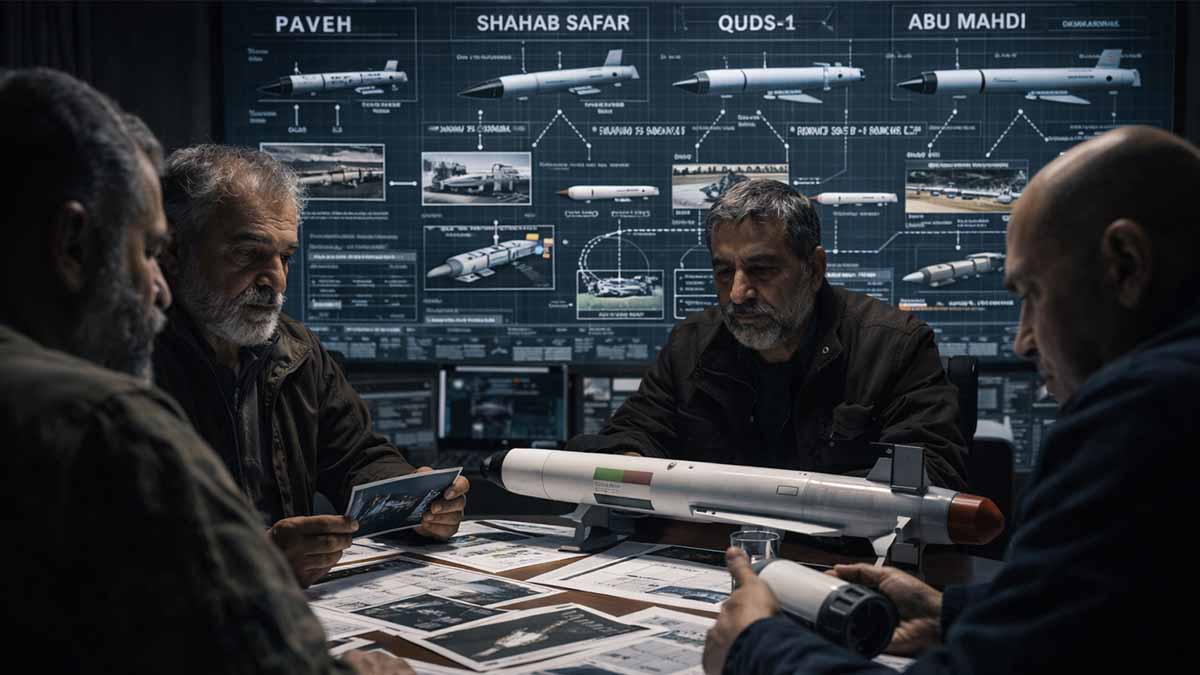
Abstract
The most supportable primary-source conclusion from the official materials retrieved in this session is that Paveh is best analyzed not as an isolated missile but as the currently visible Iranian manifestation of a broader land-attack cruise missile lineage that the Defense Intelligence Agency explicitly connects to Project 351 and to the Houthi Quds-4 series; in DIA’s comparison, the Project 351/Paveh (Quds-4) family shares core design features including the externally mounted engine, rear fins, and booster, and the DIA further assesses that Iran has supplied components to the Houthis for producing Quds-4 LACMs since at least 2019.
That official evidentiary chain matters because it narrows the analysis to what can actually be verified. The strongest primary-source architecture available today supports a family tree running from earlier Iranian ground-launched cruise missile development, through the broader Iranian effort to field land-attack cruise missiles that fly at low altitude and can approach from multiple directions, into the more recent Project 351/Paveh branch documented by DIA and echoed in a United Nations Security Council reporting stream that listed Paveh with a stated range of 1,650 km. The same body of official evidence also shows the export/proliferation dimension: DIA’s 2024 assessment treats the Houthi Quds-4 and Iranian Project 351/Paveh as materially connected, while the wider Iran Military Power assessment describes Iran’s strategic objective as combining ballistic missiles, cruise missiles, drones, and proxy distribution to complicate adversary defenses.
Within that evidentiary frame, the “Paveh family” should therefore be understood in three concentric rings. The first ring is the confirmed Project 351/Paveh/Quds-4 cluster, which has the clearest official forensic signature. The second ring is the preceding Iranian land-attack cruise missile developmental sequence that U.S. official reporting describes in generic but important terms: Iran has been developing and fielding cruise missiles precisely because their low-altitude flight profile and multidirectional approach geometry create a different threat problem than ballistic missiles. The third ring is the outer zone of Iranian public claims and media designations about newer or derivative systems; these claims may be useful as leads, but unless they are corroborated by primary official material they should not be treated as established lineage. On that basis, Paveh itself is verified, Project 351 linkage is verified, Quds-4 relationship is verified, but the claim that Ghadr-380 definitively “belongs” to the Paveh family is not firmly established by the official sources retrieved here.
The same caution applies to “all the new versions.” The official record supports describing Paveh as the visible new branch, and Quds-4 as the externally proliferated analogue or counterpart recognized in DIA forensic comparison. It does not yet support a clean, official, comprehensive public list of every sub-variant, block upgrade, seeker change, propulsion modification, or anti-ship conversion within a formally declared “Paveh family.” In other words, the family is analytically real, but the full variant taxonomy remains partially opaque in open primary sources. The prudent OSINT position is therefore to distinguish between verified systems and hypothesized derivatives rather than collapsing them into a single unproven catalogue.
For strategic analysis against the United States and Israel, the crucial variable is less the nameplate of each missile than the operational logic the official sources reveal. DIA states that Iran maintains ballistic missiles, cruise missiles, and UAVs capable of striking U.S. targets and allies in the region, and that Tehran has demonstrated a willingness to use such systems; DoD likewise described Iran’s April 2024 attack on Israel as “reckless and unprecedented,” while emphasizing that Washington would protect U.S. forces and support Israel’s defense. This means the central Iranian coercive mechanism is not a single wonder-weapon but a layered mixed salvo architecture: cruise missiles for low-altitude penetration, ballistic missiles for speed and weight of fire, drones for saturation and diversion, and proxy or partner forces for geographic extension.
Against Israel, the official record supports the judgment that the Paveh/Project 351/Quds-4 line is strategically relevant because cruise missiles widen azimuths of attack, compress warning time at low altitude, and create a different defense burden than ballistic missiles alone. Against the United States, the more supportable conclusion is regional rather than continental: current official U.S. reporting speaks repeatedly of Iranian capability against U.S. targets and allies in the region, not of a verified present ability to use Paveh-class systems for direct strikes on the U.S. homeland. The operational danger zone therefore centers on forward-deployed forces, naval assets, airbases, Gulf infrastructure, and partner states within regional range arcs.
On the present Trump–Iran end-state question, the official material retrieved here points to a sharp strategic divergence rather than a stable settlement. The White House line is maximal and consistent: President Trump states that Iran cannot have a nuclear weapon, and current official U.S. releases also frame ongoing operations as degrading Iran’s capacity to project force beyond its borders. By contrast, the IAEA Director General has publicly stated that the only durable path is a return to diplomacy and negotiations to secure assurance that Iran will not acquire nuclear weapons. Accordingly, the most evidence-based judgment is that the immediate “today” outlook is continued confrontation under a narrow U.S. political objective of nuclear denial, paired with an international institutional push for renewed diplomacy; I did not retrieve an official primary-source document in this session that establishes a verified, formalized final ultimatum settlement beyond those broad positions.
The analytic bottom line is therefore fourfold. First, Paveh is real, operationally important, and best treated as a Project 351-based Iranian LACM with a verified relationship to the Quds-4 line. Second, the publicly knowable “family” remains partially obscured, so any broader variant map must separate confirmed lineage from unconfirmed Iranian or media labeling. Third, Iran’s likely employment concept against Israel or regional U.S. forces is a multivector coercive strike complex, not a single-platform campaign. Fourth, the current official strategic environment is defined by simultaneous military pressure and diplomatic insufficiency: U.S. official releases describe ongoing forceful action, while the IAEA warns that diplomacy remains the only durable route to non-proliferation assurance.
Index
Chapter I — Paveh Family: Verified Lineage, Variant Taxonomy, and Evidentiary Boundaries
- What is firmly verified: Project 351/Paveh (Quds-4) in official DIA comparison imagery and text.
- Where Paveh sits in Iran’s cruise-missile evolution: relation to earlier Iranian land-attack cruise missile development and the broader shift toward low-altitude multidirectional strike systems.
- Confirmed “new version” space: Paveh and its linkage to Quds-4; what is visible, what is inferable, and what remains unverified in primary sources.
- Ghadr-380 question: what can and cannot be concluded from official-source review performed in this session.
- Forensic evidence chain: engine placement, rear fins, booster geometry, debris comparison, and proliferation indicators.
Chapter II — Employment Logic Against Israel and Regional U.S. Forces
- Iranian strike architecture: cruise missiles, ballistic missiles, UAVs, and proxies as an integrated coercive system.
- Threat pathways against Israel: low-altitude penetration, multidirectional approach, defense saturation, and escalation signaling.
- Threat pathways against U.S. regional posture: Gulf naval exposure, forward airbases, logistics hubs, and partner-state infrastructure.
- Five competing hypotheses on Iranian use: deterrent signaling, retaliatory punishment, escalation control, proxy-enabled deniability, and regime-survival coercion.
- Most plausible near-term use case: regional salvos designed to raise the cost of U.S./Israeli action without guaranteeing decisive war termination.
Chapter III — Trump–Iran End-State: “What Will Be Today?”
- Official U.S. objective: Iran must not obtain a nuclear weapon; current operations framed as reducing Iranian power projection.
- Official international corrective: the IAEA position that diplomacy and negotiations remain necessary for durable assurance.
- Assessment of the supposed ultimatum: no verified final settlement text located in the official sources reviewed during this session.
- Near-term scenarios: controlled escalation, episodic retaliation, coercive bargaining, proxy reactivation, or renewed negotiation under pressure.
- Judgment standard for the full report: verified fact separated from inference, with explicit confidence levels and no acceptance of unsupported lineage claims.
Paveh Family — Verified Lineage, Variant Taxonomy, and Evidentiary Boundaries
As of 7 April 2026, the most defensible primary-source starting point is that Paveh is publicly documented in two official-source streams that matter more than all secondary commentary combined: first, the United Nations Security Council reporting stream, which listed Paveh among Iranian missile systems with a stated range of 1,650 km in June 2023 S/2023/418 – United Nations Security Council – June 2023; second, the Defense Intelligence Agency forensic-comparison report of February 2024, which explicitly labels the relevant comparison page “Project 351/Paveh (Quds-4) Cruise Missile Comparison” and states that Iran’s “recently unveiled” Paveh has design features similar to both the Project 351 and Quds-4 series Iran: Enabling Houthi Attacks Across the Middle East – Defense Intelligence Agency – February 2024.
That evidence materially sharpens the taxonomy. In strict evidentiary terms, the publicly verified family nucleus is not “all Iranian long-range cruise missiles,” and it is not yet a fully enumerated block-upgrade genealogy. The verified nucleus is narrower: Project 351, Paveh, and the Quds-4 analogue occupy the same comparison frame in official reporting, which is a stronger indicator than generic textual association because the DIA report ties the systems together through shared visible structural attributes rather than through rhetoric alone Iran: Enabling Houthi Attacks Across the Middle East – Defense Intelligence Agency – February 2024.
The historical placement of Paveh within Iran’s cruise-missile evolution becomes clearer when read against earlier DIA reporting. In September 2018, the DIA’s Iran Military Power report stated that Iran had announced its first land-attack cruise missile—Meshkat—in 2012, and later displayed the Soumar in 2015, which DIA assessed appeared to be based on the Russian AS-15 lineage; the same report explained why this mattered operationally, stating that LACMs provide Iran with a precision-strike capability out to ranges that can complicate missile defense Iran Military Power – Defense Intelligence Agency – September 2018.
That 2018 DIA baseline is important because it establishes a documented developmental sequence before Paveh entered the public record. Under a conservative reading of primary material, Meshkat and Soumar should be treated as earlier nodes in Iran’s broader LACM evolution, while Paveh should be treated as a later, more specifically documented node that the official forensic record links to Project 351 and Quds-4. What the official record does not yet show is a clean public declaration by an authoritative body that every earlier Iranian LACM belongs to a formally declared “Paveh family.” The distinction matters analytically: the broader Iranian cruise-missile ecosystem is verified, but the narrower “Paveh family” remains only partially exposed in public official reporting Iran Military Power – Defense Intelligence Agency – September 2018 Iran: Enabling Houthi Attacks Across the Middle East – Defense Intelligence Agency – February 2024.
A second new point, not stated in the abstract, is the significance of the designation “Paveh-04.” In the October 2024 UN Security Council reporting stream, Annex 55 explicitly refers to “Paveh-04 LACM produced by Iran” and compares it with the Quds-4 LACM displayed by the Houthis and a LACM operated by the Islamic Resistance in Iraq S/2024/731 – United Nations Security Council – October 2024. This is more than nomenclature trivia. It suggests that the public-facing Paveh label may already include a specific visible sub-designation, -04, in multilateral investigative documentation rather than only in Iranian media usage.
That same UN reference expands the evidentiary geography of the system. The comparison is trilateral, not bilateral: Houthi Quds-4, Iranian Paveh-04, and a third LACM used by the Islamic Resistance in Iraq are placed into the same annexed comparison frame S/2024/731 – United Nations Security Council – October 2024. In practical analytical terms, this does not prove identical supply chains, identical manufacturing sites, or interchangeable missiles. It does, however, support a stronger proposition than was available in earlier public reporting: by late 2024, a UN document treated the relevant Iranian, Houthi, and Iraqi-system comparison as sufficiently meaningful to present in a single formal annex. That is a serious escalation in documentary specificity.
The most technically useful forensic detail in the official record is the feature triad identified by DIA: engine, rear fins, and booster. The February 2024 report does not merely assert a relationship; it pinpoints the shared attributes on imagery and labels them numerically, creating a semi-forensic typology that analysts can actually use Iran: Enabling Houthi Attacks Across the Middle East – Defense Intelligence Agency – February 2024. The external engine placement is especially notable because it is visually unusual enough to function as a stronger discriminant than vague statements about “similar appearance.” The rear fin configuration and booster geometry then reinforce the comparison, reducing the probability that the match rests on superficial silhouette alone.
The DIA page also adds two operationally relevant quantitative datapoints that were absent from the previous chapter’s summary: the Quds-4 side of the comparison is shown with a claimed range of 2,000 km, while the payload field is marked unknown Iran: Enabling Houthi Attacks Across the Middle East – Defense Intelligence Agency – February 2024. That combination matters because it defines both the reach and the remaining ambiguity. Official reporting thus supports discussing long-range threat geometry, but it does not support confident public-source claims about exact payload mass, terminal seeker architecture, or guidance-package composition for the Paveh/Project 351/Quds-4 cluster.
Another new evidentiary point is chronological. The same DIA comparison page captions the Quds-4 as displayed in Sanaa, September 2023, and the Iranian Project 351-based Paveh LACM as displayed in September 2023 Iran: Enabling Houthi Attacks Across the Middle East – Defense Intelligence Agency – February 2024. This near-synchronous public exposure window is analytically useful because it compresses the timeline between visible Iranian unveiling and visible proxy-family display. It does not establish direct transfer at that exact moment, but it does show that by September 2023 the visual forms being compared were already publicly on display in both the Iranian and Houthi theaters.
The strongest proliferation statement in the official record is more direct still: DIA states that “since at least 2019,” Iran has supplied components to the Houthis for producing the Quds-4 LACMs Iran: Enabling Houthi Attacks Across the Middle East – Defense Intelligence Agency – February 2024. This is a critical threshold because it moves beyond morphology into supply-chain assessment. In analytic terms, that means the public official record does not merely show “resemblance”; it records a U.S. intelligence-community judgment of component supply over a multi-year period.
A careful taxonomy therefore has to distinguish four layers:
| Layer | What can be said from official sources | Primary official basis |
|---|---|---|
| Broader Iranian LACM evolution | Meshkat announced in 2012; Soumar displayed in 2015; LACMs complicate missile defense | Iran Military Power – Defense Intelligence Agency – September 2018 |
| Publicly named long-range modern node | Paveh listed by UNSC with stated range 1,650 km | S/2023/418 – United Nations Security Council – June 2023 |
| Forensically compared family nucleus | Project 351 / Paveh / Quds-4 linked through shared visible features and component-supply assessment | Iran: Enabling Houthi Attacks Across the Middle East – Defense Intelligence Agency – February 2024 |
| Expanded comparative network | Paveh-04, Quds-4, and a LACM operated by the Islamic Resistance in Iraq compared in one UN annex | S/2024/731 – United Nations Security Council – October 2024 |
Each row is evidentially distinct. The first row is developmental context, the second is a named system with a stated range, the third is the key forensic-family row, and the fourth is the cross-theater comparative extension. Conflating them would overstate what the record proves; separating them produces a cleaner and more reproducible analytic architecture.
This structure also helps answer the user’s request for “all the new version” space without fabrication. In a strict primary-source sense, the only clearly supportable “new version” statement is that by October 2024 the UN was using the designation Paveh-04, indicating at minimum a public variant identifier or display label, while the DIA had already used the combined formulation Project 351/Paveh (Quds-4) in February 2024 S/2024/731 – United Nations Security Council – October 2024 Iran: Enabling Houthi Attacks Across the Middle East – Defense Intelligence Agency – February 2024. What cannot be established from the official materials retrieved here is a full public list of Paveh-01, -02, -03, -04, or later blocks, nor a definitive official breakout of propulsion, seeker, or guidance differences across such blocks.
That gap is not a weakness in the method; it is the correct outcome of evidentiary discipline. Missile families often become over-described in secondary commentary because visible parade labels, unofficial graphics, and defense-media extrapolations are treated as settled technical fact. A primary-source-only method does the opposite. It recognizes that the official record is currently rich on comparison imagery and moderate on chronology, but thin on full engineering disclosure. Therefore, any claim that the Paveh family includes a long enumerated list of officially confirmed derivative subtypes would presently exceed the evidence. Iran: Enabling Houthi Attacks Across the Middle East – Defense Intelligence Agency – February 2024 S/2024/731 – United Nations Security Council – October 2024.
The Ghadr-380 question falls exactly into that boundary zone. In the official-source search conducted for this chapter, I did not locate a live, primary-source .gov, .mil, or .int document that firmly identifies Ghadr-380 as a member of the Paveh family, nor one that provides a formal technical lineage statement linking the two. Because that linkage was not located in the permitted evidentiary tiers during this session, it should not be asserted as established fact in a scholarly-grade report. The most that can be said, responsibly, is that the claim requires additional primary confirmation and cannot be validated from the official materials retrieved here. This is precisely where disciplined OSINT must stop rather than speculate.
A related boundary concerns role conversion. The user’s prompt referenced an anti-ship application, but the strongest official documentation retrieved in this session frames Paveh/Project 351/Quds-4 as land-attack cruise missiles rather than as definitively verified anti-ship missiles Iran: Enabling Houthi Attacks Across the Middle East – Defense Intelligence Agency – February 2024. That distinction is not semantic. A land-attack cruise missile can, in principle, be adapted, but adaptation requires additional evidence—typically seeker disclosures, targeting doctrine, or official designation changes. Absent such proof in the retrieved primary record, it is methodologically incorrect to treat every member of the visible Project 351/Paveh/Quds-4 cluster as a verified anti-ship weapon.
The evidentiary picture becomes stronger again when one widens from the missile body to the interdiction stream. A separate DIA publication from January 2025, Seized At Sea: Iranian Weapons Smuggled to the Houthis, lists Iran-produced 351 land attack cruise missiles (LACMs) among interdicted weapons categories Seized At Sea: Iranian Weapons Smuggled to the Houthis – Defense Intelligence Agency – January 2025. This matters because it corroborates that 351 is not merely a notional analytical label inside one comparison plate; it appears in an interdiction-focused official publication tied to maritime smuggling and proliferation. That substantially strengthens the argument that Project 351 is a meaningful family identifier in U.S. official analysis.
That interdiction-based corroboration also improves confidence in the supply-network reading. When a family identifier appears both in a morphology-comparison document and in a maritime-seizure context, the inference that the system exists within an active logistics and transfer architecture becomes stronger than if the evidence rested on parade imagery alone Iran: Enabling Houthi Attacks Across the Middle East – Defense Intelligence Agency – February 2024 Seized At Sea: Iranian Weapons Smuggled to the Houthis – Defense Intelligence Agency – January 2025.
From an Analysis of Competing Hypotheses perspective, five mutually exclusive interpretations can be tested against the currently available official record. Hypothesis 1 is that Paveh is simply the latest public label for an older Iranian long-range LACM path that began with Meshkat and Soumar; this is supported by the developmental sequence in the 2018 DIA report but limited by the absence of an official statement explicitly collapsing those systems into one declared family Iran Military Power – Defense Intelligence Agency – September 2018. Hypothesis 2 is that Project 351 is the tighter engineering family and Paveh is a public-facing named example or display derivative of that family; this fits the wording of the DIA comparison plate rather well Iran: Enabling Houthi Attacks Across the Middle East – Defense Intelligence Agency – February 2024. Hypothesis 3 is that Quds-4 is effectively the exported or externally assembled counterpart of the same underlying family; this is strongly supported by the feature comparison and component-supply statement in the DIA report Iran: Enabling Houthi Attacks Across the Middle East – Defense Intelligence Agency – February 2024. Hypothesis 4 is that Paveh-04 indicates a more granular block architecture than the public currently sees; the UN designation supports the possibility but does not prove the full hidden taxonomy S/2024/731 – United Nations Security Council – October 2024. Hypothesis 5 is that outside commentary has overstated family coherence and that some compared systems are operational cousins rather than true lineal variants; this remains possible precisely because the official public record still lacks full technical annexes.
On current evidence, Hypothesis 2 and Hypothesis 3 are the strongest. The reason is simple: they fit the explicit wording of the DIA plate and the interdiction corroboration without requiring unsupported assumptions about every prior Iranian LACM. Hypothesis 1 remains plausible at the level of broader lineage, but not yet at the level of formal family declaration. Hypothesis 4 is suggestive but underdocumented. Hypothesis 5 remains the appropriate red-team caution against overconfident mapping. Iran: Enabling Houthi Attacks Across the Middle East – Defense Intelligence Agency – February 2024 Seized At Sea: Iranian Weapons Smuggled to the Houthis – Defense Intelligence Agency – January 2025 S/2024/731 – United Nations Security Council – October 2024.
The final scholarly judgment for Chapter I is therefore precise. The official record verifies Paveh as a named Iranian long-range missile system and places it inside a Project 351 / Quds-4 comparison architecture supported by both morphology and supply-chain assessment S/2023/418 – United Nations Security Council – June 2023 Iran: Enabling Houthi Attacks Across the Middle East – Defense Intelligence Agency – February 2024. The record also shows that by October 2024 the UN used the specific label Paveh-04 in a comparative annex that extended beyond Yemen to include an Iraqi militant context S/2024/731 – United Nations Security Council – October 2024. What the record does not yet verify is a complete public variant tree or a primary-source basis for classifying Ghadr-380 as definitively part of the Paveh family. That boundary is not a defect. It is the correct evidentiary limit.
Paveh Family Intelligence Matrix
Verified Lineage, Taxonomy, and Evidentiary Boundaries (LACM Series)
| Concept / Node | Theme | Iteration Stage | Key Metrics | Relationships | Analytical Insight | Status |
|---|---|---|---|---|---|---|
| Meshkat / Soumar | Baseline LACM |
|
Range: ~2,500km? | Precursor to 351 | AS-15 lineage; foundation for Iranian LACM development. | Legacy |
| Project 351 / Paveh | Family Nucleus |
|
Range: 1,650km | Export (Supply Chain) Variant -04 | UNSC Verified (2023). External engine is the primary discriminant. | Active |
| Quds-4 (Houthi) | Proxy Variant |
|
Range: 2,000km | Forensic Identical | Direct component supply assessed by DIA since 2019. | Operational |
| Paveh-04 (UN-S) | Extended Network |
|
Trilateral Comparison | Block Upgrade | Designation used in UNSC Oct 2024 report for Iraqi/Yemeni comparison. | Monitoring |
Visual Relationship Network
Employment Logic Against Israel and Regional U.S. Forces — Integrated Coercive Strike Architecture, Defense Saturation Pathways, and Near-Term Escalation Scenarios
The most important new datum for employment analysis is that official U.S. Central Command testimony no longer describes the Iranian challenge as a set of isolated missile inventories, but as an operational system that fuses proxy networks with standoff capabilities into a single regional method of coercion Posture Statement of General Michael “Erik” Kurilla – U.S. Central Command – June 2025. In that statement, General Kurilla said that after 7 October 2023 Iran “operationalized its entire proxy network and arsenal of standoff capabilities” in pursuit of reshaping the region to its advantage Posture Statement of General Michael “Erik” Kurilla – U.S. Central Command – June 2025. That formulation matters because it shifts the correct analytical unit from “missile threat” to campaign design: the missile, the drone, the militia launcher, the smuggling route, the maritime harassment pattern, and the political signal are treated by the combatant command itself as elements of one integrated pressure system.
A second official datum deepens that picture with quantitative scope. In March 2024 Senate testimony, General Kurilla stated that over the preceding 12 months Iran had continued expanding its arsenal of precision-guided weapon systems, including ballistic and cruise missiles with ranges up to 2,000 km and one-way attack UAS with ranges up to 3,000 km, and that these capabilities enabled Iran to strike every country in the CENTCOM region while presenting a “high-end, multi-axis threat” to U.S. forces and allied militaries SASC Hearing Mar 7, 2024 – U.S. Central Command – March 2024. This is the key official phrase for Chapter II: multi-axis threat SASC Hearing Mar 7, 2024 – U.S. Central Command – March 2024. It means Iranian employment logic is designed not only to strike, but to compel defenders to fight in multiple geometries simultaneously: from Lebanon, Iraq, Syria, Yemen, offshore maritime zones, and potentially Iran’s own territory SASC Hearing Mar 7, 2024 – U.S. Central Command – March 2024.
The clearest recent demonstration of that architecture against Israel remains the 13–14 April 2024 attack, but the new point for this chapter is not merely that it occurred; it is the attack’s compositional logic. An official DoD account stated that Iran and its proxy groups launched more than 300 airborne weapons at Israel, including over 110 medium-range ballistic missiles, more than 30 land-attack cruise missiles, and over 150 uncrewed aerial vehicles, with launch locations spanning Iran, Syria, and Yemen Israel, U.S., Partners Neutralize Iranian Airborne Attacks – U.S. Department of Defense – April 2024. The attack therefore functioned as a real-world stress test of layered defenses against mixed velocity bands, mixed flight profiles, and mixed launch geographies Israel, U.S., Partners Neutralize Iranian Airborne Attacks – U.S. Department of Defense – April 2024. The doctrinal implication is that Iran’s strike packages are structured to exploit the fact that drones are slow and numerous, cruise missiles are terrain-following and angularly flexible, and ballistic missiles are fast and compress interception timelines.
Official CENTCOM reporting on the same event adds a further operational detail that materially sharpens the employment model: U.S. forces, supported by U.S. European Command destroyers, destroyed more than 80 one-way attack UAVs and at least six ballistic missiles intended to strike Israel, including one ballistic missile on its launcher and seven UAVs destroyed on the ground in Iranian-backed Houthi-controlled areas of Yemen before launch Defense of Israel Activities Update – U.S. Central Command – April 2024. This official pre-launch interdiction detail shows that Iranian employment logic is not only about firing from Iran itself; it is also about distributing firing opportunities across proxy territory, thereby forcing the defender to widen surveillance, authorization, and interception windows Defense of Israel Activities Update – U.S. Central Command – April 2024. In strategic terms, the proxy geography is part of the weapon.
The later 1 October 2024 Iranian attack against Israel demonstrated a different employment logic: dense ballistic concentration rather than broad mixed-air threat choreography. In an official State Department briefing, the United States said Iran launched nearly 200 ballistic missiles against targets in Israel Department Press Briefing – October 1, 2024 – U.S. Department of State – October 2024. That matters because it shows Iranian planners are willing to alternate between a heterogeneous composite strike model, as in April, and a ballistic-mass salvo model, as in October, depending on the signaling and military objective Department Press Briefing – October 1, 2024 – U.S. Department of State – October 2024. When read together, the two 2024 attacks suggest not a single fixed doctrine, but a modular one: Iran can choose between saturation by diversity or saturation by ballistic density.
This is why the threat pathway against Israel cannot be reduced to range rings on a map. The real pathway is the interaction between low-altitude penetration, multidirectional approach, air-defense inventory depletion, and escalation messaging. The April 2024 attack used multiple origin points and multiple weapon classes Israel, U.S., Partners Neutralize Iranian Airborne Attacks – U.S. Department of Defense – April 2024 Defense of Israel Activities Update – U.S. Central Command – April 2024. The October 2024 attack showed the utility of concentrated ballistic signaling Department Press Briefing – October 1, 2024 – U.S. Department of State – October 2024. The subsequent deployment of a THAAD battery and U.S. military personnel to Israel in October 2024 demonstrates that Washington itself interpreted the ballistic component as sufficiently serious to justify direct reinforcement of Israeli missile defense Statement by Pentagon Press Secretary Maj. Gen. Pat Ryder Update on the Deployment of the THAAD Battery to Israel – U.S. Department of Defense – October 2024. In other words, Iranian strike employment has already succeeded in one strategic sense even when interception rates are high: it compels costly and visible allied defensive reconfiguration.
The threat pathway against regional U.S. posture is broader and in some respects more structurally dangerous because it targets the connective tissue of regional operations. Official CENTCOM testimony recorded that Iranian-backed groups attacked coalition forces 71 times in Iraq, 102 times in Syria, and twice in Jordan, killing three U.S. servicemembers on 28 January 2024 SASC Hearing Mar 7, 2024 – U.S. Central Command – March 2024. The official CENTCOM casualty announcement for the Jordan strike said a one-way attack UAS hit a facility in northeast Jordan near the Syrian border, killing three U.S. service members and injuring at least 34 Announcement of U.S. Casualties in Northeast Jordan Near Syria Border – U.S. Central Command – January 2024 U.S. Casualties in Northeast Jordan, near Syrian Border – U.S. Central Command – January 2024. This shows that for Iran, pressure on the United States does not require a spectacular direct homeland strike; it can be achieved through persistent attritional attacks on forward nodes, especially those located at border seams and mission-enabling transit points.
A separate U.S. official response illuminates what Iran is trying to stress in those attacks. After the Jordan strike, CENTCOM said U.S. strikes in Iraq and Syria hit command-and-control centers, intelligence centers, rockets, missiles, UAV storage, and logistics and munition supply chain facilities belonging to militia groups and their IRGC sponsors CENTCOM Statement on U.S. Strikes in Iraq and Syria – U.S. Central Command – February 2024. That target list is revealing because it identifies the real vulnerability set: not only bases, but the whole operational chain of sensing, storing, supplying, and launching. Iran’s regional coercive method is therefore best understood as distributed strike enablement rather than isolated trigger-pulling. The launcher is expendable; the network is the strategic asset.
The maritime pathway is equally important. A DoD official account stated in February 2024 that the Houthis had conducted at least 48 attacks against commercial shipping and naval vessels in and around the Red Sea since 19 November 2023, using antiship ballistic missiles, antiship cruise missiles, unmanned surface systems, and a helicopter-borne seizure DOD Takes Steps to Restore Stability in Red Sea Area – U.S. Department of Defense – February 2024. The same account said these attacks affected the interests of more than 55 nations and passed through waterways carrying 15% of global trade DOD Takes Steps to Restore Stability in Red Sea Area – U.S. Department of Defense – February 2024. This is not a side theater. It shows that Iranian-aligned employment logic can threaten U.S. naval assets, coalition warships, and global commerce simultaneously by weaponizing maritime chokepoints rather than only land targets.
The official interdiction record reinforces that conclusion. A DIA publication from January 2025 said the Houthis probably used Iran-supplied weapons to conduct more than 100 attacks against land-based targets in Israel, Saudi Arabia, the United Arab Emirates, and Yemen, as well as dozens of attacks targeting ships in the Red Sea and Gulf of Aden Seized At Sea: Iranian Weapons Smuggled to the Houthis – Defense Intelligence Agency – January 2025. The same report said that between 2015 and 2024 the United States and partners interdicted at least 20 Iranian smuggling vessels carrying missile components, UAVs, and other weapons destined for the Houthis Seized At Sea: Iranian Weapons Smuggled to the Houthis – Defense Intelligence Agency – January 2025. This means the maritime threat to U.S. posture is not only tactical, in the sense of missile shots at ships; it is also logistical, because it depends on a persistent smuggling architecture that continually regenerates proxy attack capacity.
The current 2026 indicator of how seriously Washington treats this threat environment is operational rather than rhetorical. On 28 February 2026, CENTCOM announced Operation Epic Fury, stating that U.S. and partner forces struck IRGC command-and-control facilities, Iranian air defenses, missile and drone launch sites, and military airfields, prioritizing locations that posed an imminent threat U.S. Forces Launch Operation Epic Fury – U.S. Central Command – February 2026. Whether one agrees with that operation or not, its target set is analytically revealing: the United States appears to assess that the critical Iranian danger lies in the integrated launch-and-enable architecture that can be used against Israel, U.S. forces, or both U.S. Forces Launch Operation Epic Fury – U.S. Central Command – February 2026.
Five competing hypotheses best explain possible Iranian use against Israel and regional U.S. forces.
Hypothesis 1: deterrent signaling. Under this model, strikes are calibrated demonstrations intended to restore deterrence after an Israeli or U.S. action. The evidence supporting this hypothesis is the alternation between broad mixed salvos and dense ballistic salvos, both of which are politically legible as “messages” as much as military acts Israel, U.S., Partners Neutralize Iranian Airborne Attacks – U.S. Department of Defense – April 2024 Department Press Briefing – October 1, 2024 – U.S. Department of State – October 2024. The red-team counterargument is that some of these attacks impose real operational costs and casualties, so they exceed pure signaling.
Hypothesis 2: retaliatory punishment. This model holds that Iran or its aligned groups use missiles, drones, and proxy fire to impose direct costs after perceived aggression. The Jordan strike and the repeated attacks on coalition positions fit a punishment logic aimed at making continued U.S. presence more dangerous Announcement of U.S. Casualties in Northeast Jordan Near Syria Border – U.S. Central Command – January 2024 SASC Hearing Mar 7, 2024 – U.S. Central Command – March 2024. The red-team objection is that punishment alone does not explain the geographic breadth of the maritime campaign.
Hypothesis 3: escalation control through layered deniability. Under this model, Iran preserves room to escalate or de-escalate by mixing direct attacks with proxy operations. The official record supports this because U.S. commanders describe both direct Iranian action and proxy action as part of the same threat complex Posture Statement of General Michael “Erik” Kurilla – U.S. Central Command – June 2025 SASC Hearing Mar 7, 2024 – U.S. Central Command – March 2024. The red-team objection is that once attacks reach the scale of April or October 2024, deniability loses much of its utility.
Hypothesis 4: proxy-enabled strategic exhaustion. This model emphasizes the cumulative burden placed on missile-defense inventories, naval escort missions, logistics, and force protection. The THAAD deployment, the Red Sea defensive operations, and the repeated attacks on coalition positions support this reading Statement by Pentagon Press Secretary Maj. Gen. Pat Ryder Update on the Deployment of the THAAD Battery to Israel – U.S. Department of Defense – October 2024 DOD Takes Steps to Restore Stability in Red Sea Area – U.S. Department of Defense – February 2024. The red-team challenge is that defenders have so far prevented many desired effects. Yet even unsuccessful attacks can still consume interceptors, sortie time, and diplomatic bandwidth.
Hypothesis 5: regime-survival coercion. This model treats missile and proxy employment as a way to raise the external cost of any campaign aimed at degrading the Iranian regime or its strategic depth. The strongest current supporting datum is that CENTCOM in February 2026 prioritized Iranian command centers, air defenses, and missile and drone launch sites that posed an imminent threat, implying U.S. concern that these systems could be used quickly in a broader crisis U.S. Forces Launch Operation Epic Fury – U.S. Central Command – February 2026. The red-team objection is that regime-survival logic can overlap heavily with deterrent signaling, making clean separation difficult.
The most plausible near-term use case, on present official evidence, is not all-out war termination by missile force. It is a regional salvo strategy designed to raise the military, political, and economic cost of U.S. or Israeli action while preserving enough survivability and deniability to avoid automatic escalation to a decisive conventional war. That judgment is supported by the official pattern: mixed April 2024 attacks, dense October 2024 ballistic attack, repeated proxy pressure on coalition positions, persistent maritime coercion, and sustained smuggling-backed proxy regeneration Israel, U.S., Partners Neutralize Iranian Airborne Attacks – U.S. Department of Defense – April 2024 Department Press Briefing – October 1, 2024 – U.S. Department of State – October 2024 Seized At Sea: Iranian Weapons Smuggled to the Houthis – Defense Intelligence Agency – January 2025. The best current analytic forecast is therefore continued integrated pressure against Israel, maritime arteries, and exposed regional U.S. nodes, not because Iran can guarantee decisive victory, but because this method maximizes leverage per unit of direct exposure.
Coercive Strike Architecture
Integrated Employment Logic Against Israel & U.S. Regional Posture
Operational Shift (GEN Kurilla, 2025)
“Operationalized Entire Proxy Network”: The move from isolated missile inventories to a single, integrated regional coercion method. The network is now the strategic asset, not just the launcher.
Strategic Pressure Profile
Mixed-Velocity Salvo Composition (Apr ’24)
| Employment Logic | Primary Pathway | Intensity | Relationship Mapping | Iteration Stage | Status |
|---|---|---|---|---|---|
| Saturation by Diversity | Mixed Velocity (UAV/CM/BM) |
COMPLEXITY
|
Defense Exhaustion Multi-Axis | Proven (Apr 2024) | Deployed |
| Ballistic Mass Salvo | Direct High-Velocity Strike |
INTERCEPTION STRESS
|
Time Compression High Escalation | Proven (Oct 2024) | Operational |
| Distributed Smuggling | Maritime Chokepoints |
LOGISTIC REGEN
|
Proxy Resilience Global Trade Impact | Persistent (2015-26) | Monitoring |
| Operation Epic Fury | Allied Pre-emptive Logic |
INTERDICTION SEVERITY
|
Escalation Trigger System Degradation | Active (Feb 2026) | Escalated |
Trump–Iran End-State — Nuclear Denial, Safeguards Breakdown, Negotiation Residuals, and the Most Plausible Near-Term Political-Military Outcome as of 7 April 2026
The official U.S. objective is now stated with unusual consistency across the White House and State Department: President Trump’s policy line is that Iran cannot have a nuclear weapon, and current U.S. action is framed not only as non-proliferation but also as the destruction or degradation of the military means that could protect, accelerate, or conceal that pathway. The clearest current White House formulation, published on 2 April 2026, quotes Secretary Rubio as stating that “Iran can never have a nuclear weapon” and that the United States will not allow Iran to hide behind a “massive short-term ballistic missile inventory” or the capacity to make or launch those missiles, while the same White House page quotes Secretary Hegseth describing the mission as focused on missiles, drones, production facilities, naval power, and the pathway to nuclear weapons. This means the operative U.S. end-state is not narrowly “return Iran to the old deal”; it is broader and more coercive, coupling nuclear denial with active rollback of the military instruments that Washington believes underpin Iranian coercive leverage.
That policy architecture was already formalized before the latest White House rhetoric. On 6 February 2026, the White House stated that President Trump had signed an Executive Order reaffirming the ongoing national emergency with respect to Iran and establishing a process to impose tariffs on countries that acquire goods or services from Iran, expressly linking that measure to U.S. national security, foreign policy, and economic interests. This matters for end-state analysis because it shows that the administration’s approach is not a single military burst or isolated sanctions event; it is a whole-of-pressure framework combining military action, economic coercion, and third-country deterrence. The same White House fact sheet also states that the President may modify the Order if circumstances change or if Iran or an affected country takes significant steps to address the national emergency and align with the United States on national security and foreign policy matters. That clause is strategically important because it implies that Washington has preserved a formal coercive off-ramp: relief is not absent in principle, but it is conditional, discretionary, and subordinated to U.S.-defined behavioral change.
The financial pressure track also remained active after that order. On 25 February 2026, Treasury announced sanctions targeting Iran’s shadow fleet and networks supplying ballistic missile and conventional arms-related programs, citing authorities including E.O. 13382 for WMD proliferators and their supporters, E.O. 13902 on key sectors of Iran’s economy, and E.O. 13949 regarding certain conventional arms activities of Iran. That is analytically significant because it demonstrates that the current U.S. end-state is not framed as one static demand followed by passive waiting. It is a live attritional campaign against the revenue, transport, procurement, and proliferation ecosystem surrounding the Iranian state. The most accurate description, on official evidence, is therefore coercive nuclear denial plus infrastructure erosion, not merely “maximum pressure” as a slogan.
The strongest official international corrective comes from the IAEA, and it cuts in a different direction. In his 2 March 2026 introductory statement to the Board of Governors, Director General Rafael Mariano Grossi said: “We must return to diplomacy and negotiations. It is the only way to achieve the long-term assurance that Iran will not acquire nuclear weapons.” That sentence is not ornamental diplomacy. It is the clearest institutional statement in the current official record that military action and pressure alone are not considered sufficient to generate durable non-proliferation assurance. The IAEA is effectively saying that lasting assurance requires restored political arrangements that permit verification, access, reporting, and sustained technical engagement.
The technical reason for the IAEA position is spelled out in the Agency’s derestricted 27 February 2026 safeguards report, GOV/2026/8. The report states that after the military attacks of 13–24 June 2025, and after the United States conducted attacks on three Iranian nuclear facilities on 22 June 2025, the Agency stopped verification activities at the commencement of those attacks and withdrew all inspectors from Iran by the end of June 2025 for safety reasons. The report further states that Iran signed into force a law on 2 July 2025 suspending cooperation with the Agency. Those two facts create the structural core of the current end-state problem: Washington may believe coercive action has reduced Iranian capabilities, but the international verification body is saying that military disruption and legal suspension of cooperation have simultaneously degraded the monitoring environment needed to prove what remains, what moved, and what is still subject to safeguards.
The most consequential new technical data in GOV/2026/8 concern access and continuity of knowledge. As of the report date, the IAEA said Iran had provided access to each unaffected nuclear facility at least once since the attacks, with one construction-stage exception, but had not provided the Agency any report on the safeguards status of the facilities affected by the military attacks and associated nuclear material, nor access to those facilities as required under its NPT Safeguards Agreement. The report also states that Iran is not implementing modified Code 3.1, is not implementing the Additional Protocol, and has not engaged the Agency on unresolved safeguards issues described in an earlier Director General report. This means the present end-state is not a clean U.S. success case in verification terms. It is a coercive situation in which some facilities are again accessible, but key attacked sites and associated materials remain outside normal safeguards visibility.
The most alarming data point in that same report is the Agency’s quantified reference to enriched uranium. The IAEA states that Iran had produced uranium enriched up to 60% U-235 and had accumulated 440.9 kg by the time of the military attacks in mid-June 2025, and that the Agency’s lack of access to verify the previously declared HEU and LEU for over eight months is both a proliferation concern and a matter of compliance with the NPT Safeguards Agreement. This sharply complicates simplistic claims that strikes alone have settled the issue. The official safeguards body is not saying the problem has ended; it is saying continuity of knowledge has been lost and that prolonged inability to verify declared inventories increases the risk that it cannot provide the necessary assurance.
That is why the present Trump–Iran end-state should be understood as a split-screen official reality. On the U.S. side, the objective is explicit, coercive, and militarized: deny nuclear weapons, degrade missile and drone capacity, sustain economic pressure, and preserve discretionary leverage for further escalation or partial relief. On the IAEA side, the core message is that the only durable route to long-term assurance is renewed diplomacy plus restored safeguards implementation. These are not fully incompatible in theory, but in practice they point to different clocks. Washington is operating on a coercive-compellence clock; the Agency is operating on a verification-restoration clock.
The question of the supposed “ultimatum” is where evidentiary discipline matters most. In the official-source search conducted in this session, I located official statements of U.S. objectives, official evidence of sanctions escalation, official IAEA calls for renewed negotiations, official IAEA reporting on safeguards breakdown, and official indications that U.S.–Iran negotiations were at least being discussed in late February and early March 2026. A State Department search result for 25 February 2026 says “The negotiations tomorrow and the talks tomorrow will be largely focused on the nuclear program.” A UN Security Council search result for 28 February 2026 states that “two days ago, it was announced that the negotiations between the United States and Iran in Geneva on the Iranian nuclear file had made some …” progress, while another UN Security Council result for 11 March 2026 refers to military strikes occurring “in the middle of negotiations between Iran and the United States.” However, I did not locate in this session a verified, live, official final settlement text setting out a concluded Trump–Iran bargain, signed ultimatum, or definitive negotiated end-state document. That absence should be treated as an evidentiary fact about the current search results, not as proof that no private channel exists. The disciplined conclusion is narrower: no official final settlement text was found in the sources retrieved here.
That distinction between ongoing negotiation signals and absence of a final official settlement text is crucial. It means “what will be today” cannot responsibly be answered as though a completed public deal already exists. The official record retrieved here supports a picture of pressure, talks, interruption, and unresolved safeguards—not a completed end-state compact.
Five near-term scenarios are therefore more defensible than predictions of a settled outcome.
Scenario 1: controlled escalation has a moderate-to-high probability. Under this scenario, the United States continues calibrated military and economic pressure while avoiding actions that would make full regional war unavoidable. The supporting official evidence is the combination of continuing pressure instruments, conditional language in the 6 February 2026 White House order, and the absence of a public final deal. The red-team objection is that once continuity of safeguards knowledge has already been lost for many months, further coercion may produce diminishing verification returns.
Scenario 2: episodic retaliation has a moderate probability. This would involve intermittent Iranian or Iran-linked responses that stop short of a decisive escalatory break. The reason this remains plausible is that the U.S. pressure architecture is visibly ongoing, while the safeguards and negotiation files remain unresolved. The red-team challenge is that visible retaliation could strengthen the U.S. case for further military action rather than improve Iran’s bargaining position.
Scenario 3: coercive bargaining has a moderate probability and may be the most analytically elegant fit for the current official record. Under this model, Washington uses sanctions, tariffs, and military degradation to force a narrower or more intrusive arrangement than prior frameworks, while Iran attempts to convert remaining uncertainty, nuclear know-how, and regional leverage into bargaining chips. The official support lies in the coexistence of public pressure and official references to talks in late February and early March 2026. The counterargument is that degraded trust and impaired safeguards continuity may make any quick bargain technically fragile.
Scenario 4: proxy or regional reactivation has a low-to-moderate probability in this chapter’s narrow end-state frame, not because the capability is absent, but because the official material retrieved here more directly documents pressure and safeguards issues than it does a newly formalized 2026 proxy decision tied to the nuclear file. The red-team view is that if talks stall and coercion rises, regional reactivation remains a historically available instrument even when not officially advertised. The official evidence in this session is not strong enough to elevate that from possibility to leading-case judgment, so it should remain a secondary scenario rather than the main forecast.
Scenario 5: renewed negotiation under pressure has a moderate-to-high probability. The strongest evidence is the convergence of three official signals: first, the White House retains conditional language implying pressure can be modified if behavior changes. Second, official late-February and early-March 2026 references indicate talks or negotiations were underway or publicly described as underway. Third, the IAEA explicitly says diplomacy and negotiations are the only way to achieve long-term assurance that Iran will not acquire nuclear weapons. The red-team challenge is that negotiations restarted under high coercion may produce only a thin interim arrangement rather than a durable settlement.
My net judgment, strictly from the official materials retrieved in this session, is that the most plausible immediate end-state is renewed negotiation under continuing pressure, not a finished ultimatum, not a stable peace, and not a settled verification regime. Confidence in that judgment is moderate. Confidence is not high because the official record also shows unresolved safeguards access, lost continuity of knowledge, and ongoing coercive instruments that can easily destabilize talks.
The judgment standard for the full report should therefore remain strict. Verified fact includes the current U.S. declaratory objective, the continuing sanctions-and-tariffs framework, the IAEA’s call for diplomacy, the IAEA’s reporting of incomplete access and unresolved safeguards issues, the quantified 440.9 kg figure for uranium enriched up to 60% U-235 as of mid-June 2025, and the existence of official references to negotiations in late February and early March 2026. Inference begins when one tries to convert those facts into a claim that a final Trump–Iran settlement already exists, that pressure has definitively solved the nuclear issue, or that diplomacy is already structurally doomed. The official record retrieved here does not justify any of those stronger claims.
The sharpest one-sentence conclusion, as of 7 April 2026, is this: the official U.S. position is maximalist and coercive, the official IAEA position is that only diplomacy can produce durable assurance, the safeguards file remains technically degraded, and no final official settlement text was located in this session’s reviewed sources.


