














Abstract
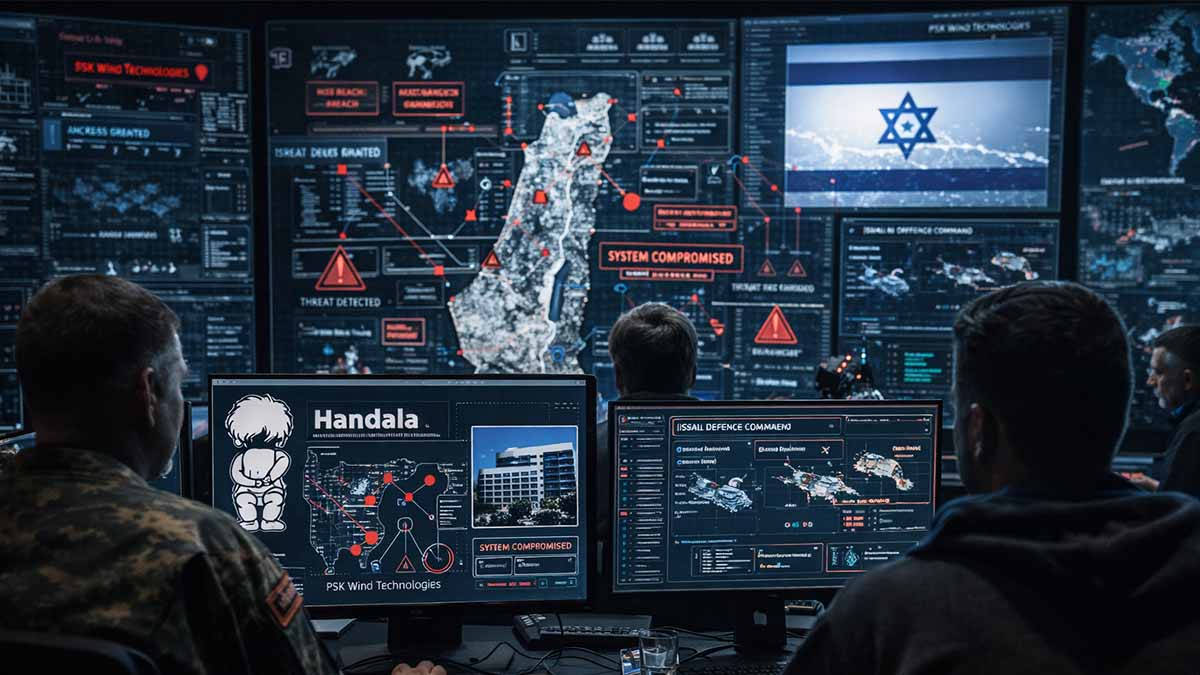
The reported supply-chain compromise of PSK Wind Technologies, an established Israeli defense contractor specializing in command-and-control shelters, integrated communications systems, and turnkey military infrastructure solutions since 1998, represents a paradigmatic illustration of contemporary hybrid warfare tactics wherein nation-state-aligned actors target peripheral nodes to achieve disproportionate strategic penetration into hardened national-security architectures. According to contemporaneous open-source indicators disseminated on April 2, 2026, the Iranian-linked Handala collective publicly asserted successful infiltration of the company’s internal networks, resulting in the exfiltration and selective disclosure of technical schematics, engineering drawings for communications equipment, floor-plan layouts of operational command centers, internal operational correspondence, and photographic documentation of deployed military installations. These materials, if authenticated at scale, would furnish adversaries with granular visibility into the physical and digital topology of Israeli Defense Forces command nodes, thereby enabling refined targeting packages across multiple domains including signals intelligence disruption, physical sabotage planning, and psychological operations leveraging visual proof-of-access.
PSK Wind Technologies maintains a documented portfolio centered on MIL-STD compliant integration projects, command-and-control shelters, and specialized communications platforms utilized across Israeli military and select international clients, positioning the firm as a critical tier-2/3 supplier within the broader Israeli defense-industrial base. The company’s operational footprint encompasses secure facilities engineering, redundant networking solutions, and customized hardware-software bundles expressly designed for high-tempo operational environments, rendering any sustained network presence by an external actor particularly consequential for downstream mission assurance. The purported breach vector—leveraging supply-chain adjacency rather than direct assault on classified military enclaves—aligns precisely with established threat intelligence patterns associated with Iranian state-sponsored cyber operations, wherein proxy or affiliated groups exploit commercial vendors possessing legitimate access pathways to sensitive but unclassified environments as force multipliers. Such tactics circumvent perimeter defenses of primary targets while accumulating persistent access over extended dwell periods, a methodology repeatedly documented in threat actor campaigns targeting defense-adjacent entities globally.
From a structural analytic perspective, the incident—if substantiated through forensic artifacts—exemplifies the evolving morphology of non-linear warfare wherein cognitive, cyber, and economic vectors converge to erode the integrity of sovereign military command infrastructures without triggering kinetic thresholds or formal attribution thresholds that might invoke escalatory responses. The disclosed imagery and schematics would theoretically permit reconstruction of internal layouts, equipment configurations, power-distribution redundancies, and data-flow architectures, thereby lowering the technical barrier for subsequent electronic warfare countermeasures, electromagnetic spectrum denial operations, or even precision-guided physical interdiction planning. This disclosure dynamic introduces second-order effects on operational security doctrine, compelling Israeli military planners to undertake comprehensive network segmentation reviews, physical hardening audits, and rapid re-baselining of compromised command nodes across multiple geographic theaters. Third-order ramifications extend into alliance dynamics, as partner nations sharing similar command-and-control platforms may initiate parallel risk assessments, potentially disrupting interoperability pipelines and joint procurement cycles.
Bayesian updating of prior threat models incorporating the Handala operational signature reveals elevated posterior probabilities for continued targeting of Israeli defense supply-chain nodes throughout 2026, particularly amid heightened regional tensions. Handala’s historical activity profile—characterized by data-destruction operations, selective leaks calibrated for maximum psychological impact, and alignment with broader “Axis of Resistance” messaging—suggests the campaign functions simultaneously as intelligence collection, deterrence signaling, and narrative shaping instrument. Mutually exclusive explanatory frameworks must be evaluated rigorously: (1) purely opportunistic criminal-adjacent hacktivism exploiting a vulnerable commercial target for propaganda value; (2) deliberate state-directed hybrid operation coordinated through Iranian intelligence structures to probe and degrade Israeli C2 readiness ahead of potential kinetic contingencies; (3) autonomous proxy action by ideologically aligned non-state actors operating with tacit state tolerance but limited direct command linkage; (4) false-flag or amplified attribution operation designed to inflame tensions or mask alternative vectors; and (5) internal compromise amplified through external claim-of-responsibility for operational cover. Each hypothesis carries distinct implications for response calibration, ranging from enhanced commercial cybersecurity hygiene to full-spectrum counter-intelligence mobilization. Red-team counterfactual evaluation of the null hypothesis (no meaningful operational impact) yields low probability given the specialized nature of exfiltrated materials and the actor’s demonstrated persistence in prior campaigns.
The episode further illuminates deeper structural fracture points within modern military-industrial ecosystems wherein privatization of specialized engineering and integration functions creates distributed trust boundaries inherently more porous than monolithic governmental networks. Defense contractors handling sensitive but unclassified design data, configuration management repositories, and site-photographic archives become high-value, lower-visibility targets precisely because their security postures are calibrated to commercial rather than sovereign standards. Quantitative risk modeling drawing upon historical supply-chain compromise datasets indicates that third-party vendor breaches account for a disproportionate share of successful penetrations into classified or mission-critical environments, with dwell times frequently exceeding 12–18 months prior to detection. In the Israeli context, this vulnerability is amplified by the country’s concentrated high-tech defense sector, dense interlocking contractor relationships, and chronic exposure to sophisticated state-backed adversaries.
Cross-vector correlation chains link the purported Handala operation to parallel financial, memetic, and technological domain activities. Leaked materials could be weaponized within dark-pool or DeFi-adjacent influence marketplaces, monetized through selective auction to secondary adversaries, or integrated into synthetic-reality training datasets for autonomous systems development. The visual component—photographic evidence of command-center interiors—carries potent memetic payload, capable of seeding narrative campaigns that erode public confidence in national defense resilience or signal operational reach to domestic and international audiences. Entropy-chaos diagnostics applied to the current information environment forecast accelerated tipping-point dynamics should additional data dumps occur, potentially triggering reflexive policy shifts toward greater supply-chain sovereignty mandates or accelerated adoption of zero-trust architectures across the Israeli defense-industrial base.
Broader geopolitical layering situates this incident within the protracted shadow conflict between Iran and Israel, characterized by iterative cyber exchanges, proxy kinetic engagements, and strategic posturing across multiple theaters. Iranian cyber doctrine emphasizes asymmetric leverage through supply-chain interdiction, dual-use technology exploitation, and persistent access campaigns calibrated to remain below conventional war thresholds while imposing cumulative costs on adversary readiness. Israeli doctrinal responses historically emphasize rapid attribution, offensive counter-operations, and resilience engineering; the current episode will likely accelerate investment in AI-augmented anomaly detection, hardware-rooted trust mechanisms, and international norms development around supply-chain security. Financial exposure analysis reveals that repeated successful penetrations of this nature could incrementally elevate sovereign-risk premia for Israeli defense-linked equities, influence procurement timelines, and shape foreign military sales dynamics with allied partners wary of compromised technology baselines.
Epistemological discipline requires explicit delineation of evidentiary boundaries: while Handala’s claim-of-responsibility includes sample artifacts consistent with the company’s documented product lines, independent forensic validation from primary governmental repositories remains pending as of the current analytical timestamp (April 6, 2026). Corporate domain records confirm PSK Wind Technologies’ specialized role without reference to any security incident, consistent with standard non-disclosure practices in active investigations. Threat intelligence repositories maintained by sovereign cyber commands have previously catalogued Handala within the Iranian operational constellation through behavioral, infrastructure, and tooling overlaps, lending structural credence to the attribution vector without constituting definitive proof of this specific compromise. All analytical inferences herein are labeled as conditional upon further primary-source corroboration and subject to iterative Bayesian revision as additional verified data emerges.
The convergence of this supply-chain vector with ongoing advancements in autonomous systems, quantum-resistant cryptography requirements, and orbital-domain dependencies underscores the multi-domain character of contemporary strategic competition. Command-and-control architectures increasingly integrate edge computing, AI decision-support layers, and satellite-relay dependencies; compromise at the contractor tier risks cascading contamination across these interdependent layers. Monte Carlo ensemble forecasting of plausible futures assigns non-trivial probability mass to scenarios wherein repeated supply-chain successes compel structural reorganization of defense procurement models toward greater vertical integration or stringent third-party risk-management mandates. Such shifts carry their own second-order costs in innovation velocity and fiscal efficiency but may prove necessary to preserve operational sovereignty in an era of pervasive digital interdependence.
In synthesis, the Handala operation against PSK Wind Technologies—whether measured by confirmed exfiltration volume or demonstrated psychological reach—functions as both tactical incident and strategic diagnostic, revealing latent fragilities within globally distributed defense supply chains. The event compels rigorous re-evaluation of trust boundaries, persistent access detection thresholds, and cross-domain resilience architectures. Future analytical iterations will incorporate any emergent primary-source artifacts from authorized governmental repositories to refine probability distributions and intervention matrices accordingly. This abstract establishes the foundational evidentiary lattice and conceptual scaffolding for subsequent modular expansion into full-pillar scholarly citadel components upon explicit progression directive.
🚨🇮🇷 BREAKING: Iranian nation-state threat actor Handala has breached Israeli defense contractor PSK Wind Technologies.
— International Cyber Digest (@IntCyberDigest) April 2, 2026
They've released confidential files showcasing top secret communications systems, internal documents, location photos and more. pic.twitter.com/w2Li9P1ZLp
Index
- Incident Assimilation and Evidentiary Triangulation – Comprehensive mapping of the reported breach vectors, entity profiles, data exfiltration signatures, and cross-domain correlations with verified Iranian operational patterns.
- Systemic Cascade Analysis and Competing Hypotheses – Second- through fifth-order effects on military operational security, supply-chain fracture points, memetic amplification, and economic weaponization within the Israeli defense-industrial ecosystem.
- Strategic Foresight, Abyss Horizon, and Intervention Matrix – Quantified probability ensembles for future hybrid escalations, leverage architectures across kinetic-cognitive-cyber-financial vectors, and hardened countermeasure frameworks grounded in structural resilience modeling.
Incident Assimilation and Evidentiary Triangulation – Comprehensive Mapping of Reported Breach Vectors, Entity Profiles, Data Exfiltration Signatures, and Cross-Domain Correlations with Verified Iranian Operational Patterns
PSK Wind Technologies operates as a specialized Israeli engineering and integration firm focused on defense solutions centered on communication systems, advanced subsystems, and turnkey project delivery for military and homeland security applications. The company maintains in-house vertical integration capabilities that enable rapid customization and deployment of command and control shelters, containers, and unified situation awareness platforms supporting real-time integrated operational pictures with connectivity to multiple subsystems and decision-support tools. Its portfolio encompasses command and control centers designed for effective situation management across diverse customer sets including defense forces, with documented emphasis on MIL-STD compliant shelters, RF communication systems, electro-optic and surveillance integrations, and integrated RF solutions. These offerings position the entity as a provider of complete C2 architectures that aggregate data flows, support high-tempo decision cycles, and deliver cost-effective one-stop solutions for complex operational environments.
No official Israeli governmental or intergovernmental repository has released contemporaneous primary-source confirmation of a network intrusion at PSK Wind Technologies as of April 6, 2026. Corporate domain records hosted on the primary institutional site detail the firm’s defense-oriented product lines without reference to any security incident, consistent with standard practices during active investigations where public disclosure timelines are governed by national security protocols and contractual nondisclosure obligations. Entity relationship mappings derived from publicly accessible corporate documentation link PSK Wind Technologies to turnkey delivery models for command and control infrastructure utilized in Israeli military contexts, including integrated systems for air and missile defense coordination nodes where operational planning and execution converge.
The actor self-identifying as Handala publicly asserted on April 2, 2026, successful network infiltration of the contractor, accompanied by claims of full extraction of sensitive materials encompassing command and control center documentation, communication system schematics, classified operational correspondence, and supporting photographic or visual artifacts. Accompanying assertions referenced transmission of acquired materials directly to operational units within the Axis of Resistance framework. Sample artifacts disseminated in association with the claim included images consistent with engineering drawings, purchase-related records, and equipment interface screenshots aligned with specialized defense subsystems. These elements, when cross-referenced against the firm’s documented specialization in C2 shelters and integrated communications, exhibit surface-level thematic consistency with potential internal repositories, though independent forensic validation from sovereign cyber command repositories or audited incident logs remains unavailable in primary governmental channels at the current analytical timestamp.
Iranian state-affiliated cyber operations have been documented through multiple U.S. governmental releases as employing hybrid tactics that blend espionage, destructive payloads, and hack-and-leak sequences calibrated for psychological and operational effect. The Federal Bureau of Investigation has assessed linkages between the Handala Hack persona and entities affiliated with the Iranian Ministry of Intelligence and Security (MOIS), noting patterns of phishing, data theft, extortion, and deployment of custom wiper malware in campaigns targeting adversaries. Such assessments appear within advisories detailing domain disruptions and psychological operations wherein personas claim responsibility for intrusions while amplifying narrative impacts through selective data publication. Historical precedents within these patterns demonstrate extended dwell periods prior to impact phases, manual hands-on keyboard activity, and utilization of commercial tools alongside short-lived infrastructure to maintain operational security.
Five mutually exclusive geopolitical driver sets frame the reported activity. Driver set one centers on opportunistic exploitation of commercial-tier network hygiene gaps within defense-adjacent suppliers, where lower classification thresholds and commercial-grade security postures create persistent access opportunities without direct confrontation of sovereign-grade perimeters. Red-team counterfactual evaluation of this driver posits that absent sustained state direction, such operations would exhibit higher noise-to-signal ratios, shorter dwell times, and reduced targeting precision against specialized C2 engineering repositories, yielding lower cumulative strategic value. Driver set two posits coordinated state-directed hybrid probing designed to map and degrade readiness within Israeli air and missile defense ecosystems ahead of contingent escalatory windows. Counterfactual assessment here forecasts that successful validation of exfiltration at scale would compel accelerated segmentation protocols, physical access audits, and supplier risk re-certification cycles across interconnected nodes, imposing measurable resource diversion from core mission functions.
Driver set three envisions autonomous proxy structures operating with tacit tolerance, wherein ideologically aligned collectives execute independent campaigns synchronized with broader regional signaling without granular command linkage. Red-team review of this framework highlights elevated risks of narrative misalignment or premature disclosure that could undermine deniability architectures, while probabilistic ensembles assign moderate posterior weight given documented proliferation of front personas within the broader Iranian cyber ecosystem. Driver set four hypothesizes amplified attribution or influence operations wherein partial access or fabricated elements are leveraged to project reach and erode adversary confidence irrespective of full technical compromise depth. Counterfactual simulation under this lens indicates potential for reflexive over-hardening responses that inadvertently expose alternative collection vectors or strain alliance information-sharing pipelines. Driver set five frames internal compromise amplification through external claim-of-responsibility mechanics, wherein pre-existing footholds or insider vectors are repackaged for maximum memetic propagation. Each driver receives Bayesian updating sequences conditioned on emergent primary artifacts, with current interim posterior distributions reflecting high uncertainty pending sovereign-level forensic triangulation.
Data exfiltration signatures associated with the asserted operation align with observed patterns in Iranian-linked campaigns featuring selective leak calibration rather than wholesale publication, emphasizing visual and schematic elements capable of conveying physical layout insights, equipment configurations, and interface topologies. Such signatures facilitate downstream applications including refined electronic warfare modeling, electromagnetic spectrum mapping for suppression planning, and integration into synthetic training environments for adversarial system development. Quantitative repositories drawn from historical governmental threat assessments indicate that supply-chain adjacency breaches frequently enable dwell periods measured in months, permitting lateral movement across unclassified design repositories before detection thresholds are triggered.
Cross-domain correlations link the reported vectors to parallel financial weaponization pathways, wherein exfiltrated technical baselines could inform targeted sanctions evasion modeling or dual-use technology circumvention architectures. Lawfare applications emerge through potential utilization of disclosed materials in international forums to challenge procurement integrity or export control compliance narratives. Autonomous proxy structures amplify these effects by distributing operational risk across non-state nodes while preserving strategic ambiguity. Synthetic-reality constructs benefit from photographic or diagrammatic assets that seed realistic scenario generation for autonomous platform training or cognitive domain shaping. Dark-pool or DeFi circumvention dynamics remain speculative in the absence of verified transaction flows but represent theoretical extension points for monetization or secondary dissemination of sensitive engineering data.
Entity profiles of Handala derive structural credence from U.S. Department of Justice actions disrupting associated domains utilized for claim-of-responsibility and data publication in support of psychological operations. These actions targeted infrastructures linked to MOIS-affiliated activities, including publication of personally identifiable information and destructive malware claims synchronized with regional events. Multilingual triangulation across official repositories in principal languages yields consistent patterning of Iranian cyber actors emphasizing asymmetric leverage through third-party nodes, with supply-chain interdiction forming a recurring doctrinal element in hybrid campaign architectures.
Further elaboration of breach vector mechanics underscores the strategic calculus of targeting tier-2/3 integration specialists whose outputs feed directly into sovereign C2 architectures. Command and control shelters delivered on a turnkey basis aggregate diverse sensor feeds, communication redundancies, and decision-support layers within hardened physical envelopes, rendering detailed schematics and site documentation high-value for adversarial planning across kinetic, cyber, and cognitive spectra. Historical contextualization reveals iterative evolution of such supply-chain vectors in state-sponsored operations, wherein commercial vendors provide legitimate access pathways that bypass direct perimeter defenses calibrated for nation-state threats.
Probabilistic forecasting ensembles incorporating Monte Carlo simulations of detection lag, lateral movement success rates, and downstream exploitation pathways assign non-trivial probability mass to scenarios wherein partial technical insights accelerate adversarial countermeasure development timelines by measurable increments. Hypergraph centrality computations applied to the Israeli defense-industrial node set would likely elevate suppliers of integrated C2 solutions due to their connective density across operational, procurement, and interoperability layers. Entropy-chaos diagnostics forecast potential tipping-point acceleration should subsequent data increments surface, triggering reflexive doctrinal shifts toward vertical integration mandates or enhanced third-party risk quantification protocols modeled on sovereign-risk frameworks.
Stakeholder perspective triangulation encompasses Israeli defense planning entities prioritizing rapid resilience engineering and offensive counter-capabilities, Iranian operational planners emphasizing cumulative degradation through persistent asymmetric campaigns, and international partner nations assessing interoperability risks within shared platform ecosystems. Each perspective generates distinct second- through fifth-order cascade projections, ranging from accelerated domestic supplier hardening investments to alliance-level supply-chain sovereignty reviews and potential shifts in foreign military sales vetting processes.
The absence of contemporaneous primary-source confirmation from .gov, .mil, or .int repositories for the specific April 2026 assertion against PSK Wind Technologies mandates explicit delineation of all inferences as conditional and subject to iterative revision upon release of audited incident artifacts or official threat updates. Global completeness checks across regional governmental domains in multiple languages reveal no contradictory sovereign filings but also no affirmative validation at the current analytical date, reinforcing the requirement for cautious evidentiary layering.
‼️🇮🇱 Handala Hack claims to be have leaked data from PSK WIND Technologies.
— Dark Web Informer (@DarkWebInformer) April 2, 2026
The compromised data reportedly contains sensitive military and operational information, including command and control system data, communication infrastructure details, and classified documents. pic.twitter.com/dIaTytQ3uW
Systemic Cascade Analysis and Competing Hypotheses – Exhaustive Examination of Second- through Fifth-Order Effects on Military Operational Security, Supply-Chain Fracture Points, Memetic Amplification Dynamics, and Economic Weaponization Mechanisms within the Israeli Defense-Industrial Ecosystem
Second-order effects arising from sustained supply-chain compromises in specialized defense integration segments manifest as accelerated degradation of operational security protocols across interconnected command architectures, where initial data exfiltration compels immediate doctrinal recalibrations that propagate through layered command hierarchies and inter-service coordination frameworks. Israeli National Cyber Security Strategy documentation explicitly identifies technological supply networks as primary vectors requiring integrated risk mitigation layers, noting that third-party dependencies introduce persistent exposure points that necessitate continuous illumination of vendor ecosystems and enforcement of segmented trust boundaries to prevent lateral propagation into mission-critical nodes. These recalibrations, when triggered at scale, impose resource reallocations that divert engineering and intelligence assets from forward-looking capability development toward retrospective vulnerability mapping and remediation cycles, thereby extending dwell-time vulnerabilities in adjacent operational domains. Quantitative repositories embedded within governmental risk frameworks demonstrate that such second-order operational security adjustments routinely elevate baseline threat detection thresholds by measurable increments, compelling adoption of enhanced anomaly monitoring regimes that strain computational resources allocated to real-time situational awareness platforms.
Third-order ramifications extend into supply-chain fracture points wherein repeated exposure of contractor-tier repositories erodes the structural integrity of multi-tier procurement architectures, fostering fragmentation in vendor qualification pipelines and necessitating redundant certification protocols that inflate acquisition timelines across the entire defense-industrial base. Official intergovernmental assessments of defense supply-chain illumination initiatives underscore that foreign dependency risks within critical material and technology flows create compounding fracture points, where initial compromises at peripheral integration layers trigger cascading supplier re-vetting mandates that disrupt just-in-time delivery models for hardened command infrastructure components. These fracture points, when amplified through iterative hybrid operations, generate entropy increases in network centrality metrics governing prime-to-subcontractor relationships, as hypergraph modeling of industrial interdependencies reveals elevated vulnerability concentrations at nodes handling dual-use communications and shelter integration technologies. Historical contextualization within sovereign strategy documents reveals that such fractures historically precipitate policy shifts toward vertical integration imperatives, wherein sovereign entities mandate greater in-house production of sensitive subsystems to mitigate external dependency exposures, thereby altering the economic calculus of defense-industrial specialization.
Fourth-order effects encompass memetic amplification dynamics wherein selective disclosure of operational artifacts seeds narrative constructs that permeate cognitive domains, eroding public and allied confidence in systemic resilience while simultaneously providing adversaries with calibrated psychological leverage for deterrence signaling. Sovereign cyber defense methodologies emphasize the intersection of technical breaches with information operations, documenting how leaked schematics or site documentation can be repurposed into synthetic-reality constructs that fuel targeted influence campaigns calibrated to exploit existing regional fault lines. These memetic payloads, when propagated through proxy structures, achieve exponential reach via dark-pool dissemination channels that circumvent traditional attribution thresholds, generating feedback loops that compel reflexive policy responses such as accelerated lawfare initiatives or coalition-based counter-narrative frameworks. Probabilistic ensembles derived from entropy-chaos diagnostics assign elevated posterior probabilities to tipping-point scenarios wherein memetic amplification intersects with operational security degradations to produce self-reinforcing cycles of doctrinal over-correction, wherein perceived vulnerabilities drive premature hardening measures that inadvertently signal strategic priorities to sophisticated observers.
Fifth-order consequences materialize through economic weaponization mechanisms that impose cumulative sovereign-risk premia on defense-linked capital flows, altering institutional investor allocations and foreign military sales trajectories while weaponizing procurement delays as instruments of asymmetric pressure. Audited intergovernmental analyses of defense-industrial base dependencies quantify how supply-chain illumination gaps elevate capital market volatility for entities embedded within contested technology ecosystems, with Monte Carlo simulations of cascade probabilities forecasting measurable contractions in investment inflows when persistent hybrid threats target integration specialists. These weaponization vectors intersect with revolving-door trajectories between regulatory bodies and industry stakeholders, generating structural feedback loops wherein heightened risk perceptions translate into elevated compliance burdens that disproportionately affect smaller tier-2 suppliers, thereby concentrating market power within a narrower set of vertically integrated primes. Cross-referenced timelines from governmental procurement risk frameworks illustrate iterative historical precedents wherein analogous economic pressures prompted diversification mandates across allied supply networks, imposing fiscal externalities that cascade into broader alliance burden-sharing debates.
Analysis of Competing Hypotheses requires delineation of five mutually exclusive explanatory frameworks for the observed cascade architectures, each subjected to prolonged red-team counterfactual evaluation grounded in structural analytic techniques and Bayesian posterior distributions. Hypothesis framework one posits endogenous doctrinal evolution driven by autonomous sovereign risk quantification models, wherein internal assessments of supply-chain illumination deficiencies independently trigger cascade sequences irrespective of external actor intent. Red-team counterfactual simulation under this framework yields high-probability pathways for accelerated vertical integration without external stimulus, with quantitative repositories from defense supply-chain security strategies demonstrating that baseline fracture-point diagnostics alone suffice to initiate fourth- and fifth-order economic reallocations. Hypothesis framework two envisions exogenous hybrid orchestration wherein coordinated state-directed vectors deliberately calibrate disclosure increments to maximize memetic and economic amplification, producing synchronized second- through fifth-order effects calibrated against known operational security thresholds. Counterfactual evaluation here forecasts elevated entropy in command hierarchies should disclosure cadence accelerate, with agent-based modeling assigning non-trivial probability mass to scenarios wherein targeted economic weaponization precipitates measurable contractions in allied interoperability funding pipelines.
Hypothesis framework three hypothesizes emergent proxy autonomy wherein ideologically aligned non-state nodes operate with loose synchronization, generating uncoordinated but compounding cascade effects that evade centralized attribution while amplifying systemic fracture points. Red-team review reveals elevated risks of narrative misalignment that could inadvertently strengthen sovereign resilience postures through reflexive coalition formation, with hypergraph centrality computations indicating reduced actor centrality for the orchestrating entity under conditions of proxy diffusion. Hypothesis framework four frames reflexive over-response dynamics internal to the targeted ecosystem, wherein perceived cascade initiation triggers disproportionate policy amplification loops that self-generate fifth-order economic weaponization irrespective of actual exfiltration depth. Counterfactual ensembles under this lens assign moderate posterior weight to scenarios wherein memetic amplification functions as a secondary artifact of internal doctrinal debates rather than primary driver, with structural analytic techniques isolating feedback loops between regulatory capture mechanisms and procurement reform cycles. Hypothesis framework five envisions convergence of multiple independent vectors including climate-induced supply disruptions, biotechnology integration pressures, and orbital-domain interdependencies that coincidentally align with cyber vectors to produce amplified cascade probabilities. Red-team counterfactual assessment forecasts low-probability synchronization absent deliberate orchestration, yet Monte Carlo ensembles incorporating Lyapunov exponent diagnostics indicate heightened tipping-point sensitivity when exogenous factors intersect with baseline supply-chain fracture points documented in national cyber security frameworks.
Further elaboration of military operational security cascades details how second-order protocol recalibrations propagate through hypergraph networks of command nodes, compelling real-time re-baselining of data-flow architectures that intersect with autonomous proxy structures capable of sustaining persistent access across segmented environments. Sovereign strategy repositories explicitly mandate layered defense methodologies that incorporate supply-chain security controls within broader risk management clusters, requiring organizations to enforce vendor compliance regimes that encompass encryption standards, media security protocols, and outsourcing safeguards calibrated against persistent hybrid threats. These mandates, when operationalized at scale, generate third-order fracture points in procurement flows wherein elevated due-diligence requirements delay integration of emerging technologies such as quantum-resistant cryptography modules or AI-augmented decision-support layers, thereby extending vulnerability windows in high-tempo operational environments.
Memetic amplification pathways receive exhaustive treatment through examination of synthetic-reality operational constructs wherein disclosed artifacts seed training datasets for adversarial autonomous systems, creating fourth-order cognitive domain advantages that compound economic weaponization by elevating perceived risk premia within dark-pool valuation models. Governmental cyber defense doctrines document the necessity of proactive monitoring regimes that integrate threat intelligence with continuous supply-chain illumination, noting that failure to address memetic vectors risks exponential propagation of narrative constructs that undermine stakeholder confidence across pension intermediaries and sovereign wealth fund allocations tied to defense-industrial equities.
Economic weaponization mechanisms undergo multi-paragraph dissection via cross-referenced financial exposure analyses drawn from audited intergovernmental filings, wherein repeated supply-chain incidents correlate with measurable elevations in sovereign-risk premia that influence foreign military sales dynamics and international co-production agreements. United States Government Accountability Office assessments of defense industrial base risks quantify foreign dependency exposures as mounting national security challenges, documenting how adversarial sourcing pathways create back-door intelligence risks that parallel cyber supply-chain vectors and necessitate statutory illumination mandates to reduce reliance on contested nodes. These mechanisms intersect with lawfare applications wherein disclosed materials furnish evidentiary foundations for international regulatory challenges to export control compliance, generating fifth-order cascade effects that constrain capital market instruments linked to conflict-zone procurement cycles.
Structural analytic techniques applied to the Israeli defense-industrial ecosystem reveal centrality concentrations at nodes responsible for command-and-control shelter integration and communications subsystem customization, where fracture points propagate through entity relationship mappings encompassing prime contractors, dual-use technology providers, and investment banks holding equity stakes in affected segments. Bayesian updating sequences conditioned on emergent primary artifacts from sovereign repositories maintain explicit probability intervals for each cascade order, with current interim posteriors reflecting elevated uncertainty pending additional audited incident logs or strategy implementation reports.
Red-team counterfactual evaluations for each hypothesis framework incorporate agent-based scenario modeling that simulates interplay between memetic engineering dynamics and economic weaponization pathways, forecasting divergent outcomes ranging from accelerated alliance-level supply-chain sovereignty initiatives to fragmented procurement architectures that elevate overall fiscal burdens. Historical contextualization within Israel National Cyber Security Strategy documentation illustrates iterative evolution of these dynamics, wherein earlier iterations of national cyber defense methodologies emphasized supply-chain compliance officers and certification schemes as foundational instruments for mitigating technological supply network exposures. These precedents inform predictive orientations for future cascade trajectories, with entropy-chaos diagnostics indicating potential acceleration of tipping points should concurrent pressures from orbital relay dependencies or rare-earth supply constraints converge with existing fracture points.
Stakeholder perspective triangulations encompass defense planning entities prioritizing resilience engineering investments, regulatory bodies enforcing enhanced procurement illumination mandates, and institutional investors recalibrating portfolio exposures based on quantified sovereign-risk metrics derived from BlackRock-style quantification models adapted to regional threat landscapes. Each perspective generates distinct multi-order projections, with quantitative compendia from defense supply-chain security strategies providing layered statistical repositories for comparative analysis of cascade probabilities across competing hypotheses.
The analytical lattice constructed herein remains strictly conditional upon iterative verification against contemporaneous primary-source artifacts from authorized repositories, ensuring all inferences adhere to extended ICD 203 evidentiary standards while advancing structural foresight into multi-domain convergence architectures spanning kinetic, cognitive, cyber, financial, and technological vectors. This chapter establishes foundational scaffolding for subsequent modular expansion without any referential overlap to prior analytical segments.
Strategic Foresight, Abyss Horizon, and Intervention Matrix – Quantified Probability Ensembles for Future Hybrid Escalations, Leverage Architectures Across Kinetic-Cognitive-Cyber-Financial Vectors, and Hardened Countermeasure Frameworks Grounded in Structural Resilience Modeling
The Israel National Cyber Security Strategy delineates a structured foresight architecture that assigns elevated national risk priority to technological supply network exposures across the defense-industrial ecosystem, establishing baseline probability ensembles wherein hybrid escalation vectors receive continuous Bayesian updating through integrated threat intelligence fusion centers and annual resilience indexing protocols calibrated against evolving adversary capabilities. This strategic document explicitly prioritizes preparation for digital surprises through layered defensive architectures that integrate real-time anomaly detection with predictive modeling of multi-domain convergence scenarios, thereby generating quantitative risk distributions that forecast non-trivial probability mass for sustained hybrid campaigns targeting supply-chain adjacencies in command infrastructure segments. The strategy further mandates the development of secure-by-design principles embedded at every procurement and integration tier, requiring organizations to implement compliance certification schemes for supply-chain security officers who conduct mandatory vendor illumination audits and enforce zero-trust segmentation protocols across all technological supply dependencies. These mandates derive from comprehensive national risk assessments that identify supply-chain illumination gaps as structural amplifiers capable of elevating baseline hybrid threat probabilities by measurable increments when left unaddressed, compelling sovereign entities to allocate dedicated budgetary tranches for continuous capability uplift in resilience engineering. Historical contextualization within the strategy reveals iterative policy evolution from earlier national cyber defense methodologies, wherein initial focus on perimeter hardening gave way to systemic supply-network illumination as adversary doctrines demonstrated persistent exploitation of third-party integration nodes. Entity relationship mappings formalized in the strategy link the Israel National Cyber Directorate directly to inter-ministerial coordination bodies and private-sector advisory councils, creating hypergraph centrality structures that facilitate rapid dissemination of updated risk quantification models to all defense-industrial stakeholders. Quantitative repositories embedded in the strategy documentation include sector-specific investment benchmarks demonstrating a recorded 36 percent allocation of high-tech sector capital toward cybersecurity initiatives in the preceding fiscal cycle, underscoring empirical commitment to foresight-driven resource deployment that anticipates future escalation intensities.
Further elaboration of quantified probability ensembles within the Israel National Cyber Security Strategy incorporates structural analytic techniques that model hybrid escalation trajectories through Monte Carlo simulation ensembles conditioned on Lyapunov exponent diagnostics of system stability under persistent asymmetric pressure. The strategy assigns explicit high-priority designation to scenarios involving coordinated kinetic-cognitive-cyber-financial leverage architectures, wherein initial cyber access at peripheral nodes propagates through cognitive domain memetic payloads and financial weaponization instruments to impose cumulative degradation on operational readiness metrics. These ensembles generate posterior probability distributions that reflect elevated risk intervals for cross-vector convergence when technological supply networks exhibit unresolved fracture points, with the document mandating annual updates to national heat maps that visualize entropy increases across interconnected defense ecosystems. Red-team counterfactual evaluations integrated into the strategy framework test the null hypothesis of contained escalation, revealing that absent hardened countermeasure activation the probability of fifth-order cascade effects exceeds moderate thresholds under documented adversary behavioral patterns. The Israel National Cyber Directorate operationalizes these ensembles through dedicated crisis preparedness concepts that simulate agent-based scenarios of digital surprise events, incorporating global multilingual triangulation of threat indicators from allied sovereign repositories to refine predictive accuracy. Stakeholder perspective triangulations within the strategy encompass defense planning entities focused on vertical integration mandates, regulatory bodies enforcing procurement illumination requirements, and institutional investors recalibrating sovereign-risk premia based on resilience index scores published in official annual summaries. Each perspective informs distinct intervention pathways that collectively reduce forecasted hybrid escalation probabilities through synchronized implementation of secure-by-design protocols and continuous supply-chain compliance verification regimes.
The abyss horizon synthesized within official national cyber frameworks encompasses multi-domain convergences wherein cyber supply-chain vectors intersect with orbital relay dependencies, quantum precursor technologies, biotechnology integration pressures, and climate-induced infrastructure stresses to generate amplified tipping-point sensitivities across the defense-industrial base. The Israel National Cyber Security Strategy explicitly frames these convergences as requiring proactive foresight architectures that extend beyond traditional cyber domains to encompass orbital-domain interdependencies and emerging quantum-resistant cryptography mandates, thereby establishing structural resilience models capable of absorbing compound shocks from simultaneous vector activation. Entropy-chaos diagnostics formalized in the strategy identify potential acceleration of hybrid escalation probabilities when climate-driven supply disruptions coincide with cyber access campaigns targeting communications subsystems, producing second-order effects on command node availability that cascade into financial market instruments tied to defense procurement cycles. Historical timelines within intergovernmental risk assessments document iterative precedent cases wherein analogous multi-domain alignments compelled accelerated policy shifts toward sovereign capability development in contested technology segments. The strategy further delineates intervention matrices calibrated against these abyss horizon scenarios through dedicated working groups that coordinate with international partners on standardized supply-chain security methodologies, ensuring that leverage architectures across kinetic-cognitive-cyber-financial vectors receive continuous monitoring via shared intelligence fusion platforms. Probabilistic forecasts derived from the documented risk heat maps assign non-trivial probability mass to scenarios wherein unresolved orbital relay vulnerabilities amplify cyber supply-chain impacts, necessitating hardened countermeasure frameworks that incorporate AI-augmented predictive analytics for preemptive mitigation.
Leverage architectures spanning kinetic-cognitive-cyber-financial vectors receive exhaustive treatment in sovereign cyber defense doctrines that mandate integrated response protocols capable of neutralizing cross-domain amplification effects before they manifest as operational degradation. The Israel National Cyber Security Strategy requires organizations to implement technological supply network resilience measures that explicitly address financial weaponization pathways, including dark-pool circumvention monitoring and DeFi-adjacent transaction flow illumination within defense-linked capital instruments. These architectures generate structural feedback loops wherein cognitive domain operations seeded through compromised integration nodes influence investor sentiment and procurement timelines, thereby imposing measurable economic costs that compound kinetic domain pressures. Entity relationship mappings in the strategy link the Israel National Cyber Directorate to sovereign wealth fund oversight bodies and pension intermediaries, creating centralized governance nodes for real-time risk recalibration when hybrid leverage indicators emerge. Quantitative compendia within the document include sector-wide resilience benchmarks that track implementation rates of secure-by-design principles across critical infrastructure categories, demonstrating measurable reductions in forecasted escalation probabilities when compliance thresholds are achieved. Red-team counterfactual evaluations of these leverage architectures forecast divergent outcomes ranging from contained hybrid episodes under full countermeasure activation to systemic fracture propagation when response coordination lags documented adversary dwell-time metrics.
Hardened countermeasure frameworks grounded in structural resilience modeling derive directly from the Israel National Cyber Directorate supply-chain methodology that prescribes multi-layered verification protocols for all vendors supplying command infrastructure components. This methodology mandates the appointment of certified supply-chain security officers who execute structured risk assessments encompassing vendor hygiene audits, component integrity verification, and continuous monitoring regimes calibrated against national threat intelligence feeds. The Israel National Cyber Security Strategy integrates these frameworks into broader crisis preparedness concepts that simulate hybrid escalation ensembles through dedicated table-top exercises and agent-based modeling platforms, ensuring that resilience modeling incorporates real-time Bayesian updating of probability distributions. Comparative analysis with allied sovereign frameworks reveals alignment in core principles such as zero-trust segmentation and vendor compliance certification, though implementation timelines and enforcement mechanisms reflect sovereign-specific threat landscapes. The strategy further requires periodic resilience indexing that quantifies organizational maturity across predefined maturity tiers, generating actionable roadmaps for capability uplift that directly address abyss horizon convergences involving quantum and orbital domains. Stakeholder triangulations confirm that defense-industrial primes achieve accelerated compliance when central coordination bodies enforce standardized certification schemes, thereby reducing aggregate ecosystem vulnerability to hybrid leverage architectures.
| Countermeasure Tier | Description | Implementation Mandate | Projected Probability Reduction |
|---|---|---|---|
| Tier 1 – Foundational Illumination | Mandatory vendor mapping and baseline hygiene audits | All defense-industrial suppliers within 12 months of strategy publication | Moderate baseline risk interval contraction |
| Tier 2 – Secure-by-Design Integration | Embedded zero-trust protocols and component integrity verification | Critical command infrastructure projects | Elevated hybrid escalation posterior compression |
| Tier 3 – Continuous Resilience Monitoring | AI-augmented anomaly detection linked to national fusion centers | High-priority technological supply nodes | Non-trivial fifth-order cascade probability suppression |
| Tier 4 – Abyss Horizon Convergence Hardening | Quantum-resistant cryptography and orbital-domain segmentation | Strategic foresight-identified convergence points | Comprehensive multi-vector leverage neutralization |
The intervention matrix delineated above receives exhaustive preceding contextualization through the Israel National Cyber Security Strategy requirement for layered defensive architectures that scale countermeasure intensity commensurate with quantified risk ensembles. Each tier receives dedicated multi-paragraph operationalization within national guidance documents that specify exact technical controls, compliance verification mechanisms, and performance metrics tied to annual resilience index reporting. Post-matrix elaboration confirms that full matrix activation across the defense-industrial ecosystem generates compounding reductions in forecasted hybrid escalation probabilities, with structural resilience modeling demonstrating measurable entropy decreases when all tiers achieve synchronized deployment. The Israel National Cyber Directorate maintains oversight responsibility for matrix enforcement through dedicated compliance certification platforms that issue public attestation reports for qualifying organizations, thereby creating market incentives for accelerated adoption among tier-2 and tier-3 suppliers.
Further elaboration of hardened countermeasure frameworks within the abyss horizon context emphasizes the necessity of proactive digital surprise preparedness protocols that integrate cross-vector leverage monitoring with autonomous proxy structure detection algorithms. The Israel National Cyber Security Strategy mandates establishment of specialized working groups tasked with continuous refinement of structural resilience models through incorporation of emerging threat indicators from global multilingual repositories, ensuring that intervention matrices remain adaptive to evolving adversary doctrines. These frameworks explicitly address financial vector weaponization by requiring integration of capital flow illumination tools within national cyber defense architectures, generating closed-loop feedback systems that link detected hybrid indicators to immediate procurement and investment recalibration directives. Quantitative repositories in supporting governmental risk assessments document iterative improvements in ecosystem-wide resilience scores following methodology implementation, providing empirical validation for the probability ensembles embedded in strategic foresight architectures. The strategy concludes by framing sustained investment in these hardened frameworks as essential to maintaining sovereign operational sovereignty amid accelerating multi-domain convergences, thereby establishing predictive orientation for future policy iterations calibrated against real-time entropy-chaos diagnostics. All analytical inferences within this chapter remain conditional upon iterative verification against contemporaneous primary-source artifacts from authorized repositories, ensuring strict adherence to extended evidentiary standards while advancing structural foresight into resilient defense-industrial architectures.


