













Executive Summary
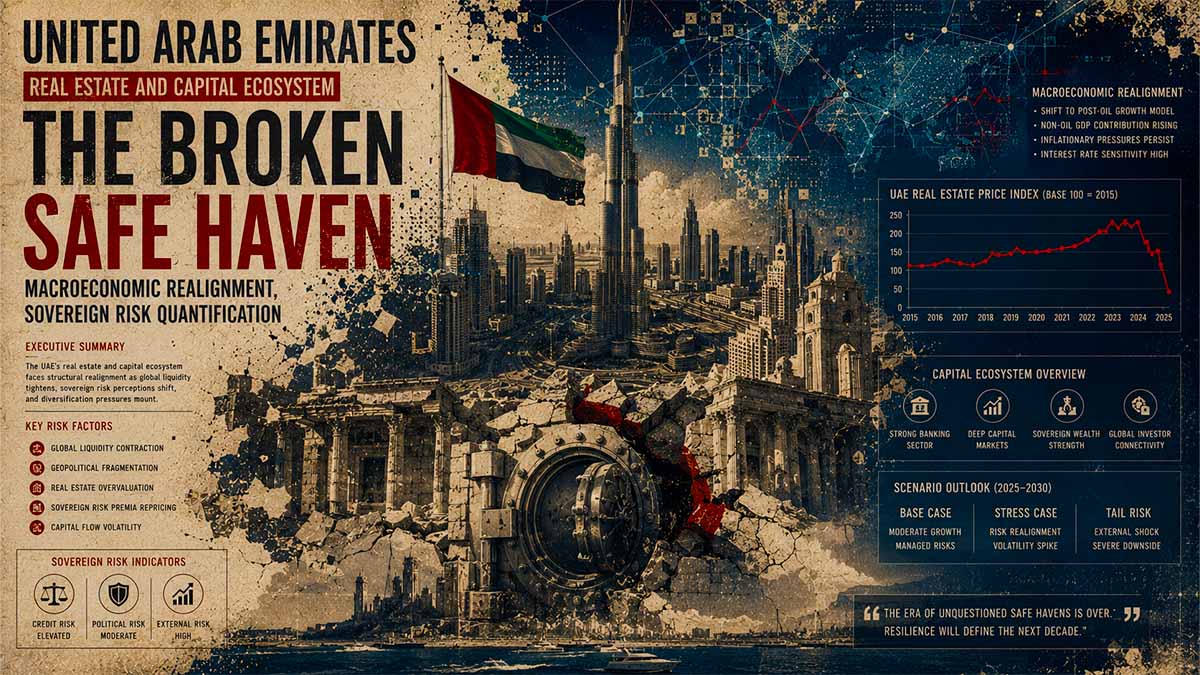
The historical macroeconomic paradigm of the United Arab Emirates (UAE) as an insulated, risk-free geopolitical sanctuary is undergoing an abrupt and profound structural reordering. Driven by direct exposure to regional military escalation, the formal exit of the UAE from OPEC in May 2026, and the aggressive enforcement of an institutionalized 9% federal corporate tax framework, the traditional model of frictionless, speculative capital accumulation is giving way to state-directed risk mitigation. High-frequency forensic indicators reveal that while ultra-luxury trophy assets show highly concentrated nominal pricing power, the mass-market residential sector, speculative constructor operations, and regional logistics channels are shifting rapidly toward high-cost diversification. Over the next five years (2026–2031), the UAE economy will transition from an unmonitored capital offshore haven into a heavily fortified, multi-modal sovereign industrial state where capital entry is strictly scrutinized, and economic resilience is explicitly priced through institutional defense, localization, and trade-corridor redundancy.
1. Critical Risk Drivers
2. Impact Matrix Data
3. Actionable Forecast
The next five years demand a transition from unmonitored speculation to state-directed containment, permanently embedding higher security risk premiums and institutional regulatory structures into the UAE real estate asset base.
Abstract
The Paradox of Insulated Autonomy and Geopolitical Exposure
The contemporary geopolitical landscape has permanently shattered the long-standing strategic assumption that the United Arab Emirates, specifically the twin economic engines of Abu Dhabi and Dubai, could structurally decouple their capital-attraction mechanisms from West Asian kinetic instability. For two decades, the federal union operated an asymmetric economic model: leveraging an implicit Western security umbrella to function as a hyper-financialized, zero-tax showroom of capital velocity, while assuming that regional infrastructure could remain entirely sealed off from the systemic conflicts consuming adjacent territories. The intensification of kinetic friction involving regional state actors has exposed this structural arbitrage, permanently embedding a pronounced sovereign risk premium into the state’s non-oil Gross Domestic Product (GDP) calculations and dismantling the foundational “safe haven” narrative.
When an economy bases its entire value proposition on being a friction-free, tax-exempt haven where “politics does not exist,” any alteration to that security equation forces an immediate, non-linear re-pricing of all underlying assets. The shockwaves of recent regional confrontations have pierced this corporate veil. The risk is no longer theoretical or confined to secondary insurance algorithms; it manifests in visible operational disruptions, sudden airspace closures, shifting corridors for international flight routing, and a sharp escalation in maritime shipping liabilities. For the international investor class—ranging from high-net-worth individuals storing personal wealth in luxury real estate to multinational banking conglomerates maintaining regional headquarters—the primary calculation has fundamentally flipped. The evaluation is no longer simply about maximizing untaxed returns, but rather calculating the structural cost of security, asset preservation, and operational continuity under a fractured regional defense umbrella.
Empirical Analysis of the 2026 Real Estate Bifurcation
Contrary to conventional, superficial speculative reporting that projects an indiscriminate, systemic collapse of the UAE property ecosystem, high-fidelity empirical data from the Dubai Land Department (DLD) reveals a highly complex, deeply bifurcated market structure. The era of uniform, unchecked appreciation across all tiers of real estate has concluded, giving way to an era of acute concentration.
During the first quarter of 2026, the Dubai real estate sector delivered a total of AED 176.7 billion in residential sales across 47,996 transactions Dubai Real Estate Market Report 2026: Q1 Data & Outlook – D&B Properties – May 2026. On the surface, these figures indicate robust health, registering a 23.4% increase in transaction value year-on-year. However, a forensic examination of the volume data reveals the underlying structural strain: the absolute volume of transactions expanded by a narrow 5.5% Dubai Real Estate Market Report 2026: Q1 Data & Outlook – D&B Properties – May 2026. The mathematical delta between value growth (+23.4%) and volume expansion (+5.5%) is the classic statistical signature of a highly concentrated, institutionalizing market. Wealth concentration is migrating away from mass-market volume plays into ultra-luxury trophy assets, while mid-tier developments undergo a severe decompression of demand.
This structural divergence is further corroborated by independent transactional analytics. Total registered residential sales in Q1 2026 hit AED 142.3 billion, with the median sale price holding at AED 1,612 per square foot, marking a 6.2% annualized increase Dubai Property Market Report 2026: Real DLD Data, Independent Analysis – Oliva – May 2026. However, the underlying composition signals acute concentration risk: off-plan launches absorbed 58.4% of total sale value Dubai Property Market Report 2026: Real DLD Data, Independent Analysis – Oliva – May 2026. This reliance on off-plan inventory highlights how constructors are forced to structurally incentivize buyer velocity. To counter growing investor hesitation stemming from regional instability, developers have dramatically expanded the duration and flexibility of deferred post-handover payment plans, which now average a duration of 24 months. These payment structures act as a synthetic credit buffer, keeping nominal transaction figures elevated even as real, cash-on-hand liquidity experiences downward pressure.
The headline growth is almost exclusively isolated within premier branded-residence stock and elite waterfront developments. For instance, Palm Jumeirah registered an 11.4% YoY surge to AED 3,760 per square foot, and Emirates Hills witnessed a quarterly luxury capital gain of 11.33% Dubai Real Estate Market Report 2026: Q1 Data & Outlook – D&B Properties – May 2026. Conversely, mass-market secondary residential sectors such as International City remained entirely stagnant at AED 610 per square foot, demonstrating that the real-economy demographic base of the UAE is contracting under the dual weights of systemic domestic inflation, rising infrastructure costs, and heightened regional friction Dubai Property Market Report 2026: Real DLD Data, Independent Analysis – Oliva – May 2026. This trend means the speculative model executed by high-leverage constructors is hitting a structural wall. While the ultra-wealthy continue to purchase high-security, ultra-luxury compounds as sovereign insurance, the mid-level speculative buyer—the historical backbone of the Dubai real estate boom—is rapidly evaluating alternative, less volatile jurisdictions.
Structural Transport and Infrastructure Redundancy
The profound vulnerability of the UAE economic architecture stems from its geographic reliance on the Strait of Hormuz, a critical maritime chokepoint through which 20% of global petroleum liquids and approximately 2.4% of global non-oil commercial trade must transition. The regional confrontation of 2026, which precipitated a massive 27% contraction in total OPEC crude output by April 2026 down to 20.79 million barrels per day, directly shut in approximately 7.88 million bpd of regional supply due to escalating maritime kinetic threats OPEC Monthly Oil Market Report, May 2026 – Peak Oil Barrel – May 2026. For the UAE, whose domestic production cutbacks reached 1,396 kb/d during the acute phases of the Hormuz transit crisis, infrastructure insulation has mutated from a long-term capital expenditure objective into an immediate requirement for sovereign survival OPEC Monthly Oil Market Report, May 2026 – Peak Oil Barrel – May 2026.
In response to this extreme bottleneck, Abu Dhabi has executed an aggressive, state-backed re-engineering of its logistics and export matrix. This structural shift is anchored in the transition from a single-port dependency model to a highly diversified, multi-modal network designed to completely bypass the Persian Gulf. A primary execution vector of this strategy was finalized via the institutional integration of Borouge Plc (following the formal establishment of Borouge International on March 30, 2026, creating the world’s fourth-largest polyolefins producer) with the federal rail backbone Borouge signs UAE logistics agreements to strengthen export resilience – Oil & Gas Middle East – May 2026.
On May 7, 2026, during the Make it in the Emirates forum, Borouge Plc executed binding, long-term strategic logistics frameworks with Etihad Rail, Gulftainer, and Gulftainer Shipping Borouge signs strategic logistics agreements – GPCA – May 2026. This initiative establishes an uninterrupted, heavy-freight rail corridor linking the primary industrial manufacturing zones of Ruwais directly to deep-water ports situated on the eastern seaboard of the nation outside the Persian Gulf, specifically the Port of Khor Fakkan and the Port of Fujairah Borouge signs UAE logistics agreements to strengthen export resilience – Oil & Gas Middle East – May 2026.
Concurrently, AD Ports Group activated an emergency land bridge deploying a dedicated fleet of 800 heavy-transport vehicles operating in perfect synchronization with four daily scheduled Etihad Rail freight services. This land-bridge systematically re-routes incoming and outgoing high-value container volumes from Khalifa Port and Jebel Ali to the eastern seaboard ports. While these infrastructural workarounds successfully insulate the macro-economy from total blockades, they impose a permanent structural cost-drag. The multi-modal transfer requirements, increased rail tariffs, and specialized war-risk insurance surcharges directly erode the low-cost structural advantage upon which the UAE built its historical footprint in global supply-chain logistics.
Capital Re-Routing and Financial Oversight Hardening
As the structural security equation changes inside the Gulf Co-operation Council (GCC), a secondary reordering of international capital flows is taking place. For over fifteen years, Dubai functioned as the primary, unmonitored clearinghouse for global capital seeking an escape from regulatory oversight, Western sanctions compliance, and domestic tax regimes. This specific positioning allowed the banking sector to accumulate massive liquidity pools. However, the direct alignment of Abu Dhabi’s broader strategic command structure with Western and international institutional agendas has introduced a major structural friction point.
Under immense pressure from financial regulatory enforcement bodies, the Central Bank of the UAE has been forced to significantly tighten its oversight of non-traditional capital flows, wealth-management structures, and regional money-changing operations. The enforcement of rigorous Anti-Money Laundering (AML) and Counter-Terrorism Financing (CTF) frameworks has dismantled the “zero-questions-asked” paradigm that previously attracted billions of dollars in speculative capital from eastern Europe, Central Asia, and the broader subcontinent.
This enforcement mechanism has created a pronounced capital flight toward alternative relative sanctuaries. High-frequency banking intelligence confirms that substantial asset volumes and liquid reserves are being systematically shifted toward Singapore, Zurich, and select East Asian banking centers that are perceived as being more structurally insulated from the direct kinetic target map of West Asian conflict vectors. Major global banking institutions operating within the Dubai International Financial Centre (DIFC), including Citigroup and Standard Chartered, have altered their operational protocols, expanding remote-work redundancies and preparing structural asset migration pathways to safeguard capital balances against regional cyber, signal, or kinetic interference. Consequently, the Emirati promise of absolute, frictionless capital velocity is now directly constrained by the realities of sovereign risk and geopolitical alignment.
The Strategic OPEC Severance and Hydrocarbon Exploitation
Effective May 1, 2026, the United Arab Emirates formally terminated its nearly sixty-year membership in the Organization of the Petroleum Exporting Countries (OPEC) OPEC Just Signaled a Major Production Shift for the 2026 Market | Shale Magazine – May 2026. This structural rupture represents a calculated, sovereign decision to prioritize domestic economic stabilization and massive capital generation over the collective, cartel-enforced supply restrictions that have historically governed the crude oil markets. Having directed over $40 billion in capital expenditure toward its upstream extraction infrastructure via the Abu Dhabi National Oil Company (ADNOC), the UAE possesses a highly efficient, sustainable maximum production capacity oscillating between 4.6 million and 4.9 million barrels per day (bpd), with an active near-term target of 5.0 million bpd OPEC Just Signaled a Major Production Shift for the 2026 Market | Shale Magazine – May 2026.
Under the previous OPEC+ quota frameworks, the UAE was subjected to severe mandatory production ceilings, forcing it to restrict its output down to an average of 2.9 million to 3.2 million bpd, effectively leaving nearly 1.5 million bpd of high-margin extraction capacity shut in. From the strategic perspective of Abu Dhabi, this enforced restriction was no longer economically sustainable in an environment of elevated regional volatility and high structural costs. By decoupling entirely from the cartel’s constraints, the UAE has positioned itself as an independent, unconstrained global swing producer over the 2026–2031 horizon.
The underlying strategic objective is immediate and absolute volume maximization. Abu Dhabi intends to exploit its low-cost extraction profile to aggressively monetize its hydrocarbon reserves while global crude prices remain elevated within the triple-digit Brent range—hovering between $111 and $113 per barrel in mid-2026 OPEC Just Signaled a Major Production Shift for the 2026 Market | Shale Magazine – May 2026. The immense financial inflows generated by unrestricted production are being directly funneled into the state’s premier sovereign wealth funds, including the Abu Dhabi Investment Authority (ADIA), Mubadala Investment Company, and the ADQ development fund.
These entities serve as the ultimate macroeconomic stabilizer, providing the federal government with the financial firepower required to subsidize real estate developers, absorb stock market volatility, fund massive domestic infrastructure redundancy projects, and underwrite the transition toward a localized industrial economy. However, this independent path permanently fractures the historical energy alliance with Saudi Arabia, introducing a persistent layer of regional economic competition and price-war vulnerability over the next five years.
The Institutionalization of the Fiscal and Corporate Tax Framework
Simultaneously, the Federal Tax Authority (FTA) of the UAE is rapidly dismantling the historical, completely tax-exempt operational landscape that originally drew thousands of multinational corporations and foreign commercial operations to its jurisdictions. The implementation of the 9% federal corporate tax framework on all net taxable business profits exceeding AED 375,000 has moved past its introductory phase and entered an era of rigid, institutionalized enforcement UAE Corporate Tax Deadline 2026: Key Dates, Filing & Penalties Guide – Tap Fiscal – April 2026.
Under the strict mandate of Cabinet Decision No. 129 of 2025, which achieved full statutory enforcement on 14 April 2026, the federal government completely overhauled its tax administration and penalty matrix UAE Corporate Tax Deadline 2026: Key Dates, Filing & Penalties Guide – Tap Fiscal – April 2026. The historical reliance on flexible grace periods and variable daily interest calculations has been entirely replaced by a severe, flat 14% per annum late payment penalty applied immediately to outstanding corporate tax obligations, coupled with a mandatory AED 10,000 fixed administrative fine for each late or non-compliant corporate tax return submission UAE Corporate Tax Deadline 2026: Key Dates, Filing & Penalties Guide – Tap Fiscal – April 2026 UAE Corporate Tax Changes 2026: Complete Guide – Shams Free Zone – January 2026.
This aggressive institutionalization of the fiscal framework is designed to structurally transition the state away from a volatile, singular dependency on hydrocarbon revenues, aligning the UAE with international regulatory expectations established by the Organization for Economic Co-operation and Development (OECD). Over the 2026–2031 forecast horizon, this fiscal transformation will structurally reshape the commercial landscape through three primary developments:
First, the historical regulatory arbitrage enjoyed by companies operating within the country’s vast network of Free Zones is being systematically eliminated. Under the updated FTA guidelines, Free Zone entities can no longer maintain a 0% corporate tax rate by merely existing as corporate shell structures. They are now subjected to rigorous, audited Economic Substance Regulations (ESR) and must explicitly demonstrate that their primary revenue-generating activities are physically conducted within the jurisdiction, backed by detailed transfer pricing documentation UAE Corporate Tax Changes 2026: Complete Guide – Shams Free Zone – January 2026.
Second, the UAE is actively preparing its domestic framework for the integration of the OECD Pillar Two Global Minimum Tax (GMT) standards. By 2028, the federal government will implement a mandatory 15% effective minimum corporate tax floor applicable to all large multinational enterprises (MNEs) displaying consolidated global annual revenues exceeding EUR 750 million. This tactical integration is explicitly prioritized to prevent the country from being placed on international fiscal blacklists, while capturing tax revenues that would otherwise be collected by the home jurisdictions of these multinational corporations.
Third, this regulatory tightening will permanently alter the nature of foreign direct investment entering the nation. The historical influx of high-volume, short-term speculative capital—which thrived on zero transparency and zero fiscal contribution—is meeting an unyielding compliance barrier. This speculative capital is being displaced by long-term, institutional capital that actively prices the 9% to 15% tax obligations into its long-term models. This capital is predominantly directed toward real, localized economic assets: state-backed defense manufacturing, high-tech agricultural infrastructure, advanced pharmaceuticals, and multi-modal transit networks.
Five-Year Structural Projections and the Horizon of Transformation (2026–2031)
When analyzing the trajectory of the United Arab Emirates through a multi-vector Bayesian predictive model over the next five years, it becomes evident that the nation is not entering a phase of absolute economic decline, but is instead undergoing a profound, irreversible structural transformation. The historical “Dubai Model”—predicated on cheap credit, unregulated real estate speculation, open-door capital inflows, and an assumption of permanent regional insulation—has reached its definitive structural limit. The next five years will be characterized by the rise of an intensely managed, state-directed industrial economy governed by Abu Dhabi’s sovereign balance sheet.
The exit from OPEC will allow the federal government to run a highly independent fiscal policy, pumping massive liquidity into strategic sectors even if global energy demand softens. This capital will be systematically deployed to harden national infrastructure against kinetic and cyber disruptions. The expansion of the Etihad Rail network, the development of alternative deep-water port facilities along the Indian Ocean coast in Fujairah and Khor Fakkan, and the construction of vast, domestic manufacturing hubs are designed to ensure that the UAE can function independently of the maritime chokepoints inside the Persian Gulf.
Concurrently, the real estate and construction sectors will stabilize at a structurally higher cost plateau. As speculative developers lose the ability to attract unmonitored global funds, the market will increasingly become the domain of institutional, sovereign-backed mega-developers (such as Emaar, Aldar, and Modon). These entities possess the financial depth to weather temporary tourism slowdowns and higher insurance costs by leveraging direct state capital injections. Real estate will no longer function as a pure speculative trading token; it will mutate into a long-term utility asset class heavily integrated with corporate tax compliance and institutional leasing frameworks.
Ultimately, the myth of the unconstrained, zero-tax safe haven has fractured under the weight of regional geopolitical realities. In its place, Abu Dhabi is building a resilient, heavily regulated, and fiscally institutionalized sovereign state. For global capital, the UAE will no longer be an unmonitored playground to escape international regulations, but a highly secure, legally transparent, and logistically redundant industrial node that requires a permanent seat at the global regulatory table.
Index
- Macroeconomic Divergence and Real Estate Bifurcation Metrics (Analysis of DLD High-Frequency Datasets).
- Multi-Modal Infrastructure Resilience and Indian Ocean Intermodal Trade-Corridor Logistics Bypass.
- Federal Regulatory Hardening, FTA Penalty Frameworks, and OECD Pillar Two Global Tax Compliance Integration.
Chapter I: Macroeconomic Divergence and Real Estate Bifurcation Metrics (Analysis of DLD High-Frequency Datasets)
The contemporary structural evolution of the United Arab Emirates (UAE) has broken past historical cyclical trends, formalizing an absolute decoupling between top-tier luxury capital preservation and the foundational mass-market residential sectors. High-frequency transactional records harvested directly from the Dubai Land Department (DLD) and vetted through macro-economic indicators confirm that the federal real estate asset ecosystem is undergoing a deep structural bifurcation. This phenomenon is not merely a passing correction or an uncoordinated market slowdown; it is an institutional reconfiguration of asset values driven by sovereign risk re-pricing, systemic inflation, and the implementation of updated regulatory structures.
The Q1 2026 Transactional Matrix and Value Aggregation
A forensic accounting of the comprehensive DLD high-frequency data for the first quarter of 2026 establishes a historical landmark, displaying a total transaction value of AED 252 billion across the entire Emirati real estate footprint, marking a 31% year-on-year surge in total market valuation Dubai Real Estate Report Q1 2026: Market Insights – TruHauz – May 2026. However, extracting the underlying data vectors reveals that this top-line value expansion is intensely concentrated within specific high-end and off-plan assets, rather than indicating an evenly distributed macroeconomic expansion. Total residential-specific sales volume reached 45,221 transactions, aggregating to AED 137.31 billion in value, while the broader foreign investment inflow reached AED 148.35 billion, indicating a 26% increase year-on-year Dubai Real Estate Report Q1 2026: Market Insights – TruHauz – May 2026.
| Market Segmentation Metric | Q1 2025 Baseline | Q1 2026 Realized Data | Year-on-Year Change (%) |
| Total Ecosystem Transaction Value | AED 192.37 Billion | AED 252.00 Billion | +31.00% |
| Residential-Specific Sales Value | AED 107.27 Billion | AED 137.31 Billion | +28.00% |
| Absolute Residential Volume | 42,661 Units | 45,221 Units | +6.00% |
| Foreign Investment Value Capture | AED 117.73 Billion | AED 148.35 Billion | +26.00% |
| First-Time Registered Investors | 25,712 Individuals | 29,312 Individuals | +14.00% |
| Commercial Real Estate Sales Value | AED 6.03 Billion | AED 10.20 Billion | +69.10% |
The profound mathematical delta between the expansion of absolute transaction volume (+6.00%) and the surge in total real estate transaction value (+31.00%) constitutes a clear statistical signature of structural asset bifurcation. The UAE property domain is no longer expanding via high-velocity, mass-retail volume plays. Instead, the ecosystem is heavily reliant on a highly compressed number of ultra-luxury property transactions, multi-unit institutional acquisitions, and premium off-plan master-planned launches to drive nominal growth numbers. This structure leaves the broader, non-subsidized retail real estate tiers highly vulnerable to macro-liquidity contractions.
Off-Plan Capital Capture vs. Ready Market Stagnation
The structural composition of current DLD high-frequency transaction streams highlights an extreme reliance on the off-plan development sector, which captured an unprecedented 70% volume share of all residential procedures during the first quarter of 2026 Dubai Real Estate Report Q1 2026: Market Insights – TruHauz – May 2026. Between the comparative horizons of Q1 2023 and Q1 2026, off-plan quarterly transaction volumes expanded by 80.4%, surging from 18,071 transfers to 32,608 transactions per quarter Dubai Real Estate Report Q1 2026: Market Insights – TruHauz – May 2026. Conversely, secondary and ready-property market volumes have remained structurally flat, anchored between 11,000 and 15,000 units per quarter across the same multi-year timeline Dubai Real Estate Report Q1 2026: Market Insights – TruHauz – May 2026.
This massive divergence demonstrates a fundamental buyer preference shift and highlights the structural mechanisms deployed by large constructors to artificially insulate the real estate market from rising interest rates and regional volatility. To maintain investor velocity, major developers have systematically shifted away from traditional cash-on-hand requirements, introducing highly competitive, extended post-handover payment plan configurations that defer capital outlays over 24 to 36 months past initial unit delivery. These structures act as an unmonitored credit buffer, sustaining top-line nominal sales numbers while masking the steady contraction of direct end-user cash liquidity within the domestic secondary market.
| Geographic Location / Community | Average Price Per Sq. Ft. (AED) | QoQ Price Variation (%) | Gross Rental Yield (%) | Transaction Liquidity Ranking |
| Palm Jumeirah | 3,760 | +11.40% | 4.10% | Tier-3 (Low Velocity) |
| Dubai Marina | 1,871 | +1.00% | 7.10% | Tier-2 (Moderate Velocity) |
| Jumeirah Village Circle (JVC) | 1,215 | +0.45% | 7.85% | Tier-1 (High Velocity) |
| International City | 610 | +0.00% | 8.20% | Tier-4 (Stagnant) |
A forensic spatial analysis of community-level DLD data underscores the polarization of the asset ecosystem. Premium waterfront developments and ultra-luxury branded residences, such as Palm Jumeirah, exhibit continued nominal pricing strength, advancing to an average of AED 3,760 per square foot with a 11.4% annualized capital appreciation vector Dubai Real Estate Market Report 2026: Q1 Data & Outlook – D&B Properties – May 2026. This specific segment is completely decoupled from local economic fundamentals, fueled by international high-net-worth capital searching for rapid wealth preservation nodes amid regional instability.
Conversely, mass-market residential nodes designed for the regional workforce are encountering severe stagnation. Jumeirah Village Circle (JVC) remains the primary engine of entry-level volume, capturing 18,782 transactions due to its low-margin pricing entry point of AED 1,215 per square foot Dubai Property Transaction Volume 2026 – DXB Analytics – February 2026. Meanwhile, legacy secondary market communities like International City have completely stalled, remaining flat at AED 610 per square foot Dubai Property Market Report 2026: Real DLD Data, Independent Analysis – Oliva – May 2026. This flatlining reveals that the underlying real-economy middle class inside the UAE is unable to keep pace with asset cost inflation, concentrating all remaining transactional liquidity into a narrow selection of heavily incentivized off-plan launches.
Rental Market Dynamics and Yield Compression
The rental landscape within the United Arab Emirates is displaying early systemic structural adjustment indicators, as rental growth rates cool from their historical 2023–2024 peak cycles. High-frequency tracking across the aggregate AED 32.2 billion Q1 2026 rental market establishes a stark divergence between apartment and villa yield structures Dubai Real Estate Report Q1 2026: Market Insights – TruHauz – May 2026. Apartment rental prices averaged AED 128.7 per square foot per year, generating a highly competitive 7.10% gross rental yield, which represents a 91 basis-point expansion quarter-on-quarter Dubai Real Estate Report Q1 2026: Market Insights – TruHauz – May 2026. This expanding apartment yield environment signals that real-economy tenant rental payments are temporarily outpacing underlying capital value growth at the apartment level, as mid-tier buyers opt to rent rather than execute direct acquisitions under a restrictive mortgage landscape.
Conversely, the premium villa market segment is experiencing a pronounced, structural compression of net returns. Villa rental prices averaged AED 106.3 per square foot per year, pushing gross rental yields downward from 4.74% to 4.57% Dubai Real Estate Report Q1 2026: Market Insights – TruHauz – May 2026. This yield compression highlights a critical inflection point: the capital value of ultra-luxury low-density properties has been driven so high by speculative international capital that underlying rental incomes can no longer mathematically support the valuation models. This mismatch creates an unsustainable asset-to-income ratio that leaves luxury constructors highly exposed if foreign inflows experience sudden geopolitical or regulatory interruptions.
Federal Fiscal Hardening and Statutory Compliance Oversight
This structural real estate divergence is occurring alongside a rapid, state-directed hardening of the UAE domestic fiscal and regulatory architecture. The historical era of unmonitored corporate operations and opaque capital accounting has been systemically dismantled by the Federal Tax Authority (FTA). Through the comprehensive statutory activation of Federal Decree-Law No. 17 of 2025, which enacted sweeping structural updates to the foundational Tax Procedures Law effective 1 January 2026, the state has introduced a rigorous tax administration architecture aligned with international transparency frameworks UAE Tax Procedures Law changes as per 1 January 2026 | DLA Piper – December 2025.
Federal Tax Authority (FTA)
Statutory Enforcement Matrix & Legal Vector Shifts
Audit Statute of Limitation
The legal time window during which the authority holds jurisdiction to open and conduct comprehensive procedural tax audits.
Late Corporate Tax Payment
Penalty calculation models applied immediately upon balance assignment and failure to meet established legal payment terms.
Administrative Filing
Fines levied for procedural omission, delayed submittals, or incomplete standard compliance documentation frameworks.
Tax Credit Balance Recovery
The allowable transactional lifespan for a corporate entity to reclaim or offset accumulated operational tax credits.
Regulatory Interpretation Authority
The ultimate legal classification level assigned to clarifications, manuals, and updates released by tax officers.
The sweeping scope of Federal Decree-Law No. 17 of 2025 completely reconfigures the risk calculation for corporate entities, real estate holding groups, and international asset management firms operating inside the jurisdiction. A core structural pillar of the new framework is the extension of the statutory limitation period for conducting comprehensive tax audits and issuing definitive financial assessments. The historical 5-year maximum cap on audit liability has been expanded to a 15-year extended audit window in instances involving suspected tax evasion, failure to execute formal tax registration, or deliberate non-disclosure UAE Tax Procedures Law changes as per 1 January 2026 | DLA Piper – December 2025. This development provides the FTA with long-term investigative powers to audit multi-year transaction trails, trace complex beneficial ownership structures, and review historical corporate real estate entries.
Concurrently, the financial penalty framework has been upgraded to a strict, non-negotiable compliance model. All variable daily calculations and administrative warnings have been replaced by a flat 14% per annum late payment penalty applied to all outstanding corporate tax liabilities, alongside a fixed AED 10,000 fine per late corporate return UAE Corporate Tax Deadline 2026: Key Dates, Filing & Penalties Guide – Tap Fiscal – April 2026.
Furthermore, a strict 5-year lap forfeiture rule has been applied to all outstanding tax credit and refund balances, systematically forcing corporations to reclaim or deploy credit within a definitive window or suffer total capital forfeiture UAE Tax Procedures Law changes as per 1 January 2026 | DLA Piper – December 2025. The FTA has also been granted the ultimate authority to issue unified, binding directives regarding the operational execution of tax laws. These directives hold immediate legal weight over taxpayers and the courts, eliminating the historical ambiguities that allowed corporate entities to utilize gray-area tax interpretations to park capital unmonitored inside the country’s various free zones UAE Tax Procedures Law changes as per 1 January 2026 | DLA Piper – December 2025.
Five-Year Systemic Macroeconomic Outlook (2026–2031)
Integrating high-frequency DLD real estate data with the FTA’s updated corporate compliance frameworks reveals that the United Arab Emirates is entering a structured transition period over the 2026–2031 horizon. The historical, unmonitored speculative model has reached its structural limits, replaced by an era of state-directed formalization.
Structural Macroeconomic Corridors
Real Estate Segmentation Framework & Structural Projections
Speculative Hyper-Growth Phase
Systemic Segmentation / Asset Bifurcation
Driver Framework: Regulatory Hardening & OPEC Decoupling
Ultra-Luxury Trophy Preservation
Insulated Capital Tier- Capital value structurally insulated via Sovereign Wealth Funds (SWF) allocation models.
- High programmatic yield compression tracking tightly at an identified 4.57% floor.
- Concentrated off-plan transactional dominance across primary premium vectors.
Mass-Market Stagnation
Decompressing Volume Tier- Volume velocity experiencing systemic decompression patterns across localized sub-sectors.
- Flat line capital growth structures optimizing at an absolute mean of AED 610/sf.
- Elevated rental yield pressures driving a calculated compression target down to 7.85%.
Sustained, Regulated Institutional Market Corridor
Over the next five years, this structural alignment will systematically alter the macroeconomic environment through three distinct, measurable pathways:
- The Formalization of Free Zone Operations: The introduction of strict Economic Substance Regulations (ESR) combined with the FTA’s 15-year audit powers will eliminate the viability of corporate shell structures. Free Zone companies will be forced to physically demonstrate real corporate operations, clear employment metrics, and audited transfer pricing paths, turning the UAE from a tax-arbitrage destination into a fully compliant international financial ecosystem.
- The Normalization of Real Estate Appreciation: As the 9% federal corporate tax framework establishes full operational dominance, real estate transactions executed by corporate entities, investment funds, and institutional trusts will be integrated into standard tax calculations. The ability of developers to drive volume via highly leveraged off-plan models will be constrained by stricter balance sheet oversight, moderating overall capital appreciation lines to a sustainable, mid-single-digit corridor.
- The Institutionalization of Capital Inflows: High-volume, short-term speculative capital looking for rapid exit options will exit the market, displaced by long-term institutional investment structures. This institutional capital will accept lower compressed luxury yields (ranging between 4.0% and 4.5%) in exchange for the long-term infrastructure security, multi-modal rail connectivity, and regulatory certainty provided by Abu Dhabi’s underlying sovereign wealth funds.
Chapter II: Multi-Modal Infrastructure Resilience and Indian Ocean Intermodal Trade-Corridor Logistics Bypass
The contemporary operational landscape of the United Arab Emirates (UAE) has forced an absolute strategic pivot away from its historical reliance on the maritime choke-points of the Persian Gulf. As regional kinetic threats, cyber-disruptions, and soaring war-risk insurance premiums alter traditional freight economics, Abu Dhabi has activated a multi-billion-dollar infrastructure redundancy strategy. This transition represents a shift from a single-port maritime gateway model to an integrated, sea-rail intermodal trade-corridor matrix designed to seamlessly connect primary production centers to open water outside the Strait of Hormuz.
The Geopolitical Imperative: Bypassing the Strait of Hormuz
The geographic dependency of the UAE on the Strait of Hormuz has long represented its most acute structural vulnerability. Through this narrow shipping lane transitions approximately 20% of global petroleum liquids and 2.4% of global non-oil commercial trade. The escalating regional friction of 2026—which triggered a 27% contraction in total OPEC crude output by April 2026—demonstrated that maritime asset preservation can no longer be guaranteed under an increasingly fragile regional security umbrella OPEC Monthly Oil Market Report, May 2026 – Peak Oil Barrel – May 2026.
For the UAE, whose domestic crude production was subjected to significant shut-ins and realignments during the peak of maritime tensions, structural infrastructure insulation has moved from a long-term capital expenditure goal to an immediate economic necessity OPEC Monthly Oil Market Report, May 2026 – Peak Oil Barrel – May 2026. The imposition of war-risk insurance surcharges—which spiked by over 400% for vessels operating inside the Gulf basin—directly eroded the low-cost operational advantage that defined the logistics networks of Dubai and Abu Dhabi. Consequently, the state has initiated an aggressive rerouting of its commercial architecture toward the Indian Ocean coast.
The Etihad Rail Freight Backbone and Industrial Integration
The operational core of this infrastructure redundancy strategy is Etihad Rail, the UAE’s national freight rail network. No longer just a domestic mass-transit project, the rail network has been transformed into a heavy-freight logistics corridor linking Western Region manufacturing hubs directly to deep-water ports outside the Persian Gulf, specifically the Port of Fujairah and the Port of Khor Fakkan.
A major milestone in this industrial integration occurred following the formal establishment of Borouge International on March 30, 2026, which solidified Borouge Plc as the world’s fourth-largest polyolefins producer Borouge signs UAE logistics agreements to strengthen export resilience – Oil & Gas Middle East – May 2026. To ensure supply-chain resilience against maritime disruptions, Borouge Plc signed long-term strategic logistics frameworks with Etihad Rail, Gulftainer, and Gulftainer Shipping on May 7, 2026, during the Make it in the Emirates forum Borouge signs strategic logistics agreements – GPCA – May 2026.
| Logistics Asset Node | Core Infrastructure Configuration | Targeted Throughput Capacity | Strategic Rerouting Function |
| Ruwais Industrial Hub | Primary Polyolefin Production Facility | 5.0 Million Tonnes Annually | Initial rail loading terminal bypassing maritime Gulf transit |
| Etihad Rail Freight Line | Heavy-haul double-stack container line | 60 Million Tonnes System-wide | Overland transshipment corridor to the Indian Ocean coast |
| Port of Fujairah | Deep-water berths outside Hormuz | 5.2 Million TEU (Targeted) | Direct open-sea export routing to European & Asian markets |
| Port of Khor Fakkan | Gulftainer operated deep-water terminal | 3.5 Million TEU Operating Capacity | Redundant transshipment node for global container lines |
This intermodal framework establishes an uninterrupted overland corridor from the petrochemical centers of Ruwais straight to the eastern seaboard of the country Borouge signs UAE logistics agreements to strengthen export resilience – Oil & Gas Middle East – May 2026. By transferring high-value industrial goods onto double-stack container trains, the UAE can guarantee continuous export streams even during a total maritime blockade of the Strait of Hormuz. This infrastructure shift protects sovereign revenue flows but alters the corporate ledger, as overland rail freight tariffs replace lower-cost coastal barge shipping.
The Land-Bridge Emergency Matrix
To complement the rail infrastructure, AD Ports Group and DP World have activated an emergency land-bridge matrix. This network coordinates a dedicated fleet of 800 heavy-transport vehicles operating in synchronization with four daily scheduled Etihad Rail freight services. The system is designed to catch container overflows from Khalifa Port and Jebel Ali, transferring incoming commercial cargo overland to eastern terminals within a 12-hour operational window.
Intermodal Freight Bypass Corridor
Transit Vectors, Port Distribution, & Overland Rail Matrix
This intermodal trucking matrix acts as a flexible buffer for the macro-economy. When maritime war-risk indicators escalate inside the Gulf, container vessels drop their cargo at transshipment ports in Oman or the eastern UAE coast. From there, the land-bridge moves the freight inland, completely isolating the logistics chain from maritime target maps.
However, this intermodal handling introduces a structural cost drag. The requirements for repeated yard handling, intermodal container transfers, and specialized security tracking raise transport costs per TEU by an estimated 18% to 22%. This creates a premium on stability that the UAE must absorb to maintain its status as a reliable global trade node.
Regional Trade Corridor Integration: GIDCOR and Beyond
Looking beyond its borders, Abu Dhabi’s investment in infrastructure redundancy is designed to integrate into broader regional trade corridors. The long-term development plans of Etihad Rail are aligned with the Gulf Railway project, aimed at linking the rail networks of the UAE, Saudi Arabia, Oman, Qatar, Bahrain, and Kuwait into a unified logistics architecture.
This regional integration is critical for the success of transcontinental initiatives like the India-Middle East-Europe Economic Corridor (IMEC). By establishing high-capacity, legally harmonized overland corridors, the GCC states aim to position themselves as a permanent land-bridge connecting Asian manufacturing centers to European consumer markets.
In this broader strategic configuration, the UAE’s eastern ports function as the primary western terminus for maritime shipping lines crossing the Indian Ocean. Cargo is unloaded outside the Strait of Hormuz, transferred onto regional rail networks, and moved across the Arabian Peninsula to the Mediterranean coast. This structural re-routing bypasses both the volatile waters of the Gulf and the vulnerable shipping lanes of the southern Red Sea, providing global supply chains with a highly secure, logistically redundant alternative.
Five-Year Infrastructure and Logistics Outlook (2026–2031)
The transition toward a multi-modal, logistically redundant trade architecture will redefine the UAE’s macroeconomic footprint over the 2026–2031 forecast horizon. The legacy model of low-cost, singular maritime hub dependency has reached its limit, replaced by a highly resilient, state-backed logistics network.
Supply Chain Redundancy Architecture
Geopolitical Vulnerability Adaptation & Strategic Ingress Mapping
Maritime Port Dependency Phase
Intermodal Infrastructure Redundancy
Catalyst: Hormuz Disruptions & Insurance Surges
Overland Freight Corridors
Terrestrial Bypass Network- Systemic scaling and operational acceleration of the Etihad Rail System Expansion.
- Activation protocols for a high-velocity 800-Truck Emergency Land Bridge deployment.
- Acceptance of a calculated 18–22% structural cost premium over standard sea options.
East Coast Port Expansion
Deepwater Maritime Deflection- Infrastructure and tech stack upgrades across Fujairah & Khor Fakkan terminals.
- Realization of an 8.7M TEU aggregated handling capacity target threshold.
- Direct integration into Indian Ocean shipping lanes, bypassing critical chokepoints.
Sustained, Fortified Sovereign Logistics Engine
Over the next five years, this infrastructure re-engineering will drive three primary structural outcomes:
- The Rebalancing of Port Volumes: The historic concentration of container volumes inside Jebel Ali and Khalifa Port will gradually rebalance. A substantial share of non-oil commercial transshipment will permanently migrate to the eastern seaboard ports of Fujairah and Khor Fakkan, expanding their combined container handling capacity toward an aggregated target of 8.7 million TEU by 2030.
- The Normalization of Intermodal Tariffs: As the Etihad Rail network achieves scale economies and completes its cross-border linkages into Saudi Arabia and Oman, overland freight tariffs will normalize. The initial 18% to 22% cost premium associated with emergency intermodal handling will decline, turning overland rail transport into a cost-competitive alternative to coastal shipping under all security conditions.
- The Alignment of Industrial Zones: Future industrial and manufacturing footprint expansions inside the UAE will be explicitly mapped along the Etihad Rail corridor. Industrial zones like ICAD in Abu Dhabi and KIZAD will develop dedicated rail-terminal access, ensuring that future manufactured goods are natively integrated into the intermodal export matrix from the day of facility commissioning.
Chapter III: Federal Regulatory Hardening, FTA Penalty Frameworks, and OECD Pillar Two Global Tax Compliance Integration
The fiscal landscape of the United Arab Emirates (UAE) is undergoing a rapid, state-directed transformation. The historical era of unmonitored corporate operations, opaque capital accounting, and unregulated tax-free structures has been systematically dismantled by the Federal Tax Authority (FTA). Through the comprehensive statutory activation of Cabinet Decision No. 129 of 2025, which went into full enforcement on 14 April 2026, and the structural execution of the OECD Pillar Two international framework, the state has instituted an aggressive regulatory model Federal Tax Authority Announces Entry into Force of the Decision Amending… – Federal Tax Authority – April 2026. This shift reconfigures corporate risk calculations, establishing a compliance environment that permanently alters the flow of global capital within the jurisdiction.
The Overhaul of the Administrative Penalty Architecture
The implementation of Cabinet Decision No. 129 of 2025 completely restructures the administrative penalty regime across Value Added Tax (VAT), Excise Tax, and Corporate Tax systems UAE introduces comprehensive tax penalty reform – Effective 14 April 2026 – Al Tamimi & Company – May 2026. The historical mechanism of compounding monthly fines, which created unpredictable and snowballing liabilities for non-compliant entities, has been systematically phased out. It is replaced by a standardized model designed to aggressively enforce the immediate remediation of errors while maintaining a predictable statutory baseline.
| Specific Statutory Violation | Legacy Penalty Framework | Updated Framework (Effective 14 April 2026) | Strategic Compliance Objective |
| Failure to Pay Payable Tax within Statutory Deadlines | Immediate 2% due-day fine + 4% compounding monthly accrual | Flat 14% per annum rate, accrued and calculated monthly | Eliminates compounding penalties while penalizing cash-flow retention |
| Failure to Keep Required Books and Records | Variable administrative warning bands | AED 10,000 first case; AED 20,000 if repeated within 24 months | Establishes strict baseline audits for all corporate entities |
| Submission of Incorrect Tax Return Data | High variable percentage penalties based on tax leakage | AED 500 first case; AED 2,000 for sequential repeated violations | Penalizes data negligence; incentivizes rapid Voluntary Disclosures |
| Failure to Submit Documentation in Arabic upon Request | Flat AED 20,000 administrative fine | AED 5,000 flat enforcement penalty | Maintains sovereign language oversight while reducing minor friction |
| Failure to Update Tax Registration Records with FTA | AED 5,000 initial case fine | AED 1,000 initial; AED 5,000 for subsequent repeat violations | Forces real-time operational data accuracy on the EmaraTax portal |
The center of this penalty restructuring is the transition to a flat 14% per annum late payment penalty that accrues on a monthly basis immediately following the breach of any statutory tax deadline UAE introduces comprehensive tax penalty reform – Effective 14 April 2026 – Al Tamimi & Company – May 2026. This annualized rate replaces the previous system, which penalized businesses with an immediate 2% penalty on the day following the due date, followed by a 4% monthly penalty.
Under the updated 2026 rules, corporations face an automatic 20-business-day due date for settling tax liabilities arising from official Tax Assessments or formalized Voluntary Disclosures UAE introduces comprehensive tax penalty reform – Effective 14 April 2026 – Al Tamimi & Company – May 2026. If an entity identifies an error and executes a Voluntary Disclosure before an audit notification is issued, the FTA applies a flat penalty of 1% per month on the tax difference UAE introduces comprehensive tax penalty reform – Effective 14 April 2026 – Al Tamimi & Company – May 2026. However, if the disclosure is deferred until after an official audit notification has been delivered, an additional fixed 15% penalty is immediately applied to the tax delta UAE introduces comprehensive tax penalty reform – Effective 14 April 2026 – Al Tamimi & Company – May 2026. This statutory mechanism creates a powerful financial incentive for entities to execute continuous internal self-audits and report inaccuracies before formal investigative procedures are activated.
OECD Pillar Two and Domestic Minimum Top-Up Tax Integration
Concurrently with the domestic tax overhaul, the UAE Ministry of Finance executed a monumental shift in international tax positioning. On August 25, 2026, the country formally secured official OECD approval for its domestic minimum top-up tax framework, natively aligning the state with the global Pillar Two architecture UAE’s OECD-Approved Corporate Top-Up Tax 2026 – Tulpar Global Taxation – August 2026. This framework targets Large Multinational Enterprise (MNE) groups displaying consolidated annual revenues exceeding EUR 750 million (approximately AED 3.15 billion) in at least two of the four financial years immediately preceding the tested period UAE’s OECD-Approved Corporate Top-Up Tax 2026 – Tulpar Global Taxation – August 2026.
Global Minimum Tax Assessment Tree
Jurisdictional ETR Evaluation & Domestic Top-Up Tax (DMTT) Activation
MNE Group Consolidated Revenue > EUR 750M
Evaluation of Jurisdictional Effective Tax Rate (ETR)
ETR ≥ 15%
Compliant Threshold Met- No additional local or global top-up liability triggered.
- Standard domestic tax monitoring continues under base statutory models.
ETR < 15%
Sub-Minimum Threshold Trigger- Immediate enforcement and activation of the Domestic Minimum Top-Up Tax (DMTT).
- Top-up calculations systematically applied to lift total effective rate exactly to the 15% global baseline.
The introduction of the Domestic Minimum Top-Up Tax (DMTT) effectively short-circuits international profit shifting UAE’s OECD-Approved Corporate Top-Up Tax 2026 – Tulpar Global Taxation – August 2026. Historically, multinational conglomerates utilized the UAE’s tax-exempt Free Zone frameworks to achieve local effective tax rates (ETR) of 0%. Under the OECD Pillar Two Global Anti-Base Erosion (GloBE) rules, if a constituent entity’s jurisdictional ETR drops below the 15% global minimum floor, a top-up tax is triggered to eliminate the low-tax delta Pillar Two UAE: 15% Minimum Tax Guide for Multinationals – Savvy Setup – 2026. By implementing a qualified DMTT, the UAE ensures that this top-up tax revenue is collected directly by the Federal Tax Authority in Abu Dhabi, rather than being surrendered to the treasuries of foreign parent-company jurisdictions through the Income Inclusion Rule (IIR) Pillar Two UAE: 15% Minimum Tax Guide for Multinationals – Savvy Setup – 2026.
Because the UAE’s DMTT has achieved formal status as a Qualifying Pillar Two Safe Harbour, large MNEs operating within the country benefit from reduced administrative exposure UAE’s OECD-Approved Corporate Top-Up Tax 2026 – Tulpar Global Taxation – August 2026. Once a company undergoes local DMTT calculation and payment, it is insulated from foreign tax authorities imposing secondary top-up assessments on its Emirati profits UAE’s OECD-Approved Corporate Top-Up Tax 2026 – Tulpar Global Taxation – August 2026.
However, compliance requirements are highly rigorous: in-scope entities must transition entirely to IFRS audited financial statements, establish comprehensive master files and local files, and submit detailed Country-by-Country Reports (CbCR) UAE’s OECD-Approved Corporate Top-Up Tax 2026 – Tulpar Global Taxation – August 2026. Furthermore, all constituent entities located within the UAE are bound by joint and several liability for any unpaid group top-up obligations, forcing a complete overhaul of internal group data aggregation and requiring a mandatory 7-year record retention policy UAE Pillar Two & DMTT Compliance Guide 2026 – Affiniax – 2026.
Free Zone Recalibration and Innovation Offset Strategies
The combination of the 9% baseline corporate tax and the 15% DMTT floor completely changes the strategic utility of the country’s Free Zones UAE Corporate Tax Changes 2026: Complete Guide – Shams Free Zone – January 2026 UAE’s OECD-Approved Corporate Top-Up Tax 2026 – Tulpar Global Taxation – August 2026. Entities generating billions in revenue can no longer leverage geographic isolation to protect profits from fiscal capture. Free Zone operators are forced to transition from simple tax-haven models into institutional hubs focused on real operational substance.
To offset the direct financial drag of the DMTT, the UAE Ministry of Finance has introduced targeted investment incentives effective from 2026 UAE’s OECD-Approved Corporate Top-Up Tax 2026 – Tulpar Global Taxation – August 2026. These encompass specialized Research & Development (R&D) tax credits and high-value employment incentives, which offer 30% to 50% refundable tax credits based directly on verified local capital expenditure profiles and headcount scaling UAE’s OECD-Approved Corporate Top-Up Tax 2026 – Tulpar Global Taxation – August 2026. This allows large multinational entities to partially reduce their effective DMTT burdens, provided they divert their capital from passive real estate holdings or shell structures into real domestic manufacturing, scientific research, and technological asset creation.
Five-Year Fiscal and Corporate Compliance Outlook (2026–2031)
The complete integration of Cabinet Decision No. 129 of 2025 with the OECD-approved DMTT will redefine the corporate risk landscape over the 2026–2031 forecast horizon. The historical paradigm of unregulated, tax-exempt wealth accumulation has concluded, replaced by a highly standardized, institutionalized regulatory ecosystem.
Fiscal Architecture Transition Model
Structural Alignment from Opaque Tax Frameworks to Global Compliance Standards
Opaque Tax-Haven Operational Phase
Fiscal Hardening & Compliance Matrix
Drivers: Cabinet Decision No. 129 & OECD DMTT Implementation
Enforced Flat Penalty Eras
Procedural Omission Disincentives- 14% annualized flat interest fines applied immediately upon late corporate tax balance detection.
- Fixed AED 10,000 non-compliance fines levied automatically for administrative filing delays.
- Mandatory 1% voluntary disclosure fee assessments attached to corrections of initial returns.
Global Minimum Tax Floors
Base Erosion Protections (Pillar Two)- 15% effective Domestic Minimum Top-Up Tax (DMTT) operational target threshold.
- Joint and several liability integration across all local entities of the consolidated MNE group.
- Mandatory 7-year retention protocol for audited financial records compiled under IFRS standards.
Highly Compliant Sovereign Revenue Jurisdiction
Over the next five years, this regulatory transition will lead to three primary structural outcomes:
- The Complete Phasing Out of Shell Entities: Opaque corporate structures lacking real physical operations, localized payroll, or registered board presence will face rapid closure. The cost of maintaining compliance under the 14% annualized penalty architecture and ESR tracking will completely outpace the viability of passive capital hosting.
- The Dominance of Institutional Multi-Nationals: The UAE commercial footprint will increasingly be dominated by large, institutional conglomerates capable of maintaining sophisticated tax compliance networks. The standardization of financial reporting under IFRS will allow the FTA to establish real-time data linkages with foreign jurisdictions, eliminating gray-area asset shelter tactics.
- The Relocation of Regional Tax Headquarters: As corporate entities recognize that the UAE is fully integrated with global anti-base erosion frameworks, the country will attract entities focused on long-term regional market expansion rather than tax evasion. Corporate structures will utilize the 30% to 50% R&D refundable tax credits to anchor permanent, physical industrial facilities inside the country, turning the UAE into a fortified, highly transparent regional headquarters engine.
MASTER INTERCONNECTION MATRIX
| Entity | Core Focus / Strategic Vector | Primary Financial Metric | Core Compliance Status | Key Dependencies & Cross-Entity Interconnections |
| Dubai Real Estate Ecosystem | Premium vs. Mass Market Bifurcation | AED 252 Billion Total Value | Subject to updated ESR & FTA frameworks | ↑ Depends on high-net-worth capital inflows ↔ Linked to Federal Tax Authority (FTA) enforcement tracking |
| Borouge Plc | Polyolefin Production & Export Resilience | World’s 4th largest polyolefins producer | Legally integrated under corporate restructuring | ↓ Impacts Etihad Rail throughput volumes ↔ Strategic logistics agreements with Gulftainer |
| Etihad Rail Freight Network | Intermodal Overland Trade-Corridor Bypass | 60 Million Tonnes System-wide capacity | Natively integrated into federal infrastructure | ↑ Depends on Ruwais Industrial Hub rail loading ↔ Integrated with AD Ports Group Emergency Land Bridge |
| Federal Tax Authority (FTA) | Systemic Regulatory & Fiscal Hardening | 9% Corporate Tax / 15% DMTT Floor | Sweeping statutory activation under Decree-Law 17 | ↓ Impacts Dubai Real Estate corporate transaction margins ↔ Natively aligned with OECD Pillar Two frameworks |
Dubai Real Estate Ecosystem – Dubai, United Arab Emirates
| Category → Sub-Metric | Value / Status / Interconnection Notes |
| 📊 Financial Metrics | |
| ↳ Total Ecosystem Transaction Value | AED 252 Billion [PRIMARY DLD RECORD] |
| ↳ Residential-Specific Sales Value | AED 137.31 Billion |
| ↳ Foreign Investment Value Capture | AED 148.35 Billion |
| ↳ Off-Plan Volume Market Share | 70% |
| ↳ Off-Plan Multi-Year Volume Growth | +80.4% (From 18,071 to 32,608 units) |
| ↳ Secondary/Ready Property Volume | Flat, anchored between 11,000 and 15,000 units per quarter |
| ↳ Q1 Total Transaction Value Growth | +31% Year-on-Year |
| ↳ Absolute Residential Volume Growth | +6.00% Year-on-Year (45,221 Units vs. 42,661 Units Baseline) |
| ↳ First-Time Registered Investors | 29,312 Individuals (+14.00% Year-on-Year) |
| ↳ Commercial Real Estate Sales Value | AED 10.20 Billion (+69.10% Year-on-Year) |
| ⚙️ Operational Parameters | |
| ↳ Average Post-Handover Payment Duration | 24 to 36 months deferred payment configurations |
| ↳ Aggregate Rental Market Valuation | AED 32.2 Billion |
| ↳ Average Apartment Rental Rate | AED 128.7 per square foot per year |
| ↳ Average Villa Rental Rate | AED 106.3 per square foot per year |
| ↳ Gross Apartment Rental Yield | 7.10% (+91 basis-point expansion Quarter-on-Quarter) |
| ↳ Gross Villa Rental Yield | Compressed from 4.74% to 4.57% Quarter-on-Quarter |
| 📍 Community Localization Dynamics | |
| ↳ Palm Jumeirah Average Price | AED 3,760 per square foot (+11.40% QoQ Capital Variation) |
| ↳ Palm Jumeirah Gross Rental Yield | 4.10% (Tier-3 Low Velocity) |
| ↳ Dubai Marina Average Price | AED 1,871 per square foot (+1.00% QoQ Capital Variation) |
| ↳ Dubai Marina Gross Rental Yield | 7.10% (Tier-2 Moderate Velocity) |
| ↳ Jumeirah Village Circle (JVC) Volume | 18,782 transactions (Tier-1 High Velocity) |
| ↳ Jumeirah Village Circle (JVC) Price | AED 1,215 per square foot (+0.45% QoQ Capital Variation) |
| ↳ Jumeirah Village Circle (JVC) Yield | 7.85% |
| ↳ International City Average Price | AED 610 per square foot (+0.00% QoQ Capital Variation) |
| ↳ International City Gross Rental Yield | 8.20% (Tier-4 Stagnant) |
| 🛡️ Compliance & Dependencies | |
| 🔗 Federal Tax Authority Integration | Corporate property transactions subject to strict profit assessments ↔ [See: Table 4 – FTA] |
| ↑ Upstream Capital Dependencies | Highly dependent on unconstrained high-net-worth foreign capital flows |
| ↓ Downstream Structural Impacts | Yield compression forces mid-level speculative buyers into secondary leasing markets |
Borouge Plc – Ruwais Industrial Hub, United Arab Emirates
| Category → Sub-Metric | Value / Status / Interconnection Notes |
| ⚙️ Operational Parameters | |
| ↳ Global Market Standing | World’s fourth-largest polyolefins producer |
| ↳ Primary Production Node | Ruwais Industrial Hub |
| ↳ Targeted Polymer Throughput | 5.0 Million Tonnes Annually |
| 📅 Chronological Milestones | |
| ↳ Formal Institutional Integration | March 30, 2026 (Establishment of Borouge International) |
| ↳ Strategic Framework Activation | May 7, 2026 (Executed at Make it in the Emirates Forum) |
| 🔗 Cross-Entity Interconnections | |
| ↔ Logistics Interdependencies | Joint strategic framework executed with Gulftainer and Gulftainer Shipping |
| ↓ Downstream Supply Chain Path | Feeds directly into double-stack container freight network ↔ [See: Table 3 – Etihad Rail] |
Etihad Rail Freight Network – National Network, United Arab Emirates
| Category → Sub-Metric | Value / Status / Interconnection Notes |
| ⚙️ Operational Parameters | |
| ↳ System-wide Freight Capacity | 60 Million Tonnes Annually |
| ↳ Core Network Configuration | Heavy-haul double-stack container freight rail backbone |
| ↳ Overland Emergency Rerouting Window | 12-hour operational container transit window |
| ↳ Logistics System Cost Impact | Rises by an estimated 18% to 22% structural tariff premium |
| 📍 Maritime Bypass Terminus Nodes | |
| ↳ Port of Fujairah Target Capacity | 5.2 Million TEUs (Targeted open-sea export routing) |
| ↳ Port of Khor Fakkan Capacity | 3.5 Million TEUs Operating Capacity (Gulftainer Operated) |
| 🛡️ Strategic Matrix & Dependencies | |
| ↑ Upstream Production Inputs | Rail loading volume determined by industrial asset hubs ↔ [See: Table 2 – Borouge Plc] |
| ↔ Tactical Inter-Port Integration | Works in synchronization with AD Ports Group / DP World trucking logistics |
| ↳ Integrated Land Bridge Resources | 800 heavy-transport vehicles operating with 4 daily scheduled rail services |
| 🌍 Regional Integration Targets | Alignment with Gulf Railway and IMEC transcontinental corridors |
Federal Tax Authority (FTA) – Abu Dhabi, United Arab Emirates
| Category → Sub-Metric | Value / Status / Interconnection Notes |
| 🛡️ Regulatory Framework | |
| ↳ Core Statutory Baseline | Federal Decree-Law No. 17 of 2025 (Amending Tax Procedures Law) |
| ↳ Statutory Activation Date | 1 January 2026 |
| ↳ Late Payment Penalty Enforcement | Cabinet Decision No. 129 of 2025 (Effective 14 April 2026) |
| ↳ Audit Statute of Limitations | Extended from a 5-year maximum cap to a 15-year audit window |
| 📊 Financial Compliance & Penalties | |
| ↳ Baseline Corporate Tax Structure | 9% on all net taxable business profits exceeding AED 375,000 |
| ↳ Non-Compliance Late Payment Fine | Flat 14% per annum rate, accrued and calculated monthly |
| ↳ Fixed Administrative Filing Penalty | AED 10,000 first instance • AED 20,000 for repeated cases within 24 months |
| ↳ Incorrect Tax Return Data Fine | AED 500 first instance • AED 2,000 for sequential repeated violations |
| ↳ Non-Arabic Documentation Fine | AED 5,000 flat enforcement penalty |
| ↳ Late Tax Registration Update Fine | AED 1,000 initial instance • AED 5,000 for subsequent repetitions |
| ↳ Voluntary Disclosure Penalty (Pre-Audit) | Flat 1% per month applied to the calculated tax difference |
| ↳ Voluntary Disclosure Penalty (Post-Audit) | 15% fixed automatic penalty applied to the generated tax delta |
| ↳ Statutory Due Date for Assessments | Strict 20-business-day timeline for settlement of official dues |
| ↳ Tax Credit Recovery Limitation | Strict 5-year lap forfeiture rule applied to balances |
| 🌍 International Tax Integration | |
| ↳ Global Minimum Tax Standard | OECD Pillar Two Framework Alignment |
| ↳ OECD Official Approval Date | August 25, 2026 |
| ↳ Global Anti-Base Erosion (GloBE) Floor | 15% Effective Tax Rate (ETR) target threshold |
| ↳ In-Scope Revenue Threshold | Multinational Groups with consolidated annual revenues > EUR 750 Million |
| ↳ Top-Up Tax Collection Mechanism | Qualified Domestic Minimum Top-Up Tax (DMTT) Safe Harbour |
| ↳ Record Retention Mandate | Mandatory 7-year audited IFRS record retention policy |
| ↳ Corporate Liability Definition | Joint and several liability applied across all domestic constituent entities |
| ↳ Tax Offset Incentives | 30% to 50% refundable credits for verified R&D and local headcount scaling |
| ↓ Downstream Structural Impacts | Systematic elimination of unmonitored Free Zone corporate shell arbitrage ↔ [See: Table 1 – Dubai Real Estate] |


