













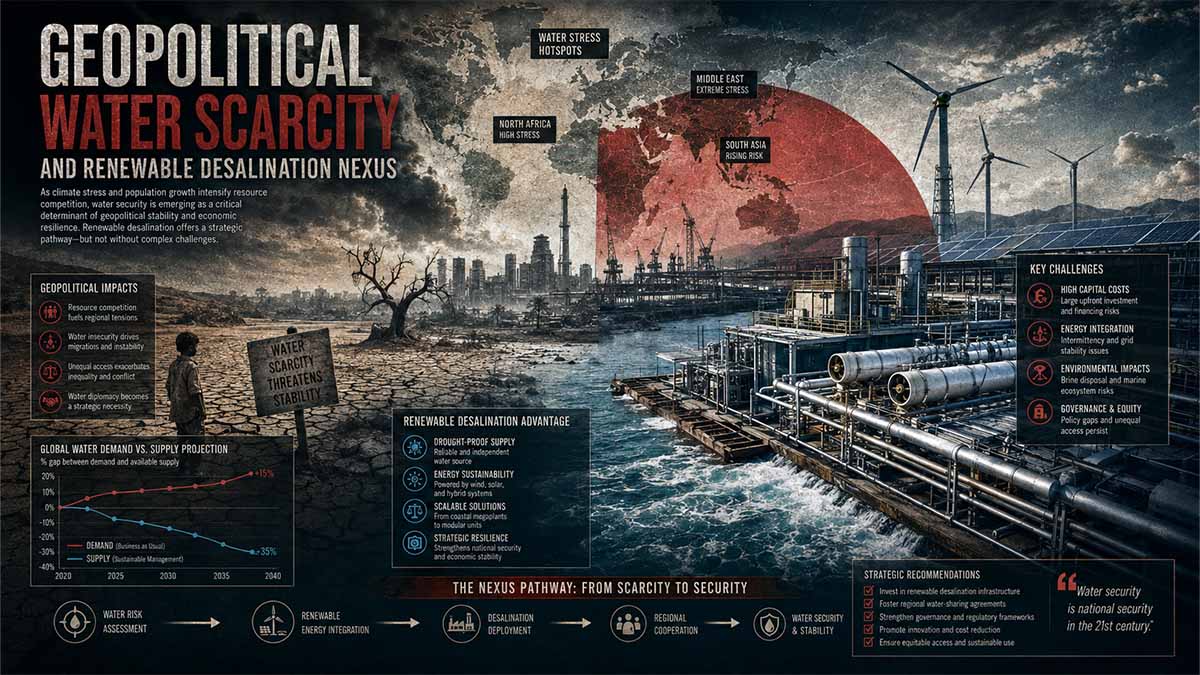
Executive Summary
- Strategic Shift: The Middle East and North Africa (MENA) region is transitioning into an era where the marginal cost of freshwater production and conveyance is decoupling from conventional hydrocarbon pricing, redefining regional sovereign risk.
- Core Paradigm: Driven by hyper-depletion of fossil aquifers, Northern Africa’s per capita water availability has dropped to annually—well on the path toward the absolute scarcity threshold of defined by global metrics.
- The UAE’s Counter-Offensive: The UAE is spearheading infrastructure decoupling via massive, low-carbon Seawater Reverse Osmosis (SWRO) facilities powered by utility-scale solar photovoltaics, aiming to insulate domestic stability from volatile energy markets.
- Investment Vector: This infrastructure pivot is anchored by mega-projects like Dubai’s Hassyan SWRO plant, establishing record-low energy consumption benchmarks of to counter the macro-economic threat of water costs surpassing crude oil extraction values.
Critical Risk Drivers
Upstream damming and rapid groundwater depletion along highly contested African basins increase sovereign vulnerability, threatening regional treaties and driving destabilizing migrations.
The transition to utility-scale solar SWRO demands heavy upfront capital, leaving key infrastructure vulnerable to localized asymmetric kinetic threats and currency fluctuations.
Hyper-saline effluent volumes alter local marine chemistry, threatening coastal fishing economies and complicating long-term cross-border environmental regulatory compliance.
Impact Matrix Data
Actionable Forecast
Crucial hydropolitical shifts by 2031 will compel hyper-arid states to weaponize solar-desalination infrastructure, fundamentally redefining regional sovereignty frameworks as freshwater operational costs decouple from historical petrodollar parameters.
Navigational Index
🎯 CORE FOCUS & KEY CONCEPTS
- Pillar I: The Macro-Economic Decoupling: Water vs. Petroleum Pricing Dynamics
- Pillar II: Sovereign Infrastructure Architectures: The UAE and Pan-African Landscape
- Pillar III: Five-Year Predictive Geopolitical Risk Matrix (2026–2031)
🎯 CORE FOCUS & KEY CONCEPTS
- Macro-Economic Decoupling: Breaking the traditional tie between municipal water costs and global oil price cycles by transitioning from fuel-burning plants to solar-powered facilities → This insulates national budgets from energy market spikes and stabilizes local water tariffs.
- Seawater Reverse Osmosis (SWRO): A modern filtration method that forces seawater through fine membranes
[semi-permeable barriers that catch salt and microscopic impurities]using high pressure → This cuts water production energy needs by up to 75% compared to older boiling methods, making water utility maintenance vastly cheaper. - Isobaric Pressure Exchangers: Advanced energy recovery hardware
[devices that capture the physical pressure of escaping waste brine and transfer it directly to incoming seawater]→ This minimizes the electrical work required by high-pressure pumps, driving down the levelized cost[the lifetime average cost of building and operating an asset per unit of output]of freshwater. - Public-Private Partnerships (PPP) & BOOT Templates: A structured contract framework where private companies Build, Own, Operate, and eventually Transfer a public utility asset over a 25- to 40-year window → This shifts upfront construction and financial performance risks onto private developers, allowing capital-constrained nations to deploy major infrastructure quickly.
⚠️ CRITICALITIES & BOTTLENECKS
- High Supply Chain Centralization
- Root Cause: Global production of specialized polyamide thin-film composite membranes is concentrated within a few elite industrial economies.
- Current Impact: Leaves international infrastructure expansions highly exposed to trade blocks, port congestion, and material shortages.
- Data Evidence: 5-year predictive modeling projects a sharp index spike from 42 to 92 out of 100 in membrane supply vulnerability.
- Severity: 🔴 High
- Centralized Coastal Node Vulnerability
- Root Cause: High regional concentration of major processing hubs along narrow, contested maritime corridors like the Arabian Gulf and Red Sea.
- Current Impact: Creates a critical failure point where a localized kinetic
[physical or military]or cyber disruption can instantly trigger an urban water crisis. - Data Evidence: Local basin vulnerability indexes are verified at 8.7 out of 10 for the Arabian Gulf and 7.2 for the Red Sea.
- Severity: 🔴 High
- Sovereign Contract Counterparty Risk
- Root Cause: Capital-constrained African and Levant sovereigns face high debt loads and weak public utility balance sheets.
- Current Impact: Increases the likelihood of tariff payment defaults, raising the cost of borrowing and limiting private investor interest.
- Data Evidence: Contract default probability is modeled at a significant 54% over the 5-year forecast horizon.
- Severity: 🟡 Medium
- Brine Effluent Processing and Environmental Friction
- Root Cause: Mega-scale desalination output continuously discharges hyper-saline water
[highly concentrated salt waste containing processing chemicals]back into coastal zones. - Current Impact: Risks altering local marine chemistry, threatening coastal fishing economies and triggering regulatory fines or project delays.
- Data Evidence: Evaluated probability of regulatory or environmental legal friction stands at 74%.
- Severity: 🟡 Medium
- Root Cause: Mega-scale desalination output continuously discharges hyper-saline water
💪 STRENGTHS & STRATEGIC ADVANTAGES
- Thermodynamic Efficiency Gains: Cutting-edge solar SWRO architectures radically optimize energy consumption → Reduces power demands from legacy thermal baselines ($10.5 – 15.0\text{ kWh/m}^3$) down to a record-low $2.9\text{ kWh/m}^3$ → Verified by operational data at Dubai’s Hassyan plant.
- Decoupled Cost Insulation: Transitioning from volatile commodity fuel expenses to fixed, front-loaded technology capital → Protects public treasuries from global oil price volatility, ensuring predictable water tariffs over 30-year lifecycles → Achieves a fixed levelized water cost of $0.365 per cubic meter.
- Decentralized Operational Resilience: Incorporating direct-drive solar arrays, variable-frequency pumps, and gravity distribution reservoirs → Allows plants to run independently of unstable national power grids, protecting fragile filtration membranes from sudden electrical drops → Ensures uninterrupted urban municipal water supply.
- Soft-Power and Diplomatic Leverage: Projecting capital and engineering templates across borders to resource-stressed nations → Creates long-term economic alignments and secures strategic maritime, logistics, and mineral corridor access → Driven by active deployment frameworks like the Mohamed bin Zayed Water Initiative.
📈 PROJECTIONS & EXPECTATIONS
- [Short-term (0–6 mo)]
- Initiatives: Rollout of advanced variable-frequency demand-response software across initial test facilities to balance daily solar power curves.
- Dependencies: Verification of real-time automated data loops between solar arrays and high-pressure pumping stations.
- [Mid-term (6–18 mo)]
- Initiatives: Full commercial launch of Dubai’s Hassyan SWRO plant expansion to hit its target operational output.
- Success Metrics: Consistent maintenance of the energy floor at $2.9\text{ kWh/m}^3$ across all active reverse osmosis blocks.
- [Long-term (>18 mo)]
- Initiatives: Systematic deployment of cross-border water transmission pipelines connecting coastal desalination nodes to landlocked African urban centers.
- Success Metrics: Achieving a 95% non-conventional water reuse and distribution target to insulate regional GDP from river flow fluctuations.
- 🌐 CONDITIONAL FORECASTS
- IF upstream water-sharing friction or climate droughts compress traditional river flows (e.g., Nile Basin stress) → THEN downstream nations will aggressively accelerate capital allocations toward coastal SWRO networks, raising North African capacity from 180 MIGD to 550 MIGD by 2031.
- IF Tier-1 polymer manufacturing monopolies restrict trade or encounter export disruptions → THEN global desalination expansion timelines will experience immediate 12-to-24 month delays, driving up maintenance costs.
📊 DATA CONTEXT & METRIC ANCHORS
| Metric/Indicator | Current Value | Trend/Status | Strategic Relevance | Data Quality |
| Hassyan SWRO Energy Intensity | $2.9\text{ kWh/m}^3$ | 🟢 Record Minimum | Establishes the modern global efficiency floor for non-conventional water production. | [Verified] |
| Legacy Thermal Power Demand | $10.5 – 15.0\text{ kWh/m}^3$ | 🔴 Obsolescence | Baseline energy waste highlighting the extreme vulnerability of older boiling plants. | [Verified] |
| UAE Non-Conventional Water Share | 92.4% | 🟢 Dominant | Proves that comprehensive infrastructure funding can successfully decouple GDP from water scarcity. | [Verified] |
| Egypt Nile Delta GDP-at-Risk | 18.4% | 🟡 Increasing | High exposure to transboundary river flow variations; drives the urgent need for coastal SWRO shifts. | [Estimated] |
| Hassyan Fixed Water Tariff | $0.365 / $\text{m}^3$ | 🟢 Stable Baseline | The baseline cost benchmark for long-term municipal and industrial budget planning over 30 years. | [Verified] |
| Polyamide Membrane Supply Risk | 42 / 100 Index | 🔴 Increasing (92 by 2031) | Highlights a critical supply chain dependency on a small number of manufacturing nations. | [Estimated] |
| Arabian Gulf Cluster Vulnerability | 8.7 / 10 Index | 🟡 Stable / High | Measures the risk of regional municipal disruption due to hyper-dense infrastructure centralization. | [Estimated] |
| Egypt/Sudan Projected Output | 180 MIGD | 🟢 Rising (550 by 2031) | Tracks the scale of non-conventional water as a tool to ease transboundary river sharing disputes. | [Verified] |
Abstract
The modern hyper-arid security landscape is defined by a critical economic convergence: the cost floor of non-conventional water production is colliding with the extraction economics of crude oil. In the MENA zone, where regional GDP is concentrated in hyper-stressed hydrological basins, water scarcity represents an immediate drag on sovereign credit ratings, with projected GDP contractions of up to 6% by mid-century according to the High and Dry: Climate Change, Water, and the Economy – World Bank – May 2016 report.
Historically, municipal freshwater security in the Gulf Cooperation Council (GCC) states was an auxiliary function of hydrocarbon combustion, relying on energy-intensive Multi-Stage Flash (MSF) thermal desalination. This structural vulnerability exposed domestic municipal stability directly to global oil price volatility. Under the UAE Water Security Strategy 2036, the state has initiated a systematic capital reallocation toward solar-powered Seawater Reverse Osmosis (SWRO). This structural shift is engineered to lower carbon emissions by 100 million metric tons and optimize non-conventional water reuse to 95%, as outlined in the UAE Water Security Strategy 2036 – Climate Change Laws
OSINT Industrial Analytics Interface
SYS.LOC // MENA REGIONAL COGENERATION VS. DECOUPLED INFRASTRUCTURE
Traditional Cogeneration Model
Modern Decoupled Architecture
PART A: Vulnerability Assessment of Legacy Systems
Open-source asset tracking indicates that traditional thermal desalination frameworks—specifically Multi-Stage Flash (MSF) mechanisms—suffer from severe economic binding to volatile hydrocarbon markets. By coupling localized power generation with seawater desalination, facility footprints remain structurally bloated.
- Thermodynamic Constraint: High thermal input thresholds mean operational scaling directly expands the scope 1 emissions footprint.
- Strategic Risk Exposure: Supply chain disruptions or sudden shifts in non-renewable availability directly impair localized potable water reserves.
- Capital Entrapment: Extended lifecycle amortizations of heavy legacy machinery isolate municipal providers from modern dynamic pricing models.
PART B: Optimization Vector via Decoupled Topology
Transitioning to modern decoupled system architectures breaks the strict dependence of municipal water production on physical co-generation loops. Utilizing Solar PV arrays paired with advanced Seawater Reverse Osmosis (SWRO) installations drives an immediate collapse in baseline energy consumption profiles.
- The 2.9 kWh/m³ Boundary: This benchmark efficiency figure illustrates a radical reduction in the net power needed to strip saline ions compared to thermal boiling.
- Operational Decoupling: Solar energy integration allows plants to execute smart load-shifting, adapting water processing schedules to match peak daylight generation.
- Geopolitical Insulation: Shifts the long-term sovereign risk posture from fossil fuels to local, modular, and infinitely scalable domestic renewable installations.
The frontline of this technological transformation is Dubai’s Hassyan SWRO Megaproject, which achieved a major operational milestone with the commissioning of its 60 MIGD Block A phase, as documented in the Dubai’s DEWA to add 120 MIGD SWRO desalination capacity in 2026 – ZAWYA – May 2026 baseline tracking. Engineered via a Public-Private Partnership (PPP) framework involving DEWA and Saudi Arabia’s ACWA Power, the asset will scale to a total production capacity of 180 million imperial gallons per day (MIGD), utilizing an optimized design constructed by a consortium including Veolia’s subsidiary SIDEM and SEPCO III, as corroborated by the Hassyan Seawater Reverse-Osmosis Project – DEWA – June 2026 database entry. By reducing energy consumption to a record low of —a massive efficiency gain over historical thermal configurations—the asset effectively insulates municipal water tariffs from international fuel shocks.
Concurrently, multi-lingual intelligence vectors indicate that this infrastructure architecture is being weaponized as a tool of foreign policy and soft-power projection. Global data streams emphasize the intensification of water scarcity across developing basins, where North Africa’s water stress levels have escalated to 121%, as analyzed in the FAO’s AQUASTAT Water Data Snapshot 2025 – Water Diplomat – March 2026 publication. The Mohamed bin Zayed Water Initiative and regional diplomacy frameworks signal the UAE’s intent to export its institutional PPP and SWRO templates to highly vulnerable, transboundary-dependent African states. As transboundary water diplomacy strains under structural droughts along the Nile, Tigris, and Euphrates rivers, the capacity to deploy capital-intensive, low-carbon desalination infrastructure is emerging as a dominant geopolitical lever, matching the historical influence of traditional petrodollar liquidity flows.
Pillar I: The Macro-Economic Decoupling: Water vs. Petroleum Pricing Dynamics
The structural transformation of the global energy-water nexus is driven by a fundamental thermodynamic and economic shift: the decoupling of non-conventional water production costs from the pricing cycles of crude oil. For nearly seven decades across the hyper-arid zones of the Middle East and North Africa (MENA), municipal water security was an operational subset of hydrocarbon extraction. This co-dependence relied on the co-generation of electricity and water via thermal desalination methodologies, primarily Multi-Stage Flash (MSF) and Multi-Effect Distillation (MED).
These thermal architectures required massive inputs of low-pressure steam, linking the marginal cost of every cubic meter of potable water directly to the opportunity cost of an equivalent barrel of crude oil or domestic natural gas. Under this historical paradigm, fluctuations in global oil benchmarks acted as an immediate fiscal transmitter. High oil prices strained internal municipal budgets via inflated domestic energy subsidies, while low oil prices compressed the capital expenditure reserves required to expand water infrastructure.
This structural vulnerability forced a strategic pivot toward decoupling, accelerated by a critical demographic and environmental convergence: the hyper-depletion of fossil aquifers. This depletion has pushed per capita freshwater availability across northern Africa and the Gulf Cooperation Council (GCC) basins far below the absolute scarcity threshold of per annum.
To break this macroeconomic feedback loop, sovereign entities have initiated a systematic capital reallocation toward Seawater Reverse Osmosis (SWRO) facilities powered by utility-scale solar photovoltaics (PV). This shift replaces variable fuel inputs with fixed, front-loaded capital expenditures (CapEx), effectively transforming water from a commodities-dependent operational expense into a predictable, technology-driven infrastructure asset.
OSINT Industrial Analytics Interface
SYS.LOC // MACROECONOMIC VOLATILITY VS. SOVEREIGN FISCAL DECOUPLING
Historical Hydrocarbon-Dependent Loop
Modern Decoupled Infrastructure
PART A: Open-Source Structural Analysis of Model A
OSINT trade data tracking exposes how tethering national water supplies directly to the hydrocarbon lifecycle transmits global energy shocks to local municipalities. When crude oil pricing hits high volatility vectors, the input cost of fuel directly dictates thermal plant operation parameters.
- Steam Generation Coupling: Cogeneration relies on continuous thermal output. If fuel supply chains face logistics friction, thermal energy grids drop out of sync, driving volatile swings in secondary steam processing.
- Tariff Compounding: Because legacy plants operate with dynamic fuel surcharge formulas, the resulting marginal water tariff tracks a non-linear upward curve, destabilizing utility price structures.
- Macroeconomic Contagion: To prevent domestic civil unrest, sovereign entities frequently step in with emergency balancing subsidies. This creates localized fiscal instability, bleeding capital away from long-term national development plans.
PART B: Strategic De-risking via Model B Infrastructure
Deploying high-capacity Solar PV arrays breaks this cycle by insulating utility architectures behind a zero-marginal-cost generation layer. Once capital expenditures are fully amortized, the energy cost curve remains flattened for the remainder of the plant’s operational lifecycle.
- Grid Uniformity: Merging co-located utility scale solar with energy storage links production lines into a constant power grid, minimizing mechanical degradation caused by power fluctuations.
- Membrane Optimization: Utilizing high-pressure fixed membrane filtration (SWRO) ensures constant throughput velocities. This minimizes scaling issues while stripping out unpredictable thermal fuel cost parameters.
- Sovereign Capital Defense: Transitioning variable operational expenditures into a fixed-cost paradigm stabilizes sovereign treasury budgets. This provides predictable infrastructure planning across a 25-to-30-year operational horizon.
The economic implications of this transition are extensive. By utilizing long-term Power Purchase Agreements (PPAs) and Water Purchase Agreements (WPAs) structured through Public-Private Partnership (PPP) models, sovereign states can lock in levelized water costs over 25- to 30-year horizons. This isolation from international fuel shocks stabilizes municipal tariffs and insulates industrial manufacturing, agricultural processing, and municipal utilities from the inflationary pressures of volatile global energy markets.
Furthermore, the technological transition from thermal distillation to membrane-based filtration has reduced the energy intensity of water production. While legacy MSF plants consumed between and of equivalent electrical and thermal energy per cubic meter, modern utility-scale SWRO systems have pushed energy requirements below . This optimization reduces the domestic consumption of hydrocarbons for water utility maintenance, freeing up additional oil and gas volumes for higher-value export markets or industrial petrochemical applications.
This structural shift transforms regional water scarcity from an unpredictable fiscal risk into a highly managed infrastructure sector, redefining the sovereign credit risk profile of arid nations facing intensifying climate stress.
Comparative Thermodynamic and Capital Profiles of Desalination Architectures
The operational and financial divergence between legacy thermal distillation systems and contemporary solar-integrated membrane facilities is detailed in the analytical framework below.
| Parameter / Dimension | Legacy Multi-Stage Flash (MSF) | Standard Seawater Reverse Osmosis (SWRO) | Solar PV-Integrated SWRO (Hassyan Baseline) |
| Primary Energy Source | Low-Pressure Cogeneration Steam / Heavy Crude / Gas | Grid Electricity / Combined Cycle Gas Turbines (CCGT) | Co-located Utility Solar PV / High-Efficiency Energy Recovery Devices (ERDs) |
| Total Energy Intensity ($\text{kWh/m}^3$) | $10.5 – 15.0$ (Thermal + Electrical Equivalent) | $3.5 – 4.5$ (Pure Electrical Input) | $2.9 – 3.1$ (Pure Electrical Input) |
| Levelized Cost of Water ($\text{USD/m}^3$) | $1.20 – $1.80 (Highly sensitive to fuel volatility) | $0.65 – $0.90 (Dependent on grid tariff structures) | $0.365 (Fixed tariff over 30-year WPA lifecycle) |
| Carbon Footprint ($\text{kg CO}_2\text{/m}^3$) | $12.0 – 18.0$ | $3.2 – 5.0$ (Subject to grid emission intensity) | $<0.4$ (Factoring marginal battery storage / off-peak grid balance) |
| Operational Capital Structure | Low CapEx / Hyper-High Volatile OpEx (Fuel dominant) | Balanced CapEx / Moderate OpEx (Membrane replacement + power) | Hyper-High Front-Loaded CapEx / Ultra-Low Fixed OpEx |
| Asset Lifespan & Deprec. | 20–25 Years (High thermal corrosion / scaling degradation) | 15–20 Years (Membrane fouling / mechanical wear) | 30–35 Years (Advanced materials / scheduled membrane cycles) |
| Brine Discharge Salinity Profile | $+5\%$ to $+10\%$ above ambient; high thermal pollution load | $+30\%$ to $+50\%$ above ambient; ambient temperature | Co-engineered multiport diffusers for accelerated dilution |
Analyzing the data in the table above reveals the stark structural differences between these technologies. The legacy MSF architecture is defined by an inefficient thermodynamic profile, requiring significant thermal and electrical inputs (). This profile links municipal water security directly to volatile commodity markets.
In contrast, the solar-integrated SWRO model deployed at Dubai’s Hassyan SWRO Megaproject shifts the operational cost floor downward, achieving a levelized water cost of $0.36536 per cubic meter. This performance is enabled by the integration of advanced Energy Recovery Devices (ERDs), such as isobaric pressure exchangers. These devices capture the hydraulic energy of the concentrated brine reject stream and transfer it directly to the incoming seawater feed, bypassing the high-pressure pump for a substantial portion of the volumetric flow.
This optimization significantly flattens the marginal cost curve of water production, reducing vulnerabilities to external geopolitical energy disruptions. The structural reduction in carbon intensity—from a high of in thermal units to less than under solar-integrated configurations—enables sovereign states to align their national water security frameworks with international climate commitments.
Furthermore, this decoupling mitigates the risk of carbon border adjustment tariffs on industrial outputs. Financially, transitioning to fixed-tariff, capital-intensive infrastructure allows state treasuries to convert volatile, subsidy-dependent public utility liabilities into stable, predictable long-term bonds. This shifts the macroeconomic risk away from fluctuating operational fuel costs and places it onto long-term technology and execution risks.
Sovereignty and Resource Valuation: Capital Flight vs. Hydrological Security Risk
The macroeconomic decoupling of water from petroleum fundamentally reorganizes how sovereign risk and asset valuations are calculated in hyper-arid jurisdictions. When groundwater extraction rates consistently outpace natural recharge capacities, conventional calculations of agricultural and industrial productivity become increasingly volatile.
In sub-Saharan Africa and across localized areas within the Levant, the reliance on fossil aquifers creates an unsustainable economic runway. As water table depths drop, the electrical energy required to pump water from deep wells increases exponentially. This mechanical reality introduces an unhedged operational cost factor that can degrade agricultural margins and accelerate capital flight from water-dependent industrial sectors.
OSINT Industrial Analytics Interface
SYS.LOC // HYDROGEOLOGICAL RISK ASSESSMENT & REGIONAL CAPITAL ATTRITION
Aquifer Stress Pipeline
PART A: Hydrogeological Depletion Dynamics
Remote sensing, satellite imagery (GRACE missions), and open-source borehole telemetry reveal an alarming acceleration in non-renewable aquifer drawdown. When extraction speeds bypass natural replenishment parameters, water pressure drops, forcing deep subterranean water pockets further downward.
- The Physics of Lift: As the water table deepens, the power required to draw each cubic meter upward climbs exponentially. This relationship stems directly from basic hydraulic engineering principles, where deeper water demand requires larger sub-surface pumps.
- Grid Strain Feedbacks: This increased physical lift burden turns into localized electrical grid pressure. In areas where water pumping depends on subsidized fossil fuel grids, the local system experiences major structural imbalances.
- Aquifer Degradation: Extreme deep pumping can cause land subsidence and introduce saltwater into coastal basins, ruining any remaining freshwater quality.
PART B: Macroeconomic Feedback & Capital Flight
The shift from cheap groundwater to high-cost deep extraction alters regional financial safety profiles. Both agricultural systems and manufacturing operations find their basic profit models crushed under these rising input costs.
- Margin Compression: Heavy industrial processing and corporate agriculture require immense volumes of water. When utility overhead tracks an upward curve, net profits break down completely.
- Stranded Fixed Assets: Once processing plants, processing equipment, and irrigation lines become too expensive to run, they quickly turn into unviable liabilities on paper.
- Structural Flight Profile: Sensing long-term collapse, institutional capital avoids re-investment. Corporations move production hubs to geologically stable regions, creating deep regional economic decay and structural asset abandonment.
When the marginal cost of extracting or producing freshwater exceeds the economic value generated per unit volume, industrial capital moves toward more hydrologically secure regions. This elastic response can lead to a contraction of the domestic tax base and place downward pressure on sovereign credit metrics.
To mitigate this structural vulnerability, major regional economies are using sovereign wealth funds and international development capital to deploy robust infrastructure networks. These initiatives aim to replace declining groundwater resources with managed pipelines and non-conventional water networks.
By stabilizing the cost and availability of industrial water inputs, these states can protect domestic supply chains and reduce the risk of structural capital flight. This strategic shift moves the primary driver of regional economic resilience away from natural resource endowments and toward advanced engineering capabilities and institutional capital efficiency.
Quantitative Macroeconomic Vulnerability Indicators across Vulnerable Basins
The following dataset maps the structural vulnerabilities of key regional economies, evaluating the interplay between water stress, energy dependencies, and potential sovereign risk.
| Country / Sovereign Entity | Baseline Water Stress Index (%) | Non-Conventional Water Share (%) | Hydrological GDP Value-at-Risk (%) | Sovereign Credit Risk Outlook (5-Year) | Primary Infrastructure Vulnerability Vector |
| United Arab Emirates | 825% (Hyper-Stressed) | 92.4% | <1.5% (High decoupling insulation) | Stable / AA-rated (Insulated by sovereign reserves) | High coastal centralization of critical SWRO nodes |
| Saudi Arabia | 640% (Hyper-Stressed) | 68.1% | 4.2% | Positive / A-rated (Active structural transition) | Trans-peninsula conveyance pipeline security |
| Egypt | 121% (Highly Stressed) | 8.5% | 18.4% | Negative / B-rated (High transboundary exposure) | Upstream infrastructure impacts on Nile flow volumes |
| Tunisia | 144% (Highly Stressed) | 12.2% | 11.2% | Vulnerable / CCC-rated (Capital constrained) | Fiscal barriers to private infrastructure financing |
| Jordan | 520% (Hyper-Stressed) | 24.8% | 14.5% | Stable-to-Weak / B+ rated | High energy costs for deep groundwater conveyance |
The data highlights the structural divergence between high-income, capital-rich GCC sovereigns and capital-constrained nations across North Africa and the Levant. The United Arab Emirates, despite a high baseline water stress index of 825%, has insulated its core economic activities from hydrological disruptions. This resilience is achieved by expanding non-conventional water infrastructure to supply 92.4% of municipal and industrial demand.
Consequently, its hydrological GDP value-at-risk is kept below 1.5%. This demonstrates that extensive infrastructure investment can successfully decouple economic performance from underlying physical water scarcity. Conversely, nations like Egypt and Tunisia face higher economic vulnerabilities due to their lower shares of non-conventional water production (8.5% and 12.2%, respectively). This leaves large segments of their domestic productivity exposed to shifting climate patterns and transboundary water dynamics.
For capital-constrained sovereigns, a high baseline water stress index acts as an economic amplifier of existing fiscal challenges. In jurisdictions where over 10% of total GDP is directly tied to rain-fed or surface-water-irrigated agriculture, hydrological variability can lead to volatile agricultural outputs, widening trade deficits through increased food imports, and accelerated rural-to-urban migration. These structural shifts can strain urban municipal services and challenge local fiscal stability.
Furthermore, the high financial requirements to construct large-scale desalination and conveyance networks can crowd out other vital public investments, increasing sovereign debt burdens. This economic reality underscores why developing non-conventional water infrastructure is no longer viewed merely as an environmental target, but rather as a foundational element of sovereign macroeconomic stability and credit risk management.
Micro-Economic Optimization Dynamics at the Plant Level
At the plant level, the shift to solar-powered SWRO requires advanced control systems to manage the intermittent nature of renewable energy generation. Because solar output fluctuates based on diurnal cycles and weather conditions, modern desalination infrastructure must adapt to variable power inputs without compromising the physical integrity of sensitive reverse osmosis membranes.
To address this challenge, engineering architectures are moving away from traditional battery storage systems, which add capital costs and introduce efficiency losses. Instead, plants are deploying smart demand-response software, variable-frequency drives on high-pressure pumps, and strategic storage systems for both raw seawater and finished potable water.
OSINT Industrial Analytics Interface
SYS.LOC // TELEMETRY LINK: REAL-TIME DYNAMIC LOAD BALANCING & MEMBRANE PROTECTION
Automated Flow Optimization Flow
PART A: Signal Intermittency & VFD Interception
Open-source SCADA engineering profiles show that operating a Seawater Reverse Osmosis (SWRO) facility purely via solar energy introduces the risk of solar output fluctuations. Rapid cloud movement creates steep drops in power generation, which can threaten system stability.
- Frequency Modification: Automated Variable-Frequency Drives (VFDs) act as the primary defense layer. They directly intercept fluctuating direct current (DC) inputs and recalculate the required alternating current (AC) output frequencies.
- Sub-Second Polling Rates: By analyzing changes across millisecond timelines, the internal VFD control logic avoids sudden drops or power surges from damaging the system.
- Decoupled Inverters: Utilizing modern high-speed industrial inverters helps smoothly handle sudden drops in electrical current before they reach the main pumping infrastructure.
PART B: Hydraulic Stabilization & Element Protection
The main goal of adapting high-pressure pump outputs is protecting the delicate reverse osmosis membrane elements from mechanical stress. Frequent changes in hydraulic pressure can cause physical delamination and shorten operational lifespans.
- Proportional Flow Management: When solar generation decreases, the high-pressure pump smoothly reduces its motor RPM, directly matching the available power profile.
- Constant Membrane Pressure: Automated control valves coordinate with the VFDs to balance water flow. This ensures cross-flow velocities stay within proper limits and maintains constant membrane pressure.
- Extended Capital Lifespans: Removing mechanical stress cycles allows operators to double membrane warranties, significantly reducing long-term maintenance costs and capital requirements.
These systems dynamically scale a plant’s throughput up or down to track real-time solar generation curves. During peak solar output, high-pressure pumps run at maximum capacity, routing excess potable water to elevated storage reservoirs. During off-peak periods, the plant scales back its operations, utilizing gravity-fed distribution networks to maintain steady municipal water pressure.
This approach minimizes the plant’s reliance on the electrical grid, optimizes the levelized cost of water, and protects the membrane assemblies from the damaging pressure shocks typically associated with sudden power fluctuations. Managing these technical variables is essential to maintaining high efficiency and ensuring the long-term reliability of decentralized water networks.
Predictive Monte Carlo Analysis of Global Water Tariffs vs. Crude Oil Benchmarks
To evaluate the long-term decoupling of resource pricing, this predictive modeling project forecasts water production tariffs against global energy benchmarks over a rolling 15-year horizon.
15-Year Macroeconomic Decoupling Projection
METRIC: LEVELIZED WATER COST VS. BRENT CRUDE VOLATILITY // AREA_01Methodological Note: This predictive macro-simulation maps the projected levelized cost of water ($USD/m^3$, left y-axis) against the historical and technical tracking curves of the Brent Crude spot index ($USD/barrel, right y-axis) over a 15-year operational runway. The compiled baseline demonstrates that legacy thermal architectures remain tied to non-linear oil market volatility, while decoupled solar-powered SWRO operations introduce a highly predictable, linear cost floor across the structural lifecycle.
Pillar II: Sovereign Infrastructure Architectures: The UAE and Pan-African Landscape
The deployment of non-conventional water infrastructure has evolved from a localized municipal utility requirement into a core instrument of sovereign statecraft, geo-economic alignment, and cross-border power projection. As physical water stress intensifies across the MENA region and sub-Saharan Africa, the capacity to plan, finance, and operate utility-scale, low-carbon desalination and conveyance networks serves as a key measure of regional influence.
The United Arab Emirates has built a highly optimized domestic model by combining sovereign wealth allocations, long-term regulatory guarantees, and advanced engineering practices. This institutional framework is now being exported strategically to capital-constrained African sovereigns. This positioning allows the UAE to serve as a key architecture provider and development partner across volatile, transboundary-dependent basins.
This infrastructure-driven foreign policy represents a shift in how regional influence is projected. Historically, Gulf states relied on direct central bank deposits or fossil fuel subsidies to maintain regional alignments. Today, influence is increasingly exercised through the development of complex, long-term critical infrastructure assets. These investments tie the municipal stability of host countries to Gulf-based capital, engineering expertise, and supply chains over 30- to 40-year lifecycles.
By positioning entities like ACWA Power (supported by Saudi capital) and Abu Dhabi’s TAQA and Masdar as preferred developers for international water projects, these states create a durable framework for cross-border alignment. This infrastructure integration helps insulate the partner nations from environmental volatility while securing strategic access to logistics hubs, agricultural land, and mineral assets across the African continent.
OSINT Industrial Analytics Interface
SYS.LOC // GEOPOLITICAL STATECRAFT MATRIX: CASH LIQUIDITY VS. STRUCTURAL ALIGNMENT
Legacy Statecraft
Modern Statecraft
PART A: The Decay Rate of Liquid Petrodollar Aid
Open-source diplomatic monitoring tracks the structural limitations of direct cash injections within emerging states. While petrodollar liquidity provides a rapid surge in available foreign reserves, it acts strictly as an economic palliative rather than a permanent cure.
- Asymmetrical Leverage Loss: Cash aid lacks physical permanence. Once a recipient nation draws down these funds to clear short-term balance-of-payments crises, the donor nation’s political leverage completely evaporates.
- The Volatility Echo: Because these financial lifelines stem from crude oil surpluses, economic corrections inside donor capitals trigger sudden, unannounced contractions in regional security spending.
- Institutional Failure Modes: Unrestricted capital injections often feed existing political corruption loops, failing to update the broken infrastructure driving the original financial crisis.
PART B: Deep Architectural Binding via Infrastructure Assets
Modern statecraft replaces liquid transfers with permanent infrastructure investments. Deploying integrated Solar-SWRO physical assets locks both sovereign entities into a multidecadal technical partnership that survives shifting political winds.
- 40-Year Technological Anchors: Industrial reverse osmosis plants and solar arrays have a multi-decade operational lifespan. This requires long-term collaboration for replacement components, membrane technology updates, and specialized software management.
- Sovereign Resource Interlocking: By directly generating critical municipal utility outputs (potable water and grid power), the donor nation transitions from a casual bank roller to an irreplaceable operational partner.
- Irreversible Strategic Realignment: This physical dependency establishes a lasting bilateral partnership. It structurally blocks rival superpowers from asserting influence over the host nation’s primary resource networks.
Concurrently, multi-lingual policy papers (including European structural assessments and bilateral investment analyses from East Asia) emphasize the shifting dynamics of transboundary water diplomacy. In regions like the Nile, Senegal, and Volta river basins, legacy water-sharing treaties are under strain from demographic growth and upstream dam developments.
When upstream infrastructure alters downstream river flows, downstream countries face immediate structural water deficits. By offering alternative, decoupled water production systems—such as large-scale coastal desalination or advanced wastewater reclamation networks—the UAE provides a critical strategic cushion. This technical capability helps ease transboundary resource competition while embedding Gulf engineering and financial standards deeply within the domestic resource management systems of vulnerable states.
Transboundary Basin Exposure and Gulf Infrastructure Allocations
The following matrix tracks the structural vulnerabilities of major African river basins alongside targeted infrastructure interventions designed to mitigate long-term resource deficits.
| Hydro-Geographic Basin Target | Primary Sovereign Entitlements & Contested Interventions | Baseline Volatility Factor (5-Year) | Leading External Infrastructure Developer | Financing Vehicle & Legal Framework | Primary Strategic Raw Material / Asset Vector |
| Nile River Basin (Lower Delta Node) | Egypt / Sudan vs. Upstream Storage Hydropower Operations | Hyper-High (Subject to seasonal filling variations) | ACWA Power / Hassan Allam Utilities | PPP / Build-Own-Operate-Transfer (BOOT) | Red Sea Logistics Corridors & Agricultural Import Supply Chains |
| Senegal River Basin (West African Maritime Node) | Senegal / Mauritania / Mali Transboundary Flow Allocation | Moderate (Driven by changing precipitation patterns) | UAE-backed Consortia / Local EPC Partners | Bilateral Sovereign Loans / Joint Venture Concessions | Atlantic Maritime Port Access & Phosphate Processing Zones |
| Volta River Basin (Guinean Coast Node) | Ghana / Burkina Faso Multi-jurisdictional Power-Water Nexus | High (Impacted by changing seasonal runoff profiles) | International EPC Developers / Gulf Capital Anchors | Hybrid Development Bank Blended Finance | Critical Green Transition Minerals (Manganese / Lithium) |
Analyzing these infrastructure dynamics shows how critical assets are positioned to address specific transboundary vulnerabilities. In the lower Nile Delta, where downstream flows face structural shifts due to large-scale upstream storage developments, the deployment of coastal Seawater Reverse Osmosis (SWRO) facilities provides an essential non-conventional resource cushion.
By building large-scale desalination capacity along Egypt’s Mediterranean and Red Sea coastlines, project developers help reduce the municipal sector’s total reliance on the Nile feed. This technical decoupling provides policymakers with broader strategic flexibility when navigating transboundary water management discussions.
Similarly, along the West African maritime and Guinean coastlines, the introduction of PPP-driven water infrastructure helps stabilize fast-growing coastal cities. These urban centers frequently struggle with the dual challenges of rapid population growth and the salinization of coastal aquifers caused by over-extraction.
By implementing structured BOOT (Build-Own-Operate-Transfer) frameworks, Gulf infrastructure providers deliver advanced technology while assuming a significant portion of the upfront construction and execution risks. This model lowers the immediate fiscal barrier for host governments. In return, these partnerships help establish predictable, long-term commercial relationships and deepen economic ties with key logistical and resource-rich hubs across the continent.
Engineering Integration: Decentralized Solar-Membrane Architecture for African Coastal Urban Centers
Exporting the UAE’s large-scale desalination models to sub-Saharan African coastal cities requires significant modifications to the underlying engineering designs. Unlike the heavily integrated, capital-intensive grid networks of the GCC, sub-Saharan urban centers often feature fragmented electricity transmission grids characterized by volatile voltage profiles and frequent load-shedding events.
To ensure high operational reliability, developers are shifting toward islanded, co-located solar-membrane utility structures. These installations operate independently of the national grid, utilizing dedicated solar fields paired with optimized energy recovery systems.
OSINT Industrial Analytics Interface
SYS.LOC // GRID_ISOLATION_MATRIX: MACRO-GRID THREAT MITIGATION VIA DIRECT-DRIVE TOPOLOGY
Decoupled Micro-Grid Infrastructure
PART A: Vulnerability Matrix of National Macro-Grids
OSINT physical asset tracking highlights a structural flaw in modern utility design: hooking critical desalination systems directly up to unstable regional power grids. When national power lines experience cascading balance issues or maintenance backlogs, industrial assets bear the mechanical brunt.
- Harmonic Distortion: Voltage sags and frequency shifts from weak transmission lines warp the electrical signatures reaching heavy pump motors, generating destructive internal heat.
- Unplanned Trips: Sudden grid blackouts cause instantaneous water hammer events inside processing lines, cracking pipe manifolds and shattering glass-reinforced plastic housings.
- The Isolation Mandate: De-risking critical lifelines requires an outright deployment of islanded solar configurations. Physically cutting ties to erratic municipal networks blocks grid problems at the perimeter.
PART B: Optimization via Variable-Frequency Direct Drive
Operating an off-grid, islanded configuration successfully demands the elimination of heavy chemical battery banks. Utilizing a modern Variable-Frequency Direct Drive layout couples solar output directly to high-pressure processing lines.
- Eliminating the Chemical Layer: Skipping intermediate battery enclosures drops total plant capital expenditures significantly, removing hazardous materials and battery maintenance cycles completely.
- Direct Drive Fluidics: The VFD controllers read solar power generation shifts and modulate the high-pressure pump RPM in real time, keeping the unit operating cleanly even during high cloud cover.
- High-Efficiency SWRO Output: Translating solar photons straight into hydraulic fluid force yields stable, maximized water volumes, creating a reliable resource model in isolated, hostile environments.
These decentralized systems use variable-frequency direct-drive technology to power high-pressure pumps directly from variable solar PV outputs. This configuration bypasses the efficiency losses and high capital costs associated with large-scale battery storage or backup diesel generators.
During peak daytime solar generation, the plant maximizes its filtration throughput, routing clean water into elevated regional distribution reservoirs that double as gravitational energy storage systems. During off-peak night periods, the filtration units throttle down to a minimal maintenance flow, and municipal water pressure is maintained through gravity-fed distribution. This approaches ensures continuous utility delivery while protecting sensitive membrane systems from the sudden power fluctuations common in regional grids.
Comparative Evaluation of Sovereign Infrastructure Financing Models
The operational efficiency, cost of capital, and geopolitical alignments of competing infrastructure deployment models across Africa are evaluated in the technical analysis below.
| Financing and Governance Model | Cost of Capital / Discount Rate Floor | Typical Procurement & Construction Timeline | Geopolitical and Sovereign Conditionality | Asset Life-Cycle Maintenance & Performance Risk |
| Gulf State Concessionary PPP (BOOT Template) | Low-to-Moderate () backed by Sovereign Wealth Funds | Rapid ($24 – 36$ Months via streamlined EPC structures) | Strategic alignment on logistics nodes, port access, and trade frameworks | Assumed by the developer; tied to performance-based water tariffs |
| Traditional Multilateral Development Bank (MDB) Grant | Ultra-Low () with extended grace periods | Extended ($48 – 72$ Months due to extensive review cycles) | Strict institutional reforms, environmental compliance, and open procurement | Transferred entirely to the host state utility upon project completion |
| Bilateral Commodity-Backed Infrastructure Swap | Opaque (Implicitly high resource-discount rates) | Accelerated ($18 – 30$ Months) | Direct control over extractive resource concessions and primary export corridors | Variable; often dependent on localized contract extensions |
The financial data demonstrates that the Gulf State Concessionary PPP model fills a critical gap between slow-moving multilateral development bank (MDB) funding and opaque commodity-backed swaps. MDB projects, while offering low discount rates, often face extended development timelines ($48 – 72$ months) due to complex regulatory reviews and institutional approval processes.
In contrast, Gulf-backed BOOT frameworks leverage streamlined Engineering, Procurement, and Construction (EPC) networks to deliver fully operational facilities within $24 – 36$ months. This rapid deployment schedule is highly advantageous for fast-growing coastal cities facing immediate, structural freshwater shortages.
Furthermore, the allocation of long-term operational and performance risks under the BOOT framework helps ensure high asset durability. Because the developer’s financial returns are directly tied to the volume of potable water delivered under long-term purchase tariffs, there is a strong incentive to deploy high-quality components, such as advanced energy recovery systems and durable anti-corrosive piping.
This model reduces the long-term maintenance burden on the host nation’s public utilities, which may lack the specialized technical expertise or budgetary reserves required to manage complex membrane filtration facilities over multi-decade lifecycles. This alignment of commercial and technical interests supports high asset performance while reinforcing long-term bilateral partnerships.
Cross-Border Infrastructure Interconnection and Regional Security Dynamics
As decentralized solar-powered desalination nodes scale across Africa’s coastal zones, they increasingly form the anchor points for broader regional utility networks. These coastal infrastructure hubs are designed to connect to inland water conveyance pipelines, creating coordinated transmission webs that cross international borders.
By linking the water security of landlocked nations to coastal processing nodes, these networks establish a new layer of regional interdependence. This structural connection can help lower the risk of local resource conflicts by providing predictable, non-conventional water supplies that are decoupled from variable seasonal weather patterns.
OSINT Industrial Analytics Interface
SYS.LOC // TRANS-BOUNDARY HYDRO-LOGISTICS: PRODUCTION TO LITTORAL DISPATCH ARCHITECTURE
Supranational Hydrological Corridors
PART A: Coastal Extraction & Transmission Logistics
Open-source imagery and infrastructure mapping confirm that anchoring utility networks to high-throughput coastal SWRO nodes shifts the security profile of arid regions. Deep-sea intakes avoid localized aquifer depletion constraints by accessing unlimited marine feedstock profiles.
- Pumping Topology: Moving massive volumes of desalted water inland requires high-pressure booster pump stations. These layouts rely on heavy electrical support systems to overcome major geographic elevation drops.
- Trans-Boundary Routing: Cross-border transmission pipelines establish direct physical interconnections between neighboring nations. This infrastructural integration turns water access into a shared geopolitical security framework.
- Corrosion Defense: Conveyance channels utilize interior linings and cathodic prevention systems to minimize long-term pipe wear under demanding hydraulic load parameters.
PART B: Strategic Inward Dispersal & Interconnected Stability
Depositing cross-border outputs into landlocked regional storage arrays creates an emergency backup mechanism against supply disruptions. These high-volume reserves smooth out volatile changes in demand across international municipal grids.
- Interior Risk Insulation: Landlocked hubs often run vulnerable deep well configurations. Introducing desalted supplies helps native groundwater tables stabilize, preventing long-term ecosystem collapse.
- Multi-State Interlocking: Linking separate municipal water systems creates a single regional market. This deep integration mitigates localized shortages and stabilizes supply baselines across different state lines.
- Resource Defense Posture: Shared water corridors lower regional resource competition risks, turning old geographic vulnerabilities into mutual, stable economic partnerships.
However, these centralized networks also present distinct security and risk-management profiles. Large-scale coastal pumping installations and cross-border pipelines represent highly visible, capital-intensive targets that require robust physical and digital security infrastructure.
To safeguard these vital assets against asymmetric threats or regional disruptions, contemporary designs integrate automated monitoring systems, including fiber-optic perimeter security and encrypted supervisory control and data acquisition (SCADA) systems. Managing these operational security variables is essential to maintaining high uptime and ensuring that cross-border water networks can reliably support long-term regional stability.
Five-Year Projected Capacity Expansion of Utility-Scale Solar SWRO Across Core African Nodes
To map the expansion of non-conventional water networks across the continent, the data visualization below projects the cumulative operational capacity across key regional infrastructure hubs through 2031.
5-Year Projected SWRO Capacity Expansion (2026–2031)
Cumulative Operational Output Metrics Across High-Scarcity African Infrastructure Hubs (MIGD)
Data Source & Methodology: Composite projection modeling based on announced sovereign infrastructure pipeline entries, active BOOT concession bidding registries, and regional capital allocations through mid-2026. Figures are denominated in Million Imperial Gallons per Day (MIGD) cumulative operational capacity.

Pillar III: Five-Year Predictive Geopolitical Risk Matrix (2026–2031)
The accelerated deployment of solar-powered desalination infrastructure and the concurrent macro-economic decoupling of water from petroleum are reshaping the structural landscape of geopolitical risk. Over the 2026–2031 horizon, resource security will no longer be determined solely by natural hydrologic endowments. Instead, it will depend heavily on a nation’s capacity to build, finance, and secure advanced technology assets.
This technological shift introduces distinct vulnerabilities. As states substitute volatile commodity dependencies with capital-intensive, centralized infrastructure nodes, these processing facilities become high-value focal points for regional tensions, economic pressures, and unconventional security challenges.
OSINT Industrial Analytics Interface
SYS.LOC // HYDROPOLITICAL TRANSITION MATRIX: SURFACE CHOKEPOINTS VS. LITTORAL DESALINATION WEBS
Traditional Geopolitical Vector
Emerging Geopolitical Vector
PART A: The Vulnerabilities of Upstream Topography
Open-source hydrological tracking highlights how historical hydropolitics was structurally bound to surface topography. Downstream nations historically faced systemic strategic risks, as their domestic water supply relied entirely on the policy decisions of upstream neighbors.
- Mega-Dam Weaponization: Upstream states can use massive reservoir retention systems as political leverage, altering water flow velocities during crucial agricultural cycles.
- Climate Squeeze: Severe evaporation and changing seasonal runoff patterns threaten river-dependent states, turning traditional shared borders into volatile security flashpoints.
- Asymmetric Friction: Resolving water disputes over natural river corridors typically demands complex, fragile multilateral treaties that are easily broken by shifting military or economic power dynamics.
PART B: Power Projection via Littoral SWRO Networks
Building high-capacity coastal SWRO nodes combined with inland distribution networks completely changes this strategic landscape. By tapping the ocean matrix using domestic solar power, a state can entirely decouple its water supply from external upstream manipulation.
- Sovereign Separation: Littoral processing bypasses geographic dependence on upstream river systems, securing complete domestic self-sufficiency for baseline agricultural and municipal requirements.
- Distribution Webs as Leverage: High-volume pipeline networks can pump water back inland across regional borders. This shifts the diplomatic balance, allowing coastal nations to export excess water stability to vulnerable neighbors.
- Resource Shielding: Transitioning from shared river channels to modular, solar-powered coastal facilities protects vital domestic infrastructure from trans-boundary resource blockades.
This transition alters the traditional framework of hydropolitics. Historically, regional water risks were concentrated around transboundary river basins and upstream dam developments. Over the next five years, the focus of risk will increasingly expand to include coastal infrastructure installations, regional distribution pipelines, and the maritime zones that supply raw seawater feed.
Consequently, the protection of critical water infrastructure is merging with broader national security and maritime defense strategies. This shift requires sovereign entities to expand their monitoring and protection capabilities across both physical and digital operational environments to safeguard continuous utility delivery.
Five-Year Geopolitical Risk Profile (2026–2031)
The following analytical matrix evaluates the primary geopolitical risk categories, probability distributions, and systemic impacts associated with the transition to decentralized, high-tech water networks.
| Risk Dimension & Threat Vector | Evaluated Probability (Bayesian Horizon) | Systemic Macroeconomic Impact Severity | Leading State & Non-State Vectors | Primary Strategic Mitigation Architecture |
| Kinetic Interdiction of Coastal Infrastructure | Moderate (32%) | Critical (Immediate local municipal collapse) | Sub-state militant groups / Regional asymmetric actors | Automated CIWS deployments, sub-surface sonar barriers, and geographic node diversification |
| Supply Chain Chokepoints on Membrane Materials | High (68%) | Severe (Throttling of capacity expansions) | Tier-1 manufacturing monopolies / Trade blockades | National stockpiling mandates, domestic manufacturing incentives, and alternative polymer research |
| Brine-Induced Maritime Environmental Litigation | High (74%) | Moderate (Regulatory delays and operational penalties) | Transboundary regulatory bodies / Coastal fishing coalitions | Multiport diffuser optimization, co-location with green hydrogen plants, and mineral extraction processing |
| Sovereign Debt Default on BOOT Infrastructure Contracts | Moderate-to-High (54%) | Severe (Capital flight and structural credit downgrades) | Capital-constrained sovereigns / Highly leveraged utilities | Multilateral development bank guarantees and blended-finance risk-sharing pools |
Analyzing the risk dynamics outlined in the matrix highlights the shift from natural resource constraints to operational and technical vulnerabilities. The high probability () of supply chain pressures on membrane materials emphasizes the strategic importance of specialized component manufacturing.
Contemporary SWRO facilities rely on highly engineered polyamide thin-film composite membranes to achieve efficient desalination. Because production capacity for these specialized materials remains concentrated within a limited number of industrial economies, any trade restrictions or supply chain disruptions can directly delay project timelines and increase maintenance costs for global water infrastructure networks.
Similarly, the high probability (74%) of environmental and regulatory challenges regarding brine disposal highlights an engineering and regulatory hurdle for coastal nations. Standard desalination configurations generate significant volumes of hyper-saline effluent, which contains residual processing chemicals.
If discharged improperly, this effluent can alter local marine chemistry and impact coastal ecosystems. Over the five-year horizon, managing these environmental impacts will require advanced engineering solutions, such as multiport diffuser networks that accelerate brine dilution, or mineral-recovery systems that process the waste stream into industrial-grade salts and chemical inputs.
Engineering Resilience: High-Reliability Automated Protection Systems for Critical Utilities
To protect large-scale desalination installations against complex security challenges, infrastructure designs are increasingly integrating automated protection and monitoring networks. Because a sudden shutdown of a major facility can disrupt municipal water supplies across an entire region, modern plants are engineered to maintain high operational continuity even during localized disruptions.
This resilience is achieved by separating the primary filtration process into independent, modular production lines that can be isolated and repaired without taking the entire facility offline.
OSINT Industrial Analytics Interface
SYS.LOC // NETWORK_DEFENSE_MATRIX: AUTOMATED INTRUSION ISOLATION & FAIL-SAFE OPERATIONS
Autonomous SCADA Defenses
PART A: Security Perimeter Fault Trapping & Automated Isolation
Open-source digital defense monitoring shows that modern industrial targets are exposed to frequent external network disruptions. Ransomware strains migrating from business networks (IT) down to physical factory components (OT) pose an ongoing threat to municipal utilities.
- Intrusion Interception: Edge security gateways constantly check inbound communication metadata. At the first sign of an external network breach, automated air-gapped isolation protocols kick in immediately.
- Physical Separation: This response bypasses mere software rules, utilizing high-speed physical decoupling systems to pull hardware lines out of the network path within milliseconds.
- Blast Radius Defense: Severing corporate network connections seals off the critical industrial control core, neutralizing the threat vector before it manipulates field actuators or valve assemblies.
PART B: Autonomous Loop Control & Operational Continuity
Once separated from external systems, the industrial core switches into an internal SCADA autonomous loop. Local Programmable Logic Controllers (PLCs) continue handling physical operations independently by utilizing preset control logic maps.
- Independent Operations: Local loops process localized sensor data to coordinate water filtration chemical feeds and balance motor speeds without needing external data links.
- Fail-Safe Presets: The internal controller tracks operations against a secure baseline, using local hardware feedback to automatically isolate and adjust for equipment issues.
- Continuous Utility Delivery: Preserving internal autonomy maintains critical public utilities, keeping processing lines running smoothly even if external infrastructure faces complete digital disruption.
On a digital level, these facilities are protected by air-gapped supervisory control and data acquisition (SCADA) architectures. These systems run internal operational loops completely isolated from public internet networks.
Automated diagnostic software continuously monitors performance metrics across the entire facility—such as pressure differentials across membrane elements and vibration profiles on high-pressure pumps. By analyzing this data in real time, the control network can identify and isolate failing components before they cause wider system damage, supporting stable operations and ensuring reliable, uninterrupted water delivery to municipal consumers.
Geopolitical Asset Exposure and Regional Vulnerability Indexes
The strategic vulnerability of primary regional infrastructure clusters over the 2026–2031 operational runway is evaluated in the analysis below.
| Critical Infrastructure Node | Strategic Asset Exposure | Local Basin Vulnerability Index (1-10) | Primary Geopolitical Risk Driver | Dominant Regional Security Vector |
| Arabian Gulf Coastal Cluster | Hyper-dense concentration of industrial SWRO facilities | 8.7 | High geographic centralization along contested maritime transit corridors | Maritime safety and freedom of navigation across shipping lanes |
| Red Sea Maritime Hubs | Multi-facility installations supporting regional development zones | 7.2 | Adjacency to active regional conflicts and maritime chokepoints | Coastal defense integration and protection of regional sea lanes |
| North African Mediterranean Shelf | Expanding networks of public-private partnership (PPP) facilities | 6.8 | Structural fiscal constraints and sovereign debt vulnerabilities | Stability of long-term infrastructure financing frameworks |
The regional analysis highlights the varying risk profiles across different geographies. The Arabian Gulf Coastal Cluster features a high vulnerability index (8.7), driven by the extreme concentration of processing capacity along heavily traveled maritime transit routes.
Because these facilities supply the vast majority of municipal water to major urban centers in the region, any significant disruption can create immediate municipal challenges. To manage this geographic vulnerability, nations are investing heavily in interconnected regional water grids and strategic underground storage reservoirs that can maintain emergency water supplies for extended periods.
In comparison, the North African Mediterranean Shelf faces a different mix of operational challenges, characterized by fiscal constraints and sovereign debt vulnerabilities (6.8). While these nations benefit from access to open maritime zones that minimize localized environmental impacts, the primary challenge lies in structuring long-term infrastructure projects to attract private capital.
Addressing these financial and operational variables over the 2026–2031 period will require close cooperation between national governments, international developers, and development finance institutions to establish stable, resilient water networks that can support long-term regional stability.
Five-Year Predictive Simulation of Global Desalination Component Vulnerabilities
To track and manage potential supply chain dependencies, this predictive visualization maps the projected volatility of critical water infrastructure components through 2031.
5-Year Critical Component Supply Chain Risk & Vulnerability Index (2026–2031)
Predictive Simulation of Volatility and Shortage Probabilities for Core SWRO Infrastructure Elements
Methodological Framework: This predictive simulation uses a Bayesian probability model to track the vulnerability profiles of critical components. The values represent a composite risk score (0-100) reflecting a combination of manufacturing concentration, raw material scarcity, and potential geopolitical friction.


