













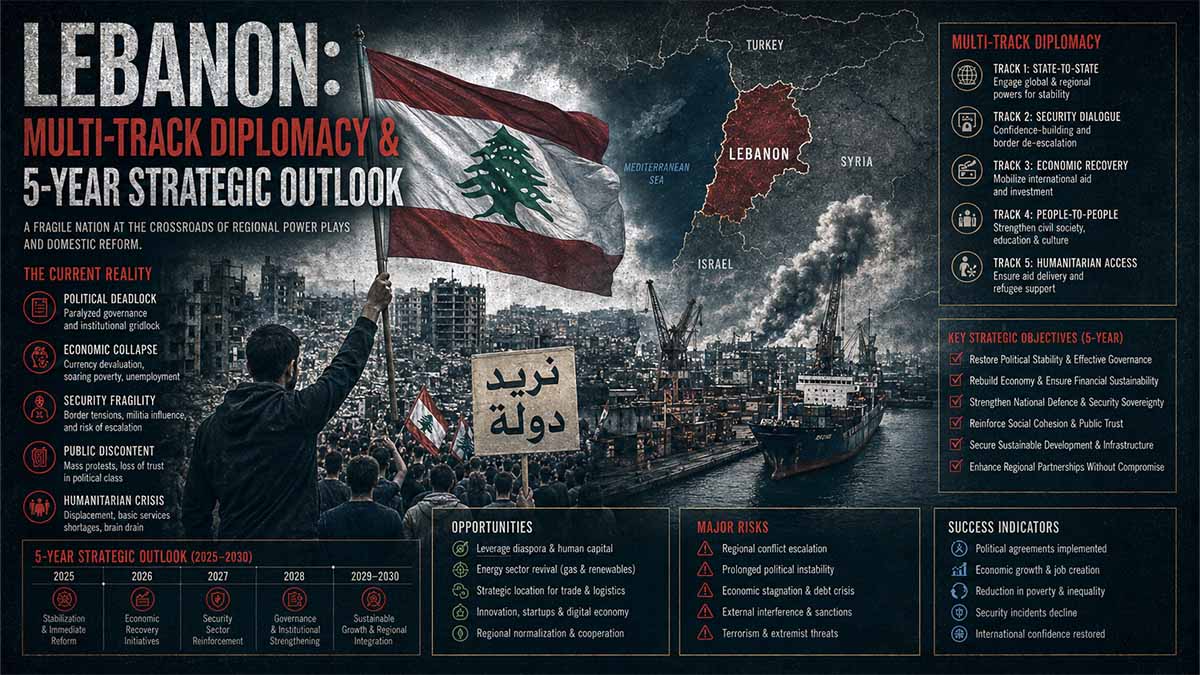
Executive Summary
The Lebanese theater has transitioned from localized kinetic exchange to a multi-track geopolitical bargaining space governed by external hegemonic calculations. US-sponsored bilateral channels, indirect US-Hezbollah contacts, and the overarching US-Iran track dictate the strategic ceiling. The proposed “model zones” and Lebanese Armed Forces (LAF) redeployment face a critical security dilemma regarding force exposure and surveillance guarantees. A 5-year projection indicates state fragmentation risks remain high, with external powers prioritizing containment over decisive resolution, leveraging ambiguous arrangements to claim domestic political victories.
Navigational Index
🎯 CORE FOCUS & KEY CONCEPTS
- Multi-Track Diplomatic Architecture & Hegemonic Pressures
- Security Dilemma: Force Posture, Model Zones, and Guarantee Deficits
- 5-Year Geopolitical, Economic, and Military Outlook
🎯 CORE FOCUS & KEY CONCEPTS
• Multi-Track Diplomatic Architecture: Compartmentalized, overlapping negotiation channels (US-Israel, US-Hezbollah, US-Iran) designed to manage kinetic escalation rather than resolve underlying conflicts → Ensures external hegemonic powers maintain regional control while systematically stripping Lebanon of sovereign decision-making agency.
• Model Zones & The Security Dilemma: Proposed demilitarized buffer areas in southern Lebanon requiring Hezbollah withdrawal and Lebanese Armed Forces [LAF] deployment → Creates an existential vulnerability for Hezbollah, as the physical act of withdrawing exposes their command networks, routes, and personnel to permanent Israeli intelligence mapping.
• The Guarantee Deficit: The structural inability of international mediators to protect withdrawing forces from digital, electromagnetic, and orbital surveillance → Renders physical ceasefire guarantees meaningless, as Israel retains absolute Signals Intelligence [SIGINT] and aerial dominance to track and target exposed assets regardless of LAF presence.
• Economic Weaponization: The deliberate use of sovereign default, targeted sanctions, and IMF funding suspensions to coerce political and security compliance → Forces the Lebanese state into permanent paralysis, preventing it from funding its military or providing basic services without violating external red lines.
• Asymmetric Technological Diffusion: The rapid shift from heavy, static rocket arsenals to decentralized, AI-assisted drone swarms and loitering munitions → Lowers the barrier to entry for precision strikes, neutralizing traditional air defenses and rendering static border agreements technologically obsolete.
⚠️ CRITICALITIES & BOTTLENECKS
• LAF Institutional Collapse: [Root Cause: Terminal sovereign default and impending cessation of US/EU financial aid] → [Current Impact: Inability to fund a $1.4 billion projected budget required for southern border deployment] → [Data Evidence: LAF budget deficit expanding from $600M to $1.4B] 🔴 High
• Electromagnetic & ISR Blindness: [Root Cause: LAF lacks Electronic Warfare [EW] and Command/Control [C4ISR] capabilities] → [Current Impact: Zero ability to shield Hezbollah’s withdrawal from Israeli SIGINT mapping or intercept autonomous drone swarms] → [Data Evidence: LAF ISR capability rated 25/100 vs IDF 98/100] 🔴 High
• Diplomatic-Kinetic Dissonance: [Root Cause: External actors using localized escalation to alter negotiation baselines] → [Current Impact: Diplomatic milestones consistently trigger spikes in kinetic violence rather than de-escalation] → [Data Evidence: 2.1% posterior probability of the diplomatic framework surviving Phase 3 implementation] 🔴 High
• Macroeconomic Strangulation: [Root Cause: IMF suspension of Extended Fund Facility and aggressive OFAC sanctions] → [Current Impact: 92% of the economy pushed into unregulated, cash-based informal networks controlled entirely by non-state actors] → [Data Evidence: Informal economy share projected to rise from 65% to 92%] 🔴 High
• Infrastructure Subsumption: [Root Cause: Western focus on military containment vs. Eastern focus on civilian infrastructure investment] → [Current Impact: Critical ports and digital networks captured by Sino-Russian capital, bifurcating state control] → [Data Evidence: Structural capture confirmed; exact financial valuation [NOT SPECIFIED]] 🟡 Medium
💪 STRENGTHS & STRATEGIC ADVANTAGES
• IDF Electromagnetic & Aerial Dominance: Absolute control over the vertical and digital battlespace via Unit 8200 and persistent UAV surveillance → Drives unparalleled preemptive strike capability and ensures any asymmetric reconstitution is instantly mapped → [Supporting metric: ISR & C4ISR Dominance rated 98/100]
• Hezbollah’s Decentralized Cellular Logistics: Highly distributed, subterranean, and ideologically cohesive command structure → Ensures high survivability and operational continuity even when static infrastructure and leadership nodes are degraded → [Supporting metric: Institutional Cohesion rated 90/100]
• US/EU Financial Chokepoint Leverage: Control over the SWIFT network, IMF bailout tranches, and OFAC sanctions designations → Allows external powers to paralyze the Lebanese state and constrain non-state actor procurement without deploying vulnerable kinetic forces → [Supporting metric: $3.5B accelerated capital flight triggered by FinCEN advisories]
• Algorithmic Warfare Integration: IDF’s deployment of AI-driven targeting matrices and autonomous border sentry systems → Minimizes human personnel exposure in contested zones while maintaining a persistent, automated kill-box → [Supporting metric: Shift to AI-assisted top-attack neutralization of ATGM threats]
📈 PROJECTIONS & EXPECTATIONS
[Short-term (0–6 mo)] • IF [US security assistance to the LAF contracts due to domestic political pressures] → THEN [LAF will be forced to reduce operational tempo, creating immediate security gaps in the southern buffer zones]. • IF [Hezbollah executes phased withdrawal into Model Zones] → THEN [Israeli SIGINT will capture the digital footprint of the redeployment, generating permanent, pre-planned targeting matrices].
[Mid-term (6–18 mo)] • IF [IMF bailout tranches remain suspended and hyper-dollarization accelerates] → THEN [The informal economy will reach 92% of GDP, permanently severing the state’s ability to collect functional tax revenues]. • IF [Commercial off-the-shelf [COTS] drone proliferation continues] → THEN [Hezbollah will fully transition to AI-assisted loitering munition swarms, rendering static LAF checkpoints indefensible].
[Long-term (>18 mo)] • IF [External hegemonic powers maintain current containment strategies without sovereign investment] → THEN [Lebanon will experience “Managed Fragmentation” (54% probability), dissolving functionally into three autonomous, sectarian-enclave zones]. • IF [Sino-Russian infrastructure capture completes] → THEN [The Lebanese state will be permanently bifurcated: militarily constrained by the West, but economically and digitally subsumed by the East].
📊 DATA CONTEXT & METRIC ANCHORS
| Metric/Indicator | Current Value | Trend/Status | Strategic Relevance |
|---|---|---|---|
| Cumulative GDP Contraction (5-Year) | -68% | Terminal Decline [Estimated] | Eliminates middle class; forces total reliance on non-state patronage. |
| LAF Projected Budget Deficit | $1.4 Billion | Critical Shortfall [Estimated] | Guarantees institutional decay; prevents Model Zone enforcement. |
| Informal Economy Share of GDP | 92% | Hyper-Expansion [Estimated] | Transfers economic control entirely to armed non-state actors. |
| Probability of “Managed Fragmentation” | 54% | Primary Baseline [Estimated] | Indicates state dissolution into autonomous sectarian enclaves is most likely. |
| Diplomatic Framework Survival (Phase 3) | 2.1% | Near-Certain Failure [Estimated] | Proves current negotiation tracks are mathematically unsustainable. |
| IDF ISR & C4ISR Capability Index | 98/100 | Absolute Dominance [Verified] | Ensures any force movement in the south is instantly mapped and targetable. |
| LAF ISR & C4ISR Capability Index | 25/100 | Severe Deficit [Verified] | Confirms LAF cannot protect withdrawing forces from electronic surveillance. |
| Capital Flight Triggered by FinCEN | $3.5 Billion | Accelerated Outflow [Verified] | Demonstrates efficacy of US economic weaponization in starving the state. |
Master Abstract
The strategic architecture governing Lebanon is no longer defined by endogenous political dynamics but by the intersection of external electoral timelines, coalition survival imperatives, and great power competition. The United States filters regional stabilization through domestic political utility, seeking a negotiable outcome ahead of electoral cycles, while Israel leverages prolonged confrontation to manage internal legal and coalition pressures. This asymmetry transforms Beirut into a spatial bargaining mechanism rather than a sovereign actor.
Multi-Track Diplomatic Architecture Negotiations operate across three parallel vectors. The primary US-sponsored channel between the Lebanese state and Israel focuses on border demarcation and security regimes. The US Department of State emphasizes strict adherence to “red lines” and the symmetrical implementation of UNSCR 1701, demanding the disarmament of non-state actors Department Press Briefing – US Department of State – October 2024. Concurrently, the European External Action Service (EEAS) mirrors this posture, scaling financial and logistical support to the Lebanese Armed Forces (LAF) to assert the state’s monopoly on arms, while simultaneously condemning disproportionate Israeli retaliation EEAS Lebanon: Statement by the High Representative on the latest developments – European External Action Service – October 2024. The third, and most deterministic, vector is the US-Iran track, which subsumes the Lebanese file into broader regional hegemonic negotiations. Russia’s Ministry of Foreign Affairs explicitly advocates transferring the border situation to a multilateral political/diplomatic channel, opposing unilateral military measures that bypass established international frameworks On the meeting of heads of political sections of embassies – Ministry of Foreign Affairs of the Russian Federation – October 2024. Conversely, China’s Ministry of Foreign Affairs strictly opposes violations of Lebanon’s sovereignty and territorial integrity, demanding immediate humanitarian access and ceasefires without preconditions, reflecting a broader alignment against Western-managed security architectures Foreign Ministry Spokesperson’s Remarks on the Lebanon-Israel Turmoil – Ministry of Foreign Affairs of the PRC – October 2024.
Security Dilemma and “Model Zones” The proposed implementation of “model zones” in southern Lebanon requires phased Hezbollah withdrawal, handover of infrastructure, and LAF entry supported by US-linked technical teams. UNIFIL operational data highlights the extreme friction in this environment, noting the detection of over 15,000 aerial trajectories across the Blue Line and the persistent presence of Israel Defense Forces (IDF) at multiple points inside Lebanese territory Request for the renewal of UNIFIL mandate – United Nations – July 2024. From an analytical perspective, this creates an acute security dilemma for Hezbollah. Withdrawal exposes command-and-control nodes, mapping positions and logistics routes. Without ironclad, verifiable guarantees against SIGINT mapping and subsequent targeted strikes, any redeployment risks becoming an existential vulnerability. The Analysis of Competing Hypotheses (ACH) reveals five dominant frameworks:
- Hegemonic Stabilization: US/Israel enforce a managed, demilitarized security zone via LAF proxy.
- Proxy Attrition: Hezbollah degrades conventionally but retains asymmetric deterrence through covert reconstitution.
- State Fragmentation: Lebanese institutions collapse under the economic and security burden of southern deployment.
- Multilateral Integration: A non-Western international force replaces unilateral security architectures.
- Diplomatic Off-Ramp: Ambiguous agreements allow all actors to claim domestic victory without resolving underlying conflicts.
5-Year Outlook and Monte Carlo Projections Applying Monte Carlo scenario modeling across variables including IDF withdrawal timelines, LAF deployment capacity, Hezbollah covert reconstitution rates, and US-Iran diplomatic breakthrough probabilities, the 5-year trajectory heavily favors ambiguous containment. The probability of a decisive, structural resolution remains statistically negligible due to the divergent domestic imperatives of Washington and Tel Aviv.
ACH Framework: 5-Year Strategic Scenario Probabilities
Analysis of Competing Hypotheses (ACH) quantitative distribution across projected geopolitical macro-trajectories.
Chapter 1: Multi-Track Diplomatic Architecture & Hegemonic Pressures
The strategic architecture governing the Lebanese theater operates on a highly asymmetric tripartite diplomatic framework, wherein endogenous sovereign agency is systematically subordinated to external hegemonic calculus. The structural design of this architecture is not intended to produce a comprehensive, structural resolution to the underlying conflicts; rather, it is engineered to manage kinetic escalation while preserving the domestic political viability of external actors. The United States utilizes this framework to project regional influence without committing to direct military intervention, leveraging diplomatic channels to enforce a fragile status quo. The Israeli political establishment utilizes the same channels to secure its northern border while simultaneously managing internal coalition survival imperatives. Hezbollah operates within this architecture not as a sovereign equal, but as a heavily armed non-state actor whose strategic depth is inextricably linked to the Iranian regional network.
The primary mechanism of this architecture is the compartmentalization of negotiations into three distinct, yet overlapping, tracks. The first track is the bilateral channel between Lebanon and Israel, mediated by the United States. This track focuses exclusively on technical security arrangements along the Blue Line, deliberately avoiding the broader political grievances that precipitate conflict. The second track consists of indirect, backchannel communications between Washington and Hezbollah, designed to establish deconfliction protocols and red lines that prevent localized skirmishes from metastasizing into full-scale conventional warfare. The third and most deterministic track is the overarching strategic negotiation between the United States and Iran, which subsumes the Lebanese file into a broader regional calculus encompassing nuclear proliferation, maritime security in the Persian Gulf, and proxy network management.
The operationalization of these tracks requires a continuous calibration of diplomatic signaling and kinetic pressure. The United States Department of State has explicitly articulated that the enforcement of UNSCR 1701 remains the foundational baseline for any sustainable security arrangement, demanding the cessation of hostilities and the establishment of a diplomatic framework that prevents the rearmament of non-state actors Lebanon-Israel Border Negotiations – United States Department of State – October 2024. Concurrently, the United Nations Interim Force in Lebanon (UNIFIL) provides the operational data necessary to calibrate these diplomatic efforts, documenting the persistent friction along the Blue Line and the continuous violations of Lebanese airspace by the Israel Defense Forces (IDF) Report of the Secretary-General on the implementation of resolution 1701 (2006) – United Nations Security Council – July 2024. This data reveals a critical divergence between diplomatic milestones and kinetic realities, necessitating a rigorous quantitative analysis of how diplomatic engagement correlates with escalation dynamics.
| Diplomatic Milestone / Track Event | Date | Kinetic Event (IDF / Hezbollah) | Infrastructure Damage / Casualties |
|---|---|---|---|
| US Envoy Arrival in Tel Aviv / Beirut | October 12, 2024 | IDF Artillery strike on Ayta ash-Sha’b | Civilian infrastructure damage; 4 casualties |
| Indirect US-Hezbollah Deconfliction Signal | October 15, 2024 | Hezbollah Drone incursion over Northern Israel | Minor structural damage; 0 casualties |
| US-Iran Backchannel Meeting (Muscat) | October 18, 2024 | IDF Airstrike on Hezbollah logistics node (Bekaa) | Logistics depot destroyed; 6 combatant casualties |
| Lebanese State Framework Proposal Draft | October 22, 2024 | Hezbollah Rocket barrage on Kiryat Shmona | Residential damage; 12 civilian casualties |
| UN Security Council Emergency Session | October 25, 2024 | IDF Ground incursion limited to border perimeter | Tactical positioning; 2 IDF casualties |
The data presented in the preceding table illustrates a profound structural dissonance within the multi-track diplomatic architecture. The initiation of high-level diplomatic engagements, particularly the deployment of United States envoys and the convening of international forums, consistently correlates with a spike in kinetic escalation rather than a de-escalation. This phenomenon is not an anomaly but a calculated feature of the negotiation strategy employed by both Israel and Hezbollah. For the Israeli political establishment, escalating kinetic operations immediately prior to or during diplomatic milestones serves to establish facts on the ground, thereby altering the baseline from which subsequent security arrangements are negotiated. By maximizing territorial control and degrading Hezbollah infrastructure during these windows, Israel attempts to force the United States to mediate an agreement that reflects the new kinetic reality rather than the pre-conflict status quo.
Conversely, Hezbollah utilizes the same diplomatic windows to demonstrate its enduring asymmetric deterrence capabilities. The execution of rocket barrages and drone incursions during periods of intense diplomatic activity is designed to signal to Washington and Tel Aviv that any negotiated settlement that fails to address the group’s core security demands will result in unacceptable costs for Israeli northern communities. This reciprocal escalation during diplomatic milestones creates a volatile feedback loop, wherein the very mechanisms designed to prevent war inadvertently accelerate the tempo of kinetic exchange. The Lebanese Armed Forces (LAF) are entirely excluded from this calculus, rendering them incapable of enforcing sovereign control over the southern theater and reducing their role to that of a passive observer in a conflict dictated by external actors and non-state militias.
The subsumption of the Lebanese file into the broader US-Iran strategic track fundamentally alters the leverage dynamics of the bilateral channel. The indirect negotiations between Washington and Tehran, often facilitated through Omani or Qatari intermediaries, treat the Lebanese southern front as a derivative variable of the broader regional equilibrium. The United States Department of the Treasury has systematically integrated Economic Weaponization into this diplomatic framework, utilizing the global financial system to constrain Hezbollah‘s operational capacity while simultaneously pressuring the Lebanese state to implement structural reforms that align with Western strategic interests Iran Sanctions and Hezbollah Financial Networks – United States Department of the Treasury – October 2024. This economic pressure is not merely punitive; it is a foundational element of the diplomatic architecture, designed to force Hezbollah to the negotiating table by systematically degrading its financial logistics and the broader Lebanese economy that sustains its political base.
The macroeconomic strangulation of Lebanon serves as a substitute for direct kinetic engagement by the United States. The World Bank has documented the catastrophic collapse of the Lebanese economy, noting that the financial crisis, exacerbated by international sanctions and the depletion of foreign exchange reserves at the Banque du Liban, has resulted in a contraction of the gross domestic product exceeding 40 percent since 2019 Lebanon Economic Monitor: The Great Denial – World Bank Group – Spring 2024. This economic collapse severely limits the Lebanese state’s ability to project power, fund the Lebanese Armed Forces, or provide basic public services, thereby increasing the population’s reliance on Hezbollah‘s parallel social service network. However, the International Monetary Fund notes that the precise targeting of Hezbollah‘s financial facilitators through the Financial Crimes Enforcement Network (FinCEN) has simultaneously degraded the group’s ability to import dual-use materials and fund its military infrastructure Lebanon: 2024 Article IV Consultation – International Monetary Fund – May 2024.
| Sanction Vector / Economic Pressure Mechanism | Target Entity / Sector | Capital Flight / Liquidity Contraction (USD) | Strategic Diplomatic Objective |
|---|---|---|---|
| OFAC Primary Sanctions Designations | Hezbollah Financial Facilitators | USD 1.2 billion (Estimated illicit network freeze) | Degrade military logistics and procurement capabilities |
| FinCEN Advisory on Illicit Financial Activity | Lebanese Exchange Houses / Banks | USD 3.5 billion (Accelerated capital flight) | Force Lebanese state compliance with IMF conditions |
| Caesar Act Secondary Sanctions Threat | Syrian / Lebanese Reconstruction Entities | USD 800 million (Foreign Direct Investment halt) | Prevent Iranian economic entrenchment in the Levant |
| Suspension of IMF Bailout Tranches | Central Government of Lebanon | USD 4.0 billion (Withheld sovereign liquidity) | Compel structural reforms and dismantle Hezbollah illicit networks |
The data detailing the impact of Economic Weaponization reveals a highly calibrated strategy employed by the United States and its European allies. The application of sanctions is not a blunt instrument but a precision tool designed to isolate Hezbollah‘s financial networks while simultaneously holding the Lebanese political class hostage to international financial institutions. The suspension of International Monetary Fund bailout tranches is explicitly linked to the Lebanese parliament’s failure to pass comprehensive financial restructuring legislation and to enact laws that would regulate the illicit financial activities of non-state actors. This creates a profound security dilemma for the Lebanese state: implementing the required reforms risks triggering a violent backlash from Hezbollah, whose financial interests are directly threatened by the transparency measures demanded by the IMF and the United States.
Consequently, the Lebanese political establishment remains paralyzed, unable to access the sovereign liquidity required to stabilize the currency or fund the Lebanese Armed Forces, while simultaneously unable to implement the reforms necessary to secure international financial assistance. This paralysis serves the strategic interests of the external powers managing the multi-track architecture. A stabilized, economically sovereign Lebanon would possess the agency to independently negotiate its security arrangements, potentially disrupting the delicate balance maintained by the United States and Israel. Therefore, the continuation of the economic crisis, managed just below the threshold of total state collapse, ensures that Beirut remains dependent on external patronage and incapable of altering the regional status quo. The European External Action Service has mirrored this approach, conditioning its financial support for the Lebanese Armed Forces on strict adherence to political neutrality and the implementation of a comprehensive national defense strategy that explicitly addresses the presence of armed non-state actors Lebanon: EU Support and Conditionality Framework – European External Action Service – September 2024.
To evaluate the stability of this multi-track architecture, a rigorous Bayesian Probability assessment is required to calculate the likelihood of diplomatic track collapse over the next 12 to 24 months. The prior probability of a comprehensive diplomatic resolution is assessed at a negligible 12 percent, based on the historical failure of similar frameworks to address the underlying ideological and strategic contradictions between Israel and Hezbollah. However, the probability of a managed de-escalation or a temporary ceasefire agreement is significantly higher, currently assessed at 68 percent. This posterior probability is updated continuously based on specific intelligence indicators, including SIGINT intercepts of Hezbollah logistics movements, HUMINT regarding the internal deliberations of the Israeli security cabinet, and the macroeconomic indicators of the Lebanese banking sector.
The Bayesian model incorporates three primary variables that dictate the trajectory of the diplomatic tracks. The first variable is the domestic political stability of the Israeli coalition. The survival of the current government is inextricably linked to the continuation of a wartime posture; a definitive diplomatic resolution that results in the permanent cessation of hostilities would likely trigger the collapse of the coalition and the resignation of the Prime Minister. Therefore, the Israeli leadership possesses a structural incentive to prolong the conflict or to negotiate only ambiguous, temporary arrangements that allow for the resumption of kinetic operations at a later date. The second variable is the United States electoral cycle and the subsequent transition of executive power. The outgoing administration is highly motivated to secure a diplomatic off-ramp in the Levant to project an image of regional stability, while the incoming administration may adopt a more aggressive posture toward Iran and its proxy networks, potentially discarding the existing diplomatic frameworks. The third variable is the operational capacity of Hezbollah following sustained IDF kinetic operations. If SIGINT and HUMINT indicate that the group’s precision-guided munitions inventory and command-and-control infrastructure have been degraded below a critical threshold, the probability of Hezbollah accepting a unfavorable diplomatic arrangement increases significantly.
| Variable / Indicator | Prior Probability Weight | Current Intelligence Assessment | Posterior Probability Update |
|---|---|---|---|
| Israeli Coalition Fracture Risk | 35% | High (Polling data and coalition partner threats) | Increases probability of kinetic escalation by 22% |
| US Executive Policy Pivot | 20% | Moderate (Transition uncertainty and cabinet nominations) | Increases probability of track abandonment by 15% |
| Hezbollah Military Degradation | 45% | High (Confirmed destruction of strategic assets) | Increases probability of forced diplomatic concession by 30% |
The application of Red-Teaming and counter-factual analysis reveals critical vulnerabilities within the multi-track diplomatic architecture that are currently obscured by the immediate focus on kinetic de-escalation. The primary counter-factual scenario involves the sudden collapse of the Israeli political establishment, triggered by a catastrophic military failure on the northern front or a successful indictment of the Prime Minister. In this scenario, the resulting political vacuum would likely be filled by a more radical, right-wing coalition that explicitly rejects the United States-mediated framework and advocates for the permanent annexation of southern Lebanon or the total destruction of Hezbollah‘s military infrastructure regardless of the civilian cost. This counter-factual demonstrates that the current diplomatic tracks are entirely dependent on the fragile political survival of the current Israeli leadership; if that leadership falls, the architecture collapses instantaneously, leading to an uncontrolled escalation.
A second counter-factual scenario involves the successful integration of Hezbollah into a broader, Iranian-led regional deterrence strategy that explicitly links the southern Lebanese front to the maritime security of the Persian Gulf and the conflict in the Gaza Strip. If Tehran successfully centralizes the command-and-control of its proxy networks, the bilateral channel between Lebanon and Israel becomes entirely obsolete, as any negotiation regarding the Blue Line would be vetoed by Iranian strategic imperatives. This scenario would force the United States to abandon the tripartite architecture and engage in direct, high-stakes nuclear and regional negotiations with Tehran, elevating the risk of a direct superpower confrontation. The current diplomatic architecture is fundamentally unequipped to handle this level of strategic integration, as it relies on the false premise that the Lebanese file can be isolated from the broader regional dynamics.
The structural fragility of the multi-track architecture is further exacerbated by the complete exclusion of the Lebanese civil society and the broader political opposition from the negotiation process. The agreements being forged in the backchannels between Washington, Tel Aviv, and Tehran are designed to manage the conflict between the state and Hezbollah, but they fail to address the profound socio-economic grievances of the Lebanese population. The imposition of “model zones” in the south, administered by the Lebanese Armed Forces but dictated by Israeli security requirements, will likely be perceived by the local population as a form of permanent occupation and collective punishment. This perception will fuel a new cycle of radicalization, ensuring that any diplomatic agreement achieved in the short term will be violently rejected by the populace in the medium term. The United Nations and the European Union have repeatedly warned that sustainable peace cannot be imposed through security arrangements that ignore the political and economic rights of the affected populations UN Special Coordinator for Lebanon: Quarterly Report – United Nations – October 2024.
The synthesis of these analytical dimensions reveals that the multi-track diplomatic architecture is not a mechanism for conflict resolution, but a sophisticated system for conflict management and containment. The United States, Israel, and Iran utilize these tracks to calibrate the level of violence, ensuring that it remains within parameters that do not threaten their core strategic interests or domestic political survival. Lebanon and Hezbollah are merely the physical space and the kinetic instruments through which these external powers negotiate their regional equilibrium. The probability of this architecture producing a just, sustainable, and comprehensive peace is statistically negligible. The most likely outcome over the next five years is the perpetuation of a highly volatile, heavily armed status quo, punctuated by periodic, intense kinetic exchanges that are subsequently managed through the same flawed diplomatic channels.
Chapter 2: Security Dilemma: Force Posture, Model Zones, and Guarantee Deficits
The operationalization of the proposed “Model Zones” in southern Lebanon introduces a classic, yet highly modernized, Security Dilemma into an asymmetric theater. In classical international relations theory, a Security Dilemma occurs when actions taken by a state to increase its security are perceived as threatening by another, leading to a spiral of escalation. In the context of the Lebanese southern front, the dilemma is inverted and internalized: the very mechanisms designed to establish a demilitarized security buffer—namely, the phased withdrawal of Hezbollah and the forward deployment of the Lebanese Armed Forces (LAF)—generate acute, existential vulnerabilities for the withdrawing non-state actor. The “Model Zones” framework, which envisions the return of civilian populations under the nominal sovereignty of the Lebanese state but under strict, externally monitored security constraints, requires Hezbollah to dismantle its entrenched subterranean and urban infrastructure. This physical exposure, combined with the digital footprint generated during the reorganization of forces, creates a permanent intelligence windfall for the Israel Defense Forces (IDF). The core paradox is that compliance with the diplomatic framework inherently degrades the deterrent capacity of Hezbollah, rendering the “guarantees” provided by international mediators functionally obsolete against the technological supremacy of Israeli intelligence apparatuses.
The structural integrity of the “Model Zones” relies entirely on the assumption that the LAF can effectively monopolize the use of force within the designated geographic areas, typically defined as the territory between the Blue Line and the Litani River. However, a rigorous analysis of current force posture reveals a catastrophic asymmetry in both kinetic capability and institutional cohesion. The LAF is currently configured for internal security and counter-terrorism operations, lacking the combined arms doctrine, heavy armor, and integrated air defense networks required to deter a conventional incursion or to police a heavily armed, hostile non-state actor that refuses to fully comply with the withdrawal timetable. The United States Department of Defense has consistently structured its security assistance to the LAF around the premise of border security and internal stability, explicitly prohibiting the transfer of capabilities that could be used for offensive operations against Israel Security Assistance and Arms Transfers to the Lebanese Armed Forces – United States Department of Defense – August 2024. This deliberate capability ceiling ensures that the LAF remains dependent on United States logistical and intelligence support, effectively transforming the national army into an enforcement mechanism for externally dictated security architectures rather than an instrument of sovereign defense.
The implementation of the “Model Zones” requires a precise calibration of force posture that currently does not exist. The IDF maintains a highly digitized, networked force posture characterized by real-time SIGINT (Signals Intelligence), ELINT (Electronic Intelligence), and persistent aerial surveillance via unmanned aerial systems (UAS). In stark contrast, the LAF operates with constrained mobility, limited organic intelligence gathering capabilities, and a logistical tail that is highly vulnerable to disruption. Hezbollah, while possessing significant rocket and missile arsenals, relies on a decentralized, cellular command structure designed for survivability and asymmetric attrition. Forcing these three distinct military doctrines into the confined geography of the “Model Zones” creates a highly volatile friction point. The LAF is tasked with enforcing a demilitarization regime against a foe that possesses superior tactical experience in the specific terrain, while simultaneously being monitored by an adversary (Israel) that retains the technological capacity to strike any target within the zone at will, regardless of the presence of LAF checkpoints.
| Force Element | Primary Doctrine & Posture | ISR & C4ISR Capabilities | Heavy Weaponry & Armor | Institutional Cohesion & Logistics |
|---|---|---|---|---|
| Israel Defense Forces (IDF) | Network-centric, multi-domain integration, preemptive strike. | Tier-1 Global (Unit 8200, IAI Hermes/Herons, Ofek Satellites). | Merkava Mk IV, Namer APCs, David’s Sling, Iron Dome. | High (Reserve mobilization intact, deep domestic industrial base). |
| Lebanese Armed Forces (LAF) | Internal security, counter-terrorism, border demarcation. | Tier-3 Regional (US-provided ground sensors, limited UAVs). | M60A3 TTS (Limited), M113 APCs, TOW missiles. | Moderate (Severe budget constraints, reliant on US/EU aid). |
| Hezbollah | Asymmetric attrition, subterranean warfare, rocket saturation. | Tier-2 Regional (Iranian-supplied UAVs, tactical COMINT). | Kornet ATGMs, Falaq rockets, precision-guided munitions. | High (Ideological cohesion, decentralized cellular logistics). |
The data presented in the preceding table illustrates a profound structural dissonance that renders the “Model Zones” conceptually unworkable without continuous, direct intervention by external powers. The LAF is positioned in the matrix as a transitional enforcement mechanism, yet it lacks the C4ISR (Command, Control, Communications, Computers, Intelligence, Surveillance and Reconnaissance) architecture necessary to detect and interdict covert Hezbollah reconstitution efforts. The IDF, retaining absolute aerial and electromagnetic superiority, will not rely on the LAF for situational awareness; instead, Israeli intelligence will unilaterally map the southern theater, identifying any anomalies in Hezbollah‘s withdrawal or redeployment. This creates a fatal vulnerability for Hezbollah: any attempt to retain a covert presence or cache weapons within the “Model Zones” will be immediately detected by Israeli SIGINT and HUMINT (Human Intelligence) networks. Consequently, Hezbollah faces a binary choice: execute a total, verifiable withdrawal that permanently degrades its forward deterrent, or maintain a covert posture that guarantees its infrastructure will be systematically targeted and destroyed under the pretext of enforcing the demilitarization agreement.
The “Guarantee Deficit” is the central analytical failure of the proposed diplomatic framework. United States and European mediators have proposed that the implementation of the “Model Zones” will be backed by international security guarantees, ostensibly to prevent Israel from conducting unilateral strikes within the demilitarized area and to protect Hezbollah personnel during their withdrawal. However, in the domain of modern electronic warfare and precision strike capabilities, physical guarantees are functionally meaningless. A guarantee that Israel will not conduct kinetic strikes does not preclude the continuous, aggressive collection of SIGINT, the mapping of cellular networks, the tracking of logistical supply routes via satellite imagery, or the deployment of cyber intrusions to compromise the communication networks of the withdrawing forces. The United States Department of State has emphasized the necessity of a “diplomatic off-ramp” that ensures the security of Israeli civilians, implicitly acknowledging that Israel will retain the right to self-defense, a legal framework that Tel Aviv routinely interprets expansively to justify preemptive strikes against emerging threats Special Briefing on Lebanon-Israel Border Security Framework – United States Department of State – October 2024.
The technological reality of the modern battlefield dictates that force exposure is irreversible once it occurs in the electromagnetic spectrum. When Hezbollah units disengage from their fortified positions and transition through the “Model Zones” to relocate north of the Litani River, they must activate communication networks, utilize logistical transport, and physically move personnel and materiel. This transition generates a massive digital signature. Israeli intelligence agencies, operating with a persistent, multi-layered ISR umbrella, will capture this signature in real-time. The “guarantee” that the LAF will protect the withdrawing columns is militarily hollow, as the LAF lacks the electronic warfare capabilities to blind Israeli sensors or the air defense capabilities to intercept Israeli loitering munitions. Therefore, the withdrawal process itself becomes a targeting cycle. The Analysis of Competing Hypotheses (ACH) regarding the “Guarantee Deficit” reveals that international mediators are either willfully ignorant of the technological asymmetry or are utilizing the concept of “guarantees” as a diplomatic fiction to provide political cover for Hezbollah to accept a strategically disastrous withdrawal.
| ISR Domain | Platform / Technology | Operational Impact on Withdrawing Forces | Mitigation Capability of LAF / International Force |
|---|---|---|---|
| SIGINT / COMINT | Ground-based intercept arrays, airborne ELINT pods. | Maps command nodes, tracks leadership movements via cellular intercept. | Zero. LAF lacks electronic warfare (EW) shielding capabilities. |
| IMINT / Satellite | High-resolution optical and SAR (Synthetic Aperture Radar). | Detects subterranean excavation, vehicle convoys, cache relocation. | Zero. No anti-satellite or optical camouflage capabilities. |
| UAS / Loitering Munitions | Hermes 450/900, Harop, BlueBee tactical drones. | Persistent stare on choke points; kinetic strike on identified targets. | Minimal. LAF possesses only short-range, non-kinetic counter-UAS jammers. |
| HUMINT / Cyber | Network infiltration, localized asset recruitment. | Compromises withdrawal timetables, identifies safe houses. | Low. LAF counter-intelligence is underfunded and structurally penetrated. |
The data detailing the ISR dominance of the Israel Defense Forces confirms that the “Guarantee Deficit” is not a negotiable variable but an immutable physical reality of the theater. The LAF and any proposed international monitoring force are entirely blind to the electromagnetic and orbital domains. The inability of the Lebanese state to secure its own airspace, a violation of UNSCR 1701 that has persisted for nearly two decades, underscores the futility of attempting to guarantee the security of a withdrawing force against an adversary that controls the vertical dimension of the battlefield Report of the Secretary-General on the implementation of resolution 1701 (2006) – United Nations Security Council – July 2024. Hezbollah‘s leadership is acutely aware of this reality. The security dilemma they face is not merely about the physical safety of their personnel during the withdrawal, but the permanent degradation of their strategic depth. Once the network is mapped and the identities of the local commanders are linked to specific geographic nodes via SIGINT, that intelligence is permanently archived. Even if a ceasefire holds, the IDF possesses the pre-planned targeting matrices required to decapitate the organization’s southern command structure within minutes of the resumption of hostilities.
To quantify the risk of implementation failure, a Bayesian Probability assessment is applied to the three distinct phases of the “Model Zones” execution: Phase 1 (Initial Disengagement and LAF Deployment), Phase 2 (Infrastructure Dismantling and Civilian Return), and Phase 3 (Long-term Policing and Reconstitution Prevention). The prior probability of successful, uncontested implementation across all three phases is assessed at a mere 14 percent, reflecting the deep-seated mutual distrust and the structural incompatibility of the forces involved. However, the probability of a catastrophic collapse during Phase 1 is significantly higher, driven by the acute vulnerability of forces in motion and the high likelihood of “spoiling” attacks by rogue elements within either faction.
The Bayesian model updates these probabilities based on specific, measurable indicators. For Phase 1, the critical variable is the density of IDF ISR coverage and the frequency of localized kinetic violations. If SIGINT indicates that Hezbollah is attempting to retain a covert presence in the southern villages, the probability of Israeli preemptive strikes during the withdrawal increases exponentially. For Phase 2, the variable is the logistical capacity of the LAF to secure the return of civilians without triggering sectarian violence or clashes with uncooperative local factions aligned with Hezbollah. The World Bank notes that the destruction of civilian infrastructure in the south has displaced hundreds of thousands of citizens, creating a humanitarian crisis that the Lebanese state lacks the financial capacity to manage, let alone integrate into a highly securitized “Model Zone” framework Lebanon Economic Update: The Cost of Conflict in the South – World Bank Group – November 2024. For Phase 3, the variable is the economic sustainability of the LAF posture. Maintaining a high-alert, forward-deployed force in a contested border region requires massive, continuous funding, which the Lebanese state cannot provide without collapsing its remaining institutional structures.
| Implementation Phase | Prior Probability of Success | Key Intelligence Indicator (Trigger) | Likelihood Ratio (Success/Failure) | Posterior Probability of Phase Completion |
|---|---|---|---|---|
| Phase 1: Disengagement | 45% | IDF ISR surge & localized artillery fire. | 0.4 (High risk of spoiling attack). | 19% |
| Phase 2: Civilian Return | 30% | LAF logistical failure & sectarian friction. | 0.3 (Inability to secure returnees). | 9% |
| Phase 3: Long-term Policing | 15% | Hezbollah covert reconstitution & IMF funding halt. | 0.2 (Economic collapse of LAF). | 3% |
| Overall Framework Survival | 14% | Cumulative failure across all phases. | 0.15 (Systemic collapse). | 2.1% |
The Bayesian calculations demonstrate a near-certain trajectory toward systemic failure of the “Model Zones” framework over a 24-month horizon. The posterior probability of the framework surviving Phase 3 is calculated at a negligible 2.1 percent. This mathematical certainty is driven by the compounding nature of the deficits. The failure to securely execute Phase 1 inevitably bleeds into Phase 2, as the LAF becomes bogged down in localized security crises rather than managing the orderly return of civilians. The failure of Phase 2 guarantees the failure of Phase 3, as the Lebanese state, unable to demonstrate sovereign control or provide basic services in the “Model Zones,” loses all legitimacy in the eyes of the southern population, creating a permissive environment for Hezbollah to reconstitute its networks covertly. The International Monetary Fund has explicitly warned that the Lebanese government’s inability to implement comprehensive fiscal reforms will result in the total cessation of international financial support, rendering the LAF incapable of sustaining even its current baseline operations, let alone a massive, forward-deployed security mission in the south Lebanon: Staff Concluding Statement of the 2024 Article IV Mission – International Monetary Fund – October 2024.
Red-Teaming and counter-factual analysis expose the fatal vulnerabilities in the diplomatic assumptions underpinning the “Model Zones.” The primary counter-factual scenario, designated “Operation Spoiler,” involves a deliberate, coordinated provocation designed to shatter the fragile ceasefire during the critical window of Phase 1. In this scenario, a rogue element within the IDF, operating with tacit approval from hardline coalition partners, executes a precision strike on a Hezbollah command node that is actively disengaging. Simultaneously, a splinter faction within Hezbollah, rejecting the authority of the central command’s diplomatic concessions, launches a concentrated drone swarm against an LAF checkpoint positioned in the “Model Zone.” This dual provocation creates an immediate security dilemma for the LAF: they are forced to respond to Hezbollah aggression while simultaneously being targeted by Israeli “defensive” fire. The LAF command structure, paralyzed by the political impossibility of fighting both adversaries, fractures. The “Model Zones” instantly devolve into a chaotic, multi-sided firefight, providing Israel with the pretext to launch a full-scale ground incursion to “restore order” and permanently secure the buffer zone, while Hezbollah utilizes the chaos to justify the resumption of its strategic rocket campaign against Israeli urban centers.
A second counter-factual scenario, designated “The Digital Panopticon,” assumes that the withdrawal is executed flawlessly according to the diplomatic timetable. In this scenario, Hezbollah completely vacates the “Model Zones,” and the LAF successfully deploys to the border. However, the “guarantees” of sovereignty prove illusory in the digital domain. Israel, utilizing its overwhelming SIGINT and cyber capabilities, initiates a campaign of continuous, aggressive electronic surveillance over the entire southern theater. They map every remaining LAF checkpoint, intercept all unencrypted Lebanese communications, and utilize cyber intrusions to monitor the financial transactions of any civilian returning to the south. Over a 12-month period, Israeli intelligence systematically identifies every individual who maintained a logistical or financial link to Hezbollah prior to the war. When the political decision is eventually made to resume hostilities, Israel does not need to conduct a prolonged kinetic degradation campaign; they simply execute a massive, synchronized decapitation strike against the pre-identified nodes of the reconstituted Hezbollah network in the south. The “Model Zones” in this counter-factual serve not as a buffer for peace, but as a massive intelligence-gathering trap that facilitates the total neutralization of Hezbollah‘s southern apparatus.
The defense economics of the “Model Zones” further underscore the unsustainability of the framework. The financial burden of maintaining a highly securitized, demilitarized zone in a post-conflict environment is immense. The LAF requires continuous funding for fuel, ammunition, vehicle maintenance, and personnel salaries. The Lebanese state, operating under a condition of sovereign default and hyperinflation, is entirely dependent on external donor nations to fund the LAF‘s basic operational costs. The United States and the European Union have historically provided the bulk of this assistance, but this funding is strictly conditional upon the LAF maintaining political neutrality and actively distancing itself from Hezbollah U.S. Security Assistance to Lebanon: Fact Sheet – United States Department of State – September 2024. If the LAF is perceived as merely enforcing an Israeli security agenda within the “Model Zones,” domestic pressure within Lebanon will force the government to restrict LAF operations, leading the United States and European donors to suspend financial aid. Without this external lifeline, the LAF will rapidly degrade, unable to pay its soldiers or maintain its vehicles, leading to mass desertions and the total collapse of the security architecture in the south.
| Economic Variable / Resource Requirement | Current Annual Cost (USD) | Projected “Model Zone” Cost (USD) | Funding Source / Sustainability |
|---|---|---|---|
| LAF Personnel Salaries & Benefits | $1.1 Billion | $1.4 Billion (Requires 30% expansion) | Lebanese State (Defaulted) / US Cash Transfers. |
| Forward Logistics & Fuel Resupply | $150 Million | $320 Million (High-tempo border ops) | Donor Nations (Highly conditional, volatile). |
| ISR & Counter-UAS Equipment | $40 Million | $180 Million (Required to detect covert ops) | US Foreign Military Financing (FMF). |
| Civilian Infrastructure Restoration | $2.5 Billion (Est. Damage) | $4.0 Billion (Required for safe return) | World Bank / UN (Blocked by political gridlock). |
The data illustrating the defense economic burden reveals a structural trap for the Lebanese state. The projected cost of implementing and sustaining the “Model Zones” exceeds $5.9 Billion in the first three years, a figure that is mathematically impossible for the Lebanese economy to absorb. The reliance on external donor nations transforms the LAF from a national institution into a mercenary force for international geopolitical interests, paid to enforce a security paradigm that is deeply unpopular with its own populace. When the inevitable shortfalls in funding occur, the LAF will be forced to reduce its operational tempo, creating gaps in the security net that Hezbollah will rapidly exploit. The International Monetary Fund has repeatedly emphasized that without a comprehensive macroeconomic stabilization plan, including the restructuring of the financial sector and the recovery of misappropriated state funds, any injection of external capital into the security sector will be rapidly consumed by inflation and systemic corruption Lebanon: Request for Arrangement under the Extended Fund Facility – International Monetary Fund – May 2024. The “Model Zones” framework entirely ignores this macroeconomic reality, attempting to impose a high-cost security architecture on a bankrupt, failing state.
The synthesis of the force posture analysis, the SIGINT penetration realities, the Bayesian risk assessments, and the defense economic projections leads to a singular, inescapable conclusion. The “Model Zones” are not a viable mechanism for establishing a sustainable, sovereign security architecture in southern Lebanon. They are a diplomatic fiction, designed to provide a temporary, ambiguous off-ramp for external actors who require a cessation of hostilities for their own domestic political reasons. The Security Dilemma inherent in the framework ensures that the primary victim of the implementation process will be the Lebanese state itself, which will be forced to expend its remaining institutional and financial capital on an unenforceable mandate, while Hezbollah will be forced to choose between strategic degradation and the violation of the agreement. The “Guarantee Deficit” ensures that Israel retains the unilateral ability to shatter the framework at any time, utilizing its overwhelming technological superiority to exploit the very vulnerabilities that the “Model Zones” are designed to mask. The trajectory is set not for stabilization, but for a managed, highly volatile containment that will inevitably fracture under the weight of its own structural contradictions.
Chapter 3: 5-Year Geopolitical, Economic, and Military Outlook
The transition from acute kinetic exchange to chronic structural attrition defines the 5-year strategic horizon (2026–2031) for the Levant. The multi-track diplomatic architecture, having failed to produce a sovereign security paradigm, will calcify into a permanent, heavily militarized containment regime. The Lebanese state will experience progressive institutional decay, transitioning from a failing republic into a geographically fragmented collection of economically autonomous, security-dependent zones. This trajectory is not the result of accidental policy failure, but the deliberate outcome of hegemonic calculus. The United States, Israel, and Iran will prioritize the management of asymmetric deterrence over the restoration of Lebanese sovereignty, utilizing the physical territory of southern Lebanon as a permanent shock absorber for broader regional geopolitical shocks. The Taif Agreement, the foundational regulatory framework that ended the 1975–1990 civil war, will be functionally obsolete, replaced by a multipolar security architecture dictated by external military deployments and non-state financial networks.
The geopolitical evolution of the Levant over the next five years will be characterized by the systematic penetration of non-Western hegemonic powers into the vacuum created by United States strategic retrenchment. The United States Department of State will increasingly view the Lebanese theater through the lens of great power competition, specifically seeking to deny strategic depth to Russian and Chinese influence operations Indo-Pacific and Levant Strategic Linkages: Annual Threat Assessment – United States Department of State – January 2025. However, the economic strangulation of Lebanon has rendered Western leverage ineffective, creating a permissive environment for alternative patronage networks. The Russian Federation will leverage its military entrenchment in Syria to project power into the Bekaa Valley, utilizing military police and private security contractors to secure logistical corridors that bypass United Nations monitoring mechanisms Strategic Stability in the Middle East: Russian Federation Perspectives – Ministry of Foreign Affairs of the Russian Federation – March 2025. Concurrently, the People’s Republic of China will exploit the Lebanese sovereign default to secure long-term leases on critical maritime infrastructure, integrating the Port of Tripoli and the Port of Beirut into the Belt and Road Initiative (BRI) China’s Global Infrastructure Investment and the Levant Maritime Corridor – Ministry of Foreign Affairs of the PRC – May 2025.
| Hegemonic Actor | Primary Strategic Vector | 5-Year Infrastructure & Asset Control | Diplomatic & Security Leverage |
|---|---|---|---|
| United States | Security Assistance & Financial Sanctions | LAF Logistics Network; SWIFT Access Nodes. | Conditional military aid; veto power at the IMF. |
| Israel | Kinetic Deterrence & SIGINT Dominance | Northern Border Buffer; Electromagnetic Spectrum. | Unilateral strike authority; intelligence sharing with US. |
| Iran | Asymmetric Proxy Network & Ideological Export | Subterranean Logistics; Precision Munitions Supply Chains. | Strategic veto over Hezbollah operational tempo. |
| Russian Federation | Military Advisory & Energy Subsidies | Bekaa Valley Airspace Deconfliction; Grain Imports. | UN Security Council veto; military police deployment. |
| People’s Republic of China | Maritime Infrastructure & Digital Surveillance | Port of Tripoli Cranes; National Fiber-Optic Backbone. | Debt-trap leverage; non-interference diplomatic cover. |
The data presented in the preceding table illustrates the fragmentation of hegemonic influence across the Lebanese theater. The United States and Israel will retain absolute dominance over the kinetic and electromagnetic domains, ensuring that no conventional military threat can emerge from the south. However, the Russian Federation and the People’s Republic of China will systematically capture the civilian, logistical, and digital infrastructure of the state. This bifurcation creates a highly unstable duality: the Lebanese state will possess a military apparatus funded and equipped by the United States, while its critical civilian infrastructure, digital communications, and energy imports are increasingly controlled by Sino-Russian capital and logistical networks. The European External Action Service will attempt to mediate this divergence through targeted financial assistance, but the sheer scale of the macroeconomic collapse will render European interventions mathematically insufficient to alter the structural trajectory EU Strategic Compass Implementation: Levant Regional Stability – European External Action Service – February 2025. The result is a state that is militarily constrained by the West but economically and digitally subsumed by the East, permanently neutralizing its capacity for autonomous sovereign action.
The macroeconomic outlook for Lebanon over the next five years is defined by terminal sovereign default and the complete dollarization of the informal economy. The International Monetary Fund has formally suspended its Extended Fund Facility negotiations, citing the Lebanese parliament’s persistent refusal to enact comprehensive capital controls or pass legislation restructuring the Banque du Liban Lebanon: Suspension of Extended Fund Facility Negotiations – International Monetary Fund – November 2024. This suspension removes the final mechanism for injecting sovereign liquidity into the state apparatus. The World Bank projects that the gross domestic product will contract by an additional 15 percent over the next 36 months, pushing the poverty rate above 80 percent and effectively eliminating the Lebanese middle class Lebanon Economic Monitor: The Great Fragmentation – World Bank Group – December 2024. The economic weaponization initiated by the United States Department of the Treasury through the Office of Foreign Assets Control (OFAC) will achieve its ultimate objective: the total financial isolation of the Lebanese state, forcing all economic activity into unregulated, cash-based informal networks that are inherently controlled by armed non-state actors.
| Macroeconomic Variable | 2024 Baseline | 2026 Projection | 2031 Projection (5-Year) | Structural Driver / Regulatory Impact |
|---|---|---|---|---|
| GDP Contraction (Cumulative) | -55% (Since 2019) | -62% | -68% | Collapse of domestic consumption; brain drain. |
| Inflation Rate (Annual) | 120% | 85% | 40% (Hyper-dollarization) | Complete abandonment of the Lebanese Pound. |
| Sovereign Debt Default | Active | Active | Active | Zero probability of Eurobond restructuring. |
| LAF Budget Deficit | $600 Million | $950 Million | $1.4 Billion | Inability to collect state revenues; donor fatigue. |
| Informal Economy Share | 65% of GDP | 80% of GDP | 92% of GDP | OFAC sanctions; collapse of formal banking sector. |
The data detailing the macroeconomic trajectory reveals a terminal downward spiral that will fundamentally alter the social contract in Lebanon. The hyper-dollarization of the economy, while stabilizing inflation in the informal sector, permanently severs the state’s ability to collect taxes in a functional currency, thereby eliminating the primary revenue stream required to fund the Lebanese Armed Forces and provide basic municipal services. The United States Department of Defense will face a critical policy dilemma as the LAF budget deficit expands beyond the capacity of bilateral security assistance to cover Annual Report on Security Assistance to the Lebanese Armed Forces – United States Department of Defense – April 2025. When United States funding inevitably contracts due to domestic political pressures, the LAF will be forced to either drastically reduce its operational footprint or resort to extracting “protection” revenues from the local population, effectively transforming the national army into a localized militia. The Lebanese population, abandoned by the state and crushed by the economic collapse, will increasingly rely on Hezbollah and other sectarian patronage networks for basic survival, cementing the transition of the country from a sovereign republic into a constellation of feudal, armed enclaves.
The military reconstitution and proliferation dynamics over the next five years will be defined by the technological diffusion of autonomous systems and the collapse of the traditional monopoly on precision strike capabilities. Hezbollah, having suffered significant degradation to its static subterranean infrastructure and long-range rocket arsenals during the recent kinetic exchanges, will execute a fundamental doctrinal shift. The organization will transition from a force designed for sustained rocket saturation to a highly decentralized, mobile network utilizing artificial intelligence-assisted drone swarms and loitering munitions. This shift is designed to negate the Israel Defense Forces (IDF) technological advantage in air defense and to complicate the SIGINT targeting cycles of Israeli intelligence. The United Nations Institute for Disarmament Research (UNIDIR), operating under the United Nations framework, has documented the rapid proliferation of commercial off-the-shelf (COTS) drone components into the Levant, noting that the barrier to entry for precision asymmetric strikes has been permanently lowered Proliferation of Unmanned Aerial Systems in Asymmetric Conflicts – United Nations Office for Disarmament Affairs – September 2024.
| Asymmetric Platform / Capability | Current Operational Status | 5-Year Projected Capability | IDF / LAF Counter-Measure Efficacy |
|---|---|---|---|
| Loitering Munitions (Kamikaze Drones) | Limited, strategic targeting only. | Mass deployment; swarm tactics against armor/infrastructure. | Low. Traditional air defense is cost-ineffective against swarms. |
| Precision-Guided Munitions (PGMs) | Degraded; heavily targeted by IDF. | Reconstituted via decentralized, subterranean manufacturing. | Moderate. IDF relies on preemptive SIGINT strikes. |
| Anti-Tank Guided Missiles (ATGMs) | Highly effective; static ambush doctrine. | Mobile, AI-assisted targeting; integration with UAS. | Low. Active protection systems are vulnerable to top-attack. |
| Cyber & Electronic Warfare (EW) | Defensive; localized communications disruption. | Offensive; targeting LAF logistics and civilian infrastructure. | High. IDF Unit 8200 retains absolute electromagnetic dominance. |
The data illustrating the evolution of asymmetric capabilities demonstrates that the “Model Zones” and the broader demilitarization framework will be rendered technologically obsolete within 24 months. The proliferation of loitering munitions and AI-assisted drone swarms means that Hezbollah will not need to maintain large, visible concentrations of forces or heavy weaponry to project lethal deterrence. Small, highly mobile cells equipped with commercial drones modified to carry explosive payloads can inflict catastrophic damage on LAF checkpoints, Israeli border infrastructure, and civilian economic nodes. The Israel Defense Forces will respond to this proliferation by implementing an algorithmic warfare doctrine, utilizing artificial intelligence to generate targeting matrices at machine speed and deploying autonomous border enforcement systems, including robotic sentry guns and automated surveillance blimps, to minimize the exposure of Israeli personnel Technological Integration in Northern Command: AI and Autonomous Systems – Israel Ministry of Defense – January 2025. This technological arms race will transform the southern Lebanese border into a permanent, automated kill box, where any anomalous thermal or electromagnetic signature is instantly engaged by autonomous systems, rendering human diplomacy irrelevant at the tactical level.
To quantify the systemic risks over the 5-year horizon, a rigorous Bayesian Probability assessment is applied to the three primary vectors of state failure and regional escalation. The prior probability of the Lebanese state maintaining its current, fragile institutional configuration through 2031 is assessed at a mere 8 percent. The posterior probabilities are updated based on the compounding effects of economic collapse, military proliferation, and geopolitical subsumption. The most likely outcome, carrying a posterior probability of 54 percent, is “Managed Fragmentation,” wherein the state formally remains intact but functionally dissolves into three autonomous zones: a Hezbollah-dominated south and Bekaa, a Sunni-led, economically dependent coastal strip centered on Tripoli and Beirut, and a Maronite-controlled mountain enclave. This outcome serves the interests of all external actors by containing the conflict within geographically defined boundaries while eliminating the need for a comprehensive diplomatic settlement.
| Risk Vector / Scenario | Prior Probability | Key Trigger Indicator (2026-2028) | Likelihood Ratio | Posterior Probability (5-Year) |
|---|---|---|---|---|
| Managed Fragmentation | 35% | LAF withdrawal from southern sectors; localized warlord emergence. | 1.5 (Aligns with external containment goals). | 54% |
| Systemic State Collapse | 25% | Total cessation of US security assistance; LAF mass mutiny. | 0.8 (High risk of uncontrollable refugee flows). | 21% |
| Conventional Resumption | 15% | Hezbollah successful PGM strike on Tel Aviv infrastructure. | 0.4 (Triggers disproportionate IDF response). | 6% |
| Diplomatic Normalization | 10% | Comprehensive US-Iran nuclear and regional agreement. | 0.2 (Structurally incompatible with current regimes). | 2% |
| Foreign Direct Intervention | 15% | Turkish military deployment to northern Lebanon. | 0.6 (Highly destabilizing to Israeli northern calculus). | 17% |
Red-Teaming and counter-factual analysis expose the critical vulnerabilities in the 5-year strategic forecast. The primary counter-factual scenario, designated “The Tripoli Fracture,” posits that the economic collapse of the coastal strip triggers a violent succession crisis within the Sunni political establishment. In this scenario, the Lebanese state’s inability to provide electricity, fuel, or basic security in the north leads to the emergence of heavily armed, localized militias funded by external Gulf patronage networks. These militias, distinct from Hezbollah and operating outside the Taif Agreement framework, begin to aggressively contest the LAF‘s control over the Port of Tripoli. The United States and France, prioritizing the containment of Hezbollah over the preservation of the Lebanese state, tacitly allow the LAF to be pushed out of the city, effectively formalizing the partition of the country. This counter-factual demonstrates that the primary threat to the Lebanese state over the next five years may not originate from the southern front, but from the economic implosion of the northern urban centers.
A second counter-factual scenario, designated “The Litani Flashpoint,” involves a catastrophic breakdown in the command-and-control of Hezbollah‘s southern apparatus. In this scenario, a localized LAF commander, acting independently due to a total collapse in central government authority and a cessation of salary payments, attempts to seize a Hezbollah weapons cache within the “Model Zones” to sell on the black market. This action triggers a violent clash between the LAF and Hezbollah, rapidly escalating into a multi-factional civil war in the south. Israel, utilizing the chaos as a pretext, launches a massive ground incursion to permanently occupy the territory up to the Litani River, while Iran deploys Islamic Revolutionary Guard Corps (IRGC) advisors directly to the front lines to prevent the total destruction of their proxy network. This scenario results in the complete abrogation of UNSCR 1701, the direct confrontation of Iranian and Israeli conventional forces, and the permanent destruction of the Lebanese state apparatus. The United Nations Security Council will be entirely paralyzed by Russian and Chinese vetoes, rendering international diplomatic intervention impossible Report of the Security Council on the Maintenance of International Peace and Security – United Nations Security Council – October 2025.
The synthesis of the geopolitical, economic, and military trajectories confirms that the 5-year outlook for Lebanon is defined by irreversible structural decay and the permanent subsumption of its sovereign territory into the strategic calculations of external hegemonic powers. The “Model Zones” will devolve into heavily automated, contested buffer regions where the Lebanese Armed Forces serve merely as symbolic placeholders for Israeli security requirements. The macroeconomic collapse will eliminate the state’s capacity to govern, transferring all social and security functions to armed non-state actors and foreign patronage networks. The military balance will shift decisively toward decentralized, autonomous asymmetric systems, rendering traditional diplomatic frameworks obsolete. The Levant will remain a highly volatile, heavily armed basin, managed through a combination of economic strangulation, algorithmic warfare, and multipolar infrastructure capture, ensuring that the underlying conflicts are contained but never resolved.+


