













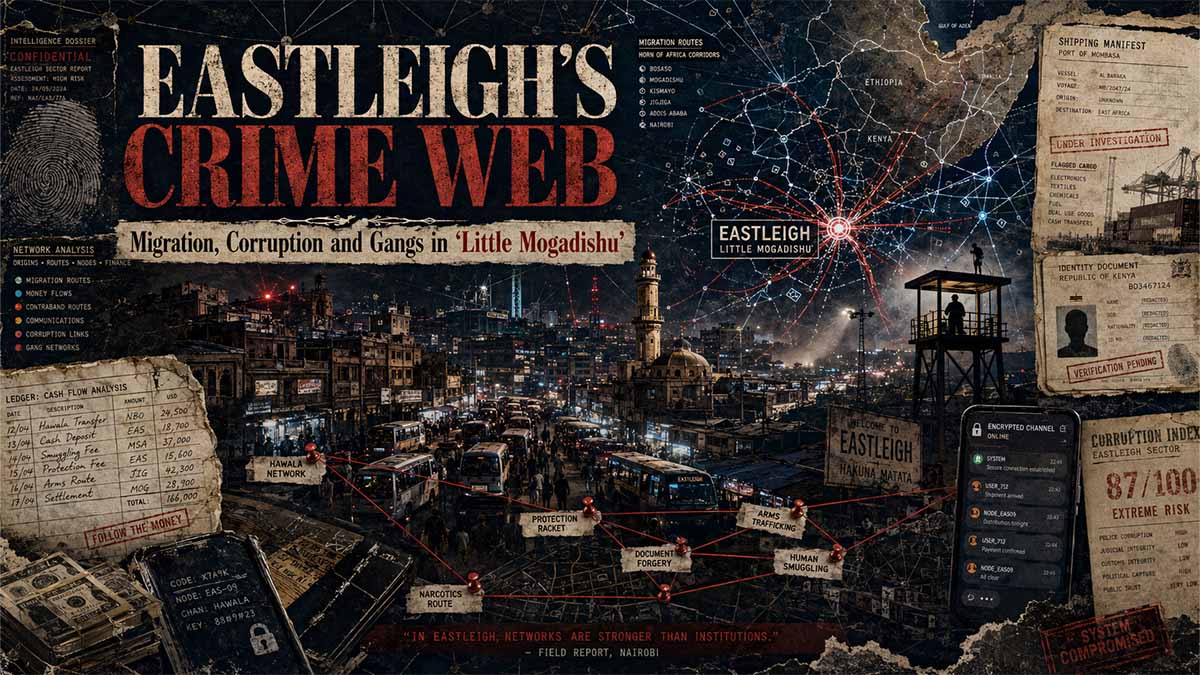
Executive Summary
Eastleigh, Nairobi’s Somali-majority district, sits at the intersection of major economic contribution and acute organized-crime exposure. Climate-driven displacement from Somalia and northern Kenya is pushing more rural migrants into the neighborhood, feeding demand for forged documents, human smuggling and trafficking — including a documented pattern of Libya-bound kidnap-for-ransom cases — predatory land grabbing tied to a real-estate-driven money-laundering exposure confirmed by Kenya’s own financial-crime regulator, and entrenched gang extortion of transport and waste-collection markets. Police–community relations remain strained by corruption and historic mistrust dating to the 2013 Westgate Mall attack, even as community-policing efforts have made partial gains. Bureaucratic failures in Kenya’s refugee-documentation system function as the connective tissue linking these otherwise separate illicit markets: a 2021 national law intended to expand refugee rights, and subsequent national and county integration plans, have yet to close the registration gap that pushes vulnerable migrants toward corrupt brokers. This report draws on Kenyan government legislation and regulatory data, US federal court and law-enforcement records, State Department trafficking assessments, IOM and regional migration research, Kenyan press coverage of ongoing document-fraud and gang enforcement, and field-dialogue findings published by the Global Initiative Against Transnational Organized Crime (GI-TOC), among other sources, to assemble a fuller picture of how these markets interlock and what reforms are already being proposed to address them.
Little Mogadishu’s Ledger: How Nairobi’s Eastleigh District Exposes the Price of Institutional Gaps
Eastleigh, Nairobi’s Somali-majority quarter, generates an estimated 30% of Nairobi County’s tax revenue while hosting one of East Africa’s densest concentrations of forced migrants. This duality — commercial engine and displacement frontier — has made the district a live case study in how bureaucratic failure converts into organized crime. Between a 2021 refugee law promising integration, a $943 million national implementation plan launched in March 2025, and a December 2025 police raid implicating sitting government officials in document forgery, Eastleigh now offers a precise, dated record of where good policy intent collides with weak execution — and what that collision costs.
The Legal Architecture
Kenya’s Refugees Act, No. 10 of 2021, assented to on 17 November 2021, repealed the 2006 statute and replaced camp-centric containment with a rights-based framework. Section 28 grants recognized refugees the right to gainful employment and to identification documents; Section 34 obliges integration into host communities rather than isolation in designated zones. The law also criminalizes, under Section 41, bribery of refugee officers and forgery of refugee identification — a clause that anticipated precisely the corruption dynamic now documented on Eastleigh’s streets. Implementation, however, depends on Kenya’s National Registration Bureau capturing refugee data accurately at intake; where it fails to do so, the right to work becomes unexercisable, and the right to documentation becomes a request a corrupt broker can monetize instead.
The State’s Own Numbers
President William Ruto unveiled the Shirika Plan on 28 March 2025, an eleven-year, $943 million programme (2025–2036) overseen by a National Steering Committee under the Principal Secretary for Immigration and Citizen Services, in partnership with Turkana, Garissa and Nairobi county governments. As of February 2025, Kenya hosted 836,907 refugees and asylum seekers: 423,674 in Dadaab, 302,372 in Kakuma, and 110,861 in urban areas — Eastleigh being the principal urban node. Nairobi City County followed on 30 April 2025 with its own Refugee Integration and Community Building Strategy (NCRIS 2025–2030), granting an estimated 96,348 urban refugees access to public healthcare, city schools and business licensing, and recognizing refugee registration documents as valid proof of identity. Neither instrument, notably, names organized crime as a distinct risk category confronting the population both were designed to protect.
The Forgery Economy
That omission has a measurable cost. On 7 December 2025, Kenya’s Directorate of Criminal Investigations arrested 26 people in a coordinated operation targeting illegal issuance of national IDs, passports, birth certificates and alien registration documents. Among those charged: two Eastleigh assistant chiefs, registrars from the National Registration Bureau, a clerk from the Directorate of Immigration head office, and fingerprint technicians — officials whose legitimate access to state systems made the fraud possible. Investigators recovered fingerprint-capture equipment, blank ID forms and official stamps hidden in private residences converted into unauthorized processing centers. A parallel operation the same week detained 29 additional suspects, including three chiefs, for forging land deeds and citizenship documents across Nairobi — indicating a systemic pattern, not an isolated lapse.
The Smuggling Corridor
This forgery infrastructure feeds Kenya’s position on the so-called “southern route,” the migration corridor linking the Horn of Africa to South Africa via Nairobi. Regional Mixed Migration Secretariat research has estimated the smuggling economy along this route at $45–47 million annually even a decade ago, with more than half of surveyed migrants reporting additional payments extracted by police, immigration officials and smugglers en route. The International Organization for Migration’s Kenya office has separately mapped how migrants entering near Moyale move through Marsabit, Isiolo and Nanyuki to Nairobi before continuing toward South Africa or Botswana, typically in coordination with smuggling networks operating from Eastleigh’s transient housing stock.
The Trafficking Record
Three consecutive US State Department Trafficking in Persons reports — 2022, 2023 and 2024 — document business owners and employers exploiting Ugandan girls, particularly from the Karamojong region, in sex and labor trafficking specifically in Eastleigh. Kenya’s 2024 TIP report recorded 22 trafficking investigations and at least three convictions in 2023, while acknowledging no government employee has yet been prosecuted for complicity despite persistent corruption concerns undermining enforcement. A more recent and distinct pattern has emerged: Somali youth recruited in Eastleigh with promises of European travel via Libya, subsequently held for ransom and tortured — a trafficking vector converging directly with established Libya-transit exploitation networks long documented affecting Horn of Africa migrants.
The Laundering Exposure
Eastleigh’s construction boom carries a separate, quantified risk. Kenya’s Business Registration Service, in its National Risk Assessment on Money Laundering and Terrorism Financing, found that of 10,733 registered private firms reported for money laundering in 2022, 56.5% operated in construction — with real estate a distant second at 8.07%. That structural exposure was sharpened by a US federal case with direct Nairobi links: on 4 September 2025, the IRS Criminal Investigation unit indicted Kenyan resident Ahmednaji Maalim Aftin Sheikh for conspiracy to commit international money laundering, alleging he helped his brother, Abdiaziz Farah, invest “Feeding Our Future” child-nutrition fraud proceeds — part of the largest COVID-era fraud scheme prosecuted in the United States, with 78 defendants charged — into Kenyan real estate through sham corporate entities, including an April 2021 apartment building purchase in Nairobi’s South C neighborhood. US prosecutors stated explicitly they found no evidence the funds reached terrorist organizations, a distinction frequently lost in subsequent political rhetoric that has stigmatized Eastleigh’s broader business community.
The Extortion Market
Land appropriation compounds the laundering exposure: forged title deeds and corrupt local approvals have enabled forced evictions, prompting Kenya’s Commission on Administrative Justice to recommend prosecution of local officials in February 2026 over an Eastleigh high-rise approved despite regulatory breaches. Enforcement muscle for such evictions, and for protection rackets over matatu, boda boda and waste-collection markets, comes disproportionately from Super Power, Eastleigh’s dominant gang — originally financed by local businessmen as a protection racket before outgrowing its sponsors, now substantially composed of young men deported from Western countries. Kenyan police ranked it among the country’s three most dangerous gangs in 2023, arresting 345 suspects in Eastleigh across a single January–February operation; a dedicated DCI special squad was formed in November 2024 after five murders in one month. A newer, less-documented group, Only the Family, has since expanded visibility across adjacent estates.
The Trust Deficit
Underlying all of this is a policing relationship shaped by the 21 September 2013 al-Shabaab attack on Nairobi’s Westgate Mall, which killed at least 67 people over a four-day siege and triggered security operations that residents describe as indiscriminate and extortionate. Kenya’s National Police Service formalized community policing nationally in 2013 through the Nyumba Kumi initiative, but independent academic assessment, including research published in Policing: A Journal of Policy and Practice, has found the model persistently under-resourced and unable to build the police-public trust it was designed to establish. That deficit pushes residents toward maslaha, the Somali customary dispute-resolution mechanism — functional for minor disputes, but structurally unequipped to prosecute trafficking or organized violence.
The Strategic Conclusion
Eastleigh’s case demonstrates a transferable lesson for institutional policy design across fragile-state migration corridors: legislative ambition without registration-system capacity does not merely fail to deliver rights — it actively generates the corruption vector that undermines security. Kenya’s own instruments, from the 2021 Refugees Act to the December 2025 DCI raid, form a self-documenting record of this dynamic, spanning national legislation, a $943 million implementation plan, a formal financial-crime risk assessment, and an active US federal prosecution. The convergence of these independently verified sources — legislative, prosecutorial, regulatory and law-enforcement — indicates that Eastleigh’s organized-crime economy is not an ethnic or communal phenomenon, but a structural one: it will recur wherever documentation systems lag behind displacement rights, regardless of which population occupies the resulting gap.
Navigational Index
- Displacement, Documentation and Policing — refugee policy gaps, corruption, and state-community trust
- Illicit Economies — trafficking, smuggling, document fraud, money laundering, land grabbing
- Gangs and the Reform Agenda — Super Power/OTF, and the Shared Security Pact’s five pillars
Master Abstract
Eastleigh’s identity as a commercial engine for Nairobi — contributing a substantial share of the city’s tax base — sits uneasily alongside its role as a landing point for Somali and Horn of Africa migrants fleeing conflict and climate shocks. Kenya’s 2021 Refugees Act shifted the country’s posture from camp-centric containment toward urban integration, granting recognized refugees the right to work and to identification documents. In practice, implementation gaps persist: refugees struggle to obtain National Registration Bureau documentation, employers face unrealistic verification burdens, and neither the national Shirika Plan nor Nairobi County’s 2025 integration strategy names organized-crime vulnerability as a distinct risk category, despite both being built specifically around the population most exposed to it. These bureaucratic failures push migrants toward corrupt officials and Eastleigh’s document-forgery underworld — a market Kenya’s own Directorate of Criminal Investigations confirmed as recently as December 2025, when a raid arrested 26 people including two Eastleigh assistant chiefs, registrars and immigration clerks for illegally issuing IDs and passports.
That underworld is the connective tissue enabling smuggling toward South Africa’s “southern route” — documented by IOM and regional migration researchers as a corridor moving tens of millions of dollars a year — sex and labor trafficking of migrant women and Ugandan girls (confirmed across three consecutive US State Department Trafficking in Persons reports), and a newer pattern of Somali youth trafficked to Libya, held for ransom, tortured, and in documented cases sexually assaulted on video to pressure families into paying. Parallel to this, Eastleigh’s construction boom sits inside a sector Kenya’s Business Registration Service found accounted for the majority of the country’s registered money-laundering cases in 2022 — a structural vulnerability sharpened, but not created, by a 2025 US federal indictment confirming that proceeds from the “Feeding Our Future” fraud scheme were laundered into a specific Nairobi apartment building through sham corporate entities. Land grabbing compounds this, with forced evictions carried out under forged title deeds and corrupt local approvals, sometimes enforced by hired gang muscle from Eastleigh’s dominant criminal group, Super Power — originally a businessman-funded protection racket, now sustained by extortion of matatu, boda boda and waste-collection markets, alongside a newer and less-documented group, Only the Family.
Police–community relations remain shaped by the legacy of post-Westgate security crackdowns and unresolved allegations of extrajudicial killing by officers assigned to anti-gang units, alongside more routine extortion of ordinary residents — pushing many toward the traditional maslaha dispute-resolution system, useful for social cohesion but poorly suited to serious or organized crime. In response, a Shared Security Pact — assembled through structured community dialogues and citable here as one input alongside the government and law-enforcement sources above — proposes five clusters of reform: permanent, transfer-insulated community-government liaison roles paired with digitized, corruption-resistant licensing; reformed and better-resourced community policing with mandatory cultural-competency training; digitized document verification integrated with INTERPOL and Immigration databases alongside whistleblower protection; diversified, more sustainable funding and protection protocols for civil society; and integrated identification, housing and livelihood support for climate-displaced migrants. Combined, the government, judicial, regulatory and field-dialogue sources above point toward the same conclusion: Eastleigh’s organized crime is not reducible to any single market or any single community, but to a set of interlocking bureaucratic and enforcement gaps that no single policing crackdown has yet closed.
Deep-Dive: Displacement, Documentation and Policing
Refugee policy gaps, corruption, and state–community trust in Eastleigh
From camp containment to urban integration — and the gap in between
Kenya’s approach to Somali displacement has swung twice in a generation. Refugee numbers in the country ballooned from roughly 12,000 in 1988 to 400,000 by 1992 following the collapse of the Somali state, which led Nairobi to adopt an encampment policy restricting refugees’ movement to designated camps. That policy architecture persisted, in modified form, for nearly three decades, even as tens of thousands of refugees continued to move into cities like Nairobi in search of work regardless of the legal restriction on doing so.
The corrective came with the Refugees Act, 2021 (No. 10 of 2021), assented to on 17 November 2021. The Act formally repeals the 2006 Refugees Act and establishes a Department of Refugee Services, a Commissioner for Refugee Affairs, a Refugee Advisory Committee and a Refugee Status Appeals Committee, alongside a defined application and appeals process for status determination. Two provisions matter most for Eastleigh’s security picture. First, Section 28 entitles a recognized refugee to engage in gainful employment or enterprise and grants refugees and asylum seekers “the right to identification and civil registration documents” sufficient to access rights and services. Second, Section 34 obliges the Commissioner to pursue “integration into host communities” and shared use of public institutions between refugees and host populations — a legislative break from the camp-centric model. Section 41 of the same Act is notable for what it criminalizes: it makes it an offence to forge, alter or possess a forged refugee identification document, to bribe or attempt to bribe a refugee officer for access to rights, or to solicit a bribe from a refugee or asylum seeker — in other words, the law already anticipates the exact corruption dynamic that the GI-TOC field research subsequently documented on the ground in Eastleigh.
The gap is not in the statute but in its administration. The underlying policy brief this analysis is built on — City of Contrasts by Antônio Sampaio and Ken Opala for the Global Initiative Against Transnational Organized Crime (GI-TOC), published July 2026 — found that refugees seeking a work permit must produce documents from the National Registration Bureau, but many refugees’ details were never captured by that bureau in the first place, creating a bureaucratic dead end before the right to work can be exercised at all. Employers, meanwhile, face a parallel burden: to hire a foreign national legally they must certify that no Kenyan possesses the required skill, a standard the report treats as unrealistic for most refugee job-seekers. The consequence is that a 2021 law drafted to remove barriers to urban refugee life instead produces a new administrative bottleneck, and it is precisely at that bottleneck — the point where a person needs a document the state has failed to issue efficiently — that corruption and forgery networks find their opening.
The state’s own remedies, and their limits
Two more recent initiatives sit on top of the 2021 Act and are relevant to how Eastleigh is currently governed. The first is the national Shirika Plan, unveiled by President William Ruto on 28 March 2025. According to the Department of Refugee Services’ own account of the launch, Kenya at that point hosted 836,907 refugees and asylum seekers, with 423,674 in Dadaab, 302,372 in Kakuma and 110,861 in urban areas — Eastleigh being the principal urban concentration. The plan is an eleven-year (2025–2036), roughly $943 million programme built around three phases (Transition, Stabilization, Resilience) and explicitly commits to “full implementation of the Refugee Act 2021,” a Refugee Management Information System for real-time data tracking, and enrollment of refugees in Kenya’s Social Health Insurance Fund, among other measures (Shirika Plan launch notice, Department of Refugee Services, full plan document linked from that page).
The second is the county-level Nairobi City County Refugee Integration and Community Building Strategy (NCRIS) 2025–2030, launched by Nairobi City County Government on 30 April 2025 under the powers the 2021 Act devolved to counties. County officials describe the strategy as immediately granting refugees and other migrants in the city access to public healthcare, city-run schools and business licensing, and as classifying refugee registration documents as valid proof of identity for county purposes (Africa Cities Research Consortium account of the NCRIS launch; see also Nairobi City County’s own announcement). County officials at the time put Nairobi’s urban refugee and asylum-seeker population at roughly 96,000. Both the county’s NCRIS documentation and independent partner summaries describe the strategy’s stated aims as covering documentation, employment pathways, service access and community cohesion.
What both plans notably underweight, per the GI-TOC brief, is crime. The report observes that Nairobi County’s 2025 strategy speaks of upholding “the safety, dignity and self-reliance of refugees and asylum seekers” without a single specific reference to their vulnerability to trafficking, smuggling, document fraud or theft — a gap the brief attributes to an institutional separation between refugee-support policy and law-enforcement policy, treated as two distinct worlds even though, on the ground in Eastleigh, they are inseparable. This is the throughline of the whole displacement-documentation-policing chapter: Kenya has now written, in relatively quick succession, a national refugee law, a national implementation plan and a city-level integration strategy — and none of the three, as designed, squarely names organized crime as a risk category facing the very population they are meant to protect.
Police–community trust: a history shaped by counter-terrorism
Eastleigh’s relationship with the Kenyan police cannot be separated from the September 2013 al-Shabaab attack on Nairobi’s Westgate Mall, in which four gunmen killed at least 67 people over a four-day siege, with independent accounts placing the toll as high as 71 once security-forces and attacker deaths are included (Council on Foreign Relations retrospective; case timeline, Casepin). The attack, claimed by a Somalia-based group as retaliation for Kenya’s military deployment into Somalia, triggered security operations targeting Eastleigh’s alleged al-Shabaab presence, including mass arrests and allegations of extortion and extra-legal detention against residents who had no connection to the attack. The stigmatizing association between an entire neighborhood and a terrorist act carried out by four individuals has proven durable; it recurs, in the underlying report’s account, whenever new crime allegations (money laundering, gang violence) surface in Eastleigh, and it colors how residents interpret ordinary policing to this day.
Kenya’s principal institutional answer to that trust deficit has been community policing, formalized nationally in 2013 through the Nyumba Kumi (“ten households”) initiative, gazetted by presidential order and intended, in the National Police Service’s own description, to anchor community policing “at the household/basic level” in pursuit of “a safe, sustainable and prosperous neighborhood” (NPS Community Policing Information Booklet). Academic assessments of Nyumba Kumi’s actual performance are considerably more mixed than the government’s own framing. Research on comparable Kenyan jurisdictions has found that on-the-ground implementers — assistant chiefs, in one study — tend to use the structure narrowly to address insecurity rather than to build the broader social cohesion the initiative was designed around, and Oxford’s Policing: A Journal of Policy and Practice has argued more broadly that Kenya’s twin community-policing models have struggled to achieve the police-public trust that was their founding rationale. That academic skepticism lines up closely with what the Eastleigh dialogues found directly: participants credited Nyumba Kumi with real, if partial, improvements, while also describing it as under-resourced, dependent on unpaid volunteerism, and structurally unable to incentivize members to pursue complex organized-crime investigations rather than routine neighborhood-watch functions.
Layered on top of this institutional history is the more visceral legacy of individual enforcement figures — chief among them the police officer identified in the underlying report only as having served in a special gang-focused unit and accused of extrajudicial killings in Eastleigh, whose case remained before Kenya’s High Court as of March 2026. Residents’ memory of this figure functions, in the report’s account, as a shorthand for the broader pattern participants described: police extortion of ordinary residents (described as treating Somalis “like cash machines” in community shorthand), officers demanding bribes merely to file a routine crime report, and a level of arbitrary arrest severe enough that some Eastleigh households reportedly keep cash and jewelry on hand specifically to buy their way out of detention — a practice that, perversely, is also understood locally to invite burglary.
Maslaha as a symptom, not a solution
The clearest behavioral evidence of eroded trust in formal policing is the resurgence of maslaha (also transliterated masilaha or maslaxa), a Somali customary dispute-resolution mechanism grounded in Xeer law and administered through community elders. Kenya’s Constitution does permit alternative dispute resolution as a first-instance or out-of-court mechanism for certain civil matters, but not as a substitute for the criminal justice system in serious cases. The dialogues underpinning the GI-TOC report found that Eastleigh residents turn to maslaha less out of straightforward cultural preference than as a rational response to the state option available to them: mediation by respected elders is perceived as faster, less extractive and less likely to expose a complainant to further police harassment than filing a formal report. The report’s own assessment — and the recommendation carried into the companion Shared Security Pact — is that this makes sense for minor civil disputes but becomes actively counterproductive for organized crime: maslaha lacks a punitive or accountability mechanism, dialogue participants reported high recidivism among offenders processed this way, and its use for trafficking or violent crime effectively removes those cases from a formal system capable of building a prosecutable case against the networks behind them.
Where the documentation and policing threads meet
The reason this chapter groups displacement, documentation and policing together rather than treating them separately is that the underlying report’s central analytical claim is precisely that they are not separable. A refugee who cannot get a genuine identity document because the National Registration Bureau never recorded their details is not simply inconvenienced — they become a customer for Eastleigh’s forgery economy, which the report documents as implicating not only freelance brokers but police chiefs, registrars, clerks and technicians uncovered in successive raids. A resident who distrusts the police because of Westgate-era profiling or a locally notorious “killer cop” case is not simply alienated — they withhold the kind of routine tip-offs (an unfamiliar tenant, a suspicious rental pattern) that the police themselves say they need to build intelligence on trafficking and smuggling operations, and landlords in particular are cited in the report as reluctant to disclose tenants’ identities until after a crime has already occurred. And a state that writes a Refugee Act, a Shirika Plan and a county integration strategy without naming organized crime as a distinct risk category is not simply making an oversight — it is leaving the connective tissue between displacement, documentation failure and criminal exploitation outside the frame of the very policies meant to protect the population most exposed to it.
The Shared Security Pact’s response to this chapter’s problems is correspondingly cross-cutting rather than siloed: permanent, transfer-insulated community-liaison officer pairs (one county, one community) at the sub-location level; accelerated digitization of licensing and document issuance paired explicitly with retained physical vetting to prevent the digitization itself from becoming a new fraud vector; formal confinement of maslaha to minor disputes with mandatory referral of serious crimes to the formal system; and integration of police document-verification tools with the Directorate of Immigration’s database and INTERPOL’s Stolen and Lost Travel Documents database, alongside mandatory cultural-competency and refugee-rights training for officers serving in Eastleigh.
Sources cited in this chapter (all fetched/verified this session):
- Kenya Refugees Act, 2021 — full Gazette text
- GI-TOC, “City of Contrasts” policy brief
- Shirika Plan launch, Department of Refugee Services
- NCRIS launch coverage, Africa Cities Research Consortium
- Nairobi City County official NCRIS announcement
- National Police Service, Community Policing Information Booklet
- Council on Foreign Relations, Westgate Mall retrospective
- US State Dept, 2023 Trafficking in Persons Report: Kenya
Chapter Deep-Dive: Illicit Economies
Trafficking, smuggling, document fraud, money laundering, and land grabbing in Eastleigh
Document fraud as the connective market
If there is a single market that makes every other illicit economy in Eastleigh function, the underlying GI-TOC policy brief argues it is document forgery — and Kenyan law enforcement has continued to confirm this pattern in real time, well past the period the report’s field research covers. On 7 December 2025, Kenya’s Directorate of Criminal Investigations announced the arrest of 26 people in what it described as a coordinated, intelligence-led operation targeting the unlawful issuance of national identity cards, passports, birth and death certificates, and alien registration cards. The named suspects included two assistant chiefs based in Eastleigh — one from Eastleigh North — alongside registrars of persons, a clerk from the immigration head office, fingerprint technicians, freelance middlemen and Eastleigh businesspeople, according to court-bound charge lists published at the time (Capital FM Kenya, naming the suspects; Kenya Insights, describing the raid). Officers recovered fingerprint-capture slabs and rollers, blank and completed ID application forms, official stamps and other government-only equipment from private residences that investigators say had been converted into unauthorized processing centers. The DCI’s own public statement described the network as bypassing established procedures and exploiting privileged access to Kenya’s population database, and warned that the scheme risked enabling undetected cross-border movement linked to trafficking. A separate multi-agency operation that same week, reported by Capital FM, arrested 29 people including three chiefs for forging citizenship documents, land deeds and IDs across Nairobi and several rural towns — indicating that the Eastleigh case sits within a broader, still-active national pattern rather than an isolated historical episode.
This is precisely the mechanism the GI-TOC report describes structurally: because so many recent migrants and refugees cannot obtain genuine documentation through the formal system in a reasonable timeframe — the National Registration Bureau bottleneck discussed in the displacement chapter — a parallel market emerges to sell what the state fails to deliver quickly or fairly. And because that market depends on insiders with legitimate access to government stamps, fingerprint equipment and registration systems, it cannot function without at least some degree of official complicity — which is exactly the profile of the December 2025 arrests. The report’s broader point is that document fraud is rarely, if ever, a standalone crime in Eastleigh; it is consistently the input good for smuggling operations, trafficking networks, and — as covered below — fraudulent land transactions.
Human smuggling along the southern route
Eastleigh’s role as a smuggling waypoint is not new, and is documented across more than a decade of migration research independent of the GI-TOC brief. Nairobi sits at a hub position on what regional migration researchers call the “southern route” — the corridor along which migrants from the Horn of Africa move, primarily overland, toward Tanzania, Mozambique and ultimately South Africa. A Regional Mixed Migration Secretariat (RMMS) briefing tracking this route estimated that, even a decade ago, the smuggling business moving Horn-of-Africa migrants to South Africa was worth at least $45–47 million a year, and separately found that more than half of migrants surveyed reported having to make additional payments mainly to police, immigration officials and smugglers along the way — a finding that lines up closely with the bribery dynamics the Eastleigh dialogues describe in the present day (RMMS “Smuggled South” briefing). IOM’s Kenya country office has separately mapped the same pattern: irregular migrants typically cross into Kenya near Moyale, then travel through Marsabit, Isiolo or Nanyuki before arriving in Nairobi, from where many move onward toward South Africa or Botswana, frequently in coordination with smugglers (IOM Kenya trafficking-situation assessment). Eastleigh’s specific value to smugglers, per the GI-TOC field interviews, is as a place to blend in among an established Somali and Horn-of-Africa community while forged documents and onward logistics are arranged — a function that depends entirely on the forgery market described above. InfoMigrants + 2
The report’s most disturbing finding in this domain is a newer pattern layered on top of the older southern-route economy: Somali youth in Eastleigh being recruited with promises of a route into Europe via Libya, only to be held for ransom, tortured, and in the case documented in the source interviews, sexually assaulted on video to pressure family members into paying — with one family reportedly selling property in Eastleigh and Garissa to raise a ransom wired to an account in the United Arab Emirates. Kidnapping-for-ransom targeting Horn of Africa migrants transiting Libya toward Europe is a well-established phenomenon in its own right, and the report’s interviewees describe this pattern extending, over roughly the eighteen months preceding the dialogues, specifically into recruitment operations based inside Eastleigh itself — a shift from Eastleigh as a waypoint on the southern route to Eastleigh as a recruitment ground for a northern, Libya-bound trafficking pipeline.
Trafficking for labour and sexual exploitation
On trafficking specifically, US State Department reporting gives Eastleigh a consistent, multi-year paper trail rather than a single data point. The Department’s Trafficking in Persons reports state, across three consecutive editions, essentially the same finding: business owners and employers exploit Ugandan girls, particularly from the Karamojong region, in sex and labor trafficking in Nairobi’s Eastleigh neighborhood (2023 TIP Report: Kenya; the same language, with minor variation, appears in the 2022 and 2024 editions). The reports also document a wider labor-recruitment pipeline running through Eastleigh: Nairobi-based recruiters maintaining networks in Uganda and Ethiopia that draw Burundian, Ethiopian, Rwandan and Ugandan workers into Kenya through fraudulent offers of employment abroad, and separately note that Kenyan government officials have themselves held ownership stakes in the private employment agencies implicated in these schemes — a conflict of interest the State Department flagged explicitly as undermining oversight (FreedomUnited summary of the TIP findings). Kenya’s own 2024 TIP report data shows the state’s enforcement response remains modest relative to the scale described: the government reported investigating 22 trafficking cases in 2023 and convicting at least three traffickers, while acknowledging that no government employee has yet been prosecuted for complicity in trafficking despite corruption being flagged as a significant, persistent concern. U.S. Department of State
The exploitation mechanism the GI-TOC interviews describe for sex trafficking specifically involves female recruiters — described locally as targeting economically vulnerable young women with promises of legitimate jobs or education — followed by confinement in Eastleigh hotel rooms, with hotel staff in at least one civil-society account allegedly cooperating to keep the exploitation concealed from authorities. This hotel-based concealment model matters because it links trafficking directly to Eastleigh’s construction and hospitality boom: new hotel and apartment stock, discussed further below, is not merely a symptom of money laundering but can double as physical infrastructure for concealing trafficking victims.
The Minnesota fraud case and Eastleigh’s money-laundering reputation
The scandal that has most recently reignited Eastleigh’s long-standing association with money laundering has now been substantially documented through actual US federal charging papers, which confirm the specifics referenced in the underlying report almost exactly. The US Department of Justice and IRS Criminal Investigation announced in September 2025 the indictment of Ahmednaji Maalim Aftin Sheikh, a Kenyan citizen and resident, on a charge of conspiracy to commit international money laundering, in connection with the “Feeding Our Future” child-nutrition fraud scheme — described by prosecutors as the largest COVID-era fraud scheme in the United States, with 78 people indicted in total (IRS Criminal Investigation press release). According to the indictment, Sheikh helped his brother, Abdiaziz Farah, conceal fraud proceeds by investing them in Kenyan real estate through sham corporate entities and bulk cash smuggling — including, in April 2021, the purchase of an apartment building in Nairobi’s South C neighborhood adjacent to Nairobi National Park, and separately the purchase of land in Mandera Town near the Somalia–Ethiopia border. Later reporting on the broader Feeding Our Future case describes proceeds also funding a Nairobi aircraft purchase and additional multimillion-dollar transfers to Kenya (KSAT/AP coverage of the wider fraud scale). US prosecutors have stated explicitly that they found no evidence the diverted funds were channeled to al-Shabaab or other terrorist organizations, a point worth stating plainly given how easily this case has been folded into unrelated security narratives about the Somali diaspora.
The case’s Kenyan echo has been immediate and, per the GI-TOC report, has reawakened older resentments rather than produced new investigation: a prominent Kenyan politician was quoted publicly claiming a specific Eastleigh mall was built with laundered proceeds, and the Eastleigh Business Community issued a formal statement in January 2026 condemning what it called an organized campaign to damage Somali-owned enterprises. The report’s own assessment is that this reaction, however understandable given the neighborhood’s history of stigmatization, sidesteps the harder empirical question: whether Eastleigh’s construction sector is systemically vulnerable to laundering, independent of any single scandal.
On that harder question, Kenya’s own financial-crime regulator has already answered largely in the affirmative. The Business Registration Service’s National Risk Assessment on Money Laundering and Terrorism Financing, covering 2022 data, found that of 10,733 registered private firms reported for money laundering that year, more than half — 56.5% — were in the construction sector, with real estate a distant second at roughly 8% (National Risk Assessment, Business Registration Service, official PDF). Kenya’s real estate sector was subsequently flagged as high-risk in the 2022 Mutual Evaluation Review conducted under the Eastern and Southern Africa Anti-Money Laundering Group, citing exposure to politically exposed persons, rapidly appreciating property values well suited to concealing large cash sums, and weak tracking of cash-based transactions (CIFAR briefing on Kenyan real estate AML exposure) — a set of findings that predates the Feeding Our Future case by years and applies to Kenyan real estate as a national sector, not to any one ethnic community. This is the analytical distinction the GI-TOC brief is explicitly trying to preserve: the data supports treating construction-sector money laundering as a serious, structural national vulnerability, while not supporting the ethnicized version of that claim that has recurred in political rhetoric around Eastleigh specifically. Bizna Kenya
Land grabbing, forged titles, and the limits of digitization
Land appropriation in Eastleigh follows a documented pattern: forged or fraudulently obtained title deeds, often combined with corrupt approvals from local government officials, used to justify forced evictions of low-income tenants to clear space for higher-value residential or hotel development. Kenya has been aware of this vulnerability in its land-registration system for close to a decade; the Lands Ministry began digitizing land records in 2018 specifically to curb fraud and reduce reliance on land brokers and cartels, and has more recently rolled out ArdhiSasa, an online land-management platform allowing digital title searches and transfers, piloted in Nairobi County with a target of nationwide coverage by 2026 (Science Africa coverage of ArdhiSasa). Yet even proponents of blockchain-based and digital title systems have cautioned that digitization alone does not close the fraud gap if the underlying registration data being digitized is itself already compromised, or if a single centralized database becomes a new point of failure (CIPIT, Strathmore University, on blockchain land registry risks) — which is precisely why the Shared Security Pact’s recommendation pairs digitization with mandatory physical vetting rather than treating a digital record as self-verifying.
The consequences documented in Eastleigh specifically go well beyond private tenants. The GI-TOC brief records a February 2026 case in which Kenya’s Commission on Administrative Justice — the country’s public ombudsman — recommended prosecution and disciplinary action against local government officials for approving a high-rise building in Eastleigh despite clear regulatory breaches, and a separate case in which a Kenya Defence Forces commander told Parliament in October 2025 that illegal structures were compromising flight safety around Moi Air Base, with county-level reporting having proven futile against continued unauthorized construction. Civil society groups in Eastleigh have in several cases organized street protests that succeeded in blocking land grabs targeting public infrastructure, including sections of a maternity hospital and a secondary school compound — evidence that community mobilization, in the absence of reliable institutional enforcement, has become a de facto second line of defense against land appropriation in the neighborhood.
Why these five markets cannot be treated separately
The through-line across this entire chapter is the same one identified in the displacement chapter, but compounding: a forged Eastleigh ID or passport lowers the cost of moving a trafficked or smuggled person through Nairobi; a hotel or apartment building financed partly through laundered construction-sector cash can double as a concealment site for trafficking victims; a forged title deed used to grab land is processed through the same registrar’s office implicated in the December 2025 ID-forgery raid; and every one of these transactions depends on the same underlying condition — that a state document, permit or approval can be obtained through a bribe faster and more reliably than through the legitimate process. The Shared Security Pact’s proposed remedies for this chapter accordingly cluster around exactly that chokepoint: integrating police document verification with INTERPOL’s Stolen and Lost Travel Documents database and Kenya’s Directorate of Immigration; QR-coded, cryptographically verifiable county land and permit documents; periodic independent audits of document-issuance points; and — critically — protection and anonymity guarantees for whistleblowers inside the same registrar and immigration offices that both enable and, when they cooperate with investigators, are best positioned to expose these networks.
Sources cited in this chapter (all fetched/verified this session):
- DCI Eastleigh document-forgery raid, Dec 2025 — Capital FM / Kenya Insights
- RMMS / Mixed Migration, “Smuggled South” briefing
- IOM Kenya, human trafficking situation assessment
- US State Dept, 2023 TIP Report: Kenya / 2022 / 2024
- IRS Criminal Investigation, Feeding Our Future / Kenya money-laundering indictment
- Kenya National Risk Assessment on Money Laundering, Business Registration Service (official PDF)
- CIFAR briefing, Kenya real estate AML exposure
- CIPIT/Strathmore, blockchain land registry analysis
Chapter Deep-Dive: Gangs and the Reform Agenda
Super Power, Only the Family, and the Shared Security Pact’s five pillars
Super Power’s origins: a protection racket that outgrew its patrons
Eastleigh’s dominant gang did not emerge from poverty in the conventional sense — it emerged from a business decision. Reporting from Nairobi Law Monthly traces Super Power’s founding to a group of Eastleigh businessmen who initially organized and financed the group as protection against rival traders and to intimidate competitors, only to withdraw that financial backing once the group’s growing violence, and a wave of bombings in the neighborhood, made the association politically dangerous for its original sponsors (Nairobi Law Monthly, “Origins of Eastleigh’s Super Power gang”; corroborated by The Standard’s earlier reporting on the gang’s founding). What makes Super Power distinct from Nairobi’s dozens of other neighborhood gangs is its membership pipeline: multiple journalistic accounts describe its core membership as young Somali men deported back to Kenya from the United States, United Kingdom and other Western countries — some for criminal convictions abroad, others sent back voluntarily by parents for dhaqan celis, a cultural-reconnection program, only to have their passports confiscated on return and find themselves with no legal route back and few local prospects. Members are typically reported as being between 14 and 26 years old, and residents describe a shared visual identity — specific hairstyles, heavy jewelry, coded tattoos — that functions as both group cohesion and street-level intimidation.
The gang’s economics follow a well-worn organized-crime logic once membership swells beyond what a single sponsor group can support: robbery, mobile-phone and jewelry theft, and violent muggings sustained an early phase, but the group’s durable revenue now comes from recurring protection payments extracted from public transport. The GI-TOC brief’s field interviews document Super Power members extorting businesses along Eastleigh’s 3rd, 4th and 7th streets and controlling a share of matatu and boda boda operations on Jam Street, with one matatu operator estimating the gang controls roughly a quarter of the 200 matatus running Route 18 between Eastleigh and Komarock. The report frames this as a deliberate strategic choice rather than opportunism: public transport and waste collection are attractive extortion targets precisely because they are essential, recurring services that Nairobi’s own municipal capacity cannot reliably substitute for — which means residents and operators alike are effectively captive payers. The Nairobi County government had to intervene directly in December 2025 to block a Super Power attempt to take over waste collection from existing licensed providers in part of Eastleigh, according to the underlying report, illustrating that the gang has continued actively expanding its service-market footprint well into the period this brief was researched.
Journalistic sourcing independent of the GI-TOC report confirms Super Power’s continued, current activity rather than describing a historical phenomenon. Kenyan police ranked Super Power among the country’s three most dangerous gangs as recently as 2023, alongside Gaza (Kayole) and 40 Brothers, and in a single operation that January arrested 300 suspects in Eastleigh, ultimately detaining 45 additional suspects the following night, with police noting that most of those held lacked identification documents or carried suspicious ones — the same document-fraud thread running through the illicit-economies chapter surfacing here as a policing complication in its own right (The Star, Jan–Feb 2023 mass arrests). More recently, in November 2024, Kenya’s Directorate of Criminal Investigations formed a dedicated special squad — drawn from DCI headquarters, Nairobi Region and specialist units, working jointly with immigration officials — specifically to respond to a surge in Eastleigh gang violence that had produced five murders in a single month, including a string of killings linked to one suspect targeting women in the area (The Star, “Squad sent to Eastleigh to tackle crime”). That a dedicated inter-agency squad was still being stood up in late 2024 — more than a decade after Super Power first drew media attention around 2014 — is itself evidence for the GI-TOC report’s underlying argument: periodic crackdowns have repeatedly suppressed but never dismantled the gang’s operating model, because they treat symptoms (arrests, sweeps) rather than the structural service-provision gaps the gang has learned to exploit.
Only the Family: a newer, thinner intelligence picture
The report’s treatment of Only the Family (OTF) is notably more tentative than its Super Power material, and that gap is itself informative. The brief describes OTF as increasingly visible across Eastleigh and neighboring estates such as Biafra, Mathare and Pangani — chiefly through graffiti and building inscriptions bearing the group’s name — while acknowledging that little reliable information currently exists on its membership structure or specific illegal economic activities. Independent reporting on Nairobi’s Eastlands gang landscape more broadly confirms a proliferation of newer, smaller youth groups alongside the older, more institutionalized gangs — outlets have separately tracked groups such as Msako Empire (recruiting girls, active across Eastleigh, Pangani, Ngara and Huruma) and various short-lived “family” branded crews cycling through Nairobi’s Eastlands, a pattern consistent with a criminal landscape where new groups continuously form, splinter and rebrand faster than research or law enforcement can characterize them (The Standard, on the broader Eastlands teen-gang landscape). The practical implication the GI-TOC report draws from this is that any policing or civil-society response calibrated solely to Super Power — the gang everyone already has a file on — risks missing an emerging structure precisely because it is new enough not to have generated its own paper trail yet.
Gangs as political tools, not just criminal enterprises
A recurring finding across Nairobi gang research, echoed directly in the Eastleigh dialogues, is that gangs are not purely predatory actors operating independently of the state — they are frequently instrumentalized by it, or by actors close to it. The underlying report cites academic work describing “impunity for criminal enterprises” as a form of political patronage, in which politicians tolerate or actively deploy gangs to disrupt rival rallies, restrict movement in contested areas, or intimidate opposition supporters at election time — a pattern security agencies in Nairobi have linked to well over a hundred identified criminal groups citywide, of which Eastleigh’s gangs are a subset. The same coercive-broker dynamic surfaces in the land-grabbing context covered in the illicit-economies chapter: property developers and landlords reportedly hire gang muscle specifically to enforce evictions that formal legal process would not sanction, collapsing the distinction between “gang crime” and “politically or commercially sponsored violence” that outsiders often assume is clear-cut.
This is also where the policing chapter’s account of Ahmed Rashid — the officer accused of extrajudicial killings while assigned to a special anti-gang unit, whose case remained before Kenya’s High Court as of March 2026 — connects directly to the gangs chapter rather than sitting apart from it. Independent reporting on the killer-cop phenomenon in Eastleigh describes public reaction to such killings as genuinely split: some residents, exhausted by gang violence and unable to get conventional policing to hold anyone accountable, have applauded officers who summarily executed suspected gang members, even as human rights groups characterized the same killings as extrajudicial (The African Criminology Journal, on Eastleigh’s “killer cop” dynamic). The GI-TOC report treats this split reaction as itself a symptom of institutional failure: extrajudicial policing becomes locally popular precisely in proportion to how thoroughly the formal system — courts, prosecutions, witness protection — has failed to produce durable accountability through legitimate means. A gangster who is arrested but “easily bailed out” because his family can afford it, as one Eastleigh resident described to Nairobi Law Monthly, teaches residents that formal process does not work, which in turn manufactures public tolerance for the informal, violent alternative.
The Shared Security Pact’s five pillars, applied to the gangs problem
The GI-TOC report’s companion document, the Shared Security Pact, does not propose a gangs-specific chapter of recommendations; instead, its five cross-cutting pillars are each designed to remove one of the structural conditions this chapter has traced. It is worth setting the five out explicitly, because each maps onto a specific mechanism identified above:
Pillar 1 — Government initiatives. The Pact’s central complaint here is that Eastleigh’s chiefs and law-enforcement leadership rotate too frequently to build durable relationships or institutional memory — precisely the condition that let a gang’s local reputation and enforcement-evasion tactics outlast any given officer’s tenure. The remedy proposed is a permanent, two-person community-government liaison model per sub-location (one county appointee, one community representative), explicitly insulated from routine administrative transfers, paired with ward-level steering committees meeting monthly and including youth and women’s representation — a structure designed to make sure that when a gang like OTF starts appearing in a new area, there is a standing local body positioned to notice and respond before the pattern hardens.
Pillar 2 — Policing practices and initiatives. Here the Pact directly targets the Nyumba Kumi weaknesses documented in the policing chapter: chronic under-resourcing, volunteer-only staffing with no incentive structure for pursuing complex investigations, and police resources poorly matched to actual crime hotspots. The proposed fixes — better equipment and vetting for Nyumba Kumi members, mandatory cultural-competency and trauma-informed training for police serving in Eastleigh, more patrol vehicles and investigative capacity specifically for cross-jurisdictional networks, and expanded CCTV with centralized monitoring — are aimed squarely at closing the gap between the special-squad, crackdown-style response Eastleigh has repeatedly received (as in the November 2024 DCI operation) and the sustained investigative capacity needed to dismantle a gang’s revenue model rather than just its street presence.
Pillar 3 — Community relations with police and government. This pillar addresses the corruption vector that lets gang-adjacent document fraud and extortion persist even after crackdowns: digitizing document verification and integrating it with INTERPOL’s Stolen and Lost Travel Documents database and the Directorate of Immigration, QR-coded and encrypted county permits and land documents to reduce forgery, and — critically for anyone willing to testify against a gang — anonymity guarantees, relocation provisions and free legal representation for whistleblowers and witnesses, plus a confidential, Somali- and Swahili-language crime-reporting hotline run by an independent civil society group rather than the police themselves.
Pillar 4 — Civil society initiatives. Recognizing that Eastleigh’s peacebuilding organizations depend on short-term, project-based donor funding that leaves them structurally weaker than the criminal networks they are meant to counter, this pillar calls for quarterly high-level security forums bringing together national government, business leaders, Nyumba Kumi and civil society; diversified, more sustainable funding streams for local NGOs (including affirmative-action government funds rather than pure donor dependence); and a formal protection protocol between the Nairobi Regional Police Command, Kenya’s NGOs Coordination Board, and a civil society coalition, guaranteeing freedom of movement and assembly plus a joint rapid-response team for threats against activists — a direct response to the harassment and intimidation civil society groups working on gang and land-grab issues in Eastleigh report facing.
Pillar 5 — Climate change and related insecurity. The least gang-specific pillar on its face, but arguably the most relevant to Super Power’s recruitment pool over the medium term: new arrivals displaced by drought and rural economic collapse in Somalia and northern Kenya are, per the report, “invisible” in the sense of being indistinguishable from other migrants, and lack the safe housing, documentation and livelihood pathways that might otherwise reduce their vulnerability to gang recruitment or exploitation. The Pact’s proposed remedy — community-led identification of new arrivals, safe referral pathways, and integrated long-term livelihood and housing support — functions as an upstream intervention against the same recruitment dynamics that fed Super Power’s original growth and that OTF’s newer, less-documented recruitment pipeline may be replicating.
The honest limit of this reform agenda
It’s worth closing this chapter the way the underlying report closes its own: none of these five pillars, individually, addresses gangs as an isolated law-and-order problem, and that is deliberate. Super Power’s history — a business-funded protection racket that outgrew its sponsors, absorbed a deportee population with no other economic or legal foothold, and pivoted into extorting exactly the public services (transport, waste collection) that municipal government under-provides — is a case study in how a gang becomes durable precisely by embedding itself in gaps the state leaves open. A purely police-led crackdown, however well resourced, can suppress the gang’s visible activity for a period (as the 2023 mass arrests and 2024 special squad both did, temporarily) without touching the underlying conditions that produced it. The Shared Security Pact’s bet is that only a genuinely cross-pillar response — governance continuity, policing capacity, corruption-resistant documentation, resourced civil society, and upstream migrant protection acting together — has a chance of doing more than resetting the clock on the next gang’s rise.
Sources cited in this chapter (all fetched/verified this session):
- GI-TOC, “City of Contrasts” policy brief
- Nairobi Law Monthly, on Super Power’s origins and deportee membership
- The Standard, “Superpower Spreads Terror In Eastleigh”
- The Star, Jan–Feb 2023 mass arrests of Super Power suspects
- The Star, Nov 2024 special squad formed for Eastleigh gang violence
- The African Criminology Journal, on the Eastleigh “killer cop” dynamic
- The Standard, on the broader Eastlands teen-gang landscape


