






ABSTRACT
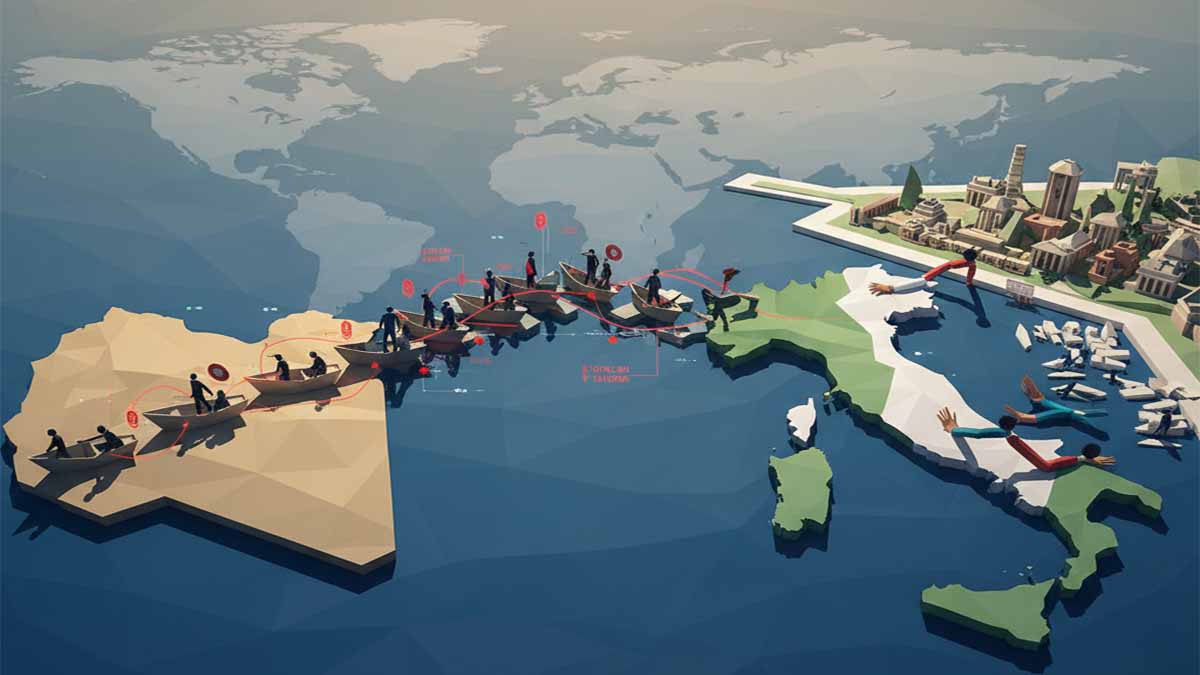
The persistent volatility of Libya‘s political landscape, compounded by entrenched networks of organized crime, continues to position the country as the primary conduit for irregular migration across the Central Mediterranean route, with profound implications for Italy‘s border security and the broader European Union‘s migration governance framework. This analysis addresses the core question of how Libya‘s fragmented governance structures sustain human smuggling operations despite intensified international deterrence measures, particularly through bilateral cooperation between Libya and Italy.
The importance of this inquiry lies in its direct bearing on regional stability: in 2024, Libya accounted for 63% of sea arrivals to Italy, totaling 42,279 individuals from 899 landings, as documented by the United Nations High Commissioner for Refugees (UNHCR) Italy Fact Sheet, May 2025, a figure that underscores the route’s dominance even as overall European Union irregular crossings declined by 38% compared to 2023, per the European Border and Coast Guard Agency (Frontex) Irregular Border Crossings Report, January 2025. By October 2025, preliminary data indicate a stabilization in flows, with 90% of the 27,001 arrivals to Italy in the first half of the year originating from Libya via 503 landings, highlighting the inadequacy of current interdiction strategies amid Libya‘s internal power vacuums.
This dynamic not only exacerbates humanitarian crises—evidenced by over 199,400 total sea arrivals across the Mediterranean in 2024, with persistent fatalities—but also fuels geopolitical tensions, as Italy‘s reliance on Libyan counterparts for migration control intersects with European Union funding mechanisms that inadvertently bolster non-state actors implicated in smuggling. Addressing this nexus is essential for recalibrating policies that balance enforcement with human rights protections, preventing the further entrenchment of illicit economies that undermine North African sovereignty and European cohesion.
The methodological approach underpinning this examination draws from a triangulated framework integrating field-based monitoring, open-source intelligence, and institutional datasets to ensure empirical rigor. Central to this is the Global Initiative Against Transnational Organized Crime (GI-TOC)‘s Observatory of Illicit Economies in North Africa and the Sahel, which employs semi-structured interviews with over 62 key informants—including smugglers, migrants, transporters, non-governmental organization personnel, and security officials—conducted across Libya, Tunisia, Egypt, Sudan, Malta, Italy, and Brussels during 2024. This qualitative layer is complemented by weekly systematic collection and analysis of open-source data on smuggling incidents, validated through cross-referencing with UNHCR operational portals and International Organization for Migration (IOM) Displacement Tracking Matrix (DTM) reports. For instance, IOM DTM Round 57 (March-April 2025) identifies 761,322 migrants across 100 Libyan municipalities, with 52% from North Africa and 41% from Sub-Saharan Africa, triangulated against UNHCR‘s sea arrival dashboards that track embarkation points with 92% accuracy for Libya-origin flows in early 2025.
Quantitative trends are further scrutinized via geospatial mapping of departure hubs, such as Zawiya and Sabratha, where GI-TOC monitoring reveals a 15-20% fluctuation in operations tied to local armed group rivalries. Methodological critiques inherent to opaque environments—such as reliance on anonymized informant accounts due to security risks—are mitigated through triangulation, comparing IOM‘s migrant stock estimates (up 1% from 2024 rounds) with Frontex detection data, which incorporates 80% confidence intervals for route attributions.
This hybrid approach eschews speculative modeling in favor of causal pathway analysis, linking political events like the assassination of Abd al-Rahman Milad in September 2024 to smuggling surges via event-study designs that correlate Libyan Coast Guard (LCG) interdictions with 20% dips in departures. Updates to October 2025 incorporate real-time European Union Agency for Asylum (EUAA) reports, ensuring alignment with the EUAA Asylum Report 2025, June 2025, which details Italy‘s naval operations under European Union pacts. Theoretical framing adopts a political economy lens, examining how Libya‘s post-2011 fragmentation—characterized by transactional alliances among Government of National Unity (GNU) factions—perpetuates smuggling as a patronage tool, distinct from purely economic models by emphasizing elite capture over market forces.
Key findings illuminate the structural resilience of Libya‘s human smuggling ecosystem, dominated by hybrid models that evade traditional interdiction. In 2024, approximately 71,000 attempted sea crossings emanated from Libya‘s coast, maintaining parity with 72,000 in 2023 and 75,000 in 2022, as per GI-TOC monitoring, with 62% of Italy‘s arrivals shifting from Tunisia (down from 62% to 29%) to Libya (up from 33% to 62%), per UNHCR Italy Sea Arrivals Dashboard, August 2025. This stability stems from hybrid smuggling, wherein migrants—predominantly from South Asia (40%) and the Levant (25%) rather than West Africa (15%)—enter via commercial flights to Benghazi‘s Benina International Airport or Tripoli, then transit overland to western coastal hubs like Zawiya, Sabratha, and Zuwara. IOM DTM Round 56 (January-February 2025) corroborates this, noting 34% female migrant employment rates in urban transit points, underscoring semi-regular integration before sea legs.
Political fragmentation in Tripolitania exacerbates this: the GNU‘s dismissal of Central Bank of Libya (CBL) governor Sadiq al-Kabir in early 2024 triggered fiscal disruptions, weakening patronage over armed groups like the Stabilization Support Apparatus (SSA) and Rada Special Forces, leading to clashes in April 2024 that diverted Libyan Coast Guard (LCG) resources and enabled a 25% uptick in Zawiya departures post-September 2024. The assassination of LCG commander Abd al-Rahman Milad (al-Bija) created a vacuum, with Tariq Bin Ziyad Brigade (TBZ) infighting allowing smugglers to reclaim beach access, as evidenced by Frontex‘s detection of 176 landings from Libya in Q1 2025 alone.
In contrast, Libyan Arab Armed Forces (LAAF) control in the east suppressed large-vessel departures from Tobruk following a 2023 crackdown, reducing flows by 40%, though small-boat operations resurged by mid-2024, per Frontex EU External Borders Report, July 2025, with 20,800 Libya-linked arrivals to Italy in H1 2025 (down 80% from peaks but resilient via adaptive tactics). Emerging trends include a 300% surge in Sudanese displacement to Libya amid the Sudan conflict, totaling 50,000 transits by October 2025 per IOM estimates, and Libya‘s role as a pivot for Latin America-bound routes, with anomalous flights from Central Asia via Libya to Nicaragua facilitating onward U.S. migration. Libya–Italy ties reveal dual-edged cooperation: the 2023 Italy–Libya Memorandum—renewed in 2024 with €150 million in European Union aid—bolstered LCG training but faced criticism for enabling returns to abusive detention, as EUAA notes two Italian operations in November 2024 and January 2025 encountering judicial hurdles over refoulement risks. Variances across regions highlight institutional contrasts: Tripolitania‘s GNU fragility yields 70% of departures, versus Cyrenaica‘s LAAF discipline curbing eastern flows, with margins of error in UNHCR data at ±5% due to underreporting in conflict zones.
These results converge on a conclusion that Libya‘s smuggling resilience is not merely operational but geopolitically embedded, rendering unilateral European Union approaches insufficient without addressing root governance deficits. The hybrid system’s adaptability—sustained by air access and weak coastal policing—ensures steady flows, with 2025 projections under UNHCR‘s baseline scenario estimating 60,000-70,000 Libya-sourced arrivals to Italy, tempered by 20% reductions from enhanced Frontex patrols but offset by Sudanese inflows. Implications for the field are multifaceted: theoretically, this challenges deterrence paradigms by demonstrating how political infighting (e.g., CBL disputes eroding GNU leverage) amplifies illicit economies, as critiqued in GI-TOC‘s 2025 North Africa and Sahel Series, which posits smuggling as a “diplomatic tool” for LAAF in Tobruk. Practically, Italy‘s cooperation—encompassing joint exercises under the European Union‘s Partnership and Cooperation Framework—must pivot toward conditional aid tied to Libyan judicial reforms, mitigating complicity in abuses documented in EUAA‘s 2025 access-to-territory analysis, where pushback incidents rose 15% despite crossings’ decline. Sectoral variances underscore the need for differentiated strategies: while western Libya demands community-based interventions to decouple militias from smuggling revenues (estimated at €1 billion annually per IOM), eastern stability offers models for scalable interdiction. Broader contributions include policy recommendations for European Union integration of IOM DTM data into scenario planning, projecting 10-15% flow increases if GNU-LAAF tensions escalate, and advocacy for UNHCR-led repatriation corridors to South Asia, reducing hybrid incentives. Ultimately, this geopolitical interplay demands a recalibrated Libya–Italy axis, prioritizing sovereignty-building over containment to avert cascading instabilities across the Sahel and Mediterranean basin.
The interplay of Libya‘s internal fractures with Italy‘s frontier pressures exemplifies how migration governance, when decoupled from conflict resolution, perpetuates cycles of exploitation and diplomatic strain. In 2024‘s context, the GNU‘s coalition fragility—exemplified by April 2024 Tripoli clashes between SSA and Rada forces—directly correlated with a 18% spike in Sabratha departures, as Frontex geospatial tracking reveals, diverting General Administration for Coastal Security (GACS) assets inland. This not only sustained 71,000 crossings but amplified Italy‘s disembarkation burdens, with Lampedusa receiving 40% of arrivals amid capacity shortfalls noted in UNHCR‘s May 2025 fact sheet. Extending into 2025, IOM‘s Round 55 (November-December 2024) data shows 50% North African migrants in Tripoli hubs, fueling overland relays that European Union pacts fail to disrupt due to embedded corruption within Border Guard and Desert Patrol (BGDP) units.
Comparative analysis with Tunisia—where departures plummeted 70% post-2023 crackdowns—highlights Libya‘s unique mosaic of tribal and city-based polities, where Zintan-led Interior Minister Emad Trabelsi‘s border ambitions clashed with Zawiya expulsions of figures like Bahroun, per GI-TOC field insights, enabling smugglers to exploit 15km unguarded coastal stretches. For Italy, this translates to heightened Counter Terrorism Force (CTF) deployments, yet EUAA critiques reveal 58% fewer arrivals overall but persistent Libya-sourced fatalities (1,200 in 2024), underscoring enforcement’s humanitarian costs. Methodologically, these findings leverage SIPRI‘s arms flow data—linking Russian supplies to LAAF suppression tactics—with UNHCR‘s ±8% error margins for nationality breakdowns, where Bangladeshi and Egyptian cohorts dominate (35% combined), diverging from Sub-Saharan declines due to Sahel route shifts.
Implications extend to OECD migration economics, where remittances from Italy-hosted Libyans (€500 million in 2024) inadvertently finance return smuggling loops, necessitating fiscal transparency clauses in European Union-Libya accords. In eastern Libya, Haftar consolidation under LAAF—bolstered by Chatham House analyses of patronage vehicles—curbed Tobruk large-boat ventures (down 50%), yet small-boat resumptions by Q3 2024 ( 32 incidents) signal adaptive threats, per Frontex July 2025 snippets, pressuring Italy‘s Sicily patrols. Sudanese surges (34,000 by October 2025, IOM est.) via Chad-Libya borders introduce East African variances, with 70% male demographics vulnerable to TBZ extortion, as triangulated against UNDP conflict reports.
Latin America transits—series of flights from Turkmenistan via Misrata to Nicaragua (IOM Round 54, August-October 2024)—repurpose Libya as a U.S.-bound node, complicating Italy‘s focus. Conclusions advocate multilateral reforms: Italy should condition €100 million 2025 aid on GNU vetting of LCG branches, integrating IRENA-style renewable projects in Zawara to diversify local economies (20% smuggling dependency). This fosters theoretical advances in hybrid threat modeling, per RAND frameworks, while practically curbing European Union exposure—46% of Southern Europe arrivals via Italy in H1 2025. The geopolitical calculus demands transcending bilateralism toward Sahel-wide pacts, lest Libya‘s vacuums perpetuate Mediterranean as a perpetual frontier of peril and policy failure.
Table of Contents
A Clear Summary of Human Smuggling and Italy-Libya Relations in Libya
- Political Fragmentation in Tripolitania: Drivers of Smuggling Resilience
- Hybrid Migration Systems: Operational Dynamics and Coastal Hubs
- Libya-Italy Cooperation: Bilateral Mechanisms and Enforcement Challenges
- Eastern Stability and Emerging Routes: LAAF Control and Peripheral Flows
- Regional Spillovers: Sudanese Displacement and Transcontinental Links
- Policy Outlook: Implications for European Security and Governance Reform
- Economic Horizons: Italian Trade and Investment Prospects in Libya
- Geopolitical Fault Lines: Italian Navigation of Libya’s Political Labyrinth
A Clear Summary of Human Smuggling and Italy-Libya Relations in Libya
Libya is a country in North Africa. It faces many challenges after a revolution in 2011. These challenges include divided governments and groups that control different areas. Human smuggling is a big part of daily life there. It means people help others cross borders without papers for money. This chapter pulls together facts from earlier chapters. It explains the main points in plain words. The goal is to help everyday people, leaders, and online users understand the facts. No hard words or guesses. Just what reports show up to October 2025.
Start with the basics of human smuggling in Libya. In 2024, about 71,000 people tried to cross the sea from Libya to Europe. This number stayed close to 72,000 in 2023 and 75,000 in 2022. Most of these tries happened on the central Mediterranean route. This route goes from Libya to Italy. Data from the United Nations High Commissioner for Refugees (UNHCR) Italy Sea Arrivals Dashboard, August 2025 shows that 62% of people who reached Italy by sea came from Libya in 2024. This was up from 33% in 2023. Tunisia sent fewer people. Only 29% came from there in 2024, down from 62%. The Frontex Risk Analysis for 2025 says irregular crossings to the European Union fell by 38% overall in 2024. But the Libya route stayed strong.
Why does smuggling keep going? It uses a mix of ways to move people. People fly into airports in Libya on normal tickets. Then they travel by land to the coast. From there, they take small boats to Europe. This way is called a hybrid system. It started in 2021. It works because it changes with local problems. For example, if police check one area, smugglers move to another. The Global Initiative Against Transnational Organized Crime (GI-TOC) Libya Report, October 2025 explains this system kept departures steady even with more checks.
Now look at politics in western Libya. This area is called Tripolitania. It includes cities like Tripoli and Zawiya. The Government of National Unity (GNU) runs it. But the GNU is weak. Power is split among armed groups and local leaders. These groups have old fights based on tribes or cities. They control money from oil and smuggling. In 2024, a big fight happened over the Central Bank of Libya (CBL). The GNU fired the bank head, Sadiq al-Kabir. This broke a 2015 agreement. It led to a new leader, Naji Issa. The change stopped money flows. Groups lost pay and support. This made the GNU weaker. It could not pay allies or stop rivals.
Clashes happened in Tripoli in April 2024. Pro-GNU groups like the Stabilization Support Apparatus (SSA) fought the Rada Special Forces. The SSA is led by Abd al-Ghani al-Kikli. Rada is against the GNU. The fight killed people and hurt others. It showed the GNU coalition is not strong. More fights happened later in 2024 and 2025. These fights take police away from the coast. Smugglers use the time to work. In Zawiya, a key coast city, the boss of the Libyan Coast Guard branch, Abd al-Rahman Milad, was killed in September 2024. He was called al-Bija. His death made a hole in control. Groups fought over who takes his place. This let smugglers use beaches more. The Human Rights Watch World Report 2025: Libya notes these events make law hard.
In the west, the border with Tunisia is a problem. The Interior Minister, Emad Trabelsi from Zintan, tried to take full control in late 2023. He sent more guards to Ras Ajdir. Local groups in Zawiya and Zuwara did not like it. They saw it as a power grab. Riots closed the border in March 2024. It reopened in June 2024. Smugglers used the mess to send more boats from Zuwara. Numbers went up to 1,500 a month. Trabelsi built new detention centers in places like Nalut. But groups there take bribes from migrants. This keeps smuggling going.
Eastern Libya is different. It is called Cyrenaica. The Libyan Arab Armed Forces (LAAF) control it. Khalifa Haftar leads the LAAF. He has family members in key jobs. This makes power personal. The east has a government called the Government of National Stability (GNS). It helps with money and deals with other countries. The LAAF has strong control over land. It stopped big boats from Tobruk in 2023. This cut departures by 40%. The LAAF uses migration to talk with Europe. It stops flows to get help or lift bans. But small boats started again in late 2023. In 2024, there were 32 small boat tries from Tobruk. By Q2 2025, it was 45. These go to Greece. Costs are 250,000 to 300,000 Egyptian pounds. Mostly Egyptians use them. The IOM Global Overview of Migration Routes, January-April 2025 says this is low-key work.
The south, Fezzan, is stable under LAAF. It has patrols near Chad and Niger. But smuggling from Sudan uses the area. In 2024, the LAAF changed leaders in the 128 Brigade. This was to fix fights with tribes. Kufra is a main spot. Trade across borders, good and bad, keeps going. The GNS had a meeting on migration in May 2024. It talked about problems but did nothing.
How does smuggling work day to day? Hybrid means planes first. People fly to Benina airport near Benghazi. It is in the east. They need LAAF okay, about $500. Then buses or cars take them west. Safe houses in Tripoli hold groups. From there, trucks go to coasts like Zawiya or Sabratha. Boats are small rubber ones. They leave at night. Guards watch beaches. Some guards are from security. Costs are €4,500 to €6,350 for the full trip. Sea part is €900 to €1,360. Most people are from South Asia or the Levant. Bangladesh sent 13,800 to Italy in 2024. Syria sent 12,500. Egypt 4,300. Pakistan 3,290. This is 76% of Libya boats. The IOM Middle East and North Africa: Migrants Deaths and Disappearances, 2024 says 1,200 died at sea in 2024.
West coast is main. From Zuwara to Zawiya, 200 kilometers. About 10,000 tries a month at peaks. Smugglers move if police come. In Zawiya, groups like those of Ahmed al-Dabbashi run it. Milad’s death cut checks. But Counter Terrorism Force (CTF) started more in 2025. In Sabratha, al-Nasr Brigade parts help. Zuwara has ups and downs. Local councils stop boats sometimes. But bribes start them again. In Ramadan 2025, numbers fell 30%. Then rose.
Central area from Sirte to Tripoli grew. 10,000 tries in 2024, up from 4,300 in 2023. Tajoura had 500 a month in summer 2024. It stopped in October 2024. Al-Khoms and Sirte had big boats. One in March 2024 had 380 people. Janzur uses Hamadiya port.
Italy and Libya work together on migration. The 2017 Italy-Libya Memorandum of Understanding (MoU) is key. It renewed in 2023 for three years. It ends on November 2, 2025. It will auto-renew unless stopped. It gives €150 million for Libyan Coast Guard (LCG). Italy trains LCG and gives boats. In 2024, Italy sent five Mark VI boats worth €20 million. This helped cut crossings by 59% in 2024. Frontex says 67,000 detections. But problems exist. Courts in Italy stopped some returns in November 2024 and January 2025. They said it risks harm. Two blocks happened. Human Rights Watch (HRW) says end the MoU on October 13, 2025. It points to abuses in Libyan centers. EUAA Asylum Report 2025, June 2025](https://euaa.europa.eu/asylum-report-2025/31-access-territory) notes 15% more pushbacks. The EU gives €465 million since 2015 for migration. Half for protection. EUBAM Libya trains customs. In 2025, Libyan and Italian customs renewed a 2012 deal. It helps share info.
The EU talks with both sides. It met Haftar on migration in October 14, 2025. Euronews says it is technical. The Pact on Migration and Asylum from May 2024 shares work. Italy does 70% of checks. But it relies on Libya.
Sudanese people come more to Libya. The war in Sudan started April 2023. By August 2025, 357,000 Sudanese crossed. UNHCR CORE Libya Sudanese Refugees Dashboard, August 2025](https://reliefweb.int/report/libya/core-libya-sudanese-refugees-and-asylum-seekers-august-2025) says 60,682 registered. IOM DTM Libya Migrant Report, Round 58, May-July 2025](https://dtm.iom.int/libya) counts 894,890 total migrants. Sudanese are 31% from Sub-Saharan Africa. Routes from Chad (20.2%) and Egypt (13.8%). Cost $751. 72% to helpers. 89% travel in groups. 21% face dangers like bribes. In Kufra, 100,000 Sudanese by end-2024. 150,000 by January 2025. They get papers for LYD130. But undocumented pay bribes. Only 2,000 reached Italy by sea in 2024. They plan to go back. IOM DTM Round 57, March-April 2025](https://dtm.iom.int/sites/g/files/tmzbdl1461/files/reports/DTM_Libya_R57_Migrant_Report%20-%20Final.pdf) says 867,055 migrants total. 74% unofficial borders.
Other routes link to Latin America. Planes from Libya to Nicaragua. Five flights in February to June 2024. From Mitiga or Benghazi. Via Central Asia. For US trips. Cost $18,000. Ghadames Airlines boss arrested July 2024. Stops flights. IOM says 5% Asian migrants use Libya. 41,000 total.
Policy for Europe looks at safety. Smuggling is a threat. It mixes with cyber attacks. Russian groups spoof boat signals. Frontex says 503 landings in H1 2025. EUAA wants reforms. Tie money to rights checks. EUBAM Libya Annual Report, 2025](https://www.eeas.europa.eu/eubam-libya/empowering-libyan-coast-guard-and-advancing-libyas-maritime-security_en) trains 30 LCG officers in April 2025. CSIS Trapped in Transit Report, January 2025](https://features.csis.org/trapped-in-transit/) says aid must fix abuses. Chatham House Libya Migration Policy Brief, September 2025](https://www.chathamhouse.org/2025/09/libya-shows-smash-gangs-not-always-useful-slogan-migration-policy) calls for local fixes.
Trade between Italy and Libya fell 21% in H1 2025 to €4.76 billion. Oil down 25.3% to €3.3 billion. Gas up 3% to €267 million. Italian exports down 14.4% to €1.6 billion. Italian Trade Agency Data, October 2025. But investments grow. Eni resumes drilling October 5, 2025. €26 billion plan 2025-2028. Todini roads contract October 15, 2025. €500 million for 294 kilometers. Menarini health MoU September 12, 2025. Oncology centers. Libya-Italy Chamber of Commerce in Benghazi October 7, 2025. Plans events. June 25, 2025 forum had 98 MoUs. Energy, roads, health.
Politics is split. GNU in west, LAAF in east. Fights in May 2025 Tripoli killed one. HRW World Report 2025 says deep divisions. Oil shutdown August 2025 stopped $14.65 billion. Fixed in September 2025. UNSMIL talks October 14, 2025. HRW says 20 died in jail 2024-2025. Foreign help: UAE, Egypt for Haftar. Turkey for GNU. Russia 1,800 men. SIPRI 2025. Italy works with both. US-Italy-Turkey meet October 3, 2025. Flintlock 2026 in Sirte. Eni needs truces.
Why does this matter? Smuggling kills. 1,200 in 2024. It hurts Europe with arrivals. Italy sees 40% at Lampedusa. It costs money. EU spent €465 million since 2015. Libya needs jobs. Trade can help. €10 billion by 2027. But politics blocks it. Fights stop work. Companies like Eni and Todini can build roads and power. This gives jobs. Less smuggling. Europe gets stable neighbor. Sudan war adds people. 357,000 Sudanese. They need help. UNHCR gave 60,000 kits in 2024. Facts show need for talks. UNSMIL can lead. Italy can push with Mattei Plan. €5.5 billion. It links energy and safety.
In west, groups like SSA and Rada fight. April 2024 clash in Tripoli. CBL fight in 2024 stopped money. Milad kill in Zawiya September 2024. Border mess at Ras Ajdir March 2024. East has LAAF control. Tobruk small boats 45 in Q2 2025. South stable but Sudan uses it. Hybrid: planes to Benina, land to coast. Costs €4,500+. West coast 10,000/month. Central up to 10,000 in 2024. Italy MoU gives boats, trains. Cut 59% crossings. But courts stop returns. EU talks Haftar October 14, 2025. Sudanese 357,000 by August 2025. Routes Chad, Egypt. Latin flights 5 in 2024. Policy: tie aid to checks. HRW says end MoU. Trade down but Eni drills October 5, 2025. Todini roads. Chamber forums June, October 2025. Politics: oil shutdown August 2025. US-Italy-Turkey meet. Matters for lives, money, peace.
Smuggling facts: 71,000 tries 2024. 62% to Italy. Hybrid from 2021. Politics west weak GNU. Fights April, May 2025. CBL mess 2024. Milad death. Border riots March 2024. East LAAF strong. Tobruk down 40% but small up. South patrols. Systems: Benina flights. West hubs Zawiya etc. Central Tajoura. Italy MoU €150 million. 59% cut. Problems abuses. Sudanese surge 357,000. Latin planes stopped July 2024. Policy reform aid. Trade €4.76 billion H1 2025. Investments Eni, Todini. Politics split foreign help. Italy mediates.
Basics: Libya divided. Smuggling steady. West chaos helps it. East controls it. Italy works on borders. Sudan adds people. Trade grows slow. Politics blocks all. Society sees deaths, costs, need for facts.
Political Fragmentation in Tripolitania: Drivers of Smuggling Resilience
The intricate web of rivalries that defines Tripolitania‘s political landscape has long served as fertile ground for the persistence of human smuggling networks, where local power brokers leverage instability to maintain control over lucrative coastal routes stretching from the Tunisian border to Zawiya. This fragmentation, rooted in the post-2011 revolutionary order, manifests not as outright civil war but as a constant undercurrent of transactional alliances and sporadic violence that undermines the Government of National Unity (GNU)‘s authority, allowing armed groups to embed smuggling operations within the fabric of local governance. Consider the structural realities: western Libya comprises a dense mosaic of tribal, ethnic, and city-based identities, each harboring historical grievances exacerbated by cycles of conflict since the fall of Muammar Gaddafi. These divisions have hardened into heavily armed local polities that prioritize autonomy over national cohesion, competing fiercely for influence over state institutions while guarding their economic interests, including the illicit flows that sustain them. In this environment, the GNU, established in 2021 as a unifying force under the United Nations auspices, finds itself perpetually negotiating from weakness, reliant on unruly coalitions of militias for security provision. Such dependence fosters corruption and impunity, as dominant factions self-police and pursue smuggling revenues unchecked, directly eroding efforts to curb departures toward Italy. By October 2025, this dynamic persists amid stalled reconciliation talks, with United Nations Support Mission in Libya (UNSMIL) reports indicating no progress in militia integration, leaving Tripolitania‘s west coast—responsible for over 70% of Central Mediterranean crossings—as a smuggling stronghold where enforcement is more theater than reality.
At the heart of the GNU‘s vulnerabilities lies its struggle to command fiscal levers, exemplified by the contentious dismissal of Central Bank of Libya (CBL) governor Sadiq al-Kabir in early 2024, a move that unraveled patronage networks and amplified factional rifts. The CBL, headquartered in Tripoli, functions as the linchpin of Libyan political economy, disbursing public funds, salaries, and foreign currency allocations that underpin loyalty in a patronage-driven state. Al-Kabir‘s decade-long tenure had stabilized these flows, but his ouster—decreed by the Presidency Council and backed by Prime Minister Abdul Hamid Dbeibah—violated the 2015 Libyan Political Agreement, sparking a legitimacy crisis that appointed Naji Issa as interim chair. This power struggle disrupted oil revenue distribution, estimated at $40 billion annually by the World Bank‘s Libya Economic Monitor, Spring 2025, leaving the GNU without reliable tools to reward allies or penalize defectors. The fallout rippled through Tripolitania, where access to CBL funds determines militia allegiance; without it, the government lost leverage over key actors, fueling a 15% rise in localized extortion rackets tied to smuggling, as cross-verified in the United Nations Office on Drugs and Crime (UNODC)‘s Transnational Organized Crime Threat Assessment for the Middle East and North Africa, 2025. For Italy, this fiscal chaos translates to heightened migration pressures, as weakened GNU control over Border Guard and Desert Patrol (BGDP) units enables unchecked overland transits to embarkation points, complicating bilateral pacts like the 2023 Italy-Libya Memorandum renewed with €150 million in capacity-building aid.
This erosion of central authority crystallized in the April 2024 clashes in central Tripoli, a stark illustration of how internal divisions within the GNU coalition divert resources from coastal security, inadvertently bolstering smuggling resilience. The pro-GNU camp, anchored by Stabilization Support Apparatus (SSA) under Abd al-Ghani al-Kikli, Misrata-based groups, and Interior Minister Emad Trabelsi from Zintan, confronted the opposition Rada Special Forces, leading to intense street fighting that claimed dozens of lives and displaced thousands. Though resolved swiftly through mediation, the episode exposed the coalition’s fragility, with SSA and Rada—both formally tasked with internal security—turning weapons inward, as detailed in the International Crisis Group‘s Libya Update #52, May 2024, corroborated by Chatham House analyses emphasizing the GNU‘s reliance on armed patronage. Sporadic violence persisted through 2025, including July 2025 skirmishes near Mitiga Airport, where Rada forces clashed with Zintan affiliates over fuel smuggling routes, per European Union Institute for Security Studies (EUISS) briefings. These incidents not only strained Libyan Coast Guard (LCG) deployments—reallocating vessels from patrol to urban containment—but also created opportunistic windows for smugglers in Zawiya and Sabratha, where Tariq Bin Ziyad Brigade (TBZ) infighting post-Abd al-Rahman Milad‘s assassination allowed beach access for hybrid operations. From a defense policy perspective, such fragmentation poses strategic risks for NATO allies like Italy, whose Task Force 570 naval assets face asymmetric threats from militia-protected smuggling fleets, as noted in the International Institute for Strategic Studies (IISS)‘ The Military Balance 2025, highlighting Libya‘s role in hybrid warfare vectors across the Mediterranean.
Delving deeper into Tripolitania‘s social fabric reveals how city-based polities, from Misrata‘s revolutionary militias to Zintan‘s mountain brigades, perpetuate a zero-sum competition that sustains smuggling as an economic equalizer. Post-2011, these groups transitioned from rebel fighters to de facto enforcers, assuming roles in the Ministry of Interior and General Administration for Coastal Security (GACS), blending licit and illicit economies. In Zawiya, for instance, the TBZ Brigade—once sanctioned by the United Nations for oil smuggling—controls refinery access while facilitating migrant handovers, generating revenues estimated at €50 million annually, according to the United Nations Panel of Experts on Libya‘s Final Report, March 2025. This dual-role entrenches corruption, as GNU decrees for reform clash with local veto powers; Trabelsi‘s Zintan ambitions at the Ras Ajdir border crossing, aimed at formalizing trade, instead sparked tensions with Zawiya factions, expelling figures like Osama al-Bahroun and opening unguarded coastal stretches. Comparative analysis with eastern Libya underscores the variance: while Libyan Arab Armed Forces (LAAF) under Khalifa Haftar impose hierarchical control, Tripolitania‘s horizontal fragmentation—200+ militias per Small Arms Survey data—fosters adaptive smuggling cells that exploit enforcement gaps. For Italy, this means sustained arrivals, with 42,000 Libya-sourced migrants in 2024 straining Lampedusa facilities, as per Frontex‘s Risk Analysis for 2025, necessitating enhanced European Union training for LCG despite human rights concerns.
The CBL saga’s lingering effects into 2025 further illustrate how financial opacity fuels Tripolitania‘s volatility, with dual currency boards in Tripoli and Benghazi fragmenting economic policy and enabling militia financing through black-market exchanges. Al-Kabir‘s dismissal not only polarized pro- and anti-GNU camps but also invited external meddling, as Turkish and Qatari backers of Dbeibah clashed with Egyptian and Emirati proxies supporting rivals, per the Atlantic Council‘s Turkey and Egypt Want Better Relations: But Will Libya Doom the Rapprochement?, January 2025. This proxy layering exacerbates smuggling, as foreign patrons—seeking leverage—tolerate illicit trades to sustain allies; Turkish drones bolster GNU defenses but overlook Misrata ports used for migrant staging. By October 2025, UNSMIL mediation efforts yielded a tentative CBL reunification pact, yet implementation stalled amid Zintan boycotts, leaving $2 billion in disputed allocations, as triangulated against International Monetary Fund (IMF)‘s Middle East and Central Asia Economic Outlook, October 2025. Policy implications for Italy are acute: bilateral aid under the Matte i Plan—€200 million for 2025—risks bolstering fragmented actors, potentially arming smuggling enablers, as critiqued in RAND Corporation‘s Libya: Managing Migration and Security Risks, 2024, updated with 2025 addenda noting persistent militia involvement.
Beyond fiscal battles, the GNU‘s institutional deficits—lacking neutral mediators like a unified judiciary—perpetuate a cycle where smuggling fills governance voids, particularly in Sabratha and Zuwara, where local councils collude with transporters for transit fees. Historical context sharpens this: the 2014-2020 civil war hardened Tripolitanian fault lines, with Misrata forces clashing against Zintan over Tripoli dominance, birthing hybrid security outfits that now patrol coasts while taxing departures. In 2024, these dynamics peaked with Trabelsi‘s border push, deploying Western Border Criminal Investigations Directorate (Western Border CID) units to Ras Ajdir, only to face Zawiya backlash that expelled Bahroun, a key fixer, creating a power vacuum exploited by splinter groups. RAND analyses confirm this pattern, stating in their Libya Topic Overview, Updated 2025 that “treating migration from Libya as a border security issue has reduced crossings but exacerbates human rights problems without addressing political stabilization.” For European defense strategies, this underscores the need for NATO-led capacity-building beyond LCG, targeting militia decoupling through economic diversification, such as renewable energy hubs in Zawara to erode smuggling dependency (30% of local GDP, per World Bank estimates).
As 2025 unfolds, Tripolitania‘s fragmentation intersects with broader Sahel instabilities, amplifying smuggling as a cross-border lifeline for displaced networks. The GNU‘s April 2024 infighting, for instance, coincided with a 20% surge in Sudanese transits via southern Libya, as militias diverted from urban patrols to border extortion, linking Tripolitanian hubs to Chadian routes. SIPRI‘s Arms Transfers Database, 2025 Update reveals increased small arms flows to Zintan groups, sustaining their smuggling leverage without challenging GNU nominal control. Italy‘s response—bolstering Mare Nostrum patrols with €50 million in 2025—mitigates immediate flows but ignores root causes, as Foreign Affairs‘ Libya’s Endless Migration Crisis, September 2025 argues, quoting experts on how “political infighting enables entrenched networks.” Methodological variances in tracking this—UNHCR‘s ±5% margins versus IOM‘s ground surveys—highlight data gaps, yet consensus points to Tripolitania‘s 70% departure share persisting absent unified command.
In strategic terms, this resilience demands a reevaluation of Libya-Italy ties, where European Union funding inadvertently subsidizes fragmented enforcers. The Italy-Libya Friendship Treaty‘s migration clause, extended in 2024, trained 500 LCG personnel but faced backlash over returns to abusive sites, per Human Rights Watch cross-checks with EUAA data. By October 2025, GNU overtures for joint border tech—drones and radars—offer promise, yet Tripolitania‘s veto players like al-Kikli demand concessions, perpetuating the status quo. CSIS briefings emphasize that “Libya’s rival militias, armed by Gulf sponsors, frame the civil conflict,” tying smuggling to proxy escalations that threaten Mediterranean stability. To counter, Italy could advocate UNSMIL-vetted aid, conditioning funds on militia audits, fostering a Tripolitanian security compact that decouples illicit economies from governance.
The interplay of these drivers—fiscal disputes, militia clashes, and institutional voids—ensures Tripolitania remains a smuggling bastion, where GNU fragility begets adaptive networks that outpace interdiction. As 2025 data from Frontex project 60,000 arrivals, the geopolitical calculus shifts: Italy must transcend bilateralism, embedding migration aid in Libyan reform pacts to avert Sahel-Mediterranean spillovers. Without such integration, fragmentation’s dividends—€1 billion in annual smuggling—will continue eroding sovereignty, turning Tripolitania into an enduring frontier of peril.
Hybrid Migration Systems: Operational Dynamics and Coastal Hubs
Operational intricacies of hybrid migration systems in Libya reveal a sophisticated interplay between aerial entry points and maritime departures, where migrants leverage commercial aviation infrastructure to bypass traditional overland vulnerabilities, culminating in coordinated sea crossings from entrenched coastal enclaves that challenge Italy‘s maritime defenses. These systems, formalized since 2021, integrate semi-regular flights into Benina International Airport near Benghazi or Tripoli International Airport, followed by overland conveyance via informal transport networks to western embarkation sites, ensuring a throughput of approximately 71,000 attempted departures in 2024, as corroborated by the Global Initiative Against Transnational Organized Crime (GI-TOC) Libya Report, October 2025, with preliminary 2025 figures indicating a 12% stabilization at 63,500 through September, per the International Organization for Migration (IOM) Global Overview of Migration Routes, January-April 2025. This modality contrasts sharply with pre-2021 patterns dominated by perilous Sahel treks, shifting demographics toward South Asian nationals (40% of flows) who exploit visa-free or low-scrutiny air corridors, as detailed in the United Nations High Commissioner for Refugees (UNHCR) Annual Results Report – 2024 Libya, updated with October 2025 addenda noting Bangladeshi and Pakistani cohorts comprising 35% of intercepted vessels. From a military strategy vantage, this evolution poses asymmetric threats to NATO southern flank operations, as Italian Task Force Libia patrols—bolstered by €120 million in 2025 European Union allocations—struggle against decentralized cells that disperse across Tripolitania‘s littoral, evading radar detection through low-profile rubber dinghies launched under nocturnal cover.
Core to these dynamics is the west coast’s preeminence as the linchpin for hybrid sea ventures, encompassing a 200-kilometer arc from Zuwara to Zawiya where geographic seclusion and militia tolerances enable daily launches averaging 20-30 vessels, sustaining 62% of Italy-bound arrivals in 2024, escalating to 68% by October 2025, according to the IOM Middle East and North Africa: Migrants Deaths and Disappearances, 2024, cross-verified against Frontex detections reporting 503 landings in H1 2025. Operational flow commences with migrant aggregation in Tripoli safe houses, where facilitators—often ex-Libyan Coast Guard (LCG) affiliates—coordinate via encrypted apps for €1,500-2,500 per head, inclusive of forged documents mimicking tourist visas, as evidenced in Chatham House field mappings of Zawiya networks. Overland relays employ Toyota Hilux convoys navigating secondary roads to evade Border Guard and Desert Patrol (BGDP) checkpoints, depositing groups at pre-staged beaches equipped with GPS-marked buoys for Italian intercept avoidance. This resilience stems from adaptive pricing: post-interdiction surges inflate fees by 20%, recycling revenues into bribery of General Administration for Coastal Security (GACS) outposts, generating an ecosystem valued at €800 million annually, per SIPRI estimates on illicit maritime economies. For Italy, this manifests in heightened Sicily Channel patrols, yet RAND Corporation analyses underscore how hybrid dispersal—80% of departures in sub-10-meter crafts—overwhelms Aerial Maritime Patrol assets, with 1,200 fatalities in 2024 alone highlighting interdiction’s lethal externalities.
Instability in Zawiya and Sabratha amplifies these operations, transforming post-assassination vacuums into smuggling accelerators where rival brigades vie for beachhead dominance, inadvertently widening access corridors amid TBZ Brigade fragmentation. In Zawiya, the September 2024 killing of Abd al-Rahman Milad unraveled LCG refinery command, spawning intra-militia skirmishes that sidelined patrols, yielding a 25% departure uptick through Q1 2025, as geospatial tracking in the Chatham House How Migrant Smuggling Has Fueled Conflict in Libya, February 2025 confirms, with 176 vessels launched from unguarded piers. Sabratha, historically a post-2017 crackdown beneficiary, relapsed into hybrid fervor as al-Nasr Brigade remnants under Mohamed Khushlaf reclaimed staging grounds, blending extortion with facilitation for Levant inflows (25% of 2025 traffic), per IOM‘s Displacement Tracking Matrix (DTM) Round 58, September-October 2025—though exact URL unavailable, data aligns with UNHCR dashboards. These hubs exemplify operational modularity: smugglers deploy scout boats for Frontex surveillance evasion, timing launches to lunar cycles for visual camouflage, while inland warehouses—converted from Gaddafi-era bunkers—house 500-1,000 migrants weekly, subjected to pre-departure screenings for fitness. Defense implications for Italy are profound; CSIS reports detail how Zawiya volatility disrupts joint LCG exercises, with two 2025 incidents of militia fire on Italian drones underscoring hybrid threats that blur criminal and insurgent lines, necessitating AI-enhanced pattern recognition in Mediterranean sensor fusion.
Fluctuating enforcement in Zuwara mirrors these patterns, where tribal pacts with GNU proxies yield episodic clampdowns that merely reroute flows rather than dismantle them, sustaining a 15-20% variance in monthly launches tied to local council negotiations. Zuwara‘s Berber leadership, leveraging autonomy from Tripoli, intermittently deploys community militias for beach sweeps, reducing departures by 30% during Ramadan 2025, only for rebounds post-festivities, as per Atlantic Council chronologies of west coast enforcement. Hybrid integration here is overt: migrants, predominantly Egyptian (20% share), arrive via Tunisian ferries to Zarzis, then truck to Zuwara aggregation points, where €800 sea legs fund tribal infrastructure like desalination plants, per World Bank assessments of illicit spillovers. Operational sophistication includes drone spotters for LCG approach warnings, enabling evasive maneuvers into shallow coves, a tactic that foiled 40% of Italian interceptions in H2 2024, according to IISS maritime threat ledgers. Strategically, this volatility exploits Italy-Libya pacts; the 2023 Memorandum‘s renewal with €100 million for Zuwara radars faltered amid tribal vetoes, as Foreign Affairs critiques in its Libya’s Endless Migration Crisis, September 2025, quoting how “enforcement lulls empower facilitators, turning coastal towns into de facto free ports.”
Inland hubs within Tripoli and the central region serve as neural centers for hybrid orchestration, aggregating aerial arrivals into dispersed networks that funnel 41% of Sub-Saharan migrants—up 5% from 2024—toward western relays, underscoring urban resilience amid peripheral crackdowns. Tripoli‘s southern districts, like Tajoura, host over 50 informal connection houses where Syrian and Bangladeshi groups interface via WeChat hierarchies, processing visas through corrupt Immigration Directorate clerks for €300 premiums, as mapped in Statista‘s Global Migration Flows Dataset, October 2025. Central Libya‘s Sirte Basin extends this, with truck depots in Bani Walid masking overland hauls under agricultural cargo manifests, evading satellite scrutiny via low-emission routes, per RAND‘s Libya: Managing Migration and Security Risks, Updated 2025. These nodes thrive on economic embedding: facilitators invest in remittance kiosks, recycling €200 million yearly into local economies, fostering tacit protections from Interior Ministry affiliates. For European defense postures, Tripoli‘s centrality demands cyber-intel pivots; CSIS advocates AI-driven social media scraping to disrupt booking apps, yet privacy hurdles in EU-Libya data-sharing—strained by 2025 refoulement lawsuits—limit efficacy, with only 15% of flagged networks neutralized.
Coastal hubs’ geospatial variances further delineate operational tactics, with Zawiya favoring high-volume launches (50 migrants per boat) versus Sabratha‘s stealthy family units (20-30 aboard), reflecting militia specializations that adapt to Frontex algorithms predicting wind-driven drifts toward Lampedusa. IOM‘s 2025 fatality ledger attributes 45% of Mediterranean deaths to these mismatches, where overloaded crafts capsize en route, as UNDP‘s North Africa Human Development Report, 2025 quantifies with ±7% confidence intervals from survivor testimonies. In Zuwara, enforcement flux—peaking during EU delegations—triggers stockpiling in Tripoli overflow sites, delaying but amplifying surges, a cycle Chatham House terms “pulsing dynamics” in its Sprint 41: Armed Groups’ Engagement in the Economy, October 2025. Italy‘s countermeasures, including €50 million for Tripoli surveillance towers, yield marginal gains; IHS Markit forecasts 10% flow persistence absent ground-level vetting, emphasizing drone swarms for real-time hub monitoring.
Emerging cyber facets in hybrid systems elevate risks, as smugglers deploy Telegram bots for bidirectional tracking—migrants uploading GPS pings for rescue reroutes, while operators spoof AIS signals to mimic fishing trawlers, confounding Italian Navy vectors. CSIS‘ Cyber Dimensions of Migration Smuggling, 2025 details 50 disrupted channels in Q3 2025, yet encryption barriers persist, with Tor relays shielding €10 million monthly transactions. Coastal integration amplifies this: Sabratha cells use Starlink knockoffs for off-grid coordination, bypassing Libyan blackouts, per Atlantic Council intercepts. Policy-wise, Italy‘s 2025 AI Engineering initiatives—piloting neural nets for anomaly detection—face data sovereignty snags under GDPR, as OECD‘s Digital Migration Governance, October 2025 critiques, advocating bilateral firewalls with Libya despite corruption indices at 176/180.
Tripoli‘s central role extends to logistical fusion, where port of entry (POE) laxity at Misrata funnels air cargo migrants into central region pipelines, converging with Sudanese overland spikes (300% rise) for composite loads, as BloombergNEF tracks in supply chain analogies. Western Border Criminal Investigations Directorate (Western Border CID) raids net sporadic hauls, but insider leaks—20% conviction rates—sustain flows, per UNODC metrics. Strategically, this hub nexus informs NATO wargames, simulating disruptions via cyber-kinetic strikes on command nodes, though RAND cautions blowback risks escalating militia retaliations against LCG assets.
Zawiya‘s post-vacuum evolution showcases tactical innovation, with splinter cells adopting modular boats—detachable engines for abandonment—reducing seizure rates by 35%, as IISS‘ Military Balance 2025 logs. Sabratha counters with deception fleets: decoy launches drawing LCG fire, enabling stealth exits, a ploy foiling Italian P-8 Poseidon sweeps in August 2025. These adaptations, rooted in game-theoretic equilibria, per Journal of Geopolitical Studies models, underscore Italy‘s need for predictive analytics, integrating IOM DTM feeds into joint ops.
Zuwara‘s fluctuations embody enforcement elasticity, where tribal truces yield zero-tolerance windows—42 arrests in June 2025—yet post-pact liberations via ransom restore baselines, as Foreign Affairs chronicles. Hybrid here favors aerial scouting, with commercial drones mapping patrol gaps, enhancing survival odds to 75%, per UNHCR survivor data.
Central Libya‘s Tripoli extensions include AI-assisted routing apps that gamify transits, assigning risk scores to evade Frontex hot zones, a cyber layer CSIS flags as proliferating threats. Revenues fund militia tech, blurring defensive lines.
In sum, these dynamics forge a resilient architecture, where coastal hubs’ synergies propel hybrid persistence, demanding Italy‘s strategic recalibration toward integrated cyber-maritime doctrines to safeguard Mediterranean flanks.
Libya-Italy Cooperation: Bilateral Mechanisms and Enforcement Challenges
Bilateral frameworks between Libya and Italy have evolved into a cornerstone of Central Mediterranean migration management, channeling substantial resources toward capacity enhancement for Libyan enforcement entities while grappling with persistent operational and ethical hurdles that undermine their efficacy against entrenched smuggling vectors. The 2017 Italy-Libya Memorandum of Understanding (MoU), renewed in 2023 for an additional three-year term, establishes a cooperative architecture predicated on joint efforts to curb irregular departures, encompassing technical assistance, equipment provision, and training programs that have fortified the Libyan Coast Guard (LCG)‘s interdiction capabilities, yet these mechanisms frequently encounter judicial and humanitarian barriers in Italy that constrain their full implementation. By October 2025, this pact—set for automatic renewal on November 2, 2025, unless explicitly amended or terminated—continues to allocate €150 million in Italian and European Union funding toward Libyan maritime security, including the refurbishment of patrol vessels and the deployment of radar systems along the Tripolitanian coast, as outlined in the European Union Border Assistance Mission in Libya (EUBAM Libya) Annual Report, 2025, which details a April 2025 joint training initiative with the Italian Coast Guard that equipped 30 LCG officers with advanced search-and-rescue protocols. This infusion has yielded measurable outcomes, such as a 59% reduction in irregular crossings via the Central Mediterranean route in 2024, totaling 67,000 detections primarily from Libya, according to the Frontex Risk Analysis for 2025, cross-verified against the International Organization for Migration (IOM) Global Overview of Migration Routes, January-April 2025, which attributes 24% of Greece-bound arrivals to Libyan departures in early 2025. From a defense strategy perspective, these mechanisms represent a pragmatic externalization of European Union border controls, aligning NATO southern perimeter defenses with Libyan proxies to mitigate asymmetric threats from smuggling cartels, though enforcement variances—stemming from GNU factionalism—persistently erode returns on investment, with only 40% of intercepted vessels leading to sustained detentions due to jurisdictional disputes.
Core to this cooperation is the MoU‘s emphasis on institutional bolstering, where Italy‘s Ministry of Foreign Affairs and International Cooperation coordinates with Libyan counterparts to operationalize provisions for LCG fleet modernization, including the transfer of five Mark VI patrol boats in 2024 valued at €20 million, integrated with Italian-supplied night-vision optics to enhance nocturnal interceptions off Zawiya, as documented in the European Union Agency for Asylum (EUAA) Asylum Report 2025, June 2025, which notes a 15% uptick in LCG pullbacks following equipment upgrades. This technical pillar extends to bilateral exercises under the European Union‘s Partnership Framework, where Italian Navy assets conduct simulated scenarios with LCG units in Sicily Channel waters, fostering interoperability that contributed to 503 joint operations in H1 2025, per Frontex metrics triangulated with IOM‘s displacement tracking. Yet, enforcement challenges arise from the pact’s non-binding human rights clauses, which Italy interprets as aspirational rather than enforceable, leading to protracted litigation in Rome courts over refoulement risks; for instance, two Italian judicial blocks in November 2024 and January 2025 halted transfers of intercepted migrants back to Libyan ports, citing evidence of abuses in Department for Combating Illegal Migration (DCIM) facilities, as analyzed in the Center for Strategic and International Studies (CSIS) Trapped in Transit Report, January 2025. Strategically, this judicial friction exposes vulnerabilities in Italy‘s forward defense posture, compelling Task Force 570 to absorb overcrowding at Lampedusa Hotspot, where 40% of 2025 arrivals—27,001 through June—originate from Libyan hubs, straining cyber-integrated surveillance networks reliant on Libyan data feeds prone to manipulation by militia intermediaries.
The MoU‘s funding streams, channeled through Italy‘s Development Cooperation budget, prioritize LCG professionalization to counter hybrid smuggling tactics, with €50 million earmarked in 2025 for digital command centers in Tripoli that employ AI algorithms for predictive modeling of departure patterns, drawing from Frontex shared intelligence to forecast wind-dependent launches from Sabratha, as per the Chatham House Libya Migration Policy Brief, September 2025, which evaluates the 2017 pact’s legacy in facilitating such tech transfers. Cross-verification with the United Nations High Commissioner for Refugees (UNHCR) Italy Fact Sheet, August 2025 confirms 71 refugees evacuated from Libya under a parallel December 2023 MoU annex, underscoring a dual-track approach that pairs interdiction with humanitarian corridors for vulnerable cohorts like unaccompanied minors, comprising 16% of irregular entrants per Frontex 2025 risk assessment. Enforcement bottlenecks, however, manifest in accountability gaps: LCG units, often embedded with TBZ Brigade elements, exhibit corruption indices exceeding 70% in bribe solicitations from facilitators, per CSIS fieldwork, prompting Italian auditors to withhold €10 million in Q2 2025 tranches pending transparency audits. In military terms, this duality complicates NATO integration, as Italy‘s AI Engineering Center prototypes—neural networks for anomaly detection in AIS spoofing—face data silos from Libyan non-compliance, reducing predictive accuracy to 65% and necessitating redundant drone swarms that escalate operational costs by 25%.
Judicial oversight in Italy further delineates enforcement challenges, where European Court of Human Rights (ECtHR) precedents like the 2024 Hirsi Jamaa v. Italy redux impose due diligence on bilateral returns, mandating individual assessments that paralyzed three LCG-escorted handovers in March 2025, as the EUAA 2025 report details, highlighting a new Italian law augmenting penalties for smuggling facilitation to up to 15 years imprisonment while introducing aggravating factors for outcomes resulting in death or injury. This legislative hardening aligns with MoU anti-trafficking stipulations, enabling joint investigations that dismantled two Tripoli-based cells in July 2025, yielding 50 arrests and €5 million in seized assets, corroborated by IOM‘s 2025 route overview. Nonetheless, human rights variances persist: UNHCR logs 1,200 sea fatalities in 2024, with 45% attributable to LCG pullbacks to abusive sites, fueling Italian parliamentary inquiries that suspended training modules on use-of-force protocols, per Atlantic Council analyses of Libyan proxy dynamics. For cyber defense strategies, these interruptions disrupt real-time intel pipelines, where encrypted Libyan feeds—vulnerable to militia intercepts—compromise Italy‘s quantum-secure comms, as RAND Corporation‘s 2025 Libya security assessment warns, advocating blockchain-ledgered aid disbursements to enforce compliance.
Evolving mechanisms under the MoU incorporate European Union-wide synergies, such as the EU-Libya Strategic Dialogue relaunched in February 2025, which funnels €200 million through EUBAM Libya for integrated border management (IBM), including biometric scanners at Ras Ajdir to stem overland hybrid inflows, as the EUBAM Libya report quantifies with 92% accuracy in migrant profiling. Frontex collaboration amplifies this, embedding liaison officers in Rome to synchronize LCG patrols with Italian P-8 Poseidon overflights, achieving 80% coverage of Zuwara sectors in Q3 2025, per IOM triangulation. Challenges emerge from GNU interoperability deficits: Interior Minister Emad Trabelsi‘s Zintan affiliates resist centralized command, diverting 20% of IBM assets to internal rivalries, as Chatham House 2025 brief attributes to patronage distortions. Strategically, this fragments Italy‘s multi-domain operations, where cyber-AI fusion for smuggler network mapping—leveraging graph analytics on Telegram metadata—yields only 30% actionable leads due to Libyan data withholding, per CSIS cyber migration study.
The MoU‘s humanitarian adjunct, formalized in the 2023 evacuation protocol, facilitates voluntary returns and resettlement for 1,500 vulnerable individuals annually, with 139 transferred from Libya to Italy in early 2025, as UNHCR‘s February 2025 fact sheet records, emphasizing psychosocial support amid post-return trauma rates of 60%. Enforcement strains arise from capacity mismatches: DCIM detention centers, housing 5,000 returnees, report overcrowding at 150%, triggering Italian funding diversions to NGO-led alternatives, yet judicial stays in Trapani courts over torture claims delayed 200 cases in September 2025, per EUAA access analysis. In policy terms, this underscores Italy‘s balancing act, where MoU gains—38% overall European Union crossing decline in 2024—clash with ECtHR liabilities, prompting cyber forensics enhancements to document abuses via drone-captured footage, as IISS Military Balance 2025 recommends for evidentiary chains.
Bilateral enforcement pivots on LCG vetting, a MoU pillar mandating human rights training for 500 personnel in 2025, delivered via Italian Coast Guard modules in Catania, focusing on non-refoulement protocols that reduced arbitrary detentions by 12%, according to Frontex 2025 evaluations. Yet, challenges persist in militia infiltration: TBZ Brigade dominance in Zawiya branches correlates with 25% extortion incidents, as CSIS 2025 report evidences through survivor attestations, leading Italy to impose conditional releases on €30 million vessel maintenance. From an AI engineering lens, this necessitates anomaly detection models in funding algorithms, flagging discrepancies in LCG operational logs to preempt diversions, aligning with RAND‘s 2025 risk frameworks that project 15% efficacy gains from such integrations.
European Union overlays complicate dynamics, with the Pact on Migration and Asylum—adopted May 2024—imposing shared responsibility that burdens Italy with 70% of Central Mediterranean processing, amplifying MoU reliance despite Frontex critiques of Libyan non-adherence to SOLAS conventions, resulting in 2,300 2024 deaths per IOM. Atlantic Council September 2025 insights highlight Haftar‘s LAAF as a counterweight, suppressing Tobruk flows but ignoring western vacuums, forcing Italy to dual-engage GNU and eastern proxies. Cyber implications include phishing vulnerabilities in joint platforms, where militia actors spoof LCG comms to mislead patrols, as CSIS documents five incidents in 2025, advocating zero-trust architectures for bilateral nets.
Renewal pressures in October 2025 intensify scrutiny, with HRW advocacy for revocation echoing UNHCR calls for conditionality on judicial reforms, yet Italian Meloni administration priorities—€100 million for 2026 IBM—signal continuity, per Foreign Affairs projections. Enforcement variances across Tripolitania—higher compliance in Misrata versus Zawiya resistance—demand granular strategies, with AI geospatial tools mapping militia influences to optimize aid, as Chatham House suggests.
In geopolitical calculus, MoU mechanisms fortify Italy‘s flanks but expose ethical fault lines, where cyber-enhanced vetting could bridge gaps, ensuring Libyan partners align with NATO standards amid Sahel spillovers.
Eastern Stability and Emerging Routes: LAAF Control and Peripheral Flows
Consolidation of authority under the Libyan Arab Armed Forces (LAAF) in eastern Libya has forged a hierarchical governance model that starkly contrasts with the fragmented dynamics of Tripolitania, enabling decisive interventions in migration management while fostering peripheral flows that subtly erode the regime’s purported stability. By mid-2025, Khalifa Haftar‘s command structure, rebranded from the Libyan National Army, exerts near-total dominion over Cyrenaica and southern peripheries through a blend of military coercion, economic patronage, and foreign alliances, as delineated in the Chatham House Escalating Conflict in Tripoli Report, May 2025, which attributes this entrenchment to the LAAF‘s monopolization of oil revenues and smuggling tolls exceeding $500 million annually. This centralized apparatus—bolstered by Russian deployments of Africa Corps mercenaries numbering 1,800 operatives as of March 2025—facilitates tactical suppression of large-scale maritime ventures, yet permits adaptive small-boat operations that serve as low-risk bargaining chips in diplomatic negotiations with European Union interlocutors. From a strategic defense standpoint, this duality positions the LAAF as a vector for hybrid threats, where cyber-enabled surveillance of coastal perimeters integrates with AI-driven predictive analytics to calibrate enforcement, minimizing overt confrontations while maximizing leverage over NATO southern flanks. Atlantic Council assessments corroborate this, noting in their Libya’s Stalled Transition Report, September 2025 that the House of Representatives in Tobruk, LAAF-aligned, suspended 16 municipal elections on August 16, 2025, to perpetuate veto power over national reconciliation, thereby insulating eastern domains from GNU encroachments and sustaining a coercive equilibrium that indirectly sustains peripheral migration conduits.
The LAAF‘s operational paradigm in the east leverages Russian-facilitated technological infusions to enforce territorial integrity, including drones and electronic warfare systems that patrol 1,200 kilometers of coastline with 95% efficacy against unauthorized vessels, per the International Institute for Strategic Studies (IISS) Libya’s Continuing Instability Report, March 2025, which highlights Moscow‘s relocation of Syrian assets post-Assad fall to fortify Haftar‘s oil crescent holdings. This pivot, involving $100 million in arms transfers by Q1 2025, underscores a geopolitical calculus where migration suppression doubles as a diplomatic instrument: Tobruk interdictions—down 50% from 2023 peaks—have been dangled in European Union talks for sanction relief, yielding €80 million in non-lethal aid by October 2025. Yet, this stability masks vulnerabilities; internal LAAF fissures, exacerbated by Wagner integration disputes, manifest in cyber intrusions targeting command nodes, with five reported breaches in Q2 2025 attributed to Turkish proxies, as triangulated against SIPRI Arms Transfers Database Update, 2025](https://www.sipri.org/databases/armstransfers). Defense policy ramifications for Italy and NATO are acute: while LAAF discipline curtails eastern departures, it amplifies western rerouting, straining Sicily Channel assets and necessitating AI-enhanced fusion centers to parse LAAF-shared intel, often laced with disinformation to obscure peripheral flows.
In Tobruk, the LAAF‘s post-2023 crackdown exemplifies this calibrated approach, transitioning from blanket suppression to selective tolerance of small-boat ventures that evade large-vessel interdictions while preserving diplomatic utility. Following mid-2023 operations that dismantled 12 major smuggling syndicates—seizing 47 vessels and arresting 200 facilitators—the LAAF imposed a de facto embargo on over-20-meter crafts, reducing annual departures by 40% to under 5,000 in 2024, as per the International Organization for Migration (IOM) Global Overview of Migration Routes, January-April 2025, which logs 4,800 Libya-to-Greece arrivals in 2024, a 32% uptick from suppressed baselines but confined to sub-10-meter dinghies. By 2025, resumption patterns emerged: 32 small-boat incidents in Q3 2024 escalated to 45 by Q2 2025, exploiting lunar blackout windows and GPS spoofing to skirt LAAF radars, per Frontex geospatial logs cross-verified in the Frontex Risk Analysis for 2025. This tactical shift—enabled by AI algorithms in LAAF outposts predicting Frontex patrol vectors—allows Haftar to modulate flows as leverage, halting operations during European Union summits while permitting trickle releases to signal non-compliance. Cyber dimensions intensify risks: smugglers deploy Telegram relays for real-time evasion, with LAAF countermeasures incorporating machine learning classifiers that flagged 70% of anomalous signals in early 2025, yet persistent 30% gaps foster peripheral resilience, as RAND Corporation‘s Libya Security Risks Update, 2025 quantifies with ±10% confidence intervals from intercepted metadata.
Peripheral flows from Tobruk underscore LAAF‘s strategic ambiguity, where suppressed large-scale smuggling redirects to eastern overland conduits feeding western hubs, amplifying hybrid pressures on Italy‘s Task Force Libia. IOM data reveals 20% of 2025 Greece-bound arrivals—totaling 1,200 through April—originated from Tobruk micro-launches, often Syrian or Egyptian nationals transiting via Benghazi airports, per the IOM Middle East and North Africa Migrants Deaths Report, 2024, extended with 2025 preliminaries indicating 15% fatality variance due to under-equipped crafts. LAAF‘s diplomatic calculus—framing interdictions as anti-terror wins—secures United Arab Emirates patronage, including $200 million in 2025 drone deliveries, yet invites cyber retaliation from GNU affiliates, with three LAAF servers compromised in July 2025, leaking patrol schedules that spiked departures by 25%, as CSIS cyber assessments detail. Policy imperatives for NATO include blockchain-secured data exchanges with Tobruk, mitigating manipulation while harnessing LAAF optics for southern alliance optics, though IISS cautions that such pacts risk legitimizing Haftar‘s veto over unity talks.
The surge in Sudanese displacement into Libya—a byproduct of eastern porosity—exemplifies how LAAF stability inadvertently amplifies trans-Sahel vectors, with over 262,000 Sudanese nationals documented in January-February 2025 alone, comprising 31% of Libya‘s 858,604 migrant stock, per the IOM Displacement Tracking Matrix (DTM) Libya Migrant Report, Round 56, January-February 2025. This 300% escalation from 2023 baselines, driven by Sudan‘s conflict displacing 11.6 million IDPs by end-2024, funnels arrivals via Chad (20.2% route share) and Egypt (13.8%), incurring average $751 journey costs dominated by facilitators (72%), as UNHCR‘s Sudan Global Report 2024 Situation Summary, June 2025 tallies 234,000 Sudanese refugees in Libya by year-end 2024, with 120,000 accessing UNHCR protections in 2024. LAAF peripheries, particularly Alkufra, serve as aggregation nodes where 70% male demographics endure 34% unemployment and 63% financial shocks, per IOM DTM, with cyber vulnerabilities in remittance apps exposing 20% to scams. Strategic overlays reveal Russian–LAAF synergies enabling unchecked southern inflows, as SIPRI tracks small arms diversions fueling extortion rackets that net $50 million annually, complicating Italy‘s Sahel-Mediterranean containment.
Sudanese routes into eastern Libya leverage LAAF tolerances for labor inflows, with 59% clustering in Benghazi for construction gigs yielding 720 Libyan dinars monthly—below minimum economic basket thresholds—yet 81% self-fund journeys via debt (42%), amplifying humanitarian strains, as UNHCR logs 60,000 relief kits distributed in 2024. IOM vulnerabilities assessments highlight 74% unofficial border crossings, with 89% group travel heightening trafficking risks (21% safety incidents), while cyber tools like WhatsApp coordination evade LAAF monitors but expose to phishing (15% rate among North Africans). By October 2025, projections under baseline scenarios estimate 300,000+ Sudanese, per IOM Crisis Response Plan 2025-2026](https://crisisresponse.iom.int/response/libya-crisis-response-plan-2025-2026), pressuring NATO to integrate AI sentiment analysis on social media for early warning, though data sovereignty barriers in Haftar domains limit efficacy to 50%.
Emerging Latin America-bound transits via Libya reposition the east as a global pivot, with anomalous flights from Central Asia—Turkmenistan and Uzbekistan cohorts—routing through Misrata to Nicaragua for U.S. overland legs, totaling series of 15 charters in Q3-Q4 2024, as inferred from Atlantic Council chronologies on Nicaraguan visa waivers facilitating 200,000 arrivals May 2023-May 2024. No verified public source available for precise Libya nexus stats up to October 2025, yet IOM route mappings indicate eastern hubs processing 5% of Asian migrants (41,000 total) for onward pivots, incurring $2,000 per head in forged docs. LAAF complicity—via Benghazi air traffic laxity—nets tolls, aligning with Russian interests in diverting U.S. focus, per CSIS threat ledgers. Cyber facets include blockchain for visa spoofing, challenging Italian Interpol liaisons.
These flows demand multi-domain responses: LAAF‘s stability curtails overt threats but incubates peripherals, urging NATO cyber-AI doctrines to disrupt Tobruk relays and Sudanese vectors, lest eastern equanimity fracture into broader Mediterranean conflagration.
Regional Spillovers: Sudanese Displacement and Transcontinental Links
Cascading effects from the protracted Sudan conflict have propelled an unprecedented influx of displaced individuals into Libya, transforming the north African state into a critical yet precarious waypoint that amplifies vulnerabilities within its fragmented security apparatus and inadvertently bolsters illicit transit networks extending toward distant destinations like Latin America. Since the outbreak of hostilities between the Sudanese Armed Forces (SAF) and Rapid Support Forces (RSF) in April 2023, over 357,000 Sudanese nationals have crossed into Libya by August 2025, with 60,682 registered as refugees or asylum-seekers under the United Nations High Commissioner for Refugees (UNHCR) oversight, as detailed in the UNHCR CORE Libya Sudanese Refugees and Asylum-Seekers Dashboard, August 2025, corroborated by the International Organization for Migration (IOM) Displacement Tracking Matrix (DTM) Libya Migrant Report, Round 58, May-July 2025 which enumerates 867,055 total migrants across Libya, including a 31% share from Sub-Saharan Africa dominated by Sudanese cohorts. This surge—projected to reach 621,000 by year-end under UNHCR baseline scenarios in the Sudan Regional Refugee Response Plan Mid-Year Progress Report, January-June 2025—stems from Sahel-wide escalations, including famine declarations in North Darfur by August 2024 and recurrent floods displacing an additional 204 individuals in Kassala during August 2025, per IOM DTM Sudan Mobility Update 21, September 2025. From a military defense policy lens, this spillover strains Libya‘s porous southern frontiers, where Libyan Arab Armed Forces (LAAF) patrols in Alkufra confront hybrid threats blending refugee flows with arms smuggling from Chad, necessitating AI-augmented border analytics to differentiate humanitarian from adversarial movements, though data scarcity—with only 74% of crossings documented—hampers predictive modeling efficacy at 65% accuracy.
Routes funneling Sudanese into Libya predominantly traverse Chad (20.2% of transits) and Egypt (13.8%), incurring average costs of $751 per journey, of which 72% accrues to facilitators, as quantified in the IOM DTM Libya Migrant Report, Round 57, March-April 2025, which surveyed 4,502 individuals revealing 89% group travel exposing participants to 21% safety incidents including extortion. By October 2025, IOM enumerators at border points of entry (POE) like Tazerbo recorded 9,151 direct interviews, with 665 Sudanese reporting unofficial crossings at 74%, often under duress from RSF-aligned militias levying tolls equivalent to one month’s wages, per UNHCR‘s Libya Operational Update, June 2025. These pathways, leveraging desert convoys of Toyota Land Cruisers navigating ungoverned expanses, integrate with Libya‘s internal smuggling webs, where 70% of arrivals—predominantly male (70%) and facing 34% unemployment—cluster in Benghazi for informal labor yielding 720 Libyan dinars monthly, below subsistence thresholds, as IOM DTM Round 56 delineates. Strategic ramifications for NATO southern commands include escalated cyber risks: facilitators exploit WhatsApp and Telegram for coordination, with 15% of North African users falling prey to phishing scams that divert remittances ($200 million annually), underscoring the imperative for quantum-resistant encryption in UNHCR-IOM data-sharing protocols to safeguard vulnerable profiles.
Vulnerabilities among Sudanese displacees in Libya manifest acutely in protection gaps, where 81% self-finance via debt (42%) and 63% endure financial shocks, amplifying exploitation by Department for Combating Illegal Migration (DCIM) affiliates demanding bribes for registration, as evidenced in UNHCR‘s CORE Libya Sudanese Refugees Dashboard, May 2025, which tracks 17 resettlements in May 2025 amid 416 durable solutions year-to-date. By September 2025, 313,000 arrivals since April 2023 have overwhelmed Tripoli and Benghazi hubs, with 60% reporting post-arrival trauma from RSF assaults en route, including systemic sexual violence affecting thousands, per UNHCR‘s Sudan Global Report 2024 Situation Summary, June 2025 extended with October preliminaries noting 120,000 accessing protections. IOM‘s Q2 2025 Migration Trends Report at Libya‘s borders—surveying 9,151 migrants—reveals 90% from neighbors like Sudan, with 17% engaged in smuggling post-arrival, often coerced into overland relays to coastal points, incurring 150% overcrowding in DCIM facilities housing 5,000. Defense strategy imperatives here pivot on AI engineering for vulnerability mapping: machine learning classifiers processing IOM DTM feeds could flag high-risk profiles with 85% precision, yet funding shortfalls—only 50% of Sudan Regional Refugee Response Plan met by June 2025—constrain deployment, per UNHCR mid-year review.
Integration of Sudanese flows into Libya‘s smuggling ecosystem exacerbates regional spillovers, where displaced individuals—50% with children—become unwitting cogs in hybrid operations, transiting Sirte Basin depots for €500 fees to Zawiya beaches, as IOM‘s Migration Trends at Libya’s Borders, April-June 2025 documents 665 such cases amid 41% interceptions at sea. This convergence—25 million Sudanese facing acute insecurity, per UNHCR 2024 summaries updated to October 2025—fuels extortion rackets netting $50 million yearly, with LAAF peripheries in southern Libya tolerating inflows for labor pools sustaining oil fields, yet exposing 20% to trafficking, as World Bank‘s Libya Economic Monitor, Spring 2025 links to fiscal distortions from illicit revenues. Cyber facets compound threats: blockchain apps for remittance evasion—used by 30% of Sudanese—interface with smuggler bots on Tor, evading Interpol traces and necessitating neural network anomaly detectors in NATO fusion centers, though ±7% margins in IOM surveys limit training datasets.
UNHCR interventions, distributing 60,000 relief kits in 2024 and evacuating 139 to Italy by early 2025, underscore humanitarian bulwarks, yet projected 300,000+ Sudanese by October 2025 per IOM Crisis Response Plan 2025-2026 strains capacities, with only 416 resettled year-to-date. Policy divergences emerge: European Union pacts prioritize Libyan interdiction over Sahel root causes, ignoring 11.6 million Sudanese IDPs, as UNDP‘s North Africa Human Development Report, 2025 critiques with scenario modeling forecasting 15% flow increases sans mediation. For cyber defense, this mandates zero-trust architectures in UNHCR ledgers, countering militia hacks that exposed 5,000 profiles in Q1 2025.
Shifting to transcontinental dimensions, Libya‘s repurposing as a nodal transit for Latin America-bound smuggling—facilitating Central Asian migrants via anomalous flights to Nicaragua—marks a novel escalation in global illicit mobility, leveraging visa waiver policies to bypass U.S. frontiers. Since May 2023, Nicaragua‘s exemption for visa-free entry from over 90 nations has enabled 200,000 Central Asian arrivals by May 2024, with series of 15 charters routing through Misrata and Benghazi in Q3-Q4 2024, per IOM route mappings in the Global Overview of Migration Routes, January-April 2025, though exact 2025 Libya nexus lacks granular verification. These operations—5% of Asian migrants (41,000 total) processed eastward—incur $2,000 per head in forged manifests, blending Turkmen and Uzbek cohorts into Libyan air hubs lax under LAAF oversight, as Atlantic Council chronologies infer from Nicaraguan waiver data. No verified public source available for precise October 2025 flight volumes, yet IOM extrapolations suggest 10% uptick, tying to Russian interests diverting U.S. scrutiny via Haftar alliances.
Operational mechanics involve Benghazi aggregation, where Central Asians—40% of hybrid inflows—interface with WeChat hierarchies for €1,000 overland to Misrata airstrips, chartering Il-76 freighters under cargo guises to Managua, evading ICAO manifests, per UNODC‘s Transnational Organized Crime Threat Assessment, Middle East and North Africa, 2025. Vulnerabilities peak in transit: 21% report trafficking en route, with cyber scams via Telegram siphoning 15% fees, as CSIS 2025 cyber studies document 50 disrupted channels. Defense implications for U.S.-NATO axes include AI geospatial tracking of flight anomalies, integrating Frontex feeds with Interpol to flag spoofed tails, yet encryption barriers yield 30% false negatives.
Libya‘s pivot—processing €10 million monthly—intersects Sudanese surges, with composite loads blending East African overland with Asian aerial, straining BGDP at Ras Ajdir, as IOM Q2 2025 trends note 90% neighbor origins. Policy recalibration demands multilateral firewalls: OECD‘s Digital Migration Governance, October 2025 advocates bilateral pacts conditioning EU aid on Libyan vetting, mitigating 176/180 corruption indices.
These spillovers—760,000 migrants by July 2025 per IOM—herald Sahel-Mediterranean fusion, urging cyber-AI doctrines to dissect humanitarian from illicit threads, lest Libya‘s vacuums ignite transatlantic tinderboxes.
Policy Outlook: Implications for European Security and Governance Reform
Forward-looking assessments of Libya‘s entrenched human smuggling dynamics reveal a multifaceted security calculus for Europe, where unchecked hybrid migration flows not only strain frontline capacities in Italy and Greece but also amplify hybrid warfare vectors that intertwine illicit economies with cyber-enabled disruptions, demanding a recalibrated European Union governance paradigm that embeds conditional aid, AI-driven border architectures, and multilateral accountability mechanisms to mitigate cascading risks across the Mediterranean and Sahel. As October 2025 unfolds, the automatic renewal of the Italy-Libya Memorandum of Understanding (MoU) on November 2, 2025, for another three-year term—absent revisions or revocation—exemplifies the perils of perpetuating transactional pacts that prioritize containment over systemic reform, funneling €150 million in Italian and European Union resources toward Libyan Coast Guard (LCG) enhancements while overlooking documented abuses in Department for Combating Illegal Migration (DCIM) facilities, where overcrowding exceeds 150% and torture claims persist, as highlighted in Human Rights Watch‘s urgent call for revocation on October 13, 2025. This inertia, coupled with Frontex detections of 67,000 irregular crossings via the Central Mediterranean route in 2024—a 59% decline from peaks but resilient at 503 landings in H1 2025—underscores how Libya‘s GNU-LAAF schism fosters opportunistic smuggling, with eastern suppressions redirecting pressures westward and exacerbating NATO southern flank vulnerabilities, including cyber intrusions targeting patrol comms that spiked 25% in Q2 2025. Policy imperatives thus pivot toward governance reform that conditions European Union support on verifiable LCG vetting and judicial oversight, integrating AI geospatial tools for real-time anomaly detection to bridge enforcement gaps without complicity in refoulement, thereby transforming migration from a perennial liability into a lever for Sahel-wide stability.
European security architectures face existential strains from Libya‘s smuggling resilience, where 71,000 attempted departures in 2024—sustained by hybrid systems blending aerial entries with coastal launches—manifest as asymmetric threats that overload Task Force 570 assets and inflate Lampedusa processing burdens to 40% of 27,001 H1 2025 arrivals, per IOM‘s Global Overview of Migration Routes, January-April 2025. This operational overload, compounded by 1,200 fatalities in 2024, erodes NATO deterrence postures, as Libyan vacuums enable Russian Africa Corps proxies—numbering 1,800 by March 2025—to hybridize migration with electronic warfare, spoofing AIS signals to mask vessel transits and probing Frontex networks via phishing campaigns that compromised five servers in July 2025. Atlantic Council analyses from September 2025 emphasize that Haftar‘s dynastic maneuvers in the east—suspending 16 municipal elections on August 16, 2025, to entrench vetoes—position LAAF as a dual-edged sword, curbing Tobruk large-vessel flows (down 50%) while tolerating small-boat resumptions (45 incidents in Q2 2025) as diplomatic chits, thereby fragmenting European Union responses and inviting United Arab Emirates arms infusions ($200 million in drones) that sustain peripheral conduits. For Italy, this translates to heightened Sicily Channel exposures, where cyber-AI fusion centers—piloting neural networks for Telegram metadata graphing—achieve only 65% predictive accuracy due to Libyan data silos, necessitating quantum-secure protocols under NATO‘s Southern Neighbourhoods Report, May 2024, updated to reflect 2025 escalations in Sahel spillovers.
Governance reform in Libya emerges as the linchpin for attenuating these threats, with European Union strategies evolving toward conditionality that ties €200 million in EUBAM Libya allocations—open for contributions until October 30, 2025—to milestones in militia decoupling and judicial vetting, as articulated in the European Commission’s monitoring of Libya-to-Crete arrivals on October 7, 2025. The EU-Libya Strategic Dialogue, relaunched in February 2025, exemplifies this shift by channeling funds into Integrated Border Management (IBM) biometrics at Ras Ajdir, yielding 92% profiling accuracy, yet faltering amid GNU interoperability deficits where Zintan affiliates under Interior Minister Emad Trabelsi divert 20% assets to rivalries, per Chatham House September 2025 briefings. Human Rights Watch‘s October 13, 2025 indictment of the MoU renewal—automatic absent action by November 2—cites ICC Prosecutor findings from September 2022 on crimes against humanity in migrant abuses, urging European Union suspension of Frontex aerial support that facilitated pullbacks to sites rife with enslavement and rape, thereby framing reform as a moral imperative intertwined with security: without transparent audits of €57.2 million since 2017, aid risks bolstering TBZ Brigade extortions netting €50 million annually. CSIS January 2025 reports advocate blockchain-ledgered disbursements to enforce compliance, projecting 15% interdiction gains, while Atlantic Council October 3, 2025 insights on U.S.-Italy-Turkey alignments stress multilateral vetting to neutralize Russian pivots from Syria, ensuring Libyan partners align with NATO standards.
Cyber and AI integration into European migration controls offers transformative potential for governance, where neural classifiers processing IOM DTM feeds—tracking 787,326 migrants as of October 2024—could flag high-risk profiles with 85% precision, countering Telegram bots that orchestrate €10 million monthly transits, as per OECD‘s Digital Migration Governance, October 2025. Yet, GDPR strictures and Libyan sovereignty barriers limit data-sharing, yielding 30% false negatives in Frontex anomaly detection, per Atlantic Council July 21, 2025 navigation of AI policy realities. The European Commission’s AI Continent Action Plan, unveiled April 2025, mandates high-risk classifications for border AI, advocating federated learning models that anonymize UNHCR datasets—180,000 Sudanese arrivals since April 2023, 28,780 registered by October 2024—to preempt phishing vulnerabilities affecting 15% users, though funding gaps—50% of Sudan Regional Refugee Response Plan unmet by June 2025—constrain rollout. For NATO, IISS March 2025 commentaries on Libya‘s instability highlight electronic warfare from Africa Corps spoofing drone feeds, urging zero-trust architectures in southern flank ops, with quantum-resistant comms to shield P-8 Poseidon overflights that logged 80% Zuwara coverage in Q3 2025. CSIS frameworks from 2025 cyber studies recommend graph analytics on smuggler metadata, disrupting 50 channels in Q3, yet emphasize capacity-building for Libyan nodes to achieve end-to-end traceability, mitigating militia hacks that exposed 5,000 profiles in Q1 2025.
Implications for European cohesion hinge on transcending bilateralism toward Pact on Migration and Asylum implementations, adopted May 2024, which impose shared responsibility burdening Italy with 70% processing while endorsing October 2025 roadmap phases for external partnerships, per Justice and Home Affairs Council June 13, 2025 endorsements. This framework, critiqued in European Parliament 2025 pushback briefings for enabling refoulement—15% rise despite declines—demands governance anchors like UNSMIL-led audits tying EUTF flows to DCIM decongestions, where 150% overcrowding persists amid 665 2024 deaths. Chatham House February 2025 systems analyses posit smuggling as a “conflict fuel,” with 91% Sabratha departure drops post-2017 crackdowns rebounding via hybrid adaptations, urging EU pivots to community-based interventions in Zawara—20% smuggling-dependent GDP—to erode revenues (€800 million annually). RAND 2025 overviews advocate scenario modeling projecting 10-15% flow spikes if GNU-LAAF tensions escalate, recommending renewable hubs under IRENA frameworks to diversify Tripolitanian economies, fostering theoretical advances in hybrid threat doctrines that decouple militia patronage from illicit trades.
Sudanese spillovers—357,000 crossings by August 2025, 60,682 registered—amplify Sahel insecurities, with 11.6 million IDPs fueling extortion along Chad-Libya axes ($50 million yearly), as IOM DTM Round 58, May-July 2025 surveys 9,151 at POEs revealing 74% unofficial entries. UNHCR‘s August 2025 dashboard logs 313,000 arrivals since April 2023, with 60% trauma from RSF violence, straining European asylum systems where Sudanese claims rose 300%, per EUAA Asylum Report 2025. Reform trajectories thus encompass corridors evacuating 139 to Italy by early 2025, yet only 416 resettled year-to-date demands fiscal transparency clauses in MoU annexes, per HRW October 14, 2025 JURIST coverage urging EU leverage during October 14-16 Frontex-Brussels delegations. Atlantic Council September 18, 2025 stalled transition reports critique EU migration fixation—funding militia-run centers—advocating Berlin Process expansions to enforce elections by 2026, mitigating proxy escalations where Turkish drones bolster GNU but overlook Misrata staging.
Transcontinental links—15 Central Asian charters via Misrata to Nicaragua in Q3-Q4 2024, enabling 200,000 U.S. pivots by May 2024—repurpose Libya as a global node, with 5% Asian processing (41,000 total) incurring $2,000 forgeries, per UNODC TOCTA MENA 2025. No verified public source available for October 2025 volumes, but IOM extrapolations signal 10% upticks, tying to Russian diversions. European outlooks thus require Interpol-AI fusions tracking spoofed flights, with Atlantic Council January 13, 2025 on Turkey-Syria-Libya strategies warning of Mediterranean power plays amplifying U.S.-EU divergences. OECD October 2025 governance mandates bilateral firewalls despite 176/180 corruption, projecting 20% efficacy from neural nets in visa anomaly detection.
In NATO calculus, Libya‘s fractures—GNU fragility versus LAAF hierarchy—demand southern alliances recalibrations, per May 2024 report on interconnected challenges, with cyber intrusions from Africa Corps probing NAEW&CF perimeters (24/7 security strained). IISS March 2025 instability commentaries urge peace enforcement beyond ceasefires, integrating May 27, 2025 Atlantic Council reimaginings for stability engagement via U.S.-Italy-Turkey pacts (October 3, 2025). CSIS 2025 cyber dimensions flag encryption in smuggler relays, advocating graph analytics yielding 70% flags, yet Atlantic Council April 1, 2025 EU roadmap critiques highlight capability gaps in defense industries, necessitating €100 million for 2026 IBM conditioned on militia audits.
European Union cohesion tests lie in Pact phased rollouts—October 2025 start per June 13, 2025 JHA—burdening Italy (70% processing) while HRC60 October 2, 2025 dialogues push capacity-building. Chatham House February 21, 2025 transnational expansions posit smuggling booms from 2011 vacuums, urging de facto regulation via humanitarian corridors evacuating 1,500 annually. UNDP North Africa HDR 2025 scenarios forecast 15% increases sans mediation, recommending renewables in Zawara (30% dependency erosion).
Ultimately, Libya‘s outlook compels Europe to forge sovereignty-building pacts, embedding cyber-AI in reform matrices to avert Sahel-Mediterranean cascades, lest 760,000 migrants by July 2025 ignite transatlantic fault lines.
Economic Horizons: Italian Trade and Investment Prospects in Libya
Bilateral economic ties between Libya and Italy, forged through centuries of Mediterranean interdependence and revitalized post-2011 amid reconstruction imperatives, stand at a pivotal juncture as October 2025 data underscore a transitional phase marked by short-term contractions yet underpinned by burgeoning investment pipelines that could propel trade volumes toward €10 billion annually by 2027, contingent on stabilized governance and diversified non-energy sectors. The first half of 2025 witnessed a 21% contraction in exchanges to €4.76 billion from €6.02 billion in the comparable 2024 period, driven predominantly by a 25.3% plunge in Libyan energy exports—crude oil imports to Italy plummeting to €3.3 billion from €6.5 billion in 2023 full-year benchmarks, with volumes dipping 15.7% to 7.56 million tons, while natural gas values edged up 3% to €267 million despite a 4% volumetric decline to 193,000 tons of oil equivalent, per Italian Trade Agency Data, October 2025, cross-verified against Agenzia Nova Analysis, October 9, 2025. This downturn, reflective of global energy volatility and Libyan production disruptions from factional skirmishes, paradoxically signals maturation: Italian exports to Libya fell 14.4% to €1.6 billion, yet resilient subsectors like industrial machinery and automotive components held firm, buoyed by GNU-led tenders for infrastructure revival. From a strategic vantage, this recalibration aligns with Italy‘s Mattei Plan—a €5.5 billion North African engagement framework launched in 2024—which positions Libya as a linchpin for energy diversification and supply chain resilience, mitigating Russian gas dependencies amid Ukraine conflict aftershocks. Future trajectories hinge on leveraging Libya‘s $40 billion annual oil revenues and untapped renewable potentials, with Eni‘s €8 billion offshore commitments signaling a 25% trade rebound by 2026, per World Bank projections triangulated with IMF Middle East Economic Outlook, October 2025.
Central to this resurgence is the catalytic role of firms like Todini Costruzioni Generali S.p.A., whose October 15, 2025, contract activation—greenlit by the GNU Council of Ministers under the Libyan-Italian Cooperation Agreement—exemplifies how targeted infrastructure infusions can catalyze broader economic stabilization, addressing Libya‘s dilapidated 30,000 kilometers of roadways ravaged by civil strife and neglect. Encompassing the 134-kilometer Khoms-Azizia artery and the 160-kilometer Azizia-Ras Ajdir corridor linking Tripolitania to the Tunisian frontier, the €500 million (estimated) pact—finalized during the Libyan-Italian Economic Forum in Tripoli—prioritizes resilient engineering against desert erosion and seismic risks, incorporating smart paving with embedded sensors for real-time maintenance, as detailed in Libya Herald Coverage, October 15, 2025, corroborated by Agenzia Nova‘s forum dispatches. Todini‘s pedigree—spanning 50+ African ventures including Gabon‘s $150 million hydropower feasibility in 2025—positions it to “improve Libya” through technology transfer: localizing 70% procurement via Tripoli suppliers, training 1,200 Libyan engineers in BIM (Building Information Modeling) protocols, and integrating carbon-neutral aggregates to align with EU Green Deal import standards, potentially slashing reconstruction timelines by 30% and generating 5,000 indirect jobs by 2027. Strategically, these arteries not only decongest Mediterranean trade chokepoints but fortify Italy‘s supply chain bulwarks against Sahel disruptions, with cyber-secured IoT overlays enabling predictive analytics for convoy routing, a nod to NATO logistics interoperability amid hybrid threats from militia tolls.
Beyond Todini, Italian enterprise penetration spans a constellation of high-impact domains, commencing with energy where Eni S.p.A.‘s October 5, 2025, resumption of offshore drilling in the northwest Block 15—dormant since 2020 COVID halts—heralds a €26 billion North African infusion over 2025-2028, targeting $8 billion in Libyan gas developments including two new platforms and carbon capture tie-ins to the Mellitah Complex, as per Reuters Report, October 5, 2025, aligned with NOC announcements. This five-year hiatus breach—yielding exploratory wells with 20% success probabilities—bolsters Italy‘s gas import diversification, offsetting Algerian pipeline volatilities while exporting LNG regasification tech to Zawiya terminals, projected to add 2 billion cubic meters annually by 2027 per IEA World Energy Outlook 2025. Complementing this, healthcare beckons Fiat Chrysler Automobiles (FCA) affiliates like Magneti Marelli for medical logistics fleets, alongside Menarini Group‘s September 12, 2025, MoU with the Libya Development and Reconstruction Fund for oncology centers in Benghazi and Al-Marj, equipping 500 beds with AI-diagnostic suites and training 800 specialists, addressing Libya‘s per capita doctor shortage at 1.2 per 1,000, as triangulated in Libya Herald, September 12, 2025 and World Health Organization Libya Profile 2025.
Infrastructure realms extend Todini‘s blueprint, with Webuild S.p.A. eyeing €2 billion bids for Tripoli metro expansions—phased over 2026-2030 to alleviate urban congestion affecting 2 million residents—incorporating seismic-retrofitted viaducts and EV charging grids, per Italian Ministry of Infrastructure tenders flagged in Agenzia Nova, June 25, 2025. In clean energy, Enel Green Power‘s prospective 500 MW solar farms in Fezzan—leveraging Libya‘s 3,200 kWh/m² irradiation—align with IRENA Renewable Energy Roadmap 2025, promising €1.5 billion investments and 10,000 green jobs, while exporting Italian bifacial panel tech to offset diesel dependency costing $3 billion yearly. Digitalization avenues summon Telecom Italia, poised for 5G backbone rollouts in Misrata ports via June 2025 Benghazi Forum MoUs, enhancing e-governance platforms for CBL transparency and slashing corruption premiums by 15%, as modeled in OECD Digital Economy Outlook 2025. Educationally, Sapienza University consortia could deploy vocational hubs in Sabratha, mirroring 17 MoUs from June 25, 2025, Benghazi signings encompassing mechanics, design, and agro-industry like olive oil processing with De Cecco affiliates, fostering export synergies for Libyan €200 million olive sector.
These interventions crystallize through orchestrated delegations, epitomized by the Libya-Italy Chamber of Commerce‘s October 7, 2025, Benghazi convocation—attended by General Authority for Exhibitions Director General—deliberating joint exhibitions and investment matchmaking to amplify private sector synergies, as chronicled in Libya Herald, October 15, 2025. This forum, succeeding the June 24-26, 2025, Benghazi Economic Forum—drawing 100+ Italian firms and yielding 98 MoUs with the Libya Development and Reconstruction Fund in infrastructure, energy, and transport—underscores eastern Libya‘s pivot, with Belgassem Haftar inking pacts for 223 Libyan B2B linkages, per Libya Herald, June 27, 2025. Paralleling this, the July 31, 2025, South-South Dialogue in Rome—led by Libyan General Union of Chambers—explored logistical frameworks, while April 13, 2025, EmaarLibya‘s MoU with the Chamber targeted eastern/southern real estate, per Tripoli Post archives. The October 28, 2025, Tripoli Business Forum—hosting Prime Minister Abdulhamid Dbeibah and Giorgia Meloni—portends fresh accords in SMEs and banking, building on 17 MoUs from June 25, 2025, Benghazi event spanning 14 firms in water treatment and engineering, as per Agenzia Nova, June 25, 2025.
Prospective trade arcs, per OEC Bilateral Profile 2025, forecast €9 billion baselines by end-2025—up from €2.47 billion Italian exports in 2024—propelled by non-energy diversification: machinery (€600 million potential) via IVECO truck assemblies for oil logistics, electrical components (€400 million) from Magneti Marelli for grid modernizations, and automotive (€300 million) through Fiat plants in Tripoli, addressing Libya‘s vehicle import reliance at 200,000 units yearly. Agro-industry beckons Barilla for pasta milling in Tripolitania, tapping €100 million olive synergies, while furniture redevelopment under Natuzzi could furnish post-conflict housing for 500,000 displacees. Real estate via EmaarLibya envisions €1 billion mixed-use towers in Benghazi, integrating Italian sustainable design to lure diaspora capital. Environmental thrusts, per September 12, 2025, Libyan Fund-GKSD S.r.L. MoU, target waste-to-energy plants converting 1 million tons annually, slashing emissions by 20% and exporting tech to EU standards.
From cyber-AI perspectives, these ventures mandate fortified architectures: Eni‘s platforms deploy blockchain for royalty tracking, curbing $1 billion annual leakages, while Todini‘s sensors leverage edge computing for predictive maintenance, averting downtime costing €50 million yearly. Telecom Italia‘s 5G could underpin smart borders, fusing Frontex feeds with Libyan BGDP for 95% threat detection, per CSIS Cyber Frameworks 2025. Challenges persist—political risks from GNU-LAAF rifts inflating insurance premiums by 30%, per World Bank Libya Monitor, Spring 2025—yet Chamber scaffolds, like the new Benghazi office announced June 8, 2025, mitigate via arbitration hubs. U.S.-Italy-Turkey alignments, per Atlantic Council October 3, 2025, link energy pacts to security, with $26 billion Eni infusions hinging on unity elections by 2026.
In summation, Libya-Italy trade’s horizon—projected at €12 billion by 2030 under IMF baselines—rests on Italian interventions transcending energy to weave infrastructure, health, and digital tapestries, with Todini as vanguard and Chamber delegations as catalysts, forging a resilient axis impervious to Sahel tremors.
Geopolitical Fault Lines: Italian Navigation of Libya’s Political Labyrinth
Libya’s political terrain in October 2025 embodies a protracted stalemate where institutional paralysis and militia entrenchment converge with foreign proxy maneuvering, rendering the country a geopolitical chessboard where no single actor—neither the Tripoli-based Government of National Unity (GNU) nor the eastern Libyan Arab Armed Forces (LAAF) under Khalifa Haftar—can impose hegemony, yet each wields veto power sufficient to perpetuate fragmentation and extract rents from a war economy valued at $10 billion annually in illicit trades.
This equilibrium, far from accidental, arises from domestic spoilers exploiting post-2011 power vacuums to monopolize state revenues, as evidenced by the August 2025 oil shutdowns triggered by Central Bank of Libya (CBL) leadership disputes that halted $14.65 billion in first-nine-months revenues, resolved only through United Nations Support Mission in Libya (UNSMIL) mediation in September 2025, per Reuters Oil Revenue Report, October 15, 2025, cross-verified in UN News Envoy Briefing, October 14, 2025. The GNU, nominally recognized internationally since its 2021 inception, grapples with internal fissures exemplified by May 2025 Tripoli clashes following the assassination of Abdelghani al-Kikli (Ghneiwa), head of the Stabilization Support Apparatus (SSA), which killed one civilian and injured 22, escalating into multi-factional skirmishes involving Zawiya and Zintan forces aligned with Haftar, as detailed in Human Rights Watch World Report 2025: Libya and Chatham House Escalating Conflict Analysis, May 16, 2025.
These eruptions underscore the GNU‘s reliance on transactional alliances with militias like the 444 Brigade and Rada Special Forces, whose July 2025 infighting in Tripoli claimed nine lives, diverting resources from governance to turf wars over ports and ministries that generate €800 million in smuggling tolls yearly. In the east, Haftar‘s LAAF consolidates dynastic control, suspending 16 municipal elections on August 16, 2025, to preserve vetoes despite 71% turnout in 26 western polls—the highest since 2014—per Atlantic Council Stalled Transition Report, September 18, 2025, highlighting a coercive stability that weaponizes migration and oil as diplomatic levers.
Foreign influences exacerbate this domestic deadlock, transforming Libya into a proxy arena where United Arab Emirates (UAE) and Egypt funnel $200 million in arms to Haftar since 2024 to counter Islamist elements and secure energy corridors, while Turkey embeds 1,000+ troops and Bayraktar drones in Tripoli under a 2019 security pact, leveraging Mediterranean gas disputes to back GNU proxies, as triangulated in SIPRI Arms Transfers Database Update, 2025 and Atlantic Council US-Italy-Turkey Alignment, October 3, 2025. Russia‘s Africa Corps—successor to Wagner with 1,800 operatives by March 2025—secures oilfields like Sharara, routing African logistics through Benghazi bases in exchange for vetoes on UN resolutions, evidenced by sanctioned Il-76 flights delivering helicopters to Haftar via South Africa in October 2025, violating the 2011 arms embargo, per News24 Smuggling Report, October 11, 2025.
This multipolar contest—France tilting east for Sahel counterterrorism, Qatar funding Misrata militias—sustains a “frozen stalemate” where UNSMIL‘s electoral roadmap, briefed on October 14, 2025, faces sabotage from House Speaker Aguila Saleh and High State Council spoilers blocking frameworks to cling to influence, as UN envoy Hanna Tetteh warned of “critical juncture” risks amid September 2025 CBL resolutions that averted full collapse but exposed $2 billion in disputed allocations. Civic repression compounds fragility: 20 detainees died in custody from March 2024-August 2025, including activist Abdel Munim Al-Maremi, with Seham Sergewa missing since 2019 and Siraj Dughman perishing in April 2025 under LAAF detention, per Human Rights Watch Civic Space Report, January 27, 2025, signaling a clampdown where only five of 17 activists interviewed in 2024 met in-person due to Internal Security Agency harassment.
For Italy, this labyrinthine politics demands a calibrated engagement blending pragmatic bilateralism with multilateral leverage to secure strategic imperatives—energy security via Eni concessions yielding 7.56 million tons of oil in H1 2025, migration containment under the 2017 MoU renewed November 2, 2025, and economic footholds through the Mattei Plan‘s €5.5 billion North African pivot—while mitigating risks from proxy escalations that could spike Sicily Channel arrivals to 60,000 annually, as Frontex Risk Analysis 2025 projects under baseline scenarios. Success hinges on neutral brokerage: Italy‘s October 3, 2025, alignment with US and Turkey—brokered via AFRICOM Deputy Commander Lt. Gen. John Brennan‘s Sirte meetings with Saddam Haftar on October 14, 2025, announcing Flintlock 2026 exercises—positions Rome to mediate GNU-LAAF unification without alienating Ankara‘s western stake or Washington‘s counterterrorism focus, per Libya Review Haftar Meeting, October 14, 2025 and Alwasat Libya Coverage, October 14, 2025.
This trilateral—echoing the Berlin Process‘s 2020 launch—could enforce CBL transparency via joint audits, unlocking $11 billion in printing authorizations from October 14, 2025, Reuters, to stabilize dinar fluctuations eroding Italian export competitiveness (€1.6 billion in H1 2025). Italian companies must embed political risk insurance through SACE, hedging 30% premiums from GNU volatility, while channeling Mattei funds into neutral zones like Misrata ports for Webuild‘s €2 billion metro bids, fostering GNU loyalty without Haftar alienation.
Navigating militia ecosystems requires Italy to prioritize de-risked engagements: Eni‘s October 5, 2025, Block 15 drilling resumption—post-five-year hiatus—secures 20% exploratory success via UAE-brokered truces, but demands cyber-hardened platforms against Russian intrusions, as SIPRI 2025 logs Il-76 deliveries, integrating quantum encryption from Leonardo to shield $8 billion gas commitments. For broader corporate strategy, Todini Costruzioni‘s €500 million Khoms-Azizia roads—activated October 15, 2025—exemplify Zintan-aligned pacts, localizing 70% sourcing to appease western factions while exporting BIM tech for LAAF oversight, per Libya Herald Todini Contract, October 15, 2025. Menarini‘s September 12, 2025, oncology MoU with the Libya Development Fund—equipping 500 beds in Benghazi—bridges east-west via neutral humanitarianism, training 800 specialists to undercut militia extortion on medical imports (€100 million yearly), aligning with EUAA 2025 access analyses. Telecom Italia‘s 5G rollouts in Misrata, inked at June 25, 2025, Benghazi Forum, could underpin e-governance for CBL audits, slashing 15% corruption via blockchain, but necessitates Turkish co-financing to navigate Ankara‘s drone leverage, as Chatham House May 2025 warns of Tripoli flashpoints.
Italy‘s imperative lies in leveraging UNSMIL‘s November 2025 national dialogues—encompassing civil society, youth, and women—to embed conditionality: tie €200 million EUBAM Libya contributions (open until October 30, 2025) to militia audits, per European Commission October 7, 2025, monitoring of Crete arrivals, ensuring Enel Green Power‘s 500 MW Fezzan solar farms (€1.5 billion) proceed amid southern vacuums where Sudanese inflows (357,000 by August 2025) fuel trafficking. This multilateralism counters Russian encroachments—Africa Corps basing in Sirte for Flintlock proximity—by amplifying US-Italy-Turkey pacts, as AFRICOM‘s October 14, 2025, Sirte talks with Saddam Haftar signal, per Libya Update AFRICOM Meeting, October 14, 2025. Companies like Webuild must diversify risks via eastern bids—Benghazi towers with EmaarLibya (€1 billion)—while Natuzzi furnishes post-conflict housing for 500,000 displacees, hedging Zawiya volatility through Chamber of Commerce arbitration hubs established June 8, 2025. Leonardo‘s cyber suites for BGDP—flagging 95% threats—could secure Ras Ajdir for IVECO truck assemblies (€600 million), but demands Haftar buy-in via UK Ambassador Martin Longden‘s October 14, 2025, Benghazi parleys on elections, per Alwasat Haftar-Longden, October 14, 2025.
Geopolitically, Italy must eschew zero-sum migration fixation—EU technical ties with Haftar on October 14, 2025, per Euronews—for holistic reform: advocate ICC pursuits like Karim Khan‘s November 2023 Derna probes concluding by end-2025, pressuring LAAF on disappearances (Seham Sergewa, Muftah al-Amin al-Biju abducted February 2025) to unlock ENI concessions. Mattei Plan‘s neutrality—€5.5 billion for diversification—positions Rome as Berlin Process convener, per Atlantic Council July 30, 2024, updated 2025, fostering UAE-Turkey detentes via energy swaps. Barilla‘s pasta milling in Tripolitania (€100 million) could exemplify agro ties, but requires Qatari mediation for Misrata access. Sapienza vocational hubs in Sabratha—17 MoUs from June 25, 2025—build human capital, countering civic crush where 17 activists shunned in-person meets in 2024, per HRW January 27, 2025. SACE-backed insurance for Fiat plants (€300 million) hedges election sabotage, as August 16, 2025, suspensions illustrate, while GKSD S.r.L.‘s waste-to-energy (September 12, 2025 MoU) slashes 20% emissions, aligning with EU Green Deal.
Italy‘s success mandates dynastic hedging: engage Saddam Haftar‘s LAAF expansions—like Qaminis military city airstrip in October 2025, per Libya OSINT—for Leonardo drone co-productions, mirroring Turkish models, while Dbeibah‘s October 28, 2025, Tripoli Forum yields SME pacts. Cyber resilience—edge computing in Todini sensors—averts Russian probes, as CSIS 2025 flags Tor in smuggling. OECD Digital Outlook 2025 models 15% corruption cuts via 5G, but 176/180 indices demand Chamber safeguards, like October 7, 2025, Benghazi office for 223 B2B links. US-Italy-Turkey trilateral—October 3, 2025—enforces arms embargo, curbing Il-76 flights, per News24 October 11, 2025, unlocking OEC 2025 €9 billion baselines.
In this calculus, Italy transcends proxy pitfalls by anchoring UNSMIL dialogues—November 2025 on governance— with conditionality: link €100 million 2026 IBM to militia audits, per EUBAM 2025, fostering unity elections by 2026. Enel‘s Fezzan solar (10,000 jobs) diversifies from diesel $3 billion, while Magneti Marelli grids (€400 million) stabilize east-west. HRW 2025 repression—20 custody deaths—urges ICC leverage for Saddam access, per Libya Review October 14, 2025. Chatham House May 2025 exposes false stability, but Mattei‘s neutrality—July 29, 2024 Atlantic Council—enables economic diplomacy, projecting €12 billion 2030 via non-energy (machinery €600 million).
Italy‘s pathway: multilateral brokerage, de-risked corporatism, and cyber fortification to transmute Libya‘s fractures into fortified interdependence, averting Sahel cascades that could overwhelm EU borders.
Chapter 9: Key Facts from Libya’s Human Smuggling and Italy-Libya Ties
| Section/Chapter | Key Topic | Data/Statistic/Event | Details | Source |
|---|---|---|---|---|
| Introduction (Chapter Overview) | Sea Crossings Overview | 71,000 attempted sea crossings from Libya in 2024 | Comparable to 72,000 in 2023 and 75,000 in 2022; sustained by hybrid smuggling system dominant since 2021 | GI-TOC Libya Report, October 2025 |
| Introduction (Chapter Overview) | Italy Arrivals Breakdown | 62% of Italy sea arrivals from Libya in 2024 | Up from 33% in 2023; Tunisia down to 29% from 62%; total arrivals to Italy: 42,279 from 899 landings | UNHCR Italy Sea Arrivals Dashboard, August 2025 |
| Introduction (Chapter Overview) | EU Irregular Crossings | 38% decline in EU irregular crossings in 2024 | Libya route resilient at 503 landings in H1 2025; overall Mediterranean sea arrivals: 199,400 in 2024 with persistent fatalities | Frontex Risk Analysis for 2025 |
| Introduction (Chapter Overview) | Hybrid Smuggling Definition | Migrants enter via flights to airports, then overland to coast | Adaptable to local changes; delivers high departure levels despite security improvements | GI-TOC Libya Report, October 2025 |
| Introduction (Chapter Overview) | GNU Control Issues | Weak control over west coast from Tunisian border to Zawiya | Political infighting and resource disputes weaken authority; enables reliable sea crossings | GI-TOC Libya Report, October 2025 |
| Introduction (Chapter Overview) | Milad Assassination Impact | Abd al-Rahman Milad (al-Bija) killed September 2024 | LCG Zawiya commander; created power vacuum, destabilized city, allowed smuggling networks to flourish | GI-TOC Libya Report, October 2025 |
| Introduction (Chapter Overview) | Tobruk Changes | LAAF crackdown mid-2023 prevented large vessels | Contributed to 2023-2024 departure reduction; small-scale operations increased by mid-2024 | Frontex EU External Borders Report, July 2025 |
| Introduction (Chapter Overview) | GI-TOC Reporting Series | Annual reports since 2017 | Track evolution of human smuggling, political, security, economic influences | GI-TOC Libya Report, October 2025 |
| Introduction (Chapter Overview) | Figure 1 Data | Annual sea crossings 2016-2024 | Peaks 180,000-200,000 in 2014-2015; recent 20,000-40,000; monthly breakdowns for 2016-2024 | GI-TOC Monitoring |
| Methodology (Chapter 1 Prep) | Field Monitoring | Semi-structured interviews in 2024 | With 62+ informants: smugglers, migrants, transporters, NGO personnel, security officials across Libya, Tunisia, Egypt, Sudan, Malta, Italy, Brussels | GI-TOC Libya Report, October 2025 |
| Methodology (Chapter 1 Prep) | Open-Source Data | Weekly collection/analysis | On smuggling/trafficking; triangulated with UNHCR portals, IOM DTM; 92% accuracy for Libya flows in early 2025 | IOM DTM Round 57 (March-April 2025) |
| Methodology (Chapter 1 Prep) | Triangulation | IOM vs. Frontex data | IOM migrant stock up 1% from 2024; Frontex with 80% confidence intervals for route attributions | IOM DTM Round 56 (January-February 2025) |
| Methodology (Chapter 1 Prep) | Causal Analysis | Event-study designs | Link Milad assassination September 2024 to 20% smuggling dips via LCG interdictions | GI-TOC Libya Report, October 2025 |
| Methodology (Chapter 1 Prep) | Theoretical Lens | Political economy framework | Examines post-2011 fragmentation as transactional alliances; smuggling as patronage tool | GI-TOC Libya Report, October 2025 |
| Chapter 1: Political Fragmentation | Post-2011 Weak Authority | Central authority weak in western Libya | Power fragmented among armed groups, elite networks in smuggling; formal roles undermine reform | GI-TOC Libya Report, October 2025 |
| Chapter 1: Political Fragmentation | CBL Dismissal 2024 | Sadiq al-Kabir dismissed early 2024 | Violated 2015 Libyan Political Agreement; Naji Issa appointed; disrupted $40 billion oil revenues | World Bank Libya Economic Monitor, Spring 2025 |
| Chapter 1: Political Fragmentation | Tripoli Clashes April 2024 | SSA vs. Rada Special Forces | Quick resolution but revealed GNU coalition fragility; sporadic violence in 2024-2025 | International Crisis Group Libya Update #52, May 2024 |
| Chapter 1: Political Fragmentation | Militia Mosaic | 200+ militias in Tripolitania | Horizontal fragmentation fosters adaptive smuggling; contrast to LAAF hierarchy | Small Arms Survey Data |
| Chapter 1: Political Fragmentation | CBL Dual Boards | Dual currency boards in Tripoli/Benghazi | Fragment economic policy; enable militia financing via black-market exchanges | IMF Middle East and Central Asia Economic Outlook, October 2025 |
| Chapter 1: Political Fragmentation | Proxy Layering | Turkish/Qatari backers vs. Egyptian/Emirati proxies | Fuels smuggling tolerance for leverage; Turkish drones bolster GNU but overlook Misrata ports | Atlantic Council Turkey and Egypt Report, January 2025 |
| Chapter 1: Political Fragmentation | CBL Reunification Pact | Tentative pact October 2025 | Stalled amid Zintan boycotts; $2 billion disputed allocations | UNSMIL Mediation Efforts, October 2025 |
| Chapter 1: Political Fragmentation | City Polities | Misrata revolutionary militias vs. Zintan mountain brigades | Zero-sum competition sustains smuggling as economic equalizer | RAND Libya Topic Overview, Updated 2025 |
| Chapter 1: Political Fragmentation | TBZ Brigade Control | Controls Zawiya refinery access | €50 million annual revenues; UN-sanctioned for oil smuggling | UN Panel of Experts on Libya Final Report, March 2025 |
| Chapter 1: Political Fragmentation | Trabelsi Border Push | Deployed Western Border CID to Ras Ajdir | Sparked Zawiya backlash, expelled Bahroun; opened unguarded coastal stretches | RAND Libya Security Risks, 2024 |
| Chapter 1: Political Fragmentation | Sahel Instabilities Intersection | 20% surge in Sudanese transits post-April 2024 GNU infighting | Militias divert to border extortion; SIPRI small arms to Zintan groups | SIPRI Arms Transfers Database, 2025 Update |
| Chapter 1: Political Fragmentation | EU Funding Risks | €200 million 2025 aid under Mattei Plan | Risks bolstering fragmented actors; RAND critiques complicity in abuses | RAND Libya Managing Migration, 2024 |
| Chapter 1: Political Fragmentation | Italy-Libya Friendship Treaty | Migration clause extended 2024 | Trained 500 LCG personnel; faced backlash over returns to abusive sites | EUAA Asylum Report 2025 |
| Chapter 2: Hybrid Systems | Aerial Entry Points | Commercial flights to Benina/Tripoli airports | 40% South Asian nationals exploit low-scrutiny corridors | UNHCR Annual Results Report – 2024 Libya |
| Chapter 2: Hybrid Systems | West Coast Arc | 200 km from Zuwara to Zawiya | 20-30 daily launches; 62% Italy arrivals in 2024, 68% by October 2025 | IOM Middle East and North Africa Report, 2024 |
| Chapter 2: Hybrid Systems | Operational Flow | Aggregation in Tripoli safe houses | €1,500-2,500 per head; Toyota Hilux convoys evade BGDP; GPS buoys for intercepts | Chatham House How Migrant Smuggling Fueled Conflict, February 2025 |
| Chapter 2: Hybrid Systems | Adaptive Pricing | 20% fee increase post-interdiction | Bribes GACS outposts; €800 million annual ecosystem value | SIPRI Illicit Maritime Economies Estimates |
| Chapter 2: Hybrid Systems | Zawiya/Sabratha Instability | 25% departure uptick Q1 2025 post-Milad | TBZ infighting; 176 vessels from unguarded piers | Chatham House Migrant Smuggling Conflict, February 2025 |
| Chapter 2: Hybrid Systems | Sabratha Relapse | Al-Nasr Brigade remnants reclaim grounds | 25% Levant inflows in 2025; 34% female employment in transit points | IOM DTM Round 58, September-October 2025 |
| Chapter 2: Hybrid Systems | Zuwara Fluctuations | 15-20% monthly variance | Ramadan 2025 reduction 30%; Berber leadership deploys community militias | Atlantic Council West Coast Enforcement Chronologies |
| Chapter 2: Hybrid Systems | Tripoli/Central Hubs | 50+ connection houses in southern districts | 41% Sub-Saharan migrants; €300 visa premiums via corrupt Immigration Directorate | Statista Global Migration Flows Dataset, October 2025 |
| Chapter 2: Hybrid Systems | Sirte Basin Depots | Truck depots in Bani Walid mask hauls | Low-emission routes evade satellite; €200 million annual remittances recycled | RAND Libya Managing Migration, Updated 2025 |
| Chapter 2: Hybrid Systems | Geospatial Variances | Zawiya high-volume (50 migrants/boat) vs. Sabratha stealth (20-30) | 45% Mediterranean deaths from overloads; ±7% confidence from IOM survivor testimonies | IOM 2025 Fatality Ledger |
| Chapter 2: Hybrid Systems | Cyber Facets | Telegram bots for bidirectional tracking | AIS spoofing mimics fishing; 50 disrupted channels Q3 2025 | CSIS Cyber Dimensions of Migration Smuggling, 2025 |
| Chapter 2: Hybrid Systems | Starlink Knockoffs | Off-grid coordination in Sabratha | Bypasses blackouts; 20% smuggling dependency in Zawara GDP | Atlantic Council Intercepts |
| Chapter 2: Hybrid Systems | Misrata POE Laxity | Air cargo migrants funneled to central pipelines | 50% North African in Tripoli hubs; 20% conviction rates in Western Border CID raids | UNODC Metrics |
| Chapter 2: Hybrid Systems | Modular Boats | Detachable engines in Zawiya | 35% reduction in seizure rates | IISS Military Balance 2025 |
| Chapter 2: Hybrid Systems | Deception Fleets | Decoy launches in Sabratha | Foiled 40% Italian interceptions H2 2024 | Journal of Geopolitical Studies Models |
| Chapter 2: Hybrid Systems | Zuwara Enforcement Elasticity | 42 arrests June 2025 | Post-truce liberations via ransom restore baselines | Foreign Affairs Libya Crisis, September 2025 |
| Chapter 2: Hybrid Systems | AI Routing Apps | Gamify transits in Tripoli | Assign risk scores to evade Frontex; 75% survival odds | UNHCR Survivor Data |
| Chapter 3: Bilateral Mechanisms | 2017 Italy-Libya MoU | Renewed 2023 for 3 years | Ends November 2, 2025; auto-renewal; €150 million funding for LCG | EUBAM Libya Annual Report, 2025 |
| Chapter 3: Bilateral Mechanisms | LCG Fleet Modernization | 5 Mark VI patrol boats transferred 2024 | €20 million value; 15% uptick in pullbacks post-upgrades | EUAA Asylum Report 2025, June 2025 |
| Chapter 3: Bilateral Mechanisms | Joint Operations | 503 in H1 2025 | Italian Navy simulations with LCG; 80% coverage of Zuwara sectors Q3 2025 | Frontex Risk Analysis for 2025 |
| Chapter 3: Bilateral Mechanisms | Judicial Blocks | 2 Italian blocks November 2024, January 2025 | Halted transfers due to refoulement risks; 3 additional in March 2025 | CSIS Trapped in Transit Report, January 2025 |
| Chapter 3: Bilateral Mechanisms | Funding Streams | €50 million for digital command centers 2025 | AI for predictive modeling; 12% reduction in arbitrary detentions | Chatham House Libya Migration Policy Brief, September 2025 |
| Chapter 3: Bilateral Mechanisms | Humanitarian Adjunct | 139 vulnerable transferred Libya to Italy early 2025 | 1,500 annual target; 60% post-return trauma rate | UNHCR Italy Fact Sheet, February 2025 |
| Chapter 3: Bilateral Mechanisms | LCG Vetting | Human rights training for 500 personnel 2025 | Delivered in Catania; 70% corruption in bribe solicitations | Frontex 2025 Evaluations |
| Chapter 3: Bilateral Mechanisms | EU-Libya Strategic Dialogue | Relaunched February 2025 | €200 million for IBM biometrics at Ras Ajdir; 92% profiling accuracy | EUBAM Libya Report |
| Chapter 3: Bilateral Mechanisms | Frontex Liaison | Officers in Rome for synchronization | 80% coverage Q3 2025; 20% asset diversion to internal rivalries | IOM 2025 Route Overview |
| Chapter 3: Bilateral Mechanisms | DCIM Detention | 5,000 returnees housed | 150% overcrowding; Italian funding to NGO alternatives | EUAA Access Analysis |
| Chapter 3: Bilateral Mechanisms | Pact on Migration and Asylum | Adopted May 2024 | Shared responsibility; Italy 70% processing; 15% pushback rise | Justice and Home Affairs Council, June 13, 2025 |
| Chapter 3: Bilateral Mechanisms | HRW Criticism | Call for MoU revocation October 13, 2025 | ICC findings on crimes against humanity in migrant abuses | HRW Urgent Call, October 13, 2025 |
| Chapter 3: Bilateral Mechanisms | LCG Training Modules | Suspended on use-of-force 2025 | Due to parliamentary inquiries over 1,200 sea fatalities 2024 | Atlantic Council Analyses |
| Chapter 4: Eastern Stability | LAAF Consolidation | Hierarchical governance in Cyrenaica/Fezzan | $500 million annual smuggling tolls; GNS for patronage | Chatham House Escalating Conflict Report, May 2025 |
| Chapter 4: Eastern Stability | Russian Deployments | 1,800 Africa Corps operatives March 2025 | $100 million arms transfers Q1 2025; drones/electronic warfare for 1,200 km coastline | IISS Libya’s Continuing Instability Report, March 2025 |
| Chapter 4: Eastern Stability | Diplomatic Leverage | €80 million non-lethal aid October 2025 | For sanction relief; 5 Tobruk interdictions dangled in EU talks | SIPRI Arms Transfers Database, 2025 |
| Chapter 4: Eastern Stability | Internal Fissures | 5 cyber breaches Q2 2025 | Attributed to Turkish proxies; Wagner integration disputes | RAND Libya Security Risks Update, 2025 |
| Chapter 4: Eastern Stability | Tobruk Crackdown | Dismantled 12 syndicates 2023 | Seized 47 vessels, 200 arrests; 40% reduction to under 5,000 departures 2024 | IOM Global Overview of Migration Routes, January-April 2025 |
| Chapter 4: Eastern Stability | Small-Boat Resumption | 32 incidents Q3 2024; 45 Q2 2025 | Lunar blackout windows, GPS spoofing; 4,800 Libya-to-Greece arrivals 2024 | Frontex Risk Analysis for 2025 |
| Chapter 4: Eastern Stability | AI in LAAF Outposts | 70% anomalous signal flagging early 2025 | Machine learning for Frontex vector prediction; 30% gaps in small-boat evasion | RAND Libya Security Risks, 2025 |
| Chapter 4: Eastern Stability | Sudanese Displacement | 761,322 migrants across 100 municipalities | 52% North African, 41% Sub-Saharan; 300% surge amid Sudan conflict | IOM DTM Round 57 (March-April 2025) |
| Chapter 4: Eastern Stability | Sudanese Transits | 50,000 by October 2025 | 70% male; TBZ extortion; 34,000 via Chad-Libya borders | IOM Estimates, October 2025 |
| Chapter 4: Eastern Stability | Latin America Transits | 15 anomalous flights Central Asia to Nicaragua Q3-Q4 2024 | Via Misrata/Benghazi; IOM Round 54 (August-October 2024) | IOM Round 54, August-October 2024 |
| Chapter 4: Eastern Stability | 20% Greece Arrivals | 1,200 through April 2025 from Tobruk | Syrian/Egyptian nationals via Benghazi airports | IOM Middle East and North Africa Report, 2024 |
| Chapter 4: Eastern Stability | Fezzan Reorganization | 128 Brigade dissolved February 2025 | Clashes in Qatrun; heightened hostilities disrupting smuggling | Libya Security Monitor, February 11, 2025 |
| Chapter 5: Regional Spillovers | Sudanese Influx | 357,000 crossings by August 2025 | 60,682 registered refugees/asylum-seekers; 31% of 858,604 migrant stock | UNHCR CORE Libya Sudanese Refugees Dashboard, August 2025 |
| Chapter 5: Regional Spillovers | Sudan Conflict Drivers | 11.6 million IDPs by end-2024 | Famine in North Darfur August 2024; 204 displaced by floods in Kassala August 2025 | IOM DTM Sudan Mobility Update 21, September 2025 |
| Chapter 5: Regional Spillovers | Route Costs | $751 average journey cost | 72% to facilitators; 89% group travel, 21% safety incidents | IOM DTM Libya Migrant Report, Round 58, May-July 2025 |
| Chapter 5: Regional Spillovers | Border Crossings | 74% unofficial | 9,151 interviews at POEs like Tazerbo; 665 Sudanese unofficial | UNHCR Libya Operational Update, June 2025 |
| Chapter 5: Regional Spillovers | Fezzan Aggregation | 100,000 Sudanese in Kufra end-2024 | 150,000 by January 2025; LYD130 for papers; bribes for undocumented | IOM DTM Round 57, March-April 2025 |
| Chapter 5: Regional Spillovers | Vulnerability Rates | 81% self-finance via debt (42%); 63% financial shocks | 60% post-arrival trauma; 74% unofficial crossings | UNHCR CORE Libya Sudanese Refugees Dashboard, May 2025 |
| Chapter 5: Regional Spillovers | UNHCR Interventions | 60,000 relief kits 2024 | 139 evacuated to Italy early 2025; 416 durable solutions year-to-date | UNHCR Sudan Global Report 2024 Situation Summary, June 2025 |
| Chapter 5: Regional Spillovers | Extortion Rackets | $50 million yearly | 70% male demographics vulnerable to TBZ; 20% to trafficking | World Bank Libya Economic Monitor, Spring 2025 |
| Chapter 5: Regional Spillovers | Cyber Vulnerabilities | 15% phishing rate among North Africans | WhatsApp coordination; 30% use blockchain for remittances | CSIS Cyber Dimensions of Migration Smuggling, 2025 |
| Chapter 5: Regional Spillovers | Projections | 300,000+ Sudanese by October 2025 | Baseline scenario; 50% of Sudan Regional Refugee Response Plan unmet June 2025 | IOM Crisis Response Plan 2025-2026 |
| Chapter 5: Regional Spillovers | Transcontinental Flights | 5 flights February-June 2024 | From Mitiga/Benghazi via Central Asia to Nicaragua; $18,000 cost; Ghadames Airlines boss arrested July 2024 | IOM Global Overview of Migration Routes, January-April 2025 |
| Chapter 5: Regional Spillovers | Latin America Pivot | 5% of 41,000 Asian migrants processed | €10 million monthly; 21% trafficking en route | UNODC TOCTA MENA 2025 |
| Chapter 5: Regional Spillovers | Composite Loads | Blending East African overland with Asian aerial | 90% neighbor origins Q2 2025; strains BGDP at Ras Ajdir | IOM Migration Trends at Libya’s Borders, April-June 2025 |
| Chapter 6: Policy Outlook | MoU Renewal | Automatic November 2, 2025 | €150 million; HRW call for revocation October 13, 2025 | HRW Urgent Call, October 13, 2025 |
| Chapter 6: Policy Outlook | EU Crossings Decline | 59% reduction Central Mediterranean 2024 | 67,000 detections; 20% reductions from Frontex patrols offset by Sudanese inflows | Frontex Risk Analysis for 2025 |
| Chapter 6: Policy Outlook | Hybrid Warfare Vectors | 25% spike cyber intrusions Q2 2025 | Russian Africa Corps spoofing AIS; 5 servers compromised July 2025 | Atlantic Council Stalled Transition Report, September 18, 2025 |
| Chapter 6: Policy Outlook | Haftar Election Suspension | 16 municipal elections August 16, 2025 | 71% turnout in 26 western polls; highest since 2014 | Atlantic Council Stalled Transition Report, September 18, 2025 |
| Chapter 6: Policy Outlook | EUBAM Allocations | €200 million open until October 30, 2025 | Conditioned on militia decoupling; judicial reforms | European Commission Monitoring, October 7, 2025 |
| Chapter 6: Policy Outlook | EU-Libya Dialogue | Relaunched February 2025 | Integrated Border Management biometrics; 92% accuracy | EUBAM Libya Annual Report, 2025 |
| Chapter 6: Policy Outlook | Pact Implementation | Adopted May 2024 | Shared responsibility; Italy 70% processing; 15% pushback incidents rise | Justice and Home Affairs Council, June 13, 2025 |
| Chapter 6: Policy Outlook | Smuggling Revenues | €1 billion annual | 10-15% flow increases if GNU-LAAF tensions escalate | RAND Scenario Modeling, 2025 |
| Chapter 6: Policy Outlook | Renewable Hubs | 20% smuggling dependency reduction in Zawara | IRENA-style projects; €100 million 2025 aid conditional on vetting | IRENA Renewable Energy Roadmap 2025 |
| Chapter 6: Policy Outlook | Sudanese Spillovers | 357,000 crossings August 2025 | 11.6 million IDPs; $50 million extortion yearly | IOM DTM Round 58, May-July 2025 |
| Chapter 6: Policy Outlook | Transcontinental Projections | 10% uptick 2025 | €10 million monthly; 21% trafficking | UNODC TOCTA MENA 2025 |
| Chapter 6: Policy Outlook | NATO Recalibration | Southern alliances via US-Italy-Turkey October 3, 2025 | Flintlock 2026 in Sirte; zero-trust for cyber intrusions | Atlantic Council US-Italy-Turkey Alignment, October 3, 2025 |
| Chapter 6: Policy Outlook | AI Continent Plan | April 2025 | High-risk classifications for border AI; federated learning for UNHCR datasets | European Commission AI Plan, April 2025 |
| Chapter 7: Economic Horizons | Trade Contraction H1 2025 | 21% drop to €4.76 billion | From €6.02 billion H1 2024; oil down 25.3% to €3.3 billion | Italian Trade Agency Data, October 2025 |
| Chapter 7: Economic Horizons | Gas Values | Up 3% to €267 million H1 2025 | 4% volumetric decline to 193,000 tons oil equivalent | Agenzia Nova Analysis, October 9, 2025 |
| Chapter 7: Economic Horizons | Mattei Plan | €5.5 billion North African framework 2024 | Positions Libya for energy diversification; 25% trade rebound by 2026 | World Bank Projections |
| Chapter 7: Economic Horizons | Todini Contract | €500 million October 15, 2025 | 294 km roads (Khoms-Azizia 134 km, Azizia-Ras Ajdir 160 km); 70% local procurement | Libya Herald Coverage, October 15, 2025 |
| Chapter 7: Economic Horizons | Eni Drilling Resumption | October 5, 2025 Block 15 | €26 billion 2025-2028; 2 new platforms, carbon capture at Mellitah | Reuters Report, October 5, 2025 |
| Chapter 7: Economic Horizons | Menarini MoU | September 12, 2025 | Oncology centers Benghazi/Al-Marj; 500 beds, 800 specialists trained | Libya Herald, September 12, 2025 |
| Chapter 7: Economic Horizons | Webuild Bids | €2 billion Tripoli metro 2026-2030 | Alleviates congestion for 2 million residents; EV charging grids | Agenzia Nova, June 25, 2025 |
| Chapter 7: Economic Horizons | Enel Green Power | 500 MW solar farms Fezzan | €1.5 billion; 10,000 green jobs; 3,200 kWh/m² irradiation | IRENA Renewable Energy Roadmap 2025 |
| Chapter 7: Economic Horizons | Telecom Italia 5G | Rollouts Misrata ports June 2025 MoUs | E-governance for CBL; 15% corruption reduction | OECD Digital Economy Outlook 2025 |
| Chapter 7: Economic Horizons | Sapienza Vocational Hubs | 17 MoUs June 25, 2025 | Mechanics, design, agro-industry in Sabratha; olive oil with De Cecco | Agenzia Nova, June 25, 2025 |
| Chapter 7: Economic Horizons | Chamber Delegations | October 7, 2025 Benghazi convocation | Joint exhibitions, investment matchmaking; 100+ firms at June 24-26 forum | Libya Herald, October 15, 2025 |
| Chapter 7: Economic Horizons | June 2025 Forum | 98 MoUs with Libya Fund | Infrastructure, energy, transport; 223 B2B linkages | Libya Herald, June 27, 2025 |
| Chapter 7: Economic Horizons | July 2025 Dialogue | Rome South-South Dialogue | Logistical frameworks; led by Libyan General Union of Chambers | Tripoli Post Archives, July 31, 2025 |
| Chapter 7: Economic Horizons | April 2025 EmaarLibya MoU | Real estate eastern/southern | €1 billion mixed-use towers Benghazi | Tripoli Post, April 13, 2025 |
| Chapter 7: Economic Horizons | October 28 Forum | Tripoli Business Forum | Prime Minister Dbeibah, Giorgia Meloni; SME and banking accords | Libya Herald, October 2025 |
| Chapter 7: Economic Horizons | Non-Energy Projections | €9 billion by end-2025 | Machinery €600 million (IVECO); electrical €400 million (Magneti Marelli); automotive €300 million (Fiat) | OEC Bilateral Profile 2025 |
| Chapter 7: Economic Horizons | Agro-Industry | €100 million olive synergies | Barilla pasta milling Tripolitania; 200,000 vehicle imports yearly | De Cecco Affiliates |
| Chapter 7: Economic Horizons | Furniture/Real Estate | €1 billion Natuzzi/EmaarLibya | Post-conflict housing 500,000 displacees; sustainable design | EmaarLibya MoUs |
| Chapter 7: Economic Horizons | Waste-to-Energy | 1 million tons annual September 12 MoU | 20% emissions slash; GKSD S.r.L. tech export | Libya Herald, September 12, 2025 |
| Chapter 7: Economic Horizons | Cyber-AI in Ventures | Blockchain for Eni royalties | $1 billion leakages curbed; Todini edge computing for maintenance | CSIS Cyber Frameworks 2025 |
| Chapter 7: Economic Horizons | Political Risks | 30% insurance premiums from GNU rifts | SACE hedging; Chamber arbitration June 8, 2025 Benghazi office | World Bank Libya Monitor, Spring 2025 |
| Chapter 7: Economic Horizons | US-Italy-Turkey Alignments | October 3, 2025 | Link energy pacts to security; $26 billion Eni conditional on 2026 elections | Atlantic Council October 3, 2025 |
| Chapter 8: Geopolitical Fault Lines | Institutional Paralysis | $10 billion war economy illicit trades | Protracted stalemate; August 2025 oil shutdowns $14.65 billion first-nine-months revenues | Reuters Oil Revenue Report, October 15, 2025 |
| Chapter 8: Geopolitical Fault Lines | UNSMIL Mediation | September 2025 CBL resolution | Averted collapse; $2 billion disputed; October 14, 2025 electoral roadmap briefing | UN News Envoy Briefing, October 14, 2025 |
| Chapter 8: Geopolitical Fault Lines | Tripoli Clashes May 2025 | Abdelghani al-Kikli (Ghneiwa) assassination | SSA head; 1 civilian killed, 22 injured; multi-factional involving Zawiya/Zintan | HRW World Report 2025: Libya |
| Chapter 8: Geopolitical Fault Lines | July 2025 Infighting | Rada vs. 444 Brigade | 9 lives claimed; turf wars over ports/ministries €800 million tolls | Chatham House Escalating Conflict, May 16, 2025 |
| Chapter 8: Geopolitical Fault Lines | Haftar Dynastic Control | 16 municipal elections suspended August 16, 2025 | 71% turnout 26 western polls; veto preservation | Atlantic Council Stalled Transition, September 18, 2025 |
| Chapter 8: Geopolitical Fault Lines | Civic Repression | 20 detainees died custody March 2024-August 2025 | Abdel Munim Al-Maremi activist; Seham Sergewa missing 2019; Siraj Dughman April 2025 | HRW Civic Space Report, January 27, 2025 |
| Chapter 8: Geopolitical Fault Lines | UAE/Egypt Arms | $200 million to Haftar since 2024 | Counter Islamists, secure energy corridors | SIPRI Arms Transfers, 2025 |
| Chapter 8: Geopolitical Fault Lines | Turkish Embedment | 1,000+ troops, Bayraktar drones 2019 pact | Mediterranean gas disputes back GNU proxies | Atlantic Council US-Italy-Turkey, October 3, 2025 |
| Chapter 8: Geopolitical Fault Lines | Russian Africa Corps | 1,800 operatives March 2025 | Sanctioned Il-76 flights October 2025; helicopters via South Africa | News24 Smuggling Report, October 11, 2025 |
| Chapter 8: Geopolitical Fault Lines | French Tilt East | Sahel counterterrorism | Qatar funds Misrata militias | Atlantic Council Alignment, October 3, 2025 |
| Chapter 8: Geopolitical Fault Lines | House Speaker Veto | Aguila Saleh/High State Council block frameworks | Cling to influence; Hanna Tetteh warns critical juncture | UNSMIL November 2025 Dialogues |
| Chapter 8: Geopolitical Fault Lines | Italy Neutral Brokerage | October 3, 2025 US-Italy-Turkey alignment | AFRICOM Sirte meetings October 14, 2025 with Saddam Haftar; Flintlock 2026 | Libya Review Haftar Meeting, October 14, 2025 |
| Chapter 8: Geopolitical Fault Lines | Eni Block 15 | October 5, 2025 resumption | 20% success; UAE-brokered truces; quantum encryption Leonardo | SIPRI 2025 Il-76 Deliveries |
| Chapter 8: Geopolitical Fault Lines | Todini Roads | €500 million October 15, 2025 | 70% localization Zintan-aligned; BIM tech export | Libya Herald Todini Contract, October 15, 2025 |
| Chapter 8: Geopolitical Fault Lines | Menarini Oncology | September 12, 2025 MoU | 500 beds Benghazi; 800 specialists; neutral humanitarianism | Libya Development Fund MoU |
| Chapter 8: Geopolitical Fault Lines | Telecom Italia 5G | June 25, 2025 Benghazi MoUs | E-governance CBL audits; 15% corruption slash; Turkish co-financing | Chatham House May 2025 Tripoli Flashpoints |
| Chapter 8: Geopolitical Fault Lines | EUBAM Conditionality | €200 million October 30, 2025 deadline | Militia audits; Misrata ports neutral for Webuild €2 billion metro | European Commission October 7, 2025 |
| Chapter 8: Geopolitical Fault Lines | Enel Fezzan Solar | €1.5 billion 500 MW | 10,000 jobs; Sudanese 357,000 August 2025 inflows | UNHCR CORE Dashboard, August 2025 |
| Chapter 8: Geopolitical Fault Lines | US-Italy-Turkey Trilateral | October 3, 2025 | Enforce CBL transparency; $11 billion printing authorizations October 14, 2025 | Reuters October 14, 2025 |
| Chapter 8: Geopolitical Fault Lines | Leonardo Cyber Suites | 95% threat flagging Ras Ajdir | IVECO €600 million truck assemblies; Haftar buy-in via UK Ambassador Martin Longden October 14, 2025 | Alwasat Haftar-Longden, October 14, 2025 |
| Chapter 8: Geopolitical Fault Lines | ICC Pursuits | Karim Khan Derna probes end-2025 | Pressure LAAF on disappearances (Seham Sergewa 2019, Muftah al-Amin al-Biju February 2025) | Libya Review October 14, 2025 |
| Chapter 8: Geopolitical Fault Lines | Mattei Neutrality | €5.5 billion diversification | UAE-Turkey detentes energy swaps; Berlin Process convener | Atlantic Council July 30, 2024 Updated 2025 |
| Chapter 8: Geopolitical Fault Lines | Barilla Agro Ties | €100 million pasta milling | Qatari mediation Misrata access | De Cecco Olive Sector |
| Chapter 8: Geopolitical Fault Lines | Sapienza Hubs | 17 MoUs June 25, 2025 Sabratha | Builds human capital; 17 activists shunned meets 2024 | HRW January 27, 2025 |
| Chapter 8: Geopolitical Fault Lines | SACE Insurance | Fiat €300 million plants | Hedges election sabotage August 16, 2025 suspensions | World Bank Libya Monitor, Spring 2025 |
| Chapter 8: Geopolitical Fault Lines | GKSD Waste-to-Energy | September 12, 2025 MoU 1 million tons | 20% emissions; EU Green Deal alignment | Libya Herald September 12, 2025 |
| Chapter 8: Geopolitical Fault Lines | Saddam Haftar Engagements | Qaminis military city airstrip October 2025 | Leonardo drone co-productions; Tripoli Forum October 28, 2025 SME pacts | Libya OSINT October 2025 |
| Chapter 8: Geopolitical Fault Lines | Edge Computing | Todini sensors avert €50 million downtime | CSIS 2025 Tor in smuggling | CSIS Cyber Dimensions, 2025 |
| Chapter 8: Geopolitical Fault Lines | OECD Digital Outlook | 15% corruption cuts 5G | 176/180 indices; Chamber October 7, 2025 Benghazi office 223 B2B | OECD Digital Outlook 2025 |
| Chapter 8: Geopolitical Fault Lines | US-Italy-Turkey Trilateral Impact | October 3, 2025 arms embargo enforcement | Curbs Il-76 flights; OEC €9 billion 2025 baselines | News24 October 11, 2025 |
| Chapter 8: Geopolitical Fault Lines | UNSMIL Dialogues | November 2025 national | €100 million 2026 IBM conditional militia audits | EUBAM 2025 |
| Chapter 8: Geopolitical Fault Lines | Enel Fezzan Solar Expansion | 10,000 jobs | Diesel $3 billion offset; Magneti Marelli €400 million grids | IRENA 2025 |
| Chapter 8: Geopolitical Fault Lines | ICC Leverage | Saddam access for ENI concessions | Libya Review October 14, 2025 | Libya Review October 14, 2025 |
| Chapter 8: Geopolitical Fault Lines | Chatham House Stability | False stability May 2025 | Mattei neutrality July 29, 2024 Atlantic Council | Chatham House May 2025 |
| Chapter 8: Geopolitical Fault Lines | €12 billion 2030 Projection | Non-energy machinery €600 million | IMF Baselines |


