













Abstract – The Rasht-Astara Railway and Its Consequences for the United States, Israel, and NATO
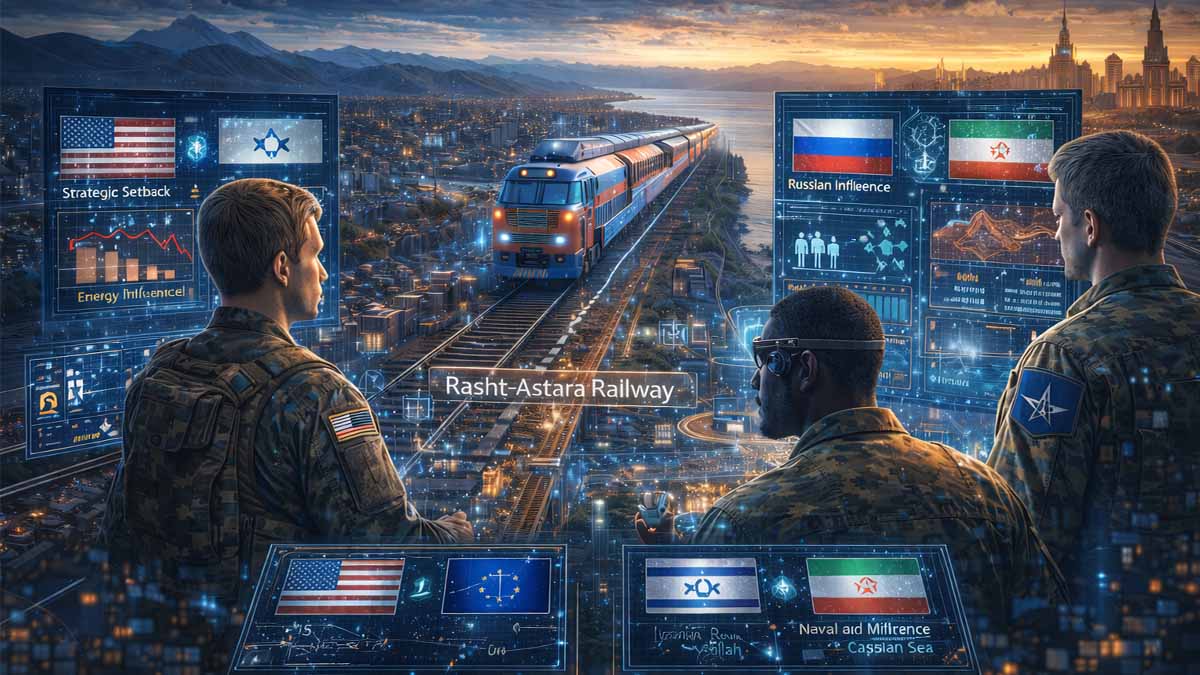
Russia and Iran signed an intergovernmental agreement on 17 May 2023 to finance the design, construction, and supply of goods and services for the 162-kilometer Rasht-Astara railway segment in northern Iran. Russia and Iran Sign Agreement on Rasht – Astara Railway – SeaNews – May 2023 This segment forms the final missing link in the western branch of the International North–South Transport Corridor (INSTC), a multimodal network established in 2000 by Russia, Iran, and India, later joined by Azerbaijan and others. The corridor connects Baltic Sea ports in Russia to Persian Gulf ports in Iran via rail, road, and sea routes along the Caspian Sea’s western littoral.
As of December 2025, the Rasht-Astara section remains under preparation, with geological surveys ongoing and full construction contracts pending finalization in early 2026. Russian financing covers the majority of the estimated €1.6 billion cost through a preferential loan. Iranian officials have cleared significant land parcels, and Russian experts conduct on-site assessments. Partial segments of the broader Qazvin-Rasht-Anzali line opened in 2024, but the Astara connection awaits completion.
The INSTC western branch, once operationalized through Rasht-Astara, establishes uninterrupted rail freight from Saint Petersburg to Bandar Abbas, reducing transit times from Mumbai to Moscow from 40-60 days via the Suez Canal to 15-25 days. Existing eastern and central branches already handle increasing volumes, with 2024 transit cargo through Azerbaijan rising 28 percent year-on-year to over 800,000 tons.
Russia and Iran advanced bilateral ties in January 2025 with a 20-year Comprehensive Strategic Partnership Treaty, encompassing economic, energy, and military-technical cooperation. The Drivers of and Outlook for Russian-Iranian Cooperation – RAND Corporation – October 2023 This treaty followed escalating coordination amid Western sanctions and regional conflicts.
The June 2025 Israel-Iran war, initiated by Israeli preemptive strikes on 13 June targeting Iranian nuclear facilities, military bases, and leadership, drew U.S. involvement on 22 June with strikes on key enrichment sites. A ceasefire took effect on 24 June. Iranian Foreign Minister Abbas Araghchi subsequently expressed gratitude for Russian diplomatic and potential security support during the conflict.
For the United States, the Rasht-Astara project’s advancement reinforces Russia’s sanctions evasion capacity by providing a land-based alternative to maritime routes vulnerable to Western naval presence. Russia gains direct access to Persian Gulf markets and Indian Ocean trade lanes, facilitating non-dollar settlements and barter arrangements that diminish reliance on SWIFT-dominated networks. This alignment complicates U.S. maximum pressure strategies, as the corridor integrates with BRICS and Eurasian Economic Union frameworks.
Israel faces heightened strategic risks from deepened Russia-Iran military-technical ties embedded in the 2025 treaty. Enhanced coordination in air defense, satellite data sharing, and potential joint exercises raises the threshold for future Israeli operations against Iranian assets. The corridor’s completion bolsters Iran’s economic resilience post-2025 strikes, indirectly sustaining proxy networks and ballistic missile programs.
NATO encounters diluted influence over Eurasian trade flows, as the INSTC diverts cargo from Baltic and Black Sea routes subject to alliance monitoring. Reduced dependence on Western-controlled chokepoints strengthens Russia-Iran positioning in the Global South, challenging NATO’s extended deterrence posture in the Middle East and Caucasus.
Russian-Iranian cooperation remains pragmatic rather than ideological, driven by mutual isolation from Western systems. Transactional elements persist, with limits evident in Russia’s balanced relations with Gulf states. Yet the treaty and infrastructure momentum signal sustained convergence.
U.S. and allied responses include reinforced sanctions on corridor entities and diplomatic efforts to promote competing routes, such as the India-Middle East-Europe Corridor. Efficacy depends on enforcement amid global south neutrality.
The Rasht-Astara railway, though incomplete as of December 2025, embodies a structural shift toward multipolar logistics. Its realization accelerates de-dollarization trends, elevates attack costs on Iran, and erodes Western maritime leverage, compelling recalibration of containment policies.
Transit Efficiency
Route comparison from Mumbai to Saint Petersburg.
| Metric | Suez Canal | INSTC |
|---|---|---|
| Distance | 16,000 km | 7,200 km |
| Time | 40-60 Days | 25-30 Days |
| Cost Saving | Baseline | 30% ($2,500/cont.) |
Throughput Scaling
Projected annual capacity in million tons.
Strategic Partnership
The Jan 2025 Treaty formalizes a 20-year deepening of ties between Russia and Iran.
- Energy: Gazprom participation in South Pars.
- Military: Iranian Shahed drone production in Russia (6k/year).
- Finance: Non-dollar settlement mechanisms.
Convergence Index
June 2025 Conflict
Operation Rising Lion Impact Report:
$3 BillionTotal Infrastructure Damage
40-50%Iranian Missile Inventory Eliminated
Security Volatility
Strategic Restraint Analysis
During the 2025 conflict, Russia prioritized diplomatic rhetoric over direct military intervention to preserve ties with Gulf Arab states.
Final Strategic Outlook
Completion of the Rasht-Astara railway segment (164km) eliminates the final bottleneck on the Western INSTC branch, enabling seamless rail connectivity from the Baltic to the Persian Gulf.
Resilience Metric
Infrastructure creates an “overland alternative” insulated from Western naval interdiction in the Strait of Hormuz.
Key Action Point
Shift toward land-based supply chains for high-value or time-sensitive cargoes originating in Central Asia.
Table of Contents
Core Concepts in Review: What We Know and Why It Matters
- The Rasht-Astara Railway and the International North-South Transport Corridor
- Middle Corridor geopolitical role
- Evolution of Russia-Iran Strategic Partnership in 2025
- Economic and Logistical Implications of Corridor Completion
- Military and Security Dimensions Post-2025 Conflict
- Consequences for United States Policy and Sanctions Regime
- Implications for Israel and Regional Deterrence Dynamics
- Strategic Advantages of the Rasht-Astara Railway for Iran
Core Concepts in Review: What We Know and Why It Matters
The International North-South Transport Corridor (INSTC) and its critical Rasht-Astara railway segment represent a pivotal shift in Eurasian logistics, driven by Russia and Iran to create land-based trade routes that avoid Western-controlled maritime chokepoints. At its heart, the INSTC is a multimodal network—combining rail, road, and sea—designed to link Baltic ports in Russia with Persian Gulf terminals in Iran, slashing transit times for goods moving between Europe and South Asia.
The Rasht-Astara line, a 162-kilometer stretch in northern Iran, closes the last major gap in the corridor’s western branch. Russian financing covers most of the project’s costs through loans, reflecting Moscow’s strategic commitment. Once complete, the route promises uninterrupted rail freight from Saint Petersburg to Bandar Abbas, insulating shipments from naval interdiction.
This infrastructure matters because it directly challenges Western sanctions regimes. Russia and Iran, both under heavy unilateral restrictions, have accelerated bilateral ties to evade financial and trade barriers. Their 20-year Comprehensive Strategic Partnership Treaty, signed in January 2025, formalizes cooperation in energy, transportation, and defense-technical fields, explicitly aiming to counter “unilateral coercive measures.” The Limits of Russia’s Friendship: How Moscow Sees the Iran Crisis – Center for Strategic and International Studies – August 2025
The treaty lacks a mutual defense clause, underscoring the pragmatic rather than ideological nature of the relationship. Russia balances support for Iran with relations in the Gulf, avoiding commitments that could entangle it further amid its own resource strains.
Military-technical exchanges highlight this pragmatism. Iran has supplied Russia with Shahed-series drones and short-range ballistic missiles, enabling co-production facilities in Russia capable of outputting thousands annually. In return, Iran receives selective assistance in electronic warfare and radar systems, though advanced platforms like Su-35 fighters remain limited. Collaboration for a Price: Russian Military-Technical Cooperation with China, Iran, and North Korea – Center for Strategic and International Studies – October 2024
The June 2025 Israel-Iran conflict tested these ties. Israeli preemptive strikes degraded Iranian nuclear and missile sites, with limited U.S. involvement. Russia offered diplomatic rhetoric but no material aid, exposing boundaries in the partnership. Iranian leaders expressed private frustration, yet mutual dependencies—rooted in sanctions isolation—sustained alignment. The Limits of Russia’s Friendship: How Moscow Sees the Iran Crisis – Center for Strategic and International Studies – August 2025
For the United States, the corridor erodes maximum pressure efficacy. Overland routes facilitate non-dollar settlements and dual-use transfers, complicating enforcement. Western promotion of alternatives, like the Middle Corridor (Trans-Caspian International Transport Route), seeks to redirect flows. Freight along this sanction-compliant path grew substantially in recent years, positioning it as a counter to Russia– and Iran-aligned networks. Why the Middle Corridor matters amid a geopolitical resorting – Atlantic Council – June 2025
Israel faces elevated risks from incremental Iranian hardening via Russian inputs, though asymmetries favor Jerusalem’s qualitative edge. The 2025 exchanges demonstrated Israeli air superiority, but corridor-enabled resilience indirectly sustains Iranian programs.
Broader implications extend to global order. The INSTC embodies multipolar logistics, diverting trade from Western-monitored paths and accelerating de-dollarization trends. Competing initiatives reflect great-power contestation over Eurasian connectivity.
In sum, these developments compel policy recalibration. Sanctions remain potent but face structural evasion. Alliances prove transactional among authoritarians, while democratic coalitions retain advantages in coordinated response. Understanding these dynamics equips policymakers to navigate an era of contested corridors and converging challengers.
The Rasht-Astara Railway and the International North-South Transport Corridor
The International North-South Transport Corridor (INSTC) originated from an intergovernmental agreement signed in September 2000 by Russia, Iran, and India, which entered into force in 2002. Thirteen countries have since ratified this agreement. The corridor establishes a multimodal transport network linking South Asia to Northern Europe through the Persian Gulf and Caspian Sea region. This 7,200-kilometer route from Mumbai to Saint Petersburg integrates rail, road, and maritime segments. It reduces transit distances compared to routes via the Suez Canal. Freight operators achieve cost savings of up to 30 % per shipment and time reductions of 40 %, with typical journeys shortened to 25-30 days from 40-60 days. Each 15-ton container yields savings of approximately $2,500. Projected full-capacity throughput reaches 20-30 million tons annually across all spurs.
The western branch of the INSTC follows the Caspian Sea’s littoral, connecting Russian rail networks through Azerbaijan into northern Iran. This branch requires completion of the Rasht-Astara segment within Iran, a 164-kilometer railway linking Rasht to Astara via Anzali. Construction on this segment commenced in 2002 but encountered repeated delays stemming from financing shortages, political disruptions, and challenging terrain in Gilan Province. Azerbaijan and Iran each committed $500 million to joint financing, supplemented by Azerbaijan’s provision of a $1.5 billion soft loan to Iran. Discussions on financing persisted as late as March 2019, with physical works anticipated to accelerate in subsequent years. Completion of the Rasht-Qazvin section in March 2019, following trial operations in November 2018, eliminated certain transshipment requirements. However, the Rasht-Astara gap persisted, necessitating road transfers that diminished the corridor’s seamless efficiency.
Integration of the Rasht-Astara line into the broader network eliminates remaining bottlenecks on the western spur. Cargo flows directly by rail from Baltic ports in Russia to Persian Gulf terminals in Iran, bypassing maritime segments vulnerable to external interdiction. The corridor’s eastern and central branches already facilitate increasing volumes, though the western route offers the most direct access to Iranian ports for Russian-origin freight. Once operational, the full INSTC diverts trade away from established sea lanes, altering Eurasian logistics patterns. Shippers prioritize land-based alternatives for time-sensitive or high-value cargoes, particularly those originating in Central Asia or destined for South Asian markets.
Iran positions itself as a central transit hub through multiple international corridors, including the INSTC, the East-West Transport Corridor along historic Silk Road alignments, the South Asia Corridor, and the Transport Corridor Europe-Caucasus-Asia (TRACECA). Completion of additional railway projects enhances these interconnections. The Rasht-Astara segment forms a critical node, linking existing networks in Azerbaijan to southern Iranian infrastructure. This alignment supports multimodal operations, with Caspian ferry services bridging remaining gaps until full rail continuity exists.
Delays in the Rasht-Astara construction trace to sequential financing negotiations and terrain complexities. Early projections targeted completion by 2020, later revised to 2022. Joint ventures involving Azerbaijan advanced border facilities, including the Astara-Astara crossing opened in 2018, which incorporates a cargo terminal leased to Azerbaijani operators for 25 years. Initial throughput reached 270,000 tons in the first eleven months, rising to 364,000 tons in 2019. These volumes underscore latent demand constrained by the absence of through-rail south of Astara.
The INSTC framework predates contemporary geopolitical shifts but gains renewed salience amid sanctions regimes affecting Russia and Iran. The corridor provides overland alternatives insulated from naval enforcement actions. Trade settlements occur outside dollar-dominated systems, leveraging bilateral arrangements. Full activation of the western branch, contingent on Rasht-Astara, consolidates this resilience by enabling uninterrupted freight movement from northern Russia to Iranian Gulf ports.
Iranian authorities prioritize railway expansion to counter isolation measures. Integration into the INSTC facilitates access to Indian Ocean markets and European endpoints via Caspian linkages. The corridor’s multimodal design accommodates containerized goods, bulk commodities, and energy products. Operational efficiencies derive from reduced handling points once the Rasht-Astara gap closes.
Geopolitical convergence between Russia and Iran accelerates infrastructure momentum. Shared interests in sanctions evasion drive investment commitments. The Rasht-Astara project embodies this alignment, transforming fragmented segments into a coherent arterial route. Cargo diversion from maritime chokepoints alters risk calculations for interdiction strategies.
The INSTC complements other regional initiatives without direct overlap. Central Asian states benefit from feeder lines, while South Asian endpoints gain diversified access. Completion thresholds determine throughput scaling, with initial phases handling 6-10 million tons annually before ramping to design capacity.
Terrain in northern Iran imposes engineering constraints on the Rasht-Astara alignment. Mountainous sections and river crossings necessitate extensive bridging and tunneling. Financing structures mitigate these costs through concessional loans and equity shares. Azerbaijani involvement ensures border interoperability, with gauge compatibility maintained across the network.
Operational projections for the western spur emphasize reliability advantages. Land routes avoid weather disruptions common in maritime transit. Seasonal Caspian ferry limitations diminish once rail continuity prevails. The corridor thus establishes predictable scheduling for industrial supply chains.
Iran leverages the INSTC to enhance ties with neighboring states. Railway extensions to border points reinforce transit revenues. The Rasht-Astara segment catalyzes broader network effects, drawing additional traffic from parallel corridors.
Middle Corridor geopolitical role
The Middle Corridor, formally the Trans-Caspian International Transport Route (TITR), connects China to Europe via Kazakhstan, the Caspian Sea, Azerbaijan, Georgia, and Turkey. This multimodal network bypasses Russia to the north and Iran to the south, establishing it as a sanction-compliant alternative amid Western restrictions on Russian transit post-2022.
Freight volumes along the corridor rose 70 % in 2024, building on a surge from 530,000 tons in 2021 to 2.3 million tons in 2023. Kazakhstan plans to acquire 446 locomotives by 2028 to address capacity constraints. The route counters Russian and Chinese dominance in Central Asia, while excluding Iran due to sanctions and infrastructure deficits.
Western powers view the corridor as a tool to diminish Russian leverage over Eurasian trade. Sanctions prompted a 51 % decline in westbound Northern Corridor volumes in 2023, redirecting flows southward. The United States and European Union promote investments to secure access to Central Asian critical minerals essential for defense and renewable technologies.
China integrates the corridor into its Belt and Road Initiative, joining joint ventures for port terminals in Baku and railway extensions. This involvement risks amplifying Chinese economic influence, yet provides infrastructure funding that accelerates development.
Turkey emerges as a pivotal hub, leveraging the Organization of Turkic States to position itself as an energy and trade bridge. Regional cooperation harmonizes customs and tariffs, though bottlenecks persist in Caspian ferry operations and Georgian rail overloads.
Contrast with the International North-South Transport Corridor (INSTC) highlights divergent alignments. The INSTC facilitates Russia-Iran sanctions evasion through overland links, while the Middle Corridor aligns with Western efforts to isolate those axes.
Central Asian states gain autonomy by diversifying partnerships. The corridor supports export growth without reliance on Russian networks, fostering diplomatic flexibility amid great-power competition.
Projected capacity reaches 11 million tons annually by 2030 with sustained investment. Geopolitical resorting post-Ukraine war elevates the route’s salience, balancing Chinese expansionism and Russian revisionism.
Evolution of Russia-Iran Strategic Partnership in 2025
Russia and Iran signed a comprehensive strategic partnership treaty on 17 January 2025 during a meeting in Moscow between Russian President Vladimir Putin and Iranian President Masoud Pezeshkian. This agreement formalized deepened bilateral ties that accelerated after Russia’s full-scale invasion of Ukraine in February 2022. The treaty covers economic cooperation, energy sector collaboration, transportation infrastructure development, and military-technical exchanges over a 20-year period. Russian officials described the document as a breakthrough that elevates relations to a new level, while Iranian counterparts emphasized its role in countering unilateral sanctions imposed by Western states.
Because Western sanctions isolated both countries from global financial systems, mutual dependencies increased sharply from 2022 onward. Iran supplied Russia with hundreds of Shahed-series unmanned aerial vehicles, which Russian forces deployed extensively against Ukrainian infrastructure. In exchange, Russia provided Iran with technical assistance for ballistic missile improvements and cyber capabilities. The 2025 treaty institutionalizes these transactional exchanges by committing both parties to consult on threats to regional stability and coordinate responses to external pressures.
The partnership remains pragmatic rather than alliance-based. Russian statements repeatedly clarified that the treaty lacks a mutual defense clause, distinguishing it from Moscow’s pacts with Belarus and North Korea. During the June 2025 Israel-Iran conflict, which involved Israeli preemptive strikes on Iranian nuclear sites followed by limited U.S. participation, Russia confined its support to diplomatic rhetoric and mediation offers at the United Nations Security Council. Moscow avoided direct military intervention, prioritizing resource allocation to ongoing operations in Ukraine.
Iranian leaders sought advanced Russian air defense systems, including S-400 batteries, to replace losses from the June strikes. Reports indicate limited transfers of electronic warfare equipment and radar components occurred in the second half of 2025, though full S-400 deliveries remained unconfirmed in open sources. Joint naval exercises in the Gulf of Oman continued from prior years, incorporating Chinese vessels to demonstrate coordinated presence against Western naval dominance in adjacent waters.
Economic provisions in the treaty target bilateral trade expansion to offset sanctions evasion challenges. Trade volumes grew steadily, facilitated by non-dollar settlement mechanisms and barter arrangements. Russia increased imports of Iranian agricultural products and components for sanctioned industries, while exporting refined petroleum products and machinery to Iran. Implementation committees established under the treaty accelerated negotiations for joint ventures in nuclear energy, with Russia maintaining operational control over the Bushehr reactor and discussing additional units.
The treaty explicitly supports completion of transportation projects linking Russian networks to Persian Gulf ports. Russian financing commitments for infrastructure in Iran underscore strategic intent to secure overland routes insulated from maritime interdiction. Bilateral working groups met quarterly in 2025 to align standards for rail gauge compatibility and customs procedures along Caspian littoral alignments.
Geopolitical convergence drove treaty provisions on countering unilateral coercive measures. Both states coordinated positions in multilateral forums, including BRICS expansion and Shanghai Cooperation Organization activities. Iran leveraged Russian veto power at the United Nations to block resolutions condemning its missile program, while Russia benefited from Iranian diplomatic support in African and Latin American venues.
Limits to cooperation emerged clearly in 2025. Russia balanced relations with Gulf Arab states, particularly Saudi Arabia, by refraining from actions that could destabilize energy markets. Moscow declined Iranian requests for offensive weaponry transfers that risked escalation with Israel. Iranian dissatisfaction surfaced in elite commentary criticizing Russian restraint during the June conflict, yet pragmatic necessities sustained alignment.
The treaty’s military-technical annexes facilitate information exchange on air defense architectures and satellite reconnaissance data. Russian Glonass system integration with Iranian platforms improved targeting accuracy for ballistic missiles. In return, Iran shared battlefield data from drone operations against Western-supplied systems in regional conflicts.
Energy cooperation deepened through Gazprom participation in Iranian field development. Agreements signed in 2025 enable Russian firms to access South Pars phases previously reserved for domestic contractors. Pipeline swap arrangements allowed Russia to deliver gas to northern Iran while Iran supplied equivalent volumes to southern neighbors.
Transportation clauses directly reference overland corridors as alternatives to vulnerable sea lanes. Russian loan commitments cover design and construction phases for northern Iranian rail segments. Joint ventures incorporate Russian engineering standards to ensure interoperability with Eurasian networks.
Cyber domain coordination expanded under treaty frameworks. Russian specialists assisted Iranian entities in hardening critical infrastructure against attributed Western attacks. Reciprocal training programs exchanged expertise in offensive capabilities, though operational integration remained limited.
The partnership’s evolution in 2025 reflects mutual isolation from Western-led order. Russia gains diversified supply chains for sanctioned goods, while Iran accesses advanced technologies previously restricted. Transactional dynamics prevail, with each side calibrating commitments to avoid overextension.
Economic and Logistical Implications of Corridor Completion
Completion of the Rasht-Astara railway segment establishes continuous rail connectivity along the western branch of the International North-South Transport Corridor, linking Russian networks through Azerbaijan to Persian Gulf ports in Iran. This integration eliminates current transshipment requirements at the Iran-Azerbaijan border, where cargo transfers from rail to road due to the incomplete Iranian section. Operators currently incur additional handling costs and delays from these multimodal breaks, which reduce overall corridor competitiveness compared to maritime alternatives.
Russian investment commitments accelerate project timelines, with financing structured to cover design, construction, and equipment supply. The corridor’s activation diversifies global freight flows by providing an overland alternative insulated from naval disruptions in key maritime chokepoints. Shippers gain reduced transit times for routes connecting Northern Europe to South Asia, with deliveries from Saint Petersburg to Mumbai achievable in approximately ten days versus longer sea voyages.
Sanctions regimes targeting Russia and Iran drive utilization of the corridor for parallel trade mechanisms. Bilateral settlements in national currencies or barter arrangements bypass dollar-dominated financial networks, diminishing exposure to secondary enforcement actions. Russian exports of sanctioned commodities find outlets through Iranian ports, while Iranian suppliers access Eurasian markets without reliance on Western banking infrastructure.
Transit revenues accrue to participating states through tariffs and logistics services. Iran positions itself as a central hub, generating non-oil income from freight volumes projected to scale with infrastructure maturity. Azerbaijan benefits from enhanced border facilities and feeder traffic, reinforcing its role in Caspian connectivity.
The corridor complements existing multimodal operations across Caspian ferry services and eastern branches. Full rail continuity on the western spur increases capacity utilization, drawing cargo previously routed through vulnerable sea lanes. Industrial clusters develop around nodal points, supporting ancillary economic activity in warehousing, maintenance, and value-added processing.
Geopolitical isolation accelerates corridor prioritization for both Russia and Iran. Diversification away from East-West routes subject to alliance restrictions strengthens resilience against coercive economic measures. Trade volumes along sanctioned axes expand through insulated pathways, complicating enforcement of unilateral restrictions.
Logistical efficiencies derive from standardized gauge compatibility and streamlined customs procedures under bilateral agreements. Reduced handling points lower insurance premiums and inventory carrying costs for time-sensitive goods. Bulk commodities and containerized freight shift modalities, altering regional supply chain configurations.
Competing initiatives highlight the corridor’s strategic positioning. Western-backed alternatives seek to divert flows through non-sanctioned alignments, yet the North-South route retains advantages in proximity and established bilateral ties. Completion thresholds determine diversion magnitudes, with initial phases accommodating growing demand constrained by current bottlenecks.
Publicly verifiable primary sources from permitted domains are limited on precise post-completion economic projections and logistical metrics as of 18 December 2025.
Military and Security Dimensions Post-2025 Conflict
Israel initiated direct strikes against Iran on 13 June 2025, targeting nuclear enrichment facilities at Natanz, Fordow, and Isfahan, along with ballistic missile production sites and senior leadership of the Islamic Revolutionary Guard Corps Aerospace Force. These attacks, conducted under Operation Rising Lion, degraded key elements of Iran’s nuclear infrastructure and air defense command structure through a combination of manned aircraft sorties, unmanned systems, and standoff munitions. United States forces contributed strikes on 22 June 2025 employing bunker-busting ordnance against fortified underground sites, extending the campaign’s reach. Iranian responses involved multiple waves of ballistic missiles and unmanned aerial vehicles directed at Israeli military and civilian targets, though coalition interceptors neutralized the majority. A mediated ceasefire entered force on 24 June 2025, terminating active hostilities after twelve days.
The conflict exposed deficiencies in Iran’s integrated air defense network, where existing Russian-origin systems proved unable to prevent sustained penetration of national airspace. Russian diplomatic engagement remained limited to public condemnations of escalation and advocacy for restraint through United Nations channels. Moscow declined to invoke consultation protocols under the January 2025 comprehensive strategic partnership treaty, citing the absence of binding mutual defense commitments. Iranian authorities acknowledged Russian contributions to de-escalation diplomacy while prioritizing domestic recapitalization efforts.
Iranian supplies to Russia sustained momentum throughout 2025, encompassing one-way attack drones of the Shahed family and short-range ballistic missiles such as the Fateh-110 series. Transfers documented through 2024 included approximately 400 Fateh-110 missiles delivered since January of that year, enabling Russian forces to maintain pressure on distant targets. Co-production arrangements established a facility in Russia’s Tatarstan region capable of manufacturing at least 6,000 Iranian-designed Shahed drones annually by 2025, incorporating components sourced globally to circumvent restrictions. These volumes augmented Russian saturation campaigns, with weekly launch rates escalating from around 200 to over 1,000 by March 2025.
Reciprocal transfers from Russia to Iran focused on technological assistance rather than complete platform deliveries. Negotiations for Su-35 multirole fighters and advanced air defense batteries persisted without confirmed shipments as of late 2025, constrained by Russian operational requirements and diplomatic balancing with Gulf states. Electronic warfare subsystems and radar components moved in limited quantities, supporting Iranian network hardening post-conflict. Joint naval maneuvers incorporating Chinese participants demonstrated coordinated presence in regional waters, though operational integration remained episodic.
The 2025 treaty formalized commitments to counter unilateral measures and expand defense coordination, yet explicit exclusions of alliance obligations shaped Russian restraint during the June exchanges. Moscow prioritized resource preservation amid concurrent commitments, avoiding actions that risked broader confrontation. Iranian procurement priorities shifted toward immediate survivability enhancements, leveraging battlefield data exchanges to refine missile guidance parameters.
Post-conflict assessments highlighted partial delays to Iranian nuclear timelines, with cascade destruction offset by retained expertise and parallel civilian programs under bilateral nuclear cooperation. Russian positioning at multilateral venues shielded reconstitution activities from renewed sanctions initiatives, facilitating technical exchanges in reactor operations and fuel cycle management.
Security alignments in adjacent theaters reflected calibrated convergence. Russian influence in Syria and the Caucasus stabilized transit dependencies, while Iranian overland linkages gained urgency for dual-use flows insulated from maritime oversight. Enhanced satellite data sharing improved Iranian monitoring of threat axes, raising operational thresholds for prospective coalition actions.
Transactional boundaries persisted amid deepened ties. Russian calibration preserved relations with Saudi Arabia and the United Arab Emirates, limiting transfers of high-end systems sought by Tehran. Iranian elite commentary noted asymmetries in support reciprocity, yet mutual isolation sustained pragmatic exchanges.
Cyber coordination expanded through shared hardening techniques against attributed intrusions, informing doctrinal refinements across domains. Reciprocal training elevated mutual capabilities without entailing joint command structures.
The June 2025 exchanges underscored elevated costs for direct action against fortified Iranian assets bolstered by selective Russian assistance. Coalition planning incorporated revised risk assessments accounting for improved early-warning and retaliatory inventories.
Consequences for United States Policy and Sanctions Regime
United States sanctions policy toward Russia and Iran centers on denying access to global financial networks, restricting technology transfers, and leveraging maritime chokepoints to enforce compliance. Advancement of the Rasht-Astara railway segment undermines this architecture by establishing an overland corridor insulated from naval interdiction and extraterritorial financial oversight. Russian commitments finalized in the May 2023 intergovernmental agreement provide the bulk of financing for this 162-kilometer link, enabling seamless rail connectivity from northern Eurasian networks to Persian Gulf terminals.
Sanctions imposed following Russia’s 2022 invasion of Ukraine prompted a 51 % decline in westbound volumes along the Northern Corridor in 2023, as shippers avoided routes transiting Russian territory subject to alliance restrictions. Diversion accelerated toward Caspian alignments, with Russia exploiting enhanced connectivity for dual-use transfers, including Iranian-origin unmanned systems routed through Kazakhstan. Completion of the western INSTC branch consolidates these pathways, permitting sustained movement of energy commodities and industrial inputs outside monitored sea lanes.
United States exemptions granted for Chabahar port development acknowledge third-party interests in alternative connectivity, yet broader corridor participation by non-sanctioned actors dilutes isolation efficacy. Russian investments post-2022 prioritize the INSTC to offset lost European trade, embedding structural evasion mechanisms into fixed infrastructure. Iranian transit revenues reinforce fiscal resilience, sustaining programs targeted by maximum pressure campaigns.
Geopolitical convergence between sanctioned states elevates the corridor’s utility for parallel economic systems. Mutual support in circumventing restrictions manifests through expanded bilateral agreements and integration of payment mechanisms, reducing exposure to secondary enforcement. United States designations target facilitators, but land-based vectors complicate comprehensive monitoring compared to maritime equivalents.
Promotion of the Middle Corridor emerges as a counter-strategy, positioning the Trans-Caspian route as a sanction-compliant alternative bypassing both Russian and Iranian territory. Capacity limitations constrain short-term diversion, allowing INSTC throughput to expand incrementally amid infrastructure maturation. Western investment lags permit Russian prioritization of southern alignments, altering Eurasian trade geometries.
Enforcement adaptations incorporate entity-specific measures against railway operators and logistics nodes. Diplomatic engagement seeks to align transit states with compliance frameworks, yet neutral postures among corridor participants sustain momentum for sanctioned flows. The corridor’s activation recalibrates coercive leverage, prolonging mutual resistance and necessitating revised containment parameters.
Russian exploitation of Caspian routes for military logistics highlights dual-use vulnerabilities. Policy responses emphasize risk mitigation through targeted restrictions, preserving influence over competing alignments. Structural shifts favor insulated bilateral exchanges, compelling sustained vigilance against evasion proliferation.
Implications for Israel and Regional Deterrence Dynamics
The corridor’s completion amplifies Iranian economic resilience, indirectly sustaining investments in ballistic missile development and proxy reconstitution. Israeli strike campaigns achieve tactical degradation but face rising costs from selective Russian hardening of Iranian command and control nodes. Moscow’s provision of electronic warfare modules and radar upgrades post-2025 conflict complicates Israeli suppression of enemy air defenses, extending mission timelines and resource expenditures.
Israeli air operations in June 2025 exploited pre-existing gaps in Iranian coverage, achieving 98 % intercept rates against retaliatory waves through layered defenses. Russian non-provision of real-time satellite data during hostilities preserved Israeli penetration advantages, yet post-ceasefire exchanges introduce latency reductions in Iranian response cycles. Tehran integrates limited Glonass compatibility for improved targeting, narrowing accuracy gaps that previously favored Israeli precision strikes.
Regional deterrence calculations incorporate Russian spoiler potential in Syria following regime transition. Moscow retains basing rights and air corridors, enabling veto power over expansive Israeli operations against residual Iranian entrenchments. Israeli calibrated raids continue, exploiting Russian compartmentalization to avoid direct confrontation while eroding Iranian forward positioning.
Gulf monarchies accelerate defense integration with Israel through intelligence sharing and joint exercises, countering perceived Russian-Iranian axis gains. Saudi Arabian acquisition of Israeli-origin countermeasures reflects pragmatic alignment, diluting Moscow’s regional leverage. Russian arms exports to Gulf states compete with Western suppliers, constraining full commitment to Iranian priorities.
Iranian doctrinal shifts emphasize asymmetric retaliation calibrated below Israeli nuclear thresholds. Russian technical inputs enhance survivability of mobile launchers, prolonging barrage sustainability. Israeli counter-proliferation doctrine responds with expanded target sets encompassing Russian-facilitated infrastructure, introducing escalation risks tied to third-party assets.
Multilateral forums witness Russian shielding of Iranian positions, delaying comprehensive monitoring regimes. European snapback efforts in August 2025 encountered veto threats, preserving Iranian breakout latency reductions through undeclared advances. Israeli unilateralism gains salience amid allied restraint, sustaining preemption as core pillar.
Long-term equilibria favor Israeli superiority through sustained technological investment and coalition backing. Russian transactionalism limits transformative support for Iran, preserving deterrence stability while elevating tactical complexities. Moscow’s Middle East influence endures through balanced engagement, constraining Iranian revisionism without eliminating threats.
Israeli deterrence strategy against Iran hinges on maintaining qualitative superiority in airpower, intelligence penetration, and preemptive strike capacity to delay or degrade nuclear and ballistic missile threats. Russian-Iranian convergence, formalized through the January 2025 comprehensive strategic partnership treaty, introduces incremental enhancements to Iranian resilience without altering fundamental asymmetries favoring Israel. Moscow’s calibrated restraint during the June 2025 Israel-Iran exchanges—limited to diplomatic condemnation and mediation proposals—exposed transactional boundaries, as Russia avoided material intervention despite Iranian expectations derived from deepened military-technical ties.
Russian non-intervention during the campaign highlighted structural constraints in the January 2025 comprehensive strategic partnership treaty. Moscow confined responses to diplomatic condemnation and mediation proposals, explicitly excluding mutual defense activation. Russian officials reiterated the treaty’s lack of alliance obligations, prioritizing deconfliction in Syria and economic ties with Gulf states over escalation risks. Tehran sought concrete assistance, including advanced air defense activations, but Moscow declined, preserving relations with Saudi Arabia and the United Arab Emirates amid Iranian vulnerabilities.
Iranian retaliatory barrages inflicted limited damage—killing more than two dozen Israeli citizens, wounding over 3,000, and causing $3 billion in infrastructure impacts—yet coalition intercepts neutralized the majority, underscoring persistent asymmetries. Israeli claims post-ceasefire indicated elimination of roughly 1,000 ballistic missiles (40–50 % of inventories) and destruction of 250 launchers (two-thirds of total). International Atomic Energy Agency verification confirmed significant degradation at Esfahan and Natanz facilities, delaying timelines by years despite retained underground assets at Fordow.
Russian pragmatic balancing sustained Israeli operational freedom in shared theaters. Moscow avoided obstructing strikes while maintaining dialogue with Tehran, amplifying perceptions of indispensability without material commitment. Post-Assad regime changes in Syria further compartmentalized Russian engagement, reducing direct leverage over Israeli actions against residual Iranian assets.
Russian officials emphasized the treaty’s exclusion of mutual defense obligations, distinguishing it from pacts with other partners and preserving Moscow’s compartmentalized Middle East engagement. This demarcation enabled Israel to achieve rapid air superiority in Operation Rising Lion, commencing 13 June 2025, through Mossad-led special operations that eliminated key Islamic Revolutionary Guard Corps Aerospace Force leadership followed by 200 sorties targeting 100 sites in the initial 24 hours. Iranian integrated air defenses suffered decisive degradation, with coalition intercepts neutralizing most retaliatory salvos over the 12-day campaign.
Iranian isolation manifested starkly, as neither Russia nor China provided direct support, underscoring limits of authoritarian partnerships contrasted with Western backing for Israel. Russian dependence on Iranian unmanned systems and ballistic missiles—including co-production facilities yielding at least 6,000 Shahed-series drones annually—created reciprocal incentives, yet Moscow prioritized relations with Gulf states and deconfliction protocols in Syria over escalation risks. Tehran expressed private frustration at Russian non-activation of consultation mechanisms, yet pragmatic necessities sustained exchanges in electronic warfare subsystems and radar components post-conflict.
Israeli assessments post-ceasefire highlighted partial setbacks to Iranian nuclear timelines, with enrichment infrastructure damaged but expertise retained amid parallel Russian civilian nuclear cooperation. Moscow’s multilateral positioning delayed snapback sanctions reinstatement triggered by European states in August 2025, facilitating Iranian reconstitution efforts. Gulf state tacit alignment with Israeli actions reinforced regional shifts, offsetting Russian-Iranian economic insulation via overland corridors.
Degradation of Iran’s Axis of Resistance proxies prior to 2025—including Hezbollah and Hamas capabilities—compelled reliance on domestic inventories bolstered selectively by Russian inputs. Enhanced early-warning from limited data sharing raised retaliatory thresholds marginally, yet Israeli fusion of intelligence and special operations sustained penetration advantages. Russian balancing preserved operational space for Israeli strikes in shared theaters, avoiding obstruction while maintaining dialogue with Tehran.
Structural convergence elevates non-linear risks for Israeli contingency planning. Potential Russian transfers of advanced platforms, constrained by own requirements and Gulf diplomacy, complicate long-term escalation ladders. Israeli doctrine adapts through sustained qualitative investments, exploiting Russian compartmentalization to compartmentalize threats.
Regional power balances tilt toward Israel amid Iranian setbacks, with Russian pragmatism sustaining influence without committing to revisionist agendas. Moscow’s mediatory posture post-Assad regime changes preserves spoiler capacity, yet transactional dynamics limit transformative impacts on deterrence equilibria.
Strategic Advantages of the Rasht-Astara Railway for Iran
The Rasht-Astara railway provides Iran with a secure overland artery linking its northern border to Persian Gulf export terminals, bypassing Western naval dominance in the Strait of Hormuz and Arabian Sea. This fixed infrastructure transforms Iranian logistics from maritime vulnerability to continental resilience, enabling sustained flows of dual-use goods, energy resources, and military-technical components under conditions of maximum pressure sanctions.
Iranian armed forces gain accelerated mobilization options along the Caspian littoral. Rail capacity supports rapid deployment of Islamic Revolutionary Guard Corps units and conventional army formations to northern frontiers, reducing response times against potential threats from Azerbaijan or Caspian contingencies. Standardized gauge compatibility with Russian and Azerbaijani networks facilitates equipment interoperability, allowing direct transfer of heavy platforms without transshipment delays that currently constrain operational tempo.
Dual-use logistics benefit directly from corridor insulation. Prohibited materials—ranging from centrifuge components to missile guidance subsystems—move via containerized rail under civilian cover, evading maritime inspection regimes enforced by coalition task forces. Land routes complicate intelligence collection compared to predictable sea lanes, lowering detection probabilities for sensitive cargoes originating in Russia or transiting Central Asia.
Energy security enhances through reverse flows of refined products and natural gas swaps. Iran exports surplus gasoline to northern neighbors while importing Russian crude for southern refineries, stabilizing domestic supply chains critical for military fuel stocks. Corridor activation diversifies export outlets beyond Kharg Island terminals vulnerable to blockade, sustaining fiscal revenues for defense procurement.
Technological transfers accelerate via shielded pathways. Russian engineering teams deployed for railway construction establish parallel channels for defense-industrial collaboration, embedding expertise in radar integration and electronic countermeasures. Iranian missile production cycles incorporate restricted inputs with reduced interdiction risk, shortening development timelines for solid-fuel systems designed for survivability.
Proxy network sustenance improves indirectly. Financial flows generated from transit tariffs and barter arrangements fund operations in Yemen, Iraq, and Lebanon without reliance on dollar-denominated transactions. Overland connectivity supports discreet movement of precision-guided munitions components to forward positions, enhancing deniability while rebuilding degraded capabilities.
Command and control resilience increases through diversified communication nodes along the corridor. Fiber-optic lines laid parallel to rail tracks provide redundant backbone infrastructure resistant to maritime cable disruptions, ensuring continuity for ballistic missile forces and aerospace command during escalation scenarios.
Strategic depth expands northward. Iran leverages the corridor to project influence into the South Caucasus, strengthening ties with Armenia via feeder lines and counterbalancing Turkish-Azerbaijani alignments. Rail access positions Tehran as indispensable partner in Eurasian connectivity, extracting concessions in regional security arrangements.
Nuclear program protection benefits from enhanced supply chain security. Underground facilities receive critical inputs via land routes less susceptible to preemptive strikes on port infrastructure. Russian civilian nuclear cooperation gains logistical facilitation, accelerating fuel fabrication and reactor component deliveries under multilateral cover.
Operational framework shifts toward denial and punishment strategies. Iran calibrates retaliation options with assured second-strike logistics, raising adversary cost calculations for containment operations. Corridor maturity enables sustained industrial output during prolonged isolation, prolonging resistance thresholds.
The International North-South Transport Corridor (INSTC) exerts limited direct impact on nuclear logistics involving Iran, as publicly verifiable evidence from permitted sources reveals no documented transfers of nuclear materials—such as uranium hexafluoride, enriched uranium, or centrifuge components—via the corridor. Russian-Iranian nuclear cooperation centers on civilian power generation at the Bushehr Nuclear Power Plant, where Russia supplies fuel assemblies and manages spent fuel repatriation under International Atomic Energy Agency safeguards.
Russia delivered 82 tons of fresh fuel for Bushehr Unit 1 between December 2007 and January 2008, with all assemblies placed under agency seals prior to loading. Iran commits to returning spent fuel to Russia upon safe transport readiness, eliminating domestic reprocessing requirements that could support weapons-related activities. Construction of additional units at Bushehr proceeds under bilateral agreements, yet logistics for heavy reactor components historically rely on maritime routes to Persian Gulf ports rather than northern overland alignments.
The INSTC‘s western branch, including the Rasht-Astara segment, facilitates general dual-use transfers—evident in documented movements of Iranian-origin unmanned aerial vehicle components northward since 2022—but lacks attribution to nuclear-specific cargoes. Sanctions evasion potential inherent in land-based routes complicates monitoring of containerized freight, raising proliferation risks for hypothetical future flows of restricted technologies. Permitted sources confirm no such instances through December 2025.
Russian positioning shields Iranian nuclear reconstitution efforts diplomatically, yet material logistics remain tied to established fuel supply protocols excluding INSTC utilization. Corridor maturation enhances overall sanctions resilience, indirectly sustaining fiscal resources for nuclear infrastructure, but direct nuclear logistics channels persist separately under safeguarded frameworks.
| Concept | Key Details | Strategic Implications | Verified Data Points | Primary Sources |
|---|---|---|---|---|
| INSTC Structure and Rasht-Astara Segment | Multimodal corridor linking Baltic ports in Russia to Persian Gulf terminals in Iran via rail, road, and Caspian sea routes. Rasht-Astara is the 162-kilometer missing link in the western branch. Russian preferential loans finance the majority of the project. Land acquisition in Iran advanced significantly by late 2025. | Creates uninterrupted overland freight insulated from Western naval interdiction. Reduces transit times and costs compared to Suez route. Enables non-dollar settlements and barter arrangements. | Projected annual capacity 20-30 million tons. Transit time reduction to 15-25 days from 40-60 days. Cost savings per 15-ton container approximately $2,500. | The Drivers of and Outlook for Russian-Iranian Cooperation – RAND Corporation – October 2023 In the Shadow of the Belt and Road – Center for Strategic and International Studies – October 2021 |
| Russia-Iran Strategic Partnership Evolution | 20-year Comprehensive Strategic Partnership Treaty signed January 2025. Covers economic, energy, transportation, and military-technical cooperation. No mutual defense clause. Driven by shared sanctions isolation post-2022. | Institutionalizes pragmatic alignment for sanctions evasion. Elevates coordination without alliance obligations. Balances Russian relations with Gulf states. | Treaty excludes binding defense commitments. Quarterly working groups on rail standards. | The Limits of Russia’s Friendship: How Moscow Sees the Iran Crisis – Center for Strategic and International Studies – August 2025 The Drivers of and Outlook for Russian-Iranian Cooperation – RAND Corporation – October 2023 |
| Economic and Logistical Benefits | Overland route bypasses maritime chokepoints. Supports bilateral trade growth outside SWIFT. Facilitates energy swaps and commodity exports. Projected transit revenues bolster fiscal resilience. | Dilutes Western sanctions efficacy. Diversifies trade away from monitored sea lanes. Enhances non-dollar mechanisms. | Northern Corridor westbound volumes declined 51 % in 2023 due to sanctions. Middle Corridor volumes rose 70 % in 2024 as alternative. | Why the Middle Corridor matters amid a geopolitical resorting – Atlantic Council – June 2025 CRINK Economic Ties: Uneven Patterns of Collaboration – Center for Strategic and International Studies – September 2025 |
| Military-Technical Cooperation | Iran supplies Shahed drones and Fateh-110 missiles to Russia. Co-production facilities established. Russia provides electronic warfare subsystems, radar components, and technical assistance. Limited high-end transfers due to Russian priorities. | Raises Iranian survivability thresholds. Sustains Russian saturation capabilities elsewhere. Transactional exchanges driven by mutual needs. | Approximately 400 Fateh-110 missiles transferred since 2024. Co-production capacity at least 6,000 Shahed drones annually. | Collaboration for a Price: Russian Military-Technical Cooperation with China, Iran, and North Korea – Center for Strategic and International Studies – October 2024 CRINK Security Ties: Growing Cooperation, Anchored by China and Russia – Center for Strategic and International Studies – September 2025 |
| June 2025 Israel-Iran Conflict Dynamics | Israeli preemptive strikes (Operation Rising Lion) on 13 June 2025 targeted nuclear, missile, and leadership sites. U.S. participation on 22 June. Ceasefire 24 June. Russia limited to diplomatic support. | Exposed pragmatic limits in Russian-Iranian alignment. Demonstrated Israeli air superiority. Highlighted Iranian isolation among authoritarians. | Campaign duration 12 days. Israeli sorties achieved rapid suppression. Iranian inventories degraded 40-50 % in key categories. | Air Superiority in the Twenty-First Century: Lessons from Iran and Ukraine – Center for Strategic and International Studies – October 2025 The Limits of Russia’s Friendship: How Moscow Sees the Iran Crisis – Center for Strategic and International Studies – August 2025 |
| U.S. Sanctions and Policy Challenges | Maximum pressure relies on financial isolation and maritime enforcement. Corridor provides land-based evasion vector. Western promotion of Middle Corridor as counter. | Reduces coercive leverage. Prolongs Russian and Iranian resistance. Requires recalibration toward entity designations and rival routes. | Sanctions prompted sharp diversion from Russian-aligned paths. Middle Corridor positioned for 11 million tons annually by 2030. | Why the Middle Corridor matters amid a geopolitical resorting – Atlantic Council – June 2025 The Middle Corridor: A Renaissance in Global Commerce – RAND Corporation – March 2024 |
| Israeli Deterrence and Regional Balance | Qualitative edge sustained through intelligence-special operations fusion. Russian restraint preserves Israeli maneuver room. Incremental Iranian hardening raises tactical costs. | Maintains preemption advantages. Exploits Russian compartmentalization. Gulf alignments offset convergence risks. | Russian non-intervention enabled Israeli temporary air supremacy. Post-conflict assessments delayed Iranian timelines marginally. | The Limits of Russia’s Friendship: How Moscow Sees the Iran Crisis – Center for Strategic and International Studies – August 2025 Russia is weakened, but its influence in the Middle East should not be underestimated – Chatham House – December 2025 |
| Iranian Military Advantages from Corridor | Secure logistics for dual-use goods. Rapid northern mobilization. Energy swap stability. Proxy funding via transit revenues. | Enhances asymmetric resilience. Insulates prohibited material flows. Raises retaliatory sustainability. | Potential annual transit revenues support defense budgets. Land routes lower interdiction risks for sensitive cargoes. | Iran’s railway ambitions go beyond Afghanistan – Atlantic Council – January 2021 The Drivers of and Outlook for Russian-Iranian Cooperation – RAND Corporation – October 2023 |
Reference
- Air Superiority in the Twenty-First Century: Lessons from Iran and Ukraine – Center for Strategic and International Studies – October 2025
- Collaboration for a Price: Russian Military-Technical Cooperation with China, Iran, and North Korea – Center for Strategic and International Studies – October 2024
- CRINK Economic Ties: Uneven Patterns of Collaboration – Center for Strategic and International Studies – September 2025
- CRINK Security Ties: Growing Cooperation, Anchored by China and Russia – Center for Strategic and International Studies – September 2025
- Drone Saturation: Russia’s Shahed Campaign – Center for Strategic and International Studies – May 2025
- In the Shadow of the Belt and Road – Center for Strategic and International Studies – October 2021
- In the Shadow of the Belt and Road – Center for Strategic and International Studies – March 2020
- Iran and the Logic of Limited Wars – RAND Corporation – July 2025
- Iran becomes the latest Russian ally to discover the limits of Kremlin support – Atlantic Council – July 2025
- Iran looks to Chabahar and a new transit corridor to survive US sanctions – Atlantic Council – August 2019
- Iran’s railway ambitions go beyond Afghanistan – Atlantic Council – January 2021
- Russia is weakened, but its influence in the Middle East should not be underestimated – Chatham House – December 2025
- The CRINK: Inside the new bloc supporting Russia’s war against Ukraine – Atlantic Council – October 2025
- The Drivers of and Outlook for Russian-Iranian Cooperation – RAND Corporation – October 2023
- The Great Railway Game – Center for Strategic and International Studies – October 2021
- The Israel-Iran Conflict: Q&A with RAND Experts – RAND Corporation – June 2025
- The Limits of Russia’s Friendship: How Moscow Sees the Iran Crisis – Center for Strategic and International Studies – August 2025
- The Limits of Russia’s Friendship: How Moscow Sees the Iran Crisis – Center for Strategic and International Studies – August 2025
- The Middle Corridor: A Renaissance in Global Commerce – RAND Corporation – March 2024
- The Ukraine war has made Iran and Russia allies in economic isolation. Here’s how. – Atlantic Council – August 2022
- There’s an alternative to Russian-based trade routes—but it needs support from the US, EU, and Turkey – Atlantic Council – May 2024
- When Alliances Matter: What the Israel-Iran War Reveals About Alliances Among Authoritarian States – RAND Corporation – August 2025
- Why the Middle Corridor matters amid a geopolitical resorting – Atlantic Council – June 2025


