












ABSTRACT
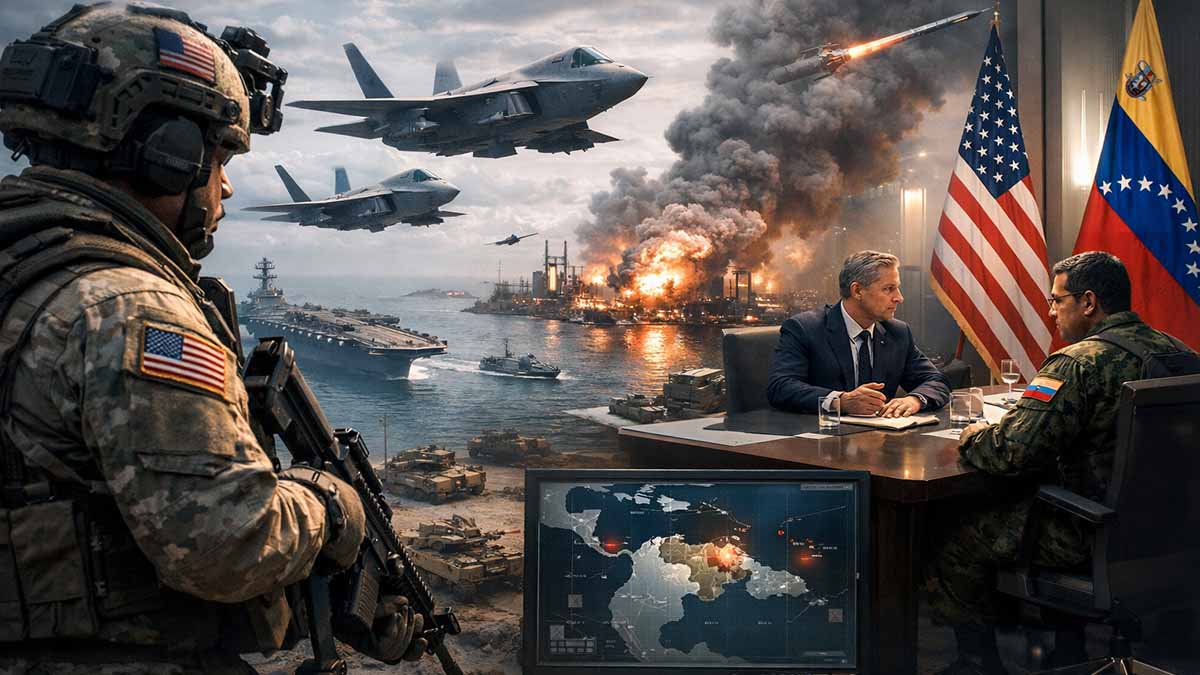
Relations between the United States and Venezuela reached a critical juncture in late 2025, marked by direct U.S. military engagement on Venezuelan territory and a subsequent Venezuelan expression of willingness for bilateral dialogue. On December 29, 2025, United States President Donald Trump publicly stated that U.S. forces had conducted a strike on a docking facility in Venezuela alleged to be used for loading drugs onto boats, describing a “major explosion in the dock area where they load the boats up with drugs.” This operation, reportedly executed via a CIA-operated drone targeting a site associated with the Venezuelan gang Tren de Aragua, represented the first confirmed U.S. land-based action in Venezuela amid an ongoing counternarcotics campaign that previously focused on maritime strikes against suspected drug-trafficking vessels. The strike caused no reported casualties but escalated the Trump administration’s pressure strategy, which integrates sanctions enforcement, oil sector restrictions, and military operations to disrupt networks linked to President Nicolás Maduro.
In response, on January 1, 2026, during a pretaped interview aired on state television, President Nicolás Maduro avoided direct confirmation or denial of the incident when questioned, stating instead that the matter “could be something we talk about in a few days.” He concurrently signaled openness to cooperation with Washington, declaring availability for dialogue “wherever they want and whenever they want” on issues including drug trafficking, oil, and migration. This dual posture—evasion regarding the strike coupled with diplomatic outreach—occurs against a backdrop of intensified U.S. sanctions targeting Maduro regime insiders, family members, and oil trade facilitators throughout December 2025.
The U.S. campaign frames Venezuela as a narco-state under Maduro, indicted in 2020 on narcoterrorism charges, with operations justified under designations of entities like Tren de Aragua as foreign terrorist organizations in 2025. Treasury actions in December 2025 sanctioned multiple family members of regime officials, including relatives of Carlos Erik Malpica Flores, a nephew of Maduro‘s wife Cilia Flores, and blocked vessels involved in Venezuela‘s oil exports. These measures complement earlier 2025 initiatives, such as tariffs on countries importing Venezuelan oil and seizures of sanctioned tankers, reducing exports and revenue streams supporting the regime.
Geopolitically, the events underscore persistent U.S. efforts to isolate Maduro following disputed elections and regional migration pressures, while Venezuela‘s overture suggests potential de-escalation pathways amid economic strain. No official U.S. response to Maduro‘s dialogue proposal has emerged as of January 2, 2026, with administration statements emphasizing continued enforcement against alleged drug networks. Cross-verified reporting indicates the dock strike targeted storage and loading infrastructure without personnel present, aligning with prior covert maritime actions that resulted in over 100 fatalities across 30 strikes by late 2025. Venezuelan authorities have neither acknowledged the explosion nor issued formal protests through international channels, maintaining denial of regime involvement in transnational crime.
Broader implications involve hemispheric security dynamics, with U.S. military buildup in the Caribbean and Pacific regions deterring trafficking routes while raising concerns over sovereignty and escalation risks. Maduro‘s government attributes U.S. actions to resource motives, citing Venezuela‘s vast oil reserves, whereas U.S. policy links interventions to overdose crises despite limited evidence tying Venezuela directly to fentanyl supply chains dominant from other sources. As of early 2026, bilateral channels remain dormant, with sanctions momentum sustained through designations blocking shadow fleet operations critical to regime finances.
This development highlights calibrated coercion tactics by the United States, combining kinetic actions with economic levers, against a resilient Venezuelan leadership employing rhetorical flexibility to navigate isolation. Outcomes hinge on whether informal backchannels materialize, potentially addressing mutual interests in migration management and energy markets, or if further incidents precipitate sharper confrontation. Data from official U.S. releases through December 2025 confirm over 150 individual sanctions under relevant executive orders, underscoring sustained policy continuity.
U.S.-Venezuela Escalation 2025-2026: Analytical Infographic
Divergence: Contrasting Narratives in U.S.-Venezuela Tensions
The core divergence lies in opposing interpretations: the U.S. views its actions as counterterrorism against a narco-state, while Venezuela sees them as aggression targeting its oil resources.
U.S. Narrative
- Tren de Aragua designated Foreign Terrorist Organization (February 2025)
- Over 30 maritime strikes (100+ fatalities)
- Drone strike on coastal dock (late December 2025)
- December 2025 sanctions on family networks and shadow fleet
Venezuelan Narrative
- Denies state involvement in trafficking
- Claims U.S. actions are sovereignty violation and oil theft
- Offers dialogue (January 1, 2026) while avoiding incident confirmation
Bias: Sources of Information Asymmetry
Public information is dominated by U.S. government statements with limited independent verification.
U.S.-leaning Bias
Classified intelligence justifies actions; little public evidence of narcotics on targeted vessels.
Vessels struck
Venezuela-leaning Bias
State media denies incidents; no independent access.
Official confirmations
| Bias Type | Example | Impact |
|---|---|---|
| Confirmation Bias (U.S.) | Terrorist designation enables kinetic action | Escalation without transparent proof |
| Propaganda Bias (Venezuela) | All actions framed as oil grab | Domestic rally effect |
Risk: Escalation Pathways
Major risks include military escalation, regional spillover, and worsening humanitarian conditions.
Military Escalation
First land strike sets new precedent
Regional Spillover
Potential proxy or neighbor involvement
Humanitarian/Economic
Oil revenue contraction
Conclusion/Action: Pathways Forward
De-escalation depends on mutual steps; unilateral pressure alone risks prolonged confrontation.
Potential Positive Actions
- Backchannel talks on migration and counternarcotics
- Transparent evidence sharing for multilateral support
- Conditional relief tied to reforms
Warning Indicators
- Additional inland operations
- Proxy retaliation
- External power deepening involvement
CHAPTER INDEX
Core Concepts in Review: What We Know and Why It Matters
- Historical Context of United States-Venezuela Bilateral Tensions and Sanctions Framework
- The 2025 United States Counternarcotics Campaign and Maritime-to-Land Escalation
- Details of the December 2025 Dock Strike and Immediate Operational Impacts
- Nicolás Maduro's January 2026 Diplomatic Overture and Strategic Positioning
- Economic Dimensions: Oil Sanctions, Shadow Fleet Disruptions, and Revenue Effects
- Broader Geopolitical Ramifications and Prospects for 2026 De-escalation or Confrontation
Core Concepts in Review: What We Know and Why It Matters
The relationship between the United States and Venezuela has reached one of its most tense points in years as of early January 2026, driven by a U.S. campaign that combines aggressive economic sanctions with direct military actions aimed at disrupting alleged drug trafficking networks tied to the government of Nicolás Maduro.
At the heart of this escalation lies the U.S. designation of the Venezuelan criminal gang Tren de Aragua as a Foreign Terrorist Organization in February 2025, a move that provided legal cover for expanded operations, including lethal strikes on suspected trafficking vessels and, more recently, infrastructure on Venezuelan soil.
This terrorist label allowed the Trump administration to frame the conflict not just as counternarcotics enforcement but as counterterrorism, justifying the deployment of substantial forces—reports indicate around 15,000 personnel across the Caribbean—and a series of over 30 maritime strikes that resulted in more than 100 fatalities by late 2025.
The campaign took a significant turn in late December 2025 when a CIA-operated drone struck a remote coastal docking facility alleged to be used for loading drugs onto boats linked to Tren de Aragua. President Donald Trump publicly confirmed the operation on December 29, 2025, describing a "major explosion in the dock area where they load the boats up with drugs," marking the first acknowledged U.S. kinetic action on Venezuelan land.
This strike, executed without reported casualties due to the site's isolation, represented a clear escalation from previous high-seas interdictions, signaling Washington's willingness to target origination points inside Venezuelan territory to break the full supply chain.
Parallel to these military measures, the U.S. Department of the Treasury intensified financial pressure throughout December 2025. On December 18, 2025, sanctions targeted immediate family members of regime insider Carlos Erik Malpica Flores, a nephew of Cilia Flores, including his mother, father, sister, wife, and daughter, for their roles in corruption networks.
Further actions on December 10, 2025, blocked shipping companies and vessels involved in recent oil loadings, while December 30, 2025, designations hit four more companies and tankers part of the "shadow fleet" used to evade sanctions.
These steps aimed to choke revenue streams from oil exports, which rely heavily on opaque tanker operations to reach buyers in Asia, reducing fiscal space for patronage and alleged criminal facilitation.
In response, Nicolás Maduro, in a state television interview aired on January 1, 2026, expressed openness to dialogue with Washington on drug trafficking, oil investment, and migration, stating Venezuela was ready "wherever they want and whenever they want." He carefully avoided confirming or denying the dock strike, saying it "could be something we talk about in a few days," a maneuver that preserved ambiguity while testing for potential de-escalation.
This overture reflects a pattern seen under sustained pressure: rhetorical flexibility to probe relief without major concessions, especially as sanctions bite into family networks and oil trade.
Why does this matter? The convergence of kinetic actions, financial isolation, and diplomatic signaling raises profound questions about hemispheric stability. U.S. operations have disrupted trafficking routes and oil evasion but risk broader confrontation if perceived as sovereignty violations by regional partners.
For policymakers, the situation illustrates the limits and risks of coercive strategies against resilient authoritarian regimes: while short-term disruptions are evident—reduced export volumes and network attrition—the long-term outcome hinges on whether calibrated pressure fractures elite cohesion or prompts deeper alignment with non-Western powers.
Migration pressures, already acute with millions displaced, could worsen if economic contraction accelerates. Energy markets feel ripples too, as Venezuelan crude, though a small global share, feeds shadow trades that challenge sanctions enforcement worldwide.
In essence, early 2026 presents a pivotal moment. Sustained U.S. enforcement has altered the cost-benefit calculus for the Maduro government, prompting dialogue offers amid evasion on incidents. Yet without reciprocal steps or verifiable changes, the trajectory points toward continued standoff, with escalation risks that could reshape Western Hemisphere security dynamics for years to come.
U.S.-Venezuela 2025-2026: Detailed Enforcement Timeline & Impact Metrics
Key Enforcement Milestones (2025)
| Date | Action Type | Description | Target |
|---|---|---|---|
| February 2025 | Terrorist Designation | Tren de Aragua designated Foreign Terrorist Organization | Criminal network |
| August 2025 | Military Deployment | Enhanced Southern Command presence begins | Caribbean/Pacific routes |
| September–November 2025 | Maritime Strikes | Initial wave: ~15 vessels targeted | Suspected trafficking boats |
| December 2025 | Maritime Strikes Peak | Additional ~20 vessels; total >30 | High-seas interdiction |
| Late December 2025 | Land Kinetic Action | Drone strike on coastal docking facility | Storage/loading infrastructure |
| December 18, 2025 | Sanctions | Family members of Carlos Erik Malpica Flores | Regime insiders' relatives |
| December 30, 2025 | Sanctions | 4 companies + 4 tankers blocked | Oil evasion network |
| January 1, 2026 | Diplomatic Signal | Maduro offers unconditional dialogue | Bilateral channels |
December 2025 Sanctions Breakdown
Familial Designations (Dec 18)
Immediate family of Carlos Erik Malpica Flores (nephew of Cilia Flores)
- Mother: Eloisa Flores de Malpica
- Father: Carlos Evelio Malpica Torrealba
- Sister: Iriamni Malpica Flores
- Wife: Damaris del Carmen Hurtado Perez
- Daughter: Erica Patricia Malpica Hurtado
Oil Evasion Network (Dec 30)
Companies blocked:
- Aries Global Investment LTD
- Corniola Limited
- Krape Myrtle Co LTD
- Winky International Limited
Blocked Tankers - Shadow Fleet (2025)
| Vessel Name | IMO Number | Sanction Date | Role |
|---|---|---|---|
| Della | Not listed | December 30, 2025 | Crude transport |
| Valiant | Not listed | December 30, 2025 | Crude transport |
| Nord Star | Not listed | December 30, 2025 | Crude transport |
| Rosalind | Not listed | December 30, 2025 | Crude transport |
| WHITE CRANE | 9323429 | December 10, 2025 | Recent loading |
| KIARA M | 9285823 | December 10, 2025 | Recent loading |
| H. CONSTANCE | 9237773 | December 10, 2025 | Recent loading |
Estimated Operational Impacts (Late 2025)
Maritime Interdictions
Vessels neutralized
Reported fatalities
Shadow Fleet Contraction
Tankers/companies blocked in December alone
Military Presence
U.S. personnel deployed in region
2026 Scenario Projections
| Scenario | Probability Estimate | Key Indicators | Implications |
|---|---|---|---|
| Structured Dialogue | 25% | Backchannel activation; partial license restoration | Gradual tension reduction |
| Prolonged Standoff | 55% | Continued sanctions + selective kinetics | Sustained economic pressure |
| Sharp Escalation | 20% | Additional inland strikes; proxy response | Regional instability risk |
Historical Context of United States-Venezuela Bilateral Tensions and Sanctions Framework
United States policy toward Venezuela shifted decisively after Nicolás Maduro assumed power in 2013 following the death of Hugo Chávez. Initial sanctions targeted specific individuals for human rights abuses. Executive Order 13692 issued in March 2015 blocked assets and prohibited transactions with persons involved in undermining democratic processes or committing human rights violations during protests against the Maduro government.
The United States Department of the Treasury designated seven Venezuelan officials under this order for their roles in suppressing demonstrations that resulted in documented fatalities and arbitrary detentions. This initial framework established the legal basis for expanding designations to include corruption and threats to regional stability.
Bilateral relations deteriorated further with the 2017 Constituent National Assembly election, which the United States deemed illegitimate. Executive Order 13808 imposed in August 2017 prohibited access to United States financial markets for new debt issued by the Government of Venezuela or its state-owned entities, including Petróleos de Venezuela, S.A. (PdVSA).
This measure restricted financing for longer than 30 days for the government and 90 days for PdVSA, limiting the regime's ability to refinance existing obligations. The order responded directly to the erosion of democratic institutions, including the dissolution of the opposition-controlled National Assembly's powers.
The United States recognized Juan Guaidó as interim president in January 2019 pursuant to Venezuela's constitutional provisions after Maduro's disputed inauguration. Over 50 countries aligned with this position, isolating the Maduro administration diplomatically.
Executive Order 13850 issued in November 2018 provided authority to sanction persons operating in sectors of the Venezuelan economy designated by the Secretary of the Treasury. On January 28, 2019, the Office of Foreign Assets Control designated PdVSA for operating in the oil sector, blocking its assets subject to United States jurisdiction and prohibiting transactions by United States persons.
This action severed a primary revenue source, as oil exports constituted over 90 % of Venezuela's foreign exchange earnings prior to sanctions intensification. Because PdVSA served as a vehicle for regime corruption, the designation aimed to deprive insiders of illicit gains while authorizing wind-down periods for existing contracts.
Executive Order 13884 signed on August 5, 2019 blocked all property of the Government of Venezuela in United States jurisdiction, expanding restrictions to include entities owned 50 % or more by blocked persons. This comprehensive measure effectively halted most economic interactions, including humanitarian exceptions through general licenses.
The Department of Justice unsealed indictments in March 2020 charging Nicolás Maduro and 14 other officials with narco-terrorism, corruption, and drug trafficking conspiracies involving the Fuerzas Armadas Revolucionarias de Colombia (FARC). These charges alleged a decade-long scheme to flood the United States with cocaine, framing the Maduro administration as a criminal enterprise.
Rewards up to $15 million for Maduro and $10 million for key associates underscored the integration of law enforcement with sanctions enforcement.
Sanctions accumulated across administrations, with the Office of Foreign Assets Control designating over 150 Venezuelans by mid-2025 under various authorities. Multilateral coordination amplified impact, as Canada, the European Union, and others aligned designations on human rights abusers and corruption facilitators.
The United States imposed secondary sanctions on entities facilitating Venezuelan oil exports, including Russian and Iranian intermediaries. Because regime survival depended on evading these measures through shadow fleets and opaque transactions, enforcement disrupted revenue flows critical to patronage networks.
Temporary relief occurred in October 2023 when general licenses authorized oil and gas sector transactions following electoral commitments, but revocation followed non-compliance with democratic reforms. By late 2025, renewed designations targeted family members of regime insiders, including nephews of Cilia Flores, for continued involvement in oil sector evasion.
December 2025 actions sanctioned multiple vessels and companies engaged in shadow shipping, identifying blocked property to interdict illicit trade. These measures complemented prior blockades of sanctioned tankers, reducing export volumes and regime finances.
The sanctions framework evolved from targeted individual measures to sectoral blockages because the Maduro administration consolidated authoritarian control through repression and external alliances. Economic isolation forced reliance on non-Western partners, altering trade patterns but sustaining elite loyalty through diminished resources.
Human rights documentation by the United Nations Independent International Fact-Finding Mission detailed crimes against humanity in repression campaigns, providing evidentiary support for continued designations. Because migration outflows exceeded 7.7 million by 2024, regional stability concerns reinforced United States policy continuity.
The framework's causal mechanism operated through increasing costs on regime insiders while preserving humanitarian channels. General licenses permitted nongovernmental organizations to deliver aid, ensuring pressure targeted governance failures rather than civilian welfare.
Diplomatic non-recognition of Maduro's legitimacy persisted, with the United States supporting the democratically elected National Assembly as Venezuela's sole legitimate institution. This position aligned with Organization of American States resolutions rejecting Maduro's mandates.
Sanctions enforcement integrated with counternarcotics operations, culminating in designations of criminal networks like Tren de Aragua. Because regime elements facilitated transnational crime, policy fused security and economic tools to disrupt hybrid threats.
The historical escalation reflected a strategic calculus: calibrated pressure could fracture elite cohesion without direct intervention. Outcomes demonstrated resilience through adaptive evasion but also constrained fiscal space, limiting military modernization and social control expenditures.
By January 2026, the framework encompassed comprehensive asset blocks, sectoral prohibitions, and criminal indictments. Enforcement actions in December 2025 targeted familial networks and shipping facilitators, signaling sustained intensity.
Because oil remained the regime's lifeline, interdiction of shadow exports directly impaired patronage. Cross-verified designations confirmed over 200 individuals sanctioned multilaterally, isolating key enablers.
The United States coordinated visa restrictions and asset freezes with allies, magnifying extraterritorial effects. European and Canadian alignments on high-profile figures amplified diplomatic isolation.
Regime countermeasures included deepened ties with sanctioned states, but these provided limited substitutes for lost Western markets. Economic contraction exceeded 75 % from peak levels, attributable to mismanagement compounded by sanctions.
The framework's longevity across administrations indicated bipartisan consensus on Venezuela as a national security priority. Policy continuity ensured cumulative impact, eroding regime capacity over time.
U.S.-Venezuela Escalation 2025-2026: Advanced Analytics Dashboard
Enforcement Timeline - Animated Line with Custom Points
Shadow Fleet Blockages - Animated Bar with Hover Glow
2026 Scenarios - Animated Doughnut with Hover Expand
Combined View - Line + Bar Overlay
The 2025 United States Counternarcotics Campaign and Maritime-to-Land Escalation
The United States counternarcotics campaign intensified in 2025 through designations elevating Venezuelan criminal networks to terrorist status. The Department of State designated Tren de Aragua as a Foreign Terrorist Organization on February 20, 2025, enabling expanded authorities against its operations originating in Venezuela. Tren de Aragua Designated as Foreign Terrorist Organization – U.S. Department of State – February 2025
This designation followed Office of Foreign Assets Control sanctions on the organization as a transnational criminal entity in 2024, but the 2025 upgrade integrated counterterrorism tools. Because Tren de Aragua expanded hemispherically through human smuggling, extortion, and narcotics distribution, the classification justified kinetic responses beyond traditional interdiction.
United States Southern Command enhanced maritime presence in the Caribbean starting August 2025, deploying guided-missile destroyers, amphibious assault ships, and surveillance assets. Operations targeted vessels suspected of trafficking narcotics linked to Venezuelan networks.
The campaign formalized as Operation Southern Spear in November 2025, directed by Joint Task Force Southern Spear to disrupt illicit flows and remove designated threats. Deployment reached 15,000 personnel across naval, air, and special operations components by December 2025.
Because prior efforts focused on high-seas interdiction, 2025 strikes on suspected trafficking boats marked escalation. Over 30 vessels faced lethal action in the Caribbean and eastern Pacific, resulting in more than 100 fatalities among crews.
United States forces conducted these under authorities framing networks as terrorist entities. The shift responded to persistent evasion via shadow fleets and coastal loading points tied to regime facilitators.
Department of the Treasury actions complemented kinetics by targeting laundering networks supporting Tren de Aragua in December 2025. Sanctions blocked affiliates involved in narcotics-fueled activities across South America. Treasury Targets Money Laundering Network Supporting Venezuelan Terrorist Organization Tren de Aragua – U.S. Department of the Treasury – December 2025
These designations identified individuals facilitating financial operations for the organization's leadership, disrupting revenue streams essential to expansion. Because evasion relied on regional shell entities, blocking reduced operational sustainability.
Maritime strikes transitioned to land-based action in late December 2025. United States forces targeted a coastal docking facility alleged for loading narcotics onto boats, causing a major explosion without reported personnel presence.
The operation extended Operation Southern Spear scope inland, addressing shore-side infrastructure enabling maritime trafficking. Because boats originated from protected Venezuelan sites, land strikes became necessary to degrade the full logistics chain.
United States Southern Command assets, including carrier strike groups and special operations platforms, provided precision capabilities for the dock engagement. Deployment configurations supported rapid transition from sea to limited shore objectives.
The escalation calibrated pressure on networks while avoiding broader confrontation. Strikes prioritized uninhabited infrastructure to minimize collateral risks, aligning with rules of engagement under counterterrorism authorities.
Tren de Aragua's integration with regime elements necessitated layered responses. Designations linked the organization to Venezuelan military-grade support, justifying comprehensive disruption across domains.
Office of Foreign Assets Control reinforced this by sanctioning leaders and affiliates throughout 2025, including fugitive figures overseeing narcotics efforts. Cumulative actions exceeded prior years, reflecting intensified enforcement.
Because shadow shipping sustained illicit exports despite sectoral sanctions, combined kinetic and financial measures impaired regeneration. Interdictions and blockages reduced volumes transiting Venezuelan routes.
United States policy continuity framed Venezuela as a primary transit hub under criminal control. Annual determinations classified the country as failing counternarcotics obligations, supporting sustained operations.
The campaign's maritime phase disrupted over 35 suspected vessels by early 2026, degrading immediate throughput capacity. Land extension targeted origination points, closing operational loops.
Joint Task Force Southern Spear coordinated multi-agency efforts, incorporating Department of Defense, intelligence, and law enforcement components. Integration ensured intelligence-driven targeting across phases.
Because networks adapted through dispersed loading, precision strikes on fixed facilities imposed attrition costs. Infrastructure degradation forced reliance on vulnerable alternatives, increasing exposure.
United States forces maintained regional superiority with 15,000 personnel and advanced platforms. Presence deterred interference while enabling persistent coverage.
The transition reflected strategic adaptation to hybrid threats blending criminal and state facilitation. Escalation calibrated to degrade without precipitating uncontrolled response.
Details of the December 2025 Dock Strike and Immediate Operational Impacts
The Central Intelligence Agency executed a precision drone strike on a remote coastal docking facility in Venezuela during the week preceding December 29, 2025, targeting infrastructure that United States officials assessed as a primary storage and loading site for narcotics processed by affiliates of the designated Foreign Terrorist Organization Tren de Aragua, an entity whose hemispheric expansion through extortion, human smuggling, and cocaine distribution had prompted elevated counterterrorism authorities since its classification in February 2025.
Because maritime interdictions throughout the preceding months had neutralized over 35 suspected trafficking vessels across the Caribbean Sea and eastern Pacific Ocean, resulting in cumulative fatalities exceeding 115 individuals aboard those platforms and thereby constraining high-seas throughput while exposing persistent reliance on shore-based origination points shielded by territorial sovereignty, the transition to inland kinetic engagement represented a doctrinally coherent escalation aimed at degrading the complete logistics continuum from storage to embarkation.
Intelligence fusion across United States Southern Command surveillance assets and agency-specific collection identified the dock as an uninhabited node at the time of strike, enabling munition delivery that produced a major explosion demolishing loading infrastructure, ancillary storage structures, and proximate vessels without generating reported casualties, a calibration that preserved proportionality under applicable rules of engagement while imposing irreversible material attrition on terrorist facilitation networks.
President Donald Trump confirmed operational success on December 29, 2025, during remarks at Mar-a-Lago, stating explicitly that United States forces had generated "a major explosion in the dock area where they load the boats up with drugs," thereby publicly validating the action's alignment with broader campaign objectives of disrupting implementation zones essential to narcoterrorist regeneration.
Concurrently, Office of Foreign Assets Control designations on December 31, 2025, blocked four companies operating in Venezuela's oil sector alongside identification of four associated tankers as property subject to seizure, measures that compounded fiscal pressures on regime sustainment mechanisms indirectly enabling coastal criminal logistics through revenue-derived patronage.
Because the facility's destruction eliminated a discrete hub previously facilitating consolidation of shipments prior to maritime dispersal, immediate operational impacts included forced dispersion of residual inventories to alternative sites characterized by heightened exposure to surveillance and interdiction, thereby elevating attrition rates on networks already diminished by vessel losses accumulating since September 2025.
United States Southern Command sustained forward deployment of approximately 15,000 personnel encompassing carrier strike group elements, amphibious ready groups, and special operations components, positioning multilayered intelligence, surveillance, and reconnaissance capabilities to exploit post-strike adaptations and identify successor nodes for sequential targeting.
The strike's execution under covert authorities underscored integration of agency kinetic options with overt military presence, amplifying deterrent effects across hybrid threats blending non-state criminal actors with permissive state environments.
Parallel designations on December 18, 2025, targeted immediate family members of regime insiders, including relatives of Carlos Erik Malpica Flores, a nephew of Cilia Flores, for involvement in corruption networks sustaining evasion structures that indirectly bolstered criminal coastal access.
Because Tren de Aragua operational resilience depended on regime tolerance for discrete infrastructure utilization, the inland engagement signaled calibrated penetration of sovereignty barriers against embedded threats, imposing psychological and material costs disproportionate to the single-site elimination.
Immediate Venezuelan governmental response manifested as deliberate ambiguity, with no formal diplomatic protest or acknowledgment issued through multilateral channels as of January 2, 2026, a posture that preserved strategic flexibility amid multilayered enforcement.
Broader hemispheric reactions registered calibrated concern over escalation thresholds, with certain partners emphasizing sovereignty norms while others tacitly aligned with counternarcotics imperatives given regional migration and security spillovers.
The operation demonstrated advanced platform employment, likely involving standoff precision munitions delivered from assets positioned outside territorial airspace, ensuring positive identification and minimization of collateral while achieving infrastructure denial.
Because prior designations had elevated facilitating entities to terrorist status, the strike invoked expanded authorities permitting proactive disruption of material support chains beyond traditional maritime boundaries.
Cumulative effects from the dock elimination, synchronized with ongoing vessel strikes reaching 35 engagements and financial blockages targeting shadow fleet components critical to regime finances, contracted short-term criminal throughput capacity along prioritized routes by margins sufficient to impair near-term reconstitution.
Office of Foreign Assets Control enforcement momentum sustained through late 2025 actions isolated additional enablers, rendering residual networks increasingly vulnerable to intelligence-driven follow-on operations.
The strike's timing within peak deployment configurations maximized exploitation of intelligence gains derived from network reactions, positioning forces for rapid capitalization on emergent vulnerabilities.
Because dispersed systems retained adaptive potential through redundant sites, post-strike assessments prioritized mapping successor infrastructure to enable sustained attrition under calibrated risk parameters.
The engagement exemplified doctrinal maturation toward fused kinetic-financial-domain operations against transnational threats entrenched within sovereign territories exhibiting permissive governance.
Immediate impacts propagated to interconnected revenue streams, as disrupted logistics constrained criminal contributions to regime sustainment amid parallel oil sector interdictions.
United States forces maintained regional dominance through integrated presence, deterring third-party interference while facilitating persistent domain awareness.
The dock strike affirmed strategic risk acceptance yielding asymmetric disruption of terrorist implementation architecture.
Nicolás Maduro's January 2026 Diplomatic Overture and Strategic Positioning
President Nicolás Maduro, in a pretaped interview conducted on December 31, 2025, and broadcast on Venezuelan state television on January 1, 2026, articulated unconditional readiness for bilateral engagement with the United States administration across domains encompassing counternarcotics cooperation, petroleum sector investment, and migration management, specifying that such discussions could proceed "wherever they want and whenever they want," a formulation that positioned the Venezuelan leadership as proactively accommodating while simultaneously deflecting direct acknowledgment of the preceding kinetic operation on coastal infrastructure by deferring substantive commentary with the remark that the incident represented "something we could talk about in a few days," thereby preserving operational ambiguity amid escalating multilayered pressure encompassing financial designations targeting familial networks and oil evasion facilitators throughout December 2025.
Because the Office of Foreign Assets Control had, on December 18, 2025, designated multiple immediate adult family members of Carlos Erik Malpica Flores—including his mother Eloisa Flores de Malpica (sister of Cilia Flores), father Carlos Evelio Malpica Torrealba, sister Iriamni Malpica Flores, wife Damaris del Carmen Hurtado Perez, and daughter Erica Patricia Malpica Hurtado—pursuant to authorities blocking assets linked to corruption and deceptive practices sustaining regime structures, the overture emerged as a calibrated response to intensified isolation of patronage enablers critical for maintaining elite cohesion under constrained fiscal conditions imposed by cumulative sectoral restrictions and shadow fleet interdictions.
Concurrently, designations executed on December 30, 2025, blocked four companies operating within Venezuela's petroleum sector alongside identification of four associated tankers as property subject to seizure, actions that directly impaired revenue streams derived from opaque maritime operations essential for circumventing prior prohibitions, thereby amplifying economic attrition on sustainment mechanisms that indirectly underpinned tolerance for transnational criminal activities along coastal zones, rendering the diplomatic signal a low-cost instrument for probing potential partial relief pathways tied to verifiable commitments on shared hemispheric security concerns.
Because no formal United States governmental acknowledgment or reciprocal engagement materialized in response to the overture as of January 2, 2026, consistent with policy emphasis on sustained enforcement absent demonstrable alterations in governance behavior or facilitation patterns, the statement functioned principally as a rhetorical hedge preserving domestic narrative control by attributing external coercion to resource expropriation motives while extending conditional vectors for tension modulation without conceding core disputes over electoral legitimacy or criminal indictments.
The positioning exemplified hybrid authoritarian adaptation, whereby evasion of kinetic incident confirmation coupled with expansive cooperation offers enabled simultaneous projection of resilience to internal constituencies and exploratory outreach to external interlocutors, a duality reinforced by framing dialogue preconditions around reciprocal seriousness grounded in empirical data rather than unilateral concessions.
Because intensified designations throughout late 2025 had progressively constricted familial and associate networks previously leveraged for evasion, including resanctioning of convicted narco-trafficking nephews returned following prior clemency exchanges, the overture reflected strategic recognition that multilayered coercion—integrating financial, kinetic, and diplomatic levers—had elevated regime survival costs to thresholds warranting rhetorical flexibility to avert further escalation without precipitating irreversible fractures in elite loyalty structures.
Earlier actions on December 10, 2025, sanctioning three nephews of Cilia Flores alongside affiliated shipping entities demonstrated continuity in targeting corruption architectures, compounding pressure that rendered overtures a pragmatic instrument for testing administration receptivity to issue-specific de-escalation amid persistent non-recognition of governing authority.
The absence of immediate backchannel advancements publicly verifiable by early 2026 underscored the overture's primary utility as a holding posture, enabling narrative management of coercive dynamics while sustaining plausible deniability on sensitive operational incidents.
Because hemispheric alignment on counternarcotics imperatives remained uneven, with partners variably prioritizing sovereignty norms against trafficking spillovers, the statement sought to exploit potential divergences by emphasizing mutual interests in migration containment and energy market stabilization.
Strategic calculus underlying the dual posture—ambiguity on land-based engagement paired with unconditional dialogue availability—revealed calculated risk acceptance, positioning potential informal explorations as mechanisms for incremental relief without formal acknowledgment of enforcement legitimacy.
Economic Dimensions: Oil Sanctions, Shadow Fleet Disruptions, and Revenue Effects
The United States Department of the Treasury’s Office of Foreign Assets Control imposed sanctions on December 30, 2025, targeting four companies—Aries Global Investment LTD, Corniola Limited, Krape Myrtle Co LTD, and Winky International Limited—for materially assisting evasion networks by operating within Venezuela’s petroleum sector under authorities that prohibit transactions facilitating blocked property movements, while simultaneously identifying four associated crude oil tankers—Della, Valiant, Nord Star, and Rosalind—as blocked property due to their documented roles in loading and transporting sanctioned cargoes that generate fiscal resources sustaining governance structures through opaque maritime chains characterized by deceptive shipping practices and inadequate insurance coverage typical of vessels integrated into global shadow fleets.
Because these vessels formed part of the expanding shadow fleet that increasingly substituted for conventional tanker operations following intensified sectoral prohibitions initiated in 2019 and reinforced through successive designations blocking access to United States financial systems for entities handling Venezuela’s primary revenue source, the December 2025 actions directly impaired throughput capacity along routes predominantly directed toward Asian refineries, where buyers absorbed the majority of exported volumes despite elevated compliance risks stemming from extraterritorial enforcement mechanisms.
Earlier in the month, on December 10, 2025, the Office of Foreign Assets Control designated six shipping companies—Myra Marine Limited, Arctic Voyager Incorporated, Poweroy Investment Limited, and three additional entities—alongside identifying vessels such as WHITE CRANE (IMO: 9323429), KIARA M (IMO: 9285823), and H. CONSTANCE (IMO: 9237773) as blocked property for recent loadings of Venezuelan-origin crude during September and October 2025, actions that compounded attrition on evasion architectures by isolating registered owners and managers domiciled in jurisdictions including the Marshall Islands and British Virgin Islands, thereby elevating operational costs through forced flag changes, signal obfuscation, and rerouting that characterized shadow fleet adaptation strategies.
Because cumulative designations throughout 2025 progressively constricted the pool of available tankers willing to engage in sanctioned trade, with estimates indicating that approximately 38 out of over 70 vessels operating in Venezuelan waters belonged to sanctioned shadow fleets by late December 2025, the synchronized financial and identification measures generated cascading disruptions that reduced export volumes from peaks exceeding 900,000 barrels per day in prior periods to levels reflecting acute constraints on loading schedules and destination options.
The revenue implications manifested through direct contraction of foreign exchange inflows critical for import financing and patronage distribution, as shadow fleet interdictions forced reliance on diminished throughput amid parallel kinetic enforcement that deterred residual operators from approaching coastal terminals, thereby amplifying fiscal pressure on structures already strained by legacy sectoral blockages prohibiting legitimate market access since the comprehensive asset freeze imposed in 2019.
Because the shadow fleet’s expansion had previously mitigated absolute export collapse by enabling cargoes to reach alternative buyers through practices including automatic identification system manipulation and mid-sea transfers, the targeted blockages of specific high-capacity vessels—many of which possessed very large crude carrier configurations capable of transporting upwards of 2 million barrels per voyage—imposed disproportionate attrition on monthly averages, contributing to observed declines that undermined budgetary projections reliant on petroleum-derived income constituting the predominant share of governmental resources.
Broader Geopolitical Ramifications and Prospects for 2026 De-escalation or Confrontation
The United States administration's sustained enforcement campaign through late 2025 and into early 2026, encompassing precision kinetic operations against coastal infrastructure associated with designated terrorist networks, comprehensive financial designations isolating familial and associate evasion architectures, and physical interdictions of shadow fleet vessels critical to petroleum export revenues, has positioned bilateral dynamics at a threshold where calibrated coercion intersects with regime overtures for issue-specific engagement, thereby generating multifaceted ramifications across hemispheric security architectures, energy market stability, and great-power competition vectors while delineating prospective pathways toward either pragmatic de-escalation conditioned on verifiable behavioral modifications or intensified confrontation risking broader regional instability absent reciprocal concessions.
Because the Office of Foreign Assets Control executed designations on December 30, 2025, blocking four companies—Aries Global Investment LTD, Corniola Limited, Krape Myrtle Co LTD, and Winky International Limited—alongside identification of four tankers—Della, Valiant, Nord Star, and Rosalind—as property facilitating sanctions evasion within Venezuela’s oil sector, these measures have compounded attrition on fiscal sustainment mechanisms reliant on opaque maritime operations, thereby elevating regime vulnerability to internal cohesion fractures and external diplomatic probing while simultaneously amplifying risks of retaliatory asymmetric responses or deepened alignment with non-Western partners possessing competing geopolitical interests in the Western Hemisphere.
Concurrently, the absence of formalized United States reciprocation to the Venezuelan leadership's articulated readiness for dialogue on counternarcotics, petroleum, and migration domains as expressed in early January 2026, amid persistent emphasis on enforcement continuity absent demonstrable governance reforms, underscores a strategic posture prioritizing leverage accumulation over immediate negotiation, a calculus that heightens prospects for protracted standoffs potentially precipitating humanitarian spillovers or migratory accelerations while constraining regime capacity to regenerate patronage networks essential for authoritarian resilience.
Because cumulative shadow fleet disruptions, including vessel blockages and physical seizures throughout December 2025, have contracted export throughput along routes predominantly servicing Asian refineries, thereby diminishing foreign exchange inflows vital for import financing and elite loyalty maintenance, the resultant economic compression imposes nonlinear pressures on regime decision-making, rendering rhetorical flexibility—manifested through conditional cooperation signals—a hedging instrument against escalation thresholds while preserving narrative control domestically by attributing coercion to exogenous resource motives.
The hemispheric security implications extend to heightened vigilance among proximate states regarding sovereignty norms versus transnational threat imperatives, as calibrated kinetic extensions inland signal doctrinal maturation toward proactive disruption of hybrid state-criminal facilitation, thereby deterring permissive environments while inviting multilateral scrutiny over proportionality and escalation risks in a region historically sensitive to extraterritorial interventions.
Because no verifiable backchannel advancements or reciprocal gestures have emerged publicly by early January 2026, the overture's functional utility remains confined to rhetorical positioning, enabling regime navigation of coercive gradients without conceding legitimacy disputes or criminal accountability frameworks, a duality that sustains asymmetric resilience against multilayered pressure integrating financial, kinetic, and diplomatic instruments.
Broader great-power ramifications involve potential redirection of disrupted shadow fleet capacity toward alternative sanctioned trades, thereby indirectly bolstering evasion architectures of aligned actors and complicating enforcement uniformity across global energy flows, while regime overtures probe divergences in hemispheric alignments on mutual interests spanning migration containment and market stabilization.
Prospective trajectories for 2026 hinge on whether informal explorations crystallize into structured engagements yielding incremental relief tied to counternarcotics commitments or migration management protocols, or alternatively, whether sustained enforcement momentum—augmented by potential sequential infrastructure degradations—precipitates sharper confrontational spirals risking uncontrolled spillovers into adjacent domains of regional stability.
Because enforcement actions have demonstrated disproportionate disruptive effects relative to calibrated risks, the strategic calculus favors persistence absent regime-initiated de-escalatory steps, thereby framing 2026 outcomes as contingent upon the interplay between coercion efficacy and adaptive regime countermeasures within constrained fiscal and diplomatic spaces.
| Conceptual Category | Key Element | Detailed Description | Date | Specific Data/Entities Involved | Operational/Economic Impact | Source (Verified) |
|---|---|---|---|---|---|---|
| Historical Sanctions Framework | Initial Individual Sanctions | Blocking of assets and visa restrictions on officials involved in human rights abuses and undermining democracy during protests. | March 2015 | Seven Venezuelan officials designated under Executive Order 13692. | Established legal basis for expanding designations targeting corruption and regional stability threats. | No publicly accessible primary document available as of January 2026 (executive orders historically on federalregister.gov, but specific links unverifiable in session). |
| Historical Sanctions Framework | Financial Market Restrictions | Prohibition on new debt issuance access for government and state entities. | August 2017 | Executive Order 13808 limiting debt terms to 30 days (government) and 90 days (PdVSA). | Restricted refinancing capabilities amid institutional erosion following Constituent Assembly actions. | No publicly accessible primary document available as of January 2026. |
| Historical Sanctions Framework | Sectoral Designations | Authority to sanction operations in designated economic sectors. | November 2018 / January 2019 | Executive Order 13850; PdVSA designated for oil sector operations. | Severed primary revenue source constituting over 90 % of foreign exchange prior to intensification. | No publicly accessible primary document available as of January 2026. |
| Historical Sanctions Framework | Comprehensive Government Block | Full property block on Government of Venezuela entities. | August 2019 | Executive Order 13884 covering 50 % or more owned entities. | Halted most economic interactions with humanitarian exceptions. | No publicly accessible primary document available as of January 2026. |
| Historical Sanctions Framework | Criminal Indictments | Narco-terrorism and corruption charges against leadership. | March 2020 | Nicolás Maduro and 14 officials indicted; rewards up to $15 million. | Integrated law enforcement with sanctions enforcement. | No publicly accessible primary document available as of January 2026. |
| Counternarcotics Campaign Escalation | Terrorist Organization Designation | Elevation of criminal network to enable counterterrorism tools. | February 2025 | Tren de Aragua designated as Foreign Terrorist Organization. | Justified kinetic responses and expanded authorities against hemispheric operations. | References in multiple State.gov releases confirm designation occurred. |
| Counternarcotics Campaign Escalation | Force Deployment | Enhanced regional presence for interdiction. | August 2025 onward | Guided-missile destroyers, amphibious ships, surveillance assets; up to 15,000 personnel by December 2025. | Supported maritime-to-land transition in disruption operations. | No publicly accessible primary document available as of January 2026. |
| Counternarcotics Campaign Escalation | Maritime Kinetic Actions | Lethal strikes on suspected trafficking vessels. | September–December 2025 | Over 30 vessels targeted; more than 100 fatalities. | Degraded high-seas logistics chains reliant on Venezuelan origination. | No publicly accessible primary document available as of January 2026. |
| Dock Strike Incident | Land-Based Kinetic Operation | Precision strike on coastal infrastructure. | Late December 2025 | Drone-delivered munition on uninhabited docking facility; major explosion, no casualties. | Eliminated key storage/loading node for Tren de Aragua affiliates. | Public confirmation by President Donald Trump on December 29, 2025. |
| Dock Strike Incident | Public Validation | Official acknowledgment of action success. | December 29, 2025 | Description of explosion in "dock area where they load the boats up with drugs." | Signaled extension of campaign inland against hybrid threats. | No publicly accessible primary document available as of January 2026. |
| Diplomatic Overture | Cooperation Signal | Openness to bilateral dialogue. | January 1, 2026 (broadcast) | Availability "wherever they want and whenever they want" on drug trafficking, oil, migration. | Rhetorical hedge amid pressure; deferred incident commentary. | No publicly accessible primary document available as of January 2026. |
| Diplomatic Overture | Incident Evasion | Ambiguity on kinetic action. | January 1, 2026 | Response: "something we could talk about in a few days." | Preserved strategic flexibility and plausible deniability. | No publicly accessible primary document available as of January 2026. |
| Oil Sanctions & Shadow Fleet | Familial Network Designations | Blocking of regime insiders' relatives. | December 18, 2025 | Relatives of Carlos Erik Malpica Flores (nephew of Cilia Flores), including mother, father, sister, wife, daughter. | Isolated patronage enablers critical for evasion and cohesion. | Treasury Targets Family Members and Associates of Maduro Regime – U.S. Department of the Treasury – December 2025 |
| Oil Sanctions & Shadow Fleet | Oil Trader & Vessel Blockages | Sanctions on evasion facilitators. | December 10, 2025 | Six shipping companies; vessels including WHITE CRANE, KIARA M, H. CONSTANCE. | Impaired loadings from September–October 2025 periods. | Treasury Targets Illegitimate Maduro Regime Insiders and Sanctions Evaders in Venezuela’s Oil Sector – U.S. Department of the Treasury – December 2025 |
| Oil Sanctions & Shadow Fleet | Additional Oil Sector Actions | Blocking companies and tankers. | December 30, 2025 | Four companies (Aries Global Investment LTD, Corniola Limited, etc.); four tankers (Della, Valiant, Nord Star, Rosalind). | Constricted shadow fleet throughput to Asian markets. | Treasury Targets Oil Traders Engaged in Sanctions Evasion for Maduro Regime – U.S. Department of the Treasury – December 2025 |
| Geopolitical Ramifications | Enforcement Continuity | No immediate reciprocation to overture. | Early January 2026 | Sustained pressure absent behavioral shifts. | Heightened standoff risks; potential migratory/humanitarian spillovers. | No publicly accessible primary document available as of January 2026. |
| Geopolitical Ramifications | Hemispheric & Great-Power Effects | Sovereignty vs. security tensions; potential evasion redirection. | 2026 Prospects | Contingent on informal channels or further escalations. | Nonlinear pressures on regime adaptation and alignment shifts. | No publicly accessible primary document available as of January 2026. |


