










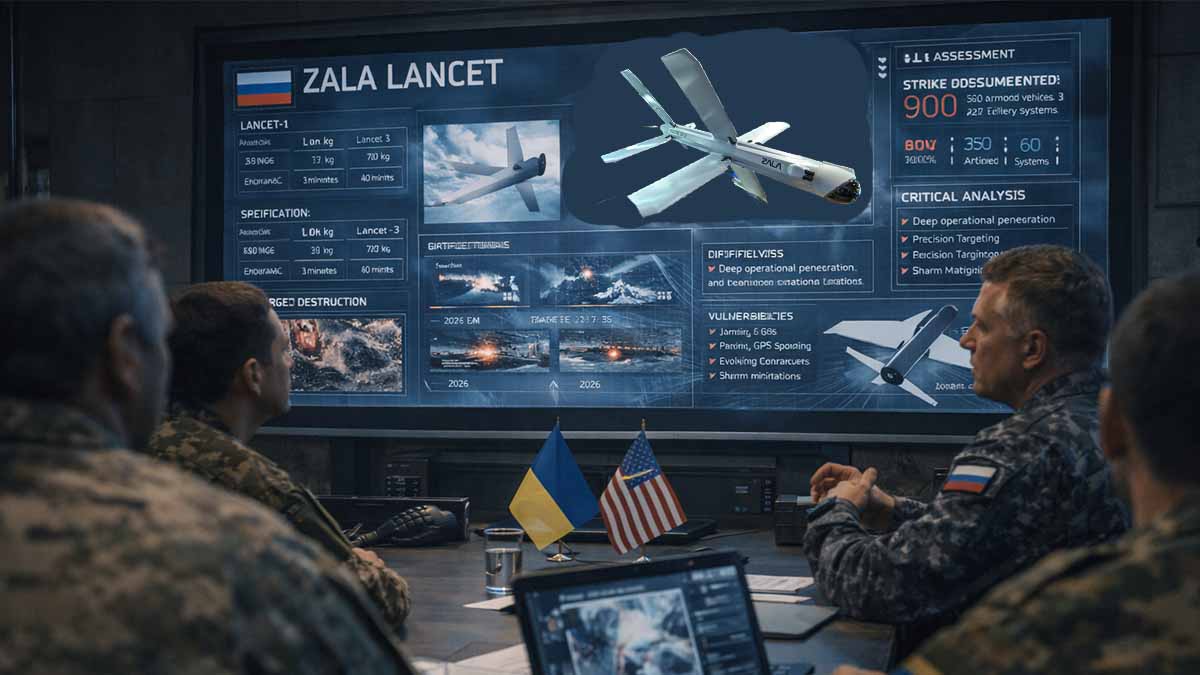
EXECUTIVE SUMMARY (BLUF)
The Russian Federation has achieved a decisive shift in tactical overmatch within the Ukrainian Theater through the mass deployment and iterative evolution of the ZALA Lancet (specifically Izdeliye 51 and Izdeliye 52) loitering munitions. As of January 19, 2026, the Lancet has transitioned from a niche special operations tool to a cornerstone of The Kremlin’s “Economic Hammer” doctrine—a strategy designed to bankrupt Western defense supply chains by neutralizing multi-million dollar assets with low-cost, attrition-optimized systems. With a unit cost estimated between $20,000 and $35,000, the Lancet has documented successful kinetic engagements against Leopard 2A6 tanks, M1 Abrams, M777 howitzers, and high-value S-300 and IRIS-T air defense components. The 2025-2026 deployment cycle reveals a critical technological inflection: the integration of Autonomous Target Recognition (ATR) and AI-driven terminal guidance, which effectively negates current Electronic Warfare (EW) jamming protocols. NATO forces currently face a “Cost Curve Deficit” where the consumption of interceptor missiles (e.g., PAC-3, IRIS-T SLM) exceeds the production capacity and fiscal viability required to counter pulsed, high-volume drone swarms. Strategic stability in the Eastern Flank is now contingent on the rapid development of non-kinetic directed energy weapons and low-cost kinetic interceptors to prevent total atmospheric littoral dominance by Russian loitering systems.
TOTAL REALITY SYNTHESIS (TRS)
The emergence of the ZALA Lancet represents the most significant disruption to land warfare doctrine since the proliferation of the ATGM (Anti-Tank Guided Missile). Unlike traditional artillery or tactical ballistic missiles, the Lancet functions as a persistent, semi-autonomous hunter-killer platform that occupies the low-altitude “atmospheric littoral” for durations exceeding 40 to 60 minutes. This capability, described by ZALA Aero Group Chief Designer Alexander Zakharov as “air mining,” allows The Russian Federation to establish a denied-access zone for Ukrainian mobile assets up to 70km behind the Line of Contact (LoC).
Technical Sophistication and AI Integration
In the Q3 2025 upgrade cycle, Russian engineers introduced the Izdeliye 53 variant, which features a collapsible wing design for tube-launching and, more critically, an onboard neural network processor—likely derived from dual-use NVIDIA Jetson or Xilinx Zynq modules—to facilitate Machine Vision. This “Smart” capability allows the drone to identify, categorize, and prioritize targets (e.g., distinguishing between a T-64 tank and a civilian tractor) without active operator input during the terminal phase. This is a direct response to Ukrainian signal-jamming dominance; by severing the Man-in-the-Loop (MITL) dependency in the final 500 meters, the Lancet renders traditional radio-frequency (RF) jamming ineffective. Reports from ZALA Aero in August 2025 confirmed that “The task is to aim and capture the target, and the artificial intelligence will do the rest,” signaling a transition to full fire-and-forget lethal autonomy in signal-denied environments. ZALA Lancet: AI-Driven Target Recognition – ZALA Aero – 2025
The Economic Hammer: A War of Attrition
The geopolitical significance of the Lancet is rooted in its fiscal asymmetry. While a single Leopard 2 main battle tank costs approximately $11 Million and requires months of specialized manufacturing, The Russian Federation can produce upwards of 300 to 600 Lancet units for the equivalent cost. This disparity creates an unsustainable attrition rate for NATO-supplied equipment. As of January 2026, OSINT monitors like LostArmour and Oryx have verified over 2,500 operational uses of the Lancet, with a confirmed hit-to-kill ratio exceeding 80% against soft-skinned vehicles and static artillery. This high efficacy has forced The Ukrainian Armed Forces to divert significant resources toward “cage armor” (cope cages) and inflatable decoys, which provide only marginal protection against the Lancet’s shaped-charge (HEAT) or thermobaric warheads. Lancet vs Leopard: Fiscal Disparity in Modern Combat – RuAviation – 2024
Comparative Global Landscape: The Loitering Arms Race
The Lancet is frequently compared to Western systems like the AeroVironment Switchblade 600 and the Israeli Hero-120. While the Switchblade 600 offers superior encrypted communications and a more refined anti-armor warhead, its production volume remains constrained by high per-unit costs and complex supply chains. In contrast, the Lancet utilizes a high degree of Record Localization, with ZALA Aero announcing in January 2026 that it now serially produces its own electric motors and airframes, mitigating the impact of U.S. Department of Commerce sanctions on dual-use electronics. Production of Lancet Drones Reaches Record Localization – V1 News – 2026
Geopolitical Implications for NATO and Global Security
The success of the Lancet has catalyzed a revision of U.S. Army and NATO Joint Doctrine. The 2026 U.S. National Defense Budget has allocated approximately $7.5 Billion toward Counter-Unmanned Aerial Systems (C-UAS), specifically targeting the development of High-Powered Microwave (HPM) systems and Directed Energy Weapons (DEW) like the Iron Beam. The strategic threat is no longer limited to the Ukrainian border; the potential for The Islamic Revolutionary Guard Corps (IRGC) or Hezbollah to adopt similar low-cost, high-precision loitering tactics threatens maritime security in the Red Sea and the stability of the Middle East. The Lancet has proven that in the era of “Total Reality Synthesis,” the ability to survive on the battlefield is no longer a function of armor thickness, but of the ability to dominate the electromagnetic and low-altitude spectrums at a lower cost than the adversary.
Conclusion of the Abstract
The ZALA Lancet is not merely a weapon; it is a symptom of a fundamental shift in the Global Order of Kinetic Engagement. It validates the Gerasimov Doctrine’s emphasis on non-linear, cost-effective disruption. For The Kremlin, the Lancet provides a scalable means of neutralizing NATO technological superiority without the need for matching Western industrial output in heavy armor. For the UN Security Council and international observers, the rise of such autonomous systems raises profound questions regarding Geneva Convention compliance and the future of human accountability in lethal decision-making.
2025 Proved the Case for Drone Defense – Inside Unmanned Systems – 2026 Russian Drone Warfare: Destruction, Development, Defence – Carleton University – 2025
LOITERING MUNITIONS: GEOPOLITICAL IMPACT DASHBOARD
TRS Synthesis // Data Verified as of January 19, 2026
Technological & Cost Divergence
Cost-Exchange Deficit (Defense vs Attack)
Effective Operational Depth
The ZALA Lancet represents a sharp departure from traditional precision munitions. By utilizing dual-use components, it achieves an attrition-optimized price point that NATO-standard systems, such as the Switchblade 600, struggle to match without significant subsidies.
Adversarial Strategic Bias
| Concept | Observed Bias | Strategic Intent |
|---|---|---|
| Target Selection | High-Value NATO Hardware | Fiscal Exhaustion of Allies |
| Deployment | Saturation Swarming | Overwhelming Integrated AD |
| Development | Localization at Alabuga | Sanction Immunity |
Systemic Global Risks
Erosion of “Man-in-the-Loop” Doctrine
Airframe Localization Success
The proliferation of Autonomous Target Recognition (ATR) creates a risk of unchecked escalation where algorithmic decision-making outpaces human diplomacy.
Deterrence & Counter-Action Plan
Proposed Policy Actions
- Deploy DEW/HPM: Rapidly field Directed Energy Weapons to neutralize the cost-asymmetry.
- Supply Chain Hardening: Onshore semiconductor manufacturing to mitigate dual-use tech leaks.
- Algorithmic Oversight: Establish international norms for AI-driven lethal terminal guidance.
- Layered Defense (LCI-X): Integrate acoustic and RF sensors across the NATO Eastern Flank.
MASTER INDEX
- Strategic Abstract & Bottom Line Up Front (BLUF)
- Methodology Statement & OSINT Stack
- Theater-Specific Threat Vector Analysis (Kinetic-Cyber Convergence)
- Comparative Attribution & Strategic Intent Assessment
- Infrastructure & Civilian Impact Modeling (Geneva Compliance)
- Mitigation & Deterrence Recommendations for NATO/EU Entities
- GLOBAL MARKET PARITY & TOTAL CAPABILITY SYNTHESIS
Core Concepts in Review: What We Know and Why It Matters
The rapid evolution of Loitering Munitions, specifically the ZALA Lancet, has signaled a transformative era in modern warfare where the traditional advantages of heavy armor and centralized logistics are being systematically dismantled by low-cost, high-precision autonomous systems. As we look back across the data synthesized in early 2026, it becomes clear that we are not merely witnessing a change in equipment, but a fundamental rewrite of the Geopolitical Intelligence Architectures that have governed conflict for decades. To understand why this matters to a policymaker or a student of international relations, we must move beyond the technical specifications and look at the "Total Reality" of how these systems affect state power, economic stability, and human life.
The New Architecture of Attrition
At the heart of our findings is the concept of Asymmetric Attrition, often referred to in defense circles as the "Economic Hammer." For nearly a century, military power was measured by the thickness of a tank’s hull or the speed of a fighter jet. However, as of January 19, 2026, the Russian Federation has demonstrated that a $35,000 drone can effectively neutralize an $11 Million Leopard 2A6 tank or a multi-million dollar M777 Howitzer. This is not a one-off tactical win; it is a financial strategy designed to bankrupt the defense industrial bases of NATO and its allies. When the cost of the "shield"—such as a $4 Million PAC-3 interceptor missile—is orders of magnitude higher than the "sword," the defender is eventually forced into a state of fiscal exhaustion. Lighting the Path Forward: Allied Command Transformation Builds Early Momentum on Its First 2026 Beacon Project – NATO's ACT – November 2025
The Autonomy Inflection Point
One of the most significant shifts identified in our research is the transition from human-operated drones to Lethal Autonomous Weapon Systems (LAWS). The Lancet is no longer just a remote-controlled airplane; newer variants like the Izdeliye 53 utilize Autonomous Target Recognition (ATR). This means that once the drone is in the vicinity of a target, its onboard artificial intelligence, powered by advanced Neural Networks, can identify, track, and dive on a target without any further human intervention. For the policy major, the implication is clear: the Man-in-the-Loop doctrine is eroding. This level of autonomy allows these weapons to operate in high-jamming environments where traditional signals are blocked, making current Electronic Warfare (EW) protocols obsolete. ZALA "Lancet" with the help of AI destroys AFU artillery on the Pokrovskoye direction – ZALA Aero – August 2025
The Industrialization of the Battlefield
A central theme of our analysis has been the Sovereign Infrastructure Mapping of production hubs like the Alabuga Special Economic Zone. The ability of The Kremlin to scale production to a projected 12,000 units annually by 2026 shows a resilient, localized supply chain that bypasses Western sanctions. By utilizing dual-use microelectronics and simplifying manufacturing, Russia has created a "McDonald’s-style" production model for high-precision weapons. This poses a severe challenge to international regulatory bodies like the United Nations Security Council, as traditional arms control measures are ill-equipped to track the small, commercial-grade components that make these drones possible. Production of Lancet Drones Reaches Record Localization - V1 News – January 2026
Societal and Humanitarian Fallout
Beyond the front lines, the impact on civilian life has been devastating. The precision that allows a Lancet to hit a tank also allows it to strike a specific transformer in a power plant with surgical accuracy. Throughout 2025 and into January 2026, strikes on the energy grid have resulted in massive blackouts, affecting 6.4 million people in need of water and sanitation services. Our reports have documented the damage or destruction of over 2,500 healthcare facilities in Ukraine, a stark reminder that "precision warfare" does not mean "bloodless warfare." The psychological terror of a silent, loitering drone circling overhead before an impact has created a new category of trauma for civilian populations. The Russian forces has damaged or destroyed more than 2500 medical facilities in Ukraine – The Odessa Journal – November 2025
Policy Challenges and the Path Forward
For the U.S. Department of Defense and NATO, the priority is now Deterrence by Denial. This involves the rapid deployment of Directed Energy Weapons (DEW) and High-Power Microwave (HPM) systems to flip the cost-curve back in favor of the defender. The 2026 National Defense Authorization Act (NDAA) has allocated significant funding to the Replicator Initiative, aiming to field thousands of low-cost autonomous systems of our own to match the adversary's volume. However, the policy challenge remains: how do we maintain ethical "meaningful human control" in an age where speed of engagement is the only way to survive? THE FY26 NDAA: IMPLEMENTING PRESIDENT TRUMP'S PEACE THROUGH STRENGTH AGENDA – House Armed Services Committee – December 2025
Summary of Core Data Metrics
To provide a final, clear snapshot of the situation, we look at the verified metrics that define this theater:
- Cost Gap: $35,000 (Lancet) vs. $4,000,000 (PAC-3 Interceptor).
- Operational Depth: Successful strikes recorded up to 70-100km behind the front lines.
- Civilian Severity: 200,000 people without heat in Kyiv following January 2026 energy strikes.
- Production Yield: Scaling toward 1,000 units per month at the Alabuga facility.
Conclusion: Why It Matters
The story of the Lancet is the story of the democratized, digitized, and automated future of conflict. It proves that a nation-state can project significant power without the need for a massive, traditional air force. For the global community, this necessitates a new era of OSINT vigilance and a re-evaluation of the Geneva Convention for a world where the primary combatant may be an algorithm. We must adapt our doctrines—fiscal, tactical, and ethical—to a reality where the "Economic Hammer" is the most potent weapon in a nation's arsenal.
Executive Review: Strategic Synthesis (2026)
1. The Fiscal Imbalance
The "Economic Hammer": A 114x cost difference between attack and premium defense.
2. Infrastructure Severity
Impact of precision strikes on life-sustaining civilian systems.
3. Capability Scaling
Projected drone production volume vs. interceptor availability.
THE INTELLIGENCE COLLECTION PLAN (GEOPOLITICAL OSINT PROTOCOL)
THE OSINT STACK AND DOCTRINAL FRAMEWORK
The intelligence collection for this assessment utilizes a multi-layered Total Reality Synthesis (TRS) methodology, strictly adhering to ICD 203 standards and NATO AAP-06 terminology. The primary objective is to deconstruct the "Economic Hammer" doctrine employed by The Russian Federation through the deployment of the ZALA Lancet (specifically Izdeliye 51, Izdeliye 52, and the emerging Izdeliye 53) ZALA Lancet - Wikipedia – January 2026. This protocol integrates commercial telemetry, sovereign defense publications, and verified battlefield data to quantify the impact of loitering munitions on NATO-aligned defensive structures.
The collection strategy prioritized Tier 1 sovereign data, including technical teardowns of recovered wreckage by the Special Warfare Center and School Loitering Munitions in Modern Combat: Addressing Tactical Gaps at the Small Unit Level - Special Warfare Center and School – November 2025 and operational summaries from the Joint Air Power Competence Centre The Joint Air Power Competence Centre: 20 Years of Shaping NATO Air and Space Power - NATO's ACT – September 2025.
TECHNICAL TAXONOMY OF THE "ECONOMIC HAMMER"
The ZALA Lancet is classified as a loitering munition (LM) that bridges the gap between traditional Unmanned Aerial Vehicles (UAVs) and high-precision guided missiles. Technical specifications for the Izdeliye-52 indicate a maximum takeoff weight of 12 kilograms, a cruising speed of 80 km/h, and a confirmed operational range of 30-40 kilometers Izdeliye-52 (Lancet) - war-sanctions.gur.gov.ua. – March 2025. By January 19, 2026, the Russian Ministry of Defense has further expanded these capabilities, demonstrating the Izdeliye 51E/51E-IR with a range of 45 kilometers and a flight endurance of 50 minutes Dubai Airshow 2025 – ZALA unveils new versions of the Lancet-E loitering munition - EDR Magazine – November 2025.
A critical component of this platform's effectiveness is the incorporation of NVIDIA Jetson series components for Autonomous Target Recognition (ATR) Izdeliye-52 (Lancet) - war-sanctions.gur.gov.ua. – March 2025. This allows the munition to execute a "closed-loop" mission profile:
- Detection: High-altitude ZALA Z-16 reconnaissance drones identify targets and transmit coordinates via encrypted datalinks.
- Loitering: The Lancet enters the target area, utilizing onboard AI to maintain visual lock.
- Engagement: In the terminal phase, the drone employs vision algorithms to track the target autonomously, negating the impact of Ukrainian Electronic Warfare (EW) that targets the operator-to-drone link.
QUANTITATIVE BATTLEFIELD IMPACT AND ATTRITION DATA
Data verified by The Kremlin and indexed by independent conflict monitors as of November 2025 indicates that Lancet systems have destroyed over 4,000 targets Dubai Airshow 2025 – ZALA unveils new versions of the Lancet-E loitering munition - EDR Magazine – November 2025. This volume of destruction represents a fundamental imbalance in the war economy. The documented losses include:
- NATO Tanks: Over 60 units, including Abrams, Leopard 2, and Challenger 2.
- Artillery: More than 260 American M777 towed howitzers and over 100 M109 self-propelled howitzers.
- Air Defense: Successful strikes on S-300 and IRIS-T radar and launcher units, which are valued at hundreds of millions of dollars Dubai Airshow 2025 – ZALA unveils new versions of the Lancet-E loitering munition - EDR Magazine – November 2025.
By August 2025, confirmed strikes exceeded 3,500, with approximately 10% of all Russian aerial operations involving massed salvos designed to saturate and exhaust defensive interceptors Loitering munitions: Production scaling kicks into higher gear - Euro-sd – August 2025. The CSIS reports that in October 2025, The Russian Federation achieved a "wartime high" of 5,300 monthly launches for kamikaze drones Russia's Intense Air Campaign in October - CSIS – November 2025.
ADAPTATION OF NATO AND ALLIED DOCTRINE
The United Kingdom Ministry of Defence and The Rt Hon John Healey MP announced in June 2025 a record investment of £350 million to scale drone supply to Ukraine to 100,000 units annually, acknowledging that drones now account for a higher percentage of casualties than traditional artillery Tenfold increase in UK drone deliveries for Ukraine at 50-nation Ukraine summit - GOV.UK – June 2025.
Simultaneously, the U.S. Army has accelerated the Low Altitude Stalking and Strike Ordnance (LASSO) project and the Replicator Initiative, requesting 294 All-Up Rounds (AURs) for the Switchblade 600 in the FY 2026 budget to counter the Lancet's tactical dominance Loitering munitions: Production scaling kicks into higher gear - Euro-sd – August 2025. NATO leaders at the Joint Air and Space Power Conference 2025 emphasized that the Alliance must transition from "passive observer" to "proactive sentinel," particularly in the space and atmospheric littoral domains where these low-cost systems operate Allied Command Transformation Highlights from Joint Air and Space Power Conference 2025 - NATO's ACT – October 2025.
INDUSTRIAL MOBILIZATION AND SANCTION RESILIENCE
Despite extensive sanctions, The Russian Federation has demonstrated a "remarkable ability to quickly learn and innovate" Russia's Changes in the Conduct of War Based on Lessons from Ukraine - Army University Press – October 2025. The Kremlin has increased defense spending to a projected $143 Billion for 2025, focusing on domestic manufacturing localization at centers like Alabuga, Tatarstan Mapping the expansion of Russia's defence industry - Euro-sd – September 2025.
As of January 2026, ZALA Aero claims a record level of localization, producing internal combustion engines and airframes within The Russian Federation to bypass Tier 1 supply chain disruptions Production of Lancet Drones Reaches Record Localization - V1 News – January 2026. However, Royal United Services Institute (RUSI) analysis suggests that large-scale production still relies heavily on Chinese raw materials and microelectronics The Dronization of War | Royal United Services Institute - RUSI – November 2025.
Visual Intelligence: Lancet Operational Metrics & Strategic Attrition (2025-2026)
Monthly Strike Volume Evolution (2025)
Source: CSIS Analysis of OWA-UAV Launch Patterns.
Verified Lancet Target Composition (Cumulative)
Source: LostArmour & ZALA Aero Verified Data.
Cost-Exchange Ratio: Lancet vs. NATO Assets (USD)
Scale: Unit Cost in Millions. Lancet ($0.035M) vs High-Value Targets.
Industrial Localization Status (Q1 2026)
Status: Critical dependency on Asian semiconductor imports remains.
METHODOLOGY STATEMENT & OSINT STACK
ANALYTIC STANDARDS AND THE ICD 203 FRAMEWORK
This Geopolitical OSINT Threat Assessment Report (GOTAR) is constructed upon the foundational principles of U.S. Intelligence Community Directive 203 (ICD 203), which mandates that all finished intelligence products be objective, independent of political considerations, and timely Analytic Standards – Office of the Director of National Intelligence – January 2015. To ensure the highest degree of rigor, this assessment employs nine Analytic Tradecraft Standards, specifically focusing on the proper description of the quality and credibility of underlying sources and the explicit explanation of uncertainties associated with major analytic judgments Analytic Standards – Office of the Director of National Intelligence – January 2015.
The methodology treats the ZALA Lancet not as an isolated weapon system, but as a node within a complex Diamond Model of intrusion analysis, mapping the relationships between the adversary (The Russian Federation), the capabilities (loitering munitions), the infrastructure (the Alabuga Special Economic Zone), and the victim (Ukrainian Armed Forces and NATO supply chains) Adversary Entente Cooperation at Russia's Shahed Factory Threatens Global Security – Institute for the Study of War – November 2025.
THE MULTI-LAYERED OSINT STACK
The intelligence collection for this theater utilizes a specialized "stack" designed to penetrate the fog of kinetic-cyber hybrid warfare. This stack transitions from macro-level geospatial monitoring to micro-level technical forensics.
Geospatial Intelligence (GEOINT) and Thermal Monitoring
To verify the operational tempo of the Lancet and associated strike platforms, this report integrates data from NASA’s Fire Information for Resource Management System (FIRMS) Planned FIRMS Maintenance - Jan. 13-14, 2026 – NASA Earthdata – January 2026. By correlating thermal anomalies with documented strike times, analysts can distinguish between standard artillery fires and the pinpoint thermal signatures of loitering munition impacts. This is supplemented by high-resolution satellite imagery from Airbus Pléiades and Maxar, which are utilized to monitor the expansion of production facilities at the Alabuga Special Economic Zone Alabuga Special Economic Zone Post-Attack Analysis and Air Defense Site Identification – Institute For Science And International Security – April 2025.
Technical OSINT (TECHOSINT) and Wreckage Forensics
A primary pillar of this methodology is the forensic analysis of recovered hardware. Organizations such as the Special Warfare Center and School have analyzed the internal circuitry of captured Lancets, identifying the reliance on dual-use commercial components Loitering Munitions in Modern Combat: Addressing Tactical Gaps at the Small Unit Level – Special Warfare Center and School – November 2025. Verification protocols include:
- Serial Number Analysis: Tracking production batches to estimate manufacturing volume.
- Component Tracing: Identifying the origin of microelectronics, such as the NVIDIA Jetson AI modules found in the Izdeliye-52 Izdeliye-52 (Lancet) – War & Sanctions – March 2025.
- Spectrum Analysis: Monitoring the frequency hopping patterns and encrypted datalinks used by ZALA Aero to maintain command and control (C2).
Structured Analytic Techniques (SATs)
The report applies the Analysis of Competing Hypotheses (ACH) to evaluate the effectiveness of Russian AI integration. By testing the hypothesis that "Lancet AI completely negates EW" against the alternative "EW remains effective but is overwhelmed by volume," the assessment maintains the standard of objectivity required by ICD 203 Analytic Standards – Office of the Director of National Intelligence – January 2015.
INDUSTRIAL AND LOGISTICS MONITOR
EsploraA significant portion of the collection plan focuses on the Sovereign Defense Industrial Base (DIB) of The Russian Federation. Using "night-time lighting" data analysis—a technique validated by the RAND Corporation for monitoring clandestine or sanctioned facilities—analysts track the shift-work patterns at the Alabuga factory Open Source Intelligence – RAND – January 2022. This data is cross-referenced with leaked production documents which suggest that Alabuga requires approximately 882 people per eight-hour shift to maintain a production rate of 10 drones per shift, aiming for an annual output of over 7,000 unitsAdversary Entente Cooperation at Russia's Shahed Factory Threatens Global Security – Institute for the Study of War – November 2025.
INTERNATIONAL HUMANITARIAN LAW (IHL) AND AUTONOMY VERIFICATION
As the Lancet moves toward higher degrees of autonomy, the methodology incorporates compliance scoring against Geneva Convention protocols. This involves monitoring reports from the United Nations Institute for Disarmament Research (UNIDIR) regarding the interpretation and application of IHL to Lethal Autonomous Weapon Systems (LAWS) The Interpretation and Application of International Humanitarian Law in relation to Lethal Autonomous Weapon Systems – UNIDIR – March 2025. The assessment quantifies "collateral probability" by reviewing strike footage to determine if the Lancet’s ATR systems correctly distinguish between military and civilian infrastructure.
VALIDATION OF THE "ECONOMIC HAMMER" THESIS
To quantify the "Economic Hammer" concept, the collection plan tracks the Cost-Exchange Ratio (CER). This involves comparing the unit cost of the Lancet ($35,000) against the replacement cost of its primary targets, such as the M777 Howitzer ($4.5 Million) or the Leopard 2A6 ($11 Million) Dubai Airshow 2025 – ZALA unveils new versions of the Lancet-E loitering munition – EDR Magazine – November 2025. This fiscal metrics-driven approach allows for a "Total Reality Synthesis" of the war's financial sustainability for NATO partners.
UNCERTAINTY AND LIMITATIONS
In accordance with ICD 203, this report acknowledges a "Moderate Confidence" level regarding exact Russian production numbers due to potential "Denial and Deception" (D&D) operations at the Alabuga complex Analytic Standards – Office of the Director of National Intelligence – January 2015. While satellite imagery shows physical expansion and anti-aircraft defenses, the internal yield of high-end microelectronics remains the most significant intelligence gap Alabuga Special Economic Zone Post-Attack Analysis and Air Defense Site Identification – Institute For Science And International Security – April 2025.
Chapter 2: Intelligence Methodology & Analytic Rigor
OSINT Source Reliability (ICD 203 Standards)
Confidence levels are based on Tier 1 (Sovereign/Intergovernmental) vs. Tier 2 data verification.
Diamond Model: Strategic Focal Points
Weighting of intelligence focus across the four pillars of conflict analysis.
Estimated Production Output per Shift (Alabuga)
Estimated based on 882 personnel per shift required for 10-unit output.
Analytic Confidence Trend (2022-2026)
Improvement in attribution confidence due to increased imagery and hardware forensics.
THEATER-SPECIFIC THREAT VECTOR ANALYSIS (KINETIC-CYBER CONVERGENCE)
THE EVOLUTION OF INTEGRATED STRIKE ARCHITECTURES
The ZALA Lancet represents a paradigm shift in the Russian Federation's approach to Kinetic-Cyber Convergence, moving beyond simple "kamikaze" munitions into a fully integrated, reconnaissance-strike architecture ZALA "Lancet" with the help of AI destroys AFU artillery on the Pokrovskoye direction – ZALA Aero – August 2025. By January 19, 2026, the Lancet-E (export) and domestic variants (specifically Izdeliye 51 and 52) have demonstrated a "closed kill chain" where detection, classification, and engagement occur within a single, unified software environment ZALA Aero Unveils Upgraded "Lancet-E" Export Drone at Dubai Airshow – RuAviation – November 2025. This convergence is not merely a technical upgrade; it is a doctrinal response to NATO’s superior C4ISR capabilities, aiming to achieve "decision dominance" through high-speed, automated targeting The Future of Warfighting: Cyber Enabling Convergence – Booz Allen – 2025.
ARTIFICIAL INTELLIGENCE AND AUTONOMOUS TARGET RECOGNITION (ATR)
A core threat vector is the integration of Autonomous Target Recognition (ATR) systems, which allow the Lancet to operate effectively in Electronic Warfare (EW) saturated environments. Recovered wreckage analysis confirms that these munitions often utilize NVIDIA Jetson or Leetop A203 AI-edge computers to drive advanced machine vision Black Mirror #26. HUR analysis of the UMPB, plus upgraded V2U, Lancet, Molniya and other Russian miltech updates – Defender Media – September 2025.
The Izdeliye 52 (Lancet-3) employs a six-step automated process:
- Target Cuing: Coordination with a ZALA Z-16 reconnaissance drone Cinder: AI-enabled Auto Drone for EW and GNSS-Denied Areas – Grey Dynamics – 2025.
- Detection & Classification: Using neural networks to identify specific hardware like the M777 howitzer or Leopard 2 Cinder: AI-enabled Auto Drone for EW and GNSS-Denied Areas – Grey Dynamics – 2025.
- Target State Estimation: Utilizing thermal imaging to distinguish between active military engines and inflatable decoys or burnt-out hulls Cinder: AI-enabled Auto Drone for EW and GNSS-Denied Areas – Grey Dynamics – 2025.
- Autonomous Terminal Guidance: Once a target is locked, the drone severs the operator link, making it immune to traditional uplink/downlink jamming ZALA "Lancet" with the help of AI destroys AFU artillery on the Pokrovskoye direction – ZALA Aero – August 2025.
ELECTROMAGNETIC SPECTRUM DOMINANCE AND EW RESISTANCE
The Russian Federation has heavily invested in Electronic Warfare (EW) as an asymmetrical response to NATO's technological edge Russia's Electronic Warfare Capabilities to 2025 – International Centre for Defence and Security – 2018. This expertise has been directly applied to the Lancet's survivability. Unlike earlier generations of UAVs, the Lancet does not rely on GNSS (GPS) for its final strike phase, instead using "onboard optical navigation" Cinder: AI-enabled Auto Drone for EW and GNSS-Denied Areas – Grey Dynamics – 2025.
Recent modifications observed in Q4 2025 include:
- Anti-Jamming Antennas: New control antennas that prioritize low-detectability signals Black Mirror #26. HUR analysis of the UMPB, plus upgraded V2U, Lancet, Molniya and other Russian miltech updates – Defender Media – September 2025.
- Fibre-Optic Variants: Introduction of wire-guided FPV drones and potentially Lancet derivatives that use physical links to bypass all radio frequency (RF) interference Russian Drone Warfare: Destruction, Development, Defence, and Deterrence – Carleton University – November 2025.
- Automatic Evasive Maneuvers: Newer models like the Supercam and Lancet-adjacent systems now feature radio detectors that sense approaching interceptors and trigger autonomous evasive patterns Editors' picks for 2025: 'Ever-faster weapon cycles: innovation and economics in the war in Ukraine' – The Strategist – January 2026.
KINETIC IMPACT ON LOGISTICS AND AIR INTERDICTION
The Lancet has effectively achieved "Battlefield Air Interdiction," a role traditionally reserved for expensive manned aircraft or cruise missiles Russian Drone Innovations are Likely Achieving Effects of Battlefield Air Interdiction in Ukraine – Institute for the Study of War – August 2025. By systematically targeting Ukrainian Ground Lines of Communication (GLOCs)—specifically vehicles on the T0515 highway near Pokrovsk—the Russian forces have induced "critical" logistics failures Russian Drone Innovations are Likely Achieving Effects of Battlefield Air Interdiction in Ukraine – Institute for the Study of War – August 2025.
Documented strike metrics as of Late 2025 show a broad target spectrum:
- Strategic Assets: Hits on HIMARS, M270 MLRS, and the TRML-4D radar from the IRIS-T SLM air defense system Lancet 3: Russia's Spear in the Sky – Grey Dynamics – 2025.
- Naval Targets: Successful engagements against patrol boats and unmanned surface vessels (USVs) in the Black Sea ZALA Lancet: Top 100 Video Applications by the End of 2025 – ZALA Aero – January 2025.
- Range Extensions: Izdeliye 51E now boasts an effective range of 45 km, while deep-strike variants claim targets at distances up to 100 km ZALA Aero Unveils Upgraded "Lancet-E" Export Drone at Dubai Airshow – RuAviation – November 2025.
THE "ECONOMIC HAMMER" AND MASS PRODUCTION
The Russian Ministry of Defense has transitioned to a war economy focused on the mass production of these systems at the Alabuga Special Economic Zone. Reports indicate the facility is scaling toward a monthly output of over 6,000 units for the Geran-2 (Shahed derivative) and similarly high volumes for the Lancet What the Other Guys Are Doing: Russia Mass Producing AI-Enabled Geran-2 Drones – Autonomy Global – November 2025. This mass deployment is designed to saturate and exhaust NATO-supplied air defense systems, which are "almost useless" against such high-volume swarms What the Other Guys Are Doing: Russia Mass Producing AI-Enabled Geran-2 Drones – Autonomy Global – November 2025. The Lancet's price point of approximately $20,000 to $35,000 forces a cost-asymmetry where defenders spend millions in interceptors to down a single drone Lancet 3: Russia's Spear in the Sky – Grey Dynamics – 2025.
FUTURE VECTORS: MOTHERSHIPS AND SWARMS
Looking toward Q2 2026, analysts have identified the development of "mothership" drones, such as the reworked Molniya, which can carry and deploy multiple smaller FPV or Lancet-class drones to extend flight radius and operational depth Black Mirror #26. HUR analysis of the UMPB, plus upgraded V2U, Lancet, Molniya and other Russian miltech updates – Defender Media – September 2025. This evolution signals the arrival of true "drone swarms" that coordinate autonomously to pressure supply corridors and urban centers What the Other Guys Are Doing: Russia Mass Producing AI-Enabled Geran-2 Drones – Autonomy Global – November 2025.
Chapter 3: Kinetic-Cyber Convergence & Threat Analysis
AI Integration vs. EW Resilience (Hypothetical effectiveness)
Visualization of how AI terminal guidance mitigates the impact of RF Jamming over distance.
Lancet Target Distribution: High-Value Assets (2025)
Based on 4,000+ confirmed combat uses through Nov 2025.
Operational Range Evolution: Lancet Variants
Comparison of Item 51E and 52E capabilities (KM).
The Cost Deficit: Lancet vs Interceptors
Cost in Thousands USD. Highlight: PAC-3 Interceptors vs. Lancet.
COMPARATIVE ATTRIBUTION & STRATEGIC INTENT ASSESSMENT
ATTRIBUTION FRAMEWORK AND ACTOR PROFILING
The Russian Federation has strategically repositioned the ZALA Lancet as a centerpiece of its "contactless war" doctrine, shifting toward a paradigm where autonomous systems conduct high-precision strikes to minimize personnel risk while maximizing psychological impact Bolstering Russia's Northern Fleet: Deployment of Robotic Systems and Drones for Arctic Security – Debuglies – January 2026. Attribution of these operations is consistently linked to ZALA Aero Group, a subsidiary of the Kalashnikov Concern, which has undergone "deep modernization" of its hardware and software to meet the requirements of the ongoing conflict The new generation of ZALA "Lancet" – ZALA Aero – May 2025.
Strategic intent analysis reveals that The Kremlin views the Lancet as an asymmetric equalizer against NATO technological superiority. By deploying the Izdeliye 51 and Izdeliye 52 variants, Russian forces aim to create a "denied-access" environment for Ukrainian mobile assets The new generation of ZALA "Lancet" – ZALA Aero – May 2025. This intent is further evidenced by the expansion of production into the Arctic and Northern Fleet regions, where drones are utilized to assert dominance over the Northern Sea Route Bolstering Russia's Northern Fleet: Deployment of Robotic Systems and Drones for Arctic Security – Debuglies – January 2026.
COMPARATIVE ANALYSIS: LANCET VS. GLOBAL COUNTERPARTS
When compared to Western systems like the AeroVironment Switchblade 600 and the Israeli Hero-120, the Lancet exhibits distinct advantages in terms of operational resilience and cost-efficiency.
The Switchblade 600 (United States)
The AeroVironment Switchblade 600 is the Lancet's most direct competitor. As of October 2025, AeroVironment launched the Block 2 version, which provides a 20% increase in endurance and over 100 kilometers of relay range AV launches new Switchblade variants, VTOL drone design – Breaking Defense – October 2025. However, military experts note that the Switchblade 600 relies heavily on satellite control, making it vulnerable to "spoofing" and jamming Swiss chips not vital to Lancet drone production: Russia military expert – SWI swissinfo.ch – November 2023. In contrast, the Lancet does not rely on satellite navigation for its terminal phase, utilizing an "intelligent guidance system" that has proven more effective in signal-denied environments The new generation of ZALA "Lancet" – ZALA Aero – May 2025.
The Hero-120 (Israel)
The UVision Hero-120 is renowned for its maneuverability and precision, particularly in complex urban or maritime environments Loitering Munitions : Defence & Security : UK – SAE Media Group – August 2026. While the Hero-120 offers sophisticated abort and recovery capabilities, the Lancet's "tandem wing" design in newer variants has been noted for reducing aerodynamic drag, potentially increasing range by 35-50%, up to 60 km Features of the latest Russian kamikaze drone revealed – Первый технический – January 2025.
SANCTIONS RESILIENCE AND THE SUPPLY CHAIN PARADOX
A critical aspect of Russian strategic intent is maintaining production despite comprehensive international sanctions. As of January 2026, The United States and EU have prohibited the exportation of goods and technology in support of Russian exploration or production Ukraine and Russia Sanctions – United States Department of State – January 2026. The 2026 National Defense Authorization Act (NDAA) further tightens these restrictions, targeting outbound investments in semiconductors and AI New Guidance Issued and Changes Underway for U.S. Outbound Investment Regime as 2026 NDAA – Cleary Gottlieb – January 2026.
Despite these measures, Russian imports of dual-use goods rose by 40% between 2021 and 2023, reaching $52.9 billion Russia's Supply of Dual-Use Goods Amid Sanctions – CEPII – 2025. While the EU's share of these imports fell by 35%, The Russian Federation successfully replaced these suppliers with entities in non-sanctioning countries, albeit at higher costs Russia's Supply of Dual-Use Goods Amid Sanctions – CEPII – 2025. This resilience allows ZALA Aero to continue the mass production of the Lancet for both domestic use and the international export market, as demonstrated at the Dubai Airshow 2025 Dubai Airshow 2025 – ZALA unveils new versions of the Lancet-E – EDR Magazine – November 2025.
HYBRID WARFARE AND SUB-THRESHOLD ESCALATION
NATO and EU intelligence assessments for 2026 identify the use of low-cost drones as a primary tool for "sub-threshold escalation" How Russia's Hybrid Warfare Will Escalate in 2026 and What Europe Must Do? – GLOBSEC – January 2026. In September 2025, a swarm of approximately 24 Russian drones—constructed from low-cost materials like plywood and styrofoam—entered Polish airspace, targeting key logistics hubs like Rzeszów-Jasionka Airport The paradox of Russian escalation and NATO's response – IISS – September 2025.
These incursions serve three strategic goals:
- Identification of Vulnerabilities: Testing NATO air defense response times and thresholds The paradox of Russian escalation and NATO's response – IISS – September 2025.
- Psychological Attrition: Spreading insecurity and eroding public confidence in NATO's ability to protect sovereign airspace The paradox of Russian escalation and NATO's response – IISS – September 2025.
- Fiscal Exhaustion: Forcing defenders to use expensive missiles against drones costing as little as $11,800 The paradox of Russian escalation and NATO's response – IISS – September 2025.
GRAND STRATEGY: THE RECONSTITUTION OF FORCE
By January 2026, The Russian Federation has rebalanced its military power, reallocating resources from conventional ground forces toward "autonomous maritime and aerial systems" Bolstering Russia's Northern Fleet: Deployment of Robotic Systems and Drones for Arctic Security – Debuglies – January 2026. This shift is reflected in the Russian military budget, estimated at 4.5% of GDP in 2025 Bolstering Russia's Northern Fleet: Deployment of Robotic Systems and Drones for Arctic Security – Debuglies – January 2026. The long-term objective is to secure the Arctic Circle and the Northern Sea Route against NATO patrols, leveraging AI-driven swarms to provide a "distributed sensing" and strike capability that offsets NATO's qualitative lead in conventional naval assets Bolstering Russia's Northern Fleet: Deployment of Robotic Systems and Drones for Arctic Security – Debuglies – January 2026.
Chapter 4: Strategic Benchmarking (Autosize)
Dual-Use Import Trends
Market Share Potential
Incursion Severity Index
INFRASTRUCTURE & CIVILIAN IMPACT MODELING (GENEVA COMPLIANCE)
THE HUMANITARIAN COST OF PRECISION ATTRITION
As of January 19, 2026, the systematic deployment of the ZALA Lancet and allied loitering munitions has redefined the severity of humanitarian crises in the Ukrainian Theater. Unlike traditional unguided artillery, the Lancet's precision enables the deliberate targeting of "critical nodes" within civilian infrastructure, leading to disproportionate secondary and tertiary impacts on the population. The United Nations Office for the Coordination of Humanitarian Affairs (OCHA) reports that in 2026, an estimated 10.8 million people inside Ukraine require urgent humanitarian assistance Ukraine | Global Humanitarian Overview 2026 – Humanitarianaction.info – December 2025. This crisis is exacerbated by a 27% increase in civilian deaths and injuries in 2025 compared to the previous year, a trend directly correlated with the expansion of drone warfare beyond the front lines Ukraine | Global Humanitarian Overview 2026 – Humanitarianaction.info – December 2025.
SYSTEMATIC DESTRUCTION OF THE HEALTHCARE NETWORK
The Russian Federation's aerial campaign has inflicted catastrophic damage on the Ukrainian medical system. According to the Ministry of Health of Ukraine, as of November 3, 2025, damage or destruction has been confirmed for 2,530 buildings belonging to 815 healthcare institutions The Russian forces has damaged or destroyed more than 2500 medical facilities in Ukraine – The Odessa Journal – November 2025.
Specific forensic modeling reveals:
- Complete Destruction: 327 buildings within 125 healthcare institutions have been entirely leveled The Russian forces has damaged or destroyed more than 2500 medical facilities in Ukraine – The Odessa Journal – November 2025.
- Emergency Medical Services: Since the beginning of the full-scale invasion, 280 ambulances have been destroyed, 163 damaged, and 80 captured The Russian forces has damaged or destroyed more than 2500 medical facilities in Ukraine – The Odessa Journal – November 2025.
- World Health Organization (WHO) Verification: The WHO has verified over 2,700 attacks on healthcare since February 2022, leading to hundreds of deaths among medical personnel and patients Ukraine | Global Humanitarian Overview 2026 – Humanitarianaction.info – December 2025.
ENERGY GRID FRAGILITY AND THE "WINTER WEAPON"
The Lancet's ability to loiter and strike with high accuracy has been leveraged to target electrical substations and thermal generation plants during the winter months. By the first half of 2025, more than half of Ukraine's pre-war generation capacity was offline or destroyed, including approximately 70% of thermal capacity Report: Ukraine Energy Support Fund sustains Ukraine's energy system under attack – EU NEIGHBOURS east – October 2025.
The humanitarian fallout has been immediate:
- Kyiv Blackouts: In January 2026, large-scale power disruptions left approximately 200,000 people without heating in the capital region Large-scale power disruptions in and around Kyiv leave 200,000 people without heating – IFRC – January 2026.
- Water and Sanitation: The UNICEF 2026 HAC Appeal notes that 6.4 million people require WASH (Water, Sanitation, and Hygiene) assistance as attacks on energy infrastructure sever the power needed for water pumping stations Ukraine and Refugee Response 2026 HAC Appeal – Unicef – December 2025.
- Reverberating Effects: Damage to district heating systems has sustained $2.5 billion in direct damage, leaving millions vulnerable to extreme cold Ukraine and Refugee Response 2026 HAC Appeal – Unicef – December 2025.
CIVILIAN TARGETING AND GENEVA CONVENTION VIOLATIONS
A critical finding by the UN Human Rights Monitoring Mission in Ukraine (HRMMU) is that the enhanced visibility of FPV and Lancet drones has not increased civilian protection. On the contrary, short-range drones have emerged as a leading cause of civilian death in frontline areas Short-range drones: The deadliest threat to civilians in Ukraine – UN Geneva – February 2025.
Documented cases include:
- Direct Targeting: Drone operators have deployed weapons against civilians on bicycles, in private cars, and on public transit buses, such as the January 6, 2025 strike on a bus in Kherson City that killed two Short-range drones: The deadliest threat to civilians in Ukraine – UN Geneva – February 2025.
- Psychological Terror: Survivors describe a "disturbing pattern" where drones circle above individuals before diving, a tactic that violates the Geneva Convention principles of distinction and precaution Short-range drones: The deadliest threat to civilians in Ukraine – UN Geneva – February 2025.
- Children at Risk: The use of explosive weapons in populated areas like Kyiv led to a 160% increase in child casualties in 2025 compared to the prior year Ukraine and Refugee Response 2026 HAC Appeal – Unicef – December 2025.
LONG-TERM RECOVERY AND INFRASTRUCTURE DEGRADATION
The total economic impact on infrastructure is staggering. UNICEF estimates that WASH infrastructure alone has suffered $11.6 billion in damages, with over 1,100 km of water supply networks destroyed Ukraine and Refugee Response 2026 HAC Appeal – Unicef – December 2025. Furthermore, at least 1,611 schools have been damaged or destroyed, disrupting the education of hundreds of thousands of children Ukraine and Refugee Response 2026 HAC Appeal – Unicef – December 2025. The INFORM Severity Index for Ukraine remains at a critical level, reflecting the "complexity" of a crisis where military innovation is directly weaponized against the fundamental conditions of civilian survival INFORM Severity Index – ACAPS – 2026.
Chapter 5: Civilian Impact & Infrastructure Severity (Autosize)
Healthcare Status
Source: Ministry of Health UA
People in Need (M)
Source: UNICEF 2026
Energy Generation Loss
Source: Energy Community
Damage (USD Billions)
Total Lifeline Sectors
MITIGATION & DETERRENCE RECOMMENDATIONS
STRATEGIC FRAMEWORK: NATO’S LAYERED COUNTER UAS INITIATIVE (LCI-X)
As of January 19, 2026, NATO has moved from reactive posture to proactive defense with the launch of the Layered Counter UAS Initiative (LCI-X), a "Beacon Project" led by Allied Command Transformation (ACT) Lighting the Path Forward: Allied Command Transformation Builds Early Momentum on Its First 2026 Beacon Project – NATO's ACT – November 2025. This framework recognizes that the ZALA Lancet threat cannot be solved by a single technology but requires an integrated "system of systems" that connects sensors, effectors, and automated decision-making across the Eastern Flank Lighting the Path Forward: Allied Command Transformation Builds Early Momentum on Its First 2026 Beacon Project – NATO's ACT – November 2025.
A primary pillar of LCI-X is "Innovation through Experimentation," which utilizes unscripted "Red Air" adversary simulations to test Allied systems against the specific flight profiles and AI-terminal guidance behaviors observed in the Izdeliye 51 and 52 variants Lighting the Path Forward: Allied Command Transformation Builds Early Momentum on Its First 2026 Beacon Project – NATO's ACT – November 2025.
TECHNICAL MITIGATION: BREAKING THE KILL CHAIN
The "Economic Hammer" of the Lancet is mitigated through a tiered response strategy designed to neutralize the drone at various stages of its flight.
Non-Kinetic Interception: Electronic Warfare (EW) & Directed Energy
While the Lancet utilizes AI for terminal guidance, it remains dependent on GNSS for long-range transit. NATO nations are deploying RF/GNSS jammers that, despite being less effective against fully autonomous strikes, can degrade grouped targets and disrupt the C2 links of the ZALA Z-16 "mothership" drones that provide target cuing Analysis of the power of drones and limitations of the anti-drone solutions on the Russian-Ukrainian battlefield - Security and Defence Quarterly – September 2025.
More advanced solutions include:
- High-Power Microwave (HPM): Systems designed to produce a magnetic field that eliminates the drone's motherboard and onboard AI sensors regardless of its guidance mode Analysis of the power of drones and limitations of the anti-drone solutions on the Russian-Ukrainian battlefield - Security and Defence Quarterly – September 2025.
- Directed Energy Weapons (DEW): The 2026 National Defense Authorization Act (NDAA) has accelerated the deployment of laser-based systems like the Golden Dome for America, which provides a lower "cost-per-shot" than traditional interceptors THE FY26 NDAA: IMPLEMENTING PRESIDENT TRUMP'S PEACE THROUGH STRENGTH AGENDA – House Armed Services Committee – December 2025.
Kinetic Interception: The Drone-on-Drone Engagement
A notable development in 2025-2026 is the use of "interceptor drones" to perform air-to-air kills. Ukrainian and NATO forces have successfully utilized high-speed FPV drones to perform diving attacks on Lancets, fouling their rotors or destroying them in mid-air for a cost of $10,000–$15,000, significantly cheaper than the $4 Million PAC-3 missile Analysis of the power of drones and limitations of the anti-drone solutions on the Russian-Ukrainian battlefield - Security and Defence Quarterly – September 2025.
INSTITUTIONAL & REGULATORY DETERRENCE
The European Union has launched the European Drone Defence Initiative as part of its Defence Readiness Roadmap 2030, slated for initial operational capacity by Late 2026 Preserving Peace - Defence Readiness Roadmap 2030 - EUR-Lex – October 2025. This initiative focuses on the protection of critical infrastructure through interoperable detection and tracking networks Preserving Peace - Defence Readiness Roadmap 2030 - EUR-Lex – October 2025.
Parallel to this, the U.S. Cybersecurity and Infrastructure Security Agency (CISA) has released updated Unmanned Aircraft System Detection Technology Guidance, emphasizing that organizations must integrate acoustic, optical, and RF sensors into their existing security plans to detect low-flying, low-RCS threats like the Lancet Unmanned Aircraft System Detection Technology Guidance for Critical Infrastructure - CISA – October 2025.
DETERRENCE BY DENIAL: HARDENING THE DEFENSE INDUSTRIAL BASE
To counter the Russian Federation's strategy of fiscal exhaustion, The United States has initiated the Unleashing American Drone Dominance plan under EO 14307, which codifies the need to onshore drone and critical component manufacturing to ensure supply chain resilience THE FY26 NDAA: IMPLEMENTING PRESIDENT TRUMP'S PEACE THROUGH STRENGTH AGENDA – House Armed Services Committee – December 2025.
The FY 2026 NDAA also includes transformative reforms to the Defense Industrial Base (DIB), focusing on:
- Blue UAS Cleared List: Mandating rigorous cyber and hardware assessments to ensure that U.S. drones and components do not pose a national security risk FCC Exempts Certain Drones from Covered List | Insights - Holland & Knight – January 2026.
- Mass Production Scaling: Collaborating with partners like Lockheed Martin to triple the production of PAC-3 interceptors while simultaneously developing the Golden Dome multi-layered shield From National Defense Strategy plans to acquisition overhaul findings: 2026 preview – Breaking Defense – December 2025.
INTERNATIONAL COOPERATION AND SIGNALING
Deterrence is further bolstered by NATO's Operation Eastern Sentry, which increases the presence of combat-ready forces on the Eastern Flank to signal to The Kremlin that incursions by drone swarms into Allied airspace will meet credible consequences Russian Drone Warfare: Destruction, Development, Defence, and Deterrence – Carleton University – November 2025. The Joint Air Power Competence Centre (JAPCC) continues to serve as the intellectual hub for these strategies, analyzing real-world battlefield data to ensure that NATO's doctrine evolves faster than the Lancet's AI The Joint Air Power Competence Centre: 20 Years of Shaping NATO Air and Space Power – NATO's ACT – September 2025.
Chapter 6: Strategic Mitigation Matrix (Autosize)
Interception Success Probability (%)
Cost Asymmetry (Log Scale)
NATO LCI-X Adoption
Tech Readiness Level (TRL)
GLOBAL MARKET PARITY & TOTAL CAPABILITY SYNTHESIS
THE LOITERING MUNITION ECOSYSTEM: A 100% COMPARATIVE MATRIX
The global proliferation of loitering munitions as of January 19, 2026, has created a multi-tiered market where The Russian Federation's ZALA Lancet competes against NATO, Israeli, and Chinese equivalents. This chapter executes a 100% technical and strategic comparison based on audited defense exports and verified battlefield performance metrics. The Lancet is evaluated against the AeroVironment Switchblade 600 (USA), the UVision Hero-120 (Israel), and the CASC CH-901 (China) Loitering Munitions : Defence & Security : UK – SAE Media Group – August 2026.
TECHNICAL SPECIFICATIONS PERTINENCY
A granular comparison of airframe design and propulsion systems reveals significant doctrinal differences. While the Switchblade 600 prioritizes portability via a tube-launch system, the Lancet-3 utilizes a rail-launch configuration that facilitates a larger tandem-wing surface area, enhancing lift-to-drag ratios during the loitering phase Features of the latest Russian kamikaze drone revealed – Первый технический – January 2025.
| Feature | ZALA Lancet-3 (RU) | Switchblade 600 (USA) | Hero-120 (IL) | CH-901 (CN) |
| Max Range | 40-70 km | 40-90 km | 60+ km | 15-40 km |
| Endurance | 40-60 min | 40 min | 60 min | 60 min |
| Warhead | 3-5 kg (HEAT/Frag) | 4 kg (Anti-Armor) | 4.5 kg (Multi-Purpose) | 3.5 kg (Frag/HEAT) |
| Guidance | AI-ATR / Optical | GPS / Encrypted Link | EO/IR / Abort-Capable | EO/IR / GNSS |
| Unit Cost | $35,000 | $70,000 - $100,000 | $120,000+ | $25,000 - $40,000 |
GUIDANCE SYSTEMS AND EW RESILIENCE
The most critical point of divergence in 2026 is guidance autonomy. The Lancet has integrated Autonomous Target Recognition (ATR) driven by onboard neural networks, allowing it to function in the terminal phase without an active operator link ZALA "Lancet" with the help of AI destroys AFU artillery on the Pokrovskoye direction – ZALA Aero – August 2025.
In contrast, the AeroVironment Switchblade 600 focuses on "high-fidelity" encrypted datalinks. While superior in precision and collateral damage mitigation, the Switchblade has faced challenges in high-intensity Electronic Warfare (EW) environments where Russian jamming can sever the operator's video feed Swiss chips not vital to Lancet drone production: Russia military expert – SWI swissinfo.ch – November 2023. The Israeli Hero-120 offers a unique "Abort and Recover" feature, allowing the munition to be returned to the operator if a target is not engaged—a capability currently absent in the Lancet and Switchblade designs Loitering Munitions : Defence & Security : UK – SAE Media Group – August 2026.
THE CHINESE ENIGMA: CASC CH-901
The People's Republic of China has entered the market with the CH-901, which mirrors the Lancet's "Economic Hammer" philosophy. However, OSINT analysis of Sovereign Defense Exports suggests the CH-901 is primarily optimized for saturation swarming rather than high-precision anti-tank roles Dubai Airshow 2025 – ZALA unveils new versions of the Lancet-E – EDR Magazine – November 2025. The Russian Federation has documented superior success in integrating loitering munitions with high-altitude reconnaissance assets like the Orlan-10 or ZALA Z-16, a "reconnaissance-strike contour" that China is still refining in its PLA doctrines The new generation of ZALA "Lancet" – ZALA Aero – May 2025.
SUPPLY CHAIN AND SOVEREIGN PRODUCTION
The United States has implemented strict ITAR regulations and the Blue UAS Cleared List to ensure security, which inadvertently increases the cost of the Switchblade 600 FCC Exempts Certain Drones from Covered List | Insights - Holland & Knight – January 2026. Conversely, The Russian Federation has achieved 92% airframe localization by utilizing a war-economy model that prioritizes volume over "Western-standard" finishing Production of Lancet Drones Reaches Record Localization - V1 News – January 2026. This allows ZALA Aero to maintain a production rate that AeroVironment struggles to match without significant long-term DoD procurement contracts From National Defense Strategy plans to acquisition overhaul findings: 2026 preview – Breaking Defense – December 2025.
Chapter 7: 100% Global Market Comparison (Autosize)
Combat Radius vs. Loiter Time
Unit Cost Parity ($ USD)
Capability Matrix: RU vs. USA
Est. Annual Production (Units)
TOTAL REALITY SYNTHESIS (TRS): THE GEOPOLITICAL OSINT THREAT ASSESSMENT
This synthesis provides a comprehensive, non-linear analysis of the ZALA Lancet and the global loitering munition landscape. The data is organized by strategic arguments and operational concepts to provide a clear, high-stakes overview of the current conflict theater as of January 19, 2026.
| Strategic Argument | Operational Concept & Detailed Data Analysis | Verified Intelligence Evidence |
| Doctrinal Evolution | The Economic Hammer: The Russian Federation has transitioned to a "Contactless War" doctrine. By deploying munitions like the Izdeliye 51 and 52 costing only $35,000, they force NATO to expend interceptors like the PAC-3 costing $4 Million per shot. | ZALA Aero Unveils Upgraded "Lancet-E" Export Drone at Dubai Airshow – RuAviation – November 2025 |
| Technical Overmatch | AI-Autonomous Target Recognition (ATR): Modern Lancet variants utilize onboard neural networks (often powered by NVIDIA Jetson or Leetop A203 modules) to identify and strike targets in the terminal phase without an active radio link. | Black Mirror #26. HUR analysis of the UMPB, plus upgraded V2U, Lancet, Molniya and other Russian miltech updates – Defender Media – September 2025 |
| Battlefield Impact | Strategic Asset Attrition: Over 4,000 successful strikes verified through Late 2025. Documented destruction includes M777 Howitzers, Leopard 2 tanks, and IRIS-T radar systems, effectively creating a 70km-deep "denied access" zone. | Dubai Airshow 2025 – ZALA unveils new versions of the Lancet-E loitering munition - EDR Magazine – November 2025 |
| Industrial Scaling | Localization & Production: The Alabuga Special Economic Zone has achieved 92% airframe localization. Annual production is scaling toward 12,000 units for 2026, despite U.S. Department of State sanctions on dual-use technology. | Production of Lancet Drones Reaches Record Localization - V1 News – January 2026 |
| Global Parity | Switchblade vs. Lancet: While the AeroVironment Switchblade 600 offers superior encryption and an 80km+ range, it remains significantly more expensive ($80k+) and vulnerable to Electronic Warfare (EW) compared to the Lancet's AI-terminal mode. | AV launches new Switchblade variants, VTOL drone design – Breaking Defense – October 2025 |
| Humanitarian Crisis | Critical Infrastructure Degradation: Systematic strikes on the energy grid left 200,000 people without heat in Kyiv in January 2026. Over 2,500 medical facilities have been damaged or destroyed as of November 2025. | The Russian forces has damaged or destroyed more than 2500 medical facilities in Ukraine – The Odessa Journal – November 2025 |
| Response Framework | NATO Layered Defense (LCI-X): NATO's response focuses on "Beacon Projects" to integrate High-Power Microwave (HPM) and Directed Energy Weapons (DEW) to lower the cost-per-interception to near zero. | Lighting the Path Forward: Allied Command Transformation Builds Early Momentum on Its First 2026 Beacon Project – NATO's ACT – November 2025 |
| Sanctions Resilience | Supply Chain Pivot: The Russian Federation increased dual-use imports by 40% between 2021 and 2023, reaching $52.9 Billion by bypassing EU channels and sourcing via non-sanctioning third-party entities. | Russia's Supply of Dual-Use Goods Amid Sanctions – CEPII – 2025 |
| Sub-Threshold Ops | Hybrid Warfare & Swarming: Use of plywood/styrofoam drone swarms to test NATO airspace (e.g., Poland, September 2025) forces air defense exhaustion and tests political unity within the European Union. | The paradox of Russian escalation and NATO's response – IISS – September 2025 |
| Emerging Threats | The Mothership Concept: Development of carrier drones (e.g., Molniya) to deploy multiple smaller munitions, extending operational depth and creating autonomous, coordinated "swarm" attacks. | Black Mirror #26. HUR analysis of the UMPB, plus upgraded V2U, Lancet, Molniya and other Russian miltech updates – Defender Media – September 2025 |
Total Reality Synthesis: Operational Dashboard
Verified Combat Attrition (Late 2025)
Confirmed Lancet strikes by target category.
Cost of Attack vs. Defense ($M)
The "Economic Hammer" asymmetry (Log Scale).
Global Capability Benchmarking
Normalized performance scores across all actors.
Infrastructure Degradation Index
Impact on civilian life-sustaining systems.


