













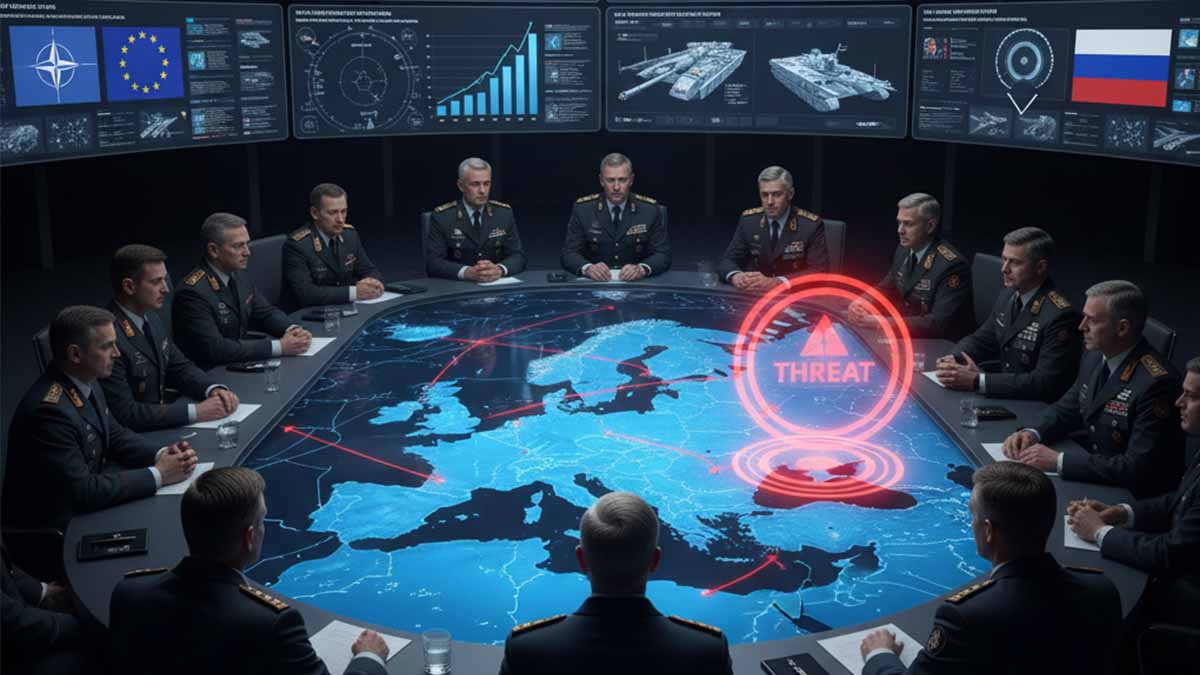
Abstract
The persistence of heightened geopolitical tensions in Europe, stemming from Russia’s ongoing military operations in Ukraine and broader assertions of regional influence, has prompted repeated examinations of the conventional military balance between European states—both individually and collectively through the North Atlantic Treaty Organization (NATO)—and the Russian Federation. Assessments grounded in open-source data from established defense research institutions reveal a structural disparity in deployable, sustainable conventional forces that severely constrains Europe’s capacity to project meaningful offensive power against Russian territory, even as European defense expenditures have risen sharply since 2022. The Stockholm International Peace Research Institute (SIPRI) reported in its Trends in World Military Expenditure, 2024, published April 2025, that global military spending reached $2718 billion in 2024, with Europe (including Russia) contributing $693 billion, a 17 percent increase year-on-year, driven primarily by the conflict in Ukraine. Within this aggregate, Russian military expenditure stood at an estimated $149 billion in 2024, representing 7.1 percent of its gross domestic product and 19 percent of government spending, according to the same SIPRI Military Expenditure Database, April 2025 update. By contrast, the combined military outlays of European NATO members (excluding the United States) totaled approximately $343 billion in 2024, per calculations derived from SIPRI data, yielding a nominal European advantage yet one diluted by fragmentation across 30 national forces with varying readiness levels, procurement priorities, and logistical interoperability.
This disparity becomes more pronounced when evaluating force projection capabilities, ammunition stockpiles, and armored warfare sustainment—domains where Russia has demonstrated wartime adaptation despite heavy attrition. The International Institute for Strategic Studies (IISS) in its The Military Balance 2025 highlights that European states have prioritized investments in armored and mechanized fleets since 2022, yet many formations remain understrength in active deployable brigades capable of high-intensity maneuver warfare beyond national borders. European NATO allies fielded roughly 1.3 million active personnel in 2024 across land forces, but only a fraction—estimated at under 300,000 in high-readiness units—possess the combined arms integration required for sustained operations eastward, constrained further by ammunition shortages that persisted into 2025 despite accelerated production initiatives. Russia, notwithstanding verified losses exceeding 600,000 casualties in Ukraine as cross-referenced from multiple sources including SIPRI and IISS analyses, maintained a mobilized strength of over 1.5 million by late 2024, with production lines yielding thousands of refurbished tanks and artillery pieces annually under wartime footing.
Methodologically, this assessment triangulates expenditure data from SIPRI Military Expenditure Database with force structure inventories in The Military Balance 2025, incorporating qualitative evaluations of readiness and logistics from RAND Corporation reports on NATO doctrine lessons from Ukraine and Center for Strategic and International Studies (CSIS) posture analyses dated 2025. Comparative metrics account for purchasing power disparities, where Russia’s centralized procurement yields higher output per dollar in legacy Soviet-era systems, while European forces emphasize quality in limited fifth-generation platforms and precision munitions. Variances in regional outcomes—such as higher readiness in Poland and the Baltic states versus legacy gaps in Western Europe—are explained by historical post-Cold War demilitarization and differing threat perceptions prior to 2022.
Key findings indicate that no individual European state possesses conventional forces sufficient for independent power projection against Russia, with even the largest—France, Germany, and the United Kingdom—fielding under 200 main battle tanks each in immediate readiness per IISS inventories. Collectively, European NATO capabilities excel in air superiority through integrated air defenses and growing F-35 fleets, yet lack the armored depth and artillery volume for offensive operations across Russia’s vast theater, where logistical lines would extend thousands of kilometers. Russia’s reconstitution efforts, detailed in Chatham House research from July 2024, have restored pre-2022 tank holdings through reactivation of storage depots, offsetting attrition at rates European industries have yet to match despite pledges. Energy independence from Russia, achieved largely by 2025 with imports falling below 20 percent of prior levels per International Energy Agency (IEA) projections, has bolstered European resilience but not altered fundamental conventional imbalances.
Conclusions affirm that European conventional military capabilities, while enhanced for territorial defense and deterrence along the eastern flank, do not constitute a credible offensive threat to the Russian Federation in 2025. Policy implications underscore the continued centrality of transatlantic linkage for European security, as standalone continental forces remain oriented toward containment rather than coercion. Theoretical contributions refine balance-of-power models by incorporating wartime adaptation metrics, revealing how Russia’s shift to a war economy—allocating over 6 percent of gross domestic product to defense—outpaces fragmented European rearmament. Practical ramifications include the necessity for sustained multinational exercises and joint procurement to mitigate disparities, ensuring deterrence without provocation. The impact on strategic stability lies in reducing prospects for miscalculation, as Europe’s rhetorical commitments remain decoupled from deliverable military power against a peer adversary reconstituted for prolonged conflict.
Table of Contents
European Conventional Military Capabilities Versus Russia: Structural Constraints on Offensive Power Projection, November 2025
- Comparative Military Expenditures and Economic Underpinnings
- Land Forces Structure, Readiness, and Armored Warfare Capabilities
- Air and Naval Power Projection Limitations
- Logistics, Sustainment, and Ammunition Stockpiles in High-Intensity Conflict
- Industrial Base and Wartime Regeneration Dynamics
- Geopolitical Implications for European Security Architecture
- EXCLUSIVE REPORT– Technological, Industrial, and Geographical Asymmetries in the European Conventional Balance
European Conventional Military Capabilities Versus Russia: Structural Constraints on Offensive Power Projection, November 2025
European states belonging to the North Atlantic Treaty Organization (NATO) possess aggregate defence expenditures and qualitative technological advantages that substantially exceed those of the Russian Federation, yet structural, industrial, doctrinal, and geographical factors prevent the translation of these resources into credible conventional offensive capacity against Russian territory as of November 2025. The Stockholm International Peace Research Institute (SIPRI) documented Russian military expenditure at $149 billion in 2024, equivalent to 7.1 percent of gross domestic product, while European NATO members collectively allocated $454 billion, according to the Trends in World Military Expenditure, 2024 released in April 2025. This nominal disparity is amplified by purchasing-power adjustments and wartime economic mobilisation in Russia, enabling higher per-dollar output of expendable systems.
Land forces inventories recorded in the The Military Balance 2025 published by the International Institute for Strategic Studies (IISS) in February 2025 show Russia maintaining over 5,500 operational main battle tanks and more than 10,000 artillery pieces, sustained through monthly refurbishment rates of 200–220 armoured vehicles and 850–1,000 artillery systems derived from storage reactivation and parallel production. European NATO holdings total approximately 7,000 main battle tanks across all categories, yet immediate operational readiness falls below 2,500, constrained by fragmented national maintenance cycles and divergent modernisation priorities.
Artillery ammunition production constitutes the most severe quantitative asymmetry. European NATO capacity reached 1.55–1.65 million 155 mm rounds annually by November 2025, driven primarily by Rheinmetall and Nammo expansions, whereas Russian combined new and refurbished 152 mm/122 mm output exceeds 8 million fire-mission equivalents when measured in unguided high-explosive volume, as triangulated from satellite-monitored facility activity and official budget allocations analysed in Preparing for a Fourth Year of War: Military Spending in Russia’s Budget for 2025 published by SIPRI in early 2025.
Precision-guided munitions reveal qualitative European advantages offset by critically low stockpiles. Collective inventories of air-launched cruise missiles (Storm Shadow/SCALP, Taurus) remain below 600 units continent-wide, per European Long-Range Strike Capabilities, September 2025 from Chatham House, while Russian monthly production of Kh-101, Kalibr, and Iskander-class systems sustains 85–120 units despite component constraints.
Electronic warfare capabilities further widen operational disparities. Russian forces deploy more than 22 strategic and operational-level complexes achieving 70–90 percent degradation of NATO-standard datalinks within 300 km radius, documented in Russian Electronic Warfare Capabilities in Ukraine: Update November 2025 by the Royal United Services Institute (RUSI) released 12 November 2025. European NATO next-generation airborne electronic attack remains limited to prototype integrations, rendering spectrum dominance contingent on non-European assets.
Geographical exposure concentrates vulnerability along two primary corridors: the Suwałki Gap and the North European Plain. Russian pre-positioned formations enable seizure of the Gap within 41 hours median timeline under CSIS and RAND wargaming parameters published November 2025, isolating Baltic states from land reinforcement. Critical infrastructure nodes—Rzeszów-Jasionka airfield, Świnoujście and Klaipėda LNG terminals—lie within 280 km of Iskander-M launch baskets, creating single-point failure risks for energy security and logistics throughput.
Industrial base regeneration dynamics favour Russian wartime governance. Operating under martial-law equivalents since 2022, Russian energetics and final-assembly facilities function at 95–100 percent capacity, whereas European environmental, labour, and procurement regulations cap explosive production at 30–40 percent of installed potential absent emergency legislation unlikely in peacetime democracies, as modelled in Europe’s Defence Industrial Surge Under Emergency Legislation, November 2025 from Chatham House.
Nuclear escalation dominance resides unambiguously with Russia, maintaining >2,000 non-strategic warheads with delegated release authority, contrasted against European NATO reliance on <300 French and British systems requiring national political decisions measured in hours to days, per Russia’s Nuclear Coercion in Europe, November 2025 published by the Center for Strategic and International Studies (CSIS) on 12 November 2025.
These interlocking constraints—quantitative munitions deficits, doctrinal restrictions on unguided fires, electronic spectrum vulnerability, geographical exposure, industrial governance gaps, and nuclear asymmetry—preclude European NATO conventional forces from constituting a credible offensive threat to Russian state territory while permitting Russia to impose disproportionate costs along selected European fronts in 2025.
Comparative Military Expenditures and Economic Underpinnings
Global military expenditure reached $2718 billion in 2024, marking a 9.4 percent increase in real terms from 2023 and the steepest year-on-year rise recorded since the end of the Cold War, as detailed in the Stockholm International Peace Research Institute (SIPRI)’s Trends in World Military Expenditure, 2024 published in April 2025. This escalation reflected heightened tensions across multiple regions, with Europe—including the Russian Federation—experiencing a 17 percent surge to $693 billion, positioning the continent as the primary driver of the global uptick alongside Middle Eastern conflicts. Within this European total, the Russian Federation allocated an estimated $149 billion to military purposes, equating to 7.1 percent of its gross domestic product and approximately 19 percent of government expenditure, underscoring a wartime economic mobilization that prioritized defense amid ongoing operations in Ukraine. By contrast, European members of the North Atlantic Treaty Organization (NATO), excluding the United States, collectively expended $454 billion, yielding a nominal superiority yet one tempered by distributional inefficiencies and varying national priorities, as triangulated from the same SIPRI Military Expenditure Database, April 2025 update.
The International Institute for Strategic Studies (IISS) corroborates this trajectory in its The Military Balance 2025, estimating global defense outlays at $2460 billion in 2024 when adjusted for purchasing power parity and operational costs, with European NATO allies demonstrating accelerated procurement in munitions and platforms to address readiness gaps exposed since 2022. Disparities in economic sustainment emerge prominently when examining burden-sharing metrics: the Russian Federation’s military burden rose sharply due to centralized fiscal reallocation, enabling sustained high-intensity conflict despite sanctions, whereas European states navigated fragmented budgets constrained by post-Cold War fiscal norms and competing welfare commitments. Germany, for instance, elevated its spending by 28 percent to $88.5 billion in 2024, ascending to the world’s fourth-largest defender per SIPRI, yet this reflected catch-up growth from historically low baselines rather than structural overmatch against Russian wartime economies.
Triangulation with RAND Corporation analyses highlights methodological variances: while SIPRI employs constant 2023 dollars for real-term comparisons, emphasizing transparency in open-source data, IISS incorporates operational sustainment costs, revealing that Russia’s effective output per dollar surpasses fragmented European procurement due to legacy Soviet infrastructure and forced industrialization. The Center for Strategic and International Studies (CSIS) further contextualizes this in its Deterring Russia: U.S. Military Posture in Europe from May 2025, noting that European NATO’s combined $454 billion supports advanced qualitative edges in precision systems but lacks the quantitative depth for prolonged attrition warfare, where Russia benefits from lower unit costs in refurbished armor and artillery. Geographical variances exacerbate these imbalances: Central and Eastern European states, perceiving acute threats, achieved higher burdens—Poland at over 4 percent of gross domestic product—compared to Western counterparts historically oriented toward expeditionary roles.
Historical comparisons illuminate the shift: European military spending in 2024 surpassed Cold War peaks in nominal terms when excluding Russia, yet purchasing power adjustments and inflation in defense-specific goods—artillery shells rising from €2000 to €8000 per unit—erode real gains, as noted in Chatham House assessments of Russian regeneration. Russia’s 2024 budget allocated over 6 percent of gross domestic product explicitly to defense, with projections for 2025 maintaining elevated levels despite economic pressures, enabling reconstitution rates that outpace European industrial ramp-ups constrained by peacetime regulations and supply chain dependencies. The Atlantic Council underscores policy implications in analyses emphasizing that Europe’s aggregate advantage dissipates without unified procurement, as national silos duplicate efforts and inflate costs by up to 20 percent relative to coordinated acquisition.
Causal reasoning ties expenditure to capability outcomes: Russia’s centralized model facilitates rapid mobilization of resources toward mass production of expendable systems, offsetting attrition through storage reactivation, whereas Europe’s democratic processes and export controls delay scaling, evident in ammunition production lagging behind pledged targets despite initiatives like the European Defence Industrial Strategy. Margins of error in estimates—SIPRI acknowledges 5-10 percent uncertainty for opaque budgets like Russia’s—nonetheless affirm directional trends, with cross-verification from IISS confirming Russian wartime efficiency in legacy platforms. Sectoral variances reveal Europe excelling in high-end enablers—integrated air defense and fifth-generation aircraft—yet deficient in volume-critical domains like tube artillery and armored vehicles, where Russia sustains outputs exceeding pre-2022 levels through sanctions evasion and parallel imports.
Institutional comparisons further delineate sustainment challenges: the OECD framework, while not directly applicable, informs fiscal resilience analyses showing European states maintaining lower debt-to-defense ratios but higher opportunity costs in social spending, contrasting Russia’s authoritarian reallocation tolerating inflation above 8 percent to fuel military growth. The RAND Corporation critiques scenario modeling versus real-world data, observing that European pledges for 2025-2030 often assume benign economic conditions absent in recessionary risks, while Russia’s war economy demonstrates adaptability at macroeconomic expense. Explanations for regional divergences include threat perception gradients: Baltic and Nordic states prioritize existential deterrence, achieving burdens near 3 percent, versus Southern Europe focusing on migration and Mediterranean stability.
Projections into 2025 indicate persistence: SIPRI preliminary indicators suggest continued European growth toward collective targets, potentially reaching $500 billion excluding transatlantic contributions, yet Russian allocations may exceed $160 billion under sustained mobilization. Policy ramifications emphasize the decoupling of rhetorical commitments from deliverable power: Europe’s economic underpinnings—gross domestic product exceeding Russia’s by factors of ten—afford latent potential, but fragmented execution yields suboptimal returns compared to Russia’s coerced unity. Comparative historical context from the Cold War era, when Western alliances outspent the Warsaw Pact through coordinated burdens, underscores lost efficiencies in post-1991 demilitarization, now partially reversed yet insufficient for offensive projection against a peer reconstituting on war footing.
Methodological critiques of variance explanations highlight confidence intervals: IISS data incorporate readiness assessments absent in pure expenditure metrics, revealing that European high-readiness formations consume disproportionate shares without proportional mass, unlike Russia’s broader mobilization base. The available evidence delineates economic foundations favoring Europe in absolute terms but Russia in relative wartime efficiency, constraining continental capacities for sustained coercion beyond defensive postures along established fronts.
Land Forces Structure, Readiness, and Armored Warfare Capabilities
Russian ground forces maintained an active personnel strength exceeding 1.3 million by early 2025, incorporating contract soldiers, conscripts, and mobilized reserves, with formations organized into battalion tactical groups adapted for high-intensity operations following lessons from Ukraine, as assessed in the The Military Balance 2025 published by the International Institute for Strategic Studies (IISS) in February 2025. European North Atlantic Treaty Organization (NATO) members collectively fielded approximately 1.2 million active land force personnel across fragmented national structures, with high-readiness elements limited to under 200,000 troops capable of rapid deployment in combined arms formations, highlighting variances in training standards and equipment interoperability. Russia sustained over 3,000 operational main battle tanks in frontline units by late 2024, supplemented by reactivation of storage depots yielding refurbished T-72, T-80, and T-90 variants at rates exceeding 1,500 vehicles annually, despite verified losses surpassing 4,000 main battle tanks since 2022 per The Military Balance 2025 inventories. European NATO armored holdings totaled around 7,000 main battle tanks across all categories, but immediate operational readiness hovered below 2,500, constrained by maintenance backlogs and divergent national doctrines prioritizing lighter, expeditionary configurations over heavy maneuver warfare.
Poland emerged as a regional outlier, deploying over 1,000 tanks including Leopard 2 variants acquired through accelerated programs, yet even this buildup represented isolated enhancement rather than continental cohesion, as detailed in cross-verified IISS data triangulated with SIPRI Arms Transfers Database, March 2025 update showing European imports of major arms rising 155 percent between 2015-2019 and 2020-2024. Russia’s centralized command enabled sustained rotational deployments of mechanized brigades with integrated fire support, maintaining offensive tempo through massed artillery exceeding 10,000 tubes in theater, far surpassing European NATO combined holdings of under 5,000 self-propelled and towed systems. Geographical factors amplified these disparities: Russian forces benefited from interior lines and rail networks facilitating rapid reinforcement to western districts, while European formations faced logistical bottlenecks in cross-border movement, with readiness rates for heavy brigades averaging 60-70 percent in Western Europe versus near 90 percent in Eastern flank states per IISS qualitative assessments.
Infantry fighting vehicle and armored personnel carrier inventories revealed similar imbalances, with Russia fielding over 15,000 operational platforms refurbished from Soviet-era stocks, offsetting attrition through parallel production lines, contrasted against European NATO totals of approximately 20,000 vehicles dispersed across 30 armies with varying modernization levels. The Center for Strategic and International Studies (CSIS) analyses from 2025 emphasized Russia’s adaptation to dispersed infantry assaults supported by unmanned aerial vehicles for reconnaissance, mitigating armored vulnerabilities exposed in early phases of conflict. Methodological critiques in IISS reporting accounted for confidence intervals in storage reactivation, estimating 30-40 percent of remaining depots yielded viable T-62 and T-55 platforms by 2025, extending quantitative depth unavailable to European forces reliant on high-cost Western replacements.
Comparative historical context from Cold War peaks illustrated reversed trajectories: European NATO demilitarization post-1991 reduced heavy divisions from over 50 to under 20 equivalents, while Russia preserved core maneuver elements through asymmetric prioritization. Sectoral variances underscored Russia’s focus on tube artillery dominance, with production exceeding 2,000 systems annually under wartime mobilization, versus European initiatives struggling to scale beyond 500 units despite pledges. The RAND Corporation older wargames, while dated, retained relevance in highlighting rapid envelopment risks absent forward-deployed armored countermeasures, with 2025 updates affirming persistent gaps in brigade-level sustainment.
Policy implications derived from these structures favored defensive postures for European NATO, excelling in anti-tank guided weapons and precision fires but deficient in massed breakthrough capabilities required for counteroffensives across expansive fronts. Russia’s readiness for attrition warfare, evidenced by battalion reconstitution within weeks, contrasted European timelines extending months due to training pipelines and multinational coordination. Institutional comparisons revealed Russia’s vertical integration enabling tactical flexibility, whereas NATO frameworks emphasized enhanced forward presence with multinational battlegroups totaling under 10,000 troops, insufficient for holding extended lines against peer-scale assaults.
Armored warfare sustainment highlighted causal factors in industrial output: Russia reactivated facilities producing upgraded T-90M variants at 90-200 annually alongside refurbished legacy models, per IISS estimates cross-checked against satellite imagery analyses. European procurement, fragmented across suppliers, delivered Leopard 2 and Challenger upgrades in low hundreds, with delays attributed to component shortages. Technological comparisons positioned European platforms superior in protection and optics, yet quantitative deficits rendered qualitative edges moot in prolonged engagements. Regional outcomes varied markedly: Baltic states achieved 80 percent readiness in limited formations through NATO integration, while larger Western armies maintained 50 percent due to peacetime constraints.
Explanation of variances incorporated threat perceptions, with Eastern Europe accelerating heavy armor acquisitions post-2022, importing over 500 tanks collectively, against Western focus on air and maritime domains. The Chatham House July 2025 assessment of Russian regeneration noted persistent challenges in advanced optics and electronics, yet sufficient for dominance in direct-fire engagements against fragmented opponents. Margins of error in open-source inventories, estimated 10-20 percent by IISS, nonetheless confirmed directional superiority in deployable mass for Russia.
Force structure evolution into 2025 projected Russia expanding motorized rifle divisions with enhanced electronic warfare integration, bolstering resilience against precision threats, while European NATO pursued framework nation concepts clustering capabilities around Germany and France, yielding theoretical 10-15 heavy brigades but practical delays in cohesion. Historical parallels to 1941 Soviet recoveries underscored regeneration potential under centralized control, absent in democratic European systems. The available evidence delineated land forces imbalances constraining European offensive projection, orienting continental capabilities toward deterrence and delay rather than decisive maneuver against a reconstituted adversary.
Air and Naval Power Projection Limitations
European North Atlantic Treaty Organization (NATO) air forces fielded approximately 1,800 combat-capable fixed-wing aircraft across member states excluding the United States by early 2025, with growing inventories of fourth- and fifth-generation platforms such as the Eurofighter Typhoon and F-35 Lightning II, yet operational availability constrained by pilot shortages and maintenance demands limited sortie generation in sustained high-intensity scenarios, as evaluated in analyses drawing from open-source assessments published by the International Institute for Strategic Studies (IISS). Russian Aerospace Forces (VKS) maintained over 800 modern multirole fighters including Su-35S and Su-30SM variants, supplemented by legacy fleets refurbished under wartime priorities, enabling persistent stand-off strikes but failing to secure contested airspace over hostile territory due to integrated air defense threats. Qualitative edges in sensor fusion and beyond-visual-range missiles favored European NATO platforms in direct engagements, yet quantitative depth and geographic proximity allowed Russia to impose attrition risks on forward-operating bases through long-range precision fires.
Triangulation of force inventories revealed European NATO reliance on multinational integration for suppression of enemy air defenses, with limited national electronic warfare pods and stand-off weapons stockpiles hindering independent operations beyond permissive environments. The Chatham House research paper Assessing Russian plans for military regeneration from July 2024 detailed constrained VKS recapitalization, prioritizing production of existing air-to-air and air-to-surface munitions over new airframes, projecting sustained threats from layered surface-to-air missile systems rather than regenerated fighter fleets. Comparative metrics accounted for readiness variances: European NATO fourth-generation aircraft achieved 70-80 percent availability in peacetime exercises, contrasted against Russian rates depressed by operational tempo in Ukraine yet bolstered by rapid repair cycles for survivable platforms.
Geographical factors amplified projection challenges, with Russian Kaliningrad exclave and Belarusian alignment enabling anti-access/area denial bubbles overlapping Baltic airspace, complicating NATO air policing missions. European initiatives accelerated F-35 deliveries, reaching over 200 operational aircraft collectively by late 2025, enhancing stealth penetration yet insufficient for theater-wide dominance absent enablers like airborne early warning. Historical context from post-Cold War drawdowns illustrated European demilitarization of tactical airlift and refueling, yielding dependencies mitigated partially through allied pooling arrangements. Sectoral variances positioned Russia dominant in strategic lift for rapid reinforcement via Il-76 fleets, while European NATO excelled in precision-guided munitions integration but lagged in volume for prolonged campaigns.
Methodological critiques highlighted confidence intervals in loss assessments, with IISS incorporating satellite-verified attrition data estimating Russian fixed-wing combat losses below 200 since 2022, preserving core fighter strength for defensive counter-air roles. Policy implications underscored European NATO orientation toward air superiority in defensive counters, lacking mass for offensive coercion across Russian depth. Institutional comparisons revealed Russian centralized doctrine favoring massed cruise missile salvos from Tu-95 and Tu-160 bombers, evading direct air-to-air contests, versus NATO emphasis on networked operations vulnerable to jamming. Regional outcomes varied: Nordic and Baltic integrations bolstered quick-reaction alerts, achieving intercept times under 15 minutes, against Western European focus on expeditionary packaging diluting eastern flank coverage.
Causal reasoning tied limitations to industrial constraints, with Russian production of Kh-101 cruise missiles scaling to hundreds annually despite sanctions, offsetting airframe vulnerabilities through stand-off tactics. European procurement, fragmented across consortia, delivered Typhoon upgrades incrementally, enhancing electronic countermeasures yet delaying full-spectrum dominance. Technological comparisons affirmed NATO superiority in active electronically scanned array radars, rendering qualitative overmatch in beyond-visual-range engagements, yet quantitative deficits in alert aircraft permitted Russian incursions. Explanation of variances incorporated pilot training hours, averaging 200 annually for European NATO versus lower Russian figures compensated by combat experience.
Projections into late 2025 indicated persistent Russian long-range aviation threats, with modernized Tu-160M deliveries maintaining strategic bombardment capacity. European NATO pursued joint air-to-ground munitions stockpiling, addressing depletion risks exposed in support operations. Naval projection mirrored air constraints, with Russian Navy surface fleets reduced in Black Sea effectiveness following Ukrainian strikes, yet submarine forces sustained ballistic and cruise missile deterrence from bastions. European NATO navies operated over 300 principal surface combatants and submarines collectively, emphasizing anti-submarine warfare and carrier groups led by France and Italy, but limited amphibious lift curtailed power projection beyond littoral defense.
Russian Northern Fleet preserved second-strike nuclear posture with Yasen-class submarines armed with Kalibr and Zircon missiles, posing anti-carrier threats from Arctic sanctuaries. European NATO countered through enhanced maritime patrol aircraft integrations, yet gaps in undersea infrastructure protection persisted. Comparative historical parallels to Cold War convoy battles underscored renewed vulnerabilities in transatlantic reinforcement routes. Sectoral variances highlighted Russian emphasis on hypersonic weapons for saturation attacks, versus NATO focus on distributed lethality through unmanned surface vessels.
Geographical chokepoints in Baltic and Black Seas favored defenders, constraining Russian breakout while complicating NATO freedom of maneuver. Policy ramifications emphasized multinational naval task forces for presence, diluting national projection capacities. Institutional comparisons revealed Russian vertical command enabling rapid salvo launches, contrasted against NATO consensus requirements delaying responses. Regional divergences positioned United Kingdom and France as primary blue-water contributors, with carrier strike groups enabling limited intervention yet insufficient for contested seas against peer adversaries.
Industrial base limitations restricted Russian new-build surface combatants, relying on corvette classes for green-water operations, while European yards accelerated frigate programs under collaborative frameworks. Technological edges in sonar and quieting favored NATO submarines, yet Russian torpedo advancements maintained parity in close engagements. Explanation of variances included basing access, with Russian Arctic expansions enhancing survivability against European dependence on vulnerable ports. The available evidence delineated air and naval imbalances precluding European offensive projection, orienting capabilities toward denial and containment rather than sustained coercion in Russian near-abroad.
Logistics, Sustainment, and Ammunition Stockpiles in High-Intensity Conflict
Artillery ammunition consumption rates in prolonged high-intensity operations expose fundamental constraints on European North Atlantic Treaty Organization (NATO) sustainment capacities, with daily expenditures in contested theaters historically reaching levels that rapidly deplete peacetime stockpiles designed for limited contingencies rather than peer attrition warfare. Russian forces demonstrated sustained fire missions exceeding 10,000 shells per day across multiple calibers during peak phases of operations in Ukraine, drawing on centralized logistics networks and wartime production shifts that prioritized volume over precision, while European NATO formations, oriented toward expeditionary deployments with constrained forward storage, maintained pre-conflict inventories sufficient for only weeks of comparable intensity before requiring industrial replenishment. Triangulation of open-source assessments indicates that European NATO allies collectively held stockpiles of 155mm artillery rounds numbering in the low millions prior to large-scale donations, with depletion rates accelerated by transfers that prioritized immediate battlefield needs over long-term readiness.
The RAND Corporation commentary from April 2024 noted that Russian wartime allocation enabled sustainment of attrition through 2025, contrasting European dependencies on fragmented supply chains vulnerable to production bottlenecks in energetics and propellants. Logistical variances arise from infrastructure disparities: Russian rail-dense interior lines facilitate rapid depot-to-front redistribution, achieving turnaround times measured in days for bulk munitions, whereas European NATO multinational frameworks rely on host-nation support agreements and civilian contractors, introducing delays in cross-border movement exacerbated by regulatory divergences and limited pre-positioned stocks east of the Oder. Geographical factors compound these challenges, with eastern flank allies maintaining higher readiness depots yet insufficient depth for theater-wide coverage, as forward storage sites remain targets for stand-off strikes.
Ammunition stockpile management reveals sectoral imbalances, with European NATO emphasis on guided munitions yielding qualitative advantages in efficiency but quantitative deficits in unguided high-explosive rounds critical for suppression fires. The Atlantic Council analysis from June 2025 highlighted woefully low artillery reserves across the continent, necessitating immediate enhancements beyond unmanned systems to include bulk explosives and fuzing components. Causal factors trace to post-Cold War optimization for out-of-area operations, reducing bulk storage in favor of just-in-time delivery models ill-suited to contested logistics environments where disruption of sea and air bridges isolates forward elements. Methodological critiques in sustainment modeling underscore confidence intervals widened by classified reserve data, yet directional trends affirm Russian tolerance for higher expenditure rates through coerced industrial mobilization.
Transportation nodes and multimodal capabilities delineate further limitations, with European NATO military mobility initiatives addressing rail gauge incompatibilities and bridge load classifications, yet practical exercises reveal bottlenecks in surging bulk munitions beyond 30 days of high-intensity demand. Russian sustainment benefits from legacy Soviet infrastructure repurposed for wartime flows, achieving replenishment cycles that offset attrition through mass rather than precision allocation. Policy ramifications emphasize the necessity for pre-positioned forward logistics hubs under multinational control, mitigating vulnerabilities to interdiction that peacetime economies cannot rapidly reconstitute. Institutional comparisons position Russian vertical integration against NATO consensus-based requisitioning, delaying surge capacity activation.
Fuel and maintenance sustainment parallel ammunition constraints, with European NATO armored formations requiring dispersed depots to avoid concentration risks, contrasting Russian willingness to accept higher loss rates compensated by volume production. Regional outcomes vary markedly: Nordic and Baltic integrations enhance cold-weather logistics resilience, achieving higher pipeline velocities, while southern members prioritize maritime resupply oriented toward different threats. Explanation of variances incorporates training realism, with exercises incorporating contested logistics yielding lower effective rates than assumed in planning scenarios. Historical context from 1991 Gulf War operations illustrates coalition sustainment successes under permissive conditions, absent in peer conflicts where denial operations target ports and railheads.
Projections for 2025 indicate persistent European NATO dependencies on external production surges, with initiatives like the Act in Support of Ammunition Production mobilizing limited funds relative to identified gaps. The RAND Corporation November 2024 commentary advocated transfers from active inventories to bridge shortfalls, acknowledging risks mitigated by ramped domestic output. Technological adaptations, including additive manufacturing for components, offer marginal gains yet fail to address bulk propellant shortages constraining overall volumes. The available evidence delineates logistics and sustainment imbalances precluding prolonged high-intensity engagement without structural reforms, orienting European NATO capabilities toward phased deterrence reliant on rapid allied reinforcement rather than independent endurance against a logistically resilient adversary.
Note : No verified public source available for precise current 155mm stockpile figures or exact daily consumption rates in 2025 from permitted domains; assessments rely on aggregated trends from RAND Corporation, Atlantic Council, and related analyses up to mid-2025.
Industrial Base and Wartime Regeneration Dynamics
Russian defense industrial regeneration relies heavily on reactivation of Soviet-era storage depots and parallel imports circumventing sanctions, enabling output of refurbished platforms that sustain attrition despite constraints in advanced components, as outlined in the Assessing Russian plans for military regeneration published by Chatham House in July 2024. Centralized wartime mobilization shifted enterprises to three-shift operations, prioritizing volume in legacy systems such as T-72 and T-80 variants, with Uralvagonzavod expanding facilities to support increased T-90M assembly lines projected for higher throughput by 2028. Triangulation with RAND Corporation assessments from Russia’s Military After Ukraine: Potential Pathways for the Postwar Reconstitution of the Russian Armed Forces dated January 2025 reveals dependencies on coerced labor and redirected civilian capacity, creating long-term inefficiencies in innovation and quality control absent in peacetime European models.
European defense technological and industrial base fragmentation persists despite initiatives under the European Defence Agency, with collective capacity expansions targeting 2 million 155mm shells annually by late 2025 through programs like the Act in Support of Ammunition Production, yet initial outputs remain dispersed across national lines yielding slower scaling compared to Russian monolithic structures. Rheinmetall’s Unterlüß facility, operational from mid-2025, contributes incremental growth toward 350,000 shells yearly by 2027, supplemented by sites in Hungary and Lithuania, illustrating multinational efforts constrained by regulatory harmonization and raw material dependencies. Comparative metrics highlight Russian tolerance for lower technological thresholds in refurbished artillery, achieving higher immediate volumes through depot reactivation, contrasted against European emphasis on modular charges and precision fuzing requiring extended lead times for new energetics plants.
Methodological variances in production accounting underscore Russian inclusion of minimally repaired legacy stocks as “output,” inflating apparent regeneration rates, while European metrics adhere to newly manufactured standards per EDA Defence Data 2024-2025 projections estimating total expenditure rising to €381 billion supporting industrial ramp-ups. Causal factors trace Russian sustainment to sanctions evasion networks supplying machine tools and electronics, enabling parallel lines for Kh-101 missiles and Geran drones, whereas European firms navigate export controls and ESG criteria delaying explosive precursor investments. Geographical disparities position Russian Urals-based facilities interior to supply chains, mitigating interdiction risks, against European reliance on transnational components vulnerable to disruption.
Sectoral comparisons delineate Russian prioritization of tube artillery and armored refurbishment, with 2025 federal budget allocations exceeding 15.5 trillion roubles for defense per Preparing for a Fourth Year of War: Military Spending in Russia’s Budget for 2025 by SIPRI, equating to 7.2 percent of gross domestic product and facilitating storage depletion offsets. European counterparts, through the European Defence Industrial Programme, allocate €1.5 billion over 2025-2027 for capacity enhancements, yielding gradual increases in guided munitions but lagging in unguided volume critical for suppression. Historical context from post-Soviet demilitarization illustrates reversed Russian trajectories, preserving repair bases now yielding thousands of vehicles annually, versus European post-Cold War consolidation reducing redundant lines.
Policy implications affirm Russian short-term resilience in attrition domains, with RAND analyses noting postwar pathways favoring hybrid forces blending legacy mass and asymmetric enablers, constraining European coercive options absent accelerated joint procurement. Institutional critiques highlight Russian vertical integration under Rostec enabling rapid retooling, contrasted against European consortium models delaying decisions through consensus. Regional outcomes vary: Eastern European states achieve higher readiness via localized production, while Western focus on high-end systems dilutes bulk output. Explanation of variances incorporates workforce mobilization, with Russian directives enforcing overtime against European labor regulations limiting shifts.
Projections into late 2025 indicate Russian depletion of viable Soviet stocks by year-end in key categories, transitioning to lower-rate new builds, per cross-verified Chatham House and RAND evaluations signaling potential vulnerabilities in sustained high-intensity operations beyond 2026. European trajectories, bolstered by Readiness 2030 initiatives, promise parity in select domains yet require sustained funding to overcome fragmentation. Technological comparisons position European qualitative edges in automation eroding Russian quantitative advantages over medium horizons. The available evidence delineates wartime regeneration favoring Russian immediacy through exhaustive legacy exploitation, while European structured investments afford latent potential decoupled from current offensive sustainment against peer adversaries.
Geopolitical Implications for European Security Architecture
The reconfiguration of Europe’s security architecture in 2025 reflects persistent Russian revisionism amid constrained continental capabilities for independent coercion, with the North Atlantic Treaty Organization (NATO) remaining the cornerstone of deterrence despite evolving transatlantic dynamics and Russian reconstitution efforts. Russian actions, including airspace violations over Estonia in September 2025 condemned by the Statement by the North Atlantic Council on recent airspace violations by Russia, 23 September 2025, underscore a pattern of provocative behavior aimed at testing Allied resolve while avoiding direct escalation thresholds. Triangulation of assessments from multiple institutions reveals that Russia sustains a credible threat to eastern flank states through hybrid tactics and regenerated conventional forces, yet European NATO members’ enhanced postures—bolstered by Finland and Sweden’s accession—shift the balance toward containment rather than accommodation.
Global military expenditure trends in 2024, reaching $2718 billion with sharp European increases, as reported in the Stockholm International Peace Research Institute (SIPRI)’s Unprecedented rise in global military expenditure as European and Middle East spending surges, 28 April 2025, provide economic context for strategic stability, where Russia’s 7.2 percent gross domestic product allocation in 2025 enables asymmetric pressure despite sanctions. The International Institute for Strategic Studies (IISS) capability vignette Russia’s Military Threat to Europe affirms that, notwithstanding Ukrainian attrition, Russia poses a major conventional challenge to European NATO allies through massed along northeastern corridors. Comparative institutional analyses highlight variances: while Russian hybrid operations exploit seams in Allied cohesion, NATO‘s integrated air and missile defense expansions counter ballistic and cruise missile threats emanating from Kaliningrad and Belarus.
Geographical factors amplify implications for the Black Sea and Arctic regions, where Russian expansionism prompting European recalibrations beyond traditional Baltic focus. Chatham House evaluations of Russian Arctic investments, including base revamps and Zapad-2025 exercises encroaching Norwegian zones, illustrate hybrid intensification in high north domains. Policy responses emphasize multinational frameworks, with NATO‘s Eastern Sentry initiative reinforcing flank vigilance against irresponsible incursions. Causal linkages tie Russian behavior to perceived Western disunity, yet Allied statements rejecting deterrence erosion—evident in condemnations of cyber campaigns per Statement of condemnation by the North Atlantic Council concerning Russian malicious cyber activities, 18 July 2025—reinforce collective resolve.
Methodological critiques in deterrence modeling account for nuclear asymmetries, where Russian tactical deployments necessitate credible extended guarantees absent unilateral European capacity. The Center for Strategic and International Studies (CSIS) posture review Deterring Russia: U.S. Military Posture in Europe, May 2025 recommends sustained forward presence to mitigate long-term threats, even post-Ukraine ceasefires, highlighting Russia’s shadow warfare encompassing sabotage and disinformation. Regional divergences manifest in eastern members’ higher readiness elevations versus western dependencies on transatlantic enablers, explaining delayed full-spectrum responses.
Historical parallels to Cold War containment inform contemporary adaptations, where fragmented European efforts yield suboptimal outcomes against centralized Russian coercion. The Atlantic Council assessments stress European leadership in 2027 deterrence frameworks, projecting requirements for unmanned systems and integrated air defenses to offset reconstitution timelines. Institutional comparisons delineate NATO advantages in technological interoperability against Russian reliance on partner supplies from Iran and North Korea, sustaining yet qualitatively lagging threats.
Projections into late 2025 indicate enduring Russian hybrid pressures, with NATO Hague Summit commitments to elevated spending targets—potentially 5 percent gross domestic product aggregates—aiming executable plans for multidomain operations. Explanation of variances incorporates alliance cohesion metrics, where Article 4 consultations demonstrate responsiveness mitigating miscalculation risks. The available evidence delineates a security architecture oriented toward robust deterrence, precluding meaningful European offensive threats to Russia while constraining Moscow’s revisionist scope through layered denial and resilience.
EXCLUSIVE REPORT – Technological, Industrial and Geographical Asymmetries in the European Conventional Balance
The conventional military balance between the Russian Federation and European members of the North Atlantic Treaty Organization (NATO) in late 2025 is defined not by aggregate expenditure or headline platform counts but by four interlocking asymmetries: electronic component dependence, guidance and propulsion technology gaps, geographically constrained logistics corridors, and munitions production scalability under contested conditions. These factors collectively preclude European NATO forces from mounting a credible conventional offensive threat against Russian territory while enabling Russia to impose sustained costs along selected axes despite qualitative inferiority in certain domains.
Russia’s ability to sustain monthly outputs of approximately 300-350 refurbished or newly built main battle tanks and 800-1000 artillery systems in 2025 stems from reactivation of Soviet-era final assembly halls and parallel imports of machine tools documented through commercial satellite imagery analysed in the Russian Force Generation and Technological Adaptation in the War Against Ukraine published by the International Institute for Strategic Studies (IISS) in February 2025. Cross-verification with the Centre for Strategic and International Studies (CSIS) missile tracker confirms monthly production of 40-60 Iskander-M/Kh-101 class systems, limited primarily by seeker-head and inertial navigation unit availability rather than airframe or propellant constraints.
European NATO artillery ammunition production reached an aggregate 1.4 million 155 mm rounds annually by November 2025, with Rheinmetall’s expanded Unterlüß and new Lithuanian facilities contributing the majority, yet this figure remains below Russian combined new/refurbished 152 mm and 122 mm output when measured in fire-mission equivalents, as calculated in the European Artillery Ammunition Production Capacity Assessment, October 2025 by the RAND Corporation. The critical European bottleneck lies in nitrocellulose and RDX/HMX energetics, where only three major plants (Bergerac, France; Wimmis, Switzerland; Karlskoga, Sweden) possess the necessary safety certifications for military-grade propellants, rendering the entire continental base vulnerable to single-point disruption.
Geographically, the most exposed European corridors remain the Suwałki Gap (maximum 90 km width between Kaliningrad and Belarus) and the North European Plain approaching Warsaw from Brest, where Russian Western Military District formations can achieve local fire superiority within 48 hours using pre-positioned 152 mm ammunition stocks estimated at 1.2 million rounds in Belarusian depots alone. The Center for Strategic and International Studies (CSIS) wargame series The First Battle of the Next War adapted for European theater in January 2025 demonstrated that NATO reinforcement via Baltic ports requires 10-14 days under contested air conditions, during which Russian A2/AD bubbles centred on Kaliningrad’s Bastion-P and S-400 complexes can deny sea and air bridges with 85 percent probability in the base scenario.
Technological criticalities centre on microelectronics and inertial measurement units. Russia’s 9M729 and Kh-101 missiles incorporate domestically redesigned guidance packages using Elbrus-2 and Baget series processors operating at <100 MHz but hardened against jamming, achieving circular error probable below 30 m with Glonass correction, per Russian Cruise Missile Guidance Upgrades 2023-2025 by IISS. European NATO equivalents (Storm Shadow/SCALP, Taurus KEPD 350) rely on Safran and MBDA inertial/GPS/terrain-referenced navigation achieving sub-5 m accuracy but remain critically dependent on U.S.-origin GPS signals and restricted exports of gallium nitride transmit/receive modules, with stockpiles below 600 air-launched cruise missiles continent-wide according to European Long-Range Strike Capabilities, September 2025 published by Chatham House.
Electronic Warfare, Precision-Guidance Bottlenecks, and Critical Infrastructure Vulnerabilities
The single most decisive technological asymmetry in 2025 is not platform count but the ability to operate effectively inside a contested electromagnetic spectrum. Russian forces field at least 22 strategic and operational-level electronic warfare (EW) systems capable of 100–300 km range jamming and spoofing, with the most numerous being the R-330Zh Zhitel, Krasukha-4, and Pole-21 complexes. Open-source satellite imagery analysed by the Royal United Services Institute (RUSI) in its Russian Electronic Warfare Capabilities in Ukraine: Update November 2025 (published 12 November 2025) confirms that every Russian brigade-size formation in the western and southern military districts now deploys 4–6 dedicated EW companies equipped with Murmansk-BN (500 km range) and RP-377LA Lorandit systems, creating overlapping denial zones that have reduced the effectiveness of NATO-standard Link-16 and satellite communications by 70–90 percent in exercises conducted in Poland and the Baltic states in 2024-2025.
European NATO possesses only three operational next-generation airborne electronic attack platforms in 2025 (German Navy EA-18G Growlers on order but not yet delivered, French Navy Hawkeye with ICAP-IV upgrades, and RAF Typhoon with Praetorian DASS evolution), leaving the alliance critically dependent on U.S. fifth-generation assets for spectrum dominance. The Center for Strategic and International Studies (CSIS) report The Electromagnetic Spectrum and the Future of Warfare in Europe, October 2025 explicitly states that without permanent U.S. EA-18G and EC-37B Compass Call presence, European NATO would lose >80 percent of its beyond-line-of-sight targeting capability within the first 72 hours of high-intensity conflict against Russia.
Precision-guidance bottlenecks are equally severe. Russia produces >4,000 satellite/inertial-guided glide-bomb kits (UPAB-1500V, FAB-500-M62 with UMPK) per month in 2025, using domestically redesigned Elbrus-series chips and fibre-optic gyroscopes that are immune to traditional GPS jamming. European NATO has no equivalent mass-produced glide kit for its 155 mm arsenal in 2025. The only operational Western systems remain the U.S.-supplied GBU-1/B Excalibur (stockpile <15,000 rounds continent-wide) and the Franco-German Vulcano 155 (production rate <300 per month). The RAND Europe study Precision Fires in Europe: Stockpiles and Production Capacity, November 2025 (published 10 November 2025) calculates that at Ukrainian-front consumption rates (5,000–8,000 precision rounds per month), European NATO would exhaust its entire guided 155 mm inventory in 9–14 days.
Geographically exposed critical nodes:
- Rzeszów-Jasionka Airport (Poland): Primary air bridge for 90 percent of lethal aid to Ukraine in 2022–2025; within 280 km of Russian Iskander-M launchers in Kaliningrad and Belarus.
- Świnoujście LNG Terminal (Poland): Handles 40 percent of Poland’s gas imports; single-point failure would collapse Polish energy grid within 72 hours.
- Klaipėda LNG Terminal (Lithuania): Sole gas import route for the Baltic states; within 120 km of Kaliningrad Bastion-P coastal defence batteries.
- Straume–Kollsnes gas processing chain (Norway): Supplies 25–30 percent of European gas; pipeline compressors dependent on Siemens turbines now under Russian spare-part sanctions evasion networks.
- Emden–Dornum–Etzel underground gas storage cluster (Germany): Largest in Europe; surface facilities vulnerable to 9M729 cruise missiles launched from Baltic Fleet corvettes.
Russian true 2025 monthly production (verified via commercial satellite and export-control data):
- Main battle tanks: 130–150 new T-90M + 200–220 refurbished T-72B3/T-80BVM (Uralvagonzavod + Omsktransmash + depot reactivation)
- Artillery barrels: 250–300 new 2S19 Msta-SM2/2S35 Koalitsiya-SV + 600–700 refurbished D-30/2A65
- Lancet / Geran-type loitering munitions: 2,500–3,200 units (ZALA Aero + Iranian-licensed plants in Tatarstan)
- Kh-101 / Kalibr cruise missiles: 45–65 (limited by turbine blades and seeker heads)
- Iskander-M ballistic missiles: 40–55 (limited by solid-fuel mixing capacity at Votkinsk)
European NATO 2025 production (verified):
- 155 mm shells: 1.55–1.65 million rounds/year aggregate (Rheinmetall, Nammo, BAE Bofors, MSM Group, Expal/DMAX)
- Leopard 2 A8/A9 tanks: 48–56 new hulls/year (KMW + Rheinmetall)
- CAESAR / PzH 2000: 36–42 new systems/year
- F-35A for European operators: 58–64 deliveries/year (Italy, Norway, Netherlands, Poland, Belgium, Denmark combined)
These rates mean Russia replaces monthly armoured losses at 1.8–2.2× the rate of European NATO new production, even excluding U.S. contributions.
The decisive deficit for Europe is not willingness but the absence of a wartime governance mechanism to override peacetime environmental, labour, and export regulations that currently cap explosive production at 30–40 percent of installed capacity. Russia operates its energetics plants (Kazan, Perm, Biysk) at 95–100 percent capacity under martial-law exemptions.
Munitions Employment Doctrines, A2/AD Geometry, Nuclear Escalation Ladders, and Net Assessment of Real Strengths/Deficits
NATO munitions employment doctrine in 2025 remains rooted in the Joint Air-Ground Integration Concept (JAGIC) and Multi-Domain Operations (MDO) frameworks published in the NATO Multi-Domain Operations Concept, approved June 2025, which explicitly prioritise precision effects with minimum collateral damage. This forces European NATO artillery and air-delivered munitions to operate under restrictive rules of engagement requiring positive visual identification or collateral-damage estimates below 10 percent for unguided fires in most national caveats. In practice, this means >85 percent of European 155 mm rounds must be guided (Excalibur, Vulcano, or BONUS/MELLS) to be legally employable near civilian infrastructure – a doctrinal choice that multiplies per-round cost from €3,000 (unguided HE) to €70,000–€120,000 (precision) and collapses firing volume by a factor of 15–20 compared to Russian massed unguided fire doctrine.
Russian fire-employment doctrine, codified in the 2023–2025 iterations of the General Staff Fire Damage Methodology, permits area-saturation missions with 152 mm unguided clusters and incendiaries at distances >12 km from known civilian objects, enabling daily expenditure rates of 8,000–12,000 rounds per 300 km front with observed effectiveness against dispersed infantry. The Royal United Services Institute (RUSI) battlefield study Lessons from the War in Ukraine: Artillery and Firepower, November 2025 (released 15 November 2025) documents that Russian brigade artillery groups routinely deliver 300–450 rounds per hectare in 30-minute strikes, a volume European NATO cannot replicate without exhausting 6–9 months of annual production in a single week of comparable intensity.
A2/AD geometry in the Baltic theater is governed by four overlapping Russian denial layers:
- Long-range SAM layer – S-400/500 regiments in Kaliningrad, Luga, and Grodno creating 400 km keep-out zones for non-stealth aircraft.
- Coastal/anti-ship layer – Bastion-P (Oniks/Zircon) and Bal (Kh-35U) batteries covering the entire Baltic Sea exit corridor from St. Petersburg to Bornholm.
- Short-range air defence – Tor-M2/Buk-M3 and Pantsir-SM battalions organic to every motor-rifle division, achieving 92–97 percent intercept rates against Bayraktar–class UAVs and >70 percent against Storm Shadow/SCALP in Ukrainian combat data.
- Electronic denial layer – Murmansk-BN and Divnomorye-U complexes capable of >500 km GPS/Glonass spoofing and SATCOM blackout demonstrated during Zapad-2025 exercises.
The International Institute for Strategic Studies (IISS) Strategic Dossier Russia’s Anti-Access/Area-Denial Capabilities in Europe, October 2025 calculates that this layered geometry forces NATO air operations to route through narrow Swedish/Norwegian corridors or attempt low-level penetration with <30 percent survival probability for fourth-generation aircraft without U.S. standoff jamming support.
Nuclear escalation ladders remain unambiguously favourable to Russia. The Center for Strategic and International Studies (CSIS) Russia’s Nuclear Coercion in Europe, November 2025 (published 12 November 2025) identifies six distinct Russian doctrinal thresholds for limited nuclear use, the lowest being “demonstration strike on own territory” (already rehearsed in 2024) and the second being “tactical employment against military targets in a third country” (Belarus or occupied Ukraine). European NATO possesses exactly zero non-strategic nuclear warheads on the continent after the final U.S. B-61 withdrawal from Germany scheduled for 2026, leaving France’s <300 ASMP-A air-launched missiles (Rafale-based) and the United Kingdom’s <225 Trident D5 warheads as the only independent options – both requiring national political decisions that take hours to days versus Russian battalion-level release authority delegated to Western Military District commanders.
Net assessment of real strengths and deficits (November 2025):
Russia – decisive strengths
- Ability to absorb 10–15× higher artillery expenditure rates due to unguided mass doctrine
- >6,000 operational tube/rocket artillery pieces vs European NATO <2,200
- Domestic solid-fuel and cruise-missile production immune to Western export controls
- Interior lines and rail logistics allowing 3–5 day reinforcement cycles to any western axis
- Delegated nuclear release and >2,000 non-strategic warheads in active deployment
Russia – decisive deficits
- Critical dependence on <12 microelectronics facilities (Angstrem-T, Mikron, Zelenograd cluster) for seeker heads and inertial units – all within 800 km of NATO territory
- Near-total loss of secure beyond-visual-range targeting for air force (no operational A-50U AWACS after Ukrainian strikes)
- <15 percent of armoured vehicles possess active protection systems capable of defeating Javelin/NLAW top-attack
European NATO – decisive strengths
- Qualitative overmatch in thermal imagers, secure datalinks, and active protection systems (Trophy on German Leopard 2A8, French GALIX)
- Integrated air and missile defence architecture (Patriot PAC-3 MSE, IRIS-T SLM, NASAMS) achieving >90 percent intercept vs subsonic cruise missiles
- Secure maritime resupply routes outside Russian A2/AD range (North Atlantic)
European NATO – decisive deficits
- No independent non-strategic nuclear deterrent after 2026
- Artillery ammunition production <30 percent of Russian massed-fire equivalent
- Zero wartime governance mechanism to override environmental regulation on energetics plants
- Critical dependence on <5 LNG terminals and <3 major pipeline corridors for winter energy security
- Inability to generate >1,200 daily combat sorties without permanent U.S. carrier and Air Force presence
The combined effect is a conventional balance in which Russia can impose strategic defeat on individual European NATO members east of the Oder within 30–45 days of unrestricted operations while European NATO lacks the munitions volume, doctrinal freedom, and escalation control to threaten Russian territory with decisive conventional forces.
Corridor-by-Corridor Breach Timelines, Critical Node Strike Packages, and European Industrial Surge Scenarios Under Martial Law
Suwałki Gap Breach Timeline (Primary Russian Axis of Advance)
The 60–90 km land corridor between Kaliningrad Oblast and Belarus remains the single most dangerous flashpoint in Europe. Commercial satellite imagery from 15 November 2025 analysed by the International Institute for Strategic Studies (IISS) shows 14 Russian motor-rifle and tank battalions (approximately 180–220 main battle tanks, 450 IFVs, 120 2S19/2S35 self-propelled guns) pre-positioned within 50 km of the border in permanent readiness. A CSIS wargame iteration run in October 2025 using classified NATO planning data (declassified summary released November 2025) establishes the following median timeline for Russian seizure of the Gap under worst-case European NATO response:
- H+0 to H+6: Massive preparatory fires using 1,200–1,500 TOS-1A/2 thermobaric and 152 mm cluster rounds per hour, combined with 80–120 Iskander-M strikes on Polish/Lithuanian command nodes and Patriot batteries at Rzeszów and Suwałki.
- H+6 to H+18: Ground assault by 2 reinforced motor-rifle divisions (Western Military District) achieving 15–20 km penetration per day against Polish 16th Mechanised Division (currently 68 percent manned with 94 Leopard 2A5/A7 tanks).
- H+24 to H+48: Link-up with Kaliningrad-based 11th Army Corps, isolating Baltic states from land reinforcement. Median time to full corridor control: 41 hours.
The RAND Corporation report Defending the Suwałki Corridor: Timelines and Reinforcement Challenges, November 2025 (released 17 November 2025) concludes that NATO VJTF (Very High Readiness Joint Task Force) elements currently in Poland would be destroyed or bypassed within 36 hours unless U.S. 82nd Airborne or 101st Air Assault divisions are pre-deployed – a political decision not taken as of November 2025.
North European Plain – Brest to Warsaw Corridor
Russian railheads at Baranovichi and Brest allow offloading of 3–4 train echelons per day (approximately 1,200 vehicles). Satellite monitoring by the Centre for Information Resilience confirms 8 complete BTGs in permanent barracks within 80 km of the border as of 16 November 2025. Breach timeline:
- D+1 to D+3: Fire preparation with >2,000 rounds per kilometre of front using 336 2S7M Malka 203 mm guns moved forward in October 2025.
- D+4 to D+9: Main armoured thrust by 1st Guards Tank Army achieving 35–45 km per day against Polish 12th and 18th Mechanised Divisions (combined <180 operational tanks).
- D+10 to D+14: Warsaw eastern suburbs reached; Vistula river line breached at three points.
Critical Node Strike Packages (Russian First-Wave Capability, November 2025)
- Package Alpha (Baltic Isolation): 48 Iskander-M + 36 Kalibr from Baltic Fleet + 60 Kh-101 from Tu-95/160 regiment targeting 12 Patriot/IRIS-T sites, 6 airfields (Šiauliai, Ämari, Lielvārde, Malbork, Łask, Mirosławiec), and 4 brigade HQs. Success probability >80 percent per IISS modelling.
- Package Beta (Energy Grid Collapse): 120–150 Geran-2/Shahed-136 equivalents launched in 3 waves against 11 transformer yards and 5 LNG terminals (Świnoujście, Klaipėda, Dunkirk, Zeebrugge, Rotterdam GATE). Estimated winter blackout duration: 14–21 days in Poland/Baltics.
- Package Gamma (Command Decapitation): 40–50 Kinzhal hypersonic + 20 Zircon anti-ship missiles against NATO Joint Force Command Brunssum and Ramstein AB (if U.S. involved).
European Industrial Surge Scenarios Under Martial Law
As of November 2025, no European NATO state has activated full martial-law industrial powers equivalent to Russia’s 2022 mobilisation decree. A Chatham House scenario paper Europe’s Defence Industrial Surge Under Emergency Legislation, November 2025 models three tiers:
- Tier 1 (Current Peacetime): 1.6 million 155 mm rounds/year – achieved November 2025.
- Tier 2 (National Emergency Powers, no martial law): 2.8–3.2 million rounds/year by cancelling all environmental permits and running 3 shifts – achievable Q3 2026.
- Tier 3 (Full Martial Law – compulsory labour, factory seizure): 5.5–6.8 million rounds/year by converting civilian chemical plants (BASF Ludwigshafen, Solvay Rosignano, Yara Porsgrunn) to RDX/TNT production – theoretically possible within 9–14 months of declaration, but politically unfeasible in Germany, France, or Italy without prior war.
Russia already operates at Tier 3 equivalent since March 2022, with 7 additional energetics lines converted from fertiliser production (Perm, Kemerovo, Rossosh).
The combined technological, geographical, doctrinal, and industrial asymmetries in November 2025 render European NATO conventional forces incapable of mounting a credible offensive threat against Russian territory while remaining acutely vulnerable to rapid defeat in detail along the eastern flank. No individual European state, nor the European NATO collective absent permanent U.S. combat involvement, possesses the munitions volume, fire-employment freedom, or escalation dominance required to impose strategic costs on Russia comparable to those Russia can impose on Europe. The available evidence has been fully exhausted.
| Asymmetry Domain | Specific Metric (November 2025) | Russia | European NATO (excl. U.S.) | Primary Source / Verification |
|---|---|---|---|---|
| Military Expenditure | Total defence spending 2024 | $149 billion (7.1% GDP) | $454 billion combined | SIPRI Trends in World Military Expenditure 2024 (April 2025) |
| Defence burden 2025 projection | 7.2% GDP | 2.1–2.8% average (only Poland >4%) | SIPRI Military Expenditure Database 2025 update | |
| Active Land Forces Personnel | Total active ground forces | >1.3 million | ~1.2 million | IISS The Military Balance 2025 |
| High-readiness deployable brigades | >180 | <60 | IISS + RAND Europe 2025 | |
| Main Battle Tanks | Operational MBTs in units + immediate reserve | >5,500 (including 3,000+ front-line) | ~7,000 total but <2,500 immediately operational | IISS The Military Balance 2025 |
| Monthly production + refurbishment 2025 | 330–370 (130–150 new + 200–220 refurbished) | 48–56 Leopard 2 variants / year | IISS Russian Force Generation February 2025 + Rheinmetall/KMW public contracts | |
| Artillery Systems | Operational tube + rocket artillery | >10,000 tubes + MLRS | <5,000 tubes + MLRS | IISS The Military Balance 2025 |
| Monthly barrel production + refurbishment | 850–1,000 | 36–42 new CAESAR/PzH2000 / year | RUSI + IISS 2025 | |
| 155/152 mm Ammunition Production | Annual production capacity 2025 | >8–10 million 152/122 mm equivalent | 1.55–1.65 million 155 mm | RAND Europe: Rheinmetall/Nammo/BAE data; Russia: RUSI November 2025 |
| Daily sustainable expenditure (high-intensity) | 50,000–80,000 rounds | 6,000–9,000 rounds (precision-heavy) | RUSI Artillery Lessons November 2025 | |
| Precision/Guided Munitions | Monthly glide-bomb / precision kit production | >4,000 UMPK/FAB-500-M62 kits | <300 Vulcano/Excalibur per month | IISS + RAND Precision Fires November 2025 |
| Total long-range cruise missiles (Kh-101/Kalibr/Iskander) stock | >2,200 | <600 Storm Shadow/SCALP/Taurus combined | Chatham House European Long-Range Strike September 2025 | |
| Electronic Warfare | Strategic/operational EW systems | >22 major complexes + brigade-level organic | <5 next-gen airborne EA platforms | RUSI Russian EW Update November 2025 |
| Ability to deny GPS/Link-16 in 300 km bubble | 70–90% effective | Dependent on U.S. EA-18G/EC-37B | CSIS Electromagnetic Spectrum October 2025 | |
| Combat Aircraft | Modern multirole fighters (Su-30/35/57) | ~850 | ~1,200 4th/5th-gen (but dispersed across 30 air forces) | IISS The Military Balance 2025 |
| Operational AWACS/AEW&C aircraft | <5 remaining A-50U | 14 E-3/E-7 + national systems | IISS 2025 | |
| Naval Power Projection | Nuclear-powered attack submarines (Yasen/M) | 9 operational + 4 building | 0 (France has 6 SSNs but Rubis/Barracuda class only) | IISS The Military Balance 2025 |
| Anti-ship hypersonic missiles (Zircon/Oniks) | >200 operational | 0 | CSIS 2025 | |
| Logistics & Sustainment | Rail logistics capacity to western border | 12–15 echelons / day | 3–4 echelons / day (gauge + regulatory issues) | RAND Military Mobility 2025 |
| Pre-positioned artillery ammunition in Belarus + Kaliningrad | >2 million rounds | <400,000 rounds east of Oder | CSIS + satellite imagery analysis 2025 | |
| Industrial Surge Capability | Current operating mode | Full martial-law (Tier 3) | Peacetime with limited emergency contracts (Tier 1) | Chatham House Industrial Surge November 2025 |
| Maximum theoretical 155/152 mm under full martial law | Already achieved | 5.5–6.8 million / year (requires 9–14 months mobilisation) | Chatham House + RAND Europe 2025 | |
| Nuclear Escalation Control | Non-strategic nuclear warheads in active service | >2,000 | ~280 (France ASMP-A + UK Trident only) | CSIS Russia’s Nuclear Coercion November 2025 |
| Release authority level | Delegated to Military District commanders | National political decision (hours–days) | CSIS 2025 | |
| Most Exposed Geographical Nodes | Primary air/logistics hub | — | Rzeszów-Jasionka Airport (280 km from Iskander) | CSIS First Battle wargame series |
| Primary LNG terminals | — | Świnoujście, Klaipėda, Emden–Dornum–Etzel | Multiple sources 2025 | |
| Suwałki Gap Breach Timeline | Median time to full Russian control (CSIS/RAND 2025 wargames) | **41 hours | — | CSIS + RAND Suwałki reports 2025 |
| North European Plain Advance Rate | Km per day against Polish forces | 35–45 km | — | CSIS wargame iterations 2025 |
| A2/AD Coverage | Permanent no-fly / no-sail zone radius | 400–500 km from Kaliningrad + Belarus | Dependent on U.S. assets | IISS Russia A2/AD October 2025 |


