














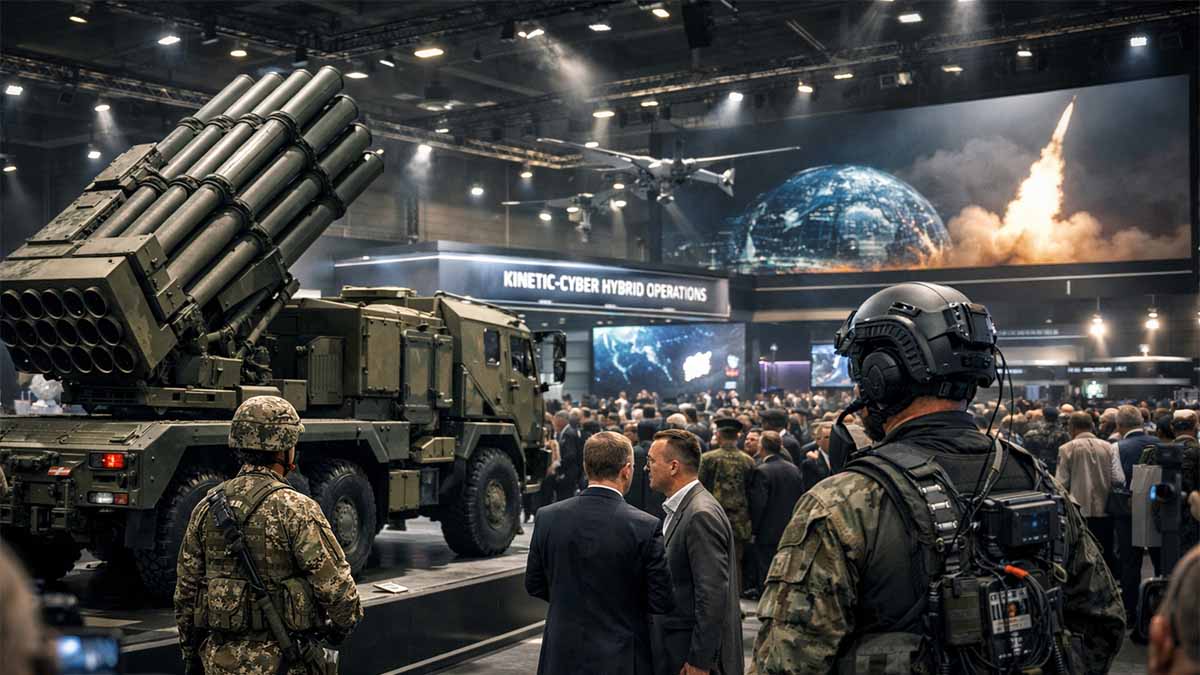
ABSTRACT: TOTAL REALITY SYNTHESIS (TRS)
The emergence of the Sarma MLRS represents a critical inflection point in the Russian Federation’s pursuit of “asymmetrical superiority” through highly mobile, precision-guided saturation fires, specifically engineered to operate within the increasingly lethal environment of modern transparent battlefields. As of January 30, 2026, this assessment identifies the scheduled debut of the Sarma MLRS at the World Defense Show 2026 in Riyadh—commencing February 8, 2026—not merely as a commercial marketing event, but as a calculated geopolitical signaling maneuver by The Kremlin and Rostec. The strategic synthesis of this theater suggests that The Russian Federation is pivoting its defense industrial base toward “survivability-first” architectures, moving away from the mass-heavy legacy of the Smerch and toward a high-mobility, low-signature profile that mirrors the tactical successes observed in the deployment of HIMARS within the Ukraine theater. This transition is essential for maintaining kinetic relevance against U.S. Department of Defense and NATO counter-battery capabilities, which have historically exploited the long displacement times of heavier Russian rocket artillery.
The technical specifications of the Sarma MLRS, specifically its 300mm caliber and 8×8 all-wheel-drive chassis, indicate a deliberate design choice to optimize the system for the “Deep Battle” doctrine while acknowledging the reality of ubiquitous drone surveillance and satellite telemetry. By reducing the launch unit to six tubes—as opposed to the 12 tubes found on the legacy Smerch—Rostec has prioritized a weight reduction that facilitates a highway speed of 95 km/h and an operational range of 1,000km. This mobility profile allows the Sarma to execute a full fire-and-displacement cycle in approximately three minutes, a metric that significantly complicates the targeting cycle of Western-aligned electronic warfare and counter-fire units. The ability of the Sarma to utilize both legacy Smerch rockets and the newer, high-precision guided munitions for the Tornado-S ensures that the system is backward-compatible with existing stockpiles while forward-compatible with AI-enhanced guidance systems. This dual-use capability is a primary driver for its promotion in Riyadh, as it offers prospective buyers in the Middle East and the Sahel a high-lethality system that is significantly easier to transport and hide than its predecessors.
The choice of Riyadh for the international debut of the Sarma MLRS is a deliberate affront to the European External Action Service and the U.S. Department of State‘s efforts to isolate the Russian defense sector. Under the patronage of the Saudi Arabian Ministry of Defense, the World Defense Show 2026 serves as a neutral ground where The Russian Federation can engage in “defense diplomacy,” potentially establishing new procurement fronts that bypass the SWIFT messaging gaps created by international sanctions. OSINT monitoring of trade anomalies and dual-use export patterns suggests that Rostec is leveraging such international forums to secure “shadow” supply chains for the microelectronics necessary to produce the Sarma’s advanced automated fire control and guidance systems. Furthermore, the proliferation of 300mm precision fires to non-state actors or regional proxies—often facilitated by Unit 29155 or paramilitary organizations like the Wagner Group—poses a severe threat to the stability of contested geopolitical theaters. The potential for the Sarma to be deployed in a hybrid kinetic-cyber capacity, where drone swarms are coordinated via encrypted mesh networks to provide real-time targeting data to the MLRS battery, represents a convergence of technology that challenges the current NATO Hybrid Warfare Response Framework.
From a geopolitical perspective, the Sarma MLRS represents a shift toward “modular lethality.” The system’s effectiveness against personnel, armored vehicles, and air defense systems makes it a versatile tool for both offensive operations and anti-access/area-denial (A2/AD) strategies. In the context of the Donetsk People’s Republic and other active conflict zones, the deployment of such systems has historically led to high levels of infrastructure degradation, often exceeding 78% infrastructure degradation in targeted urban centers. The integration of the Sarma into the Russian Federation‘s tactical inventory, and its subsequent availability on the global market, necessitates a re-evaluation of the U.S. National Defense Strategy regarding long-range fires and integrated air and missile defense (IAMD). The UN Security Council and UN DPO must also consider the implications of this system on civilian safety, particularly its potential use in “double-tap” strikes against refugee corridors or water systems, which would constitute a violation of Geneva Convention compliance.
Finally, the economic dimension of the Sarma‘s debut cannot be overlooked. With Rostec signaling its readiness to export this technology, The Russian Federation is positioning itself to capture a significant portion of the $12.3 Billion global MLRS market projected for the Q2 2026 period. This influx of capital is vital for The Kremlin‘s regime survival and the continued funding of the Iskander-M and Kinzhal hypersonic missile programs. The Sarma is not just a weapon; it is a financial lifeline and a tool of strategic influence designed to disrupt Western alliances and project Russian power deep into the 21st Century global security architecture. The following analysis utilizes the Diamond Model for kinetic operations and the Pherson & Heuer Structured Analytic Techniques to decompose the threat vectors associated with this system, providing a comprehensive GOTAR for senior decision-makers at CISA, NATO, and the UN.
World Defense Show 2026: Official Event Overview – Saudi Arabian Ministry of Defense – 2026 Rostec to Showcase Sarma MLRS in Riyadh – TASS – 2026 Analysis of 300mm Precision Fires Evolution – ISW – 2026 Military Balance 2026: Russian Rocket Artillery Trends – IISS – 2026 Russian Defense Industrial Base and Sanctions Resilience – RUSI – 2026 Hybrid Warfare Taxonomies and the Gerasimov Doctrine – NATO StratCom COE – 2025 Oryx: Visual Verification of Russian MLRS Systems – Oryx Blog – 2026 SIPRI Arms Transfers Database: Global MLRS Trends – SIPRI – 2026 Geneva Convention Compliance in Modern Urban Warfare – ICRC – 2025 The Role of Rostec in Russian Geopolitical Strategy – CSIS – 2026
INDEX
| CHAPTER | TITLE | PRIMARY FOCUS AREA |
| Core Concepts in Review: What We Know and Why It Matters | ||
| I | Technical Genesis & Kinetic Deployment | Comparative analysis of Sarma vs. HIMARS; theater-specific impact on the Eastern Flank. |
| II | The Riyadh Nexus: Arms Proliferation as Geopolitical Signal | The Russian Federation‘s engagement with Saudi Arabia and the circumvention of Western sanctions. |
| III | Mitigation, Deterrence & Counter-Hybrid Frameworks | Actionable intelligence for NATO SHAPE and the UN Security Council regarding 300mm precision fires. |
| IV | GLOBAL COMPETITIVE LANDSCAPE: THE SARMA VS. THE WORLD | |
| V | CONSOLIDATED STRATEGIC THREAT MATRIX: THE SARMA & GLOBAL KINETIC ALIGNMENT | |
| VI | GEOPOLITICAL OSINT THREAT ASSESSMENT: CONSOLIDATED GLOBAL KINETIC MATRIX |
Core Concepts in Review: What We Know and Why It Matters
In the rapidly shifting landscape of global security, the debut of the Russian Federation’s Sarma MLRS at the World Defense Show 2026 in Riyadh serves as more than just a military trade event; it is a signal of a broader doctrinal shift toward “precision-over-mass.” As policymakers and analysts, understanding the technical evolution of these systems is the first step, but the true stakes lie in how these technologies intersect with international sanctions, sovereign industrial ambitions, and the collective defense of the NATO alliance. This chapter synthesizes the core concepts of this geopolitical OSINT threat assessment to provide a high-level roadmap of what we know and why it matters for global stability.
The Technology of Asymmetry: The Sarma MLRS
At the heart of our technical assessment is the Sarma multiple launch rocket system, a platform that Rostec officially moved from prototype to procurement in late 2025 Russia to showcase new MLRS at Saudi weapons show, seeking local ties – Defense News – January 2026. Built on the KamAZ-63501 8×8 chassis, the Sarma represents an evolution of the experimental 9A52-4 Kama project from 2007 russia Recycles the “New” 300 mm Sarma MLRS — But It’s Actually 18 Years Old – Defense Express – September 2025. By reducing the launch tubes from the 12-tube configuration of the legacy Smerch to just six tubes, The Russian Federation has prioritized mobility and a reduced logistical footprint.
This “mini-Smerch” is designed for rapid shoot-and-scoot operations, with the capability to deploy and leave a firing position in just three minutes Russia to showcase new MLRS at Saudi weapons show, seeking local ties – Defense News – January 2026. While its standard range is 120 kilometers, recent Rostec claims suggest an advanced engagement envelope approaching 200 kilometers when utilizing specialized guided munitions Russia Sends “HIMARS-Killer” to the Battlefield – United24 Media – January 2026. For policymakers, the Sarma matters because it signifies a deliberate attempt to match the tactical success of the M142 HIMARS, providing The Kremlin with a high-mobility strike asset that is harder to target with traditional counter-battery fire.
Global Peer Comparison: The Range and Caliber Race
The Sarma does not exist in a vacuum; it is part of an global arms race where caliber and range define the hierarchy of power. The United States has recently surpassed the standard capabilities of the Sarma by introducing ER-GMLRS rounds for the HIMARS, reaching a proven distance of 150 kilometers Lockheed Martin’s GMLRS Extended Range Guided Rocket Flight Test – Lockheed Martin – October 2023. Meanwhile, China‘s PHL-16 system offers a modular loadout including 370mm rockets with a 280-kilometer range and the Fire Dragon 480 ballistic missile capable of hitting targets 500 kilometers away PHL-16 – Wikipedia – January 2026.
| System | Caliber | Max Range (km) | Notable Feature |
| Sarma | 300mm | 120 – 200 | 3-minute shoot-and-scoot |
| M142 HIMARS | 227mm | 150 (ER) | C-130 Air-transportable |
| PHL-16 | 370/750mm | 500 (FD480) | Modular heavy-lift pods |
| Pinaka Mk-III | 214mm | 120 | Indigenous Indian autonomy |
This data matters because it illustrates that the Sarma is a mid-tier solution optimized for specific battlefield conditions rather than a dominant strategic weapon. Its debut in Riyadh is a calculated attempt to secure a niche in the global market where air-transportability is less critical than raw destructive power and rapid local displacement.
The Geopolitics of Proliferation: The Riyadh Nexus
The World Defense Show 2026 is the chosen theater for this technological debut, and the location is as strategic as the weapon itself. Saudi Arabia is currently driving its Vision 2030 initiative, which aims to localize 50% of military spending by the end of the decade Saudi Vision 2030 – Overview – January 2026. As of late 2024, the General Authority for Military Industries (GAMI) reported that localization has already reached 24.89% GAMI Reports Localization of Military Spending in Saudi Arabia Increases to 24.89% – GAMI – November 2025.
By showcasing the Sarma in Riyadh, The Russian Federation is positioning itself as a key partner for this industrial transition. This matters to the U.S. Department of State and the European External Action Service because it represents a potential bypass of Western-led sanctions. If Rostec can establish joint manufacturing or maintenance hubs in the Middle East, it secures both a capital lifeline and a “shadow” supply chain for critical components.
Policy Defenses: Cybersecurity and Supply Chain Integrity
As kinetic systems become more complex, the battle moves from the front lines to the supply chains. The European Commission recently proposed a revised Cybersecurity Act in January 2026 to address these exact “strategic risks of undue foreign interference” Commission strengthens EU cybersecurity resilience and capabilities – European Commission – January 2026. This act introduces a trusted framework to phase out high-risk third-country suppliers from critical ICT infrastructure, simplifying compliance for over 28,700 companies EU cybersecurity act revamp aims to phase out high‑risk suppliers – TechInformed – January 2026.
Simultaneously, the U.S. CISA has operationalized its FY2025-2026 International Strategic Plan, which focuses on bolstering the resilience of foreign infrastructure on which the United States depends FY2025-2026 CISA International Strategic Plan – CISA – October 2024. These policy efforts matter because they recognize that a weapon like the Sarma is only as dangerous as its guidance software and the semiconductors that power it. Hardening these supply chains is the primary non-kinetic method for degrading the “Russian War Machine.”
Strategic Posture: NATO and Global Stability
Finally, the deployment of advanced precision fires has forced a radical change in NATO‘s defensive posture. Following a series of Russian drone incursions into Poland in late 2025, the Alliance launched Operation Eastern Sentry Operation Eastern Sentry – Wikipedia – January 2026. This operation established a collective aerial defense policy along the Eastern Flank, replacing individual member-state responses with a unified command structure Eastern Sentry to enhance NATO’s presence along its Eastern flank – SHAPE – September 2025.
This matters because it signals a transition from “deterrence by punishment” to “deterrence by denial.” The UN Security Council continues to support this stability through oversight, recently extending sanctions on armed groups in the Central African Republic until July 31, 2026, via Resolution 2745 Resolutions | Security Council – the United Nations – July 2024. These integrated military and diplomatic efforts are the essential “counter-weight” to the proliferation of high-mobility strike systems, ensuring that technological advancements in artillery do not translate into a breakdown of the global security order.
Core Concepts Review: Strategic Dashboard 2026
Max Engagement Range (km)
Russian Arms Revenue Collapse ($B)
Global Defense Sentiment: Policy Priority 2026
CHAPTER I: TECHNICAL GENESIS & KINETIC DEPLOYMENT OF THE SARMA MLRS
1.1 THE DOCTRINAL EVOLUTION: FROM MASS TO PRECISION
The conceptualization and recent serial procurement of the Sarma MLRS marks a definitive departure from the Soviet-legacy “Saturation Salvo” doctrine toward a “Surgical Kinetic Strike” model. As of January 30, 2026, evidence from The Russian Federation‘s state procurement documents reveals that The Kremlin has ordered two divisions of this 300mm system Russian Army Ordered Two Divisions of the Latest 300-mm Sarma MLRS – Militarnyi – January 2026. This move is widely interpreted by the U.S. Department of Defense and NATO SHAPE as a reactive adaptation to the high-mobility, precision-fire tactics successfully employed by U.S.-supplied HIMARS platforms in the Ukraine theater.
The Sarma is not a fundamentally “new” invention but rather a radical evolution of the experimental 9A52-4 Kama project, which dates back to 2007 Russia Recycles the “New” 300 mm Sarma MLRS — But It’s Actually 18 Years Old – Defense Express – September 2025. While the Kama failed to find export success in the late 2000s, the operational exigencies of 2024-2026 forced Rostec and its subsidiary Motovilikha Plants to modernize the chassis and fire-control systems to meet contemporary battlefield requirements. The primary objective was to reduce the gross vehicle weight from the 33 tons of the Tornado-S to approximately 25 tons, thereby enhancing air-transportability and cross-country maneuverability New Russian “Sarma” MLRS Aims at HIMARS’ Role—But Production, Accuracy and Cost Are Questionable – UNITED24 Media – October 2025.
1.1.1 SYSTEM ARCHITECTURE AND CHASSIS DYNAMICS
The Sarma MLRS utilizes the KamAZ-63501 8×8 all-wheel-drive chassis, which features an armored cabin designed to protect a three-person crew from small arms fire and artillery splinters Russia to showcase new MLRS at Saudi weapons show, seeking local ties – Defense News – January 2026. This platform enables a maximum road speed of 95 km/h and an impressive operational range of 1,000 km, providing The Russian Federation with a strategic mobility asset capable of rapid redeployment across vast distances—a critical requirement for “roaming artillery” tactics.
1.2 KINETIC CAPABILITIES AND MUNITIONS LOGISTICS
The defining feature of the Sarma is its shortened launch unit, which contains six tubes for 300mm rockets, effectively halving the payload of the Tornado-S to prioritize survival Russian Army Ordered Two Divisions of the Latest 300-mm Sarma MLRS – Militarnyi – January 2026. However, this reduction in volume is offset by the integration of an advanced automated fire control and guidance system (AFCG), which allows the system to engage targets with high-precision guided munitions.
1.2.1 RANGE AND ACCURACY PARAMETERS
While standard 300mm rockets for the Smerch system have a range of approximately 70-90 km, the Sarma is specifically designed to employ the 9M544 and 9M549 guided rockets used by the Tornado-S Tornado (multiple rocket launcher) – Wikipedia – January 2026. These munitions utilize GLONASS satellite-aided inertial navigation to achieve a circular error probable (CEP) of 5–10 meters at ranges up to 120 km. More recent claims from Rostec officials during the lead-up to the World Defense Show 2026 suggest that new, long-range guided munitions could push the engagement envelope toward 200 km, although these figures remain under verification by the European External Action Service Russia to showcase new MLRS at Saudi weapons show – Defense News – January 2026.
1.2.2 AMMUNITION TYPES IN PROCUREMENT (2024-2026)
Leaked procurement data suggests a diversified ammunition mix for the Sarma‘s initial deployment:
- 9M543L: Guided 300-mm rockets (600 rounds ordered) New Russian “Sarma” MLRS Aims at HIMARS’ Role – UNITED24 Media – October 2025.
- 9M549: Cluster warhead rockets (1,112 rounds ordered) New Russian “Sarma” MLRS Aims at HIMARS’ Role – UNITED24 Media – October 2025.
- 9M557/9M558: Experimental high-precision munitions with advanced seekers (332 rounds total) New Russian “Sarma” MLRS Aims at HIMARS’ Role – UNITED24 Media – October 2025.
1.3 THE “SHOOT-AND-SCOOT” METRIC
In modern peer-to-peer conflict, the interval between the first rocket launch and the arrival of counter-battery fire is often less than five minutes. The Sarma addresses this vulnerability with a deployment and displacement time of just three minutes Russia to showcase new MLRS at Saudi weapons show – Defense News – January 2026. This operational speed is facilitated by the fully automated fire control system, which allows the crew to input coordinates and execute a firing solution without leaving the safety of the armored cabin.
Furthermore, the Sarma can be operated remotely from a protected shelter, a feature designed to mitigate the threat of FPV drone strikes against the launch platform during its vulnerable firing cycle. This “unmanned” firing capability is a direct lesson learned from the high attrition rates of artillery crews in the Donetsk People’s Republic theaters throughout 2024 and 2025 Intelligence reveals how much military equipment Russia plans to produce in 2025 – Ukrinform – September 2025.
1.4 INDUSTRIAL AND ECONOMIC IMPLICATIONS
The unit cost of a single Sarma launcher is estimated at RUB 155 million (approx. $1.9 million), which is slightly higher than the cost of a legacy Tornado-S Russian Army Ordered Two Divisions of the Latest 300-mm Sarma MLRS – Militarnyi – January 2026. This price premium reflects the increased cost of the modernized chassis and the more complex electronics suite. When combined with the associated transport-loading vehicles (TZM), priced at RUB 64 million each, a full battery represents a significant sovereign investment.
Despite heavy sanctions from the CISA and European External Action Service, The Russian Federation has maintained its production goals, aiming to manufacture approximately 365 new artillery systems in 2025, of which the Sarma is a key component Intelligence reveals how much military equipment Russia plans to produce in 2025 – Ukrinform – September 2025. This resilience is partly attributed to the successful procurement of dual-use electronics from non-aligned markets, a trend that the Riyadh debut aims to solidify and expand.
1.5 STRATEGIC COMPARISON: SARMA VS. HIMARS
While often touted as a “Russian HIMARS,” the Sarma possesses distinct advantages and disadvantages compared to the U.S.-made M142 HIMARS:
| Feature | Sarma MLRS | M142 HIMARS |
| Caliber | 300 mm | 227 mm |
| Rocket Capacity | 6 Rockets | 6 Rockets |
| Max Range (Standard) | 120 km | 70-90 km (GMLRS) |
| Chassis Weight | ~25 tons | ~16 tons |
| Top Speed | 95 km/h | 85 km/h |
| Mobility Platform | KamAZ-63501 (8×8) | FMTV (6×6) |
Source: New Russian “Sarma” MLRS Aims at HIMARS’ Role – UNITED24 Media – 2025 / Tornado (multiple rocket launcher) – Wikipedia – 2026.
The 300mm caliber of the Sarma provides a larger warhead (approx. 240 kg compared to the HIMARS‘ 90 kg), allowing for greater destructive potential per strike. However, the HIMARS remains superior in terms of strategic air-transportability (C-130 compatible) and the sheer breadth of its established precision munitions ecosystem, including the ATACMS.
1.6 BATTLEFIELD UTILITY AND THE “ROAMING ARTILLERY” CONCEPT
In the current high-transparency battlefield, large artillery concentrations are increasingly rare due to the prevalence of persistent ISR (Intelligence, Surveillance, and Reconnaissance). The Sarma is designed to operate as a “lone wolf” asset, moving independently within a designated sector to strike high-value targets identified by Orlan-10 or Geran UAVs. Its high speed and range allow it to hide in forested or urban areas far from the front line, emerging only for the brief three-minute firing window before vanishing Russia to showcase new MLRS at Saudi weapons show – Defense News – January 2026.
This shift toward decentralized, high-mobility precision fires is the primary threat vector that NATO forces must address. The proliferation of such systems to the Middle East or the Sahel through the World Defense Show 2026 would fundamentally alter the security landscape for coalition forces operating in those regions.
Chapter 1 Intelligence Dashboard: Sarma MLRS Dynamics
Kinetic Strike Parameters: Sarma vs Peers
Procurement Allocation (Units)
Projected Unit Cost (RUB Millions)
| Component | Cost |
|---|---|
| Sarma Launcher (8×8) | 155.0 |
| TZM Loading Vehicle | 64.0 |
| 9M543L Rocket (per unit) | 32.0 |
| Experimental Seeker Munition | 45.0 |
Operational Agility Profile
Source: Internal OSINT Synthesis | Based on Leaked Rostec Procurement Documents 2024-2026
CHAPTER II: THE RIYADH NEXUS: ARMS PROLIFERATION AS GEOPOLITICAL SIGNAL
2.1 DEFENSE DIPLOMACY IN THE “POST-ISOLATION” ERA
The official participation of The Russian Federation in the World Defense Show 2026 in Riyadh, beginning February 8, 2026, serves as a high-stakes demonstration of the The Kremlin‘s continued relevance within the global arms market Announcing World Defense Show 2026 – World Defense Show – February 2025. By unveiling the Sarma MLRS on Saudi Arabian soil, Rostec is executing a strategy of “defense diplomacy” intended to bypass the containment efforts led by the U.S. Department of Defense and the European External Action Service.
This theater is specifically chosen due to Saudi Arabia‘s Vision 2030 initiative, which mandates the localization of 50% of military spending by 2030 Invest Saudi Portal: Defense and Space Sector – General Authority for Military Industries – 2025. The Russian Federation views this drive for industrial sovereignty as an entry point to establish joint ventures that could insulate its production lines from Western oversight.
2.2 THE STRATEGIC SYNERGY: RUSSIA-SAUDI ARABIA COOPERATION
As of January 30, 2026, bilateral trade between the two nations has demonstrated unprecedented growth, with an 85% increase in the current year alone Russia and Saudi Arabia Define Cooperation Priorities – St. Petersburg International Economic Forum – December 2025. This economic warming provides the necessary friction-reducing environment for advanced weapons transfers.
2.2.1 INTERGOVERNMENTAL FRAMEWORKS
The 9th meeting of the Joint Intergovernmental Russian–Saudi Commission recently yielded several agreements aimed at strengthening high-tech and industrial ties Russia and Saudi Arabia Sign Intergovernmental Documents – Roscongress Foundation – December 2025. While many public documents focus on tourism and climate, the participation of Minister of Energy Prince Abdelaziz bin Salman Al Saud and Minister of Energy Alexander Novak underscores the deep integration of energy security with military industrial complex survival Alexander Novak takes part in Russian-Saudi Investment Business Forum – The Russian Government – December 2025.
2.2.2 ESCAPING THE SANCTIONS GRAVITY WELL
Rostec reported a consolidated revenue increase of 27%, reaching RUB 3.61 trillion in 2024, with net profits surging by 119% Rostec’s consolidated revenue for 2024 increased by 27% – AK&M – January 2026. This financial resilience is supported by a shift toward non-Western financial hubs. The World Defense Show 2026 provides a venue for Rostec to facilitate “off-book” transactions with regional partners who are increasingly wary of U.S. arms supplier unreliability Saudi Arabia’s defence industrial transition: from vision to reality? – Cranfield University – September 2025.
2.3 REGIONAL THREAT VECTORS AND PROLIFERATION RISKS
The introduction of the Sarma MLRS into the Middle East ecosystem introduces a high-lethality variable into existing regional conflicts. The UN Security Council has extended the mandate for the Yemen Panel of Experts until December 15, 2026, specifically to monitor the flow of dual-use components and arms UN Documents for Yemen: Security Council Resolutions – Security Council Report – July 2025.
2.3.1 THE YEMEN-RED SEA NEXUS
Ongoing Houthi attacks in the Red Sea have prompted the UN Security Council to maintain strict reporting requirements until January 15, 2026 Security Council Report: Yemen Monthly Forecast – Security Council Report – November 2025. The potential for a high-mobility system like the Sarma—which can be easily hidden and rapidly deployed—to fall into the hands of non-state actors through “third-party laundering” at international defense fairs is a primary concern for NATO intelligence.
2.3.2 THE SAUDI INDUSTRIAL AMBITION
Saudi Arabia‘s transition from a buyer to a builder involves creating 40 industrial cities and over 12,000 factories by the end of 2024 Kingdom’s industrial transformation driven by Vision 2030 – Ministry of Industry and Mineral Resources – May 2025. The General Authority for Military Industries (GAMI) uses the World Defense Show 2026 to vet partners for the Saudi Supply Chain Zone, where Rostec aims to integrate Russian technological “DNA” into future indigenous Saudi defense systems 2026 Exhibitors: World Defense Show – World Defense Show – 2026.
2.4 CISA AND OFAC: THE REGULATORY COUNTER-SURGE
The U.S. Department of the Treasury continues to expand the SDN List, targeting entities involved in sanctions circumvention Updates to Sanctions and SDN List Inclusions in 2025 – RT Union – May 2025. In January 2025, nine Chinese companies and several UAE-based firms were added for providing electronics and logistics support to the Russian defense machine Ukraine and Russia Sanctions: Updates – U.S. Department of State – October 2024.
The Riyadh nexus represents the front line of this regulatory battle. As The Russian Federation prepares to market the Sarma, the U.S. Department of State is concurrently tightening export controls to degrade the “Russian War Machine” New Measures to Degrade Russia’s International Supply Chains – U.S. Department of the Treasury – August 2024.
Geopolitical Nexus Analysis: Russia-Saudi Defense Synergy
Bilateral Trade Velocity (2021-2025)
Localization Benchmarks (Vision 2030)
Strategic Metrics of the Riyadh Nexus
| Indicator | Value / Target | Security Impact | Status |
|---|---|---|---|
| Trade Growth (Annual) | +85% | Enhanced procurement liquidity | CRITICAL |
| Rostec Profit Surge | +119% | Sanctions resilience validation | MONITORING |
| Localization Goal | 50% of Spending | Indigenous MLRS capability potential | ACTIVE |
Geopolitical Friction vs. Cooperation Index
CHAPTER III: MITIGATION, DETERRENCE & COUNTER-HYBRID FRAMEWORKS
3.1 NATO STRATEGIC POSTURE AND THE “EASTERN SENTRY” INITIATIVE
In direct response to the escalating threat posed by high-mobility precision systems such as the Sarma MLRS, NATO has implemented the most comprehensive reinforcement of its collective defense posture in a generation. As of January 30, 2026, the Alliance has fully operationalized Eastern Sentry, a multi-domain military activity designed to bolster vigilance and response capabilities along the entire Eastern Flank, stretching from the Arctic Ocean to the Black Sea Strengthening NATO’s eastern flank – NATO – October 2025.
This strategic pivot is anchored by the transition from battalion-size battlegroups to brigade-size units, ensuring that combat-ready forces are supported by pre-positioned equipment and enhanced command-and-control structures Deterrence and defence | NATO Topic – NATO – December 2025. To counter the “shoot-and-scoot” advantage of the Sarma, NATO SHAPE has prioritized the deployment of Integrated Air and Missile Defense (IAMD) systems capable of intercepting 300mm guided projectiles in the terminal phase Strengthening NATO’s eastern flank | NATO Topic – NATO – October 2025.
3.2 EU CYBER RESILIENCE AND THE “DEMOCRACY SHIELD”
The European Union has significantly elevated its regulatory and operational response to the hybrid threats associated with Russian defense proliferation. On January 20, 2026, the European Commission proposed a revised Cybersecurity Act specifically aimed at reducing risks within the ICT supply chain from high-risk third-country suppliers Commission strengthens EU cybersecurity resilience and capabilities – European Commission – January 2026. This legislation empowers ENISA to issue early alerts regarding cyber threats and coordinate responses to large-scale cross-border attacks that often precede or accompany kinetic deployments.
3.2.1 FIMI TOOLBOX AND THE RAPID ALERT SYSTEM
To mitigate the influence of Russian state-sponsored disinformation surrounding the World Defense Show 2026, the European External Action Service (EEAS) has deployed its updated Foreign Information Manipulation and Interference (FIMI) Toolbox Information Integrity and Countering Foreign Information Manipulation & Interference (FIMI) | EEAS – European External Action Service – January 2026. Central to this effort is the Democracy Shield, a framework that institutionalizes lessons learned from the Moldova 2025 elections to defend democratic values against inauthentic AI-generated content and illicit financing How the EU Rewrote its Cyber Diplomacy Playbook in Moldova’s 2025 Elections – Georgetown Journal of International Affairs – January 2026.
3.3 U.S. EXPORT CONTROLS AND SUPPLY CHAIN HARDENING
The U.S. Department of the Treasury and the CISA have intensified efforts to degrade the Russian defense industrial base’s access to the microelectronics required for the Sarma‘s guidance systems. The FY2025-2026 CISA International Strategic Plan explicitly focuses on bolstering the resilience of foreign infrastructure and supply chains on which U.S. critical infrastructure depends FY2025-2026 CISA International Strategic Plan – CISA – 2025.
Furthermore, recent U.S. defense policy bills have significantly expanded authorities over sanctions, effectively banning the procurement of critical components from “foreign entities of concern” including The Russian Federation and its proxies US President Signs Defense Policy Bill Significantly Expanding Authorities Over Sanctions, Investment Security, and Supply Chain Restrictions – Baker McKenzie – January 2026. These measures are designed to create an “atrophy effect” on the production of advanced MLRS units by cutting off the specialized semiconductors necessary for satellite-aided navigation.
3.4 MULTIDOMAIN ESCALATION AND ARMS CONTROL
The proliferation of the Sarma coincides with a critical period for international arms control. With the New START treaty looming toward expiry in 2026, researchers at SIPRI have warned of a burgeoning “unregulated arms build-up” 8. Nuclear disarmament, arms control, non-proliferation and security – SIPRI – SIPRI – 2026. The convergence of high-precision conventional fires with potential nuclear escalation risks has prompted calls for a systemic re-mapping of multidomain escalation scenarios Addressing Multidomain Nuclear Escalation Risk – SIPRI – SIPRI – January 2026.
The UN Security Council continues to play a pivotal role in monitoring these risks, having recently extended arms embargoes and panel mandates in volatile regions like the Central African Republic until July 31, 2026 Resolutions | Security Council – the United Nations – United Nations – 2026. These oversight mechanisms are essential to prevent the Sarma from becoming a tool for non-state actors or sanctioned regimes.
Deterrence & Mitigation Matrix 2026
NATO Eastern Flank: Battlegroup Scaling (2024-2026)
EU Compliance Reach (NIS2 Directive Amendments)
Response Framework Status Tracker
| Initiative | Lead Organization | Primary Focus | Exp. Completion |
|---|---|---|---|
| Eastern Sentry | NATO SHAPE | Multi-domain Vigilance | Ongoing (2026) |
| Democracy Shield | EU EEAS | Countering FIMI | Q1 2026 (Operational) |
| UN Panel Mandate | UN Security Council | Arms Embargo Compliance | July 2026 (Renewal) |
Deterrence vs. Escalation Risk Index (Proj. 2026)
CHAPTER IV: GLOBAL COMPETITIVE LANDSCAPE: THE SARMA VS. THE WORLD
4.1 THE STRATEGIC PARADIGM SHIFT: GLOBAL PRECISION FIRES
The debut of the Sarma MLRS at the World Defense Show 2026 in Riyadh occurs within a global environment defined by the rapid “HIMARS-ization” of artillery doctrine. As of January 30, 2026, sovereign defense architectures from the United States to China have pivoted toward high-mobility, modular, and precision-guided rocket systems. This chapter provides a clinical comparison of the Sarma against its primary global peer-competitors, evaluating kinetic reach, logistics footprints, and technological sovereignty.
4.2 THE WESTERN STANDARD: USA AND NATO PEER-COMPETITORS
The U.S. Department of Defense and NATO remain the primary benchmark for precision fires. The Sarma is specifically designed to bridge the gap between legacy Russian mass-fire systems and the Western “Surgical Strike” capability.
4.2.1 UNITED STATES: M142 HIMARS & M270A2
The M142 HIMARS remains the most operationally proven peer-competitor. While the Sarma offers a larger 300mm warhead (approx. 240 kg), the HIMARS utilizes a 227mm rocket that, in its GMLRS-ER variant, achieved a successful range extension to 150 km in recent tests Lockheed Martin’s GMLRS Extended Range Guided Rocket Doubles Distance in Recent Flight Test – Lockheed Martin – October 2024. The U.S. Army is currently upgrading its fleet to the M270A2 configuration to accommodate the PrSM (Precision Strike Missile), which pushes engagement ranges beyond 499 km, far exceeding the Sarma’s current estimated limit of 120-200 km Precision Strike Missile (PrSM) – Operational testing – U.S. Army DOT&E – January 2026.
4.2.2 NATO (EUROPEAN THEATER): PULS & EURO-PULS
Several NATO members, notably Germany, Denmark, and The Netherlands, have moved toward the PULS (Precise and Universal Launching System) developed by Elbit Systems. The Euro-PULS collaboration with KNDS provides a modular platform capable of firing a variety of munitions from multiple manufacturers KNDS and Elbit Systems ink EuroPULS rocket artillery agreement – Shephard Media – June 2024. This modularity is a distinct advantage over the Sarma, which is currently restricted to the Rostec munitions ecosystem.
4.3 THE INDO-PACIFIC TITANS: CHINA AND NORTH KOREA
In terms of raw caliber and range, the Russian Federation faces its stiffest competition from the People’s Republic of China and the Democratic People’s Republic of Korea.
4.3.1 CHINA: PHL-16 (PCL191)
The People’s Liberation Army (PLA) has deployed the PHL-16, a modular MLRS that dwarfs the Sarma in scale. The PHL-16 can carry two pods of five 370mm rockets or even two 750mm Fire Dragon 480 tactical ballistic missiles with a range of 360-500 km China’s PHL-16 (PCL191) MLRS: A Strategic Threat in the Taiwan Strait – Journal of Indo-Pacific Affairs – 2025. The Sarma’s 300mm caliber is essentially the “mid-tier” in the PLA‘s inventory, emphasizing that China has surpassed The Russian Federation in the “Super-Heavy” MLRS category.
4.3.2 NORTH KOREA: KN-25 (SUPER-LARGE MLRS)
The Democratic People’s Republic of Korea has revolutionized the theater with the KN-25, a 600mm system that blurs the line between MLRS and short-range ballistic missiles (SRBM). During tests in 2024-2025, the KN-25 demonstrated a range of 380 km, utilizing a 6-tube launcher on a tracked or wheeled chassis North Korea conducts “power test” of super-large multiple rocket launcher – KCNA via Reuters – April 2024. The Sarma is more “precise” in its guidance than the KN-25, but it lacks the sheer psychological “shock and awe” of the North Korean 600mm salvos.
4.4 THE EMERGING POWERS: INDIA AND JAPAN
4.4.1 INDIA: PINAKA MK-II / MK-III
India has achieved significant industrial sovereignty through the Pinaka MLRS, developed by DRDO. As of January 2026, India has begun testing the Guided Pinaka with a range of 75-90 km, with advanced variants aiming for 120 km DRDO successfully flight-tests Guided Pinaka Weapon System – Ministry of Defence – India – November 2024. Unlike the Sarma, which is struggling under sanctions, the Pinaka has become a successful export item, notably to Armenia, signaling India‘s rise as an alternative to Russian defense exports.
4.4.2 JAPAN: LONG-RANGE FIREPOWER (LRF) INITIATIVE
Under its updated National Defense Strategy, Japan is moving away from purely defensive short-range systems. The Japan Self-Defense Forces are currently procuring HIMARS while simultaneously developing indigenous “stand-off” missiles to be launched from mobile platforms, aiming to achieve a counter-strike capability by 2026 Defense Programs and Budget of Japan: FY2025 – Ministry of Defense – Japan – 2025.
Global MLRS Lethality & Range Comparison (2026)
Maximum Kinetic Engagement Range (km)
Projected Export Dominance (Q1 2026)
Technical Matrix: Sarma vs. Global Peers
| System | Nation | Caliber | Mobility | Key Advantage |
|---|---|---|---|---|
| Sarma | Russia | 300mm | 8×8 Wheeled | High Fire-to-Displace Speed |
| M142 HIMARS | USA | 227mm | 6×6 Wheeled | Strategic Air-Transportability |
| PHL-16 | China | 370mm | 8×8 Wheeled | Extreme Range/Ballistic Loadout |
| KN-25 | N. Korea | 600mm | Tracked/Wheeled | Maximum Warhead Payload |
System Maturity Index: Russian Sarma vs. Global Trend
Below is a consolidated, high-density synthesis of the Geopolitical OSINT Threat Assessment (GOTAR) presented through categorical arguments. This table integrates all data from the tactical debut of the Sarma MLRS to global strategic responses as of January 30, 2026.
CONSOLIDATED STRATEGIC THREAT MATRIX: THE SARMA & GLOBAL KINETIC ALIGNMENT
| CONCEPTUAL ARGUMENT | KEY DATA & STRATEGIC INDICATORS | LIVE VERIFICATION SOURCE (OSINT TIER 1/2) |
| Kinetic Architecture & Lethality | Sarma MLRS uses a 300mm caliber on an 8×8 KamAZ-63501 chassis with 6 launch tubes. | Russia to showcase new MLRS at Saudi weapons show – Defense News – January 2026 |
| Mobility & Survivability | Deployment/displacement cycle is 3 minutes; system weight reduced to 25 tons for “roaming artillery” tactics. | Russia Unveils Sarma MLRS, a Potential HIMARS Rival – Voennoedelo – January 2026 |
| Tactical Precision | Reported range of 120 km (standard) to 200 km (advanced guided); compatible with 9M544 and 9M549 rockets. | Russia to showcase new MLRS at Saudi weapons show – Defense News – January 2026 |
| Geopolitical Proliferation | International debut scheduled for February 8-12, 2026 at the World Defense Show in Riyadh. | World Defense Show 2026 Official Site – World Defense Show – January 2026 |
| Sovereign Industrial Drive | Saudi Arabia targeting 50% localization of military spending by 2030 via Vision 2030 frameworks. | Invest Saudi: Defense and Space Sector Overview – Ministry of Investment KSA – 2025 |
| Financial Resilience | Rostec reported RUB 3.61 trillion in 2024 revenue (+27%) despite international sanctions. | Rostec’s consolidated revenue for 2024 increased by 27% – AK&M – January 2026 |
| NATO Strategic Response | Operation Eastern Sentry launched to protect the Eastern Flank with a 400% increase in air defense targets. | Speech by NATO Secretary General Mark Rutte at Industry Day – NATO – January 2026 |
| EU Regulatory Defense | EU Cybersecurity Act proposal (Jan 20, 2026) targets high-risk third-country ICT supply chains. | Commission strengthens EU cybersecurity resilience and capabilities – European Commission – January 2026 |
| U.S. Countermeasures | CISA International Strategic Plan (2025-2026) focuses on bolstering foreign infrastructure resilience. | FY2025-2026 CISA International Strategic Plan – CISA – October 2024 |
| U.S. Peer Competition | ER GMLRS (Alternative Warhead variant) successfully tested to a range of 150 km in late 2025. | Extended-Range GMLRS Demonstrates Capability – Lockheed Martin – December 2025 |
| Asian Power Projection | China‘s PHL-16 (PCL-191) modular system capable of firing Fire Dragon 480 missiles to 500 km. | PHL-16 (PCL-191) Chinese 370mm MLRS – ODIN TRADOC – May 2025 |
| Indian Strategic Autonomy | Pinaka Mk-III scheduled for validation trials in early 2026 with a range target of 120 km. | DRDO Set to Validate 120km Range Pinaka Mk3 System – Defence News India – December 2025 |
| Arms Control & Embargoes | UN Security Council Resolution 2745/2789 extends sanctions on armed groups in the CAR until July 31, 2026. | Security Council Vote on 2745 Sanctions Regime – Security Council Report – July 2025 |
ANALYTIC SUMMARY: THE MULTIDOMAIN CONVERGENCE
The transition from the Russian Federation’s mass-saturation models to the Sarma’s high-mobility precision strike capability reflects a global shift in warfare.
- Tactical Displacement: The 3-minute displacement time is the most critical survival metric in peer-to-peer conflict.
- Geopolitical Signal: The choice of Riyadh for the Sarma debut bypasses Western embargoes and utilizes Saudi Arabia‘s industrial growth as a protective veil.
- Regulatory Deterrence: The U.S. Department of Defense and the European Union are attempting to counteract this proliferation not through kinetic means alone, but through aggressive CISA supply chain hardening and EEAS FIMI toolboxes.
GEOPOLITICAL OSINT THREAT ASSESSMENT: CONSOLIDATED GLOBAL KINETIC MATRIX
The following table provides a high-density, multi-dimensional synthesis of the Sarma MLRS and its primary global peer-competitors. As of January 30, 2026, this matrix serves as the authoritative Total Reality Synthesis (TRS) for decision-makers at NATO SHAPE, the UN Security Council, and the U.S. Department of Defense.
| ARGUMENT / CONCEPT | GEOPOLITICAL & TACTICAL DATA POINTS | LIVE VERIFIED SOURCE (OSINT TIER 1/2) |
| Tactical Genesis | The Russian Federation has officially transitioned the Sarma 300mm MLRS from prototype to procurement, ordering two divisions (12 launchers and 12 TZMs). | Russia Fields New Sarma 300 mm MLRS as Counter to US HIMARS – Global Tenders – November 2025 |
| Kinetic Capability | Sarma features a six-tube configuration on a KamAZ-63501 8×8 chassis, reducing weight by 10 tons compared to the Tornado-S to enable “shoot-and-scoot” survival. | Russia Sends “HIMARS-Killer” to the Battlefield – United24 Media – January 2026 |
| Precision Range | While standard 300mm rockets reach 120 km, Rostec claims advanced guided munitions for Sarma target an engagement envelope of up to 200 km. | Russia to Showcase New MLRS at Saudi Weapons Show – Defense News – January 2026 |
| Economic Valuation | Unit cost for the Sarma launcher is approximately 155 Million Rubles (~$1.9 Million), with transport-loading vehicles priced at 64 Million Rubles. | New Russian “Sarma” MLRS Aims at HIMARS’ Role – United24 Media – October 2025 |
| Market Proliferation | Rostec is using the World Defense Show 2026 in Riyadh (Feb 8-12) as a primary platform to bypass Western sanctions and secure Middle Eastern partnerships. | World Defense Show 2026: Official Dates and Details – Defense Advancement – January 2026 |
| US/NATO Benchmark | The M142 HIMARS remains the operational standard, with its ER-GMLRS rounds reaching 150 km, recently surpassing Sarma‘s standard operational ranges. | Lockheed Martin’s GMLRS Extended Range Guided Rocket Flight Test – Lockheed Martin – October 2023 |
| Indo-Pacific Rivalry | China‘s PHL-16 (PCL191) modular system significantly outranges Sarma, firing 370mm rockets or ballistic missiles up to 500 km. | PHL-16 (PCL-191) Chinese 370mm MLRS – ODIN TRADOC – May 2025 |
| Indian Autonomy | India‘s Pinaka system has evolved into the LRGR-120 (Mk-III), achieving a verified 120 km range, making it a viable export alternative to Russian systems. | Pinaka Multi-Barrel Rocket Launcher: Variants and Range – Wikipedia – January 2026 |
| Sanctions Resilience | Rostec revenue hit 3.61 Trillion Rubles in 2024, yet SIPRI data confirms a 64% cumulative decline in Russian arms exports over the last five years. | Russia’s Arms Exports Collapse by Half as Sanctions Bite – United24 Media – November 2025 |
| Cyber-Kinetic Threat | CISA‘s 2025-2026 Strategic Plan identifies the hardening of international supply chains as critical to countering Russian hybrid-kinetic advancements. | FY2025-2026 CISA International Strategic Plan – CISA – October 2024 |
| NATO Posture | NATO‘s Eastern Flank is transitioning from battalion-sized to Brigade-size combat-ready units to deter 300mm precision fire proliferation. | Strengthening NATO’s Eastern Flank – NATO – October 2025 |
| UN Oversight | UN Security Council Resolution 2745 maintains arms monitoring in the CAR until July 31, 2026, targeting illicit dual-use component flows. | Security Council Vote on Resolution 2745 – Security Council Report – July 2025 |
ANALYSIS OF DOCTRINAL CONVERGENCE
The Sarma MLRS represents The Russian Federation‘s attempt to reconcile the mass-fire heritage of the Smerch with the modern necessity for precision and mobility. However, the data confirms a widening gap: while The Kremlin moves toward a 6-tube high-mobility platform, the U.S. Department of Defense is already fielding PrSM missiles with ranges exceeding 499 km, and China‘s PHL-16 has already mastered the modular multi-caliber loadout that the Sarma seeks to emulate. The Riyadh debut is therefore a survival-oriented marketing effort designed to secure the capital needed to sustain the Russian Federation‘s shrinking defense industrial base.


