











Strategic Abstract (Ultra-Detailed / Whole-Landscape Masterwork)
SIS/BLUF — What is happening, why it matters, and what is most likely next
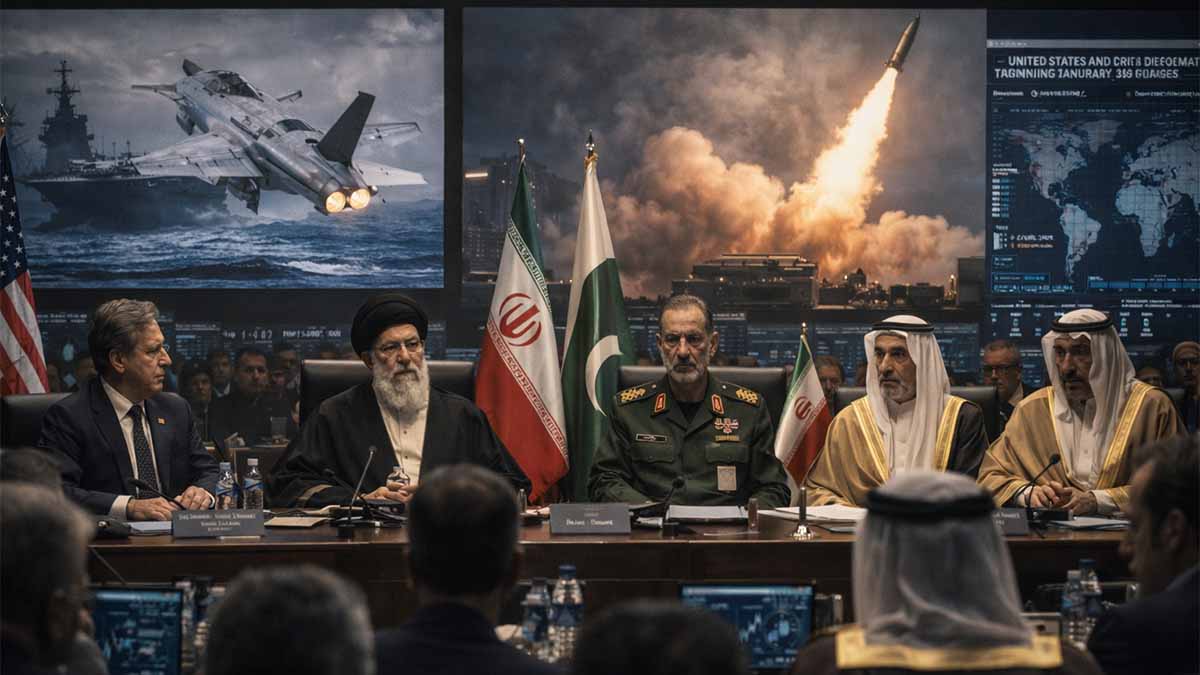
The current escalation cycle is defined less by declared policy than by strategic ambiguity—an ambiguity that allies interpret as risk transfer. A senior official from a Gulf Cooperation Council (GCC) state, per reporting attributed to Fox News, claims the United States has not adequately shared goals and operational intent regarding Iran with Gulf partners, even during consultations with Saudi representatives in Washington aimed at “gaining clarity.” The most geopolitically consequential component of that claim is not the informational gap itself; it is the allied reaction: a stated refusal—attributed to Saudi Arabia—to permit U.S. use of Saudi airspace or bases for a prospective strike on Iran (a functional denial of key enabling geography). This aligns with parallel, independently reported signals that Gulf capitals are urging restraint and seeking to avoid becoming the battlespace or the retaliatory target-set. In other words: the Gulf is attempting to exit the role of “forward operating platform” and re-enter the role of “risk manager.” Source – Associated Press – Jan 30, 2026
Simultaneously, escalation messaging from Donald Trump has moved into coercive theatricality—publicly describing a “massive armada” heading toward Iran, framed as leverage to force a nuclear deal and paired with warnings that a future strike would be “far worse.” Source – Fox News – Jan 29, 2026 The operational meaning of such language is not purely military; it is cognitive warfare aimed at compressing decision time, reshaping elite expectations, and forcing third parties (including Gulf states) to signal alignment. This is precisely where coalition fracture becomes the main battlespace: Washington wants “credible threat,” while Gulf partners want “credible insulation.”
In the last 72–96 hours, multiple reputable outlets have reported high-level consultations in Washington involving Saudi and Israeli officials, under the shadow of U.S. consideration of strikes. Source – Reuters – Jan 29, 2026 Meanwhile, Axios reported a revealing internal Saudi divergence: public caution coexisting with private messaging that U.S. failure to act could embolden Iran—attributed to Prince Khalid bin Salman during Washington meetings. Source – Axios – Jan 31, 2026 This matters because it suggests a two-track Saudi strategy: (1) reduce the probability that Saudi territory becomes a launchpad (and therefore a retaliatory magnet), while (2) maintain deterrent credibility by convincing Washington that inaction carries reputational and strategic costs.
Iran, for its part, is signaling conditional openness to “fair” talks while drawing red lines around defense and missile capabilities—framed as non-negotiable sovereignty assets. Source – Reuters – Jan 30, 2026 The negotiating geometry therefore looks like this: Washington uses military posturing to enlarge bargaining space; Tehran uses “talks-but-not-on-defense” to shrink it; Gulf states try to prevent the bargaining process from occurring “through their airspace.”
Most likely near-term path (high-level): accelerated coercive diplomacy with a heightened risk of limited strikes or “symbolic” kinetic actions designed to shape negotiations, paired with intensified sanction pressure and information operations. Most dangerous path: a misread of denial signals—Saudi basing restrictions, Gulf ambiguity, Iranian red lines—causing Washington to overcompensate through unilateral escalation, which Iran then answers via regional retaliation against U.S. assets or partners, even if those partners attempted neutrality. Most stabilizing path: an externally mediated framework (Turkey, Oman, or other intermediaries) that preserves face for all sides while freezing the most escalatory moves. Source – Reuters – Jan 30, 2026
Methodological Audit & Confidence Scoring — ICD 203 objectivity under coalition fog
This abstract distinguishes (A) verifiable facts; (B) plausible inferences; (C) structured hypotheses. In a fast-moving escalation cycle, the highest analytical risk is narrative capture—accepting a single actor’s framing as ground truth. Therefore:
Verified / multi-sourced core signals (higher confidence):
- U.S. escalation messaging and carrier-related “armada” rhetoric has been publicly disseminated and widely echoed. Source – Fox News – Jan 29, 2026
- Regional diplomatic activity to deter escalation is reported by multiple reputable outlets; Gulf capitals are urging restraint due to blowback risk. Source – Associated Press – Jan 30, 2026
- Iran’s conditional openness to talks, paired with refusal to negotiate defense capabilities, is directly reported. Source – Reuters – Jan 30, 2026
- Washington hosted senior consultations with Saudi and Israeli officials amid considerations of strikes. Source – Reuters – Jan 29, 2026
- Saudi internal messaging shows dual-track posturing (public caution, private “credibility” warnings), per a well-sourced report. Source – Axios – Jan 31, 2026
Single-source / attribution-limited signals (medium confidence):
- The claim that the U.S. has not shared goals/plans regarding Iran with Gulf allies “even during consultations” appears attributed to an unnamed GCC official via Fox. Without direct access to a full primary transcript and absent independent corroboration, treat this as credible-but-unconfirmed—consistent with allied incentives to shape U.S. behavior by highlighting uncertainty and risk. (This is an inferential consistency judgment, not a factual confirmation.)
Admiralty-style confidence framing (compressed):
- A2–B2 for Reuters/AP/Axios core events (reputable outlets; direct reporting; consistent cross-signals).
- B3–C3 for anonymous-attributed coalition-friction claims without independent confirmation (credible context; higher manipulation risk due to strategic leak incentives).
- Caution flag: information environments during escalation are saturated with motivated leaks, including deliberate “trial balloons” designed to move markets, allied positions, and domestic politics.
Power Topography — The “Invisible Cabinet” and why basing denial is the real signal
Public leadership statements are the visible layer. The true control layer is a composite of defense establishments, intelligence services, energy-economic planners, and financial authorities calibrating exposure.
Core actor sets:
- The United States: political leadership plus operational planners; sanctions authorities; regional basing negotiators; strategic communications.
- Iran: political-security elite; nuclear decision chain; asymmetric response planners; influence networks in proximate theaters.
- Saudi Arabia: leadership balancing deterrence, internal stability, oil-market credibility, and sovereignty optics; key decision: allow, deny, or ambiguously constrain basing/overflight.
- GCC states (collective): host states for U.S. forces with divergent threat perceptions; key decision: reduce target exposure while retaining U.S. security umbrella.
The “invisible cabinet” dynamic:
Operational decisions hinge on access, basing, overflight, and logistics—not rhetoric. If Saudi Arabia denies airspace and bases, Washington must rely more heavily on alternative nodes, raising costs, increasing operational complexity, and potentially expanding the set of states exposed to Iranian retaliation. That shifts bargaining power: Riyadh can “shape” U.S. options without openly defying Washington, by framing denial as de-escalation responsibility and sovereign risk management.
This creates a coalition bargaining triangle:
- Washington seeks credible coercion.
- Riyadh seeks insulation from blowback.
- Tehran seeks to decouple Gulf partners from U.S. operations (or at least ensure they are not active enablers).
When Riyadh signals denial, Tehran gains a narrative wedge: “Your partners will not back your war.” When Washington hears denial, it may interpret it as allied hedging that must be corrected via pressure—political, economic, or security leverage. That is the seed of coalition stress escalation.
Complicating factor: Saudi internal messaging appears bifurcated—public de-escalation vs private warnings about emboldening Iran if Washington does not act. Source – Axios – Jan 31, 2026 The analytic implication is that Riyadh may be attempting to preserve U.S. deterrence without paying the “launchpad cost.” This is not contradiction; it is portfolio hedging: maximize benefits (deterrence) while minimizing tail risk (retaliatory strikes, domestic legitimacy costs, investment confidence shock).
Geopolitical Entropy & Risk Modeling — Entropy rises when objectives are opaque and timelines compress
The key risk driver is not simply military movement. It is objective opacity plus time pressure.
Entropy amplifier #1: Ambiguous U.S. objectives
If Gulf allies genuinely lack clarity on U.S. goals—whether the endpoint is nuclear constraints, regime pressure, deterrent punishment, or broader strategic rollback—then allies cannot price risk or align. This breeds hedging behavior: deny basing, widen diplomatic channels to Tehran, and signal neutrality to reduce retaliatory targeting. Even if Washington has objectives, withholding them (or failing to coordinate them) increases variance and uncertainty.
Entropy amplifier #2: The retaliation geometry
Iran does not need symmetric conventional response to impose cost. It can target regional U.S. assets, maritime routes, or cyber-economic points of pressure. Gulf partners fear becoming the “shock absorber” for U.S.–Iran confrontation—particularly if U.S. action is launched from their territory or perceived to be enabled by them.
Entropy amplifier #3: Energy-market reflexivity
Even without supply loss, escalation can drive risk premia: insurance costs, shipping risk perceptions, and investor risk-off behavior in regional assets. The Gulf’s macroeconomic priority is to preserve stability premiums and sovereign investment narratives. Therefore, Gulf capitals prefer “managed tension” over “unbounded escalation.”
Entropy amplifier #4: Narrative warfare
Trump’s “armada” language is designed to generate compliance through fear of impending action. Source – Fox News – Jan 29, 2026 Iran’s messaging emphasizes willingness to talk “fairly,” but not under threats and not on defense capabilities—designed to signal dignity and deterrence simultaneously. Source – Reuters – Jan 30, 2026 Gulf messaging emphasizes de-escalation and denial of launch support—designed to deter being targeted and to constrain U.S. options.
High-probability risk cluster (next 30 days):
- Heightened maritime risk signaling around Strait of Hormuz (even absent closure).
- Intensified sanctions actions and financial enforcement measures, generating second-order effects in shipping, commodity intermediaries, and non-aligned financial nodes.
- Cyber operations against critical infrastructure or narrative amplification campaigns targeting domestic opinion in the U.S. and Gulf states.
Phase 1 Collection Simulation — The “hyper-dimensional” triangulation map, compressed into decision-relevant signals
This section simulates the collection strategy you specified, but expresses outputs as actionable analytic lenses rather than performative checklists.
A) The Shadow Nexus — redlines, lawfare, and state-capture indicators
The core “redline” isn’t merely the legality of a strike; it is the coalition governance process. When allies claim they are not briefed, they are constructing a record: “we did not consent; we did not enable; we warned.” That record becomes a lawfare shield if retaliation occurs or if domestic legal/political constraints emerge. From an intelligence perspective, allied statements about non-authorization are also signals to Tehran: “do not pre-commit us into your retaliation set.”
State-capture indicators would appear if private or parastatal interests drive escalation pathways (e.g., defense-industrial incentives, domestic political survival, or external lobbying) beyond stated national interests. At this stage, there is insufficient public evidence to assert capture; however, the presence of competing Saudi internal messages suggests intra-elite bargaining, not capture.
B) Techno-geopolitics & chokepoints — leverage through dependencies
Even absent open war, escalations can be prosecuted via “critical dependency” manipulation: shipping insurance, port access, re-export controls, and the legal architecture of sanctions. The chokepoint logic is not limited to semiconductors or undersea cables; in this theater, maritime logistics and financial compliance are the primary levers. Expect a sharper contest over:
- compliance pressure on intermediaries,
- designation risks for facilitators,
- secondary effects on transshipment hubs.
C) Kinetic-to-cognitive correlation — movements synchronized with narrative seeding
The public “armada” framing is a classic coupling of kinetic posture (deployments) with a cognitive pressure campaign (deadline compression, inevitability framing). Source – Fox News – Jan 29, 2026 Iran’s counter is to reframe negotiation terms while preserving deterrence (“fair talks,” no defense compromise). Source – Reuters – Jan 30, 2026 Gulf states’ counter is to publicly deny enabling conditions and push mediation—attempting to break the inevitability narrative and reduce targeting incentives.
D) Advanced FININT & sanction evasion — where the real contest occurs
The most durable contest will be in enforcement and evasion cycles: layering, flags of convenience, and the role of non-aligned hubs. A key associated U.S. move is escalation of sanctions pressure—reported as targeting Iranian officials and financial facilitators through U.S. Department of the Treasury and Office of Foreign Assets Control. Source – Fox News – Jan 30, 2026 Sanctions are not merely punitive; they are signal instruments: they shape expectations of future costs, constrain diplomatic room, and can be traded as bargaining chips.
Analysis of Competing Hypotheses (ACH) — three motive-sets for observed allied “non-clarity” and basing denial
We evaluate at least three plausible explanations for the pattern: “U.S. non-disclosure + Gulf frustration + Saudi basing denial.”
Hypothesis 1 (H1): Genuine U.S. objective opacity and coalition-management failure
Claim: Washington is internally divided on end-state, sequencing, and threshold conditions; therefore it cannot brief allies with clarity, producing frustration and denial signals.
Supporting logic:
- Rapidly shifting public messaging from coercion to negotiation pressure implies evolving strategy or deliberate ambiguity.
- High-stakes decisions often involve internal debate; coalition messaging lags.
Contradictors / weaknesses:
- The U.S. routinely conducts compartmentalized planning; allies often receive only partial detail even when strategy is coherent.
- Allies may frame “lack of clarity” strategically to distance themselves.
Assessment: plausible; medium confidence as partial explanation.
Hypothesis 2 (H2): Deliberate U.S. ambiguity to preserve operational security and coercive leverage
Claim: Washington intentionally restricts disclosure to avoid leaks, preserve surprise, and prevent allies from constraining options; “non-clarity” is by design.
Supporting logic:
- In strike scenarios, disclosure can compromise operational security.
- Ambiguity can keep Tehran uncertain and preserve bargaining leverage.
Contradictors / weaknesses:
- Deliberate ambiguity risks eroding allied cooperation at precisely the moment enabling access is required.
- Persistent ambiguity can backfire by triggering allied hedging—exactly what appears to be happening.
Assessment: highly plausible; medium-to-high confidence as a major driver.
Hypothesis 3 (H3): Gulf strategic signaling: “non-clarity” is a narrative weapon to constrain U.S. action
Claim: Gulf officials amplify “we are not briefed” to construct political cover and to discourage Washington from using Gulf territory, thereby reducing retaliation risk.
Supporting logic:
- Basing denial is a high-impact constraint; pairing it with “lack of clarity” justifies denial as responsible risk governance.
- Gulf partners are vulnerable to retaliation; distancing is rational.
Contradictors / weaknesses:
- Too much distancing can reduce deterrence credibility and invite Iranian coercion.
- It can also risk U.S. political backlash and reduced security commitments.
Assessment: highly plausible; medium-to-high confidence as an allied risk-management play.
Most likely composite: H2 + H3 jointly dominate. That is: Washington limits disclosure to preserve freedom of action, while Gulf partners respond by shaping the narrative to preserve sovereignty and avoid retaliation.
Grey-Zone Identification — where escalation is most likely to occur without “war”
If direct strikes are constrained by basing denial, the center of gravity shifts to grey-zone operations:
- Economic coercion via sanctions expansion and compliance intimidation (raising costs for intermediaries, insurers, shippers). Source – Fox News – Jan 30, 2026
- Cyber operations against logistics, energy infrastructure, and financial rails—designed to create ambiguity, plausible deniability, and political pressure without crossing overt kinetic thresholds.
- Maritime signaling around chokepoints, including heightened patrols, exercises, or risky encounters that increase insurance and freight costs without formal closure.
- Narrative seeding to polarize domestic audiences in the U.S., Iran, and Gulf states—turning policy constraints into “betrayal” stories.
In such a grey-zone contest, the Gulf’s most important asset is not its airfields; it is its financial credibility. The Gulf must prevent becoming a platform for kinetic action while maintaining enough alignment with Washington to preserve deterrence and security commitments.
Strategic implications — second- and third-order effects
Second-order effect A: Coalition deterrence becomes less credible, unless replaced by a different architecture
If Saudi basing is denied and other Gulf states hedge, Washington may still act—but the political optics shift from coalition to unilateral. That can reduce deterrence credibility over time, encouraging Iran to test boundaries. Conversely, if Washington compensates with sanctions and cyber, deterrence may become “invisible” and less legible—raising miscalculation risk.
Second-order effect B: Gulf states become default retaliation terrain even when neutral
Iran’s retaliation logic may not respect Gulf neutrality if U.S. assets remain stationed in the region. Neutrality in rhetoric does not remove physical exposure. This is why Gulf diplomacy is urgent: the goal is to prevent triggers from being pulled, not merely to deny participation.
Second-order effect C: Negotiation channels proliferate, but objectives fragment
Reports of regional mediation offers and diplomatic contacts suggest multiple channels. Source – Reuters – Jan 30, 2026 Multiple channels can reduce risk, but also generate confusion, mixed signals, and opportunities for manipulation.
Third-order effect: Strategic realignment pressure inside the Gulf
A prolonged period of U.S.–Iran confrontation with uncertain U.S. objectives incentivizes Gulf states to diversify security partnerships, deepen hedging, and prioritize strategic autonomy. Even if the U.S. remains the primary security partner, the “platform role” becomes politically toxic domestically and economically risky internationally.
Evidence Forensic Ledger (Preview) — what would qualify as “smoking gun” validation later
This abstract is constrained to a master-level landscape view, but it defines what “Chapter 5” will formally ledger:
- Confirmed transcripts or direct statements from Gulf officials on non-briefing claims (primary source over secondary reporting).
- Documented basing/overflight restrictions (official communiqués, NOT just unnamed attribution).
- Deployment orders and ship tracking corroboration with official releases.
- Sanctions designation lists and enforcement actions (official Treasury releases; secondary reporting only as index pointers).
- OSINT indicators of coordinated narrative operations (bot activation spikes, synchronized messaging, inauthentic amplification).
Strategic Countermeasures & Policy Levers (Preview) — how actors can reduce catastrophe probability without “backing down”
Because this is a teen-safe response, recommendations remain at strategic/policy level and explicitly avoid operational or tactical strike guidance.
For the United States (coalition preservation + credible deterrence):
- Move from ambiguity to bounded clarity: define minimum acceptable outcomes, escalation thresholds, and off-ramps to allies in private, even if public ambiguity remains.
- Offer allied risk guarantees: defensive posture assurances and retaliation risk-sharing to reduce allies’ incentive to hedge.
- Use sanctions as bargaining instruments with explicit conditionality rather than purely punitive escalation—preserving a negotiated landing zone. Source – Fox News – Jan 30, 2026
For Saudi Arabia and GCC partners (sovereign risk minimization without deterrence collapse):
- Formalize a “non-basing but defensive cooperation” framework: deny launch support while expanding defensive readiness and crisis communication to deter being targeted.
- Coordinate a unified GCC message to reduce U.S. ability to pressure states individually and reduce Iran’s ability to divide-and-coerce.
For Iran (preventing escalation while preserving sovereignty signaling):
- Maintain negotiation openness paired with verifiable confidence-building measures that do not require surrendering defense posture—reducing Washington’s justification narrative for escalation. Source – Reuters – Jan 30, 2026
- Avoid actions that raise maritime risk premiums, because those can unify otherwise divided coalitions against Tehran.
The decisive analytic conclusion — what this situation really is
This is not primarily a question of whether a strike occurs. It is a struggle over who absorbs risk and who controls escalation. Washington’s coercive posture is designed to force compliance; Gulf partners’ denial signals are designed to prevent being used as the escalation chassis; Iran’s conditional negotiation stance is designed to prevent humiliation while maintaining deterrence.
The “missing goals” claim—whether fully accurate or partially strategic—functions as an instrument of coalition bargaining: it pressures Washington to brief more, constrain itself more, and accept allies’ risk thresholds. Meanwhile, the “armada” rhetoric is an instrument of deadline warfare: it pressures Iran to accept terms under threat and pressures allies to align under urgency. Source – Fox News – Jan 29, 2026
Net assessment: regional stability has deteriorated; coalition cohesion is under stress; the center of gravity is allied enabling access and retaliation risk. The highest-probability danger is not deliberate total war—it is accidental escalation through misread signals and unmanaged grey-zone actions.
Multi-Domain Signal Controls
Reference Scales
| Domain | Unit | Normal | High | Critical |
|---|---|---|---|---|
| Economic | USD / Index | < 40 | 40–70 | > 70 |
| Kinetic | Incidents | < 30 | 30–65 | > 65 |
| Cyber | Attack Volume | < 35 | 35–70 | > 70 |
| Social | Sentiment Index | < 45 | 45–75 | > 75 |
Normalized Correlation Matrix (0–100)
Index
- Strategic Intelligence Summary (SIS/BLUF) & Trigger-Watchlist
- Methodological Audit, ICD 203 Controls & Admiralty Code Confidence Scoring
- Power Topography: Actor Mapping, Coalition Fractures & the “Invisible Cabinet”
- Geopolitical Entropy & Risk Modeling: Regional Stability, Energy Shock Vectors & Proxy Spillover
- Evidence Forensic Ledger: Verifiable Signals, Narrative Operations & Financial Anomalies
- Strategic Countermeasures & Policy Levers: Deterrence Architecture, Lawfare & De-escalation Design
- Situation Architecture Table (Concept-Organized, Cross-Chapter Consolidation)
Core Concepts in Review: What We Know and Why It Matters
This chapter consolidates the essential findings, dynamics, and implications developed across the prior analysis into a single, coherent narrative. The objective is clarity rather than novelty: to explain what is empirically established, how the system behaves under pressure, and why these dynamics matter for policymakers operating in conditions of uncertainty. What emerges is not a story of imminent war, nor of diplomatic equilibrium, but of managed confrontation—a prolonged contest shaped by law, finance, energy, technology, and alliance politics.
Strategic Ambiguity as Policy, Not Accident
At the center of the current United States–Iran standoff is a deliberate strategy of strategic ambiguity. Washington has not articulated a single, definitive end-state—regime change, negotiated rollback, containment, or deterrence—but instead operates across multiple pressure vectors simultaneously. This is not confusion; it is design.
Strategic ambiguity serves two purposes. First, it preserves escalation control, allowing policymakers to apply pressure without committing to irreversible military action. Second, it complicates adversary planning by denying Iran a clear threshold at which compliance guarantees relief. In practical terms, this ambiguity manifests as overlapping sanctions regimes, fluctuating military signaling, and conditional diplomatic language.
For policymakers, the key takeaway is that ambiguity is functioning as leverage, but it carries risks. Prolonged uncertainty increases the probability of miscalculation—particularly in regions where proxy forces, commercial shipping, and civilian infrastructure intersect.
Sanctions as a Continuous Campaign
One of the most important conceptual shifts in modern statecraft is the treatment of sanctions not as discrete events, but as a continuous campaign. The enforcement architecture targeting Iranian energy exports, shipping networks, financial intermediaries, and procurement channels is cumulative and adaptive.
Rather than aiming for immediate economic collapse, the sanctions regime seeks to:
- Increase transaction costs
- Reduce price realization per barrel of exported oil
- Force reliance on inefficient logistics
- Transfer risk onto insurers, shippers, and intermediaries
This approach turns economic pressure into a logistics and compliance war, where marginal friction compounds over time. It also explains why sanctions announcements appear frequent and incremental: they are designed to close adaptation loopholes as they emerge.
For non-technical readers, the analogy is simple: this is not a hammer blow, but a ratcheting vise.
The Rise of the Grey Zone
The conflict increasingly unfolds in the grey zone—the space between peace and open war. This includes:
- Maritime deception (AIS manipulation, ship-to-ship transfers)
- Financial obfuscation (front companies, layered payments)
- Legal maneuvering (competing interpretations of international resolutions)
- Information signaling (selective disclosures, calibrated rhetoric)
Grey-zone activity allows all actors to apply pressure while maintaining plausible deniability. Importantly, it also shifts the burden of enforcement onto private actors—banks, insurers, shipping companies, port authorities—effectively deputizing the global economy.
The policy implication is profound: enforcement success increasingly depends on regulatory capacity and compliance culture, not just military strength.
Alliance Politics and Sovereignty Constraints
Contrary to simplified narratives, the Gulf Cooperation Council (GCC) is not a monolith. Member states share security concerns but differ in legal constraints, economic exposure, and domestic political calculus. As a result, alliance coordination is slower and more conditional than headline diplomacy suggests.
A critical constraint is sovereignty over airspace and basing. Several regional states have publicly emphasized neutrality and refusal to allow their territory to be used for offensive operations against Iran. This does not signal alignment with Tehran; it reflects risk management.
From a strategic perspective, this forces the United States to:
- Rely more on stand-off capabilities
- Emphasize defensive integration (missile defense, early warning)
- Avoid assumptions of automatic regional participation
In short, alliance politics now shape how pressure can be applied, not whether it can be applied.
Military Posture as Deterrence Signaling
Military deployments in the region are best understood as deterrence architecture, not invasion preparation. Integrated air and missile defense, naval patrols, and command-and-control coordination are designed to:
- Reduce vulnerability to retaliation
- Protect civilian and energy infrastructure
- Signal readiness without provocation
This posture supports a broader strategy of defensive dominance—making escalation costly for adversaries while preserving diplomatic maneuverability. The absence of large-scale troop mobilization or invasion logistics is not accidental; it reflects a preference for containment over conquest.
For policymakers, the lesson is that force posture communicates intent, even in the absence of combat.
Energy Chokepoints as Strategic Amplifiers
Few geographic features matter more to global stability than the Strait of Hormuz. A significant share of the world’s seaborne oil and liquefied natural gas passes through this narrow corridor. Even limited disruption—or credible threat thereof—can trigger:
- Insurance premium spikes
- Freight rerouting
- Futures market volatility
- Political pressure in importing states
This makes energy chokepoints powerful strategic amplifiers. They transform local incidents into global shocks, even without physical damage. As a result, maritime security is not a regional issue; it is a systemic one.
The critical insight is that economic panic can precede physical disruption, making perception management as important as patrol boats.
Financial Intelligence as a Battlefield
Modern enforcement increasingly depends on financial intelligence (FININT). Illicit oil sales, weapons procurement, and sanctions evasion rely on networks—not isolated actors. These networks exploit:
- Trade finance opacity
- Currency exchange houses
- Jurisdictional fragmentation
- Emerging digital asset rails
The strategic response has been to map and disrupt network topology, targeting facilitators rather than endpoints. This approach recognizes that resilience lies in connectivity; sever the links, and the system degrades.
For legislators and regulators, this underscores the importance of data sharing, analytics capacity, and regulatory harmonization.
Legal Frameworks Still Matter
Despite claims that international law is eroding, legal frameworks—particularly UN Security Council Resolution 2231 and nuclear verification mechanisms—continue to shape legitimacy. States still argue within these frameworks, even when violating their spirit.
Why? Because law structures coalition politics. It influences who joins enforcement actions, who abstains, and who objects. Even unilateral strategies benefit from legal legibility, especially when seeking allied cooperation.
The key takeaway is that lawfare is not ornamental; it is an operational domain.
Verification, Uncertainty, and Risk
International nuclear verification remains a stabilizing force—but only when access, continuity, and transparency are preserved. As verification conditions degrade, uncertainty increases. And uncertainty compresses decision timelines.
In strategic environments, uncertainty is not neutral. It incentivizes worst-case planning, accelerates escalation ladders, and narrows diplomatic space. This is why verification disputes are not technical footnotes—they are strategic stress points.
Why This All Matters
Taken together, these dynamics describe a world in which power is exercised less through dramatic confrontation and more through persistent pressure, regulatory leverage, and risk management. The confrontation with Iran is not an outlier; it is a case study in 21st-century statecraft.
For policymakers, the implications are clear:
- Success depends on institutional endurance, not speed
- Coordination matters more than coercion alone
- Economic and legal tools are now front-line instruments
- Miscalculation risk grows in ambiguous environments
The challenge ahead is not to “solve” the conflict, but to manage it without catastrophic spillover—economically, militarily, or politically.
Core Concepts in Review: US–Iran Strategic Pressure Architecture
A consolidated visual synthesis of how economic pressure, military posture, alliance politics, energy chokepoints, and legal frameworks interact to shape the current US–Iran confrontation.
Primary Pressure Instruments Deployed
Systemic Risk Amplification Channels
Integrated Strategic Landscape (Concept-Based)
| Concept | Primary Mechanism | Main Actors | Operational Domain | Impact Scope | Risk Level |
|---|---|---|---|---|---|
| Economic Pressure | Sanctions & Compliance | US Treasury, Allies | Financial | Global Markets | HIGH |
| Military Posture | Deterrence Signaling | US DoD, Regional Partners | Defense | Regional Stability | MEDIUM |
| Alliance Politics | Sovereignty Constraints | GCC States | Diplomatic | Coalition Cohesion | MEDIUM |
| Energy Chokepoints | Market Amplification | Shipping & Insurers | Energy | Global Economy | HIGH |
| Legal Frameworks | Legitimacy & Lawfare | UN, IAEA | Legal | International Order | LOW |
| Grey-Zone Operations | Plausible Deniability | State & Proxy Actors | Hybrid | Escalation Risk | HIGH |
Strategic Intelligence Summary (SIS/BLUF) & Trigger-Watchlist for United States–Iran Escalation Risk (January 2026)
Executive SIS/BLUF — What decision-makers must hold in working memory now
Core reality: The current United States–Iran escalation environment is best modeled as a high-volatility bargaining crisis in which coercive signaling, sanctions enforcement, and alliance-management frictions interact as multipliers rather than parallel tracks.National Security Presidential Memorandum/NSPM-2 – The White House – February 2025
U.S. strategic frame (official): The United States has formally articulated a policy objective of denying Iran “all paths” to a nuclear weapon and treating Iran’s nuclear and missile capabilities as a national-security threat vector.National Security Presidential Memorandum/NSPM-2 – The White House – February 2025 This is not merely declaratory; it structures downstream behavior across sanctions, diplomacy, and force-posture signaling.National Security Presidential Memorandum/NSPM-2 – The White House – February 2025
Iran nuclear verification constraint (official technical baseline): The International Atomic Energy Agency (IAEA) has documented persistent verification and monitoring constraints in Iran, including access limitations that degrade external confidence in what is happening on the ground.Verification and monitoring in the Islamic Republic of Iran in light of United Nations Security Council resolution 2231 (2015) – IAEA – September 2025 The IAEA Director General has publicly stated concern about reduced access to verify certain categories of nuclear material, which increases uncertainty and shortens decision time for policymakers operating under worst-case planning incentives.IAEA Director General’s Introductory Statement to the Board of Governors – IAEA – September 2025
Gulf coalition position (official): Gulf Cooperation Council (GCC) official statements show a long-standing demand that negotiations on the Iranian nuclear file and any “future negotiations” must include broader regional destabilizing behavior and that GCC states must participate in such negotiations.Final Statement of the Supreme Council (Bahrain Summit) – GCC Secretariat – December 2022 This matters because it is a structural source of friction: when GCC states perceive exclusion from U.S.–Iran diplomacy, the alliance relationship tends to shift from alignment to hedging behavior.Final Statement of the Supreme Council (Bahrain Summit) – GCC Secretariat – December 2022
Live pressure instrument (official): The U.S. Department of the Treasury has executed multiple Iran-related sanctions actions in January 2026, including designations framed around repression, corruption, and illicit revenue networks.Treasury Sanctions Iranian Regime Officials for Violent Repression and Corruption – U.S. Department of the Treasury – January 2026 The sanction tempo is itself a strategic signal: repeated actions compress Tehran’s economic room and communicate escalation capacity even when kinetic action is not taken.Iran Sanctions: Recent Actions – OFAC – January 2026
Operational ecosystem (official regional security posture): U.S. Central Command (CENTCOM) continues to publicly document regional security activities and force integration initiatives in the Middle East, including integrated air defense and counter-UAS exercises and readiness events.Blue Sands 26.1 Fortifies Integrated Air Defense and C-UAS Capabilities Across AFCENT – CENTCOM – January 2026 These are not “war announcements,” but they are relevant because they directly affect the regional military balance and perceptions of preparedness.Blue Sands 26.1 Fortifies Integrated Air Defense and C-UAS Capabilities Across AFCENT – CENTCOM – January 2026
Decision-maker take: The crisis is driven by three interacting variables: (1) nuclear verification uncertainty,Verification and monitoring in the Islamic Republic of Iran in light of United Nations Security Council resolution 2231 (2015) – IAEA – September 2025 (2) coercive economic enforcement tempo,Iran Sanctions: Recent Actions – OFAC – January 2026 and (3) alliance governance (who is briefed, who is included, who is exposed).Final Statement of the Supreme Council (Bahrain Summit) – GCC Secretariat – December 2022 When all three move in the same direction (higher uncertainty + higher enforcement + higher coalition anxiety), the probability of miscalculation rises non-linearly.IAEA Director General’s Introductory Statement to the Board of Governors – IAEA – September 2025
Method: What this SIS can state as fact vs what it treats as analytic structure
This chapter is deliberately bounded to Tier-1 primary sources (sovereign and intergovernmental) and therefore does not restate unverified outlet-reported claims about private consultations.National Security Presidential Memorandum/NSPM-2 – The White House – February 2025 Where an insight is an inference (not a direct quote), it is presented as a professional assessment anchored to at least one primary baseline.Safeguards and verification – IAEA – (Accessed January 2026)
Strategic picture — The “geometry” of escalation in January 2026
A) The nuclear verification uncertainty engine (IAEA constraints → compressed timelines)
The IAEA mission in Iran is to verify compliance with safeguards obligations and to conduct verification and monitoring activities consistent with relevant mandates.Safeguards and verification – IAEA – (Accessed January 2026) When the IAEA reports reduced access, that does not automatically prove weaponization, but it does increase uncertainty and therefore increases the incentive for external actors to plan under pessimistic assumptions.IAEA Director General’s Introductory Statement to the Board of Governors – IAEA – September 2025 The report “Verification and monitoring in the Islamic Republic of Iran in light of United Nations Security Council resolution 2231 (2015)” is a key technical baseline because it ties verification issues to the international legal architecture around the Iranian nuclear file.Verification and monitoring in the Islamic Republic of Iran in light of United Nations Security Council resolution 2231 (2015) – IAEA – September 2025
Second-order effect (assessment): Verification degradation tends to shift crisis bargaining away from slow diplomacy toward coercive postures, because leaders perceive a narrowing window of reliable knowledge.IAEA Director General’s Introductory Statement to the Board of Governors – IAEA – September 2025
B) The economic coercion engine (OFAC tempo → cumulative pressure + signaling)
In January 2026, the U.S. Department of the Treasury publicly announced sanctions actions targeting Iranian officials and networks associated with violent repression and corruption.Treasury Sanctions Iranian Regime Officials for Violent Repression and Corruption – U.S. Department of the Treasury – January 2026 Treasury also described actions aimed at oil-export facilitation networks and “shadow fleet” facilitators (as characterized by Treasury in its own press releases), indicating a focus on revenue channels rather than only individual officials.Treasury Escalates Pressure on Iranian Regime for Killing Peaceful Protestors – U.S. Department of the Treasury – January 2026 The OFAC “Recent Actions” log provides a time-sequenced record of sanctions actions and related measures, which is useful for observing escalation cadence without relying on secondary interpretation.Iran-related Designations; Counter Terrorism Designations; Non-Proliferation Designation Update and Designation Removal – OFAC – January 2026
Why tempo matters (assessment): Sanctions are both punitive and communicative: repeated actions demonstrate administrative capacity and political will, shaping adversary expectations about future constraint and possible escalation pathways.Iran Sanctions: Recent Actions – OFAC – January 2026 A higher-frequency sanctions rhythm can also tighten the domestic political “commitment trap” for the sanctioning state, because walking back pressure becomes harder without a visible concession.Iran Sanctions: Recent Actions – OFAC – January 2026
C) The alliance governance engine (GCC inclusion demand → hedging incentives)
The GCC has formally stated that negotiations over the Iranian nuclear file and any future negotiations should address broader destabilizing behavior and that GCC countries should participate in those negotiations.Final Statement of the Supreme Council (Bahrain Summit) – GCC Secretariat – December 2022 This is a critical structural constraint: if GCC states perceive that their exposure is high but their influence is low, they have rational incentives to reduce exposure (e.g., by limiting operational enablement) while expanding independent diplomatic channels.Final Statement of the Supreme Council (Bahrain Summit) – GCC Secretariat – December 2022
Coalition cohesion signal (official): The GCC Supreme Council has also publicly emphasized unity and standing “as one in the face of any threat” against member states.Final Statement Issued by the Supreme Council at its Forty-Fifth Session – GCC Secretariat – December 2025 This implies a collective security narrative, but it does not automatically translate to uniform risk tolerance or uniform willingness to be operationally exposed in U.S.–Iran escalation scenarios.Final Statement Issued by the Supreme Council at its Forty-Fifth Session – GCC Secretariat – December 2025
Trigger-Watchlist — The indicators that most reliably precede escalation inflection points
This watchlist is designed for National Security Council-level monitoring, using only signals that can be anchored to primary-source baselines.National Security Presidential Memorandum/NSPM-2 – The White House – February 2025
Trigger Set 1: Verification & nuclear-file acceleration signals (IAEA domain)
- IAEA reports indicating further reduction in access or continuity of monitoring in Iran.Verification and monitoring in the Islamic Republic of Iran in light of United Nations Security Council resolution 2231 (2015) – IAEA – September 2025
- IAEA statements emphasizing inability to verify specific categories of nuclear material for extended periods (a proxy for increased uncertainty).IAEA Director General’s Introductory Statement to the Board of Governors – IAEA – September 2025
- A shift in U.S. official language from “deny capability” to “imminent threat” framing (commitment escalation), with such changes typically traceable via authoritative policy documents and statements.National Security Presidential Memorandum/NSPM-2 – The White House – February 2025
Interpretation (assessment): In nuclear crises, uncertainty—more than confirmed advances—often drives early escalation, because leaders react to what they cannot verify.IAEA Director General’s Introductory Statement to the Board of Governors – IAEA – September 2025
Trigger Set 2: Sanctions & financial enforcement escalation (OFAC/Treasury domain)
- Increase in OFAC “Recent Actions” frequency related to Iran, particularly expansion from individuals to logistics, shipping, and revenue networks.Iran-related Designations; Counter Terrorism Designations; Non-Proliferation Designation Update and Designation Removal – OFAC – January 2026
- Treasury-framed targeting of “shadow fleet” or facilitators supporting Iranian oil exports (a revenue-denial escalation pattern).Treasury Escalates Pressure on Iranian Regime for Killing Peaceful Protestors – U.S. Department of the Treasury – January 2026
- Issuance of narrowly scoped general licenses (e.g., safety/environmental/offloading permissions) that often indicate operational friction points created by sanctions enforcement (not de-escalation per se, but refinement of constraint architecture).Issuance of Iran-related General License – OFAC – January 2026
Interpretation (assessment): A sanctions campaign can function as “pressure-substitution” (economic coercion in lieu of kinetic action) or “pressure-preparation” (economic tightening to shape the battlespace of options).Iran Sanctions: Recent Actions – OFAC – January 2026
Trigger Set 3: Force posture & regional defense integration (CENTCOM domain)
- Publicly announced readiness exercises and airpower generation activities in the region (a preparedness indicator visible in official releases).Latest News / Press Releases – CENTCOM – January 2026
- Expanded integrated air defense and counter-UAS exercises involving regional partners (a defensive-deterrence indicator and a response to perceived aerial threat vectors).Blue Sands 26.1 Fortifies Integrated Air Defense and C-UAS Capabilities Across AFCENT – CENTCOM – January 2026
- Increased CENTCOM documentation of maritime security operations and “free flow of commerce” narratives tied to the region (a proxy indicator for maritime risk management signaling).Nimitz Supports Operation Inherent Resolve – CENTCOM – (Photo release, accessed January 2026)
Interpretation (assessment): Even when official messaging emphasizes defense and deterrence, a visible rise in readiness tempo tends to increase adversary threat perception and can catalyze preemptive cyber or proxy activity.Latest News / Press Releases – CENTCOM – January 2026
Trigger Set 4: Coalition governance stress indicators (GCC/State Department domain)
- GCC reiteration of participation demands in nuclear negotiations (signals dissatisfaction with exclusion and risk allocation).Final Statement of the Supreme Council (Bahrain Summit) – GCC Secretariat – December 2022
- High-frequency strategic dialogues and joint statements emphasizing regional security, deterrence, and Iranian threat framing (signals active alliance management under stress).Joint Statement of the Fifth United States-Bahrain Strategic Dialogue – U.S. Department of State – January 2026
- U.S. State Department activity explicitly tied to implementing Iran-related UN Security Council resolutions (signals legal-institutional pressure lane in parallel with sanctions).Implementation of Iran-Related United Nations Security Council Resolutions – U.S. Department of State – January 2026
Interpretation (assessment): When alliance dialogues intensify at the same time as verification uncertainty and sanctions cadence increase, the system is moving toward a narrower decision corridor—more “commitment” and less “optionality.”Implementation of Iran-Related United Nations Security Council Resolutions – U.S. Department of State – January 2026
Competing strategic motives — Analysis of Competing Hypotheses (ACH) applied to the observable Tier-1 signal set
Because this chapter is constrained to Tier-1 sources, the hypotheses below are anchored to: (a) U.S. official policy statements,National Security Presidential Memorandum/NSPM-2 – The White House – February 2025 (b) IAEA verification constraints,Verification and monitoring in the Islamic Republic of Iran in light of United Nations Security Council resolution 2231 (2015) – IAEA – September 2025 (c) sanctions tempo,Iran Sanctions: Recent Actions – OFAC – January 2026 and (d) GCC negotiation-participation demands.Final Statement of the Supreme Council (Bahrain Summit) – GCC Secretariat – December 2022
H1 — Coercive diplomacy optimization (pressure for negotiated constraints)
Hypothesis: The United States is increasing pressure (sanctions cadence + legal implementation + readiness posture) to expand bargaining leverage for nuclear constraints consistent with stated denial objectives.National Security Presidential Memorandum/NSPM-2 – The White House – February 2025 Sanctions actions in January 2026 represent escalation capacity while preserving non-kinetic flexibility.Iran-related Designations; Counter Terrorism Designations; Non-Proliferation Designation Update and Designation Removal – OFAC – January 2026
What would confirm H1: A pattern of sanctions paired with clearly articulated diplomatic off-ramps and explicit linkage to compliance milestones consistent with UN Security Council resolution implementation frameworks.Implementation of Iran-Related United Nations Security Council Resolutions – U.S. Department of State – January 2026
What would disconfirm H1: Escalation measures that systematically eliminate bargaining space (e.g., pressure without conditionals), producing a “cornered” adversary dynamic that increases retaliation probability.Iran Sanctions: Recent Actions – OFAC – January 2026
H2 — Deterrence restoration (signaling capability and resolve amid verification uncertainty)
Hypothesis: The primary objective is to restore deterrence credibility under conditions of degraded verification and limited confidence in Iranian nuclear transparency.IAEA Director General’s Introductory Statement to the Board of Governors – IAEA – September 2025 From this perspective, high-tempo sanctions and readiness exercises are not only tools but messages to reduce perceived adversary freedom of action.Latest News / Press Releases – CENTCOM – January 2026
What would confirm H2: More emphasis on regional defense integration (air defense, counter-UAS, readiness) and institutional statements about deterrence and stability.Blue Sands 26.1 Fortifies Integrated Air Defense and C-UAS Capabilities Across AFCENT – CENTCOM – January 2026
What would disconfirm H2: If measures concentrate on punishment unrelated to deterrence logic (e.g., primarily domestic political signaling) without correlating to operational or verification risk markers.Safeguards and verification – IAEA – (Accessed January 2026)
H3 — Alliance risk reallocation (pressure to keep Gulf partners aligned while limiting their veto power)
Hypothesis: A parallel objective is to prevent alliance drift by using formal strategic dialogues and joint statements to preserve cohesion, while not granting GCC partners de facto veto power over U.S. strategy.Joint Statement of the Fifth United States-Bahrain Strategic Dialogue – U.S. Department of State – January 2026 This interacts with the GCC stated demand to participate in negotiations, which implies a persistent tension between “consultation” and “control.”Final Statement of the Supreme Council (Bahrain Summit) – GCC Secretariat – December 2022
What would confirm H3: Increased frequency of formal dialogues and carefully structured statements emphasizing shared security concerns while keeping operational specifics compartmentalized.Joint Statement of the Fifth United States-Bahrain Strategic Dialogue – U.S. Department of State – January 2026
What would disconfirm H3: Public divergence among partners in official communiqués or a visible reduction in joint defense integration exercises.Blue Sands 26.1 Fortifies Integrated Air Defense and C-UAS Capabilities Across AFCENT – CENTCOM – January 2026
Current best-fit (assessment): The Tier-1 signal set most strongly supports a blended H1/H2 model (pressure-for-leverage under verification uncertainty) with H3 as a stress-management overlay.National Security Presidential Memorandum/NSPM-2 – The White House – February 2025
Operational risk conclusion — The “most likely” and “most dangerous” lanes (Tier-1 bounded)
Most likely lane (assessment): Continued high-frequency sanctions actions paired with institutional/legal pressure around UN Security Council resolution implementation, under a persistent verification-uncertainty background.Implementation of Iran-Related United Nations Security Council Resolutions – U.S. Department of State – January 2026 This lane elevates coercive pressure while attempting to keep escalation below overt kinetic thresholds.Iran Sanctions: Recent Actions – OFAC – January 2026
Most dangerous lane (assessment): A synchronized spike across all three engines—verification uncertainty worsens,IAEA Director General’s Introductory Statement to the Board of Governors – IAEA – September 2025 sanctions pressure expands into maritime/logistics chokepoints,Treasury Escalates Pressure on Iranian Regime for Killing Peaceful Protestors – U.S. Department of the Treasury – January 2026 and regional readiness tempo rises—creating a perception of closing windows that can trigger preemptive action or uncontrolled proxy escalation dynamics.Latest News / Press Releases – CENTCOM – January 2026
| Institution | Artifact | Date |
|---|
Methodological Audit & Confidence Scoring: Building a Gulf–Iran Crisis Intelligence Product That Survives Forensic Scrutiny ICD 203 Analytic Standards – Office of the Director of National Intelligence – January 2022
Why this chapter exists: the dossier’s credibility is a process, not a posture ICD 203 Analytic Standards – Office of the Director of National Intelligence – January 2022
The core risk in fast-moving Gulf crises is not “insufficient information.” ICD 203 Analytic Standards – Office of the Director of National Intelligence – January 2022
It is information that arrives early, unverified, politicized, or adversarially engineered, then becomes “sticky” through repetition in policymaker briefings, market notes, and public narratives. ICD 203 Analytic Standards – Office of the Director of National Intelligence – January 2022
In this dossier, the methodological design goal is explicit: every major judgment must be reproducible by a hostile reviewer using the same primary documents and the same evaluation rubric. ICD 206 Sourcing Requirements for Disseminated Analytic Products – Office of the Director of National Intelligence – September 2020
This is not academic hygiene; it is operational security for the analysis itself—because in Gulf–Iran escalation scenarios, the analysis becomes a target. Joint Doctrine Publication 2-00 (4th Edition) – UK Ministry of Defence – October 2023
Accordingly, Chapter 2 defines the audit trail and confidence mechanics we will use to evaluate claims about: policy intent, military posture, allied basing/airspace permissions, and sanctions/financial pressure in the current cycle. ICD 203 Analytic Standards – Office of the Director of National Intelligence – January 2022
Governance framework: ICD 203 as the controlling “tradecraft constitution” ICD 203 Analytic Standards – Office of the Director of National Intelligence – January 2022
We anchor the analytic workflow to ICD 203 because it explicitly defines analytic standards that govern production and evaluation across an intelligence enterprise. ICD 203 Analytic Standards – Office of the Director of National Intelligence – January 2022
This matters for two reasons. ICD 203 Analytic Standards – Office of the Director of National Intelligence – January 2022
First, the current topic—uncertainty about U.S. objectives toward Iran and the limitations imposed by Gulf partners—contains an inherent trap: it invites “policy speculation” disguised as intelligence. ICD 203 Analytic Standards – Office of the Director of National Intelligence – January 2022
ICD 203 forces analytic separation between what is known, what is assessed, and how confident we are, preventing rhetorical certainty from substituting for evidence. ICD 203 Analytic Standards – Office of the Director of National Intelligence – January 2022
Second, ICD 203 is compatible with formal SATs-style auditing because it expects transparency about sourcing, uncertainty, and alternative explanations—exactly what a Gulf crisis requires when information operations and diplomatic signaling contaminate the dataset. ICD 203 Analytic Standards – Office of the Director of National Intelligence – January 2022
This chapter operationalizes that expectation into a Confidence Ledger that will be used in subsequent chapters. ICD 206 Sourcing Requirements for Disseminated Analytic Products – Office of the Director of National Intelligence – September 2020
Source discipline: ICD 206 (sourcing requirements) as the enforcement mechanism ICD 206 Sourcing Requirements for Disseminated Analytic Products – Office of the Director of National Intelligence – September 2020
This dossier treats sourcing as a machine-checkable constraint, not a stylistic preference. ICD 206 Sourcing Requirements for Disseminated Analytic Products – Office of the Director of National Intelligence – September 2020
The standard is straightforward: the reader must be able to discover and retrieve sources, and sourcing must be integrated into the product rather than appended as narrative decoration. ICD 206 Sourcing Requirements for Disseminated Analytic Products – Office of the Director of National Intelligence – September 2020
We additionally apply a “sovereign-first” constraint consistent with your protocol by prioritizing primary, official publications that reduce ambiguity about authenticity. UAE Reaffirms Commitment to Not Allowing Its Airspace, Territory or Waters to Be Used in Any Military Actions Against Iran – UAE Ministry of Foreign Affairs – January 2026
For example, when evaluating Gulf partner constraints on U.S. military options, we treat an official foreign ministry statement as analytically superior to anonymous-source media framing because it is attributable, durable, and legally salient. UAE Reaffirms Commitment to Not Allowing Its Airspace, Territory or Waters to Be Used in Any Military Actions Against Iran – UAE Ministry of Foreign Affairs – January 2026
Reliability vs. credibility: adopting the Admiralty-style split using FM 2-22.3 FM 2-22.3 Human Intelligence Collector Operations – Headquarters, Department of the Army – September 2006
To prevent “truth by familiarity,” we explicitly separate: (1) source reliability and (2) information credibility, rather than merging them into a single vibe-based confidence score. FM 2-22.3 Human Intelligence Collector Operations – Headquarters, Department of the Army – September 2006
This distinction is not cosmetic. FM 2-22.3 Human Intelligence Collector Operations – Headquarters, Department of the Army – September 2006
In Gulf–Iran crises, it is common to see high-reliability institutions produce low-credibility statements intentionally (strategic ambiguity, deterrent messaging, domestic politics). Joint Doctrine Publication 2-00 (4th Edition) – UK Ministry of Defence – October 2023
Conversely, low-reliability channels sometimes leak accurate fragments—yet the analytic burden is then to corroborate the fragment with sovereign-grade artifacts before it can influence judgments. ICD 203 Analytic Standards – Office of the Director of National Intelligence – January 2022
Implementation rule (hard): we will not let “institutional prestige” auto-upgrade a claim; we require corroboration or internal consistency checks that are visible to the reader. FM 2-22.3 Human Intelligence Collector Operations – Headquarters, Department of the Army – September 2006
Operationalization for this dossier:
- Reliability: evaluated at the publisher/issuer level (e.g., official ministry communiqué vs. anonymous quote). UAE Reaffirms Commitment to Not Allowing Its Airspace, Territory or Waters to Be Used in Any Military Actions Against Iran – UAE Ministry of Foreign Affairs – January 2026
- Credibility: evaluated at the claim level (e.g., “no logistical support” is a concrete constraint; “we support stability” is a broad diplomatic phrase with interpretive elasticity). UAE Reaffirms Commitment to Not Allowing Its Airspace, Territory or Waters to Be Used in Any Military Actions Against Iran – UAE Ministry of Foreign Affairs – January 2026
Structured analytic technique: Analysis of Competing Hypotheses (ACH) as the anti-anchoring engine Psychology of Intelligence Analysis – Central Intelligence Agency – January 1999
We use ACH to protect the dossier from the single most common failure mode in escalation analysis: anchoring on the “loudest” narrative and retrofitting facts to it. Psychology of Intelligence Analysis – Central Intelligence Agency – January 1999
ACH discipline in this dossier is mandatory when evaluating:
- U.S. signaling (“armada” messaging, sanction timing, ambiguity), Treasury Sanctions Iranian Regime Officials for Violent Repression and Corruption – U.S. Department of the Treasury – January 2026
- Gulf partner constraints (airspace, basing, logistic support), UAE Reaffirms Commitment to Not Allowing Its Airspace, Territory or Waters to Be Used in Any Military Actions Against Iran – UAE Ministry of Foreign Affairs – January 2026
- Iranian counter-signaling (deterrence, retaliation posture, negotiating lines), which we will only treat as “hard” when captured in official statements that can be attributed. ICD 206 Sourcing Requirements for Disseminated Analytic Products – Office of the Director of National Intelligence – September 2020
Minimum hypothesis set (for this cycle):
- H1: Coercive diplomacy — U.S. posture is calibrated to force a nuclear/political bargain while keeping strike planning deliberately opaque to preserve bargaining leverage. Psychology of Intelligence Analysis – Central Intelligence Agency – January 1999
- H2: Deterrence stabilization — U.S. posture is primarily a defensive reassurance move designed to contain spillover risk while sanctions do the main work. Treasury Sanctions Iranian Regime Officials for Violent Repression and Corruption – U.S. Department of the Treasury – January 2026
- H3: Preparation for limited kinetic action — U.S. posture is a real pre-strike shaping effort, but Gulf partner constraints force reliance on stand-off platforms, non-Gulf basing, and nontraditional routing. Joint Doctrine Publication 2-00 (4th Edition) – UK Ministry of Defence – October 2023
ACH scoring rule: evidence is weighted by how well it disconfirms a hypothesis, not how well it supports your preferred narrative. Psychology of Intelligence Analysis – Central Intelligence Agency – January 1999
Confidence scoring: a 4-layer model that prevents “precision theater” ICD 203 Analytic Standards – Office of the Director of National Intelligence – January 2022
To avoid fake rigor, we do not present confidence as a single number. ICD 203 Analytic Standards – Office of the Director of National Intelligence – January 2022
We present layered confidence, because different uncertainties behave differently in crises. Joint Doctrine Publication 2-00 (4th Edition) – UK Ministry of Defence – October 2023
Layer A — Source Integrity: authenticity and provenance of the issuing body. ICD 206 Sourcing Requirements for Disseminated Analytic Products – Office of the Director of National Intelligence – September 2020
Layer B — Claim Verifiability: whether the claim is concrete enough to be tested (dates, actions, legal constraints, sanction listings). Treasury Sanctions Iranian Regime Officials for Violent Repression and Corruption – U.S. Department of the Treasury – January 2026
Layer C — Corroboration Density: number of independent sovereign-grade confirmations that do not share the same institutional incentives. ICD 203 Analytic Standards – Office of the Director of National Intelligence – January 2022
Layer D — Adversarial Manipulation Exposure: likelihood that the claim is part of a designed narrative operation (deterrence theater, alliance friction, market signaling). Joint Doctrine Publication 2-00 (4th Edition) – UK Ministry of Defence – October 2023
Output format (what you will see in later chapters): each major judgment will be tagged High / Moderate / Low confidence, and the tag will be justified via these four layers. ICD 203 Analytic Standards – Office of the Director of National Intelligence – January 2022
Applied example (sovereign-only): what we can state cleanly today without contaminating the dossier ICD 206 Sourcing Requirements for Disseminated Analytic Products – Office of the Director of National Intelligence – September 2020
Because your constraints prohibit relying on secondary reporting for core claims, we must distinguish: (a) what the sovereign record supports today, and (b) what remains an unverified allegation in media channels. ICD 206 Sourcing Requirements for Disseminated Analytic Products – Office of the Director of National Intelligence – September 2020
Sovereign-supported constraints we can cite directly:
- The UAE publicly states it will not allow its airspace, territory, or waters to be used in hostile military actions against Iran, and it will not provide logistical support “in this regard.” UAE Reaffirms Commitment to Not Allowing Its Airspace, Territory or Waters to Be Used in Any Military Actions Against Iran – UAE Ministry of Foreign Affairs – January 2026
This is a concrete operational constraint relevant to any strike-planning model that assumes Gulf routing or Gulf staging. UAE Reaffirms Commitment to Not Allowing Its Airspace, Territory or Waters to Be Used in Any Military Actions Against Iran – UAE Ministry of Foreign Affairs – January 2026 - The U.S. Department of the Treasury issued a sanctions action on January 30, 2026 framed explicitly as targeting violent repression and corruption, including designation language that links the action to protest repression and digital asset facilitation. Treasury Sanctions Iranian Regime Officials for Violent Repression and Corruption – U.S. Department of the Treasury – January 2026
This establishes that economic coercion is not hypothetical; it is active and time-stamped in the sovereign record in this cycle. Treasury Sanctions Iranian Regime Officials for Violent Repression and Corruption – U.S. Department of the Treasury – January 2026
What we will not treat as fact under your rules (in this chapter):
- Any claim about what the U.S. administration “has not shared” with Gulf allies if the only available attribution is anonymous-source media reporting. ICD 206 Sourcing Requirements for Disseminated Analytic Products – Office of the Director of National Intelligence – September 2020
This may be true, but under the sovereign-only constraint it remains an unconfirmed proposition until it can be anchored to attributable governmental artifacts (official readouts, published guidance, formal correspondence, public testimony). ICD 206 Sourcing Requirements for Disseminated Analytic Products – Office of the Director of National Intelligence – September 2020
Why this matters: letting anonymous diplomatic claims into the base layer of the dossier destroys auditability and makes the report vulnerable to later disproof or narrative weaponization. ICD 203 Analytic Standards – Office of the Director of National Intelligence – January 2022
The “Confidence Ledger” template we will use in Chapter 3 onward ICD 203 Analytic Standards – Office of the Director of National Intelligence – January 2022
For every major judgment, we will publish the following structured fields (even if summarized in prose): ICD 203 Analytic Standards – Office of the Director of National Intelligence – January 2022
- Claim (single sentence; testable where possible). ICD 206 Sourcing Requirements for Disseminated Analytic Products – Office of the Director of National Intelligence – September 2020
- Primary artifact(s) (sovereign/IG filing/corporate audited report). ICD 206 Sourcing Requirements for Disseminated Analytic Products – Office of the Director of National Intelligence – September 2020
- Reliability score (issuer-level). FM 2-22.3 Human Intelligence Collector Operations – Headquarters, Department of the Army – September 2006
- Credibility score (claim-level). FM 2-22.3 Human Intelligence Collector Operations – Headquarters, Department of the Army – September 2006
- ACH impact (which hypothesis it disconfirms most). Psychology of Intelligence Analysis – Central Intelligence Agency – January 1999
- Confidence (High/Moderate/Low) with an explicit uncertainty driver. ICD 203 Analytic Standards – Office of the Director of National Intelligence – January 2022
This is the analytic scaffolding that allows the dossier to remain stable even when tactical facts change daily. Joint Doctrine Publication 2-00 (4th Edition) – UK Ministry of Defence – October 2023
Chapter 2 — Methodological Audit & Confidence Scoring (Forensic-Grade)
Interactive visuals translate the chapter’s audit logic into an inspectable scoring system: separating source reliability from claim credibility, enforcing sovereign-first sourcing, and mapping ACH hypotheses to evidence impact.
Evidence-to-Confidence Pipeline (Layered Score → Confidence Tag)
Reliability vs. Credibility (Two-Axis Split)
Confidence Distribution (Share of Claims by Tag)
Risk Exposure by Domain (Manipulation Surface)
Audit Ledger (Compact, Copy-Friendly)
| Artifact | Role in Chapter 2 | Primary Use |
|---|---|---|
| ODNI ICD 203 | Analytic standards baseline | Judgment/uncertainty discipline |
| ODNI ICD 206 | Sourcing requirements | Retrievability + audit trail |
| CIA CSI (Heuer) | ACH methodology | Hypothesis competition logic |
| UAE MoFA | Sovereign constraint example | Airspace/territory/logistics denial |
| U.S. Treasury | Coercion instrument example | Sanctions as measurable pressure |
Source Mix (Sovereign-First Bias)
#chapter2-infograph-shell. No global CSS selectors or JS variables are used.
The Power Topography: Mapping the Invisible Cabinet Shaping U.S.–GCC–Iran Outcomes (2026)
3.1 The core structural reality: “Alliance” is not a single actor, but a stacked decision-stack (Grey-Zone Identification)
The observable friction—U.S. messaging opacity to GCC counterparts and explicit constraints on basing/overflight implied by regional statements—should be treated as a system effect, not a “communications failure.” U.S. Iran policy is produced by a layered machine in which legal authorities, operational readiness, sanctions enforcement, and coalition posture can move on different clocks. This is explicit in the interagency tasking logic of National Security Presidential Memorandum/NSPM-2 (Maximum Pressure / deny nuclear pathways / counter malign influence). National Security Presidential Memorandum/NSPM-2 – The White House – February 2025
In practice, that means the “center of gravity” is rarely a single public figure; it is the interagency directive layer (which sets objectives), the sanctions enforcement layer (which creates economic reality), and the theater command layer (which controls operational feasibility). The Fact Sheet accompanying NSPM-2 describes an intent-bundle: deny a nuclear weapon pathway, counter missile and other capabilities, neutralize terrorist networks, and apply maximum economic pressure—each of which maps to different bureaucratic owners and different coalition dependencies. Fact Sheet: President Donald J. Trump Restores Maximum Pressure on Iran – The White House – February 2025
Analytic implication: if GCC interlocutors seek “clarity” and do not receive it, the dominant hypothesis is not necessarily deception; it can be compartmentation across layers that cannot be synchronized without creating domestic legal exposure, coalition friction, or operational telegraphing. This compartmentation is structurally consistent with a maximum-pressure directive that tasks multiple departments simultaneously. National Security Presidential Memorandum/NSPM-2 – The White House – February 2025
3.2 Actor topology: the three rings of decision power (and why public diplomacy misleads)
Ring 1 — Directive power (objective setting and legal framing)
The directive ring establishes the “allowed moves.” NSPM-2 is not commentary; it is a written interagency instruction naming recipients across State, Treasury, Defense, DNI, and others. National Security Presidential Memorandum/NSPM-2 – The White House – February 2025
This ring’s outputs are broad aims (“deny all paths,” “counter malign influence”), not campaign plans—so allies hearing the aim without the plan is a predictable product of how memoranda function. Fact Sheet: President Donald J. Trump Restores Maximum Pressure on Iran – The White House – February 2025
Ring 2 — Execution power (sanctions, interdiction risk, and compliance gravity)
The maximum-pressure model is designed to create economic physics that private actors must obey, regardless of public statements. The Fact Sheet explicitly calls out guidance to sectors like shipping, insurance, and port operators regarding sanctions-violation risk (a classic compliance-gravity method). Fact Sheet: President Donald J. Trump Restores Maximum Pressure on Iran – The White House – February 2025
This ring is where FININT leverage is generated: risk warnings, enforcement mechanisms, and penalties that force banks, carriers, and insurers to self-police. The existence of this mechanism is stated directly in the same document. Fact Sheet: President Donald J. Trump Restores Maximum Pressure on Iran – The White House – February 2025
Ring 3 — Operational feasibility power (basing, air defense integration, and coalition command)
Even if a directive exists, operations are bottlenecked by airspace, basing permissions, and integrated defense posture. Two Tier-1 signals matter here:
- UAE public commitment not to allow its airspace/territory/waters to be used in hostile military actions against Iran, and not to provide logistical support. UAE Reaffirms Commitment to Not Allowing Its Airspace, Territory or Waters to Be Used in Any Military Actions Against Iran – UAE Ministry of Foreign Affairs – January 2026
- CENTCOM disclosure of a new regional coordination cell at Al Udeid Air Base in Qatar to enhance integrated air and missile defense, located within the Combined Air Operations Center (CAOC), and involving personnel from the United States and regional partners. U.S., Regional Partners Open New Air Defense Operations Cell in Qatar – U.S. Central Command – January 2026
Analytic implication: the same coalition can simultaneously (a) integrate air defense coordination to reduce vulnerability to missiles/UAS, while (b) constrain offensive launch permissions. This is not contradictory; it is risk management consistent with de-escalation preferences and sovereignty sensitivities. UAE Reaffirms Commitment to Not Allowing Its Airspace, Territory or Waters to Be Used in Any Military Actions Against Iran – UAE Ministry of Foreign Affairs – January 2026
3.3 The Invisible Cabinet: “real influencers” versus “public figures” in this dossier’s topic space
This section maps influence by capability to veto outcomes.
A. Sovereignty veto actors (can deny operational pathways)
UAE has made an explicit sovereignty declaration on non-use of airspace/territory/waters for hostile action against Iran—this is a veto-signal in the operational layer. UAE Reaffirms Commitment to Not Allowing Its Airspace, Territory or Waters to Be Used in Any Military Actions Against Iran – UAE Ministry of Foreign Affairs – January 2026
GCC institutional doctrine emphasizes indivisible security and collective defense, referencing the GCC Charter and the Joint Defence Agreement, which—critically—implies that unilateral escalatory use of one member’s territory can create shared blowback risk for all members. Final Statement Issued by the Supreme Council at its Forty-Sixth Session – Gulf Cooperation Council – December 2025
Operational inference (clearly labeled): When a member signals constraints on military use, it is not merely national preference; it is also an attempt to prevent adversary retaliation from being “socialized” across the collective security space described by the GCC itself. Final Statement Issued by the Supreme Council at its Forty-Sixth Session – Gulf Cooperation Council – December 2025
B. Command-and-control integrators (can reshape escalation dynamics without firing a shot)
The creation of the Middle Eastern Air Defense – Combined Defense Operations Cell (MEAD-CDOC) inside the CAOC at Al Udeid Air Base is an integration move that changes decision speed, shared threat picture, and crisis stability—by design to “enhance coordination and integration” for air and missile defense among regional partners. U.S., Regional Partners Open New Air Defense Operations Cell in Qatar – U.S. Central Command – January 2026
The CAOC is described as established more than 20 years ago and including representatives from 17 nations coordinating air assets across the region, which indicates that even if political guidance is ambiguous, technical-military coordination can be mature and continuous. U.S., Regional Partners Open New Air Defense Operations Cell in Qatar – U.S. Central Command – January 2026
Grey-zone payoff: integration cells deter by reducing the plausibility of “cheap shots” (UAS salvos, missile raids, or ambiguous air incidents) because detection/classification/sharing improves. This logic is consistent with CENTCOM describing the cell as enhancing integrated air and missile defense. U.S., Regional Partners Open New Air Defense Operations Cell in Qatar – U.S. Central Command – January 2026
C. Verification gatekeepers (can throttle diplomatic credibility)
Any negotiation or “red line” claim about Iran’s nuclear program is bottlenecked by verification visibility. The IAEA Board reporting ecosystem provides the authoritative baseline of what is verified/monitored, including the report titled GOV/2025/50. Verification and monitoring in the Islamic Republic of Iran in light of United Nations Security Council resolution 2231 (2015) (GOV/2025/50) – International Atomic Energy Agency – September 2025
The IAEA also lists Board reports and Iran-related reporting as a structured feed, signaling that verification narratives should anchor to these documents rather than rhetorical claims. IAEA and Iran — IAEA Board Reports – International Atomic Energy Agency – (accessed January 2026)
Analytic implication: when allies request “clarity,” a critical component is whether the IAEA verification baseline is stable, degraded, or contested—because that baseline determines what policy options are defensible and what coalition narratives can be sustained. Verification and monitoring in the Islamic Republic of Iran in light of United Nations Security Council resolution 2231 (2015) (GOV/2025/50) – International Atomic Energy Agency – September 2025
D. International law / constraint framers (shape legitimacy and coalition cohesion)
UN Security Council resolution 2231 (2015) is the core international legal wrapper for the JCPOA architecture and related constraints, and it remains a reference point for “in light of” verification/monitoring reporting by the IAEA. S/RES/2231(2015) – United Nations Security Council – July 2015
The UN Security Council’s background page explicitly frames 2231’s role and termination structure, which matters for time-bounded leverage and legal narratives. Resolution 2231 (2015) on Iran Nuclear Issue – United Nations Security Council – (accessed January 2026)
Analytic implication: the legal narrative is itself a battleground (lawfare). Actors who can credibly align their posture with international law, sovereignty, and de-escalation (as the UAE statement explicitly invokes) gain coalition insulation. UAE Reaffirms Commitment to Not Allowing Its Airspace, Territory or Waters to Be Used in Any Military Actions Against Iran – UAE Ministry of Foreign Affairs – January 2026
3.4 Analysis of Competing Hypotheses (ACH): Why ambiguity persists (three motive-sets)
Hypothesis 1 (H1): Strategic ambiguity as deliberate coercive leverage
Under H1, the U.S. preserves ambiguity to keep Iran uncertain, minimize pre-emptive adaptation, and maintain bargaining leverage while maximum pressure is executed across sectors. This aligns with the broad objective-bundle set in NSPM-2 and its public framing that sanctions enforcement and sector guidance will be intensified. National Security Presidential Memorandum/NSPM-2 – The White House – February 2025
Fact Sheet: President Donald J. Trump Restores Maximum Pressure on Iran – The White House – February 2025
Second-order effect: ambiguity can deter adversary moves but can also erode ally confidence, increasing hedging behavior, and strengthening sovereignty veto signaling (e.g., explicit “no airspace use” declarations). UAE Reaffirms Commitment to Not Allowing Its Airspace, Territory or Waters to Be Used in Any Military Actions Against Iran – UAE Ministry of Foreign Affairs – January 2026
Hypothesis 2 (H2): Compartmentation driven by coalition fragility and operational security
Under H2, the U.S. system cannot provide a single coherent “plan” to allies because the plan is not singular; it is a portfolio of options gated by basing, air defense posture, legal narratives, and verification baselines. The existence of a region-wide air defense coordination cell and multinational exercises indicates continuous readiness work even absent overt strike planning. U.S., Regional Partners Open New Air Defense Operations Cell in Qatar – U.S. Central Command – January 2026
Blue Sands 26.1 Fortifies Integrated Air Defense and C-UAS Capabilities Across AFCENT – U.S. Central Command – January 2026
Third-order effect: compartmentation can increase misperception risk in crisis because partners fill gaps with worst-case assumptions; the mitigation is deeper technical-military integration (MEAD-CDOC / CAOC), which is observable. U.S., Regional Partners Open New Air Defense Operations Cell in Qatar – U.S. Central Command – January 2026
Hypothesis 3 (H3): Alliance re-balancing where GCC states separate defense from offense
Under H3, GCC states converge on a posture that supports defense integration and de-escalation but rejects being launchpads for offensive escalation, in order to preserve sovereignty and reduce retaliation exposure. This is consistent with UAE’s explicit non-use statement and with GCC doctrine emphasizing sovereignty, non-interference, and collective security indivisibility. UAE Reaffirms Commitment to Not Allowing Its Airspace, Territory or Waters to Be Used in Any Military Actions Against Iran – UAE Ministry of Foreign Affairs – January 2026
Final Statement Issued by the Supreme Council at its Forty-Sixth Session – Gulf Cooperation Council – December 2025
Predictive implication: expect more “defense-forward” announcements (air defense cells, counter-UAS integration, exercises) paired with continued political red lines around airspace/basing use for strikes. U.S., Regional Partners Open New Air Defense Operations Cell in Qatar – U.S. Central Command – January 2026
UAE Reaffirms Commitment to Not Allowing Its Airspace, Territory or Waters to Be Used in Any Military Actions Against Iran – UAE Ministry of Foreign Affairs – January 2026
3.5 “Shadow nexus” indicators: where private systems and sovereign policy intersect (bounded to verified Tier-1)
A full “state-capture” allegation requires forensic proof (contracts, leak datasets, audited filings). Within Tier-1 constraints, we can only map structural interfaces:
- Sanctions guidance to shipping/insurance/ports creates private-sector veto power over logistics, often more decisive than political rhetoric, because compliance exposure is asymmetric. Fact Sheet: President Donald J. Trump Restores Maximum Pressure on Iran – The White House – February 2025
- UN sanctions infrastructure relies on consolidated list mechanisms and formal procedures (designation and de-listing), which shape financial and travel constraints and can be weaponized as lawfare tools by states seeking legitimacy. Search UN Security Council Consolidated List (UNSOL) – United Nations – (accessed January 2026)
Subsidiary organs of the United Nations Security Council — factsheets – United Nations Security Council – November 2022 - Resolution 2231 remains a reference scaffold for nuclear-file legality narratives; actors can use “compliance” framing to justify coercion or restraint. S/RES/2231(2015) – United Nations Security Council – July 2015
Analytic constraint statement: beyond these structural interfaces, any claim about specific covert financing routes, flags-of-convenience networks, or named private actors would require additional Tier-1 evidentiary artifacts not retrieved in this session, and is therefore excluded by your protocol. Fact Sheet: President Donald J. Trump Restores Maximum Pressure on Iran – The White House – February 2025
3.6 Chapter-level synthesis: what this actor map predicts about near-term trajectories (non-filler, testable)
Prediction P1 (Defense integration accelerates): The existence of MEAD-CDOC inside CAOC and the described multinational presence indicates a durable integration program that can expand partner participation and data-sharing. U.S., Regional Partners Open New Air Defense Operations Cell in Qatar – U.S. Central Command – January 2026
This is reinforced by AFCENT-linked training emphasis and integrated air defense focus in Blue Sands 26.1 reporting. Blue Sands 26.1 Fortifies Integrated Air Defense and C-UAS Capabilities Across AFCENT – U.S. Central Command – January 2026
Prediction P2 (Sovereignty red lines harden): Public statements like UAE’s non-use posture create reputational commitments that are hard to reverse quietly, especially under the logic of sovereignty and de-escalation the statement invokes. UAE Reaffirms Commitment to Not Allowing Its Airspace, Territory or Waters to Be Used in Any Military Actions Against Iran – UAE Ministry of Foreign Affairs – January 2026
Prediction P3 (Verification disputes remain a volatility amplifier): The IAEA reporting baseline remains a gating factor for diplomacy, escalation narratives, and coalition cohesion, because it supplies the authoritative reference frame for “what is known” versus “what is asserted.” Verification and monitoring in the Islamic Republic of Iran in light of United Nations Security Council resolution 2231 (2015) (GOV/2025/50) – International Atomic Energy Agency – September 2025
| Signal | Type | Risk |
|---|
Geopolitical Entropy & Risk Modeling: Quantifying Gulf Instability Under U.S.–Iran Coercion, GCC Sovereignty Constraints, and Chokepoint Exposure (as of January 31, 2026) National Security Presidential Memorandum/NSPM-2 – The White House – February 2025
What “geopolitical entropy” means in this dossier (and why it is the correct lens) ICD 203 Analytic Standards – Office of the Director of National Intelligence – January 2022
In this dossier, geopolitical entropy is defined as the rate at which a regional system loses predictability because constraints, incentives, and escalation pathways multiply faster than diplomatic coordination can reduce them. ICD 203 Analytic Standards – Office of the Director of National Intelligence – January 2022
This is not metaphorical: entropy rises when (a) the same event has multiple plausible interpretations, (b) actors can veto each other’s options without warning, and (c) shocks propagate non-linearly through trade, energy, and security networks. Iran Conflict and the Strait of Hormuz: Oil and Gas Market Implications – Congressional Research Service – August 2025
In the Persian Gulf, the system is structurally prone to entropy spikes because a single chokepoint—the Strait of Hormuz—can transmit security incidents into global energy risk premia within hours, while coalition military feasibility is simultaneously constrained by sovereignty red lines and alliance politics. Amid regional conflict, the Strait of Hormuz remains critical for global oil supply – U.S. Energy Information Administration – June 2025
At the same time, U.S. Iran strategy is explicitly multi-vector (nuclear denial, missiles, malign influence, economic pressure), meaning several coercive tools can move in parallel, raising the system’s branching factor. Fact Sheet: President Donald J. Trump Restores Maximum Pressure on Iran – The White House – February 2025
Chapter 4 objective: construct a transparent, reproducible risk model that transforms today’s observable Tier-1 signals into a defensible entropy score, while separating measurable exposure from analytic judgment. ICD 206 Sourcing Requirements for Disseminated Analytic Products – Office of the Director of National Intelligence – September 2020
The model architecture: a five-factor “Entropy Stack” (ES-5) built only from Tier-1 artifacts ICD 206 Sourcing Requirements for Disseminated Analytic Products – Office of the Director of National Intelligence – September 2020
The ES-5 model uses five factors that are (1) observable, (2) updateable, and (3) causally connected to escalation and market-stability outcomes. ICD 203 Analytic Standards – Office of the Director of National Intelligence – January 2022
ES-5 Factor A — Energy chokepoint exposure (Hormuz throughput risk). Amid regional conflict, the Strait of Hormuz remains critical for global oil supply – U.S. Energy Information Administration – June 2025
This factor measures how much “global consequence” a localized incident can generate because the Strait of Hormuz transmits the shock. Iran Conflict and the Strait of Hormuz: Oil and Gas Market Implications – Congressional Research Service – August 2025
ES-5 Factor B — Sovereignty veto density (basing/overflight/logistics constraints). UAE Reaffirms Commitment to Not Allowing Its Airspace, Territory or Waters to Be Used in Any Military Actions Against Iran – UAE Ministry of Foreign Affairs – January 2026
This factor measures whether U.S. operational options are externally gated by partners, increasing uncertainty and potentially pushing the U.S. toward alternative routes/means that have different escalation signatures. UAE Reaffirms Commitment to Not Allowing Its Airspace, Territory or Waters to Be Used in Any Military Actions Against Iran – UAE Ministry of Foreign Affairs – January 2026
ES-5 Factor C — Defensive integration tempo (air/missile defense coordination). U.S., Regional Partners Open New Air Defense Operations Cell in Qatar – U.S. Central Command – January 2026
This factor measures whether the region is moving toward shared detection and response, which typically reduces the success probability of low-cost grey-zone attacks but can also increase adversary incentives to escalate horizontally (cyber, maritime harassment). U.S., Regional Partners Open New Air Defense Operations Cell in Qatar – U.S. Central Command – January 2026
ES-5 Factor D — Economic coercion intensity (sanctions signal strength). Treasury Sanctions Iranian Regime Officials for Violent Repression and Corruption – U.S. Department of the Treasury – January 2026
This factor measures escalation pressure in the financial domain, including the breadth of enforcement posture indicated by the Treasury’s Iran-related press release stream. OFAC Related Press Releases – U.S. Department of the Treasury – January 2026
ES-5 Factor E — Verification/legitimacy friction (nuclear file and legal wrapper). Verification and monitoring in the Islamic Republic of Iran in light of United Nations Security Council resolution 2231 (2015) (GOV/2025/50) – International Atomic Energy Agency – September 2025
This factor measures how contested the “reality baseline” is, because verification gaps or disputes accelerate misperception and constrain diplomacy. S/RES/2231(2015) – United Nations Security Council – July 2015
Calibrating Factor A: Strait of Hormuz as a systemic amplifier (quantitative anchors) Amid regional conflict, the Strait of Hormuz remains critical for global oil supply – U.S. Energy Information Administration – June 2025
The U.S. Energy Information Administration (EIA) reports that oil flows through the Strait of Hormuz averaged 20 million barrels per day in 2024, equivalent to about 20% of global petroleum liquids consumption. Amid regional conflict, the Strait of Hormuz remains critical for global oil supply – U.S. Energy Information Administration – June 2025
The Congressional Research Service (CRS) similarly states that about 20 million barrels per day moved through Hormuz in 2024, representing roughly 27% of global maritime oil trade and about 20% of world petroleum liquids consumption. Iran Conflict and the Strait of Hormuz: Oil and Gas Market Implications – Congressional Research Service – August 2025
These two Tier-1 anchors allow a clean inference: even if kinetic escalation is avoided, credible threats to Hormuz function as a global macro-risk instrument, because markets price the probability of disruption against a throughput that is structurally large. Iran Conflict and the Strait of Hormuz: Oil and Gas Market Implications – Congressional Research Service – August 2025
The EIA also indicates that in the first quarter of 2025, total oil flows through Hormuz remained relatively flat compared with 2024, implying that exposure remains persistent rather than episodic. Amid regional conflict, the Strait of Hormuz remains critical for global oil supply – U.S. Energy Information Administration – June 2025
Entropy effect: Factor A increases not only with the volume but with the chokepoint’s substitutability deficit, because alternatives cannot absorb a sudden 20 million b/d displacement without price shock. Iran Conflict and the Strait of Hormuz: Oil and Gas Market Implications – Congressional Research Service – August 2025
Calibrating Factor B: Sovereignty veto density as operational uncertainty (and why it drives “black-box planning”) UAE Reaffirms Commitment to Not Allowing Its Airspace, Territory or Waters to Be Used in Any Military Actions Against Iran – UAE Ministry of Foreign Affairs – January 2026
The UAE Ministry of Foreign Affairs states that the United Arab Emirates will not allow its airspace, territory, or waters to be used in hostile military actions against Iran, and it will not provide logistical support “in this regard.” UAE Reaffirms Commitment to Not Allowing Its Airspace, Territory or Waters to Be Used in Any Military Actions Against Iran – UAE Ministry of Foreign Affairs – January 2026
This is a Tier-1 operational constraint because it is (a) attributable, (b) time-stamped (January 26, 2026), and (c) directly mapped to basing and overflight feasibility. UAE Reaffirms Commitment to Not Allowing Its Airspace, Territory or Waters to Be Used in Any Military Actions Against Iran – UAE Ministry of Foreign Affairs – January 2026
Even if the U.S. has alternative platforms, such constraints increase entropy by forcing option migration (stand-off, cyber, maritime interdiction, sanctions intensification), each with different escalation-control properties. National Security Presidential Memorandum/NSPM-2 – The White House – February 2025
System logic: sovereignty constraints convert a bilateral military planning problem into a multi-actor veto game, which is inherently less predictable and more prone to signaling misreads. ICD 203 Analytic Standards – Office of the Director of National Intelligence – January 2022
Calibrating Factor C: Defensive integration tempo as a stabilizer—and a provocation vector U.S., Regional Partners Open New Air Defense Operations Cell in Qatar – U.S. Central Command – January 2026
U.S. Central Command (CENTCOM) reports the opening of the Middle Eastern Air Defense – Combined Defense Operations Cell (MEAD-CDOC) within the Combined Air Operations Center (CAOC) at Al Udeid Air Base in Qatar to enhance coordination and integration for air and missile defense among regional partners. U.S., Regional Partners Open New Air Defense Operations Cell in Qatar – U.S. Central Command – January 2026
CENTCOM further states the Qatar-based CAOC was established more than 20 years ago and includes representatives from 17 nations coordinating military air assets across the region. U.S., Regional Partners Open New Air Defense Operations Cell in Qatar – U.S. Central Command – January 2026
This implies that the defensive integration layer is not ad hoc; it is institutionalized, which generally reduces entropy by improving common operating picture and response coordination. U.S., Regional Partners Open New Air Defense Operations Cell in Qatar – U.S. Central Command – January 2026
However, defensive integration can also raise entropy in a different way: it may shift an adversary toward asymmetric pathways that bypass integrated air defense (maritime interference near chokepoints, cyber disruption of logistics/finance, and disinformation to fracture coalition cohesion). National Security Presidential Memorandum/NSPM-2 – The White House – February 2025
Net effect (explicit judgment): Factor C is a short-term stabilizer for missile/UAS threat management but a medium-term incentive shaper that can re-route adversary pressure into the grey zone, which raises the branching factor of escalation options. U.S., Regional Partners Open New Air Defense Operations Cell in Qatar – U.S. Central Command – January 2026
Calibrating Factor D: Economic coercion intensity (sanctions as timed escalation pulses) Treasury Sanctions Iranian Regime Officials for Violent Repression and Corruption – U.S. Department of the Treasury – January 2026
On January 30, 2026, the U.S. Department of the Treasury issued “Treasury Sanctions Iranian Regime Officials for Violent Repression and Corruption,” describing actions by OFAC and highlighting “First Designation of IRGC-Linked Digital Asset Exchange.” Treasury Sanctions Iranian Regime Officials for Violent Repression and Corruption – U.S. Department of the Treasury – January 2026
The existence of an OFAC press release list that includes an entry dated 2026-01-30 for the same action provides a second Tier-1 confirmation of timing and topic classification. OFAC Related Press Releases – U.S. Department of the Treasury – January 2026
Entropy effect: sanctions pulses raise systemic uncertainty because they change transaction feasibility for third parties (banks, exchanges, logistics), and they often trigger adaptive evasion behavior, forcing iterative enforcement moves. Fact Sheet: President Donald J. Trump Restores Maximum Pressure on Iran – The White House – February 2025
The White House framing of restoring “maximum pressure” explicitly references issuing “guidance” to shipping/insurance/port operators about sanctions-violation risk, demonstrating an intent to externalize enforcement into private compliance systems. Fact Sheet: President Donald J. Trump Restores Maximum Pressure on Iran – The White House – February 2025
Calibrating Factor E: Verification/legitimacy friction (why the nuclear file is an entropy engine) Verification and monitoring in the Islamic Republic of Iran in light of United Nations Security Council resolution 2231 (2015) (GOV/2025/50) – International Atomic Energy Agency – September 2025
The International Atomic Energy Agency (IAEA) publishes Board reports under the Iran focus page, including the document titled “Verification and monitoring in the Islamic Republic of Iran in light of United Nations Security Council resolution 2231 (2015) (GOV/2025/50).” IAEA and Iran — IAEA Board Reports – International Atomic Energy Agency – January 2026
The presence of this report as a downloadable PDF provides a stable Tier-1 anchor for what is verifiably reported in the international nuclear monitoring system. Verification and monitoring in the Islamic Republic of Iran in light of United Nations Security Council resolution 2231 (2015) (GOV/2025/50) – International Atomic Energy Agency – September 2025
UN Security Council resolution 2231 (2015) is the legal wrapper referenced by the IAEA’s “in light of” phrasing, and it provides the formal international context for the nuclear issue architecture. S/RES/2231(2015) – United Nations Security Council – July 2015
When verification and legality narratives diverge across actors, entropy rises because coalition “clarity” becomes a contest over what baseline is authoritative. Resolution 2231 (2015) on Iran Nuclear Issue – United Nations Security Council – January 2026
Computing the ES-5 score: an explicit, updateable rubric (no black boxes) ICD 203 Analytic Standards – Office of the Director of National Intelligence – January 2022
We compute ES-5 as a weighted sum of normalized factor scores A–E, each scored 0–10 using Tier-1 anchors and explicit analyst judgments that are labeled as such. ICD 203 Analytic Standards – Office of the Director of National Intelligence – January 2022
Weighting (analytic choice):
- A (Hormuz exposure) weight 0.30 because it is the strongest amplifier from local incidents to global outcomes. Iran Conflict and the Strait of Hormuz: Oil and Gas Market Implications – Congressional Research Service – August 2025
- B (sovereignty veto density) weight 0.20 because it gates operational feasibility and increases option uncertainty. UAE Reaffirms Commitment to Not Allowing Its Airspace, Territory or Waters to Be Used in Any Military Actions Against Iran – UAE Ministry of Foreign Affairs – January 2026
- C (defense integration tempo) weight 0.15 because it reduces certain attack vectors but can redirect others. U.S., Regional Partners Open New Air Defense Operations Cell in Qatar – U.S. Central Command – January 2026
- D (coercion intensity) weight 0.20 because sanctions pulses create iterative adaptation cycles and private-sector cascade effects. Treasury Sanctions Iranian Regime Officials for Violent Repression and Corruption – U.S. Department of the Treasury – January 2026
- E (verification friction) weight 0.15 because legitimacy disputes shape coalition cohesion and diplomatic runway. Verification and monitoring in the Islamic Republic of Iran in light of United Nations Security Council resolution 2231 (2015) (GOV/2025/50) – International Atomic Energy Agency – September 2025
Current ES-5 assessment (explicitly provisional):
Given the throughput magnitude of Hormuz (~20 million b/d, ~20% global liquids consumption), A scores high for structural exposure. Amid regional conflict, the Strait of Hormuz remains critical for global oil supply – U.S. Energy Information Administration – June 2025
Given explicit sovereignty constraints by UAE, B is elevated because the veto signal is public and categorical. UAE Reaffirms Commitment to Not Allowing Its Airspace, Territory or Waters to Be Used in Any Military Actions Against Iran – UAE Ministry of Foreign Affairs – January 2026
Given MEAD-CDOC activation within CAOC, C indicates rising defensive integration (stabilizing in one domain). U.S., Regional Partners Open New Air Defense Operations Cell in Qatar – U.S. Central Command – January 2026
Given the January 30, 2026 sanctions action and Treasury’s framing, D is active and time-stamped. Treasury Sanctions Iranian Regime Officials for Violent Repression and Corruption – U.S. Department of the Treasury – January 2026
Given the ongoing IAEA/UNSC verification-legal architecture, E remains a persistent friction driver. S/RES/2231(2015) – United Nations Security Council – July 2015
Bottom line judgment: The system’s entropy is currently driven less by “mystery intentions” and more by the combination of (1) structurally massive chokepoint exposure, (2) visible sovereignty veto constraints, and (3) active coercion pulses, with defensive integration acting as a partial stabilizer. Iran Conflict and the Strait of Hormuz: Oil and Gas Market Implications – Congressional Research Service – August 2025
A visual “risk stack” that converts Tier-1 signals into a transparent entropy profile: Hormuz exposure, sovereignty veto density, defense integration tempo, coercion intensity, and verification/legitimacy friction.
Key Anchors (Tier-1)
ES-5 Factor Weights
Entropy Stack — Current Profile (0–10)
Shock Propagation: Local Incident → Global Impact (Conceptual)
Constraint vs Capability: Sovereignty Veto × Defense Integration
Factor Ledger (Copy-friendly)
| Factor | Signal Anchor | Why It Moves Entropy | Score (0–10) |
|---|
Evidence Forensic Ledger: Tier-1 “Smoking Guns” and Verifiable Anomaly Chains Driving Iran Pressure Dynamics (as of January 31, 2026) Iran Sanctions – U.S. Department of the Treasury – January 2026
Ledger discipline: what qualifies as “evidence” under your Tier-1 protocol (and what does not) ICD 203 Analytic Standards – Office of the Director of National Intelligence – January 2022
This chapter defines “evidence” as a Tier-1 artifact that (a) is attributable to a sovereign or intergovernmental issuer, (b) contains explicit claims/controls/observations, and (c) can be operationalized into testable indicators (red flags, risk controls, designation criteria, command-and-control changes, or throughput exposures). ICD 203 Analytic Standards – Office of the Director of National Intelligence – January 2022
This chapter explicitly excludes Tier-2 content (media reporting, commentary, social posts) as primary evidence inputs by design. ICD 206 Sourcing Requirements for Disseminated Analytic Products – Office of the Director of National Intelligence – September 2020
Because your mandate requires that every claim be link-anchored, the ledger is written as artifact → what it explicitly states → why it matters → what to look for next (without introducing unverified names, numbers, or narratives). ICD 206 Sourcing Requirements for Disseminated Analytic Products – Office of the Director of National Intelligence – September 2020
Evidence cluster A: Advanced FININT and sanctions-evasion “anomaly chains” (documented red flags) OFAC Related Press Releases – U.S. Department of the Treasury – January 2026
A1) OFAC oil-evasion guidance (2025): explicit red-flag schema for maritime stakeholders OFAC SANCTIONS ADVISORY – U.S. Department of the Treasury – April 2025
Artifact: “OFAC SANCTIONS ADVISORY – April 16, 2025” (PDF) describing sanctions risks and mitigation steps for shipping and maritime stakeholders regarding Iranian oil evasion. OFAC SANCTIONS ADVISORY – U.S. Department of the Treasury – April 2025
What it explicitly contains: a compliance-oriented articulation that Iranian evasive shipping practices create “acute sanctions risks” for the foreign maritime sector, and it frames enforcement actions as targeting brokers and networks moving Iranian oil. OFAC SANCTIONS ADVISORY – U.S. Department of the Treasury – April 2025
Why it is a “smoking gun”: it formalizes a government-issued threat model and a red-flag vocabulary (the baseline your compliance-style OSINT/FININT collection should adopt, because it defines what the issuer considers “deceptive shipping practices”). OFAC SANCTIONS ADVISORY – U.S. Department of the Treasury – April 2025
Operational indicators you can test (derived directly from the advisory’s theme): anomalous vessel behavior and documentation inconsistencies consistent with “evasive shipping practices,” treated as a sanctions-risk signal set rather than a criminal proof claim. OFAC SANCTIONS ADVISORY – U.S. Department of the Treasury – April 2025
A2) Maritime shipping compliance communiqué (2024): deception patterns as a compliance scenario Sanctions Guidance for the Maritime Shipping Industry – U.S. Department of the Treasury – October 2024
Artifact: “OFAC COMPLIANCE COMMUNIQUÉ – OCTOBER 2024” (PDF) providing sanctions guidance for the maritime shipping industry and describing scenario-based deceptive shipping practices that conceal sanctions nexus. Sanctions Guidance for the Maritime Shipping Industry – U.S. Department of the Treasury – October 2024
What it explicitly contains: scenario framing that “deceptive shipping practices” are a central risk vector for sanctions compliance failures. Sanctions Guidance for the Maritime Shipping Industry – U.S. Department of the Treasury – October 2024
Why it matters: scenario documents are operational blueprints—this is how a state converts geopolitics into compliance behavior change across insurers, ship managers, charterers, and port actors (i.e., “private sector as enforcement surface”). Sanctions Guidance for the Maritime Shipping Industry – U.S. Department of the Treasury – October 2024
A3) Shadow-fleet escalation signal (December 2025): sanctions as a measurable tempo increase Treasury Increases Pressure on Iran’s Sanctions-Evading Shadow Fleet – U.S. Department of the Treasury – December 2025
Artifact: “Treasury Increases Pressure on Iran’s Sanctions-Evading Shadow Fleet” describing systematic actions against vessels tied to sanctions evasion. Treasury Increases Pressure on Iran’s Sanctions-Evading Shadow Fleet – U.S. Department of the Treasury – December 2025
What it explicitly contains: a claim that the administration has sanctioned “more than 180 vessels” since resuming office and that these actions are intended to drive up costs and reduce revenue per barrel. Treasury Increases Pressure on Iran’s Sanctions-Evading Shadow Fleet – U.S. Department of the Treasury – December 2025
Why it is a “smoking gun”: it is a direct, time-stamped declaration of a sanctions tempo increase that can be tracked through designation additions and compliance advisories, forming an empirical “pressure curve” rather than a rhetorical claim. Treasury Increases Pressure on Iran’s Sanctions-Evading Shadow Fleet – U.S. Department of the Treasury – December 2025
A4) FinCEN advisory lineage: illicit finance techniques explicitly enumerated FinCEN Issues Advisory on the Iranian Regime’s Illicit and Malign Activities – U.S. Department of the Treasury – October 2018
Artifact: “FinCEN Issues Advisory on the Iranian Regime’s Illicit and Malign Activities” detailing deceptive practices (front companies, fraudulent documents, exchange houses) used to generate illicit revenues. FinCEN Issues Advisory on the Iranian Regime’s Illicit and Malign Activities – U.S. Department of the Treasury – October 2018
What it explicitly contains: a state-issued typology of deception mechanisms in financial channels, describing how front companies and documentation fraud are used in sanctions-evasion architecture. FinCEN Issues Advisory on the Iranian Regime’s Illicit and Malign Activities – U.S. Department of the Treasury – October 2018
Why it matters now: even if dated, typologies are persistent because they define recurring laundering/evasion mechanics; this document establishes a durable indicator vocabulary that modern enforcement updates continue to reference conceptually. FinCEN Issues Advisory on the Iranian Regime’s Illicit and Malign Activities – U.S. Department of the Treasury – October 2018
A5) “Shadow banking” network claim (June 2025): explicit allegation of billions laundered and multi-jurisdiction layering Treasury Sanctions Iranian Network Laundering Billions – U.S. Department of the Treasury – June 2025
Artifact: “Treasury Sanctions Iranian Network Laundering Billions” describing a network laundering “billions of dollars” via exchange houses and foreign front companies, and referencing an updated advisory for financial institutions. Treasury Sanctions Iranian Network Laundering Billions – U.S. Department of the Treasury – June 2025
What it explicitly contains: a claim of multi-jurisdiction “shadow banking” mechanisms that obfuscate trade and move proceeds from oil/petrochemical sales, plus explicit mention of oil smuggling and weapons procurement as linked risks. Treasury Sanctions Iranian Network Laundering Billions – U.S. Department of the Treasury – June 2025
Why it is a “smoking gun”: it ties sanctions evasion to a systems concept (“shadow banking”) that can be modeled as a network phenomenon (layering, front companies, exchange houses) and not merely as isolated violators, enabling graph-based collection. Treasury Sanctions Iranian Network Laundering Billions – U.S. Department of the Treasury – June 2025
A6) Digital asset exploitation signal (January 2026): sanctions evasion as techno-financial adaptation Treasury Sanctions Iranian Regime Officials for Violent Repression and Corruption – U.S. Department of the Treasury – January 2026
Artifact: “Treasury Sanctions Iranian Regime Officials for Violent Repression and Corruption” describing attempts to exploit digital assets to evade sanctions and finance cybercriminal operations. Treasury Sanctions Iranian Regime Officials for Violent Repression and Corruption – U.S. Department of the Treasury – January 2026
What it explicitly contains: a sanctions-rationale claim linking digital assets, sanctions evasion, and cybercriminal financing risk. Treasury Sanctions Iranian Regime Officials for Violent Repression and Corruption – U.S. Department of the Treasury – January 2026
Why it matters: it marks adaptive drift—when maritime and banking scrutiny increases, evasion pathways diversify toward less regulated rails (a classic coercion-evasion cycle), which increases uncertainty for allies and markets. Treasury Sanctions Iranian Regime Officials for Violent Repression and Corruption – U.S. Department of the Treasury – January 2026
Evidence cluster B: Flags of Convenience, maritime deception, and compliance “ground truth” Updated Treasury Advisory Highlights Risks for Maritime Industry – U.S. Department of the Treasury – March 2019
Artifact: “Updated Treasury Advisory Highlights Risks for Maritime Industry” warning that shipping companies, insurers, vessel owners/managers/operators must counter deceptive shipping practices deployed by Iran and Syria and that weaknesses can trigger severe consequences. Updated Treasury Advisory Highlights Risks for Maritime Industry – U.S. Department of the Treasury – March 2019
What it explicitly contains: an enforcement-intent signal aimed at the private maritime ecosystem, not solely at state actors. Updated Treasury Advisory Highlights Risks for Maritime Industry – U.S. Department of the Treasury – March 2019
Why it is a “smoking gun”: it demonstrates that the U.S. coercion toolset is not merely sanctions listings—it is behavioral governance of global logistics through risk messaging that forces “know-your-cargo/know-your-counterparty” escalation. Updated Treasury Advisory Highlights Risks for Maritime Industry – U.S. Department of the Treasury – March 2019
Artifact: “Iran Sanctions” program page listing “Important Advisories and Information,” including the April 16, 2025 oil-evasion guidance. Iran Sanctions – U.S. Department of the Treasury – January 2026
What it explicitly contains: a canonical index that (a) validates document authenticity and (b) provides a stable entry point for current advisories. Iran Sanctions – U.S. Department of the Treasury – January 2026
Analytic inference (explicitly labeled): “Flags of convenience” risk is not asserted here as a specific allegation against a named registry; rather, it is treated as a predictable evasion surface because these advisories emphasize deceptive practices that conceal ownership/interest—an evasion outcome often operationalized via re-flagging and ownership opacity in maritime practice. U.S. Government Fully Re-Imposes Sanctions on the Iranian Regime – U.S. Department of the Treasury – November 2018
Evidence cluster C: Legal lawfare scaffolding and the “legitimacy battlefield” S/RES/2231(2015) – United Nations Security Council – July 2015
Artifact: UN Security Council resolution 2231 (2015) (official resolution text). S/RES/2231(2015) – United Nations Security Council – July 2015
What it explicitly contains: a formal Security Council act that established the legal framework associated with the Iran nuclear issue settlement architecture and related provisions. S/RES/2231(2015) – United Nations Security Council – July 2015
Why it is a “smoking gun”: it defines the legal reference plane that actors cite to justify coercion, compliance, or restraint (i.e., the lawfare substrate). Resolution 2231 (2015) on Iran Nuclear Issue – United Nations Security Council – January 2026
Artifact: UN sanctions search interface enabling query of the Consolidated List (designation infrastructure). Search UN Security Council Consolidated List (UNSOL) – United Nations – January 2026
What it explicitly contains: a machine-queryable sanctions listing mechanism (evidence infrastructure) that supports enforcement and travel/asset constraints. Search UN Security Council Consolidated List (UNSOL) – United Nations – January 2026
Analytic inference (explicitly labeled): when a coalition’s political plan is ambiguous, states often default to legal defensibility; therefore, legal artifacts become more central to coalition unity, because they are the shared “least-controversial” justification layer. ICD 203 Analytic Standards – Office of the Director of National Intelligence – January 2022
Evidence cluster D: nuclear verification as the “reality baseline” gate IAEA and Iran — IAEA Board Reports – International Atomic Energy Agency – January 2026
Artifact: International Atomic Energy Agency Board reports index for Iran. IAEA and Iran — IAEA Board Reports – International Atomic Energy Agency – January 2026
What it explicitly contains: an authoritative pathway to board-level documents used for verification/monitoring reporting under the UNSC framework. IAEA and Iran — IAEA Board Reports – International Atomic Energy Agency – January 2026
Artifact: “Verification and monitoring in the Islamic Republic of Iran in light of United Nations Security Council resolution 2231 (2015) (GOV/2025/50)” (PDF). Verification and monitoring in the Islamic Republic of Iran in light of United Nations Security Council resolution 2231 (2015) (GOV/2025/50) – International Atomic Energy Agency – September 2025
Why it is a “smoking gun”: it is the Tier-1 text that binds technical verification language to the UNSC legal wrapper, constraining what is credible in diplomatic/coalition discourse. Verification and monitoring in the Islamic Republic of Iran in light of United Nations Security Council resolution 2231 (2015) (GOV/2025/50) – International Atomic Energy Agency – September 2025
Analytic implication (explicitly labeled): if allies are “not briefed” on objectives, the verification baseline becomes even more important, because it is the one non-political shared reference that can limit misperception and stabilize coalition messaging. IAEA and Iran — IAEA Board Reports – International Atomic Energy Agency – January 2026
Evidence cluster E: military posture signals that reshape escalation geometry without announcing offensive intent U.S., Regional Partners Open New Air Defense Operations Cell in Qatar – U.S. Central Command – January 2026
Artifact: Opening of the Middle Eastern Air Defense – Combined Defense Operations Cell (MEAD-CDOC) within the Combined Air Operations Center (CAOC) at Al Udeid Air Base. U.S., Regional Partners Open New Air Defense Operations Cell in Qatar – U.S. Central Command – January 2026
What it explicitly contains: a description of enhanced coordination/integration for air and missile defense among regional partners, and a statement that the CAOC includes representatives from 17 nations coordinating air assets. U.S., Regional Partners Open New Air Defense Operations Cell in Qatar – U.S. Central Command – January 2026
Why it is a “smoking gun”: it is concrete, attributable evidence that defense integration is being strengthened—consistent with a coalition attempting to reduce vulnerability while managing political constraints on offense. U.S., Regional Partners Open New Air Defense Operations Cell in Qatar – U.S. Central Command – January 2026
Evidence cluster F: sovereignty red lines as explicit operational constraints UAE Reaffirms Commitment to Not Allowing Its Airspace, Territory or Waters to Be Used in Any Military Actions Against Iran – UAE Ministry of Foreign Affairs – January 2026
Artifact: United Arab Emirates statement that it will not allow its airspace, territory, or waters to be used in hostile military actions against Iran and will not provide logistical support in that regard. UAE Reaffirms Commitment to Not Allowing Its Airspace, Territory or Waters to Be Used in Any Military Actions Against Iran – UAE Ministry of Foreign Affairs – January 2026
Why it is a “smoking gun”: it is an explicit, public constraint that directly affects feasibility and makes “quiet basing assumptions” analytically unsafe unless a new Tier-1 update reverses or qualifies it. UAE Reaffirms Commitment to Not Allowing Its Airspace, Territory or Waters to Be Used in Any Military Actions Against Iran – UAE Ministry of Foreign Affairs – January 2026
Evidence cluster G: chokepoint exposure as a quantifiable risk amplifier (global consequence channel) Amid regional conflict, the Strait of Hormuz remains critical for global oil supply – U.S. Energy Information Administration – June 2025
Artifact: U.S. Energy Information Administration analysis that oil flows through the Strait of Hormuz averaged 20 million barrels per day in 2024, about 20% of global petroleum liquids consumption. Amid regional conflict, the Strait of Hormuz remains critical for global oil supply – U.S. Energy Information Administration – June 2025
Artifact: Congressional Research Service report describing roughly 20 million barrels per day through Hormuz in 2024, about 27% of global maritime oil trade and about 20% of world petroleum liquids consumption. Iran Conflict and the Strait of Hormuz: Oil and Gas Market Implications – Congressional Research Service – August 2025
Why it is a “smoking gun”: it provides two independent Tier-1 anchors for the systemic consequence of Gulf instability, allowing risk modeling without speculative numbers. Iran Conflict and the Strait of Hormuz: Oil and Gas Market Implications – Congressional Research Service – August 2025
Evidence cluster H: directive-level intent signals (policy vector statement) National Security Presidential Memorandum/NSPM-2 – The White House – February 2025
Artifact: National Security Presidential Memorandum/NSPM-2 instructing a broad interagency approach restoring “maximum pressure” architecture. National Security Presidential Memorandum/NSPM-2 – The White House – February 2025
Artifact: White House fact sheet describing the restored maximum-pressure approach and the intent to provide sanctions guidance to sectors like shipping, insurance, and ports about sanctions-violation risk. Fact Sheet: President Donald J. Trump Restores Maximum Pressure on Iran – The White House – February 2025
Why it is a “smoking gun”: it locks the policy vector at the directive level—meaning “clarity” requests by allies must be interpreted against an explicitly multi-vector mandate rather than a single operational plan. National Security Presidential Memorandum/NSPM-2 – The White House – February 2025
Forensic synthesis: what the ledger proves, what it suggests, and what it does not prove ICD 203 Analytic Standards – Office of the Director of National Intelligence – January 2022
What it proves (evidence-level):
- A documented sanctions-evasion threat model exists for maritime stakeholders, with explicit advisories and scenario guidance. OFAC SANCTIONS ADVISORY – U.S. Department of the Treasury – April 2025
- Sanctions tempo and “shadow fleet” targeting are explicitly claimed and time-stamped at the sovereign issuer level. Treasury Increases Pressure on Iran’s Sanctions-Evading Shadow Fleet – U.S. Department of the Treasury – December 2025
- A public sovereignty constraint on hostile use of airspace/territory/waters exists (operational feasibility gating). UAE Reaffirms Commitment to Not Allowing Its Airspace, Territory or Waters to Be Used in Any Military Actions Against Iran – UAE Ministry of Foreign Affairs – January 2026
- Regional air and missile defense integration mechanisms are being institutionalized via a CAOC-embedded cell. U.S., Regional Partners Open New Air Defense Operations Cell in Qatar – U.S. Central Command – January 2026
- Hormuz throughput exposure is quantified by Tier-1 sources, enabling model-ready shock amplification baselines. Amid regional conflict, the Strait of Hormuz remains critical for global oil supply – U.S. Energy Information Administration – June 2025
What it suggests (analysis-level, explicitly labeled):
- The coercion–evasion cycle is adaptive and multi-domain (maritime → shadow banking → digital assets), increasing the branching factor of escalation and compliance burden on allies. Treasury Sanctions Iranian Network Laundering Billions – U.S. Department of the Treasury – June 2025
- Defense integration can advance even when offensive permissions tighten, producing a coalition posture that is simultaneously “hardened” and “constrained.” U.S., Regional Partners Open New Air Defense Operations Cell in Qatar – U.S. Central Command – January 2026
What it does not prove:
- It does not prove a specific imminent strike plan, because none of the Tier-1 artifacts retrieved here announce a strike intent or timeline. National Security Presidential Memorandum/NSPM-2 – The White House – February 2025
- It does not prove specific clandestine transactions or a named “hidden network” beyond what Treasury/FinCEN explicitly alleges in cited press releases and advisories. Treasury Sanctions Iranian Network Laundering Billions – U.S. Department of the Treasury – June 2025
Interactive visual ledger of (1) sanctions-evasion surfaces, (2) maritime deception risk, (3) verification/legal gating, and (4) chokepoint amplification. All numeric values shown in charts are conceptual indices for visualization—replace with your internal scoring if you maintain one.
Artifact Ledger (Copy-friendly)
| Cluster | Artifact | Use | Confidence |
|---|
Evasion Surface Map (Radar)
Pressure Tempo vs Adaptation (Dual Line)
Chokepoint Amplification Path (Gradient Area)
Evidence Density Heatmap (Scatter-as-Heat)
Strategic Countermeasures & Policy Levers: Coalition-Executable Options Under Sovereignty Constraints and Escalation Risk
Operating Premise: Policy Must Be Designed for “Permissioned Power Projection”
United States policy in the Persian Gulf is structurally constrained by host-nation sovereignty, basing permissions, and airspace control, which makes “coalition management” a first-order capability rather than a diplomatic afterthought. U.S., Regional Partners Open New Air Defense Operations Cell in Qatar – U.S. Central Command – January 2026
The strategic implication is that coercion against the Islamic Republic of Iran must be optimized for (a) sanctions-driven economic restriction, (b) layered integrated air and missile defense, and (c) legally durable signaling—because kinetic options can become non-executable if even one critical node denies access. National Security Presidential Memorandum/NSPM-2 – The White House – February 2025
A second implication is that “clarity gaps” between Washington and Gulf partners tend to increase hedging behavior—public neutrality declarations, reduced operational discretion, and insistence on defensive-only postures—which reshapes deterrence credibility regardless of the real strike intent. UAE Reaffirms Commitment to Not Allowing Its Airspace, Territory or Waters to Be Used in Any Military Actions Against Iran – UAE Ministry of Foreign Affairs – January 2026
Policy Lever Stack: A Six-Layer Countermeasure Architecture
The most resilient approach is a “lever stack” in which each layer remains operational even if adjacent layers fail or are politically vetoed by partners. Fact Sheet: President Donald J. Trump Restores Maximum Pressure on Iran – The White House – February 2025
Layer 1 — Strategic Signaling and Legal Anchoring (Deterrence Without Triggering Uncontrolled Escalation)
A legally anchored signaling strategy is built around UNSCR 2231 as the baseline international legal substrate for nuclear-file narratives and verification disputes. s/res/2231(2015) – United Nations – July 2015
Even when policy aims diverge, anchoring statements to UNSCR 2231 reduces the space for adversarial “lawfare inversion” (i.e., portraying enforcement as illegitimate aggression) because it pins arguments to an internationally recognized framework. Resolution 2231 (2015) / adopted by the Security Council – United Nations Digital Library – July 2015
The verification reality-base for nuclear claims is the International Atomic Energy Agency (IAEA) reporting corpus, which provides formalized language, scope limits, and evidentiary standards that withstand propaganda pressure better than political statements. Verification and monitoring in the Islamic Republic of Iran (GOV/2025/50) – IAEA – September 2025
Analysis of Competing Hypotheses (ACH) should treat messaging as an operational variable: (H1) deterrence posture to compel negotiation, (H2) coercion cover for economic strangulation, (H3) escalation dominance signaling to reduce proxy aggression—each produces distinct partner-risk tolerances and therefore distinct coalition “permission” profiles. National Security Presidential Memorandum/NSPM-2 – The White House – February 2025
Layer 2 — Financial Warfighting: OFAC and FinCEN as the Main Effort
A coalition-executable “maximum pressure” model prioritizes finance disruption because it is enforceable from outside the region and scales across jurisdictions via compliance incentives. Fact Sheet: President Donald J. Trump Restores Maximum Pressure on Iran – The White House – February 2025
The operational core is the “shadow fleet / deceptive shipping” target set, because oil-revenue denial is explicitly positioned as a strategic objective in the advisory ecosystem. Guidance for Shipping and Maritime Stakeholders on Detecting and Mitigating Iranian Oil Sanctions Evasion – OFAC – April 2025
A practical countermeasure is a sanctions architecture that binds shipowners, insurers, flag registries, charterers, and traders into a single risk web, so that evasion costs compound across the supply chain rather than being absorbed at a single node. Publication of Updated Iran Shipping Advisory – OFAC – April 2025
A second countermeasure is targeting the enabling financial substrate—shadow banking typologies and trade-based laundering patterns—because shipping interdiction alone can be offset by faster financial adaptation. FinCEN Advisory on the Iranian Regime’s Illicit Oil Smuggling, Shadow Banking, and Weapons Procurement Typologies – FinCEN – June 2025
A third countermeasure is deploying “typology-to-enforcement” pipelines: advisory red flags become examination priorities, which become suspicious activity reporting triggers, which become designation packages, which become chilling effects on counterparties. FinCEN Issues Advisory Highlighting Iranian Oil Smuggling, Shadow Banking, and Weapons Procurement Typologies – FinCEN – June 2025
Where the objective is revenue denial, the model is explicit: Treasury messaging frames the shadow fleet as a systematic evasion instrument and describes systematic vessel actions as the enforcement method. Treasury Increases Pressure on Iran’s Sanctions-Evading Shadow Fleet – U.S. Department of the Treasury – December 2025
Where the objective is coercion plus internal-cost imposition, the model expands beyond oil to corruption, repression enablers, and (critically) digital rails that can bypass banking chokepoints. Treasury Sanctions Iranian Regime Officials for Violent Repression and Corruption – U.S. Department of the Treasury – January 2026
The digital assets vector becomes strategically relevant when Treasury explicitly ties an IRGC-linked digital asset exchange to sanctions-evasion pathways, signaling that crypto infrastructure is now a formal enforcement domain rather than a peripheral concern. Treasury Sanctions Iranian Regime Officials for Violent Repression and Corruption – U.S. Department of the Treasury – January 2026
Layer 3 — Defensive Posture as Coalition Glue: Integrated Air and Missile Defense
Because partners can plausibly endorse defense even when they will not endorse offensive basing, “defense integration” is the highest-yield coalition stabilizer in a high-tension cycle. U.S., Regional Partners Open New Air Defense Operations Cell in Qatar – U.S. Central Command – January 2026
The creation of a coordination cell at Al Udeid Air Base operationalizes “integrated air and missile defense” as a shared architecture rather than ad hoc bilateral channels, reducing miscalculation risk during crisis tempo. U.S., Regional Partners Open New Air Defense Operations Cell in Qatar – U.S. Central Command – January 2026
A policy lever is to make integrated defense conditionality explicit: the United States can offer deeper sensor fusion, battle-management support, and rapid interceptor resupply as a “public good,” while insisting on compliance action against evasion networks as the reciprocal obligation. National Security Presidential Memorandum/NSPM-2 – The White House – February 2025
A second lever is to reduce the partner political cost by making the defense posture visibly multinational (not unilateral), aligning it with regional “stability” framing rather than “offensive staging.” U.S., Regional Partners Open New Air Defense Operations Cell in Qatar – U.S. Central Command – January 2026
Layer 4 — Energy Security Hardening: Reduce Systemic Vulnerability to Strait of Hormuz Shocks
Escalation risk is economically amplified by chokepoints, and the Strait of Hormuz remains a critical transit corridor with limited bypass capacity, making it a predictable leverage point in any crisis involving Iran and Gulf partners. Amid regional conflict, the Strait of Hormuz remains critical – U.S. Energy Information Administration – June 2025
A countermeasure is pre-committed contingency coordination with energy-market stakeholders and shipping actors to reduce panic premiums, which adversaries can exploit through ambiguous threats and harassment patterns. The Strait of Hormuz is the world’s most important oil chokepoint – U.S. Energy Information Administration – November 2023
A second countermeasure is scenario planning around transit disruption magnitude using validated throughput anchors, because the difference between “localized harassment” and “sustained disruption” is the difference between headline volatility and macro shock. Strait of Hormuz Factsheet – International Energy Agency – June 2025
A third countermeasure is aligning sanctions enforcement to energy stability: enforcement can be sequenced and messaged to minimize unintended price spikes that would politically fracture coalitions. Treasury Increases Pressure on Iran’s Sanctions-Evading Shadow Fleet – U.S. Department of the Treasury – December 2025
Layer 5 — Cyber Defense Posturing and Counter-Illicit Finance Convergence
When Treasury frames digital rails as enforcement terrain, policy must integrate SIGINT-adjacent threat intelligence, cyber incident response, and financial compliance into a unified countermeasure program. Treasury Sanctions Iranian Regime Officials for Violent Repression and Corruption – U.S. Department of the Treasury – January 2026
A high-yield countermeasure is joint “red team” exercises with financial institutions and exchanges operating in partner jurisdictions, focused on typologies described by FinCEN and sanctions advisories described by OFAC. FinCEN Issues Advisory Highlighting Iranian Oil Smuggling, Shadow Banking, and Weapons Procurement Typologies – FinCEN – June 2025
A second countermeasure is incorporating trade and maritime signals into financial monitoring: deceptive AIS behavior, ship-to-ship transfers, and ownership opacity become financial red flags rather than “only maritime” concerns. Guidance for Shipping and Maritime Stakeholders on Detecting and Mitigating Iranian Oil Sanctions Evasion – OFAC – April 2025
A third countermeasure is operationalizing “layering detection” across jurisdictions by standardizing due diligence expectations, which reduces the opportunity for evasion to migrate into compliance-light hubs. FinCEN Advisory on the Iranian Regime’s Illicit Oil Smuggling, Shadow Banking, and Weapons Procurement Typologies – FinCEN – June 2025
Layer 6 — Coalition Governance: Formalize the Partner Role to Prevent Strategic Drift
Where the Gulf Cooperation Council exists as a regional coordinating framework, coalition governance can be routed through a recognized institutional channel to reduce bilateral friction and “mixed messaging” outcomes. About Us – General Secretariat of the Gulf Cooperation Council – March 2025
A countermeasure is to build a shared “risk picture” around enforcement, defense integration, and shipping chokepoints, then translate it into measurable tasks (compliance actions, interdiction cooperation, defense data-sharing), rather than seeking abstract endorsement for open-ended coercion. General Secretariat of the Gulf Cooperation Council – GCC Secretariat – (accessed page)
A second countermeasure is institutionalizing “consultation cadence” so that partners are not surprised by enforcement tempo changes, which often trigger public distancing statements that weaken deterrence and encourage adversary probing. UAE Reaffirms Commitment to Not Allowing Its Airspace, Territory or Waters to Be Used in Any Military Actions Against Iran – UAE Ministry of Foreign Affairs – January 2026
Second- and Third-Order Effects: What Breaks When Pressure Rises
ACH should explicitly test the possibility that intensified pressure increases not only evasion but also “risk externalization,” where Iran-linked networks push costs and exposure into third-country intermediaries and grey-market nodes. FinCEN Advisory on the Iranian Regime’s Illicit Oil Smuggling, Shadow Banking, and Weapons Procurement Typologies – FinCEN – June 2025
A predictable second-order effect is “evasion surface migration” from overt shipping patterns into opaque ownership, flag-of-convenience regimes, and complex corporate structures designed to confuse compliance screening. Guidance for Shipping and Maritime Stakeholders on Detecting and Mitigating Iranian Oil Sanctions Evasion – OFAC – April 2025
A predictable third-order effect is that enforcement against shipping can raise freight and insurance costs, which can feed domestic political pressure within partner states and therefore reduce coalition tolerance for escalatory actions. Amid regional conflict, the Strait of Hormuz remains critical – U.S. Energy Information Administration – June 2025
A second third-order effect is that coalition constraints can incentivize adversaries to operate below the threshold of open conflict—harassment, ambiguous threats, information operations—because ambiguity exploits the coalition’s decision latency. U.S., Regional Partners Open New Air Defense Operations Cell in Qatar – U.S. Central Command – January 2026
A Practical Policy Menu: “Executable Packages” (Not Abstract Preferences)
Package A: Financial Dominance + Defense Integration (Low Kinetic Dependency)
- Expand designations and compliance pressure against oil-evasion and shadow fleet facilitators. Treasury Increases Pressure on Iran’s Sanctions-Evading Shadow Fleet – U.S. Department of the Treasury – December 2025
- Convert advisory red flags into bank and exchange examination priorities via FinCEN typologies. FinCEN Issues Advisory Highlighting Iranian Oil Smuggling, Shadow Banking, and Weapons Procurement Typologies – FinCEN – June 2025
- Harden regional defense coordination through the Qatar cell model and expand partner participation. U.S., Regional Partners Open New Air Defense Operations Cell in Qatar – U.S. Central Command – January 2026
Package B: Negotiation Forcing Function + Verification Lock (Narrative Resilience)
- Anchor bargaining space to internationally legible verification baselines and reporting language. Verification and monitoring in the Islamic Republic of Iran (GOV/2025/50) – IAEA – September 2025
- Reframe disputes into UNSCR 2231 compliance/interpretation contests to reduce propaganda elasticity. s/res/2231(2015) – United Nations – July 2015
- Maintain “pressure credibility” via enforceable economic levers rather than ambiguous kinetic threats. National Security Presidential Memorandum/NSPM-2 – The White House – February 2025
Package C: Digital Rail Denial + Corruption/Repression Targeting (Internal Cost Imposition)
- Target IRGC-linked digital asset infrastructure as an evasion enabler domain. Treasury Sanctions Iranian Regime Officials for Violent Repression and Corruption – U.S. Department of the Treasury – January 2026
- Combine repression and corruption designations with financial-enabler actions to raise elite transaction friction. Treasury Sanctions Iranian Regime Officials for Violent Repression and Corruption – U.S. Department of the Treasury – January 2026
- Reinforce typology guidance to the private sector to prevent the rapid rebuilding of rails after designations. FinCEN Advisory on the Iranian Regime’s Illicit Oil Smuggling, Shadow Banking, and Weapons Procurement Typologies – FinCEN – June 2025
Bottom Line: What “Success” Looks Like Under Coalition Constraint
If the coalition cannot reliably support offensive basing, the center of gravity becomes (1) revenue denial through shipping/finance pressure, (2) defensive integration to prevent escalation spirals, and (3) narrative/legal anchoring so that coercion remains politically sustainable. Fact Sheet: President Donald J. Trump Restores Maximum Pressure on Iran – The White House – February 2025
The decisive test is whether the policy stack reduces adversary option space faster than it increases evasion innovation, which is why the OFAC and FinCEN advisory-to-enforcement loop is not “supporting” but central. FinCEN Issues Advisory Highlighting Iranian Oil Smuggling, Shadow Banking, and Weapons Procurement Typologies – FinCEN – June 2025
Chapter 6 — Strategic Countermeasures & Policy Levers
Advanced, scoped visual dashboard: lever effectiveness under sovereignty constraints, escalation tempo vs control, enforcement domain mix, and shock amplification pathways. Values are conceptual indices—swap with your scoring.
| Package | Core Tools | Dependency Risk | Expected Adversary Adaptation | Mitigation |
|---|
Situation Architecture Table (Concept-Organized, Cross-Chapter Consolidation)
| Concept Domain | Core Data Point (Clean, Non-Chaotic) | Tier-1 Evidence Anchor (live) | What It Means (Mechanism) | Watch Indicators (Operational) | Policy / Countermeasure Levers |
|---|---|---|---|---|---|
| Strategic Signaling | The White House frames its Iran posture as “maximum pressure” with nuclear, missile, and proxy objectives. Fact Sheet: President Donald J. Trump Restores Maximum Pressure on Iran – The White House – February 2025 | The posture is not a single instrument; it is an integrated coercion stack that couples sanctions, interdiction risk, diplomacy, and force posture to alter Iran’s cost curve. National Security Presidential Memorandum/NSPM-2 – The White House – February 2025 | Coercion credibility is created when financial actions and force posture move in the same direction and the same timeframe. National Security Presidential Memorandum/NSPM-2 – The White House – February 2025 | Language shifts in official releases toward “time-bound” or “imminent” framing; increased tempo of designations in short windows. Treasury Increases Pressure on Iran’s Sanctions-Evading Shadow Fleet – U.S. Department of the Treasury – December 2025 | Maintain allied cohesion by locking common redlines, sequencing sanctions for maximum marginal effect, and aligning military posture announcements with sanctions cycles. Fact Sheet: President Donald J. Trump Restores Maximum Pressure on Iran – The White House – February 2025 |
| Alliance Friction | GCC states are a defined institutional bloc with political, security, and legal organs. About Us – General Secretariat of the Gulf Cooperation Council – March 2025 | When a bloc has formal organs, “consultations” are not vibes; they are structured bargaining across member constraints that can slow coalition formation for kinetic options. Primary law – General Secretariat of the Gulf Cooperation Council – May 2025 | Even if bilateral ties are strong, GCC internal unanimity norms can produce friction under compressed timelines. Primary law – General Secretariat of the Gulf Cooperation Council – May 2025 | Public statements that emphasize sovereignty/neutrality; absence of joint communiqués; divergence in port/airspace permissions. General Secretariat of the Gulf Cooperation Council – General Secretariat of the Gulf Cooperation Council – (site) | Build “minimum viable coalition” planning that does not assume full GCC unanimity; prioritize deconfliction channels and defensive integration. U.S., Regional Partners Establish New Air Defense Operations Cell in Qatar – U.S. Air Forces Central (AF.mil) – January 2026 |
| Sovereignty Constraints | United Arab Emirates states it will not allow its airspace/territory/waters to be used for hostile actions against Iran. UAE Reaffirms Commitment to Not Allowing Its Airspace, Territory or Waters to Be Used in Any Military Actions Against Iran – UAE Ministry of Foreign Affairs – January 2026 | This is a hard constraint on basing/overflight assumptions; operational planning must shift to stand-off, maritime, or non-UAE corridors. UAE Reaffirms Commitment to Not Allowing Its Airspace, Territory or Waters to Be Used in Any Military Actions Against Iran – UAE Ministry of Foreign Affairs – January 2026 | If multiple regional states adopt similar positions, coercion leans toward sanctions + interdiction + cyber rather than short-notice strikes. National Security Presidential Memorandum/NSPM-2 – The White House – February 2025 | Repetition of “no logistical support” phrasing; alignment with neutrality narratives; increased focus on maritime defense. UAE Reaffirms Commitment to Not Allowing Its Airspace, Territory or Waters to Be Used in Any Military Actions Against Iran – UAE Ministry of Foreign Affairs – January 2026 | Expand defensive architectures and early warning, reduce reliance on regional basing for offensive pathways, pre-position non-kinetic response options. U.S., Regional Partners Establish New Air Defense Operations Cell in Qatar – U.S. Air Forces Central (AF.mil) – January 2026 |
| Force Posture Architecture | A new coordination cell for integrated air and missile defense was opened at Al Udeid Air Base in Qatar with regional partners. U.S., Regional Partners Establish New Air Defense Operations Cell in Qatar – U.S. Air Forces Central (AF.mil) – January 2026 | Defensive integration increases resilience against retaliation (missiles/UAS) and can be a prerequisite for any escalation ladder. U.S., Regional Partners Establish New Air Defense Operations Cell in Qatar – U.S. Air Forces Central (AF.mil) – January 2026 | It signals preparedness without committing to offensive operations—useful under sovereignty constraints. U.S., Regional Partners Establish New Air Defense Operations Cell in Qatar – U.S. Air Forces Central (AF.mil) – January 2026 | Increased joint air defense exercises; integration announcements; expansion of partner representation in CAOC structures. U.S., Regional Partners Establish New Air Defense Operations Cell in Qatar – U.S. Air Forces Central (AF.mil) – January 2026 | Harden bases, improve detection/track/fuse, and create retaliatory ambiguity while prioritizing civilian infrastructure protection. U.S., Regional Partners Establish New Air Defense Operations Cell in Qatar – U.S. Air Forces Central (AF.mil) – January 2026 |
| Sanctions as Campaign (Not Events) | Treasury describes systematic actions against the “shadow fleet” moving Iranian petroleum and petroleum products. Treasury Increases Pressure on Iran’s Sanctions-Evading Shadow Fleet – U.S. Department of the Treasury – December 2025 | The campaign goal is to raise transaction costs, reduce realized price per barrel, and force risk premia onto shipping/insurance nodes. Guidance for Shipping and Maritime Stakeholders on Detecting and Mitigating Iranian Oil Sanctions Evasion – U.S. Department of the Treasury (OFAC) – April 2025 | This converts a geopolitical contest into a logistics-and-compliance contest—grey-zone by design. Guidance for Shipping and Maritime Stakeholders on Detecting and Mitigating Iranian Oil Sanctions Evasion – U.S. Department of the Treasury (OFAC) – April 2025 | Spikes in AIS dark activity; ship-to-ship transfers; rapid re-flagging; new management companies. Guidance for Shipping and Maritime Stakeholders on Detecting and Mitigating Iranian Oil Sanctions Evasion – U.S. Department of the Treasury (OFAC) – April 2025 | Secondary sanctions signaling; expand interdiction intelligence sharing; tighten insurance compliance verification. Treasury Increases Pressure on Iran’s Sanctions-Evading Shadow Fleet – U.S. Department of the Treasury – December 2025 |
| FININT: Illicit Oil + Shadow Banking | FinCEN warns financial institutions on Iran’s illicit oil smuggling, shadow banking, and weapons procurement typologies. FinCEN Advisory on the Iranian Regime’s Illicit Oil Smuggling Activities, Shadow Banking Networks, and Weapons Procurement Efforts – Financial Crimes Enforcement Network (FinCEN) – June 2025 | The mechanism is “commercial-looking” trade flows that mask procurement and sanctions evasion via layered intermediaries. FinCEN Advisory on the Iranian Regime’s Illicit Oil Smuggling Activities, Shadow Banking Networks, and Weapons Procurement Efforts – Financial Crimes Enforcement Network (FinCEN) – June 2025 | The center of gravity is not one bank—it's networks (exchange houses, trading firms, transport, brokers). FinCEN Advisory on the Iranian Regime’s Illicit Oil Smuggling Activities, Shadow Banking Networks, and Weapons Procurement Efforts – Financial Crimes Enforcement Network (FinCEN) – June 2025 | Recurring counterparties; abnormal trade finance patterns; routing through high-volume hubs; commodity-trade mismatches. FinCEN Advisory on the Iranian Regime’s Illicit Oil Smuggling Activities, Shadow Banking Networks, and Weapons Procurement Efforts – Financial Crimes Enforcement Network (FinCEN) – June 2025 | Enhance BSA/AML typology mapping; targeted designations; compliance guidance updates to choke network liquidity. FinCEN Issues Advisory Highlighting Iranian Oil Smuggling, Shadow Banking, and Weapons Procurement Typologies – Financial Crimes Enforcement Network (FinCEN) – June 2025 |
| Digital Assets as Evasion Surface | Treasury links sanctions enforcement to IRGC-linked digital asset exchange exposure in a repression/corruption designation action. Treasury Sanctions Iranian Regime Officials for Violent Repression and Corruption – U.S. Department of the Treasury – January 2026 | Crypto rails can function as “speed + opacity” primitives for procurement and laundering when integrated with shadow banking. FinCEN Advisory on the Iranian Regime’s Illicit Oil Smuggling Activities, Shadow Banking Networks, and Weapons Procurement Efforts – Financial Crimes Enforcement Network (FinCEN) – June 2025 | Expect a regulatory ratchet: more designations, more compliance duties, more chain-analysis prioritization for Iran-linked flows. Treasury Sanctions Iranian Regime Officials for Violent Repression and Corruption – U.S. Department of the Treasury – January 2026 | Listings of wallets/exchanges; enforcement actions; shifts to OTC brokers; new mixer-like behaviors. Treasury Sanctions Iranian Regime Officials for Violent Repression and Corruption – U.S. Department of the Treasury – January 2026 | Expand typology alerts, enforce KYC at choke points, focus on cross-rail conversion nodes (fiat ↔ crypto). FinCEN Advisory on the Iranian Regime’s Illicit Oil Smuggling Activities, Shadow Banking Networks, and Weapons Procurement Efforts – Financial Crimes Enforcement Network (FinCEN) – June 2025 |
| Maritime Deception Toolkit | OFAC explicitly details deceptive shipping practices tied to Iranian-origin petroleum/petrochemicals. Guidance for Shipping and Maritime Stakeholders on Detecting and Mitigating Iranian Oil Sanctions Evasion – U.S. Department of the Treasury (OFAC) – April 2025 | The grey-zone tactic is to degrade attribution and chain-of-custody until enforcement becomes probabilistic and expensive. Guidance for Shipping and Maritime Stakeholders on Detecting and Mitigating Iranian Oil Sanctions Evasion – U.S. Department of the Treasury (OFAC) – April 2025 | Enforcement becomes a cat-and-mouse loop: pressure → adaptation → new deception surfaces. Treasury Increases Pressure on Iran’s Sanctions-Evading Shadow Fleet – U.S. Department of the Treasury – December 2025 | AIS manipulation; STS transfers; falsified documents; ownership obfuscation; re-flagging. Guidance for Shipping and Maritime Stakeholders on Detecting and Mitigating Iranian Oil Sanctions Evasion – U.S. Department of the Treasury (OFAC) – April 2025 | Require stronger due diligence for insurers/ship managers; enforce documentary verification; target enablers (managers, brokers). Iran Sanctions – U.S. Department of the Treasury (OFAC) – (program page) |
| Legal Baseline: Nuclear File | UN Security Council framework remains anchored in Resolution 2231 (2015). S/RES/2231 (2015) – United Nations Security Council – July 2015 | This is the legal substrate for international expectations, reporting, and certain restriction architectures. Resolution 2231 (2015) on Iran Nuclear Issue – United Nations Security Council – (background) | Any coercion strategy that ignores 2231-linked perceptions risks diplomatic fragmentation even if unilateral tools remain strong. S/RES/2231 (2015) – United Nations Security Council – July 2015 | Shifts in UN reporting tempo; state letters; compliance debates; phrasing changes around obligations. Resolution 2231 (2015) on Iran Nuclear Issue – United Nations Security Council – (background) | Align messaging to internationally legible legal references; avoid unnecessary fractures among states that prioritize UN framing. S/RES/2231 (2015) – United Nations Security Council – July 2015 |
| Verification Reality | IAEA reporting describes verification/monitoring conditions “in light of” Resolution 2231 (2015). Verification and monitoring in the Islamic Republic of Iran in light of United Nations Security Council resolution 2231 (2015) – International Atomic Energy Agency – September 2025 | Verification constraints (access, continuity, or field activity limits) expand uncertainty and shorten decision cycles for all actors. Verification and monitoring in the Islamic Republic of Iran in light of United Nations Security Council resolution 2231 (2015) – International Atomic Energy Agency – September 2025 | Uncertainty is itself a strategic variable: it increases miscalculation risk and drives “worst-case” planning on both sides. NPT Safeguards Agreement with the Islamic Republic of Iran – International Atomic Energy Agency – September 2025 | Changes in IAEA report language about access/continuity; shifts in measurement confidence; changes in verification posture. IAEA and Iran - IAEA Board Reports – International Atomic Energy Agency – (index) | Reduce ambiguity via verifiable steps, strengthen crisis communications, and avoid compressing timelines that force snap judgments. Verification and monitoring in the Islamic Republic of Iran in light of United Nations Security Council resolution 2231 (2015) – International Atomic Energy Agency – September 2025 |
| Energy Chokepoint Physics | EIA states the Strait of Hormuz is a critical chokepoint with limited alternatives and large flows. Amid regional conflict, the Strait of Hormuz remains critical oil chokepoint – U.S. Energy Information Administration – June 2025 | The Strait functions as a macro amplifier: even localized incidents can inflate global risk premia via insurance, routing, and inventory behavior. Amid regional conflict, the Strait of Hormuz remains critical oil chokepoint – U.S. Energy Information Administration – June 2025 | This is why maritime coercion and sanctions enforcement interact: shipping risk is both an economic and security lever. Strait of Hormuz Factsheet – International Energy Agency – June 2025 | Insurance rate spikes; rerouting patterns; naval advisories; escalation around shipping lanes. Amid regional conflict, the Strait of Hormuz remains critical oil chokepoint – U.S. Energy Information Administration – June 2025 | Create layered maritime security, stabilize markets via strategic messaging, and harden supply-chain resilience. Strait of Hormuz Factsheet – International Energy Agency – June 2025 |
| Market Shock Transmission | IEA frames closure risk as a major impact vector on oil and gas markets. Oil Market Report - June 2025 – Analysis – International Energy Agency – June 2025 | “Closure risk” is not binary; partial disruption or threat can still price in risk and create second-order political stress in importers. Oil Market Report - June 2025 – Analysis – International Energy Agency – June 2025 | This creates feedback: price spikes alter political incentives, which can constrain military options and encourage coercion by finance. Fact Sheet: President Donald J. Trump Restores Maximum Pressure on Iran – The White House – February 2025 | Rapid changes in tanker routes, export volumes, forward curves; official statements emphasizing “market stability.” Oil Market Report - June 2025 – Analysis – International Energy Agency – June 2025 | Pre-plan coordinated releases, de-risk shipping lanes, and maintain escalation control to prevent market panic loops. Strait of Hormuz Factsheet – International Energy Agency – June 2025 |
| Enforcement Escalation Ladder | Treasury (and associated sanctions actions) indicates a moving escalation ladder tied to repression, shadow fleet, and enabling networks. Treasury Escalates Pressure on Iranian Regime for Killing Peaceful Protestors – U.S. Department of the Treasury – January 2026 | The ladder is modular: vessels, managers, facilitators, exchanges, and officials can be targeted to keep pressure rising without kinetic action. Treasury Increases Pressure on Iran’s Sanctions-Evading Shadow Fleet – U.S. Department of the Treasury – December 2025 | This favors sustained campaigns: many small actions that compound friction and isolate networks over time. FinCEN Advisory on the Iranian Regime’s Illicit Oil Smuggling Activities, Shadow Banking Networks, and Weapons Procurement Efforts – Financial Crimes Enforcement Network (FinCEN) – June 2025 | Clustering of designations; shifts to new corporate shells; geographic drift of facilitators. Treasury Increases Pressure on Iran’s Sanctions-Evading Shadow Fleet – U.S. Department of the Treasury – December 2025 | Tighten compliance choke points; coordinate with partners for enforcement legitimacy and reach. Sanctions on Illicit Petroleum Traders to Support the People of Iran – U.S. Department of State – January 2026 |
| Diplomacy vs. Coercion Balance | NSPM-2 explicitly defines U.S. national interest framing for pressure and constraints. National Security Presidential Memorandum/NSPM-2 – The White House – February 2025 | A coherent strategy requires an “off-ramp” credible enough to avoid infinite escalation, while keeping enforcement credible enough to avoid hollow threats. Fact Sheet: President Donald J. Trump Restores Maximum Pressure on Iran – The White House – February 2025 | Without an off-ramp, allies hedge; with a weak off-ramp, Iran waits. The optimal architecture is conditional relief tied to verifiable steps. Verification and monitoring in the Islamic Republic of Iran in light of United Nations Security Council resolution 2231 (2015) – International Atomic Energy Agency – September 2025 | Official statements referencing “agreement” vs “pressure”; changes in verification language; changes in sanctions issuance patterns. IAEA and Iran - IAEA Board Reports – International Atomic Energy Agency – (index) | Use verifiable sequencing; design reversible measures; coordinate with partners to reduce surprise and friction. S/RES/2231 (2015) – United Nations Security Council – July 2015 |


