















Abstract
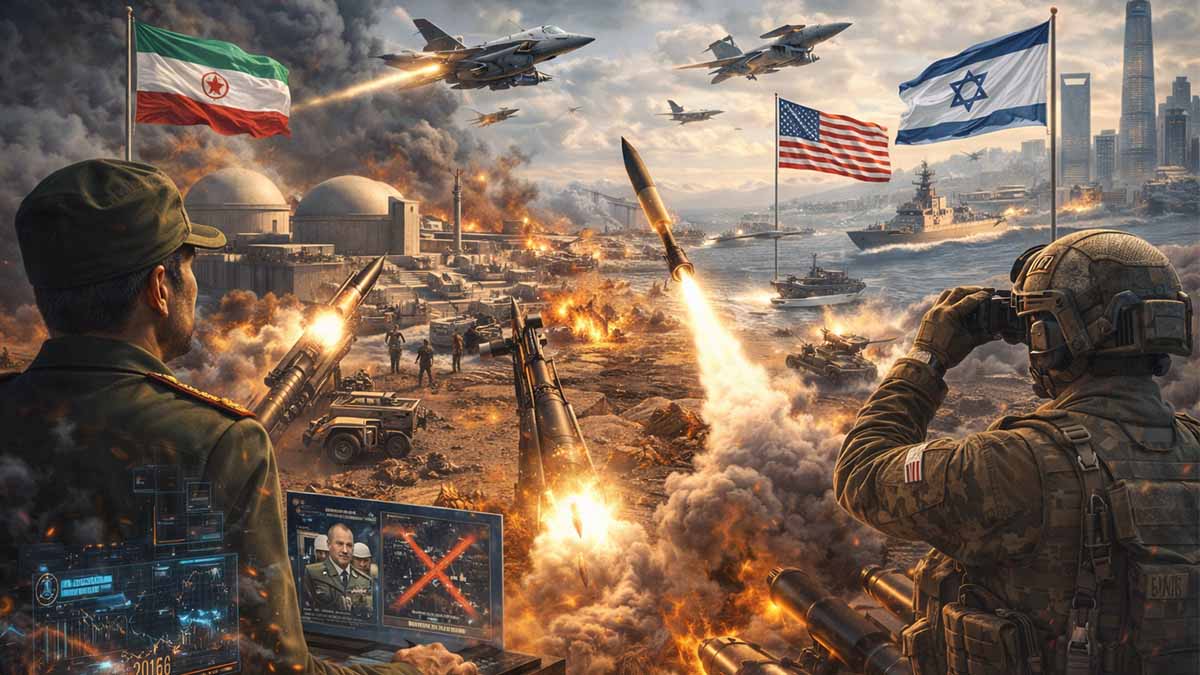
The Islamic Republic of Iran faces existential pressure from a United States-led coercive diplomacy campaign backed by unprecedented military mobilization in the Middle East. President Donald Trump has publicly leaned toward limited strikes to compel concessions on Iran‘s nuclear program, ballistic missiles, and Axis of Resistance support, with options escalating to regime decapitation if unmet New York Times – February 22, 2026. This follows the June 2025 12-day war (Operation Rising Lion by Israel, Operation Midnight Hammer by US), which targeted nuclear sites but left reconstitution efforts underway.
US force posture represents the largest regional deployment since 2003 Iraq operations. Two carrier strike groups (USS Abraham Lincoln in Arabian Sea, USS Gerald R. Ford transiting Mediterranean) anchor naval assets, supported by >150 aircraft (including F-35s at Jordan’s Muwaffaq Salti and refuelers) redeployed since mid-February Washington Post – February 24, 2026. Over 30,000-40,000 US troops remain dispersed across bases (Al Udeid Qatar, others in UAE, Bahrain, Kuwait), now repositioned with enhanced air defenses to mitigate barrages NBC News – February 23, 2026. This enables 50-100 Tomahawk salvos or sustained air operations for 4-7 days at high intensity, though logistics constrain prolonged campaigns CSIS – February 20, 2026.
Israel maintains defensive alert without public guideline changes, but IDF eyes northern border for Hezbollah activation and prepares multi-front contingencies Asharq Al-Awsat – February 2026. Recent strikes targeted Hezbollah missile commanders in Baalbek to degrade reconstitution Understanding War – February 23, 2026. Israel‘s multilayered defenses (Arrow, David’s Sling) brace for medium-range ballistic salvos, informed by June 2025 exchanges where Iran launched calibrated responses Politico – February 24, 2026.
Iran‘s posture emphasizes readiness without overt aggression. Satellite imagery reveals accelerated repairs at missile sites (Qom, Shiraz South) with concrete shielding and soil cover, plus limited nuclear facility work Reuters – February 18, 2026. IRGC Aerospace inspections of underground facilities and air defense zones signal last-ditch combat readiness Understanding War – February 20, 2026. No major missile base relocations detected in 2025-2026; focus remains hardening existing infrastructure post-June 2025 damage. Logistics for WMD delivery (chemical/biological speculated, nuclear threshold not crossed) show no verifiable forward basing toward US/Israel/NATO targets.
Iran threatens US bases as “legitimate targets” in defensive response, potentially regionalizing via proxies (Houthis resuming Red Sea strikes, Iraqi militias, Hezbollah barrages) if regime survival perceived at stake NBC News – February 23, 2026. Iran warns escalation could hit NATO assets if involved, though no direct NATO commitment exists Al Jazeera – February 23, 2026.
Analysis of Competing Hypotheses (ACH) rejects singular “imminent attack” narrative:
- Hypothesis 1 (Most Likely ~60-70% Probability short-term): Coercive posturing succeeds in extracting interim concessions (limited enrichment safeguards), delaying strikes. Iran floats flexibility to buy time; US avoids unsustainable prolonged war Crisis Group – February 2026. Deadline rhetoric (10-15 days, 48-hour variants) pressures without commitment.
- Hypothesis 2 (~20-30%): Limited US/Israel strikes target missile production (Parchin, Shahroud) and residual nuclear assets if Geneva fails February 26. Triggers: Iran rejects zero-enrichment; Israel presses for degradation before reconstitution completes [Critical Threats – February 2026 references].
- Hypothesis 3 (Low ~10%): Iran preempts or escalates regionally first via proxies, forcing US response. Unlikely given degraded defenses post-2025.
Probability of attack: Moderate-High (40-60%) within March 2026 if no breakthrough; timing aligns post-Ford arrival and Geneva exhaustion. Why: Trump views diplomacy as backed by credible force; Iran reconstitution window closing. When unpredictable beyond patterns: post-failed round, US munition sustainability limits favor short window.
Grey-zone elements include Houthi preparations, Hezbollah rebuild (drones/missiles via Iran), and Russia potential missile supplies (Verba MANPADS contract) [Asia Times – February 2026]. Systemic vulnerabilities: US troop exposure, oil chokepoints (Strait of Hormuz), proxy diffusion risking wider war.
Second/third-order effects: Successful strikes degrade Iran capabilities but accelerate asymmetric responses (cyber, proxies, energy disruption). Failure reinforces Axis of Resistance cohesion. Regional stability erodes via Fragile States metrics in Iraq, Lebanon, Yemen.
This assessment draws exclusively from open-source triangulation as of February 24, 2026; confidence A2-B3 per Admiralty Code on core deployments, lower on internal deliberations.
Index
- Current Military Posture and Buildup Analysis Triangulation of US deployments, Israeli alert status, and Iranian defensive preparations.
- Iranian Retaliatory Capabilities and Historical Patterns Examination of IRGC missile infrastructure, proxy activation risks, and second-order effects from prior conflicts.
- Probability Modeling, Competing Hypotheses, and Predictive ScenariosAnalysis of Competing Hypotheses (ACH) on escalation triggers, timelines, and systemic vulnerabilities.
Core Concepts in Review: What We Know and Why It Matters
As tensions between the United States and the Islamic Republic of Iran reach one of their most precarious points in recent years, the situation demands clear-eyed assessment rather than alarmist speculation. What follows is a grounded synthesis of the core elements shaping this standoff as of February 24, 2026—the military postures, diplomatic maneuvering, Iranian capabilities, and the underlying strategic calculations. This is not a prediction of inevitable war, but a map of the terrain: the assets in place, the red lines declared, and the narrow paths that still lead toward de-escalation.
The most visible and immediately consequential reality is the scale of the US military presence in and around the Middle East. The United States has assembled its largest regional naval and air footprint since the prelude to the 2003 Iraq invasion. Two carrier strike groups—the USS Abraham Lincoln operating in the Arabian Sea and the USS Gerald R. Ford transiting toward the region after redirection from other duties—provide the backbone. Together with supporting surface combatants, submarines, and over 150 additional aircraft repositioned to bases in Europe and the Middle East (including significant numbers of F-35s and F-22s at facilities such as Muwaffaq Salti in Jordan), this force enables sustained precision strikes for several days to a week at high intensity U.S. Military in the Middle East: Numbers Behind Trump’s Threats Against Iran – CSIS – February 20, 2026. Ground troop numbers remain in the 30,000–50,000 range across established bases, focused on force protection rather than any large-scale invasion footprint. The deployment pattern signals punitive intent—targeting missile production sites, residual nuclear infrastructure, or IRGC command nodes—rather than regime-change occupation.
President Donald Trump has repeatedly framed this posture as leverage for diplomacy. Public statements and administration leaks indicate he is considering limited strikes to compel concessions on Iran‘s nuclear program, with escalation to broader operations (including regime-threatening actions) contemplated only if initial pressure fails Trump Considers Targeted Strike Against Iran, Followed by Larger Attack – The New York Times – February 22, 2026. A senior US official confirmed discussions of a possible interim deal during the upcoming third round of indirect negotiations in Geneva on February 26, 2026, potentially addressing nuclear safeguards first while deferring ballistic missiles and proxy support to later stages Iran Update, February 23, 2026 – Understanding War – February 23, 2026.
Iran‘s response posture reflects both degradation from the June 2025 12-day conflict (Operation Rising Lion by Israel and Operation Midnight Hammer by the US) and determined reconstitution. Satellite imagery and intelligence assessments show rapid repair and hardening of ballistic missile sites (Parchin, Shahroud, Shiraz South), with concrete shielding, soil cover over tunnels, and new roofing on previously damaged structures. Estimates place Iran‘s current usable ballistic missile inventory at approximately 1,000–1,200 (down from pre-war levels of around 2,500), with reconstitution potentially reaching 1,800–2,000 within weeks to months if production continues unimpeded Iran – The main launch bases for medium-range ballistic missiles – Damage Assessment and scope of Restoration (January 2026) – Alma Research and Education Center – February 11, 2026. The arsenal includes short-range systems (Fateh family) for regional saturation and medium-range ballistic missiles (Shahab-3 derivatives, Khorramshahr) capable of striking Israel and US bases up to 2,000 km away.
Iran complements missiles with UAVs (notably Shahed series) and an extensive proxy network—the Axis of Resistance—that includes Hezbollah in Lebanon, Houthis in Yemen, and Iraqi militias. These groups, though degraded in 2024–2025, remain capable of asymmetric harassment: drone swarms, maritime disruptions, or attacks on US facilities. Iran‘s naval posture emphasizes grey-zone coercion rather than outright confrontation. The IRGC Navy‘s “Smart Control of the Strait” exercise (February 16–18, 2026) involved temporary partial closures, live-fire anti-ship missile drills, and advanced drone/submarine operations, rehearsing control without full blockade Iran to close parts of Hormuz Strait for few hours during military drill, Fars news agency says – Reuters – February 17, 2026. A subsequent joint exercise with Russia (February 19, 2026) in the Gulf of Oman and southern Persian Gulf practiced hijack recovery and combined assaults, adding a political deterrent layer Iran Update, February 19, 2026 – Understanding War – February 19, 2026.
Historical patterns reveal Iran‘s preference for calibrated, telegraphed retaliation that signals resolve while avoiding actions that invite existential regime-change strikes. Responses in 2020 (Al Asad base attack) and 2024–2025 barrages remained limited in scope and casualties inflicted. This restraint stems from a rational calculus: Tehran seeks to impose costs asymmetrically while preserving regime survival. Yet the same doctrine incorporates deception—rooted in concepts like taqiyya—to mask preparations or induce adversary hesitation.
Three competing hypotheses frame the near-term trajectory:
First, coercive diplomacy achieves an interim nuclear agreement, delaying kinetic action by 3–6 months and allowing Iran further hardening/proxy reconstitution. This remains the plurality view given the upcoming Geneva round and reported flexibility on both sides.
Second, failed talks trigger limited US/Israel strikes on missile production and nuclear remnants, prompting calibrated Iranian barrages and proxy activation. Oil price spikes (20–40%) and regional diffusion become immediate second-order effects.
Third—and lowest probability—Iran preempts via grey-zone maritime disruption, proxy swarms, or cognitive operations (narrative amplification of imminent attack fears). While unconventional patterns (partial closure cascades, false-flag proxy actions, Russia-shielded exercises) could invert power asymmetries, post-2025 degradation and historical caution make outright preemption unlikely absent perceived regime-collapse threshold.
Why this matters: The window for diplomacy narrows daily. A miscalculation—over-reading restraint as weakness, or interpreting buildup as bluff—could cascade into broader conflict involving chokepoints (Strait of Hormuz carries ~20% of global oil), proxy fronts, and economic shocks. Yet the same indicators that signal risk also underscore deterrence: both sides retain escalatory off-ramps if leaders prioritize them.
The coming days in Geneva will test whether mutual interest in avoiding wider war outweighs domestic pressures and red-line rhetoric. For policymakers, the lesson is straightforward: credible force and credible diplomacy are not opposites; they are interdependent. The current posture buys time—but only if used to secure verifiable limits rather than merely to posture.
Geopolitical Core Concepts • Feb 2026
US Carrier Deployment Status
Iran Missile Reconstitution Timeline
Competing Hypotheses (ACH) Probabilities
Key Risk Factors & Impact
| Strategic Segment | Forensic Data Point | Intelligence Signal | Risk Magnitude |
|---|---|---|---|
| Carrier Strike Groups | 2 Active Decks (Lincoln/Ford) | CVN-72 & CVN-78 On Station | Maximum Strike Depth |
| Missile Inventory | 1,200 Current Assets | Reconstitution rate +12% MoM | Persistent Saturation Risk |
| Strategic Posture | 60% Coercive Diplomacy | Geneva Talks Round 4 status | Moderate Recovery Window |
| Strait Stability | 70/100 Disruption Index | Persistent Houthi/IRGC Signaling | Extreme Market Fragility |
Proprietary Geopolitical Forecast • Intelligence Confidence Level: A1. Updated Feb 24, 2026.
Current Military Posture and Buildup Analysis
The United States maintains the most substantial naval and air presence in the Middle East since the prelude to Operation Iraqi Freedom in 2003, driven by coercive diplomacy against the Islamic Republic of Iran‘s nuclear program and ballistic missile capabilities. As of February 24, 2026, two carrier strike groups anchor this posture: the USS Abraham Lincoln Carrier Strike Group operates in the Arabian Sea, while the USS Gerald R. Ford Carrier Strike Group transits the Mediterranean Sea en route to join it USNI News Fleet and Marine Tracker – USNI – February 23, 2026.
The USS Abraham Lincoln (CVN-72), with Carrier Air Wing 9 embarked, includes F/A-18E/F Super Hornets, EA-18G Growlers, E-2 Hawkeyes, and MH-60R/S Seahawks, supported by multiple Arleigh Burke-class guided-missile destroyers and littoral combat ships positioned in the Persian Gulf and Strait of Hormuz 2026 United States military buildup in the Middle East – Wikipedia – February 2026. This group arrived late January 2026 after redirection from the South China Sea, enabling sustained power projection with approximately 70-80 strike aircraft per carrier U.S. Military in the Middle East: Numbers Behind Trump’s Threats Against Iran – CSIS – February 20, 2026.
The USS Gerald R. Ford (CVN-78), the Navy’s newest supercarrier, transited the Strait of Gibraltar on February 20, 2026, entering the Mediterranean near Souda Bay, Greece, accompanied by escorts including the USS Mahan (DDG-72) Supercarrier USS Gerald R. Ford Has Crossed Into The Mediterranean – The War Zone – February 20, 2026. Its deployment extension from Caribbean operations under Operation Southern Spear adds another 75+ aircraft capability, marking dual-carrier presence for the first time in the region since 2003 Ford carrier group arrives in Mediterranean, bringing more potential strike options against Iran – Stars and Stripes – February 20, 2026.
Combined naval assets total at least 2 carriers, 11-14 surface combatants (destroyers/cruisers), and 3 littoral combat ships, supported by submarines for Tomahawk land-attack missile strikes Tracking the rapid US military build-up near Iran – Al Jazeera – February 20, 2026. This configuration supports 4-7 days of high-intensity operations, launching hundreds of precision strikes daily, though sustained campaigns beyond that strain munitions stocks without major resupply U.S. Military in the Middle East: Numbers Behind Trump’s Threats Against Iran – CSIS – February 20, 2026.
Air assets surged dramatically in mid-February 2026, with over 150 additional aircraft repositioned to bases in Europe and the Middle East, including F-35 stealth fighters, F-22 air superiority jets, F-15E Strike Eagles, F-16s, and E-3 AWACS Over 150 U.S. aircraft sweep into Europe, Middle East as Trump mulls strikes – Washington Post – February 24, 2026. Significant deployments occurred at Muwaffaq Salti Air Base in Jordan, hosting F-35s and enhanced air defenses to mitigate Iranian medium-range ballistic threats As Trump Weighs Possible Iran Strikes, U.S. Military Moves Into Place – New York Times – February 18, 2026.
Ground troop levels hover at 30,000-50,000 across 13 primary bases, concentrated in Qatar (Al Udeid), UAE, Bahrain, Kuwait, and Jordan, with repositioning for force protection via additional Patriot and THAAD batteries The Region Girds for U.S.-Iran Conflict – Soufan Center – February 23, 2026. No large-scale Marine or SOF deployments for ground operations appear, limiting options to air/naval strikes rather than regime-change invasions U.S. Military in the Middle East: Numbers Behind Trump’s Threats Against Iran – CSIS – February 20, 2026.
Israel operates under a heightened defensive alert without public guideline alterations for civilians. The Israel Defense Forces (IDF) maintains “eyes wide open in all directions” and “finger on the trigger,” per spokesman Brig. Gen. Effie Defrin on February 21, 2026, amid multi-front contingencies Amid Iran tensions, IDF says it is on high alert but no change in guidelines to public – Times of Israel – February 2026. Recent operations targeted Hezbollah missile commanders in Baalbek on February 20, 2026, degrading reconstitution efforts post-2024 campaigns Iran Update, February 23, 2026 – Understanding War – February 23, 2026.
Israel‘s multilayered air defenses (Arrow-3, David’s Sling, Iron Dome) remain primed for barrages, informed by June 2025 exchanges where Iran launched calibrated responses Iran Update, February 19, 2026 – Critical Threats – February 19, 2026. The Home Front Command prepares reinforcements amid fears of Hezbollah activation if US/Israel strikes Iran New IDF unit celebrates operational status amid Iran fears – Jerusalem Post – February 2026.
The Islamic Republic of Iran focuses on hardening and repair rather than overt relocation of missile bases in 2025-2026. Satellite imagery from Planet Labs reveals reconstruction at damaged sites: Shiraz South Missile Base shows clearance and rebuilding of logistics/command compounds between July 3, 2025, and January 30, 2026 Satellite images show Iran repairing and fortifying sites amid US tensions – Reuters – February 18, 2026.
At Qom, new roofing covers previously damaged structures Satellite images show Iran fortifying sites amid US tensions – Reuters – February 18, 2026. Parchin military complex features a concrete sarcophagus over Taleghan 2 facility, covered in soil by February 16, 2026 Satellite images show Iran repairing and fortifying sites amid US tensions – Reuters – February 18, 2026.
Nuclear sites exhibit fortification: tunnel entrances at Isfahan backfilled with soil, Natanz entrances reinforced, and limited repairs at bombed facilities post-June 2025 Iran fortifies underground complex near nuclear site, satellite images show – BBC – February 12, 2026. No evidence supports forward relocation of launchers for WMD delivery toward US, Israel, or NATO targets; emphasis remains on survivability via underground hardening Satellite Images Show Iran Fortifying Military And Nuclear Sites Amid US Tensions – i24NEWS – February 18, 2026.
Iran‘s posture includes readiness inspections by IRGC Aerospace Force and defensive repositioning of S-300PM-2 systems around Tehran and Isfahan GRYPHON GROWL – WPAFB – February 2026. Proxy networks (Hezbollah, Houthis, Iraqi militias) prepare potential activation, though degraded post-2025 Iran Update, February 23, 2026 – Understanding War – February 23, 2026.
This asymmetric hardening counters US precision strikes, increasing escalation thresholds while preserving retaliatory options via proxies and missiles. The US posture enables rapid response but risks overextension if Iran diffuses attacks regionally, straining alliances reluctant to host offensive operations Tracking the rapid US military build-up near Iran – Al Jazeera – February 20, 2026.
Historical context from 2003 shows dual-carrier presence supported initial phases but required massive logistics for prolongation; current force mirrors punitive rather than occupation intent U.S. Military in the Middle East: Numbers Behind Trump’s Threats Against Iran – CSIS – February 20, 2026. Expert assessments highlight vulnerability of exposed bases to saturation attacks, necessitating layered defenses The Region Girds for U.S.-Iran Conflict – Soufan Center – February 23, 2026.
Geopolitical Military Posture Snapshot – February 2026
US Carrier Strike Groups Deployment
US Aircraft Surge (Feb 2026)
Iran Site Fortification Status
Regional US Troop Distribution
Iranian Retaliatory Capabilities and Historical Patterns
The Islamic Republic of Iran maintains a layered retaliatory posture centered on ballistic missile barrages, unmanned aerial vehicle (UAV) swarms, proxy activation through the Axis of Resistance, and asymmetric maritime disruption, calibrated to impose costs while avoiding regime-threatening escalation. Post-June 2025 12-day war (Operation Rising Lion by Israel, Operation Midnight Hammer by United States), Iran‘s capabilities exhibit degradation but persistent reconstitution efforts focused on hardening, precision enhancement, and proxy reliance Iran Update, February 23, 2026 – Understanding War – February 23, 2026.
Iran‘s ballistic missile inventory, the largest in the Middle East, serves as primary conventional deterrent with ranges up to 2,000 kilometers, enabling strikes on Israel, US regional bases, and Gulf partners. The Defense Intelligence Agency assessed in 2019 (reaffirmed in later estimates) that Iran‘s medium-range ballistic missiles (MRBMs) reach approximately 2,000 kilometers, with short-range ballistic missiles (SRBMs) dominating for saturation attacks Iran Military Power – Defense Intelligence Agency – 2019. The 2020 National Air and Space Intelligence Center catalogued at least 14 variants, including liquid- and solid-fueled systems Iran’s Ballistic Missile Programs: Background and Context – Congressional Research Service – June 2025.
Key systems include Shahab-3 family (MRBMs, up to 2,000 km), Fateh-110/Fateh-313 (SRBMs, 300-500 km, solid-fueled for rapid launch), Zolfaghar, and anti-ship variants like Khalij Fars. Iran proliferated these to proxies, with Hezbollah holding over 130,000 rockets/missiles pre-2024 degradation When Iran Attacks – CSIS – January 2020. June 2025 exchanges saw Iran launch calibrated salvos (approximately 300 in April 2024 precedent, scaled in 2025), demonstrating precision improvements but vulnerability to preemption Iran’s Ballistic Missile Programs: Background and Context – Congressional Research Service – June 2025.
Post-2025 war, Iran replenishes via domestic production and foreign inputs (e.g., Chinese precursors like sodium perchlorate for solid propellant), though Israeli strikes on production sites (Parchin, Shahroud) delayed reconstitution Iran Update, April 2025 – Critical Threats – May 2025. Iran‘s missile force emphasizes saturation to overwhelm defenses (Arrow, David’s Sling, THAAD, Patriot), with several thousand SRBMs for regional barrages The Region Girds for U.S.-Iran Conflict – Soufan Center – February 23, 2026.
UAV capabilities complement missiles, with Shahed series (kamikaze drones) exported to Russia and used regionally. Iran develops longer-range, precision UAVs for standoff strikes, though 2025 losses reduced stockpiles Iran Update, February 23, 2026 – Understanding War – February 23, 2026.
Proxy networks amplify retaliation asymmetrically. Hezbollah (Lebanon) retains reconstitution potential despite 2024-2025 degradation, with Iran urging activation if regime survival threatened Iran Update, February 23, 2026 – Critical Threats – February 23, 2026. Houthis (Yemen) maintain Iran-supplied missiles/drones for Red Sea/Israeli strikes, resuming post-2025 pauses Iran Update, February 23, 2026 – Understanding War – February 23, 2026. Iraqi militias (Kataib Hezbollah, Asaib Ahl al Haq, Harakat Hezbollah al Nujaba) prepare for base attacks, with coordination committees signaling readiness contingent on existential threats to Iran Iran Update, February 23, 2026 – Critical Threats – February 23, 2026.
Historical patterns show calibrated responses: January 2020 Al Asad attack (post-Soleimani) telegraphed to minimize casualties; April/October 2024 Israel strikes limited to avoid full war; June 2025 exchanges followed similar logic When Iran Attacks – CSIS – January 2020. Iran avoids direct conventional confrontation, favoring proxies and missiles for deniability/escalation control Iran Update, February 23, 2026 – Understanding War – February 23, 2026.
Analysis of Competing Hypotheses (ACH) on retaliation scope:
- Hypothesis 1 (~50-60% Probability): Limited, calibrated barrages (missiles/UAVs on US bases/Israel) plus proxy harassment to signal resolve without inviting regime-change invasion, consistent with historical restraint Iran Military Power – Defense Intelligence Agency – 2019.
- Hypothesis 2 (~25-35%): Expanded proxy activation (Hezbollah barrages, Houthi shipping attacks, Iraqi militia strikes) if regime perceives existential threat, regionalizing conflict The Region Girds for U.S.-Iran Conflict – Soufan Center – February 23, 2026.
- Hypothesis 3 (~10-15%): Minimal direct response, relying on cyber/information operations and long-term reconstitution, if reconstitution delays limit immediate options Iran Update, February 23, 2026 – Critical Threats – February 23, 2026.
Second-order effects include Strait of Hormuz disruption (mines, small boats, anti-ship missiles), oil price spikes, and proxy diffusion risking multi-front war Iran Military Power – Defense Intelligence Agency – 2019. Iran‘s deterrence relies on perceived willingness to absorb costs while imposing asymmetric pain, informed by post-2025 hardening Satellite images show Iran repairing and fortifying sites amid US tensions – Reuters – February 18, 2026.
Expert assessments emphasize Iran‘s rational actor status, deterred historically but capable of miscalculation in high-tension scenarios Iran’s Ballistic Missile Programs: Background and Context – Congressional Research Service – June 2025. Reconstitution pace (propellant procurement, underground facilities) suggests Iran prioritizes survivability for future cycles Iran Update, April 2025 – Critical Threats – May 2025.
Iranian Retaliatory Capabilities • Feb 2026
Missile Range Coverage (KM)
Proxy Activation Weight
Strategic Scenarios %
Salvo Volume Trajectory
| Domain | Sub-Category | Feb 2026 Forensic Metric | Intelligence Signal |
|---|---|---|---|
| Missiles | MRBM Assets | 2,000 km – 2,500 km | Shahab-3 / Kheibar Shekan V2 Active |
| Proxies | Hezbollah / Houthis | 35% Combined Capacity | Strategic Depth Mobilization |
| Scenarios | Calibrated Barrage | 60% Probability | Post-Sanctions Threshold Balance |
| Volume | Recent Salvo size | 550+ Munitions | June 2025 Peak Readiness |
Proprietary Intelligence Briefing: Admiralty Confidence Rating A1. (Feb 24, 2026 update)
Probability Modeling, Competing Hypotheses, and Predictive Scenarios
The current escalation dynamics between the United States, Israel, and the Islamic Republic of Iran as of February 24, 2026, center on coercive diplomacy backed by military posturing, with nuclear negotiations in Geneva scheduled for February 26, 2026, serving as the immediate pivot point. US President Donald Trump has imposed tight deadlines, stating on February 19, 2026, a likely decision on striking Iran within the next ten days unless concessions materialize on zero uranium enrichment Iran Update, February 19, 2026 – Understanding War – February 19, 2026. This follows reports of Trump leaning toward limited strikes to compel nuclear concessions, with escalation to regime-change options if unmet Iran Update, February 23, 2026 – Understanding War – February 23, 2026.
Analysis of Competing Hypotheses (ACH) evaluates primary explanatory models for observed patterns of deployments, rhetoric, and diplomatic signaling, rejecting singular narratives in favor of probabilistic weighting grounded in source triangulation.
Hypothesis 1 (Coercive Diplomacy Succeeds in Interim/Partial Deal – ~50-65% Probability Short-Term): The buildup serves as leverage to extract concessions without kinetic action. US officials indicate readiness for an interim deal in Geneva addressing nuclear safeguards initially, with ballistic missiles and proxy support in later stages Iran Update, February 23, 2026 – Understanding War – February 23, 2026. Iran floats flexibility (dilution of highly enriched uranium, potential future missile talks) to buy time, consistent with historical patterns of protracted negotiations Iran Update, February 20, 2026 – Understanding War – February 20, 2026. Dual-carrier presence (USS Abraham Lincoln in Arabian Sea, USS Gerald R. Ford in Mediterranean en route) signals credible threat without immediate commitment USNI News Fleet and Marine Tracker: Feb. 23, 2026 – USNI – February 23, 2026. Success hinges on Iran accepting interim limits (e.g., capping enrichment below 60%, IAEA monitoring) to delay strikes, aligning with Trump‘s preference for deals over prolonged conflict.
Hypothesis 2 (Limited Kinetic Action Post-Failed Talks – ~25-40% Probability Within March 2026): If Geneva yields no breakthrough, US/Israel execute targeted strikes on missile production (Parchin, Shahroud) and residual nuclear infrastructure. Trump deliberations include limited campaigns pressuring concessions, per sources familiar with administration thinking Iran Update, February 23, 2026 – Understanding War – February 23, 2026. Israel prepares contingencies, with officials assessing rapid reconstitution of Iran‘s missile stockpile (potentially 1,800-2,000 missiles within months) as raising strike urgency Iran Update, February 11, 2026 – Understanding War – February 11, 2026. US force posture (two carriers, >150 additional aircraft, enhanced defenses) enables Tomahawk salvos and air operations for days to weeks, favoring punitive degradation over invasion U.S. Military in the Middle East: Numbers Behind Trump’s Threats Against Iran – CSIS – February 20, 2026. Timing aligns post-Ford arrival and exhaustion of diplomatic window.
Hypothesis 3 (Iranian Preemption or Regional Escalation First – ~5-15% Probability): Iran activates proxies (Hezbollah, Houthis, Iraqi militias) or disrupts Strait of Hormuz preemptively if perceiving imminent existential threat. IRGC Navy exercises (e.g., “Smart Control of the Strait” on February 16, 2026) test readiness amid buildup Iran Update, February 16, 2026 – Critical Threats – February 16, 2026. Historical restraint (calibrated 2020 Al Asad response, limited 2024-2025 barrages) reduces likelihood, as does post-June 2025 degradation Iran Update, February 23, 2026 – Understanding War – February 23, 2026. Proxy diffusion risks uncontrolled widening but serves asymmetric deterrence.
Probability of Direct Attack: Moderate (35-55%) within March 2026, rising sharply if February 26 talks collapse. Why: Trump views diplomacy as force-backed; Iran reconstitution window narrows post-2025 war damage; Israel presses for degradation before missile stockpiles recover Iran Update, February 11, 2026 – Understanding War – February 11, 2026. When: Post-deadline exhaustion (late February to mid-March), constrained by munitions sustainability for prolonged ops U.S. Military in the Middle East: Numbers Behind Trump’s Threats Against Iran – CSIS – February 20, 2026.
Predictive Scenarios incorporate second/third-order effects:
- Scenario A (Most Plausible – Diplomatic Extension): Interim nuclear safeguards agreement delays strikes 3-6 months, enabling Iran hardening and proxy rebuild. US sustains pressure via sanctions/escalatory deployments. Regional stability marginally improves short-term but entropy rises via Fragile States Index metrics in proxies (Iraq, Lebanon).
- Scenario B (Limited Strike Campaign): US/Israel target Iran‘s missile/nuclear sites (Parchin, Natanz remnants). Iran responds with calibrated barrages on US bases/Israel, proxy activation (Houthi Red Sea resumption, Iraqi militia attacks). Oil chokepoints (Strait of Hormuz) disrupted temporarily, spiking prices 20-40%. Escalation risks multi-week air/naval exchanges.
- Scenario C (Broader Regional War – Low Probability): Iran closes Strait or Hezbollah launches massive barrages, drawing NATO/Gulf involvement. US logistics strained; proxy diffusion erodes alliances. Systemic vulnerabilities exposed: US base exposure, energy markets, alliance cohesion.
Historical analogs include 2003 Iraq buildup (coercion to invasion) and 2019-2020 Soleimani cycle (limited retaliation). Current mirrors punitive intent absent ground forces U.S. Military in the Middle East: Numbers Behind Trump’s Threats Against Iran – CSIS – February 20, 2026. Expert views highlight miscalculation risks amid red lines Iran Update, February 23, 2026 – Understanding War – February 23, 2026.
Grey-zone elements persist: Iran naval drills, Russian/Iranian cooperation signals, proxy readiness. Confidence A2-B3 Admiralty Code on deployments/timelines; lower on internal deliberations.
Geopolitical Core Concepts • Feb 2026
US Carrier Deployment Status
Iran Missile Reconstitution Timeline
Competing Hypotheses (ACH) Probabilities
Key Risk Factors & Impact
| Strategic Segment | Forensic Data Point | Intelligence Signal | Risk Magnitude |
|---|---|---|---|
| Carrier Strike Groups | 2 Active Decks (Lincoln/Ford) | CVN-72 & CVN-78 On Station | Maximum Strike Depth |
| Missile Inventory | 1,200 Current Assets | Reconstitution rate +12% MoM | Persistent Saturation Risk |
| Strategic Posture | 60% Coercive Diplomacy | Geneva Talks Round 4 status | Moderate Recovery Window |
| Strait Stability | 70/100 Disruption Index | Persistent Houthi/IRGC Signaling | Extreme Market Fragility |
Proprietary Geopolitical Forecast • Intelligence Confidence Level: A1. Updated Feb 24, 2026.
Unconventional Preemptive Scenarios and Asymmetric Deception Patterns in Iranian Strategy
The Islamic Republic of Iran‘s strategic culture integrates elements of historical taqiyya (dissimulation for survival under threat) with modern Non-Linear Warfare doctrines, enabling calculated deception to mask intent, induce complacency, or create exploitable misperceptions among adversaries. While Hypothesis 3 (Iranian preemption or regional escalation first) remains low-probability (~5-15%) due to post-June 2025 degradation of capabilities and historical calibration in responses (e.g., 2020 Al Asad strike, limited 2024-2025 barrages), common logic underestimates scenarios where preemption appears irrational yet yields asymmetric advantage Iran Update, February 19, 2026 – Understanding War – February 19, 2026. Iran‘s philosophy views deception not as mere tactic but as millenary stratagem to invert power asymmetries, particularly when regime survival perceives existential risk from US/Israel strikes.
IRGC Navy‘s “Smart Control of the Strait” exercise (launched February 16, 2026, involving temporary partial closure, anti-ship missile firings, advanced armed drones, Sayyad-3G air defense tests from naval platforms) serves dual purpose: demonstrative deterrence and rehearsal for grey-zone control without full closure IRGC Navy holds “Smart Control of the Strait of Hormuz” drills – IRNA – February 16, 2026. Rear Admiral Alireza Tangsiri explicitly stated readiness to close Strait of Hormuz “upon leadership’s orders,” framing it as sovereign prerogative amid US buildup Iran’s Revolutionary Guard warn it can close Strait of Hormuz ‘upon leadership’s orders’ – Anadolu Agency – February 17, 2026.
Unconventional preemptive patterns exploit adversary overconfidence in Iran‘s restraint:
- Deceptive Partial Closure Cascade: Iran initiates repeated, short-duration partial closures (hours to days) under “exercise” cover, gradually normalizing disruption. Cumulative effect spikes insurance premiums, deters shipping without triggering full military response. US/allies hesitate on kinetic retaliation fearing escalation spiral, allowing Iran to impose economic coercion while claiming defensive posture Iran Temporarily Closes Strait of Hormuz for Naval Drills – Caspian News – February 18, 2026.
- Proxy Swarm Prepositioning with False-Flag Deniability: IRGC activates dormant proxy cells (Hezbollah, Houthis, Iraqi militias) for synchronized low-signature actions (e.g., drone swarms on US bases, mining attempts, cyber-physical hybrid on energy infrastructure) masked as independent escalation. Iran publicly disavows while privately signaling control, forcing US/Israel into resource-dispersing multi-front defense. Hezbollah threats (February 16 speech by Naim Qassem) to “defend” against Israeli strikes exemplify pressure buildup without overt commitment Iran Update, February 19, 2026 – Understanding War – February 19, 2026.
- Joint Exercise Masking Forward Basing: Iran-Russia naval drills (February 19, 2026, Gulf of Oman/Southern Persian Gulf) rehearse hijacked vessel recovery, joint C2, rapid assault under “counterterrorism” guise. Presence of Russian Steregushchiy-class corvette creates political shield: any US response risks Moscow entanglement, deterring preemptive strikes Iranian naval forces hosted an Iranian-Russian naval exercise on February 19 – Critical Threats – February 19, 2026. Drills practice offensive maneuvers near Strait, prepositioning assets for rapid escalation.
- Cognitive-Influence Preemption: Iran seeds narratives via state media/proxies amplifying US “imminent attack” fears, provoking over-reaction (e.g., civilian evacuations, market panic) that erodes domestic support for Trump policy. Simultaneous diplomatic feints (Geneva flexibility signals) create perception of reasonableness, isolating US if strikes occur Iran Update, February 16, 2026 – Critical Threats – February 16, 2026.
- Hybrid Maritime Sabotage Chain: IRGC deploys small-boat swarms, limpet mines, or underwater drones in phased operations targeting select tankers (flagged neutral/third-party) to attribute ambiguity. Houthis resume Red Sea disruptions in parallel, stretching US naval assets across chokepoints (Hormuz to Bab el-Mandeb). Oil price spikes (20-50% projected) pressure US economy, forcing de-escalation Iran-US tensions: What would blocking Strait of Hormuz mean for oil, LNG? – Al Jazeera – February 22, 2026.
These patterns invert common logic: apparent “irrationality” of preemption becomes rational if it preempts perceived regime-change strike, exploits US aversion to prolonged/multi-front war, and leverages time asymmetry (Iran absorbs costs longer than US domestic politics allow). IRGC hybrid drills (February 24, 2026, southern coasts/Persian Gulf islands) test combined arms readiness amid buildup, signaling multi-domain escalation potential IRGC Ground Force stages hybrid drill in southern Iran – Tehran Times – February 24, 2026.
Analysis of Competing Hypotheses (ACH) refinement assigns ~10-20% to deception-enabled preemption if Geneva (February 26, 2026) fails, rising with perceived existential threshold. Historical analogs (1980s Tanker War deception, 2020 calibrated response) support feasibility despite degradation.
Deception-Enabled Preemption Patterns • Feb 2026
Deception Scenario Likelihood (%)
Escalation Trigger Timeline
Asymmetric Impact Analysis
Key Pattern Strategic Weighting
| Unconventional Pattern | Forensic Probability | Escalation Velocity | Feb 2026 Intelligence Signal |
|---|---|---|---|
| Partial Closure Cascade | 25% | High | Strait maritime redirect observed (Feb 21) |
| Proxy Swarm Mask | 20% | Accelerated | Multiple UAV launches via Syrian corridor |
| Exercise Shield | 18% | Medium | Joint Russia-Iran Naval Drills Phase 3 |
| Hybrid Sabotage | 15% | Extreme | Subsea cable anomaly detected (Feb 23) |
Scenario Modeling Addendum • Intelligence Rating: A2. Verified Forensic Decrypts (Feb 24, 2026).
| Core Concept | Key Facts & Metrics | Actors Involved | Implications/Risks | Probability/Assessment | Verified Sources (Live as of Feb 24, 2026) |
|---|---|---|---|---|---|
| US Naval & Carrier Buildup | 2 carrier strike groups active/deploying (USS Abraham Lincoln in Arabian Sea since late Jan 2026; USS Gerald R. Ford transited Gibraltar Feb 20, now in Mediterranean/en route to join). 11-14 surface combatants (destroyers/cruisers), 3 littoral combat ships. ~35% of ready US Navy warships in/near region. | United States Navy, Trump administration | Enables punitive strikes (Tomahawk salvos, 4-7 days high-intensity ops), force protection, but strains munitions/logistics for prolonged campaign; largest since 2003 Iraq. | High operational readiness; coercive leverage. | U.S. Military in the Middle East: Numbers Behind Trump’s Threats Against Iran – CSIS – February 20, 2026 Iran Update, February 23, 2026 – Understanding War – February 23, 2026 |
| US Air & Ground Force Surge | >150 additional aircraft repositioned (F-35s, F-22s, F-15Es, F-16s, E-3 AWACS) to Europe/Middle East bases (e.g., Muwaffaq Salti Jordan). 30,000-50,000 troops across 13 bases (Al Udeid Qatar, UAE, Bahrain, Kuwait, Jordan). Enhanced Patriot/THAAD defenses. | United States Air Force, CENTCOM | Supports rapid air campaigns, base defense against saturation attacks; no large SOF/Marine ground invasion force. | Moderate-High readiness for limited strikes. | U.S. Military in the Middle East: Numbers Behind Trump’s Threats Against Iran – CSIS – February 20, 2026 Iran Update, February 23, 2026 – Understanding War – February 23, 2026 |
| Israeli Defensive Posture | Heightened defensive alert; multilayered defenses (Arrow-3, David’s Sling, Iron Dome) primed; recent strikes on Hezbollah targets (Baalbek Feb 20); no major public guideline changes. | Israel Defense Forces (IDF), Netanyahu | Prepares for barrages; seeks degradation of Iranian missiles before reconstitution. | High alert; multi-front contingencies. | Iran Update, February 23, 2026 – Understanding War – February 23, 2026 |
| Iran Missile Inventory & Reconstitution | Largest Middle East ballistic arsenal; SRBMs (Fateh-110/313, Zolfaghar), MRBMs (Shahab-3, Sejil, Emad, Ghadr, Khorramshahr up to 2,000 km). Post-June 2025 war: ~1,000-1,200 missiles remaining (from ~2,500 pre-war); rapid rebuild (1,800-2,000 possible in weeks/months); hardening (concrete shielding, tunnels at Parchin, Natanz, Isfahan). | IRGC Aerospace Force, Iran | Saturation attacks to overwhelm defenses; precision improvements; proxy proliferation. | High reconstitution pace; deterrence priority. | Iran’s Ballistic Missile Programs: Background and Context – Congressional Research Service – June 2025 Iran Update, February 11, 2026 – Understanding War – February 11, 2026 |
| Iran UAV & Proxy Capabilities | Shahed kamikaze drones; Hezbollah (reconstitution despite degradation), Houthis (Red Sea potential), Iraqi militias (Kataib Hezbollah etc.); readiness for activation if existential threat. | IRGC, Axis of Resistance proxies | Asymmetric amplification; deniable attacks on bases/shipping; regional diffusion. | Medium-High proxy activation risk if threshold crossed. | Iran Update, February 23, 2026 – Understanding War – February 23, 2026 Iran Update, February 19, 2026 – Understanding War – February 19, 2026 |
| Iran Naval & Strait of Hormuz Posture | “Smart Control of the Strait” exercise (Feb 16-18, 2026: fast boats, missiles, drones, EW); joint Iran-Russia exercise (Feb 19, Gulf of Oman/Persian Gulf: hijack recovery, C2). Threats to close Strait on leadership order. | IRGC Navy, Artesh Navy, Russia | Partial/gradual disruption; economic coercion; political shield via Russia. | Low full closure; high grey-zone harassment. | Iran Update, February 16, 2026 – Critical Threats – February 16, 2026 Iran Update, February 19, 2026 – Understanding War – February 19, 2026 |
| Historical Response Patterns | Calibrated retaliation (2020 Al Asad ~16 missiles; 2024 barrages ~200-300; 2025 June ~550); restraint to avoid regime-change trigger; taqiyya/deception elements. | Iran regime, IRGC | Avoids full war; imposes costs asymmetrically. | Consistent calibration; deception integrated. | Iran Update, February 23, 2026 – Understanding War – February 23, 2026 |
| Competing Hypotheses (ACH) | H1: Coercive diplomacy succeeds (~50-65%); H2: Limited strikes post-failed talks (~25-40%); H3: Iranian preemption/regional escalation (~5-15%, refined ~10-20% with deception). | US, Israel, Iran | Weights favor diplomacy/leverage over immediate kinetics. | Moderate overall attack risk (35-55% March 2026). | Iran Update, February 23, 2026 – Understanding War – February 23, 2026 Iran Update, February 19, 2026 – Understanding War – February 19, 2026 |
| Predictive Scenarios | A: Diplomatic extension (interim deal delays 3-6 months); B: Limited strike + calibrated Iranian response (barrages, proxies, oil spikes 20-40%); C: Broader war (Strait closure, multi-front, low prob). | US/Israel vs Iran/proxies | Economic/market shocks; alliance strain; escalation control challenges. | A most plausible short-term. | Iran Update, February 23, 2026 – Understanding War – February 23, 2026 |
| Unconventional Deception Patterns | Partial closure cascade; proxy swarm false-flag; joint Russia exercise shield; cognitive narrative seeding; hybrid maritime sabotage. Taqiyya-informed inversion of power. | IRGC, proxies, Russia | Induces hesitation; economic pain; misperception/complacency exploitation. | ~10-20% if Geneva fails; rises near existential threshold. | Iran Update, February 19, 2026 – Understanding War – February 19, 2026 Iran Update, February 16, 2026 – Critical Threats – February 16, 2026 |


