















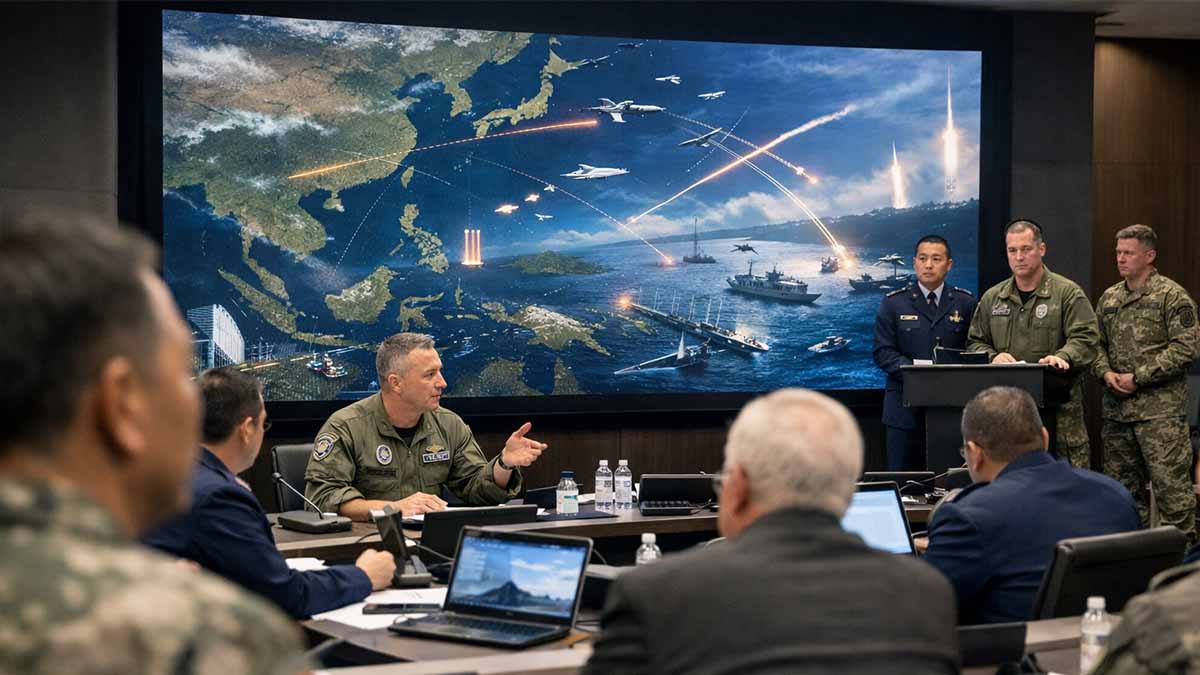
The global strategic landscape underwent a fundamental transformation during the summer of 2025, a period defined by the high-intensity twelve-day war between Iran, Israel, and the United States. This conflict, while regional in its geographic scope, served as a global laboratory for contemporary integrated air and missile defense (IAMD), laying bare the critical vulnerabilities in Western magazine depth and the unsustainable cost-exchange ratios of modern kinetic interception. As the U.S. military supported Israeli operations by utilizing its regionally deployed air and missile defense assets to intercept a massive influx of Iranian missiles and drones, the logistical and financial strain provided a stark preview of the challenges awaiting in the Indo-Pacific. In this theater, the United States squares off against an increasingly capable and assertive China, whose People’s Liberation Army (PLA) has invested decades into “intelligentized” warfare and mass saturation capabilities. The central question for regional stability is whether the United States and its allies—specifically Japan, Australia, South Korea, and Taiwan—can navigate the challenging geography and fractious politics of the Indo-Pacific to counter Chinese advantages through coordinated defense architectures.
The Crucible of June 2025: Attrition, Cost-Exchange, and the Interceptor Gap
The twelve-day war of June 2025, often referred to in intelligence assessments as Operation Rising Lion, functioned as a critical stress test for the United States’ Global Force Management Allocation Plan. During the height of the engagement, the U.S. military deployed two Terminal High Altitude Area Defense (THAAD) batteries to Israel, eventually expending more than 150 interceptors to neutralize Iranian ballistic threats. This expenditure represented approximately 25% of the total U.S. THAAD inventory, a staggering rate of consumption for a conflict that lasted less than a fortnight. At a unit cost of approximately $12.7 million per interceptor, the financial outlay for THAAD operations alone exceeded $1.9 billion, illustrating the massive fiscal burden of high-end missile defense.
Beyond the THAAD systems, the U.S. Navy’s surface fleet faced an equally rigorous test. Reports indicate that over the 12-day period, the Navy launched approximately 130 SM-3 and 150 SM-6 interceptors. The cumulative impact on global stockpiles was immediate and severe. By the end of June 2025, the U.S. SM-3 inventory had decreased by 33%, while SM-6 stocks saw a 17% reduction. These figures are particularly alarming given that production rates for these systems have historically struggled to keep pace with operational demand. Between January 2024 and June 2025, the Pentagon produced only 87 SM-3s and 187 SM-6s, a rate that is wholly insufficient to replenish the stocks exhausted during even a limited regional contingency.
The most profound lesson of the 2025 conflict, however, was the cost-exchange imbalance inherent in countering low-cost unmanned aerial systems (UAS). While the United States and its partners achieved high interception rates—reported as 93% in the UAE and 97% in Qatar—these successes were characterized by many analysts as a “strategic failure” due to the underlying economics. The use of a $4 million Patriot PAC-3 MSE missile to down a $30,000 Iranian Shahed-type drone creates a cost-exchange ratio of roughly 133:1. This asymmetry allows an adversary to achieve “offense in depth” by forcing the defender to burn through expensive, finite interceptors to neutralize cheap, mass-produced threats. Even the small percentage of drones that leaked through defenses inflicted disproportionate damage, such as the reported destruction of a $300 million AN/TPS-59 radar site in Bahrain by a single OWA drone.
Comparative Interceptor Expenditure and Inventory Impact (June 2025)
| System | Interceptors Fired (12 Days) | Unit Cost (Est.) | Inventory Impact | Production Rate (Annual) |
| THAAD | 150+ | $12.7 Million | 25% Reduction | 12 – 25 units |
| SM-3 | 130 | $14 – $25 Million | 33% Reduction | ~60 units |
| SM-6 | 150 | $4.3 Million | 17% Reduction | ~125 units |
| Patriot PAC-3 MSE | Not Specified | $4.0 Million | 75% Below Pentagon Req. | 600 – 650 units |
The exhaustion of these resources in the Middle East directly eroded the United States’ deterrence posture in the Indo-Pacific. By July 2025, Patriot stockpiles had fallen to just 25% of the volume deemed necessary for a major Indo-Pacific contingency, prompting concerns that China might perceive a “window of opportunity” while U.S. magazine depth was at its historical nadir.
The USSC Hawaii Framework: “Latent Link” and “Long Sense, Short Defense”
In direct response to the vulnerabilities exposed in 2025, the United States Studies Centre (USSC) convened a landmark Tabletop Exercise (TTX) in Honolulu, Hawaii, in June 2025. This exercise brought together twenty “Track 2” IAMD experts from the United States, Japan, Australia, South Korea, and Taiwan to test the operational and political feasibility of a networked coalition defense architecture. The exercise assumed a scenario where the coalition faced a simulated Chinese air and missile attack, requiring the integration of disparate national assets to close the burgeoning “missile gap”.
The analysis of the Honolulu architectures yielded two primary operating concepts: “latent link” and “long sense and short defense”. These concepts were designed to navigate the unique challenges of the Indo-Pacific, where the tyranny of distance is compounded by the political sensitivities of sovereign fire control and the fear of “entrapment” in regional conflicts.
The Latent Link: Interoperability at the Speed of Relevance
The “latent link” concept addresses the political-technical paradox of coalition defense. While close-knit integration offers the greatest military-technical advantage—allowing sensors and shooters from different nations to talk to each other in real-time—it is often politically unfeasible to maintain such links in peacetime due to sovereignty concerns and Chinese diplomatic pressure.
Under the “latent link” model, coalition partners establish the capability for their respective jurisdiction-level battle management systems (BMS) to share fire-quality track data. This involves years of upfront coordination in terms of procurement, testing, training, data and communications protocols, and cybersecurity standards. However, these cross-jurisdictional links are set, by default, to a deactivated or “latent” form. When kinetic conflict begins and the political landscape shifts, these pre-established links can be “switched on,” activating coalition track sharing at a speed of relevance.
This approach offers several strategic advantages:
- Deterrence through Ambiguity: Beijing must account for the potential of a unified coalition sensor and shooter grid, even if those links are not active during peacetime.
- Sovereignty Preservation: Partners retain sovereign control over their engagement zones and rules of engagement (ROE) until the moment of activation.
- Inventory Management: Once active, the latent link allows for theater-wide inventory management, preventing multiple partners from firing expensive interceptors at the same incoming threat, thereby preserving magazine depth.
Long Sense and Short Defense: Maximizing Geographic Depth
The second concept, “long sense and short defense,” seeks to optimize the geographic distribution of coalition assets. In the Indo-Pacific, the vast distances mean that individual national defense “bubbles” are often too small to provide comprehensive coverage.
- Long Sense: This component involves forward-deploying sensors—such as high-altitude UAVs, space-based assets, or ground-based radars—to partners’ territories to gain additional sensing range for early warning. By pushing the “detection line” closer to the Chinese mainland, the coalition gains critical minutes of reaction time.
- Short Defense: This involves layering “short” or terminal defense assets, such as Patriot or THAAD batteries, to provide additional magazine depth. Because these shooters are being fed high-quality data from “long sense” assets, their effective engagement range and confidence levels are significantly increased.
Together, these concepts allow the coalition to build a “cross-partner IAMD interoperability” that closes the missile gap without relying solely on the expansion of domestic procurement, which is often constrained by overstretched defense industrial bases.
The PLA’s “Intelligentized” Saturation: The Atlas Drone Swarm and Beyond
The urgency of implementing the USSC framework is underscored by the rapid evolution of the People’s Liberation Army Rocket Force (PLARF) and the PLA’s broader investments in artificial intelligence and unmanned systems. The PLA has identified “intelligentization” as its major modernization priority, aiming to leverage AI to enable a single command node to coordinate dozens of drones simultaneously—an area where it believes it can surpass the United States.
The Atlas System and the “Wolf Pack” Doctrine
In early 2026, the PRC state broadcasting service (CCTV) revealed the “Atlas” drone swarm operations system. This system represents a significant leap in the PLA’s ability to conduct autonomous, coordinated strikes designed specifically to overwhelm sophisticated air defense networks like Taiwan’s “T-Dome”.
| Atlas System Component | Technical Specifications / Capability |
| Swarm-2 Launch Vehicle | Can carry and launch 48 fixed-wing drones; 3-second launch interval. |
| Command Vehicle | Single node can simultaneously control up to 96 drones in a swarm. |
| Drone Payloads | Modular; includes electro-optical reconnaissance, strike munitions, and relay jammers. |
| Control Logic | AI-driven “smart brain” for autonomous formation adjustment and collision avoidance. |
| Mission Range | Deep-strike variants can penetrate hundreds or thousands of kilometers. |
The “Atlas” system is not merely a collection of drones; it is a “system-level combat” tool. Footage from March 2026 demonstrated the system’s ability to autonomously identify a command vehicle among multiple targets and execute a coordinated strike. The use of AI allows these swarms to loiter over targets, providing persistent surveillance and the ability to strike from low altitudes with small radar cross-sections, making early detection by traditional radars exceedingly difficult.
Saturation via Rocket Artillery: The PCL-191
Complementing the drone swarm is the PCL-191 long-range rocket artillery system, which has become a centerpiece of PLA drills around Taiwan. The PCL-191 can fire 370 mm rockets with a range of approximately 350 kilometers, allowing it to bombard targets across the Taiwan Strait with high precision and at a fraction of the cost of a ballistic missile. The PLA Daily’s analysis of conflicts in the Middle East and Ukraine has led the PLA to conclude that high-end air defense systems (like Patriot) are “inadequate or too costly” for drone and rocket interception. By employing a “multi-wave, multi-missile” strategy, the PLA aims to exhaust Taiwan’s interceptors through low-cost saturation before launching decisive strikes with more advanced assets.
The Military-Industrial-Financial Complex: Scaling the “Arsenal of Freedom”
To counter the PLA’s mass, the United States has launched a massive rearmament effort, transitioning from a “just-in-time” delivery model to what defense contractors are calling a “high-volume” readiness model. This transition is underpinned by record-breaking backlogs and a “collaborative funding approach” with the Department of War that aims to preserve free cash flow for contractors while accelerating production capacity.
Industrial Production Targets and Framework Agreements (2026–2030)
In early 2026, the Pentagon secured seven-year framework agreements with Lockheed Martin and RTX (Raytheon) to triple or even quadruple the production of key interceptors.
| Munition System | 2025 Base Production (Est.) | 2026-2027 Target Production | Strategic Role |
| Patriot PAC-3 MSE | 600 units | 2,000 units (Annual) | Primary terminal ballistic defense. |
| THAAD | 96 units | 400 units (Annual) | High-altitude theater defense. |
| SM-6 | 125 units | 500+ units (Annual) | Anti-ship, air defense, BMD. |
| Tomahawk | 60 units | 1,000+ units (Annual) | Long-range precision strike. |
| AMRAAM | Not Specified | 1,900+ units (Annual) | Air-to-air combat. |
| GMLRS | Not Specified | 14,000 units (Annual) | Precision ground artillery. |
Lockheed Martin’s 2026 Proxy Statement highlights that the company finished 2025 with a record backlog of nearly $194 billion, which represents more than two-and-a-half years of sales. This unprecedented demand is driven not only by U.S. requirements but also by “allied interoperability” needs, as partners in the Indo-Pacific and Europe seek to build their own “Golden Domes” of defense.
The Financial Dimension: Institutional Ownership and Market Valuation
The rearmament is also a massive financial operation. The “Big Three” asset managers—Vanguard, BlackRock, and State Street—hold significant institutional ownership in the major defense contractors, ensuring that the “military-industrial complex” is deeply integrated into the “financial complex”.
- Vanguard Portfolio Management: Following an internal reorganization in late 2025, Vanguard’s beneficial ownership across the S&P 500 defense sector remains a stabilizing force for long-term capital allocation.
- Market Valuation: Lockheed Martin’s stock valuation reached a high of 29.38x P/E ratio in March 2026, reflecting investor confidence in the sustained growth of the “Arsenal of Freedom”.
- Backlog and Cash Flow: Northrop Grumman reported a record backlog of $95.7 billion at the end of 2025, with free cash flow growing at a projected 15% CAGR through 2026.
This financial stability is critical for the “long-term success of the AUKUS partnership” and other trilateral defense initiatives. However, the “supply chain resiliency” remains a point of concern. Lockheed Martin has had to formalize MoUs with German and Polish firms to produce PAC-3 MSE components locally, aiming to alleviate global bottlenecks in solid rocket motors (SRMs) and seeker assemblies.
Regional Fault Lines: Taiwan’s Budgetary Crisis and the T-Dome
The practical implementation of the USSC’s coordinated defense concept is currently being tested most acutely in Taiwan. In late 2025, President Lai Ching-te proposed a landmark $40 billion (NT$1.25 trillion) “special defense budget” dedicated to strengthening asymmetric combat capacity and developing an integrated air defense network dubbed “T-Dome”.
The T-Dome Concept: An Asymmetric Shield
Modelled on Israel’s Iron Dome but adapted for the high-intensity missile threat of the PLA, the T-Dome is envisioned as a multi-layered, AI-integrated air defense shield.
- Integration of Assets: The system aims to fuse data from the Sky Bow III (Tien Kung), Land Sword II, and Patriot missile systems with AI-assisted decision-making and satellite/radar feeds.
- UAV Defense: The budget includes procurement for 200,000 unmanned systems to counter Chinese swarms and provide reconnaissance.
- Domestic Production: A significant portion of the budget is allocated to the Chungshan Institute of Science and Technology to scale production of indigenous missiles like the Hsiung Feng II and III.
Political Gridlock in the Legislative Yuan
Despite the “imminent military threats” cited by the Ministry of National Defense (MND), the special budget has faced months of obstruction by the opposition KMT and TPP parties.
- The Impasse: The KMT-controlled legislature has questioned the size and scope of the budget, with some members proposing much smaller alternatives (e.g., $12 billion) focused only on conventional U.S. weapons.
- LOA Expiration: This delay had real-world consequences in early 2026. U.S. Letters of Offer and Acceptance (LOAs) for critical systems like HIMARS, Javelin, and TOW-2B missiles were set to expire on March 15. The MND was forced to seek emergency authorization to sign these LOAs before the full budget was formally approved to avoid price renegotiations and delivery delays.
- U.S. Pressure: Bipartisan U.S. lawmakers sent a letter to the Legislative Yuan in February 2026, urging them to “meet the moment” and pass the budget, warning that failure to do so would leave a “breach” in the Indo-Pacific’s collective defense posture.
By late March 2026, the MND reported that peak delivery payments for these projects would reach NT$570 billion over the next three years, underscoring the “peak fiscal pressure” facing the island as it attempts to rearm in the face of PLA “intelligentization”.
Simulation and Modeling: TIDALWAVE and the Reality of Failure
To quantify the operational risks, the Heritage Foundation conducted the “TIDALWAVE” simulation, an AI-enabled model that analyzes the two systems most likely to determine the outcome of a protracted conflict with China: fuel and ammunition.
The Two Phases of Systemic Failure
The simulation’s findings are sobering, suggesting that the U.S. munitions system follows two distinct phases of operational failure in a high-intensity fight:
- Stock Depletion (Day 1 – 25): Initial stockpiles of high-end PGMs like LRASMs (Long-Range Anti-Ship Missiles) are depleted in approximately one week. Forward-deployed AIM-120 and AIM-9X air-to-air missiles are exhausted within 5 to 10 days of the start of major combat (modeled as Day 30).
- Protracted Collapse (Day 30 – 120): Insufficient throughput and the “brittle” nature of logistics flow lead to a systemic failure. Strategic sealift capacity, limited by a readiness rate of only 60-65% and an average vessel age of 45 years, fails to keep up with demand.
The Launcher Paradox
A critical third-order insight from the TIDALWAVE simulation is the “Launcher Paradox.” Wargames consistently show that concentrated hubs like Kadena and Guam could suffer up to 90% aircraft attrition on the ground in the opening wave of Chinese strikes. This leads to a situation where the U.S. may “lose the launchers” before it completely runs out of munitions. For example, the simulation projects a ~73.1% attrition rate for the F/A-18E fleet. If the platforms are destroyed, the remaining millions of rounds of ammunition in the “rear” become stranded and useless.
Bayesian Risk Assessment and Maritime Chokepoints
The military failure is compounded by economic chokepoints. Bayesian network analysis applied to the China-Australia shipping route indicates that kinetic conflict in the First Island Chain has a near-100% probability of collapsing maritime passage volume.
- Brent Crude Impact: Models for March 2026 predict Brent crude spiking to $126.15/bbl following a 95.3% collapse in Strait of Hormuz tanker traffic during the simultaneous 2026 Hormuz Crisis.
- Fiscal Strain: This “energy chokepoint disruption” forces allied governments to divert defense funds to emergency reserves and commodity stabilization, further slowing the “rearmament fiscal trajectory”.
$\text{Let } P(S) \text{ be the probability of systemic operational failure.}$
$\text{According to the Heritage model: } P(S) \approx 1.0 \text{ if } T_{reload} > 14 \text{ days and } Q_{stock} < 30 \text{ days of expenditure.}$
Given that transit time for warships to reach a secure port for rearm can take up to two weeks, the “reload latency” becomes a primary driver of local failure.
The Road Ahead: Trilateral Integration and AUKUS Pillar II
Despite the daunting challenges, the “latent link” concept is beginning to take root in trilateral cooperation between the U.S., Japan, and Australia. The AUSMIN 2025 consultations and the AUKUS Defense Ministers’ Meeting in December 2025 underscored a commitment to “move full steam ahead” on integrating air and missile defense data.
- Enhanced Air Cooperation: Infrastructure works at RAAF Bases Tindal and Darwin are being expanded to support rotations of U.S. bombers and ISR aircraft, serving as the “short defense” nodes for Australia’s north.
- AUKUS Pillar II: This focuses on “advanced capabilities” such as hypersonics and directed-energy weapons, which are seen as the only long-term solution to the cost-exchange imbalance of drone swarms.
- The “Japan-USA-India Triad”: Emerging coordination in Space Domain Awareness (SDA) is aimed at providing the “long sense” capability needed to track hypersonic glide vehicles moving at Mach 15.
- https://debuglies.com/2026/03/23/the-operational-consolidation-of-the-berlin-tokyo-axis-strategic-integration-and-multi-domain-deterrence-in-the-indo-pacific-theater-2026-edition/
Nuanced Conclusions and Strategic Recommendations
The transition from the 12-day war in the Middle East to the burgeoning confrontation in the Indo-Pacific has fundamentally altered the requirements for strategic deterrence. The evidence suggests that a reliance on traditional procurement and isolated national defense “bubbles” will lead to systemic failure within the first month of a conflict with China. To counter the PLA’s advantages in mass, cost-imposition, and “intelligentization,” the United States and its allies must aggressively pursue the “latent link” architecture.
- Standardization as Strategy: The “latent link” is only possible if partners standardize data protocols (e.g., Link-16, IBCS) and cyber security frameworks now. The political gridlock in Taiwan serves as a warning that domestic politics can undermine technical readiness at the eleventh hour.
- Solving the Cost-Exchange Crisis: The U.S. must accelerate the deployment of “affordable mass” like the LUCAS drone and directed-energy weapons. Firing $4 million interceptors at $30,000 drones is a path to fiscal and operational exhaustion.
- Mitigating the Launcher Paradox: Allied posture must shift from concentrated “super-hubs” to dispersed, resilient nodes. The “long sense” provided by forward sensors must be coupled with “short defense” assets that can be reloaded or replaced quickly without two-week transit times.
- Financial and Industrial Synchronization: The “Arsenal of Freedom” must be treated as a trilateral industrial base. Australia’s $2 billion investment in U.S. submarine production and Japan’s acquisition of Tomahawks are steps toward a “military-industrial-financial complex” that can sustain a high-intensity war of attrition.
Ultimately, the ability of the Indo-Pacific coalition to navigate its challenging geography and politics will depend on whether it can activate its latent links at the “speed of relevance” before the sheer mass of Chinese offensive power achieves a decisive fait accompli. The lessons of 2025 have provided the blueprint; the challenge of 2026 is to build the architecture.
IAMD Attrition & Coalition Dynamics
Operational analysis of the June 2025 “Rising Lion” conflict and the subsequent Indo-Pacific “Latent Link” strategic framework.
Regional Interceptor Impact (June 2025)
| Concept / Asset | Theme | Metric Magnitude | Relationships | Iteration Stage | Analytical Insight | Status |
|---|---|---|---|---|---|---|
| THAAD Operations | Strategic Def. | Inventory Attrition | 25% inventory burnt in 12 days; unsustainable. | CRITICAL | ||
| Atlas Drone Swarm | Offense Mass | Saturation Force | AI-driven swarm-96 capability enables mass saturation. | ACTIVE | ||
| Latent Link | Coalition Arch. | Force Multiplier | Solves sovereignty paradox via ‘on-demand’ integration. | TESTING | ||
| T-Dome (Taiwan) | Asymmetric Def. | Fiscal Reliance | Facing legislative obstruction; $40B budget at risk. | STALLED |


