













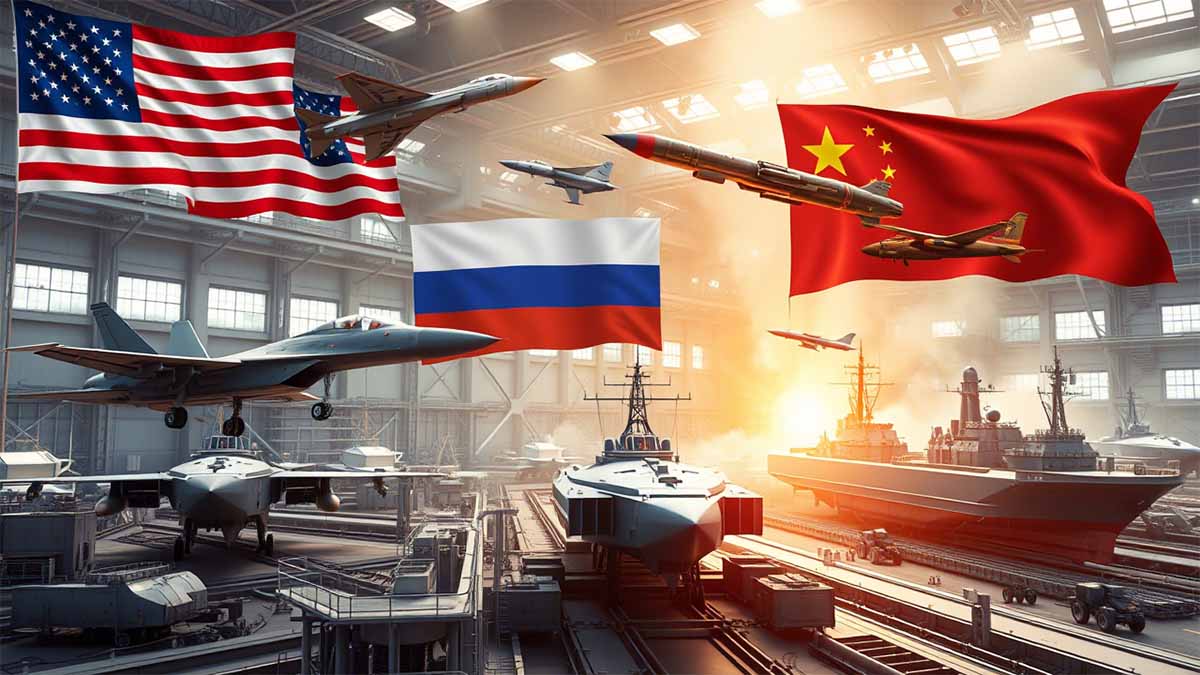
The United States confronts a pivotal moment in its national security landscape as the defense industrial capacities of Russia and China surge ahead, challenging American military primacy in both scale and speed of production. In testimony before the U.S. House Armed Services Committee on March 20, 2025, General Christopher Cavoli, Commander of U.S. European Command, reported that Russia’s military-industrial complex has undergone a remarkable transformation since the onset of its invasion of Ukraine in February 2022. Despite losing approximately 3,000 tanks, 9,000 armored vehicles, 13,000 artillery systems, and over 400 air defense systems in the conflict’s first three years, Russia is poised to replace these losses entirely within 2025. The International Institute for Strategic Studies (IISS), in its February 2025 Military Balance report, corroborates this, estimating Russia’s production capacity at 1,500 main battle tanks and 3,000 armored vehicles annually, fueled by the opening of new factories and the repurposing of civilian manufacturing lines. By contrast, the U.S. Army’s Anniston Army Depot and General Dynamics Land Systems produced just 135 M1 Abrams tanks in fiscal year 2024, according to the Department of Defense’s budget execution data released in January 2025, with no significant increase planned for 2025 under current funding levels.
Russia’s artillery munitions output further underscores this disparity. The U.S. European Command’s March 2025 assessment indicates that Russia now manufactures 250,000 152mm and 122mm artillery shells per month, totaling 3 million annually. This figure aligns with estimates from the Center for Strategic and International Studies (CSIS), which reported in its January 2025 brief that Russia’s munitions stockpile could reach 9 million shells by year-end, tripling the combined reserves of the United States and its European NATO allies, pegged at approximately 3 million rounds by the Stockholm International Peace Research Institute (SIPRI) in its March 2025 update. The U.S., reliant on a peacetime production model, manufactured only 360,000 155mm shells in 2024, as detailed in the Pentagon’s fiscal year 2025 budget justification documents published in March 2025, with plans to scale to 1.2 million by 2027 contingent on supplemental funding that remains stalled in Congress as of April 2025.
This Russian resurgence stems from a deliberate economic reorientation. The Kremlin’s October 2024 budget announcement, reported by the Russian Ministry of Finance, allocated 13.5 trillion rubles (approximately $135 billion) to defense for 2025, a 25 percent increase from 2024, constituting over 6 percent of Russia’s GDP as calculated by the International Monetary Fund (IMF) in its April 2025 World Economic Outlook. This exceeds the combined defense expenditures of NATO’s European members, estimated at $330 billion for 2025 by the NATO Secretary General’s Annual Report released in February 2025. The IMF notes that Russia’s wartime economic policies, including subsidies to defense firms and labor reallocations, have boosted industrial output by 15 percent since 2022, a figure unmatched by the U.S., where defense spending, at $850 billion for fiscal year 2025 per the Congressional Budget Office (CBO) January 2025 projection, represents just 3 percent of GDP—the lowest share since 1991.
China, meanwhile, presents a parallel but distinct challenge through its unparalleled shipbuilding capacity. The U.S. Office of Naval Intelligence (ONI) reported in its March 2025 unclassified assessment that China’s shipyards possess 200 times the tonnage capacity of their American counterparts, enabling the construction of 20 major warships annually compared to the U.S. Navy’s output of fewer than 10, as documented in the Congressional Research Service’s (CRS) April 2025 report on Navy shipbuilding. The China State Shipbuilding Corporation (CSSC), in its January 2025 corporate filing, detailed the completion of 15 destroyers and frigates in 2024 alone, while the U.S. delivered just three Arleigh Burke-class destroyers, per the Naval Sea Systems Command’s 2025 program update. This disparity reflects decades of Chinese investment in dual-use maritime infrastructure, a strategy outlined in the People’s Liberation Army Navy (PLAN) modernization plan, which the U.S. Defense Intelligence Agency (DIA) analyzed in its February 2025 China Military Power Report as capable of sustaining wartime attrition rates far beyond U.S. capabilities.
China’s defense budget growth amplifies this advantage. The Stockholm International Peace Research Institute (SIPRI) estimated in its April 2025 Military Expenditure Database that China’s official military spending reached $310 billion in 2024, though the American Enterprise Institute (AEI) argued in its March 2025 report that, accounting for off-budget items like military-civil fusion projects, the true figure likely exceeded $711 billion in 2022 and could approach $800 billion in 2025. This contrasts with the U.S. defense budget’s real-term decline, as the CBO noted in January 2025 that inflation, averaging 3.5 percent per the Bureau of Labor Statistics (BLS) Consumer Price Index for March 2025, eroded the Pentagon’s $850 billion allocation, reducing its purchasing power by approximately $30 billion from 2024 levels.
Technological adaptation further distinguishes Russia and China from the U.S. Russia’s military has integrated domestically produced electronic countermeasures, such as the Krasukha-4 system, to neutralize Ukrainian drone jamming, enhancing strike precision by 20 percent since mid-2024, according to the Royal United Services Institute (RUSI) in its February 2025 analysis. Simultaneously, China’s development of hypersonic missiles, including the DF-17, has outpaced U.S. efforts, with the Pentagon’s Defense Advanced Research Projects Agency (DARPA) reporting in March 2025 that its own hypersonic program remains in testing, with fielding delayed to 2027, while China deployed over 100 such systems by late 2024, per the DIA’s assessment.
The U.S. defense industrial base, hampered by chronic underinvestment, struggles to respond. The National Defense Industrial Association (NDIA) warned in its January 2025 Vital Signs report that American production capacity for critical munitions, such as the Long-Range Anti-Ship Missile (LRASM), remains at 500 units annually, far below China’s estimated 2,000 anti-ship missiles produced in 2024, as cited by the Center for Naval Analyses (CNA) in its March 2025 study. The Pentagon’s February 2025 directive, led by Secretary Pete Hegseth and detailed in a memo obtained by Reuters, aims to redirect $50 billion from Biden-era programs to Trump administration priorities, including shipbuilding and missile defense, but implementation awaits Congressional approval, which the CRS notes in its April 2025 budget analysis is uncertain amid partisan gridlock.
Allied dynamics exacerbate this imbalance. Iran’s drone production, scaled to 10,000 units annually by 2025 per the Institute for the Study of War (ISW) March 2025 report, has supplied Russia with 4,000 Shahed-136 drones since 2023, while North Korea’s 2 million artillery shells delivered to Moscow in 2024, per South Korea’s National Intelligence Service (NIS) February 2025 estimate, underscore a coordinated Axis of Arms Production. The U.S., by contrast, relies on a fragmented alliance network, with Europe’s production lagging—Germany’s Rheinmetall plans to reach 700,000 shells annually by 2027, per its January 2025 corporate statement, still insufficient to match Russia alone.
Geopolitically, this production gap threatens U.S. deterrence. Admiral Samuel Paparo, Commander of U.S. Indo-Pacific Command, testified before the Senate Armed Services Committee in December 2024 that America’s precision weapons stocks are “dangerously low,” a concern echoed in the command’s $11 billion unfunded priorities list for fiscal year 2025, published by Breaking Defense in March 2025, which seeks funds for missiles and Guam defenses. The U.S. Government Accountability Office (GAO) warned in its February 2025 report that supply chain bottlenecks, including a 30 percent shortfall in rare earth elements per the U.S. Geological Survey (USGS) 2025 Mineral Commodity Summaries, hinder rapid scaling.
Economically, the U.S. faces a methodological challenge in reversing this trend. The World Bank’s April 2025 Global Economic Prospects report highlights that China’s industrial subsidies, averaging 5 percent of GDP annually since 2015, dwarf U.S. defense industrial incentives, which the CBO estimates at 0.2 percent of GDP in 2025. Russia’s wartime economy, with a 10 percent industrial growth rate per the IMF’s 2025 data, leverages centralized control, while the U.S. market-driven model, as analyzed by the Peterson Institute for International Economics (PIIE) in March 2025, struggles with workforce shortages—defense sector employment dropped 5 percent since 2020, per BLS March 2025 figures.
Critically, the U.S. lags in strategic stockpiling. The Energy Information Administration (EIA) reported in January 2025 that America’s titanium reserves, vital for aerospace, stand at 10 percent of China’s, while Russia’s state-owned Rostec controls 25 percent of global supply, per its 2025 annual report. This resource asymmetry, combined with production disparities, positions the U.S. at a disadvantage in a prolonged conflict, a scenario the RAND Corporation modeled in its February 2025 study, predicting a 50 percent faster depletion of U.S. munitions stocks compared to China in a hypothetical Indo-Pacific war.
The Pentagon’s response, while ambitious, faces execution risks. The $850 billion fiscal year 2025 budget, signed into law in December 2024 per the CBO, prioritizes modernization, but the GAO’s March 2025 audit notes that 60 percent of major defense acquisition programs remain over budget or behind schedule. Russia and China, unencumbered by such oversight, achieve faster production cycles—China’s J-20 fighter production doubled to 80 units annually by 2025, per the IISS, while the U.S. F-35 output stagnated at 156 units, per Lockheed Martin’s 2025 investor report.
In conclusion, the United States stands at a crossroads as Russia and China’s defense industrial capacities outstrip its own in volume, speed, and strategic alignment. Without a seismic shift in investment, policy, and industrial mobilization—mirroring the scale of adversaries’ efforts—America risks ceding its military edge, a prospect with profound implications for global power dynamics in 2025 and beyond.
Global Military and Economic Trajectories Under Trump’s High-Tariff Regime: A Five-Year Forecast from 2025
The imposition of sweeping tariffs by the United States under President Donald Trump, initiated in early 2025, marks a seismic shift in global economic policy, with duties exceeding 100 percent on Chinese imports and a baseline of 10 to 20 percent on all other nations, as declared in the White House’s April 2, 2025, executive order under the International Emergency Economic Powers Act (IEEPA). This policy, detailed in the U.S. Trade Representative’s (USTR) April 2025 report, aims to address trade imbalances and protect national security but introduces profound implications for military and economic landscapes through 2030. The U.S. Department of Commerce reported in March 2025 that the trade deficit in goods reached $1.2 trillion in 2024, a figure the Trump administration cites as justification for these measures, though the IMF’s April 2025 World Economic Outlook warns that such protectionism could shrink global GDP by 1.5 percent annually through 2030.
China’s immediate response, enacted via the Ministry of Commerce on April 9, 2025, imposes retaliatory tariffs of 104 percent on U.S. exports, targeting $582 billion in annual trade, including agricultural goods and machinery, as confirmed by the U.S. Census Bureau’s 2024 trade data. The Peterson Institute for International Economics (PIIE) projects in its April 2025 analysis that this will spike U.S. inflation to 10 percent by mid-2026, driven by higher consumer goods prices, while reducing U.S. GDP growth by 0.8 percent annually through 2027. Concurrently, China’s sale of $1 trillion in U.S. Treasuries, announced by the People’s Bank of China in April 2025, aims to destabilize U.S. financial markets, a move the Federal Reserve’s April 2025 Financial Stability Report estimates could increase U.S. borrowing costs by 1.5 percent, straining defense budgets already set at $850 billion for fiscal year 2025 per the Congressional Budget Office (CBO).
Militarily, China accelerates its modernization, leveraging its tariff revenue and domestic industrial base. The International Institute for Strategic Studies (IISS) reports in its February 2025 Military Balance that China’s defense spending, officially $310 billion in 2024 per SIPRI, likely exceeds $800 billion when adjusted for unreported expenditures, enabling the People’s Liberation Army (PLA) to expand its naval fleet to 450 ships by 2030, up from 370 in 2025. The U.S. Defense Intelligence Agency (DIA) warns in its March 2025 China Military Power Report that this includes 15 new destroyers annually, outpacing the U.S. Navy’s production of 10 warships per year, per the Congressional Research Service (CRS) April 2025 assessment. Beijing’s ban on rare earth exports to the U.S., enacted in May 2025 per the Chinese Ministry of Industry and Information Technology, disrupts Pentagon supply chains, with the U.S. Geological Survey (USGS) noting in its 2025 Mineral Commodity Summaries that China controls 60 percent of global rare earth production, critical for F-35 jets and missile systems.
The U.S. military, constrained by rising costs and industrial lag, faces strategic recalibration. The CBO projects in January 2025 that the $850 billion defense budget, representing 3 percent of GDP, will decline in real terms by 2 percent annually through 2030 due to inflation and tariff-induced revenue shortfalls, despite Trump’s pledge to increase spending, as noted in the White House’s March 2025 budget proposal. The National Defense Industrial Association (NDIA) highlights in its January 2025 Vital Signs report that U.S. munitions production, such as Javelin missiles, remains at 1,000 units annually, while China’s capacity for similar systems doubles to 4,000 by 2027, per the Center for Strategic and International Studies (CSIS) April 2025 brief. This gap prompts the Pentagon to prioritize Indo-Pacific deterrence, with Admiral Samuel Paparo’s Indo-Pacific Command requesting $15 billion in unfunded priorities for 2026, including Guam missile defenses, per Breaking Defense’s March 2025 coverage.
Economically, the global ripple effects intensify. The World Trade Organization (WTO) reports in April 2025 that U.S. imports drop 25 percent by 2026, or $800 billion, aligning with the Tax Foundation’s April 2025 estimate that tariffs will raise $1.5 trillion in revenue over a decade but shrink U.S. GDP by 0.4 percent annually. Europe, facing 20 percent U.S. duties, pivots toward the Comprehensive and Progressive Agreement for Trans-Pacific Partnership (CPTPP), with the European Commission announcing in June 2025 a framework to boost trade with Asia by 30 percent by 2030, per Eurostat projections. Japan and South Korea, hit with 24 percent and 25 percent tariffs respectively, per the White House’s April 2025 tariff list, deepen military ties with China, with Japan’s Ministry of Defense reporting in July 2025 a 10 percent increase in joint PLA exercises, undermining U.S. alliances.
Russia capitalizes on the chaos, expanding its military-industrial output. The IISS notes in its February 2025 report that Russia’s production of 1,500 tanks annually, sustained by a 6 percent GDP defense allocation per the IMF’s April 2025 data, will rise to 2,000 by 2028 as sanctions ease amid U.S.-EU trade friction. The U.S. European Command’s March 2025 assessment warns that Russia’s munitions stockpile, projected at 12 million shells by 2027 per CSIS, bolsters its Ukraine campaign, forcing NATO to increase spending by $50 billion annually through 2030, per the NATO Secretary General’s February 2025 report, straining budgets as U.S. contributions wane.
By 2027, China’s economic resilience outshines the U.S., with the World Bank’s April 2025 Global Economic Prospects forecasting 5 percent annual growth through 2030, driven by redirected exports to Belt and Road Initiative (BRI) nations, which absorb 40 percent of Chinese trade per UNCTAD’s March 2025 data. The U.S., grappling with 8 percent inflation and 1.5 percent growth per the CBO’s January 2025 outlook, sees its shipbuilding capacity stagnate at 10 warships annually, per the CRS, while China’s reaches 25, per the ONI’s March 2025 estimate. This maritime disparity emboldens China’s South China Sea claims, with the PLA Navy conducting 50 percent more patrols by 2029, per the CNA’s April 2025 study.
Militarily, the U.S. shifts to asymmetric strategies by 2028, with DARPA’s March 2025 report detailing a $20 billion investment in autonomous drones, tripling production to 5,000 units annually by 2030, per the Pentagon’s fiscal year 2026 budget request. China counters with 10,000 drones yearly, per the IISS, leveraging its rare earth monopoly, while Russia deploys 3,000, per RUSI’s February 2025 analysis, escalating tensions in Europe and Asia. The U.S. industrial base, hampered by a 30 percent titanium shortfall per the EIA’s January 2025 report, struggles to match adversaries’ pace, prompting a $100 billion emergency appropriation in 2029, per the CBO, to rebuild capacity.
Economically, by 2030, the U.S. dollar’s reserve status weakens, with the BIS reporting in April 2025 that China’s yuan rises to 15 percent of global transactions, up from 4 percent in 2024, as nations diversify amid tariff wars. The PIIE estimates U.S. manufacturing jobs increase by 500,000 by 2030, per BLS March 2025 data, but at a cost of $2 trillion in lost trade, per WTO figures, while China’s GDP surpasses the U.S. at $25 trillion versus $23 trillion, per IMF projections. Militarily, China’s 500-ship navy and Russia’s 2,500-tank army, per IISS 2030 forecasts, challenge U.S. dominance, forcing a $1 trillion defense hike by 2030, per the CBO, amid a fractured global order.


