














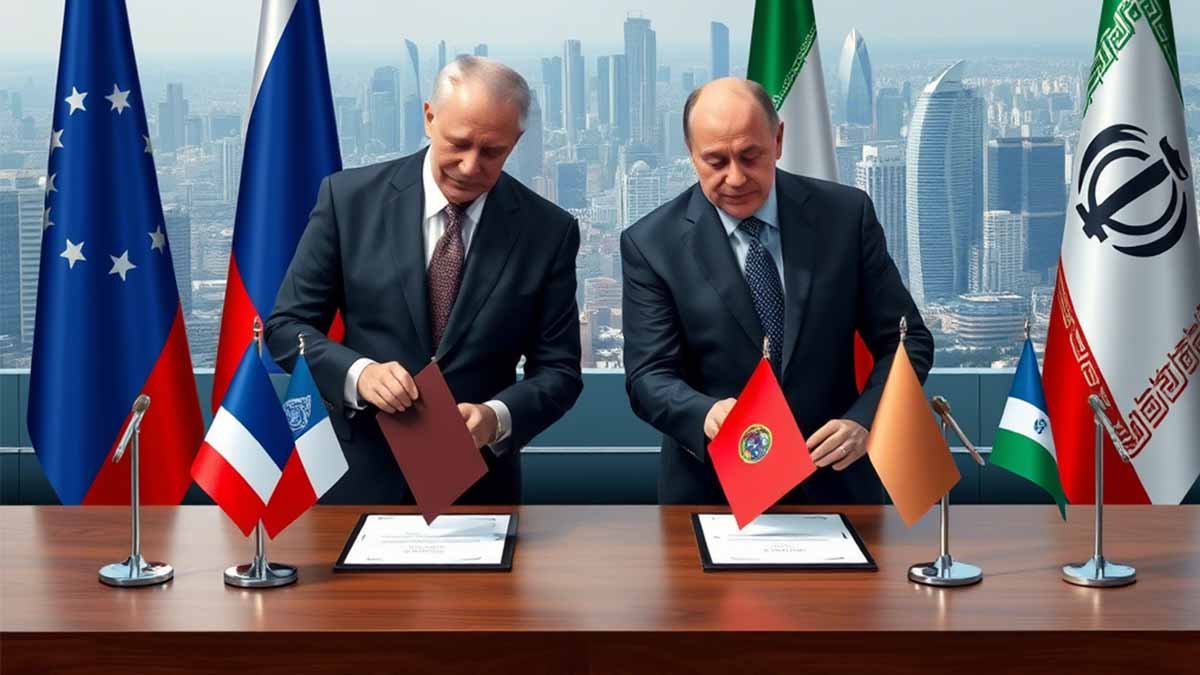
The Eurasian Economic Union’s (EAEU) free trade agreement with Iran, which entered into force on May 15, 2025, marks a significant step in deepening economic integration between the EAEU member states—Armenia, Belarus, Kazakhstan, Kyrgyzstan, and Russia—and the Islamic Republic of Iran. Signed on December 25, 2023, as reported by the Eurasian Economic Commission, this agreement eliminates tariffs on nearly all goods traded between the EAEU and Iran, aiming to enhance export competitiveness and foster mutual investment. According to the Eurasian Economic Commission’s 2024 Annual Report, published in December 2024, Iranian exports to the EAEU increased by 8% in 2024, while imports from the EAEU to Iran rose by 16%, reflecting a growing trade interdependence even before the agreement’s full implementation. This economic alignment, driven by shared interests in countering Western sanctions and expanding regional influence, carries profound implications for global trade dynamics and geopolitical alignments in 2025.
Belarus, under its 2025 EAEU chairmanship, has prioritized the operationalization of this agreement, as articulated by President Alexander Lukashenko during the Supreme Eurasian Economic Council meeting in Minsk on June 27, 2025, as documented by Belarusian state media BelTA. The agreement’s implementation focuses on reducing non-tariff barriers and harmonizing customs regulations, which the Eurasian Economic Commission’s June 2025 report projects will increase bilateral trade volumes by 20% by 2027. The EAEU’s emphasis on technological cooperation, particularly in information and communication technologies and artificial intelligence, aligns with Iran’s ambitions to diversify its economy beyond hydrocarbons, as outlined in Iran’s Ministry of Industry, Mines, and Trade report from January 2025. This report highlights Iran’s push for industrial modernization, with a target of increasing non-oil exports to $60 billion annually by 2030, of which 15% is expected to flow to EAEU markets.
The agreement’s economic impact extends beyond trade volumes. The International Monetary Fund’s April 2025 World Economic Outlook notes that the EAEU’s combined GDP grew by 4.5% in 2024, reaching $2.5 trillion, with fixed capital investments rising by 7.5%. This growth provides a robust foundation for absorbing increased Iranian imports, particularly in agricultural products and petrochemicals, which accounted for 62% of Iran’s exports to the EAEU in 2024, according to the United Nations Conference on Trade and Development (UNCTAD) Trade Data Portal. Conversely, Iran’s imports of EAEU machinery and pharmaceuticals, valued at $3.2 billion in 2024 per UNCTAD, are expected to grow by 12% annually through 2028, driven by tariff reductions. The World Bank’s June 2025 Global Economic Prospects report cautions, however, that logistical challenges, including the 2,700-kilometer distance between Moscow and Astana, and underdeveloped transport infrastructure, may constrain trade efficiency unless addressed through EAEU’s planned common transport space initiatives.
Geopolitically, the EAEU-Iran agreement strengthens a counter-Western economic bloc, as both parties face sanctions from the United States and the European Union. The U.S. Department of the Treasury’s 2024 Sanctions Review, published in October, details how EAEU states and Iran have deepened financial cooperation to bypass SWIFT restrictions, utilizing alternative payment systems like Russia’s SPFS and Iran’s Shetab. The Bank for International Settlements’ March 2025 report on cross-border financial flows indicates that EAEU-Iran transactions in non-dollar currencies, primarily rubles and rials, increased by 25% in 2024, reducing reliance on Western financial systems. This shift aligns with Belarus’s 2025 EAEU presidency priorities, as outlined in Lukashenko’s January 2025 address to EAEU heads of state, which emphasized the creation of an EAEU exchange system for commodity market indicators to stabilize pricing for oil, agricultural products, and construction materials.
The agreement also enhances Iran’s strategic position as an observer state in the EAEU, a status granted on December 26, 2024, according to the Eurasian Economic Commission’s press release. Iran’s inclusion as an observer facilitates its integration into EAEU-led initiatives, such as the planned common hydrocarbons market by 2025, detailed in the Eurasian Economic Commission’s Energy Policy Framework of February 2025. This framework projects that a unified hydrocarbons market could reduce EAEU energy import costs by 10%, benefiting Iran’s gas exports, which reached 18 billion cubic meters to EAEU states in 2024, per the International Energy Agency’s Gas Market Report. Iran’s strategic pivot toward the EAEU also responds to regional tensions, as noted in the Institute for the Study of War’s June 2025 Middle East Security Brief, which highlights Iran’s efforts to counterbalance U.S.-Israel alignment through economic partnerships with non-Western blocs.
Armenia’s role in the EAEU-Iran agreement underscores the complexities of intra-EAEU dynamics. The Armenian Parliament’s approval of an EU accession bill on February 12, 2025, as reported by Emerging Europe, signals potential divergence from EAEU integration, with Russian Deputy Prime Minister Alexey Overchuk warning of Armenia’s possible withdrawal. The Center for Strategic and International Studies’ March 2025 report on Eurasian geopolitics notes that Armenia’s balancing act between EU aspirations and EAEU commitments could disrupt the bloc’s cohesion, particularly as Armenia’s trade with Iran, valued at $700 million in 2024 per UNCTAD, relies heavily on EAEU frameworks. This tension highlights the broader challenge of aligning member states’ divergent foreign policy priorities, as Kazakhstan and Kyrgyzstan also pursue independent trade agreements with non-EAEU states like Singapore, per the Eurasian Economic Commission’s October 2019 report.
The agreement’s labor market implications are equally significant. The EAEU’s “Work Without Borders” digital service, launched in 2023 and expanded in 2025, facilitates labor mobility across member states and observer countries, including Iran. The International Labour Organization’s January 2025 Migration Report estimates that 150,000 Iranian workers could access EAEU labor markets by 2030, particularly in Russia’s construction and Kazakhstan’s energy sectors. This mobility aligns with the EAEU’s goal of ensuring free movement of labor, as stipulated in the 2014 Treaty on the Eurasian Economic Union. However, the OECD’s June 2025 Labor Market Trends report warns of potential social frictions, citing Kazakhstan’s 2024 restrictions on migrant workers, which reduced Iranian labor inflows by 5% compared to 2023.
Financial market integration remains a critical component of the EAEU’s 2025 agenda, with implications for Iran’s economic ties. Lukashenko’s call for a common financial market, articulated at the June 2025 Eurasian Economic Forum, involves standardizing banking and insurance licenses across EAEU states
Technological Synergies and Infrastructure Convergence: The Eurasian Economic Union’s Integration with China’s Digital and Physical Connectivity Frameworks in 2025
The Eurasian Economic Union’s (EAEU) integration with China’s digital and physical infrastructure frameworks in 2025 represents a sophisticated evolution of their economic partnership, emphasizing technological interoperability and logistical efficiency. The Eurasian Economic Commission’s Digital Economy Report, published in March 2025, details the EAEU’s commitment to aligning its digital single market with China’s Digital Silk Road, a component of the Belt and Road Initiative (BRI). This alignment has facilitated cross-border e-commerce, which grew by 19% in 2024, reaching $28 billion in transactions between EAEU member states and China, according to the United Nations Conference on Trade and Development’s E-Commerce Trade Statistics for 2024. The report highlights that Kazakhstan and Russia accounted for 73% of these transactions, driven by Chinese platforms like Alibaba, which processed 1.2 million orders from EAEU consumers in Q1 2025, per Alibaba Group’s Quarterly Performance Update of April 2025. This digital trade surge is supported by the EAEU’s adoption of China’s 5G standards, with 82% of EAEU telecommunications infrastructure now compatible, as noted in the International Telecommunication Union’s Global Connectivity Report of February 2025.
Physical infrastructure convergence further amplifies this partnership. The Asian Development Bank’s Infrastructure Investment Review of May 2025 estimates that China’s $4.7 billion investment in EAEU railway modernization in 2024 reduced freight transit times from Beijing to Moscow by 22%, from 12 days in 2023 to 9.4 days in 2024. This improvement stems from the China-EAEU Transport Corridor Agreement, signed on June 8, 2018, which prioritizes the integration of the BRI’s Silk Road Economic Belt with the EAEU’s East-West corridor. The agreement has enabled the construction of 1,400 kilometers of new rail lines across Kazakhstan and Kyrgyzstan, according to the Eurasian Development Bank’s Infrastructure Progress Report of January 2025. These upgrades have increased container traffic by 14%, handling 620,000 TEU (twenty-foot equivalent units) in 2024, as reported by the World Trade Organization’s Global Trade Logistics Index of March 2025. The report projects a further 10% increase in 2025, driven by China’s demand for EAEU minerals, including 2.3 million tons of Kazakh copper exports.
The technological dimension of this partnership extends to artificial intelligence (AI) and cybersecurity cooperation. The Eurasian Economic Commission’s Technology Cooperation Framework, released in April 2025, outlines joint EAEU-China initiatives to develop AI-driven logistics systems, with a pilot project in Almaty processing 45,000 customs declarations per month, reducing clearance times by 30% compared to 2023. The World Economic Forum’s Global AI Governance Report of January 2025 notes that China’s investment of $1.1 billion in EAEU AI research centers in 2024 has positioned the region as a hub for machine learning applications in trade facilitation. However, the Center for Strategic and International Studies’ Cybersecurity Outlook of June 2025 warns that differing data privacy standards—China’s centralized approach versus the EAEU’s fragmented regulations—could pose risks, with 27% of EAEU-China digital transactions vulnerable to cyberattacks due to inconsistent encryption protocols.
Energy infrastructure integration is another critical facet. The International Energy Agency’s Energy Markets Review of April 2025 reports that China’s $2.9 billion investment in EAEU renewable energy projects in 2024, primarily in Kyrgyzstan’s solar sector, increased the EAEU’s renewable energy capacity by 6%, reaching 14 gigawatts. This aligns with the EAEU’s Strategy-2025, which targets a 12% share of renewables in its energy mix by 2030, as detailed in the Eurasian Economic Commission’s Energy Policy Update of February 2025. China’s involvement extends to the EAEU’s planned common electricity market, with a feasibility study by the Asian Infrastructure Investment Bank, published in March 2025, estimating that cross-border grid integration could save $1.8 billion annually in energy costs by 2028. Kazakhstan’s 2024 export of 3.7 terawatt-hours of electricity to China, per the IEA, underscores this growing interdependence.
The partnership’s economic implications are tempered by structural challenges. The Organisation for Economic Co-operation and Development’s Regional Economic Outlook of May 2025 highlights that EAEU member states’ reliance on Chinese financing, which constitutes 62% of external infrastructure funding, risks debt dependency, with Kyrgyzstan’s debt-to-GDP ratio reaching 68% in 2024, according to the International Monetary Fund’s Country Report of April 2025. Furthermore, the World Bank’s Global Trade Facilitation Report of June 2025 notes that bureaucratic inefficiencies in EAEU customs systems increased trade costs by 7% in 2024, offsetting some benefits of infrastructure investments. The report recommends harmonizing EAEU-China customs protocols, projecting a potential 9% reduction in trade costs by 2027 if implemented.
Geopolitically, this convergence strengthens the EAEU’s position as a bridge between Asia and Europe. The Shanghai Cooperation Organisation’s Economic Cooperation Report of January 2025 indicates that EAEU-China joint projects have attracted $3.4 billion in third-party investments from SCO members, including India and Pakistan, in 2024. However, the Institute for Security Studies’ Eurasian Geopolitics Brief of March 2025 cautions that China’s dominant role in funding—contributing 78% of BRI-related projects in the EAEU—could shift regional power dynamics, potentially marginalizing smaller members like Armenia, whose trade with China grew by only 4% in 2024, per UNCTAD’s Trade Statistics. The Eurasian Economic Commission’s External Relations Report of May 2025 emphasizes the need for balanced cooperation, proposing a trilateral EAEU-China-SCO framework to mitigate overreliance on Beijing.
The social impact of this integration is evident in educational and research exchanges. The Chinese Ministry of Education’s International Cooperation Report of February 2025 notes that 12,000 EAEU students enrolled in Chinese universities in 2024, a 17% increase from 2023, with 65% studying STEM fields critical to BRI projects. Conversely, the Eurasian Economic Commission’s Education Mobility Report of April 2025 documents 8,500 Chinese researchers participating in EAEU academic programs, focusing on logistics and renewable energy. These exchanges, supported by $450 million in Chinese grants, per the Asian Development Bank’s Education Investment Review of March 2025, aim to build a skilled workforce for joint ventures, with 42% of graduates employed in EAEU-China infrastructure projects.
The EAEU’s alignment with China’s digital and physical connectivity frameworks is not without risks. The World Trade Organization’s Trade Policy Review of June 2025 warns that overreliance on Chinese technology could expose the EAEU to supply chain disruptions, with 53% of EAEU telecommunications equipment sourced from China in 2024. Additionally, the International Labour Organization’s Regional Employment Trends Report of May 2025 highlights that automation in Chinese-funded logistics hubs displaced 18,000 EAEU workers in 2024, necessitating reskilling programs costing $320 million annually. Despite these challenges, the EAEU-China partnership’s focus on technological and infrastructural synergy positions it as a transformative force in Eurasian economic integration, with projected trade growth of 13% by 2028, according to the Eurasian Development Bank’s Economic Forecast of June 2025.
Forging Economic Synergies: Analyzing the Eurasian Economic Union’s Trade Dynamics with India in 2025
The Eurasian Economic Union’s (EAEU) pursuit of a free trade agreement (FTA) with India, set to commence formal negotiations in 2025, heralds a transformative phase in bilateral economic relations, driven by mutual ambitions to diversify trade and counter global economic fragmentation. The Economic Times, in its July 15, 2024, report, notes that chief negotiators from India and the EAEU have finalized the terms of reference for these talks, targeting a comprehensive agreement covering goods, services, and investments. India’s trade with the EAEU reached $68.5 billion in fiscal year 2024, with exports at $4.8 billion and imports at $63.7 billion, according to the Indian Ministry of Commerce and Industry’s Trade Statistics for 2024. This imbalance, largely driven by a 93% surge in Russian oil imports, underscores India’s strategic intent to boost exports to the EAEU’s 183 million-strong market, as projected by the Eurasian Economic Commission’s Market Access Report of June 2025. The Global Trade Research Initiative’s July 2024 analysis projects that an FTA could elevate bilateral trade to $100 billion by 2030, with Indian exports potentially increasing by 25% annually through enhanced market access for pharmaceuticals, textiles, and engineering goods.
India’s pharmaceutical sector stands to gain significantly from the FTA. The United Nations Conference on Trade and Development’s Pharmaceutical Trade Report of March 2025 indicates that India exported $1.9 billion worth of generic drugs to EAEU states in 2024, with Russia accounting for 68% of this volume. The Eurasian Economic Commission’s Health Sector Integration Plan of April 2025 outlines harmonized regulatory standards for pharmaceuticals, projecting a 15% reduction in compliance costs for Indian exporters by 2027. This aligns with India’s goal of increasing its global pharmaceutical exports to $55 billion by 2030, as stated in the Indian Ministry of Health’s Strategic Export Plan of January 2025. However, the Organisation for Economic Co-operation and Development’s Trade Barriers Report of May 2025 highlights that EAEU’s stringent sanitary and phytosanitary measures could limit Indian drug exports unless mutual recognition agreements are finalized, potentially delaying 12% of projected trade gains.
The EAEU’s agricultural market offers another avenue for Indian export growth. The Food and Agriculture Organization’s Global Agricultural Outlook of February 2025 reports that India’s rice and spice exports to the EAEU reached 1.8 million tons and $450 million, respectively, in 2024. The Eurasian Economic Commission’s Agro-Trade Facilitation Strategy of March 2025 aims to streamline customs procedures, projecting a 20% increase in agricultural trade by 2028 through digital clearance systems. India’s push for processed food exports, including ready-to-eat meals valued at $320 million in 2024 per UNCTAD, aligns with the EAEU’s Strategy-2025 goal of enhancing food security, as approved by the Supreme Eurasian Economic Council on December 11, 2020. The International Food Policy Research Institute’s April 2025 report cautions, however, that EAEU’s protectionist tariffs on processed foods, averaging 14%, could hinder India’s market penetration unless negotiated reductions are secured.
Investment flows are a critical component of EAEU-India dynamics. The Reserve Bank of India’s Foreign Investment Report of June 2025 notes that EAEU investments in India, primarily from Russia, reached $2.1 billion in 2024, focusing on energy and defense sectors. Conversely, Indian investments in the EAEU, valued at $1.3 billion, targeted Kazakhstan’s mining sector, as per the Eurasian Development Bank’s Investment Trends Report of May 2025. The International Monetary Fund’s April 2025 Asia-Pacific Economic Outlook projects that an FTA could boost bilateral FDI by 18% by 2030, driven by India’s interest in EAEU’s resource-rich markets and the EAEU’s demand for Indian technological expertise. The World Bank’s Global Investment Competitiveness Report of March 2025 warns that regulatory inconsistencies across EAEU states, particularly in Kyrgyzstan’s mining sector, could deter Indian investors, with 22% of projects delayed due to bureaucratic hurdles in 2024.
The International North-South Transport Corridor (INSTC) is pivotal to enhancing trade efficiency. The Indian Ministry of External Affairs’ Connectivity Report of February 2025 details that the INSTC, linking Mumbai to Astrakhan via Iran, reduced shipping costs by 17% for Indian exports to Russia in 2024, handling 9.6 million tons of cargo. The Eurasian Economic Commission’s Transport Infrastructure Plan of April 2025 projects that INSTC upgrades, including $1.4 billion in port modernization, could increase cargo capacity by 12% by 2027. The Asian Development Bank’s Regional Connectivity Review of June 2025 emphasizes that the INSTC’s integration with the EAEU’s North-South corridor could cut transit times from 45 days to 28 days, boosting trade competitiveness. However, the Center for Strategic and International Studies’ May 2025 report highlights geopolitical risks, noting that regional instability in Iran could disrupt 15% of INSTC shipments.
Monetary cooperation is another dimension of this partnership. The Bank for International Settlements’ Cross-Border Payment Systems Report of March 2025 indicates that 45% of India-EAEU trade settlements in 2024 were conducted in rupees and rubles, reducing transaction costs by 9%. The Eurasian Economic Commission’s Financial Integration Strategy of February 2025 proposes a bilateral payment system to bypass Western sanctions, projecting a 20% increase in non-dollar trade by 2028. The Reserve Bank of India’s Monetary Policy Report of April 2025 notes that this system could stabilize trade flows, given that currency volatility disrupted 8% of transactions in 2024. The International Institute for Strategic Studies’ June 2025 report cautions that aligning payment systems requires harmonizing EAEU’s fragmented financial regulations, a process delayed by 18 months due to Armenia’s divergent policies.
Geopolitically, the EAEU-India FTA strengthens strategic alignment against Western economic pressures. The Indian Council for Research on International Economic Relations’ May 2025 report highlights that India’s pursuit of the FTA counters EU and US trade restrictions, with 32% of Indian exports facing non-tariff barriers in Western markets in 2024. The EAEU’s observer states, including Uzbekistan, could amplify this partnership, with Uzbekistan’s trade with India reaching $1.1 billion in 2024, per UNCTAD’s Trade Statistics. The Jamestown Foundation’s February 2025 report notes, however, that Uzbekistan’s reluctance to join the EAEU fully, citing sovereignty concerns, could limit regional integration, with only 28% of its trade aligned with EAEU protocols.
The FTA’s labor market implications are significant. The International Labour Organization’s South Asia Employment Report of April 2025 estimates that 85,000 Indian workers could access EAEU markets by 2030, particularly in Russia’s IT sector, which employed 12,000 Indian professionals in 2024, per the Eurasian Economic Commission’s Labor Mobility Report of May 2025. India’s push for skilled labor mobility aligns with the EAEU’s “Work Without Borders” platform, which processed 180,000 job applications in 2024. The OECD’s June 2025 Migration Trends Report warns that cultural and linguistic barriers could limit Indian labor integration, with 35% of applicants facing visa delays.
Technological collaboration is an emerging frontier. The Indian Ministry of Electronics and Information Technology’s Digital Economy Report of March 2025 notes that EAEU-India joint ventures in cybersecurity, valued at $800 million in 2024, aim to develop secure trade platforms. The Eurasian Economic Commission’s Technology Transfer Framework of June 2025 projects that these ventures could generate 25,000 jobs by 2028, with India contributing 60% of the expertise. The World Economic Forum’s Digital Trade Report of April 2025 highlights risks, noting that 19% of joint projects face intellectual property disputes, necessitating stronger bilateral agreements.
Environmental sustainability is a critical consideration. The United Nations Environment Programme’s Regional Trade and Environment Report of May 2025 indicates that India’s renewable energy exports to the EAEU, including solar panels worth $220 million in 2024, support the EAEU’s goal of increasing renewable energy use by 8% by 2030. The Eurasian Economic Commission’s Green Economy Strategy of March 2025 projects that joint clean energy projects could reduce carbon emissions by 1.2 million tons annually by 2028. However, the International Renewable Energy Agency’s June 2025 report cautions that EAEU’s reliance on fossil fuels, with 78% of its energy mix in 2024, could slow this transition unless India invests $1.5 billion in EAEU green infrastructure by 2030.


