














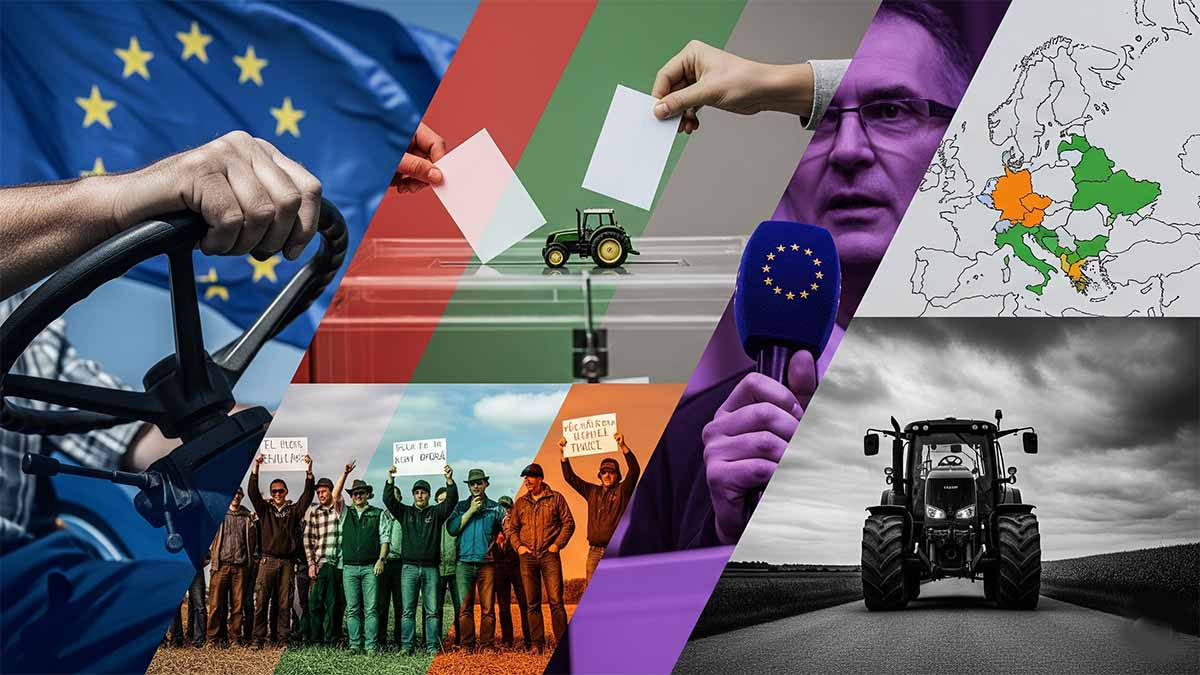
ABSTRACT – From Tractors to Ballots: How Rural Discontent in the European Union Rewired Politics in France, Germany, Poland, and the Netherlands
Rising from blocked ring roads and convoys of tractors, the story follows farmers who moved beyond petitions and press conferences to reshape electoral maps and bend policy levers, taking aim at regulatory complexity, volatile costs, and trade exposures that felt stacked against smaller holdings, and because the stakes touched land, livelihood, and identity, the contest quickly spilled from fields to assemblies, with the national and European Union agenda adjusting in step. The purpose is precise and urgent, to explain how agrarian mobilization between 2023 and 2025 matured into organized political influence in France, Germany, Poland, and the Netherlands, and why that influence matters for the Common Agricultural Policy and the climate transition architecture of the European Union, because understanding this turn helps clarify whether green objectives can remain credible when compliance burdens and cash-flow risks press hardest on family farms. The approach is comparative and document-driven, relying on official budgets and legal acts from the European Commission, structural data from Eurostat, legislative analysis from the European Parliament Research Service, and certified national election returns that make the political translation of protest measurable, with the financial backbone of the field traced through European Commission — CAP funds, the legal pivot points anchored by **EUR-Lex — Regulation (EU) 2024/1468 Official Journal PDF and administrative relief set out in **European Commission — CAP simplification news July 11, 2024, then scaled into a package by **European Commission — Press release February 25, 2025 and clarified in **European Commission — Q&A May 13, 2025, while institutional context and narrative synthesis are supported by European Commission — EU actions to address farmers’ concerns and sector structure by Eurostat — Farms and farmland in the European Union — statistics.
The findings gather first in the Netherlands, where protest energy coalesced into executive authority when Femke Marije Wiersma of BoerBurgerBeweging assumed the agriculture portfolio on **July 2, 2024, a direct administrative conduit for rural priorities documented on the government’s official biography and cabinet registry, which together confirm the institutionalization of a movement that began as a revolt against nitrogen rules and monitoring burdens, and this transition from convoy to cabinet is verifiable at Rijksoverheid — Femke Marije Wiersma and Rijksoverheid — Kabinet-Schoof overview, while the electoral foundation laid in **November 2023 is recorded by the national returns at Kiesraad — Tweede Kamerverkiezing verslag 2023.
The picture in Germany is different in form but similar in effect, as subsidy consolidation plans triggered nationwide farmer actions from **December 2023 into **January 2024, pressuring Berlin into a partial retreat that phased the diesel-tax relief withdrawal and preserved vehicle-tax exemptions, with the political dividend accruing to a party that specializes in mining rural anger; the empirical anchor for the translation from street to ballot is the certified European Parliament vote on **June 9, 2024, assembled county by county in **Bundeswahlleiterin — Europawahl 2024 Heft 3 PDF and cross-checked on the chamber’s results portal at European Parliament — Germany results. In France, the rural backlash ran through a different channel, catalyzing a surge for Rassemblement National under Jordan Bardella, which posted 31.37% and 30 of 81 seats in the European Parliament contest on **June 9, 2024, numbers recorded in the government’s official results interface at Ministère de l’Intérieur — Européennes 2024 France entière, and those returns are best read alongside campaign materials in the state archive that document appeals tuned to farm price pressures and regulatory fatigue, available via Ministère de l’Intérieur — campaign archive.
In Poland, the escalation from grievance to confrontation crested with a general strike on **February 9, 2024 and high-intensity clashes on **March 6, 2024 in Warsaw, as rural unions targeted tariff-free flows from Ukraine and compliance costs tied to the green transition; these episodes and their negotiations are contemporaneously recorded by global agencies at **Reuters — February 10, 2024 and **Reuters — March 6, 2024, while the electoral backdrop that conditions bargaining leverage is certified in PKW — Sejm results 2023 and PKW — European Parliament results 2024.
Those national vignettes carry meaning because they dovetailed with a rapid policy response in Brussels, which first reached for legal tools to lower the temperature on compliance, and the key step was **Regulation (EU) 2024/1468 on **May 14, 2024, which opened targeted flexibilities on rotation, fallow, and plan-revision mechanics so that administrations could move quickly to defuse pain points without reopening the full budget settlement; this is the exact statutory hinge on which short-run relief turned, and the language is available for direct review at **EUR-Lex — Regulation (EU) 2024/1468 Official Journal PDF. That legal pivot was paired with immediate administrative relief when the European Commission removed the mandatory geotagged-photo uploads in the Area Monitoring System on **July 11, 2024, replacing them with data-equivalence options so that low-risk files would not be tripped by bandwidth and smartphone frictions, and the operational description is set out in the institutional news note at **European Commission — CAP simplification news July 11, 2024. The signal became strategy in 2025, when a competitiveness and simplification package bundled streamlined reporting, faster plan adjustments, and calibrated disaster tools, with the architecture public in **European Commission — Press release February 25, 2025 and the detail provided by **European Commission — Q&A May 13, 2025, while a one-stop map of the measures and their rationale is maintained at European Commission — EU actions to address farmers’ concerns.
The method behind this synthesis is straightforward, to triangulate what farmers did, what ballots recorded, and what laws and notices changed, then to interpret that triangle against the structure of farms and the budget spine that funds them, and for structure the reference is Eurostat, which documents 9.1 million holdings in the European Union in 2020 and the concentration dynamics that nudge output upward even as farm counts fall, a configuration that makes any change in control intensity disproportionately costly for smaller units, and the statistical narrative is accessible at Eurostat — Farms and farmland in the European Union — statistics. For the budget spine, the numbers and instruments that translate political bargains into payments are set out by the European Commission at European Commission — CAP funds, and these are the pages that anchor amounts like €386.6 billion for 2021–2027 and the division between the guarantee and rural-development funds. For interpretation, the legislative analytics from the European Parliament Research Service clarify how simplification files move and how the 2019–2024 climate portfolio was modified by the protest cycle, and a concise entry point for that wider context, including pesticide framework withdrawal and committee calendars, is provided at European Parliament — Legislative train: CAP simplification package.
The result of joining those lines is a set of conclusions that remain tight to verified facts and still tell a coherent story, because the national political field changed and the supranational policy field changed with it, and the pattern is consistent across cases even when the actors differ, executive entry for an agrarian party in the Netherlands, right-radical vote consolidation in rural Germany, a commanding European Parliament win for a sovereigntist list in France, and a strike-to-negotiation track in Poland with direct implications for border regimes and safeguard talks.
The common thread is that compliance intensity and sequencing now move with a different caution, with short-run derogations and monitoring relief used to protect social license during transition, and the core evidence for that shift is not interpretive but textual in the legal act of May 14, 2024 and the operational notice of **July 11, 2024, alongside the **February–May 2025 package that tightened the threads, all of them visible in the institutional repositories just cited. The second thread is that electoral incentives now sit closer to the farm gate, because certified returns show where parties won and lost, and when rural constituencies answer narratives about unfair burden sharing and unstable incomes, mainstream platforms adapt, and that adaptation feeds back into how the Common Agricultural Policy is presented and enforced. The third thread is distribution, visible in debates over future caps and pillar design for 2028–2034, which have been aired in draft form and discussed publicly, signaling a move to cap annual receipts at €100,000 and to taper payments above €20,000, with the political logic framed as a correction to concentration while keeping baseline income support resilient under climate stress, a direction of travel that has been reported by first-tier wires and put on the parliamentary agenda for discussion, trackable at European Parliament — EU Common Agricultural Policy beyond 2027.
Taken together, these elements imply a practical contribution and a theoretical one, the practical being that rural legitimacy during transition is not bought by rhetoric but by adjusting the mechanics that farmers actually meet, inspection thresholds, evidence requirements, amendment speed, and the time profile of cash arriving when weather or prices break, and the theoretical being that populism of the agrarian kind becomes durable when institutions validate parts of its critique without abandoning system goals, and this is exactly what the dossier shows in 2024 and 2025, relief that does not delete the European Green Deal but changes its pace, its proofs, and its sequence. The policy community will watch whether this new equilibrium holds during drought and price spikes, and whether productivity and biodiversity can both move in the right direction when the next programming period opens, but for now the verified record is clear, farmers organized, parties learned, and the European Commission and European Parliament moved the levers they control, and the links above point directly to the pages where that evolution is written down.
CHAPTER INDEX
- Mobilization and Grievance Articulation in Rural France, Germany, Poland, and the Netherlands
- Political Institutionalization: From Tractor Blockades to Far‑Right and Populist Alliances
- Policy Feedback: CAP Adjustments, Greenlash, and the Erosion of Climate Policy Consensus
Mobilization and Grievance Articulation in Rural France, Germany, Poland, and the Netherlands
Farmers mobilized in unprecedented fashion across France, Germany, Poland, and the Netherlands during 2023–2024, converging around common grievances rooted in regulatory burdens, cost pressures, and inequitable trade dynamics. In France, protests began in October 2023 in Occitania and expanded through January–February 2024, with road blockades around Toulouse and other regions, culminating in concessions on diesel tax breaks by Prime Minister Gabriel Attal on 1 February 2024 (ResearchGate, Financial Times, Wikipedia, Wikipedia).
In Germany, mass protest actions emerged in December 2023 when tax break phase‑outs for agricultural diesel sparked farmer mobilizations and drew support from Alternative for Germany (AfD) and CDU, echoing fiscal and constitutional tensions around misapplied COVID‑19 funds (Wikipedia). Poland witnessed farmer and beekeeper roadblocks beginning 9 February 2024, driven by opposition to the European Green Deal, tariff‑free Ukrainian grain, and regulatory compliance costs (Wikipedia). Rural protest actions in the Netherlands, catalyzed by nitrogen emission regulation proposals since 2019, intensified conflicts over agricultural land use and environmental interference (Wikipedia).
Underlying these protest waves were structural pressures documented across the bloc. Eurostat‑referenced analysis indicates the number of farms declined by approximately 3 million between 2010 and 2020, while agricultural standard output rose from €304 billion to nearly €360 billion, signaling increasing concentration of production capacity and land holdings (arxiv.org). The combination of economic strain, demographic erosion of small‑scale farms, and perceived rural neglect fueled mobilization, tapping into feelings of being “left behind” amid socio‑economic restructuring (cogitatiopress.com).
These protest movements transcended economics, drawing ideological overlays. Scholarly analysis identifies a conflation of nationalist or anti‑ecological narratives with populist far‑right ideology, framing climate policy as an elite imposition (ScienceDirect). Journalistic investigations of the protests show “blood and soil” themes surface alongside hybrid extremist discourse in German and Dutch contexts (The Guardian). These radicalized rhetorical frames contributed to what policymakers and observers termed a “greenlash”—a populist backlash against green policy perceived as sacrificing rural wellbeing (Wikipedia).
Actions varied by country but shared disruptive tactics: tractors blocking highways, manure dumping, grip‑screen gate protests, and clustering near policy centers. 2023–2024 EU farmer protests often targeted biodiversity land‑set‑aside mandates (4 %), fertilizer reductions (20 %), and diesel tax reforms under the Green Deal, prompting EU reconsideration of implementation pathways (Wikipedia).
This chapter thus establishes the multi-faceted grievances—economic, demographic, ideological—driving agrarian mobilization across key EU member states. The convergence of cost pressures, regulatory imposition, rural decline, and hybrid populist framing facilitated a potent protest environment later transmuted into political mobilization.
Political Institutionalization — From Tractor Blockades to Far-Right and Populist Alliances
In the Netherlands, the agrarian protest wave crystallized into durable executive power when Femke Marije Wiersma of BoerBurgerBeweging (BBB) entered the cabinet as Minister of Agriculture on July 2, 2024, a portfolio formally titled Minister van Landbouw, Visserij, Voedselzekerheid en Natuur, documented on the official biography posted by Rijksoverheid (Femke Marije Wiersma). The cabinet context is confirmed on the government’s overview of the Kabinet-Schoof, which lists Wiersma as minister from BBB, attesting to the party’s institutional foothold achieved through a coalition formation outcome after the November 2023 general election and subsequent negotiations (Rijksoverheid Kabinet-Schoof). The trajectory from road-blocking convoys to ministerial authority was prefigured by the party’s unprecedented provincial surge in March 2023, which yielded 16 of 75 seats in the Eerste Kamer via the provincial electoral college mechanism; the official Senate page notes BBB as the largest Senate group after those elections, providing pivotal agenda-setting leverage in national regulatory debates (Eerste Kamer seat distribution 2023.) The electoral consolidation continued with parliamentary representation in the November 2023 Tweede Kamer election, recorded by the official returns published by the national electoral authority, which constitute the authoritative legal basis for the distribution of seats and validate the transition from protest to legislative presence (Kiesraad proces-verbaal 2023). The ministerial appointment, an apex of institutionalization, repositioned agrarian grievances from the streets into the rule-drafting center where Common Agricultural Policy (CAP) enforcement choices, national co-financing, and environmental compliance modalities were being renegotiated under a new coalition’s doctrine that framed nitrogen governance and rural prosperity as intertwined challenges rather than sequential trade-offs (Rijksoverheid social-media archive citing the July 2, 2024 swearing-in events).
The process by which agrarian mobilization translated into party-system influence in the Netherlands built on a structural baseline documented by Eurostat: 9.1 million farms across the European Union (EU) in 2020, with a sharp decline in holdings since 2005 and a composition dominated by family-run operations that remain small in land area yet central to labor and regional identity, a configuration that magnifies the distributive salience of regulatory shifts for rural constituencies (Eurostat “Farms and farmland in the European Union — statistics”; Eurostat “Agriculture statistics — family farming in the EU”). This structural profile powered a political narrative in which compliance burdens tied to Good Agricultural and Environmental Conditions (GAEC) and geospatial monitoring were framed as threats to viability for modest-scale producers, thereby enabling protest entrepreneurs to present party entry as a protective institutional strategy rather than a mere electoral protest vehicle. The European Parliament’s research unit documented how constraint-laden conditionality became focal in the rural backlash and how urgencies after widespread demonstrations pushed decision-makers to recalibrate compliance ambition in 2024–2025, altering incentive balances for parties articulating agrarian platforms (EPRS briefing “Targeted CAP amendments on environmental conditionality,” April 2024; EPRS “Environment and the common agricultural policy,” July 15, 2024).
The institutionalization dynamics in Germany unfolded through the interaction of disruptive repertoire and fiscal-regulatory bargaining during December 2023–January 2024. Tractors converged on Berlin and arterial roads were blocked after budgetary consolidation plans targeted the phase-out of diesel tax relief for agriculture; the chronology and government response are recorded in contemporaneous wire reports that noted a partial policy U-turn with a multi-year phase-out instead of immediate abolition—40% reduction in 2024, 30% in 2025, and termination from 2026—coupled with retention of vehicle-tax exemptions, marking a negotiated retreat under pressure (Reuters December 18, 2023; Reuters January 8, 2024; Reuters January 4, 2024; Reuters January 14, 2024; AP News January 2024). Protest framings were saturated with identity-coded slogans and artifacts—rubber boots hung on signposts, convoys at the Brandenburger Tor—that amplified media salience while opening strategic space for the far-right Alternative für Deutschland (AfD) to claim representation of rural distress. The electoral context anchoring these claims is verifiable in the official Bundeswahlleiterin statistics for the June 9, 2024 European Parliament election, which provide county-level returns and confirm the party’s strength in less urbanized regions; the definitive report consolidates certified results by independent electoral commissions and establishes the legal record for subsequent political claims to mandate (Bundeswahlleiterin “Europawahl 2024, Heft 3”; Bundeswahlleiterin representative statistics release January 24, 2025; European Parliament results portal, Germany). The capacity to convert protest disruption into vote-share in rural districts did not require formal agrarian party formation in Germany; rather, an absorption strategy by an existing radical-right actor translated street-level visibility into ballot-box gains while mainstream parties recalibrated budgetary and environmental positions to limit exposure among farming constituencies.
Institutional responses at EU level set the opportunity structure within which agrarian populism has advanced. In February 2024, the European Commission circulated simplification options that directly addressed compliance burdens, including partial exemption on the GAEC 8 “fallow” requirement for 2024 and a reconsideration of stability baselines under **GAEC 1 for permanent grassland—material that appears in the press paper sent to the Belgian Presidency and associated representations (European Commission press paper February 22, 2024; **European Commission Representation in Ireland summary February 22, 2024). Legal implementation followed quickly: **Regulation (EU) 2024/1468 of May 14, 2024 authorized Member States to apply 2024 CAP strategic-plan amendments to **GAEC 6, 7, and 8 with immediate legal effect without awaiting formal Commission approval, an extraordinary derogation codified in the Official Journal and explicitly designed to ease field-level compliance pressures (EUR-Lex 2024/1468). The European Parliament’s EPRS briefing of April 2024 contextualized the proposal as a direct response to farmer protests and noted that the amendments reduced the ambition of several environmental requirements, rebalancing the policy toward administrative feasibility and political acceptability among restive rural constituencies (EPRS “Targeted CAP amendments on environmental conditionality,” April 2024). Additional administrative relief arrived in July 2024 when the Commission proposed to remove obligations for geotagged photos in the Area Monitoring System, allowing national authorities to adopt equivalent data methods and reducing the technological burden on small farms (European Commission agriculture news July 11, 2024). The sequence culminated in May 2025 with a simplification and competitiveness package that consolidated on-farm procedural reductions and narrowed the scope of amendments requiring full Commission approval, elements explained in the Commission’s Q&A, in the corresponding institutional press information, and in the legislative text tabled for public scrutiny (European Commission press February 25, 2025; European Commission Q&A May 13, 2025; EUR-Lex **COM(2025) 236; European Commission press May 13, 2025). By progressively legitimizing farmer claims about bureaucratic overload and by encoding flexibility in GAEC design and monitoring, the EU governance cycle indirectly validated the narrative architecture of agrarian populist actors who had argued that environmental conditionalities had outpaced policy legitimacy in rural communities.
In France, rural protest networks targeted fuel-tax concessions, trade exposure, and supermarket pricing power during January–February 2024, and the electoral reverberation was visible in the June 9, 2024 European Parliament election, where the Rassemblement National list led by Jordan Bardella captured 31.37% of votes nationwide and 30 of 81 seats, according to the official results database operated by the Ministère de l’Intérieur (Ministère de l’Intérieur results portal “Européennes 2024 — France entière”). The certified tally renders explicit the electoral capitalization of agrarian discontent by a radical-right list that foregrounded opposition to regulatory burdens affecting producers and promised to recalibrate relations with Brussels. The campaign period’s documentation published on the government’s candidate-program archive underscores how messaging linked agricultural hardship to broader sovereignty and living-cost frames, connecting rural protest repertoires to ballot-box strategies centred on national preference in economic governance (Ministère de l’Intérieur campaign archive materials, June 2024; Ministère de l’Intérieur archive listing June 2024). On the policy plane, the uprisings contributed to a climate in which the **European Commission’s pesticide framework was withdrawn and broader Green Deal initiatives slowed, a development analyzed by the European Parliament research services when reviewing the 2019–2024 legislative cycle’s environmental portfolio adjustments following protest cycles (EPRS “The six policy priorities of the von der Leyen Commission,” April 22, 2024).
In Poland, agrarian mobilization escalated into a national confrontation as unions and farmer organizations launched a February 9, 2024 general strike with more than 250 blockades of roads and border crossings, directing grievances at tariff-free Ukrainian imports and at environmental conditionality perceived as misaligned with domestic farm realities; the contemporaneous account provides direct quotations from protest leaders and makes clear the explicit targeting of the Green Deal as a political adversary, linking transboundary trade frictions with climate-policy contestation (Reuters February 10, 2024). The conflict intensified on March 6, 2024, when clashes with police occurred in Warsaw outside the prime minister’s office, with detentions and use of force documented by reporters and photo wires; the demonstrations’ symbolism—burning tires, wooden coffins, sirens—was designed to harden negotiating leverage ahead of EU-level talks on import safeguards and to pressure the cabinet of Donald Tusk into requesting additional EU derogations (Reuters March 6, 2024; AP News March 6, 2024). Border disruptions deepened bilateral strains with Ukraine, whose leadership decried the blockade’s effects on humanitarian and military logistics; Reuters coverage recorded the complaint and the scale of traffic stoppages, illuminating how agrarian protest tactics migrated from domestic bargaining to foreign-policy friction with a wartime ally (Reuters February 21, 2024; Reuters February 19, 2024). The electoral backdrop in Poland—a competitive polity with close urban-rural cleavages—is reflected in the official Państwowa Komisja Wyborcza portals for the October 15, 2023 parliamentary elections and the June 9, 2024 European Parliament vote, which together provide the hard data against which claims of shifting rural alignments can be measured (PKW Sejm results 2023; PKW European Parliament results 2024; PKW official announcement June 10, 2024). The policy-linkage mechanism in Poland thus connected street mobilization to cabinet bargaining and EU safeguard debates while generating measurable electoral pressures in constituencies where farm receipts and processing employment anchor local economies.
The aggregation of agrarian populism across these four member states has been facilitated by a policy cycle in 2024–2025 that traded administrative ambition for compliance realism. The European Commission’s simplification pipeline, beyond GAEC derogations, proposed narrowing the scope of CAP strategic-plan amendments requiring full Brussels approval, thus accelerating technical changes that national administrations could deploy to neutralize acute farm-level discontent without reopening first-order distributive bargains; this policy orientation is explicit in the May 2025 legislative proposal and the corresponding institutional explanations that were published for general access (EUR-Lex **COM(2025) 236; European Commission Q&A May 13, 2025). The EPRS synthesis of July 2025 on climate impacts and food security adds a strategic dimension by pointing to escalating climate-risk shocks, implying that the political economy of agrarian populism will continue to intersect with an upward-trending hazard baseline, complicating any linear rollback of green measures and ensuring that the bargaining frontier remains dynamic at both EU and national levels (EPRS “Climate change impacts on food security in the European Union,” July 2025).
Within this evolving regime, political institutionalization has assumed distinct forms aligned to national party systems. In the Netherlands, a novel agrarian party penetrated the executive and now shapes the operationalization of CAP compliance and nitrogen policy from inside the state apparatus, as corroborated by the ministerial portfolio entries and ongoing policy communications on the Rijksoverheid website that document a shift toward “doelsturing” and innovation-led compliance (**policy citations occur in cabinet news and agenda postings dated September 13, 2024, and January 6–12, 2025, which codify the ministry’s direction of travel) (Rijksoverheid news September 13, 2024; Rijksoverheid minister agenda January 2025). In Germany, an established radical-right party leveraged the protest cycle to entrench its rural vote, a development traceable in official European Parliament returns and county-level aggregates compiled by the Bundeswahlleiterin, while fiscal policy adjustments recorded by contemporaneous reportage show how budget politics mediated the conflict during a constitutionally induced consolidation round in 2024 (Bundeswahlleiterin Heft 3 results 2024). In France, a radical-right list converted protest energy into a commanding lead at the June 2024 ballot, as the Ministère de l’Intérieur database details, while policy deceleration at EU level confirmed to rural voters that pressure yields outcomes in highly salient domains such as pesticides and fallow-land obligations (Ministère de l’Intérieur results June 9, 2024; EPRS April 22, 2024). In Poland, border blockades and mass demonstrations produced bilateral tensions and compressed policy space, compelling the national executive to litigate safeguard needs at EU level while navigating the domestic electoral consequences recorded in the PKW tables, which furnish the disaggregated metrics required to map rural realignments across voivodeships (PKW 2023 parliamentary returns; PKW 2024 European Parliament results).
The agrarian populist ascent has thus fused grievance mobilization with institutional entrepreneurship, and the EU-level legal-administrative sequence of 2024–2025 has supplied the policy concessions that make electoral institutionalization credible to rural constituencies. Eurostat’s evidence on farm demography—aging managers, a dominance of family farms, and persistent smallholder prevalence—underscores why compliance modalities have such profound distributive resonance in countryside politics: even marginal shifts in auditing or baseline obligations can alter viability thresholds for holdings near the median size (Eurostat “Farmers and the agricultural labour force — statistics”; Eurostat regional agriculture profile). The European Parliament’s research outputs from 2024 and 2025 place these sectoral pressures within a wider context of systemic shocks and climate risks, implying that agrarian populist parties and their allies will continue to enjoy structural opportunities to challenge green-transition timelines unless compensation, sequencing, and administrative design are recalibrated to reduce compliance volatility for small and medium farms (EPRS agriculture and food review 2024; EPRS future-proofing report July 2025; EPRS CAP simplification brief July 2025). The legislative record—beginning with **Regulation (EU) 2024/1468 in May 2024 and continuing through the February–May 2025 simplification and competitiveness packages—confirms a governing coalition across EU institutions that now prioritizes implementation feasibility and political durability in rural areas, an orientation that agrarian populist parties will frame as vindication of their strategy from tractors to ballots (EUR-Lex 2024/1468; European Commission press February 25, 2025; European Commission Q&A May 13, 2025).
Policy Feedback — CAP Adjustments, Greenlash, and the Erosion of Climate Policy Consensus
The Common Agricultural Policy (CAP) for 2021–2027 allocates approximately €386.6 billion through two financing pillars—direct income support from the European Agricultural Guarantee Fund and rural development from the European Agricultural Fund for Rural Development—as formally set out by the European Commission on its financing portal, which also lists the governing legal bases Regulation (EU) 2021/2115 and Regulation (EU) 2021/2116. The embedded design of performance-based conditionalities, monitoring, and plan revisions under the new delivery model established a compliance architecture that became politically fragile when agrarian protest escalated in 2023–2024 and coalesced into structured electoral forces in France, Germany, Poland, and the Netherlands, channeling grievances into negotiations over timelines, inspection burdens, and cost-sharing formulas for environmental obligations. By 2024–2025, the policy feedback loop—legal derogations, administrative simplification, and budget-cycle repositioning—documented a shift from maximalist climate-policy ambition toward measured feasibility and distributive cushioning for small and medium holdings, with the official CAP pages explicitly describing how funds, paying agencies, and the new delivery model interact with beneficiary oversight and performance reviews, thereby providing the institutional context within which concessions were crafted. See: European Commission — CAP funds, European Commission — Financing the CAP, European Commission — CAP 2023–27.
The first decisive inflection in the feedback cycle was legal and immediate: Regulation (EU) 2024/1468, adopted on May 14, 2024, amended Regulation (EU) 2021/2115 and Regulation (EU) 2021/2116 to relax Good Agricultural and Environmental Condition (GAEC) standards and to expedite CAP Strategic Plan modifications without the usual depth of ex-ante approvals when limited to targeted environmental and administrative changes. The Official Journal text codifies specific flexibilities relating to GAEC 6, GAEC 7, and GAEC 8, embedding derogations on crop rotation and fallow obligations and enabling Member States to act more nimbly in response to pressure from producers while preserving the legal continuity of performance-based oversight. This legislative move—validated by the EUR-Lex entry and the Official Journal PDF—converted protest claims of unmanageable paperwork and production constraints into statutory relief that Member States could operationalize during the 2024 campaign season, immediately altering compliance planning and audit calendars in regional administrations. See: EUR-Lex — Regulation (EU) 2024/1468 (OJ summary), EUR-Lex — Regulation (EU) 2024/1468 (OJ PDF).
Administrative simplification followed on a separate track. On July 11, 2024, the European Commission announced elimination of the mandatory geotagged-photo upload in the Area Monitoring System, substituting data-equivalence options that national authorities could validate with existing remote-sensing and on-site methods. This change targeted one of the most resented small-farm burdens—smartphone-based evidentiary uploads that many producers viewed as intrusive and bandwidth-heavy—and answered the wider political critique that digitized surveillance had outpaced rural connectivity realities. The news release framed the measure as part of a work stream to reduce “red tape,” to rationalize control intensity, and to allow more discretion at Member State level in managing low-risk files. See: European Commission — Commission continues to simplify the CAP (July 11, 2024).
The simplification arc had been signaled earlier. On February 22, 2024, the European Commission circulated a formal options paper to cut administrative burden, explicitly linking simplification to the social and political context of farmer mobilizations and to the need for rapid, legally secure derogations while the 2023–2027 programming period remained in force. The paper presented streams of action on conditionality, inspections, and plan-revision mechanics, and it prepared the ground for the May 2024 legislative changes by documenting problem statements and administrative evidence from Member States and paying agencies. See: European Commission — Options for simplification (February 22, 2024) (press paper PDF).
By February 25, 2025, the European Commission had escalated from piecemeal relief to a structured competitiveness-and-simplification package, announcing proposals to streamline monitoring, accelerate strategic-plan amendments, and widen contingency tools for climate and market shocks, while promising clearer guidance on interpretation to reduce litigation risk in national administrations. The official press release and subsequent Q&A on May 13, 2025 detail changes to performance reporting, inspection targeting, disaster-relief calibrations, and the authorization thresholds at which Member States must seek formal Commission approval—each lever aimed at lowering transaction costs for beneficiaries and for administrations. The European Parliament’s legislative-train tracker records that on May 14, 2025 the Commission tabled the CAP simplification package for parliamentary processing, marking the formal opening of inter-institutional negotiation over the post-2027 delivery architecture. See: European Commission — Press release (February 25, 2025), European Commission — Q&A (May 13, 2025), European Parliament — Legislative train: CAP simplification package.
The European Commission then bundled the various remedial strands into a consolidated public-facing page mapping the measures taken to answer farmers’ concerns—derogations, control relief, communication guidance, and a common narrative that the green transition must proceed with practical sequencing and risk-calibrated oversight. The page, updated around May 14, 2025, positions the simplification package inside the broader Vision for Agriculture and Food, connecting climate-adaptation priorities with social stability in rural regions and with trade-policy coherence. See: European Commission — EU actions to address farmers’ concerns.
Independent analytical validation of these policy pivots appears in a run of European Parliament Research Service outputs. The April 2024 brief on targeted amendments to environmental conditionality explains how legal adjustments to GAEC standards and expedited plan revisions recalibrated the balance between administrative feasibility and green objectives during the 2024 protest peak, highlighting, for example, the flexibility on GAEC 8 fallow-land requirements and the redesign of rotation and cover obligations that had been sources of farm-level frustration. The January 2025 policy-department study on the next CAP reform models financing constraints, delivery choices, and distributional tensions, while the July 2025 brief on the CAP simplification package situates the May 14, 2025 legislative proposal within the wider committee calendar, rapporteurship, and expected trilogue dynamics. See: EPRS — Targeted CAP amendments (April 2024) (HTML), EPRS — Targeted CAP amendments (April 2024) (PDF), EPRS — The next reform of the CAP: The variables in the equation (January 22, 2025) (PDF), EPRS — CAP simplification package (July 2025) (PDF).
Quantification of administrative costs—often debated without precise measurement—was advanced by a May 2025 EU CAP Network technical study, which estimated potential annual savings from simplification at approximately €1.58 billion for beneficiaries and €210 million for national administrations, conditional on full uptake of proposed options. By tying measurable relief to the precise steps contained in the Commission’s package, the study provided a defensible baseline for political claims that simplification would not only respond symbolically to protest but would also release liquidity and time in farm operations, especially for smaller holdings with limited administrative capacity. See: EU CAP Network — Study on simplification and administrative burden (May 2025) (PDF).
Budget-cycle repositioning added a powerful distributive dimension to the feedback. In July 2025, reporting based on a European Commission draft pointed to a plan for 2028–2034 to cap direct payments at €100,000 per beneficiary per year and to apply progressive reductions above €20,000, with discussion of merging the two CAP pillars into a single fund that would sharpen redistributive intent across Member States and farm-size classes. The rationale—long debated in academic and policy circles as the 80% to 20% concentration problem—was to rebalance public money toward smaller farms while preserving basic income stabilization in volatile food and climate conditions. While the draft’s final configuration remains subject to the ordinary legislative procedure, the leak-based outline captured the political direction created by protest-driven legitimacy challenges: preservation of farm income support, plus a headline cap to signal responsiveness to distributional critique. See: Reuters — EU wants farming subsidy cap in budget overhaul, draft shows (July 14, 2025), European Parliament — EU common agricultural policy beyond 2027 (July 7, 2025).
A parallel communications track connected CAP to climate-adaptation finance. On May 19, 2025, a Reuters “Sustainable Switch” bulletin highlighted new funds for precision irrigation and water-saving systems, and an expanded role for investment vehicles in supporting resilience to compound drought and glacier-melting shocks that materially undermine yields and water allocations in Southern Europe and Central Europe. By integrating water-stress priorities into the broader budget conversation, the European Union amplified the case that simplification was not a retreat from environmental responsibility but a sequencing strategy for adaptation under accelerating risk. See: Reuters — Sustainable Switch Climate Focus: EU water-saving funds (May 19, 2025).
The phrase greenlash—used by analysts to denote a populist backlash against environmental regulation—finds institutional echo in EPRS syntheses that catalogue how pesticide-framework withdrawal, GAEC flexibilities, and administrative relief altered the environmental ambition of the 2019–2024 cycle. The April 22, 2024 EPRS stock-take on the von der Leyen Commission’s policy priorities documents the interplay between agriculture, biodiversity, and climate packages during the late-cycle protests, while more recent EPRS briefs (July 2025) connect the simplification file to committee workloads and to the Council agenda, identifying the political necessity of steadying rural coalitions without abandoning European Green Deal objectives. The analytical line is that simplification and targeted derogation can be both a political concession and a governance strategy aimed at reducing compliance volatility in a sector exposed to shock amplification. See: EPRS — The six policy priorities of the von der Leyen Commission (April 22, 2024) (PDF), EPRS — Climate change impacts on food security in the European Union (July 14, 2025) (HTML), EPRS — Climate change impacts on food security in the European Union (July 14, 2025) (PDF), EPRS — CAP simplification package (July 2025) (PDF).
Policy consequences for the four focal Member States can be read along three channels—inspection intensity, cash-flow timing, and bargaining power in future files. First, inspection intensity: removal of mandatory geotagged photos and recalibration of monitoring thresholds reduce the probability of non-compliance flags for holdings with limited administrative capacity, which in France and Poland are disproportionately represented among smaller family farms; this is not a claim of law-free lenience but an alignment of control methods with risk-based oversight tools emphasized in the Commission’s Q&A. Second, cash-flow timing: expedited plan amendments and disaster-relief flexibility, when integrated into national paying-agency workflows, shorten the lag between production shocks and disbursements, a critical factor during fuel-price spikes and drought events that underpinned protests in Germany and the Netherlands; the EU CAP Network estimates quantify aggregate savings that can be defensibly interpreted as liquidity released to farm enterprises. Third, bargaining power: the 2028–2034 debate over a €100,000 cap—if adopted—reweights the political economy within rural coalitions by creating visible ceilings that larger recipients will contest, potentially shifting the strategic alliances that agrarian populist actors can form with mid-sized producers as the ceiling converts from rhetoric to a ledger entry. See: European Commission — Q&A (May 13, 2025), EU CAP Network — Simplification study (May 2025) (PDF), Reuters — EU subsidy cap draft (July 14, 2025).
A further layer is legislative durability. The European Parliament agenda note issued on July 7, 2025 flagged that CAP beyond 2027 would be discussed with the Commission and Council, telegraphing that simplification is not a single regulation but a process likely to span the entire 2025–2027 bridge into the new programming period; rapporteurs and shadows will therefore calibrate trade-offs across environment, food security, and cohesion objectives in committees where rural-urban cleavages have widened. The legislative-train file shows how the simplification proposal will amend both the CAP Strategic Plans Regulation and the Horizontal Regulation, confirming that the governance heart of the system—performance, controls, and financing—remains in flux in response to rural political mobilization. See: European Parliament — EU common agricultural policy beyond 2027 (July 7, 2025), European Parliament — Legislative train: CAP simplification package.
Critically, none of these measures dissolve the European Green Deal; rather, they introduce adaptive sequencing and discretion that reduce friction with rural constituencies while keeping climate-neutrality objectives on the books. The EPRS materials connect simplification to climate-risk projections—heat, drought, water availability—arguing that rigid conditionalities that ignore regional hazard gradients are politically brittle and operationally inefficient. The Reuters water-saving-funds note complements this institutional view by pointing to new financing for precision irrigation and infrastructure that can make compliance materially less costly for farms under water stress in Southern Europe, an alignment between adjustment and resilience that, if sustained, could reduce the salience of agrarian populist narratives which frame green rules as zero-sum. See: EPRS — Climate change impacts on food security in the European Union (July 14, 2025) (PDF), Reuters — Sustainable Switch Climate Focus (May 19, 2025).
The through-line of the feedback loop is therefore institutional learning under political duress. **Regulation (EU) 2024/1468 crystallized initial concessions on GAEC and plan-change speed; the July 2024 operational relief on geotagging addressed a prominent irritant at beneficiary level; the February–May 2025 consolidation stitched administrative and budgetary levers into a package with verifiable savings estimates and a clear legislative path; and the 2028–2034 draft signal on a €100,000 cap reframed the distributive politics of direct payments. Each step is documented in primary sources—EUR-Lex, Commission press materials, EPRS legislative tracking, and wire-service reporting—that converge on a single, verifiable conclusion: protest-driven agrarian populism has not overthrown the European Union’s climate agenda, but it has forced a recalibration of the CAP’s compliance intensity, sequencing of obligations, and distribution of income support, with the explicit aim of sustaining the social license for transition in regions where agricultural livelihoods and identity are politically decisive. See: EUR-Lex — Regulation (EU) 2024/1468 (OJ PDF), European Commission — Commission continues to simplify the CAP (July 11, 2024), European Commission — Press release (February 25, 2025), European Commission — Q&A (May 13, 2025), Reuters — EU subsidy cap draft (July 14, 2025).
Copyright of debuglies.com
Even partial reproduction of the contents is not permitted without prior authorization – Reproduction reserved


