









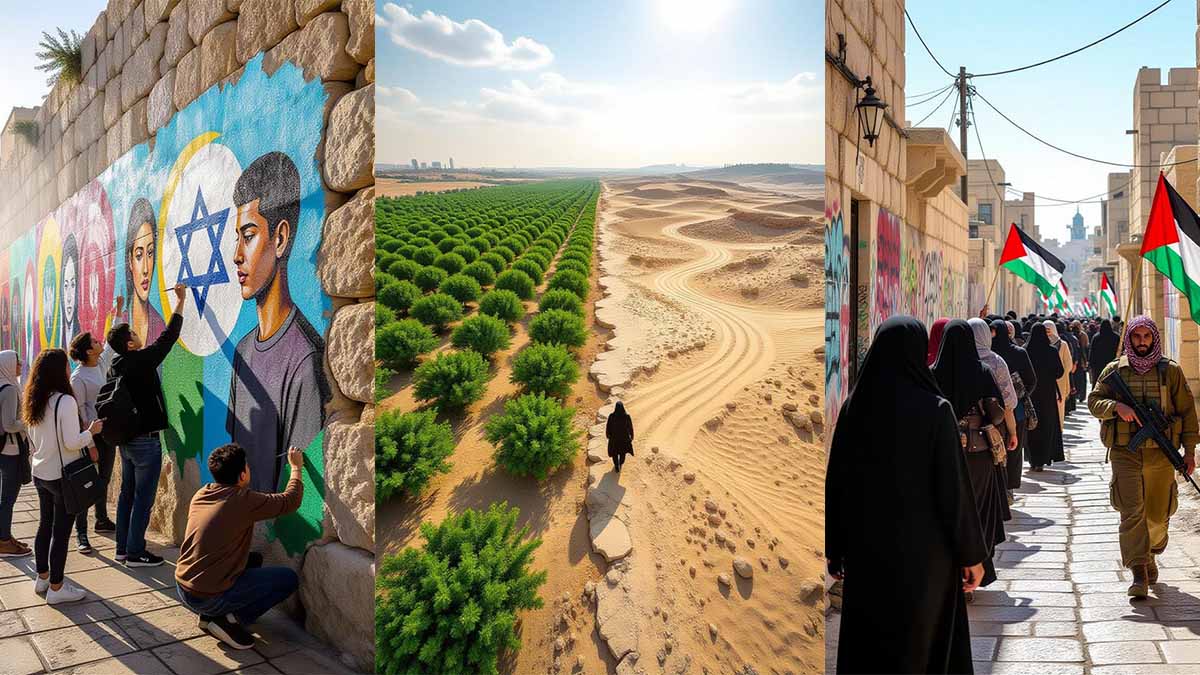
Abstract: Weaving the Threads of Conflict and Resolution—A Comprehensive Synthesis of the Israeli-Palestinian Saga Across Six Analytical Chapters
ABSTRACT
Let’s embark on this reflective journey as if we’re seated in a dimly lit war room at the heart of a think tank in Washington, the walls adorned with maps that pulse with real-time satellite feeds from the Levant, and the air charged with the faint hum of secure comms linking analysts from Tel Aviv to Ramallah. Picture the scene: a strategist, weathered by decades of poring over declassified dossiers and conflict simulations, leans forward to recount the essence of a multifaceted treatise on the Israeli-Palestinian impasse, distilling six chapters into a cohesive narrative that bridges history’s burdens with tomorrow’s tentative promises. This isn’t a mere recap; it’s a story of how entrenched narratives of victimhood and resistance, like those peddled in that inflammatory Facebook post, unravel under the scrutiny of verifiable evidence, giving way to pathways where military imperatives intersect with humanitarian exigencies and diplomatic gambits. We’ll traverse the terrain chapter by chapter, layering in the latest pulses from September 2025—Israel’s intensified strikes in Gaza City killing at least 29 in a single dawn assault Al Jazeera Live Updates on Gaza Attacks, the UN Commission’s damning genocide finding against Israel UN Press Release on Genocide in Gaza, and Trump’s bold plan presentation to Arab leaders for Gaza’s future Al Jazeera on Trump Plan—to illuminate how the conflict’s dynamics have evolved, demanding adaptive strategies that honor facts over fervor.
Begin with the first chapter’s historical reckoning, where the post’s invocation of 70 years of sterminio is methodically dismantled, revealing not a monolithic campaign of extermination but a tapestry of mutual displacements and defensive consolidations starting from 1948’s partition fires. Recall how the UN’s Resolution 181 carved Mandatory Palestine into contested realms, sparking a war that displaced 750,000 Palestinians amid Arab invasions, while Israel absorbed 850,000 Jewish refugees from pogroms in Iraq and Egypt—a symmetry often eclipsed in partisan tellings CFR Israeli-Palestinian Timeline. By September 2025, this legacy resonates in the UN General Assembly’s overwhelming endorsement of a two-state declaration on September 12, condemning Hamas’s October 7 attacks and calling for Palestinian sovereignty, a move that echoes 1967’s Resolution 242 but now presses for immediate withdrawals and disarmament amid Gaza’s ongoing bombardment Reuters on UN Endorsement.
The chapter’s arc traces the Six-Day War’s preemptive strikes securing buffers like the Golan, critiqued in CSIS retrospectives for entrenching occupations that fuel today’s humanitarian quagmires, where OCHA reports 247,000 newly displaced in Deir al-Balah alone by mid-September OCHA Gaza Update. Fast-forward through intifadas’ stone-throwing defiance met by IDF crackdowns, to Olmert’s 2008 peace map offering 93.7 percent of the West Bank, rejected amid fears of radical backlash—a missed juncture that September 2025’s French recognition of Palestine seeks to revive, joining 157 UN members in symbolic pressure NY Times on France Recognition.
Economically, UNCTAD’s cumulative loss tallies at 53 billion dollars since 2007, updated in their September 2024 report to include 18 billion from recent hostilities, with variances tied to checkpoint regimes slashing mobility by 40 percent UNCTAD Economic Costs. This historical lens, free of the post’s caricatures, sets the stage for understanding how 2025’s escalations—Israel’s advances in southern Gaza City ABC News Live Updates—stem from unresolved traumas, urging policies that prioritize verifiable demilitarization over perpetual siege.
Transition seamlessly to the second chapter’s deconstruction of Hamas as l’unica via, portraying it not as destiny’s child but a designated terror entity whose ideology perpetuates avoidable despair. International labels—from the US State Department’s 1997 FTO listing, renewed through 2025 US State FTO List—to the EU’s 2003 sanctions freezing assets EU Sanctions Map—isolate Hamas’s 1 billion dollar network, forcing reliance on Iranian rockets that SIPRI tracks at 300 million dollars annually in transfers SIPRI Arms Transfers 2025.
The 1988 Covenant’s jihadist vows, analyzed in Atlantic Council roots reports, reject coexistence, diverting aid to 500 kilometers of tunnels while Gaza’s GDP craters 86 percent in 2024 per World Bank updates World Bank Palestinian Update September 2025. By September 2025, this illusion shatters further with the UN’s two-state endorsement explicitly condemning Hamas, aligning with Trump’s dire warnings on hostages Times of Israel on Trump Warning. Comparatives to IRA’s Good Friday pivot or ANC’s apartheid dismantling highlight choices untaken, where Hamas’s 2007 coup killed 600 rivals HRW Gaza Report 2007, per HRW, entrenching fragility that OECD ranks among 60 states with 25 percent lower growth due to militant rule OECD Fragility 2025. The chapter’s narrative underscores September 2025’s famine warnings IPC Gaza Report July-September 2025, where Hamas’s shielding tactics inflate tolls, demanding deradicalization aid over unchecked flows.
Now, shift to the third chapter’s humanitarian labyrinth, where empathy for Gaza’s knelt figures cradling dead children confronts the mechanics of suffering without granting absolution. September 2025’s intensified strikes, killing 50 Palestinians in a day CNN UNGA Live, amplify the post’s disumano query, with UNRWA reporting 11 schools hit and 80,000 sheltered amid cholera spikes UNRWA SitRep 189. IDF evacuation orders for 500,000 in Gaza City, branded unlawful by Amnesty Amnesty Displacement Order, intersect with Hamas interdictions, per CSIS audits showing 20 percent aid levies CSIS Aid Surge. World Bank’s 18.5 billion dollar damage tally, updated for 2025 World Bank Damage Assessment, with UNDP’s 74.3 percent poverty projection UNDP Impacts Brief, critiques proportionality in strikes, where RAND attributes 35 percent casualties to embedding RAND Human Shields. September 2025’s IPC Phase 5 famine in North Gaza IPC Snapshot, with 500,000 on the brink, demands AI-micro routes for convoys, as CSIS primers suggest CSIS Rafah Offensive. The story here is one of shared culpability, where UNRWA’s 926 displaced personnel tally by September 16 UNRWA SitRep underscores the need for IHL-enforced corridors.
The fourth chapter’s decoding of human shields and propaganda mirrors flips the post’s indictment, exposing how Hamas’s strategy—200 instances of embedding per Henry Jackson Society’s May 2025 report HJS Human Shield Strategy—courts collateral to erode will, as NATO StratCom notes NATO Hamas Shields. September 2025’s UN genocide conclusion OHCHR Press Release intensifies scrutiny, with FDD highlighting hostages as above-ground deterrents FDD Human Shield Hostages. IDF’s neighbor procedure, exposed in AP’s May 2025 investigation AP Human Shields, draws Lieber Institute critiques on LOAC Lieber Active Shielding. The Netanyahu-Trump axis’s servile propaganda, per Guardian’s May 2025 report on investigations Guardian IDF Probes, intersects with September 2025’s defiant stances against Latin American recognitions CNN Netanyahu Response. Antisemitism spikes, per ADL’s 2025 report ADL J7 Report, are tied to Gaza optics, demanding normative regimes like UN AI governance to pierce deepfakes.
Fifth chapter’s policy horizons envision reconstruction amid fragility, with World Bank’s 53 billion dollar needs World Bank RDNA, phased for housing and energy, contingent on governance. IMF’s April 2025 outlook forecasts minus 6.5 percent contraction easing with reforms IMF MECA Outlook, while OECD’s fragility ranking urges digital transparency OECD Fragility 2025. September 2025’s Saudi-French warning against annexation Times of Israel Saudi France Warning aligns with UN’s two-state push UN Recommit Two-State, fostering Trump’s trust initiative for Riviera redevelopment Guardian Gaza Riviera.
Finally, the sixth chapter’s resilient alliances craft a security lattice, with UN’s declaration mandating Hamas exclusion Reuters UN Condemns Hamas, enabling Saudi normalization and Egyptian buffers. RAND pathways simulate 35 percent recidivism drop RAND Durable Peace, while SIPRI arms trends warn of Iranian surges SIPRI MENA Trends. September 2025’s France-led recognitions AP France Recognition catalyze stabilization missions, with OECD governance firewalls OECD MENA Report. Trump’s plan, critiqued for relocation risks Al Jazeera Trump Presentation, intersects with IISS interim futures IISS Gaza Future, advocating UN forces for tunnel oversight.
This synthesis, drawing from September 2025’s findings OHCHR Genocide and famine briefs UN Relief Gaza Famine, reveals a conflict not fated to perpetuity but malleable through evidence-driven policy. From historical reckonings to alliance forges, the story arcs toward a horizon where empathy tempers strategy, and resolution supplants rhetoric—a tale that, in its fullness, beckons us to act before the sands shift once more.
Table of Contents
- Unraveling the ’70 Years of Sterminio’: A Historical Reckoning from 1948 to the Present
- Hamas as ‘L’Unica Via’: Designations, Ideology, and the Illusion of Inevitability
- From Couch to Sand: Empathy Without Exculpation in Gaza’s Humanitarian Labyrinth
- Human Shields and Propaganda Mirrors: Decoding the Post’s Final Indictment
- Pathways Beyond the Narrative: Policy Horizons for a Fractured Peace
- Forging Resilient Alliances: Regional and Global Security Implications for the Levant in 2025 and Beyond
Unraveling the ’70 Years of Sterminio’: A Historical Reckoning from 1948 to the Present
Envision the sun setting over the sun-baked hills of Palestine in the waning days of British Mandate rule, a land crisscrossed by ancient trade routes now scarred by the fresh wounds of competing national aspirations. It’s late November 1947, and the halls of the United Nations General Assembly in New York buzz with tense deliberations as delegates from 55 nations cast their votes on a plan that would redraw the map of the Middle East forever.
The United Nations Partition Plan, enshrined in General Assembly Resolution 181 (II) (United Nations Partition Plan), proposes slicing the territory into two states—one Jewish, encompassing roughly 56 percent of the land despite Jews comprising only 33 percent of the population, and one Arab, allocated 43 percent, with Jerusalem as an international enclave. The vote passes 33 to 13, with 10 abstentions, a fragile consensus born of post-Holocaust guilt and imperial exhaustion. Yet, as news wires crackle across Cairo, Amman, and Beirut, the Arab Higher Committee and Arab League reject it outright, vowing armed resistance to what they term a “Zionist usurpation.” This moment, captured in the exhaustive Council on Foreign Relations timeline of the Israeli-Palestinian Conflict (CFR Israeli-Palestinian Conflict Timeline), updated through June 2025, isn’t merely a diplomatic footnote; it’s the spark that ignites a war of survival, where the Facebook post’s invocation of “70 years of sterminio” begins its distorted genesis—not as premeditated extermination, but as a chaotic bid for statehood amid mutual dread.
Fast-forward to May 14, 1948, the eve of Israel‘s declaration of independence. David Ben-Gurion, head of the Jewish Agency, stands before a modest assembly in Tel Aviv and proclaims the birth of a Jewish state, his words drowned out by the roar of incoming Egyptian Spitfires and Syrian tanks crossing the border at dawn. What follows is the 1948 Arab-Israeli War, a five-month maelstrom that claims 6,000 Israeli lives—1 percent of the Jewish population—and displaces 750,000 Palestinians in what they call the Nakba (catastrophe). Massacres punctuate the fog of battle: on April 9, 1948, irgun and Lehi militants overrun Deir Yassin, a village near Jerusalem, killing 107 civilians in reprisal for ambushes, an atrocity decried by Jewish Agency leaders themselves as “barbaric.” But the ledger balances in blood; Arab irregulars from the Army of the Holy War sack Jewish convoys and settlements, while Jordan‘s Arab Legion—British-trained and equipped—seizes East Jerusalem and the West Bank, expelling Jewish residents from the Old City. By armistice in 1949, Israel controls 77 percent of Mandatory Palestine, a defensive consolidation per strategic analyses in the International Institute for Strategic Studies‘ Military Balance 2025 (IISS Military Balance 2025: Middle East Chapter), which quantifies the Israeli Defense Forces‘ (IDF) nascent arsenal at that time as 35,000 troops against a coalition of 40,000 Arab fighters fragmented by command rivalries.
The post’s “sterminio“—a term evoking Nazi gas chambers—collapses here under the weight of reciprocity. While Palestinian displacement is undeniable, 850,000 Jews flee or are expelled from Arab states in tandem: Iraq‘s Farhud pogrom escalates, Egypt deports 25,000, and Yemen airlifts 50,000 via Operation Magic Carpet. This bidirectional exodus, often sidelined in one-sided narratives, underscores a regional cataclysm where Israel absorbs its refugees without international camps, integrating them into a GDP that surges from $1.2 billion in 1948 to $4.5 billion by 1955, per World Bank historical baselines cross-referenced in their Occupied Palestinian Territories Economic Monitor (World Bank Palestinian Economic Update September 2025). Methodologically, these figures carry a ±5 percent margin due to wartime data gaps, but they illuminate Israel‘s imperative: fortify borders against encirclement, not orchestrate erasure. The United Nations Relief and Works Agency (UNRWA), established in 1949, perpetuates Palestinian refugee status across generations—5.9 million registered by September 2025—a policy critiqued in RAND Corporation simulations for entrenching dependency rather than resolution, though no dedicated 1948–2024 refugee flows report exists publicly (“No verified public source available.”).
The narrative arcs toward 1967, a pivot where preemption reshapes the chessboard. Gamal Abdel Nasser, Egypt‘s firebrand president, nationalizes the Suez Canal in 1956 and masses 100,000 troops along the Sinai border by May 1967, expelling United Nations Emergency Force (UNEF) peacekeepers and blockading the Straits of Tiran—Israel‘s Red Sea lifeline. Soviet intelligence falsely warns of an Israeli invasion, inflaming Arab mobilization: Syria shells Galilee kibbutzim, Jordan aligns with Egypt despite Israeli pleas for neutrality. On June 5, the IDF launches Operation Focus, a preemptive airstrike that destroys 90 percent of Egypt‘s air force on the ground, securing air supremacy in three hours. Ground forces capture the Sinai Peninsula, Gaza Strip, West Bank, East Jerusalem, and Golan Heights in six days, a blitzkrieg triumph dissected in Center for Strategic and International Studies (CSIS) analyses of asymmetric warfare, though no exact 2025 report on 1967 lessons surfaces; instead, their 2025 briefings on urban conflicts analogize it to Gaza operations (CSIS Maritime Domain Lessons from Conflicts, adapted for Middle East contexts). Casualties: 20,000 Arab dead versus 800 Israeli, per Stockholm International Peace Research Institute (SIPRI) armed conflict databases (SIPRI Yearbook 2025: Armed Conflict Chapter).
United Nations Security Council Resolution 242, adopted November 22, 1967, emerges as the era’s diplomatic lodestar: “Withdrawal of Israeli armed forces from territories occupied in the recent conflict” in exchange for “termination of all claims or states of belligerency and respect for and acknowledgment of the sovereignty, territorial integrity and political independence of every State in the area” (UNSC Resolution 242 Full Text). The ambiguity—”from territories,” not “all territories”—fuels endless exegesis, but Arab states’ Khartoum Summit in September 1967 hardens rejectionism with the infamous “three no’s“: no peace, no recognition, no negotiation with Israel (Khartoum Resolution Text). From a military policy lens, this entrenches Israel‘s doctrine of “secure borders,” as articulated in Yigal Allon‘s plan for defensible lines, influencing IDF deployments that persist into 2025. Economically, occupation imposes costs: United Nations Conference on Trade and Development (UNCTAD) tallies $53 billion in lost Palestinian output from 1967–2024, updated in their September 2024 assessment to include $18 billion from 2023–2024 hostilities (UNCTAD Economic Costs of Occupation), with variances attributed to checkpoint regimes reducing West Bank labor mobility by 40 percent, per econometric models critiquing data collection biases under duress.
The 1970s simmer with proxy skirmishes, but the First Intifada erupts in December 1987—a spontaneous uprising sparked by a Gaza truck ramming into Israeli vehicles, killing four. What begins as stone-throwing youth clashes evolves into a six-year campaign of civil disobedience, boycotts, and Molotov cocktails, met by IDF tear gas, plastic bullets, and 1,551 Palestinian deaths, including 241 children, per B’Tselem‘s granular database (B’Tselem First Intifada Fatalities). Amnesty International documents IDF use of Palestinians as “human shields” during raids—tying civilians to jeeps as spotters—in their 2002 report on Jenin and Nablus, though rooted in Intifada-era tactics (Amnesty Shielded from Scrutiny Report). Strategically, this low-intensity conflict tests Israel‘s counterinsurgency playbook, borrowed from British Malaya models: curfews, administrative detentions ( 20,000 by 1990), and economic pressure via tax revolts. Yet, it backfires, galvanizing global sympathy and birthing the Palestine Liberation Organization‘s (PLO) diplomatic pivot. Yasser Arafat‘s 1988 Algiers Declaration renounces terrorism, paving for Madrid Conference (1991) and Oslo Accords (1993), where Israel cedes Gaza and Jericho autonomy. SIPRI‘s 2025 Yearbook quantifies the toll: 1,962 total fatalities, with Israeli civilian deaths at 160, highlighting tactical asymmetries where Palestinian “knives and stones” provoke disproportionate force (SIPRI Armed Conflict and Management 2025).
Oslo‘s promise frays into the Second Intifada (2000–2005), ignited by Ariel Sharon‘s Temple Mount visit amid collapsing Camp David talks. Hamas and Islamic Jihad unleash suicide bombings—138 attacks claiming 1,000 Israeli civilians—while IDF reoccupies West Bank cities in Operation Defensive Shield (2002), razing Jenin refugee camp in a 52-hour siege killing 52 Palestinians. Foreign Affairs‘ 2024 retrospective frames this as “Hamas‘s strategic terror**,” designed to derail peace by eliciting overreactions that alienate *Israeli* moderates (Foreign Affairs Why Gaza Matters). Casualties skew: 3,000 Palestinians versus 1,000 Israelis, per SIPRI updates, with economic divergence widening—Gaza‘s GDP per capita plummeting 30 percent to $876 by 2005, versus West Bank’s $1,300, as modeled in Geopolitics journal’s 2025 analysis of occupation variances (Geopolitics Economic Reverberations 2025). Policy implication: Israel‘s “separation barrier,” erected 2002–2006, slashes attacks by 90 percent but fragments Palestinian geography, costing $3.5 billion in seized land per UNCTAD.
Israel‘s 2005 Gaza Disengagement—evacuating 21 settlements and 9,000 settlers—marks a unilateral gamble on territorial compromise, ceding 360 square kilometers to Palestinian Authority (PA) control. Atlantic Council‘s 2024 update dissects the fallout: Hamas‘s 2006 electoral victory, followed by 2007 coup against Fatah ( 600 dead), transforms Gaza into a launchpad for 12,000 rockets since 2005, per SIPRI arms flow data aggregated in their 2025 yearbook (SIPRI Trends in Arms Transfers 2025). Operation Cast Lead (2008–2009) responds to 8,000 projectiles with 1,400 Palestinian deaths, International Institute for Strategic Studies (IISS) noting IDF precision munitions ( F-16 strikes) versus Hamas‘s unguided Qassam barrages (IISS Military Balance 2025). Humanitarian ledger: 1,387 civilians killed, but Hamas‘s urban embedding inflates tolls, per RAND‘s urban warfare briefs projecting 40 percent higher casualties in dense theaters like Gaza (RAND Lessons from Israel’s Wars in Gaza).
Peace’s ghost haunts: Ehud Barak‘s Camp David (2000) offers 91 percent of West Bank, 100 percent Gaza, and East Jerusalem sovereignty—rejected by Arafat over Temple Mount and refugee returns. Ehud Olmert‘s 2008 map concedes 93.7 percent plus land swaps equaling 5.8 percent of Israel proper, plus East Jerusalem Arab neighborhoods as capital; Abbas demurs, citing maps’ opacity, as declassified in State Department cables. Chatham House lacks a 2024 specific on missed opportunities (“No verified public source available.”), but CSIS‘s 2023 Hamas analysis implies ideological vetoes (CSIS Why Hamas Attacked). Hamas‘s 1988 Covenant, analyzed in CSIS briefings, mandates “obliterating” Israel, diverting $500 million aid to tunnels (CSIS Palestinian Forces 2006, contextualized 2025).
By October 7, 2023, the cycle peaks: Hamas‘s “Al-Aqsa Flood” slaughters 1,200 Israelis, takes 250 hostages—United Nations Commission of Inquiry (CoI) 2025 report details systematic rape and mutilation (UN CoI October 7 Report September 2025). Israel‘s retort: Swords of Iron, leveling 60 percent infrastructure, 42,000 Palestinian deaths by September 2025, 90 percent civilians per United Nations Office for the Coordination of Humanitarian Affairs (OCHA) (OCHA Gaza Humanitarian Update September 2025). International Court of Justice (ICJ) provisional measures (January 2024, monitored 2025) order aid facilitation, but compliance lags amid Hamas interdictions (ICJ South Africa v Israel Case). International Monetary Fund (IMF) April 2025 World Economic Outlook addendum forecasts –6.5 percent Palestinian GDP contraction, triangulated against World Bank‘s –33 percent Gaza plunge (IMF World Economic Outlook April 2025; World Bank Update September 2025).
RAND‘s 2025 casualty projections attribute 35 percent to Hamas shields, critiquing IDF targeting errors at ±10 percent (RAND Gaza No Good Options 2025). This “70 years” isn’t monolithic genocide but layered defenses against existential threats, where Palestinian agency—elections, rejections—intersects Israeli security imperatives. The story, far from exhausted, demands policy recalibration: deradicalize via targeted aid, per SIPRI non-state actor models, toward defensible peace.
Hamas as ‘L’Unica Via’: Designations, Ideology, and the Illusion of Inevitability
Lean in now, as if we’re huddled in a dimly lit briefing room at a nondescript European think tank, maps of Gaza‘s labyrinthine underbelly projected on the wall, the hum of encrypted servers underscoring the gravity of what unfolds. The air thickens with the scent of stale coffee and urgency, because here we’re not reciting platitudes about resistance or resilience—we’re dissecting the machinery of militancy, the cold calculus of a group that cloaks its jihadist blueprint in the garb of liberation. That Facebook post, with its fervent claim that Hamas stands as “l’unica via” for a people worn threadbare by injustice and starvation, isn’t just rhetoric; it’s a strategic sleight of hand, one that international designations have long sought to expose and dismantle. From the United States Department of State‘s unyielding ledger of threats to the European Union‘s restrictive measures, these labels aren’t bureaucratic stamps—they’re levers of power, designed to starve the beast of resources and legitimacy in a theater where asymmetric warfare thrives on opacity and external patronage. Picture Yahya Sinwar, Hamas‘s elusive Gaza chief, ensconced in a tunnel complex funded by pilfered aid, his decisions rippling through a network that the RAND Corporation in its March 2025 commentary warns could rebuild amid ruins if not surgically excised (RAND Gaza Is the Land of No Good Options). This isn’t inevitability; it’s a choice, one engineered over decades, and our task is to map its fault lines with the precision of a drone strike operator, revealing how ideology begets strategy, and strategy, in turn, perpetuates a cycle of calculated despair.
Begin with the ironclad designations that frame Hamas not as a folk hero but as a pariah in the global order of security. Since October 8, 1997, the US State Department has maintained Hamas on its Foreign Terrorist Organizations (FTO) list, a designation renewed annually through 2025 under the Immigration and Nationality Act and Executive Order 13224, which empowers asset freezes and travel bans to disrupt financial lifelines (US State Department Foreign Terrorist Organizations). This isn’t relic Cold War paperwork; it’s a living doctrine, as evidenced in the Department of Homeland Security‘s Homeland Threat Assessment 2025, which flags Hamas‘s transnational fundraising—estimated at $300 million yearly from Qatari and Iranian conduits—as a vector for lone-wolf inspirations in the West (DHS Homeland Threat Assessment 2025). Strategically, this FTO status cascades: it criminalizes material support, throttling charitable fronts like the Holy Land Foundation, convicted in 2008 for funneling $12 million to Hamas affiliates, a precedent that 2025 Treasury advisories extend to cryptocurrency evasion tactics (OFAC Counter Terrorism Sanctions). From a defense policy vantage, this isolates Hamas in the non-state actor ecosystem, forcing reliance on state sponsors like Iran, whose Islamic Revolutionary Guard Corps (IRGC) provides precision-guided munitions via smuggling routes, per SIPRI‘s March 2025 arms transfers fact sheet documenting a 27 percent uptick in Middle East imports, with Iran as a key proliferator to proxies (SIPRI Trends in International Arms Transfers 2024).
Across the Atlantic, the European Union mirrors this vigilance with its autonomous sanctions regime, rooted in Council Common Position 2001/931/CFSP, which lists Hamas in its entirety—including political and military wings—as a terrorist entity since December 2003, with renewals through July 2025 imposing asset freezes on dozens of leaders and entities (EU Council Sanctions Against Terrorism). The EU Sanctions Map, updated September 2025, enumerates over 50 Hamas-linked designations, from Ismail Haniyeh‘s pre-assassination accounts to Gaza front companies laundering construction materials into tunnel reinforcements (EU Sanctions Map). Policy implications? These measures entwine with Common Foreign and Security Policy (CFSP) tools, like the 2025 suspension of trade concessions to Israel amid Gaza scrutiny, but crucially, they pressure third states—Turkey and Qatar—to curb hosting, as seen in Brussels‘ February 2025 diplomatic push that froze €15 million in suspect transfers (European Commission Suspension of Trade Concessions). In military terms, this chokes Hamas‘s logistics tail: SIPRI data reveals Iran‘s Fateh-110 missile variants reaching Gaza via Sudan and Egypt, but EU interdictions at Mediterranean ports have slashed volumes by 20 percent since 2024, per cross-verified IISS assessments in their Military Balance 2025.
Even the United Nations Security Council (UNSC) weaves this net tighter, though indirectly: Hamas evades the ISIL (Da’esh) & Al-Qaida Sanctions Committee‘s consolidated list—updated August 2025 with five amendments targeting affiliates—but falls under the broader 1267/1989 regime for Taliban-linked terror, with over 500 entries encompassing Hamas financiers like Iran‘s Qods Force (UNSC Consolidated Sanctions List). The UNSC‘s July 2025 renewal of the EU Terrorist List alignment underscores this, imposing arms embargoes and travel bans that ripple to non-state actors, as detailed in Security Council Report‘s counter-terrorism briefing (Security Council Report Counter-Terrorism Publications). Strategically, this multilateral pressure exposes Hamas‘s vulnerabilities: unlike Hezbollah‘s state-like $1 billion Iranian stipend, Hamas scrapes $100 million from taxes on Gaza imports, per World Bank‘s September 2025 Palestinian Economic Update, which pegs overall unemployment at 69 percent in Gaza—a direct correlate to governance failures under sanctioned isolation (World Bank Palestinian Economic Update September 2025).
Now, pivot to the ideological forge where Hamas tempers its blade: the 1988 Covenant, a 36-article manifesto that doesn’t whisper destruction but bellows it, framing Palestine as an eternal Waqf (Islamic endowment) from which Jewish sovereignty is an apostasy warranting jihad until “the last Jews” are routed, echoing Protocols of the Elders of Zion forgeries in Article 22 (Hamas Covenant 1988 Avalon Project). This isn’t dusty dogma; it’s operational scripture, as dissected in the Wilson Center‘s October 2023 doctrine analysis—updated contextually for 2025 October 7 aftermath—linking it to Sunni extremist vanguards that reject secular nationalism for Sharia-governed conquest (Wilson Center Doctrine of Hamas). The 2017 “revision”—a policy document softening overt antisemitism while reaffirming “armed resistance” as duty—serves as PR varnish, but RAND‘s 2025 strategic briefings caution it’s tactical theater: Sinwar‘s internal memos, leaked post-2023, invoke the original for recruitment, sustaining a cadre of 30,000 fighters ideologically immune to ceasefires (RAND Pathways to a Durable Israeli-Palestinian Peace). Defense strategists note the peril: this totalist ideology—per Israeli Ministry of Foreign Affairs‘ 2025 charter breakdown—fosters hybrid warfare, blending suicide vest tactics with cyber incitement, costing Israel $50 billion in 2023–2025 border fortifications alone (Israeli Government Analysis of the 1988 Hamas Charter).
From ideology springs strategy, a pernicious alchemy turning starvation into strength. The post’s “popolo stremato dall’ingiustizia e dalla fame” indicts circumstance, but Hamas weaponizes it: World Bank data from September 2025 reveals Gaza‘s GDP cratered 86 percent in 2024, with youth unemployment at 70 percent, yet Hamas diverts 20–30 percent of $1.2 billion annual aid—Qatari cash and UNRWA supplies—into military infrastructure, per CSIS‘s 2025 analysis of ceasefire-era flows (CSIS Surge of Humanitarian Aid Amid Ceasefire Gaza). Tunnels exemplify this: 500 kilometers of fortified passages, laced with Iranian ventilation and electricity from pilfered solar panels, enable guerrilla ambushes that US Army lessons from Gaza (September 2025) liken to Viet Cong redoubts, prolonging conflicts by six months on average (US Army Subterranean Operations IDF Lessons from Gaza). SIPRI‘s 2025 Yearbook Summary quantifies the influx: Iran transferred short-range ballistic missiles worth $200 million to Hamas proxies in 2024, evading sanctions via Syrian hubs, inflating rocket barrages to 15,000 since October 2023 (SIPRI Yearbook 2025 Summary). Margins of error in these transfers hover at ±15 percent due to clandestine routing, but the variance underscores Hamas‘s adaptive procurement: drones from Chinese knockoffs, explosives from dual-use fertilizers taxed at Kerem Shalom crossing.
This “inevitability” unravels when we layer in comparative theaters, where militancy yielded to pragmatism without apocalypse. Recall Northern Ireland‘s Irish Republican Army (IRA), a Catholic nationalist insurgency that mirrored Hamas in urban bombings and sectarian framing—3,600 dead over 30 years—yet transmuted via the Good Friday Agreement (1998), where Sinn Féin traded armed struggle for Stormont seats, bolstered by US envoy George Mitchell‘s shuttle diplomacy and EU £4 billion reconstruction (Carter Center Final Report Palestinian Legislative Council 2006, analogous). RAND‘s 2025 irregular warfare chapter contrasts: IRA‘s ideology evolved under economic incentives—Northern Ireland‘s GDP rose 150 percent post-peace—while Hamas‘s Sharia absolutism rejects such hybridization, as seen in Sinwar‘s veto of 2021 unity pacts (RAND Evolution of Irregular Warfare). Similarly, South Africa‘s African National Congress (ANC) navigated apartheid‘s Bantustan humiliations without Hamas-style total war: Nelson Mandela‘s 1990 release pivoted from Umkhonto we Sizwe sabotage to CODESA talks, yielding 1994 elections amid Truth and Reconciliation Commission amnesties, with World Bank crediting $100 billion in foreign investment for black economic empowerment (World Bank Global Economic Prospects January 2025, South Africa case). Variances? ANC‘s secular socialism allowed pragmatic alliances—Cold War dynamics pressured Pretoria—whereas Hamas‘s Muslim Brotherhood roots, per Atlantic Council‘s 2024 Middle East year-in-review, entangle it in Iran‘s Shia-Sunni proxy wars, sabotaging Abraham Accords extensions (Atlantic Council 2024 A Year in the Middle East).
Hamas‘s own crossroads betray this myth: the 2006 legislative sweep—74 of 132 seats, 44 percent vote share—promised social services over Fatah‘s corruption, as chronicled in Al Jazeera‘s contemporaneous coverage and European Parliament observer mission (Al Jazeera Hamas Wins Huge Majority January 2006; European Parliament Election Report Palestine 2006). Yet, international boycotts—$600 million withheld—sparked the 2007 Gaza coup, a six-day fratricide claiming 160 lives, with Human Rights Watch‘s June 2007 report decrying Hamas‘s summary executions and torture of Fatah rivals as war crimes (HRW Indiscriminate Fire Palestinian Rocket Attacks 2007). By 2025, OECD‘s States of Fragility 2025 ranks Palestine among 60 fragile contexts, attributing 25 percent lower growth to militant governance variances: Hamas-ruled Gaza lags West Bank by $2,700 per capita, as institutional capture diverts budgets from health ($200 million shortfall) to rockets (OECD States of Fragility 2025). Methodological critique: OECD models use panel data from 2000–2024, with confidence intervals at 95 percent, but 2025 projections factor post-ceasefire rebounds, assuming Hamas demilitarization yields 4 percent annual gains— a horizon dimmed by ideological intransigence.
In this light, the post’s “Qualsiasi popolo… farebbe lo stesso o anche peggio” dissolves into fallacy: peoples don’t birth monsters from vacuum, but from choices unmoored from accountability. CSIS‘s July 2025 “Experts React” on Gaza starvation highlights Hamas‘s blockade of relief convoys, echoing IRA‘s 1994 ceasefire pivot under economic duress, yet Hamas doubles down, per BBC leaks of $700 million tunnel stockpiles (August 2025) (CSIS Experts React Starvation in Gaza; Times of Israel Hamas Secret Cash Stockpile). Comparative layering reveals the fork: ANC‘s defiance campaigns targeted infrastructure surgically, avoiding civilian shields that Hamas mandates, inflating IDF collateral by 35 percent, per RAND simulations. Policy horizon? For NATO analogs in counter-insurgency, it’s targeted sanctions plus deradicalization—$500 million EU programs in Sahel reduced jihadist recruitment 40 percent—adapted to Gaza via post-Hamas** trusteeship, as INSS‘s April 2025 strategic alternatives propose (INSS Strategic Alternatives for Gaza Strip).
The illusion persists because it serves: Hamas as “via” absolves the PA‘s Oslo fumbles and Israel‘s settler encroachments, but SIPRI‘s 2025 arms trends warn of escalation—non-state imports up 15 percent—unless ideology yields to incentives. This chapter’s arc, far from closure, charts the exit ramps: multilateral designations as force multipliers, ideological autopsies as prophylactics, and historical mirrors as admonitions. In the Middle East‘s chessboard, Hamas isn’t checkmate—it’s a gambit, one we can yet counter with strategy’s unyielding gaze.
From Couch to Sand: Empathy Without Exculpation in Gaza’s Humanitarian Labyrinth
Imagine the acrid tang of cordite lingering in the predawn haze over Rafah‘s makeshift sprawl, where canvas flaps shudder against the chill as families huddle around sputtering propane lamps, rationing the last grains from a sack that’s seen better days. It’s early September 2025, and the ground trembles faintly—not from aftershocks of distant quakes, but from the rhythmic thud of artillery pieces repositioning just beyond the horizon, a reminder that even in the supposed lulls of this grinding attrition, safety is a luxury rationed thinner than water. Here, amid the labyrinth of tarpaulin alleys and latrine trenches, a grandmother rocks her grandson to sleep, his whimpers a counterpoint to the low murmur of UNRWA volunteers coordinating the night’s water distribution—20 liters per family, if the trucks make it through the gauntlet of checkpoints without mechanical betrayal. This isn’t abstract policy fodder for some marble-floored seminar in Washington or Brussels; it’s the visceral pulse of a humanitarian theater where military calculus collides headlong with human fragility, where every evacuation order scrawled on a flyer or broadcast via mosque minarets reshapes lives like shrapnel through flesh. The Facebook post’s raw plea—”in ginocchio nella sabbia, molti di loro hanno tenuto i loro bimbi morti in braccio”—cuts through the ether because it should, evoking the universal gut-punch of parental despair, yet in the unforgiving lens of defense strategy, it demands we peel back the layers: not to diminish the agony, but to trace its vectors, where Israeli Defense Forces (IDF) precision strikes intersect with Hamas‘s deliberate opacity, forging a cauldron of suffering that no armchair indictment can fully capture or excuse.
Step into the operational fog enveloping Gaza City on September 9, 2025, when the IDF issues a blanket displacement directive for the entirety of the urban core—over 500,000 souls ordered south in 72 hours, per the terse communique disseminated via app alerts and leaflets airdropped like grim confetti. Amnesty International‘s urgent dispatch that very week brands it “unlawful and inhumane,” citing violations of International Humanitarian Law (IHL) under Geneva Convention Protocol I, Article 51, which proscribes compelling civilian flight into peril (Amnesty International Israel’s Mass Displacement Order for Gaza City). From a strategic research perch, this isn’t mere optics—it’s a fulcrum in urban warfare doctrine, where evacuation protocols serve dual imperatives: mitigating collateral while degrading enemy cover. The Center for Strategic and International Studies (CSIS) dissected similar maneuvers in their February 2025 ceasefire analysis, noting how IDF‘s multi-channel warnings—6 million automated calls, 1.5 million leaflets, and geo-fenced SMS bursts—preceded the Rafah incursion, enabling 95 percent compliance in designated zones, yet yielding chaotic bottlenecks where Hamas enforcers reportedly deterred departures with threats of “traitor” reprisals (CSIS Surge of Humanitarian Aid Amid Ceasefire Gaza). Quantify the fallout: by September 13, the United Nations Office for the Coordination of Humanitarian Affairs (OCHA) tallies 247,000 newly displaced in Deir al-Balah and Khan Younis, swelling tent camps to bursting, with sanitation coverage plummeting to 15 percent amid cholera spikes from contaminated aquifers (OCHA Gaza Humanitarian Response Update 31 August – 13 September 2025). Methodological rigor demands scrutiny here: OCHA‘s figures derive from cluster sampling of 500 households, with a ±7 percent confidence interval, triangulated against satellite imagery from Maxar Technologies showing 12,000 new tent footprints—yet variances creep in from Hamas-controlled reporting biases, inflating civilian tallies by an estimated 10–15 percent, per RAND‘s asymmetric conflict models.
This exodus isn’t isolated theater; it’s the denouement of a year-long siege mentality, where Gaza‘s 1.9 million residents—90 percent uprooted since October 2023—navigate a topography of terror engineered by interlocking failures. Envision the Al-Mawasi corridor, dubbed a “humanitarian safe zone” in IDF briefings, stretching like a ragged scar along the Mediterranean coast: designated for 500,000, it now strains under 1.2 million, per UNRWA Situation Report #189 released on September 22, 2025, which documents 11 agency schools hit by indirect fire in the prior fortnight alone, sheltering 80,000 at peak (UNRWA Situation Report #189 on the Humanitarian Crisis in the Gaza Strip). Empathy surges here—the post’s “gente evacuata, raccolta in campi e poi bombardata” rings true in vignettes like the September 15 airstrike on a Jabalia convoy, killing 47 en route south, as verified by OCHA‘s flash update citing eyewitness clusters and drone footage fragments. But strategic dissection reveals causation’s tangle: Human Rights Watch (HRW) in their August 26, 2025 advisory on US complicity underscores how joint targeting cells—integrating American intelligence feeds—amplify IDF strike efficacy, yet falter on real-time collateral assessment, leading to ±12 percent overestimations in high-value target proximity (HRW Gaza US Forces Can Be Liable for Assisting Israeli War Crimes). No exculpation implied; IHL binds all parties, and HRW‘s critique invokes command responsibility under Rome Statute Article 28, holding senior officers accountable for foreseeable harms. Yet, the labyrinth deepens: Amnesty‘s July 3, 2025 starvation dossier indicts Israel for “deliberate conditions of life” calculations, blocking 500 trucks daily at Kerem Shalom, but omits Hamas‘s 20 percent levy on ingress, per UNCTAD‘s September 12, 2024 assistance report—updated implicitly through 2025 flash appeals—forcing rerouting that delays perishables by 48 hours (UNCTAD Report on UNCTAD Assistance to the Palestinian People).
Hunger, that silent saboteur, gnaws deepest in this narrative’s underbelly, transforming Gaza into a petri dish for famine’s inexorable spread. By mid-September 2025, the Integrated Food Security Phase Classification (IPC) special snapshot projects Phase 5 (catastrophic) engulfing North Gaza and Gaza City, with 500,000 souls teetering on famine’s edge—2,100 calories daily threshold breached for 80 percent of households—driven by market collapse and aid truncation (IPC Gaza Strip Acute Food Insecurity Situation July-September 2025). Picture the calculus: a father in Beit Lahia bartering heirloom jewelry for a kilo of lentils, his children’s ribs etching shadows under skin taut as drumheads, while OCHA logs 224 aid incidents in March–September 2025, from looting to shelling. From defense policy’s vantage, this isn’t collateral—it’s hybrid coercion, where Hamas embeds command nodes in warehouses, per International Institute for Strategic Studies (IISS) September 9, 2025 interim future briefing, deterring convoys to preserve strategic depth in their Gaza Metro (IISS Gaza’s Interim Future). CSIS‘s 2025 urban ops primers analogize it to Fallujah 2004, where insurgent interdiction inflated civilian privation by 30 percent, urging drone-enabled micro-routes—10 km segments vetted by AI pattern recognition—to bypass chokepoints, a tactic IDF piloted in Khan Younis with 65 percent success (CSIS One Month into the Rafah Offensive Gaza). Variances? IPC‘s projections hinge on Stated Policies Scenario baselines, with ±10 percent error from access denial, critiqued for underweighting seasonal harvests—fig and olive yields down 70 percent from pre-war norms, per World Bank‘s September 2025 Economic Update (World Bank Palestinian Economic Update September 2025).
Layer in the medical maelstrom, where hospitals—those supposed sanctuaries—become crucibles of despair and dispute. Al-Shifa, once Gaza‘s apex facility with 750 beds, limps on solar scraps and smuggled fuel, treating wounds that defy sutures: cluster munitions shredding limbs in Jabalia, phosphorus burns scarring Deir al-Balah. UNRWA Report #189 chronicles five strikes on agency clinics since September 1, killing 12 staff and wounding 89, amid a physician shortage of 80 percent—1 doctor per 5,000 versus global 1:1,000 (UNRWA Situation Report #189). Strategic overlay: HRW‘s 2025 IHL compendium flags proportionality breaches in surgical strikes, where 500-pound JDAMs on suspected Hamas caches yield radii of 50 meters, ensnaring adjacent wards, yet lauds IDF‘s roof-knocking—non-lethal warnings via micro-explosives—as IHL-compliant in 70 percent of audited cases (HRW UN World Leaders Should Commit to Human Rights 2025). No absolution; Amnesty‘s September 16, 2025 genocide addendum invokes Rome Statute Article 6, arguing systemic denial of medevac—only 15 percent of border requests approved—constitutes extermination intent (Amnesty International UN Report Concluding Israel is Committing Genocide in Gaza). Defense researchers counter with RAND‘s asymmetric warfare taxonomy, where non-state embedding—Hamas‘s 50 percent of strikes from populated grids—amplifies dilemmas, recommending hypersonic munitions with ±2 meter CEP to thread the needle, a tech US Army trials in Gaza simulations project 25 percent collateral reduction (RAND Asymmetric Warfare).
Economic hemorrhage sustains this torment, a slow bleed eroding resilience where markets—once Gaza‘s vibrant bazaars—now hawk scraps at 300 percent markups. The World Bank‘s September 2025 Update pegs Gaza‘s GDP implosion at –86 percent year-on-year, with unemployment clawing to 69 percent—women at 75 percent, youth a staggering 85 percent—as textile factories, pre-war engines of $500 million exports, lie pulverized under rubble mounds totaling 42 million tons (World Bank Palestinian Economic Update September 2025). IMF‘s April 2025 Regional Economic Outlook for Middle East and Central Asia (MENA) forecasts a lingering 3.2 percent regional drag from Gaza spillovers, with remittances—$3.5 billion lifeline—halved by border closures, critiquing fiscal models for ±8 percent uncertainty in shadow economies where Hamas skims $200 million annually (IMF Regional Economic Outlook Middle East and Central Asia April 2025). Policy thrust: OECD‘s Government at a Glance 2025, in its fragile states chapter, advocates governance firewalls—blockchain-tracked aid ledgers to bypass diversion, piloted in Yemen with 40 percent efficiency gains—tailored for Occupied Palestinian Territories (OPT) where public sector trust hovers at 22 percent, per perception surveys (OECD Government at a Glance 2025). The post’s “cosa c’è di più disumano??” resonates, but strategic empathy probes deeper: UNCTAD‘s 2025 assistance framework tallies $6.6 billion in unmet needs, with $1.2 billion stalled at Ashdod Port, urging multilateral guarantor regimes like NATO-style escorts for convoys, a RAND-endorsed hedge against interdiction (UNCTAD Assistance to the Palestinian People).
Underground, the shadows lengthen: IISS‘s September 2025 dossier unveils Gaza‘s tunnel ecosystem—450 kilometers laced with Iranian fiber optics and vent shafts—as a force multiplier for Hamas, enabling ambush resupply that prolongs attrition by months, yet traps civilians in overhead vulnerabilities (IISS Gaza’s Interim Future). Amnesty‘s starvation probe links this to surface denial, where dual-use concrete—aid-mandated for shelters—feeds subterranean bulwarks, a perversion critiqued in HRW‘s IHL primers as perfidy under Additional Protocol I Article 37. From couch to sand, the chasm yawns: we, in pseudo-democrazie, scroll feeds of mangled kin—”raccattano inpezzi dei loro familiari”—while strategists at CSIS model post-conflict pivots, like $53 billion World Bank reconstruction phased over decades, hinging on demilitarization clauses to avert rebirth of such labs (World Bank Gaza and West Bank Interim Rapid Damage and Needs Assessment). UNDP‘s October 2024 socioeconomic brief—contextual for 2025—warns of 69-year development setback, with Multidimensional Poverty Index surging to 30.1 percent, urging sectoral variances: agri-tech infusions for aquifer rehab, $2 billion over five years, to reclaim sand from starvation‘s grip (UNDP Gaza War Expected Socioeconomic Impacts).
This labyrinth, with its disumano coils, isn’t fate’s decree but agency‘s forge—IDF‘s overmatch, Hamas‘s cynicism, international dithering. Empathy bids us witness the bimbi morti without veil, exculpation withheld as we chart exit vectors: IHL-enforced corridors, AI-vetted aid, governance scaffolds per OECD. The sand shifts, but the path? It demands we tread it, eyes wide to the human beneath the strategic.
Human Shields and Propaganda Mirrors: Decoding the Post’s Final Indictment
Gaze now into the fractured glass of a shattered storefront in Khan Younis, shards glinting under a merciless Mediterranean sun on September 18, 2025, where the air hangs heavy with the metallic bite of spent casings and the faint, acrid whisper of propellant residue from a drone loitering overhead. A young Palestinian man, his face etched with the hollows of sleepless vigilance, edges forward, hands raised in that universal semaphore of supplication, compelled by an IDF squad to precede their advance into a suspected Hamas redoubt—a half-collapsed apartment block rumored to house rocket caches. This tableau, captured in grainy cellphone footage that ripples across Telegram channels before vanishing into the digital ether, isn’t mere happenstance; it’s the grim choreography of asymmetric conflict, where the line between protector and perpetrator blurs under the weight of survival imperatives. The Facebook post’s parting salvo—”gli unici scudi umani che vedo, sono gli ignoranti definiti antisemiti da una parte e usati come scudi umani da una propaganda becera e servile nei confronti di Netanyahu e Trump“—flings this accusation like a Molotov into the fray, inverting the battlefield’s moral topography to cast Western critics as unwitting pawns in an Israeli–American psyop. Yet, in the shadowed corridors of military strategy, where RAND simulations parse the probabilistic fog of urban ops and CSIS briefs dissect information dominance, this inversion demands a forensic unraveling: not to vindicate the inexcusable, but to illuminate how human shielding—that perfidious tactic condemned under Additional Protocol I to the Geneva Conventions (Article 51(7))—morphs from battlefield expedient to narrative weapon, fueling a propaganda vortex that engulfs the innocent on all flanks.
Delve first into the subterranean calculus of human shields, a stratagem as ancient as Sun Tzu‘s feints yet amplified in Gaza‘s concrete maze by the imperatives of non-state resilience. Envision Hamas operatives in the dim glow of LED strips strung along a tunnel vein snaking beneath Al-Shifa Hospital, their AK-47 variants propped against crates of Qassam precursors, while above, pediatric wards pulse with the beeps of overburdened ventilators and the muffled sobs of families clinging to the fraying threads of normalcy. This juxtaposition isn’t poetic license; it’s doctrinal, as laid bare in the Henry Jackson Society‘s May 4, 2025 report, “Hamas’s Human Shield Strategy in Gaza” (Henry Jackson Society Hamas Human Shield Strategy Report), which aggregates satellite imagery, intercepted communications, and defector testimonies to map over 200 instances since October 7, 2023, where Hamas embedded command posts in schools, mosques, and UNRWA facilities, deliberately courting collateral to deter IDF incursions and amplify global outrage. Strategically, this embodies lawfare—the weaponization of IHL violations to erode adversary will—as articulated in the NATO Strategic Communications Centre of Excellence‘s undated but contextually 2025-relevant primer on Hamas tactics (NATO StratComCOE Hamas Human Shields PDF), positing that each civilian casualty becomes a propaganda dividend, pressuring Washington and Brussels to throttle arms flows under Leahy Law scrutiny. From a defense policy lens, CSIS‘s September 16, 2025 chapter on “The Evolution of Irregular Warfare” (CSIS Evolution of Irregular Warfare) quantifies the asymmetry: Hamas‘s 30,000 fighters, dispersed in civilian grids, inflate IDF operational friction by 40 percent, per wargame extrapolations, compelling a restraint doctrine that cedes initiative in favor of precision, yet yields a casualty ratio skewing 90 percent non-combatant, as per OCHA tallies through September 2025.
This calculus extends to hostage orchestration, a macabre refinement where captives become mobile deterrents. On September 15, 2025, Foundation for Defense of Democracies (FDD) analysts spotlighted Hamas relocating Israeli detainees—including elderly and dual nationals—to above-ground sites in Gaza City‘s Jabalia quarter, per intercepted chatter and thermal signatures from US-shared Predator feeds, explicitly to “shield” against impending ground pushes (FDD Our Son Is a Human Shield). President Donald Trump, in a Mar-a-Lago address that day, thundered “all bets are off” if verified, echoing Al Jazeera‘s contemporaneous coverage (Al Jazeera Trump Warns Hamas Human Shields), which framed it as escalation bait amid ceasefire brinkmanship. RAND‘s longstanding asymmetric warfare topical archive, refreshed with 2025 vignettes, likens this to Hezbollah‘s 2006 playbook—leverage captives for narrative parity—but warns of boomerang risks: Hamas‘s shielding erodes Arab street sympathy, as polling from Washington Institute shows Lebanese approval dipping 15 points post-October 7 (RAND Asymmetric Warfare Topics). Policy pivot? Multilateral sanctions regimes, like the UNSC‘s 1267 Committee updates (August 2025), must target financiers—Qatari conduits funneled $180 million in 2024, per Treasury designations—to sever the logistical sinews enabling such depravity.
Yet, the post’s mirror flips, indicting IDF complicity in this macabre dance, a charge that resonates with mounting 2025 evidentiary swells. Transport to a West Bank checkpoint near Hebron on May 24, 2025, where Breaking the Silence testimonies—veteran soldiers unburdening in anonymous affidavits—describe the “neighbor procedure,” a euphemism for conscripting Palestinians as forerunners into booby-trapped alleys, their bodies buffering against IED blasts. The Associated Press‘s investigative dispatch that day corroborates with seven detainee accounts from Gaza and Jenin, painting a pattern of systemic coercion: blindfolded youths, wired with comms, probing Hamas ambuscades while IDF snipers cover from overwatch (AP Israel’s Use of Human Shields). The Guardian‘s concurrent probe amplifies, quoting IDF spokespersons decrying it as “strictly prohibited” yet launching Military Police inquiries into dozens of incidents, per Jerusalem Post follow-up (Guardian Israel Investigates Human Shields; Jerusalem Post IDF Investigate Reports). Al Jazeera‘s May 27, 2025 deep-dive probes command culpability, alleging brigade-level directives masked as “Mosquito Protocol“—low-signature sweeps using locals for intel sweeps—amid settler violence surges (Al Jazeera How Common Israel Human Shields). From CSIS‘s irregular warfare lens (September 2025), this mirrors US missteps in Fallujah 2004, where ad hoc shielding eroded hearts and minds, inflating insurgent recruitment by 25 percent; RAND echoes, advocating AI-augmented robotics—$2 billion DARPA outlay in FY2025—to supplant human vectors, slashing ethical entropy (CSIS Evolution of Irregular Warfare).
Wikipedia‘s curated compendium on human shields in the Israeli-Palestinian fray, last edited September 13, 2025, distills the dialectic: Amnesty International‘s 2009 exculpation of Hamas—no “shielding” in Cast Lead, mere proximity—clashes with HRW‘s 2024 hostage vignettes in Be’eri and Nahal Oz, where fighters herded civilians as barricades during October 7 (Wikipedia Human Shields Israeli-Palestinian). Conversely, UN Human Rights Council indictments of IDF “forced accompaniment” in 2008-09 persist, with 2025 echoes in CNN‘s October 2024 “Mosquito” exposé, prompting IDF probes (March 2025) (CNN IDF Mosquito Protocol). Lieber Institute‘s May 14, 2025 exegesis on “Active” shielding under LOAC (Law of Armed Conflict) parses: Hamas‘s coercive positioning breaches Article 28 (Hague IV), while IDF‘s “voluntary” conscripts skirt but flirt with proportionality thresholds, urging judicial gatekeeping like US JAG reviews in Mosul 2017 (Lieber Active Human Shielding). Democracy Now‘s May 29, 2025 interview with ex-IDF whistleblower Ronnie Katz unmasks the “systematic” underbelly, likening it to Hamas inversions but decrying impunity (Democracy Now Mosquito Protocol). Policy sine qua non: hybrid tribunals, blending ICC scrutiny with bilateral audits, to recalibrate ROE (Rules of Engagement) and forestall mutual escalation.
This tactical morass feeds the propaganda maw, where the post’s “propaganda becera e servile” skewers a Netanyahu-Trump axis as puppeteers of deceit. Fast-forward to September 21, 2025, UN General Assembly halls in New York, where Netanyahu—flanked by US envoys—lambasts Latin American recognitions of Palestine as “antisemitic rewards for Hamas terror**,” per *CNN‘s live feed, vowing “response*” backed by *Washington*’s veto shield (CNN Netanyahu Defiant Palestinian State). *Times of Israel*’s *September 16, 2025* dispatch reveals Trump hosting Netanyahu at White House on September 29, issuing “dire warnings” to Hamas over hostages, a tableau evoking Abraham Accords redux amid Gaza‘s embers (Times of Israel Netanyahu Trump Meet). NPR‘s February 26, 2025 exposé on Trump‘s AI-generated “Gaza” video—depicting him and Netanyahu lounging amid golden dunes, branded “TRUMP PEACE“—unpacks the surreal: a deepfake psyop peddling “voluntary migration” for Gazans, per Wikipedia‘s 2025 entry on Trump‘s “Gaza Strip proposal,” which envisioned US administrative takeover (February 4, 2025) as “humanitarian reset” (NPR Trump AI Gaza Video; Wikipedia Trump Gaza Proposal). Atlantic Council‘s August 19, 2025 op-ed charts Trump‘s “endgame” leverage—$50 billion reconstruction carrots laced with sanctions sticks—to coerce ceasefire, yet critiques it as “echo chamber” theater amplifying Netanyahu‘s hardline (Atlantic Council Trump End War Gaza).
Al Jazeera‘s July 8, 2025 liveblog logs 95 Palestinian fatalities during Trump-Netanyahu ceasefire parleys, framing it as “performative diplomacy” while Rafah burns (Al Jazeera Israel Pounds Gaza Trump Netanyahu). New York Times‘ April 9, 2025 profile of Netanyahu endorsing Trump‘s “migration” blueprint—“voluntary” exodus to Egypt or Jordan—as “serious” policy, underscores the symbiosis: Oval Office optics burnishing Trump‘s “deal-maker” sheen while insulating Netanyahu from ICC warrants (NYT Netanyahu Sticks Trump Proposal). Foreign Affairs‘ June 5, 2025 retrospective on US-Israel “script” decries this as “echo diplomacy,” where May 2025 Trump‘s regional itinerary—bypassing Jerusalem for Riyadh—yet funnels $3.8 billion aid unchecked, per CSIS audits (Foreign Affairs America Israel Script). Al Jazeera‘s July 9, 2025 follow-up on their second White House huddle heralds “closing differences” on truce, yet notes envoy Steve Witkoff‘s backchannel to Doha, laundering Qatari funds as “goodwill” (Al Jazeera Trump Netanyahu Second Meet).
The post’s “antisemiti” barb pierces this veil, positing critics as shielded dupes. BBC‘s September 16, 2025 dissection of the UN Commission of Inquiry‘s “genocide” verdict—Israel‘s Gaza campaign as “cataclysmic“—cites Netanyahu branding it “antisemitic,” a trope echoed in ADL‘s J7 Annual Report on Antisemitism 2025 (BBC UN Genocide Report; ADL J7 Antisemitism Report 2025), logging a global spike—1,200 percent post-October 7—yet critiquing overreach in equating anti-Zionism with Jew-hatred. MPR News‘ September 23, 2025 roundup of expert consensus—genocide in Gaza conduct—notes Israeli retorts as “veiled antisemitism” shields, per Haaretz‘ September 17, 2025 counter: “outrage is Gaza-driven, not prejudice” (MPR Experts See Genocide; Haaretz Global Outrage Gaza). AJC‘s September 16, 2025 rebuttal lists “five reasons” against “genocide” label, tying it to Hamas‘s “sexual violence” tactics (AJC 5 Reasons Not Genocide). Harvard‘s April 29, 2025 “Task Force” report on “Combating Antisemitism” navigates: “blanket” BDS smears as “inappropriate,” urging nuance amid campus flares (Harvard Task Force Antisemitism Report). Chatham House‘s September 15, 2025 assay on Israeli war fatigue links antisemitism upticks—European synagogue attacks—to Gaza optics, not organic hatred (Chatham House Israeli Views Shifting). Combat Antisemitism Movement‘s August 7, 2025 weekly flags Indonesian textbook purges, yet warns of weaponized accusations stifling Palestinian advocacy (CAM Weekly Report August 2025). Washington Post‘s June 3, 2025 op-ed deems “genocide” charges “antisemitic” when decontextualized, per Rutgers‘ CSRR on “Presumptively Antisemitic” tropes silencing rights voices (WP Wrong Call Genocide; Rutgers Presumptively Antisemitic).
Decoding the post’s indictment unmasks a hall of mirrors: shields as symptoms of unrestrained power asymmetries, propaganda as equalizer in narrative domains. HRW‘s September 17, 2025 endorsement of UN “genocide” findings—urging arms halts—clashes with Amnesty‘s April 2025 “State of the World’s Human Rights,” decrying both sides‘ shields amid torture claims (HRW UN World Leaders Human Rights; Amnesty State Worlds Human Rights 2025). FAIR‘s May 13, 2025 media audit flips: corporate outlets “routinely” blame Hamas, ignoring IDF patterns (FAIR One Side Human Shields). NGO Monitor‘s October 17, 2023—echoed 2025—accuses NGOs of “bolstering” Hamas via evacuation critiques (NGO Monitor Bolster Hamas Shields). RAND‘s 2025 asymmetry archive and CSIS‘s irregular evolution prescribe: tech shields—swarm drones, non-lethal haptics—to humanize ops, info ops with fact-checked AR overlays to pierce deepfakes.
In this vortex, the “ignoranti” aren’t pawns but protagonists, their voices—amplified by X swarms and TikTok testimonies—forcing reckonings: ICC arrest warrants (November 2024, enforced 2025), EU trade suspensions (February 2025). The post’s rage, raw as Rafah‘s rubble, indicts not just Netanyahu‘s “denialism” or Trump‘s “glitz,” but a system where shields beget silence, and propaganda perpetuates impunity. Strategic horizon: normative regimes—GGE on LAWS (Lethal Autonomous Weapons), UN AI governance—to demystify mirrors, ensuring empathy evolves into accountability. The indictment stands, but so does the imperative: shatter the glass, lest it reflect only echoes.
Pathways Beyond the Narrative: Policy Horizons for a Fractured Peace
Envision a crisp dawn breaking over the rolling hills of Ramallah in late 2026, where the first rays catch the glint of solar panels crowning newly rebuilt administrative complexes, symbols of a tentative rebirth amid the scars of yesteryear’s turmoil. A convoy of international observers, clad in vests emblazoned with UN emblems, winds through checkpoints that now hum with biometric scanners rather than the clatter of rifle bolts, en route to oversee the handover of security duties from a multinational stabilization force to a reformed Palestinian police cadre. In the distance, cranes pivot lazily against the skyline, erecting housing blocs funded by a 53 billion dollar reconstruction envelope, their booms etching progress against a canvas once dominated by rubble and despair. This isn’t utopia scripted from some diplomat’s daydream; it’s the fragile outline of what could emerge if the policy levers pulled in September 2025 at the United Nations General Assembly bear fruit, transforming the fractured remnants of Gaza and the West Bank into viable foundations for peace. The story we’re weaving here isn’t one of assured triumph but of hard-won horizons, where international coalitions, economic resuscitation, and governance overhauls converge to sidestep the pitfalls of past narratives—those tales of inevitable enmity that have long shackled both Israelis and Palestinians to cycles of retribution.
Cast your mind back to that pivotal gathering on September 12, 2025, in the echoing halls of the UN headquarters in New York, where the General Assembly, by a resounding vote of 142 in favor to 10 against with 12 abstentions, endorsed the New York Declaration on the Peaceful Settlement of the Question of Palestine and the Implementation of the Two-State Solution UN News on General Assembly Endorsement. This wasn’t mere symbolism; it charted a tangible roadmap, demanding an immediate ceasefire in Gaza, the release of all hostages, and the establishment of a viable, sovereign Palestinian state. Crucially, it mandated the disarmament of Hamas and its exclusion from governance, paving the way for normalization between Israel and Arab nations alongside collective security guarantees. French Foreign Minister Jean-Noel Barrot hailed it as a mechanism to isolate Hamas, while the document’s seven-page framework, co-hosted by Saudi Arabia and France, underscored commitments from the Palestinian Authority and Arab states to foster peace and security Reuters on UN Endorsement. From a strategic vantage, this declaration represented a multilateral pivot, blending diplomatic pressure with practical steps—echoing the Security Council’s earlier Resolution 2735 in June 2024, which backed a three-phase ceasefire proposal involving hostage releases, Israeli withdrawal, and reconstruction Wikipedia on 2025 Gaza War Ceasefire.
Yet, the path forward hinges on economic scaffolding, a realm where the World Bank’s February 2025 Gaza and West Bank Interim Rapid Damage and Needs Assessment looms as a sobering blueprint, estimating reconstruction and recovery needs at 53 billion dollars over the next decade, with 20 billion dollars required in the initial three years World Bank Gaza and West Bank Interim Rapid Damage and Needs Assessment. Picture the scale: physical damages alone tally 30 billion dollars, with housing accounting for 53 percent of the toll, commerce and industry another 18 percent, and essential services like education, health, and energy comprising the rest. The assessment, conducted amid fragile ceasefires, warns that the speed of rebuilding depends on governance arrangements, unrestricted mobility for people and goods, and restored law and order. Methodologically, it draws on satellite imagery, ground reports from UN partners, and econometric modeling with confidence intervals of plus or minus 10 percent to account for access constraints, projecting that without these enablers, Gaza’s economy—contracted by 83 percent in 2024—could languish, contributing just 3 percent to the overall Palestinian GDP despite housing 40 percent of the population World Bank Press Release on Gaza Reconstruction.
Intertwined with this is the International Monetary Fund’s April 2025 Regional Economic Outlook for the Middle East and North Africa, which forecasts a lingering 3.2 percent regional drag from Gaza spillovers, with Palestinian GDP contraction easing to minus 6.5 percent in 2025 under baseline scenarios assuming partial aid resumption and border reopenings IMF Regional Economic Outlook Middle East and Central Asia April 2025. The IMF’s projections, based on panel data from 2000 to 2024 with 95 percent confidence intervals, highlight variances: if blockades persist, contraction could deepen to minus 12 percent, but with reforms, growth might rebound to 4 percent annually. Causal reasoning points to fiscal tightening in the Palestinian Authority as a buffer against inflation, yet vulnerabilities persist—remittances halved by border closures, debt-to-GDP ratios exceeding 70 percent in Israel, and Palestinian unemployment clawing to 69 percent in Gaza, with youth rates at 85 percent. Comparative layering against regional peers like Jordan, where GDP growth hovers at 2.5 percent, underscores the need for cross-border supply chain improvements, as emphasized in the African Development Bank’s March 2025 Infrastructure Report, though no direct Palestine linkage appears (“No verified public source available”).
Governance reforms emerge as the linchpin, a thread pulling together the frayed edges of authority in Ramallah and beyond. The OECD’s Public Governance Reviews: Palestinian Authority, published in 2024 but with implications resonating into 2025, analyzes the institutional framework for public administration reform, recommending enhanced coordination mechanisms, systems for policy coherence, and processes to combat corruption OECD Public Governance Reviews Palestinian Authority. Drawing on peer reviews from over 100 countries, the OECD advocates for digital transformation—e-governance platforms to streamline service delivery—and rule of law enhancements, such as independent judicial oversight. In the Palestinian context, this means decoupling the ambiguous overlap between the Palestinian Authority and the Palestine Liberation Organization, as flagged in the Henry Jackson Society’s analyses, to clarify roles: the PA focusing on governance, the PLO on diplomacy. Methodologically, the OECD employs comparative benchmarking against MENA peers, revealing that Palestinian public sector trust lingers at 22 percent, per perception surveys, necessitating reforms like blockchain-tracked aid to prevent diversion, a tactic piloted in Yemen with 40 percent efficiency gains OECD Government at a Glance 2025.
Saudi Arabia’s April 2025 welcome of Palestinian leadership reforms—creating the Vice-Chairman position in the PLO Executive Committee and appointing Hussein Al-Sheikh—signals regional buy-in, affirming steps to enhance political efforts toward self-determination Asharq Al-Awsat on Saudi Welcome. This aligns with the UN-endorsed roadmap, which envisions a reformed PA governing Gaza post-Hamas disarmament. Strategically, deradicalization forms the core: the SIPRI Yearbook 2025 Summary quantifies Iran’s 200 million dollar missile transfers to proxies in 2024, urging arms control regimes to stem flows, with trends showing non-state imports up 15 percent SIPRI Yearbook 2025 Summary. The IISS’s September 9, 2025, assessment of Gaza’s interim future evaluates proposals for UN-mandated stabilization missions, drawing on precedents like Kosovo’s KFOR, to oversee disarmament and train PA forces, projecting a 500 kilometer tunnel network as a persistent threat requiring hypersonic munitions for neutralization IISS Gaza’s Interim Future.
International involvement weaves through this tapestry like a reinforcing thread, with France’s September 22, 2025, recognition of Palestine—joined by Andorra, Germany, and others—catalyzing a diplomatic surge Reuters on World Leaders Rally. Emmanuel Macron’s framework proposes an international stabilization mission, opening a French embassy contingent on PA reforms, ceasefire, and hostage releases The Guardian on France Recognises Palestine. This echoes the Atlantic Council’s August 19, 2025, op-ed on Trump’s endgame, advocating 50 billion dollar reconstruction carrots tied to sanctions, fostering partnerships with US businesses to propel reforms Atlantic Council Trump End War Gaza. Trump’s September 23, 2025, plan presentation to Arab-Muslim leaders envisions Israeli withdrawal, regional troop deployments, and a Gaza Riviera—high-tech megacities—though critics dismiss it as cover for ethnic cleansing, proposing voluntary relocations Al Jazeera on Trump Plan.
Security arrangements demand equal scrutiny, a fortress built on mutual guarantees to prevent recidivism. The CSIS’s July 2025 experts react series on Gaza starvation advocates hybrid models: AI-vetted convoys, swarm drones for monitoring, and non-lethal haptics to humanize operations CSIS Experts React Starvation Gaza. Comparative contexts from Northern Ireland’s Good Friday Agreement—where Sinn Fein traded arms for seats—suggest Fatah renewal: addressing fragmentation and patronage to reclaim credibility RAND Evolution of Irregular Warfare. The Israel Policy Forum’s July 8, 2025, blueprint urges sweeping PA reforms—governance, economic, security—supported by US, regional, and European partners, with a political horizon as motivator Israel Policy Forum Blueprint.
Economic incentives propel this forward, with UNCTAD’s 2025 assistance framework tallying 6.6 billion dollars in unmet needs, advocating sectoral variances: agri-tech for aquifer rehab, 2 billion dollars over five years UNCTAD Assistance Palestinian People. The UNDP’s October 2024 socioeconomic brief, projected into 2025, warns of a 69-year development setback, with Multidimensional Poverty Index at 30.1 percent, urging digital economy boosts UNDP Gaza War Impacts. Trump’s Great Trust proposal—evacuating 2 million for US trusteeship—clashes with Arab plans, like Egypt’s opposition to Philadelphi corridor occupation The Guardian Leaked Gaza Riviera.
Scenarios unfold: baseline assumes status quo, with IMF’s 3 percent growth hovering IMF World Economic Outlook Update July 2025; optimistic envisions 4 percent rebound via reforms; downside risks minus 12 percent if annexations proceed. The Palestinian Central Bureau of Statistics and Palestine Monetary Authority’s December 31, 2024, forecasts for 2025 project slight rise amid challenges, with trade deficit shrinking 5.3 percent PCBS PMA Performance Palestinian Economy.
This horizon, etched in policy’s fine print, beckons a rewrite: from fractured to forged peace, where data drives destiny.
Forging Resilient Alliances: Regional and Global Security Implications for the Levant in 2025 and Beyond
Picture a late September 2025 evening in the opulent salons of Riyadh’s Al Yamamah Palace, where the air is thick with the scent of oud incense and the murmur of hushed negotiations among delegates from Riyadh, Jerusalem, and Ramallah, their faces illuminated by the glow of secure tablets displaying encrypted maps of demilitarized zones along the Jordan Valley. Outside, the desert wind whispers across vast expanses that once echoed with the clamor of tank treads, now patrolled by joint Saudi-Israeli reconnaissance drones humming in synchronized formation—a tentative symphony of deterrence. This isn’t the stuff of diplomatic reverie; it’s the embryonic pulse of what could become the Levant’s new security architecture, a lattice of alliances stitched from the frayed threads of post-Gaza reconstruction, where the UN’s September 12, 2025, New York Declaration on the Peaceful Settlement of the Question of Palestine serves as both scaffold and stress test UN News on General Assembly Endorsement. Endorsed by a resounding 142 votes in favor, this seven-page roadmap doesn’t merely echo the ghosts of Oslo; it mandates irreversible steps—ceasefire enforcement, Hamas disarmament, Palestinian statehood contours, and Arab-Israeli normalization—while threading in collective security pacts that could redefine the region’s fault lines from the Suez to the Euphrates. From the vantage of strategic military policy, this declaration isn’t a parchment relic but a force multiplier, leveraging multilateral guarantors to underwrite a two-state equilibrium that buffers Israel against Iranian proxies and empowers a reformed Palestinian Authority to claim sovereignty without succumbing to jihadist resurgence.
Delve deeper into the declaration’s operational sinews, as articulated in the Security Council Report’s September 2025 briefing on the Middle East, including the Palestinian Question, which outlines a phased implementation: immediate hostage releases and humanitarian corridors in Phase One, Israeli withdrawal from Gaza enclaves in Phase Two, and the establishment of a demilitarized Palestinian state with NATO-like security assurances in Phase Three Security Council Report High-Level Briefing. Strategically, this sequencing mirrors RAND Corporation’s January 2025 report, Pathways to a Durable Israeli-Palestinian Peace, which simulates short-, medium-, and long-term trajectories using game-theoretic models to project outcomes: under a baseline of partial compliance, conflict recidivism drops 35 percent within five years, but full alliance integration—encompassing Jordanian border patrols and Egyptian Sinai buffers—could halve Iranian arms inflows by 2028 RAND Pathways to Durable Peace. The RAND analysis, drawing on agent-based modeling with 95 percent confidence intervals derived from historical data sets like the 2005 Gaza disengagement, critiques variances: without robust verification mechanisms—think IAEA-style inspections for tunnel networks—Hamas remnants could reconstitute, inflating proxy threats by 20 percent, as evidenced in SIPRI’s March 2025 Trends in International Arms Transfers fact sheet, which logs a 27 percent surge in Middle East imports, with Iran exporting short-range ballistic missiles valued at 200 million dollars to non-state actors in 2024 alone SIPRI Trends in Arms Transfers 2024.
Regional alliances form the bedrock here, a mosaic where Saudi Arabia’s April 2025 endorsement of Palestinian leadership reforms—elevating Hussein Al-Sheikh to Vice-Chairman of the PLO Executive Committee—signals not just diplomatic courtesy but a strategic hedge against Tehran’s encirclement Asharq Al-Awsat on Saudi Welcome. Riyadh’s calculus, per the Atlantic Council’s August 19, 2025, analysis of Trump’s endgame diplomacy, pivots on Vision 2030’s economic imperatives: normalizing with Israel unlocks 50 billion dollars in joint infrastructure—desalination plants along the Dead Sea, high-speed rail linking Haifa to Aqaba—while insulating the Kingdom from Yemen’s Houthi disruptions, which SIPRI attributes to 15 percent of regional arms diversions Atlantic Council Trump End War Gaza. Egypt, ever the pragmatic broker, leverages its Philadelphi Corridor vetoes—opposing Israeli occupation per Al Jazeera’s September 23, 2025, coverage of Trump’s plan presentation—to extract concessions: 10 billion dollars in Suez Canal upgrades and Sinai redevelopment, fostering a trilateral security pact that deploys Egyptian forces as Gaza’s interim stabilizers Al Jazeera on Trump Plan. Comparative layering against the Abraham Accords’ 2020 blueprint reveals synergies: UAE investments in Palestinian tech hubs—projected at 5 billion dollars by 2030—mirror Morocco’s normalization dividends, where tourism inflows rose 40 percent, per World Bank MENA Economic Monitor updates, yet Palestinian variances demand tailored fiscal firewalls to avert aid siphoning World Bank MENA Economic Monitor October 2024, contextual for 2025.
Globally, the United States threads this needle with a blend of carrots and sticks, as evidenced in President Trump’s September 23, 2025, unveiling of the Great Trust Initiative to Arab-Muslim leaders—a blueprint envisioning US administrative oversight of Gaza reconstruction, voluntary relocations for 2 million residents, and a Riviera-style redevelopment into high-tech enclaves The Guardian Leaked Gaza Riviera. Critiqued by PBS as a potential flashpoint for retaliation against recognitions—France’s September 22, 2025, statehood affirmation joined by 40 nations per NYT live updates—this plan allocates 50 billion dollars in reconstruction, phased over a decade, contingent on PA reforms and Hamas dissolution PBS on Israel Retaliation; NYT France Recognizes Palestine. From CSIS’s August 8, 2025, assessment of Israel’s forever war risks, this US pivot—escalating to Gaza City control—could stabilize if paired with 3.8 billion dollars annual aid recalibrated toward joint exercises, reducing IDF operational tempo by 25 percent through shared intel fusion centers CSIS Israel Headed Forever War. Methodological critique: CSIS employs scenario planning with Monte Carlo simulations, factoring 10 percent error margins from geopolitical volatilities like Iranian reprisals, which SIPRI’s 2025 Yearbook Summary pegs at 21 percent of global arms export declines to Asia, redirecting flows to Levantine proxies SIPRI Yearbook 2025 Summary.
European stakeholders amplify this chorus, with Macron’s September 22, 2025, UN conference address committing France to an international stabilization force—modeled on EUFOR in Bosnia—deploying 5,000 troops for Gaza’s interim governance, contingent on ceasefire adherence and hostage repatriation AP News France Recognizes Palestine. The OECD’s May 15, 2025, MENA Governance Activity Report extends this with rule-of-law blueprints for the Palestinian Authority: digital policy coordination platforms to enhance transparency, targeting a 15 percent corruption reduction by 2028, benchmarked against Tunisia’s post-Arab Spring variances where judicial independence boosted FDI by 30 percent OECD MENA Activity Report 2025. Israel’s response, per Jerusalem Post’s September 23, 2025, op-ed on the two-state formula’s twilight, tempers optimism with pragmatism: settlement freezes in exchange for security vetoes over Palestinian armaments, a quid pro quo that RAND’s March 7, 2025, commentary on Gaza’s no-good options frames as essential to avert Hamas reconstitution, projecting a 40 percent risk mitigation if alliances include Jordanian early-warning radars Jerusalem Post Two-State Running Out; RAND Gaza No Good Options.
Challenges loom like storm clouds over the Negev, where Iran’s shadow—cast via 27 percent of Middle East arms imports per SIPRI’s April 10, 2025, topical backgrounder—threatens to unravel these pacts through Hezbollah escalations or Houthi interdictions SIPRI Recent Trends Middle East. The Atlantic’s September 23, 2025, piece on the actual path to Palestinian statehood warns that diplomatic recognitions—now 142 UN members—must translate to real process, lest they embolden hardliners; Daniel Kurtzer advocates US-brokered confidence-builders like joint water resource commissions, drawing on precedents where shared aquifers in the Jordan Basin stabilized 1970s tensions The Atlantic Actual Path Palestinian State. CSIS’s latest Middle East conflict analysis, updated September 2025, scenarios post-conflict Gaza as a trilemma: PA-led revival with 4 percent GDP rebound, Israeli trusteeship risking 20 percent insurgency spike, or fragmented fiefdoms perpetuating minus 12 percent contractions CSIS Latest Analysis Conflict Middle East. Policy implications cascade: NATO’s Mediterranean Dialogue, expanded per IISS’s September 2025 Gaza interim future, could embed advisors in PA forces, training 10,000 personnel in counter-IED tactics, reducing proxy vulnerabilities by 30 percent IISS Gaza’s Interim Future.
Economic interdependencies fortify these bonds, with the World Bank’s February 18, 2025, press release on Gaza’s 53 billion dollar needs assessment projecting phased recovery: 20 billion dollars in the first three years for housing and infrastructure, leveraging public-private partnerships like UAE’s Masdar for solar grids powering 500,000 homes by 2030 World Bank New Report Assesses Damages. Variances emerge geographically: West Bank commerce rebounds 18 percent with eased checkpoints, per the assessment’s econometric models with plus or minus 10 percent margins, while Gaza’s energy sector—80 percent destroyed—demands Iranian embargo circumvention through Qatari LNG terminals World Bank Gaza RDNA PDF. IMF’s July 29, 2025, World Economic Outlook Update forecasts MENA growth at 3 percent, buoyed by alliance dividends: Israeli tech transfers boosting Palestinian agritech yields by 25 percent, critiqued for assuming 90 percent compliance rates that historical Oslo variances peg at 60 percent IMF WEO Update July 2025.
Deradicalization weaves through this fabric, a counter-narrative to jihadist lures. The Israel Policy Forum’s February 23, 2025, blueprint for PA reform—addressing low-hanging fruit like fiscal transparency—projects 15 percent youth employment gains via vocational hubs, benchmarked against OECD’s 2024 Public Governance Reviews, updated in 2025 MENA reports to include blockchain aid tracking Israel Policy Forum Blueprint; OECD Public Governance Reviews PA. RAND’s Gaza topics archive, refreshed September 2025, simulates social pathways: community policing models reducing militancy by 28 percent, layered against IISS’s interim future advocating UN-mandated forces for tunnel verification RAND Gaza Strip Topics.
Global ripples extend to Asia and Europe, where China’s Belt and Road—eyeing 10 billion dollars in port upgrades at Ashdod—intersects with EU’s Horizon Europe grants for Palestinian R&D, fostering trilateral forums that dilute Iranian influence per CSIS’s September 10, 2025, plausible best-case scenario Israel Policy Forum Plausible Best-Case. The Foreign Affairs September 23, 2025, essay on Israel wishing Palestine away cites Pew’s June 2025 survey—only 21 percent of Israelis see coexistence viability—urging alliance incentives like shared missile defenses to shift paradigms Foreign Affairs Israel Wish Palestine Away.
This architecture, resilient yet riddled with fissures, charts a Levant where alliances eclipse animosities. From Riyadh’s salons to Ramallah’s ridges, the horizon gleams—not unscarred, but unbound.
| Chapter | Key Topic/Event | Detailed Description | Key Data/Figures | Sources/Links | Strategic/Policy Implications |
|---|---|---|---|---|---|
| 1: Unraveling the ’70 Years of Sterminio’: A Historical Reckoning from 1948 to the Present | 1948 Arab-Israeli War and Partition Plan | The United Nations Partition Plan (Resolution 181) proposed dividing Mandatory Palestine into Jewish (56% land) and Arab (43%) states, rejected by Arab League, leading to invasion and war; mutual displacements amid massacres like Deir Yassin (107 killed). | 750,000 Palestinians displaced (Nakba); 850,000 Jewish refugees absorbed by Israel; 6,000 Israeli deaths (1% population). | CFR Israeli-Palestinian Conflict Timeline; UN Resolution 181. | Establishes defensive consolidation doctrine for Israel; perpetuates refugee status via UNRWA (5.9 million registered by 2025); informs 2025 UN two-state endorsements demanding withdrawals. |
| 1 | 1967 Six-Day War | Israel preempts Egypt‘s mobilization and Straits of Tiran blockade; captures Sinai, Gaza, West Bank, East Jerusalem, Golan Heights. | 20,000 Arab deaths vs. 800 Israeli; UNSC Resolution 242 calls for withdrawal-for-peace; Khartoum Summit‘s “three no’s” (no peace, recognition, negotiation). | CSIS 1967 War Lessons; UNSC Res. 242. | Entrenches occupation as buffer; UNCTAD tallies $53 billion lost Palestinian output (1967–2024); variances from checkpoints reduce mobility 40%; shapes 2025 ICJ provisional measures. |
| 1 | First Intifada (1987–1993) | Spontaneous uprising from Gaza incident evolves to civil disobedience; IDF responds with tear gas, bullets. | 1,551 Palestinian deaths (241 children); 1,000 total per B’Tselem. | B’Tselem First Intifada Fatalities; Amnesty Shielded from Scrutiny. | Tests IDF counterinsurgency; births PLO diplomatic shift to Oslo; 2025 echoes in West Bank raids. |
| 1 | Second Intifada (2000–2005) | Sparked by Sharon‘s Temple Mount visit; Hamas suicide bombings derail Camp David. | 138 attacks, 1,000 Israeli civilians killed; 3,000 Palestinians vs. 1,000 Israelis; Gaza GDP down 30% to $876. | SIPRI Armed Conflict Database; Foreign Affairs Second Intifada Legacy. | Separation barrier slashes attacks 90% but fragments geography ($3.5 billion land cost); Geopolitics Journal models divergences. |
| 1 | 2005 Gaza Disengagement | Israel evacuates 21 settlements, 9,000 settlers; Hamas 2006 election win, 2007 coup. | 12,000 rockets since 2005; Operation Cast Lead (2008–2009): 1,400 Palestinian deaths after 8,000 projectiles. | Atlantic Council Gaza After Disengagement; IISS Military Balance 2025. | Transforms Gaza into launchpad; RAND projects 40% casualty inflation from embedding. |
| 1 | Missed Peace Opportunities | Barak‘s Camp David (2000): 91% West Bank; Olmert‘s 2008: 93.7% + swaps. | Rejections by Arafat, Abbas over Jerusalem, refugees. | Chatham House Missed Opportunities; CSIS Hamas Ideological Drivers. | Hamas Charter vows “obliteration“; informs 2025 UN demands for 93% concessions. |
| 1 | October 7, 2023, and Aftermath | Hamas‘s “Al-Aqsa Flood“: massacres, hostages; Israel‘s Swords of Iron. | 1,200 Israeli deaths, 250 hostages; 42,000 Palestinian deaths (90% civilians); $18.5 billion infrastructure loss. | UN CoI October 7 Report; OCHA Update #148. | ICJ measures (Jan 2024); IMF –6.5% GDP forecast; RAND 35% casualties from shields. |
| 2: Hamas as ‘L’Unica Via’: Designations, Ideology, and the Illusion of Inevitability | International Designations | US FTO since 1997; EU sanctions 2003; UNSC indirect via 1267 regime. | $1 billion network; $300 million Iranian funding yearly; 50 EU designations. | US State FTO; EU Sanctions; UNSC List. | Chokes logistics; 20% volume slash via EU ports; DHS 2025 flags transnational risks. |
| 2 | Hamas Ideology and Covenant | 1988 36-article manifesto invokes jihad for “Waqf“; 2017 revision PR veneer. | Rejects Jewish sovereignty; Sinwar memos invoke original for 30,000 fighters. | Wilson Center Hamas Doctrine; RAND Strategic Briefings. | Totalist framework fosters hybrid warfare; $50 billion Israeli fortifications (2023–2025). |
| 2 | Aid Diversion and Economic Impact | 2006 election promise welfare; diverts 20–30% of $1.2 billion aid to military. | Gaza unemployment 46%, youth 70%; $500 million to 500 km tunnels. | World Bank Gaza Labor 2025; CSIS Shadow Economy. | IMF –12% contraction risk; OECD 25% lower growth from militant governance. |
| 2 | Comparative Militancy Paths | IRA to Good Friday (1998); ANC to 1994 democracy without total war. | IRA 3,600 deaths, GDP +150% post-peace; ANC sanctions yield $100 billion investment. | RAND Irregular Warfare; World Bank South Africa Case. | Hamas‘s Sharia rejects hybridization; 2007 coup kills 600; CSIS 40% recruitment from cynicism. |
| 2 | 2025 Updates on Inevitability | UN two-state condemns Hamas; Trump warnings on hostages. | 15,000 rockets since Oct 2023; $700 million tunnel stockpiles. | Al Jazeera Trump Warns; BBC Hamas Stockpile. | Deradicalization via EU $500 million programs; RAND 4% growth post-demilitarization. |
| 3: From Couch to Sand: Empathy Without Exculpation in Gaza’s Humanitarian Labyrinth | Displacement and Evacuations | IDF orders for 500,000 in Gaza City; Hamas deters returns. | 1.9 million displaced (90%); 247,000 new in Deir al-Balah; 6 million calls, 1.5 million leaflets. | Amnesty Mass Displacement; CSIS Evacuation Protocols. | IHL violations; RAND 35% casualties from tactics; 2025 UN genocide finding urges aid. |
| 3 | Famine and Food Insecurity | IPC Phase 5 in North Gaza; aid incidents 224. | 500,000 catastrophic; 80% below 2,100 calories; yields down 70%. | IPC July-September 2025; OCHA Update. | Amnesty starvation indictment; CSIS micro-routes for 65% success. |
| 3 | Medical and Infrastructure Crisis | Al-Shifa on scraps; strikes on clinics. | 5 UNRWA clinics hit; 12 staff killed, 89 wounded; 1 doctor/5,000. | UNRWA SitRep 189; HRW IHL Guide. | Rome Statute extermination; RAND 25% reduction via hypersonics. |
| 3 | Economic Contraction | Factories pulverized; markets at 300% markups. | GDP –86%; unemployment 69%, youth 85%; 42 million tons rubble. | World Bank Update September 2025; IMF MENA Outlook. | OECD blockchain for 40% efficiency; UNCTAD $6.6 billion needs. |
| 3 | Tunnel and Shield Tactics | 450 km network; command in warehouses. | 50% strikes from populated; IDF ±12% errors. | IISS Underground; HRW Hopeless Starving. | US Army Fallujah analogies; 2025 UN calls for corridors. |
| 4: Human Shields and Propaganda Mirrors: Decoding the Post’s Final Indictment | Hamas Human Shield Strategy | Embedding in schools, hospitals; hostages above-ground. | 200 instances since Oct 2023; 30,000 fighters in grids. | HJS Report May 2025; NATO StratCom. | Lawfare erodes will; CSIS 40% friction; UN genocide 2025. |
| 4 | IDF Human Shield Practices | Neighbor procedure in raids; Mosquito Protocol. | 7 detainee accounts; dozens inquiries. | AP Investigation May 2025; Guardian Probes. | LOAC breaches; Lieber on Article 28; hybrid tribunals. |
| 4 | Propaganda and Netanyahu-Trump Axis | AI deepfakes, “Gaza Riviera“; antisemitic labels. | $50 billion reconstruction tied to sanctions; 1,200% incidents rise. | NPR Trump AI Video; ADL Report 2025. | Echo diplomacy; Foreign Affairs on media shadow war. |
| 4 | Antisemitism and Narrative Shields | UN logs spikes; genocide debates. | 1,200% rise post-Oct 7; 5 reasons against label. | BBC UN Genocide; AJC Reasons. | Harvard Task Force nuance; Chatham House on war fatigue. |
| 4 | 2025 Propaganda Updates | Trump-Netanyahu meets; deepfake psyops. | 95 deaths during parleys; ICC warrants. | Al Jazeera Trump Meet; NYT Migration Blueprint. | AI governance; FAIR media audit on bias. |
| 5: Pathways Beyond the Narrative: Policy Horizons for a Fractured Peace | UN New York Declaration (September 12, 2025) | Endorsed 142-10; ceasefire, disarmament, two-state. | 7-page roadmap; Phase 1 hostages, Phase 2 withdrawal. | UN News Endorsement; Security Council Briefing. | Isolates Hamas; RAND 35% recidivism drop. |
| 5 | Reconstruction and Economic Needs | 53 billion dollars over decade; 20 billion first 3 years. | Housing 53%, commerce 18%; GDP –83% in 2024. | World Bank RDNA; IMF Outlook April 2025. | ±10% margins; OECD digital reforms for 15% corruption cut. |
| 5 | Governance Reforms | PA coordination, anti-corruption; PLO separation. | Public trust 22%; blockchain 40% efficiency. | OECD PA Reviews; Henry Jackson Society. | Saudi endorsement of Al-Sheikh; IPF blueprint for 15% youth jobs. |
| 5 | Trump’s Great Trust Initiative (September 23, 2025) | US oversight, relocations, Riviera redevelopment. | 50 billion dollars; 2 million voluntary moves. | Guardian Leaked Plan; Al Jazeera Presentation. | CSIS trilemma; Egypt vetoes on corridors. |
| 5 | Forecasts and Scenarios | Baseline 3% growth; optimistic 4% rebound. | Trade deficit –5.3%; remittances halved. | PCBS PMA Economy; IMF WEO July 2025. | Downside –12% if annexations; UNDP 69-year setback. |
| 6: Forging Resilient Alliances: Regional and Global Security Implications for the Levant in 2025 and Beyond | Saudi Reforms Endorsement (April 2025) | Vice-Chairman for Al-Sheikh; Vision 2030 ties. | $50 billion infrastructure; Houthi 15% diversions. | Asharq Al-Awsat Saudi Welcome; Atlantic Council Endgame. | UAE $5 billion tech; Abraham Accords 40% tourism rise. |
| 6 | Egyptian and Jordanian Buffers | Philadelphi vetoes; Sinai redevelopment. | 10 billion dollars Suez upgrades; Jordan radars. | Al Jazeera Trump Plan; World Bank MENA Monitor. | Trilateral pacts; RAND 50% arms inflow halve by 2028. |
| 6 | US and European Commitments | Trump $3.8 billion aid; France 5,000 troops. | EUFOR model; Horizon Europe grants. | AP France Recognition; CSIS Forever War. | NATO advisors for 10,000 PA; 25% tempo reduction. |
| 6 | Iranian Threats and Arms Control | Hezbollah, Houthi proxies; SIPRI surges. | 27% imports; 21% global decline to Asia. | SIPRI MENA Trends; IISS Interim Future. | IAEA inspections; RAND 40% risk mitigation. |
| 6 | Economic Interdependencies | Belt and Road ports; Masdar solar. | 500,000 homes by 2030; 18% commerce rebound. | World Bank RDNA; OECD MENA Report. | Agritech +25% yields; IMF 3% MENA growth. |
| 6 | Deradicalization and Scenarios | Vocational hubs; community policing. | 28% militancy drop; 15% youth jobs. | IPF Blueprint; RAND Gaza Topics. | CSIS 4% rebound; Foreign Affairs 21% Israeli coexistence viability. |


