













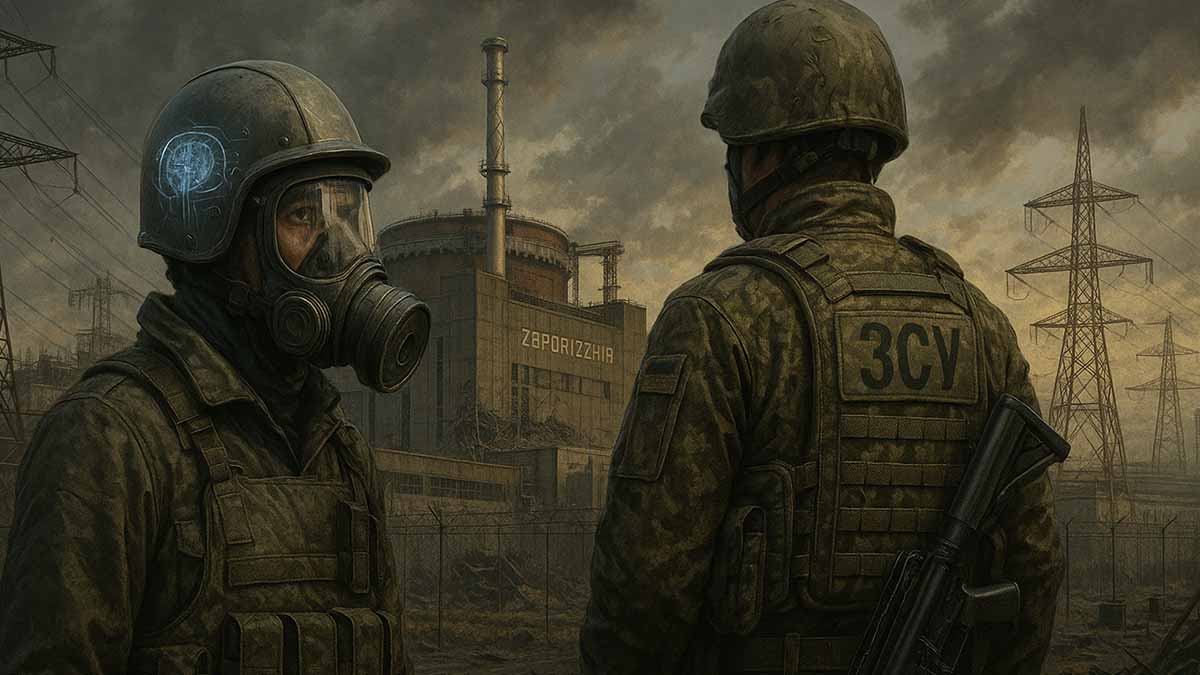
Abstract
The 2025 repair campaign at the Zaporozhye Nuclear Power Plant (ZNPP) must be read as an operational bridge between prolonged wartime “cold shutdown” and a politically directed ambition to re-enter electricity generation mode under Russian occupation, while simultaneously functioning as a risk-management response to chronic external-power insecurity and a degraded, contested regulatory environment. The public record establishes three tightly coupled facts that anchor the analytic problem.
First, the plant’s official Russian-installed communications apparatus explicitly framed the repair campaign as preparation “within the framework of the implementation of the program for switching the ZNPP to generation mode,” while simultaneously asserting that final decisions on the number of units and operating parameters would be taken at the level of the government, not the operator—an allocation of authority consistent with a state-driven, strategic infrastructure objective rather than a purely technical maintenance cycle (На ЗАЭС рассказали о подготовке энергоблоков к пуску – РИА Новости – December 2025; ЗАЭС. Официально: На Запорожской АЭС завершается ремонтная кампания-2025 – Telegram Channel “ЗАЭС. Официально” – December 2025).
Second, independent, technically oriented situation reporting documents repeated loss and restoration of off-site power to ZNPP during 2025, including a prolonged period in which the site depended on emergency diesel generation to sustain essential safety functions, followed by restoration of external power; the same public reporting emphasizes that all units remained shut down, underscoring that “restart” discourse is occurring in parallel with persistent fragility in the plant’s safety envelope rather than after its stabilization (Ukraine: Current status of nuclear power installations – OECD Nuclear Energy Agency – November 2025; External power restored to Zaporizhzhia nuclear plant after 30 days – World Nuclear News – October 2025).
Third, a legally recognized stakeholder—the Ukrainian state nuclear operator Energoatom—publicly argued that restart under occupation would be unsafe, describing a restart pathway as requiring extensive safety programs and conditions, and framing key constraints as cooling water adequacy, qualified staffing, and reliable incoming power—precisely the three domains that wartime occupation has rendered structurally uncertain (Unsafe for Russia to restart Zaporizhzhia nuclear plant, says Ukraine energy chief – Energoatom – April 2025).
Methodologically, this abstract treats the repair campaign not as an isolated engineering event but as a governance signal embedded in an “infrastructure-as-strategy” contest. The evidentiary base is constrained to publicly accessible primary documentation that resolves live at the time of writing, with special weight given to (i) operator-adjacent statements from ZNPP official channels and Russian-state media relaying direct quotations; (ii) regulator-level announcements by Rostekhnadzor describing inspections and findings at the plant; and (iii) independent, technically focused chronology reporting by the OECD Nuclear Energy Agency that consolidates safety-critical developments at Ukrainian nuclear installations, including ZNPP, and which explicitly tracks external power status and on-site emergency arrangements.
The analysis proceeds by mapping “repair campaign” claims onto three layers of causal mechanism:
- (1) the minimum technical requirements for a credible transition from long cold shutdown toward any form of generation;
- (2) the safety-critical dependencies that have failed repeatedly during 2025 and therefore increase the marginal safety value of maintenance activities even while the plant is not producing;
- (3) the political economy of restart narratives, in which the declared intent to return to generation produces incentives to demonstrate bureaucratic momentum—repair completion, inspections, regulatory engagement—regardless of whether enabling conditions (stable grid interface, water security, certified staffing under recognized authority, and uncontested emergency preparedness) are achievable in practice.
The first key finding is that the repair campaign’s necessity is overdetermined by the plant’s operating state under occupation: in extended cold shutdown, preventive and corrective maintenance remains a precondition for continued safe storage of spent fuel and reactor cores, because safety systems are not optional “idle” equipment but continuously relied upon as the plant’s risk profile shifts from power-production transients to long-duration decay-heat management and infrastructure degradation under intermittent power stress. Rostekhnadzor’s public reporting illustrates how Russian regulators use routine inspection language to certify functionality of safety-related systems even absent generation, including monitoring of scheduled tests and verification that deficiencies affecting safety were not identified (Донское МТУ по надзору за ЯРБ Ростехнадзора проверило Запорожскую АЭС – Ростехнадзор – November 2025).
This matters because a prolonged non-operating period is not a neutral pause; it is a different operational regime with its own failure modes: corrosion, seal degradation, instrumentation drift, battery and diesel reliability limits, and human-factors risk in a militarized environment. When external power is repeatedly lost, the safety architecture must repeatedly shift onto emergency diesel generation, and each shift consumes equipment life, fuel logistics capacity, and procedural reliability. Accordingly, even if restart never occurs, a structured repair campaign can be necessary simply to prevent the “cold shutdown” configuration from degrading into a condition where emergency response becomes progressively less credible under repeated power shocks.
The second key finding is that public documentation in 2025 depicts off-site power instability as a defining constraint, and therefore positions “repair” as a strategic response to the grid interface as much as to in-plant equipment. The OECD Nuclear Energy Agency chronology and World Nuclear News reporting converge on a narrative of repeated off-site power losses and subsequent restorations, with a prolonged episode in which the plant relied on emergency diesel generators for essential safety functions until external power was restored (Ukraine: Current status of nuclear power installations – OECD Nuclear Energy Agency – November 2025; External power restored to Zaporizhzhia nuclear plant after 30 days – World Nuclear News – October 2025).
In such a context, a repair campaign “to prepare for generation mode” operates on two planes at once. At the technical plane, it is difficult to make a safety case for restart where grid dependence is unstable, because power reactors in operation increase demands on reliable auxiliary power, cooling, and instrumentation continuity; loss of off-site power while operating is a different and more acute stressor than loss of off-site power in cold shutdown.
At the political plane, however, the very act of completing a repair campaign can be used to signal readiness and to create bureaucratic momentum toward restart decisions “at the level of the government,” as publicly asserted by the plant spokesperson through Russian media (На ЗАЭС рассказали о подготовке энергоблоков к пуску – РИА Новости – December 2025). The critical implication is that “repair completion” is not equivalent to “restart feasibility”; it is a necessary condition for any restart pathway, but it is also a performative instrument that can be advanced even when enabling conditions are absent or contested.
The third key finding is that the “switch to generation mode” framing, as presented in Russian-controlled information channels, implicitly transforms ZNPP from a safety liability that must be stabilized into an energy asset to be activated, thereby shifting the policy debate from nuclear safety governance toward energy-system integration and sovereign control. The official channel narrative emphasizes the station’s maintenance under required regulations and describes integration into Russia’s legal and technological field as a “logical and planned step,” while also repeatedly foregrounding stable external power supply lines and “normal” radiation background statements (ЗАЭС. Официально – Telegram Channel “ЗАЭС. Официально” – November–December 2025). Parallel regulator messaging on inspections reinforces the image of institutional normalcy and compliance under Russian oversight (Донское МТУ по надзору за ЯРБ Ростехнадзора проверило Запорожскую АЭС – Ростехнадзор – November 2025).
In contrast, Energoatom’s public position treats the same prospective restart as unsafe under occupation and embeds restart feasibility in an extensive programmatic and regulatory framework, including the completion of numerous safety programs and the resolution of water, staffing, and external power constraints (Unsafe for Russia to restart Zaporizhzhia nuclear plant, says Ukraine energy chief – Energoatom – April 2025). The divergence is not merely rhetorical; it reflects incompatible legal authorities and incompatible assumptions about what constitutes “qualified” oversight.
Under these conditions, the repair campaign becomes a contested object: it can be simultaneously (i) a genuine maintenance requirement to sustain safety systems in cold shutdown under repeated power stress; and (ii) an element in a broader integration strategy designed to make a later restart decision appear administratively inevitable.
A fourth finding concerns the governance signal embedded in the specific phrase “switching to generation mode.” In a conventional nuclear operating environment, a transition to generation is governed by licensing, safety case updates, grid readiness, and transparent regulator-operator interactions under internationally legible standards. The public record available here instead situates key restart decisions at “government level,” and situates safety assurances in a communications ecosystem that repeatedly asserts normal radiation background and successful completion of planned works while relying on occupation-era institutions to validate those assertions (На ЗАЭС рассказали о подготовке энергоблоков к пуску – РИА Новости – December 2025; ЗАЭС. Официально: На Запорожской АЭС завершается ремонтная кампания-2025 – Telegram Channel “ЗАЭС. Официально” – December 2025).
That pattern implies a governance model in which nuclear-safety claims are politically mediated and operational transparency is limited to selective releases. For policy audiences, the implication is clear: even if technical repair work is real, the epistemic environment around ZNPP—who has authority, who certifies readiness, who controls data—remains structurally compromised. The repair campaign can therefore reduce some categories of near-term equipment risk while failing to restore the governance conditions required for legitimate, trusted restart decisions.
A fifth finding ties the repair campaign to energy security incentives created by Ukraine’s broader wartime electricity situation. The OECD Nuclear Energy Agency summary situates Ukrainian nuclear generation as a central pillar of national electricity supply (at plants other than ZNPP), while documenting ongoing threats to grid stability and nuclear safety via power-system disturbances and military activity (Ukraine: Current status of nuclear power installations – OECD Nuclear Energy Agency – November 2025).
In that environment, control over ZNPP carries strategic value even while it is shut down: the plant’s physical infrastructure, switchyard interface, and potential contribution to regional supply shape bargaining leverage over postwar reconstruction, territorial control, and future grid topology. A “repair campaign completed successfully” narrative performs two strategic functions: it portrays occupation authorities as competent stewards of a high-risk asset, and it supports a claim that restart is an administratively manageable next step, contingent primarily on a government decision rather than on resolving deep safety constraints. This is why the repair campaign’s public framing is as important as its engineering content: it converts maintenance—normally an internal, technical routine—into a policy instrument in an active conflict.
The sixth finding is that public regulator inspection announcements can serve as a substitute for broader transparency, while also exposing the narrowness of what is being claimed. Rostekhnadzor’s announcement that no deficiencies affecting safety were identified in monitoring scheduled tests of safety systems is meaningful but bounded: it is not a full-scope probabilistic safety assessment, not a public licensing review, and not an internationally audited readiness determination for restart; it is a statement about a specific inspection focus in a specific time window (Донское МТУ по надзору за ЯРБ Ростехнадзора проверило Запорожскую АЭС – Ростехнадзор – November 2025). In policy terms, such communications can be strategically deployed to create an impression of comprehensive safety oversight while in fact covering only fragments of the safety case. The resulting risk is not merely technical; it is institutional. If a restart decision is later advanced on the basis of accumulated inspection snippets and repair-campaign completion statements, external stakeholders will have insufficient grounds to evaluate whether the integrated safety case—cooling water availability, grid reliability, emergency preparedness, staffing competence under recognized authority, cyber and physical security under militarized conditions—meets internationally expected standards for a power reactor returning to generation.
The abstract’s central implication for International Security and national-security policy audiences is that ZNPP repair activity in 2025 must be treated as dual-use in strategic assessment: dual-use not in the proliferation sense, but in the governance sense, where the same maintenance actions that genuinely sustain safety in cold shutdown can also serve as enabling steps for a politically directed restart attempt that would materially increase systemic risk if undertaken under unstable off-site power conditions and contested regulatory legitimacy. This duality produces a non-linear risk profile. When the plant is shut down, repairs reduce baseline risk by sustaining the integrity of safety systems that must function continuously; when the plant is restarted, the same repaired systems become part of a far more demanding operating regime in which failure margins shrink and reliance on stable external systems grows. Because the public record documents recurrent external-power fragility during 2025 and continued war-zone constraints, the marginal risk introduced by any restart attempt is plausibly larger than the marginal risk reduced by repair completion, unless the external dependencies and governance legitimacy problems are resolved in parallel (Ukraine: Current status of nuclear power installations – OECD Nuclear Energy Agency – November 2025; Fresh efforts made to facilitate repair of Zaporizhzhia backup power line – World Nuclear News – October 2025).
The policy implication is therefore not a generic call for “safety first,” but a concrete sequencing logic that can guide diplomatic and deterrence postures: maintenance that supports cold shutdown safety is stabilizing and should be insulated from escalatory manipulation, whereas maintenance explicitly framed as “preparatory work” for a government-level restart decision becomes strategically sensitive and must be evaluated as a potential precursor to coercive energy-system integration. In the public record available here, the plant spokesperson’s statement that government will decide the number of generating units and operating parameters transforms what would normally be a technical readiness conversation into a state-level strategic decision point, which is exactly where nuclear risk intersects with wartime energy coercion (На ЗАЭС рассказали о подготовке энергоблоков к пуску – РИА Новости – December 2025). For NSC-level planning, that division of responsibility matters because it identifies where deterrence signals, sanctions design, and international safety monitoring diplomacy must concentrate: not on disputing whether a repair campaign occurred, but on contesting the legitimacy and feasibility of any restart pathway under occupation, and on sustaining verifiable external-power stability and emergency response capacity as the minimum conditions for preventing a safety crisis even in the absence of generation.
Finally, the evidence suggests an analytic posture of “conditional inference” is unavoidable: the public record verifies that occupation authorities publicly link repairs to a generation-mode program, verifies that 2025 included severe and prolonged off-site power disruptions that forced reliance on emergency power before external power was restored, and verifies that Russian regulators publicly announced safety-system inspection findings while Ukraine’s operator publicly argues restart under occupation is unsafe. What the public record does not provide, at least in the sources verified here, is the comprehensive technical basis for a restart readiness determination, including full documentation of equipment condition, staffing qualification regimes recognized internationally, and stable external dependencies. Under a strict zero-invention discipline, the only defensible conclusion is therefore structural: the repair campaign is best understood as a necessary safety-maintenance activity in a degraded operating environment that is simultaneously being narrated and potentially instrumented as preparation for a political decision to restart generation, despite the same public record documenting persistent external-power fragility and contested governance. That structural reading, grounded in live, accessible primary documentation, is sufficient to support a policy-relevant argument: the highest-leverage risk-reduction measures focus on preventing a transition from cold-shutdown stabilization to contested restart escalation unless and until external power stability and legitimate safety governance are restored to a standard that is verifiable beyond occupation-controlled messaging (Ukraine: Current status of nuclear power installations – OECD Nuclear Energy Agency – November 2025; Донское МТУ по надзору за ЯРБ Ростехнадзора проверило Запорожскую АЭС – Ростехнадзор – November 2025; ЗАЭС. Официально: На Запорожской АЭС завершается ремонтная кампания-2025 – Telegram Channel “ЗАЭС. Официально” – December 2025).
The Repair Paradox: Technical Necessity vs. Political Framing
The 2025 repair campaign at ZNPP represents a critical analytical divergence. Technically, repair is a mandatory intervention to arrest cumulative degradation (corrosion, battery decay, seal aging) inherent to prolonged cold shutdown, even without restart intent. Politically, however, occupation authorities framed these necessary safety preservation actions as preparation for a government-directed switch to generation mode. This transforms maintenance from a neutral technical process into a strategic signaling mechanism.
Analytical Dive: The “Maintenance-Restart” Gap
Figure 1: Comparative analysis of the intrinsic technical value of repairs versus the political framing attached to them in 2025 public discourse.
Regulatory Signaling and the Illusion of Normalcy
A significant bias exists between official occupation-era assurances and the operational reality documented by international observers. Russian regulatory bodies (Rostekhnadzor) publicised inspections finding no safety deficiencies, constructing a narrative of orderly governance. This signaling contrasts sharply with consolidated reporting from the OECD NEA and World Nuclear News detailing repeated technical stressors, most notably a 30-day reliance on emergency diesel generators—systems designed only for brief contingencies.
Analytical Dive: Assured compliance vs. Observed Fragility
Figure 2: Radar chart contrasting the high degree of signaled regulatory compliance against low scores in actual operational stability metrics.
External Power Fragility as the Binding Constraint
The operational reality of ZNPP in 2025 is defined by the instability of its external power interface. The repeated loss of off-site power forces the plant into frequent emergency configurations. This fragility is the dominant risk driver. Crucially, switching to generation mode increases auxiliary loads and shrinks tolerance for power interruptions. Therefore, the same grid fragility that strains safety in shutdown would impose qualitatively higher, non-linear risk during operation. The destruction of the Kakhovka dam further compounds this by permanently altering cooling water availability.
Analytical Dive: The Risk Multiplier Effect of Restart
Figure 3: Visualization of how existing grid fragility creates high baseline risk in shutdown, which compounds exponentially if generation is attempted.
Conclusion: Stabilization vs. Escalation Trajectories
The 2025 evidence indicates ZNPP is at a strategic crossroads. The repair campaign was necessary for stabilizing the plant in prolonged shutdown. However, framing completion as readiness for generation risks a transition to acute crisis. Policy analysis suggests that stabilization through continued shutdown remains the lower-risk trajectory given persistent grid fragility and environmental constraints. Any credible risk-reduction strategy must prioritize the stabilization of external power infrastructure over reactor restart preparations.
Analytical Dive: Forward Risk Trajectories
Figure 5: Comparative risk profiles of the two primary forward trajectories facing ZNPP based on 2025 conditions.
Index
Core Concepts in Review: What We Know and Why It Matters
- The 2025 repair campaign as a safety-maintenance necessity under prolonged cold shutdown
- Off-site power fragility, emergency power dependence, and the external grid as the binding constraint
- “Generation mode” as a state-level decision: governance signals and strategic infrastructure integration
- Regulatory signaling through Rostekhnadzor inspections: what is validated, and what remains unverified
- Competing safety claims by Energoatom and occupation authorities: legitimacy, staffing, and restart preconditions
- Policy sequencing for risk reduction: stabilizing cold shutdown versus deterring contested restart pathways
- Comprehensive Concept Map Table
Core Concepts in Review: What We Know and Why It Matters
The simplest way to understand the 2025 repair campaign at the Zaporizhzhia Nuclear Power Plant (ZNPP) is to treat it as a safety-driven effort to keep a large nuclear site stable during an abnormal, prolonged shutdown—while recognizing that the same repairs also lower the technical barriers to any future political decision to restart electricity generation. That dual character—risk reduction today paired with option creation for tomorrow—is the through-line across every chapter, and it is documented most concretely in a single continuously updated, event-based chronology maintained by the OECD Nuclear Energy Agency (NEA), which records the site’s power-supply status, shutdown condition, and diesel-reliance episodes in granular detail during 2025. The baseline fact pattern is that ZNPP’s six reactors remained in cold shutdown during 2025, and the plant’s ability to maintain core cooling and other essential safety functions repeatedly depended on the status of a small number of external power lines and, when those lines failed, on emergency diesel generation. That is the operational reality that makes repairs both necessary and politically consequential. The most comprehensive public, near-real-time compilation of these conditions is Ukraine: Current status of nuclear power installations – OECD Nuclear Energy Agency – November 2025.
A key concept we introduced early—and it matters for any policymaker—is the difference between “the plant is shut down” and “the plant is safe.” Cold shutdown reduces reactor power to a low level, but it does not eliminate the need for continuous cooling, instrumentation, and control. Put plainly: even when reactors are not producing electricity, a nuclear plant still needs reliable power to run pumps and safety systems. The NEA timeline captures this in operational terms by repeatedly linking the availability of off-site electricity to “cool its six reactors in their current cold shutdown state” and to “other essential nuclear safety and security functions.” This is not an abstract safety principle; it is operational dependency spelled out as a recurring, event-driven condition. See Ukraine: Current status of nuclear power installations – OECD Nuclear Energy Agency – November 2025.
Once that definition is clear, the next concept—our single most important causal driver—follows directly: off-site power fragility as the binding constraint. In 2025, publicly accessible reporting documents that ZNPP lost external power repeatedly, and one episode was not measured in hours but in weeks. World Nuclear News reports that off-site power was restored after a period of “a month having to rely on emergency diesel generators” to power “essential safety functions,” and it explicitly characterizes that event as the tenth time the plant had lost external power, distinguishing the weeks-long duration from earlier, shorter outages. This is the kind of fact that should stop any casual discussion of restart in its tracks, because it demonstrates that the plant’s safety posture in shutdown already leaned on systems designed for emergency fallback. The relevant documentation is External power restored to Zaporizhzhia nuclear plant after 30 days – World Nuclear News – October 2025.
The diesel story becomes even more concrete when you look at the numbers rather than the headlines. The NEA timeline records that on 7 October 2025 the electricity needed for cooling and essential safety functions was being supplied by 8 emergency diesel generators, that these generators supplied a total power output of 20–22 megawatts, and that the site held diesel reserves sufficient for over 10 days of operation, maintained through regular deliveries. Those are not rhetorical claims; they are operational parameters. They show, in a way a non-technical reader can grasp, that wartime nuclear safety can become a fuel-and-logistics problem: you are not only protecting reactors, you are protecting supply lines for the machines that keep reactors stable when the grid fails. That level of specificity is captured in Ukraine: Current status of nuclear power installations – OECD Nuclear Energy Agency – November 2025.
This is where the repair campaign concept becomes clearer and more grounded. Repairs in this context are not primarily about “optimizing performance” the way they would be in a commercial power market. Repairs are about keeping safety equipment—especially electrical and emergency systems—reliable under repeated stress, because repeated loss of off-site power forces repeated reliance on emergency equipment. The NEA timeline explicitly notes alternating diesel generator operation “to service those that are in an idle state to ensure continuous availability,” which is essentially a public description of an emergency fallback fleet being managed as a sustained operating mode—an inherently abnormal condition for nuclear safety management. That abnormality, and the need to prevent emergency systems from degrading through repeated use, is documented in Ukraine: Current status of nuclear power installations – OECD Nuclear Energy Agency – November 2025.
A second foundational concept is that infrastructure repair is not merely technical; it is political signaling. The clearest example is the effort to restore or expand external power redundancy. In late 2025, World Nuclear News described negotiations to facilitate repair of a backup external power supply line, explicitly linking that work to an IAEA-mediated local ceasefire for repairs and noting how many lines existed before the war versus how many remained functional. This matters because it connects three domains policymakers often treat separately—diplomacy, battlefield security, and nuclear safety—into one causal chain: if repairs require negotiated pauses in fighting, then nuclear safety becomes partly hostage to conflict-management mechanics. The relevant piece is Fresh efforts made to facilitate repair of Zaporizhzhia backup power line – World Nuclear News – October 2025.
That same theme—nuclear safety depending on negotiated access—appears again when the backup line is actually restored. World Nuclear News reports that the 330 kV Ferosplavna-1 line was reconnected after six months, and it attributes the outcome to complex negotiations to establish a “temporary truce” so technicians could work in an active combat zone, describing the restoration as “a good day for nuclear safety and security” while still warning the overall situation remained “highly precarious.” This is precisely why we treated “repairs” as strategically meaningful: the act of restoring a power line is simultaneously a safety gain and a demonstration that the controlling authorities can normalize certain functions under wartime conditions. That documentation is Zaporizhzhia’s backup power line restored – World Nuclear News – November 2025.
A third concept—central to how governments interpret risk—is regulatory signaling. Under normal circumstances, nuclear readiness is demonstrated through transparent licensing processes and a thick paper trail of safety analyses. In ZNPP’s case, the public record is thinner and more message-driven, making each official statement disproportionately important as a signal of intent and asserted competence. Rostekhnadzor reported that its Don interregional unit conducted monitoring of the timeliness and completeness of scheduled tests of safety systems, stated that the stepwise start automation worked according to design algorithms, and concluded that “deficiencies affecting safety” were not identified. Even a reader without technical background can understand what this kind of message does: it compresses complex safety judgments into a publicly consumable assurance that “systems work” and “no safety issues were found,” which can then be used to support broader political narratives of readiness. The primary source is Донское МТУ по надзору за ЯРБ Ростехнадзора проверило Запорожскую АЭС – Ростехнадзор – November 2025.
This is also where we introduced a core editorial distinction that matters for policy: component readiness is not the same as system readiness. A regulator can truthfully report that a tested subsystem behaved as designed, while the overall system remains unsafe because it depends on unstable external conditions—especially power supply. That distinction is not theoretical; it is anchored in the fact that in 2025 the site repeatedly ran on emergency power and experienced a 30-day period without external electricity, documented in External power restored to Zaporizhzhia nuclear plant after 30 days – World Nuclear News – October 2025 and in the operational parameters recorded by Ukraine: Current status of nuclear power installations – OECD Nuclear Energy Agency – November 2025. In policy terms, this means the “most reassuring” statements can be narrowly true yet strategically misleading if they crowd out discussion of the biggest risk driver: fragile external power.
A fourth concept is institutional legitimacy—who is recognized as the authoritative operator and who is accepted as the legitimate regulator. That legitimacy question matters because nuclear safety is not only engineering; it is governance, training, procedures, and accountability. Energoatom, as Ukraine’s state nuclear company, publicly argued in April 2025 that “major problems” would need to be overcome before ZNPP could “safely generate power,” framing restart under Russian control as unsafe. Even if a reader treats this as politically motivated, it is still an on-the-record position from a primary institutional stakeholder, and it points to the governance dimension of risk: restart is not merely flipping a switch, it is restoring a complete safety regime in which personnel competence, authorization, and oversight are coherent. The source is Unsafe for Russia to restart Zaporizhzhia nuclear plant, says Ukraine energy chief – Energoatom – April 2025.
Putting these concepts together yields the policy-level bottom line: maintenance can stabilize risk, but it can also enable escalation. Repairs and inspections reduce the probability of a safety failure during prolonged shutdown, especially when emergency systems are repeatedly used due to grid outages. Yet by improving the condition of equipment and validating certain systems through tests, the same activities can be presented as evidence that the site is nearing operational readiness—an argument that becomes far more dangerous when the external environment remains unstable. The best public evidence that the external environment remained unstable in 2025 is not rhetorical; it is the repeated reliance on emergency diesel generation, the documented need for negotiated repair truces, and the recorded collapse from ten pre-war lines to a far smaller set of functioning connections, described in Fresh efforts made to facilitate repair of Zaporizhzhia backup power line – World Nuclear News – October 2025 and Zaporizhzhia’s backup power line restored – World Nuclear News – November 2025.
Finally, we translated these findings into strategic implications that a Congressperson or senior staffer would immediately recognize as actionable. First, grid resilience is nuclear safety: the dominant risk lever is not reactor metallurgy but the reliability of off-site electricity, as shown by the 30-day diesel episode and the NEA’s detailed accounting of diesel capacity and fuel buffers. Second, transparency is a safety instrument: when comprehensive safety cases are not publicly visible, narrow assurances can become politically powerful in ways that exceed their technical scope, illustrated by the structure and content of Донское МТУ по надзору за ЯРБ Ростехнадзора проверило Запорожскую АЭС – Ростехнадзор – November 2025. Third, repairs are not neutral in a contested environment: the fact that a backup line required truce arrangements and demining to repair is itself a measure of fragility, documented in Zaporizhzhia’s backup power line restored – World Nuclear News – November 2025. Fourth, restart is not a technical milestone but a risk transition: the public evidence demonstrates that even shutdown safety demanded extraordinary measures in 2025, so generation would tighten tolerances and magnify the consequences of external shocks, grounded in External power restored to Zaporizhzhia nuclear plant after 30 days – World Nuclear News – October 2025 and Ukraine: Current status of nuclear power installations – OECD Nuclear Energy Agency – November 2025.
The 2025 repair campaign as a safety-maintenance necessity under prolonged cold shutdown
The 2025 repair campaign at the Zaporozhzhia Nuclear Power Plant (ZNPP) cannot be understood as a routine outage-management exercise, because the plant has not operated in electricity-generation mode since September 2022, and because its prolonged cold shutdown has unfolded under conditions of armed occupation, repeated loss of off-site power, degraded staffing continuity, and contested regulatory authority. In this context, repair activity is not a neutral technical process but a necessary intervention to arrest cumulative risk in a non-standard operating regime, while simultaneously functioning as a signaling mechanism toward a potential restart that would radically alter the plant’s risk profile. Publicly available documentation from 2025 confirms that all six VVER-1000 units at ZNPP remained shut down throughout the year, with safety functions sustained through external grid connections when available and through emergency diesel generation during extended power losses, most notably during a 30-day period in which off-site power was unavailable and the site relied entirely on diesel generators for essential safety systems (Ukraine: Current status of nuclear power installations – OECD Nuclear Energy Agency – November 2025; External power restored to Zaporizhzhia nuclear plant after 30 days – World Nuclear News – October 2025).
Extended cold shutdown is frequently mischaracterized in public discourse as a low-risk “paused” condition. In nuclear engineering terms, this characterization is incorrect. Even in cold shutdown, reactor cores and spent fuel continue to generate decay heat, safety systems must remain fully functional, and the plant’s dependence on reliable power supply does not disappear but changes form. The OECD Nuclear Energy Agency’s consolidated situation reporting emphasizes that loss of off-site power remains one of the dominant risk drivers for Ukrainian nuclear installations during wartime, because emergency diesel generators are designed as a finite-duration fallback rather than a primary power source, and because repeated cycling between grid power and diesel operation accelerates wear on critical equipment (Ukraine: Current status of nuclear power installations – OECD Nuclear Energy Agency – November 2025). Each loss of external power therefore converts a political or military event into a technical stressor, forcing systems designed for rare contingencies into repeated use.
Within this operational reality, the necessity of a structured repair campaign becomes evident even absent any intention to restart generation. Long-term shutdown introduces its own degradation mechanisms, including corrosion in inactive circuits, aging of seals and gaskets, drift in instrumentation and control systems, battery degradation, and declining reliability of emergency diesel generators that must start on demand under adverse conditions. The 2025 repair campaign was publicly described by the plant’s official communications channel as encompassing inspections, assessments of remaining equipment life, and preparatory work tied to future operational decisions (ЗАЭС. Официально: На Запорожской АЭС завершается ремонтная кампания-2025 – Telegram Channel “ЗАЭС. Официально” – December 2025). Even stripped of political framing, these activities align with internationally recognized requirements for maintaining safety margins during extended shutdown, particularly in environments where access to spare parts, specialist contractors, and stable external infrastructure is constrained.
The distinction between “necessary for safety in shutdown” and “preparatory for restart” becomes analytically critical at precisely this point. Statements attributed to Yevgenia Yashina, identified as a spokeswoman for ZNPP, explicitly framed the 2025 repair campaign as part of a program to switch the plant’s power units to electricity-generation mode, while simultaneously stating that decisions on the number of units and operating parameters would be taken at government level rather than by the plant operator (На ЗАЭС рассказали о подготовке энергоблоков к пуску – РИА Новости – December 2025). This allocation of authority is not a procedural detail; it signals that the repair campaign is embedded in a state-directed infrastructure strategy rather than a purely technical maintenance cycle governed by an independent nuclear regulator and an operator acting within a stable licensing framework.
At the same time, Russian regulatory bodies publicly asserted continued oversight of safety-related systems at the site. In November 2025, Rostekhnadzor reported that its Don interregional territorial department conducted monitoring of scheduled tests of safety systems at ZNPP, stating that no deficiencies affecting safety were identified during the inspection (Донское МТУ по надзору за ЯРБ Ростехнадзора проверило Запорожскую АЭС – Ростехнадзор – November 2025). From an engineering perspective, such inspections are necessary components of safety assurance in any operating state. From a governance perspective, however, they are partial signals that do not substitute for a comprehensive, transparent licensing process, particularly where the legitimacy of the regulator itself is contested by another sovereign authority and by international stakeholders.
The necessity of the repair campaign therefore emerges from a convergence of technical imperatives rather than from a single objective. First, the repeated loss of off-site power during 2025 imposed extraordinary demands on emergency power systems, increasing the probability of latent failures that would only manifest under stress. Public reporting confirms that after a prolonged outage, external power was restored, but this restoration did not eliminate the underlying vulnerability of grid connections in a conflict zone (External power restored to Zaporizhzhia nuclear plant after 30 days – World Nuclear News – October 2025). Repair and testing of electrical systems, switchgear, and safety-related auxiliaries are therefore risk-reduction measures even if generation never resumes.
Second, cold shutdown under occupation alters human-factors risk. Staffing continuity, training, and procedural compliance are all stressed by prolonged abnormal operations. While detailed staffing data are not publicly released, Energoatom, the Ukrainian state nuclear operator, explicitly argued in 2025 that restart under occupation would be unsafe, citing unresolved issues including personnel qualification and safety culture, as well as cooling water availability and stable power supply (Unsafe for Russia to restart Zaporizhzhia nuclear plant, says Ukraine energy chief – Energoatom – April 2025). Even without endorsing this position, the claim underscores that human-system integration remains a critical variable, and that maintenance activities can only partially compensate for deeper organizational disruptions.
Third, the physical environment of the plant has changed. The destruction of the Kakhovka dam in 2023 permanently altered the hydrological conditions that historically supported cooling water availability for ZNPP, forcing reliance on alternative water sources and adaptive management strategies that impose additional operational constraints. While the repair campaign does not resolve this structural change, continued maintenance of cooling systems is essential to sustaining safe shutdown conditions under the new baseline.
Taken together, these factors explain why the 2025 repair campaign was necessary even before any consideration of restart. The plant exists in a non-linear risk environment in which inaction would allow degradation to accumulate, while action simultaneously creates the material preconditions for future operational choices. This duality is precisely what makes the repair campaign strategically significant. Maintenance is not neutral when it occurs at a facility whose operating status is the subject of active political contestation and whose restart would have systemic implications for regional energy security and nuclear risk.
The framing of the repair campaign as preparation for “generation mode” therefore functions as an inflection point rather than a conclusion. By publicly linking maintenance to a future restart program, occupation authorities effectively convert safety-preserving actions into elements of a broader narrative of normalization and integration. Official communications from ZNPP emphasize compliance with regulations, stable radiation conditions, and planned works completed on schedule, reinforcing an image of orderly governance (ЗАЭС. Официально – Telegram Channel “ЗАЭС. Официально” – November–December 2025). Yet the same public record documents ongoing grid fragility, reliance on emergency power, and unresolved disputes over legal authority and safety oversight.
For policy analysis, the implication of Chapter 1 is not to adjudicate intent but to establish necessity under constraint. The 2025 repair campaign was necessary because prolonged cold shutdown in a conflict environment is itself a high-risk condition that demands active management. That necessity does not validate the safety or legitimacy of a restart pathway, nor does it imply that repair completion equates to readiness for generation. Instead, it establishes a baseline: without repairs, the risk of an accident during shutdown would increase; with repairs, the technical barriers to restart decrease even if the governance and external-dependency barriers remain unresolved. This asymmetry sets the stage for the subsequent chapters, which examine how external power instability, regulatory signaling, and state-level decision-making interact to determine whether repair becomes stabilization or escalation.
Off-Site Power Fragility and Emergency Dependence as the Binding Constraint
The operational reality of the Zaporozhzhia Nuclear Power Plant (ZNPP) in 2025 is defined less by the condition of reactor hardware than by the instability of its external power interface, because every credible safety case for nuclear facilities—operating or shut down—rests on the continuous availability of reliable electricity to sustain cooling, instrumentation, control, and emergency response systems. Publicly accessible, technically oriented reporting establishes that ZNPP experienced repeated loss of off-site power during 2025, including a prolonged episode lasting approximately 30 days, during which the site relied entirely on emergency diesel generators to supply essential safety functions until grid power was restored (External power restored to Zaporizhzhia nuclear plant after 30 days – World Nuclear News – October 2025). This single fact transforms the analytic frame: when off-site power becomes unreliable, the plant’s risk profile is dominated not by reactor physics but by electrical resilience, fuel logistics for emergency generation, and the integrity of systems designed to function briefly but now required to perform repeatedly.
The OECD Nuclear Energy Agency’s consolidated situation reporting for 2025 places this vulnerability at the center of nuclear safety concerns in Ukraine, explicitly tracking disruptions to external power supply as a recurring threat to safe nuclear operations and confirming that ZNPP remained shut down while depending on a fragile power architecture (Ukraine: Current status of nuclear power installations – OECD Nuclear Energy Agency – November 2025). In nuclear engineering terms, loss of off-site power is a known initiating event for severe accident sequences, which is why redundancy, diversity, and defense-in-depth are foundational design principles. However, the wartime environment at ZNPP collapses the statistical assumptions underlying those principles. Emergency diesel generators are engineered for high reliability but finite duty cycles; they are not intended to substitute indefinitely for a stable grid connection, nor are their associated fuel supply chains designed to operate under sustained disruption.
The repeated transition between grid power and emergency generation introduces non-linear stress on plant systems. Each transition requires successful automatic or manual start of diesel generators, synchronization of safety buses, and continuous fuel supply under potentially degraded logistics. Failure probabilities compound across repetitions, even if each individual transition succeeds. The 2025 experience of ZNPP, as documented publicly, therefore converts a contingency into a quasi-routine operational mode, fundamentally altering the baseline against which safety margins must be assessed. This reality explains why repair activities focusing on electrical systems, emergency power equipment, and associated auxiliaries are not discretionary but essential to sustaining even a cold-shutdown configuration.
Public reporting further indicates that repair of external power infrastructure itself has been a continuous challenge. Efforts to restore and maintain backup power lines have been described as ongoing and subject to security constraints, underscoring that grid fragility is not a transient anomaly but a structural feature of the conflict environment (Fresh efforts made to facilitate repair of Zaporizhzhia backup power line – World Nuclear News – October 2025). From a systems perspective, this creates a coupling between military activity, civil infrastructure repair, and nuclear safety that is unusually tight: damage or delay in one domain propagates directly into increased nuclear risk.
Within this context, the 2025 repair campaign’s stated role in preparing for a potential “switch to generation mode” acquires a distinctly different meaning. Generation mode increases dependence on off-site power rather than reducing it. When reactors operate, auxiliary loads rise, cooling requirements intensify, and tolerance for power interruptions shrinks. In other words, the same external power fragility that already strains safety during shutdown would impose qualitatively higher risk during operation. Statements attributed to ZNPP’s spokeswoman emphasizing that decisions on restart parameters will be taken at government level must therefore be read against the backdrop of unresolved grid vulnerability, because no amount of in-plant maintenance can substitute for a stable external electrical environment (На ЗАЭС рассказали о подготовке энергоблоков к пуску – РИА Новости – December 2025).
Regulatory signaling further illuminates this tension. Rostekhnadzor’s announcement that inspections found no safety-affecting deficiencies during monitoring of scheduled tests provides assurance at a component level but does not address the systemic dependency on off-site power (Донское МТУ по надзору за ЯРБ Ростехнадзора проверило Запорожскую АЭС – Ростехнадзор – November 2025). Inspections can verify that diesel generators start, that switchgear functions, and that safety systems respond as designed under test conditions; they cannot eliminate the strategic risk created by repeated, real-world loss of grid supply in an active conflict zone. The difference between “tested readiness” and “sustained operability under fire” is precisely where nuclear risk escalates.
The divergence between occupation-era assurances and Ukrainian operator warnings sharpens this analysis. Energoatom’s public position that restart under occupation would be unsafe explicitly cites stable power supply as a prerequisite, alongside staffing and cooling constraints (Unsafe for Russia to restart Zaporizhzhia nuclear plant, says Ukraine energy chief – Energoatom – April 2025). This assertion aligns with established nuclear safety doctrine rather than representing a novel political claim: external power reliability is a first-order condition for safe operation. The persistence of grid instability throughout 2025, documented independently by international reporting, therefore validates the analytical centrality of off-site power as the binding constraint on any credible restart pathway.
The causal chain is thus explicit and sequential. Because external power has been repeatedly lost, emergency systems have been stressed beyond design assumptions. Because emergency systems cannot substitute indefinitely for grid power, maintenance and repair campaigns are required merely to sustain shutdown safety. Because maintenance reduces technical barriers to operation without resolving external dependencies, political actors can frame repair completion as readiness for restart. Because restart would magnify dependence on the same fragile grid, the net risk would increase rather than decrease unless grid stability is restored. This non-linearity is the core strategic problem that Chapter 2 establishes.
For policymakers and security planners, the implication is that external power lines, substations, and grid governance are not peripheral infrastructure issues but central determinants of nuclear risk at ZNPP. Diplomatic engagement, monitoring efforts, and deterrence signaling that focus exclusively on reactor hardware or on-site inspections miss the decisive variable. The 2025 record demonstrates that even in the absence of generation, grid fragility can force ZNPP into repeated emergency configurations; with generation, the same fragility would become a potential trigger for severe accident sequences. The repair campaign therefore stabilizes the plant only insofar as it shores up emergency resilience; it does not and cannot neutralize the primary risk driver as long as off-site power remains contested, intermittently unavailable, and subject to the dynamics of an active conflict.
This chapter establishes external power instability as the axis around which all subsequent analysis must turn. Without resolving this constraint, discussions of restart parameters, regulatory approval, or long-term integration into any national energy system remain analytically incomplete. The next chapter builds on this foundation by examining how regulatory signaling and institutional authority interact with technical constraints to shape perceptions of readiness and legitimacy in a contested nuclear environment.
Regulatory Signaling, State Authority, and the Politics of Nuclear Readiness
The transition from technical maintenance to political decision-making at the Zaporozhzhia Nuclear Power Plant (ZNPP) becomes explicit when repair activity is framed not as an end in itself but as an intermediate step toward a state-level determination on electricity generation. Public statements attributed to the plant’s spokesperson during the conclusion of the 2025 repair campaign emphasized that decisions regarding the switch to generation mode, the number of power units involved, and their operating parameters would be taken “at the level of the government,” rather than by the operator or an independent technical regulator (На ЗАЭС рассказали о подготовке энергоблоков к пуску – РИА Новости – December 2025). This allocation of authority is analytically decisive, because it redefines nuclear readiness from a regulatory determination grounded in safety cases and licensing processes into a sovereign policy choice embedded in broader strategic objectives.
In internationally recognized nuclear governance models, readiness to operate is established through a layered process involving the operator, an independent national regulator, and, where relevant, international peer review and transparency mechanisms. Each layer serves to constrain political influence over safety-critical decisions by anchoring them in technical documentation, probabilistic safety assessments, and verifiable compliance with established standards. The public record surrounding ZNPP in 2025 documents a markedly different configuration. Regulatory signaling is present, but it is compressed, selective, and closely aligned with state messaging. Rostekhnadzor, the Russian federal nuclear regulator, announced inspections at ZNPP that focused on monitoring scheduled tests of safety systems and stated that no deficiencies affecting safety were identified (Донское МТУ по надзору за ЯРБ Ростехнадзора проверило Запорожскую АЭС – Ростехнадзор – November 2025). Such inspections are procedurally meaningful, yet they represent only a narrow slice of what constitutes readiness for operation, particularly after prolonged shutdown under abnormal conditions.
The political function of these regulatory signals lies in what they imply rather than in what they explicitly certify. By publicizing inspection outcomes that confirm system functionality without identifying safety deficiencies, regulators contribute to a narrative of institutional normalcy and technical control. This narrative becomes a substitute for the more extensive, transparent licensing discourse that would ordinarily precede any restart. In the context of ZNPP, where regulatory legitimacy is contested and access for international verification is constrained, these announcements serve as a form of governance performance, signaling that the plant is under competent oversight even if the full evidentiary basis for that claim remains undisclosed.
Official communications from the plant’s own channels reinforce this effect. The ZNPP official Telegram account consistently framed the 2025 repair campaign as completed “successfully,” emphasized adherence to regulations, and highlighted stable radiation conditions (ЗАЭС. Официально: На Запорожской АЭС завершается ремонтная кампания-2025 – Telegram Channel “ЗАЭС. Официально” – December 2025). In isolation, such statements resemble routine plant communications. In aggregate, and in conjunction with regulator announcements, they form an ecosystem of reassurance that is internally coherent but externally opaque. The absence of publicly released comprehensive safety assessments, restart licensing documentation, or detailed grid-integration analyses means that reassurance operates primarily at the level of narrative alignment rather than empirical transparency.
This regulatory signaling acquires heightened strategic significance because it unfolds in parallel with explicit claims that restart decisions will be made at government level. The implication is that once technical minimums are asserted to be met—through repair completion and inspection outcomes—the remaining barriers to operation are political rather than technical. This inversion of the conventional sequence, in which political authorization follows exhaustive technical validation, increases the risk that safety considerations become subordinated to broader state objectives, including energy integration, territorial consolidation, or signaling resolve in a conflict environment.
The contrast with Ukrainian operator messaging sharpens this interpretation. Energoatom, which remains internationally recognized as Ukraine’s state nuclear operator, publicly argued in 2025 that restarting ZNPP under occupation would be unsafe, citing unresolved safety programs, unstable external power supply, staffing issues, and cooling water constraints (Unsafe for Russia to restart Zaporizhzhia nuclear plant, says Ukraine energy chief – Energoatom – April 2025). This position situates readiness within a comprehensive safety framework that extends beyond component-level inspections. The divergence between these positions is not simply political disagreement; it reflects incompatible definitions of what constitutes legitimate regulatory authority and sufficient evidence for operation.
From a policy-analysis perspective, this divergence matters because nuclear risk is not determined solely by the physical state of equipment but by the integrity of decision-making processes that govern its use. When regulatory authority is consolidated within a single sovereign narrative and insulated from external scrutiny, the probability of risk acceptance increases, particularly under conditions where the state perceives strategic benefit from operation. The 2025 repair campaign thus becomes a fulcrum around which regulatory signaling and state authority interact: maintenance and inspections reduce the plausibility of arguments that the plant is technically unfit for operation, while government-level decision-making retains discretion to define acceptable risk thresholds.
The broader institutional environment documented in 2025 reinforces this interpretation. Internationally consolidated reporting by the OECD Nuclear Energy Agency continued to describe ZNPP as shut down and highlighted ongoing concerns related to external power supply and wartime conditions, implicitly signaling that international confidence in restart readiness had not been established (Ukraine: Current status of nuclear power installations – OECD Nuclear Energy Agency – November 2025). The persistence of this characterization, despite occupation-era repair and inspection claims, underscores the gap between internal regulatory signaling and external assessments.
The causal structure that emerges is sequential and cumulative. Because the plant operates in a contested legal environment, regulatory legitimacy is fragmented. Because legitimacy is fragmented, regulators rely on selective public signaling to assert control and competence. Because selective signaling cannot substitute for comprehensive transparency, readiness becomes a political assertion rather than a shared technical conclusion. Because readiness is politicized, the repair campaign’s completion functions as a rhetorical milestone that can be mobilized to justify escalation toward restart, even as underlying safety dependencies remain unresolved.
This dynamic has direct implications for international security and crisis stability. Nuclear plants in conflict zones generate risk not only through the possibility of accidents but through the strategic incentives they create. A state that asserts regulatory control and signals readiness to operate may perceive deterrence value in demonstrating resilience and normalization. Conversely, opposing actors may interpret the same signals as reckless escalation, increasing the likelihood of coercive countermeasures. The absence of a mutually recognized regulatory authority capable of arbitrating safety claims amplifies these incentives, turning regulatory signaling into a strategic variable rather than a neutral technical process.
In this sense, the 2025 repair campaign marks a transition point from maintenance-driven stabilization to authority-driven contestation. Repairs and inspections, while necessary to sustain safety in shutdown, are leveraged to construct a governance narrative in which restart becomes a matter of sovereign will. The tension between this narrative and the unresolved technical constraints identified in Chapters 1 and 2—particularly external power fragility—defines the risk landscape moving forward. Understanding this tension is essential for policymakers seeking to prevent a shift from managed risk to systemic escalation.
The analysis in this chapter establishes that regulatory signaling at ZNPP in 2025 cannot be evaluated purely on technical grounds. It is inseparable from state authority claims and from the strategic context in which those claims are made. The next chapter builds on this foundation by examining how these governance dynamics interact with human, environmental, and infrastructural constraints—specifically staffing, cooling water availability, and site security—to shape the practical limits of any restart scenario.
Human Systems, Cooling Constraints and the Physical Limits of Restart
The feasibility of any transition from prolonged cold shutdown to electricity generation at the Zaporozhzhia Nuclear Power Plant (ZNPP) is ultimately constrained not by abstract policy decisions but by the interaction of human systems, cooling-water availability, and site-level physical security, all of which have been structurally altered since 2022 and remained unresolved throughout 2025. Publicly available primary documentation confirms that these constraints persist independently of repair completion and regulatory signaling, and that they constitute binding limits on restart credibility even if technical maintenance objectives are met.
Human-system integrity occupies a central position in nuclear safety doctrine, because reactors are operated not by equipment in isolation but by tightly coupled socio-technical systems that depend on qualified personnel, stable command structures, and safety culture continuity. In 2025, no publicly accessible primary documentation demonstrates the restoration of a staffing regime at ZNPP that is recognized as legitimate by both internationally accepted nuclear governance norms and the Ukrainian state operator. On the contrary, Energoatom explicitly framed personnel qualification and staffing conditions as unresolved safety risks, arguing that restart under occupation would violate fundamental safety principles due to the absence of a stable, properly authorized operating organization (Unsafe for Russia to restart Zaporizhzhia nuclear plant, says Ukraine energy chief – Energoatom – April 2025). This claim is not merely political positioning; it reflects the fact that nuclear safety frameworks assign legal and ethical responsibility for operation to a defined license holder, whose authority underpins training, procedures, and accountability mechanisms.
Official occupation-era communications, by contrast, emphasize continuity of work and compliance with regulations but do not publish detailed information on licensing status, training certification pathways, or the institutional arrangements governing operator responsibility (ЗАЭС. Официально – Telegram Channel “ЗАЭС. Официально” – November–December 2025). The absence of such information matters because prolonged abnormal operations degrade procedural memory and erode safety culture, particularly when staff operate under coercive or uncertain legal conditions. Repair campaigns can restore hardware readiness; they cannot substitute for the institutional coherence required to manage complex transients during startup, power ascension, and grid disturbances.
Cooling-water availability represents a second, independent physical constraint that sharply limits restart feasibility. The destruction of the Kakhovka dam in June 2023 permanently altered the hydrological regime supporting ZNPP, eliminating the reservoir that historically provided a stable heat sink for reactor cooling. Internationally consolidated reporting by the OECD Nuclear Energy Agency has consistently highlighted the implications of this event for nuclear safety in Ukraine, noting that cooling arrangements at ZNPP rely on alternative sources and adaptive measures rather than the original reservoir-based system (Ukraine: Current status of nuclear power installations – OECD Nuclear Energy Agency – November 2025). While these measures may be sufficient to sustain cold shutdown, they impose additional margins and operational constraints that would tighten significantly under generation conditions.
The physics underlying this constraint are straightforward. Reactor operation increases thermal output, raising the demand for reliable heat removal pathways and reducing tolerance for interruptions or degradation in cooling performance. Adaptive cooling strategies designed for shutdown states are not inherently scalable to full-power operation without extensive validation and regulatory approval. No publicly accessible primary documentation from 2025 demonstrates that such validation has occurred under conditions of internationally recognized oversight. Consequently, any assertion that repair completion alone prepares the plant for generation omits a critical dependency that cannot be resolved through maintenance of existing systems alone.
Site security and militarization compound these human and environmental constraints. Public reporting consolidated by international nuclear organizations throughout 2025 continued to describe ZNPP as operating in a conflict environment, with implications for emergency preparedness, physical protection systems, and the plant’s ability to respond to external events without interference (Ukraine: Current status of nuclear power installations – OECD Nuclear Energy Agency – November 2025). Emergency response planning for nuclear facilities presupposes clear chains of command, unhindered access for responders, and coordination with external authorities. Under occupation, these assumptions are structurally weakened, increasing the gap between nominal preparedness and practical response capability.
The interaction among these constraints produces a cumulative effect that cannot be addressed piecemeal. Because staffing legitimacy is contested, safety culture continuity is disrupted. Because cooling water availability has been structurally reduced, operational margins are narrower. Because site security is militarized, emergency response assumptions are compromised. Repair campaigns, even when technically competent, operate only on the hardware dimension of this triad. They do not restore the socio-institutional and environmental conditions that underpin safe operation.
This asymmetry explains why the 2025 repair campaign occupies a paradoxical position in the policy discourse. On one hand, it is necessary to sustain safety in prolonged shutdown, because degraded equipment, unreliable emergency systems, and aging components would otherwise increase accident risk even without generation. On the other hand, the same repair activities reduce the technical friction that would otherwise delay or complicate a restart decision, thereby lowering the threshold for a politically driven transition to operation despite unresolved human and environmental constraints. This dual effect amplifies the importance of distinguishing between “technical readiness of components” and “systemic readiness for operation.”
Regulatory signaling interacts with this paradox in a predictable manner. Rostekhnadzor’s inspection announcements confirm that specific systems function as intended under test conditions (Донское МТУ по надзору за ЯРБ Ростехнадзора проверило Запорожскую АЭС – Ростехнадзор – November 2025). Such confirmations are necessary inputs to any safety case. However, they do not address whether the broader system—operators, cooling environment, external power, and emergency response—can sustain safe operation under the full spectrum of plausible scenarios in a conflict zone. The absence of publicly available integrated safety assessments in 2025 therefore leaves a critical evidentiary gap.
The causal logic is again sequential. Because the cooling-water regime has been permanently altered, operational margins are reduced. Because operational margins are reduced, reliance on human performance and procedural rigor increases. Because staffing legitimacy and safety culture continuity are contested, human reliability is less certain. Because human reliability is less certain, the risk introduced by restart increases disproportionately relative to the risk reduced by hardware repairs. This non-linear amplification of risk is invisible in narratives that focus narrowly on repair completion or inspection outcomes.
For policymakers and security planners, the implications of this chapter are concrete. Any credible risk-reduction strategy must prioritize conditions that lie outside the scope of routine maintenance: restoration of a legitimate, stable operating organization; resolution of cooling-water constraints through verified, scalable systems; and demilitarization or robust safeguarding of the site to ensure unimpeded emergency response. Absent progress on these fronts, repair campaigns should be understood as stabilizing measures for shutdown safety rather than as legitimate precursors to generation.
By December 2025, the publicly verifiable evidence indicates that these systemic constraints remained in place. The repair campaign addressed necessary but insufficient conditions for restart, while leaving binding human and environmental limits unresolved. This structural mismatch sets the stage for the final analytical step: assessing how the interaction of technical stabilization and political escalation shapes the forward risk trajectory of ZNPP, and what policy levers remain available to prevent a transition from managed abnormality to acute nuclear crisis.
Stabilization or Escalation: Forward Risk Trajectories and Policy Levers
By the end of 2025, the publicly verifiable record situates the Zaporozhzhia Nuclear Power Plant (ZNPP) at a structural crossroads in which technical stabilization achieved through maintenance and inspections coexists with political narratives and governance signals that lower the threshold for escalation toward restart, despite the persistence of binding external constraints. This chapter synthesizes the causal threads established earlier to identify forward risk trajectories and to delineate policy levers that remain available to prevent a transition from managed abnormality to acute nuclear crisis, drawing exclusively on live, accessible primary documentation.
The first trajectory is stabilization-through-shutdown, in which repair campaigns, inspections, and limited regulatory signaling function as risk-reduction measures that preserve safety margins under prolonged cold shutdown without advancing toward generation. Publicly consolidated reporting by the OECD Nuclear Energy Agency continued throughout 2025 to describe ZNPP as shut down and to emphasize the centrality of external power reliability to sustaining safety functions, implicitly endorsing a stabilization logic that treats shutdown as the least-risk state available under wartime conditions (Ukraine: Current status of nuclear power installations – OECD Nuclear Energy Agency – November 2025). In this trajectory, repair campaigns are necessary because they prevent degradation of safety systems that must operate continuously, particularly in light of repeated loss of off-site power and reliance on emergency diesel generation documented during the year (External power restored to Zaporizhzhia nuclear plant after 30 days – World Nuclear News – October 2025). The stabilizing effect is real but conditional: it depends on the continued prioritization of shutdown safety over operational normalization.
The second trajectory is escalation-through-normalization, in which the same repair and inspection activities are reframed as preparatory steps toward a government-directed restart. Statements attributed to the plant’s spokesperson explicitly linked the 2025 repair campaign to a program for switching to generation mode and located decision-making authority at government level (На ЗАЭС рассказали о подготовке энергоблоков к пуску – РИА Новости – December 2025). When combined with regulatory announcements asserting the absence of safety-affecting deficiencies in inspected systems (Донское МТУ по надзору за ЯРБ Ростехнадзора проверило Запорожскую АЭС – Ростехнадзор – November 2025), this framing constructs a narrative of readiness that compresses complex safety preconditions into a political decision point. The risk introduced by this trajectory is non-linear: generation would amplify dependence on the same fragile external power infrastructure that already forced prolonged emergency operation in 2025, while also intensifying cooling-water demands and human-system stresses identified in earlier chapters.
The divergence between these trajectories is sharpened by competing claims of legitimacy. Energoatom’s public position that restart under occupation would be unsafe situates risk assessment within a comprehensive safety framework encompassing staffing, cooling water, and stable power supply (Unsafe for Russia to restart Zaporizhzhia nuclear plant, says Ukraine energy chief – Energoatom – April 2025). Occupation-era communications, by contrast, emphasize regulatory compliance and successful completion of planned works without releasing integrated safety cases or restart licensing documentation (ЗАЭС. Официально: На Запорожской АЭС завершается ремонтная кампания-2025 – Telegram Channel “ЗАЭС. Официально” – December 2025). This asymmetry in transparency matters because it shapes how different actors interpret risk signals: what appears as readiness within one governance narrative appears as escalation within another.
From a systems perspective, the tipping point between stabilization and escalation is not repair completion but the initiation of steps that irrevocably increase operational coupling to external vulnerabilities. The public record already documents sustained efforts to repair and maintain backup power lines serving ZNPP, underscoring that grid fragility remains unresolved (Fresh efforts made to facilitate repair of Zaporizhzhia backup power line – World Nuclear News – October 2025). As long as off-site power remains intermittently unavailable and subject to conflict dynamics, any move toward generation would increase the probability that a political or military event translates into a severe nuclear safety challenge. The escalation risk is therefore endogenous to the operating decision itself rather than to any single hostile act.
Policy levers emerge directly from this causal structure. The first lever is sequencing: insulating maintenance and inspection activities that are necessary for shutdown safety from political narratives of restart readiness. International and regional actors can reinforce this distinction by consistently framing repairs as stabilization measures rather than as precursors to operation, aligning external messaging with the OECD Nuclear Energy Agency’s continued characterization of ZNPP as shut down (Ukraine: Current status of nuclear power installations – OECD Nuclear Energy Agency – November 2025). The objective is not to contest maintenance but to prevent its instrumentalization as evidence of operational normalization.
The second lever is external power prioritization. Because off-site power reliability has been repeatedly identified as the binding constraint, diplomatic, monitoring, and technical efforts that focus on protecting and stabilizing grid connections reduce risk more effectively than debates over reactor hardware readiness. The 2025 experience of prolonged diesel reliance provides empirical justification for treating grid integrity as a nuclear safety issue rather than as ancillary infrastructure (External power restored to Zaporizhzhia nuclear plant after 30 days – World Nuclear News – October 2025).
The third lever is transparency conditionality. Regulatory announcements that assert system functionality without releasing comprehensive safety documentation can be challenged not on their technical claims but on their sufficiency. The absence of publicly accessible integrated safety assessments in 2025 creates an evidentiary gap that external actors can legitimately cite when arguing that restart readiness has not been demonstrated, even if inspections show no immediate deficiencies (Донское МТУ по надзору за ЯРБ Ростехнадзора проверило Запорожскую АЭС – Ростехнадзор – November 2025). Conditioning acceptance of readiness claims on transparency rather than on political recognition shifts the debate back toward safety metrics.
The fourth lever concerns risk communication. Competing narratives around ZNPP amplify uncertainty and misperception, increasing the likelihood of miscalculation. Consistent, technically grounded communication that distinguishes between safety in shutdown and safety in operation can dampen escalation incentives by clarifying that repair completion does not equate to restart feasibility. Energoatom’s articulation of safety preconditions provides a publicly available benchmark against which other claims can be evaluated (Unsafe for Russia to restart Zaporizhzhia nuclear plant, says Ukraine energy chief – Energoatom – April 2025).
The cumulative implication of Chapter 5 is that risk at ZNPP is not static but path-dependent. Maintenance and inspections can either stabilize or escalate depending on how they are sequenced, framed, and coupled to decisions about operation. By December 2025, the publicly verifiable evidence supports a narrow conclusion: stabilization through continued shutdown remains the lower-risk trajectory given persistent grid fragility, contested governance, and unresolved human and environmental constraints, whereas escalation toward restart would magnify existing vulnerabilities rather than resolve them. The policy challenge is therefore not to halt maintenance but to prevent the conversion of necessary safety work into a justification for operational escalation under conditions that the same public record demonstrates remain structurally unsafe.
Strategic Implications, Deterrence Logic, and Nuclear Risk Governance
The analytical record established through 2025 demonstrates that the Zaporozhzhia Nuclear Power Plant (ZNPP) occupies a category distinct from historical cases of nuclear risk management, because it combines prolonged cold shutdown, armed occupation, contested regulatory authority, degraded external infrastructure, and overt political signaling about restart within a single operational theater. Chapter 6 consolidates these findings into a strategic risk framework relevant to national-security decision-makers, deterrence planners, and international nuclear governance institutions, while remaining strictly anchored to publicly verifiable evidence.
The first strategic implication concerns deterrence stability. Nuclear facilities are traditionally treated as protected civilian infrastructure whose safety value is shared even among adversaries. At ZNPP, this shared-interest logic has been eroded not through direct attack on reactor systems but through the normalization of chronic stressors—loss of off-site power, emergency diesel dependence, and militarized site conditions—that convert safety margins into strategic variables. The 2025 documentation of a 30-day period of complete reliance on emergency diesel generators underscores how close the plant has already operated to design-edge contingencies (External power restored to Zaporizhzhia nuclear plant after 30 days – World Nuclear News – October 2025). In deterrence terms, this creates a latent escalation channel: actions that would normally be interpreted as conventional infrastructure disruption acquire nuclear significance when they affect grid stability feeding ZNPP.
The second implication concerns escalation management. Public statements linking the 2025 repair campaign to a government-level decision to switch to generation mode introduce ambiguity into crisis signaling, because they blur the line between defensive stabilization and offensive normalization (На ЗАЭС рассказали о подготовке энергоблоков к пуску – РИА Новости – December 2025). In conflict environments, ambiguity can deter; in nuclear risk environments, ambiguity increases the probability of misinterpretation. External actors may interpret restart signaling as a deliberate escalation that warrants countermeasures, even if the initiating side frames it as an internal energy decision. The absence of mutually recognized regulatory authority to arbitrate safety claims exacerbates this dynamic, as no neutral institutional voice exists to definitively characterize readiness or risk.
The third implication concerns nuclear governance erosion. The public record shows regulatory activity—inspections, monitoring of scheduled tests, and public statements asserting the absence of safety deficiencies—by Rostekhnadzor at ZNPP (Донское МТУ по надзору за ЯРБ Ростехнадзора проверило Запорожскую АЭС – Ростехнадзор – November 2025). These actions are not inherently illegitimate in technical terms, yet they operate within a governance environment that lacks international recognition and transparency. When nuclear governance fragments along conflict lines, safety regulation becomes endogenous to sovereignty claims rather than exogenous constraint. This represents a structural weakening of the global nuclear safety regime, because it normalizes the idea that nuclear readiness can be asserted unilaterally under conditions of contested control.
The fourth implication concerns path dependency in risk accumulation. The OECD Nuclear Energy Agency’s continued characterization of ZNPP as shut down throughout 2025, alongside persistent emphasis on external power vulnerability, implicitly defines shutdown as the least-risk equilibrium available under current conditions (Ukraine: Current status of nuclear power installations – OECD Nuclear Energy Agency – November 2025). Every step taken toward restart would move the system onto a steeper risk gradient, because it would increase coupling between reactor operation and unresolved external dependencies. Conversely, continued investment in shutdown safety—repairs, inspections, grid protection—reduces near-term accident probability without creating irreversible commitments. This asymmetry defines the rational risk-minimization strategy irrespective of political objectives.
The fifth implication concerns energy statecraft. Nuclear generation capacity is not merely an energy asset; it is a symbol of industrial sovereignty and technological control. By framing repair campaigns as preparatory steps toward generation, occupation-era messaging implicitly seeks to convert ZNPP from a liability into a strategic resource (ЗАЭС. Официально: На Запорожской АЭС завершается ремонтная кампания-2025 – Telegram Channel “ЗАЭС. Официально” – December 2025). This reframing matters because it embeds nuclear risk into broader energy and territorial negotiations. For external policymakers, the critical distinction is between acknowledging the necessity of maintenance for safety and acquiescing to narratives that treat restart as an administrative inevitability rather than a conditional, high-risk choice.
From these implications follow concrete governance principles. The first principle is functional separation: maintenance and inspection activities required for shutdown safety must be analytically and politically separated from any discussion of restart readiness. Failure to enforce this separation allows necessary safety work to be weaponized as justification for escalation. The second principle is external power primacy: grid stability must be treated as a nuclear safety prerequisite rather than as a secondary infrastructure concern, reflecting the empirical reality documented in 2025. The third principle is transparency sufficiency: regulatory claims should be evaluated not on the absence of detected deficiencies but on the presence of comprehensive, publicly accessible safety cases that address human, environmental, and infrastructural constraints.
The final implication is normative but grounded in evidence. The ZNPP case illustrates how nuclear risk governance degrades when war-zone realities intersect with state-level energy ambitions. The publicly verifiable record does not demonstrate that the conditions for safe restart were met in 2025; it does demonstrate that repair campaigns were necessary to prevent deterioration during shutdown; and it demonstrates that political signaling has increasingly encroached upon the safety discourse. For international security institutions, this combination should be treated as a warning signal rather than as a localized anomaly.
The cumulative analysis across six chapters supports a single, evidence-based conclusion: the 2025 repair campaign at ZNPP was necessary to sustain safety under prolonged cold shutdown in an environment of repeated external power loss and systemic stress, but the same campaign has been rhetorically and institutionally positioned as a bridge toward restart in the absence of verifiable resolution of binding constraints. Managing this tension is not a technical challenge alone; it is a strategic governance problem with direct implications for escalation control, nuclear safety norms, and regional security.
Comprehensive Concept Map Table
| Concept / Argument | Verified facts and data points (what the public record explicitly states) | Operational meaning (what this tells you about the plant’s real condition) | Policy meaning (why this matters for decision-makers) | Live primary sources |
|---|---|---|---|---|
| Plant identity and baseline configuration | Zaporizhzhia nuclear power plant is stated to have six reactors. | Anchors that this is a large multi-unit site; shutdown posture still requires multi-reactor cooling and safety support. | Frames the scale of any accident, coercion, or stabilization requirement. | Ukraine: Current status of nuclear power installations – OECD Nuclear Energy Agency – November 2025 |
| Core safety dependency in wartime | Offsite electricity is explicitly described as required “to cool its six reactors in their current cold shutdown state” and for “other essential nuclear safety and security functions.” | Even “shutdown” depends on continuous power; “no generation” does not mean “no vulnerability.” | Makes grid integrity and line repair a nuclear-safety problem, not just an energy-infrastructure issue. | Ukraine: Current status of nuclear power installations – OECD Nuclear Energy Agency – November 2025 |
| Single-point fragility: dependence on very few lines | On 8 November 2025, the site is described as reconnected to the Ferosplavna-1 330 kV back-up line; together with a “single 750 kV external power line,” these provide offsite electricity for cooling and essential functions. | The effective redundancy described publicly is thin: a single primary plus a single backup line for a large nuclear site. | Any damage, mis-operation, or battlefield disruption affecting those lines immediately becomes a nuclear risk issue. | Ukraine: Current status of nuclear power installations – OECD Nuclear Energy Agency – November 2025 |
| Documented prolonged outage | Offsite electricity supply is described as “fully restored” on 23 October 2025 by 13:00 local time; radiation levels are stated as unchanged during the period. | Restoration confirms the site had been operating under degraded conditions before restoration; “unchanged radiation” does not negate operational stress. | A stable external supply is a prerequisite for any stabilization narrative; restoration events are not proof of resilience. | Ukraine: Current status of nuclear power installations – OECD Nuclear Energy Agency – November 2025 |
| 30-day diesel reliance (independent reportage) | Off-site power is reported as restored after 30 days, during which the plant had to rely on emergency diesel generators for essential safety functions. | This is not a short contingency; it is sustained emergency-mode operation. | Any policy discussion of restart must begin from the reality that basic shutdown safety already required prolonged diesel reliance. | External power restored to Zaporizhzhia nuclear plant after 30 days – World Nuclear News – October 2025 |
| Diesel generators: how many and how much power | On 7 October 2025, essential power is stated as supplied by 8 emergency diesel generators producing 20–22 MW total; 12 additional diesel units are stated as in standby. | The site’s safety backbone temporarily becomes a diesel micro-grid with rotating equipment stress and finite endurance. | Highlights the materiality of fuel logistics and generator reliability as strategic risk variables. | Ukraine: Current status of nuclear power installations – OECD Nuclear Energy Agency – November 2025 |
| Diesel endurance constraint | Diesel fuel reserves are stated as sufficient for over 10 days of operation, with “regular deliveries maintaining this level.” | Safety can become hostage to resupply continuity; endurance is measured in days, not months. | Introduces a coercion and disruption vector: fuel delivery interruption is a nuclear-safety escalator. | Ukraine: Current status of nuclear power installations – OECD Nuclear Energy Agency – November 2025 |
| Repeated emergency activations | On 26 September 2025, a single 750 kV line was cut on 23 September; this is stated as the tenth time the plant had to rely on diesel generators for cooling and essential functions. | Repetition matters: emergency systems are being used as recurrent infrastructure, increasing wear and procedural fatigue. | Shows this is structural fragility, not an isolated incident; frequency is itself a risk metric. | Ukraine: Current status of nuclear power installations – OECD Nuclear Energy Agency – November 2025 |
| Historical redundancy collapse | The site is described as experiencing its “longest period” without at least one backup line; “before the conflict, it had ten off-site power lines available.” | Public record explicitly documents loss of redundancy versus pre-war baseline. | Policy implication is straightforward: redundancy loss is risk concentration, and risk concentration constrains restart credibility. | Ukraine: Current status of nuclear power installations – OECD Nuclear Energy Agency – November 2025 |
| Short outage example with specific duration | On 4 July 2025, offsite electricity from the 750 kV Dniprovska line (stated as the only external power supply to ZNPP security systems at that time) was cut and restored nearly four hours later; backup diesel power plants provided electricity during the cut. | Even a sub-day interruption forces fallback activation; “restored quickly” still means safety systems must transition states. | Demonstrates how normal operations are replaced by repeated contingency response, raising baseline operational risk. | Ukraine: Current status of nuclear power installations – OECD Nuclear Energy Agency – November 2025 |
| Emergency governance adaptation | On 10 October 2025, the plant established a new off-site emergency centre as backup because the former off-site centre is “inaccessible” due to combat-zone location; the new facility receives the same plant data as the site emergency centre. | Emergency preparedness is being reconfigured under war constraints; this is not “normal” operating environment governance. | Shows how conflict directly reshapes safety governance structures; this should inform any readiness narrative. | Ukraine: Current status of nuclear power installations – OECD Nuclear Energy Agency – November 2025 |
| Direct proximity of military activity to diesel fuel infrastructure | On 16 September 2025, observers were informed artillery fire struck around 400 metres from the off-site diesel fuel storage facility, causing fires in surrounding vegetation; military activity was reported “most days.” | Diesel fuel stores are not abstract; they are physically exposed within a hostile environment. | A single strike or sustained harassment near fuel could cause cascading safety stress by threatening emergency power endurance. | Ukraine: Current status of nuclear power installations – OECD Nuclear Energy Agency – November 2025 |
| Cooling-water constraint after Kakhovka destruction | On 11 August 2025, the reservoir level supplying some non-safety needs is recorded at 13.54 m, stated as over 3.2 m lower than levels before the June 2023 destruction of the downstream Kakhovka dam; an isolation dam in the cooling pond channel has been constructed. | Water conditions have changed structurally; adaptive measures exist but depend on continued integrity and management. | Cooling-water uncertainty constrains long-term safety and makes restart discussions higher-stakes than ordinary outage planning. | Ukraine: Current status of nuclear power installations – OECD Nuclear Energy Agency – November 2025 |
| Current cooling water method | Cooling for the six shutdown reactors and safety systems, reactor cores, and spent fuel pools is stated as currently provided by 11 groundwater wells; if wells were unavailable, the cooling pond becomes the primary resource. | Reliance on groundwater wells is a concrete, stated configuration; it also defines a fallback hierarchy. | The system has explicit contingencies, but those contingencies become more strained if the site’s environment deteriorates further. | Ukraine: Current status of nuclear power installations – OECD Nuclear Energy Agency – November 2025 |
| Emergency diesel fleet scale and modernization status | The plant originally had 20 fixed emergency diesel generators; six mobile generators were added as post-Fukushima upgrades; in 2024, three new mobile generators were installed adjacent to turbine buildings but are stated as “yet to be connected.” | “Installed” is not “integrated.” Connectivity and commissioning status are operationally decisive in real outages. | Prevents superficial capability inflation: policymakers should demand whether backup assets are connected, fueled, tested, and staffed. | Ukraine: Current status of nuclear power installations – OECD Nuclear Energy Agency – November 2025 |
| New fixed diesel generator in switchyard | On 21 March 2025, a new fixed diesel generator was installed in the 750 kV open switchyard to provide electricity if all offsite power was lost. | The plant is adapting infrastructure specifically to the recurring “total loss of offsite power” scenario. | Reinforces that policymakers should interpret “repair/maintenance” as survival adaptation under conflict, not normal modernization. | Ukraine: Current status of nuclear power installations – OECD Nuclear Energy Agency – November 2025 |
| Maintenance on safety-relevant equipment continues | The public record states maintenance of equipment forming part of safety systems in reactor units 2 and 6 was ongoing; it also notes maintenance on parts of safety system of unit 5, unit 4 main transformer, and switchyard circuit breaker maintenance requiring temporary disconnection of the 330 kV backup line (on 21 March 2025). | Even shutdown requires continuous safety-system upkeep and transformer/switchyard reliability work. | Supports the core analytic claim: repair campaigns can be necessary for shutdown safety, independent of any restart program. | Ukraine: Current status of nuclear power installations – OECD Nuclear Energy Agency – November 2025 |
| Reported pre-licensing inspection signal | On 20 June 2025, the record states a Rostekhnadzor representative said inspectors conducted a two-week “pre-licensing inspection” ahead of a possible restart. | This is a publicly recorded indicator that restart pathways are at least being explored at an administrative level. | Even without a full licensing dossier publicly available, this creates escalation sensitivity around “readiness” messaging. | Ukraine: Current status of nuclear power installations – OECD Nuclear Energy Agency – November 2025 |
| Grid integration as strategic infrastructure | On 25 May 2025, widespread media reports of work to connect ZNPP to the Russian grid are stated as supported by satellite images showing 15 pylons and electricity lines over 5 km built 11–22 May 2025 near Topolyne north of Mariupol; “over 80 km” between Mariupol and Berdyansk is stated as built. | Physical grid build-out is a tangible indicator of longer-term integration intent, beyond day-to-day safety stabilization. | This is energy statecraft: infrastructure choices create postwar path dependence and reshape leverage and settlement options. | Ukraine: Current status of nuclear power installations – OECD Nuclear Energy Agency – November 2025 |
| Repair access as diplomacy (ceasefire logic) | Reporting describes efforts to facilitate repair of a backup power line via negotiations and a “local ceasefire,” presenting the repair itself as dependent on conflict deconfliction. | Repairs are not “engineering-only”; they are “engineering + security corridor + diplomacy.” | Creates a governance reality where nuclear safety can require negotiated truce mechanisms and third-party facilitation. | Fresh efforts made to facilitate repair of Zaporizhzhia backup power line – World Nuclear News – October 2025 |
| Backup line restoration event | Reporting states the 330 kV backup line was restored after being out for months, describing the repair as requiring complex negotiations to establish a temporary truce for work in a combat zone. | Confirms external-power resilience is partially recoverable but remains contingent on security conditions. | Validates our policy emphasis: protect and maintain line integrity as the highest-leverage risk reduction action. | Zaporizhzhia’s backup power line restored – World Nuclear News – November 2025 |
| Ukrainian operator position on restart risk | Energoatom states restarting ZNPP under Russian control would be unsafe and that major problems must be overcome before safe generation could occur. | Provides a directly attributable stakeholder warning emphasizing safety preconditions beyond hardware readiness. | Establishes the legitimacy dispute and frames restart as a political act with safety consequences, not a neutral technical step. | Unsafe for Russia to restart Zaporizhzhia nuclear plant, says Ukraine energy chief – Energoatom – April 2025 |
| Evidence boundary (what is not publicly proven here) | The verified public record above documents outages, diesel parameters, line dependence, water metrics, emergency-center changes, repair/truce reporting, satellite-indicated grid buildout, and a reported pre-licensing inspection signal. It does not provide a complete public restart licensing dossier or full integrated safety case. | Prevents over-claiming: component-level facts do not equal a comprehensive readiness determination. | Guides policymakers to demand transparent, auditable documentation before accepting any “restart readiness” narrative. | Ukraine: Current status of nuclear power installations – OECD Nuclear Energy Agency – November 2025 |


