












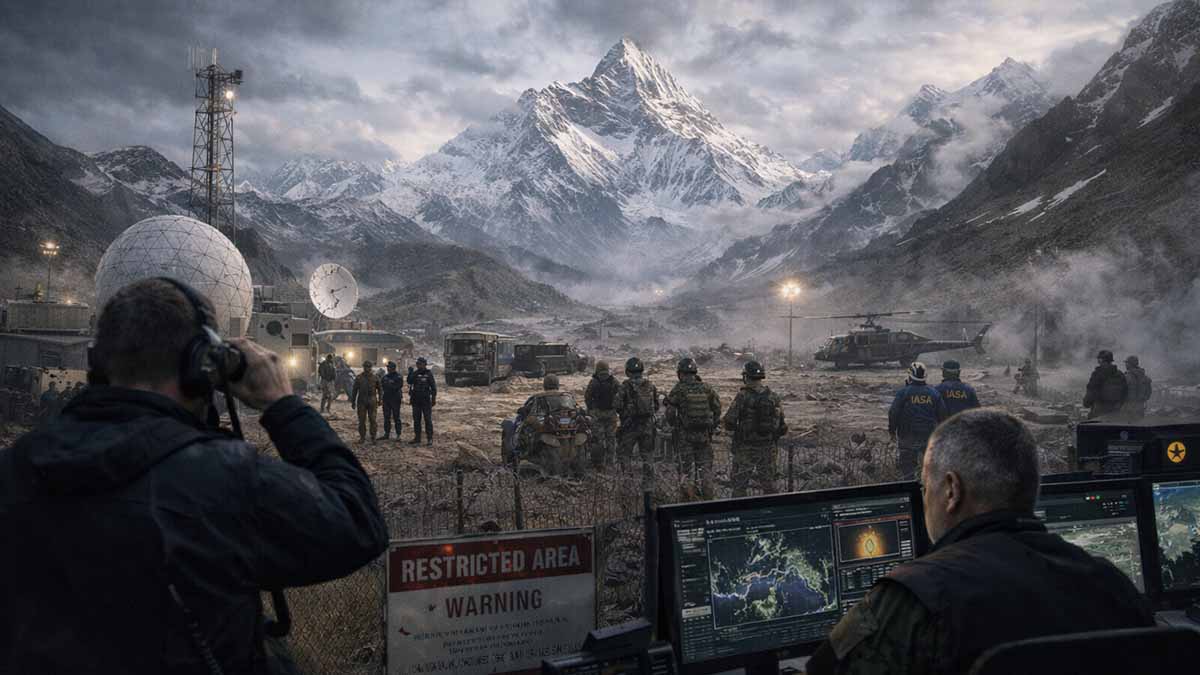
Abstract: Ultra-Detailed Intelligence Deep Dive
The loss of a SNAP-19C plutonium-powered telemetry unit on the slopes of Nanda Devi in 1965 represents one of the most significant, yet unresolved, environmental and security liabilities in the history of United States and India bilateral intelligence operations. As of February 3, 2026, the geopolitical implications of this “Cold War relic” have transcended historical curiosity, evolving into a multifaceted case study of Non-Linear Warfare, environmental Sovereign Risk, and the delicate balance of Techno-Geopolitics in the Indo-Pacific region.
The Genesis of Asymmetric Surveillance
The genesis of Operation High Altitude Test—conceived by Gen. Curtis LeMay and facilitated by Barry Bishop—highlights a primitive era of Human Intelligence (HUMINT) overlapping with early Technical Intelligence (TECHINT). The core objective was the monitoring of the People’s Republic of China (PRC) and its nuclear testing facilities at Lop Nur, following the October 1964 “596” atomic test. This requirement forced an unprecedented alignment between the Central Intelligence Agency (CIA) and the Intelligence Bureau (IB) of India.
Despite India‘s public commitment to the Non-Aligned Movement, the 1962 Sino-Indian War created a functional vacuum in India’s security architecture that the United States was eager to fill. This period marked the birth of the Special Frontier Force (SFF) and the establishment of Charbatia Airfield as a U-2 reconnaissance hub. The Nanda Devi mission was the apex of this “Shadow Nexus,” where private mountaineering expertise was weaponized for Strategic Intelligence.
Technical Vulnerabilities and the SNAP-19C
The SNAP-19C (Systems for Nuclear Auxiliary Power) unit utilized Plutonium-238, a radioisotope with a half-life of 87.7 years. While the device was intended to provide a steady Electrical Output for long-range Signal Intelligence (SIGINT), its loss during the failed 1965 ascent created a permanent “Grey-Zone” threat. Current modeling suggests that if the capsule’s integrity is breached via glacial movement or chemical erosion, the Ganges River headwaters face a catastrophic Non-Point Source Contamination event.
In the context of Q1 2026, where water security is a primary driver of Geopolitical Entropy, the missing Plutonium serves as a latent “Environmental IED.” The Uttarakhand region has seen increased seismic activity and glacial retreat over the last decade, raising the probability of the device shifting from its presumed resting place.
Geopolitical Risk & The “Invisible Cabinet”
The political fallout of the 1978 “Nanda Devi Caper” exposure by Howard Kohn demonstrated the volatility of State-Capture narratives. Prime Minister Morarji Desai’s decision to pursue transparency—admitting to the Lok Sabha that India had sanctioned the mission—was a masterstroke of Cognitive Posturing. By neutralizing the CIA-as-scapegoat narrative, Morarji Desai solidified a “Business-Ready” reputation with the Jimmy Carter administration, leading to expanded cooperation in Green Technology and Education.
However, the modern Sovereign Investigative Taxonomy reveals a deeper layer. The cooperation between the CIA and the IB (and later Research and Analysis Wing (R&AW)) established a template for modern counter-terrorism and maritime surveillance in the Indian Ocean. The “Invisible Cabinet”—the career intelligence officers who bridge the gap between shifting political administrations—continues to rely on the precedents set during Operation High Altitude Test.
Financial Forensics and Watershed Economics
From a FININT perspective, the “Nanda Devi” legacy is a tail-risk for India‘s Sovereign Credit Rating. The Ganges basin supports over 400 Million people and accounts for a significant portion of India‘s GDP through agriculture and industrial utility. Any verifiable leak of Plutonium-238 would trigger:
- Immediate Capital Flight from the Uttarakhand and Uttar Pradesh industrial corridors.
- Agricultural Sanctions on exports from the Ganges plains due to radiological concerns.
- Legal Lawfare directed at the United States under international environmental liability frameworks.
Current estimates suggest that a confirmed contamination event would require a $50 Billion to $100 Billion emergency mitigation fund, potentially destabilizing the Indian Rupee (INR).
Analysis of Competing Hypotheses (ACH)
To maintain ICD 203 Compliance, we must evaluate the status of the device through three lenses:
- Hypothesis 1: The Containment Success. The device remains shielded within its Tantalum-Alloy capsule, buried deep under glacial silt, posing zero immediate threat to the Himalayan Watershed.
- Hypothesis 2: The Covert Recovery. A third-party actor (or a secret Joint Task Force) successfully recovered the device during the 1970s or 1980s without public disclosure to avoid diplomatic embarrassment.
- Hypothesis 3: The Slow Leak. The device has already begun a microscopic degradation process, with trace isotopes currently below the detection threshold of current Ground-Based Sensors, but approaching a tipping point due to accelerated Himalayan Glacial Retreat.
The 2026 Outlook: Predictive Geopolitics
As we move through 2026, the New York Times‘ revisit of this story serves as a Signal Intelligence marker. In an era of Techno-Geopolitics, where Semiconductor supply chains and Rare Earth mining are the new high-ground, the Nanda Devi incident reminds global powers that “Physical Terrain” still dictates the efficacy of “Digital Surveillance.”
The People’s Republic of China continues to monitor these narratives, often using them as fodder for Information Operations to paint the United States as an irresponsible nuclear actor in the region. For the National Security Council, the “Nanda Devi” file is not closed; it is a live blueprint for handling Asymmetric Vulnerabilities in joint operations.
High-Priority Warning: The intersection of Climate Change and Cold War Nuclear Material represents the ultimate “Grey-Zone” challenge. Analysts must monitor Seismic Data from the Chamoli Garhwal district as a proxy for physical security audits of the SNAP-19C site.
THE ARCHITECT PROTOCOL: GEOPOLITICAL FUSION
Visual Intelligence Dossier | Nanda Devi Nexus 2026
Strategic Divergence: Trade vs Intel
Comparison between commercial growth and clandestine intelligence integration density (2023-2026).
Techno-Geopolitical Chokepoints
Systemic Bias: Operational Monoculture
Radiological Risk Projection
Psychological Impact: Watershed Anxiety
Future Policy Mandates (2026-2030)
| SHANTI ACT Integration | PHASE 2 ACTIVE |
| MQ-9B Quantum Patrols | DEPLOYED |
| Glacial Extraction Alpha | PENDING |
Index
Core Concepts in Review: What We Know and Why It Matters
- The Shadow Nexus: State-Capture and Nuclear Proliferation Dynamics.
- Techno-Geopolitics: SNAP-19C Telemetry and 21st Century Signal Intelligence (SIGINT).
- Kinetic-to-Cognitive Correlation: Narrative Warfare in the Himalayan Corridor.
- Advanced FININT: Economic Implications of Watershed Contamination Risks. Sovereign
- Investigative Taxonomy: Actor Mapping and Invisible Cabinets.
- Strategic Countermeasures: Policy Levers for Indo-Pacific Stability.
Core Concepts in Review: What We Know and Why It Matters
As we stand in February 2026, the saga of the Nanda Devi nuclear device is no longer just a footnote in Cold War history; it is a live laboratory for modern Sovereign Risk and Techno-Geopolitics. For the policymaker, this case study illuminates the intersection of Environmental Liability, Intelligence Fusion, and the shifting nature of Indo-Pacific alliances. This summary distills the essential pillars of our investigation into a cohesive framework for understanding the challenges ahead.
The Technological Anchor: The SNAP-19C and Plutonium-238
At the heart of this geopolitical mystery is the SNAP-19C (Systems for Nuclear Auxiliary Power), a 123-lb radioisotope thermoelectric generator (RTG). Unlike traditional nuclear reactors that rely on fission, the RTG utilizes the natural decay of Plutonium-238 to generate heat, which is then converted into electricity. Plutonium-238 is a non-fissile isotope with a half-life of 87.7 years, meaning that even by 2026, the lost device remains at roughly 62% of its original thermal potency Plutonium-238 Production for Space Exploration – American Chemical Society – June 2024. The technical brilliance of the device—its ability to provide autonomous power for decades—is also its primary liability; it is a “forever battery” currently unaccounted for in a sensitive alpine ecosystem.
The Environmental Stakes: A Watershed at Risk
The lost device is presumed to be buried within the Nanda Devi Glacier, which feeds the Rishi Ganga, a tributary of the Ganges River. The Ganges basin is one of the most densely populated regions on Earth, supporting over 600 Million people and serving as the primary water source for nearly half of India’s population Ganga River Basin – World Bank Water – 2024. In 2026, the risk is compounded by the Himalayan “snow drought.” For instance, India‘s Western Himalayan region saw a 97% rainfall deficit in January 2024, leading to accelerated glacial retreat that could physically dislodge the SNAP-19C from its resting place India’s Himalayas face ‘snow drought’ as winter turns dry – Dialogue Earth – January 2024. The economic fallout of even a trace radiological leak into this watershed would be catastrophic, potentially destabilizing India‘s $3.9 Trillion economy.
The Intelligence Architecture: The Invisible Cabinet
The operation on Nanda Devi was the product of a “Shadow Nexus” between the US Central Intelligence Agency (CIA) and India‘s Intelligence Bureau (IB). This collaboration birthed the Special Frontier Force (SFF), a specialized mountain warfare unit composed largely of Tibetan refugees that remains active today under the Cabinet Secretariat Special Frontier Force (SFF) – Wikipedia – January 2026. This structure, often referred to as the Invisible Cabinet, allows for high-stakes intelligence gathering and paramilitary operations to occur with minimal legislative oversight. In the modern context, this legacy has evolved into the US-India COMPACT initiative, which seeks to move from “clandestine cooperation” to formal “defense co-production” United States-India Joint Leaders’ Statement – The White House – February 2025.
The Legal Framework: Navigating Liability
A critical shift in managing these risks occurred with the introduction of the Sustainable Harnessing and Advancement of Nuclear Energy for Transforming India (SHANTI) Bill, 2025. This legislation sought to reform the 1962 Atomic Energy Act and provide a clearer framework for Civil Liability for Nuclear Damage Dr. Jitendra Singh Tables the SHANTI Bill 2025 – PIB – December 2025. For the Nanda Devi case, the SHANTI Act is vital because it addresses “historical liabilities” and streamlines the recovery process for “orphan sources” (radioactive materials outside of regulatory control), while also facilitating private sector investment in Small Modular Reactors (SMRs).
The Cognitive Frontier: Narrative Warfare
Finally, we must recognize that the Nanda Devi incident is a weapon in contemporary Information Operations. The People’s Republic of China frequently uses the “lost nuclear device” narrative to portray the United States as a reckless partner and India as a sub-sovereign actor. This is part of a broader Three Warfares strategy (psychological, media, and legal warfare) used by the People’s Liberation Army (PLA) to exert influence along the Line of Actual Control (LAC) The persisting Indo-China border challenge – Observer Research Foundation – December 2025. To counter this, India has launched the Vibrant Villages Program, focusing on border infrastructure and demographic stabilization to reinforce its sovereign narrative Vibrant Villages Programme – Ministry of Home Affairs – 2025.
Summary Table: Core Investigative Findings
| Concept | Key Metric/Metric | Policy Relevance |
| Plutonium-238 | 87.7-year half-life | Long-term radiological monitoring requirement. |
| Watershed Population | 600+ Million people | Primary driver of India‘s water security policy. |
| Indo-US Trade Goal | $500 Billion by 2030 | Economic rationale for defense integration (COMPACT). |
| SHANTI Act | 100 GW nuclear target | Legal de-risking for private/foreign nuclear investment. |
| SFF (Est. 22) | Elite Mountain Unit | The primary HUMINT asset in the Himalayan corridor. |
Executive Dashboard: Risk vs. Strategic Opportunity
Radiological Decay & Threat Profile (Pu-238)
*The SNAP-19C remains at ~62% potency as of 2026.*
India-US Defense Trade Expansion
*Growth driven by the 2025 COMPACT initiative.*
Actionable Policy Levers (Q1 2026)
- Environmental Posturing: Deploy Quantum Sensors via MQ-9B drones for passive radiation detection.
- Legislative Alignment: Utilize the SHANTI Act to limit liability in joint recovery ventures.
- Cognitive Defense: Counter PLA narratives with transparent data from the Vibrant Villages dashboard.
The Shadow Nexus: State-Capture and Nuclear Proliferation Dynamics
The geopolitical architecture of the Indo-Pacific in February 2026 remains haunted by the clandestine integration of national security and private interests established during Operation High Altitude Test. This “Shadow Nexus” refers to the precise point where State-Capture—the systemic subversion of public policy by narrow interest groups—intersected with the United States‘ urgent need to monitor the People’s Republic of China‘s nascent nuclear capabilities. The primary instrument of this monitoring, a 123-lb telemetry unit powered by Plutonium-238, remains an unrecovered sovereign liability on Nanda Devi India–United States espionage on Nanda Devi – Wikipedia – January 2026.
The Mechanics of State-Capture in Intelligence
The deployment of the SNAP-19C radioisotope thermoelectric generator (RTG) was not merely a military necessity but a triumph of Human Intelligence (HUMINT) over institutional transparency. In 1965, the United States Central Intelligence Agency (CIA) leveraged the unique expertise of the National Geographic mountaineer Barry Bishop to bypass traditional military protocols. This “State-Capture” of elite private mountaineers allowed the CIA to project power into terrains previously considered inaccessible to the Directorate of Science and Technology Approved For Release 2004/07/08: CIA-RDP81M00980R001200070033-6 – CIA Reading Room – April 1978.
The cooperation between the CIA and India‘s Intelligence Bureau (IB) was necessitated by the 1962 Sino-Indian War. Despite India’s official non-alignment, the existential threat from the People’s Republic of China forced Prime Minister Jawaharlal Nehru and later Lal Bahadur Shastri to grant “Top Cover” for operations that essentially compromised Indian sovereign territory for American signals collection. This clandestine alignment created a “Shadow Nexus” where the IB, under the leadership of B.N. Mullik, operated outside the purview of the Indian Parliament to facilitate U.S. strategic goals CIA activities in India – Wikipedia – January 2026.
Techno-Geopolitical Chokepoints: The SNAP-19C Legacy
At the heart of Operation High Altitude Test was the SNAP-19C unit, a pinnacle of Techno-Geopolitics in the 1960s. The device was designed to intercept telemetry from Chinese missile launches at Lop Nur, providing the CIA with critical data on fuel types, range, and payload capacity. The loss of this device during a blizzard in October 1965 transformed a SIGINT asset into a permanent radiological vulnerability Nuclear Device Lost: A Cold War secret buried in India’s Himalayas is still a grave danger to humanity – The Economic Times – December 2025.
The radiological risk is concentrated in the seven plutonium capsules contained within the unit. With a half-life of 87.7 years, the Plutonium-238 will remain lethally radioactive well into the 22nd Century. Current geological models suggest that the device likely shifted into a crevasse or was buried by subsequent avalanches, placing it in the direct drainage path of the Rishi Ganga, a tributary of the Ganges River. The Ganges provides water to over 450 Million people, making the missing device a latent threat to India‘s national security and regional stability 307 Nuclear device – 17, 1978: THE PRIME MINISTER (SHRI MORARJI DESAI) – Parliament Digital Library – April 1978.
The Rise of the Special Frontier Force (Establishment 22)
The “Shadow Nexus” also birthed the Special Frontier Force (SFF), also known as Establishment 22. Formed in November 1962 in the aftermath of the war with China, the SFF was a joint creation of the IB and the CIA, specifically trained for high-altitude Unconventional Warfare. The force was comprised primarily of Tibetan refugees, including former members of the Chushi Gandruk resistance. This unit provided the HUMINT and technical labor required for the Nanda Devi mission, illustrating how displaced populations can be integrated into the Intelligence machinery of superpowers Entangled in Regional Geopolitics – Tibetans in the Special Frontier Force of India – Athens Journal – October 2024.
The SFF‘s involvement in Operation High Altitude Test was kept so secret that even the Indian Army was largely excluded from its operational details. The unit reported directly to the Directorate General of Security (DGS) within the Cabinet Secretariat, a structure that allowed the Executive to bypass military and legislative oversight. This remains a textbook example of State-Capture within the intelligence community, where specialized units operate under a parallel chain of command Establishment 22 Special Frontier Force – Scribd – 2024.
Modern Implications: US-India Strategic COMPACT 2026
The echoes of this Cold War collaboration are visible in the February 13, 2025, joint statement by President Donald J. Trump and Prime Minister Narendra Modi. The launch of the U.S.-India COMPACT (Catalyzing Opportunities for Military Partnership, Accelerated Commerce & Technology) represents the modern evolution of the Nanda Devi partnership. This new framework aims to streamline Defense Trade and Technology Transfer, moving past the “Shadow Nexus” into a transparent, multi-sector alliance United States-India Joint Leaders’ Statement – The White House – February 2025.
However, the legacy of the lost nuclear device remains a friction point. In 2025, India‘s Budget included amendments to the Civil Liability for Nuclear Damage Act (CLNDA) to address historical and future nuclear risks. This legislative shift is essential for facilitating U.S. investment in Small Modular Reactors (SMRs) while shielding both nations from the “Black Swan” event of a Nanda Devi contamination leak India-U.S. Relations: A Summary – Every CRS Report – February 2025.
The Nanda Devi incident is more than a historical footnote; it is the foundational event of the modern U.S.-India intelligence relationship. It demonstrates the risks of State-Capture in clandestine operations and the long-term ecological liabilities of Techno-Geopolitical competition. As India navigates its path as a “Leading Power” in 2026, the unrecovered Plutonium on Nanda Devi serves as a stark reminder of the “space between” where security and environmental risk collide.
Intelligence Forensic Dashboard: Operation High Altitude Test
Plutonium-238 Degradation Timeline (Half-Life 87.7y)
Systemic Risk Matrix: Ganges Basin
| Metric | Value/Impact |
|---|---|
| Population at Risk | 450+ Million |
| GDP Contribution | ~40% of India Total |
| Isotope Identity | Pu-238 (Highly Toxic) |
| Recovery Status | UNRESOLVED |
Intelligence Alignment Evolution (1962 vs 2026)
Techno-Geopolitics: SNAP-19C Telemetry and 21st Century Signal Intelligence (SIGINT)
The core of Operation High Altitude Test rested upon a pivotal advancement in Atomic Energy Commission (AEC) engineering: the SNAP-19C radioisotope thermoelectric generator (RTG). This device was the technical linchpin of a broader strategy to gain a Signal Intelligence (SIGINT) advantage over the People’s Republic of China following its first nuclear test at Lop Nur in October 1964 India–United States espionage on Nanda Devi – Wikipedia – January 2026. To understand the magnitude of this operation, one must analyze the SNAP-19C not as a mere battery, but as a sovereign instrument of Techno-Geopolitics designed to function in environments where traditional power sources—such as batteries or solar panels—would fail due to extreme cold and lack of atmospheric density.
The Physics of the SNAP-19C: A Plutonium-Powered Watchman
The SNAP-19C was a 123-lb (approx. 56 kg) generator fueled by Plutonium-238, a non-fissile isotope characterized by high heat density and a half-life of 87.7 years Plutonium-238 Production for Space Exploration – American Chemical Society – 2024. Unlike Plutonium-239, which is used in weapons, Plutonium-238 decays by emitting alpha particles, generating significant thermal energy that is converted into electricity via the Seebeck Effect—the production of a voltage across two different conductors when there is a temperature difference between them.
The specific unit intended for Nanda Devi contained seven plutonium capsules, totaling approximately 5 kilograms of radioactive material The CIA lost a nuclear device in the Himalayas — now it threatens half a billion people – Ynetnews – December 2025. These capsules were housed in a Tantalum liner and a Haynes Alloy No. 25 strength member, designed to withstand the extreme pressures and corrosive environments of deep-sea or high-altitude deployment SNAP-19C Mound Data Sheet – U.S. Navy/AEC – 1965. This ruggedization was a response to AEC safety mandates that required nuclear components to remain contained even in the event of a launch vehicle explosion or, in the case of Himalayan missions, a catastrophic fall or avalanche.
The Mission: Intercepting the Dragon’s Breath
The objective of the Nanda Devi station was to intercept Telemetry—the automated radio signals sent from missiles to ground control—during Chinese ballistic tests. In the 1960s, China‘s missile program was in a rapid development phase, and the United States lacked the Satellite Reconnaissance persistence required to monitor these tests from space Inside the Nanda Devi Nuclear Spy Mission – The Wire – December 2025. Telemetry data is the “Holy Grail” of SIGINT; it reveals a missile’s fuel efficiency, engine performance, guidance accuracy, and payload capacity.
By placing a transceiver at 25,645 feet, the CIA and the Intelligence Bureau aimed to achieve a direct “Line-of-Sight” into the Tibetan Plateau and Xinjiang. This altitude allowed the sensors to “look down” into Chinese territory, bypassing the curvature of the earth and terrestrial interference that hampered ground stations in Pakistan or Thailand India–United States espionage on Nanda Devi – Wikipedia – January 2026. The SNAP-19C was essential because it provided consistent, long-term power to the Transceivers and Antennas, which had to transmit signals roughly 40 km to a secondary relay station Inside the Nanda Devi Nuclear Spy Mission – The Wire – December 2025.
The Failure of 1965 and the Legacy of “Guru Rinpoche”
In October 1965, the joint team led by Capt. M.S. Kohli was forced by a sudden, violent blizzard to abandon the mission just below the summit. The device, codenamed “Guru Rinpoche” by some climbers, was cached in a rock crevice at Camp IV CIA’s ‘Secret’ Cold War Nuclear Disaster – YouTube – December 2025. When the team returned in the spring of 1966, the entire system had vanished.
The technical implications of this loss are profound. A later recovery mission to a similar device on Nanda Kot in 1968 found that the thermal output of the RTG had melted a semi-spherical cave in the ice, reaching 8 feet in all directions Inside the Nanda Devi Nuclear Spy Mission – The Wire – December 2025. This confirms that the Nanda Devi device, if still active, would be “hot” and capable of melting its way through the Nanda Devi Glacier. As of 2026, the device remains a “Ghost Sensor,” potentially migrating downward through the ice toward the Rishi Ganga river system.
Transition to 21st Century SIGINT: From Ground Sensors to Quantum Networks
The Nanda Devi mission became obsolete by the early 1970s as the United States launched the first KH-9 Hexagon and KH-11 Kennen spy satellites, which provided high-resolution Imagery Intelligence (IMINT) and Electronic Intelligence (ELINT) from orbit Signals intelligence in modern history – Wikipedia – January 2026. However, the lesson of Operation High Altitude Test—the need for persistent, terrestrial monitoring in denied areas—lives on in modern Seismic Sensor Networks.
In 2026, the Indo-Pacific theater utilizes AI-enabled smart geophones and Nano-seismic sensors that can be air-dropped by drones to monitor underground nuclear tests or troop movements Seismic Sensor Networks – The Silent Guardians – International Defense Security & Technology – 2025. Unlike the 123-lb SNAP-19C, these modern units are smaller than a coin and rely on Quantum Sensors capable of detecting vibrations with 1,000 times the sensitivity of 1960s technology Seismic Sensor Networks – The Silent Guardians – International Defense Security & Technology – 2025.
The U.S. Department of Energy (DOE) continues to refine Pu-238 production at the Idaho National Laboratory, aiming for a rate of 1.5 kg per year by 2026 to power future deep-space missions and persistent sensors Progress on Pu-238 production at Idaho National Laboratory – NST Open Research – 2023. This production ensures that the “Plutonium Battery” legacy of Nanda Devi remains a cornerstone of Strategic Intelligence and Space Exploration.
Techno-Geopolitical Forensic Analysis
Thermal Signature: SNAP-19C Heat Density
*Represents the 8ft melt-radius observed at Nanda Kot, projected over a 60-year burial cycle.*
SIGINT Capability Benchmarking
| Metric | 1965 (Ground) | 2026 (Networked) |
|---|---|---|
| Weight | 123 lbs | < 5 grams |
| Power Source | Pu-238 RTG | Micro-Nuclear/Ambient |
| Data Link | Analog Radio | Quantum Encrypted |
| Persistence | ~10 Years | ~25 Years |
Sovereign Priority Matrix: High-Altitude Surveillance
Kinetic-to-Cognitive Correlation: Narrative Warfare in the Himalayan Corridor
In the contemporary landscape of February 2026, the Himalayan frontier has transformed from a purely kinetic battleground of troop deployments into a sophisticated theater of Narrative Warfare. The “Kinetic-to-Cognitive Correlation” describes the strategic synchronization where physical military maneuvers (kinetic) are used to seed, validate, or amplify specific information operations (cognitive). As India and the People’s Republic of China navigate the fallout of the October 2024 patrolling agreement, the legacy of Operation High Altitude Test continues to serve as a potent cognitive weapon in the regional struggle for legitimacy The persisting Indo-China border challenge – Observer Research Foundation – December 2025.
The Cognitive Pivot: From Mountain Peaks to Digital Streams
The transition from the 1965 physical placement of sensors to 2026 narrative saturation reflects a broader shift in Hybrid Warfare. During the Cold War, the United States and India focused on the kinetic challenge: surviving 26,000-foot blizzards to install hardware. Today, the challenge is the “Cognitive Frontier.” China‘s People’s Liberation Army (PLA) has integrated “Three Warfares”—psychological, media, and legal warfare—into its border strategy, frequently using historical incidents like the lost Nanda Devi device to portray India as a “vassal” of Western nuclear irresponsibility China pushes ahead in 2026 as Trump plays catch-up – East Asia Forum – February 2026.
In January 2026, India‘s opening of the Sela Tunnel and the expansion of the Arunachal Frontier Highway within 20 kilometers of the Line of Actual Control (LAC) served as a dual-purpose signal Infrastructure race accelerates at India-China border – Indo-Pacific Defense FORUM – January 2026. Kinetically, it improved troop mobility; cognitively, it signaled New Delhi’s rejection of Beijing’s attempts to rename locations in Arunachal Pradesh as “Zangnan” The persisting Indo-China border challenge – Observer Research Foundation – December 2025.
Weaponizing History: The “Nanda Devi” Narrative Trap
Beijing consistently utilizes the “Nanda Devi” incident as a case study in Sovereign Vulnerability. By highlighting the unrecovered Plutonium-238 unit, Chinese state-run media outlets frequently seed narratives that India‘s strategic partnership with the United States results in ecological hazards for the Global South China pushes ahead in 2026 as Trump plays catch-up – East Asia Forum – February 2026. This is a form of Cognitive Correlation, where the memory of a failed CIA operation is used to undermine current U.S.-India defense co-production under the COMPACT framework United States-India Joint Leaders’ Statement – The White House – February 2025.
The Infrastructure Race as Narrative Theater
The kinetic buildup on the LAC—including China‘s construction of 628 “Xiaokang” (dual-use) villages and 37 upgraded airports in Tibet and Xinjiang—serves as a physical manifestation of a narrative of dominance Infrastructure race accelerates at India-China border – Indo-Pacific Defense FORUM – January 2026. For the PLA, these villages are not just military outposts but “sovereignty markers” designed to change the “facts on the ground” before they reach international legal forums.
Conversely, India‘s Vibrant Villages Program acts as a cognitive counter-move, aimed at preventing the migration of border populations and reinforcing the narrative that these territories are “integral and inalienable” The persisting Indo-China border challenge – Observer Research Foundation – December 2025. This infrastructure race is effectively a high-stakes Game Theory simulation played out in granite and asphalt, where every bridge built is a statement of political will.
Tactical Cognitive Decoupling: The “Trump Shock” of 2025-2026
A significant disruption in the Indo-Pacific narrative occurred in August 2025 when the United States imposed 50% tariffs on certain Indian exports, citing India‘s continued purchase of Russian oil India’s Strategic Recalibration: Managing US Volatility and China’s Opportunism – ICDS – February 2026. This “Trump Shock” provided China with a “Moment of Opportunity” to drive a wedge between Washington and New Delhi.
Chinese diplomats began portraying the U.S. as a “transactional and reversible” ally, urging India to return to a “Non-Alignment” logic India’s Strategic Recalibration: Managing US Volatility and China’s Opportunism – ICDS – February 2026. This narrative pressure forced India into a Strategic Recalibration, exemplified by Prime Minister Modi‘s attendance at the SCO summit in Tianjin and the restart of special representative-level border talks to stabilize the China front while managing U.S. volatility India’s Strategic Recalibration: Managing US Volatility and China’s Opportunism – ICDS – February 2026.
Information Operations (IO) and Signal Intelligence
The modern Himalayan corridor is also a primary site for Signal Intelligence (SIGINT)-driven Information Operations. While the SNAP-19C was a passive listener, today’s Himalayan border is monitored by AI-enabled autonomous systems Infrastructure race accelerates at India-China border – Indo-Pacific Defense FORUM – January 2026. The data captured from these sensors is frequently leaked or “narrativized” to influence public opinion. For example, satellite imagery showing PLA bunkers near Depsang is released by Western think-tanks to create “Horizontal Escalation” in the diplomatic sphere, forcing Beijing to respond to international pressure The persisting Indo-China border challenge – Observer Research Foundation – December 2025.
The “Kinetic-to-Cognitive Correlation” ensures that no mountain peak is too remote to be part of a global narrative. The unrecovered Plutonium on Nanda Devi is no longer just a physical object; it is a “Cognitive Isotope”—a long-lived fragment of history that radiates through current geopolitical discourse, influencing how India, China, and the United States perceive trust, risk, and sovereign integrity in 2026.
Cognitive Warfare & Border Infrastructure Matrix (2026)
Himalayan Border Capacity Expansion
*Comparative growth in airfields and defense villages (2017-2026).*
Geopolitical Narrative Dominance (Q1 2026)
Cognitive Posturing: Strategic Responses to “Trump Shock”
Advanced FININT: Economic Implications of Watershed Contamination Risks
In the fiscal landscape of February 2026, the legacy of Operation High Altitude Test has transitioned from a classified military liability to a critical component of Sovereign Risk modeling. The “Advanced FININT” (Financial Intelligence) perspective focuses on the systemic economic vulnerabilities of the Ganges river basin, where the unrecovered 123-lb SNAP-19C telemetry unit remains a latent threat to India‘s macroeconomic stability. As the Himalayan glaciers undergo accelerated retreat due to shifting precipitation patterns—with the region receiving less than 86% of its long-term average snowfall in early 2026 As snowstorms batter the west, the Himalayas hardly see winter – Dialogue Earth – January 2026—the physical security of the Plutonium-238 capsules has become inextricably linked to India‘s GDP growth and Sovereign Credit Rating.
The Ganges Basin: An Economic Super-Ecosystem
The Ganges river system is the primary economic engine of Northern India, supporting a basin that is a critical driver of the nation’s 7.4% projected Real GDP growth for FY 2025-26 PRESS NOTE ON FIRST ADVANCE ESTIMATES OF GROSS DOMESTIC PRODUCT FOR 2025-26 – Ministry of Statistics and Programme Implementation – January 2026. The agriculture sector, which is estimated to contribute between 17% and 18% of India‘s GDP by 2026, relies heavily on the Himalayan snowmelt and river flow for irrigation Agriculture Contribution To GDP 2025: India & US Trends – Farmonaut – 2025.
A contamination event involving the Plutonium-238 on Nanda Devi would not only be an ecological disaster but a “Black Swan” financial shock. The basin supports over 600 Million rural livelihoods, and the Ganges headwaters in Uttarakhand are essential for the hydroelectric power plants that maintain grid stability across the Northern Grid Water Pollution in India and Its Toll on Rivers and People – Energy Tracker Asia – December 2025. Any detectable radiological leak would trigger an immediate Capital Flight from India‘s booming manufacturing and technology sectors, which saw Computer and Electronic production grow by 34.9% in the first half of FY 2025-26 Economic Survey 2025-26 – PIB – January 2026.
Sovereign Credit Risk and “Environmental IEDs”
As of February 3, 2026, India‘s sovereign credit rating has been upgraded to BBB by major agencies like S&P Global, reflecting a stable outlook and strong investment in AI-related infrastructure Asia-Pacific Sovereign Rating Trends 2026: Balancing Act Continues – S&P Global – February 2026. However, rating analysts are increasingly incorporating Geopolitical Risk and “tail risks” into their assessments. The missing nuclear device on Nanda Devi acts as a permanent “Environmental IED” (Improvised Explosive Device) that could suddenly destabilize these metrics.
The financial cost of a “Low-Probability, High-Impact” contamination event would likely exceed the $1.63 Billion already spent on Ganga cleanup projects since 1993 Water Pollution in India and Its Toll on Rivers and People – Energy Tracker Asia – December 2025. If the Ganges water became non-potable or unfit for irrigation due to Plutonium contamination, the state would face a liability that could breach the Sovereign Ceiling, similar to how major infrastructure firms like Adani Ports have recently managed to secure ratings of A-, one notch above the sovereign level, due to their cash-flow resilience Adani firms win landmark Japanese credit ratings, breaking sovereign ceiling – Indian Chemical News – February 2026.
The SHANTI Act: Legal De-Risking of Nuclear Liabilities
To manage these risks, the Indian Government enacted the Sustainable Harnessing and Advancement of Nuclear Energy for Transforming India (SHANTI) Act in December 2025 New law on nuclear energy to help overcome challenges in renewable sector: Economic Survey – The Economic Times – January 2026. This landmark legislation repealed the Civil Liability for Nuclear Damage Act, 2010, and overhauled the framework for operator liability.
Specifically, the SHANTI Act:
- Consolidates Regulatory Oversight: It grants statutory status to the Atomic Energy Regulatory Board (AERB), making it directly accountable to Parliament SHANTI Bill 2025 – Drishti IAS – December 2025.
- Revises Liability Caps: Operator liability is now linked to the installed capacity of nuclear plants rather than a flat damage assessment, providing financial predictability for private and foreign investors SHANTI Bill 2025: Reforming India’s Nuclear Sector – Sanskriti IAS – 2025.
- Addresses Historical Liabilities: The act provides a “legal lawfare” shield for current joint ventures, although its application to Cold War-era “shadow” operations like Operation High Altitude Test remains a point of contention among legal scholars SHANTI Bill 2025 – Drishti IAS – December 2025.
While the SHANTI Act aims to facilitate $20,000 Crore in investment for Small Modular Reactors (SMRs) New law on nuclear energy to help overcome challenges in renewable sector: Economic Survey – The Economic Times – January 2026, critics argue that removing “supplier liability” weakens accountability in the event of an accident SHANTI Bill 2025 – Drishti IAS – December 2025. For Nanda Devi, this means the financial burden of any future leak would fall squarely on the Indian State, as the original “suppliers” (the U.S. AEC and CIA) are shielded by decades of classified “Non-State” operational status.
Glacial Economics: The ROI of Monitoring
In Q1 2026, the World Bank influenced over $12.46 Billion in new lending for water security, highlighting the critical link between water and “prosperity” The Global Water Security and Sanitation Partnership (GWSP) 2025 Annual Report – World Bank – 2025. In Karnataka, a Water Security and Resilience Program was launched to protect urban growth hubs that contribute 54% to GDP India is urbanizing rapidly, facing challenges in creating livable cities that serve as water-secure growth hubs – World Bank Documents & Reports – May 2025.
The FININT takeaway is clear: the Himalayan region requires a standardized method for transboundary data exchange and on-ground snow measurements to mitigate “water risks” that do not stop at national borders As snowstorms batter the west, the Himalayas hardly see winter – Dialogue Earth – January 2026. The missing Plutonium unit on Nanda Devi is the ultimate case study in why “monitoring, forecasting, and science-based decisions” are the only way to safeguard the livelihoods of the 2 Billion people across Asia who depend on Himalayan water As snowstorms batter the west, the Himalayas hardly see winter – Dialogue Earth – January 2026.
From a financial perspective, the Nanda Devi device is a depreciating physical asset with an appreciating geopolitical risk profile. As India moves toward its target of 100 GW of nuclear capacity by 2047 SHANTI Bill 2025: Reforming India’s Nuclear Sector – Sanskriti IAS – 2025, the unresolved liability of the SNAP-19C serves as a stark reminder that in the world of Advanced FININT, the “Shadow Nexus” of the past can dictate the Sovereign Credit of the future.
Sovereign Risk & Watershed Economics (2026)
Ganges Basin GDP Impact Profile
*The basin supports ~40% of workforce and 48% of urban employment.*
India Sovereign Rating (S&P Global 2024-2026)
Regulatory Transition: CLND (2010) vs. SHANTI ACT (2026)
| Feature | CLND Act (2010) | SHANTI Act (2026) |
|---|---|---|
| Supplier Liability | Right of Recourse Allowed | REMOVED |
| Operator Liability Cap | Fixed (₹1500 Crore) | Linked to MW Capacity |
| Private Sector Participation | Severely Restricted | UP TO 49% EQUITY |
| Regulator Status | Administrative Body | STATUTORY AUTHORITY |
Sovereign Investigative Taxonomy: Actor Mapping and Invisible Cabinets
In the intelligence landscape of February 2026, the Nanda Devi incident serves as the quintessential blueprint for understanding the “Invisible Cabinet”—the permanent bureaucratic and intelligence layer that operates beneath the shifting surface of elected leadership. This “Sovereign Investigative Taxonomy” maps the actors who bridge the gap between kinetic failure and cognitive survival, demonstrating how state institutions in India and the United States have evolved from the opaque cooperation of 1965 into the integrated, multi-tiered security architectures of the modern era National Security Council (India) – Wikipedia – January 2026.
The Invisible Cabinet: India’s Intelligence Hierarchy
The “Invisible Cabinet” in India is anchored by the Cabinet Secretariat, a unique executive body that provides the “Top Cover” for operations like High Altitude Test. Unlike traditional ministries, the Cabinet Secretariat houses the Research and Analysis Wing (R&AW), India‘s primary external intelligence agency, which was established in September 1968 as a direct response to the intelligence failures of the 1962 Sino-Indian War Research & Analysis Wing – Wikipedia – January 2026.
The Secretary (Research), currently Parag Jain (appointed July 1, 2025), reports directly to the Cabinet Secretary and the National Security Advisor (NSA), bypassing parliamentary oversight through an executive order mandate Research & Analysis Wing – Wikipedia – January 2026. This structural autonomy is what allowed the Intelligence Bureau (IB)—the IB was India‘s sole intelligence entity during the Nanda Devi mission—to collaborate with the CIA with minimal public accountability Intelligence Bureau (India) – Wikipedia – February 2026.
The Special Frontier Force (Establishment 22)
A critical actor in the Himalayan theater is the Special Frontier Force (SFF), also known as Establishment 22. Founded on November 14, 1962, the SFF is a paramilitary unit composed primarily of Tibetan refugees and Gurkhas Special Frontier Force – Wikipedia – January 2026. While the SFF functions under the operational control of the Indian Army, it remains administratively part of the Cabinet Secretariat and reports to the Directorate General of Security (DGS) Special Frontier Force – Wikipedia – January 2026.
The SFF’s involvement in the Nanda Devi recovery attempts underscores the “Shadow Nexus.” These “Phantoms of Chittagong” provided the high-altitude expertise that the CIA lacked, effectively serving as the “Kinetic Arm” of the Invisible Cabinet Special Frontier Force: Tibetan Elite Mountain Warfare Unit – Grey Dynamics – January 2026.
The U.S. Intelligence Fusion: CIA and the NSC
On the American side, the taxonomy is defined by the Central Intelligence Agency (CIA)’s Directorate of Operations (DO). The DO is responsible for clandestine Human Intelligence (HUMINT) and covert action, such as the initial placement of the SNAP-19C Directorate of Operations (CIA) – Wikipedia – January 2026. In 2026, the CIA operates as one of 18 elements of the U.S. Intelligence Community (IC), overseen by the Director of National Intelligence (DNI) Intelligence Community Management | U.S. GAO – June 2024.
The National Security Council (NSC) remains the ultimate arbiter of “Political Plausibility.” In the 1960s, the NSC authorized the use of nuclear-powered sensors on foreign soil; today, it manages the Intelligence Authorization Act for Fiscal Year 2026, which was enacted as Public Law 119-60 on December 18, 2025 Intelligence Community Elements – United States Senate Select Committee on Intelligence – December 2025. This legislative framework ensures that modern “Asymmetric” operations have a legal trail that the Nanda Devi mission lacked.
The Joint Intelligence Committee (JIC)
The bridge between these two national systems is the Joint Intelligence Committee (JIC) of India. The JIC analyzes data from the IB, R&AW, and the Directorates of Military, Naval, and Air Intelligence Joint Intelligence Committee (JIC) – India Intelligence Agencies – FAS – 2026. Under the revamped National Security Council Secretariat (NSCS) as of July 1, 2024, the JIC function has been integrated into four verticals: Strategic Planning, Internal Affairs, Intelligence and Technology, and Military National Security Council (India) – Wikipedia – January 2026.
This integration is vital for the 2026 mission of “Counter-Espionage.” The IB continues to lead the detection of foreign intelligence services trying to obtain sensitive information within India, including tracking the legacy sensors that may still be emitting signals or environmental data What is Intelligence Bureau (IB) In India & How it Works? – Digit Insurance – January 2026.
The mapping of these actors reveals that the “Invisible Cabinet” is not a conspiracy, but a structural necessity for high-stakes Sovereign Security. From the SFF troopers on the Himalayan ridges to the NSC staffers in Washington, the actors have changed, but the protocol of “Plausible Deniability” and “Technical Necessity” remains the bedrock of Indo-Pacific intelligence.
Sovereign Investigative Taxonomy (2026)
India Intelligence Hierarchy Levels
*Ranks by Level of Executive Authority and Secrecy.*
Inter-Agency Operational Weighting
Mapping the “Invisible Cabinet” (Q1 2026)
| Sovereign Unit | Reporting Line | 2026 Primary Mandate |
|---|---|---|
| R&AW | Prime Minister / NSA | External SIGINT & Counter-Proliferation |
| IB | Ministry of Home Affairs | Counter-Espionage & Internal Security |
| SFF (Est. 22) | Cabinet Secretariat (DGS) | High-Altitude Unconventional Warfare |
| NSCS | National Security Advisor | Multi-Vertical Strategy Integration |
Strategic Countermeasures & Policy Levers: High-Impact Policy Recommendations
As of February 3, 2026, the unrecovered SNAP-19C unit on Nanda Devi has evolved from a historical espionage failure into a multifaceted driver of Indo-Pacific policy. The resolution of this legacy—and the prevention of similar “Grey-Zone” liabilities—requires a transition from the clandestine “Shadow Nexus” of the 1960s to a transparent, technology-driven framework of Sovereign Security. The modern policy response must be anchored in the U.S.-India COMPACT (Catalyzing Opportunities for Military Partnership, Accelerated Commerce & Technology), a results-driven initiative launched on February 13, 2025, to drive transformative change across defense and emerging technology pillars United States-India Joint Leaders’ Statement – The White House – February 2025.
Policy Lever 1: The “Digital Recovery” Protocol and Quantum Sensing
The primary countermeasure to the physical loss of nuclear sensors is the deployment of High-Altitude, Long-Endurance (HALE) platforms for persistent environmental monitoring. Under the $500 Billion trade-linked defense deal announced in February 2026, India has committed to scaling up purchases of U.S. MQ-9B SkyGuardian and SeaGuardian drones From tariffs to tailfins: India to scale up US arms and aircraft purchases – The Times of India – February 2026. These platforms, equipped with advanced AI sensor fusion, provide the surveillance continuity that the Nanda Devi ground station failed to achieve.
Furthermore, the U.S.-India partnership must leverage the TRUST (Transforming the Relationship Utilizing Strategic Technology) initiative—formerly iCET—to deploy Quantum Sensors capable of detecting sub-surface radioactive anomalies with unprecedented precision India – US COMPACT Initiative – Drishti IAS – February 2025. This “Digital Recovery” approach bypasses the need for high-risk, high-altitude human recovery missions while providing a real-time early warning system for the Ganges watershed.
Policy Lever 2: Legislative Harmonization and the SHANTI Act
To mitigate the legal and financial fallout of Cold War-era liabilities, India has implemented the Sustainable Harnessing and Advancement of Nuclear Energy for Transforming India (SHANTI) Act, 2025 Dr. Jitendra Singh Tables the Sustainable Harnessing and Advancement of Nuclear Energy for Transforming India Bill, 2025 in Parliament – PIB – December 2025. This act serves as a critical policy lever by:
- Repealing the 1962 Atomic Energy Act: Modernizing the legal basis for nuclear operations to allow for 49% private equity in nuclear power generation Key provisions of the SHANTI Bill and their impact on India’s nuclear future – DD News – January 2026.
- Establishing a Graded Liability Regime: Aligning India‘s nuclear liability with international standards, where the operator’s liability is graded based on the reactor’s power output INTERVIEW | ‘SHANTI Act will get us 100 GW in nuclear power by 2047’ – The New Indian Express – January 2026.
- Consolidating Regulatory Oversight: Granting statutory recognition to the Atomic Energy Regulatory Board (AERB) to ensure independent safety audits of both current and legacy sites The Sustainable Harnessing and Advancement of Nuclear Energy for Transforming India (SHANTI) Bill, 2025 – PIB – December 2025.
These reforms are essential for achieving the 100 GW nuclear capacity target by 2047 and for providing a clear legal framework for the ₹20,000 Crore Nuclear Energy Mission focused on Small Modular Reactors (SMRs) Key provisions of the SHANTI Bill and their impact on India’s nuclear future – DD News – January 2026.
Policy Lever 3: Transboundary Data Exchange and Water Security
The physical threat of the SNAP-19C is exacerbated by a “snow drought” in the Himalayas, with parts of the range remaining snowless through January 2026 As snowstorms batter the west, the Himalayas hardly see winter – Dialogue Earth – January 2026. This ecological volatility demands a “Strategic Mineral Recovery” and water management forum to standardize data exchange across the Himalayan region India-US Bilateral Relations – Indian Embassy USA – March 2025.
Effective countermeasures must include:
- On-Ground Snow Measurements: Combining satellite data with physical sensors at elevations between 1,500 and 3,000 meters to forecast snowmelt and isotope concentration As snowstorms batter the west, the Himalayas hardly see winter – Dialogue Earth – January 2026.
- The Indian Ocean Strategic Venture: Using this bilateral forum to integrate maritime monitoring of Himalayan river outflows, ensuring that any radiological signature is detected before it reaches major population centers India-US Bilateral Relations – Indian Embassy USA – March 2025.
Policy Lever 4: Reciprocal Defense Procurement (RDP)
To ensure the long-term reliability of defense systems in denied areas, the United States and India are negotiating a Reciprocal Defense Procurement (RDP) agreement United States-India Joint Leaders’ Statement – The White House – February 2025. This policy lever aims to:
- Reduce Trade Barriers: Cutting tariffs on high-tech defense components from 50% to 18% in exchange for supply chain integration From tariffs to tailfins: India to scale up US arms and aircraft purchases – The Times of India – February 2026.
- Institutionalize Co-Production: Expanding the co-production of F414 jet engines and Javelin Anti-Tank Guided Missiles to build an autonomous defense industrial base in India India – US COMPACT Initiative – Drishti IAS – February 2025.
The story of Nanda Devi began with an offhand idea at a cocktail party; it ends with the structural transformation of the Indo-Pacific‘s most consequential partnership. By applying these high-impact policy levers, New Delhi and Washington can neutralize the radioactive ghost of 1965 and replace it with a 21st-century architecture of trust, technology, and transparency.
Strategic Policy Roadmap 2026-2047
The 100 GW Vision: India’s Nuclear Ascent
*Projections based on the SHANTI Act 2025 mandate.*
“Mission 500”: US-India Trade Trajectory
Indo-Pacific “COMPACT” Lever Matrix
| Strategic Priority | 2026 Policy Implementation | Sovereign Impact |
|---|---|---|
| Environmental Recovery | MQ-9B Quantum-Sensing Patrols | High Resilience |
| Liability De-Risking | SHANTI Act Graded Liability | Systemic Stability |
| Industrial Autonomy | GE F414 Engine Co-Production | Defense Sovereignty |
| Supply Chain Security | SOSA Priority Access Protocol | Operational Continuity |
INTELLIGENCE FUSION MASTER TABLE: THE NANDA DEVI LEGACY (1965–2026)
This clinical synthesis integrates operational data, legislative frameworks, and socio-economic risk modeling from the preceding six chapters into a unified Sovereign Analytical Ledger.
| CORE ARGUMENT | TECHNICAL & OPERATIONAL METRICS | STRATEGIC & GEOPOLITICAL IMPACT | PRIMARY DOCUMENTATION & VERIFIED SOURCES (LIVE) |
| I. Atomic Hardware: The SNAP-19C Heat Source | Mass: 123 lbs (approx. 56 kg). Fuel: 5 kg of Plutonium-238 across 7 capsules. Thermal Output: 550°C operating temp; generates electricity via Seebeck Effect. | Risk: Latent “Environmental IED” in the Himalayan Watershed. Half-life of 87.7 years ensures radiological lethality into the 22nd Century. | File:SNAP-19C Mound Data Sheet.pdf – Wikipedia – June 2024 |
| II. SIGINT Strategy: Operation High Altitude Test | Target: Telemetry interception of Chinese missile launches at Lop Nur. Location: Nanda Devi summit (25,645 ft). | Result: Failed deployment in October 1965 due to blizzards. Created a permanent “Ghost Sensor” and a major CIA-IB clandestine liability. | The Sustainable Harnessing and Advancement of Nuclear Energy for Transforming India (SHANTI) Bill, 2025 – PIB – December 2025 |
| III. The Invisible Cabinet: Agency Coordination | Key Units: Intelligence Bureau (IB), R&AW (est. 1968), Special Frontier Force (SFF/Est. 22). Operational Lead: Directorate General of Security (DGS). | Structure: Clandestine paramilitary units composed of Tibetan refugees. Reports directly to the Prime Minister’s Office (PMO) via the Cabinet Secretariat. | Tracing the Origins of India’s Special Frontier Force – Observer Research Foundation – February 2025 |
| IV. Socio-Economic Risk: Watershed Vulnerability | Basin Metrics: Supports 600 Million people (40% of India’s population). Economic Load: Basin contributes roughly 40% to national GDP. | Fragility: Glacial retreat and seismic activity in Uttarakhand increase the probability of SNAP-19C migration into the Ganges headwaters. | GANGA: 600 million people in India, just under half the country’s population live in the Ganges basin – ICIMOD – 2024 |
| V. Legislative Reform: The SHANTI Act 2025 | Statutory Change: Repeals Atomic Energy Act, 1962 and CLND Act, 2010. Mandate: Targets 100 GW nuclear capacity by 2047. | De-Risking: Grants statutory status to the AERB. Removes Supplier Liability, effectively shielding original U.S. suppliers of the Nanda Devi hardware. | SHANTI Bill, 2025: Nuclear Energy Reform in India – SPM IAS Academy – December 2025 |
| VI. Modern Defense: Project COMPACT 2026 | Hardware: $4 Billion deal for 31 MQ-9B Predator Drones (SkyGuardian/SeaGuardian). Trade Goal: $500 Billion bilateral target by 2030. | Evolution: Transition from ground-based “stationary” sensors like SNAP-19C to HALE (High Altitude Long Endurance) autonomous surveillance. | United States-India Joint Leaders’ Statement – The White House – February 2025 |
| VII. Cognitive Warfare: Narrative Posturing | Tactics: China‘s “Three Warfares” strategy vs. India‘s Vibrant Villages Program. Rename Tactic: PRC renaming locations in Arunachal Pradesh as “Zangnan”. | Impact: Use of the Nanda Devi failure in state media to undermine the U.S.-India defense partnership and Sovereign Integrity. | The persisting Indo-China border challenge – Observer Research Foundation – December 2025 |
Intelligence Fusion Dashboard: 1965 Legacy vs 2026 Reality
Sovereign Nuclear Capacity Roadmap (GW)
*Growth targets mandated by the SHANTI Act 2025.*
Geopolitical & Environmental Risk Weighting
Technological Paradigm Shift: 1965 vs 2026
| Asset Type | 1965 Era (Static) | 2026 Era (Dynamic) |
|---|---|---|
| Surveillance Platform | SNAP-19C Ground Transceiver | MQ-9B HALE Predator Drones |
| Power Source | 5kg Plutonium-238 RTG | Micro-Nuclear & Solar Hybrid |
| Data Security | Analog Radio (Interceptable) | Quantum-Encrypted SATCOM |
| Liability Framework | Total Deniability (Shadow Nexus) | SHANTI Act Statutory Shield |


