










ABSTRACT — FORENSIC IMMERSION BRIEF
Day 4 — 03 March 2026, 18:00 CET
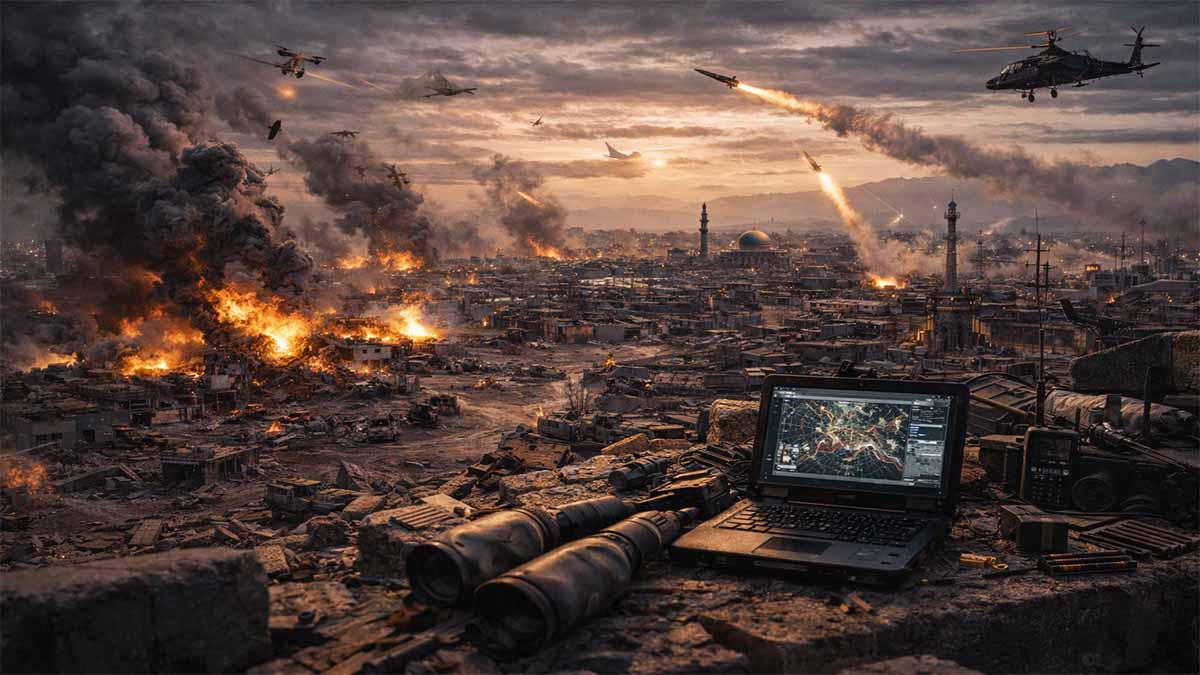
What transpired in the predawn hours above Qom today is without modern precedent. Israel struck the compound of Iran’s Assembly of Experts in the holy city of Qom on Tuesday, targeting the 88-member body as it was convening to select a successor to Supreme Leader Ayatollah Ali Khamenei, who was killed in US-Israeli airstrikes on Saturday. Morocco World News The geopolitical implications transcend kinetics. By striking the body charged with constitutional succession at the precise moment it was counting ballots, the Israeli Air Force (IAF) did not merely destroy a building — it struck at the Islamic Republic’s capacity to legally reproduce its own sovereign authority.
The Israeli Air Force struck the building housing Iran’s Council of Experts in the holy city of Qom in an attempt to disrupt the process of appointing a new supreme leader. Former Supreme Leader Ali Khamenei was assassinated Saturday, along with dozens of senior Iranian leaders, in the first wave of Israeli airstrikes. The Israeli defense official said the strike took place while votes were being counted. Axios
This is not an isolated kinetic event. It is the fourth day of Operation Roaring Lion (Israel) / Operation Epic Fury (United States) — a joint campaign whose strategic ambition is explicit regime termination. Codenamed Operation Roaring Lion by Israel and Operation Epic Fury by the United States Department of Defense, it targeted key Iranian officials, military commanders and facilities, and was aimed at regime change. US President Donald Trump declared that the objective of the operation was to destroy Iran’s missile and military capabilities, prevent Iran from obtaining nuclear weapons, and ultimately topple the regime. Wikipedia
The succession battlefield: The Interim Leadership Council was established on 1 March 2026 after the assassination of Ali Khamenei, consisting of President Masoud Pezeshkian, Chief Justice Gholam-Hossein Mohseni-Eje’i and Ayatollah Alireza Arafi. Wikipedia This three-person constitutional body now governs the most powerful theocratic state in the Middle East — during active war, with its supreme commander dead, its IRGC commander dead, and its succession assembly just bombed.
The Islamic Revolutionary Guard Corps (IRGC) and Iran’s security chief Ali Larijani are also expected to play pivotal roles in the transitional council, but it remains to be seen where the balance of power lies. The commander-in-chief of the IRGC was also killed in the US-Israeli attack on Saturday — the second such killing in less than a year — and the next leader of the elite military and economic force is yet to be announced. Al Jazeera IRGC-linked channels cite Ahmad Vahidi, recently appointed deputy chief, as the probable successor to the IRGC command.
Larijani’s dual role is the single most operationally significant variable in post-Khamenei Iran. Ali Larijani, the 67-year-old secretary of the Supreme National Security Council (SNSC), is now at the centre of Tehran’s response to its biggest crisis since 1979. He is expected to have an important role alongside the three-man transitional council running Iran after Khamenei’s death. Al Jazeera Yet his posture has hardened: Larijani rejected media reports that he wanted new talks with the US, saying on Monday that Iran would “not negotiate” with Washington. Al Jazeera His 48-hour transformation from pragmatist diplomat to hardline war coordinator signals that any negotiated off-ramp has, at minimum, been suspended.
The power vacuum risk: The appointment of a new successor has been described by Suzanne Maloney, vice president of the Brookings Institution, as necessarily “improvisational” and “dictated by the context of the moment,” with expert warnings that “a smooth process is nearly impossible” — and her expectation is that the temporary council will remain permanent. Wikipedia This is not merely a governance observation — it is a strategic forecast of institutional entropy. The IRGC, now operating without a confirmed supreme commander and under kinetic pressure, may consolidate de facto military authority independent of the civilian council structure.
Iran’s retaliatory architecture — kinetic layer: The regime has fired more than 400 ballistic missiles and almost 1,000 drones at Arab states along the Persian Gulf since Khamenei’s killing, according to regional governments. Iran’s neighbors have spent decades preparing for a potential attack. But the ferocity of Tehran’s retaliation has left both governments and people of the region stunned. CNN The strategic logic is attrition-by-saturation: overwhelm coalition air defenses before interceptor magazines run dry.
Firas Maksad of the Eurasia Group told CNN that Iran has a lot more short-range ballistic missiles capable of reaching its immediate neighbors compared to long-range projectiles. “What the Iranians have a lot more of are short-range ballistic missiles capable of reaching the Gulf, and thousands of quickly manufacturable suicide drones. As the Iranians run out of the long-range stuff, the center of gravity of this conflict is increasingly shifting to the GCC and oil infrastructure.” CNN
The cyber dimension — a new theater: In the hours following the initial strikes, Iran began a multi-vector retaliatory campaign. Unit 42 observed an escalation in cyberattacks from activists outside the country. However, threat activity from nation-state groups based within Iran is mitigated in the near term because of the limited internet connectivity — Iran’s available internet connectivity dropped to between 1–4% from the morning of February 28. Palo Alto Networks
With conventional military operations crippled by Operation Epic Fury, Iran will rely on cyber attacks as its primary retaliation tool, according to an analysis from American cybersecurity company Anomali. The Iranians have already mobilised APT42 and APT33, two groups with links to the IRGC and MOIS (known as MuddyWater). Iranian-linked groups are likely to target Israeli and American defence, government and intelligence networks. The most likely tactic is deploying wiper malware — malicious software designed to permanently erase data and disable computer systems. Euronews
As of March 2, 2026, approximately 60 individual groups — including pro-Russian collectives — were actively engaged in operations targeting Israeli, Western, and regional assets, many operating under the newly formed “Electronic Operations Room,” established on February 28, 2026. These groups have claimed responsibility for attacks ranging from DDoS assaults on banks and government sites to full infrastructure compromises affecting energy, payment, and defense systems. Cyber Security News
Terrorist activation — NATO threat vector: Colin Clarke, executive director of the Soufan Center security advisory firm, warned that Iran could resort to extreme measures including terrorism: “For Iran, this war is existential. And because it is, I would fully expect Tehran to activate any sleeper cell capacity it has in the West to make this painful for the US and Israel. Hezbollah and other assets could very well seek to conduct attacks in Europe, North America, etc.” Thomas Warrick, a scholar at the Atlantic Council and former deputy assistant secretary for counterterrorism policy at DHS, similarly raised the possibility that Iran will target Trump and other top US officials. Fortune
JPMorgan Chase CEO Jamie Dimon warned that he expects a rise in cyber or terrorist attacks globally after the US and Israel attacked Iran. “You’ve got to expect there’ll be cyberattacks or terrorist attacks, either here or around the world. Banks may be targets.” CNBC
Munitions saturation — the defining strategic constraint: This is the variable most likely to determine the conflict’s duration and outcome. Iran knows that Israeli and US theories of success are premised on a quick and decisive strike campaign. Tehran is therefore pursuing an attritional strategy, attempting to saturate Israeli, US, and Gulf air defenses in hopes of depleting interceptor stockpiles. It fired more than 1,200 missiles and drones during the first 48 hours of the war. Iran has already seen 200 of its ballistic missile launchers destroyed, according to Israeli military sources. Foreign Policy
The real constraint for the United States is stockpiles of interceptor missiles, such as Patriot and SM-6. Christopher Preble, a senior fellow at the Stimson Center, warned that high interception rates cannot continue indefinitely: “It is reasonable to speculate that the pace of operations right now, in terms of numbers of interceptions, could not continue indefinitely, certainly, and perhaps could not continue for more than several weeks.” Al Jazeera
A January 2026 Heritage Foundation report warns that high-end interceptors such as SM-3, SM-6, PAC-3 MSE, and THAAD would likely be exhausted within days of sustained combat, with some systems depleted after just two to three major PLA salvoes. The report says that aggregate US vertical launch system (VLS) inventories at an estimated 17,000 rounds are insufficient for even one full fleet reload, and pier-side rearming creates multi-week gaps. Asia Times
The strategic implication is global: By striking before Russian and Chinese assistance to Iran could be brought to bear, Israel may be using that window of opportunity to decapitate the Iranian regime, with the US aiming for a decisive victory to forestall a looming munitions shortage in the Pacific in a possible war with China over Taiwan. Prolonged hostilities with Iran would only deepen America’s Pacific vulnerability. Asia Times
Trump’s timeline is explicit: On 1 March, Trump stated that the operation would take one month or less for these objectives to be completed. Wikipedia The munitions calculus strongly corroborates this political timeline — it is not simply presidential optimism but a hard operational ceiling on sustainable interceptor-intensive conflict.
INDEX
| Chapter | Title | Core Focus |
|---|---|---|
| I | The Succession Void | Iran’s shattered command architecture, the Interim Leadership Council, IRGC power consolidation, and successor probability matrix |
| II | The Retaliation Architecture | Kinetic, cyber, and proxy retaliation vectors — NATO threat assessment, sleeper cell activation, global financial exposure |
| III | The Munitions Horizon | US-Israeli offensive and defensive stockpile depletion analysis, saturation thresholds, production gaps, and the Pacific strategic bleed-out |
| IV | Regional Coalition Dynamics | GCC, Turkey, Russia, China, and the Fracturing International Order |
Operation Roaring Lion · Intelligence Dashboard
| Metric | Value | Status | Source / Notes |
|---|---|---|---|
| Khamenei Assassination Date | 28 February 2026 | Confirmed | SNSC official confirmation, 01 Mar 2026 |
| Assembly of Experts Strike — Qom | 03 March 2026, morning | Confirmed | Tasnim, IDF statement, Axios |
| Total IDF Strike Waves (as of Day 4) | 9 waves declared | Ongoing | IDF official statement, Euronews |
| Bombs dropped by IDF (cumulative) | 2,500+ | Ongoing | Morocco World News / IDF briefing |
| Fighter jets, largest IAF sortie | ~200 (historical record) | Historical | IAF statement via Wikipedia |
| THAAD interceptors expended (June 2025 war) | 100–150 (≈25% of stockpile) | Critical | CNN / JINSA report July 2025 |
| THAAD annual production rate | 11–37 units/year | Critical | DoD FY2026 budget estimates |
| US THAAD total stockpile | ~534–632 interceptors | Depleting | CSIS Dec 2025 / Heritage Foundation Jan 2026 |
| Iranian missile launchers destroyed | 200+ (Israeli estimate) | Unverified | IDF via Foreign Policy, 02 Mar 2026 |
| Iran pre-war ballistic missile stockpile (est.) | ~3,000 missiles + 400 launchers | Degrading | CSIS / NPR Seth Jones, Mar 2026 |
| Iran internet connectivity (Day 1) | 1–4% of normal | Disrupted | Unit 42 / Palo Alto Networks, Feb 2026 |
| Active cyber threat groups (Day 4) | ~60 groups | Escalating | Cyber Security News, 03 Mar 2026 |
| UAE intercepted projectiles (cumulative) | 152 ballistic missiles, 506 drones | Ongoing | UAE Ministry of Defence, 03 Mar 2026 |
| UAE casualties from Iranian attacks | 3 killed, 58 injured | Confirmed | UAE MoD statement via Euronews |
| Interim Leadership Council members | Pezeshkian, Mohseni-Eje’i, Arafi | Constitutional | Al Jazeera / Iran Constitution Art. 111 |
| Trump’s stated campaign duration | “4–5 weeks, possibly longer” | Political | Trump / Euronews, 03 Mar 2026 |
Chapter I: The Succession Void — Iran’s Shattered Command Architecture, the Interim Leadership Council, IRGC Power Consolidation, and Successor Probability Matrix
I.1 — Constitutional Architecture: The Mechanism the Strikes Tried to Destroy
The legal framework governing Iran’s succession process is codified in Article 111 of the Constitution of the Islamic Republic of Iran, the full text of which is published at the official Office of the Supreme Leader portal Leadership in the Constitution of the Islamic Republic of Iran – Office of the Supreme Leader of Iran – current. That article prescribes with precision: upon the death, resignation, or dismissal of the Supreme Leader, the Assembly of Experts shall choose a new leader at the earliest possible time; pending that selection, a provisional three-member council — composed of the President, the Head of the Judiciary, and one Guardian Council jurist selected by the Expediency Discernment Council — shall exercise the Leader’s constitutional functions. The supreme leader’s powers, enumerated under Article 110, include supreme command of all armed forces, appointment and dismissal of IRGC commanders and judiciary chiefs, declaration of war and peace, and delineation of the Islamic Republic’s general policies. The council that now holds these functions is not a weakened caretaker — constitutionally, it is Iran’s sovereign.
Ayatollah Ali Khamenei was killed at 08:10 IRST on 28 February 2026 during the opening salvo of Operation Roaring Lion / Operation Epic Fury. His death was confirmed by the Supreme National Security Council (SNSC) and by IRNA state media on 1 March 2026, approximately 24 hours after the strike. Between those two moments — roughly 08:10 on 28 February and the council’s establishment on 1 March — Iran existed in a genuine constitutional interregnum, with no confirmed acting supreme leader and an IRGC command fractured by simultaneous decapitation strikes. This interval constitutes the most significant power vacuum in the Islamic Republic’s 47-year existence.
The historical comparison is instructive: when Ayatollah Ruhollah Khomeini died on 3 June 1989, the Assembly of Experts convened and named Khamenei as successor within less than one day — a smooth transition conducted under peacetime conditions, with the full institutional machinery intact, and a single dominant faction controlling the succession process. The 2026 transition inverts every one of those conditions. The Assembly itself has now been struck twice — in Tehran on 2 March and in Qom on 3 March 2026 — during its effort to convene and vote.
I.2 — The Interim Leadership Council: Anatomy of a Wartime Troika
The Interim Leadership Council established on 1 March 2026 consists of three figures whose ideological, institutional, and factional profiles collectively reveal the tension at the regime’s center of gravity.
President Masoud Pezeshkian, 71, is the sole reformist in the troika. A heart surgeon by training and military veteran of the Iran-Iraq War, he was elected in 2024 on a platform of economic stabilization, social easing, and diplomatic re-engagement. His victory was itself anomalous — the Guardian Council allowed his candidacy only after the most qualified reformist competitors were disqualified, making his election partly a safety valve for popular frustration. Pezeshkian campaigned on resuming nuclear negotiations and reducing international isolation; his implicit political mandate is now in direct collision with the wartime imperative of projecting revolutionary defiance. As the only council member with an elected mandate, he holds formal procedural precedence but lacks the security apparatus relationships that give real wartime power. On the first day of the conflict, he described Khamenei’s killing as “an open declaration of war against Muslims” and declared Iran’s retaliation “a legitimate duty and right” — language designed to align him with hardline consensus under existential pressure. His survival was publicly confirmed by Iranian state television on 1 March 2026, which broadcast a video recording of him declaring the council operational, apparently responding to domestic speculation that he too had been killed.
Chief Justice Gholam-Hossein Mohseni-Eje’i, 71, is the regime’s hardest internal edge on the council. Appointed to the judiciary’s supreme post by Khamenei in July 2021, he previously served as Intelligence Minister (2005–2009) and Prosecutor-General (2009–2014). He has been sanctioned by Canada, the United States, Switzerland, and the European Union for documented human rights abuses — specifically for his role in the suppression, torture, and forced confession extraction of protesters following the 2009 Green Movement. His response to the January 2026 nationwide protests over the collapsing rial was to promise “no leniency” toward “rioters.” Mohseni-Eje’i represents the IRGC-judiciary nexus — the institutional coalition that has dominated internal security since 2009 and regards any negotiated accommodation with the United States as ideological surrender. He is simultaneously listed by Polymarket prediction markets as the narrow frontrunner for permanent supreme leader succession at approximately 18% probability, reflecting analyst consensus that his judiciary position gives him administrative machinery and IRGC alignment that reform-leaning candidates cannot match.
Ayatollah Alireza Arafi, the Guardian Council jurist and head of Iran’s seminary system, completes the troika as the council’s clerical legitimacy pillar. He was personally appointed by Khamenei to the Guardian Council and served as his designated representative in informal monthly advisory sessions addressing religious and legal questions — a relationship that gives Arafi unique standing as a recognized instrument of Khamenei’s ideological continuity. Arafi leads Friday prayers in Qom and oversees seminary education for the nation’s entire clerical class, controlling the credentialing pipeline for every future ayatollah. He is the deputy chairman of the Assembly of Experts itself — the precise body now being bombed — meaning he holds influence over both the constitutional succession mechanism and the wartime governing council simultaneously. He is, as described by Middle East Eye, more stringent than Khamenei on cultural enforcement including the compulsory hijab, and is an advocate of full Sharia implementation. His profile as a Khamenei loyalist with theological depth and institutional breadth makes him a genuine succession candidate, not merely a caretaker appointment.
The council’s critical structural weakness is that it concentrates three powerful but institutionally competing factions — reformist executive, hardline judiciary, and clerical establishment — into a body that must make war-and-peace decisions under kinetic pressure without a supreme arbiter. In 1989, that arbiter role was played by Khamenei himself before he even formally assumed the supreme leadership. Today, the arbitration function is vacant by design and by assassination.
I.3 — The Larijani Parallel Power Axis
Operating outside the formal constitutional structure but exercising what multiple sources confirm is decisive operational authority is Ali Larijani, 67, Secretary of the Supreme National Security Council (SNSC). His institutional position coordinates Iran’s defence, nuclear, and regional security strategy — the same functions that, under the constitution, were supreme-leader prerogatives. Khamenei appointed him to the SNSC secretariat post following the June 2025 Twelve-Day War, explicitly to manage the nuclear diplomacy track with Washington through back-channels via Oman. As recently as late February 2026, Larijani traveled to Muscat to prepare indirect nuclear talks, telling Oman state television: “In my view, this issue is resolvable. If the Americans’ concern is that Iran should not move toward acquiring a nuclear weapon…” — a pragmatist formulation that was being treated as a potential diplomatic opening days before the strikes began.
His transformation upon Khamenei’s assassination was total. By 1 March, he delivered a public address on state television vowing to inflict “a force they have never experienced before” and explicitly accused Trump of falling into an “Israeli trap.” By 3 March, he formally rejected any negotiation with Washington, declaring Iran “will not negotiate” with the United States during active hostilities. The pragmatist diplomat who had been the republic’s primary back-channel had become, within 72 hours, its most visible war-hawk spokesperson.
This transformation is analytically significant beyond its rhetorical dimension. Larijani’s public hardening signals one of two things: either genuine strategic recalculation driven by the existential nature of the threat — in which case his subsequent policy posture will track consistently with the rhetoric — or a performative radicalization designed to consolidate his position within a leadership competition in which association with any form of accommodation to Washington is immediately fatal. Both hypotheses are operationally consequential, because Larijani’s institutional control of the SNSC gives him actual authority over military targeting decisions, nuclear file management, and proxy network coordination that the formal council members do not individually hold.
His family network reinforces his structural power: his brother Sadeq Larijani served as chief justice until 2019, runs a religious institution in Qom, and is himself listed among potential supreme leader candidates. This family’s combined presence in the SNSC, the judiciary system, the Qom seminary world, and the historical IRGC command structure makes the Larijani dynastic network — described by Time in 2009 as “the Kennedys of Iran” — the single most resilient institutional cluster in post-Khamenei Iran.
I.4 — IRGC Command: Vahidi and the Junta Hypothesis
The Islamic Revolutionary Guard Corps, with approximately 125,000 active personnel (per IISS Military Balance 2024 data), controls Iran’s strategic missile force through its Aerospace Force (~15,000 personnel), its Persian Gulf naval dominance through the IRGC Navy (~20,000 personnel), and its domestic political enforcement through the Basij (~40,000 mobilized paramilitaries). The IRGC also controls an estimated one-third of Iran’s formal economy through affiliated business conglomerates — a financial power base that makes it the Islamic Republic’s dominant institutional actor independent of the supreme leadership.
The IRGC’s commander-in-chief chain has suffered catastrophic attrition in less than twelve months. General Hossein Salami was killed in the June 2025 conflict. His successor Mohammad Pakpour was killed on 28 February 2026 alongside Khamenei in the first-wave strike. The armed forces Chief of Staff Abdolrahim Mousavi, defense minister Aziz Nasirzadeh, and senior SNSC adviser Ali Shamkhani were simultaneously eliminated. By 1 March 2026, Brigadier General Ahmad Vahidi was named the new IRGC Commander-in-Chief by Iranian state media. His appointment was rapid — within approximately 17 hours of Pakpour’s confirmed death.
Vahidi’s profile is extraordinary for both his operational history and his international legal status. He is the founder and first commander of the Quds Force (holding that post from approximately 1988 to 1997), the IRGC’s external operations directorate. He holds a PhD in Strategic Studies and has served as Defence Minister (2009–2013) under Ahmadinejad, Interior Minister (2021–2024) under Raisi, and IRGC Deputy Commander-in-Chief from December 2025. He carries an active Interpol Red Notice, and an Argentine court definitively ruled in 2024 that he bore central responsibility for coordinating the 1994 AMIA Jewish Community Center bombing in Buenos Aires (85 killed, 300 wounded) through proxy networks while commanding the Quds Force. His last public statement before ascending to IRGC command declared: “The enemies must review their calculations over and over again, for a miscalculation will cause them immense trouble.”
The selection of Vahidi — an Interpol-wanted Quds Force architect — to command the IRGC during its most existential crisis points directly toward one of the chapter’s core competing hypotheses: that the IRGC is not merely executing political decisions but is now the primary decision-making body within Iran, with the formal constitutional council serving as a legitimating facade.
I.5 — ACH++ Analysis: Five Competing Succession and Governance Hypotheses
The following Analysis of Competing Hypotheses applies ICD 203++ standards: facts, assumptions, and probabilistic intervals are explicitly separated.
Hypothesis A — Constitutional Council Governs Transitionally (probability: 25–35%)
The troika of Pezeshkian, Mohseni-Eje’i, and Arafi functions as constitutionally intended: managing day-to-day state administration while delegating military decisions to Larijani/Vahidi and awaiting the Assembly of Experts’ eventual succession vote. This outcome presupposes that the council’s three members can achieve operational consensus on war termination conditions and can protect themselves and the Assembly members long enough for a formal process to conclude. The key assumption here is that constitutional procedure retains sufficient institutional momentum to function under kinetic pressure — an assumption that is being actively tested by the continued targeting of every Iranian governance gathering. Red-team counterfactual: the Qom strike on 3 March may have already invalidated this hypothesis by making it physically impossible to convene the 88-member Assembly in any secure location.
Hypothesis B — IRGC Junta Supplants Council (probability: 30–40%)
The IRGC under Vahidi, operating through its established network of IRGC-affiliated commanders across ground forces, aerospace/missile force, and navy, consolidates de facto command authority and renders the constitutional council ceremonial. This outcome is structurally consistent with post-Khamenei power dynamics: the IRGC was already the dominant institutional power even during Khamenei’s tenure, and his death — combined with the elimination of every senior civilian security official who could credibly check IRGC authority — removes the primary institutional constraint on military-political dominance. This hypothesis is strengthened by the IRGC’s reported desire to “skip the formal election process” and appoint a successor quickly. Vahidi’s Quds Force background equips him to manage the proxy network in parallel with conventional military command. The critical uncertainty is whether an IRGC takeover triggers a schism with Qom-based clerical authority that delegitimizes the Republic’s theocratic foundation — a risk the IRGC has historically been careful to manage.
Hypothesis C — Permanent Leadership Council Replaces Single Supreme Leader (probability: 15–20%)
The Assembly of Experts — or what remains of it after the Qom and Tehran strikes — opts for the collegial model that Akbar Hashemi Rafsanjani reportedly discussed as early as December 2015, formalizing the troika as a permanent or semi-permanent governing structure rather than selecting a single Vali-ye Faqih. This outcome would represent the most significant constitutional transformation in the Islamic Republic’s history, requiring either a formal constitutional amendment or a creative reinterpretation of Article 5’s requirement for “a just and pious Islamic scholar.” Its probability increases if the Assembly determines that no single candidate commands sufficient combined clerical legitimacy, IRGC confidence, and popular non-hostility to be viable. The Brookings Institution’s Suzanne Maloney assesses that “a smooth process is nearly impossible” and that the temporary council may simply become permanent — a prediction whose probability has increased materially since the Qom strike.
Hypothesis D — Factional Fragmentation / Dual Power (probability: 10–15%)
The Islamic Republic fractures into competing power centers — an IRGC military junta in Tehran asserting de facto governance; a clerical leadership network in Qom asserting religious legitimacy and attempting to convene succession proceedings; and the formal constitutional council attempting to mediate between both while managing the active war. This outcome is the most dangerous from a weapons-command perspective, as it raises questions about which faction controls authorization for unconventional retaliation, proxy activation, and potential Strait of Hormuz closure orders. It is partially evidenced already: reports of Ghalibaf claiming war command authority, Rouhani “trying his chance,” and the IRGC operating military decisions through Larijani rather than through the council.
Hypothesis E — Accelerated Negotiated Capitulation / Regime Collapse (probability: 5–10%)
The combination of physical decapitation, continuing strikes, economic collapse, domestic popular celebrations of Khamenei’s death, and interceptor-depleted defenses produces a threshold where one or more council members or IRGC factions opens a back-channel for conditional ceasefire or even the structured handover of nuclear files that Washington originally demanded. This is the stated objective of Operation Epic Fury — “regime change” as declared by Trump. Its probability is low but non-trivial, particularly if strikes continue to target every institutional gathering for another 7–10 days, making organized resistance physically impossible to coordinate. The clearest indicator variable for this hypothesis would be either direct contact between Larijani and a US intermediary in Oman or Qatar, or a significant reduction in Iranian missile launch tempo indicating decision-making paralysis rather than strategic restraint.
I.6 — The Succession Candidate Matrix
The formal process for selecting a permanent supreme leader requires a simple majority vote of the Assembly of Experts, provided the Assembly can actually convene. As of 3 March 2026, that convening is physically blocked by the active targeting of assembly gatherings. The following candidate profiles constitute the operative field:
Alireza Arafi currently holds the highest institutional positioning of any candidate: council member, Guardian Council jurist, Assembly of Experts deputy chairman, and head of the seminary system. His weakness is limited public profile and the absence of a personal revolutionary-era narrative. He is regarded as more doctrinally rigid than Khamenei and would likely pursue a stricter Sharia enforcement agenda that could deepen domestic unrest. His selection probability is assessed at 22–28% under the single-leader scenario.
Gholam-Hossein Mohseni-Eje’i carries maximum IRGC confidence given his intelligence minister history and judiciary hardline record. He is sanctioned by every major Western bloc. His selection would signal institutional closure, not accommodation — a message with high coherence for wartime consolidation but severe implications for any subsequent diplomatic normalization. Assessed at 18–22% probability.
Ali Larijani cannot formally run for supreme leader under current Guardian Council rules — he was disqualified from the 2021 presidential election — unless the Assembly effectively overrides that vetting mechanism under emergency constitutional logic. However, his SNSC authority gives him functional equivalence to supreme leadership in security and military domains. If the collegial council model persists, Larijani may be the effective supreme leader without the formal title. Assessed at 12–18% probability for formal appointment; significantly higher for de facto dominance.
Mojtaba Khamenei, the son of the late supreme leader, has extensive IRGC and Basij networks and is reported to have been Khamenei’s own preference (subsequently denied by pro-government media). He presents the explicit problem of appearing dynastic — a direct echo of the monarchical system the 1979 Revolution overthrew. However, wartime conditions may suppress the clerical establishment’s historical objection to hereditary succession if the IRGC can rally behind him as a continuity figure. Assessed at 10–15% probability, higher if IRGC junta consolidates.
Sadeq Larijani, former chief justice and Ali Larijani’s brother, holds deep theological credentials from Qom and maintains clerical establishment relationships that his more politically secular brother lacks. He represents the “compromise candidate” scenario — acceptable to both the IRGC and the seminary system, without Mohseni-Eje’i’s human rights profile. Assessed at 8–12% probability.
Hassan Khomeini, grandson of the Republic’s founder, would carry extraordinary symbolic legitimacy but was barred from Assembly of Experts candidacy in 2016 and has been systematically excluded from the regime’s upper echelons. His candidacy would require an explicit reversal by the Guardian Council that is structurally unlikely given that council’s composition. Assessed at 3–6% probability under conventional scenarios; higher only if a genuine reformist opening emerges.
Permanent collegial council / position abolished: assessed at 15–20% aggregate probability across the Hypothesis C outcome space.
I.7 — Second-Order Cascades: What the Succession Void Means for Regional Operations
The succession void does not merely create uncertainty about who signs documents. Under Article 110, the supreme leader is constitutionally the sole authority to appoint or dismiss the IRGC commander, declare war and peace, and authorize mobilization of forces. With those powers now distributed across a council that has never operated before, under conditions of active war, with each member holding different factional loyalties and threat assessments, the command authority for Iran’s most sensitive military options — Strait of Hormuz closure, Quds Force proxy escalation, and the remnant nuclear program — is functionally unclear.
The IRGC under Vahidi has operational continuity in its missile launches, drone operations, and proxy coordination. Hezbollah in Lebanon has resumed firing into northern Israel, with the IDF confirming on 2 March it was striking Hezbollah targets in response. The Houthis in Yemen have resumed Red Sea attacks. The “Guardians of the Blood Brigade” in Iraq conducted drone strikes on the US Victory Base near Baghdad International Airport. Handala Hacker Group claimed to have shut down gas stations across Jordan. These operations are executing without a confirmed supreme leader — which suggests either that IRGC operational commands were pre-delegated for this contingency, or that Vahidi is exercising command authority extraconstitutionally.
The geopolitical second-order implication is stark: a fractured Iranian command architecture that cannot clearly authorize a ceasefire is also an architecture that cannot reliably prevent unauthorized escalation. The most dangerous scenario is not a deliberate Iranian decision to close the Strait of Hormuz — that is a calculable deterrent-rational act — but an IRGC sub-command, operating under degraded communications and existential siege psychology, taking an unauthorized action that triggers alliance obligations on multiple sides simultaneously.
| Candidate | Role (Current) | IRGC Alignment | Clerical Legitimacy | Western Sanctions | Succession Probability (Single Leader) |
|---|---|---|---|---|---|
| Alireza Arafi | Council member, Guardian Council jurist, Assembly deputy chair | Moderate | High | None | 22–28% |
| Gholam-H. Mohseni-Eje’i | Chief Justice, Council member | High | Moderate | Yes (US/EU/CA/CH) | 18–22% |
| Ali Larijani | SNSC Secretary | High | Moderate | Disqualified by GC | 12–18% (formal); higher de facto |
| Mojtaba Khamenei | Son of Khamenei, IRGC/Basij ties | Very High | Low-Moderate | Unknown | 10–15% |
| Sadeq Larijani | Former Chief Justice, Qom cleric | Moderate-High | High | Yes (US) | 8–12% |
| Hassan Khomeini | Grandson of Khomeini founder | Low | Very High (symbolic) | None | 3–6% |
| Permanent Council / Abolished | — | Shared | Contested | — | 15–20% |
Chapter I · The Succession Void — Iran Command Architecture
| Actor / Metric | Role / Value | Status | Key Attribute |
|---|---|---|---|
| Ali Khamenei | Supreme Leader (deceased) | KIA 28 Feb 2026 | Ruled 36.5 years; no named successor |
| Masoud Pezeshkian | President / Council Member | Active | Reformist; confirmed alive 1 Mar |
| Gholam-H. Mohseni-Eje’i | Chief Justice / Council Member | Active | Sanctioned US/EU/CA/CH; hardline |
| Alireza Arafi | Guardian Council / Council Member | Active | Seminary head; Khamenei loyalist |
| Ali Larijani | SNSC Secretary | Active | GC-disqualified; de facto war command |
| Ahmad Vahidi | IRGC Commander-in-Chief | Interpol Red Notice | Quds Force founder; AMIA implicated |
| Mohammad Pakpour | IRGC C-in-C (deceased) | KIA 28 Feb 2026 | Second IRGC chief killed in <9 months |
| Hossein Salami | IRGC C-in-C (deceased) | KIA Jun 2025 | Killed in 12-Day War |
| Ali Shamkhani | Senior SNSC adviser (deceased) | KIA 28 Feb 2026 | Former navy admiral; key security node |
| Abdolrahim Mousavi | Armed Forces Chief of Staff (deceased) | KIA 28 Feb 2026 | Conventional armed forces commander |
| Assembly of Experts | 88-member clerical body | Struck ×2 | Tehran (2 Mar); Qom (3 Mar 2026) |
| Power vacuum duration | ~17 hours | Resolved (formally) | 28 Feb 08:10 → 1 Mar, council formed |
| Mohseni-Eje’i succession odds | ~18% (Polymarket) | Frontrunner | Narrow market leader |
| Arafi succession probability | 22–28% (analyst est.) | Top tier | Council + Assembly dual role |
| Collegial council outcome | 15–20% probability | Scenario | Rafsanjani model; Maloney assessment |
| IRGC Junta probability | 30–40% probability | Highest single scenario | Structural driver; Vahidi command |
Chapter II: The Retaliation Architecture — Kinetic, Cyber, and Proxy Vectors; NATO Exposure; Sleeper Cell Activation; Global Financial Cascade
II.1 — Strategic Logic of Iran’s Retaliation Doctrine
Iran’s retaliatory posture in Operation True Promise IV — the regime’s own codename for its response campaign — is not reactive improvisation. It is the execution of a pre-designed multi-vector asymmetric doctrine developed over decades precisely for the scenario now unfolding: the decapitation of supreme leadership combined with an existential kinetic campaign against IRGC infrastructure, nuclear sites, and command nodes. The doctrine rests on four simultaneous pressure tracks — kinetic missile and drone strikes, proxy network activation, cyber and information warfare, and economic chokepoint weaponization — deployed in parallel to maximize coalition cost, exhaust interceptor magazines, and internationalize the conflict beyond the US-Israeli dyad’s preferred operational perimeter.
The doctrine’s foundational logic is that Iran cannot win a symmetric war against the combined military power of the United States and Israel. It can, however, impose costs that exceed the political tolerance of a US domestic audience, strain alliance cohesion among Gulf Cooperation Council states, fracture the Western diplomatic consensus, and create global economic pain severe enough to generate third-party pressure for de-escalation. Every vector in the retaliation architecture serves one or more of these objectives simultaneously.
Critically, Iran’s foreign minister stated on 2 March 2026 that his country’s military units were “currently acting independently from any central government control” — a disclosure that, whether genuine or strategic, has profound command-and-control implications. If accurate, it means retaliatory actions may be proceeding without coordinated authorization from the Interim Leadership Council, making them harder to switch off through diplomacy and harder to predict in scope or target selection.
II.2 — Kinetic Layer I: Ballistic Missiles, Drones, and the Gulf Saturation Campaign
The kinetic retaliation has operated across four concentric target rings: Israel itself; US military installations in Jordan, Kuwait, Bahrain, Qatar, and Iraq; Gulf Arab civilian and energy infrastructure; and — in the most significant geographic escalation — European sovereign territory via the strike on RAF Akrotiri.
By 3 March 2026, the regime had launched more than 400 ballistic missiles and approximately 1,000 drones against regional targets. The UAE Ministry of Defence confirmed interception of 152 ballistic missiles and 506 drones from the 18 February baseline, with 3 people killed and 58 injured across 15 nationalities. Iranian strikes damaged the Aramco Ras Tanura refining facility in Saudi Arabia, struck the US Embassy compound in Riyadh with two drones, set fire to a tanker port in Bahrain (Mina Salman), and forced the closure of Dubai International Airport — the world’s busiest by international passenger volume — for the third consecutive day as of 3 March.
Qatar’s LNG position is particularly alarming. Iranian drone strikes hit facilities at Ras Laffan Industrial City and Mesaieed Industrial City on 1 March, forcing Qatar to halt LNG production preemptively. Qatar is the world’s second-largest LNG exporter, and its supply disruption is already transmitting into European natural gas markets, which surged more than 20% within 48 hours of the strikes beginning, as reported by NPR. European storage facilities entering March 2026 were already below seasonal norms, removing the buffer that might otherwise absorb a short-duration supply shock.
The Iranian Khorramshahr-4 ballistic missile — carrying a 1,500 kilogram warhead and with an operational range of 2,000–3,000 miles — is assessed by the Foundation for Defense of Democracies to be capable of reaching Greece, Italy, Germany, Poland, and Denmark from Iranian territory. The deployment of this system against NATO members remains a threshold that has not yet been crossed, but the RAF Akrotiri strike demonstrates that Iran has now exercised the political decision to target UK sovereign territory — 40 years after the last attack on the same base, in 1986. The escalation ladder between striking a UK base in Cyprus and deploying a Khorramshahr-4 against a continental NATO target is shorter than analysts had assumed before 2 March.
II.3 — The Akrotiri Strike: NATO’s Eastern Mediterranean Exposure and the Article 5 Calculus
At approximately 00:03 local time on 2 March 2026, a Shahed-136 one-way attack drone — the same Iranian-designed platform deployed by Russia against Ukraine since 2022 — struck the runway at RAF Akrotiri, Cyprus. This is British sovereign territory under the Akrotiri and Dhekelia Sovereign Base Area framework, making it the first strike on UK soil in the conflict. No casualties resulted, but the symbolic and legal dimensions are substantial.
The strike’s timing was precisely calibrated to the political inflection point that preceded it. Prime Minister Keir Starmer announced on 1 March that the UK would allow the United States to use British bases — including Diego Garcia and RAF Fairford in Gloucestershire — for strikes on Iranian missile launch sites, framing the authorization as “collective self-defense of longstanding friends and allies” and action “in accordance with international law.” Within hours of that announcement, Akrotiri was struck. IRGC General Sardar Jabbari subsequently declared that the Americans had relocated most of their aircraft to Cyprus and threatened to “launch missiles at Cyprus with such intensity that the Americans will be forced to leave the island.”
The Article 5 implications are formally ambiguous but politically volatile. RAF Akrotiri is UK sovereign territory, placing the attack within the definitional scope of Article 5 of the North Atlantic Treaty, which treats an armed attack against one member as an attack against all. However, Cyprus itself is an EU member but not a NATO member. Cypriot President Nikos Christodoulides immediately declared his country “not involved in any way and does not intend to be part of any military operation.” Greece dispatched two frigates — Kimon and Psara — equipped with anti-drone systems, alongside four F-16 fighter jets, to reinforce Cypriot air defense. France and Germany issued a joint statement condemning Iranian attacks and signaling willingness to “take steps to defend our interests and those of our allies in the region, potentially by enabling necessary and proportionate defensive action.”
This represents the first NATO collective defense signaling explicitly triggered by Iranian action. It is not yet an Article 5 invocation, but it establishes the threshold conversation that was previously theoretical. If a second strike on Akrotiri occurs, or if Iran targets a NATO member with a ballistic missile rather than a drone, the alliance faces a decision architecture it has not formally prepared for — defending a member targeted by a state it is not formally at war with, during a campaign conducted by two non-NATO members (US and Israel) whose operations the UK has now explicitly facilitated.
II.4 — Proxy Network: The Axis of Resistance as a Distributed Kinetic System
Iran’s proxy architecture — the “Axis of Resistance” — constitutes a distributed kinetic system that multiplies the geographic footprint of Tehran’s retaliation far beyond what Iran’s own degraded missile forces can reach. The primary nodes, in order of current operational significance:
Hezbollah (Lebanon) retained significant capabilities despite the Israeli campaign that killed its longtime leader Hassan Nasrallah in 2024. By 2 March, Hezbollah had resumed rocket and missile fire into northern Israel, drawing IDF airstrikes across Lebanon that killed at least 31 people and wounded 149, according to Lebanon’s Health Ministry. The IDF stated explicitly: “Hezbollah is operating on behalf of the Iranian regime, opening fire against Israeli civilians, and bringing ruin to Lebanon.” IDF troops are prepared for an “all-fronts scenario” under Operation Roaring Lion’s expanded framing.
Hezbollah’s global significance exceeds its Lebanese theater. Former National Security Council counterterrorism director Javed Ali, now a professor at the University of Michigan, described the organization as carrying “the most capable” terrorism infrastructure among Iran’s proxies. Its global support network — cultivated since the 1980s through financing, surveillance, and dormant cell placement — is the primary vehicle for potential strikes in Europe and North America. The critical analytical uncertainty is how much autonomous activation capacity these networks retain after Hezbollah’s leadership was degraded in 2024 and what level of IRGC-Quds Force direction is necessary to trigger them.
Ansarallah (Houthis) in Yemen resumed Red Sea attacks on 28 February, the same day the campaign began. Their anti-ship missile and drone inventory, substantially reconstituted since the June 2025 conflict, threatens tanker transit through the Bab el-Mandeb Strait — a second chokepoint whose blockage would compound the Hormuz closure by eliminating the primary geographic alternative for cargoes already rerouted away from the Persian Gulf. The combination of simultaneous Hormuz and Bab el-Mandeb pressure is the most severe maritime supply shock scenario available to Iran’s strategic planners.
Iraqi Shia militias — specifically the “Guardians of the Blood Brigade” — executed drone strikes on the US Victory Base near Baghdad International Airport, with one of two drones reportedly impacting the base. The Al-Nujaba militia issued formal statements declaring Khamenei’s killing “heralds the start of a religious war” and demanding retaliatory action. These groups operate with significant autonomous initiative but historically calibrate their tempo to IRGC-Quds Force guidance when that guidance is available. Under Vahidi’s command and with internet connectivity inside Iran at 1–4%, the degree of real-time operational direction they are receiving is operationally unclear.
II.5 — Cyber Layer: APT42, APT33, and the Electronic Operations Room
The cyber dimension of Iran’s retaliation is structurally differentiated from its kinetic campaign by one decisive factor: Iran’s own near-total internet blackout at 1–4% connectivity from 28 February has severely constrained its state-directed cyber operations in the near term. Unit 42 of Palo Alto Networks assessed that this disruption “will likely hinder the ability of state-aligned threat actors to coordinate and execute sophisticated cyberattacks in the near-term.”
However, the vacuum created by state actor degradation has been filled and then exceeded by a hybrid ecosystem of hacktivist groups, semi-autonomous proxies, and criminal opportunists. By 2 March 2026, approximately 60 individual groups — including pro-Russian collectives — were actively engaged in operations under the newly formed “Electronic Operations Room,” established on 28 February. Anomali and SentinelOne identified APT42 (linked to IRGC) and APT33 (linked to MOIS, also known as MuddyWater) as the primary Iranian state-aligned platforms, with both groups already mobilized before full operational capacity is restored.
The dominant attack vectors, per ZENDATA Cybersecurity analysis of the first 72 hours, are: DDoS attacks at 37% of all incidents; disinformation and PSYOPS at approximately 20%; wiper malware deployment at 18%; infrastructure compromise at 10%; and ransomware and initial access sales (including SCADA/PLC access to industrial control systems) at the remainder. The SCADA/PLC access listings are the most alarming item — they represent pre-positioned capability for attacks on critical infrastructure including power grids, water systems, and industrial facilities that could be exercised after Iran’s connectivity is restored.
The most psychologically impactful early operation was the prayer app hijacking: a widely-used Iranian religious calendar and prayer time application with over 30 million installations was compromised to send surrender messages to soldiers and civilians. State television satellite feeds were simultaneously replaced with speeches by Trump and Netanyahu. These operations — occurring at the precise moment Iranians turned to state media for coverage of the strikes — were designed to maximize psychological impact during the regime’s most vulnerable window.
The Handala Hacker Group claimed responsibility for shutting down gas stations across Jordan, exploiting that country’s cooperation with US-Israeli operations as justification. Ransomware-as-a-service group Tarnished Scorpius listed an Israeli industrial machinery firm on its leak site. The cyber-criminal layer is operating with alignment to Iranian strategic objectives but without formal coordination, creating an unpredictable long tail of activity that persists independent of any ceasefire at the state level.
II.6 — The Fatwa Vector: Legal-Religious Authorization for Global Terror
On 1 March 2026, Grand Ayatollah Nasser Makarem Shirazi issued a fatwa declaring holy war (jihad) against the United States and Israel following Khamenei’s assassination. The fatwa, reported by Iran’s state-run Tasnim News Agency, declared all Muslims obligated to avenge the “blood of the martyr” and identified the US and Israel as “the main perpetrators of this crime.” A fatwa from a senior Marja of Makarem Shirazi’s standing is not merely political rhetoric — it is a religious legal instrument that, under Usuli Twelver Shia jurisprudence, creates binding obligation for those who recognize his authority. Its issuance transforms potential lone-wolf actors from individuals acting out of radicalized motivation into individuals who may perceive themselves as executing a religious duty with scholarly authorization.
German terrorism expert Nicolas Stockhammer assessed this fatwa as activating a dormant legitimation framework for violence in Europe. Heiko Teggatz, head of the German Federal Police Union, stated it “cannot be ruled out that Iran will send people all over the world to carry out terrorist attacks on Israeli and American facilities.” Germany itself is assessed as particularly exposed: IRGC-linked networks remain active in the country following a series of documented incidents including the 2022 Molotov cocktail attack on a Bochum synagogue by an IRGC asset and coordinated surveillance operations against dissidents. Multiple mosques in Europe remain under documented Iranian regime influence, according to security experts cited by Euronews, despite the German closure of the Islamic Centre Hamburg.
II.7 — NATO Sleeper Cell Threat Assessment: Geographic and Target Topology
The threat picture for NATO territory is structured across three activation tiers:
Tier 1 — Directed State Operations: Missions planned and executed with direct IRGC-Quds Force command and operational support. These include assassination attempts against Israeli and US officials abroad, attacks on Jewish community institutions, and disruption of US and Israeli diplomatic facilities. Thomas Warrick of the Atlantic Council, former DHS deputy assistant secretary for counterterrorism, specifically assessed that the Islamic Republic will likely target President Trump and other senior US officials, putting stress on the FBI, Secret Service, and Capitol Police. Historical precedent: the 2011 Iranian plot to assassinate the Saudi Ambassador in Washington DC using a Mexican cartel intermediary; the 2022 Molotov cocktail against a Bochum synagogue; the UK-foiled May 2025 attack described as the largest counterterrorism operation in years.
Tier 2 — Semi-Directed Proxy Operations: Hezbollah cells receiving strategic activation signals but executing with tactical autonomy. The documented Hezbollah operational infrastructure in Europe includes: financing and logistics networks in Germany, Belgium, France, and Spain; surveillance operations against Jewish communities, Israeli diplomatic facilities, and US military installations; and dormant operational cells in cities including Berlin, Paris, London, and Madrid. Colin Clarke of the Soufan Center assessed these cells represent Hezbollah’s most significant capability: “I think this would be the time when Iran would seek to use those, because the threat is existential.”
Tier 3 — Self-Radicalized Lone-Wolf Actors: Individuals activated by public signals — including the Makarem Shirazi fatwa — without any organizational contact. The 2 March shooting at an Austin, Texas bar (2 killed, 14 wounded), where the suspect Ndiaga Diagne wore an Iranian flag shirt and a “Property of Allah” sweatshirt, exemplifies this tier. The FBI is investigating as potential terrorism; officials note prior mental health history, illustrating the analytical difficulty of distinguishing organized IRGC direction from fatwa-inspired self-radicalization.
The UK’s domestic threat level from Iran was assessed at “substantial” (meaning an attack is “likely”) as of 3 March — Defense Secretary John Healey confirmed on Sky News that force protection posture “is at its highest” across the region. Germany’s Marc Henrichmann, a parliamentary intelligence committee member, warned: “The escalation in the Middle East doesn’t just affect the region itself.”
II.8 — Economic Chokepoint Weaponization: The Hormuz Stranglehold
The Strait of Hormuz closure is Iran’s most powerful non-kinetic weapon and its most consequential retaliation vector from the perspective of second-through-fifth order effects on the global economy. As of 3 March, an IRGC commander formally declared the strait “closed,” with warnings that any vessel attempting transit “would be set ablaze.” The impact is structural rather than merely declarative: insurance withdrawal has achieved the commercial effect of a naval blockade without requiring Iran to sustain one militarily.
Key market facts as of 3 March 2026: Brent crude opened 3 March approximately 10% higher than the pre-campaign price, trading around $80 per barrel, with intraday spikes reaching 13% ($82 per barrel). Goldman Sachs calculated an $18/barrel risk premium already priced in to the market. Wood Mackenzie warned of $100 oil if the closure persists. UBS analysts raised the possibility of prices above $120 in a sustained disruption scenario. European natural gas prices surged more than 20% within 72 hours, amplified by the Qatar LNG production halt. Gold surged nearly 2% to test $5,400 per ounce as safe-haven flows intensified.
The structural exposure by consumer nation is asymmetric. According to Kpler vessel-tracking data, approximately 40% of China’s oil imports and 30% of its LNG imports transit Hormuz; Saudi Arabia’s East-West Pipeline capacity of 7 million b/d and the UAE’s Fujairah bypass provide partial but insufficient alternatives in a full closure scenario. For South Asia, the exposure is near-total: Qatar and the UAE account for 99% of Pakistan’s LNG imports, 72% of Bangladesh’s, and 53% of India’s. A sustained Hormuz closure would force India and China — already managing inflationary pressures — to compete for Atlantic LNG cargoes, tightening the Pacific basin and intensifying the global price competition the Stimson Center described as a “transmission belt between regional war and the global economy.”
OPEC+ pledged a 206,000 barrel per day production increase to mitigate shortages — a gesture whose symbolic value exceeds its material significance, as that volume represents less than 2% of daily Hormuz throughput at pre-conflict levels. Iran itself, as the EIA notes, holds the world’s fourth largest proven oil reserves at approximately 170 billion barrels — a resource whose denial to global markets is Iran’s ultimate economic leverage.
The Russia strategic benefit is measurable and immediate. With Middle Eastern barrels facing logistical disruption, both India and China face strong incentives to deepen reliance on Russian supply, a dynamic that Kpler analysis assessed as likely to cause China to “abandon” any recent restraint on Russian crude intake. The conflict thus delivers a substantial indirect subsidy to Moscow’s war economy without requiring Russia to fire a single shot.
II.9 — ACH++ Analysis: Five Hypotheses on Retaliation Escalation Trajectory
| Hypothesis | Description | Key Indicator | Probability |
|---|---|---|---|
| A — Attritional Saturation | Iran continues current launch tempo, attempting to exhaust coalition interceptors over 3–5 weeks while proxy network activates globally | Sustained 150–300 daily projectile launches; no ceasefire signal | 35–40% |
| B — Hormuz Hard Closure | IRGC executes sustained naval blockade + mining; full commercial shutdown regardless of insurance | Tanker attacks increase; mine-laying reported; no-go zone declared formally | 15–20% |
| C — European Terror Escalation | Hezbollah sleeper cell activates in EU/UK; attack on Jewish, Israeli, or US target in NATO territory | Fatwa compliance signal; increased “chatter” confirmed by CISA/FBI alert | 20–25% |
| D — Negotiated Threshold | Larijani back-channel re-opens through Oman; Iran signals conditional ceasefire around nuclear file | SNSC statement on diplomacy; Omani foreign minister re-engagement | 10–15% |
| E — Unauthorized Escalation | IRGC sub-command executes action (missile strike on EU target; WMD-adjacent attack) outside council authorization, due to command fragmentation | “Mosaic defense” cell acting without central coordination; attack disproportionate to stated doctrine | 5–8% |
| Retaliation Vector | Targets Struck (Days 1–4) | Geographic Reach | Primary Effect | NATO Nexus |
|---|---|---|---|---|
| Ballistic Missiles | Israel, UAE, Kuwait, Bahrain, Qatar, Saudi, Iraq | Regional | Air defense attrition | Indirect (US bases) |
| Shahed Drones | UAE airports, US Embassy Riyadh, Ras Tanura, Mina Salman port, RAF Akrotiri | Regional + EU sovereign | Infrastructure disruption | Direct (UK sovereign) |
| IRGC Naval/Hormuz | 5+ tankers struck; 150+ ships stranded | Global shipping lanes | Energy price shock | Economic |
| Hezbollah (Lebanon) | Northern Israel; IDF counterstrikes | Regional | Second-front pressure | Indirect |
| Iraqi Militias | US Victory Base Baghdad | Iraq | US force attrition | Direct (US forces) |
| Houthis (Yemen) | Red Sea; resumed attacks | Maritime | Second chokepoint | Economic / indirect |
| Cyber (APT42/APT33 + ~60 groups) | Banks, government, infrastructure globally | Global | Command disruption; financial system | NATO-wide |
| Terror cells (fatwa-activated) | Austin TX shooting; Richmond Hill gym; foiled plots | Global | Societal fear; political pressure | NATO homeland |
Chapter II · The Retaliation Architecture
| Vector / Metric | Value | Status | Source / Context |
|---|---|---|---|
| Ballistic missiles launched (Days 1–4) | 400+ | Ongoing | UAE MoD; CNN; regional govts |
| Drones deployed (Days 1–4) | ~1,000 | Ongoing | UAE MoD confirmed 506 intercepted |
| UAE intercepted missiles | 152 ballistic | Confirmed | UAE Ministry of Defence, 3 Mar 2026 |
| RAF Akrotiri strike | Shahed-136, runway hit 00:03 2 Mar | Confirmed | UK MoD; Cyprus President; Al Jazeera |
| UK terror threat level | Substantial (“likely”) | Elevated | UK Defence Sec. Healey, Sky News |
| Brent crude peak spike | +13% ($82/bbl intraday) | Volatile | CNBC, 1–2 Mar 2026 |
| Brent Day 4 level | ~$80/bbl (+10% from pre-conflict) | Elevated | Al Jazeera, NPR, 3 Mar 2026 |
| Goldman Sachs risk premium | $18/barrel | Priced in | Goldman Sachs note, cited CNBC/FM |
| $100/bbl threshold warning | Wood Mackenzie / Barclays | Tail risk | Barclays note 28 Feb; WM analysis |
| Gold price peak | ~$5,400/oz | Safe haven | Finance Magnates, 2 Mar 2026 |
| EU natural gas price surge | >+20% | Acute | NPR energy report, 2 Mar 2026 |
| Qatar LNG production | Halted (drone strikes Ras Laffan) | Disrupted | Al Jazeera; CNBC, 1–2 Mar 2026 |
| Ships stranded at Hormuz | 150+ | Ongoing | Al Jazeera; Kpler, 3 Mar 2026 |
| Hormuz daily oil throughput (2024) | ~20 million bbl/day | Baseline | US EIA 2024 data |
| Pakistan LNG from Qatar+UAE | 99% | Critical | Kpler data via CNBC |
| Active hacktivist cyber groups | ~60 | Escalating | Cyber Security News, 3 Mar 2026 |
| Makarem Shirazi fatwa | Issued 1 Mar 2026 | Active | Iran Tasnim News Agency |
| Austin TX shooting (suspected terror) | 2 killed, 14 wounded, 2 Mar | FBI investigating | CBS News / AP via Euronews |
| Hezbollah Lebanon strikes (Day 3) | 31 killed, 149 wounded (Lebanon MoH) | Active | Reuters, IDF statement, 2 Mar 2026 |
| Iran foreign minister command-control | “Units acting independently” | Critical signal | Euronews, 2 Mar 2026 |
| OPEC+ response | +206,000 bbl/day pledged | Insufficient | Kpler / Reuters, 1 Mar 2026 |
Chapter III: The Munitions Horizon — Offensive and Defensive Stockpile Depletion, Saturation Thresholds, Production Gaps, and the Pacific Strategic Bleed-Out
III.1 — The Foundational Paradox: Firing Speed Versus Manufacturing Speed
The central strategic paradox governing Operation Epic Fury’s sustainability is brutally simple: a Tomahawk cruise missile that requires more than a year to manufacture can be expended in seconds; a THAAD interceptor that costs $12.7 million and demands months of integration and testing is consumed in the fraction of time it takes an Iranian ballistic missile to cross the Strait. This asymmetry — between the industrial tempo of the US defense manufacturing base and the operational tempo of modern high-intensity conflict — is not a newly discovered vulnerability. It is a structural condition that senior military leadership explicitly warned President Trump about in the weeks preceding Operation Epic Fury. General Dan Caine, Chairman of the Joint Chiefs of Staff, outlined to the president the list of operational risks before authorization: chief among them, the depleted Pentagon arsenal accumulated through four years of supplying Ukraine and the prior June 2025 Israeli-Iranian conflict. The president proceeded nonetheless, setting a stated operational timeline of “four or five weeks” — a figure that, as this chapter will demonstrate, maps almost precisely onto the outer boundary of what the US interceptor magazine can sustain without catastrophic degradation of the Pacific deterrence posture.
The 2026 National Defense Authorization Act formalized congressional acknowledgment of this crisis: it includes a provision requiring Defense Secretary Pete Hegseth to produce a classified report detailing how many days US forces could fight in multiple theaters before current stockpiles are exhausted. The existence of that statutory requirement is itself the assessment — no such requirement would exist if the answer were “indefinitely.”
III.2 — THAAD: The Critical Interceptor and Its Depletion Trajectory
Terminal High Altitude Area Defense (THAAD) is the US military’s highest-tier theater missile defense system, designed to intercept ballistic missiles in their terminal phase at altitudes up to 150 kilometers. A single THAAD battery comprises 95 soldiers, six truck-mounted launchers, 48 interceptors (eight per launcher), one AN/TPY-2 radar, and a fire-control and communications component. The United States operates seven THAAD systems globally; two were deployed to Israel during the June 2025 12-day war and remain in the theater for Operation Epic Fury.
The June 2025 conflict consumed approximately 25% of the US global THAAD stockpile, per a senior retired US Army officer cited by CNN US used about 25% of its THAAD missile interceptors during Israel-Iran war – CNN – July 2025. Specifically, of approximately 550 ballistic missiles launched by Iran in that 12-day period, US forces expended more than 150 THAAD interceptors and approximately 80 SM-3 missiles, per reporting. The CSIS December 2025 report by Wes Rumbaugh assessed that 534 THAAD interceptors had been delivered to the US by December 2025, establishing the baseline stockpile before Epic Fury commenced China watching as US missile stocks drain over Iran – Asia Times – March 2026.
The replacement pipeline is structurally insufficient for wartime replenishment. The Department of Defense FY2026 budget recorded only 11 new THAAD interceptors procured in FY2025 and projected 12 more in FY2026 US used about 25% of its THAAD missile interceptors during Israel-Iran war – CNN – July 2025. Monthly production therefore runs at approximately 6–7 units. Under the standard two-interceptors-per-target shoot doctrine required to achieve high probability of kill, those 6–7 monthly units can theoretically counter only 3–4 confirmed incoming ballistic missiles under ideal conditions Could the US run low on weapons for its assault on Iran? – Al Jazeera – March 2026. Iran has launched more than 400 ballistic missiles in the first four days of Epic Fury alone.
In January 2026, the Pentagon and Lockheed Martin signed an agreement to bolster THAAD production from 96 annually to 400 annually, representing a more than fourfold increase Iran mission takes toll on US munition stockpile, lawmakers weigh supplemental defense funding – Breaking Defense – March 2026. However, Tom Karako of CSIS cautioned explicitly: “The current prospect for ramping munitions is a bit less sanguine than meets the eye” — framework agreements are not the same as executed contracts, and industrial ramp-up timelines for precision aerospace components cannot be compressed arbitrarily regardless of financial authorization.
The critical additional constraint is the Saudi Arabia backlog: CSIS analysis confirmed 360 THAAD interceptors ordered by Saudi Arabia and awaiting delivery are competing for the same Lockheed Martin production lines, constraining US replenishment capacity even as the January agreement is implemented.
III.3 — The Tomahawk Crisis: A Decade of Production Collapse Meets Peak Combat Demand
The Tomahawk Land Attack Missile (TLAM) is the United States’ primary long-range precision strike asset, forming the backbone of the opening salvoes of Operation Epic Fury. The USS Frank E. Petersen Jr. (DDG-121) and USS Delbert D. Black (DDG-119), Arleigh Burke-class guided-missile destroyers, were photographed by US Navy official imagery firing Tomahawks on 28 February 2026, documenting the system’s central offensive role. The Bryan Clark (retired submariner, Hudson Institute) assessed that the US could fire at least 100 Tomahawk missiles as part of Epic Fury, given the massive buildup of Navy warships in the region Iran mission takes toll on US munition stockpile – Breaking Defense – March 2026.
The production history reveals a catastrophic decade-long mismatch between procurement and operational demand. In FY2023, only 68 Tomahawks were produced. That figure collapsed to 34 in FY2024 and a planned low of 22 in FY2025, while the United States simultaneously consumed hundreds in combat across Yemen, Iran (June 2025), and other theaters Tomahawk Missile Statistics in US 2026 – The World Data – 2026. Of more than 8,919 Tomahawks produced across all variants since 1983, more than 2,465 have been expended in combat operations — a figure growing rapidly with 2025–2026 operations. Defense analysts assessed the US burned through approximately 15 years’ worth of Tomahawk stockpile in just five years — the precise trajectory that triggered the 4 February 2026 emergency production agreement between RTX (Raytheon) and the Pentagon to scale annual output to more than 1,000 units per year Tomahawk Missile Statistics in US 2026 – The World Data – 2026.
RTX declined to confirm current annual production rates to Breaking Defense, but indicated the agreements could represent four times the current rate. The gap between “announced framework” and “missiles in magazine” is measured in years, not weeks.
III.4 — SM-3, SM-6, Patriot, and the Vertical Launch System Constraint
The depletion crisis extends systematically across every tier of the US missile defense architecture. The January 2026 Heritage Foundation report on defense readiness assessed that high-end interceptors including SM-3, SM-6, Patriot Advanced Capability-3 Missile Segment Enhancement (PAC-3 MSE), and THAAD would likely be exhausted within days of sustained combat with a peer adversary, with some systems depleted after just two to three major PLA salvoes China watching as US missile stocks drain over Iran – Asia Times – March 2026. The same report assessed aggregate US Vertical Launch System (VLS) inventories at an estimated 17,000 rounds — insufficient for even one full fleet reload — with pier-side rearming creating multi-week gaps.
Reports indicate that during the June 2025 conflict, the US also ran out of large numbers of ship-borne interceptors, forcing operational consideration of pulling THAAD systems from other sensitive regional deployments Could the US run low on weapons for its assault on Iran? – Al Jazeera – March 2026. Secretary of State Marco Rubio acknowledged publicly that Iran is able to produce many more offensive weapons than the US and its allies can build interceptors to stop — a candid admission of the structural cost-exchange dilemma that defines the strategic horizon of this conflict.
In February 2026, the Pentagon and RTX inked separate agreements to boost SM-6 production to more than 500 per year — again, framework agreements rather than immediate deliveries. Current and former defense officials within CENTCOM warned of a “Winchester scenario” — the military term for complete ammunition depletion — specifically for SM-3 and Tomahawk systems if operational tempo is sustained beyond several weeks China watching as US missile stocks drain over Iran – Asia Times – March 2026.
III.5 — Offensive Munitions: Bunker Busters, MOABs, and JDAM Constraints
Operation Epic Fury’s offensive campaign against Iran’s deeply buried nuclear and military facilities required the most specialized and limited items in the US inventory. The GBU-57/B Massive Ordnance Penetrator (MOP) — a 30,000-pound bunker-busting bomb designed specifically to defeat deeply buried hardened targets like Fordow and Natanz — is produced in extremely limited quantities and is available only for the B-2 Spirit stealth bomber. During Operation Midnight Hammer (June 2025), seven B-2s dropped 14 GBU-57/B bombs simultaneously on Fordow and Natanz. The MOP inventory is classified, but the program’s production run has historically been measured in dozens, not hundreds. Each additional employment of the weapon against reconstituted or alternative Iranian nuclear hardening reduces that inventory without rapid possibility of replenishment.
Joint Direct Attack Munitions (JDAMs) — GPS guidance kits that convert unguided bombs into precision weapons — represent the highest-volume precision-strike item in the campaign, with more than 2,500 targets struck and 2,500+ bombs dropped in the first four days per IDF data. JDAM kits are produced at significantly higher rates than interceptors, but the Ukraine supply program over four years, combined with Israeli support operations since October 2023, has substantially drawn down the stockpile of 1,000-pound and 2,000-pound bomb bodies available for kit conversion. The Low-Cost Unmanned Combat Attack System (LUCAS) one-way attack drones are also being employed, representing US adoption of the same attrition logic Iran uses with Shaheds.
III.6 — The Cost-Exchange Calculus: Iran’s Structural Advantage
The strategic mathematics of the cost-exchange ratio constitute Iran’s most enduring asymmetric advantage. The Jewish Institute for National Security of America (JINSA) calculated in July 2025 that Iran launched 574 medium-range ballistic missiles over the 12-day war at an estimated total cost of $1.1–$6.6 billion, depending on missile composition. The cost spread reflects the enormous range between cheaper Emad variants at approximately $250,000 each and mid-tier Ghadr systems at approximately $5 million each China watching as US missile stocks drain over Iran – Asia Times – March 2026.
Against this Iranian expenditure, the US alone expended approximately 92 THAAD interceptors at $12.7 million each — approximately $1.17 billion — representing ~14% of the THAAD stockpile consumed in exchange for intercepting a portion of the Iranian salvo. Combined US-Israeli interceptor spending reached an estimated $1.48–$1.58 billion for the June 2025 12-day campaign. In Epic Fury, which has already entered Day 4 with no signs of a reduction in Iranian launch tempo, those figures are being exceeded at a rate that extrapolates to full THAAD stockpile depletion well within the president’s stated “four or five week” timeline.
Kelly Grieco, senior fellow at the Stimson Center, articulated the structural problem with precision: the US is “using [munitions] faster than we can replace them,” highlighting the unsustainable nature of utilizing million-dollar interceptors against cheap Iranian drones China watching as US missile stocks drain over Iran – Asia Times – March 2026. Christopher Preble of the Stimson Center was even more direct: “It is reasonable to speculate that the pace of operations right now, in terms of numbers of interceptions, could not continue indefinitely, certainly, and perhaps could not continue for more than several weeks” Could the US run low on weapons for its assault on Iran? – Al Jazeera – March 2026.
Major US defense contractors are projected to spend $10.08 billion in capital expenditure in 2026, a nearly 38% increase from 2025, reflecting the real-time liquidity crunch as the Pentagon surge-orders replenishment U.S. Munitions: A Flow Analysis of the Iran Conflict’s Financial Impact – AInvest – March 2026. This represents an extraordinary demand signal but does not translate into missiles in launchers for months to years.
III.7 — The Ukraine Drain: Four Years of Pre-Positioned Depletion
The Iran munitions crisis cannot be analyzed in isolation from its most significant precursor: four years of Ukraine supply that systematically drew down the US and NATO interceptor and precision-munitions stockpiles with no corresponding production ramp-up. The Pentagon halted shipments of certain air defense missiles to Ukraine in July 2025 explicitly due to fears over low US stockpiles — a decision that itself signaled the threshold had been crossed from managed reduction to genuine strategic constraint. The transfer of Patriot systems, HIMARS rockets, SM interceptors, and JDAM kits to Kyiv created a cumulative pre-depletion that means Operation Epic Fury began from a lower inventory baseline than any previous major US combat operation since 1991.
The 2026 NDAA provision requiring Hegseth to report on multi-theater sustainability was designed specifically to quantify this cumulative effect. The answer, according to former defense officials cited across multiple institutions, is measured in single-digit weeks for the most critical high-end interceptor categories — not months, not years.
III.8 — The Pacific Strategic Bleed-Out: China’s Silent Victory
The most consequential second-order effect of Operation Epic Fury’s munitions consumption is not felt in the Persian Gulf — it is felt in the Western Pacific. Sidharth Kaushal, senior research fellow at the Royal United Services Institute (RUSI), assessed: “From a narrowly military standpoint, the Chinese are absolutely the winners in that these last almost two years in the Middle East have seen the US expend pretty substantial amounts of capabilities that the American defense industrial base will find pretty hard to replace” US used about 25% of its THAAD missile interceptors during Israel-Iran war – CNN – July 2025.
The mechanism is structural: the Heritage Foundation January 2026 report assessed that SM-3, SM-6, PAC-3 MSE, and THAAD inventories would be exhausted within days of sustained combat in a Taiwan Strait scenario, with aggregate VLS rounds insufficient for a full fleet reload. Of the seven THAAD systems the United States maintains globally, one is permanently stationed in South Korea (deterring North Korea and providing depth against PLA ballistic missiles) and one in Guam (the primary US strategic hub in the Western Pacific). Both serve as deterrents against China and North Korea simultaneously — and both are drawing from the same depleted national stockpile currently being consumed at elevated rates in the Middle East. The CSIS December 2025 analysis by Rumbaugh identified production rate fluctuations of more than ±100% year-to-year as a structural demand-signal failure that undermines industrial planning China watching as US missile stocks drain over Iran – Asia Times – March 2026.
Seth Jones of CSIS articulated the strategic dilemma: the more the US employs Tomahawks, bunker busters, and MOABs in Iran, the less it retains for deterrence against China over Taiwan, Russia in Europe, or North Korea in Northeast Asia. This is not merely an abstract warning — Beijing has been explicitly following the rate at which Washington consumes its arsenal, and PLA strategic planners will have updated their coercive calculus accordingly.
Asia Times analysis identified the underlying strategic logic of Israel’s timeline pressure: by striking before Russian and Chinese assistance to Iran could be brought to bear, Israel may have deliberately used a narrowing operational window precisely because prolonging the conflict deepens America’s Pacific vulnerability — a shared strategic interest in decisiveness that explains Trump’s “four or five week” framing as operational reality, not political preference China watching as US missile stocks drain over Iran – Asia Times – March 2026.
III.9 — ACH++ Analysis: Five Hypotheses on the Munitions Sustainability Horizon
| Hypothesis | Description | Critical Assumption | Probability |
|---|---|---|---|
| A — Timeline-Bounded Campaign | US sustains operations for 3–5 weeks, interceptors reach threshold depletion, political-military decision forces wind-down before “Winchester” | Iran launch tempo holds at current ~150/day; no saturation surge | 35–42% |
| B — Managed Doctrine Shift | CENTCOM modifies shoot doctrine, substitutes cheaper interceptors / directed energy / electronic warfare for high-end missiles, extending magazine while accepting elevated miss rates | Adequate lower-tier systems available; allied burden-sharing increases | 20–28% |
| C — Production Emergency Bridge | Congress passes emergency supplemental; Lockheed/RTX accelerate deliveries; allied transfers (Japan, Korea stockpile loans) partially offset depletion | Political consensus on supplemental; industrial ramp faster than precedent suggests | 10–15% |
| D — Iranian Saturation Surge | IRGC executes deliberate saturation campaign with 500–1,000 simultaneous launches, intentionally exhausting THAAD/Patriot magazines before sustained ground-phase operations begin | IRGC has reserved large portion of inventory; strategic patience to hold salvoes | 12–18% |
| E — Premature Operational Ceiling | Interceptor depletion forces operational pause within 2–3 weeks, exposing US forces in Gulf to unintercepted barrages; creates political pressure for ceasefire on terms short of stated objectives | Depletion faster than projected due to simultaneous multi-front demands | 8–15% |
| System / Munition | Pre-Epic-Fury Estimated Stock | June 2025 Expenditure | Monthly Production (FY2025) | Projected Weeks at Current Tempo | Pacific Deterrence Impact |
|---|---|---|---|---|---|
| THAAD interceptors | ~534–632 | ~92 (25% of stock) | 6–7 units | ~3–5 weeks to critical threshold | Severe (Korea, Guam at risk) |
| SM-3 | Classified; assessed low | ~80 fired | Classified | Assessed: 2–4 weeks | Severe (carrier defense) |
| SM-6 | Classified | Significant | ~125/yr (pre-RTX deal) | Assessed: 3–6 weeks | High |
| PAC-3 MSE | Classified | Significant | ~500/yr | Assessed: 4–8 weeks | High |
| Tomahawk TLAM | ~1,000 (CSIS estimate) | ~75 (June 2025 Midnight Hammer) | 22–34/yr (FY2024–25) | Critical – days at surge rate | Very High |
| GBU-57/B MOP | Classified; assessed dozens | 14 (June 2025) | <10/yr | Immediate constraint | Indirect (China hardened sites) |
| JDAM kits | High volume; Ukraine-depleted | Very high (2,500+ bombs Day 1–4) | ~30,000/yr | Moderate | Moderate |
| HIMARS GMLRS | Ukraine-depleted | Ongoing | ~10,000/yr | Moderate | Moderate |
Chapter III · The Munitions Horizon
| System / Munition | Est. Pre-Epic-Fury Stock | Jun 2025 Expended | Monthly Production | Weeks to Critical Threshold | Pacific Risk |
|---|---|---|---|---|---|
| THAAD Interceptor | 534–632 (CSIS Dec 2025) | ~92 (~25% of stock) | 6–7 units | 3–5 weeks | Severe |
| SM-3 | Classified; assessed low | ~80 fired | Classified | 2–4 weeks | Severe |
| SM-6 | Classified | Significant | ~125/yr pre-RTX deal | 3–6 weeks | High |
| PAC-3 MSE (Patriot) | Classified; Ukraine-depleted | Significant | ~500/yr | 4–8 weeks | High |
| Tomahawk TLAM | ~1,000 (CSIS estimate) | ~75 (Midnight Hammer 2025) | 22–34/yr (FY24–25) | Days–2 wks surge | Very High |
| GBU-57/B MOP | Classified; est. dozens | 14 (June 2025) | <10/yr | Immediate constraint | Indirect |
| JDAM kits | High; Ukraine-depleted | 2,500+ Days 1–4 | ~30,000/yr | Moderate | Moderate |
| HIMARS GMLRS | Ukraine-depleted baseline | Ongoing | ~10,000/yr | Moderate | Moderate |
| THAAD FY2025 procurement | 11 new interceptors (DoD FY2026 budget) | ||||
| THAAD FY2026 projected receipt | 12 interceptors (DoD FY2026 budget estimates) | ||||
| THAAD FY2027 acquisition target | 37 interceptors (DoD plan, per CNN) | ||||
| Lockheed Jan 2026 THAAD deal | 96/yr → 400/yr target (framework, not contract) | ||||
| RTX Feb 2026 Tomahawk deal | >1,000/yr target (~4× current rate, framework) | ||||
| RTX Feb 2026 SM-6 deal | >500/yr target (framework) | ||||
| Iran Jun 2025 missile expenditure cost | $1.1–$6.6B for 574 MRBMs (JINSA Jul 2025) | ||||
| US THAAD cost per interceptor | ~$12.7M each | ||||
| US Jun 2025 THAAD spend | ~$1.17B (92 interceptors at $12.7M) | ||||
| Combined US-Israel intercept spend (Jun 2025) | $1.48–$1.58B | ||||
| Defense contractor capex 2026 | $10.08B (+38% vs 2025) | ||||
| Saudi Arabia THAAD backlog | 360 interceptors awaiting delivery (CSIS Dec 2025) | ||||
| US VLS total fleet inventory | ~17,000 rounds (Heritage Foundation Jan 2026) | ||||
| 2026 NDAA provision | Requires SecDef report on multi-theater stockpile sustainability | ||||
Chapter IV: Regional Coalition Dynamics — GCC, Turkey, Russia, China, and the Fracturing International Order
IV.1 — The Structural Architecture of Coalition Space
Operation Epic Fury has done something no preceding US-Israeli operation against Iran achieved: it has simultaneously forced every regional and global power into a posture-defining moment for which none was adequately prepared. The cascade of Iranian missile and drone strikes against Gulf Cooperation Council capitals — from Dubai to Doha to Manama to Riyadh — within the first 48 hours shattered the strategic compartmentalization that allowed GCC states, Turkey, Russia, and China to maintain studied ambiguity during the June 2025 12-day war. No fence exists between burning airports and neutral foreign policy. Each actor’s response now reveals structural alignments, hidden constraints, and emerging strategic pivots that will define the Middle East’s regional order for a generation regardless of how the immediate conflict concludes.
Sinem Cengiz, researcher at Qatar University’s Gulf Studies Center, articulated the historical rupture with precision: “For the first time in history, all the GCC states were targeted by the same actor within 24 hours. Their long-standing nightmare scenario has happened” Iran attacks UAE, Saudi missiles, drones, GCC air defense — Breaking Defense — March 2026. That observation is not merely rhetorical. Every GCC government had separately constructed its foreign policy architecture around the assumption that Iran would not directly target the Gulf’s civilian and economic infrastructure at scale. That assumption has been empirically invalidated in four days.
IV.2 — Saudi Arabia: From Cautious Instigator to Full Coalition Partner
Saudi Arabia’s role in precipitating Operation Epic Fury is the most significant undisclosed diplomatic story of the conflict. According to both The Telegraph and The Washington Post, Crown Prince Mohammed bin Salman conducted multiple phone calls with President Trump in the weeks preceding the strikes, urging him to attack Iran and stating explicitly that “Iran would become stronger and more dangerous if Washington did not strike immediately.” This transforms Riyadh from a passive bystander into a co-architect of the campaign — a posture that inverts the restrained messaging Saudi Arabia deployed during Operation Midnight Hammer in June 2025, when its statement highlighted “the need to exert all possible efforts to exercise restraint” and “avoid further escalation.”
The contrast with the June 2025 response is analytically decisive. Qatar in June 2025 expressed “regret” over US attacks on Iran; Kuwait “expressed its deep concern” over “the targeting of Iranian nuclear facilities” and implicitly accused the US of violating “international laws and conventions” Overcoming Division: Arab Gulf States Condemn Iran in Harmony — Foundation for Defense of Democracies — March 2026. By 2 March 2026, every one of those states had reversed its position entirely, driven by Iran’s direct targeting of civilian infrastructure across their territories.
Saudi Arabia’s formal statement condemned Iran’s aggression “in strongest terms,” declared Riyadh’s “readiness to place all its capabilities at their disposal in support of any measures” taken by coalition partners, and authorized a counterattack if Iran continued retaliatory strikes Peace Through Strength: President Trump Launches Operation Epic Fury — The White House — March 2026. Crown Prince MBS phoned UAE President Mohamed bin Zayed to express “full solidarity” and reaffirm Riyadh’s “readiness to provide all possible support” to Abu Dhabi. US President Trump told CNN on 3 March that the Iranian attacks on the Gulf were “the biggest surprise” of the conflict: “They were going to be very little involved and now they insist on being involved.”
The strategic logic driving Saudi Arabia’s radicalization is clear: Riyadh has long sought regional dominance and viewed Iran’s proxy network and nuclear program as the primary obstacle. The June 2025 conflict weakened Iran’s proxy architecture and nuclear timeline. Epic Fury holds the prospect of delivering a “more resounding blow.” Saudi Arabia’s dominant regional position may explain why Iran initially demonstrated relative restraint — reportedly only two attacks on Saudi territory in the first 48 hours compared to more than 150 missiles and 500 drones against the UAE — calculating that Riyadh was the most likely of the Gulf countries to respond militarily and therefore the target most requiring deterrence-through-restraint. That calculation failed when Iran elevated its campaign against Saudi infrastructure on 2 March, striking Ras Tanura and targeting Riyadh’s Eastern Province.
IV.3 — UAE: Civilian Exposure Transforms the Calculation
The UAE absorbed the heaviest Iranian barrage of any GCC state: more than 165 ballistic missiles, 2 cruise missiles, and 541 drones targeted at Emirati territory in the first four days, per the UAE Ministry of Defence. Iranian projectiles or debris struck landmark buildings and Dubai International Airport, while interceptor debris killed one Asian national in a residential area and wounded 58 people of 15 nationalities — a demographic snapshot that illustrates the economic cosmopolitanism that is simultaneously Dubai’s greatest asset and its greatest vulnerability. The UAE simultaneously recalled its ambassador to Israel — a stark diplomatic signal of Emirati frustration with the operational trajectory — while reserving the right to respond to Iranian aggression The Gulf that emerges from the Iran war will be very different — Atlantic Council — March 2026.
Ryan Bohl of the RANE Network assessed: “If Iranian attacks continue throughout this week, I would expect the Gulf Arab states to eventually participate in counter-attacks on Iran. The UAE in particular would be one to watch” Iran attacks UAE, Saudi missiles, drones, GCC air defense — Breaking Defense — March 2026. This assessment reflects a structural strategic reality: Abu Dhabi cannot sustain indefinite attrition of its air defense magazines defending against saturation attacks without either responding offensively to disrupt Iranian launch capacity or accepting permanent exposure. The UAE’s prior détente-with-Iran architecture — built after the 2022 Houthi attacks and rationalized as necessary cost management — has been comprehensively dismantled by Iran’s own decision to make it a primary target.
IV.4 — Qatar’s Impossible Position and the LNG Dimension
Qatar occupies the most strategically contradictory position of any GCC state. It hosts Al Udeid Air Base, the largest US air base in the Middle East and the forward headquarters of CENTCOM — making it an essential node of the coalition campaign. It simultaneously derives the overwhelming share of its national wealth from Ras Laffan Industrial City, the world’s largest single site for LNG and GTL production, which Iranian drones struck on 1 March. Qatar is simultaneously an operational theater, an economic target, and a diplomatic actor — former Prime Minister Sheikh Hamad bin Jassim publicly cautioning that GCC states “must not be dragged into a direct confrontation with Iran,” warning that “a direct clash between the Council’s states and Iran, if it occurs, will deplete the resources of both sides” After Iran’s salvo hit their skylines, will Gulf states enter the war? — Al Jazeera — March 2026.
Qatar nonetheless took a significant offensive step on 2 March: shooting down two Iranian jets, marking the first direct military action by a GCC state against Iranian aircraft. This crossed a threshold that earlier GCC statements had deliberately avoided, pulling Doha from passive defense into active conflict participation. Qatar’s 16 civilian injuries, targeted energy infrastructure, and forced LNG production halt have generated sufficient domestic and commercial pressure that continued passive defense is no longer politically viable.
IV.5 — The Collective GCC Response Framework
The GCC foreign ministers and senior officials convened an online emergency session with Secretary General Jasem Al Budaiwi on 1 March, producing a collective statement invoking “all necessary measures” to defend security and territory, asserting “legal right to respond,” and condemning Iranian attacks as violations of sovereignty, international law, and the UN Charter Gulf states condemn ‘heinous’ Iranian attacks — The National — March 2026. A separate joint statement co-signed by the US, Bahrain, Jordan, Kuwait, Qatar, Saudi Arabia, and the UAE condemned Iran’s “indiscriminate and reckless missile and drone attacks.”
This joint statement represents the first formal US-GCC collective condemnation framework targeting Iran directly rather than its proxies. Its legal significance is material: by collectively asserting “individual and collective self-defense” rights under the UN Charter, the GCC has created the legal architecture for offensive coalition action against Iran without requiring a new UN Security Council authorization that Russia and China would veto. The statement explicitly rejects Iran’s claim that by targeting US bases in the region it was attacking “American soil” and has no intention of harming neighbors — a rejection that removes the legal basis for Iran’s civilian-harm-denial doctrine.
The lone GCC voice advocating explicit restraint was Oman’s Foreign Minister Badr Al Busaidi: “The door to diplomacy remains open. I still believe in the power of diplomacy to resolve this conflict. The sooner talks are resumed, the better it is for everyone” Gulf states condemn ‘heinous’ Iranian attacks — The National — March 2026. Oman’s mediation role — the country whose Foreign Minister had declared peace “within reach” just hours before the strikes began and who met Vice President Vance in Washington on 27 February — is now structurally bifurcated: Muscat simultaneously condemns the operation as having undermined its mediation and insists the diplomatic channel remains functional. Oman is the only GCC state not to have issued a right-to-respond statement, preserving its back-channel viability as the single available diplomatic off-ramp.
Ali Bakir, defense analyst at Qatar University, identified the structural defense vulnerability exposed: “Despite decades of heavy defense spending, Gulf states remain highly exposed to missile and drone warfare. Air defense systems can intercept, but not at scale or at low cost. Saturation attacks remain a serious concern. Collective coordination among Gulf states remains limited at best and operationally non-existent beyond the public statement” Iran attacks UAE, Saudi missiles, drones, GCC air defense — Breaking Defense — March 2026.
IV.6 — Turkey: NATO’s Most Consequential Outlier
Turkey is the single actor in the coalition architecture whose position is simultaneously most valuable and most operationally ambiguous. As a NATO member sharing a 560-kilometer land border with Iran, with a Foreign Minister (Hakan Fidan) who previously served as director of Turkish intelligence and maintains deep contacts across the Iranian political system, Ankara possesses a combination of Alliance membership and Iranian access that no other actor can replicate.
President Erdogan condemned the strikes as a “clear violation of international law,” warned the region faces the risk of being “dragged into a ring of fire” if diplomacy is not given a chance, and declared Turkey “ready to assume a facilitating role between Iran and the United States” Turkey’s Readiness to Mediate — Anadolu Agency — 2026. By 3 March, Foreign Minister Fidan confirmed Turkey was “engaging with all parties to find a way to end the war and return to negotiations” and was in parallel talks with Oman Turkey Says It’s Engaging With All Sides to End Iran War — Reuters/US News — March 2026. Erdogan proposed hosting a teleconference between Trump and Iranian President Pezeshkian and spoke directly with Pezeshkian to convey Turkey’s mediation offer.
The strategic value of Turkey’s mediating posture is enormous: analysts note Trump is “listening to President Erdogan” and Rubio to Fidan, because of the “respect” US leaders hold for their Turkish counterparts Türkiye steps up diplomacy — TRT World — 2026. Turkey’s domestic constraints are equally real: Ankara is battling approximately 31% inflation as of early 2026; as an energy importer, Hormuz disruption widens its current account deficit and pressures the Lira. The Ramadan framing — Erdogan explicitly invoking “this holy month of Ramadan” — adds religious-political domesticcalculus: appearing to facilitate a wartime ceasefire during Islam’s most sacred month confers significant legitimacy capital across the Muslim world.
Turkey’s functional role is therefore dual: publicly the most credible NATO member pressing for de-escalation, privately the most viable communication conduit between Washington and what remains of Iran’s decision-making apparatus. The success of this function depends on whether Iran’s fragmented command structure can produce an interlocutor with sufficient authority to conclude a credible negotiating commitment — precisely the succession void analyzed in Chapter I.
IV.7 — Russia: Strategic Condemnation Without Material Commitment
Russia issued what appeared to be its strongest condemnation of any US military action since the 2003 Iraq invasion: describing Operation Epic Fury as “a deliberate, premeditated, and unprovoked act of armed aggression against a sovereign and independent UN member state, in direct violation of the fundamental principles and norms of international law” Emergency Meeting on Military Escalation — Security Council Report — February 2026. Together with China, Russia requested an emergency UN Security Council session under the “Threats to international peace and security” agenda item. The Russian foreign ministry warned of the risk of a “humanitarian, economic and possibly radiological catastrophe,” specifically citing strikes on nuclear facilities under IAEA safeguards.
Yet President Putin himself had not spoken publicly on the conflict as of 2 March, a conspicuous silence that Matt Gerken, chief geopolitical strategist at BCA Research, interpreted as reflecting the structural constraints on Russian power: “years of grinding war in Ukraine have hollowed out Russia’s capacity to project power beyond its borders” Why Iran should not count on Russia and China — CNBC — March 2026. Russia’s military is overstretched, its economy under sustained sanctions pressure, and its Middle Eastern footprint diminished following the collapse of the Assad regime in Syria in December 2024 — the loss of a second regional ally following Hezbollah’s degradation.
Russia’s most significant material exposure is the Iran drone supply relationship that has sustained its Ukraine campaign since 2022. A collapsed or restructured Iranian regime that suspends Shahed drone deliveries to Moscow degrades Russia’s offensive capacity in Ukraine. Simultaneously, the Hormuz disruption that redirects Indian and Chinese crude purchasing toward Russian barrels is a direct economic windfall. Moscow’s calculus is therefore paradoxical: it benefits financially from the conflict’s oil price effects while suffering strategically from the potential loss of its most militarily valuable non-NATO partner. The House of Commons Library research briefing confirmed explicitly: “While Russia has a military pact with Iran, this does not include requirements to come to Iran’s defence” US-Israel strikes on Iran: February/March 2026 — House of Commons Library — March 2026.
IV.8 — China: The Calculating Abstainer
China’s response to Operation Epic Fury represents one of the most carefully calibrated exercises in strategic hedging in its recent diplomatic history. Foreign Ministry Spokesperson Mao Ning issued the formal condemnation at the 2 March press conference: “The attack and killing of Iran’s supreme leader is a grave violation of Iran’s sovereignty and security. It tramples on the purposes and principles of the UN Charter and basic norms in international relations. China firmly opposes and strongly condemns it. We urge for an immediate stop to the military operations” Foreign Ministry Spokesperson Mao Ning’s Regular Press Conference — Ministry of Foreign Affairs of the PRC — March 2026. This is the authoritative Tier-1 official statement of Chinese government policy, directly from Beijing’s own foreign ministry platform.
Yet beyond that rhetoric, Gabriel Wildau of advisory firm Teneo assessed that China’s statement was “strongly condemnatory, but beyond this rhetoric I don’t see China’s government taking concrete action to support Tehran” Why Iran should not count on Russia and China — CNBC — March 2026. The reason is structural: Beijing holds a planned summit with Trump and “preserving détente with the US remains a strategic priority for China’s leadership.” Ahmed Aboudouh of Chatham House assessed that “Beijing may seek concessions on issues more directly related to its interests, such as Taiwan and trade, in exchange for its significantly watered-down messaging on Iran.”
China’s economic exposure to the conflict is acute. China imports approximately 40% of its oil and 30% of its LNG through the Strait of Hormuz, imports more than 80% of Iranian oil, and has invested heavily in Belt and Road infrastructure throughout the region. The National Interest assessment of China’s strategic calculus identified the core tension: “Epic Fury underscores that reality. If Iran’s political trajectory ultimately shifts — whether toward fragmentation, reform, or a more pro-Western alignment — China risks losing not just discounted oil but a strategically useful partner positioned at a critical crossroads. Beijing has benefited from a Middle East in which American power is tied down and contested. A rapid and decisive US–Israel campaign complicates that calculus” How China Views the US Strikes on Iran — The National Interest — March 2026.
China’s fundamental strategic limitation is the same that constrains Russia: it condemns, evacuates nationals, pressures diplomatically — but it does not deploy carrier strike groups. The Gulf monarchies and Middle Eastern states that hedge between Washington and Beijing precisely because they know that trade and technology cannot substitute for security guarantees will recalibrate accordingly. China’s influence in a post-Epic Fury Middle East will depend entirely on whether Washington or Tehran emerge dominant — a binary outcome in which Beijing has little operational agency.
IV.9 — ACH++ Analysis: Five Hypotheses on Coalition Crystallization
| Hypothesis | Description | Key Indicator | Probability |
|---|---|---|---|
| A — GCC Enters Offensive Operations | UAE and/or Saudi Arabia launch direct strikes on Iranian missile launch sites after continued attacks on civilian infrastructure; transforms from defensive coalition to active co-belligerents | Second major attack on Saudi/UAE civilian infrastructure post-MBS authorization | 25–32% |
| B — Turkey Brokers Ceasefire Framework | Erdogan-Fidan diplomatic track produces preliminary ceasefire agreement via Oman back-channel within 7–10 days; pauses kinetic operations pending negotiations | Reduced Iranian launch tempo; SNSC signal; Trump-Pezeshkian contact | 15–22% |
| C — GCC Defensive Solidarity, No Escalation | Gulf states absorb Iranian strikes, maintain right-to-respond posture without executing; rely on US to pursue military objectives while protecting domestic populations | No formal GCC offensive authorization; continued US operational leadership | 28–35% |
| D — Russia/China Upgrade Support to Iran | Material assistance beyond verbal condemnation: intelligence sharing, electronic warfare support, weapons transfers, or financial sanctions-evasion infrastructure | Verified Russian electronic warfare deployment; Chinese banking system workarounds confirmed | 8–12% |
| E — Coalition Fragmentation | Qatar’s mediating history, Oman’s diplomacy, and GCC divergence on escalation produce visible split; Iran exploits divisions to fracture US-Gulf alignment | GCC emergency session produces dissenting statement; Oman objects to offensive action | 10–15% |
| Actor | Formal Posture | Material Action | Key Constraint | Strategic Interest |
|---|---|---|---|---|
| Saudi Arabia | Full solidarity; offensive authorization | Interceptions; MBS urged Trump pre-war | Iran threat to regional dominance | Weakened/removed Iran = dominant GCC power |
| UAE | Condemned Iran; reserved right to respond; ambassador recalled from Israel | 165 missiles + 541 drones intercepted; Qatar jets shot down | Civilian economic exposure; dual deterrence | Restore deterrence; protect $500B+ economy |
| Qatar | Condemned Iran; shot down 2 Iranian jets | Air defense activated; LNG halted | Al Udeid co-location; LNG vulnerability | War termination to restore energy exports |
| Oman | Sole diplomatic voice; “door open” | Back-channel preserved; no military action | Mediation credibility | Ceasefire broker; preserve neutrality premium |
| Bahrain | US 5th Fleet host; condemned Iran | Base defense; sirens across country | Physical proximity to Iranian strikes | Protect US alliance; minimal independent action |
| Turkey | “Non-aligned”; condemned strikes | Intensive phone diplomacy; ceasefire push | Inflation; border with Iran; NATO membership | Mediator premium; regional stabilizer role |
| Russia | Strong condemnation of US/Israel | UNSC emergency session; no material support | Ukraine overstretch; drone supply chain at risk | Oil price windfall; no Iran defense obligation |
| China | Strong condemnation; urges ceasefire | UNSC coordination with Russia; nationals evacuated | Trump summit; Hormuz energy exposure | Preserve Iranian oil access; extract US concessions |
| US | Operation Epic Fury; regime change objective | 2 carriers, B-2s, Tomahawks, THAAD | Munitions depletion; 4–5 week timeline | Eliminate nuclear program; reshape regional order |
| Israel | Operation Roaring Lion; existential framing | 200+ fighter jets; 600+ targets | Public legitimacy; ceasefire pressure | Permanently degrade Iranian threat capacity |
Chapter IV · Regional Coalition Dynamics
| Actor | Formal Posture | Material Action Taken | Key Constraint | Net Alignment |
|---|---|---|---|---|
| Saudi Arabia | Full solidarity; authorized counterattack | MBS urged Trump pre-war; air defense deployed; Ras Tanura defended | Escalation could draw full Iranian retaliation on oil infrastructure | Strong US/Israel |
| UAE | Condemned Iran; reserved right to respond; recalled ambassador to Israel | Intercepted 165 missiles, 541 drones; civilian casualties suffered | $500B+ economy dependent on stability; dual signaling required | Conditional US/Israel |
| Qatar | Condemned Iran; shot down 2 Iranian jets (1st offensive GCC action) | Al Udeid air base operational; LNG production halted | Ras Laffan + Al Udeid = dual target + dual asset | Conditional US |
| Oman | “Door to diplomacy open”; mediating role preserved | No military action; back-channel maintained | Mediation credibility requires neutrality | Neutral Mediator |
| Bahrain | Condemned Iran; joint GCC statement signed | US 5th Fleet host; base defense activated | Smallest GCC state; closest to Iranian threat | Strong US |
| Kuwait | Condemned Iran (reversal from Jun 2025) | Air defense; 32 civilians injured; refinery shrapnel hit | Italian and US forces at Ali Al Salem | US-aligned |
| Turkey | Condemned US/Israel strikes; urges ceasefire; “non-aligned” | 7+ diplomatic calls; mediation offer to both sides; Fidan-Oman track | ~31% inflation; NATO obligations; Iranian border (560km) | Mediator / NATO outlier |
| Russia | Strongest condemnation; “unprovoked armed aggression” | UNSC emergency session (with China); no military action confirmed | Ukraine overstretch; no Iran defense obligation in pact | Rhetorical Iran support |
| China | Condemned; “firmly opposes”; UNSC coordination with Russia | Nationals evacuation; no material action confirmed | Trump summit; Hormuz energy exposure (~40% oil imports) | Rhetorical Iran support |
| E3 (UK/France/Germany) | Condemned Iranian attacks; backed proportionate defensive measures | UK bases opened to US; RAF Akrotiri struck; Greek frigates to Cyprus | Article 5 implications; domestic anti-war politics | Qualified US support |
| UN / Guterres | Condemned both US/Israel strikes AND Iranian retaliation | Emergency UNSC session; no resolution possible (RU/CN veto) | Structural paralysis from P5 split | Neutral condemnation |
| GCC Joint Statement co-signers | US, Bahrain, Jordan, Kuwait, Qatar, Saudi Arabia, UAE — joint condemnation of Iran’s “indiscriminate and reckless” attacks | |||
| GCC posture shift vs Jun 2025 | June 2025: Qatar “regret” over US strikes; Kuwait “concern”; Saudi urged restraint. March 2026: All condemned Iran, reserved right to respond | |||
| MBS-Trump calls pre-war | Multiple calls urging attack; MBS stated Iran “would become stronger” without immediate strike (Washington Post / Telegraph) | |||
| China MOFA official statement | “China firmly opposes and strongly condemns [killing of Khamenei]” — fmprc.gov.cn, March 2, 2026 | |||
| Russia pact with Iran | “Does not include requirements to come to Iran’s defence” — House of Commons Library, March 2026 | |||
| Turkey-Iran border length | 560 km (vulnerability + opportunity for Ankara) | |||
| Oman FM pre-war assessment | Feb 27: “Peace within reach; Iran agreed to never stockpile enriched uranium” — then strikes launched Feb 28 | |||


