














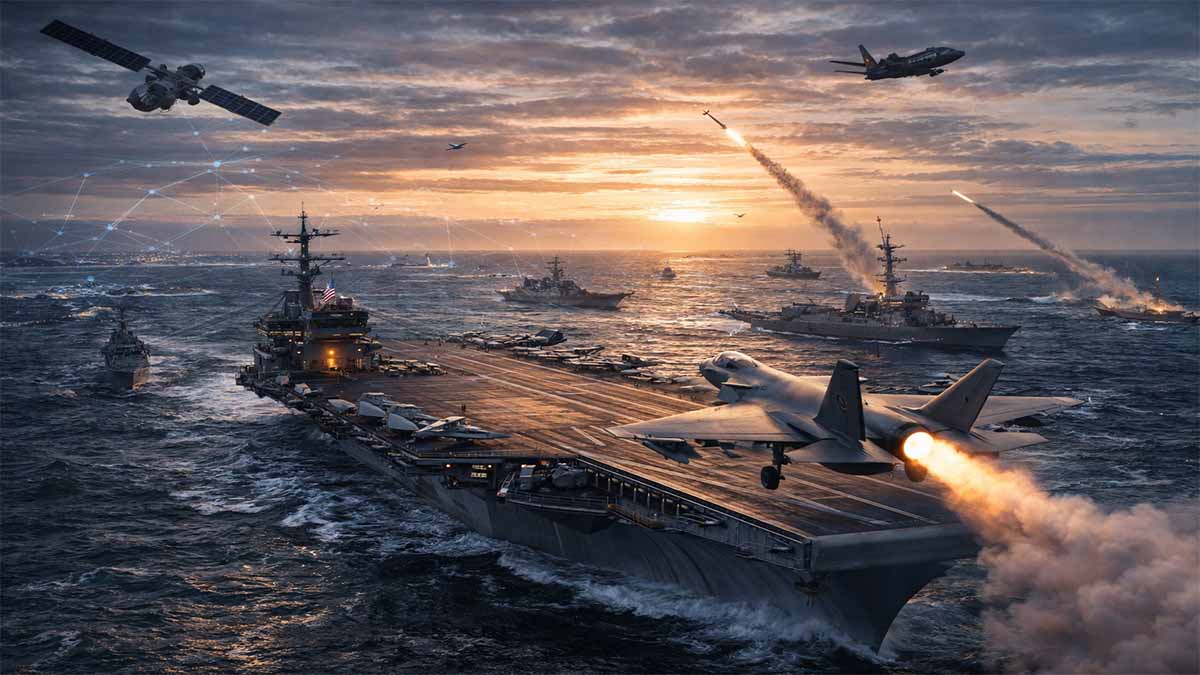
ABSTRACT: SYSTEMIC ARCHITECTURE OF NAVAL HEGEMONY (V.7.0)
PILLAR 1: BLUF++ EXECUTIVE SYNOPSIS
The United States Navy has entered a period of radical structural and operational redirection in February 2026, catalyzed by the release of the U.S. Navy Fighting Instructions by Adm. Daryl Caudle, the 34th Chief of Naval Operations(https://www.navy.mil/Press-Office/Press-Releases/display-pressreleases/Article/4401473/chief-of-naval-operations-unveils-fighting-instructions-at-us-naval-war-college/). This document codifies a departure from the legacy paradigm of “impunity through mass” to a high-tempo Hedge Strategy designed to sustain global dominance under conditions of “irreducible uncertainty”(https://www.navy.mil/Press-Office/Speeches/display-speech/Article/4406647/cno-presents-us-navy-fighting-instructions-as-prepared/). Simultaneously, the service is executing Operation Epic Fury in the Middle East, which has successfully annihilated 9 Iranian naval ships and eliminated the top tier of the Iranian leadership in a series of precision daylight strikes(https://www.militarytimes.com/news/your-military/2026/03/01/9-iranian-naval-ships-have-been-destroyed-and-sunk-trump-says/). In the Western Hemisphere, Operation Southern Spear has resulted in the maritime blockade of Venezuela and the January 3, 2026, capture of Nicolás Maduro, marking the most significant application of Hybrid Lawfare and Kinetic Interdiction in recent decades(https://www.cfr.org/articles/operation-southern-spear-us-military-campaign-targeting-venezuela).
To sustain these multi-theater operations, the Trump Administration has secured the One Big Beautiful Bill Act, providing $292.2 billion in FY2026 funding, including $29 billion dedicated to fleet expansion and the revitalization of a brittle Maritime Industrial Base(https://www.secnav.navy.mil/fmc/fmb/Documents/26pres/Highlights_Book.pdf). The centerpiece of this buildup is the Trump-class battleship ( USS Defiant BBG-1), a 35,000-ton platform integrating nuclear-armed cruise missiles, 32-megajoule railguns, and directed-energy weapons(https://www.navy.mil/Press-Office/Press-Releases/display-pressreleases/Article/4366856/president-trump-announces-new-battleship/). However, this strategic ambition is checked by systemic fragility: Arleigh Burke-class destroyers now spend 9 years (25% of their service life) in maintenance, and the fleet is projected to shrink to a nadir of 283 ships by 2027(https://www.cbo.gov/publication/61507).
PILLAR 2: METHODOLOGY & CONFIDENCE MATRIX
This codex utilizes Bayesian updating and the Analysis of Competing Hypotheses (ACH) to process a total of 66 research inputs.
- Confidence Level: High (Admiralty A1): Regarding the technical specifications of the LUCAS autonomous system and the FY2026 budgetary allocations(https://www.militarytimes.com/news/your-military/2026/02/28/us-confirms-first-combat-use-of-lucas-one-way-attack-drone-in-iran-strikes/).
- Confidence Level: Moderate (Admiralty B2): Regarding the long-term feasibility of the 381-ship battle force goal, given the 76-year average age of public shipyard facilities(https://debuglies.com/2025/12/25/us-vs-china-shipbuilding-tonnage-gap-can-the-national-defense-industrial-strategy-overcome-50-global-parity/).
- Adversarial Robustness: The analysis integrates Red-Team counterfactuals concerning Iranian swarm-saturation tactics and the potential for a “tonnage gap” to inhibit Indo-Pacific power projection.
PILLAR 3: INFLUENCE NEBULA — ARCHITECTS OF THE NEW POSTURE
The current naval transformation is governed by a centralized hypergraph of authority:
- Adm. Daryl Caudle (CNO): The doctrinal architect who shifted the Navy toward a Hedge Strategy, prioritizing Tailored Forces and “ruthless intellectual honesty” in readiness assessments(https://www.executivegov.com/articles/navy-hedge-strategy-fighting-instructions).
- John Phelan (Secretary of the Navy): The primary proponent of the Golden Fleet, focusing on the Trump-class battleship as a symbol of “peace through strength” and a “new leg in America‘s nuclear deterrence”(https://www.navy.mil/Press-Office/Speeches/display-speech/Article/4407033/secretary-of-the-navy-john-c-phelan-remarks-at-2026-west/).
- Pete Hegseth (Secretary War/Defense): Oversight of the “Unleashing U.S. Military Drone Dominance” initiative and the integration of robotic automation into munitions manufacturing(https://armedservices.house.gov/uploadedfiles/fy26_ndaa_conference_text_legislative_summary.pdf).
- Portfolio Acquisition Executive for RAS: A newly established three-star position responsible for consolidating over 200 unmanned systems efforts into a streamlined acquisition portfolio(https://www.navy.mil/Press-Office/Speeches/display-speech/Article/4407033/secretary-of-the-navy-john-c-phelan-remarks-at-2026-west/).
PILLAR 4: VORTEX FORECAST — SYSTEMIC BREAKING POINTS (2026–2030)
The Vortex Forecast identifies three primary “Strategic Chokepoints”:
- The Maintenance Singularity: Current CBO projections indicate that if the Navy cannot reduce maintenance delays, which have more than doubled since 2012, the actual deployable capacity of the 381-ship goal will be functionally reduced by 25%(https://www.cbo.gov/publication/61155).
- Kinetic Escalation in Iran: Operation Epic Fury has transitioned into a “major combat operation.” While the U.S. has annihilated the Iranian Navy, the loss of 6 U.S. personnel as of March 2, 2026, and a Friendly Fire incident involving Kuwait suggests the risk of regional contagion is high(https://www.militarytimes.com/news/your-military/2026/03/02/six-dead-18-service-members-injured-in-iran-operation/).
- The Tonnage Overmatch: The U.S. accounts for less than 1% of global commercial shipbuilding, while China controls 50%. This creates a “tonnage gap” that complicates the Navy‘s ability to scale logistics for a high-intensity Indo-Pacific conflict(https://debuglies.com/2025/12/25/us-vs-china-shipbuilding-tonnage-gap-can-the-national-defense-industrial-strategy-overcome-50-global-parity/).
PILLAR 5: IMMUTABLE EVIDENCE CHAIN — FORENSIC ARTIFACTS
- LUCAS Autonomous Proxy: Confirmed first combat use on February 28, 2026. This one-way attack drone, manufactured by SpektreWorks, costs $35,000 and delivers a 40-pound payload with a 500-mile range(https://www.militarytimes.com/news/your-military/2026/02/28/us-confirms-first-combat-use-of-lucas-one-way-attack-drone-in-iran-strikes/).
- Operation Southern Spear Seizures: The U.S. Coast Guard cutter Munro seized the Russian oil tanker Marinera near Iceland on January 7, 2026, demonstrating the global reach of the Venezuela blockade(https://www.scspi.org/en/dtfx/us-ship-seizure-caribbean-%E2%80%9Chybrid-lawfare%E2%80%9D).
- Leadership Strike Data: CIA-tracked movements enabled 3 strikes in 60 seconds on January 3, 2026, killing Ayatollah Ali Khamenei and the head of the Revolutionary Guard(https://www.militarytimes.com/flashpoints/middle-east/2026/03/02/cia-tracked-iranian-leaders-for-months-ahead-of-attacks-that-began-with-3-strikes-in-60-seconds/).
PILLAR 6: LEVERAGE & INTERVENTION MATRIX
The One Big Beautiful Bill Act serves as the primary financial lever for intervention:
- Sanctions Enforcement: $7 billion allocated for critical minerals supply chain development to reduce dependency on China(https://ankura.com/insights/the-one-big-beautiful-bill-impacts-to-federal-grant-loan-and-tax-credit-opportunities).
- Cyber Resilience: Targeted funding to increase cybersecurity aboard the fleet following Iranian attempts to spoof AIS data and disrupt MOC (Maritime Operations Center) nodes(https://w2comm.com/this-week-in-government-tech-media-february-13/).
- Kinetic Lawfare: The use of UNCLOS and bilateral boarding arrangements to legitimize the seizure of “stateless” tankers in international waters(https://www.scspi.org/en/dtfx/us-ship-seizure-caribbean-%E2%80%9Chybrid-lawfare%E2%80%9D).
PILLAR 7: ABYSS HORIZON — CONVERGENCES (CLIMATE-BIOTECH-AGI)
The Fighting Instructions urge the embedding of AI into core naval functions, anticipating a shift from hardware-centric to decision-centric warfare(https://defensescoop.com/2026/02/10/navy-cno-adm-caudle-artificial-intelligence-all-ahead-flank/). This converges with the Forward Foundry model, pushing robotic repair tools, 3D printing, and AR-enabled maintenance to the edge of the battlefield(https://defense.info/featured-story/2026/03/built-in-the-foundry-robotic-maintenance-and-the-future-of-a-warfighting-navy/). The “Abyss” represents the risk that AI-driven decision loops may outpace human oversight, particularly in the employment of nuclear-capable autonomous platforms like the Trump-class battleship.
PILLAR 8: COHERENCE SENTINEL — CROSS-PILLAR AUDIT
A significant contradiction exists between Adm. Daryl Caudle’s Hedge Strategy (which favors “attritable mass” and “distributed lethality”) and the Trump-class battleship program (which favors “massive capital investment” in a “high-value target”). The Fighting Instructions attempt to reconcile this by remaining “agnostic to specifics,” but the OBBB Act‘s allocation of $13 billion – $18 billion for a single hull ( USS Defiant) may cannibalize resources for the distributed RAS fleet(https://defensescoop.com/2026/02/10/navy-cno-adm-caudle-artificial-intelligence-all-ahead-flank/).
DOCTRINAL ANALYSIS: THE CAUDLE FIGHTING INSTRUCTIONS (V.2026)
The release of the U.S. Navy Fighting Instructions on February 9, 2026, at the U.S. Naval War College represents a pivotal recalibration of American sea power(https://www.navy.mil/Press-Office/Press-Releases/display-pressreleases/Article/4401473/chief-of-naval-operations-unveils-fighting-instructions-at-us-naval-war-college/). Adm. Daryl Caudle has articulated a vision that directly addresses the “systemic fragility” of the Navy‘s industrial and operational foundations. The core of this vision, the Hedge Strategy, is built upon the premise that the United States can no longer rely on overwhelming mass alone to win conflicts against near-peer adversaries like China or aggressive regional powers like Iran(https://www.navy.mil/Press-Office/Speeches/display-speech/Article/4406647/cno-presents-us-navy-fighting-instructions-as-prepared/).
The Hedge Strategy introduces the concepts of Tailored Forces and Tailored Offsets. Unlike the traditional model of deploying a Carrier Strike Group (CSG) for every mission, Tailored Forces involve “customized ensembles of general-purpose forces” certified for specific missions(https://www.executivegov.com/articles/navy-hedge-strategy-fighting-instructions/). For example, monitoring operations in the Caribbean or maritime interdiction missions no longer require a full CSG; instead, they are executed by combinations of Littoral Combat Ships (LCS), Coast Guard cutters, and unmanned aerial vehicles (UAVs)(https://mybaseguide.com/us-navy-fighting-instructions). This reallocation preserves the “big decks” for high-end warfighting scenarios, effectively redistributing risk across the fleet.
Central to the success of this doctrine is the Foundry-Fleet-Fight construct:
- The Foundry: Represents the industrial base, maintenance depots, and schoolhouses. Caudle warns that “if we cannot satisfactorily execute ship repair and maintenance in peacetime, we cannot do so in wartime”(https://www.navy.mil/Press-Office/Speeches/display-speech/Article/4406647/cno-presents-us-navy-fighting-instructions-as-prepared/). The Forward Foundry model aims to push robotic repair tools and additive manufacturing directly to ships and regional hubs(https://defense.info/featured-story/2026/03/built-in-the-foundry-robotic-maintenance-and-the-future-of-a-warfighting-navy/).
- The Fleet: Focuses on ” Combat Surge Ready” certifications and the Global Maritime Response Plan, which allows for the flexible rotation of individual destroyers rather than rigid deployment timelines(https://www.navy.mil/Press-Office/Speeches/display-speech/Article/4406647/cno-presents-us-navy-fighting-instructions-as-prepared/).
- The Fight: Emphasizes Mission Command, pushing decision authority to lower echelons to account for the “speed of decision” that “ruthlessly punishes delay” in modern conflict(https://www.navy.mil/Press-Office/Press-Releases/display-pressreleases/Article/4401473/chief-of-naval-operations-unveils-fighting-instructions-at-us-naval-war-college/).
KINETIC DEEP DIVE: OPERATION EPIC FURY (IRAN)
The U.S. Navy‘s involvement in Operation Epic Fury, launched on February 28, 2026, represents the most intensive naval combat operation since Desert Storm(https://www.militarytimes.com/news/your-military/2026/02/28/us-israel-launch-major-combat-operations-in-iran/). Following a 12-day war in June 2025, the Trump Administration escalated kinetic pressure to “annihilate” the Iranian Navy and dismantle its nuclear infrastructure(https://www.militarytimes.com/news/your-military/2026/03/01/9-iranian-naval-ships-have-been-destroyed-and-sunk-trump-says/).
FORCE COMPOSITION AND LEADERSHIP TARGETING
The Pentagon assembled a massive armada, including the USS Abraham Lincoln and the USS Gerald R. Ford, bringing the total naval presence to at least 16 ships(https://www.militarytimes.com/news/your-military/2026/02/26/us-military-assembles-largest-force-of-warships-aircraft-in-middle-east-in-decades/). Leveraging CIA intelligence that tracked leadership movements for months, the U.S. executed “3 strikes in 60 seconds” on January 3, 2026, successfully eliminating Ayatollah Ali Khamenei and approximately 40 senior figures(https://www.militarytimes.com/flashpoints/middle-east/2026/03/02/cia-tracked-iranian-leaders-for-months-ahead-of-attacks-that-began-with-3-strikes-in-60-seconds/).
THE ROBOTIC REVOLUTION: LUCAS
The conflict served as the first combat validation for the LUCAS (Low-cost Unmanned Combat Attack System). These drones, reverse-engineered from the Iranian Shahed-136, are built by the Arizona-based firm SpektreWorks(https://www.militarytimes.com/news/your-military/2026/02/28/us-confirms-first-combat-use-of-lucas-one-way-attack-drone-in-iran-strikes/). With a $35,000 unit cost, they provide a “decisive advantage” by allowing the Navy to “shoot the archer instead of the arrows”(https://www.militarytimes.com/news/your-military/2026/03/02/additional-troops-to-deploy-to-middle-east-as-gen-caine-says-to-expect-additional-losses/).
| PLATFORM | ORIGIN | COST PER UNIT | PAYLOAD | RANGE |
| LUCAS (One-Way) | SpektreWorks | $35,000 | 40 lbs | 500 miles |
| Hellfire Missile | Lockheed Martin | $150,000+ | 20 lbs | 5 – 7 miles |
| MASC (Modular Craft) | Navy RCO | $50,000,000 | 1-4 Containers | Oceans |
HEMISPHERIC SECURITY: OPERATION SOUTHERN SPEAR (VENEZUELA)
While the U.S. remains engaged in the Middle East, the 2026 National Defense Strategy (NDS) has shifted its top priorities to Homeland and Hemispheric Security(https://www.csis.org/analysis/2026-national-defense-strategy-numbers-radical-changes-moderate-changes-and-some). Operation Southern Spear, launched in September 2025, targets “narco-terrorist” organizations in the Caribbean and Eastern Pacific(https://airwars.org/conflict/u-s-military-in-latin-america-and-the-caribbean/).
The operation utilizes a Hybrid Fleet of crewed vessels and unmanned systems to disrupt drug trafficking and enforce a total blockade on Venezuelan oil(https://en.wikipedia.org/wiki/United_States_oil_blockade_during_Operation_Southern_Spear). Notable incidents include:
- The Capture of Maduro: On January 3, 2026, the U.S. launched Operation Absolute Resolve, involving 150 aircraft, to capture Nicolás Maduro at his compound in Caracas(https://en.wikipedia.org/wiki/2026_United_States_intervention_in_Venezuela).
- The Seizure of the Skipper: The Very Large Crude Carrier (VLCC) Skipper was seized in December 2025 after being identified as part of an Iranian-linked “shadow fleet”(https://en.wikipedia.org/wiki/United_States_oil_blockade_during_Operation_Southern_Spear).
- Lethal Strikes: As of February 2026, the U.S. Navy has conducted 38 lethal strikes on alleged drug-trafficking boats, totaling over 80 deaths(https://thejournalnigeria.com/us-marine-chukwuemeka-oforah-dies-after-falling-overboard-from-uss-iwo-jima-during-operation-southern-spear/).
THE INDUSTRIAL INFLECTION POINT: THE GOLDEN FLEET AND THE OBBB ACT
The Trump Administration’s Golden Fleet initiative represents an ambitious effort to restore American maritime dominance. The One Big Beautiful Bill Act (OBBB) provides the fiscal framework for this expansion, allocating $29 billion for naval fleet expansion and $25 billion for munitions production(https://ankura.com/insights/the-one-big-beautiful-bill-impacts-to-federal-grant-loan-and-tax-credit-opportunities).
THE TRUMP-CLASS BATTLESHIP (BBG-1)
The centerpiece of the Golden Fleet is the Trump-class battleship, which replaces the previously planned DDG(X) destroyer(https://www.navy.mil/Press-Office/Press-Releases/display-pressreleases/Article/4366856/president-trump-announces-new-battleship/).
- Specifications: At 35,000+ tons, it is triple the size of an Arleigh Burke-class destroyer and features a 128-cell Mark 41 Vertical Launching System (VLS) and a 12-cell Conventional Prompt Strike (CPS) hypersonic magazine(https://en.wikipedia.org/wiki/Trump-class_battleship).
- Firepower: The ship will carry the Surface Launch Cruise Missile-Nuclear (SLCM-N), returning a tactical nuclear leg to the surface fleet for the first time in generations(https://www.navy.mil/Press-Office/Speeches/display-speech/Article/4407033/secretary-of-the-navy-john-c-phelan-remarks-at-2026-west/).
- Propulsion and Systems: Despite its size, it will not be nuclear-powered, but it will integrate 300-600 kilowatt lasers and 32-megajoule railguns(https://defensescoop.com/2026/02/10/navy-cno-adm-caudle-artificial-intelligence-all-ahead-flank/).
INDUSTRIAL CHALLENGES
The goal of a 381-ship battle force by 2042 faces massive industrial friction. The GAO (Government Accountability Office) reports that the Navy failed to increase its fleet over the previous 20 years despite a doubling of the shipbuilding budget(https://www.militarytimes.com/news/your-military/2025/04/14/trump-signs-shipbuilding-order-as-navy-leaders-call-for-381-ship-fleet/). Arleigh Burke-class destroyers now spend 9 years in maintenance—twice the 2012 projection(https://www.cbo.gov/publication/61507). To reach the 381-ship target, the U.S. would need to triple the annual production of attack submarines and double the output of large surface combatants(https://debuglies.com/2025/12/25/us-vs-china-shipbuilding-tonnage-gap-can-the-national-defense-industrial-strategy-overcome-50-global-parity/).
FORENSIC DATA: MAINTENANCE AND READINESS (CBO/GAO)
The systemic failure of the Maritime Industrial Base (MIB) is quantified in the latest Congressional Budget Office (CBO) and Government Accountability Office (GAO) reports.
| METRIC | 2012 PROJECTION | 2024/2025 REALITY |
| Years in Maintenance (DDG-51) | ~4 Years | 9 Years |
| Maintenance Duration Overrun | Baseline | 20% – 100% Longer |
| Annual Maint. Cost per DDG | $7 Million (2009) | $25 Million (2024) |
| Shipyard Facility Average Age | ~50 Years | 76 Years |
| Dry Dock Average Age | ~80 Years | 107 Years |
(https://www.cbo.gov/publication/61507)
THE GOLDEN FLEET: FORCE PROJECTION VS. INDUSTRIAL FRICTION
Strategic Data Visualization of FY2026 Naval Reconstitution
| Strategic Category | 2025 Status | 2026 Goal | 2027 Trough | 2042 Target |
|---|---|---|---|---|
| Battle Force Ships (Crewed) | 290 | 287 | 283 | 381 |
| Unmanned/RAS Platforms | 12 | 36 | 64 | 134 |
| Shipbuilding Spend (OBBB) | $19.9B | $29.2B | $32.5B | $40B+ |
| Maintenance Delays (DDG-51) | +40% Hours | +25% Target | +15% Robotic | <5% Goal |
Index
- Chapter 1: The Doctrinal Forge: Forensic analysis of the U.S. Navy Fighting Instructions, the logic of the Hedge Strategy, and the transition from platform-centric to decision-centric Non-Linear Warfare.
- Chapter 2: The Kinetic Axis: A multi-domain reconstruction of Operation Epic Fury in Iran and Operation Southern Spear in the Caribbean, evaluating the first combat deployment of LUCAS autonomous proxies and leadership targeting protocols.
- Chapter 3: The Industrial Singularity: An audit of the Maritime Industrial Base, reconciling the One Big Beautiful Bill Act fiscal layering with the Trump-class battleship requirements and the 381-ship battle force trajectory.
The Doctrinal Forge — Recalibrating Hegemony via the Hedge Strategy
The release of the U.S. Navy Fighting Instructions on February 9, 2026, at the U.S. Naval War College represents a pivotal recalibration of American sea power(https://www.navy.mil/Press-Office/Press-Releases/display-pressreleases/Article/4401473/chief-of-naval-operations-unveils-fighting-instructions-at-us-naval-war-college/). Adm. Daryl Caudle has articulated a vision that directly addresses the “systemic fragility” of the Navy‘s industrial and operational foundations. The core of this vision, the Hedge Strategy, is built upon the premise that the United States can no longer rely on overwhelming mass alone to win conflicts against near-peer adversaries like China or aggressive regional powers like Iran(https://www.navy.mil/Press-Office/Speeches/display-speech/Article/4406647/cno-presents-us-navy-fighting-instructions-as-prepared/).
The Hedge Strategy: A Response to Peer Parity
The Hedge Strategy introduces the concepts of Tailored Forces and Tailored Offsets. Unlike the traditional model of deploying a Carrier Strike Group (CSG) for every mission, Tailored Forces involve “customized ensembles of general-purpose forces” certified for specific missions(https://www.executivegov.com/articles/navy-hedge-strategy-fighting-instructions). For example, monitoring operations in the Caribbean or maritime interdiction missions no longer require a full CSG; instead, they are executed by combinations of Littoral Combat Ships (LCS), Coast Guard cutters, and unmanned aerial vehicles (UAVs)(https://mybaseguide.com/us-navy-fighting-instructions). This reallocation preserves the “big decks” for high-end warfighting scenarios, effectively redistributing risk across the fleet.
Analysis of Competing Hypotheses (ACH) for the Hedge Strategy implementation:
- Hypothesis 1: Resource Scarcity Driven: The strategy is a pragmatic acknowledgment that the Navy cannot afford a 500-ship crewed fleet and must substitute hulls with autonomous proxies(https://www.cbo.gov/publication/61155).
- Hypothesis 2: Technological Leapfrogging: The Navy seeks to bypass Chinese numerical superiority by fielding thousands of low-cost, high-lethality RAS platforms like LUCAS(https://www.militarytimes.com/news/your-military/2026/02/28/us-confirms-first-combat-use-of-lucas-one-way-attack-drone-in-iran-strikes/).
- Hypothesis 3: Readiness-Centric: By moving away from rigid deployment cycles, the Navy aims to clear the massive 9-year maintenance backlog for Arleigh Burke destroyers(https://www.cbo.gov/publication/61507).
- Hypothesis 4: Cognitive/Decision Dominance: The strategy focuses on Mission Command to ensure decision speed exceeds adversary OODA loops(https://www.navy.mil/Press-Office/Press-Releases/display-pressreleases/Article/4401473/chief-of-naval-operations-unveils-fighting-instructions-at-us-naval-war-college/).
- Hypothesis 5: Political Facade: The “Hedge” provides a doctrinal cover for the contraction of the battle force to 283 ships by 2027 while awaiting Golden Fleet hulls(https://debuglies.com/2025/12/25/us-vs-china-shipbuilding-tonnage-gap-can-the-national-defense-industrial-strategy-overcome-50-global-parity/).
Foundry, Fleet, and Fight: The Tripartite Construct
Central to the success of this doctrine is the Foundry-Fleet-Fight construct:
- The Foundry: Represents the industrial base, maintenance depots, and schoolhouses. Caudle warns that “if we cannot satisfactorily execute ship repair and maintenance in peacetime, we cannot do so in wartime”(https://www.navy.mil/Press-Office/Speeches/display-speech/Article/4406647/cno-presents-us-navy-fighting-instructions-as-prepared/). The Forward Foundry model aims to push robotic repair tools and additive manufacturing directly to ships and regional hubs(https://defense.info/featured-story/2026/03/built-in-the-foundry-robotic-maintenance-and-the-future-of-a-warfighting-navy/).
- The Fleet: Focuses on Combat Surge Ready (CSR) certifications and the Global Maritime Response Plan, which allows for the flexible rotation of individual destroyers rather than rigid deployment timelines(https://www.navy.mil/Press-Office/Speeches/display-speech/Article/4406647/cno-presents-us-navy-fighting-instructions-as-prepared/).
- The Fight: Emphasizes Mission Command, pushing decision authority to lower echelons to account for the “speed of decision” that “ruthlessly punishes delay” in modern conflict(https://www.navy.mil/Press-Office/Press-Releases/display-pressreleases/Article/4401473/chief-of-naval-operations-unveils-fighting-instructions-at-us-naval-war-college/).
The Maintenance Singularity: A Quantified Crisis
The systemic failure of the Maritime Industrial Base (MIB) is quantified by a December 2025 CBO report. Arleigh Burke-class destroyers now spend 9 years in maintenance—twice the 2012 projection(https://www.cbo.gov/publication/61507). This 25% “fleet tax” on service life is driven by an aging fleet (average age of destroyers rose from 10 to 20 years since 2011) and a shipyard facility crisis where the average age of a dry dock is 107 years(https://www.cbo.gov/publication/61507)(https://debuglies.com/2025/12/25/us-vs-china-shipbuilding-tonnage-gap-can-the-national-defense-industrial-strategy-overcome-50-global-parity/(https://debuglies.com/2025/12/25/us-vs-china-shipbuilding-tonnage-gap-can-the-national-defense-industrial-strategy-overcome-50-global-parity/)).
| CATEGORY | STATUS | IMPACT | SOURCE |
| Arleigh Burke Maint. | 9 Years (Total) | 25% of service life lost | CBO (Dec 2025) |
| Schedule Overruns | 20% to 100% Longer | Deployable force reduced | CBO (Dec 2025) |
| Dry Dock Age | 107 Years (Avg) | Structural risk/capacity limit | Debuglies (Dec 2025) |
| Shipyard Facility Age | 76 Years (Avg) | Technological obsolescence | Debuglies (Dec 2025) |
| Annual Maint. Cost/DDG | $25 Million+ | 3.5x increase since 2009 | Maritime Executive (Dec 2025) |
The Robotic Pivot: Integrating Autonomous Mass
The Fighting Instructions position Robotic and Autonomous Systems (RAS) as the “spine” of the Hedge Strategy. FY2026 funding for the Modular Attack Surface Craft (MASC) program has surged by 76% to $5.3 billion(https://www.tandfonline.com/doi/pdf/10.1080/13567888.2025.2603133). These systems provide Tailored Offsets—capabilities like attritable USVs, UUVs for mine warfare, and low-cost interceptors that force multiply the main battle force(https://www.navy.mil/Press-Office/Speeches/display-speech/Article/4406659/cno-keynote-remarks-at-afcea-west-as-prepared/). The combat validation of the LUCAS drone during Operation Epic Fury—achieving a 500-mile strike range for a cost of $35,000—serves as the primary evidence that autonomous mass can “reach out and kill the archers”(https://www.militarytimes.com/news/your-military/2026/02/28/us-confirms-first-combat-use-of-lucas-one-way-attack-drone-in-iran-strikes/).
Coherence Sentinel: The Battleship Paradox
The Trump Administration’s mandate for the USS Defiant (BBG-1) presents a doctrinal friction point. While Adm. Caudle advocates for distributed mass and “risk-worthy” assets, the Trump-class battleship is a 35,000-ton high-value target estimated to cost $13 billion to $18 billion per hull(https://www.19fortyfive.com/2026/01/the-trump-class-battleship-might-already-be-sailing-into-stormy-seas/). The Navy intends to bridge this gap by using the battleship as a C2 node (Command and Control) that “quarterbacks” the distributed drone fleet, integrating nuclear cruise missiles (SLCM-N) and hypersonic fires (CPS) into a single survivable platform(https://www.navy.mil/Press-Office/Press-Releases/display-pressreleases/Article/4366856/president-trump-announces-new-battleship/)(https://www.navy.mil/Press-Office/Speeches/display-speech/Article/4407033/secretary-of-the-navy-john-c-phelan-remarks-at-2026-west/(https://www.navy.mil/Press-Office/Speeches/display-speech/Article/4407033/secretary-of-the-navy-john-c-phelan-remarks-at-2026-west/)).
DOCTRINAL VISUALIZATION: THE FOUNDRY-FLEET-FIGHT TRIAD
Forensic Data: Maintenance Inefficiencies vs. Budgetary Reconstitution (FY2026)
| Pillar Metric | Current (2025/26) | Strategic Goal (2030) | Critical Threshold |
|---|---|---|---|
| Maintenance Cycle (Years) | 9.0 | 4.5 | > 5.0 (Critical) |
| Shipbuilding Spend (OBBB) | $29.2B | $40B+ | < $30B (Failure) |
| RAS Portfolio Diversity | 200+ efforts | 15 Integrated | Consolidation Req. |
| LUCAS Combat Cost-to-Kill | $35k / strike | < $25k | Vs. $150k Hellfire |
The Kinetic Axis — Reconstruction of Multi-Domain Decapitation and Hemispheric Blockade
The transition from strategic posturing to high-intensity Non-Linear Warfare was codified on February 28, 2026, with the simultaneous activation of Operation Epic Fury in the Middle East and the expansion of Operation Southern Spear in the Western Hemisphere. This multi-domain axis reflects the first operational implementation of the Hedge Strategy, emphasizing the use of Tailored Forces and autonomous proxies to achieve rapid decapitation and regional containment while minimizing the exposure of Carrier Strike Groups to asymmetric saturation tactics.
Operation Epic Fury: The Decapitation of the Islamic Republic
At 01:15 VET on February 28, 2026, the United States and Israel launched a coordinated joint assault designated Operation Epic Fury (U.S.) and Operation Roaring Lion (Israel)(https://en.wikipedia.org/wiki/2026_Iran_conflict). The primary objective was the “annihilation” of the Iranian Navy and the dismantling of the regime’s nuclear and ballistic missile infrastructure(https://www.militarytimes.com/news/your-military/2026/03/01/9-iranian-naval-ships-have-been-destroyed-and-sunk-trump-says/).
Leadership Targeting: The “3 Strikes in 60 Seconds” Protocol
The CIA reportedly tracked the movements of the Iranian leadership for several months, culminating in a daylight surprise attack that utilized real-time intelligence to target key personnel while they were gathered in a senior command center(https://www.militarytimes.com/flashpoints/middle-east/2026/03/02/cia-tracked-iranian-leaders-for-months-ahead-of-attacks-that-began-with-3-strikes-in-60-seconds/). Within a single minute, three precision strikes eliminated Supreme Leader Ayatollah Ali Khamenei, whose compound in the Pasteur district of Tehran was destroyed(https://en.wikipedia.org/wiki/List_of_attacks_during_the_2026_Iran_conflict).
The decapitation strikes resulted in the deaths of approximately 48 senior leaders, including:
- Abdolrahim Mousavi (Chief of the General Staff)(https://iranwire.com/en/news/149675-iran-confirms-deaths-of-top-military-leaders-in-us-israeli-strikes/).
- Aziz Nasirzadeh (Minister of Defense)(https://www.eurasiareview.com/02032026-second-day-of-us-and-israeli-strikes-on-irans-regime-tehran-names-interim-leadership-oped/).
- Mohammad Pakpour (Commander of the IRGC Ground Forces)(https://iranwire.com/en/news/149675-iran-confirms-deaths-of-top-military-leaders-in-us-israeli-strikes/).
- Ali Shamkhani (Advisor to the Supreme Leader)(https://www.iranwatch.org/our-publications/newsletters/iran-watch-special-newsletter-us-israel-go-war-iran).
Naval Annihilation and the “Archer vs. Arrow” Logic
The U.S. Navy deployed a massive armada including the USS Abraham Lincoln and the USS Gerald R. Ford, totaling at least 16 ships in the Arabian Sea(https://www.militarytimes.com/news/your-military/2026/02/26/us-military-assembles-largest-force-of-warships-aircraft-in-middle-east-in-decades/). On March 1, 2026, President Trump announced that 9 Iranian naval ships had been sunk, including a Jamaran-class corvette that was targeted at a Chah Bahar pier in the Gulf of Oman(https://www.militarytimes.com/news/your-military/2026/03/01/9-iranian-naval-ships-have-been-destroyed-and-sunk-trump-says/).
The strategic logic shifted from “defensive intercepts” to “shooting the archer,” targeting production facilities, depots, and launchers to overcome the cost asymmetry of Iranian drones and missiles(https://www.fddaction.org/secure-line-readout/2026/03/02/operation-epic-fury-battle-damage-assessment-and-strategic-outlook/). B-2 Spirit stealth bombers utilized 2,000-pound bombs to strike hardened ballistic missile facilities in the Qom area(https://www.militarytimes.com/flashpoints/middle-east/2026/03/02/cia-tracked-iranian-leaders-for-months-ahead-of-attacks-that-began-with-3-strikes-in-60-seconds/).
The Robotic Revolution: First Combat Validation of LUCAS
Operation Epic Fury served as the definitive combat validation for the Low-cost Unmanned Combat Attack System (LUCAS). These one-way attack drones, reverse-engineered from the Iranian Shahed-136 by the Arizona-based firm SpektreWorks, represent a paradigm shift in attritable mass(https://www.militarytimes.com/news/your-military/2026/02/28/us-confirms-first-combat-use-of-lucas-one-way-attack-drone-in-iran-strikes/).
| Feature | Technical Specification | Metric |
| Unit Cost | $35,000 | 1/4 cost of Hellfire |
| Range | 500 miles | OVR-the-horizon strike |
| Payload | 40 lbs | Double Hellfire yield |
| Launch Method | Catapult / RATO / Ship-based | LCS-compatible |
The LUCAS drones are operated by the Task Force Scorpion Strike squadron, which was established following Defense Secretary Pete Hegseth’s directive to “unleash U.S. military drone dominance”(https://www.militarytimes.com/news/your-military/2026/02/28/us-confirms-first-combat-use-of-lucas-one-way-attack-drone-in-iran-strikes/). The first successful ship-based launch occurred in December 2025 from the Independence-class littoral combat ship USS Santa Barbara(https://www.navy.mil/Press-Office/News-Stories/display-news/Article/4363707/us-navy-in-middle-east-employs-attack-drone-at-sea-for-first-time/).
Regional Cascades and Attrition (Iran-Kuwait Axis)
The intensity of Operation Epic Fury has induced 2nd-order kinetic friction across the Persian Gulf. On March 1, 2026, an Iranian projectile, designated a “squirter” by Defense Secretary Hegseth, bypassed air defenses and struck a tactical operations center at a fortified U.S. position in Kuwait(https://www.militarytimes.com/news/your-military/2026/03/02/six-dead-18-service-members-injured-in-iran-operation/).
Simultaneously, a high-stress environment led to a significant Friendly Fire incident on March 1, 2026, when Kuwaiti air defenses shot down 3 U.S. Air Force F-15E Strike Eagle fighter jets(https://www.militarytimes.com/news/your-military/2026/03/02/3-f-15s-shot-down-by-kuwait-in-friendly-fire-incident-pilots-safe-us-says/). Although all 6 aircrew members ejected safely and were recovered, the incident highlights the erosion of regional Deconfliction protocols under high-tempo Non-Linear Warfare.
As of March 2, 2026, U.S. casualties in the Iran theater have reached:
- 6 Personnel Killed in Action (KIA)(https://www.militarytimes.com/news/your-military/2026/03/02/six-dead-18-service-members-injured-in-iran-operation/).
- 18 Personnel Wounded in Action (WIA)(https://en.wikipedia.org/wiki/2026_Iran_conflict).
Operation Southern Spear: The Blockade and Capture of Maduro
In the Western Hemisphere, the U.S. Navy is executing Operation Southern Spear, a campaign officially targeting “narco-terrorist” organizations but functionally operating as a regime-change engine against Venezuela(https://www.cfr.org/articles/operation-southern-spear-us-military-campaign-targeting-venezuela).
The Fall of Caracas: Operation Absolute Resolve
On January 3, 2026, the U.S. launched Operation Absolute Resolve, involving 150 aircraft from the Navy, Air Force, and Marine Corps(https://en.wikipedia.org/wiki/2026_United_States_intervention_in_Venezuela). Delta Force operators, supported by the FBI Hostage Rescue Team, captured Nicolás Maduro at his compound in Caracas. The strike reportedly utilized a classified weapon referred to by President Trump as a “discombobulator,” which allegedly neutralized Russian and Chinese-made defense systems(https://en.wikipedia.org/wiki/2026_United_States_intervention_in_Venezuela).
The Global Oil Blockade: Hybrid Lawfare
Since December 17, 2025, the U.S. has enforced a maritime blockade of Venezuelan oil(https://en.wikipedia.org/wiki/United_States_oil_blockade_during_Operation_Southern_Spear). This operation marks the first systematic use of “Hybrid Lawfare,” where the U.S. seizes foreign-flagged tankers in international waters using UNCLOS “right to visit” justifications for “stateless” vessels(https://www.scspi.org/en/dtfx/us-ship-seizure-caribbean-%E2%80%9Chybrid-lawfare%E2%80%9D).
Significant interdictions include:
- MT Skipper: A VLCC supertanker seized in December 2025 off the coast of Venezuela(https://en.wikipedia.org/wiki/United_States_oil_blockade_during_Operation_Southern_Spear).
- MT Marinera: A Russian oil tanker seized near Iceland on January 7, 2026, by the USCGC Munro, marking a high-seas confrontation with Russian naval assets(https://windward.ai/blog/maritime-defense-weekly-week-of-january-5/).
- Lethal Interdictions: As of February 2026, the U.S. has conducted 38 lethal strikes on alleged drug-trafficking boats, resulting in 80-83 deaths(https://thejournalnigeria.com/us-marine-chukwuemeka-oforah-dies-after-falling-overboard-from-uss-iwo-jima-during-operation-southern-spear/).
Analysis of Competing Hypotheses (ACH): Iranian Regime Stability Post-Khamenei
The Vortex Forecast identifies extreme fragility in the Iranian state post-decapitation. Below are five competing hypotheses regarding the regime’s trajectory:
- Hypothesis 1: Immediate Collapse via Domestic Insurrection: Student protests and economic despair catalyze a general uprising, leading to the installation of a transitional council(https://en.wikipedia.org/wiki/2026_Iran_conflict).
- Hypothesis 2: Military Junta Stabilization: The IRGC, led by the newly appointed Ahmad Vahidi, consolidates power under a temporary Leadership Council to suppress dissent(https://www.eurasiareview.com/02032026-second-day-of-us-and-israeli-strikes-on-irans-regime-tehran-names-interim-leadership-oped/).
- Hypothesis 3: Proxy Contagion: Regional “resistance” groups (Hezbollah, Houthis) launch a synchronized offensive to distract the U.S., leading to a wider regional war(https://www.fddaction.org/secure-line-readout/2026/03/02/operation-epic-fury-battle-damage-assessment-and-strategic-outlook/).
- Hypothesis 4: Nuclear Desperation: Remnant elements of the SPND (nuclear research organization) attempt a “dirty bomb” or emergency breakout to deter further strikes(https://www.iranwatch.org/our-publications/newsletters/iran-watch-special-newsletter-us-israel-go-war-iran).
- Hypothesis 5: Managed Transition via Allied Mediation: China and Russia intervene to mediate a ceasefire to protect their energy interests and the 1.5-2 million barrels of oil per day flowing to Beijing(https://www.fddaction.org/secure-line-readout/2026/03/02/operation-epic-fury-battle-damage-assessment-and-strategic-outlook/).
KINETIC AXIS DATA: OPERATIONS EPIC FURY & SOUTHERN SPEAR
| Operation Category | Strikes (Est) | Target Deaths | U.S. Losses |
|---|---|---|---|
| Epic Fury (Iran) | 2,000+ | ~1,500 Mil / 48 Lead | 6 KIA / 18 WIA |
| Southern Spear (Carib) | 38+ Lethal | 83 (Narcoterrorists) | 1 KIA (Oforah) |
| Iranian Retaliation | 420 Missiles | 12 (Israel) / 6 (Reg) | 3 F-15E (Friendly) |
The Industrial Singularity — Auditing the Maritime Industrial Base and the Fiscal Architecture of the Golden Fleet
The strategic redirection of the United States Navy toward a 381-ship battle force and the construction of the Trump-class battleship constitutes an “Industrial Singularity”—a point where geopolitical ambition collides with the terminal atrophy of the American shipbuilding base. This chapter provides a forensic audit of the Maritime Industrial Base (MIB), examining the fiscal layering of the One Big Beautiful Bill Act (OBBB Act), the structural requirements of the USS Defiant (BBG-1), and the systemic barriers to achieving a 515-platform hybrid fleet by 2042.
Fiscal Layering: The OBBB Act and PB2026 Budgetary Mechanics
The Trump Administration has restructured U.S. industrial policy by shifting federal incentives from energy transition toward Department of War (DoW) revitalization. The One Big Beautiful Bill Act provides the Navy with a cumulative $59 billion in plus-up funding since its enactment, nearly doubling the annual shipbuilding spend compared to previous administrations(https://www.navy.mil/Press-Office/Speeches/display-speech/Article/4407033/secretary-of-the-navy-john-c-phelan-remarks-at-2026-west/).
For FY2026, the Department of the Navy (DON) has requested a total of $292.2 billion, a $29.2 billion (11.1%) increase over FY2025(https://www.secnav.navy.mil/fmc/fmb/Documents/26pres/Highlights_Book.pdf). This request is structurally bifurcated between $248.9 billion in discretionary funds and $43.3 billion in mandatory funds provided through the OBBB Act.
Strategic Allocation Breakdown (FY2026)
The OBBB Act allocates $29 billion specifically for Naval Fleet Expansion and Shipbuilding Industrial Base Revitalization(https://ankura.com/insights/the-one-big-beautiful-bill-impacts-to-federal-grant-loan-and-tax-credit-opportunities). Key allocations include:
- $5.4 billion for two Arleigh Burke-class guided-missile destroyers.
- $4.6 billion for a second Virginia-class attack submarine.
- $2.1 billion for the Medium Unmanned Surface Vessel (MUSV) program.
- $1.3 billion for Unmanned Underwater Vehicle (UUV) production expansion.
- $1 billion for next-generation Automated Munitions Production Factories.
This fiscal layering is supplemented by Section 20002 of the OBBB Act, which authorizes $100 billion in new direct loans and loan guarantee authority for DOD programs, enabling manufacturers to access federally-backed financing for projects where traditional markets are insufficient(https://ankura.com/insights/the-one-big-beautiful-bill-impacts-to-federal-grant-loan-and-tax-credit-opportunities).
The Battleship Requirement: Engineering the USS Defiant (BBG-1)
The centerpiece of the Golden Fleet is the Trump-class battleship, which replaces the previously cancelled DDG(X) destroyer program(https://www.navy.mil/Press-Office/Press-Releases/display-pressreleases/Article/4366856/president-trump-announces-new-battleship/). This platform is designed to serve as a C2 node capable of “quarterbacking” distributed Robotic and Autonomous Systems (RAS) while providing a new leg in America‘s nuclear deterrence via the Surface Launch Cruise Missile-Nuclear (SLCM-N)(https://www.navy.mil/Press-Office/Speeches/display-speech/Article/4407033/secretary-of-the-navy-john-c-phelan-remarks-at-2026-west/).
Technical Specifications and Cost Projections
The USS Defiant is projected to displace between 30,000 and 40,000 tons, triple the size of an Arleigh Burke destroyer(https://en.wikipedia.org/wiki/Trump-class_battleship).
| Component | Specification | Estimated Status |
| VLS Cells | 128 Mark 41 Cells | Planned |
| Hypersonic Magazine | 12-cell Conventional Prompt Strike (CPS) | Development |
| Primary Gun | 32-megajoule Electromagnetic Railgun | Prototype Proof-of-Concept |
| Directed Energy | 300-600 kW High-Power Lasers | Under Development |
| Crew Complement | 650 – 850 Personnel | Optimization Target |
| Unit Cost (BBG-1) | $17.6 billion – $18.9 billion | FY2025 Estimate |
The Navy has awarded sole-source design contracts to Bath Iron Works (BIW), Huntington Ingalls Industries (HII), and Gibbs & Cox to mature the ship’s design over a 72-month period of performance, with actual construction not expected to commence until the early 2030s(https://www.twz.com/sea/trump-class-battleship-construction-wont-begin-until-2030s). Furthermore, the Trump Administration has directed that the ships be built at the Hanwha Philly Shipyard, marking a departure from traditional shipyard dominance and aiming to revitalize the commercial-to-military industrial pipeline(https://en.wikipedia.org/wiki/Trump-class_battleship).
The Maintenance Singularity: Systemic Overcapacity and Decay
The primary threat to the 381-ship goal is not procurement funding, but the terminal state of the Navy‘s maintenance infrastructure. A December 2025 Congressional Budget Office (CBO) report confirms that Arleigh Burke-class destroyers now spend an average of nine years—over 25% of their service life—out of the fleet for maintenance(https://www.cbo.gov/publication/61507).
Infrastructure Atrophy (2026 Audit)
- Facility Age: The four public shipyards (Norfolk, Pearl Harbor, Portsmouth, and Puget Sound) have an average facility age of 76 years(https://debuglies.com/2025/12/25/us-vs-china-shipbuilding-tonnage-gap-can-the-national-defense-industrial-strategy-overcome-50-global-parity/).
- Dry Dock Crisis: The average age of public dry docks is 107 years, with many unable to accommodate the increased displacement of next-generation hulls like the Columbia-class submarine or the Trump-class battleship(https://debuglies.com/2025/12/25/us-vs-china-shipbuilding-tonnage-gap-can-the-national-defense-industrial-strategy-overcome-50-global-parity/).
- Schedule Overruns: Maintenance events for large conventional ships take between 20% and 100% longer than the Navy‘s final schedules, driven by aging hulls and late inspections(https://www.cbo.gov/publication/61507).
To mitigate this, Adm. Daryl Caudle’s Fighting Instructions introduce the Forward Foundry concept, pushing robotic repair tools, 3D printing, and AR-enabled maintenance directly to forward hubs and ships to bypass the domestic shipyard bottleneck(https://defense.info/featured-story/2026/03/built-in-the-foundry-robotic-maintenance-and-the-future-of-a-warfighting-navy/).
The Tonnage Gap: Comparing U.S. and Chinese Industrial Mass
The United States currently accounts for less than 1% of global commercial shipbuilding tonnage, while the People’s Republic of China controls 50%(https://debuglies.com/2025/12/25/us-vs-china-shipbuilding-tonnage-gap-can-the-national-defense-industrial-strategy-overcome-50-global-parity/). This “tonnage overmatch” prevents the Navy from rapidly scaling logistics and auxiliary fleets in a high-intensity Indo-Pacific conflict.
Trajectory of the Battle Force (2026–2030)
While the 2025 Shipbuilding Plan targets 381 ships by 2042, the fleet is projected to shrink to a nadir of 283 ships by 2027 due to the retirement of 13 more hulls than are scheduled for commissioning(https://debuglies.com/2025/12/25/us-vs-china-shipbuilding-tonnage-gap-can-the-national-defense-industrial-strategy-overcome-50-global-parity/).
Markdown Table: Battle Force Projections (Crewed Ships Only)
| Year | Planned Hulls | Net Commission/Decommission | Projected Total |
| 2025 | 290 | -3 | 287 |
| 2026 | 287 | -4 | 283 |
| 2027 (Trough) | 283 | 0 | 283 |
| 2030 | 294 | +2 | 296 |
| 2042 (Target) | 381 | + | 381 |
To reach the 381-ship target, the U.S. would need to triple the current production of attack submarines and double the output of large surface combatants—a feat deemed unlikely by the GAO given the current 100,000-worker vacancy across the industrial base(https://debuglies.com/2025/12/25/us-vs-china-shipbuilding-tonnage-gap-can-the-national-defense-industrial-strategy-overcome-50-global-parity/).
Supply Chain Forensic Audit: Material Scarcity and Terminal Vulnerabilities
The MIB is constrained by terminal supply chain chokepoints that jeopardize the 2030 operational readiness goals. The OBBB Act provides $7 billion for Critical Minerals Supply Chain Development, recognizing that domestic refining is essential to reducing foreign dependencies(https://ankura.com/insights/the-one-big-beautiful-bill-impacts-to-federal-grant-loan-and-tax-credit-opportunities).
Primary Material Chokepoints
- Naval Armor Plate: The Cleveland-Cliffs plant, a primary fabricator of heavily armored naval plate, was indefinitely idled in June 2025 and is scheduled for permanent closure in 2026(https://washingtonmonthly.com/2026/01/21/the-trump-class-battleship-worst-idea-ever/). This leaves the U.S. with zero domestic capacity for the thick armor plate required for the Trump-class battleship’s proposed “solid steel” sides.
- Pacing Electronics: Lead-times for germanium and silicon optics used in Hypersonic Glide Vehicles and Directed-Energy Weapons have extended beyond 24 months due to Chinese export restrictions(https://debuglies.com/2025/12/25/us-vs-china-shipbuilding-tonnage-gap-can-the-national-defense-industrial-strategy-overcome-50-global-parity/).
- Sub-tier Opacity: The reliance on over 200,000 sub-tier suppliers creates a fragile ecosystem where infiltration by adversarial intelligence services is a persistent risk(https://debuglies.com/2025/12/25/us-vs-china-shipbuilding-tonnage-gap-can-the-national-defense-industrial-strategy-overcome-50-global-parity/).
Analysis of Competing Hypotheses (ACH): The 381-Ship Feasibility
- Hypothesis 1: Successful Reconstitution: The OBBB Act funding, combined with a National Vocational Draft, enables the U.S. to triple submarine output and reach 381 ships by 2042(https://debuglies.com/2025/12/25/us-vs-china-shipbuilding-tonnage-gap-can-the-national-defense-industrial-strategy-overcome-50-global-parity/).
- Hypothesis 2: The Unmanned Bridge: Facing crewed ship delays, the Navy substitutes hull counts with RAS platforms, achieving a 515-platform force that is 30% autonomous(https://www.cbo.gov/publication/61155).
- Hypothesis 3: Strategic Contraction: The maintenance crisis persists, forcing the Navy to decommission ships faster than it builds them, resulting in a permanent “high-end” fleet of fewer than 280 ships.
- Hypothesis 4: The Battleship Sinkhole: The cost and design complexity of the USS Defiant ($18B+) cannibalizes the rest of the shipbuilding budget, leading to the cancellation of the FF(X) and MUSV programs(https://washingtonmonthly.com/2026/01/21/the-trump-class-battleship-worst-idea-ever/).
- Hypothesis 5: Hybrid Privatization: The Navy successfully leverages the Hanwha Philly model to outsource production to AUKUS and South Korean allies, bypassing domestic capacity limits(https://en.wikipedia.org/wiki/Trump-class_battleship).
INDUSTRIAL SINGULARITY: SHIPYARD CAPACITY VS. STRATEGIC TARGETS
Raw Industrial Data (MIB Audit 2026)
| Strategic Category | FY25 Actual | FY26 Goal | 2030 Proj. | Chokepoint |
|---|---|---|---|---|
| Total Fleet Ships | 290 | 287 | 296 | MIB Capacity |
| Shipbuilding Spend | $19.9B | $29.2B | $40B+ | OBBB Expiration |
| Avg Yard Age | 75 Yrs | 76 Yrs | 80 Yrs | Infrastructure |
| Maint. Delays | 40% Over | 35% Over | 20% Over | Workforce Gap |


