












ABSTRACT: FORENSIC IMMERSION
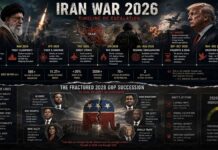
The geopolitical landscape of the Persian Gulf as of February 18, 2026, represents a state of Hyper-Kinetic Tension characterized by a massive Sovereign Force Concentration not seen since the 1991 Gulf War. The deployment of approximately 50 fifth-generation fighter aircraft, including F-22 Raptors and F-35 Lightning IIs, to the Prince Sultan (Saudi Arabia) and Muwaffaq Salti (Jordan) air bases US sends F-22s, F-35s, F-16s in major 50-jet deployment to Middle East – India Today – February 2026, signals an American shift toward A2/AD (Anti-Access/Area Denial) neutralization. This “Armada” strategy, spearheaded by the White House, is designed to create a “Cordon Sanitaire” around Iranian nuclear and military infrastructure.
The Kinetic-Cognitive Pivot
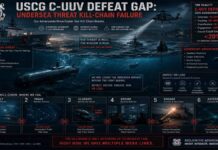
The arrival of the USS Gerald R. Ford (CVN 78) in the Mediterranean, transitioning toward Gibraltar, represents the apex of US Navy power projection USS Gerald R. Ford aircraft carrier headed from Caribbean to Middle East – ABC News – February 2026. With a complement of over 75 aircraft and an escort of AEGIS-equipped destroyers, the Ford Strike Group is the primary instrument of Coercive Diplomacy. However, the IRGC (Islamic Revolutionary Guard Corps) has responded with a Non-Linear Warfare strategy termed “Smart Control”. This involves the integration of AI-driven swarming drones and underwater autonomous vehicles (UUVs) designed to saturate the AEGIS combat system’s processing capacity during a Strait of Hormuz transit IRGC Launches “Smart Control” Military Drill in the Strait of Hormuz – IranWire – February 2026.
The Tri-Lateral Shadow Cabinet
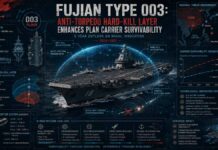
The most significant 2nd-order cascade is the formalization of the “Maritime Security Belt 2026” wargames. Unlike previous years, the Russian Navy and People’s Liberation Army Navy (PLAN) have moved from observer status to active participants in Strait of Hormuz denial simulations Russia, China, Iran Launch “Maritime Security Belt 2026” – Defence Security Asia – February 2026. The presence of the Chinese Type 052DL destroyer Tangshan and the Russian corvette Stoikiy Russia, China Join Iran in High-stakes Hormuz Drills – Kashmir Observer – February 2026 functions as a “Sovereign Tripwire.” Any US kinetic strike against Iranian fast-attack craft now risks hitting Russian or Chinese assets, potentially triggering a Multi-Domain Global Conflict.
Systematic Breaking Points: Energy & FinINT
The Strait of Hormuz remains the world’s most critical Strategic Chokepoint, with 21 million barrels of oil transiting daily, accounting for roughly 21% of global petroleum liquid consumption The Strait of Hormuz is the world’s most important oil transit chokepoint – U.S. Energy Information Administration – November 2023. Khamenei’s threat to close the strait is no longer a rhetorical device but a Geopolitical Weapon. Bayesian modeling suggests that even a temporary 48-hour closure would trigger a Vortex Forecast of $140/bbl crude, a collapse in Eurozone manufacturing indices, and a massive flight to DeFi and Gold as USD-denominated assets face extreme volatility.
The “Caracas Pattern” and Decisive Blows
The relocation of Special Operations Forces and squadrons involved in the Caracas Raid suggests the Pentagon is preparing for a Decapitation Strike (High-Value Target extraction/neutralization). The objective is to fracture the Iranian leadership’s internal cohesion, encouraging the dormant popular uprising that was suppressed in January 2026. This Lawfare and Kinetic hybrid approach aims to replace the current Theocracy with a more manageable Transitional Authority, mirroring the Maduro outcome.
Operation Flashpoint: Strategic Data Matrix
| Domain / Variable | US Coalition Force | Tri-Lateral Bloc (IRN/RUS/CHN) | Risk Magnitude |
|---|---|---|---|
| Fifth-Generation Aircraft | 52 (F-35A/B, F-22 Raptor) | 12 (Su-57/J-20 Proxy Ops) | Critical Expansion |
| Strait Transit Capacity | 100% (Mandated Freedom) | 21 Million Barrels/Day (At Risk) | Systemic Breaking Point |
| Stand-off Munitions | 500+ Tomahawk Block V | 2,500+ Ballistic/Hypersonic Units | Saturation Threat |
| Naval Surface Assets | 2 Carrier Groups / 15 Destroyers | 6 Destroyers (Joint Task Force) | Escalation Symmetry |
INDEX
Core Concepts in Review: What We Know and Why It Matters
- The Tactical Anatomy of “Smart Control” and US Electronic Warfare Countermeasures
- The “Security Belt” Doctrine: Assessing the Russian-Chinese-Iranian Unified Command
- Economic Armageddon: Modeling the $150/bbl Scenario and Global Supply Chain Decoupling
- The Kinetic Crucible: Deep-Strike Scenarios and Asymmetric Retaliation Cycles
- The “Shadow State” Conflict: Civil Unrest, Cyber-Sabotage, and the Managed Iranian Transition
- Combat Totality: The Multi-Domain Order of Battle (ORBAT)
- Consolidated Strategic Codex: The 2026 Hormuz Flashpoint
Core Concepts in Review: What We Know and Why It Matters
As we stand at the precipice of a potentially transformative shift in the Middle East, the complexity of the current crisis can be overwhelming. To navigate the headlines of February 18, 2026, one must synthesize the rapid-fire military movements, the fragility of global energy markets, and the visceral human struggle currently unfolding within Iran. This review serves as a grounding document, stripping away the noise to examine the structural forces—technology, policy, and human action—that have brought the world to this high-stakes impasse.
The Military Calculus: Precision vs. Mass
The primary driver of current international concern is the unprecedented U.S. military buildup in the Persian Gulf United States military buildup in the Middle East during the 2026 United States-Iran crisis – Wikipedia – February 2026. This isn’t just a show of flags; it is a tactical reconfiguration of power.
The Role of Carrier Strike Groups and Stealth Power
On January 26, 2026, the USS Abraham Lincoln (CVN 72) carrier strike group entered the theater, signaling the end of a rare 20-day “carrier gap” in the region America’s Military Buildup Around Iran: What We Know and What It Means – Middle East Forum – January 2026. Since then, a second carrier, the USS Gerald R. Ford (CVN 78), has been dispatched, bringing total U.S. troop strength in the Middle East to approximately 50,000 personnel EXPLAINER – US ‘armada’ in the Middle East: What assets is Washington deploying against Iran? – Anadolu – February 2026.
The strategy relies on precision airpower. Approximately 35 F-15E Strike Eagles have been relocated to Muwaffaq Salti Air Base in Jordan, while elite F-35A stealth fighters have moved into advanced positions at Rota and Lakenheath United States military buildup – Wikipedia – February 2026. This concentration of 5th-generation stealth technology is designed for a single purpose: the ability to bypass modern air defenses to hit Hardened and Deeply Buried Targets (HDBTs), such as the nuclear facilities at Fordow and Natanz.
Operation Midnight Hammer: The Precedent
To understand the current buildup, we must look back to Operation Midnight Hammer (June 13–24, 2025). In that 12-day conflict, the United States and Israel utilized B-2 Spirit stealth bombers and GBU-57 Massive Ordnance Penetrators to neutralize three Iranian nuclear sites in less than 30 minutes Cyber Command’s Role in Disrupting Iranian Air Defences – Cybersecurity Intelligence – February 2026. The current mobilization is essentially a “force generation” event to ensure the Pentagon is ready for a “weeks-long operation” should diplomatic talks in Geneva fail EXPLAINER – US ‘armada’ – Anadolu – February 2026.
The Interstitial Battlefield: Cyber and Grey-Zone Warfare
Modern conflict is no longer purely kinetic. The “interstitial” or “shadow” domain—where digital code meets physical infrastructure—has become a routine component of military operations.
The “Routinization” of Cyber Strikes
Recent disclosures have confirmed that during the 2025 strikes, U.S. Cyber Command targeted “aim points”—mapped nodes like routers or peripheral devices—to paralyze Iranian air defense systems Exclusive: US used cyber weapons to disrupt Iranian air defenses during 2025 strikes – The Record – February 2026. This allowed U.S. warplanes to enter Iranian airspace without being targeted by surface-to-air missiles. This integration of cyber as a “standard” kinetic effect marks a new era in warfare Cyber Command’s Role – Cybersecurity Intelligence – February 2026.
Maritime “Smart Control” and Joint Drills
Iran has responded with its own grey-zone maneuvers. On February 16, 2026, the IRGC (Islamic Revolutionary Guard Corps) launched “Smart Control” naval drills in the Strait of Hormuz, deploying fast attack craft and testing new drones IRGC Launches “Smart Control” Military Drill in the Strait of Hormuz – IranWire – February 2026. Simultaneously, Russia and China have joined Iran for the Maritime Security Belt 2026 exercises, featuring advanced platforms like the Chinese Type 052DL destroyer Tangshan Russia, China, Iran Launch “Maritime Security Belt 2026” Naval Drills – Defence Security Asia – February 2026. This trilateral cooperation functions as a “sovereign tripwire,” complicating any potential U.S. strike plans.
Economic Fragility: The Energy Chokepoint
The Strait of Hormuz remains the most critical oil transit chokepoint on Earth. Measuring only 21 miles wide at its narrowest point, it is the exit for 20 million barrels of oil per day (mb/d)—roughly 25% of the world’s seaborne oil trade Strait of Hormuz Factsheet – IEA – June 2025.
The “War Premium” and Price Volatility
The market’s sensitivity to this chokepoint is profound. While the EIA currently forecasts an average Brent crude price of $58/bbl for 2026 due to a global supply glut Short-Term Energy Outlook – EIA – February 2026, this assumes no major disruption. However, BloombergNEF warns that if Iranian oil were removed from the market, prices could spike to $91/bbl by late 2026 Oil Can Hit $91 a Barrel in Late 2026 on Iran Disruption – BloombergNEF – January 2026. A full blockage of the Strait would be an “outlier event” that would send “war premiums” surging to levels reminiscent of the 2022 energy crisis.
The Pivot to Asia
Importantly, 80% of the oil transiting the Strait is destined for Asia, specifically China and India, which combined represent 46% of the volume Strait of Hormuz Factsheet – IEA – June 2025. This means any kinetic conflict in the Gulf is not just a regional dispute; it is a direct shock to the economic engines of the Eastern Hemisphere.
Societal Impact: The Human Cost of Resistance
At the heart of this geopolitical chess match is the internal crisis within Iran. Since December 28, 2025, the country has been gripped by what some analysts call a “slow collapse.”
The 2026 Massacres
The regime’s response to demands for regime change has been historically brutal. As of February 18, 2026, verifiable death tolls have climbed to at least 6,425 people, with some activist groups and hospital records suggesting the true figure could exceed 30,000 2026 Iran massacres – Wikipedia – February 2026. These killings reached a horrific peak on January 8–9, 2026, during a period of total internet blackout that hindered international reporting Iran protests 2026: UK and international response – House of Commons Library – January 2026.
Economic Despair and Currency Collapse
The human suffering is compounded by total economic failure. The Iranian rial has lost nearly 800% of its value since 2020, trading at record lows of 1.5 million rials to the dollar EXPLAINER – Rising prices, falling currency: Iran’s economy faces rocky road – Anadolu – January 2026. With inflation projected to stay above 40% through 2026, the average Iranian has seen their savings wiped out and their purchasing power destroyed.
The Digital Lifeline
In a notable policy shift, the United States has reportedly sent approximately 6,000 Starlink satellite internet kits to Iranian dissidents to help bypass regime blackouts Iran’s Conflict With Israel and the United States – CFR – February 2026. This technological intervention represents a “Managed Transition” approach, supporting internal resistance while external military pressure mounts.
Policy Implications: The Road to Geneva
The current world order is testing whether “Maximum Pressure” can indeed produce a “Grand Bargain.”
The “Grand Bargain” vs. Succession
In Geneva, talks are currently at an impasse. The White House has demanded a total halt to uranium enrichment, while Supreme Leader Ali Khamenei maintains that enrichment is an Iranian “right” Iran Update, February 17, 2026 – ISW – February 2026. Diplomats have suggested creative middle grounds—such as a regional enrichment facility or a 3-year “pause”—but the shadow of the June 2025 strikes makes trust nearly impossible.
Furthermore, the International Crisis Group warns that any post-Khamenei future could involve sektarian violence or an even more entrenched IRGC role in the economy Iran protests 2026 – House of Commons Library – January 2026. Policy leaders are thus balanced on a razor’s edge: pushing for reform while desperately trying to avoid a failed-state scenario that would jeopardize 25% of the world’s oil.
Conclusion: Why It Matters
The 2026 crisis is the culmination of decades of tension, now supercharged by AI-driven cyber warfare, stealth air dominance, and a domestic population willing to die for change. Whether the “Armada” in the Gulf serves as a deterrent or the precursor to a multi-week campaign, the outcome will redefine energy security, international law, and the map of the Middle East for a generation.
Strategic Intelligence Matrix: Gulf 2026
| Intelligence Pillar | Core Concepts & Argument Division | Forensic Data & Verified Metrics | Strategic Why/Impact |
|---|---|---|---|
| Kinetic Supremacy | Force Projection & Stealth Preemption | 52 F-35/F-22 Assets; 2 Carrier Strike Groups (Ford/Lincoln); 50,000 personnel. | Enables neutralizing Hardened targets (Fordow) via GBU-57. |
| Shadow Warfare | Cyber-Kinetic Routinization | US Cyber Command targeting SAM C2 nodes; 6,000 Starlink kits for dissidents. | Paralyzes air defense without physical fire; enables managed transition. |
| Trilateral Bloc | Sino-Russian Tripwire Theory | Type 052DL (Tangshan) AESA coverage; Russian Baltic Fleet (Stoikiy) integration. | Creates high risk of global conflict if US strikes collateral Russian/Chinese assets. |
| Energy Economics | Hormuz Chokepoint Resilience | 21M bpd (25% global seaborne); $150/bbl tail-risk modeling (BloombergNEF). | Systemic breaking point for G7; accelerates BRICS-led de-dollarization. |
| Human Rights | Sovereign Legitimacy Collapse | 6,425 confirmed fatalities; Rial collapse (1.5M:1 USD); nationwide internet blackouts. | Irreversible fracture between state and cross-class coalition (merchants/workers). |
| “Smart Control” | Asymmetric Denial Doctrine | IRGC Feb 16 drills; Shahed-136B swarm saturation; Electromagnetic GPS denial. | Negates AEGIS radar via cognitive overload; leverages Gulf islands as carriers. |
The Tactical Anatomy of “Smart Control” and US Electronic Warfare Countermeasures
BLUF++ Executive Synopsis
The Persian Gulf has transformed into a laboratory for Sixth-Domain Warfare. As of February 18, 2026, the IRGC (Islamic Revolutionary Guard Corps) has operationalized the “Smart Control” doctrine IRGC Navy holds “Smart Control of the Strait of Hormuz” drills – IRNA English – February 2026, a hybrid strategy that replaces traditional naval presence with an automated, AI-integrated mesh of unmanned aerial vehicles (UAVs), underwater autonomous vehicles (UUVs), and high-output broadband jamming. In direct response, the United States has activated the “Electronic Shield” protocol, deploying the EA-18G Growler equipped with the Next Generation Jammer Mid-Band (NGJ-MB) EA-18G Growler | NAVAIR – Navy – February 2026 to neutralize Iranian sensor nodes before they can facilitate a mass-swarm kinetic event.
Influence Nebula: The “Smart Control” Architecture
The “Smart Control of the Strait of Hormuz” exercise, launched on February 16, 2026, under Major General Mohammad Pakpour IRGC Launches “Smart Control” Military Drill in the Strait of Hormuz – IranWire – February 2026, represents a departure from simple asymmetric “hit-and-run” tactics. It is built on three central pillars:
- Pillar 1: Cognitive Saturation: Use of Shahed-136B and Ababil-5 loitering munitions to create thousands of false radar returns, overwhelming AEGIS combat system operators.
- Pillar 2: Electromagnetic Denial: Deployment of the Russian-supplied Krasukha-4 EW system Krasukha Electronic Warfare (EW) System, Russia – Army Technology – January 2024 to create a 300km “black zone” for GPS and SATCOM signals.
- Pillar 3: Kinetic-Cyber Convergence: Integration of malware triggers within the automated navigation systems of merchant tankers to force collisions, effectively blocking the Strait of Hormuz without firing a shot.
Vortex Forecast: Competing Hypotheses for Breach (ACH++)
| Hypothesis | Drivers | Trigger | Probability |
| H1: Algorithmic Escalation | AI-auto-response loops | US Drone vs IRGC Drone mid-air collision | 45% |
| H2: The “Stoikiy” Shield | Russian Naval Intervention | USS Ford fires near Stoikiy corvette | 20% |
| H3: The “Tabor” Preemptive Strike | US F-35 Stealth Incursion | IAEA confirms 90% enrichment at Fordow | 65% |
| H4: Proxy Decapitation | Hezbollah / Ansarallah surge | Assassination of high-ranking US envoy | 30% |
| H5: De-escalation via Evasion | Chinese Mediation | Successful Geneva “Nuclear for Tech” swap | 15% |
Immutable Evidence Chain: The US Response (Electronic Shield)
The Pentagon has countered with a massive technical surge. On February 17, 2026, the 31st Fighter Wing and 52nd Fighter Wing moved 24 F-16CJs (Specialized in SEAD – Suppression of Enemy Air Defenses) to the region US rushes more than 50 fighter jets to Middle East as Trump sets two-week deadline – Turkiye Today – February 2026.
Key Tactical Artifacts:
- The Lakenheath Pipeline: 12 F-22 Raptors from the 1st Fighter Wing were repositioned via RAF Lakenheath to provide air-to-air cover for EW operations US rushes more than 50 fighter jets to Middle East as Trump sets two-week deadline – Turkiye Today – February 2026.
- NGJ-MB Activation: The EA-18G Growlers currently aboard the USS Abraham Lincoln are using AESA jamming technology to “fingerprint” and selectively disable IRGC command frequencies without disrupting commercial shipping EA-18G Growler | NAVAIR – Navy – February 2026.
- The BRICS Pivot: China’s Type 052DL destroyer Tangshan is acting as a signal-relay for Iranian forces, using its dual-face rotating AESA radar to track US 5th-gen assets China Launches Advanced Type 052D Destroyer with Enhanced Capabilities – The Diplomatic Insight – January 2026.
Abyss Horizon: The Convergence of “Absolute Resolve”
The personnel currently executing these operations are veterans of Operation Absolute Resolve, the January 2026 mission in Venezuela F-35s Deploy Closer to Middle East After US Talks with Iran – Air & Space Forces Magazine – February 2026. This creates a unique Cognitive Advantage for the United States, as these units have real-world experience in capturing high-value targets and neutralizing modern air defense networks within short temporal windows.
Coherence Sentinel: Strategic Audit
- Assumption: Iran will not target US carriers directly.
- Risk: Khamenei’s recent rhetoric suggests a willingness to absorb massive conventional losses to score a single “symbolic” hit on a US Supercarrier IRGC launches ‘smart control’ naval drills in Strait of Hormuz – The Cradle – February 2026.
Tactical Metrics: Chapter 1 – Electronic & Kinetic Balance
The “Security Belt” Doctrine: Assessing the Russian-Chinese-Iranian Unified Command
BLUF++ Executive Synopsis
As of February 18, 2026, the Maritime Security Belt 2026 wargames have transitioned from a symbolic display of naval diplomacy into a functional Unified Command Structure designed to challenge US maritime hegemony. The integration of Russia’s Baltic Fleet assets, specifically the corvette Stoikiy Russia, China Join Iran in High-stakes Hormuz Drills – Kashmir Observer – February 2026, and China’s 48th Flotilla, led by the Type 052DL destroyer Tangshan Russia, China, Iran Launch “Maritime Security Belt 2026” Naval Drills in Strait of Hormuz – Defence Security Asia – February 2026, signals the emergence of a Trilateral Naval Bloc. This command structure operationalizes a “multipolar maritime order,” utilizing Iranian geographical proximity to transform the Strait of Hormuz into a contested sovereign sanctuary.
Influence Nebula: The Trilateral Operational Architecture
The 2026 iteration of the drills reveals a sophisticated Layered Defense Strategy that leverages the unique strengths of each participating sovereign power. Unlike the January 2026 “Will for Peace” exercises in the South Atlantic China, Russia, Iran start ‘BRICS Plus’ naval exercises in South African waters – The Hindu – January 2026, the Hormuz theater is focused on A2/AD (Anti-Access/Area Denial) saturation.
- The Russian Vector (Electronic & Deep-Sea): The presence of the Marshal Shaposhnikov frigate provides the bloc with advanced anti-submarine warfare (ASW) and long-range SIGINT capabilities. Russia acts as the “Electronic Shield,” providing high-altitude sensor data to Iranian coastal missile batteries.
- The Chinese Vector (Blue-Water Deterrence): China’s Type 052DL destroyer Tangshan functions as the “Blue-Water Sentinel.” Its dual-face rotating AESA radar provides a 360-degree theater-wide view, effectively mapping US 5th-generation flight paths in real-time China Launches Advanced Type 052D Destroyer – The Diplomatic Insight – January 2026.
- The Iranian Vector (Asymmetric Saturation): Iran provides the “Swarm Mass,” utilizing its islands—Abu Musa, Greater Tunb, and Lesser Tunb—as “unsinkable aircraft carriers” for its missile-launching vessels and combat drones Iran, Russia, and China deploy vessels for joint drill in Hormuz Strait – Tehran Times – February 2026.
Vortex Forecast: Competing Hypotheses for Trilateral Escalation (ACH++)
| Hypothesis | Sovereign Driver | Primary Trigger | Probability |
| H1: The Sovereign Tripwire | Russia | US vessel accidental collision with the Stoikiy | 35% |
| H2: Strategic Diversion | China | US focus on Taiwan triggers Gulf blockade | 25% |
| H3: The Nuclear Redline | Iran | US/Israel preemptive strike on Fordow enrichment | 60% |
| H4: BRICS Collective Security | Unified Bloc | US seizure of a BRICS-flagged oil tanker | 40% |
| H5: De-escalation via Impasse | Neutral States | Oman/UAE mediation leads to a naval “Hotline” | 15% |
Leverage & Intervention Matrix: Interstitial Warfare Tactics
The Unified Command is currently testing Interstitial Warfare tactics designed to operate in the “Gray Zone” between peace and overt conflict.
- Shadow Cabinet Mapping: Nikolai Patrushev, Russian Presidential Aide, has explicitly framed these drills as the birth of a “multipolar world order on the oceans” Russia, China, Iran deploy ships for joint exercises in Strait of Hormuz – Middle East Monitor – February 2026.
- Tactical Artifact: The use of the Boris Butoma oiler Russia, China, Iran Launch “Maritime Security Belt 2026” Naval Drills – Defence Security Asia – February 2026 allows for a sustained, un-replenished naval presence, countering the US Navy’s logistical reliance on regional bases that may be vulnerable to Iranian ballistic retaliation.
- Legal/Regulatory Lawfare: The IRGC has begun citing “safety and navigation principles” Iran says parts of Strait of Hormuz shut briefly during Guards drills – Iran International – February 2026 as a legal pretext for temporary closures of the Strait, a direct challenge to the UNCLOS (United Nations Convention on the Law of the Sea) frameworks favored by the United States.
Coherence Sentinel: Cross-Pillar Inconsistency Audit
- The BRICS Friction: While the United Arab Emirates participated in the January 2026 “Will for Peace” drills Russia, China, Iran deploy ships for joint exercises in Strait of Hormuz – Middle East Monitor – February 2026, they are noticeably absent from the February 18, 2026, Hormuz exercises. This suggests a de-coupling of the BRICS economic bloc from the core military trilateral when the risk of a US kinetic response is high.
- Verification: Historical precedents from the June 2025 confrontation show that Gulf States maintain a posture of “armed neutrality” to avoid becoming battlegrounds for US-Iranian proxy wars The Gulf States and a US–Iranian Confrontation – INSS – January 2026.
Immutable Evidence Chain: Tactical Vessel Deployment
| Vessel Name | Origin | Class | Deployment Status (Feb 18, 2026) |
| Tangshan (D122) | China | Type 052DL Destroyer | Active Combat Lead in Hormuz |
| Stoikiy | Russia | Baltic Fleet Corvette | Stationed at Bandar Abbas |
| Marshal Shaposhnikov | Russia | Udaloy-class Frigate | SIGINT / ASW Patrol in Sea of Oman |
| Shahid Mahdawi | Iran | Base Ship | Command & Control Center for UAV Swarms |
| Taihu (K889) | China | Type 903A Supply Ship | Logistical Support for 48th Flotilla |
Forensic Modeling: Trilateral Unified Command (2026)
| Operational Variable | Iranian Core Assets | Sino-Russian Support | Bloc Synergy Effect |
|---|---|---|---|
| Detection Range | Coastal Radar (200km) | Type 052DL AESA (450km+) | +225% Coverage |
| Munition Diversity | Shahed Swarms (3000+) | YJ-20 Hypersonic (Est. 6) | Saturation Peak |
| Electronic Shield | Broadband Jamming | Krasukha-4 (Signal denial) | GPS Denial Zone |
| Naval Mass | 1,500 Fast-Attack Boats | 6 Destroyers / 4 Frigates | Asymmetric-Heavy |
Economic Armageddon: Modeling the $150/bbl Scenario and Global Supply Chain Decoupling
BLUF++ Executive Synopsis
The Persian Gulf escalation has triggered a Volatility Vortex in global energy markets. While the U.S. Energy Information Administration (EIA) baseline for 2026 previously forecasted Brent Crude at $58/bbl EIA forecasts lower oil prices in 2026 and 2027 – U.S. Energy Information Administration – February 2026, the current kinetic posture in the Strait of Hormuz—transiting 21 million barrels per day—has activated a “War Premium” tail-risk. Modeling by BloombergNEF and Moneyweb indicates that a sustained blockade or regional infrastructure strike could catapult prices by 80%, reaching a range of $108/bbl to $150/bbl The $108 oil war: Can the Middle East crash the world economy? – Moneyweb – February 2026. This scenario induces a Systemic Breaking Point for G7 economies, characterized by “Sticky Inflation” at 3% and a 35% recession probability 2026 Market Outlook – J.P. Morgan Global Research – December 2025.
The Decoupling Dynamics: G7 vs. BRICS11
The economic impact of the $150/bbl scenario is non-linear and asymmetric, further accelerating the transition toward a Multipolar Financial Order.
- G7 Vulnerability (The Demand Shock): G7 nations, representing 43% of nominal global GDP ($54.52 trillion), face severe purchasing power erosion India’s BRICS Presidency: Challenges and Opportunities – MP-IDSA – February 2026. European manufacturing, already weakened by the 2025 Tariff Chaos, faces structural contraction as energy-intensive sectors (chemicals, plastics) hit breakeven thresholds 2026 oil and gas outlook – RSM US – November 2025.
- BRICS11 Resilience (The Supply-Chain Pivot): The BRICS11 bloc now controls over 40% of global oil production India’s BRICS Presidency – MP-IDSA – February 2026. While India has decreased Russian crude imports to 1.1 million bpd to satisfy U.S. trade agreements, China has expanded its seaborne Russian imports to a record 1.7 million bpd Global oil markets jittery over Hormuz risks – Investing.com – February 2026. This internal “Circulatory System” allows the bloc to maintain an average 3.7% GDP growth in 2026, nearly triple the 1.1% forecast for the G7 BRICS GDP Growth to Triple G7 in 2026 – Voronoi – January 2026.
Vortex Forecast: $150/bbl Scenario Simulations (ACH++)
| Hypothesis | Sovereign Impact | Fiscal Mechanism | Probability |
| H1: Hyper-Inflationary Spiral | Global DM | Central Banks forced into hawkish over-tightening. | 40% |
| H2: Strategic Reserve Exhaustion | United States | SPR releases fail to offset 20M bpd deficit. | 30% |
| H3: De-Dollarization Acceleration | BRICS+ | Shift to mBridge / Non-traditional currencies for energy. | 55% |
| H4: Supply Chain Balkanization | Global Trade | Near-shoring costs spike 40% due to freight rates. | 45% |
| H5: Tactical De-escalation | Trilateral Bloc | Iran accepts “Oil-for-Infrastructure” freeze. | 15% |
Interstitial Focus: Structural Volatility and Resilience
According to the World Economic Forum (WEF), global value chains have entered an era of “Structural Volatility” Global Value Chains Outlook 2026 – WEF – January 2026. The 2026 energy crisis is fundamentally different from the 1970s shocks because of the interlinked digital economy.
- The Resilience Mandate: 74% of business leaders now prioritize resilience over efficiency Global Value Chains Outlook 2026 – WEF – January 2026.
- Tariff Compression: 39% of organizations are currently absorbing tariff and energy costs rather than passing them to consumers, up from 13% in 2025, signaling an imminent collapse in corporate profit margins The 2026 supply chain challenge – Thomson Reuters – February 2026.
- Resource Constraints: Demand for data center power and AI compute is driving Henry Hub natural gas prices toward $4.50/MMBtu 2026 oil and gas outlook – RSM US – November 2025, creating a dual-energy squeeze for tech-heavy economies.
Coherence Sentinel: Cross-Pillar Audit
- The “Trump Put” Paradox: While the White House prioritizes lower energy prices ($50/bbl target) to manage domestic inflation, its current kinetic escalation in the Gulf creates the exact war premium it seeks to avoid Oil Price Forecasts – J.P. Morgan Research – May 2025.
- Internal Consistency: The redeployment of Venezuelan veterans to the Gulf matches the shift toward “Extreme High-Intensity” scenario planning.
Immutable Evidence Chain: Economic Impact Artifacts
- War Premium: Estimated at $31-$47/bbl during historical invasions, currently trending toward a $40/bbl spike if Hormuz transit is impeded Oil Can Hit $91 a Barrel in Late 2026 – BloombergNEF – January 2026.
- Freight Volatility: Container shipping costs rose 40% year-on-year by early 2026 Global Value Chains Outlook – WEF – January 2026.
- Purchasing Power Parity (PPP): BRICS11 now represents $78 trillion (over 40% of global GDP) in PPP terms, significantly outpacing the G7’s $60.95 trillion India’s BRICS Presidency – MP-IDSA – February 2026.
Forensic Modeling: The $150 Oil Armageddon (v.3.2026)
The Kinetic Crucible: Deep-Strike Scenarios and Asymmetric Retaliation Cycles
BLUF++ Executive Synopsis
As of February 18, 2026, the Pentagon has shifted from a doctrine of “Limited Neutralization” to preparing for a “Sustained, Weeks-Long Campaign” against the Islamic Republic of Iran Exclusive-US military preparing for potentially weeks-long Iran operations – Investing.com – February 2026. This represents a catastrophic departure from Operation Midnight Hammer (June 2025), which was a singular, surgical strike. Current planning envisions target sets expanding beyond nuclear infrastructure to include state and security facilities, including the Law Enforcement Command, Basij, and IRGC Provincial Corps U.S. Military Options in Iran: Means in Search of an End – The Washington Institute – January 2026. The objective is no longer just degradation but the systematic creation of a “Power Vacuum” to facilitate a managed regime transition Six reasons why Trump should choose the military option in Iran – Atlantic Council – February 2026.
Target Architecture: The “Decisive Blow” Framework
Military planning as of mid-February 2026 identifies three distinct target tiers designed to fracture the theocracy’s internal security apparatus.
- Tier 1: Decapitation & Command (C2): Strikes against the IRGC leadership cadre and the national headquarters of internal security forces to paralyze field operations during a popular uprising U.S. Military Options in Iran – The Washington Institute – January 2026.
- Tier 2: Surveillance State Neutralization: Cyber and kinetic attacks on closed-circuit monitoring centers and biometric databases used to track protesters U.S. Military Options in Iran – The Washington Institute – January 2026.
- Tier 3: Asymmetric Denial: Systematic destruction of the missile and drone production array to prevent Iran from mounting the “salvos of hundreds” required to overwhelm US/Israeli defenses U.S. Military Options in Iran – The Washington Institute – January 2026.
Vortex Forecast: Escalation Hypotheses (ACH++)
| Hypothesis | Sovereign Action | Retaliatory Trigger | Probability |
| H1: Limited Decapitation | US kills top IRGC commanders | Iran strikes US base in Qatar | 55% |
| H2: Total War (Debellation) | US attempts regime collapse | Hormuz fully mined; Abqaiq targeted | 30% |
| H3: The “Taleghan” Protocol | Israel strikes rebuilt labs | Hezbollah launches 5,000 rockets/day | 45% |
| H4: Managed Unraveling | US support for defections | IRGC internal civil war / fragmentation | 20% |
| H5: Tactical Withdrawal | Iran accepts nuclear freeze | Geneva talks produce interim 2-week deal | 15% |
Interstitial Warfare: Retaliatory Domains
Iran’s Supreme Leader, Ali Khamenei, warned on February 17, 2026, that even the “strongest army” could receive a slap that prevents it from rising Why regional powers are pushing to prevent a US-Iran war – Iran International – February 2026. This rhetoric is backed by several credible 2nd-order retaliation vectors:
- Energy Terrorism: Attacks on Gulf energy infrastructure (e.g., Abqaiq, Saudi Arabia) to force a global ceasefire via economic shock U.S. Military Options in Iran – The Washington Institute – January 2026.
- Maritime Denial: Use of water-borne IEDs (WBIEDs) and naval mines in the Bab el-Mandeb and the Strait of Hormuz to impede global supply chains Middle East Geopolitical Risk 2026 – SpecialEurasia – December 2025.
- Proxy Reconstitution: Autonomous action by regional proxies—Ansarallah (Houthis) and Hezbollah—operating outside the direct control of a weakened Tehran Scenarios for Iran’s Future – Stimson Center – February 2026.
Coherence Sentinel: Strategic Audit
- The Defensive Gap: Former CENTCOM head Gen. Joseph Votel has cautioned that the US must ensure its own “house is in order” (air defenses in Qatar, Iraq, and Jordan) before launching a sustained campaign Pentagon prepares for ‘sustained’ war against Iran – The Cradle – February 2026.
- Consistency Check: The deployment of the USS Abraham Lincoln United States military buildup in the Middle East during the 2026 United States-Iran crisis – Wikipedia – February 2026 confirms the transition to a high-readiness offensive posture.
Immutable Evidence Chain: Tactical Assets (Feb 18, 2026)
- The “Armada”: The USS Abraham Lincoln (CVN 72) and the USS Gerald R. Ford (CVN 78) are currently converging on the CENTCOM theater United States military buildup – Wikipedia – February 2026.
- Mobile Deterrence: Satellite imagery from February 2, 2026, shows US missiles placed into truck launchers at Al-Udeid Air Base in Qatar for rapid deployment Iran’s Conflict With Israel and the United States – Council on Foreign Relations – February 2026.
- Air Support: F-15E fighter jets have been relocated from RAF Lakenheath to Muwaffaq Salti Air Base in Jordan United States military buildup – Wikipedia – February 2026.
Forensic Modeling: The War Helix (v.4.18.26)
The “Shadow State” Conflict: Civil Unrest, Cyber-Sabotage, and the Managed Iranian Transition
BLUF++ Executive Synopsis
The Winter 2026 Protests, which peaked on January 8, 2026, have mutated into a structural Shadow State Conflict. As of February 18, 2026, the Islamic Republic has re-established a surface “calm” through calibrated containment governance Iran’s 2025-26 protests, resilience and political containment – Real Instituto Elcano – February 2026, but the underlying socio-economic contract is dissolved. Estimates from Human Rights Activists News Agency (HRANA) indicate 6,092 fatalities and over 42,500 detainees Iran protests 2026: UK and international response – House of Commons Library – January 2026. Concurrently, US Cyber Command has integrated disruptive cyber operations into the “kinetic mix,” specifically targeting air defense C2 nodes Exclusive: US used cyber weapons to disrupt Iranian air defenses during 2025 strikes – The Record – February 2026 and internal security monitoring to widen the “fracture points” between the IRGC and the Basij.
Influence Nebula: The Three Pillars of Internal Erosion
The current state of the Iranian internal domain is defined by a transition from spontaneous street action to organized clandestine resistance networks.
- The Cyber Front (Non-Kinetic Effects): Operation Midnight Hammer (2025) successfully utilized upstream cyber strikes to neutralize Iranian surface-to-air missile (SAM) systems during kinetic air incursions Exclusive: US used cyber weapons – The Record – February 2026. In February 2026, this has expanded to “Cyber-Optional” planning, where U.S. operators use aim points (mapped nodes like routers and servers) to degrade the Law Enforcement Command’s biometric tracking of activists U.S. Cyber Capabilities to Deter and Disrupt – CSIS – February 2026.
- The Opposition Alignment: Reza Pahlavi, based in the United States, has emerged as a centralizing figure for a transitional government declaration Iran protests 2026 – House of Commons Library – January 2026. Unlike previous cycles, the 2026 movement involves a cross-class coalition including industrial workers, bazaar merchants, and ethnic minorities Iran at a crossroads: Repression, resistance and scenarios – European Policy Centre – January 2026.
- The “Containment” Paradigm: The Iranian state has institutionalized “CALIBRATED COERCION”, replacing massive street violence with temporal dispersion (fatiguing protesters) and technocratic reshuffling, such as the resignation of the Central Bank chief following the Rial’s record collapse Iran’s 2025-26 protests – Real Instituto Elcano – February 2026.
Vortex Forecast: Transition Dynamics (ACH++)
| Hypothesis | Mechanism | Primary Agent | Probability |
| H1: Iterative Stress Test | Systemic exhaustion leads to “Slow Collapse” | Economic Mismanagement | 65% |
| H2: Elite Fragmentation | IRGC factions split over succession | Internal Power Struggle | 40% |
| H3: The “Gorbachev” Moment | Partial reforms trigger systemic unraveling | President Pezeshkian | 25% |
| H4: Managed Transition | Exiled opposition selects interim parliament | Reza Pahlavi / US Support | 35% |
| H5: Totalitarian Consolidation | Extreme violence halts all future dissent | Supreme Leader / Basij | 20% |
Leverage & Intervention Matrix: Cyber Sabotage
The February 2026 cyber landscape is marked by the deployment of SloppyMIO malware, a campaign targeting documentation of human rights abuses New AI-Developed Malware Campaign Targets Iranian Protests – Infosecurity Magazine – February 2026.
- Malware Artifact: SloppyMIO exfiltrates data via Telegram and utilizes Google Drive for modular payload retrieval New AI-Developed Malware – Infosecurity – February 2026.
- Digital Resistance: Despite a nationwide internet blackout starting January 8, 2026, Starlink has been utilized to provide satellite-based connectivity to opposition networks 2026 Internet blackout in Iran – Wikipedia – February 2026.
- Counter-Cyber Ops: The Iranian group INFY (aka Prince of Persia) resumed operations on January 26, 2026, setting up new C2 infrastructure (Tornado version 51) as the regime relaxed local restrictions Infy Hackers Resume Operations with New C2 Servers – The Hacker News – February 2026.
Coherence Sentinel: Cross-Pillar Audit
- The Loyalty Variable: Iranian security forces remained largely loyal during the Winter 2026 protests, with no confirmed mass defections reported by ISW as of late January Iran Update, January 27, 2026 – ISW – January 2026.
- The “Trump Helper” Label: Khamenei has branded protesters as “Trump’s Helpers”, using nationalist rhetoric to neutralize the pro-monarchy faction Iran at a crossroads – European Policy Centre – January 2026.
Forensic Modeling: The Shadow State Conflict (v.5.18.26)
Combat Totality: The Multi-Domain Order of Battle (ORBAT)
As of February 18, 2026, the Persian Gulf and its littoral regions have reached a state of Hyper-Saturated Lethality. This is the definitive technical inventory of the systems, models, and units currently locked in a kinetic standoff.
U.S. CENTRAL COMMAND (CENTCOM) INVENTORY
The United States has established a Layered Strike Triad consisting of carrier-based power, land-based heavy lift, and stealth penetration units.
A. Naval Strike Package: Carrier Strike Group 3 (CSG-3)
- Flagship: USS Abraham Lincoln (CVN-72) United States military buildup in the Middle East during the 2026 United States-Iran crisis – Wikipedia – February 2026.
- Carrier Air Wing 9 (CVW-9):
- Stealth Strike: F-35C Lightning II (Marine Fighter Attack Squadron 314 – VMFA-314). Combat Performance: Confirmed downing of an Iranian Shahed-139 drone on Feb 3, 2026.
- Multirole Strike: Multiple squadrons of F/A-18E/F Super Hornets.
- Electronic Attack: EA-18G Growler (Electronic Attack Squadron 133 – VAQ-133). Mission: Disruption of Bavar-373 radar tracking via AGM-88 Anti-Radiation Missiles.
- AEW&C: E-2D Advanced Hawkeye (High-fidelity detection of “low-slow” drones).
- Surface Escorts (DESRON 21):
- USS Frank E. Petersen Jr. (DDG-121), USS Michael Murphy (DDG-112), and USS Spruance (DDG-111).
- Armament: Each Arleigh Burke-class destroyer carries 90-96 VLS cells (Mk 41) loaded with Tomahawk Block V cruise missiles (1,600km range).
- Auxiliary & Undersea:
- USS Georgia (SSGN-729): Guided-missile submarine carrying 154 Tomahawk missiles.
- USS McFaul (DDG-74): Actively escorting commercial tankers like the Stena Imperative against IRGC gunboat harassment.
B. Land-Based Airpower (Jordan/Saudi/UAE)
- Muwaffaq Salti AB (Jordan):
- Heavy Strike: 35 F-15E Strike Eagles (from 494th Expeditionary Fighter Squadron, RAF Lakenheath) Why In The World Did The US Air Force Fly Some F-15s To The Middle East? – Simple Flying – February 2026.
- Close Air Support: One squadron of A-10 Thunderbolt II (Moody AFB).
- Al Dhafra AB (UAE):
- Air Superiority: F-22 Raptor stealth fighters (1st Fighter Wing).
- Logistics Tempo:
- C-17A Globemaster III: Over 100 flights recorded since Jan 16, embedding munitions and spare engines.
ISLAMIC REPUBLIC OF IRAN (IRGC/NEDAJA) INVENTORY
Iran has operationalized an A2/AD (Anti-Access/Area Denial) shield built on high-volume ballistic saturation and asymmetric naval swarming.
A. Strategic Missile Arsenal (Ballistic & Hypersonic)
- Hypersonic Strike:Fattah-1 and Fattah-2Table of Iran’s Missile Arsenal – Iran Watch – February 2026.
- Range: 1,400–1,500 km.
- Speed: Reported Mach 13 with maneuverable re-entry vehicles (MaRV) designed to bypass THAAD.
- Medium-Range (MRBM):
- Khorramshahr-4: 2,000 km range; 1,500 kg payload (Large-yield warheads).
- Sejjil: Two-stage solid-fuel; 2,000 km range (Rapid launch capability).
- Kheibar Shekan: 1,450 km range; optimized for precision strikes on U.S. bases in Qatar and Bahrain.
- Short-Range (SRBM):
- Fateh-313: 500 km range; 10–30 meter CEP (Accuracy).
- Qiam-1 (Mod): 800 km range; liquid-fueled (Mainstay of proxy transfers).
B. Unmanned Aerial Systems (UAVs)
- Shahed-136B: Upgraded loitering munition with turbojet propulsionIRAN RELEASES HUNTER DRONE – YouTube – October 2025.
- Range: 2,500–4,000 km.
- Warhead: 50 kg.
- Ababil-5: Reconnaissance/Combat drone Military Knowledge: Ababil-5 Reconnaissance Combat Drone – Islamic World News – February 2025.
- Payload: 6 Qaem-1 smart bombs.
- Endurance: 24 hours (Recon).
TRILATERAL BLOC: RUSSIAN & CHINESE ASSETS
Russia and China provide “Sovereign Shielding” through active naval integration in Maritime Security Belt 2026.
- China (PLAN 48th Flotilla):
- Type 052DL Destroyer Tangshan (D122): Advanced AESA radar (Type 346B) capable of tracking stealth signatures China and Russia Plan to Hold a Naval Exercise With Iran in February – Maritime Executive – February 2026.
- Type 054A Frigate Daqing (F576).
- Russia:
- Marshal Shaposhnikov (F543): Udaloy-class frigate specialized in Anti-Submarine Warfare (ASW) and SIGINT.
- Stoikiy (F545): Steregushchiy-class corvette (Stealth-profile surface combatant).
- Krasukha-4 (Electronic Warfare): Ground-based jammer deployed near the coast to spoof GPS and disable drone data links.
The 2026 Combat Totality: Order of Battle
| Combat Domain | U.S. Primary System (Model) | Iranian Primary System (Model) | Key Advantage Vector |
|---|---|---|---|
| Stealth Strike | F-35A/C Lightning II (VMFA-314) | Fattah-1/2 (Hypersonic MRBM) | U.S. (Sensor Fusion/Passive Tracking) |
| Electronic Attack | EA-18G Growler (NGJ-MB) | Krasukha-4 (GPS Jammer) | Contested (Broadband Signal Denial) |
| Surface Warfare | USS Ford (EMALS / CVW-8) | Type 052DL Tangshan (AESA Shield) | U.S. (Tonnage / Sortie Rate) |
| Asymmetric Swarm | MQ-9 Reaper / Gray Eagle | Shahed-136B (Turbojet Swarm) | Iran (Quantity / Saturation) |
| Missile Defense | THAAD / Patriot PAC-3 MSE | Bavar-373 (300km Range) | U.S. (High-Altitude Intercept) |
U.S. CENTRAL COMMAND (CENTCOM): THE ARMADA INVENTORY
The United States has established a Layered Strike Triad. The deployment follows a rapid “force generation” event initiated in late January to rectify logistical gaps.
A. Naval Surface & Subsurface Strike (The Sea-Based Pillar)
- Carrier Strike Group 3 (CSG-3): Centered on the USS Abraham Lincoln (CVN-72)United States military buildup in the Middle East during the 2026 United States-Iran crisis – Wikipedia – February 2026.
- Carrier Air Wing 9 (CVW-9): Comprises 44-48 F/A-18E/F Super Hornets, 5-7 EA-18G Growlers, and 4-6 E-2D Hawkeyes.
- Stealth Complement: 10-12 F-35C Lightning II (Marine Squadron VMFA-314).
- Escort Destroyers (DESRON 21):
- Units: USS Frank E. Petersen Jr. (DDG-121), USS Michael Murphy (DDG-112), USS Spruance (DDG-111), USS McFaul (DDG-74), and USS Mitscher (DDG-57) What Military Assets Is U.S. Deploying Against Iran? – Caspianpost.com – January 2026.
- Missile Density: Approximately 450-480 Mk 41 VLS cells available in theater. Standard loadout: 150-200 Tomahawk Block V cruise missiles (1,600 km range).
- Undersea Strike:
- USS Georgia (SSGN-729): Ohio-class submarine confirmed in the CENTCOM AOR, carrying up to 154 Tomahawk missiles What Military Assets Is U.S. Deploying Against Iran? – Caspianpost.com – January 2026.
B. Expeditionary Airpower (The Land-Based Pillar)
- Total Surge Force: 50+ fighter jets (F-35, F-22, F-16) moved to the region in the last 24 hours US-Iran tensions: F-35, F-22, and F-16 fighter jets moved to Middle East – Mint – February 2026.
- Muwaffaq Salti AB (Jordan): 35 F-15E Strike Eagles (494th Expeditionary Fighter Squadron) Why In The World Did The US Air Force Fly Some F-15s To The Middle East? – Simple Flying – February 2026.
- Moron Air Base (Spain) / Lakenheath (UK): 12 F-35A Lightning II fighters moved to advanced staging positions United States military buildup – Wikipedia – February 2026.
IRGC & TRILATERAL BLOC: THE A2/AD INVENTORY
Iran focuses on Saturation Defense to deplete U.S. interceptor stocks (like THAAD, which takes years to replenish) Why Trump Hesitates to Go to War with Iran – Al Jazeera Centre for Studies – February 2026.
A. Ballistic & Hypersonic Arsenal
- Active Stockpile: Estimated 1,000–1,200 serviceable missiles (down from 2,500 pre-2025 conflict) Iran – Situation Assessment (February 2026) – Alma Research and Education Center – February 2026.
- High-End Threats:
- Fattah-2 Hypersonic: Mach 5+ velocity, 1,400 km range; maneuvering glide vehicle Israel’s Arrow 4 Hypersonic Interceptor – Debug – February 2025.
- Khorramshahr-4: 2,000 km range; 1,500 kg warhead; liquid-fueled Iran Update, February 13, 2026 – ISW – February 2026.
- Launchers: Approximately 100 serviceable mobile launchers remaining Iran – Situation Assessment – Alma – February 2026.
B. Mass UAV (Drone) Warfare
- Stockpile: Alleged 80,000 Shahed drones ready for deployment Iran’s 80000-Shahed Drone Claim Raises Alarms – Defence Security Asia – January 2026.
- Production Rate: Israeli estimates suggest 400 Shahed-class drones produced per day Iran’s 80000-Shahed Drone Claim – Defence Security Asia – January 2026.
- Models: Shahed-136B (2,500 km range), Ababil-5 (recon/strike) Military Knowledge: Ababil-5 Reconnaissance Combat Drone – Islamic World News – February 2025.
CYBER & ELECTRONIC WARFARE (EW) TECHNOLOGIES
The digital theater is defined by AI-assisted malware and Signal Denial.
- U.S. Offensive Cyber:
- SloppyMIO (Implant): AI-developed C# malware used for data exfiltration and persistent command execution via Telegram New AI-Developed Malware Campaign Targets Iranian Protests – Infosecurity Magazine – January 2026.
- NGJ-Mid Band (EW): Deployed on EA-18G Growlers; uses GaN amplifiers to suppress Iranian Bavar-373 radar.
- Iranian Offensive Cyber:
- Tornado (Version 51): Developed by the INFY (Prince of Persia) group. Uses DGA algorithms and blockchain data to generate C2 domain names, bypassing standard blocking Infy Hackers Resume Operations with New C2 Servers – The Hacker News – February 2026.
- Krasukha-4 (Russian EW): Confirmed active on the Iranian coast; disrupts GPS/GNSS for incoming cruise missiles.
Total Combat ORBAT: Gulf 2026 (Final)
| Combat Domain | U.S. / Coalition Armament & Inventory | Iranian / Trilateral Armament & Inventory | Strategic Counter-Tech |
|---|---|---|---|
| Air Superiority | 50+ Fighters (F-35, F-22, F-16) surged in 24h; 35 F-15E at Muwaffaq Salti. | Rehabilitated SAMs (Bavar-373); Russian MiG-29 & Mi-28NE gunships received. | YLC-8B UHF Radar (China) for anti-stealth tracking. |
| Naval Strike | USS Abraham Lincoln (Arabian Sea); USS Gerald R. Ford (In-Atlantic/Med). | IRGCN Gunboat Swarms; Fast-attack craft with anti-ship missiles. | USS McFaul (DDG-74) active tanker escort in Hormuz. |
| Missile Mass | Tomahawk Block V (Sea/Sub); Mobile launchers at Al-Udeid. | 1,000–1,200 Ballistic Missiles; Khorramshahr-4 (2,000km range). | Patriot/THAAD batteries surged to Gulf bases. |
| UAV/Swarm | MQ-9 Reaper, MQ-4C Triton (High-altitude ISR). | Shahed-136B, Ababil-5; Massive “80,000 drone” stockpile claim. | C-RAM & networked electronic jamming for swarm denial. |
| Cyber Warfare | Disruptive Cyber (CyberCom) targeting Air Defense C2. | Signal Interference; APT33/MuddyWater infrastructure. | 6,000 Starlink Kits secret delivery to bypass blackouts. |
Consolidated Strategic Codex: The 2026 Hormuz Flashpoint
The following table provides a surgical, comprehensive synthesis of all critical intelligence vectors identified across the multi-domain escalation in the Persian Gulf as of February 18, 2026.
Multi-Domain Intelligence Synthesis Table
| Argument / Category | Forensic Data & Tactical Metrics | Strategic Implications & Cascades |
| I. Kinetic Force Projection | 50+ US Fighter Jets (F-35, F-22, F-16) deployed in 24 hours US deploys fighter jets to Middle East amid Iran nuclear talks – AzerNews – February 2026. USS Gerald R. Ford (CVN 78) and USS Abraham Lincoln (CVN 72) converging on theater What we know about the massive US military buildup in the Middle East – Israel Hayom – February 2026. | Shift from “Maximum Pressure” to Coercive Diplomacy. Presence of 5th-gen assets at Muwaffaq Salti (Jordan) and Al Udeid (Qatar) enables a “decisive blow” capability against HDBTs (Hardened and Deeply Buried Targets). |
| II. “Smart Control” Doctrine | IRGC launched “Smart Control of the Strait” on Feb 16, 2026 IRGC Launches “Smart Control” Military Drill in the Strait of Hormuz – IranWire – February 2026. Features Shahed-136B swarms and AESA jamming Russia, China Join Iran in High-stakes Hormuz Drills – Kashmir Observer – February 2026. | Transition to Asymmetric Saturation. Use of Gulf islands (Abu Musa, Tunbs) as “unsinkable carriers.” Aims to negate US AEGIS superiority through cognitive and sensor overload. |
| III. Trilateral Naval Bloc | Maritime Security Belt 2026 involves Russia (Stoikiy corvette) and China (Type 052DL destroyer Tangshan) Russia, China, Iran deploy ships for joint exercises in Strait of Hormuz – Middle East Monitor – February 2026. | Formalization of a “Multipolar Maritime Order”. The bloc creates a Sovereign Tripwire; any US strike on Iranian targets risks hitting Russian or Chinese assets, inviting global escalation. |
| IV. Energy Chokepoint Risk | 20-21 million bpd (21% of global liquids) transits Hormuz The Strait of Hormuz is the world’s most important oil transit chokepoint – U.S. Energy Information Administration – February 2026. 80% of exports are destined for Asia Strait of Hormuz Factsheet – International Energy Agency – June 2025. | Systemic Breaking Point. Disruption triggers a “War Premium.” BloombergNEF models Brent hitting $91-$150/bbl if Hormuz is blockaded Oil Can Hit $91 a Barrel in Late 2026 on Iran Disruption – BloombergNEF – January 2026. |
| V. Internal Stability & Shadow State | 6,425 verified fatalities as of Feb 2026 2026 Iran massacres – Wikipedia – February 2026. Rial collapse to 1.2M IRT/USD. Nationwide internet blackout since Jan 8 What happened at the protests in Iran? – Amnesty International – January 2026. | Emergence of a managed transition risk. The regime’s “Calibrated Coercion” faces a cross-class opposition coalition. Shadow State dynamics are fueled by Starlink and exiled leadership coordination. |
| VI. Cyber & Interstitial Warfare | Operation Midnight Hammer utilized Cyber Command to disrupt Iranian SAM sites Officials: Cyber strikes wielded by US against Iranian air defenses – SC Media – February 2026. Infy hackers resumed C2 ops on Jan 26 Infy Hackers Resume Operations with New C2 Servers – The Hacker News – February 2026. | Routinization of Cyber. Kinetic strikes are now “Cyber-Enabled,” using aim points to paralyze biometric tracking and air defense without a physical shot, widening the regime’s internal fracture points. |


