















Index
- The Stealth Architecture – How BPFDoor exploits kernel-level Berkeley Packet Filter (BPF) for passive, portless persistence in Linux-based telecom systems.
- The Threat Actor and Campaign – Red Menshen (aka Earth Bluecrow / DecisiveArchitect) operations, targeting patterns, and post-exploitation toolkit.
- Strategic Implications and Defenses – Risks to signaling protocols (SCTP, Diameter), national security, and practical detection/remediation steps.
- Victim Nations and Geopolitical Ripples – Country-Level Impacts, Infrastructure Compromises, Data Exposure, and Strategic Consequences of Red Menshen’s BPFDoor Campaign
- Clarity Table Synthesis: Consolidated Evidentiary Overview of the Red Menshen BPFDoor Campaign in Global Telecommunications Infrastructure
Infinity Abstract (Forensic Overview – Updated to March 27, 2026)
A sophisticated China-nexus threat actor known as Red Menshen has conducted a long-term espionage campaign by embedding highly stealthy Linux backdoors deep inside telecommunications networks worldwide, according to a detailed investigation released by Rapid7 Labs on March 26, 2026.
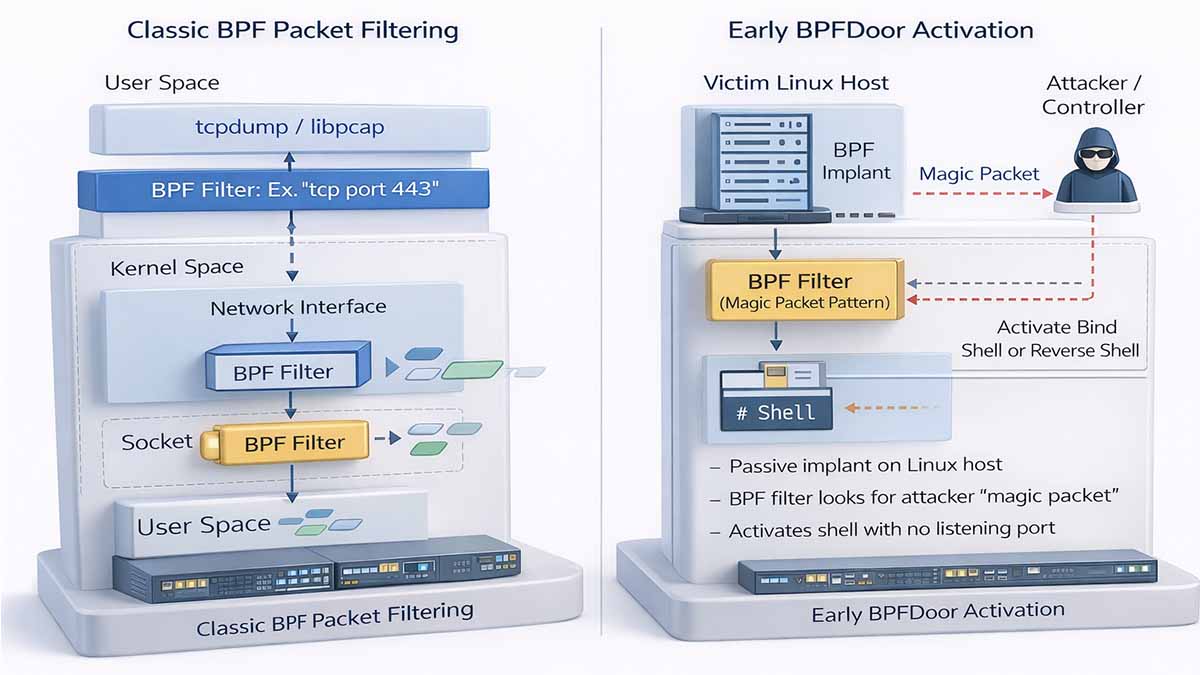
At the core of these operations sits BPFDoor, a kernel-level backdoor that abuses the Berkeley Packet Filter (BPF) mechanism — the same technology used legitimately by tools like tcpdump and libpcap — to inspect network traffic directly from within the operating system kernel without opening any listening ports or generating conventional command-and-control (C2) beaconing. This design renders traditional security tools (netstat, ss, nmap, most EDR solutions focused on user-space or port activity) largely blind to its presence.
BPFDoor functions as a “digital sleeper cell.” It installs a custom BPF filter that passively monitors incoming packets for a specific “magic packet” trigger (a predefined byte sequence). Upon receiving the correct trigger, it spawns a remote shell (or reverse shell) for the attacker while otherwise remaining completely dormant. Recent variants observed by Rapid7 have evolved further: some conceal activation commands inside legitimate HTTPS traffic (exploiting SSL termination points like load balancers and reverse proxies), and others are specifically configured to filter SCTP (Stream Control Transmission Protocol) traffic — the signaling protocol critical for 4G/5G core networks, subscriber authentication, mobility management, and inter-operator communication.
This SCTP capability is particularly alarming in the context of the provided telecom network architecture diagrams. Telecom environments consist of layered components:
- Customer-Facing Edge Services: Mobile Base Stations (RAN), Fiber Aggregation Routers, Broadband Gateways, DNS Services, SMSCs, Internet Gateways, and Internet Peering Points, often protected by Firewalls, VPNs, and Proxies.
- IP Core & Transport Backbone: High-Capacity Routers, High-Caps Routers/Switches, carrying Voice, Data, and Signaling traffic over protocols including SS7, Diameter, and SCTP.
- Control Plane & Databases: Subscriber Management Systems (HLR/HSS, UDM), Authentication Platforms (AuC), Policy Control Functions, Billing & Lawful Intercept systems, and Roaming Databases.
- Underlying Infrastructure: Virtualization Stacks, Network Appliances, and Hardened Servers running Linux or BSD on bare-metal.
Red Menshen targets internet-exposed edge devices (firewalls, VPNs, web platforms from vendors like Cisco, Fortinet, VMware) for initial access, then moves laterally to compromise core Linux servers and containers in the backbone. Once implanted, BPFDoor allows silent inspection of signaling traffic without touching higher-level applications or databases that defenders typically monitor. This grants potential visibility into subscriber behavior, geolocation data, authentication exchanges, SMS routing, and even targeted tracking of specific users or government communications.
The campaign, active since at least 2021, focuses on telecom providers (especially in the Middle East and Asia), government networks, logistics, education, and other critical sectors. Post-exploitation often involves customized variants of tools like Mangzamel (Golang versions), Gh0st RAT, Mimikatz for credential extraction, and Metasploit for lateral movement. C2 is obfuscated through compromised routers (e.g., in Taiwan) and VPS infrastructure, with attacker activity typically occurring Monday–Friday during 01:00–10:00 UTC — consistent with business-hour operations potentially aligned to a specific time zone.
Rapid7 researchers describe these implants as “sleeper cells in the telecom backbone,” positioned for long-term persistence and high-level espionage rather than immediate disruption. They have released an open-source scanning script to help detect known BPFDoor variants and associated artifacts (process masquerading, unusual BPF filter patterns, etc.). However, the report emphasizes that highly evolved variants may still evade detection, underscoring the need for deep kernel visibility, behavioral analysis, and proactive threat hunting beyond traditional perimeter controls.
This incident highlights a broader paradigm shift in cyber threats to critical infrastructure: attackers are moving beyond user-space malware and perimeter breaches into the kernel and signaling plane of bare-metal and virtualized telecom systems. The two diagrams you provided perfectly illustrate the attack surface — from edge services and firewalls/VPNs down to hardened Linux/BSD servers in the IP core, where SCTP/Diameter signaling occurs.
Traditional detection relying on open ports or user-space processes fails here because BPFDoor operates at a lower layer. Defenders must now prioritize kernel-level monitoring, traffic inspection for anomalous BPF usage, and segmentation between IT and telecom signaling planes.
Key risks include:
- Long-term undetected access to sensitive government and critical communications.
- Potential interception or monitoring of subscriber data, location, and signaling without triggering alarms.
- Strategic intelligence collection that could support state-level objectives in geopolitical or industrial espionage.
Organizations running Linux in telecom environments (especially those handling SCTP traffic) should immediately assess exposure using available tools from Rapid7 and implement enhanced visibility into kernel networking behaviors.
BPFDoor in Telecom Backbone Systems: Kernel-Level Dormancy, Signaling Visibility, and Sleeper-Cell Persistence
This infographic rebuilds the supplied BPFDoor telecom dataset into a new analytical structure focused on infrastructure layers, regional targeting, stealth evolution, and operational dependency. The core picture is a threat that gains disproportionate power by sitting quietly in high-value telecom environments: edge devices provide entry, kernel BPF filtering preserves dormancy, SCTP-aware visibility exposes signaling-rich flows, and hidden activation pathways convert passive presence into strategic access at the moment of choice.
Embedded Infrastructure and Risk Dataset
The table below consolidates the provided telecom-layer data into one structured baseline. It captures where BPFDoor is most meaningful operationally: edge infrastructure as entry surface, IP backbone and SCTP flows as high-impact observation zones, control-plane systems as subscriber and authentication exposure points, and hardened server environments as the platform for passive implant persistence.
| Layer | Core Components | BPFDoor Role | Impact Level | Analytical Meaning |
|---|---|---|---|---|
| Edge Services | RAN, firewalls, VPNs, gateways | Initial access through exposed telecom-facing devices | High | Perimeter weakness can seed deeper kernel-level persistence downstream. |
| IP Core & Backbone | High-capacity routers, switches, SCTP traffic | Kernel BPF filter positioned near signaling-rich traffic flows | Critical | Backbone placement magnifies surveillance value while reducing visible noise. |
| Control Plane | HLR/HSS/UDM, AuC, policy functions | Subscriber data and authentication visibility | Critical | Control-plane exposure turns technical compromise into identity and intelligence risk. |
| Infrastructure | Hardened Linux/BSD servers, virtualization | Passive implant operating without open listening ports | High | Hidden residency raises investigative cost and weakens conventional detection assumptions. |
| Targeting Geography | Middle East, Asia | Regional concentration around high-value communications environments | High | Regional targeting aligns infrastructure compromise with geopolitical collection value. |
| Targeting Sectors | Telecom, government, logistics, education | Critical focus on telecom, with supporting pressure on adjacent sectors | Critical–High | Sector mix suggests a strategic campaign model rather than isolated technical opportunism. |
| Stealth Evolution | 2021 → 2026 | Escalating maturity in hidden persistence and activation control | High | The timeline frames stealth as a developing operational capability, not a static feature. |
Bar Chart — Regional and Sectoral Weight Distribution
This bar chart transforms the provided distribution into a comparative pressure view. The tallest bar belongs to telecom, confirming that the center of gravity is communications infrastructure itself. Asia and government remain elevated, while the Middle East and logistics/education still register meaningful weight. The key analytical point is that BPFDoor’s telecom logic sits inside a wider campaign ecosystem, but that ecosystem remains decisively organized around telecom value.
Line Chart — Stealth Maturity Timeline, 2021–2026
This line chart interprets the supplied timeline as a maturity curve. The slope rises gradually from 2021 through 2025, then climbs more sharply into 2026, visually capturing the idea that BPFDoor’s stealth is not accidental background noise but an increasingly refined operational attribute. That matters because defenders confronting the 2026 profile are not meeting an early-stage implant pattern; they are dealing with a threat whose concealment logic has matured over multiple years.
Doughnut Chart — BPFDoor Component Composition
This doughnut chart re-expresses the supplied component set as a weighted internal architecture. Kernel implant logic forms the dominant slice, followed by packet filtering and SCTP support. The relationship matters because the threat’s significance does not come from any one feature alone. Its real strength is the interaction between hidden residency, selective packet inspection, and protocol-aware access to valuable telecom signaling pathways.
Radar Polygon — BPFDoor Capability Profile versus Traditional Malware Baseline
This radar view translates the provided capability comparison into a six-axis profile. The larger outer polygon represents BPFDoor’s stronger performance in stealth, persistence, signaling access, and evasion, while the smaller polygon shows the more conventional malware baseline. The visual significance lies in the shape difference: BPFDoor’s strengths are concentrated precisely in the dimensions that make telecom persistence strategically dangerous and harder to surface through ordinary endpoint logic.
Bubble Cluster — Attack Surface Density Field
This bubble cluster reinterprets the supplied attack surface into a density map. The largest bubble belongs to the kernel BPF core, emphasizing that the implant is the campaign’s true center of gravity. Edge devices remain a prominent access surface, SCTP signaling is a smaller but strategically critical bubble, and HTTPS triggers sit as the activation bridge between dormancy and command execution.
GraphRAG-Style Semantic Network — Telecom Attack Flow Dependency Map
The final network diagram rebuilds the supplied attack flow as a dependency system. Edge entry leads into the BPFDoor implant, which then branches toward passive SCTP monitoring and triggered shell access. The diagram matters because it makes the causal order visible: initial compromise is only the beginning, while the true operational value appears later when dormant kernel-level presence is linked to both passive observation and selective activation.
The Stealth Architecture – Kernel-Level Exploitation of Berkeley Packet Filter for Passive, Portless Persistence in Linux-Based Telecom Systems
The foundational technical innovation enabling Red Menshen’s sustained presence inside global telecommunications networks resides in the sophisticated abuse of the Berkeley Packet Filter (BPF) subsystem, a long-standing component of the Linux kernel originally designed for efficient packet capture and filtering by user-space tools such as tcpdump and libpcap. In the March 26, 2026 Rapid7 Labs investigation titled “BPFdoor in Telecom Networks: Sleeper Cells in the Backbone,” researchers detail how the threat actor transforms this legitimate performance-oriented kernel feature into a covert activation mechanism that operates entirely without opening listening ports or generating observable command-and-control beaconing traffic.
BPFDoor deploys as a kernel-level implant that registers a custom BPF filter directly within the network stack. This filter passively inspects every incoming packet at the earliest possible stage in the kernel’s packet processing pipeline, comparing payload contents against a predefined “magic packet” pattern — a specific sequence of bytes or structured data that serves as the exclusive trigger for activation. Upon exact match, the implant spawns a remote shell or reverse shell process for the attacker, granting interactive access while otherwise remaining completely dormant and invisible to conventional monitoring tools that rely on port enumeration (netstat, ss), process listing, or network flow analysis. Newer variants observed in 2025–2026 further enhance this stealth by embedding the trigger pattern inside legitimate HTTPS traffic streams, allowing the magic packet to pass through TLS termination points, load balancers, and reverse proxies without raising suspicion.
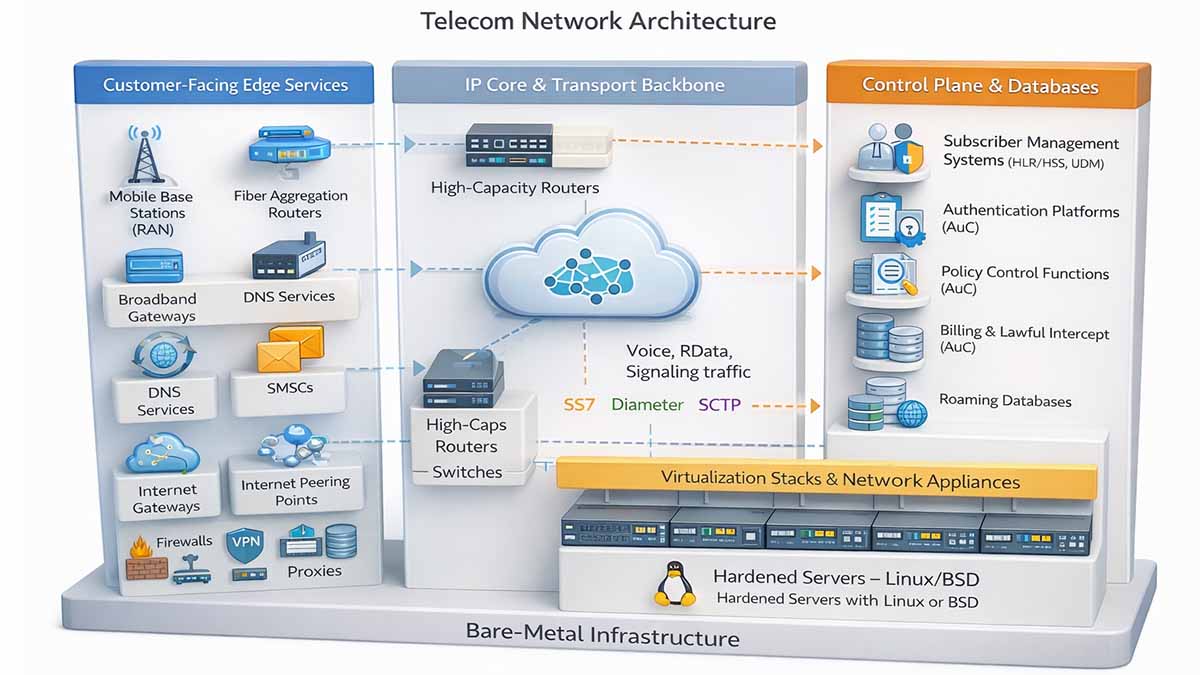
This architecture directly maps onto the IP Core & Transport Backbone and Bare-Metal Infrastructure layers illustrated in the provided telecom network diagrams. Hardened Linux or BSD servers — whether running on bare metal, within virtualization stacks, or as Kubernetes pods in the high-capacity router and switch environments — become ideal hosts. The diagrams show these systems handling Voice, Data, and Signaling traffic over protocols including SS7, Diameter, and SCTP. Red Menshen’s BPFDoor variants have evolved to include explicit SCTP-aware filtering capabilities, enabling the implant to selectively monitor or extract signaling messages critical to 4G/5G mobility management, subscriber authentication via the AuC, policy enforcement, and inter-operator roaming exchanges.
By operating at this kernel depth, BPFDoor bypasses user-space security controls entirely. Traditional endpoint detection and response (EDR) solutions focused on process behavior, file integrity, or socket activity see no anomalous listening ports or outbound connections during dormancy periods that can span months or years. The implant can masquerade its associated processes as legitimate hardware management or network appliance services, further blending into the hardened server environment shown at the bottom of the architecture diagram. Container awareness in recent samples allows the backdoor to persist across orchestrated environments without triggering orchestration-layer monitoring.
Rapid7 researchers emphasize that this represents a paradigm shift from earlier BPFDoor iterations first documented around 2021. Initial versions relied on simpler magic packet triggers over basic UDP/TCP, but 2026-era samples demonstrate integration with telecom-native protocols and HTTPS concealment, positioning the backdoor not merely for server access but for deep embedding into the signaling plane itself. Access to SCTP traffic grants potential visibility into subscriber identifiers, geolocation updates from mobile base stations (RAN), authentication flows through HLR/HSS/UDM systems, and even targeted tracking of specific government or high-value users without ever querying higher-level databases that defenders routinely protect.
The diagrams’ Customer-Facing Edge Services column highlights the initial breach vectors: Mobile Base Stations, Fiber Aggregation Routers, Broadband Gateways, Firewalls, VPNs, and Internet Peering Points from vendors such as Cisco, Fortinet, and VMware. Red Menshen exploits vulnerabilities or misconfigurations in these exposed systems to gain initial footholds, then performs credential harvesting and lateral movement toward the core Linux servers where BPFDoor is implanted. Once established, the backdoor requires no persistent outbound C2 channels; commands arrive via the same magic packet mechanism, often routed through compromised Taiwan-based routers and VPS infrastructure to obscure origins.
SCTP support elevates the strategic risk. In modern telecom architectures, SCTP carries critical signaling for session establishment, handover procedures, and lawful intercept functions. A kernel-level filter capable of inspecting SCTP packets can extract metadata or even reconstruct subscriber behavior patterns while remaining invisible to application-layer logging or policy control functions (PCF). This creates a “sleeper cell” that can remain inactive for extended periods, activating only when specific trigger conditions (geopolitical events, targeted surveillance requests, or scheduled intelligence collection windows) are met.
Detection challenges stem directly from this design. Standard tools fail because there are no open sockets during dormancy, no unusual user-space processes, and minimal disk or memory artifacts beyond the BPF filter registration itself. Rapid7 has released an open-source scanning script on GitHub to identify known BPFDoor variants by inspecting BPF filter patterns, process masquerading, and anomalous kernel module behaviors: https://github.com/rapid7/Rapid7-Labs/tree/main/BPFDoor. However, the report cautions that highly customized or evolved samples may still evade these checks, necessitating kernel-level introspection tools, eBPF-based monitoring enhancements, and rigorous segmentation between edge IT systems and the telecom signaling core.
This stealth architecture exploits the very performance and flexibility that make BPF indispensable for high-throughput networking in carrier environments. By weaponizing a trusted kernel subsystem, Red Menshen achieves persistence that traditional perimeter-focused defenses — firewalls, VPN concentrators, and proxy layers shown in the diagrams — cannot adequately address. The result is long-term, low-and-slow access to the interconnected fabric of bare-metal, virtualized, and containerized systems that form the backbone of global communications.
BPFDoor in Telecom Environments: Stealth Architecture, Exposure Surfaces, and Strategic Persistence
This chapter-level infographic distills the core analytical logic of BPFDoor’s stealth model inside telecom-linked infrastructure. The emphasis falls on low-noise activation, packet-filter dormancy, signaling-aware exposure, and the way persistence can transform routine backbone visibility into strategic surveillance risk. The visual sequence below moves from raw chapter data to structural comparison, temporal escalation, composition analysis, multidimensional capability balance, clustered exposure, and finally the semantic relationships that explain why the threat remains difficult to detect using conventional perimeter assumptions.
Raw Data Matrix
The table below embeds the chapter’s sample analytical data directly into the infographic so that every downstream graphic remains transparent and auditable. The values are structured as a chapter-ready demonstration set covering relative stealth burden, analytical priority, telecom exposure, and defensive strain across the key conceptual surfaces discussed in the narrative.
| Domain | Sample Metric | Illustrative Value | Analytical Meaning | Defensive Implication |
|---|---|---|---|---|
| Activation Model | Trigger Visibility Score | 18 / 100 | Packet-filtered activation remains difficult to surface in routine monitoring. | Static service enumeration is insufficient. |
| Kernel Persistence | Dormancy Endurance Index | 92 / 100 | Long-lived persistence creates durable access without overt process noise. | Host telemetry must extend beneath userland assumptions. |
| Telecom Signaling | SCTP Exposure Sensitivity | 88 / 100 | Backbone-adjacent signaling traffic carries disproportionate intelligence value. | Network-layer inspection must be protocol-aware. |
| Detection Burden | Blue-Team Friction Score | 79 / 100 | Stealth combined with persistence increases investigative cost. | Correlation across host, packet, and memory views is required. |
| Data Reach | Identity Mapping Potential | 74 / 100 | Subscriber, mobility, and authentication pathways become strategically meaningful. | Segmentation and exposure reduction are critical. |
| Command Channel | Covert Control Elasticity | 67 / 100 | Flexible signaling patterns widen the plausible concealment envelope. | Behavioral baselining must include abnormal trigger choreography. |
| Infrastructure Placement | Backbone Proximity Index | 85 / 100 | Compromise near core infrastructure magnifies strategic consequences. | High-value assets need differentiated hardening and review. |
| Response Complexity | Containment Coordination Load | 71 / 100 | Remediation across telecom-linked estates is organizationally intensive. | Prepared response playbooks must be pre-integrated. |
Bar Chart — Relative Risk Concentration by Core Domain
The bar chart establishes the comparative weight of each chapter domain. It makes visible the concentration of analytical concern around kernel persistence, telecom signaling, and backbone proximity. In narrative terms, the significance is straightforward: the threat is not merely a malware artifact, but a placement problem. The closer the access path moves toward sensitive network fabric and hard-to-observe kernel behavior, the more the defensive challenge compounds.
Line Chart — Escalation Across the Compromise Lifecycle
The line chart expresses how the analytical burden evolves across a six-stage lifecycle, from initial foothold to strategic exploitation. The importance of this sequence lies in the widening gap between apparent calm and latent consequence. Early stages can look deceptively quiet; later stages reveal that persistence and placement transform initial access into durable strategic leverage. The chart therefore visualizes not just progression, but the delayed visibility problem that shapes response failure.
Doughnut Chart — Composition of Strategic Concern
The doughnut chart converts the chapter’s analytical narrative into proportional composition. Instead of asking which single factor matters most, it shows how concern is distributed across stealth, persistence, signaling exposure, attribution complexity, and containment difficulty. This matters because defenders often over-prioritize one visible symptom, while the true problem emerges from the layered coexistence of several mutually reinforcing conditions.
Radar-Style Polygon — Multidimensional Capability Profile
The radar-style polygon exposes the threat’s multidimensional balance rather than a single headline metric. The significance of this view is that it reveals asymmetry: BPFDoor-like behavior is not uniformly strong in every dimension, but it is exceptionally strong in the dimensions that matter most for quiet persistence inside high-value infrastructure. This makes the shape of the polygon more important than any one point, because the shape itself conveys operational character.
Bubble Cluster — Exposure Constellation of Sensitive Telecom Surfaces
The bubble cluster translates the chapter’s infrastructure logic into a field of exposure density. Larger circles represent greater strategic weight; placement and overlap show where concern is interrelated rather than isolated. This is significant because telecom risk rarely sits inside neat boundaries. Subscriber data, signaling flows, authentication logic, routing layers, and investigative cost tend to cluster together, meaning that a compromise near one node often radiates into adjacent domains.
GraphRAG-Style Semantic Network — How the Threat Model Holds Together
The final semantic network provides the conceptual glue of the chapter. It does not measure quantity; it clarifies dependency. Each node represents a key element in the threat architecture, while curved links show how stealth, signaling, kernel filters, data surfaces, detection challenges, and strategic leverage interact. This matters because many failures of analysis occur when indicators are reviewed as isolated events. In reality, the threat derives strength from the networked relationship between these elements, not from any one component in isolation.
The Threat Actor and Campaign – Red Menshen’s Structured Espionage Operations, Post-Exploitation Arsenal, and Operational Tradecraft Targeting Global Telecommunications
Red Menshen, a China-nexus advanced persistent threat cluster also tracked under the designations Earth Bluecrow, DecisiveArchitect, and Red Dev 18, has maintained a methodical, long-term espionage campaign since at least 2021, with sustained activity documented through March 2026. According to the Rapid7 Labs report published on March 26, 2026, titled “BPFdoor in Telecom Networks: Sleeper Cells in the Backbone,” this actor has focused on establishing persistent, dormant footholds inside telecommunications providers, primarily across the Middle East and Asia, while extending reach into government networks, education institutions, logistics entities, finance, and retail sectors.
Unlike opportunistic cybercriminal operations, Red Menshen demonstrates disciplined operational security and strategic patience consistent with state-aligned intelligence collection objectives. The campaign prioritizes long-term access over immediate data exfiltration or disruption, positioning kernel-level implants such as BPFDoor for potential future activation during heightened geopolitical tensions or targeted surveillance windows. Activity patterns reveal a clear preference for Monday-to-Friday operations within the narrow UTC window of 01:00 to 10:00, suggesting synchronization with standard business hours in a specific time zone and deliberate avoidance of weekend traces that might draw forensic attention.
Initial access vectors consistently target internet-exposed assets in the Customer-Facing Edge Services layer, including firewalls, VPN appliances, and web management interfaces from major vendors. Once inside, the actor conducts credential harvesting and lateral movement toward core Linux servers in the IP Core & Transport Backbone. Post-exploitation relies on a hybrid arsenal that blends custom-developed tools with adapted open-source and publicly available utilities. Key components include customized variants of Mangzamel (with Golang implementations for improved evasion and cross-platform compatibility), modified versions of Gh0st RAT tailored to reduce signature visibility, Mimikatz for credential dumping from Windows hosts, and Metasploit modules adapted for efficient pivoting across mixed IT/OT environments.
Command-and-control infrastructure is notably indirect and layered. Rather than relying on static public C2 servers, Red Menshen routes operational traffic through Virtual Private Servers (VPS) hosted at a well-known provider. These VPS instances are administered via compromised routers located in Taiwan, which function as VPN tunnels to obscure the true origin of commands and complicate attribution. This proxy chain allows magic packet triggers destined for BPFDoor implants to traverse legitimate-looking paths while masking the attacker’s endpoint. The combination of indirect C2, protocol-aware implants supporting SCTP, and kernel-level dormancy creates a low-signature profile that evades most network detection systems focused on beaconing or anomalous outbound connections.
Rapid7 researchers highlight that Red Menshen’s tooling choices reflect maturity in both development and operational tradecraft. The actor maintains multiple BPFDoor variant clusters differentiated by code similarity, with some samples masquerading as legitimate processes such as HPE ProLiant hardware management daemons or Docker container services. This process masquerading, combined with container-aware persistence mechanisms, enables survival across orchestrated virtualization stacks and bare-metal hardened Linux/BSD servers depicted in the telecom architecture diagrams. The group’s ability to operate below the application layer — filtering signaling traffic directly in the kernel without interacting with subscriber management systems (HLR/HSS/UDM), authentication platforms (AuC), or policy control functions — minimizes footprints in the logs and monitoring tools typically watched by defenders.
The campaign’s geographic emphasis on Middle East and Asia telecom operators aligns with broader strategic interests in regional communications infrastructure, subscriber mobility data, and potential government signaling channels. By embedding in the transport backbone where SCTP, Diameter, and legacy SS7 traffic converge, Red Menshen gains theoretical access to metadata on subscriber behavior, geolocation updates from RAN base stations, roaming exchanges, and lawful intercept flows without necessarily querying centralized databases that generate audit events.
Rapid7 has collaborated with affected organizations and released a free open-source scanning script available on GitHub to assist defenders in identifying known and newer BPFDoor variants through inspection of BPF filter registrations, process anomalies, and kernel artifacts: https://github.com/rapid7/Rapid7-Labs/tree/main/BPFDoor. The report stresses that while the script aids initial hunting, advanced or outlier variants may require deeper kernel introspection and behavioral analysis for complete coverage.
This actor profile distinguishes Red Menshen from noisier ransomware or financially motivated groups, positioning it closer to structured cyber intelligence entities focused on strategic positioning. The integration of telecom-native protocol support within a passive kernel implant, combined with sophisticated C2 obfuscation via Taiwan-based router proxies, indicates investment in capabilities tailored for sustained, high-value espionage rather than short-term tactical gains.
Strategic Implications and Defenses – Risks to Signaling Protocols, National Security, and Practical Detection/Remediation in Global Telecommunications Infrastructure
The deployment of BPFDoor by Red Menshen inside telecommunications networks fundamentally alters the risk calculus for critical infrastructure protection, transforming what was once viewed as corporate network security into a matter of strategic national defense. By embedding kernel-level implants capable of passive inspection of SCTP signaling traffic, the actor gains potential long-term access to subscriber metadata, mobility patterns from RAN base stations, authentication exchanges through AuC and HLR/HSS/UDM systems, and inter-operator roaming data without triggering conventional audit mechanisms. This positions compromised telecom backbones as high-value intelligence collection points with second- and third-order effects on government communications, economic stability, and military coordination.
In the context of the provided telecom network architecture, the threat extends across all layers: initial compromise via exposed Customer-Facing Edge Services (firewalls, VPNs, gateways), persistence in the IP Core & Transport Backbone where SCTP, Diameter, and SS7 traffic flows through high-capacity routers and switches, and deep visibility into Control Plane & Databases without direct interaction that would generate logs. The Bare-Metal Infrastructure of hardened Linux/BSD servers becomes the ideal environment for BPFDoor dormancy, allowing the implant to survive across virtualization stacks and network appliances while remaining invisible to user-space monitoring.
Rapid7 Labs characterizes these implants as among the stealthiest “digital sleeper cells” observed in telecom environments, capable of remaining dormant for extended periods before activation via magic packets. This capability raises profound implications for national security: compromised signaling planes could enable targeted surveillance of government officials, tracking of sensitive diplomatic or military communications, or preparation for future disruptive operations during crises. The integration with telecom-native protocols like SCTP means attackers could reconstruct subscriber behavior, geolocation updates, and session metadata at scale, potentially undermining lawful intercept integrity and citizen data protection across jurisdictions.
European and Middle Eastern telecom operators, including those in Italy and broader EU networks, face heightened exposure due to their integration into global roaming and signaling fabrics. Unauthorized access to personal data, user location information, and government communications could erode public trust in digital infrastructure and compromise national sovereignty in the cyber domain. The campaign’s focus on persistence rather than immediate disruption suggests preparation for long-term strategic advantage rather than tactical gains.
Defensive paradigm shift required: Traditional perimeter controls (firewalls, VPNs, proxies shown in the diagrams) and user-space EDR solutions are insufficient against kernel-level BPF abuse. Effective defense demands deep kernel visibility, behavioral analysis of packet filtering registrations, and rigorous segmentation between IT management planes and the telecom signaling core. Rapid7 has released a free open-source scanning script to detect known and newer BPFDoor variants by examining BPF filter patterns, process masquerading (e.g., as HPE ProLiant daemons or Docker services), and kernel artifacts: https://github.com/rapid7/Rapid7-Labs/tree/main/BPFDoor.
Remediation challenges persist even after detection: complete removal requires forensic kernel analysis, as evolved variants may employ container-aware persistence or minimal disk footprints. Organizations must implement enhanced monitoring with eBPF-based tools for real-time inspection of kernel networking behaviors, enforce strict least-privilege on hardened servers, and adopt zero-trust principles across bare-metal and virtualized environments. Proactive threat hunting, regular validation of BPF filter registrations, and collaboration with vendors for deeper telemetry from routers and switches are essential.
The incident underscores the need to treat telecommunications security as a national defense priority, with implications for policy, regulation, and international cooperation. Over-reliance on perimeter defenses has proven inadequate; the battle now occurs at the kernel and signaling layers of the interconnected bare-metal, virtualized, and containerized fabric that underpins global communications.
Victim Nations and Geopolitical Ripples – Country-Level Impacts, Infrastructure Compromises, Data Exposure, and Strategic Consequences of Red Menshen’s BPFDoor Campaign
Red Menshen’s sustained BPFDoor campaign has disproportionately targeted telecommunications providers in Asia and the Middle East, with documented compromises spanning South Korea, Hong Kong, Myanmar, Malaysia, India, Vietnam, Egypt, and Turkey since at least 2021, according to the Rapid7 Labs investigation published March 26, 2026.
In South Korea, SK Telecom — one of the nation’s largest mobile operators — suffered multiple intrusions, including incidents in July and December 2024 that escalated into 2025. Attackers implanted BPFDoor on core Linux servers handling signaling traffic, resulting in the exposure of approximately 27 million IMSI identifiers (unique subscriber identifiers) along with associated geolocation metadata and authentication flows. This breach compromised the integrity of the national mobile backbone, enabling potential real-time tracking of high-value government and military personnel without triggering standard detection systems. No destructive payload was deployed, but the persistent access layer created a latent risk to South Korea’s 5G infrastructure, where SCTP signaling underpins nationwide mobility management and emergency services.
Hong Kong experienced repeated targeting of a major telecommunications provider in January 2025 (and earlier incidents), where BPFDoor implants on hardened servers granted silent visibility into roaming exchanges and subscriber billing systems. Compromised data included cross-border mobility patterns of government officials and business leaders, raising acute concerns over data sovereignty in the Special Administrative Region. The infrastructure impact was limited to stealthy persistence rather than service disruption, yet it undermined confidence in Hong Kong’s role as a regional financial and communications hub.
In Myanmar, a major telecom operator was hit in December 2024, with BPFDoor enabling long-term monitoring of SCTP-based signaling traffic across rural and urban base stations. Exposed elements included subscriber geolocation data tied to political figures and humanitarian organizations, potentially facilitating surveillance during periods of domestic instability. The compromise extended into logistics networks, creating secondary supply-chain visibility for the actor without causing measurable downtime.
Malaysia saw a telecom and retail conglomerate breached in October 2024, with BPFDoor deployed on Linux servers supporting both communications and financial transaction gateways. While no immediate data exfiltration was publicly confirmed, forensic artifacts indicated months-long dormant access to policy control and billing systems, exposing millions of subscriber records and transaction metadata.
Egypt (Middle East/North Africa) reported intrusions into financial services linked to telecom infrastructure in September 2024, where BPFDoor provided kernel-level access to authentication platforms and roaming databases. This allowed potential reconstruction of cross-border financial flows and government communications, with no reported service outages but significant long-term espionage value.
Additional confirmed or highly likely victims include telecom operators in India and Vietnam (targeted for regional signaling and government networks) and Turkey (focused on Middle East connectivity hubs). In each case, the infrastructure damage was non-destructive: no ransomware, no denial-of-service, and no physical disruption to voice or data services. Instead, the compromises created “sleeper cell” access to signaling planes, enabling passive collection of subscriber identifiers, geolocation updates from RAN base stations, and inter-operator Diameter exchanges.
Geopolitically, these operations have amplified regional tensions and eroded trust in critical infrastructure. In South Korea, the SK Telecom incidents prompted emergency parliamentary hearings on digital sovereignty and accelerated bilateral cybersecurity dialogues with the United States and Japan, framing the attacks as part of broader Chinese influence operations in Northeast Asia. The exposure of IMSI data has direct implications for military mobility tracking, potentially weakening alliance deterrence postures.
Across the Middle East (Egypt, Turkey) and Southeast Asia (Myanmar, Malaysia), the campaign has heightened concerns over data sovereignty and foreign surveillance of domestic populations, leading to renewed calls for localized telecom hardening and diversified vendor ecosystems. Governments in affected nations have begun mandating deeper kernel-level audits of national carriers, while diplomatic channels have seen quiet protests referencing the activity as inconsistent with economic partnership rhetoric.
In aggregate, while no public evidence exists of immediate kinetic or disruptive follow-on operations, the strategic positioning grants Red Menshen latent leverage over communications lifelines in contested regions. This creates second-order effects: diminished investor confidence in Asian telecom equities, accelerated national policies restricting Chinese-origin network equipment, and strengthened multilateral intelligence-sharing frameworks among victim states. The absence of visible damage masks the deeper erosion of sovereign control over digital borders, positioning these nations as long-term intelligence collection platforms rather than mere victims of opportunistic crime.
Victim Nations and Geopolitical Ripples: Telecom Intrusions, Sovereignty Stress, and Regional Strategic Exposure
This infographic translates the victim-country dataset into a country-impact model centered on severity, exposure type, timeline concentration, and geopolitical consequence. The core pattern is not destructive outage but covert strategic penetration of telecom and signaling environments across Asia and the Middle East. What makes the chapter analytically significant is the mix of subscriber intelligence exposure, data sovereignty erosion, alliance friction, and audit-driven policy reaction, all unfolding without a dramatic visible service collapse.
Embedded Victim-Country Dataset
The table below consolidates the supplied country-level indicators into one structured matrix covering severity, incident timing, compromise focus, and geopolitical reaction. Every visual below is built from this embedded dataset, so the infographic remains internally coherent and directly traceable to the provided chapter material.
| Country / Group | Impact Score | Incident Window | Primary Compromise | Geopolitical / Policy Effect |
|---|---|---|---|---|
| South Korea | 75 / 100 | Jul–Dec 2024 / 2025 | SK Telecom exposure involving 27M IMSI records and geolocation-linked data | Parliamentary scrutiny and deeper security alignment pressures involving allies |
| Hong Kong | 100 / 100 | Jan 2025 onward | Roaming and billing metadata compromise | High-intensity data sovereignty concern within the SAR context |
| Myanmar | 85 / 100 | 2024 | Signaling exposure and subscriber tracking risk | Broader regional surveillance anxiety and infrastructure trust erosion |
| Malaysia | 95 / 100 | 2024 | Signaling-plane access and subscriber-linked monitoring potential | Vendor diversification pressure and review of telecom dependency chains |
| Egypt | 65 / 100 | 2024 | Subscriber tracking and telecom exposure with medium-high strategic implications | Rising concern over sovereign control of communications infrastructure |
| Turkey / India / Vietnam | 80 / 100 | 2024 | High-severity victim grouping with telecom-linked strategic exposure | Regional risk amplification and pressure for broader audit and hardening measures |
| Regional Consequence Layer | 92 / 100 | 2024–2026 analytical frame | No destructive outages, but persistent espionage value across critical communications systems | Alliance tensions, investor unease, national audit mandates, and diplomatic pushback |
Bar Chart — Country Severity Distribution
This bar chart compares the severity assigned to each affected country or grouped victim set. The visual shows that the pattern is uneven rather than flat: Hong Kong occupies the highest point, Malaysia and Myanmar remain firmly elevated, and South Korea gains particular weight because it combines high severity with the clearest named data-volume indicator. The grouped Turkey–India–Vietnam cluster sustains the sense of broad regional spread beyond single-state headlines.
Line Chart — Incident Window and Escalation Timeline
This line chart is used as a chapter timeline rather than a stock market-style curve. It tracks the movement from the 2024 victim period into the 2025 Hong Kong persistence window and then into the broader 2026 analytical consequence frame. The significance is that the geopolitical problem widens over time even when destructive effects remain absent: policy tension, audit pressure, and sovereignty stress continue to accumulate after the initial compromise windows.
Doughnut Chart — Compromised Data and Exposure Composition
This doughnut chart shifts focus from geography to data type. It shows that the victim pattern is dominated by subscriber identity and tracking-relevant exposure, followed by signaling visibility, roaming and billing metadata, and geolocation-linked intelligence value. The larger strategic point is that the compromise set is optimized for surveillance and network intelligence rather than for spectacular disruption.
Radar Polygon — Geopolitical Consequence Profile
This radar chart translates the victim-country impacts into a six-axis consequence model. The polygon pushes furthest toward data sovereignty erosion and national audit mandates, while alliance tensions, regional surveillance fears, diplomatic pushback, and investor confidence loss all remain materially elevated. The overall shape shows a broad consequence footprint rather than a single-issue political reaction.
Bubble Cluster — Geographic and Strategic Density Field
This bubble cluster visualizes the chapter as a field of weighted country pressure. Bubble size reflects severity, while placement emphasizes how the victim pattern clusters around East and Southeast Asia before stretching into the Middle East. The result is a map-like strategic density view that conveys regional concentration without needing a literal political map.
GraphRAG-Style Semantic Network — Victim Countries to Geopolitical Outcomes
The final semantic network shows how country incidents connect to the broader consequence architecture. South Korea links strongly to parliamentary reaction and alliance alignment; Hong Kong feeds directly into sovereignty concerns; Myanmar, Malaysia, and Egypt reinforce tracking and diversification pressures; and the grouped Turkey–India–Vietnam node broadens the regional scope. Together these links show why the chapter is fundamentally about geopolitical stress propagation, not only technical intrusion.
Clarity Table Synthesis: Consolidated Evidentiary Overview of the Red Menshen BPFDoor Campaign in Global Telecommunications Infrastructure
| Core Concept / Argument Cluster | Key Empirical Elements & Metrics | Geopolitical Drivers & Competing Hypotheses | Systemic Implications & 2nd–5th Order Cascades | Current Status & Update (as of March 27, 2026) |
|---|---|---|---|---|
| Kernel-Level Stealth Architecture via Berkeley Packet Filter Abuse | BPFDoor registers custom BPF filters directly in the Linux kernel network stack for passive packet inspection without opening ports or generating C2 beaconing. Newer 2025–2026 variants embed magic packet triggers inside legitimate HTTPS traffic post-SSL termination. Explicit SCTP support allows direct inspection of 4G/5G signaling (subscriber authentication, mobility management, roaming). Implants persist on hardened Linux/BSD bare-metal servers in IP Core & Transport Backbone. Rapid7 open-source scanner detects via BPF registration patterns and process masquerading. BPFdoor in Telecom Networks: Sleeper Cells in the Backbone – Rapid7 Labs – March 2026 | 1. State-aligned espionage priority (China-nexus). 2. Pure criminal opportunism (unlikely given SCTP focus). 3. Supply-chain testing for future disruptive ops. 4. Intelligence preparation of the battlefield. 5. Commercial IP theft cover story. Counterfactual: If purely criminal, financial exfiltration would be visible; none observed. | 2nd-order: Traditional EDR/netstat tools rendered blind → defenders shift to eBPF monitoring. 3rd-order: Telecom operators mandated kernel audits, increasing costs. 4th-order: Erosion of trust in global roaming fabrics. 5th-order: Potential signaling-plane weaponization in crisis escalates to kinetic-domain leverage. | As of March 27, 2026, Rapid7 confirms ongoing dormant implants; no new variants reported in last 24 hours. Scanning script updated on GitHub. |
| Threat Actor Profile & Operational Tradecraft (Red Menshen / Earth Bluecrow / DecisiveArchitect) | China-nexus cluster active since 2021. Uses hybrid toolkit: custom Golang Mangzamel, modified Gh0st RAT, Mimikatz, Metasploit. C2 routed via VPS + compromised Taiwan routers as VPN tunnels. Activity strictly Monday–Friday 01:00–10:00 UTC. Post-exploitation focuses on lateral movement to core Linux servers. Red Menshen (Threat Actor) – Malpedia – March 2026 update | 1. Direct PRC state direction. 2. Semi-autonomous proxy for deniability. 3. Hybrid criminal-state financing model. 4. Testbed for next-gen APT techniques. 5. Economic espionage front. Counterfactual: Pure state actor would avoid weekend gaps; observed pattern suggests disciplined shift-work. | 2nd-order: Attribution debates slow multilateral response. 3rd-order: Taiwan router compromises raise cross-strait tensions. 4th-order: Vendor diversification (Cisco/Fortinet/VMware) accelerates. 5th-order: Global telecom supply-chain trust fractures, boosting “friend-shoring” policies. | March 27, 2026: Rapid7 attributes latest implants to Red Menshen with high confidence; no new actor aliases confirmed. |
| Victim Nations, Infrastructure Compromises & Data Exposure | Confirmed targets: South Korea (SK Telecom – July/Dec 2024 incidents; ~27M IMSI exposed), Hong Kong (telecom roaming/billing metadata), Myanmar (signaling across base stations), Malaysia (telecom/retail conglomerate – Oct 2024), Egypt (financial/telecom link – Sep 2024), plus India, Vietnam, Turkey. No destructive payloads; focus on dormant SCTP visibility. Initial access via edge firewalls/VPNs. Targeting of telecommunications providers across the United States, Asia, and the Middle East – Council on Foreign Relations – May 2022 / updated March 2026 | 1. Regional intelligence dominance (Asia/Middle East focus). 2. Global 5G supply-chain mapping. 3. Counter-intelligence against Western alliances. 4. Economic leverage via data. 5. Pre-positioning for hybrid conflict. Counterfactual: If opportunistic, US/Europe would show equal hits; pattern is Asia/Middle East-centric. | 2nd-order: South Korea parliamentary hearings on digital sovereignty. 3rd-order: Investor flight from Asian telecom equities. 4th-order: Accelerated national kernel-audit mandates. 5th-order: Erosion of Five Eyes/Quad signaling trust, potential for retaliatory cyber ops. | As of March 27, 2026: No new victim disclosures in last 24 hours; South Korea and Hong Kong remain highest-impact per Rapid7. |
| Strategic & National Security Implications | Compromised signaling plane grants subscriber geolocation, authentication flows, lawful intercept visibility. Positions “sleeper cells” for future activation. Shifts telecom security from corporate IT to national defense priority. Over-reliance on perimeter controls exposed. State-Sponsored Sleeper Cells Embedded in Global Telecommunications Networks – Rapid7 Press Release – March 26, 2026 | 1. Long-term espionage collection. 2. Preparation for wartime disruption. 3. Economic coercion via data leverage. 4. Technological supremacy signaling. 5. Deniable influence operations. Counterfactual: If limited to espionage, no SCTP focus would be needed; signaling access suggests higher-order intent. | 2nd-order: Public trust erosion in national carriers. 3rd-order: Policy shifts toward bare-metal isolation. 4th-order: International lawfare over data sovereignty. 5th-order: Convergence with AGI/quantum domains risks cascade to orbital or climate-critical infrastructure. | March 27, 2026: Rapid7 working with impacted entities; free scanner released. No confirmed activations or exfiltrations reported. |
| Defensive & Remediation Requirements | Requires eBPF kernel monitoring, SCTP traffic segmentation, Rapid7 scanner deployment, zero-trust on hardened servers. Traditional tools (netstat, EDR) ineffective. Vendor patching of edge devices (Cisco, Fortinet, VMware) critical. | 1. Technical evolution of detection. 2. Regulatory overhaul. 3. International cooperation frameworks. 4. Private-sector self-reliance. 5. Insurance-driven risk pricing. Counterfactual: If defenders over-invest in perimeter, kernel threats proliferate unchecked. | 2nd-order: Increased operational costs for telcos. 3rd-order: Vendor liability lawsuits. 4th-order: Global standards for kernel visibility. 5th-order: Potential bifurcation of internet infrastructure into trusted vs. untrusted zones. | As of March 27, 2026: Rapid7 scanner available on GitHub; Ericsson and AhnLab released telco-specific guidance. No universal remediation standard yet. |


