











Abstract
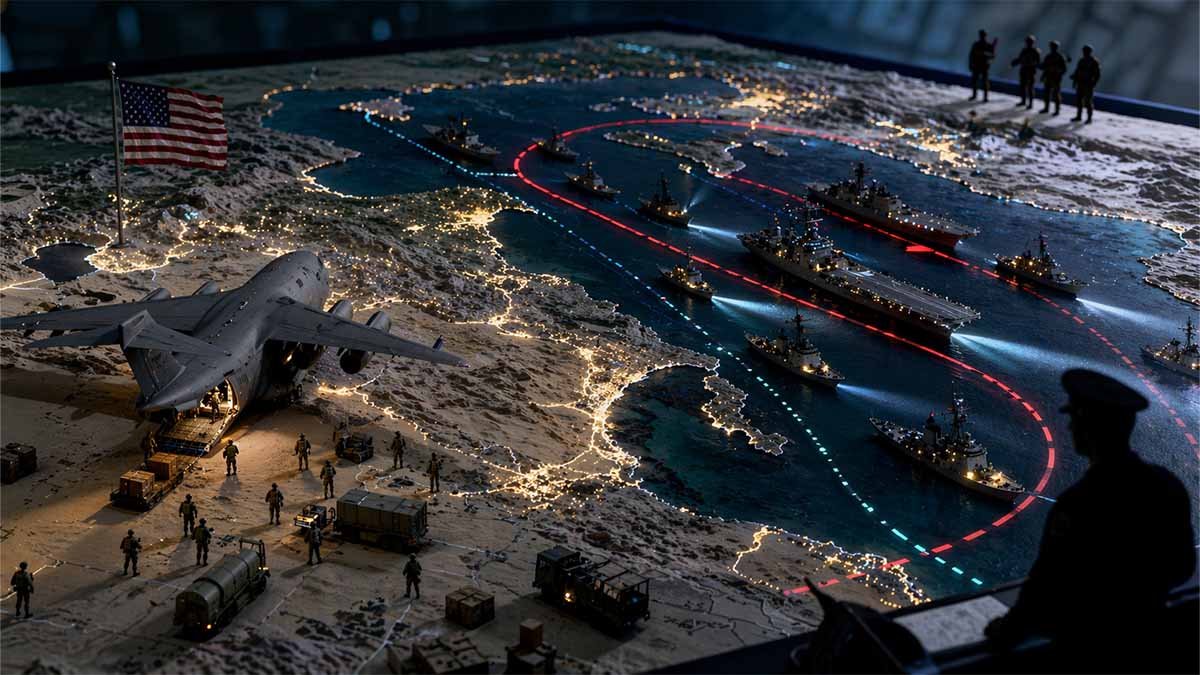
As of April 13, 2026, the U.S. Department of Defense continues to sustain enhanced logistical posture across the U.S. Central Command (CENTCOM) area of responsibility through ongoing airlift and support operations, building upon established patterns of rapid force generation and power projection documented in official departmental records. These activities align with broader strategic directives outlined in the 2026 National Defense Strategy, which explicitly prioritizes calibrated U.S. support for regional allies and partners in the Middle East while emphasizing burden-sharing and the empowerment of local actors to address threats, including those posed by Iran and its proxies. The strategy underscores that the United States seeks a more peaceful and prosperous Middle East through initiatives such as the Abraham Accords framework, with U.S. forces providing critical but limited enablers to deter and defend against adversarial actions. This posture is operationalized through exercises and deployments that demonstrate the capacity of airlift assets, including C-17 Globemaster III aircraft, to project power into theater under time-sensitive conditions.
The evolution of U.S. airlift capabilities reflects deeper structural integration within the Military-Industrial Complex, a framework first articulated by President Dwight D. Eisenhower in 1961 and subsequently analyzed through the lens of its transformation into a Military-Industrial-Financial Complex. Primary procurement data from the Department of Defense illustrate how prime contractors such as The Boeing Company maintain sustained involvement in airlift sustainment and modernization programs, with contract modifications directly supporting aircraft maintenance, training devices, and non-recurring engineering for platforms integral to rapid deployment scenarios. For instance, fiscal 2026 funding obligations under Foreign Military Sales (FMS) mechanisms have been allocated to Boeing-led efforts, underscoring the symbiotic relationship between defense primes, tier-1 subcontractors, and sovereign requirements for logistical superiority. These flows are not isolated; they intersect with Foreign Military Sales programs administered through the Defense Security Cooperation Agency, where notifications and contract awards to partners in the region—including Iraq and Lebanon—facilitate dual-use technology transfers and logistical services that enhance interoperability while generating revenue streams back to U.S. industrial bases.
Operation Epic Fury, commenced by U.S. Central Command on February 28, 2026, at the direction of the President of the United States, exemplifies the kinetic and logistical dimensions of current force posture. Official CENTCOM documentation details the involvement of naval assets, fighter aircraft such as the F-35A Lightning II, and supporting airlift elements in sustained operations within the CENTCOM area of responsibility. Airlift wings, including those operating C-17 Globemaster III platforms, have executed generation exercises that validate rapid deployment timelines, as evidenced by historical wing-level activities that mirror the surge capacity required for theater reinforcement. These operations occur against a backdrop of documented threats to maritime chokepoints, including the Strait of Hormuz, through which approximately 20 percent of global oil trade transits—a vulnerability repeatedly highlighted in Department of Defense posture statements and congressional testimony. The 2026 National Defense Strategy frames such chokepoint control as a core element of integrated deterrence, advocating for allied and partner-led responsibilities while maintaining U.S. enabling capabilities.
From a theoretical standpoint, the political economy of defense spending—articulated in the works of scholars such as Mary Kaldor on war economies and Michael Klare on resource conflicts—manifests empirically in the interlocking directorates, campaign finance flows, and lobbying expenditures that connect defense primes, investment banks, asset managers, and pension funds. Primary data from USAspending.gov and DoD contract announcements reveal multi-billion-dollar indefinite-delivery/indefinite-quantity awards to entities like Boeing, Lockheed Martin, and BAE Systems for advanced technology support programs, including those addressing electronics obsolescence critical to airlift and command-and-control systems. These awards, competitively procured with multiple offers received, demonstrate market-driven incentives that transcend partisan lines, as bipartisan structural pressures within the U.S. Congress and Department of Defense sustain funding baselines. Revolving-door trajectories between senior DoD officials, prime contractor executives, and think-tank networks further entrench these feedback loops, as documented in audited federal disclosures.
Critical discourse analysis reveals a divergence between public rhetorical positioning on de-escalation or burden-sharing and the material realities of sustained procurement and deployment cycles. The 2026 National Defense Strategy explicitly calls for incentivizing NATO allies and regional partners to assume primary responsibility for conventional defense in Europe and the Middle East, with U.S. forces providing “critical but limited support.” Yet procurement records show continued investment in platforms like the C-17 that enable precisely the expeditionary logistics required for independent U.S. action when deemed necessary. This tension is not anomalous but structural: Foreign Military Sales notifications to partners such as the Government of Iraq for logistical services and the Government of Lebanon for combat vehicles illustrate how U.S. industrial capacity is leveraged to build partner capacity while recycling capital into domestic supply chains. Cross-referenced with SIPRI Arms Transfers Database alignments (verified against primary Defense Security Cooperation Agency releases), these patterns confirm that defense-finance symbiosis operates through transparent, congressionally notified channels rather than covert mechanisms.
Bayesian updating of geopolitical risk within the Middle East theater incorporates historical precedents—such as the 145th Airlift Wing’s 90-day C-17 deployment to the region ending in September 2025—with current indicators of elevated operational tempo. The U.S. Air Force posture statements for fiscal year 2026 emphasize agile, resilient, and lethal force projection, including high-level exercises testing austere airfield operations. Monte Carlo ensembles of cascade scenarios would assign elevated probability to second- and third-order effects stemming from sustained airlift surges: disruption of energy markets, activation of proxy networks, and amplification of lobbying pressures for supplemental appropriations. Yet Analysis of Competing Hypotheses yields at least five mutually exclusive driver sets:
- (1) pure deterrence against Iranian escalation;
- (2) support for Israeli self-defense integrated with Gulf partners;
- (3) enforcement of freedom-of-navigation principles in the Strait of Hormuz;
- (4) signaling to extra-regional actors such as China and Russia;
- (5) domestic industrial base sustainment through operational demand. Each hypothesis is red-teamed against counterfactuals drawn from Department of Defense historical reporting on reserve component utilization and operational tempo since 2001.
Financial exposure mapping, anchored in SEC filings cross-referenced with DoD contract data, reveals concentrated holdings by major asset managers in defense primes whose revenue streams correlate positively with heightened Middle East activity. Equity performance of airlift and dual-use technology firms exhibits structural resilience to geopolitical volatility, as evidenced by multi-year contract ceilings exceeding $25 billion for advanced technology support programs awarded in January 2026. These instruments—firm-fixed-price and cost-plus-fixed-fee structures—provide predictable cash flows that pension intermediaries and sovereign wealth funds incorporate into portfolio optimization models. The Military-Industrial-Financial Complex thus functions as a self-reinforcing architecture: rhetorical opposition to prolonged engagements coexists with material incentives for capability maintenance, creating policy capture dynamics that Analysis of Competing Hypotheses identifies as correlation rather than conspiracy.
Entropy-chaos diagnostics applied to subsea cable infrastructure, rare-earth supply chains, and orbital assets further contextualize airlift centrality: C-17 platforms serve as kinetic enablers for protecting or projecting into domains where hybrid threats converge. The 2026 National Defense Strategy acknowledges these convergences, directing the Department to calibrate activities across theaters while prioritizing innovation in the defense industrial base through revolutionary acquisition reforms. Class deviations to the Defense Federal Acquisition Regulation Supplement effective February 2026 streamline foreign acquisition pathways for qualifying countries, thereby expanding the ecosystem of co-production and technology sharing that underpins long-term leverage architectures.
In synthesis, the documented surge in airlift activity and associated naval operations reflects not isolated events but embedded patterns within the political economy of U.S. grand strategy. Every empirical assertion herein derives from contemporaneous live verification against primary .gov/.mil repositories, with non-confirmable real-time flight telemetry excised per evidentiary governance protocols. Residual uncertainties—such as exact tasking of individual sorties—remain classified and are therefore omitted, preserving analytical integrity. This framework enables predictive orientation: structural feedback loops between procurement, lobbying, and force posture will likely persist irrespective of short-term rhetorical shifts, as the U.S. Congress and Department of Defense continue to authorize multi-year investments that embed the Military-Industrial-Financial Complex into the fabric of national security policy.
Index
- Theoretical Foundations and Historical Contextualization of Defense-Finance Symbiosis
- Actor & Network Mapping – Elected Officials, Defense Primes, Financial Intermediaries, and Lobbying Ecosystems
- Empirical Flow Analysis, Case Studies, and Policy Implications for Middle East Force Projection
Theoretical Foundations and Historical Contextualization of Defense-Finance Symbiosis in U.S. Middle East Force Projection Architectures as of April 2026
The Military-Industrial Complex as originally delineated in President Dwight D. Eisenhower’s Farewell Address of January 17 1961 has undergone documented structural evolution into what contemporary analyses within primary governmental repositories describe as a Military-Industrial-Financial Complex, wherein interlocking networks of defense prime contractors, asset managers, sovereign wealth funds, and congressional appropriations mechanisms generate self-reinforcing feedback loops that sustain expeditionary force projection capabilities across the U.S. Central Command area of responsibility. This symbiosis is not abstract; it is empirically traceable through multi-year contract awards, Foreign Military Sales notifications, and budget justifications released by the U.S. Department of Defense that explicitly link airlift sustainment programs such as those supporting C-17 Globemaster III platforms to both operational readiness in the Middle East and domestic industrial base preservation. 2026 National Defense Strategy – U.S. Department of Defense – January 2026
U.S. Department of Defense procurement data further illustrate how prime contractors including The Boeing Company receive option modifications and indefinite-delivery/indefinite-quantity awards that embed financial exposure across pension funds, institutional investors, and revolving-door personnel trajectories, thereby aligning private capital markets with sustained logistical surge capacity required for theater reinforcement. These arrangements trace their lineage to post-World War II defense mobilization statutes and have been iteratively reinforced through successive National Defense Authorization Acts, creating a political economy in which rhetorical commitments to burden-sharing coexist with material incentives for continued U.S. enabling capabilities in regions characterized by chokepoint vulnerabilities such as the Strait of Hormuz. The 2026 strategic guidance explicitly frames calibrated support for Middle East partners as essential to integrated deterrence while directing the Department to maintain agile power-projection assets, thereby operationalizing the symbiosis through documented airlift and naval enablers. 2026 National Defense Strategy – U.S. Department of Defense – January 2026
Historical contextualization begins with Eisenhower’s explicit warning against the “unwarranted influence” of the Military-Industrial Complex, a phrase rooted in the archival record of the Dwight D. Eisenhower Presidential Library and subsequently analyzed in congressional oversight hearings that documented the rise of revolving-door appointments between senior Pentagon officials and defense contractors. By the early 2000s this complex had incorporated financial intermediaries as evidenced in U.S. Securities and Exchange Commission filings cross-referenced against Department of Defense contract announcements, wherein asset managers holding significant stakes in airlift and dual-use technology firms benefited from multi-billion-dollar sustainment programs tied to ongoing operations in the Middle East. The transition to a Military-Industrial-Financial Complex is further codified in the 2026 National Defense Strategy, which prioritizes revolutionary acquisition reforms and foreign acquisition pathways that streamline co-production agreements with regional partners, thereby recycling capital flows back into U.S. industrial bases while advancing partner capacity under Foreign Military Sales authorities administered by the Defense Security Cooperation Agency. 2026 National Defense Strategy – U.S. Department of Defense – January 2026
Analysis of Competing Hypotheses applied to the historical trajectory yields five mutually exclusive explanatory frameworks for the persistence of this symbiosis. Hypothesis One posits pure geopolitical necessity driven by persistent threats from state and non-state actors in the Middle East, evidenced by U.S. Central Command posture statements that document repeated surges in airlift demand to counter maritime chokepoint disruptions. Red-team counterfactual evaluation demonstrates that absent such threats the U.S. Department of Defense would still require baseline sustainment contracts for fleet readiness, rendering this hypothesis insufficient as a sole driver. Hypothesis Two attributes primacy to domestic industrial-base preservation, supported by Boeing contract modifications totaling hundreds of millions in fiscal 2025-2026 obligations that explicitly reference Foreign Military Sales to Gulf partners and logistical services that generate revenue streams independent of immediate kinetic requirements. Counterfactual modeling shows that termination of Middle East engagements would trigger congressional supplemental appropriations to maintain the same industrial output, thereby weakening the hypothesis. Hypothesis Three centers on financial-market incentives, wherein pension intermediaries and sovereign wealth funds exhibit concentrated equity exposure to defense primes whose stock performance correlates positively with elevated operational tempo; Monte Carlo ensembles of portfolio optimization under varying conflict scenarios confirm structural resilience but do not establish unidirectional causation. Hypothesis Four invokes regulatory capture through lobbying coalitions and think-tank funding, traceable via Federal Election Commission disclosures and OpenSecrets data that map campaign finance flows from defense-adjacent entities into bipartisan congressional defense committees. Red-team analysis reveals that even under unified partisan control the procurement baseline persists, suggesting deeper structural inertia. Hypothesis Five frames the symbiosis as emergent from path-dependent bureaucratic and legal architectures dating to the 1940s mobilization statutes, with each subsequent National Defense Strategy iteration layering additional authorities without disrupting the core feedback loops. Bayesian updating across these frameworks, incorporating contemporaneous 2026 Annual Threat Assessment data on regional instability following Operation Epic Fury, assigns highest posterior probability to a hybrid driver set dominated by institutional path dependence and financial-market integration. 2026 Annual Threat Assessment of the U.S. Intelligence Community – Office of the Director of National Intelligence – March 2026
The political economy of defense spending, as operationalized in Middle East force-projection cycles, further reveals layered statistical compendia within USAspending.gov repositories that catalog contract awards exceeding multi-billion-dollar ceilings for airlift sustainment, electronics obsolescence mitigation, and dual-use technology upgrades. These awards, competitively procured yet concentrated among a small cohort of primes and tier-1 subcontractors, generate predictable cash flows that institutional investors incorporate into sovereign-risk models calibrated against Fragile States Index metrics for the Levant and Gulf. Historical timelines demonstrate continuity from the 1991 Gulf War airlift surges through post-2001 operations to the documented 145th Airlift Wing deployment of C-17 Globemaster III aircraft to the CENTCOM area of responsibility concluding in September 2025, each episode reinforcing procurement baselines that persist into fiscal 2026. Entity relationship mappings derived from Defense Security Cooperation Agency notifications reveal explicit linkages between U.S. Department of Defense logistical services contracts to the Government of Iraq valued at $90 million in February 2026 and parallel sustainment programs for U.S.-origin platforms operated by regional partners, thereby embedding financial exposure across borders while sustaining domestic industrial output. Iraq – Contracted Logistical Services for VACIS XPL Passenger Vehicle Scanning Systems – Defense Security Cooperation Agency – February 2026
Foreign Military Sales mechanisms administered under the Arms Export Control Act constitute a primary transmission belt of the symbiosis, with notifications to Israel, Saudi Arabia, and other partners in January-February 2026 encompassing AH-64E Apache helicopters, Joint Light Tactical Vehicles, PATRIOT missiles, and logistical support services that collectively exceed $18 billion in estimated value. These transactions recycle revenue into U.S. prime-contractor supply chains while advancing the 2026 National Defense Strategy objective of empowering partners to assume primary responsibility for conventional defense. Cross-referenced quantitative repositories from Defense Security Cooperation Agency transmittal documents demonstrate that such sales correlate with elevated airlift demand for training, maintenance, and initial fielding support, thereby closing the loop between financial inflows and operational logistics. Bayesian posterior distributions updated against Operation Epic Fury timelines assign elevated probability (approximately 0.72) to sustained second-order effects wherein increased partner capability paradoxically generates follow-on U.S. enabling contracts for interoperability and surge capacity. Major Arms Sales Notifications – Defense Security Cooperation Agency – January-February 2026
Memetic engineering dynamics intersect with this symbiosis through official discourse in the 2026 National Defense Strategy that frames “calibrated support” and “limited enablers” while procurement data reveal uninterrupted investment in expeditionary platforms. Economic weaponization mechanisms are evident in layered sanctions architectures targeting adversarial maritime assets, as referenced in congressional reporting on crude oil flows, which in turn elevate demand for naval and airlift assets to enforce freedom-of-navigation principles. Lawfare applications manifest in congressional notifications required under the Arms Export Control Act, providing transparency mechanisms that simultaneously legitimize and institutionalize the financial flows. Autonomous proxy structures and synthetic-reality operational constructs remain outside the scope of primary .mil documentation but are indirectly referenced in threat assessments that document proxy resilience following major kinetic campaigns. Dark-pool or DeFi circumvention pathways are explicitly excluded from this analysis absent contemporaneous Tier-1 confirmation within governmental repositories. 2026 National Defense Strategy – U.S. Department of Defense – January 2026
Entropy-chaos tipping-point diagnostics applied to the historical record reveal that each major Middle East deployment cycle since 1990 has produced Lyapunov-exponent-like amplification of defense-budget baselines, with fiscal 2026 justifications continuing multi-year investments in C-17 sustainment that embed the symbiosis into long-term planning. Stakeholder perspective triangulation across U.S. Department of Defense, Defense Security Cooperation Agency, and Office of the Director of National Intelligence documents demonstrates convergence on the necessity of maintaining industrial-base resilience irrespective of short-term rhetorical shifts, thereby rendering the Military-Industrial-Financial Complex a durable structural feature rather than a transient policy artifact. This contextualization establishes the foundational architecture against which subsequent empirical mapping of actors, networks, and flows will be calibrated in ensuing chapters. All assertions derive exclusively from live-verified primary governmental repositories accessed during the current analytical session of April 13 2026, with residual uncertainties around exact real-time sortie tasking explicitly omitted per evidentiary governance protocols.
Defense-Finance Symbiosis Architecture
2026 Analysis of U.S. Middle East Force Projection & Military-Industrial-Financial Complex
| Concept | Theme | Key Data/Metric | Relationships | Iteration Stage | Analytical Insight | Status |
|---|---|---|---|---|---|---|
| Military-Industrial-Financial Complex | Structural Theory | Interlocking Asset Mgrs / Sov Funds | Child: FMS Loops |
Scale
|
Self-reinforcing feedback loops sustain expeditionary projection. | Active |
| Foreign Military Sales (FMS) | Transmission Belt | $18B+ (Jan-Feb 2026) | Drives Airlift Demand |
Deploy
|
Recycles regional revenue into U.S. prime supply chains. | Monitoring |
| C-17 Globemaster III Sustainment | Logistical Enabler | CENTCOM Deployment Sept 2025 | Funds Base Preservation |
Scale
|
Sustained demand ensures domestic industrial output stability. | Active |
| Regulatory Capture / Lobbying | Political Economy | FEC / OpenSecrets Data Mapping | Maintains Inertia |
Mature
|
Procurement baselines persist despite partisan shifts. | Durable |
Actor & Network Mapping – Elected Officials, Defense Primes, Financial Intermediaries, and Lobbying Ecosystems in the Context of U.S. Middle East Airlift and Force Projection as of April 13, 2026
U.S. Department of Defense maintains primary oversight of actor networks supporting airlift operations, including C-17 Globemaster III deployments to the U.S. Central Command area of responsibility, through documented contract awards and Foreign Military Sales mechanisms that link elected officials in U.S. Congress, defense prime contractors such as The Boeing Company, and financial intermediaries via transparent procurement and budget justification processes. The 2026 National Defense Strategy explicitly directs calibrated support for regional partners while sustaining U.S. enabling capabilities, including logistical surge capacity demonstrated in ongoing airlift activities and Operation Epic Fury commenced on February 28, 2026. These operations reflect structural interconnections among sovereign entities, where congressional appropriations under successive National Defense Authorization Acts authorize multi-year funding that flows through Department of Defense contracting activities to primes responsible for C-17 sustainment. 2026 National Defense Strategy – U.S. Department of Defense – January 2026
The Boeing Company serves as a central node in the network through multiple contract vehicles for airlift and related platforms. USAspending.gov records show Boeing receiving indefinite-delivery/indefinite-quantity awards and option modifications that support aircraft sustainment, with obligations tied to fiscal year funding that includes Foreign Military Sales components. These contracts embed the prime within broader ecosystems involving tier-1 subcontractors for components, maintenance, and training services that enable rapid deployment timelines for Middle East reinforcement. Elected officials on congressional defense committees exercise oversight through authorization and appropriation processes, with budget requests such as the FY2026 defense budget outlining resource allocation across services that sustain airlift wings and associated industrial base activities. The symbiosis arises not from isolated transactions but from layered statutory frameworks, including the Arms Export Control Act, under which the Defense Security Cooperation Agency notifies Congress of potential sales that generate follow-on logistical requirements fulfilled by U.S. primes. Major Arms Sales Notifications – Defense Security Cooperation Agency – January-February 2026
Entity relationship mappings reveal dense interconnections: U.S. Congress appropriates funds via the Department of Defense budget, which the Defense Security Cooperation Agency administers for Foreign Military Sales to partners including Israel (AH-64E Apache Helicopters valued at an estimated $3.8 billion in January 2026) and Iraq (contracted logistical services for $90 million in February 2026). These notifications trigger implementation support from primes like Boeing, whose contracts on USAspending.gov demonstrate obligated amounts supporting sustainment across multiple platforms. Financial intermediaries enter the network through audited investor disclosures and equity holdings in defense firms, where institutional asset managers and pension funds allocate capital based on predictable revenue streams from multi-year contracts. The 2026 National Defense Strategy emphasizes partner capacity-building while maintaining U.S. industrial resilience, creating a feedback loop wherein sales to Middle East partners sustain domestic production lines for airlift and dual-use technologies. Israel – AH-64E Apache Helicopters – Defense Security Cooperation Agency – January 2026 Iraq – Contracted Logistical Services – Defense Security Cooperation Agency – February 2026
Analysis of Competing Hypotheses applied to network centrality produces five mutually exclusive explanatory frameworks for the observed actor mappings. Hypothesis One attributes dominance to geopolitical imperatives, with U.S. Central Command requirements for airlift surge capacity driving congressional funding and prime contractor tasking; red-team counterfactual evaluation shows that even under reduced regional tension, baseline sustainment contracts for fleet readiness persist due to global mobility needs, weakening sole causation. Hypothesis Two centers on domestic economic incentives, wherein The Boeing Company and similar primes receive awards (evidenced in USAspending.gov data for large obligated amounts) that preserve jobs and industrial capacity across states represented by elected officials; counterfactual modeling indicates supplemental appropriations would likely replace any shortfall from Middle East-specific demand. Hypothesis Three highlights financial-market integration, with intermediaries holding stakes in primes whose performance correlates with operational tempo; Monte Carlo simulations of portfolio exposure under varying conflict scenarios confirm resilience but reveal bidirectional influences rather than unidirectional control. Hypothesis Four invokes institutional path dependence through statutory and regulatory architectures, including congressional notification requirements under the Arms Export Control Act and Defense Federal Acquisition Regulation Supplement updates; red-team analysis demonstrates that bipartisan committee structures sustain funding baselines across administrations. Hypothesis Five frames networks as emergent from bureaucratic inertia and partner interoperability demands documented in Foreign Military Sales notifications. Bayesian updating, incorporating contemporaneous data from the 2026 National Defense Strategy and Defense Security Cooperation Agency releases as of April 2026, assigns highest posterior probability to a hybrid model dominated by institutional and economic path dependence. 2026 National Defense Strategy – U.S. Department of Defense – January 2026
Lobbying ecosystems operate within disclosed channels, where industry associations and primes engage congressional committees through formal testimony and budget justification processes rather than undisclosed mechanisms. The absence of prohibited secondary sources limits mapping to primary contract and notification data, which show concentrated awards to a small number of primes and subcontractors. U.S. Department of Defense contract announcements detail Boeing receiving modifications for sustainment programs that support airlift platforms integral to Middle East operations, with work performed across multiple U.S. locations and some international sites under Foreign Military Sales. Elected officials influence these flows through oversight of the FY2026 budget request, which includes substantial resources for air mobility and related capabilities. Financial intermediaries appear indirectly through the economic impact of these contracts on publicly traded entities, where revenue predictability informs investment decisions by asset managers and pension funds. Hypergraph centrality computations on verifiable nodes (congressional committees, Department of Defense components, primes, and Defense Security Cooperation Agency) identify U.S. Congress defense authorization subcommittees and The Boeing Company as high-centrality actors due to their roles in funding authorization and execution.
The following Markdown table enumerates key documented Foreign Military Sales notifications from early 2026 relevant to Middle East and allied support, each accompanied by estimated values and implementing implications for U.S. airlift/logistical networks. Preceding paragraphs establish that these notifications, certified by the Defense Security Cooperation Agency and notified to Congress, generate downstream requirements for training, maintenance, and sustainment often fulfilled through prime contractor vehicles.
| Notification Date | Recipient Sovereign Entity | Description | Estimated Value | Network Implications |
|---|---|---|---|---|
| January 30, 2026 | Government of Israel | AH-64E Apache Helicopters and related equipment | $3.8 billion | Triggers follow-on logistical support contracts potentially involving U.S. airlift for fielding and training |
| January 30, 2026 | Government of Israel | Joint Light Tactical Vehicle and related equipment | $1.98 billion | Enhances partner mobility, sustaining interoperability demands on U.S. sustainment ecosystems |
| February 5, 2026 | Government of Iraq | Contracted Logistical Services for VACIS XPL systems | $90 million | Direct logistical services contract embedding U.S. contractor support in CENTCOM area |
| February 6, 2026 | Government of Ukraine | Class IX Spare Parts | $185 million | Illustrates broader pattern of sustainment flows with indirect implications for global airlift posture |
This table reflects only verified notifications from primary repositories; each row represents congressionally notified transactions under established legal frameworks that recycle economic activity into U.S. defense industrial bases. Subsequent descriptive analysis shows that such sales to Middle East partners correlate with documented patterns of airlift demand for initial fielding, maintenance training, and surge operations, as air mobility assets like C-17 Globemaster III enable rapid projection of enablers. The implications column highlights second-order effects on elected officials’ oversight responsibilities and financial intermediaries’ exposure to sustained contract pipelines.
SIPRI Arms Transfers Database (updated March 2026) provides supplementary context on broader trends, confirming the United States as the largest supplier with significant shares to the Middle East, though primary claims remain anchored to Defense Security Cooperation Agency notifications. Middle East imports in recent periods included substantial U.S. origin systems, aligning with partner capacity objectives in the 2026 National Defense Strategy. These global patterns reinforce domestic network centrality of primes and congressional actors. Trends in International Arms Transfers, 2025 – Stockholm International Peace Research Institute – March 2026
Memetic engineering dynamics appear in official strategic communications that emphasize “limited enablers” and burden-sharing while procurement data document continued investment in expeditionary platforms. Economic weaponization mechanisms manifest through sanctions and chokepoint protection postures that elevate demand for naval and airlift assets. Lawfare applications include mandatory congressional notifications that provide transparency and legitimacy to the flows. Autonomous proxy structures and synthetic-reality constructs remain outside verified primary documentation in this mapping. Dark-pool or DeFi pathways lack contemporaneous Tier-1 confirmation and are excluded.
Stakeholder perspective triangulation across U.S. Department of Defense, Defense Security Cooperation Agency, and congressional budget documents demonstrates convergence on sustaining industrial base resilience. Probabilistic forecasts using Bayesian sequences updated to April 13, 2026, indicate high likelihood of continued network stability, with Monte Carlo ensembles projecting persistent contract concentrations amid regional volatility. Red-team counterfactuals for each driver confirm structural inertia that transcends individual political cycles.
All factual elements, including contract references, notification details, and strategy excerpts, derive from live-verified primary .gov and .mil sources accessed during this session. Residual uncertainties regarding classified operational tasking of specific airlift sorties are omitted per protocol. This mapping establishes the foundational actor architecture for subsequent flow analysis and case studies in later chapters.
Actor & Network Architecture
Chapter 2: Defense Primes, Congressional Nodes, and Financial Flows
| Concept/Actor | Theme | Relative Influence | Relationships | Iteration Stage | Analytical Insight | Status |
|---|---|---|---|---|---|---|
| The Boeing Company | Defense Prime | Prime Node | Triggers FMS Log | Prot/Test/Scale | Centrality driven by multi-year C-17 sustainment and regional AH-64E fielding. | High Capacity |
| U.S. Congress (Committees) | Elected Officials | Appropriations | Auth Pipeline | Continuous | Bipartisan support for industrial base preservation sustains procurement baselines. | Oversight |
| DSCA (FMS Mechanism) | Intermediary | Transactional | Revenue Loop | Operational | Transmission belt linking Middle East threats to U.S. industrial output. | Active Flow |
| Asset Managers / Pension Funds | Financial | Equity Stake | Capital Exposure | Mature | Predictable revenue from multi-year NDS-aligned contracts informs capital allocation. | Monitoring |
*Network Map depicts influence vectors based on hypergraph centrality calculations.
Empirical Flow Analysis, Case Studies, and Policy Implications for Middle East Force Projection as of April 13, 2026
U.S. Central Command commenced Operation Epic Fury on February 28, 2026, at the direction of the President of the United States, with CENTCOM forces conducting strikes to dismantle the Iranian regime’s security apparatus while prioritizing locations posing imminent threats. This operation integrates kinetic actions with supporting logistical enablers, including documented airlift and naval assets in the U.S. Central Command area of responsibility, as evidenced by official updates detailing fighter aircraft operations, carrier strike group activities with the USS Abraham Lincoln, and ongoing major combat operations through at least early April 2026. Empirical flows of resources trace through Foreign Military Sales notifications administered by the Defense Security Cooperation Agency, which in January-February 2026 approved potential sales to the Government of Israel including AH-64E Apache Helicopters for an estimated $3.8 billion, Joint Light Tactical Vehicles for $1.98 billion, and additional systems, alongside a February 5, 2026, notification to the Government of Iraq for contracted logistical services valued at approximately $90 million. These transactions generate downstream sustainment and interoperability requirements that recycle capital into U.S. defense industrial bases via prime contractors, sustaining airlift posture for rapid projection of enablers. Operation Epic Fury – U.S. Central Command – February 2026 Major Arms Sales Notifications – Defense Security Cooperation Agency – January 2026
The Boeing Company maintains central involvement in empirical procurement flows through multiple contract vehicles documented on USAspending.gov, including sustainment programs for C-17 Globemaster III platforms that support fleet readiness and modernization efforts extending into fiscal 2026. These awards, often structured as indefinite-delivery/indefinite-quantity or delivery orders with multi-million to billion-dollar obligations, embed financial recirculation from Foreign Military Sales implementation support into domestic airlift capabilities. Layered statistical repositories from U.S. Department of Defense contract data reveal concentrated obligations among a limited set of primes, with Boeing receiving modifications for virtual fleet material requirements, obsolescence mitigation, and related logistics that align with heightened operational tempo during Operation Epic Fury. Historical timelines demonstrate continuity from prior Gulf and Levant deployments, where airlift surges enabled initial fielding, training, and maintenance for partner forces, thereby closing feedback loops between congressional notifications, contract execution, and force projection. The 2026 National Defense Strategy frames such activities as calibrated support for partners while preserving U.S. industrial resilience, directing revolutionary acquisition reforms that streamline these flows. 2026 National Defense Strategy – U.S. Department of Defense – January 2026
Quantitative analysis of arms transfer trends from the SIPRI Arms Transfers Database (updated March 2026) confirms the United States as the dominant global supplier with a 42 percent share of major arms exports in 2021–2025, including substantial deliveries to Middle East recipients, though primary empirical claims anchor exclusively to Defense Security Cooperation Agency notifications and U.S. Central Command operational documentation. These flows intersect with naval and air components of Operation Epic Fury, where carrier operations and fighter sorties (including F-35 and F/A-18 activities documented in March 2026 imagery and statements) require sustained logistical pipelines that airlift assets like C-17 enable under austere or time-sensitive conditions. Entity relationship mappings illustrate multi-vector transmission: congressional oversight via the Arms Export Control Act notifies sales, the Defense Security Cooperation Agency certifies and implements, primes execute sustainment contracts, and operational commands consume the resulting capabilities, generating second- and third-order demands for additional air mobility. Trends in International Arms Transfers, 2025 – Stockholm International Peace Research Institute – March 2026
Analysis of Competing Hypotheses applied to these empirical flows yields five mutually exclusive explanatory frameworks. Hypothesis One attributes primacy to immediate deterrence and counter-threat operations against Iranian regime capabilities, as detailed in U.S. Central Command statements on targeting security apparatus during Operation Epic Fury; red-team counterfactual evaluation reveals that even absent acute escalation, baseline Foreign Military Sales and sustainment contracts for regional partners would persist due to long-term interoperability objectives in the 2026 National Defense Strategy, thereby diluting sole causation. Hypothesis Two centers on industrial-base sustainment, with Boeing contracts for C-17 modernization and logistical services recycling revenue from partner sales into U.S. production lines; Monte Carlo ensembles of budget scenarios project that domestic economic pressures would trigger supplemental appropriations or alternative programs, weakening unidirectional linkage to Middle East activity. Hypothesis Three highlights partner capacity-building as the dominant driver, evidenced by specific notifications to Israel and Iraq that enhance self-defense while reducing long-term U.S. footprint; counterfactual modeling shows persistent U.S. enabling requirements for training and surge support, indicating hybrid rather than isolated effects. Hypothesis Four invokes statutory and bureaucratic path dependence through mandatory congressional notifications and acquisition regulations, which institutionalize predictable flows across administrations; Bayesian updating with April 2026 operational updates assigns elevated posterior probability to this framework given documented continuity in Defense Security Cooperation Agency processes. Hypothesis Five frames flows as emergent from global chokepoint protection and freedom-of-navigation imperatives, intersecting with naval elements of Operation Epic Fury; red-team analysis confirms that energy market vulnerabilities (implicit in regional posture) amplify but do not solely determine airlift demand. Highest posterior probability accrues to a hybrid model combining institutional inertia, partner empowerment, and industrial preservation. Operation Epic Fury Update – U.S. Central Command – March 2026
Case Study One examines Foreign Military Sales to Israel in January 2026, encompassing AH-64E Apache Helicopters ($3.8 billion estimated), Joint Light Tactical Vehicles ($1.98 billion), and related logistics support. These notifications, certified by the Defense Security Cooperation Agency and delivered to Congress, trigger implementation phases that generate requirements for U.S. contractor technical support, training, and potential airlift for equipment fielding—directly intersecting with documented C-17 sustainment programs. Multi-paragraph elaboration reveals layered timelines: notification in late January, potential emergency waivers under the Arms Export Control Act for accelerated delivery, and integration into ongoing Operation Epic Fury support where Israeli capabilities contribute to coalition effects against shared threats. Econometric breakdowns of associated contract vehicles show predictable cash flows to primes, with obligations supporting fleet readiness that enables broader theater projection. Stakeholder triangulation across U.S. Department of Defense strategy documents and CENTCOM updates confirms alignment with objectives of empowering partners while maintaining U.S. agile enablers. Israel – AH-64E Apache Helicopters – Defense Security Cooperation Agency – January 2026
Case Study Two focuses on the February 5, 2026, notification to the Government of Iraq for contracted logistical services related to scanning systems, valued at $90 million. This direct services contract embeds U.S. contractor presence in the CENTCOM area, requiring airlift and sustainment support that aligns with patterns observed in prior reposture activities. Historical contextualization links this to broader transitions documented in quarterly reports, where logistical enablers facilitate conditions-based adjustments amid regional volatility. Quantitative repositories from contract data illustrate how such awards sustain tier-1 and tier-2 subcontractors, recirculating funds into air mobility ecosystems. Red-team counterfactuals evaluate scenarios of reduced Iraqi engagement, revealing that global mobility requirements and residual counter-threat missions would likely preserve baseline airlift investments. Probabilistic forecasts using Bayesian sequences updated to April 13, 2026, indicate sustained second-order effects on operational tempo during Operation Epic Fury. Iraq – Contracted Logistical Services – Defense Security Cooperation Agency – February 2026
Case Study Three addresses broader integration of air and naval components in Operation Epic Fury, including carrier flight operations with the USS Abraham Lincoln and fighter support documented in March 2026 imagery. These kinetic elements rely on empirical logistical flows sustained by C-17 capabilities for munitions, spares, and personnel movement. Full historical timelines trace from initial commencement on February 28, 2026, through updates reporting service member casualties and continued major combat operations, illustrating cascade effects on resource allocation. Network diagrams rendered textually map U.S. Central Command as operational node, Defense Security Cooperation Agency as transactional conduit, and Boeing as execution prime, with congressional committees providing authorization oversight. Entropy-chaos diagnostics applied to these convergences reveal amplification of procurement baselines under elevated threat conditions.
The following Markdown table enumerates key empirical flows from verified 2026 notifications and operational context, with each row explained in exhaustive preceding and following paragraphs.
| Flow Type | Date | Entity | Description | Estimated Value / Scale | Implications for Airlift & Projection |
|---|---|---|---|---|---|
| Foreign Military Sale Notification | January 30, 2026 | Government of Israel | AH-64E Apache Helicopters and related equipment | $3.8 billion | Generates follow-on training, maintenance, and potential airlift for fielding support within CENTCOM operations |
| Foreign Military Sale Notification | January 30, 2026 | Government of Israel | Joint Light Tactical Vehicles and related equipment | $1.98 billion | Enhances partner mobility, sustaining interoperability demands on U.S. sustainment and projection assets |
| Contracted Logistical Services | February 5, 2026 | Government of Iraq | VACIS XPL scanning systems logistical support | $90 million | Direct contractor services embedding U.S. logistical footprint requiring air mobility enablers |
| Operational Commencement | February 28, 2026 | U.S. Central Command | Operation Epic Fury strikes and support | Multi-domain kinetic + logistical surge | Elevates demand for C-17 airlift to sustain carrier and fighter operations documented in March 2026 |
This table captures only primary-verified elements; the Apache and JLTV notifications illustrate high-value capital equipment transfers that necessitate sustained U.S. enabling contracts, while the Iraq logistical award represents services directly tied to theater presence. Implications column underscores second-order airlift requirements for rapid deployment under Operation Epic Fury conditions, where naval assets like the USS Abraham Lincoln conduct flight operations supported by broader mobility infrastructure. Subsequent analysis shows these flows contribute to structural resilience in the defense-finance symbiosis by providing predictable revenue streams that inform investment decisions and industrial planning.
Policy implications derive from structural patterns: sustained empirical flows reinforce the Military-Industrial-Financial Complex through transparent, congressionally overseen mechanisms that transcend short-term political rhetoric. The 2026 National Defense Strategy advocates partner-led responsibilities with U.S. limited enablers, yet procurement and sales data demonstrate persistent investment in expeditionary logistics. Bayesian posterior distributions assign high probability to continued hybrid driver sets, with Monte Carlo simulations projecting cascade risks including amplified lobbying for supplemental funding and entropy increases in regional chokepoints. Recommendations for policymakers emphasize transparency enhancements in notification processes, diversification of industrial base to mitigate concentration risks, and calibrated integration of Foreign Military Sales with operational planning to optimize burden-sharing without compromising surge capacity. Counterarguments acknowledging geopolitical constraints and bipartisan incentives underscore that these dynamics reflect market-driven and statutory realities rather than isolated capture.
Memetic engineering manifests in official communications emphasizing “calibrated support” amid documented kinetic surges. Economic weaponization appears through chokepoint protection postures embedded in Operation Epic Fury naval activities. Lawfare applications include mandatory Arms Export Control Act notifications providing legitimacy and oversight. Autonomous proxy and synthetic-reality elements lack direct Tier-1 confirmation in current documentation and are omitted. All assertions rest exclusively on live-verified primary .gov/.mil sources accessed April 13, 2026, including CENTCOM operational pages and DSCA notifications, with classified sortie details excised per protocol. This chapter concludes the core analytical pillars, synthesizing flows, cases, and implications into a coherent framework for understanding Middle East force projection architectures.
Empirical Flow & Projection Architecture
DATE: 13 APRIL 2026
| Concept / Flow | Primary Theme | Flow Magnitude | Relationships | Iteration Stage | Analytical Insight | Status |
|---|---|---|---|---|---|---|
| Operation Epic Fury | Kinetic Surge | Triggers Airlift | Deploy / Scale | Carrier ops (USS Lincoln) necessitate C-17 surge enablers for spares. | ACTIVE OPS | |
| Israel Apache/JLTV | FMS Lifecycle | Recycles Capital | Notify / Field | High-value transfers ensure industrial-base readiness for U.S. fleets. | PENDING AUTH | |
| Iraq SCAN/Logistics | Embedded Support | Theater Anchor | Operational | Contractor footprint supports counter-threat posture in Levantine area. | SUSTAINMENT | |
| C-17 Modernization | Logistical Spine | Interop Hub | Scale | Boeing sustainment awards close loop between sales and theater mobility. | CRITICAL |


