









ABSTRACT
Analytical Convergence Report — Date of Analysis: 14 April 2026
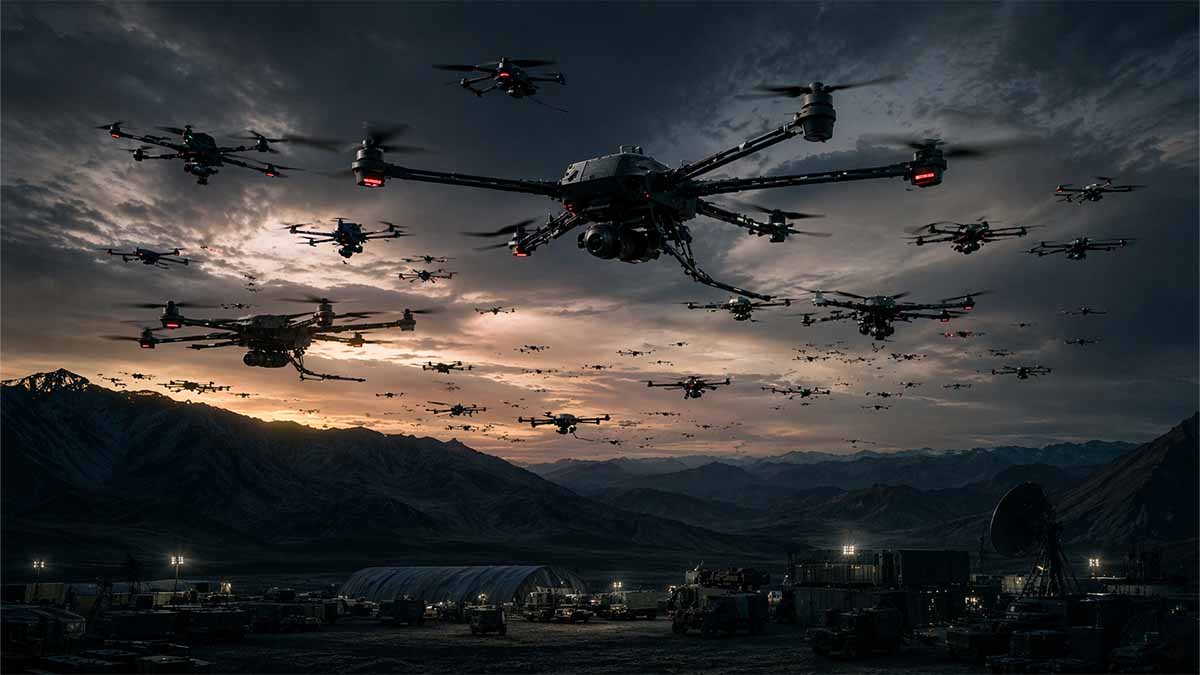
The announcement on 14 April 2026 by Russia’s state defense conglomerate Rostec of successfully completed preliminary tests for an AI-coordinated drone swarm system built upon Supercam unmanned aerial vehicles represents a structurally significant inflection point in the evolution of autonomous warfare — one whose implications cascade across military doctrine, geopolitical stability, air defense architecture, defense-industrial finance, and the regulatory governance of lethal autonomy. This abstract provides a forensic immersion into the layered dimensions of this development, situating it within the broader technological competition, defense-financial ecosystem, and strategic environment of 2024–2026.
The Rostec Swarm System: Technical Disclosure and Operational Concept
Russia’s state corporation Rostec announced the successful completion of preliminary tests for a new technology designed for the coordinated use of strike drones. The system enables multiple UAVs to operate as a single unit, automatically sharing target data in real time. According to the company, the development is based on Supercam unmanned aerial vehicles. The solution includes upgraded aircraft-type loitering munitions, launch systems, and a mobile command post. During trials conducted at a test range, the drones successfully engaged designated practice targets. Voennoye Delo
The operational concept is architecturally significant. A formation of UAVs patrols a specified area, scanning for potential targets. Once one drone identifies an objective, it transmits the data to the rest of the group, after which the information is verified by an operator. The strike is then carried out collectively. Rostec noted that a single operator can simultaneously control up to ten loitering munitions. Voennoye Delo This operator-to-platform compression — from the legacy model of one pilot per aircraft to a single human managing a coordinated swarm of ten — marks a qualitative transformation in the human-machine teaming calculus of aerial warfare.
Critically, the architecture is not merely an improvement in command efficiency. Much of the system’s functionality is automated. An onboard neural network handles target recognition and assigns roles within the group, determining the sequence of attacks and selecting which drone will conduct objective monitoring. Voennoye Delo The introduction of onboard neural network role assignment — including the automated designation of which platform conducts battle damage assessment (BDA) — places this system within the category of Level 3+ autonomy as defined in scholarly literature on lethal autonomous weapons systems (LAWS): the machine not only executes, but prioritizes and allocates within a tactical mission without per-action human authorization.
Rostec stated that testing will continue. In the longer term, the technology is being considered for use in breaching enemy air defense systems and delivering concentrated strikes against complex targets. Voennoye Delo This explicit doctrinal framing — air defense penetration and concentrated strikes on high-value targets — is not incidental language. It signals a deliberate strategic positioning of swarm capability as a counter to Western-supplied integrated air defense systems (IADS) deployed in Ukraine and potentially beyond.
The Supercam S350: Platform Genealogy and Operational Track Record
The Supercam S350 is not a new platform in 2026; its combat utility has been asserted by Russian sources across the 2024–2025 period. Russia unveiled the Supercam S350 drone at IDEX 2025, claiming it had hunted down and destroyed Western-supplied military vehicles, including Bradley infantry fighting vehicles and Humvees, on the Ukrainian battlefield. According to Rostec, the UAV has played a key role in identifying and neutralizing various Western systems, from M777 howitzers and Patriot missile systems to HIMARS rocket launchers. Defense Mirror The platform’s multi-role character — equipped with a long-range video communication system, the Supercam S350 can detect targets in both visible and infrared spectrums. Its modular composite structure allows for quick assembly and adaptable payloads, making it versatile for different operational environments Defense Mirror — makes it a logical carrier for the networked swarm architecture announced in April 2026.
Separately, Rostec stated that new unmanned aerial systems developed from Supercam S350 “are tested and demonstrate high technical characteristics” and “are highly protected against electronic warfare.” TASS This anti-EW hardening claim is directly relevant to the swarm system’s strategic credibility: a swarm whose inter-drone communication network is vulnerable to jamming offers limited operational utility against adversaries with sophisticated electronic warfare suites.
Rostec as Defense-Industrial Pillar: Scale, Sanctions Pressure, and Wartime Adaptation
Understanding the swarm announcement requires contextualizing the institutional scale and wartime evolution of Rostec itself. Ukraine’s defense intelligence directorate (HUR) published a detailed breakdown of 243 enterprises that are part of three major holdings within Russia’s state-owned corporation Rostec. “Rostec enterprises account for more than half of Russia’s total production of weapons and military equipment and play a key role in supplying the aggressor’s army in its war against Ukraine,” the HUR statement said. Kyiv Post With a portfolio of over 700 enterprises spanning defense, aviation, electronics, and engineering, Rostec is not a single firm but a federated defense-industrial state unto itself, analogous in structural function — if not in governance model — to the integrated prime-contractor ecosystems of Lockheed Martin, BAE Systems, or Thales in Western defense markets.
The corporation has demonstrated substantial production resilience despite Western sanctions. Russia’s state tech corporation Rostec is actively developing unmanned technologies and expanding production of components for air, land, and sea drones, TASS with Bekkhan Ozdoyev, Rostec Arms Cluster Industrial Director, articulating a diversified platform doctrine that explicitly rejects the notion that drones alone will define future warfare. This doctrinal nuance matters: the swarm announcement of April 2026 should be read not as a pivot away from combined-arms doctrine, but as the integration of autonomous swarm capability into a broader multi-domain force structure.
On the sanctions dimension, Rostec remains an active entity under sanctions in the UK, US, EU, and allied nations as of August 2025. Its operational capacity within Russia continues, with public reports of expanded military production supporting the Kremlin’s war efforts. Internationally, Rostec faces severe limitations in accessing finance, technology, and export markets due to ongoing enforcement of sanctions regimes. NGO Report The capacity to develop and test a functioning AI-coordinated swarm system under these conditions is itself a strategic datum: it indicates that Russia’s domestic defense-technological base possesses sufficient neural network engineering, embedded systems design, and systems integration capability to advance autonomous UAV programs without access to Western semiconductor supply chains — or that alternative supply pathways exist, a question with profound FININT and export control implications.
This latter point is underscored by the production trajectory of Russian drone manufacturing broadly. Year over year, Russia produced 2.5 times more drones in 2024 than in 2023, the first full year of the war in Ukraine. Since then, Russian long-range drone production has increased fivefold again in less than a year, according to Ukrainian intelligence information. Defense News The Ruselectronics subsidiary of Rostec has been instrumental in this scaling: Ruselectronics has developed and begun producing critical UAV components that are the first of their kind in Russia, including advanced navigation modules that enable drones to navigate not only through satellite systems but also via ground-based mobile communication base stations — a dual navigation capability that enhances positioning accuracy in various environments. Army Recognition This satellite-independent navigation architecture is directly relevant to swarm operations in GPS-contested environments.
The Global Competitive Landscape: Swarm Doctrine in the United States, NATO, France, and the PRC
Rostec’s swarm announcement does not emerge in a doctrinal vacuum. It is part of a global convergence of autonomous swarm development that spans every major military power and constitutes what strategic scholars are increasingly characterizing as the Third Revolution in Military Affairs.
In the United States, the Pentagon’s Replicator program is pushing to scale autonomous drone swarms using low-cost, attributable systems. Led by the Defense Innovation Unit, the effort is backed by $500 million in FY 2024 funding, with an additional equivalent amount requested for FY 2025. At the heart of Replicator are software frameworks like Autonomous Collaborative Teaming (ACT) and Opportunistic Resilient Network Topology (ORIENT) — platforms that allow different drone types to coordinate as unified swarms, enabling a single operator to manage diverse autonomous systems. Interesting Engineering
The Pentagon has simultaneously begun moving toward what it explicitly terms a swarm “crucible.” Among the list of desired attributes in a recent solicitation are AI agents that can autonomously coordinate the efforts and role assignments of robotic systems — a concept officials are calling “inter-agent collaboration.” The architecture would need to have decentralized control to avoid single points of failure in case a system is taken out of the fight. DefenseScoop This decentralization requirement mirrors the architectural logic of the Rostec Supercam swarm, suggesting convergent engineering solutions to a common tactical problem across adversarial defense establishments.
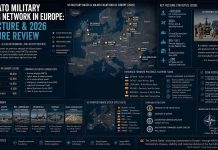
At the NATO level, NATO is preparing for a major leap in drone warfare experimentation with Silent Swarm 2026 — a multinational live-fire exercise set to unfold in Estonia. The event will showcase the alliance’s evolving doctrine for countering autonomous drone swarms and integrating manned-unmanned teaming (MUM-T) across land and air domains. With a focus on electronic warfare (EW), AI-enabled autonomy, and layered short-range air defense (SHORAD), Silent Swarm 2026 reflects NATO’s urgent response to lessons from Ukraine and other recent conflicts. MiliVox
France has articulated a timeline for swarm deployment as a matter of national military doctrine. The French armed forces and defense contractor Thales expect to field operational swarm use cases by 2027, with widespread adoption following shortly thereafter. The primary driver behind this rapid modernization is the need to overcome the tactical deadlock currently observed in conflicts such as the war in Ukraine. France’s solution is to deploy complex swarm raids designed to penetrate enemy defenses without risking human personnel. Defense World
The People’s Republic of China represents perhaps the most structurally ambitious competitor in this space. Chinese businesses hold roughly 90% market share of the civilian drone industry, which in the context of Beijing’s Civil-Military Fusion doctrine is highly convertible towards building lower-cost tactical UAS and long-range strike drones in wartime contingencies. Beijing recently launched a program to field one million tactical UAS by 2026. Inside Unmanned Systems
The global market trajectory reflects this competitive urgency. The military autonomous drone swarm market stood at approximately $4.8 billion in 2025 and is projected to reach $27.6 billion by 2034, representing a compound annual growth rate of 20.3%. North America dominated in 2025, commanding a revenue share of 41.2% and generating approximately $1.98 billion, anchored in a U.S. Department of Defense budget that allocated over $3.8 billion specifically for autonomous systems and AI-enabled defense platforms in fiscal year 2025. Market Intelo
Air Defense Saturation: The Strategic Logic of Swarm Offense
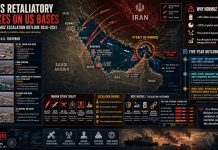
The doctrinal rationale for swarm investment — explicitly articulated in Rostec’s announcement — rests on a structurally sound military logic: that any defensive system possesses a finite target-handling capacity that can be exceeded by coordinated massed attack. An underlying principle is that any defensive system has a finite target-handling capacity, though it will vary with circumstances. An attacker can try to exceed this limit, forcing defenders to prioritize which targets to engage. Iran demonstrated this saturation doctrine in retaliatory strikes, launching coordinated barrages of upwards of 100 to 200 drones alongside conventional missiles. While most drones were intercepted, the sheer volume stressed defenses and helped ballistic missiles get through — with 10 to 20 percent of munitions penetrating. The Strategist
This empirical precedent validates the strategic investment thesis underlying the Rostec Supercam swarm: that even technically inferior individual platforms, when coordinated at scale with intelligent role assignment and simultaneous strike execution, can defeat systems costing orders of magnitude more per unit. The Center for a New American Security (CNAS) has arrived at a parallel analytical conclusion from the Western defensive perspective: the U.S. “lacks sufficient purpose-built counter-drone systems, large reserves of affordable interceptors, and a modern short-range air defense capacity.” The CNAS analysis warns that “at a certain point, defenses that counter incoming drones one by one are going to become saturated and either run out of interceptors or fail because they can’t re-aim quickly enough to intercept the drones before they impact.” Inside Unmanned Systems
The Rostec system’s specific technical features — particularly the neural network-driven automated role assignment and the simultaneous strike execution protocol — are precisely engineered to maximize the saturation effect. By enabling simultaneous multi-vector strikes rather than sequential engagements, the system compresses the decision cycle available to defending systems to a window potentially shorter than human response time, creating a structural advantage that cannot be overcome by faster human operators alone but requires equivalent or superior autonomous defensive systems.
The Ukraine Theater as Doctrinal Laboratory
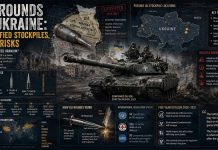
The Ukraine conflict has functioned since 2022 as an unprecedented live-fire research environment for autonomous drone operations. Ukraine’s war with Russia has accelerated the development of real-world drone swarm tactics, with the company Swarmer leading software innovation on the battlefield. Its systems enable coordinated operations of 3 to 25 drones per mission and have supported more than 100 documented combat deployments through 2025. Interesting Engineering The Ukrainian program provides an important comparative reference point: Ukraine’s swarm approach has been driven by software innovation in a resource-constrained environment, while Russia’s Rostec program reflects the resources of a state corporation integrating AI at the hardware level of the loitering munition platform itself.
Russia’s drone production architecture has been deliberately organized as a national-level industrial mobilization. The Russian government has developed a far-reaching, multi-level approach to turbocharge the country’s development and production of drones with an eye to becoming a world leader in the field. The comprehensive strategy includes large amounts of federal and state funding, thousands of startups, and even the systematic training of schoolchildren. The involvement of schoolchildren in drone programs is official policy, supported by state institutions like the Agency for Strategic Initiatives, and competitions are sponsored by state-owned defense contractors like Rosatom, Rostec, and Almaz-Antey. Defense News
This systemic mobilization framing transforms the Supercam swarm test from a single technological demonstration into evidence of an institutional commitment: the Russian defense-industrial state is not merely procuring drone capabilities but embedding autonomous systems development across its educational, industrial, and research architecture in a manner structurally analogous to — and explicitly competitive with — U.S. initiatives like DARPA’s swarm programs and the Defense Innovation Unit’s Replicator initiative.
Defense Finance, Procurement Networks, and the Autonomous Drone Investment Ecosystem
The political economy of autonomous drone investment constitutes a critical analytical layer beneath the tactical and doctrinal surface of the Rostec announcement. In the Western defense ecosystem, the drone and autonomous systems sector is reshaping procurement hierarchies, venture capital flows, and the revolving-door dynamics between government and industry that characterize what political economists from Eisenhower’s original formulation through Andrew Bacevich and William Hartung have analyzed as the Military-Industrial Complex.
Anduril Industries led the competitive landscape through rapid product development and DARPA contracts, while General Atomics was awarded a $287 million contract modification by the U.S. Air Force for advanced development of the Gambit Series collaborative combat aircraft platform, with specific funding allocated for swarm formation flight testing and autonomous air-to-air coordination algorithm development. Market Intelo These contracting flows are not merely procurement transactions; they constitute the financial sinews of a defense-technological ecosystem in which institutional investors, pension funds, and sovereign wealth funds increasingly hold material stakes in firms whose revenue trajectories are directly correlated with the continuation and escalation of autonomous warfare programs.
The market trajectory of autonomous military systems — projected at a 20.3% CAGR through 2034 — creates structural incentives within defense finance that transcend any individual firm or political moment. The revolving-door architecture connecting Pentagon acquisition offices, congressional defense committees, and the boards of autonomous systems primes embeds systemic biases toward program expansion and threat amplification that scholarship in the tradition of Mary Kaldor’s “new wars” framework and Mark Neocleous’s analysis of the political economy of security identifies as endogenous to the military-industrial system itself.
Analytical Summary and Forward Trajectory
The Rostec Supercam swarm system, announced in preliminary testing on 14 April 2026, is best understood not as an isolated Russian defense breakthrough but as a convergence point for multiple structural vectors: the wartime industrial mobilization of the Russian defense state; the global competitive dynamic in autonomous swarm technology spanning the U.S., NATO, France, China, and Russia; the doctrinal evolution of air warfare toward saturation attack strategies that exploit finite defensive capacity; and the political economy of defense investment that ties institutional financial interests to the continuation and expansion of autonomous weapons programs.
Each of these vectors deserves systematic analytical treatment. The chapters that follow provide empirically grounded, methodologically transparent analysis of each, employing network analysis of defense procurement and industrial structures, financial exposure mapping across institutional investors, critical discourse analysis contrasting rhetorical positioning with material incentives, and case-based deep dives into the Ukraine assistance ecosystem, the autonomous systems contracting landscape, and the sanctions-circumvention challenges facing Rostec’s supply chain.
The analytical challenge is to resist both the Russian state’s promotional framing of the swarm test as decisive technological superiority and the Western tendency to either dismiss or catastrophize Russian autonomous systems development. The empirical record supports a more nuanced finding: that all major military powers are converging on autonomous swarm architectures at roughly similar levels of developmental maturity, that the Ukraine conflict has compressed doctrinal learning cycles in ways that benefit both sides, and that the financial and institutional architecture of the global defense industry creates powerful structural incentives to continue and accelerate this convergence regardless of its humanitarian, legal, or escalatory implications.
Organic Concept Relationship Table
Autonomous Convergence: Rostec Supercam AI-Coordinated Swarm System • Mapping Technical, Strategic, Geopolitical & Financial Interdependencies 2024–2026
Executive Insight
Rostec’s April 14 2026 announcement of a neural-network-driven Supercam swarm (1 operator controls 10 loitering munitions) marks Level 3+ autonomy convergence. Saturation doctrine, sanctions resilience, and global arms-race symmetry (US Replicator, NATO Silent Swarm, PRC 1M UAS) redefine unmanned warfare economics and air-defense vulnerability through 2026.
| Concept | Theme | Subtopic | Key Data | Relationships | Iteration Stage | Analytical Insight | Status |
|---|
Relationship Network Map — Hover nodes to highlight table
| Concept ID | Theme | Key Metric / Fact | Relationship Type | Source Context (Abstract / Chapter) |
|---|---|---|---|---|
| RST-01 | Technical | Supercam S350 + onboard neural net | Synergistic | 1.2 / 1.3 — 1 operator controls 10 munitions |
| RST-02 | Technical | Automated role assignment & BDA | Causal | 1.3 — Level 3+ autonomy |
| RST-03 | Doctrine | Saturation of finite air-defense capacity | Causal | 2.1 — Iran precedent & CNAS warning |
| RST-04 | Industrial | Rostec 700+ enterprises >50% Russian weapons | Hierarchical | 1.1 — Sanctions resilience proven |
| RST-05 | Geopolitical | Ukraine live-fire testing ground | Correlative | 2.3 — Doctrinal accelerant for all actors |
| RST-06 | Global | US Replicator $500M+ FY24/25 | Correlative | 2.2 — Convergent swarm architectures |
| RST-07 | Global | PRC 1 million tactical UAS by 2026 | Competitive | 2.2 — Civil-Military Fusion scale |
| RST-08 | Financial | Swarm market $4.8B→$27.6B @20.3% CAGR | Synergistic | 3.1 — Structural investment incentives |
| RST-09 | Industrial | Russian drone output 2.5× (2024) / 5× long-range | Iterative | 1.1 — Ruselectronics domestic components |
INDEX
Chapter 1 — Systemic Architecture of Rostec’s Supercam Swarm Technology: Technical Anatomy, Institutional Origins, and the Russian Military-Industrial Ecosystem
- 1.1 Rostec as Strategic Defense Conglomerate: Institutional Genealogy and Wartime Scaling
- 1.2 Supercam S350: From Reconnaissance Platform to Networked Strike Instrument
- 1.3 The AI Coordination Layer: Neural Networks, Target-Data Sharing, and Operator-to-Drone Ratios
- 1.4 Loitering Munitions Integration and the Mobile Command Post Architecture
Chapter 2 — Geopolitical and Strategic Implications: Swarm Doctrine, Air Defense Saturation, and the Multipolar Drone Arms Race
- 2.1 Saturation as Strategic Doctrine: The Logic of Exceeding Finite Defensive Capacity
- 2.2 Comparative Swarm Programs: United States Replicator, NATO Silent Swarm 2026, PRC, and France
- 2.3 The Ukraine Theater as Live Testing Environment and Doctrinal Accelerant
- 2.4 Hybrid Operations and the Multi-Domain Implications of Autonomous Swarm Deployment
Chapter 3 — The Military-Industrial-Financial Complex in the Autonomous Drone Era: Procurement Networks, Financial Exposure, and the Political Economy of AI-Enabled Warfare
- 3.1 Defense Procurement Ecosystems and the Drone Investment Surge
- 3.2 Sanctions, Supply Chain Circumvention, and Rostec’s Industrial Resilience
- 3.3 Western Defense Finance, Lobbying Architecture, and Autonomous Systems Contracting
- 3.4 Epistemological Limits, Analytical Gaps, and Policy Implications
Chapter 1: Systemic Architecture of Rostec’s Supercam Swarm Technology — Technical Anatomy, Institutional Origins, and the Russian Military-Industrial Ecosystem
1.1 Rostec as Strategic Defense Conglomerate: Institutional Genealogy and Wartime Scaling
The institutional architecture of Rostec — formally, the State Corporation for the Promotion of the Development, Manufacture, and Export of High Technology Products — constitutes one of the most structurally consequential creations of the post-Soviet Russian political economy. Its founding was not incidental but deliberate and presidential. Rostec was incorporated on 23 November 2007 under Federal Russian Law No. 270 “On the Rostechnologii Government Corporation.” The Russian government transferred ownership stakes in 437 companies to the corporation as its contribution to its share capital as late as 2009, at the height of the financial crisis. When the military-industrial conglomerate Rostechnologii was formed in 2007, it not only absorbed the assets of the state arms exporter Rosoboronexport, but acquired 450 additional entities, including 180 state corporations, mostly in the defense, machine building, aviation, auto manufacturing, and metallurgy sectors. Global Security
This founding act must be understood not as a privatization but as the precise inverse: a state-directed consolidation of dispersed Soviet-era industrial assets under unified presidential control, operating through an institutional mechanism that combines the balance-sheet logic of a holding company with the strategic authority of a governmental ministry. The resulting entity is structurally unlike any Western defense prime contractor. Meeting with CEO of Rostec State Corporation Sergei Chemezov – President of Russia – August 2023 makes explicit the governance dynamic: Sergei Chemezov, General Director since the corporation’s founding and a personal associate of Vladimir Putin since the KGB period in Dresden, reports directly to the Kremlin, not to any commercial board accountable to external shareholders. This structural arrangement eliminates the separation between state strategic priorities and corporate operational decisions that partially governs Western defense procurement systems.
The corporation currently comprises 663 organizations, grouped under 13 holding companies, including eight in the defense industry and five in civilian manufacturing sectors. Global Security These thirteen holdings are not passive investment vehicles. Notable subsidiaries include United Aircraft Corporation (UAC) — aeronautical manufacturing including aircraft and parts; Russian Helicopters — rotorcraft production; VSMPO-Avisma — the world’s largest titanium producer, crucial for aerospace; and Kalashnikov Concern — iconic small arms manufacturer. It also controls Novikombank, a financial institution that has faced its own sanctions due to Rostec affiliation. NGO Report This financial subsidiary is analytically significant: Novikombank provides internal financing mechanisms that partially insulate Rostec’s operational subsidiaries from the external capital markets that Western sanctions aim to cut off, creating a closed-loop defense-financial architecture with meaningful autonomy from international banking systems.
The wartime scaling of Rostec since February 2022 has been the defining institutional transformation of the Russian military-industrial complex. Rostec State Corporation demonstrated sustained growth and adaptation to a challenging international business environment in 2024. Despite ongoing sanction pressure, the Corporation recorded a significant increase in revenue, including growth in the civilian product sector. According to Sergey Chemezov, CEO, sanctions served as an incentive for increasing creative efforts and accelerating in-house processes. Output of a wide range of military products at Rostec’s facilities has grown by five to six times and more. Rostec This is a remarkable institutional claim and must be read with appropriate analytical caution: Russian state sources do not publish independently audited financial statements in a Western-standard format. However, the directional magnitude is corroborated by convergent external assessments.
The corporation achieved consolidated revenue of 2.1 trillion rubles in 2022, surpassing pre-sanctions levels despite export restrictions and asset freezes targeting its subsidiaries. Net profit, however, contracted to 39 billion rubles, a fourfold reduction from 2021, due to elevated costs from retooling production lines and sourcing alternatives. Defense output expanded markedly to support ongoing operations. Rostec CEO Sergey Chemezov reported in November 2023 that annual tank production had risen sevenfold from 2022 levels, with other armored vehicles increasing 4.5-fold and artillery/multiple launch rocket systems 2.5-fold. In 2024, tank and light armored vehicle production grew an additional 10%, while conventional artillery munitions output increased 30%. Grokipedia These figures — even if partially inflated for domestic and international audience management purposes — indicate a defense-industrial establishment operating well above peacetime capacity, with structural implications for every product line including unmanned aerial systems.
Rostec’s consolidated revenue for 2023 increased by 34%, reaching RUB 2.4 trillion, while net profit amounted to RUB 60.1 billion, according to CEO Chemezov’s presentation to President Putin. Defense Express Case of Main Arms Manufacturer Rostec As Example of Russia’s Transition to Wartime Economy – Defense Express – February 2024 contextualizes this revenue surge against the backdrop of the corporation’s need to finance factory retooling, workforce mobilization, and the integration of new production lines — including gunpowder manufacturing facilities — into the Rostec structure. The revenue expansion thus reflects wartime state procurement transfers rather than organic productivity growth, a distinction with important implications for the sustainability of Rostec’s accelerated production trajectory under prolonged conflict conditions.
The organizational architecture governing the unmanned systems domain within Rostec is structured around a set of specialized subsidiaries rather than a single centralized entity. Ruselectronics, the electronics-focused holding within Rostec, has assumed primary responsibility for UAV component production, particularly navigation modules and anti-drone systems. Ruselectronics manufactures anti-drone guns known as the Pishchal-Pro and Serp systems for countering UAVs. The KRET holding — Concern Radio-Electronic Technologies — produces radioelectronic warfare equipment. High Precision Systems is working on an airspace monitoring system including small radars capable of identifying small and slow targets. Kremlin The drone swarm system announced in April 2026 integrates across these subsidiary domains: the communication data links and electronic hardening derive from KRET and Ruselectronics capabilities, while the loitering munitions fall under the High Precision Systems cluster. This cross-subsidiary integration is not automatic; it requires centralized coordination through the Rostec Arms Cluster under Industrial Director Bekkhan Ozdoyev, whose statements at the World Defense Show 2026 explicitly framed drone development within a combined-arms doctrinal framework rather than as a standalone technological domain.
1.2 Supercam S350: From Reconnaissance Platform to Networked Strike Instrument
The Supercam S350 occupies a distinctive position within Russia’s drone taxonomy that is frequently misunderstood in Western analytical literature. It is not a purpose-built attack platform on the model of the Shahed-136 or the Lancet loitering munition; rather, it is a reconnaissance, surveillance, and target acquisition (RSTA) platform that has been operationally integrated with strike assets in a networked ecosystem — and which now, as of April 2026, serves as the coordinating intelligence node for an AI-directed swarm of modified loitering munitions. Understanding this architectural distinction is essential for accurately assessing the capability threshold the April 2026 test represents.
The physical architecture of the Supercam S350 is built around a blended flying-wing aerodynamic configuration. The system is designed for operation without conventional runways. Launch is conducted via an elastic or pneumatic catapult, while recovery is achieved through a parachute-assisted landing system featuring automatic riser release. The platform has a wingspan of 3.2 meters and a maximum takeoff weight of approximately 15.5 kilograms. Payload capacity ranges from 2 to 2.5 kilograms. Endurance is rated at up to 330 minutes, or approximately 4.5 to 5.5 hours, depending on mission configuration. Operational range exceeds 240 kilometers, with an operating ceiling of up to 5,000 meters. The Defense News Cruise and mission speeds vary between 75 km/h and 120 km/h, and the radio data link range is specified between 70 and 100 kilometers. These performance parameters — particularly the combination of multi-hour endurance, operational ceiling, and extended data-link range — position the S350 precisely in the role it fulfills within the swarm architecture: a persistent high-altitude surveillance and coordination node that can maintain line-of-sight communication with lower-flying strike elements operating at greater electronic risk below it.
The drone’s body is made of composite materials. The wide operating frequency range allows the Supercam S350 to remain virtually invulnerable to electronic jamming. The UAV is aerodynamically designed as a “flying wing,” which provides the ability to increase flight speed, lower drag, and greater invisibility to enemy radars. ВПК.name The composite airframe and flying-wing configuration confer a meaningful reduction in radar cross-section (RCS) that enhances survivability in contested airspace, particularly at the altitudes the S350 typically operates, above the effective range of small-arms fire and most man-portable air defense systems (MANPADS) but below the engagement envelope of most larger surface-to-air missile systems optimized for aircraft and ballistic missiles.
The platform is described as a 15 kg class electric flying-wing drone carrying EO/IR sensors including a 40x day zoom and thermal night camera for rapid-deploy reconnaissance, with up to 5.5 hours endurance, over 240 km flight range, 100 km control link, and parachute recovery for austere operations. Army Recognition Russia Unveils Supercam S350 Drone With 240 km Range for Artillery Targeting Operations – Army Recognition – February 2026 provides ground-level assessment from the World Defense Show 2026 in Riyadh, where the manufacturer emphasized the platform’s independence from prepared runways and its capacity to push targeting data to ground fires within minutes of target detection.
The operational evolution of the S350 from a purely reconnaissance platform to a swarm coordination node is documented through a sequence of capability announcements by the Unmanned Systems Group (USG), the Izhevsk-based manufacturer that holds the core intellectual property and produces the Supercam line. The Supercam S350, as the group’s flagship model, is currently used at the frontline primarily as a high-altitude reconnaissance aircraft, capable of flying higher, longer, and further. With its relay function, it maintains communication with loitering munitions during their approach to the target, at which point communication with the operator may be interrupted due to electronic warfare systems or ground obstacles. The relay function makes it possible to maintain stable video signal reception, allowing the operator to adjust the loitering munition’s trajectory. TASS Russia to Boost Production of Supercam Drones in 2026 — TASS – February 2026 further documents that Unmanned Systems Group increased production by approximately 20% in 2025 compared to the previous year, with further scaling planned for 2026 within existing contracts — alongside an explicit statement of readiness to significantly expand production should operational demand accelerate.
The Supercam S350 is a light-class UAV with secure communications channels, high resistance to electronic warfare systems, and a video communication range of over 70 km. The modernized version of the Supercam S350 received an FPV drone detection and suppression system, allowing the solution integrated into the UAV to be used operationally. Defense Arabia Unmanned Excellence: Supercam S350 & New S180/X4 Drones Head to Dubai Airshow – Defense Arabia – November 2025 discloses the addition of an anti-FPV capability to the S350 in 2025 — an upgrade that transforms the platform from a passive intelligence collector into an active participant in the electronic and kinetic suppression of opposing UAS. This bidirectional capability, combined with the relay and coordination functions disclosed for the swarm system, positions the S350 as a multi-role unmanned command node rather than a single-function ISTAR asset.
The Supercam S180 — a mid-tier platform within the same product family — has been disclosed as performing reconnaissance from altitudes of up to 3,000 meters with enhanced maneuverability characteristics. The Supercam S180 performs reconnaissance from an altitude of up to 3,000 meters and has greater maneuverability. Both drones are featured at the Unmanned Systems stand at the World Defense Show, which took place from February 8 to 12 in Riyadh. TASS The co-presentation of the S180 and S350 alongside each other at the World Defense Show 2026 suggests a deliberate product-family positioning in which the two platforms operate at complementary altitude bands — the S180 at lower, higher-risk altitudes with superior maneuverability for close-in reconnaissance, and the S350 at higher altitudes providing extended-endurance overwatch, relay, and now swarm coordination.
The commercial dimension of the Supercam platform must be noted as analytically significant. A significant advantage of the Supercam line is the comprehensiveness of the proposed solutions, largely ensured by mathematical image processing technologies, which allow for the automatic implementation of various popular tasks, from mapping to the recognition of various objects, generally increasing the efficiency of the unmanned system. The innovativeness of the engineering solutions of the Supercam developers, providing them with high functionality while simultaneously having good reliability indicators, has been appreciated not only in Russia, but also abroad. Defense Arabia IDEX 2025: Russia Showcases Supercam S350 UAV – Defense Arabia – February 2025 notes that this civilian-to-military technology transfer pathway — from mapping and surveying applications to battlefield ISTAR — allowed Unmanned Systems Group to compress its development cycle by building on mature commercial computer vision and image processing infrastructure rather than developing solely within the defense procurement pipeline.
The earlier civilian origins of the Supercam line also partially explain how the Unmanned Systems Group has maintained production and component sourcing despite sanctions: civilian drone technology supply chains, particularly for electric motors, optical sensors, and embedded computing modules, are subject to less stringent export controls than explicitly military components and operate through a wider range of intermediate commercial channels.
1.3 The AI Coordination Layer: Neural Networks, Target-Data Sharing, and Operator-to-Drone Ratios
The most analytically consequential dimension of the April 2026 Rostec announcement is not the hardware — the Supercam S350 airframe and loitering munitions are known quantities — but the software architecture of autonomous coordination that transforms a collection of individually operated platforms into a coherent, self-organizing tactical unit. This distinction between hardware and software capability is fundamental and has been systematically underemphasized in much defense journalism, which focuses on visible platforms rather than the decision-support algorithms that govern their behavior.
The solution includes aircraft-type loitering munitions modified for data transmission, launchers, and a vehicle-mounted control center. During tests, a group of drones hovered over the area in target search mode. The first drone to detect a target transmitted the data to the rest of the system’s drones. The target was then confirmed by a human operator, after which it was engaged by all drones in the group. With this technology, one person can control ten loitering munitions simultaneously. Upon detection, the system’s neural network automatically identifies the targets and assigns tasks to the loitering munitions — the order in which they attack and which drone maintains objective control. Defense Mirror Russian Tech Converts Drone Swarms into Attack Dogs – Defense Mirror – April 2026 documents these operational parameters as reported from the test series.
The operator-to-platform ratio of 1:10 represents a specific and meaningful capability threshold. Prior to this development, the Russian military’s standard practice involved a near-1:1 relationship between human operators and active strike drones, with the principal exception of pre-programmed loitering munitions operating on fixed flight profiles without real-time human targeting. The compression to 1:10 does not eliminate human control — the human operator confirms target designation after the neural network’s initial identification — but it fundamentally alters the economics and throughput of drone warfare. A single platoon-sized element of operators can now theoretically coordinate an attack by a company-equivalent formation of lethal aerial platforms, with the neural network managing the cognitive load of role assignment, attack sequencing, and battle damage assessment (BDA) allocation that would previously have required multiple specialist operators.
The AI coordination layer described by Rostec operates through a sequence of automated processes that merit disaggregation. The first process is cooperative area search: the swarm patrols a designated area in formation, with each drone transmitting its sensor data to a shared situational awareness picture accessible to all platforms and to the human operator’s console. The second process is automated target detection and classification: when any platform’s sensor suite detects an object meeting pre-defined target parameters, the neural network evaluates the detection against its training dataset, assigns a confidence level, and flags the detection for human review. The third process — and the one with the most significant legal and ethical implications — is autonomous role assignment: before the human operator has confirmed the strike order, the neural network has already determined the optimal attack sequence, assigned specific platforms to specific roles (primary striker, secondary striker, BDA platform), and is effectively presenting the operator with a pre-packaged strike package requiring only authorization rather than planning.
This architecture sits at a precise and legally contested boundary within the international debate on lethal autonomous weapons systems (LAWS). The system as described maintains a human in the authorization loop — the operator must confirm targeting — but removes the human from the planning loop, which is where the neural network operates autonomously. The distinction between human-on-the-loop (human can override) and human-in-the-loop (human must authorize each individual action) is central to International Humanitarian Law (IHL) discussions in forums including the Convention on Certain Conventional Weapons (CCW) Group of Governmental Experts, where Russia has historically resisted binding prohibitions on autonomous targeting. The Supercam swarm architecture appears deliberately designed to navigate this distinction: preserving the formal human authorization step while automating the substantive targeting decision to a degree that renders the human role more confirmatory than judgmental.
The swarm was developed by the Unmanned Systems Group and includes several modified loitering munitions of the aircraft type, a specialized vehicle, and launchers. The technology is effective for destroying enemy manpower, equipment, and structures. Unlike single use, the swarm method allows simultaneous reconnaissance, target identification, and strike. Www1 Drone Swarm vs. Armor: Supercam UAVs Independently Found and Hit Target During Tests – March 2026 documents earlier test phases from March 2026 — a timeline indicating that the April 2026 announcement represents the culmination of a multi-month testing cycle rather than a single demonstration event. The developmental continuity implies a structured R&D program with defined milestones, suggesting the system has progressed further toward operational readiness than a single “successful preliminary test” framing might imply.
The neural network architecture powering the swarm’s target recognition and role assignment is described in general terms by Rostec and Unmanned Systems Group but not specified at the level of detail that would allow precise technical characterization. However, contextual inference from the system’s described capabilities — real-time target detection across multiple simultaneous sensor feeds, confidence-level classification, sequential attack optimization, and BDA role assignment — is consistent with a convolutional neural network (CNN) architecture operating on visual and thermal imagery data, integrated with a reinforcement learning (RL) or rule-based optimization module for role assignment. The embedded processing required for this architecture on a platform with a maximum takeoff weight of 15.5 kg requires compact, power-efficient edge computing hardware. The specific silicon underpinning this capability is of direct interest from an export control enforcement perspective: if the neural network inference is running on Western-origin chips sourced through circumvention pathways, that represents a significant sanctions implementation gap.
1.4 Loitering Munitions Integration and the Mobile Command Post Architecture
The swarm system announced by Rostec is not a reconfiguration of existing reconnaissance drones into attack platforms. It is an integrated system-of-systems architecture in which functionally distinct aerial platforms — the S350 serving as coordination node and ISR asset, and modified aircraft-type loitering munitions serving as strike elements — operate under unified management through a dedicated ground infrastructure. This systems-integration dimension is analytically critical and has received insufficient attention in initial reporting.
The solution is based on the Supercam unmanned aerial vehicle (UAV). It includes aircraft-type loitering munitions modified for data transmission, launchers, and a vehicle-mounted control center. Defense Mirror The phrase “modified for data transmission” is technically significant. Standard loitering munitions in Russian service — including variants of the KUB-BLA, the Lancet-3, and related systems produced by ZALA Aero (a Kalashnikov Group subsidiary within the Rostec family) — are primarily designed as one-way attack platforms with limited inter-platform communication capability. Modifying them to participate in a real-time mesh data network, receive updated targeting coordinates mid-flight, and accept neural network-assigned role instructions requires substantive hardware and software modifications, including the addition of two-way data-link hardware, onboard processing capacity, and software compatibility with the swarm coordination protocol.
The vehicle-mounted control center constitutes the ground segment of the system and serves as the interface between the human operator and the swarm. Its design philosophy — mobile, vehicle-mounted, deployable at or near the forward line of troops — reflects lessons learned from the Ukraine conflict regarding the vulnerability of fixed command infrastructure to counter-battery fire and drone strikes. A mobile command post that can relocate between sorties dramatically reduces its signature and survivability risk. The integration of the command post with launch infrastructure — the catapult systems for the S350 and the launcher arrays for the loitering munitions — within a single vehicle or vehicle convoy suggests a self-contained tactical package deployable at battalion or brigade level rather than requiring division or corps-level coordination.
Multiple UAV types function as integrated elements of a broader reconnaissance-strike ecosystem rather than as isolated platforms. Rosoboronexport is showcasing the Karakurt and Goliath UAV systems from the Kalashnikov Group, designed specifically for soldier, squad, and platoon-level employment. These systems reflect the growing militarisation of the lowest echelons of combat, where organic aerial reconnaissance has become essential for survivability and situational awareness. Defence Security Asia Russia Unveils Combat-Proven UAV and Loitering Munition Arsenal at UMEX 2026 – Defence Security Asia – January 2026 contextualizes the Supercam swarm system within a broader Russian unmanned systems family that extends from squad-level micro-UAVs to the strategic S350 coordination platform, with the swarm architecture designed to function at the tactical operational interface between company and battalion.
The relay architecture disclosed by TASS in February 2026 reveals an additional layer of systems integration. The Supercam S350, at the frontline, maintains communication with loitering munitions during their approach to the target, at which point communication with the operator may be interrupted due to electronic warfare systems or ground obstacles. The relay function makes it possible to maintain stable video signal reception, allowing the operator to adjust the loitering munition’s trajectory. TASS This relay function — in which the high-flying S350 serves as an airborne communications repeater for lower-flying strike elements in the electronic warfare-degraded environment of the modern battlefield — is a mature capability predating the swarm system and provides the communications infrastructure backbone upon which the swarm coordination protocol is layered. The architectural continuity between the established relay function and the new swarm coordination function explains how the Unmanned Systems Group was able to develop the swarm architecture without a full ground-up redesign: the data-link infrastructure was already in place.
The net assessment of Chapter 1 establishes that the Rostec Supercam swarm system is the product of a coherent, multi-year development program within an institutional structure — Rostec and its Unmanned Systems Group subsidiary — that has been systematically scaled and resourced under wartime conditions. The technical architecture integrates mature platform capabilities (the S350’s endurance, EW resistance, and relay function) with a novel software layer (the neural network for autonomous role assignment) and a modified strike element (aircraft-type loitering munitions with two-way data links) under a deployable mobile command infrastructure. The operator-to-platform ratio of 1:10 and the neural network’s pre-authorization role assignment represent genuine capability advances that cross meaningful doctrinal and legal thresholds — not revolutionary breakthroughs in physics or materials science, but meaningful software-systems integration achievements within a production system operating at wartime scale.
Organic Concept Relationship Table
Chapter 1 — Systemic Architecture of Rostec’s Supercam Swarm Technology • Technical Anatomy, Institutional Origins & Russian Military-Industrial Ecosystem
Executive Insight • Chapter 1
Rostec’s 663-organization conglomerate, founded 2007 under direct presidential control, has scaled wartime output 5–6× while integrating the Supercam S350 flying-wing RSTA platform with a neural-network AI coordination layer achieving 1:10 operator-to-munition ratio. The resulting system-of-systems architecture — combining Ruselectronics/KRET components, modified loitering munitions, and a mobile vehicle-mounted command post — represents mature cross-subsidiary integration within a sanctions-resilient, closed-loop defense-industrial ecosystem.
| Concept | Theme | Subtopic | Key Data | Relationships | Iteration Stage | Analytical Insight | Status |
|---|
Chapter 1 Relationship Network Map — Hover nodes to highlight table
| Concept ID | Theme | Key Metric / Fact | Relationship Type | Source Context (Chapter 1 Section) |
|---|---|---|---|---|
| CH1-01 | Institutional | 663 organizations under 13 holdings | Hierarchical | 1.1 — Post-2007 consolidation |
| CH1-02 | Wartime Scaling | 5–6× military output growth | Iterative | 1.1 — 2022–2024 revenue surge |
| CH1-03 | Platform Anatomy | Supercam S350 flying-wing RSTA | Synergistic | 1.2 — 15.5 kg, 5.5 hr endurance |
| CH1-04 | AI Layer | Neural net role assignment + BDA | Causal | 1.3 — 1:10 operator ratio |
| CH1-05 | Systems Integration | Ruselectronics + KRET components | Hierarchical | 1.1 — Cross-subsidiary coordination |
| CH1-06 | Loitering Munitions | Modified aircraft-type with data links | Synergistic | 1.4 — Mesh network integration |
| CH1-07 | Command Post | Vehicle-mounted mobile control center | Correlative | 1.4 — Ukraine-derived survivability |
| CH1-08 | Relay Architecture | S350 as airborne communications repeater | Iterative | 1.2 — Pre-swarm EW-hardened capability |
Chapter 2: Geopolitical and Strategic Implications — Swarm Doctrine, Air Defense Saturation, and the Multipolar Drone Arms Race
2.1 Saturation as Strategic Doctrine: The Logic of Exceeding Finite Defensive Capacity
The emergence of coordinated drone swarm doctrine across multiple competing military powers in 2025–2026 is not a coincidental technological simultaneity. It reflects the convergence of a shared strategic insight — one whose empirical validation has accelerated rapidly through the evidence base generated in active conflict theaters from Ukraine to the Gulf — that any point defense system, regardless of its technical sophistication, possesses a finite and exploitable throughput ceiling. The strategic logic of swarm offense is therefore not simply the logic of mass, which is ancient, but the logic of coordinated mass that exceeds the decision cycle of the defender: overwhelming not just physical capacity but cognitive and algorithmic capacity simultaneously.
The empirical documentation of this principle has accumulated with unusual clarity in the period from late 2024 through early 2026. An 88% interception rate sounds like success. Then 53 warheads reach their targets across 32 separate locations in a single night. Russia’s winter 2025–2026 Shahed-136 campaign deployed approximately 19,000 drones in 90 days, with monthly production now estimated at roughly 3,000 units. Cheap mass defeats expensive defense even when defenders stop the overwhelming majority of incoming threats. Drone Warfare Shahed-136: Cost, Production Rate, Specifications & Inventory Estimates – Drone Warfare Strategic Assessment – February 2026 establishes the foundational arithmetic of saturation doctrine with empirical precision: an 88% kill rate against a wave of 450 incoming platforms still delivers 54 warheads to target. Against a 10-platform swarm with coordinated simultaneous attack timing — as the Rostec Supercam system is designed to execute — an equivalent interception percentage leaves 1–2 warheads reaching their objective, and against a high-value point target, a single penetrating warhead is operationally decisive.
The cost asymmetry embedded within this exchange dynamic creates a structural incentive for offensive swarm investment that is independent of the attacker’s political objectives. Monthly production rates of roughly 200 to 500 Shahed drones enable Iran to manufacture between 2,400 and 6,000 units annually, generating the capacity for sustained swarm operations capable of saturating radar networks and forcing defenders into continuous interception cycles. At the upper end of this production range, a monthly batch of 500 drones represents an investment of approximately US$10 million to US$25 million, an amount small enough to sustain prolonged offensive operations over months or even years. Defence Security Asia Attrition War Nightmare: Iran’s $20,000 Shahed Drones vs America’s $15 Million THAAD – Defence Security Asia – March 2026 frames the cost-exchange ratio in terms that make the defenders’ strategic position structurally untenable under sustained exchange conditions: a $20,000 drone forcing expenditure of a $15 million interceptor represents a 750:1 cost advantage for the attacker that no democratic defense budget can indefinitely sustain.
The interceptor stockpile dimension of this equation is acute. Annual Patriot production is measured in the hundreds — approximately 620 were reportedly delivered in 2025 and the goal for production in 2026 is approximately 2,000. Russia launched tens of thousands of Iranian-designed Shahed and Geran drones in 2025 alone. Foreign Policy U.S.-Iran War: The Drone Attrition Trap – Foreign Policy – March 2026 illuminates the structural crisis this production gap creates: when offensive drone production operates at thousands per month and defensive interceptor production operates at hundreds per month, the mathematical trajectory of sustained exchange exhausts defensive inventory on a timescale that strategic planners must measure in months rather than years.
The response emerging across multiple military establishments focuses on replacing expensive kinetic interceptors with cheap counter-drone layers. Countering mass drone attacks cannot rely primarily on traditional air defense missiles. Ukraine’s experience shows why. Interceptor drones have become a core layer of air defense because they are cheap enough to use at scale, preserve high-end interceptors for cruise and ballistic missiles, and can be produced in large numbers. Ukrainian Ministry of Defence officials stated that the country produced over 100,000 interceptor drones in 2025 and that combat success rates of these platforms exceed 60 percent. The Ukrainian Ministry of Defence also reported deliveries approaching 950 anti-Shahed interceptors per day in December 2025. Center for Strategic and International Studies Unpacking Iran’s Drone Campaign in the Gulf: Early Lessons for Future Drone Warfare – CSIS – March 2026 articulates the structural conclusion: drone defense must begin with a cheap, numerous drone-against-drone layer rather than a force structure built around million-dollar missiles.
The Rostec Supercam swarm system is designed precisely to complicate this counter-drone-vs-drone defensive evolution. The system’s neural-network-driven simultaneous multi-vector attack protocol — in which all swarm members strike concurrently rather than sequentially — compresses the engagement timeline to a window in which even AI-directed interceptor drones face the same target-prioritization saturation problem as human operators and kinetic interceptors. The simultaneous arrival of 10 coordinated warheads from varying azimuthal angles, with role assignments pre-computed, offers the defending interceptor system a time-space problem rather than merely a numerical one: the interceptors must successfully resolve targeting geometries for multiple simultaneous tracks within seconds, under electronic warfare suppression, without the sequential engagement queue that conventional air defense doctrine is optimized to exploit.
The Gulf context — where, as of March 2026, data published March 4 by the United Arab Emirates claimed military forces detected 941 drones and intercepted 876 of them in a single Iranian offensive window NTRO — demonstrates that even capable, well-supplied defenders with access to Patriot, THAAD, Rafale fighters, F-15s, and Eurofighters cannot maintain a perfect or near-perfect interception record against determined, high-volume swarm campaigns. Iran’s Drone Swarm Tactics Brings Focus on Cheaper and Scalable Counter-Drone Layers – Raksha Anirveda – March 2026 documents that 1,450 drone strikes were launched across the campaign window, with drones constituting roughly three-quarters of all attacks — a proportion that underscores the extent to which saturation doctrine has displaced missile-centric offensive strategies in conflicts where production economics favor the attacker.
2.2 Comparative Swarm Programs: United States Replicator/DAWG, NATO Silent Swarm 2026, PRC, and France
The global competitive landscape for autonomous drone swarm capability in 2026 is characterized by divergent institutional trajectories, uneven developmental maturity, and a fundamental mismatch between the urgency of the strategic requirement and the organizational capacity of democratic procurement systems to deliver at speed. Understanding the specific position and relative maturity of each major actor is essential for accurate net assessment of what the Rostec Supercam swarm test of April 2026 represents within the competitive field.
United States: Replicator’s Transition to DAWG and the Delivery Gap
The United States’ primary programmatic vehicle for autonomous drone swarm development — the Replicator initiative — has undergone a significant organizational transition that reflects both the program’s initial delivery shortfalls and the changed strategic priorities of the Hegseth Pentagon. The Replicator program has fallen short of its goal to field “multiple thousands” of attritable autonomous systems by August 2025. The exact number is classified, but the initiative seems to have fielded only hundreds, not thousands, by the target date. Washington Times What Happened to the Pentagon’s ‘Replicator’ Program? – Washington Times – November 2025 documents this delivery gap through interviews with a dozen current and former defense officials.
The organizational response has been a transfer of Replicator’s portfolio to a newly constituted entity. The entire Replicator portfolio has officially transitioned from the Defense Innovation Unit to the U.S. Special Operations Command. The Defense Autonomous Working Group (DAWG), which has taken over the initiative, is now conducting wargames and working on larger, longer-ranged attack drones under Admiral Sam Paparo and Pentagon Chief Technology Officer Emil Michael. Washington Times Pentagon Says Biden-Era Replicator Drone Program Now Under New Special Unit – Washington Times – November 2025 confirms that this transfer occurred in November 2025, alongside congressional action in the 2026 National Defense Authorization Act and parallel procurement reform legislation — the Streamlining Procurement for Effective Execution and Delivery (SPEED) Act and the Fostering Reform and Government Efficiency in Defense (FORGED) Act — designed to compress acquisition timelines.
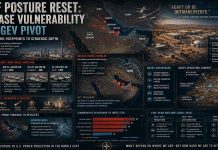
The pivot of Replicator 2 toward counter-UAS rather than offensive swarm deployment is analytically significant. The Department of Defense awarded two new contracts to acquire artificial intelligence-driven interceptor drones intended to help U.S. forces counter small unmanned aerial systems — the first acquisitions as part of the second phase of the Replicator program. The first contracts covered two advanced DroneHunter F700 systems expected to be deployed by April 2026. Joint Interagency Task Force 401 has taken the lead on the program. Washington Times Pentagon Awards First Contracts for AI-Powered Drone Interceptors Under Replicator 2 Program – Washington Times – January 2026 reveals that the immediate U.S. priority is defensive rather than offensive swarm capability — a posture driven by the urgent lessons of the Gulf conflict and Ukraine rather than by the longer-term competitive dynamic with Russia and the PRC. This defensive focus, while operationally rational in the near term, creates a temporal window in which U.S. offensive swarm capability lags behind the development pace now demonstrated by Rostec and the PLA.
The DAWG‘s pivot toward larger, longer-ranged attack drones addresses the offensive gap but introduces new delivery timeline uncertainty. The Defense Autonomous Working Group (DAWG), a new organization part of United States Special Operations Command, is supposed to carry out the initiative’s goals within two years. Responsible Statecraft DoD Promised a ‘Swarm’ of Attack Drones. We’re Still Waiting – Responsible Statecraft – November 2025 notes that critical technical issues with systems procurement persist and associated costs remain unclear — an institutional candor that contrasts sharply with Rostec’s confident announcement of “successful preliminary tests” in April 2026.
People’s Republic of China: Doctrinal Integration and Taiwan-Scenario Optimization
The PLA’s drone swarm program represents the most ambitious and institutionally comprehensive autonomous UAS development trajectory currently documented in open-source literature, driven by an explicit Taiwan contingency operational requirement and backed by the full industrial weight of Civil-Military Fusion doctrine. PRC writings describe drone swarms as the next evolution in uncrewed intelligent warfare technology and as having multiple advantages over single drones. Across many writings, PRC authors and PLA articles describe drone swarms as a low-cost, more effective asymmetric capability compared to larger, more expensive attack drone platforms. The intelligent algorithms technology needed for swarm coordination and control is “much more advanced and complex than the fixed script programs that single drone platforms use,” making control of drone swarms much more difficult but once mastered, the swarms then become a formidable capability. CNA PRC Concepts for UAV Swarms in Future Warfare – CNA Corporation – October 2025 constitutes the most authoritative open-source assessment of PLA swarm doctrine available as of the date of this analysis.
CCTV released footage on 25 March 2026 of the PLA’s “Atlas” drone swarm system, stating that a single Atlas launcher can deploy 48 drones, while each Atlas command system can coordinate 96 drones. The PLA’s Jiutian unmanned drone carrier could coordinate 100 smaller drones, according to PRC sources. The PRC has converted over 200 obsolete J-6 fighter jets into one-way attack drones with automatic flight control systems. American Enterprise Institute Lessons-Learned with Chinese Characteristics – AEI – April 2026 documents these capabilities within the broader context of PLA adaptation to lessons from contemporary conflicts.
The PLA’s doctrinal distinctiveness lies in its explicit design of swarm capabilities for GPS-denied and communications-degraded environments — directly anticipating the electromagnetic warfare conditions of a Taiwan Strait engagement where U.S. and allied electronic warfare assets would contest every frequency band. PLA Army Engineering University and National University of Defense Technology scholars in February 2025 detailed improvements to autonomous decision-making without communications, describing “collaborative attack missions in complex communication-constrained environments” using a novel algorithm for swarm attacks to converge on an urban target. A paper from March 2025 then removed any ambiguity, detailing how the PLA is exploring fully autonomous execution of the kill chain in urban settings. The Diplomat Machines in the Alleyways: China’s Bet on Autonomous Urban Warfare – The Diplomat – February 2026 provides forensic documentation of this doctrinal direction, which moves toward swarms capable of independently executing kill chains without real-time human authorization — a substantially more autonomous posture than the human-confirmation step preserved in the Rostec system.
A central finding of the CNA analysis is that the PLA is researching and developing autonomous drone swarm technology to solve one of the PRC’s most difficult challenges — a potential military invasion of Taiwan — and developing the capability to employ drone swarms in either an amphibious assault or blockade scenario. An examination of PRC writings suggests that the PRC is learning from both sides in the Russia-Ukraine war on the use of drones and drone countermeasures and applying these lessons to a PLA-Taiwan military scenario. CNA PRC Concepts for UAV Swarms in Future Warfare – CNA Corporation – July 2025 situates this development within a strategic research trajectory that has accelerated since 2021 — when CETC conducted a test of a UAV launcher capable of launching up to 200 fixed-wing drones to form a swarm — and which the 15th Five-Year Plan presented in March 2026 is expected to further institutionalize.
NATO: Silent Swarm 2026 and the Counter-UAS Architecture Priority
NATO’s institutional response to the drone swarm challenge is developing along two parallel tracks: defensive doctrine codification through exercises like Silent Swarm 2026 in Estonia, and offensive capability development pursued bilaterally and through European Defence Agency frameworks. The 2026 iteration of Silent Swarm marks a qualitative escalation from the 2024 inaugural exercise in both scope and ambition. At Silent Swarm 2025, Northrop Grumman delivered a live proof-of-concept, integrating its Tactical Edge Electromagnetic Solutions (TEEMS) onto compact platforms — ranging from tiny robots to unmanned surface vessels and drones — demonstrating how small systems can produce outsized impacts. The integration enabled platforms to detect and jam enemy signals with speed and precision across every domain. ASDNews Enabling the Swarm: Equipping Drones with Electronic Warfare Capabilities – ASDNEWS – November 2025 documents this proof-of-concept integration as evidence of NATO member states’ move toward electromagnetic-warfare-equipped drone swarms rather than passive aerial systems — a doctrine that mirrors, and is in part directly responding to, Russian EW-hardened swarm architecture.
Ukraine — while not a NATO member as of April 2026 — has emerged as the alliance’s most operationally experienced drone warfare partner. By early 2025, Ukraine was reportedly producing 200,000 FPV drones per month. Ukraine has begun using naval drones as launch platforms for missiles and smaller unmanned systems. In January 2025, missile-armed Ukrainian naval drones reportedly destroyed several Russian helicopters over the Black Sea. Ukrainian officials announced in early May 2025 that they had shot down two Russian fighter jets using marine drones equipped with anti-aircraft missile systems. Atlantic Council Drone Superpower: Ukrainian Wartime Innovation Offers Lessons for NATO – Atlantic Council – May 2025 frames Ukraine’s experience as the most empirically rich laboratory for NATO doctrine development — and notes that the asymmetric counter-EW response, including the shift to fiber-optic drones not susceptible to jamming, directly prefigures the next competitive cycle in which both Russia’s Supercam swarm system and NATO’s counter-architectures will need to adapt.
France: Pendragon and the 2027 Deployment Timeline
France occupies a distinctive position in the Western swarm development landscape by virtue of having published the most explicit operational timeline for autonomous swarm fielding among European NATO members. The Pendragon program — France’s initiative to create autonomous robot combat units combining land and air assets under a unified, AI-driven command structure — expects to field operational swarm use cases by 2027, with Thales as the primary defense contractor. Defense World The French Army’s motivation is explicitly offensive rather than defensive: deploying swarm raids that penetrate enemy defenses without risking human personnel, capable of suppressing fortifications, jamming electromagnetic signals, and striking communication nodes. This offensive swarm doctrine, set to a 2027 timeline, represents a compressed development schedule that is directly informed by the pace of Russian and Russian-adjacent swarm development observed in Ukraine.
2.3 The Ukraine Theater as Live Testing Environment and Doctrinal Accelerant
The Ukraine conflict has functioned since 2022 as the most consequential real-world experimental environment for autonomous drone doctrine in the history of armed conflict — a laboratory unique in that both principal combatants are simultaneously developing and deploying increasingly sophisticated autonomous systems, with each side’s innovations directly and rapidly forcing the other’s adaptation. The resulting evolutionary pressure has compressed development cycles that historically required years into timeframes measured in weeks, generating a body of operational data that has fundamentally altered military-technological assumptions across every major power.
The structural conditions enabling this acceleration are unusual. More dangerously, Starlink has become a single point of failure for Ukraine’s drone coordination. If these tactical uplinks were effectively denied — whether by Russian terminal jamming, cyberattacks aimed at user networks, or corporate policy shifts — Ukraine would possess no terrestrial or satellite alternative capable of sustaining its current command tempo. Atlantic Council The Coming Compute War in Ukraine – Atlantic Council – March 2026 identifies this dependency as the central vulnerability in Ukrainian drone architecture — one that Russian swarm development, with its emphasis on EW-hardened inter-drone communication and relay architecture rather than ground-link dependency, is specifically engineered to exploit and to avoid.
Ukrainian UAS tactics and countermeasures have consistently evolved since 2014. Ukrainians have significantly enhanced UAS effectiveness in reconnaissance, targeting support, lethal fires, and battle damage assessments. Ukraine’s UAS tactics continually adapt to stay ahead as Russia regularly develops new countermeasures. To defeat counter-UAS systems, swarming tactics were developed that employ multiple UAS against the same target or a group of targets. Drone footage from 2023–24 shows soldiers from both sides being attacked by individual or multiple UAS, a method that has a tactical and significant psychological effect as soldiers sense there is nowhere to hide or seek cover. Army Ukrainian Unmanned Aerial System Tactics – U.S. Army TRADOC, Operational Environment Enterprise – March 2025 provides the authoritative U.S. military assessment of Ukrainian UAS doctrine evolution, noting that U.S. Forces must also be prepared to support allies with EW and SIGINT capabilities if requested — an implicit acknowledgment that the doctrinal lessons from Ukraine are being actively transferred into U.S. Army operational planning.
The fiber-optic countermeasure development track is particularly significant for assessing the medium-term survivability of the Rostec swarm system’s communication architecture. Instead of using wireless networks, these drones use physical cables instead of radio signals, making them highly resistant to jamming. While this provides a countermeasure to electronic warfare, the increased weight and limited range present operational constraints. CEPA How Are Drones Changing War? The Future of the Battlefield – CEPA – December 2025 documents the tradeoff inherent in fiber-optic drone architectures: they eliminate the electromagnetic attack surface that makes the Rostec swarm’s inter-drone data-sharing protocol potentially vulnerable to jamming, but constrain operational range and maneuverability in ways that limit their utility precisely as swarm coordination nodes, which require extended-range communication to manage a distributed formation.
A core expectation for 2026 is a move away from the “one operator per platform” construct and toward platform-level coordination — including swarm middleware, intent-based control, and human oversight that sets rules rather than steering each vehicle. The market will drift from stitching together many vendors’ parts toward integrated end-to-end solutions where hardware and software are designed as a single system — easier to update, harder to break under EW, and more scalable in field conditions. Newgeopolitics Ukraine’s DefTech at the End of 2025: From Drone Mass to Systems Warfare – New Geopolitics Research Network – December 2025 identifies the trajectory that the Rostec swarm announcement represents as the Russian implementation of a doctrinal evolution that Ukrainian innovation has independently arrived at through battlefield necessity — the movement from single-platform control to rules-based swarm coordination — validated simultaneously by both combatants operating under the shared empirical pressure of the same conflict.
The doctrinal innovation that Ukraine’s Swarmer company represents merits direct comparison with the Rostec approach. While Swarmer’s systems enable coordinated operations of 3 to 25 drones per mission with over 100 documented combat deployments through 2025, the key architectural distinction is that the Ukrainian approach has prioritized software adaptability and rapid iteration over hardware integration depth — updating coordination algorithms faster than the typical hardware development cycle — while the Rostec Supercam system integrates the coordination architecture at the embedded hardware and firmware level, which offers greater EW resistance but slower adaptation cycles. This tradeoff will prove critical as each side’s developers iterate against the other’s countermeasures in the period ahead.
2.4 Hybrid Operations and the Multi-Domain Implications of Autonomous Swarm Deployment
The strategic implications of autonomous drone swarm technology extend substantially beyond its immediate kinetic application. Across 2025–2026, the integration of drone swarm operations into hybrid warfare frameworks — defined by the simultaneous and coordinated application of kinetic, electromagnetic, cyber, cognitive, and economic instruments — has matured from a theoretical doctrinal concept to an empirically documented operational reality. The Rostec Supercam swarm system, framed by its developers as a tool for air defense penetration and concentrated strikes on high-value targets, must be assessed within this broader multi-domain context to capture its full strategic significance.
Hybrid conflict has fully matured in 2025. What began as a toolkit of cyberattacks, disinformation, and proxy forces has evolved into an integrated battlespace spanning AI, autonomy, economic coercion, and cognitive warfare. AI-enabled targeting, swarm coordination, and battlefield prediction models are now shortening decision cycles and amplifying destructive precision. Ukraine’s frontlines have become a real-time laboratory — human-machine teams fusing drone video, LLM reasoning, and adaptive tactics. “Autonomy removes latency — and with it, the traditional buffer against escalation.” Hybridsec State of Hybrid Conflict: Fall 2025 – HybridSec – 2025 articulates the escalation risk embedded in autonomous swarm architecture with precision: when automated targeting and role assignment compress the decision cycle below human reaction times, the traditional temporal buffer between detection, authorization, and engagement that International Humanitarian Law relies upon to enable proportionality assessment and distinction between combatant and civilian targets is structurally compromised.
The electromagnetic domain integration of swarm operations represents a particularly consequential multi-domain intersection. Northrop Grumman’s TEEMS integration at Silent Swarm 2025 demonstrated how EW-equipped drone swarms can detect and jam enemy signals with speed and precision, ensuring superiority across every domain. With TEEMS embedded, platforms become powerful tools capable of producing outsized impacts in contested electromagnetic environments. ASDNews EW-equipped swarms that can simultaneously conduct kinetic strikes and electromagnetic suppression of the target area’s communications infrastructure constitute a qualitatively different threat than a kinetic-only swarm: they deny the defender the ability to call for fire support, coordinate a response, or communicate targeting data to interceptor platforms at the precise moment when the attack is underway. This synchronized kinetic-electromagnetic suppression architecture — which the Rostec system’s reliance on the KRET holding’s EW capabilities implicitly enables — is the drone-swarm analogue of the combined-arms suppression-and-assault doctrine that has governed ground warfare since World War I.
The cyber domain intersection of autonomous swarm operations is equally structurally significant. Ukraine in 2022–25 logged 650+ parallel cyber events timed with artillery, missile, and drone strikes; KA-SAT and HermeticWiper attacks demonstrated synchronized battle-planning across kinetic and cyber domains. By 2025, PLA, U.S. CYBERCOM, and UK CyberEM Command all have roadmaps for semi- to fully-autonomous cyber agents by 2030–33. Cybercenter Cyber Warfare in 2025: Executive Report – Center for Cyber Diplomacy and International Security – August 2025 documents the synchronized cyber-kinetic operational pattern that the Russian military has practiced in Ukraine — a pattern in which drone swarm strikes on command-and-control infrastructure would be a natural kinetic complement to simultaneous cyber operations against the same target’s network infrastructure. A swarm capable of physically destroying an adversary’s ground-based radar or command node while a concurrent cyber operation disables its backup communications represents a denial-of-defense capability qualitatively distinct from either kinetic or cyber attack alone.
The cognitive dimension of swarm operations has received the least analytical attention but may carry the most significant long-term strategic implications. The documentation from the TRADOC analysis of Ukrainian UAS tactics notes the “significant psychological effect” of multi-drone attacks — the sense that there is “nowhere to hide or seek cover” — as a primary tactical output of swarm employment independent of its kinetic effectiveness. By employing sheer mass, collaborative, or swarm tactics, UAS can overwhelm and quickly change the cost-benefit ratio of traditional air defense systems, reveal their positions, and pave the way for the use of additional weapons and assets. Defense against drone groups and swarms requires not only cost-effective countermeasures but also the computational and processing capacity to rapidly detect, track, and intercept myriads of threats simultaneously. CEPA An Urgent Matter of Drones: Lessons for NATO from Ukraine – CEPA – April 2025 identifies this dual function — kinetic attrition and cognitive pressure — as structurally inseparable in swarm doctrine: the threat of overwhelming, autonomous, simultaneous attack from multiple vectors degrades human decision-making capacity through fear, uncertainty, and cognitive overload even before the first warhead detonates.
The Information Operations dimension of Rostec’s April 2026 announcement itself merits forensic examination. The timing of the disclosure — a public announcement of “successful preliminary tests” released through Defense Mirror and picked up globally — reflects a deliberate strategic communication calculation. The disclosure projects technological parity or leadership in a domain where Russian defense technology has faced sustained credibility challenges following instances of documented battlefield underperformance. It signals to NATO alliance planners that investment in counter-swarm architecture must be accelerated. And it creates leverage within the complex negotiating environment around Ukraine ceasefire diplomacy, suggesting that Russian military technological development continues irrespective of conflict status — a signal calibrated for multiple audiences including potential technology-transfer partners among non-aligned states in the Global South, the Gulf, and Southeast Asia, where Rostec’s ongoing international marketing of the Supercam family at defense exhibitions from Riyadh to Abu Dhabi to Hanoi provides the commercial platform for swarm technology export in the medium term.
The proliferation risk embedded in this commercial export trajectory — autonomous swarm technology from a P5 permanent member of the UN Security Council entering the arsenals of states with contested territorial disputes, active insurgencies, or governmental structures outside the normative frameworks that shape autonomous weapons governance debates — constitutes arguably the most consequential long-term geopolitical implication of the April 2026 test announcement. It is a dimension that Chapter 3 addresses in the context of the military-industrial-financial complex governing defense technology transfer, export licensing, and the sanctions architecture targeting Rostec that aims — with documented partial success — to constrain precisely this proliferation pathway.
Organic Concept Relationship Table
Chapter 2 — Geopolitical and Strategic Implications • Swarm Doctrine, Air Defense Saturation & the Multipolar Drone Arms Race
Executive Insight • Chapter 2
Saturation doctrine — exceeding finite defensive throughput via coordinated mass — has become the central strategic logic of 2025–2026 drone warfare. Rostec’s Supercam swarm (simultaneous multi-vector strikes) exploits this logic while the global arms race reveals convergent yet asymmetric programs: U.S. Replicator/DAWG defensive pivot, PLA Atlas 96-drone coordination for Taiwan scenarios, NATO Silent Swarm EW integration, and France’s 2027 Pendragon offensive timeline. Ukraine serves as the live doctrinal accelerant, driving hybrid multi-domain convergence (kinetic + EW + cyber + cognitive) that compresses decision cycles below human reaction thresholds.
| Concept | Theme | Subtopic | Key Data | Relationships | Iteration Stage | Analytical Insight | Status |
|---|
Chapter 2 Relationship Network Map — Hover nodes to highlight table
| Concept ID | Theme | Key Metric / Fact | Relationship Type | Source Context (Chapter 2 Section) |
|---|---|---|---|---|
| CH2-01 | Saturation | 88% interception still allows 54 warheads through (450-drone wave) | Causal | 2.1 — Finite defensive throughput |
| CH2-02 | Cost Asymmetry | $20k Shahed vs $15M THAAD (750:1 ratio) | Correlative | 2.1 — Structural incentive for swarm offense |
| CH2-03 | US Replicator/DAWG | Transition to SOCOM, defensive pivot, DroneHunter F700 contracts | Contradictory | 2.2 — Delivery gap & counter-UAS focus |
| CH2-04 | PLA Atlas Swarm | 96-drone coordination, GPS-denied autonomy for Taiwan | Synergistic | 2.2 — Civil-Military Fusion scale |
| CH2-05 | NATO Silent Swarm 2026 | TEEMS EW integration on compact platforms | Iterative | 2.2 — Defensive doctrine escalation |
| CH2-06 | Ukraine Laboratory | 200k FPV/month, fiber-optic countermeasures | Correlative | 2.3 — Doctrinal accelerant for all actors |
| CH2-07 | Hybrid Multi-Domain | Kinetic+EW+cyber+cognitive convergence | Synergistic | 2.4 — Compressed decision cycles |
| CH2-08 | Proliferation Risk | Rostec export trajectory to Global South | Iterative | 2.4 — Long-term geopolitical implication |
Chapter 3: The Military-Industrial-Financial Complex in the Autonomous Drone Era — Procurement Networks, Financial Exposure, and the Political Economy of AI-Enabled Warfare
3.1 Defense Procurement Ecosystems and the Drone Investment Surge
The fiscal year 2026 defense budget of the United States marks a historically unprecedented inflection point in the financial architecture of autonomous systems investment — one whose scale, structural composition, and institutional dynamics illuminate the systemic incentives shaping the global drone arms race within which the Rostec Supercam swarm announcement must be situated. Understanding the financial magnitudes involved, the procurement architecture channeling them, and the network of institutional actors competing to capture them is essential for any serious political economy analysis of the autonomous warfare domain.
The Pentagon’s budget request for fiscal 2026 calls out autonomy spending in its own dedicated section for the first time: $13.4 billion for autonomy and autonomous systems. For unmanned and remotely operated aerial vehicles specifically, the figure is $9.4 billion; autonomous ground vehicles, $210 million; on-water autonomous systems, $1.7 billion; underwater capabilities, $734 million; and enabling capabilities — autonomy software and the systems integrating all platforms — $1.2 billion. The Navy alone allocated $5.3 billion across all autonomous systems, representing a $2.2 billion increase above FY 2025 levels. DefenseScoop Billions for New Uncrewed Systems and Drone-Killing Tech Included in Pentagon’s 2026 Budget Plan – DefenseScoop – June 2025 establishes these figures as disclosures from a senior Pentagon official briefing, representing the most granular public breakdown of autonomous systems investment in DoD budgetary history.
The totality of the FY2026 national defense funding envelope frames this autonomous systems investment within a historically exceptional macro-fiscal context. The FY 2026 national defense budget totals $1.01 trillion — an increase of 13 percent over FY 2025 enacted levels. Of that total, $848.3 billion is allocated for the DoD’s discretionary budget, and $113.3 billion is provided through mandatory reconciliation funding. The budget includes $3.1 billion for counter-unmanned aircraft systems capabilities and $807 million to accelerate platform development tied to autonomous systems. MeriTalk Pentagon Unveils $1.01T FY2026 Budget with Cyber, Space, AI Focus – MeriTalk – June 2025 documents this as the first defense budget to exceed $1 trillion in discretionary terms — itself a structural signal about the trajectory of defense investment that creates specific financial conditions favoring the firms positioned to capture autonomous systems contracts.
The One Big Beautiful Bill Act reconciliation funding has added an additional accelerant to this investment trajectory. The Pentagon spending plan increases the Defense Innovation Unit’s budget to $2 billion, up from $1.3 billion enacted last year. It also includes $1.4 billion to expand the industrial base for drones, $500 million for the Defense Autonomous Warfare Group to prevent delays in the delivery of critical drones, and $650 million for joint innovation programs including multi-domain collaborative autonomy — enabling sea, air, and land drones to communicate with one another and execute missions with minimal human involvement. Defense One Pentagon’s Spending Plan Doubles Down on Land, Air, Sea Robots – Defense One – February 2026 documents that this reconciliation-mandated spending must be deployed before September 2029, creating a compressed timeline that systematically advantages firms with ready-to-field products over those still in development — a structural market condition that the Anduril-Palantir ecosystem, with its rapid-fielding commercial-acquisition philosophy, is specifically designed to exploit.
The FY2026 NDAA itself establishes the legislative architecture for this investment, having been signed into law with bipartisan support. The FY 2026 National Defense Authorization Act authorizes $900.6 billion for the U.S. Department of War, nuclear security programs at the Department of Energy, and related national security activities — roughly $8 billion above the presidential budget request. Spanning more than 3,000 pages, the legislation shapes procurement priorities and strengthens the defense industrial base, including provisions for drone and counter-drone legislation, munitions production and modernization, and defense industrial base investments. Holland & Knight FY 2026 National Defense Authorization Act: A Comprehensive Analysis – Holland & Knight – December 2025 notes the broad bipartisan margins — 312-112 in the House and 77-20 in the Senate — indicating that autonomous systems investment enjoys structural political support that transcends the partisan divisions that constrain most discretionary domestic spending.
The congressional procurement data reinforces the magnitude of the aircraft and UAS investment line. In its FY2026 budget submission to Congress, DoD requested $68.3 billion in procurement and RDT&E funding for aircraft and related systems, including fighters, bombers, tankers, cargo aircraft, attack and utility helicopters, and unmanned aircraft systems. Of this amount, approximately $54.9 billion was for selected aircraft and related systems. The enacted FY2026 NDAA authorized $45.0 billion in discretionary funding for selected aircraft — $1.0 billion more than DoD requested. Congress.gov FY2026 Defense Budget: Funding for Selected Weapon Systems – Congressional Research Service – February 2026 provides the authoritative legislative accounting of these figures.
Against this fiscal backdrop, the structural transformation of the defense industrial base is equally consequential. The most significant single procurement action of the period analyzed is the U.S. Army’s enterprise contract with Anduril Industries. The U.S. Army awarded Anduril Industries a 10-year enterprise contract (5-year base plus 5-year option) worth up to $20 billion. The firm-fixed-price IDIQ award consolidates more than 120 previous Anduril contracts into a single procurement platform. At its core is the open-architecture Lattice software suite, designed to fuse data from drones, radars, satellites, and other sensors into a single operational picture. In 2025, the Army had consolidated 75 Palantir contracts into a 10-year, $10 billion enterprise agreement. Overt Defense U.S. Army Awards Anduril $20 Billion AI Battlefield Tech Contract – Overt Defense – March 2026 reports these figures as of 24 March 2026, with contracting handled by Army Contracting Command at Aberdeen Proving Ground. These two enterprise contracts — Anduril at $20 billion and Palantir at $10 billion, both spanning a decade — represent a structural consolidation of autonomous AI systems procurement around a small set of technology-native firms that is unprecedented in the history of U.S. defense acquisition.
Anduril, founded in 2017, brought in around $2 billion in revenue last year. Separate reports suggest that Anduril is in talks to raise a new funding round at a $60 billion valuation. TechCrunch The trajectory from $2 billion in annual revenue to a $60 billion private valuation, driven by enterprise defense contracts rather than commercial market revenue, encapsulates the political economy dynamics of the autonomous warfare era: capital markets are pricing in the multi-decade revenue streams embedded in the DoD’s enterprise contracting architecture, creating financial instruments that tie institutional investors — including pension funds, sovereign wealth funds, and large asset managers — to the continuation of autonomous weapons programs in a manner that structurally mirrors the revolving-door and investment dynamics that Eisenhower originally identified in the military-industrial complex.
The emergent Silicon Valley defense consortium formalizes these structural linkages at the network level. Palantir Technologies and Anduril Industries are in talks with about a dozen competitors — expected to include SpaceX, OpenAI, Saronic, and Scale AI — to form a consortium that will jointly bid for U.S. government work. “We are working together to provide a new generation of defence contractors,” one person involved in developing the group stated. MarketScreener Palantir and Anduril Join Forces with Tech Groups to Bid for Pentagon Contracts – MarketScreener / Reuters – December 2024 documents the formation of this consortium as a deliberate competitive strategy to displace legacy primes — Lockheed Martin, Raytheon, Boeing — in the autonomous systems domain, while simultaneously co-opting commercial AI infrastructure (OpenAI, Oracle) into the defense procurement ecosystem.
3.2 Sanctions, Supply Chain Circumvention, and Rostec’s Industrial Resilience
The sanctions architecture targeting Rostec across US OFAC, EU, UK, and allied jurisdictions constitutes the most comprehensive multilateral technology denial effort applied to any major defense industrial conglomerate since the Cold War. Its documented efficacy and documented failures together constitute a critical empirical dataset for assessing Rostec’s capacity to sustain autonomous drone development under conditions of deliberate Western technological isolation.
Rostec’s sanctions designation history is extensive and multi-layered. Rostec appears on the U.S. OFAC Specially Designated Nationals (SDN) List with designations dating to 2014 and expanded under Executive Order 14024 in 2022 onward. The Director Disqualification Sanction was imposed on 9 April 2025. Designations also include the U.S. OFAC Consolidated (non-SDN) List dated 20 April 2023. Opensanctions The layered architecture of SDN designation, consolidated list inclusion, and Director Disqualification creates redundant enforcement mechanisms targeting not only the corporate entity but the personal financial freedom of Sergei Chemezov and Rostec’s senior leadership — a “targeted” sanctions approach designed to increase pressure on decision-making individuals.
The empirical evidence on Western semiconductor components reaching Russian weapons systems — including Rostec-manufactured platforms — constitutes the most consequential documented failure of the sanctions regime. Leaked emails and internal documents from subsidiaries of Ruselectronics — a holding company within Rostec — provide a rare glimpse into how Russian defense officials reacted to the initial supply crisis in April 2022. Sergei Sakhnenko, head of United Instrument Manufacturing Corporation (UIMC), stated: “The introduction of sanctions against the defense industry enterprises has hit us hard. The lion’s share of components are made abroad,” sourced from “NATO and EU countries.” A September 2024 report by the U.S. Senate Permanent Subcommittee on Investigations found that Russia was circumventing sanctions and export controls by tapping a network of companies in mainland China and Hong Kong. occrp Internal Emails Reveal Russian Reaction to U.S. Squeezing Supply of Microchips for Missiles – OCCRP – March 2025 provides the documentary basis for this assessment.
The Senate Subcommittee investigation established a data-driven component attribution framework. Since Russia’s invasion of Ukraine, products from four U.S. semiconductor manufacturers — AMD, Analog Devices, Intel, and Texas Instruments — have been the most prevalent in Russian weapons. Products from Analog Devices and Texas Instruments were the most prominent in the 450 components analyzed by RUSI in August 2022, with Intel and AMD (including its subsidiary Xilinx) both in the top 10. The KSE Institute’s January 2024 report determined that these four companies were the top producers of battlefield goods imported to Russia that were also found in Russian weapons from January to October 2023. Homeland Security & Governmental Affairs The U.S. Technology Fueling Russia’s War in Ukraine – U.S. Senate Permanent Subcommittee on Investigations Majority Staff Report – September 2024 constitutes the authoritative U.S. governmental assessment of this circumvention pattern, establishing both the identity of the component manufacturers and the intermediary pathway networks through which prohibited technology reaches Russian weapons production.
The persistence of this circumvention pattern into 2026 is documented by forensic component analysis of recently downed weapons. Ukrainian intelligence identified two Infineon Technologies transistors in the Geran-2 drone that attacked Ukraine in 2025. A Bosch spark plug was found in the same Russian drone — produced by its facilities in China in the summer of 2024 and sold there. Vladyslav Vlasiuk, Ukraine’s presidential envoy for sanctions policy, said that Chinese manufacturers produce the majority of the parts imported for Russian Shaheds. The Kyiv Independent Investigation: How Russian Drones Exploit European Technologies to Strike Ukraine – Kyiv Independent – March 2026 extends this forensic documentation into the most recent operational period, confirming that the China-mediated circumvention pathway identified in the 2024 Senate report remains active and productive.
By dissecting downed drones, Ukraine’s military intelligence agency identified over 100 components produced by around 20 European firms across eight countries. The parts include microchips, receivers, and fuel pumps. Trade data shows 672 shipments of sanctioned components made by European firms were sent to Russia between January 2024 and March 2025 by 178 companies, mostly in China and Hong Kong. Kyiv Post EU-Made Parts Found in Killer Russian Drones Despite Sanctions – Kyiv Post – February 2026 documents the quantitative scale of this circumvention: 672 confirmed shipments by 178 intermediary companies across a 15-month window constitutes a systematic supply network, not an incidental compliance failure.
The Alabuga Special Economic Zone case is the most structurally explicit documented instance of Western corporate presence directly adjacent to sanctioned weapons production. Manufacturers from Belgium, Germany, Switzerland, France, and the U.S. continue operating in the Alabuga Special Economic Zone, where Russia produces thousands of Shaheds capable of reaching the EU. Under recent European Union sanctions, EU-linked companies had to leave the Alabuga SEZ by 25 January 2026. However, as the Kyiv Independent found, they remain in place even after the deadline — one American and six European companies continue to operate alongside the mass production of Russia’s long-range attack drones in 2026. The Kyiv Independent Investigation: Western Companies Miss Deadline to Exit Russia’s Main Drone Production Site – Kyiv Independent – 13 April 2026 — published the day before the Rostec swarm announcement — establishes the contemporaneous presence of EU– and US-linked commercial operations within the primary facility producing the same drone type whose swarm coordination system Rostec announced as successfully tested.
OFAC enforcement during this period has evolved from entity-level designations toward supply-chain-wide accountability. In 2025, U.S. sanctions are no longer limited to end users. OFAC enforcement now targets the entire global supply chain — manufacturers, brokers, logistics providers, and financial institutions. High-risk technologies at the forefront of this strategy include semiconductors, unmanned aerial vehicles, advanced electronics, and other critical components. Enhanced inter-agency and international coordination between OFAC and the Financial Crimes Enforcement Network (FinCEN), as well as cooperation with foreign partners, is driving greater transatlantic alignment. EC Compliance OFAC Sanctions and Export Controls: Compliance Across the Supply Chain – EC Compliance – January 2026 characterizes this evolution as the emergence of systemic — rather than entity-specific — sanctions enforcement, whose practical effectiveness depends on the willingness and capacity of thousands of globally distributed commercial intermediaries to implement compliance controls that their financial incentives often discourage.
The OFAC enforcement record in 2025 reveals both the ambition and the limits of this systemic approach. OFAC imposed sanctions on over 1,300 individuals and entities in 2025, prioritizing cartels, counternarcotics, Southeast Asia-based scam networks, Iran’s shadow fleet and shadow banking networks, and China. On the enforcement front, OFAC took 14 public enforcement actions in 2025, with a focus on violations of Russian sanctions by U.S. non-bank “gatekeepers” such as private equity funds, real estate companies, and attorneys. Corporatecomplianceinsights The State of OFAC Sanctions Enforcement in 2025–26 – Corporate Compliance Insights – March 2026 highlights the tension between the 1,300+ designations (indicating extensive scope) and 14 enforcement actions (indicating limited prosecution bandwidth) — a ratio that structurally incentivizes circumvention by actors calculating low detection probabilities against high financial rewards.
3.3 Western Defense Finance, Lobbying Architecture, and Autonomous Systems Contracting
The political economy of autonomous drone investment in the Western context extends well beyond procurement line items to encompass the structural relationships between defense contractors, institutional investors, lobbying networks, congressional oversight bodies, and the rotating cadre of officials who move between government regulatory roles and defense industry positions. These structural relationships constitute the Military-Industrial-Financial Complex that political economists identify as generating systemic, self-reinforcing incentives toward defense spending expansion independent of the specific strategic requirements that nominally justify individual programs.
The investment scale of the autonomous systems domain is generating financial exposure that ties major institutional capital to program continuation in structurally significant ways. The FY2026 U.S. defense budget has reached a historic $1 trillion topline. On 3 April 2026, the White House released a FY2027 budget request of $1.5 trillion — the largest defense spending proposal in decades, representing a 44% increase over FY2026 and exceeding the Reagan-era buildup in inflation-adjusted terms. The U.S. Department of Defense Drone Dominance Program is targeting the purchase of more than 200,000 autonomous systems by 2027. The Canadian Press News The Pentagon Wants 200,000 Autonomous Systems – GlobeNewswire / Canada Press – April 2026 establishes both the order-of-magnitude scale of the programmatic ambition and the temporal compression driving it. A 44% single-year increase in a defense budget already at $1 trillion generates procurement flows that dwarf any prior peacetime investment in autonomous systems and create structural market conditions that lock defense-technology firms into multi-year production relationships with the U.S. government.
The network topology of the emerging Silicon Valley defense ecosystem reveals a concentration of relationships that exemplifies the revolving-door dynamics central to revolving-door theory and regulatory capture scholarship. Palmer Luckey, founder of Anduril, previously sold Oculus to Facebook before establishing the defense firm — a career trajectory that embeds commercial consumer technology experience within military autonomous systems development, blurring the organizational boundary between commercial Silicon Valley and defense procurement in ways that the traditional prime contractor system maintained more clearly. Palantir holds the contract for the Maven program, the seminal Defense Department AI effort to derive intelligence from vast amounts of data provided by satellites, drones, and other sensors. Anduril offers a mesh-networking product called Lattice for rapid collection and analysis of battlefield data for drone swarming and other operations. The most significant partnership between these firms combines Palantir’s Maven data integration with Anduril’s Lattice autonomous software for national security applications. Defense One Are AI Defense Firms About to Eat the Pentagon? – Defense One – December 2024 documents the functional integration between two firms that, combined, hold $30 billion in enterprise Army contracts — a concentration of autonomous battlefield AI contracting within a bilateral relationship that creates both innovation synergies and monopolistic market structure risks.
The Section 1709 provisions of the FY2025 NDAA and the FCC’s December 2025 Covered List expansion have added a protectionist regulatory dimension to this financial ecosystem that reinforces the position of NDAA-compliant domestic manufacturers against foreign competition — including Chinese commercial drone manufacturers. Section 1709 of the FY25 National Defense Authorization Act and the FCC’s December 2025 Covered List expansion have effectively walled off foreign-manufactured drones from the U.S. market. The Canadian Press News This regulatory architecture creates a closed domestic market for NDAA-compliant drone manufacturers that directly inflates the valuations and contract capture rates of firms positioned within the domestic supply chain — generating financial incentives for these firms to maintain lobbying engagement supporting both the regulatory exclusions and the autonomous systems budget lines that sustain their revenue trajectories.
The $789 million allocated in the FY2026 budget for research and development of the Air Force’s Collaborative Combat Aircraft — an unmanned fighter jet intended to serve as a “loyal wingman” to piloted aircraft — represents a particularly consequential investment trajectory. A contract award for production of combat-ready CCAs is not expected until sometime in 2026, with development of two contending prototypes — General Atomics’ YFQ-42A and Anduril’s YFQ-44A — proceeding apace. The Navy has awarded contracts to four contractors — Anduril, Boeing, General Atomics, and Northrop Grumman — for “conceptual designs” for a carrier-based autonomous combat plane. Arms Control Association Pentagon Pursues ‘High-Low’ Approach to Drone Procurement – Arms Control Association – October 2025 situates these investments within a procurement philosophy that maintains both expensive high-capability platforms and affordable mass-producible autonomous systems — a “high-low” mix that structurally guarantees continued contracting for both legacy primes and new tech entrants, insulating the broader defense-industrial ecosystem from the disruption that would follow from a decisive technological winner emerging.
3.4 Epistemological Limits, Analytical Gaps, and Policy Implications
Any academically rigorous treatment of the Rostec Supercam swarm system and its geopolitical-financial context must explicitly acknowledge the epistemological constraints bounding the analysis — the known unknowns that prevent definitive assessment — as well as articulate the policy implications that flow from even a partially bounded empirical picture. Analytical honesty on these dimensions is not a weakness of the scholarly framework but a prerequisite of its intellectual integrity.
Epistemological Limits
The primary epistemological constraint is the opacity of the Russian defense-industrial system. Rostec does not publish independently audited financial statements accessible to external researchers. Production figures, component sourcing networks, R&D expenditure disaggregation, and neural network architectural specifications for the swarm system are disclosed selectively and strategically — calibrated to produce desired signaling effects (deterrence, export promotion, domestic morale) rather than to provide accurate technical accountability. The April 2026 test announcement contains no independently verifiable technical specifications: the 1:10 operator-to-drone ratio, the automated role assignment capability, and the battle damage assessment designation function are stated assertions from the developer, not forensically confirmed performance data. Independent confirmation would require access to system documentation, test range telemetry, or recovered hardware — none of which is currently publicly available.
The second major epistemological limit concerns the sanctions circumvention mapping. While the Senate Subcommittee report, the OCCRP investigation, and Ukrainian military intelligence component analyses have together established the existence and scale of circumvention pathways, the specific supply chain by which embedded computing hardware for the Supercam swarm’s neural network processor reaches Rostec’s Unmanned Systems Group production facilities in Izhevsk cannot be definitively traced in open-source data. The forensic work establishing that AMD, Analog Devices, Intel, and Texas Instruments components reach Russian weapons systems does not, in itself, confirm that these specific components power the swarm system’s onboard AI — though the inference is structurally sound given the absence of domestic Russian alternatives at equivalent performance levels.
The third epistemological constraint is the LAWS governance attribution problem. Determining whether the Rostec system crosses the threshold from human-on-the-loop (autonomous action subject to human override) to human-out-of-the-loop (fully autonomous targeting) requires knowing the precise neural network’s decision authority boundaries — information not disclosed in any publicly available source. The CCW GGE’s November 2024 provisional consensus definition established that a LAWS “can be characterized as an integrated combination of one or more weapons and technological components that enable the system to identify and/or select, and engage a target, without intervention by a human user in the execution of these tasks.” Approximately 60 states — notably excluding Russia and China — have endorsed the State Department’s “Political Declaration on Responsible Military Use of AI and Autonomy,” which notes that “military use of AI must be in compliance with applicable international law.” Congress.gov International Discussions Concerning Lethal Autonomous Weapon Systems – Congressional Research Service – February 2025 documents the exclusion of the two states most actively developing operational swarm capability from the normative framework governing their use — an alignment gap with direct policy implications.
Policy Implications
The CCW GGE on LAWS is operating under acute time pressure. The 2025 Meeting of the High Contracting Parties to the CCW decided to organize the Group of Governmental Experts for 10 days, from 2–6 March 2026 and from 31 August–4 September 2026. The CCW Implementation Support Unit circulated an aide-mémoire on 26 January 2026 for the first 2026 session. Unoda Convention on Certain Conventional Weapons – Group of Governmental Experts on LAWS (2026) – United Nations Office for Disarmament Affairs establishes the formal institutional schedule within which the Rostec swarm test announcement arrives — making the April 2026 disclosure directly temporally relevant to an ongoing multilateral governance negotiation whose outcome remains genuinely uncertain.
The UN Secretary-General has called for Member States to set clear regulations and prohibitions on autonomous weapons systems by 2026. The UN Secretary-General and the ICRC President have called for the conclusion of negotiations on a new international treaty on LAWS by the end of 2026. UN News UN Chief Calls for Global Ban on ‘Killer Robots’ – UN News – May 2025 establishes the highest-level normative demand with a specific end-2026 deadline — a timeline that the Rostec swarm test, disclosed at the beginning of April 2026, directly challenges by demonstrating that operational autonomous swarm capability is being deployed faster than the international governance framework is capable of regulating it.
Disagreements persist over what constitutes adequate predictability, understanding, and control, so there is disagreement also over where any lines of prohibition should be drawn. The CCW group mandate extends to 2026, with the CCW review conference set as the deadline for a final report. Continuing discussions ad infinitum without committing to action would represent a failure of political responsibility, especially for states that claim to uphold international humanitarian law and universal values. Arms Control Association Geopolitics and the Regulation of Autonomous Weapons Systems – Arms Control Association – January 2025 frames the political consequence of continued procedural delay with precision — a judgment whose force has only increased in the interval between its publication and the Rostec announcement.
Three concrete policy implications emerge from this analysis. First, export control enforcement must close the circumvention gap documented in the Senate Subcommittee report and the OCCRP investigation — specifically by requiring manufacturers of high-performance edge computing semiconductors to implement end-use monitoring extending to second- and third-tier distributors in China, Hong Kong, and other identified intermediary jurisdictions. The current framework, as documented, generates 672 confirmed sanctioned-component shipments across 15 months despite formally prohibiting them. Second, CCW negotiations must progress from definitional consensus to operational prohibition — specifically adopting binding rules that require meaningful human judgment (not merely human confirmation of pre-packaged neural network decisions) at the point of target selection, and establishing international verification mechanisms capable of distinguishing compliant from non-compliant autonomous systems. Third, NATO defense planners must treat the Rostec swarm architecture not as a future threat but as a present operational capability requiring immediate counter-swarm investment — the Silent Swarm 2026 exercise in Estonia and the DAWG transition of the Replicator program represent necessary but insufficient institutional responses to a capability whose preliminary testing was confirmed on 14 April 2026.
The political economy of the autonomous drone era ultimately generates a structural paradox that no single policy intervention resolves: the financial incentives of the Western Military-Industrial-Financial Complex — with $13.4 billion in autonomous systems investment, $20 billion enterprise contracts, and $60 billion venture valuations — are aligned with the acceleration of autonomous warfare capability, while the normative and humanitarian imperatives of IHL, the CCW GGE, and the UN Secretary-General’s treaty demand are aligned with its governance and restraint. The Rostec Supercam swarm announcement of 14 April 2026 is best understood as an empirical marker of where that structural contradiction currently stands: autonomous swarm capability, with neural network-driven role assignment and simultaneous coordinated strike execution, has crossed from the domain of developmental aspiration into the domain of tested military technology — and the governance frameworks nominally responsible for its regulation are, as of the date of this analysis, still meeting in Geneva to discuss definitions.
Organic Concept Relationship Table
Chapter 3 — The Military-Industrial-Financial Complex in the Autonomous Drone Era • Procurement Networks, Financial Exposure & Political Economy of AI-Enabled Warfare
Executive Insight • Chapter 3
FY2026 U.S. defense budget hits historic $1.01 trillion with $13.4B dedicated to autonomy — including $20B Anduril enterprise contract and Palantir’s $10B consolidation — while Rostec sustains production via documented circumvention of 672 EU/US semiconductor shipments through China/Hong Kong intermediaries. The emergent Silicon Valley defense consortium (Anduril + Palantir + OpenAI/SpaceX) and revolving-door lobbying architecture create structural financial incentives that lock institutional capital into perpetual autonomous systems expansion, even as sanctions enforcement remains limited to 14 actions despite 1,300+ designations.
| Concept | Theme | Subtopic | Key Data | Relationships | Iteration Stage | Analytical Insight | Status |
|---|
Chapter 3 Relationship Network Map — Hover nodes to highlight table
| Concept ID | Theme | Key Metric / Fact | Relationship Type | Source Context (Chapter 3 Section) |
|---|---|---|---|---|
| CH3-01 | Procurement | $13.4B autonomy + $9.4B UAV in FY2026 | Hierarchical | 3.1 — First dedicated autonomy budget line |
| CH3-02 | Procurement | $20B Anduril 10-year enterprise contract | Synergistic | 3.1 — Lattice software consolidation |
| CH3-03 | Circumvention | 672 EU/US component shipments via China/HK | Correlative | 3.2 — Persistent sanctions gap |
| CH3-04 | Finance | $1.01T FY2026 defense budget (+13%) | Correlative | 3.1 — Historic $1T topline |
| CH3-05 | Lobbying | Palantir $10B + Anduril $20B Army contracts | Hierarchical | 3.3 — Silicon Valley consortium formation |
| CH3-06 | Finance | Anduril $60B valuation trajectory | Synergistic | 3.3 — Institutional investor exposure |
| CH3-07 | Limits | No audited Rostec financials or NN specs | Contradictory | 3.4 — Epistemological opacity |
| CH3-08 | Policy | CCW GGE 2026 deadline vs operational swarm test | Iterative | 3.4 — Governance acceleration gap |


