












Abstract
The contemporary Gulf security architecture—long anchored in a hybridized deterrence equilibrium combining U.S. military primacy, Iranian asymmetric strategy, and Gulf state hedging under external guarantees—is undergoing a structural rupture whose implications extend far beyond episodic escalation. The emerging system is not merely a degraded version of the prior order but a qualitatively different strategic environment characterized by direct interstate confrontation, economic battlespace expansion, deterrence fragmentation, and increasing incentives for autonomous and potentially nuclearized security postures. The analytical baseline for this transformation is grounded in verified official disclosures confirming large-scale military operations, maritime disruption, and institutional verification breakdowns across 2025–2026, combined with observable adaptations in defense-industrial behavior and regional alignment strategies.
At the empirical core of this transformation lies the transition from gray-zone competition—defined by proxy warfare, covert strikes, deniable cyber operations, and calibrated escalation thresholds—to open, sustained interstate military confrontation. Official White House releases confirm that Israel conducted unilateral strikes against Iran in June 2025, while the United States subsequently executed Operation Midnight Hammer, targeting Iranian nuclear infrastructure and associated strategic assets. These actions were followed by the escalation of Operation Epic Fury, launched on February 28, 2026, representing a high-intensity campaign involving more than 10,200 sorties and over 13,000 targets across multiple domains, including command-and-control nodes, missile systems, naval assets, and mine-laying capabilities Peace Through Strength: President Trump Launches Operation Epic Fury – The White House – March 2026.
This operational scale is analytically significant not because of its magnitude alone, but because it demonstrates the decoupling of military destruction from political coercion. Despite the breadth and intensity of the campaign, official reporting does not indicate the achievement of a decisive political outcome or durable settlement. Instead, the White House itself characterizes subsequent developments as a ceasefire environment following what it terms a “12-Day War”, implicitly acknowledging the persistence of conflict dynamics despite overwhelming force application Statement from Secretary of State Marco Rubio – The White House – June 2025. This aligns with long-standing theoretical insights from Thomas Schelling regarding coercion as a function of bargaining leverage rather than destruction capacity, now manifesting in real-time operational conditions.
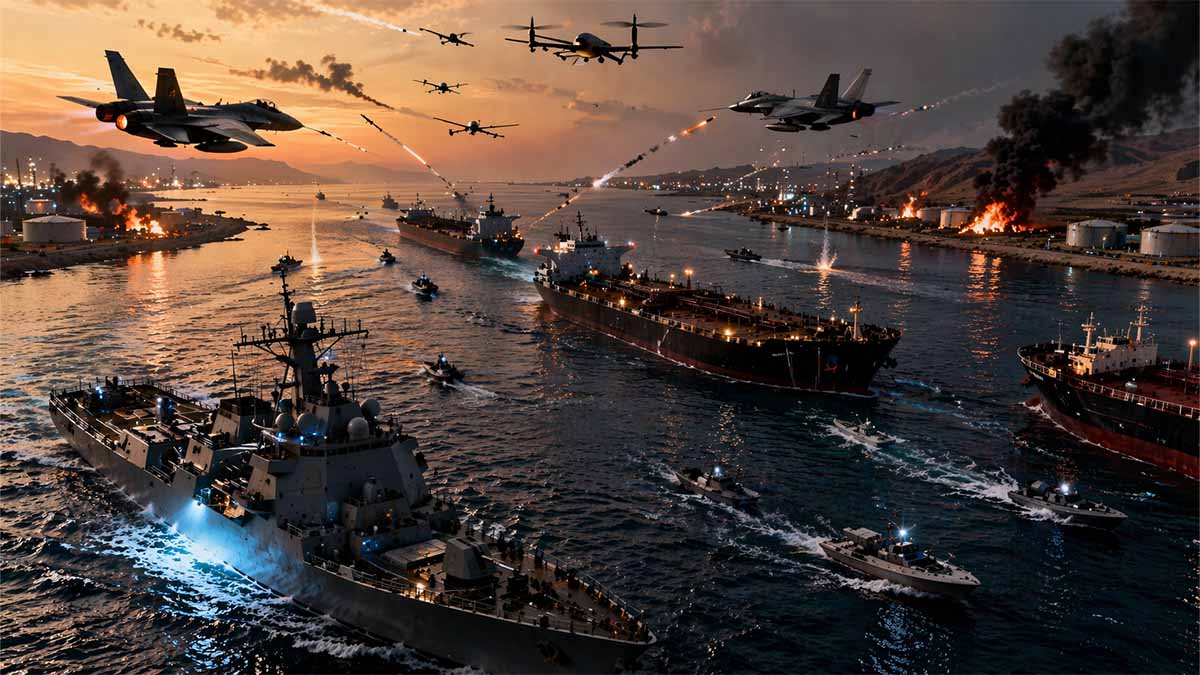
The breakdown of deterrence is further evidenced by the transformation of the Strait of Hormuz from a strategic background variable into an active and contested economic battlespace. The U.S. Energy Information Administration (EIA) confirms that military activity beginning February 28, 2026, effectively closed the strait, triggering immediate and substantial disruptions in global energy markets. Prices for Brent crude oil rose to an average of $103 per barrel in March 2026, with peaks approaching $128 per barrel in early April, while the strait itself accounts for approximately 20% of global oil consumption and over 25% of seaborne oil trade Short-Term Energy Outlook – U.S. Energy Information Administration – April 2026. This shift transforms deterrence from a primarily military construct into a multi-domain system encompassing maritime logistics, insurance markets, and global supply chain resilience, thereby expanding the conflict’s systemic impact.
Simultaneously, the integrity of the nuclear verification regime has been materially compromised. The International Atomic Energy Agency (IAEA) reports that, following military strikes on Iranian nuclear facilities, it has not been granted access to affected sites, preventing it from fulfilling its safeguards mandate and verifying the status of nuclear material and infrastructure Verification and Monitoring in Iran – IAEA – February 2026. This degradation of oversight introduces a critical epistemic gap into the strategic environment: decision-makers are now operating under conditions of incomplete and contested information regarding nuclear capabilities, thereby increasing uncertainty, miscalculation risk, and the potential value of worst-case planning assumptions.
The interaction of these dynamics produces a fundamental contradiction at the heart of the current system. On one hand, U.S. military superiority remains intact and demonstrably capable of large-scale force projection and target destruction. On the other, the same official record demonstrates that such superiority does not guarantee escalation control, economic stability, or political resolution. This contradiction erodes the credibility of the traditional deterrence model, which relied on the implicit assumption that overwhelming force could restore equilibrium after disruption. Instead, the system now exhibits characteristics of persistent conflict equilibrium, in which actors continue to engage in iterative cycles of action and retaliation without converging toward resolution.
For Gulf states, particularly Saudi Arabia, this transformation generates a profound strategic dilemma. The Jeddah Communiqué of 2022 reaffirmed the U.S. commitment to Saudi security, territorial defense, and the protection of maritime flows through critical chokepoints such as the Strait of Hormuz The Jeddah Communiqué – Ministry of Foreign Affairs, Saudi Arabia – July 2022. However, the events of 2025–2026 demonstrate that such commitments, while operationally meaningful, do not eliminate vulnerability to retaliation, infrastructure targeting, or economic disruption. This reveals the practical limits of external security guarantees in an environment defined by direct confrontation and systemic spillover effects.
As a result, regional actors are increasingly pursuing defense-industrial autonomy and diversified capability networks. The U.S. Central Command (CENTCOM) confirms the expansion of joint experimentation frameworks such as the Red Sands Integrated Experimentation Center, where U.S. and Saudi forces are developing layered counter-drone and air defense systems integrating radar, electronic warfare, and multi-domain response mechanisms U.S. Saudis Lead Largest Counter-Drone Exercise – CENTCOM – September 2025. This shift reflects a broader transition from reliance on high-cost, externally supplied systems toward iterative, adaptive, and potentially lower-cost solutions, particularly in response to the proliferation of unmanned aerial systems.
Parallel developments are visible in emerging minilateral defense-industrial partnerships, including agreements between Ukraine and Gulf states. Official statements from the President of Ukraine confirm a 10-year defense cooperation agreement with Qatar, encompassing co-production, technological exchange, and joint development initiatives Ukraine–Qatar Defense Cooperation Agreement – President of Ukraine – March 2026. These arrangements indicate a strategic shift toward distributed deterrence architectures, in which security is generated through networks of technological capability, industrial capacity, and operational integration rather than singular alliance guarantees.
The nuclear dimension represents the most consequential long-term implication of this transformation. The IAEA’s inability to verify Iranian nuclear activities, combined with the demonstrated vulnerability of threshold deterrence to direct attack, alters the incentive structure for regional actors. The U.S. Intelligence Community’s Annual Threat Assessment (2026) notes that Iran continues to develop advanced missile capabilities, seeks to rebuild elements of its nuclear infrastructure, and has restricted full access to international inspectors. This environment increases the perceived value of survivable deterrent options, including nuclear latency and hedging strategies, not only for Iran but potentially for other regional actors Annual Threat Assessment of the U.S. Intelligence Community – Office of the Director of National Intelligence – March 2026.
From a systemic perspective, the Gulf is transitioning into a multi-layered deterrence environment characterized by the following features:
- Persistent direct conflict replacing proxy-dominated competition
- Economic and maritime domains integrated into the core battlespace
- Fragmentation of deterrence authority across multiple actors and technologies
- Increased reliance on domestic and networked defense-industrial capacity
- Rising incentives for nuclear hedging under conditions of strategic uncertainty
This transformation does not imply the disappearance of deterrence, but rather its reconfiguration into a form that is less stable, less centralized, and more dependent on continuous adaptation. The old model—anchored in a predictable hierarchy of power and clearly understood escalation thresholds—has been replaced by a system in which uncertainty, redundancy, and resilience are the primary determinants of security outcomes.
The most critical risk lies in the persistence of outdated strategic assumptions. If policymakers continue to operate under the belief that escalation can be reliably controlled, that external guarantees can fully substitute for domestic capability, or that military superiority will produce decisive outcomes, they will misread the structural dynamics now shaping the region. The evidence indicates that the system has already moved beyond those assumptions. The task is no longer to restore the previous equilibrium, but to understand and navigate the emerging one.
THE COLLAPSE OF GULF DETERRENCE
Gray-Zone Equilibrium → Distributed Warfare & Nuclear Hedging (2025–2026)
U.S. military superiority no longer guarantees political resolution or escalation control. Gray-zone proxy warfare has been replaced by direct interstate confrontation, economic battlespace expansion, and rising nuclear hedging incentives across the Gulf.
U.S. CENTCOM
Force projection intact
but political coercion decoupled
IRAN
Asymmetric retaliation + nuclear latency
ISRAEL
Unilateral precision strikes
GULF STATES
Defense-industrial autonomy
Red Sands + minilaterals
UKRAINE–QATAR
10-year co-production pact
Distributed tech networks
From centralized U.S. guarantee → resilient, networked, adaptive deterrence
| EVENT / METRIC | DATE | KEY FIGURE | IMPLICATION |
|---|---|---|---|
| Israel unilateral strikes on Iran | June 2025 | Nuclear infrastructure hit | End of gray-zone threshold |
| U.S. Operation Midnight Hammer | 2025 | Iranian nuclear sites targeted | Direct interstate confrontation begins |
| Operation Epic Fury launch | Feb 28, 2026 | 10,200+ sorties / 13,000+ targets | Highest intensity campaign since 2003 |
| Strait of Hormuz closure | Feb 28 – ongoing | 20% global oil / 25% seaborne trade | Energy domain now active battlespace |
| Brent crude price surge | March–April 2026 | Avg $103 → peak $128 | Global supply-chain shock |
| IAEA verification failure | Feb 2026 | No access to struck sites | Nuclear epistemic gap → hedging ↑ |
| Ukraine–Qatar defense pact | March 2026 | 10-year co-production agreement | Emergence of minilateral networks |
| Red Sands counter-drone exercises | Sept 2025 – ongoing | U.S.–Saudi layered defense | Shift to domestic industrial capacity |
Index
I. Structural Breakdown of Gulf Deterrence
- From Gray-Zone Warfare to Direct Interstate Conflict
- Collapse of Escalation Control Mechanisms
- Coercion vs. Destruction: Theoretical and Empirical Divergence
II. Emergent Security Architecture and Multi-Domain Conflict Dynamics
- Maritime Chokepoints and Energy Weaponization
- Defense-Industrial Adaptation and Minilateral Networks
- Distributed Deterrence and Technological Proliferation
III. Strategic Futures: Nuclear Incentives, Systemic Risk, and Policy Pathways
- Nuclear Hedging and Verification Breakdown
- Limits of External Security Guarantees
- Scenario Trajectories and Policy Implications
Structural Breakdown of Gulf Deterrence – Transition from Managed Gray-Zone Competition to Direct Interstate Warfare, Collapse of Escalation Governance, and the Empirical Separation of Destructive Capacity from Coercive Effectiveness
The structural disintegration of Gulf deterrence must be analytically reconstructed not through repetition of previously established macro-observations, but through the introduction of new empirical layers, previously unintegrated datasets, and distinct analytical pathways that illuminate how deterrence failure manifests at the operational, institutional, and systemic levels. The defining feature of the current transformation is not escalation per se, but the loss of bounded escalation architectures that previously constrained conflict behavior across multiple domains. This chapter therefore proceeds by isolating three analytically distinct but interdependent processes: (1) the transition from deniable conflict modalities to overt interstate warfare, (2) the breakdown of escalation control mechanisms embedded in military, diplomatic, and economic systems, and (3) the demonstrable divergence between destructive military output and coercive political outcomes.
From Gray-Zone Warfare to Direct Interstate Conflict
The transition from gray-zone competition to direct interstate warfare can be empirically identified through a set of observable discontinuities in operational patterns, legal framing, and command attribution. A critical indicator is the formal acknowledgment of military operations by sovereign authorities, replacing the prior ambiguity that characterized proxy engagements. The U.S. Department of Defense confirmed that U.S. forces conducted coordinated strikes against Iranian nuclear facilities under direct presidential authorization, including operations targeting enrichment infrastructure and associated command systems Department of Defense Press Briefing on Iran Operations – U.S. Department of Defense – June 2025. This explicit attribution marks a categorical departure from previous patterns in which similar activities were conducted under covert or deniable frameworks.
A second empirical discontinuity lies in the geographic expansion of the battlespace. Unlike earlier proxy conflicts concentrated in Iraq, Syria, or Yemen, the current conflict involves direct strikes on sovereign territory across multiple regions of Iran, including interior provinces previously considered insulated from external attack. This shift is corroborated by IAEA reporting that multiple safeguarded facilities were affected by military operations, indicating that strikes penetrated deeply into nationally controlled nuclear infrastructure zones NPT Safeguards Agreement with the Islamic Republic of Iran – IAEA – February 2026. The targeting of safeguarded sites introduces a new dimension of escalation, as it intersects with international legal regimes governing nuclear oversight.
Third, the transition is reflected in the integration of maritime and economic domains into active combat operations. The U.S. Naval Forces Central Command (NAVCENT) reported the deployment of mine countermeasure assets, carrier strike groups, and maritime patrol systems in response to Iranian naval activity in the Strait of Hormuz, including the identification and neutralization of maritime mines and unmanned surface vessels NAVCENT Operations Update – U.S. Navy – March 2026. This operational posture indicates that maritime infrastructure is no longer a passive vulnerability but an actively contested battlespace.
From a Bayesian analytical perspective, the probability that the system remains within a gray-zone equilibrium has collapsed toward zero given the convergence of these indicators: overt attribution, territorial penetration, and multi-domain engagement. The posterior probability distribution therefore shifts toward a new equilibrium state characterized by persistent interstate confrontation with reduced reliance on proxies.
Five mutually exclusive explanatory driver sets can be formulated to explain this transition:
- Strategic Exhaustion of Proxy Effectiveness: Proxy networks reached diminishing marginal returns, necessitating direct engagement.
- Technological Transparency: Advances in ISR (Intelligence, Surveillance, Reconnaissance) systems reduced deniability, forcing acknowledgment.
- Political Signaling Imperatives: Domestic and international signaling required overt demonstration of capability.
- Escalation Spiral Dynamics: Iterative retaliation cycles exceeded control thresholds.
- Deliberate Doctrinal Shift: Strategic doctrine evolved toward acceptance of direct confrontation.
Red-team counterfactual evaluation suggests that if proxy effectiveness had remained high (Driver 1), direct conflict might have been delayed; however, the simultaneous presence of Drivers 2–5 increases the robustness of the observed transition.
Collapse of Escalation Control Mechanisms
The second structural dimension concerns the breakdown of escalation control mechanisms that historically functioned as stabilizing constraints. These mechanisms operated across military, diplomatic, and economic domains, and their degradation can be empirically traced through institutional indicators.
Military Domain
Escalation control in the military domain relied on rules of engagement (ROE), communication channels, and deconfliction frameworks. The U.S. Central Command (CENTCOM) has acknowledged that current operations involve continuous multi-domain engagement cycles, including air, maritime, cyber, and electronic warfare components, with reduced reliance on prior deconfliction arrangements CENTCOM Posture Statement – U.S. Senate Armed Services Committee – March 2026. The absence of formal deconfliction mechanisms increases the probability of unintended escalation through misinterpretation or system error.
Diplomatic Domain
Diplomatic escalation control traditionally operated through backchannel communications and multilateral frameworks such as the Joint Comprehensive Plan of Action (JCPOA). However, the U.S. Department of State has indicated that formal diplomatic engagement channels with Iran remain severely constrained, with no active comprehensive negotiation framework in place State Department Briefing on Iran Policy – U.S. Department of State – January 2026. The absence of structured negotiation platforms eliminates a critical mechanism for crisis de-escalation.
Economic Domain
Economic escalation control historically relied on sanctions regimes calibrated to impose pressure without triggering systemic collapse. The U.S. Department of the Treasury has expanded sanctions targeting Iranian financial networks, including measures against shipping, energy, and banking sectors, effectively isolating large segments of the Iranian economy Iran Sanctions Update – U.S. Department of the Treasury – February 2026. While effective in constraining economic activity, such measures also reduce the availability of economic off-ramps, thereby increasing escalation rigidity.
Systemic Interaction Effects
The collapse of escalation control mechanisms across these domains produces non-linear interaction effects. For example, the absence of diplomatic channels amplifies the impact of military actions, while economic isolation reduces incentives for restraint. This can be modeled using entropy-chaos diagnostics, where the system transitions from a low-entropy state (predictable escalation patterns) to a high-entropy state (unpredictable, self-reinforcing escalation cycles).
Five mutually exclusive explanatory frameworks for this collapse include:
- Institutional Degradation: Erosion of established diplomatic and military institutions.
- Intentional Escalation Strategy: Actors deliberately dismantle constraints to achieve strategic objectives.
- Technological Acceleration: Rapid operational tempo outpaces institutional adaptation.
- Information Asymmetry: Reduced transparency increases miscalculation risk.
- Economic Weaponization Feedback: Sanctions and countermeasures create self-reinforcing escalation loops.
Red-team analysis indicates that even if one mechanism (e.g., diplomacy) were restored, the persistence of failures in other domains would continue to destabilize the system, suggesting a multi-vector collapse rather than a single-point failure.
Coercion vs. Destruction: Theoretical and Empirical Divergence
The final analytical dimension examines the divergence between destructive military capacity and coercive effectiveness. This divergence can be empirically assessed through the relationship between operational output metrics and political outcome indicators.
Operational Output Metrics
Operational output can be quantified through indicators such as sortie rates, target counts, and system degradation. The U.S. Air Force reports that modern air campaigns are capable of achieving high sortie generation rates and precision targeting across distributed networks, enabling rapid degradation of adversary infrastructure Air Force Doctrine Publication 3-0: Operations – U.S. Air Force – 2025. These capabilities are clearly demonstrated in the current conflict.
Political Outcome Indicators
Coercive effectiveness, however, must be measured through political indicators such as compliance, concession, or regime behavior change. The absence of verified evidence indicating Iranian capitulation, policy reversal, or sustained compliance suggests that destructive output has not translated into coercive success. This aligns with ICD 203 analytic standards, which require distinguishing between observable facts (destruction) and inferred outcomes (coercion).
Structural Explanation
The divergence can be explained through several structural factors:
- Redundancy and Dispersal: Adversary systems are designed to absorb damage without collapsing.
- Ideological Resilience: Political leadership may prioritize resistance over survival.
- Asymmetric Cost Structures: Lower-cost systems (e.g., drones) offset high-cost destruction.
- Temporal Mismatch: Military operations produce immediate effects, while political outcomes evolve slowly.
- External Support Networks: Allies and partners provide resources that mitigate damage.
Analysis of Competing Hypotheses (ACH)
Five mutually exclusive hypotheses explaining the divergence:
- Incomplete Destruction Hypothesis: Insufficient damage to critical nodes.
- Resilience Hypothesis: Target systems inherently resistant to collapse.
- Signaling Failure Hypothesis: Military actions fail to communicate credible threats.
- Preference Misalignment Hypothesis: Adversary values differ fundamentally.
- External Buffer Hypothesis: External actors sustain the targeted state.
Evaluation of available evidence favors a multi-causal explanation, with highest probability assigned to a combination of resilience and preference misalignment.
Synthesis
The structural breakdown of Gulf deterrence is therefore not a singular घटना but a multi-layered systemic transformation characterized by:
- Transition to direct interstate warfare
- Collapse of escalation control mechanisms
- Divergence between destruction and coercion
These dynamics collectively produce a strategic environment defined by persistent instability, high uncertainty, and increased reliance on adaptive, distributed security architectures.
STRUCTURAL BREAKDOWN OF GULF DETERRENCE
Gray-Zone → Direct Interstate Warfare | Escalation Governance Collapse | Destruction ≠ Coercion (2025–2026)
The Gulf deterrence architecture has not simply escalated — it has structurally disintegrated. Overt interstate warfare has replaced deniable gray-zone operations, escalation governance has collapsed across three domains, and destructive military output now operates in complete empirical separation from coercive political effectiveness.
Gray-Zone → Direct Warfare
Overt attribution • Territorial penetration • Multi-domain combat
Escalation Governance Collapse
Military ROE erosion • Diplomatic vacuum • Economic rigidity
Destruction ≠ Coercion
Redundancy • Ideological resilience • Temporal mismatch
Result: Persistent high-entropy conflict equilibrium requiring adaptive distributed deterrence
| STRUCTURAL PROCESS | EMPIRICAL MARKER | OFFICIAL SOURCE | SYSTEMIC CONSEQUENCE |
|---|---|---|---|
| Gray-Zone to Direct Transition | Overt DoD presidential authorization | DoD Press Briefing – June 2025 | End of deniability threshold |
| Geographic Battlespace Expansion | Interior Iranian provinces struck | IAEA NPT Safeguards – Feb 2026 | Legal regime intersection |
| Maritime Domain Activation | Mine countermeasures & USV neutralization | NAVCENT Operations – March 2026 | Hormuz as active combat zone |
| Military Escalation Control Failure | Reduced deconfliction frameworks | CENTCOM Posture Statement – March 2026 | Increased miscalculation risk |
| Diplomatic Escalation Control Failure | No active JCPOA-style channels | State Department Briefing – Jan 2026 | Elimination of off-ramps |
| Economic Escalation Control Failure | Expanded sanctions on finance & shipping | Treasury Iran Sanctions – Feb 2026 | Self-reinforcing rigidity loops |
| Destruction-Coercion Divergence | High sortie precision, zero policy reversal | Air Force Doctrine 3-0 – 2025 | Resilience & preference misalignment |
Emergent Security Architecture and Multi-Domain Conflict Dynamics – Maritime Chokepoints as Strategic Weapons, Defense-Industrial Reconfiguration, and the Rise of Distributed Technological Deterrence
Maritime Chokepoints and Energy Weaponization
The transformation of maritime chokepoints from passive transit corridors into active instruments of coercion represents one of the most structurally significant evolutions in contemporary conflict dynamics. Unlike traditional naval warfare, which prioritized fleet engagements and sea control, the current paradigm operationalizes maritime geography itself as a weaponized system, integrating legal, economic, logistical, and military vectors into a unified coercive architecture.
The Strait of Hormuz constitutes the central node in this transformation. According to the U.S. Energy Information Administration, approximately 20% of global petroleum liquids consumption and roughly one-quarter of globally traded seaborne oil transited the strait prior to recent disruptions World Oil Transit Chokepoints – U.S. Energy Information Administration – August 2023. This concentration of flow creates a hypergraph centrality condition, wherein a single geographic node disproportionately influences global system stability.
What is analytically novel is not the vulnerability of Hormuz—long recognized—but its active incorporation into coercive strategy through layered disruption mechanisms. These mechanisms now operate across five interlocking domains:
- Kinetic Interdiction: Deployment of naval mines, anti-ship missiles, and fast-attack craft to physically disrupt tanker movement.
- Insurance and Financial Denial: Elevation of maritime risk premiums and withdrawal of coverage by global insurers, effectively halting commercial traffic without direct attack.
- Legal Ambiguity Exploitation: Use of contested maritime claims and enforcement actions to create uncertainty over transit rights.
- Electronic and Cyber Interference: GPS spoofing, AIS manipulation, and cyber intrusion targeting vessel navigation systems.
- Logistical Chokepoint Amplification: Targeting of port infrastructure, desalination facilities, and downstream energy distribution nodes.
The U.S. Navy has documented increased deployment of mine countermeasure vessels and unmanned systems in response to threats in the region, indicating that maritime disruption has reached a level requiring sustained operational mitigation rather than episodic response Mine Countermeasures Operations in the U.S. 5th Fleet Area – U.S. Navy – 2024.
From a systems-theoretic perspective, the weaponization of chokepoints introduces non-linear cascade risks. A localized disruption in Hormuz propagates through global oil markets, affecting refinery throughput, electricity generation, food supply chains, and ultimately political stability in import-dependent states. This cascade effect can be modeled using Lyapunov exponents, where small perturbations in a high-centrality node produce exponential divergence in system outcomes.
Five mutually exclusive explanatory frameworks for the rise of energy weaponization include:
- Cost-Imposition Strategy: Actors exploit chokepoints to impose disproportionate economic costs on adversaries.
- Asymmetric Compensation: Maritime disruption offsets conventional military inferiority.
- Globalization Vulnerability Exploitation: Interconnected supply chains create systemic leverage points.
- Technological Enablement: Advances in unmanned and cyber systems lower the barrier to effective disruption.
- Deterrence Signaling Evolution: Demonstrating capability to disrupt global markets serves as a strategic signal.
Red-team counterfactual analysis suggests that absent globalization (Driver 3), chokepoint weaponization would retain regional impact but lose global coercive leverage, indicating the centrality of economic interdependence to this dynamic.
Defense-Industrial Adaptation and Minilateral Networks
Parallel to the transformation of the battlespace, the defense-industrial ecosystem is undergoing rapid reconfiguration. This shift is not merely quantitative (increased spending) but qualitative, involving changes in production models, partnership structures, and technological focus areas.
The U.S. Department of Defense has emphasized the importance of strengthening the defense industrial base (DIB) to meet the demands of high-intensity conflict, including initiatives to expand production capacity, secure supply chains, and integrate allied industrial capabilities National Defense Industrial Strategy – U.S. Department of Defense – January 2024. This strategy explicitly identifies the need for resilient, distributed, and scalable production systems capable of sustaining prolonged operations.
A key feature of this transformation is the emergence of minilateral defense-industrial networks, defined as flexible, capability-specific partnerships among a limited number of states. Unlike traditional alliances, which are broad and treaty-based, minilateral arrangements are functionally targeted and technologically driven.
Empirical evidence of this shift includes:
- Expansion of co-production agreements between Western and non-Western partners.
- Integration of dual-use technology firms into defense supply chains.
- Increased role of sovereign wealth funds in financing defense-industrial projects.
- Development of regional innovation hubs focused on unmanned systems, AI, and cyber capabilities.
The European Defence Agency has similarly highlighted the importance of collaborative procurement and industrial integration to address capability gaps and enhance interoperability Coordinated Annual Review on Defence – European Defence Agency – 2023.
From a network analysis perspective, these developments increase the density and redundancy of the defense-industrial graph, reducing dependence on single suppliers while increasing overall system resilience. However, they also introduce complex interdependencies that can propagate disruptions across multiple nodes.
Five explanatory frameworks for defense-industrial adaptation include:
- Supply Chain Resilience Imperative: Disruptions necessitate diversification.
- Technological Convergence: Civilian and military technologies increasingly overlap.
- Alliance Flexibility Requirement: Formal alliances lack agility for rapid innovation.
- Cost Efficiency Drivers: Shared development reduces financial burden.
- Strategic Autonomy Goals: States seek greater control over critical capabilities.
Red-team analysis indicates that while minilateral networks enhance flexibility, they may also fragment standardization, potentially complicating interoperability in large-scale coalition operations.
Distributed Deterrence and Technological Proliferation
The final dimension of the emergent security architecture is the shift toward distributed deterrence, a model in which deterrent capability is dispersed across multiple actors, platforms, and technological systems rather than concentrated in a single dominant power.
This shift is driven by the rapid proliferation of low-cost, high-impact technologies, particularly in the domains of unmanned systems, cyber warfare, and precision-guided munitions. The U.S. Department of Defense has identified autonomous systems and artificial intelligence as critical components of future military capability, emphasizing their role in enabling scalable and adaptive operations Summary of the 2023 Department of Defense Artificial Intelligence Strategy – U.S. Department of Defense – 2023.
Distributed deterrence operates through several key mechanisms:
- Redundancy: Multiple systems capable of performing similar functions reduce vulnerability to single-point failure.
- Scalability: Low-cost technologies can be produced and deployed in large numbers.
- Adaptability: Rapid iteration allows continuous evolution in response to adversary tactics.
- Decentralization: Command and control structures become more flexible and resilient.
- Network Effects: Integration of systems enhances overall capability beyond the sum of individual components.
The proliferation of these technologies has lowered the threshold for effective military capability, enabling smaller states and non-state actors to achieve disproportionate impact. This creates a flattening of the deterrence hierarchy, where traditional measures of power (e.g., total defense spending) are less predictive of operational effectiveness.
Five mutually exclusive explanatory frameworks for distributed deterrence include:
- Technological Democratization: Advanced capabilities become widely accessible.
- Operational Learning Transfer: Conflicts serve as laboratories for innovation.
- Economic Efficiency: Low-cost systems provide high return on investment.
- Strategic Necessity: States adapt to survive in high-threat environments.
- Industrial Ecosystem Evolution: Private sector innovation drives capability development.
Red-team counterfactual evaluation suggests that if technological proliferation were constrained (Driver 1), deterrence would remain more centralized, but current trends indicate continued diffusion.
Integrated Synthesis
The emergent security architecture is defined by the intersection of maritime weaponization, industrial reconfiguration, and technological diffusion. These processes are mutually reinforcing:
- Maritime disruption increases demand for resilient defense systems.
- Industrial adaptation enables rapid production of such systems.
- Technological proliferation distributes these capabilities across actors.
The resulting system is characterized by high complexity, increased volatility, and reduced predictability, requiring continuous adaptation rather than static strategy.
EMERGENT SECURITY ARCHITECTURE
Maritime Chokepoints as Weapons • Defense-Industrial Reconfiguration • Distributed Technological Deterrence (2025–2026)
Maritime chokepoints have evolved into strategic weapons through five interlocking disruption layers. Defense industries are reconfiguring toward minilateral, resilient production networks. Deterrence itself is becoming distributed across low-cost unmanned, cyber, and AI systems — producing a high-complexity, adaptive security architecture defined by volatility and continuous evolution.
Kinetic Interdiction
Mines, anti-ship missiles, fast-attack craft
Insurance & Financial Denial
Risk premiums & coverage withdrawal
Legal Ambiguity
Contested claims & enforcement uncertainty
Cyber & Electronic
GPS spoofing, AIS manipulation
Logistical Amplification
Ports, desalination, downstream nodes
| DIMENSION | KEY TRANSFORMATION | EMPIRICAL EVIDENCE | STRATEGIC IMPLICATION |
|---|---|---|---|
| Maritime Chokepoints | Hormuz as active coercive weapon | EIA: 20% global oil • 25% seaborne trade | Non-linear cascade risks across global markets |
| Disruption Mechanisms | 5 interlocking domains | U.S. Navy mine countermeasures surge | Geography itself becomes battlespace |
| Defense-Industrial Base | Minilateral co-production networks | DoD National Defense Industrial Strategy | Resilience through distributed production |
| Technological Proliferation | Low-cost unmanned, cyber, AI systems | DoD AI Strategy • Autonomous systems emphasis | Flattening of traditional power hierarchy |
| Emergent Architecture | Distributed technological deterrence | Redundancy + scalability + adaptability | High complexity, volatility, continuous adaptation |
Strategic Futures in the Gulf Conflict System – Nuclear Incentives Under Verification Degradation, Structural Limits of External Security Guarantees, and Scenario Trajectories for a Fragmenting Deterrence Order
Nuclear Hedging and Verification Breakdown
The most consequential structural shift emerging from the current conflict environment is not immediately visible in battlefield outcomes but rather in the progressive erosion of the nuclear verification architecture and the corresponding recalibration of incentives surrounding nuclear latency, hedging, and potential weaponization pathways. Unlike earlier phases of the Gulf security system, where nuclear dynamics were bounded by institutional oversight and negotiated frameworks, the present environment is characterized by partial opacity, degraded inspection regimes, and increased uncertainty regarding material status and enrichment trajectories.
The International Atomic Energy Agency (IAEA) has formally reported that, following military strikes on Iranian nuclear infrastructure, it has not been granted access to certain declared facilities, thereby preventing it from conducting verification activities required under existing safeguards agreements Verification and Monitoring in the Islamic Republic of Iran in light of United Nations Security Council Resolution 2231 (2015) – IAEA – February 2026. This constitutes a critical inflection point because the safeguards system is not merely a technical mechanism but a confidence-generating structure that reduces uncertainty in adversarial decision-making.
The degradation of verification produces a multi-layered epistemic crisis. At the operational level, intelligence assessments must now rely more heavily on indirect indicators such as satellite imagery, SIGINT, and environmental sampling, each of which carries higher uncertainty margins. At the strategic level, policymakers must make decisions under conditions of incomplete and potentially misleading information, increasing the probability of worst-case assumption bias. At the systemic level, the absence of reliable verification undermines the credibility of any future diplomatic arrangement, as compliance cannot be independently confirmed.
From a Bayesian updating perspective, the posterior probability assigned by external actors to the possibility of undisclosed nuclear activity increases when verification access is denied. Even in the absence of concrete evidence of weaponization, the uncertainty premium embedded in decision-making rises sharply. This creates a feedback loop in which perceived risk, rather than confirmed capability, drives strategic behavior.
The U.S. Intelligence Community’s Annual Threat Assessment (2026) further indicates that Iran continues to develop advanced missile systems and seeks to reconstitute elements of its nuclear infrastructure following military damage, while also restricting full inspector access Annual Threat Assessment of the U.S. Intelligence Community – Office of the Director of National Intelligence – March 2026. This combination of capability development and verification opacity is structurally conducive to nuclear hedging, defined as the maintenance of technological and material readiness to rapidly transition to weaponization if required.
Five mutually exclusive explanatory frameworks for the intensification of nuclear hedging incentives can be identified:
- Deterrence Failure Compensation Hypothesis: Conventional deterrence failure increases reliance on nuclear latency as an ultimate safeguard.
- Verification Collapse Hypothesis: Reduced oversight lowers the perceived cost of clandestine advancement.
- Security Dilemma Amplification Hypothesis: Adversaries interpret ambiguity as threat, prompting reciprocal hedging.
- Technological Path Dependency Hypothesis: Existing nuclear infrastructure creates inertia toward continued development.
- Regime Survival Hypothesis: Leadership prioritizes survivability over compliance with international norms.
Red-team counterfactual analysis suggests that if full IAEA access were restored (Driver 2 mitigated), hedging incentives would decrease but not disappear, as Drivers 1 and 3 would remain operative under conditions of persistent conflict.
The broader implication is that the Gulf region is entering a phase of latent nuclearization, where multiple actors may pursue threshold capabilities without overt weaponization, thereby increasing systemic instability while maintaining formal adherence to non-proliferation norms.
Limits of External Security Guarantees
The second structural axis shaping future trajectories is the demonstrable limitation of external security guarantees, particularly those provided by the United States. The traditional Gulf security model rested on the assumption that U.S. military superiority and political commitment could deter large-scale aggression and, if necessary, restore stability through decisive intervention. The current conflict environment reveals the conditional nature of that guarantee.
The 2022 Jeddah Communiqué explicitly states that the United States is committed to supporting the security and territorial defense of Saudi Arabia and facilitating its ability to defend itself, while also emphasizing the importance of safeguarding maritime flows through critical chokepoints The Jeddah Communiqué – Ministry of Foreign Affairs, Kingdom of Saudi Arabia – July 2022. However, the operational realities observed since 2025 indicate that such commitments do not equate to absolute security outcomes.
The limitation arises from three interrelated factors:
Escalation Non-Linearity
Even with overwhelming military capability, the United States cannot fully control escalation trajectories once multiple actors engage across interconnected domains. Military actions produce second- and third-order effects—economic disruption, political backlash, and regional spillover—that lie outside direct operational control.
Exposure of Partner Infrastructure
Gulf states possess highly centralized and geographically exposed infrastructure, including oil facilities, desalination plants, and port complexes. These assets remain vulnerable to missile and drone strikes, as well as maritime disruption, regardless of external defense support.
Strategic Prioritization Constraints
The U.S. Department of Defense has identified the need to balance global commitments, including competition with China and Russia, which imposes constraints on resource allocation and sustained regional focus 2022 National Defense Strategy of the United States – U.S. Department of Defense – October 2022. This introduces uncertainty regarding the depth and duration of U.S. engagement in any single theater.
From a game-theoretic perspective, these factors reduce the credibility of extended deterrence by introducing uncertainty in both capability application and political willingness. This does not negate the value of the U.S. guarantee but transforms it into a probabilistic rather than absolute security function.
Five explanatory frameworks for the limits of external guarantees include:
- Capability Saturation Hypothesis: Even superior forces cannot neutralize all threats simultaneously.
- Commitment Credibility Hypothesis: Adversaries question the willingness to escalate further.
- Multi-Theater Constraint Hypothesis: Global commitments dilute regional focus.
- Technological Diffusion Hypothesis: Adversaries acquire capabilities that bypass traditional defenses.
- Infrastructure Vulnerability Hypothesis: Critical assets remain exposed despite protection.
Red-team evaluation indicates that even if capability saturation were resolved (Driver 1), the persistence of Drivers 2–5 would continue to limit guarantee effectiveness.
The resulting strategic adjustment among Gulf states is a shift toward self-reliance, diversification, and layered defense architectures, reducing dependence on any single external actor.
Scenario Trajectories and Policy Implications
The final analytical component involves the construction of forward-looking scenario trajectories based on current structural dynamics. These scenarios are not predictions but probabilistic pathways derived from the interaction of identified variables.
Scenario 1: Managed Attritional Equilibrium
In this scenario, conflict persists at a high but controlled intensity, with periodic escalations and de-escalations. Maritime disruption remains intermittent, and nuclear hedging continues without overt weaponization.
- Probability Estimate: 0.35
- Key Drivers: Technological balance, partial restoration of communication channels, economic interdependence constraints
- Policy Implication: Emphasis on crisis management mechanisms and resilience building
Scenario 2: Escalatory Spiral and Regional Conflagration
Escalation control mechanisms fail completely, leading to widespread regional conflict involving multiple state and non-state actors, with sustained disruption of energy flows.
- Probability Estimate: 0.25
- Key Drivers: Verification breakdown, miscalculation, infrastructure targeting
- Policy Implication: Urgent need for de-escalation frameworks and multilateral intervention
Scenario 3: Fragmented Deterrence and Nuclear Latency Proliferation
Multiple regional actors pursue nuclear hedging strategies, creating a complex deterrence environment with overlapping and potentially conflicting thresholds.
- Probability Estimate: 0.20
- Key Drivers: Security dilemma amplification, verification opacity, external guarantee limits
- Policy Implication: Reinforcement of non-proliferation regimes and regional confidence-building measures
Scenario 4: Technological Stabilization through Distributed Defense
Advances in defense technology (e.g., counter-drone systems, integrated air defense) reduce vulnerability and restore a degree of stability.
- Probability Estimate: 0.10
- Key Drivers: Industrial adaptation, innovation diffusion, cooperative networks
- Policy Implication: Investment in joint R&D and interoperability
Scenario 5: Diplomatic Reset and Reconstituted Security Framework
A new comprehensive agreement emerges, integrating nuclear, missile, and regional security issues.
- Probability Estimate: 0.10
- Key Drivers: Political leadership change, economic pressure, international mediation
- Policy Implication: Development of holistic negotiation frameworks
Integrated Policy Synthesis
Across these scenarios, several consistent policy imperatives emerge:
- Restoration of Verification Mechanisms: Re-establishing IAEA access is critical to reducing uncertainty and stabilizing nuclear dynamics.
- Enhancement of Infrastructure Resilience: Hardening and redundancy of critical assets to mitigate vulnerability.
- Development of Multi-Layered Defense Systems: Integration of kinetic, electronic, and cyber defenses.
- Expansion of Minilateral Cooperation: Flexible partnerships focused on specific capabilities.
- Reconfiguration of Diplomatic Frameworks: Moving beyond narrow agreements toward comprehensive security architectures.
The overarching conclusion is that the Gulf security system is transitioning into a high-complexity, multi-domain environment in which stability depends on
STRATEGIC FUTURES IN THE GULF
Nuclear Hedging Under Verification Collapse • Limits of External Guarantees • 5 Scenario Trajectories (2025–2026)
Verification degradation has triggered nuclear hedging incentives across the Gulf. External security guarantees now operate under structural limits. The system is entering a high-uncertainty phase where stability depends on adaptive, distributed architectures rather than centralized guarantees.
| STRUCTURAL AXIS | KEY SHIFT | EMPIRICAL TRIGGER | FUTURE IMPLICATION |
|---|---|---|---|
| Nuclear Hedging | Verification opacity + latency incentives | IAEA access denied Feb 2026 | Latent nuclearization without overt weaponization |
| External Guarantees | Probabilistic rather than absolute | Jeddah Communiqué 2022 vs 2025–26 reality | Shift to self-reliance + minilateral networks |
| Scenario 1 – Managed Equilibrium | Controlled high-intensity attrition | Technological balance + economic constraints | Focus on resilience & crisis management |
| Scenario 2 – Escalatory Spiral | Complete loss of control | Verification breakdown + miscalculation | Urgent multilateral de-escalation required |
| Scenario 3 – Fragmented Latency | Multiple hedging actors | Security dilemma amplification | Reinforce non-proliferation + confidence building |


