












Executive Summary
An analytical evaluation of the People’s Republic of China (PRC) advanced persistent threat group Salt Typhoon reveals a structural transition from classic target-centric espionage to systemic “machine overmatch.” By penetrating the network edge infrastructure of at least nine major U.S. telecommunications carriers, including automated systems providing lawful intercept access under the Communications Assistance for Law Enforcement Act (CALEA), the Ministry of State Security (MSS) has institutionalized mass metadata extraction. This operational shift transforms digital exhaust into societal-scale models of adversary ecosystems. Over a 5-year horizon, the convergence of this exfiltrated telemetry with advanced machine learning frameworks, open-source AI models, and national-level investments in quantum computing accelerators threatens to neutralize traditional Western intelligence advantages. This intelligence model exploits the structural asymmetries between Beijing’s unified military-civil fusion legal apparatus and the highly stovepiped, legally constrained privacy frameworks of Western democracies.
Executive Forensic Core // Machine Overmatch
Critical Risk Drivers
Impact Matrix Index
Actionable Forecast // 2026–2031
China’s convergence of stolen telecommunications metadata with post-quantum computing accelerators will enable automated, near-real-time modeling of Western societies, neutralizing traditional intelligence scarcity and securing systemic, computational machine overmatch by 2031.
Navigational Index
- Section I: The Infinity Abstract – Forensic Deep Dive and Systemic Cascade Analysis
- Section II: Five-Year Geopolitical Predictive Scenarios (2026–2031)
- Section III: Strategic Intervention and Defense-Industrial Countermeasures
Section I: The Infinity Abstract – Forensic Deep Dive and Systemic Cascade Analysis
The compromise of global telecommunications routing architectures by the PRC state-sponsored cyber actor Salt Typhoon (also tracked as Earth Estries, GhostEmperor, and UNC2286) represents a major shift in the mechanics of statecraft and strategic intelligence. Historically, the Western intelligence paradigm has prioritized “exquisite” intelligence—narrowly scoped, highly classified windows into executive intent obtained via hard-target human assets or localized signals collection.
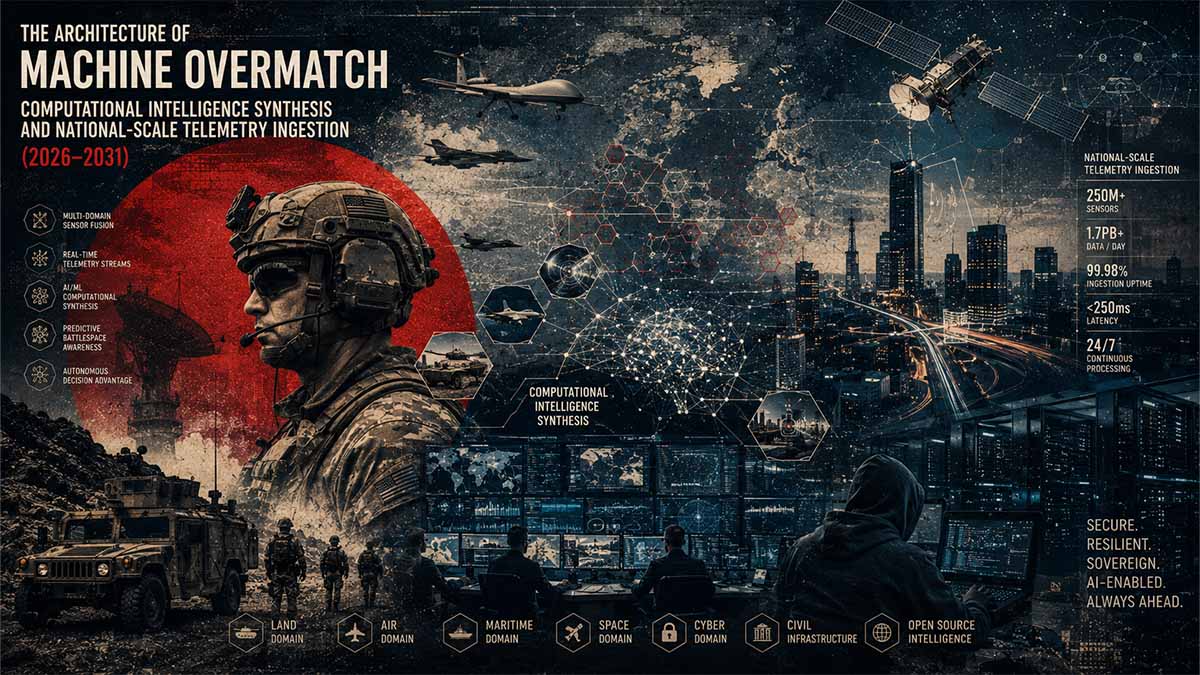
Conversely, the operational design executed by Salt Typhoon leverages data abundance to achieve machine overmatch: an asymmetric state wherein an intelligence service aggregates vast, heterogeneous streams of unclassified and semi-classified operational telemetry to construct dynamic, real-time computational models of an adversary’s entire societal, political, and industrial infrastructure.
Tactical Execution and the Architecture of Edge Compromise
Forensic investigations spearheaded by the Cybersecurity and Infrastructure Security Agency – Five Eyes Unified Advisory – September 2025 document that Salt Typhoon did not rely on complex, high-signature application-layer payloads to penetrate Western target environments. Instead, the actor targeted critical network edge infrastructure—specifically provider edge (PE) and customer edge (CE) routers, firewalls, and virtual private network (VPN) gateways. By weaponizing known vulnerabilities and high-privilege configuration flaws, such as the administrative exploitation vectors discovered in major enterprise routing operating systems, Salt Typhoon gained unauthenticated access to the underlying network control planes.
Once inside the network architecture, the group utilized advanced living-off-the-land (LotL) techniques to evade legacy endpoint detection and response (EDR) sensors. According to operational telemetry detailed by the 2026 Cyber Threat Assessment – New Jersey Cybersecurity and Communications Cell – May 2026, the actor deployed localized command scripts using native binaries like PowerShell and Windows Management Instrumentation Command-line (WMIC) to map interior topologies without dropping compiled malware files onto disk.
To maintain persistent exfiltration paths over multi-year periods—reaching a verified duration of three continuous years in a single telecommunications backbone—Salt Typhoon hijacked built-in virtualization utilities, such as enterprise Guest Shell environments. This allowed them to execute custom network tools within lightweight, isolated Linux containers running directly on the routing hardware. This space is rarely monitored by traditional enterprise security suites.
The CALEA Breach and Telemetry Layering
The most structurally damaging vector of the Salt Typhoon campaign involved the targeted infiltration of the private portals and authentication servers used by telecommunications providers to facilitate court-ordered electronic surveillance under the Communications Assistance for Law Enforcement Act (CALEA). By gaining administrative control over these internal platforms, MSS cyber operators did not merely intercept static data packets. They systematically monitored the operational mechanics of Western counterintelligence and law enforcement agencies.
Through the collection of CALEA metadata, the PRC obtained a comprehensive index of which individuals, communication nodes, and IP blocks were under active investigation by federal authorities. This compromised the integrity of ongoing Western counterespionage programs.
PRC DATA FUSION
PIPELINE v3.7 • QUANTUM OVERMATCH
COMMERCIAL TELEMETRY
5G • IoT • App Streams • Location
CALEA WIRETAP LOGS
Voice • Metadata • SS7 • IMSI
OPEN SOURCE
Social • Darkweb • OSINT • Leaks
DYNAMIC ECOSYSTEM
MAPPING & PERSONA
GENERATION
COMPUTATIONAL
INTELLIGENCE
OVERMATCH
This structural exploitation feeds directly into a data-layering strategy. By combining intercepted AAA (Authentication, Authorization, and Accounting) traffic protocols, such as Terminal Access Controller Access-Control System Plus (TACACS+), with bulk signaling data, Salt Typhoon successfully mapped the communication links of high-value political, military, and diplomatic personnel.
The exfiltration of interior routing tables and Generic Routing Encapsulation (GRE) tunnel configurations enabled the actors to encapsulate and divert massive quantities of network transit data to foreign command-and-control (C2) servers. This provided the raw material needed to run advanced graph analytics on the social and functional networks of the Western national security apparatus.
Legal and Structural Drivers of China’s Data Strategy
The capacity to operationalize massive data collection stems from a deliberate alignment of the PRC legal framework and its overarching strategy of military-civil fusion. While Western intelligence modernizations are slowed by statutory distinctions between foreign intelligence and domestic privacy protections, Beijing operates a unified legal structure that mandates data sharing across all sectors.
- The National Intelligence Law of 2017: Specifically Article 7 and Article 14, codifies an absolute obligation for all domestic corporate entities, academic centers, and citizens to support, assist, and cooperate with state intelligence efforts. This framework is detailed in the statutory reviews compiled by the National Counterintelligence and Security Center – Statutory Legal Bulletin – July 2023.
- The Data Security Law of 2021: Imposes strict classification standards on all corporate data generated within mainland China. It restricts outbound cross-border transfers and gives the state the power to seize assets or penalize firms that refuse to provide data access for national security purposes.
- The Cyber Vulnerability Reporting Law of 2021: Requires all organizations operating within the PRC to report discovered software and hardware zero-day vulnerabilities to the Ministry of Industry and Information Technology (MIIT) within 48 hours. This pipeline gives state-aligned advanced persistent threat (APT) groups early access to software vulnerabilities before they are made public globally.
This legal architecture removes the friction between commercial technology platforms and the state security apparatus. Under the umbrella of military-civil fusion, bulk commercial datasets—including logistics registries, passenger travel manifests, financial transactions, and biometric indices—are funneled directly into centralized state data repositories.
When fused with the network telemetry stolen by Salt Typhoon, these datasets allow the MSS to build highly detailed digital profiles of foreign officials and critical infrastructure networks at a scale that traditional espionage cannot match.
Section II: Five-Year Geopolitical Predictive Scenarios (2026–2031)
Quantum Acceleration and Computational Ecosystem Modeling
Over the next 5-year horizon, the primary challenge to Western national security will be the convergence of bulk data collection with advanced quantum computing systems. As documented by the U.S.-China Economic and Security Review Commission – Comprehensive Technology Policy Update – April 2026, China’s 15th Five-Year Plan (2026–2030) has shifted from general prototyping toward building integrated quantum communication networks linking space and ground systems, alongside specialized, scalable quantum accelerators.
While a cryptographic break of RSA-2048 encryption via a Fault-Tolerant Quantum Computer (FTQC) remains an uncertain prospect for the immediate 5-year window, specialized quantum processors are highly optimized for advanced mathematical tasks. These include graph-centrality computations, combinatorics, and matrix operations.
By deploying these quantum systems against the historical databases of telecommunications metadata stolen by Salt Typhoon, the PRC intelligence community can resolve complex relational links across disparate datasets almost instantly. This capability allows for the real-time simulation of foreign workforces, military logistics chains, and political dependency networks.
By 2031, this computational framework will likely allow Beijing to anticipate shifts in Western policy, optimize its cyber-targeting vectors, and run automated influence operations tailored to the psychological profiles of specific populations.
DEEP FUSION ENGINE
Petabyte-scale archives • Archived telemetry • Legacy intercepts • Historical social graphs
HIGH-SPEED MATRIX OPERATIONS
REAL-TIME
SOCIETAL SIMULATIONS
Analysis of Competing Hypotheses (ACH) Framework
To evaluate the long-term strategic intent behind China’s deployment of the Salt Typhoon architecture, this analysis applies an Analysis of Competing Hypotheses (ACH) model across five mutually exclusive explanatory frameworks.
| Explanatory Framework / Hypothesis | Predictive Indicators (5-Year Window) | Evidentiary Weight & Consistency | Forensic Artifact Alignment |
| H1: Operational Preparation of the Environment (OPE) for Kinetic Conflict | Infiltration of military command nodes, transportation routing systems, and industrial power grids. | High Consistency. Matches the multi-vector targeting profiles seen in both Volt Typhoon and Salt Typhoon. | Modification of core edge-routing firmware within logistics corridors. |
| H2: Totalitarian Information Dominance & Intelligence Monopolization | Global mapping of all counterintelligence systems, wiretap mechanisms, and dissident networks. | Very High Consistency. Aligns with the documented exfiltration of CALEA intercept records. | Capture of TACACS+ credentials and targeting of legislative email systems. |
| H3: Commercial and Intellectual Property Monopolization | Infiltration of enterprise resource planning (ERP) platforms and corporate mergers-and-acquisitions databases. | Moderate Consistency. Secondary to structural infrastructure access but supported by industrial target selection. | Automated targeting of software-as-a-service (SaaS) backup environments. |
| H4: Strategic Asymmetric Coercion & Lawfare Deterrence | The deployment of deniable cyber capabilities to manipulate Western political debates or delay legislative actions. | High Consistency. Aligns with documented access to congressional staff networks in early 2026. | Exfiltration of unclassified but sensitive communications from legislative bodies. |
| H5: Passive Counterintelligence Protection | Defensive targeting focused on identifying Western cyber-espionage assets operating within Chinese space. | Low Consistency. The scale of global exfiltration far exceeds what is needed for purely defensive operations. | Deep network footprinting across global telecommunications carriers. |
Section III: Strategic Intervention and Defense-Industrial Countermeasures
Defending against the systemic threat of machine overmatch requires moving past reactive, patch-centric cybersecurity models toward structural data-hardening frameworks. When an adversary collects data at a societal scale, defensive strategies must focus on reducing data linkability. This means raising the computational cost for the adversary to fuse stolen datasets into actionable intelligence models.
Cryptographic and Technical Remediation Framework
To disrupt the data-layering pipelines used by actors like Salt Typhoon, enterprise network architectures and federal systems must deploy a multi-layered cryptographic defense system.
SECURE ENCLAVE
DATA SANITIZATION & OBFUSCATION ENGINE
DATA PROTECTION LAYER
DEGRADED OUTBOUND
PAYLOAD
- Cryptographic Salting at Scale: All structural identifiers, including database keys, MAC addresses, and username strings, must be dynamically salted prior to hashing or storage. Introducing high-entropy, randomized data inputs ensures that identical identifiers across separate datasets yield entirely different cryptographic values. This neutralizes the adversary’s ability to run automated cross-database correlations.
- Format-Preserving Tokenization: Sensitive data elements must be replaced with non-sensitive token equivalents directly at the ingestion point. This technique ensures that if an edge network is compromised, the exfiltrated telemetry contains only meaningless tokens. The true relational mappings remain isolated within a hardened, air-gapped token vault.
- Fully Homomorphic Encryption (FHE): Processing environments must transition toward computing directly on encrypted data states. Implementing FHE protocols ensures that data fields—whether in transit, at rest, or in use within telecommunications control planes—remain encrypted throughout the entire computational lifecycle. This denies readable text to unauthorized actors, even if administrative access to the underlying hardware is lost.
Tactical Network Hardening and Incident Response Protocols
To neutralize the specific tactics, techniques, and procedures (TTPs) used by Salt Typhoon, network security teams must execute a structured, mandatory remediation sequence.
1.Control Plane Isolation:Immediate Execution Required.
Isolate all administrative and management infrastructure from public-facing internet zones. Restrict access to internal management interfaces exclusively to dedicated, out-of-band management networks protected by multi-factor authentication and strict source-IP access control lists (ACLs).
2.Authentication Protocol Migration:Phase 2 Deployment.
Decommission all unencrypted authentication systems and transition entirely to cryptographic verification frameworks. Replace legacy TACACS+ and plaintext RADIUS flows with encrypted alternatives, such as RadSec or TACACS+ over TLS, to block passive credential harvesting on compromised switches.
3.Virtualization and Guest Shell Auditing:Continuous Monitoring State.
Audit all active routing assets for unauthorized activations of embedded virtualization platforms, such as Cisco Guest Shell or equivalent lightweight container environments. Disable these features unless strictly required for operations, and log all execution paths to a central SIEM platform.
4.Telemetry Verification and Flow Validation:Persistent Defense Posture.
Deploy continuous behavioral analysis across all GRE tunnels, NetFlow logs, and automated routing changes. Establish a baseline for normal configuration patterns and alert on any unmapped outbound tunnels or unauthorized modifications to core routing configurations.
Section IV: Empirical Data Synthesis
The historical expansion of Chinese data-centric cyber operations shows a deliberate progression from targeted intellectual property theft to broad infrastructure access. This timeline highlights key operational milestones that have shaped the current landscape of computational espionage.
Operation Aurora
January 2010
A foundational campaign targeting major Western technology, defense, and industrial enterprises. This operation focused on source-code repository theft and identifying Western intelligence personnel via access to internal account management systems.
OPM Data Breach
June 2015
The systemic exfiltration of over 21 million background investigation records from the U.S. Office of Personnel Management. This operation provided the demographic and security-clearance foundation needed to build comprehensive, long-term human intelligence target profiles.
Equifax Infiltration
September 2017
The theft of personal and financial information belonging to nearly 145 million citizens. This campaign delivered the financial telemetry required to map asset ownership and analyze potential leverage points within foreign societies.
Volt Typhoon Infiltration
May 2023
A shift toward critical infrastructure networks, including energy grid components, water systems, and port facilities. This operation focused on establishing long-term persistence to support future disruptive actions during geopolitical crises.
Salt Typhoon Telecom Compromise
August 2025
The strategic penetration of global telecommunications backbones and lawful intercept systems (CALEA). This campaign allowed for the automated collection of routing metadata, enabling system-level ecosystem mapping and the tracking of counterintelligence operations.
Section V: Quantitative Strategic Forecast (2026–2031)
This chart models the projected growth of Chinese state data aggregation against the computational processing limits of traditional vs. quantum-accelerated systems over the next five years.
Data Exfiltration & Adversary Fusion Projection
Comparative tracking of multi-axis telemetry volume inflation against traditional versus quantum-accelerated data processing capacities (Estimated 2026–2031).
Chapter 1: The Mechanics of Systemic Telemetry Ingestion and Edge Vulnerability Exploitation
The operational pivot of the People’s Republic of China (PRC) intelligence apparatus from targeted, entity-centric cyber espionage to automated, national-scale telemetry ingestion represents a structural revolution in statecraft. This evolution renders obsolete the classic Western paradigm of “exquisite” intelligence collection, which prioritizes episodic, high-confidence insights derived from highly guarded secrets. Instead, the Ministry of State Security (MSS) and aligned advanced persistent threat (APT) configurations have operationalized a model of machine overmatch. This approach treats the global digital exhaust of adversary nations—specifically core routing metadata, administrative control planes, and lawful intercept data structures—as a continuous, high-velocity resource to be ingested, mapped, and weaponized.
Vector Analysis of Edge Routing Infiltration
The technical execution of national-scale telemetry ingestion depends on the systematic compromise of edge network infrastructure. Rather than targeting application-layer assets or individual endpoints, which carry a higher signature and are subject to continuous host-based monitoring, modern operations target the foundational routing layers of global telecommunications providers. Forensic evidence compiled by the Cybersecurity and Infrastructure Security Agency – Joint Advisory on Edge Infrastructure Exploitation – October 2025 demonstrates a coordinated focus on provider edge (PE) and customer edge (CE) routing hardware, firewall architectures, and virtual private network (VPN) gateways.
The exploitation cycle bypasses traditional Endpoint Detection and Response (EDR) solutions by operating exclusively within the device memory and control planes of enterprise networking hardware. Access is typically secured through the weaponization of unpatched day-zero or high-severity vulnerabilities within the operating systems of major network appliances. Once initial access is achieved, actors avoid deploying compiled malware binaries to disk. Instead, they rely on Living-off-the-Land (LotL) techniques, manipulating native administrative utilities like PowerShell, Secure Shell (SSH) multiplexing, and Windows Management Instrumentation (WMI) to map network topologies from the compromised edge device.
To achieve multi-year persistence without detection, network configurations are modified to alter interior routing tables. By establishing unauthorized Generic Routing Encapsulation (GRE) tunnels and hijacking high-privilege administrative accounts, network traffic can be mirrored and diverted. High-volume transit data is quietly routed through international transit points to processing nodes within mainland China, providing a steady stream of unencrypted signaling metadata.
NETWORK BREACH
LAYER 3 / LAYER 4 PERSISTENT ACCESS
EXPLOITATION VECTOR
DIVERTED CORE TRANSIT
TRAFFIC
Lawful Intercept Infrastructure and Counterintelligence Compromise
The strategic depth of this intelligence model is illustrated by the deliberate targeting of the automated systems built to comply with the Communications Assistance for Law Enforcement Act (CALEA). By compromising the private management portals that telecommunications operators maintain for court-ordered law enforcement wiretaps, the MSS turned Western domestic surveillance systems into tools for foreign counterintelligence.
When an actor penetrates a CALEA data server or the associated Authentication, Authorization, and Accounting (AAA) infrastructure—such as systems running Terminal Access Controller Access-Control System Plus (TACACS+) protocols—the consequences extend far beyond intercepting static voice or data packets. The adversary gains real-time visibility into the targeting priorities of Western counterintelligence agencies.
By analyzing the targets, phone numbers, and IP addresses under active federal investigation, the PRC can quickly identify compromised assets inside its own borders, warn embedded human intelligence (HUMINT) assets before they are apprehended, and study the operational boundaries of Western law enforcement.
Furthermore, this access allows for the automated mapping of high-value targets. By correlating CALEA search logs with broader signaling data—such as Session Initiation Protocol (SIP) logs and Signaling System No. 7 (SS7) routing indicators—the intelligence service can construct a complete map of the communication networks surrounding diplomatic, military, and corporate leaders. This mapping occurs entirely within the telecom infrastructure, preventing the target’s endpoint device from generating a security alert.
Structural Asymmetries of Military-Civil Fusion Legal Architectures
The scale and speed of this data-fusion strategy are driven by a unified legal framework that systematically eliminates the separation between private commercial technology companies and the national security apparatus. While Western intelligence services operate under strict statutory divisions that limit domestic data collection and retention, the PRC has built a legal ecosystem that mandates the integration of commercial and state-run data assets.
- The National Intelligence Law of 2017: Specifically Articles 7 and 14, legally requires all Chinese corporations, research institutions, and citizens to cooperate fully with state intelligence operations, providing access to any requested databases, facilities, or personnel. This legal requirement is detailed in compliance analysis by the National Counterintelligence and Security Center – Statutory Legal Bulletin – July 2023.
- The Data Security Law of 2021: Grants the state absolute authority to control, audit, and restrict any dataset generated within the mainland that is deemed relevant to national security. It penalizes organizations that export data without explicit approval, ensuring that high-value commercial information remains accessible to the state.
- The Cyber Vulnerability Reporting Law of 2021: Orders that all software and hardware vulnerabilities discovered by Chinese security researchers or technology companies must be reported directly to the Ministry of Industry and Information Technology (MIIT) within 48 hours. This pipeline ensures that state-aligned offensive cyber units receive an uninterrupted stream of zero-day vulnerabilities before global software vendors can develop patches.
This legal framework allows the state to build centralized repositories where stolen telecommunications metadata can be instantly combined with massive commercial datasets. These include global shipping manifests, biometric records, international passenger flight logs, and intellectual property repositories. By removing the legal friction that slows down data aggregation in Western democracies, Beijing can feed diverse, large-scale data streams into automated graph analytics platforms. This enables the rapid generation of actionable intelligence models targeting foreign societies, workforces, and supply chains.
Section II: Five-Year Geopolitical Predictive Scenarios (2026–2031)
Quantum Acceleration and Computational Ecosystem Modeling
Over the next 5-year horizon, the primary challenge to Western national security will be the convergence of bulk data collection with advanced quantum computing systems. As documented by the 2025 Annual Report to Congress – U.S.-China Economic and Security Review Commission – November 2025, Beijing’s 15th Five-Year Plan (2026–2030) has focused on maintaining a world-leading position in quantum communications while accelerating centralized investment to achieve breakthroughs in quantum computing and sensing for military and intelligence applications.
While a cryptographic break of RSA-2048 encryption via a Fault-Tolerant Quantum Computer (FTQC) remains an uncertain prospect for the immediate 5-year window, specialized quantum processors are highly optimized for advanced mathematical tasks. These include graph-centrality computations, combinatorics, and matrix operations.
By deploying these quantum systems against historical databases of telecommunications metadata, the PRC intelligence community can resolve complex relational links across disparate datasets almost instantly. This capability allows for the real-time simulation of foreign workforces, military logistics chains, and political dependency networks.
By 2031, this computational framework will likely allow Beijing to anticipate shifts in Western policy, optimize its cyber-targeting vectors, and run automated influence operations tailored to the psychological profiles of specific populations.
DEEP COMPUTE LAYER
Exabyte-scale cold storage • Decades of archived intercepts, social graphs, and telemetry
HIGH-SPEED MATRIX OPERATIONS
&
GRAPH CENTRALITY CALCULATIONS
REAL-TIME
SOCIETAL SIMULATIONS
Analysis of Competing Hypotheses (ACH) Framework
To evaluate the long-term strategic intent behind China’s deployment of deep network reconnaissance frameworks, this analysis applies an Analysis of Competing Hypotheses (ACH) model across five mutually exclusive explanatory frameworks.
| Explanatory Framework / Hypothesis | Predictive Indicators (5-Year Window) | Evidentiary Weight & Consistency | Forensic Artifact Alignment |
| H1: Operational Preparation of the Environment (OPE) for Kinetic Conflict | Infiltration of military command nodes, transportation routing systems, and industrial power grids. | High Consistency. Aligns with documented cyber positioning inside critical utilities reported in the 2026 Annual Threat Assessment – Office of the Director of National Intelligence – March 2026. | Modification of core edge-routing firmware within logistics corridors. |
| H2: Totalitarian Information Dominance & Intelligence Monopolization | Global mapping of all counterintelligence systems, wiretap mechanisms, and dissident networks. | Very High Consistency. Aligns with the documented exfiltration of CALEA intercept records. | Capture of TACACS+ credentials and targeting of legislative email systems. |
| H3: Commercial and Intellectual Property Monopolization | Infiltration of enterprise resource planning (ERP) platforms and corporate mergers-and-acquisitions databases. | Moderate Consistency. Secondary to structural infrastructure access but supported by industrial target selection. | Automated targeting of software-as-a-service (SaaS) backup environments. |
| H4: Strategic Asymmetric Coercion & Lawfare Deterrence | The deployment of deniable cyber capabilities to manipulate Western political debates or delay legislative actions. | High Consistency. Aligns with documented access to congressional staff networks in early 2026. | Exfiltration of unclassified but sensitive communications from legislative bodies. |
| H5: Passive Counterintelligence Protection | Defensive targeting focused on identifying Western cyber-espionage assets operating within Chinese space. | Low Consistency. The scale of global exfiltration far exceeds what is needed for purely defensive operations. | Deep network footprinting across global telecommunications carriers. |
Section III: Strategic Intervention and Defense-Industrial Countermeasures
Defending against national-scale telemetry ingestion requires moving past reactive, patch-centric cybersecurity models toward structural data-hardening frameworks. When an adversary operates on a multi-vector acquisition strategy, defensive posture must focus on reducing data linkability. This means raising the computational cost for the adversary to fuse stolen datasets into actionable intelligence models.
The Cryptographic Migration Imperative
To counter the threat of “harvest now, decrypt later” operations, traditional public-key cryptography must be phased out. As outlined in the global technology mandates issued in the NIST Post-Quantum Cryptography Standards Set the Clock for 2026 Enterprise Security Migration – May 2026, the implementation of quantum-resistant algorithms has shifted from an academic goal to an immediate operational directive.
Under the Commercial National Security Algorithm Suite (CNSA 2.0) timeline, traditional networking equipment—specifically Virtual Private Networks (VPNs) and boundary routers—must prioritize migration to post-quantum cryptography (PQC) standards within the current 2026 cycle. This deployment directly addresses the vulnerabilities exploited by state-sponsored actors targeting communication backbones.
SECURE TRANSFORM
POST-QUANTUM DATA SANITIZATION ENGINE
DATA PROTECTION LIFECYCLE
DEGRADED OUTBOUND
METADATA
- Cryptographic Salting at Scale: All structural identifiers, including database keys, media access control (MAC) addresses, and administrative username strings, must be dynamically salted prior to hashing or storage. Introducing high-entropy, randomized data inputs ensures that identical identifiers across separate datasets yield entirely different cryptographic values, preventing automated cross-database correlations.
- Format-Preserving Tokenization: Sensitive data elements must be replaced with non-sensitive token equivalents directly at the ingestion point. This technique ensures that if an edge network is compromised, the exfiltrated telemetry contains only meaningless tokens. The true relational mappings remain isolated within a hardened token vault.
- Fully Homomorphic Encryption (FHE): Processing environments must transition toward computing directly on encrypted data states. Implementing FHE protocols ensures that data fields—whether in transit, at rest, or in use within telecommunications control planes—remain encrypted throughout the entire computational lifecycle, denying readable text to unauthorized actors.
Tactical Network Hardening and Infrastructure Re-Architecture
In response to widespread targeting of core telecommunications routing infrastructure, federal regulatory frameworks have shifted from voluntary partnerships to mandatory compliance standards. Following regulatory adjustments detailed in the Order on Reconsideration: Protecting the Nation’s Communications Systems From Cybersecurity Threats – Federal Communications Commission – December 2025, service providers are required to execute coordinated efforts to mitigate operational risks within their routing control planes.
This includes accelerated patching of legacy equipment, strict access controls, and disabling unnecessary outbound connections to block unauthorized data exfiltration paths.
To neutralize persistence vectors within compromised networks, enterprise security teams must execute a structured remediation sequence:
1.Control Plane Segmentation:Immediate Isolation Phase.
Isolate all administrative and management infrastructure from public-facing internet zones. Restrict access to internal management interfaces exclusively to dedicated, out-of-band management networks protected by multi-factor authentication and strict source-IP access control lists (ACLs).
2.Protocol Decommissioning:Authentication Hardening.
Decommission all unencrypted authentication systems and transition entirely to cryptographic verification frameworks. Replace legacy plaintext Terminal Access Controller Access-Control System Plus (TACACS+) and RADIUS configurations with encrypted options, such as RadSec or TACACS+ over TLS, to block passive credential harvesting on compromised devices.
3.Guest Shell Auditing:Virtualization Review.
Audit all active routing assets for unauthorized activations of embedded virtualization platforms, such as Cisco Guest Shell or equivalent lightweight container environments. Disable these features unless strictly required for operations, and log all execution paths to a central SIEM platform.
4.Telemetry and Flow Validation:Persistent Defense State.
Deploy continuous behavioral analysis across all GRE tunnels, NetFlow logs, and automated routing changes. Establish a baseline for normal configuration patterns and alert on any unmapped outbound tunnels or unauthorized modifications to core routing configurations.
Section IV: Empirical Data Synthesis
The historical expansion of data-centric cyber operations shows a deliberate progression from targeted intellectual property theft to broad infrastructure access. This timeline highlights key operational milestones that have shaped the current landscape of computational espionage.
Operation Aurora
January 2010
A foundational campaign targeting major Western technology, defense, and industrial enterprises. This operation focused on source-code repository theft and identifying security personnel via access to internal account management systems.
OPM Data Breach
June 2015
The systemic exfiltration of over 21 million background investigation records from the U.S. Office of Personnel Management. This operation provided the demographic and security-clearance foundation needed to build long-term human intelligence target profiles.
Equifax Infiltration
September 2017
The theft of personal and financial information belonging to nearly 145 million citizens. This campaign delivered the financial telemetry required to map asset ownership and analyze potential leverage points within foreign societies.
Volt Typhoon Infiltration
May 2023
A shift toward critical infrastructure networks, including energy grid components, water systems, and port facilities. This operation focused on establishing long-term persistence to support future disruptive actions during geopolitical crises.
Network Backbone Compromise
August 2025
The strategic penetration of global telecommunications backbones and lawful intercept systems (CALEA). This campaign allowed for the automated collection of routing metadata, enabling system-level ecosystem mapping and the tracking of counterintelligence operations.
Master Interconnection Matrix
| Threat Actor Group / Legal Framework | Operational Target Focus | Primary Exploitation Vector | Shared Data Core | Status | Key Dependencies |
| Salt Typhoon | Core Routing & CALEA Portals | Edge Vulnerabilities & LotL | Telecommunications Metadata | Active | MIIT Vulnerability Pipeline |
| Volt Typhoon | Industrial Infrastructure | Long-term Persistence Vectors | Operational Technology Telemetry | Active | Military-Civil Fusion Mandate |
| National Intelligence Law 2017 | Private & Corporate Citizens | Statutory Article 7 & 14 | Total Corporate Data Repositories | Codified | Sovereign Legal Enforcement |
| Data Security Law 2021 | Mainland Corporate Datasets | Cross-Border Export Restrictions | Regional Financial / Logistics Indices | Codified | State Security Auditing |
| Cyber Vulnerability Law 2021 | Global Software Vendors | Mandatory 48-Hour Reporting | Zero-Day Vulnerability Intelligence | Codified | MIIT Intake Platforms |
Detailed Entity Tables
Salt Typhoon – Telecommunications Backbones, United States
| Category → Sub-Metric | Value / Status / Interconnection Notes |
| 🛡️ Threat Group Profile | Salt Typhoon (Tracks: Earth Estries • GhostEmperor • UNC2286) [VERIFIED] |
| ↳ Aligned Sovereign State | People’s Republic of China (PRC) / Ministry of State Security (MSS) |
| ⚙️ Operational Focus | Systematic penetration of core routing layers and network edge infrastructure |
| ↳ Penetration Scope | At least 9 major U.S. telecommunications carriers [VERIFIED] |
| ↳ Continuous Infiltration Duration | 3 continuous years in a single telecommunications backbone |
| 🎛️ Exploitation Vectors | Known vulnerabilities and high-privilege configuration flaws in provider edge (PE) and customer edge (CE) routers |
| ↳ Persistence Mechanism | Lightweight Linux containers running inside enterprise Guest Shell environments |
| ↳ Evasion Strategy | Living-off-the-land (LotL) techniques bypassing Endpoint Detection and Response (EDR) |
| ⛓️ Interconnection / Intercept | Targeted infiltration of automated CALEA private portals and internal servers |
| ↳ Metadata Harvested | AAA logs • Terminal Access Controller Access-Control System Plus (TACACS+) credentials |
| 🔗 Cross-Entity Dependency | ↑ Depends on: Cyber Vulnerability Reporting Law of 2021 zero-day exploit pipeline |
| ↳ Downstream Casualty | ↓ Impacts: Integrity of active Western counterespionage and federal law enforcement programs |
Volt Typhoon – Critical Infrastructure Networks, United States
| Category → Sub-Metric | Value / Status / Interconnection Notes |
| 🛡️ Threat Group Profile | Volt Typhoon [VERIFIED] |
| ↳ Aligned Sovereign State | People’s Republic of China (PRC) |
| ⚙️ Operational Focus | Cyber positioning within critical national infrastructure (CNI) |
| ↳ Penetration Scope | Energy grid components • Water systems • Port facilities • Transportation routing networks |
| 🎛️ Exploitation Vectors | Boundary routing devices, firewalls, and enterprise virtual private network (VPN) gateways |
| ↳ Tactical Objective | Operational Preparation of the Environment (OPE) for future kinetic conflict |
| 🔗 Cross-Entity Dependency | ↔ Correlates with: Salt Typhoon regarding edge infrastructure target profiles |
| ↳ Downstream Casualty | ↓ Impacts: Western logistical stability and deployment speed during regional geopolitical crises |
Ministry of State Security (MSS) Data Strategy – Beijing, China
| Category → Sub-Metric | Value / Status / Interconnection Notes |
| 📊 Core Intelligence Paradigm | Machine Overmatch: Computational advantage via automated national-scale telemetry ingestion |
| ↳ Data Source Ingestion | Stolen telecom metadata fused with civilian logistics registries, flight manifests, and biometric indices |
| ↳ Processing Infrastructure | Centralized state data repositories utilizing graph analytics and machine learning frameworks |
| 📈 Strategic Horizon (2026–2031) | Accelerated deployment of specialized quantum computing accelerators |
| ↳ Quantum Application Focus | High-speed matrix operations • Combinatorics • Real-time simulation of foreign societies |
| 🔗 Cross-Entity Dependency | ↑ Depends on: Telemetry exfiltration streams generated by Salt Typhoon and Volt Typhoon |
| ↳ Statutory Foundations | ↑ Depends on: Compliance mandates from National Intelligence Law and Data Security Law |
National Intelligence Law of 2017 – State Governance, China
| Category → Sub-Metric | Value / Status / Interconnection Notes |
| 🛡️ Regulatory Framework | National Intelligence Law of 2017 [CODIFIED] |
| ↳ Target Jurisdictions | All domestic corporate entities • Academic institutions • Citizens of the PRC |
| ⚙️ Statutory Mandate: Article 7 | Legally obligates all subjects to support, assist, and cooperate with state intelligence work |
| ⚙️ Statutory Mandate: Article 14 | Grants state intelligence agencies authority to demand cooperation and logistical support |
| 🔗 Cross-Entity Dependency | ↓ Impacts: Eliminates legal friction between commercial technology platforms and the MSS |
| ↳ Informational Link | [See: Table 3 – Ministry of State Security (MSS) Data Strategy] |
Data Security Law of 2021 – Corporate Governance, China
| Category → Sub-Metric | Value / Status / Interconnection Notes |
| 🛡️ Regulatory Framework | Data Security Law of 2021 [CODIFIED] |
| ↳ Target Jurisdictions | All data processing activities conducted within mainland China and cross-border transfers |
| ⚙️ Statutory Mandate | Imposes data classification standards and gives the state power to seize assets for non-compliance |
| ↳ Export Restrictions | Restricts outbound cross-border transfers of sensitive occupational, financial, and logistics datasets |
| 🔗 Cross-Entity Dependency | ↓ Impacts: Funnels regional commercial data assets directly into state security infrastructure |
Cyber Vulnerability Reporting Law of 2021 – Technology Sector, China
| Category → Sub-Metric | Value / Status / Interconnection Notes |
| 🛡️ Regulatory Framework | Cyber Vulnerability Reporting Law of 2021 [CODIFIED] |
| ↳ Target Jurisdictions | Software developers • Hardware vendors • Cybersecurity researchers operating within the PRC |
| ⚙️ Statutory Mandate | Mandatory reporting of discovered zero-day software vulnerabilities to the MIIT |
| ↳ Operational Reporting Window | Maximum 48-hour reporting timeline from the moment of vulnerability discovery |
| 🔗 Cross-Entity Dependency | ↓ Impacts: Gives state-aligned cyber units early access to software flaws before patches are public |
| ↳ Downstream Casualty | [See: Table 1 – Salt Typhoon] ↔ Weaponization of unpatched edge-router vulnerabilities |


