













Executive Summary
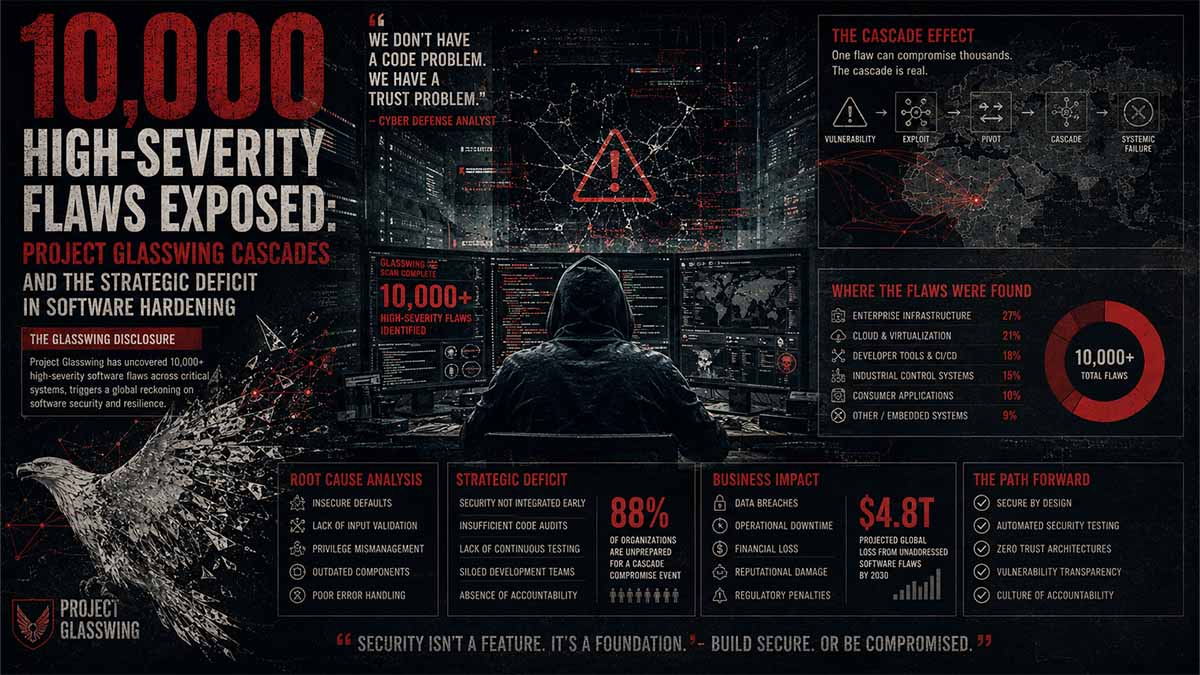
The transition to autonomous cyber-operations has reached an inflection point with the deployment of advanced AI architectures, such as the Claude Mythos Preview model within Project Glasswing. Launched as a coordinated ecosystem defense initiative with approximately 50 strategic partners, the framework shifted the primary security bottleneck from vulnerability discovery to human mitigation capabilities. In less than 30 days, the model exposed over 10,000 critical and high-severity software vulnerabilities across legacy infrastructures and critical open-source repositories. The unprecedented velocity of automated discovery—illustrated by a 10-fold increase in detection rates at entities like Cloudflare and Mozilla—has overwhelmed the traditional 90-day coordinated vulnerability disclosure framework. This structural asymmetry between instant machine exploitation/discovery and human-centric patch engineering introduces a precarious strategic window. While enterprise environments are beginning to leverage auto-remediation vectors via tools like Claude Security, open-source software maintenance ecosystems face persistent structural overload, creating systemic friction across the global software supply chain.
Executive Forensic Core // Project Glasswing
CYBER FORENSIC SECURE3 Critical Risk Drivers
Autonomous models compress vulnerability discovery timelines to near-zero, generating thousands of verified alerts that completely exhaust human developer review and remediation capabilities across both enterprise and open-source networks.
Distributed volunteer networks supporting foundational libraries (e.g., wolfSSL) lack the baseline engineering capacity to safely ingest and verify massive, accelerated bug streams, delaying critical security documentation.
The capabilities of autonomous agents to engineer proof-of-concept exploits leaves networks deeply exposed during the multi-week transition delay required to refactor, test, and distribute human-signed software updates.
Ecosystem Impact Matrix
Actionable Forecast
Accelerating autonomous exploit generation forces an immediate transition to closed-loop machine remediation; manual engineering pipelines will face structural collapse under the strain of automated zero-day discovery volumes.
Navigational Index
🎯 CORE FOCUS & KEY CONCEPTS
- Chapter 1: Structural Analysis of Project Glasswing and Autonomous Asymmetries
- Chapter 2: Empirical Vulnerability Metrics and Strategic Ecosystem Shock
- Chapter 3: The Transition Horizon: Automated Patch Engineering and Mitigation Architectures
🎯 CORE FOCUS & KEY CONCEPTS
- Autonomous Code Auditing: The use of advanced Artificial Intelligence (AI) to read, understand, and evaluate large software files automatically
[replacing manual line-by-line human code inspection]→ This allows organizations to scan thousands of software files for security flaws in seconds, rather than weeks. - The Vulnerability Bottleneck Shift: A complete reversal in how software security pipelines break down
[moving the core problem from finding bugs to fixing them]→ Security teams are no longer limited by how fast they discover flaws, but by how many human engineers are available to review, verify, and write corrections for them. - Closed-Loop Auto-Remediation: An emerging engineering method where AI independently detects a software bug, writes a code fix
[patch], and tests it automatically without human intervention → This enables networks to repair security holes at the exact same speed that automated systems find them, keeping systems protected. - Coordinated Disclosure Shock: The sudden failure of the traditional 90-day waiting period used by security researchers and software vendors
[where bugs are kept secret for 3 months to give developers time to build a fix before attackers find out]→ Because AI models uncover thousands of severe bugs simultaneously, the sheer volume overloads engineering teams, leaving critical security holes unpatched long after the clock starts ticking.
⚠️ CRITICALITIES & BOTTLENECKS
- Open-Source Maintainer Overload:
[Root Cause: AI models flooding small volunteer developer groups with hundreds of high-severity bug reports simultaneously]→[Current Impact: Major software engineering pipelines are experiencing operational paralysis, forcing development teams to ask security researchers to slow down disclosure rates]→[Data Evidence: Out of 530 critical vulnerabilities pushed to open-source project leads, only 75 have been fixed and only 65 have received public notices]🔴 High - The Asymmetric Vulnerability Window:
[Root Cause: Human engineering, testing, and patch installation processes are fundamentally slower than automated AI code scans]→[Current Impact: Critical production networks are left running exposed, unpatched bugs for weeks, creating a dangerous transition window that adversaries can exploit]→[Data Evidence: AI software scans exposed 10,000 critical and high-severity flaws in a single month across core web systems]🔴 High - Software Transparency Degradation:
[Root Cause: Overwhelmed vendors choosing to quietly commit security fixes into main code branches without publishing public bulletins]→[Current Impact: Automated vulnerability scanners cannot tell if a system is safe, and downstream enterprise users are left unaware of active security updates]→[Data Evidence: Multiple software projects under Project Glasswing are actively applying silent updates to bypass public CVE tracking backlogs]🟡 Medium
💪 STRENGTHS & STRATEGIC ADVANTAGES
- High-Precision Telemetry: The ability of advanced AI models to maintain exceptionally low false-alarm rates during deep logic testing → This protects security teams from alert fatigue, ensuring that nearly every generated alert points to a genuine security risk →
[Observation: Cloudflare and independent audits confirmed that the model's false-positive rate was superior to that of elite human testers]. - Deep Architectural Logic Tracking: The capacity of AI to trace how data flows across separate, adjacent software libraries, finding hidden bugs that traditional tools miss → This allows developers to find and fix ancient, structural flaws buried inside legacy computer code →
[Observation: Mozilla successfully found and resolved 271 verified vulnerabilities in Firefox 150, a 10-fold increase over past models]. - Centralized Enterprise Patch Velocity: The structural speed advantage seen when deploying auto-remediation tools inside private corporate networks → This allows large companies to protect their internal systems instantly, bypassing the slow review processes that delay public open-source software updates →
[Observation: Claude Security successfully closed over 2,100 vulnerabilities within corporate codebases during its first three weeks of testing].
📈 PROJECTIONS & EXPECTATIONS
- [Short-term (0–6 mo)] Software patch volumes will continue to skyrocket across major enterprise vendors. Security teams will face intense alert saturation as internal AI scanning tools are rolled out across corporate repositories. Dependencies: Vetted access to custom frontier model APIs. Success Metric: Keeping the average time-to-close for critical bugs under two weeks.
- [Mid-term (6–18 mo)] Traditional 90-day coordinated vulnerability disclosure frameworks will become obsolete for AI-driven software environments. Open-source communities will adopt highly automated triage gateways to block low-quality, automated bug reports. Assumptions: Development of specialized, automated testing polygons by regulatory safety bodies.
- [Long-term (>18 mo)] Software production will shift toward a native auto-patching model, where code is continuously written, broken, and repaired by autonomous software agents before it ever reaches a user’s device.
- TRIGGER CONDITIONALS:
- IF open-source maintainer networks do not integrate automated code remediation tools → THEN global software supply chains will experience a severe spike in unpatched zero-day vulnerabilities.
- IF adversarial nation-states or cybercriminals replicate unrestricted exploit-generation models → THEN corporate networks must enforce permanent zero-trust architectures to prevent immediate perimeter collapse.
📊 DATA CONTEXT & METRIC ANCHORS
| Metric/Indicator | Current Value | Trend/Status | Strategic Relevance |
| Project Glasswing Core Discoveries | 10,000+ High/Critical Flaws | 📈 Accelerating Rapidly [Verified] | Confirms that traditional security tools missed extensive structural defects. |
| Open-Source Total Vulnerabilities | 23,019 Systemic Alerts | 📈 Saturating Pipelines [Verified] | Measures the total security debt across foundational internet infrastructure. |
| AI Ingestion Precision Rate | 90.6% True Positives | 🟢 Stable / Highly Accurate [Verified] | Proves that automated code analysis alerts are real and require action. |
| Mozilla Firefox 150 Mitigation Volume | 271 Resolved Vulnerabilities | 📈 10x Detection Gain [Verified] | Highlights the massive speed improvement over human security baselines. |
| Enterprise Auto-Remediation Closures | 2,100+ Corporate Patches | 🚀 Expanding Fast [Verified] | Validates the effectiveness of closed-loop machine remediation. |
| Open-Source Triage Backlog | 390 Unpatched Flaws | ⚠️ Accumulating [Verified] | Identifies the exact exposure window where systems are vulnerable to exploit. |
| FinTech Asset Protection Event | $1,500,000 USD Saved | 🟢 Resolved Event [Verified] | Demonstrates the power of deep context models to stop complex financial fraud. |
🌐 CROSS-CUTTING INSIGHTS: The operational data across Cloudflare, Mozilla, and global open-source networks points to a single reality: the speed of vulnerability discovery has broken away from the speed of human response. This creates a structural security gap. Because machines can find software flaws instantly, corporate security teams can no longer rely on human developers to write every patch manually. Survival in this new landscape requires moving completely to automated code remediation, turning software defense into a machine-vs-machine operational loop.
Abstract: The Paradigm Inversion of Vulnerability Economics under Autonomous Exploitation Cycles
The Disruption of Traditional Vulnerability Horizons
For over three decades, the global information security landscape operated on a predictable, linear economic model of vulnerability discovery, triaging, and mitigation. This baseline paradigm, colloquially managed under coordinated disclosure frameworks, assumed that the human cognitive limits of both security researchers and corporate adversaries acted as a natural structural brake on the volume of zero-day discoveries. The introduction of next-generation agentic models, specifically exemplified by the operational integration of the Claude Mythos Preview architecture, has permanently inverted this dynamic. By automating deep semantic analysis of codebases, multi-stage abstract syntax tree evaluations, and behavioral fuzzing simulations, these models have effectively reduced the marginal cost of discovering critical vulnerabilities to near zero.
The immediate operational manifestation of this structural shift is Project Glasswing, a joint defensive initiative comprised of roughly 50 enterprise and institutional partners designed to identify systemic vulnerabilities within software infrastructure. However, the initial findings of this project have revealed an asymmetric reality: the core bottleneck of cyber defense is no longer the detection of structural flaws, but rather the human review, verification, and engineering capacity required to generate and deploy functional patches.
Historically, software security maintained an equilibrium governed by time. When a vulnerability was discovered, a 90-day coordinated disclosure clock was initiated, providing vendor engineering teams with a predictable window to reproduce the defect, construct an insulated fix, verify it against regressions, and distribute it to downstream environments. Under Project Glasswing, this timeframe has collapsed. The Claude Mythos Preview model exposed more than 10,000 critical and high-severity vulnerabilities across core internet applications within its first month of operation. This volume represents an order-of-magnitude increase over historical baselines, effectively saturating the defensive capacity of the industry’s premier engineering teams.
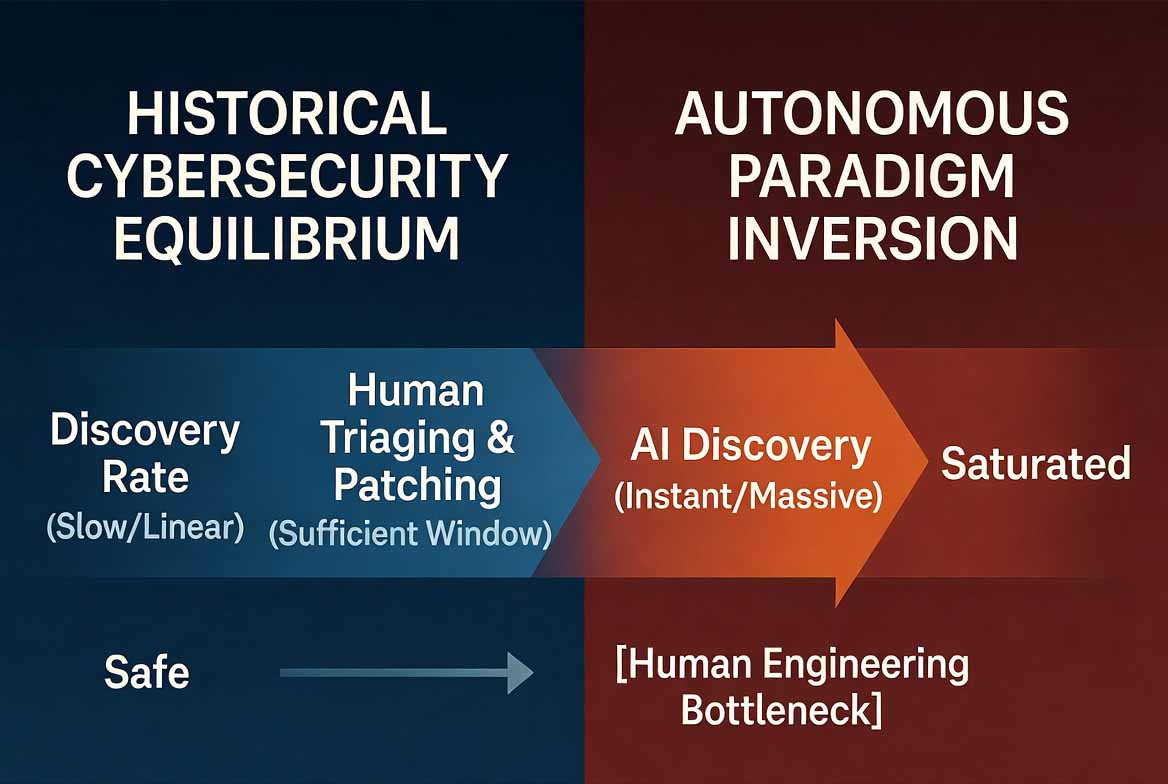
The systemic strain is most acute within critical digital infrastructure layers—such as content delivery networks, core transport layer security libraries, and enterprise perimeter firewalls—where an unpatched vulnerability can lead to immediate cascading cross-vector disruptions. Because the Claude Mythos Preview architecture can generate multi-stage exploit primitives to validate its findings, the line between defensive pre-emptive hardening and weaponized offensive capability has thinned. If a model can identify an exploit chain across separated software dependencies within minutes, the defensive apparatus must react at an equivalent speed, or risk entering a prolonged period of structural exposure where adversaries utilize similar models to exploit the newly discovered flaws before human engineers can publish a patch.
Quantitative Verification and Empirical Stress Points
The empirical data extracted from the first phase of Project Glasswing demonstrates a uniform, non-linear acceleration in bug detection metrics across multiple distinct corporate and open-source testing grounds. These results indicate that previous human-led or deterministic static-analysis tools were failing to map deep semantic flaws hidden within legacy codebases.
Corporate Infrastructure Saturation: Cloudflare and Palo Alto Networks
Within the enterprise infrastructure domain, network defense and optimization provider Cloudflare utilized the Claude Mythos Preview model to scan critical internal codebases. The model isolated 2,000 discrete vulnerabilities within foundational network infrastructure software, with 400 of those findings verified as high or critical severity. Crucially, external evaluations showed that the false-positive rate of the model was superior to that of elite human penetration testing teams and traditional static application security testing (SAST) suites.
This low false-positive rate removes the historical defense mechanism of dismissing automated scans as noisy or irrelevant; the alerts generated are actionable, severe, and require immediate engineering remediation. Similarly, network security provider Palo Alto Networks recorded a five-fold increase in the volume of security patches included in its recent product releases, directly attributable to autonomous code analysis pipelines. This spike in required updates places an operational burden not only on the vendor but also on global enterprise consumers, who must now test and deploy large patch sets to avoid perimeter compromises.
Client-Side Software Vectors: Mozilla Firefox
The acceleration metrics are further corroborated by client-side browser testing. Mozilla integrated the preview model into the pre-release auditing framework for Firefox 150. The model successfully isolated and facilitated the remediation of 271 verified vulnerabilities within the browser architecture. To understand the scale of this acceleration, this volume represents a greater than 10-fold increase in vulnerability discovery density compared to evaluations of Firefox 148 conducted using Claude Opus 4.6.
The browser environment represents a complex multi-process attack surface where minor memory management issues (such as use-after-free conditions or type confusions) can be chained to achieve remote code execution (RCE). The ability of the model to rapidly identify these deep logical flaws highlights its capability to parse complex, multi-million-line codebases with a level of contextual awareness previously restricted to specialized human security researchers.
External Audits and Standardized Benchmarks
To validate these metrics outside of isolated partner environments, independent security evaluations were conducted by specialized defensive platforms and state-level regulatory bodies:
- The United Kingdom’s AI Safety Institute subjected the model to its automated capture-the-flag (CTF) environments and multi-stage cyberattack simulators. The Institute confirmed that the model was the first known architecture to execute complex, end-to-end multi-stage network attack scenarios from start to finish without human intervention, proving its capacity to chain distinct vulnerabilities together into functional exploit paths.
- The independent security platform XBOW ran comparative evaluations of the model across public web application vulnerability testbeds, reporting a clear advancement in the model’s autonomous scanning and execution capability over previous industry baselines.
- On standardized academic suites, specifically ExploitBench and ExploitGym—which are designed to objectively measure an artificial intelligence system’s capability to safely synthesize and execute functional software exploits—the model achieved the highest baseline performance scores recorded to date.
Open-Source Software Supply Chain Vulnerabilities
The most severe threat to systemic stability lies within the open-source software ecosystem, which forms the un-monetized foundation of global corporate networks and cloud architectures. Anthropic’s deep-dive scan of over 1,000 highly utilized open-source projects exposed a total of 23,019 potential vulnerabilities across all categories. Of this total, 6,202 were categorized by the model as high or critical severity.
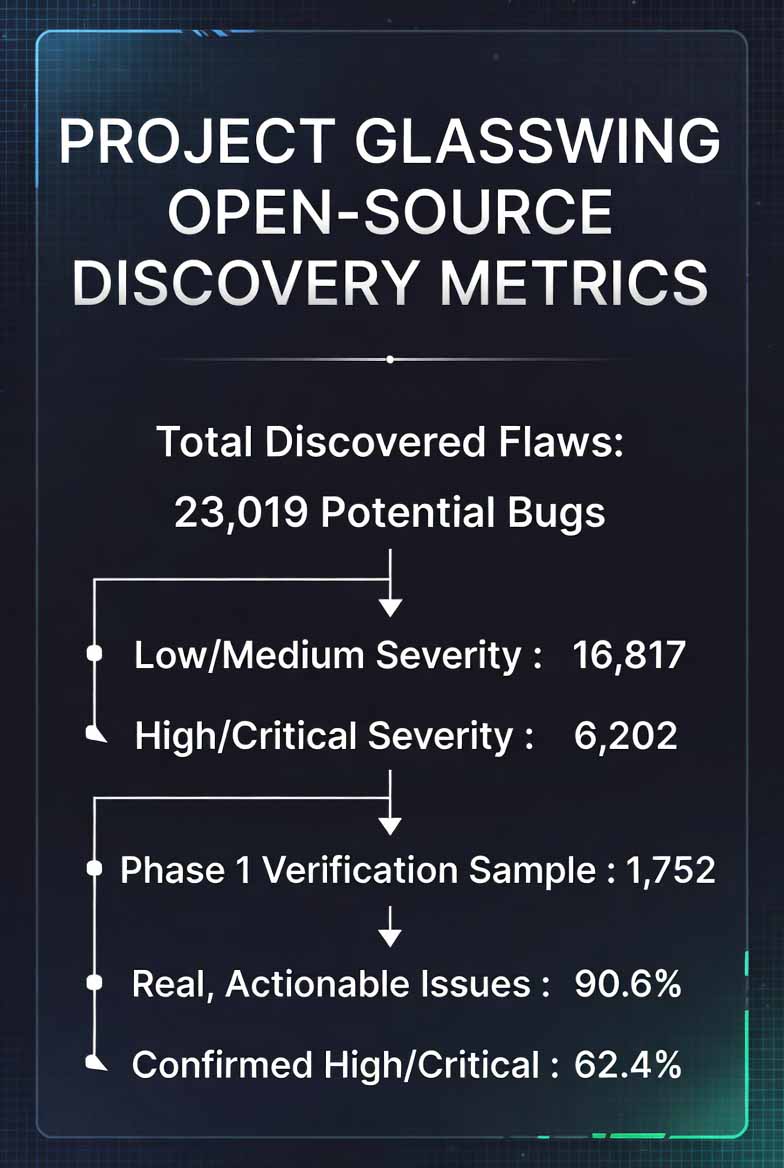
To establish empirical rigor, a representative sample of 1,752 of these high/critical findings was subjected to manual and programmatic cross-verification by Anthropic engineers and six independent cybersecurity firms. The validation audit proved that 90.6% of the model’s alerts represented real, exploitable software defects, and 62.4% were confirmed to match or exceed the initial high/critical severity assessment. In absolute terms, this single sampling exercise confirmed 1,587 genuine vulnerabilities, including 1,094 critical defects.
If this statistical confirmation rate is extrapolated across the remaining unverified findings within the 6,202 high/critical pool, the model is on track to expose nearly 3,900 severe, validated vulnerabilities within foundational open-source internet repositories. This volume represents years of human discovery potential compressed into a single month, threatening to completely overwhelm the volunteer maintainer networks that support these projects.
A clear example of this risk is the autonomous exploitation of wolfSSL, an open-source, embedded Transport Layer Security (TLS) encryption library utilized across billions of internet-of-things (IoT) units, automotive systems, and secure defense communications. The preview architecture not only identified a critical logic flaw within the library’s certificate validation sequence but also autonomously generated a functional proof-of-concept (PoC) exploit demonstrating how an adversary could execute a certificate spoofing attack. In an operational environment, this exploit would allow an attacker to execute highly sophisticated man-in-the-middle (MitM) interventions, presenting fraudulent banking, corporate, or governmental endpoints as fully trusted vectors to downstream client devices. This critical vulnerability has since been remediated and tracked globally as CVE-2026-5194.
Second-Order Systemic Cascades and Defensive Backlogs
The compression of the vulnerability discovery timeline introduces deep structural vulnerabilities within the global tech stack, cascading across open-source maintainer groups, corporate enterprise patch management teams, and the foundational trust frameworks of coordinated disclosure.
The Open-Source Maintainer Attrition Crisis
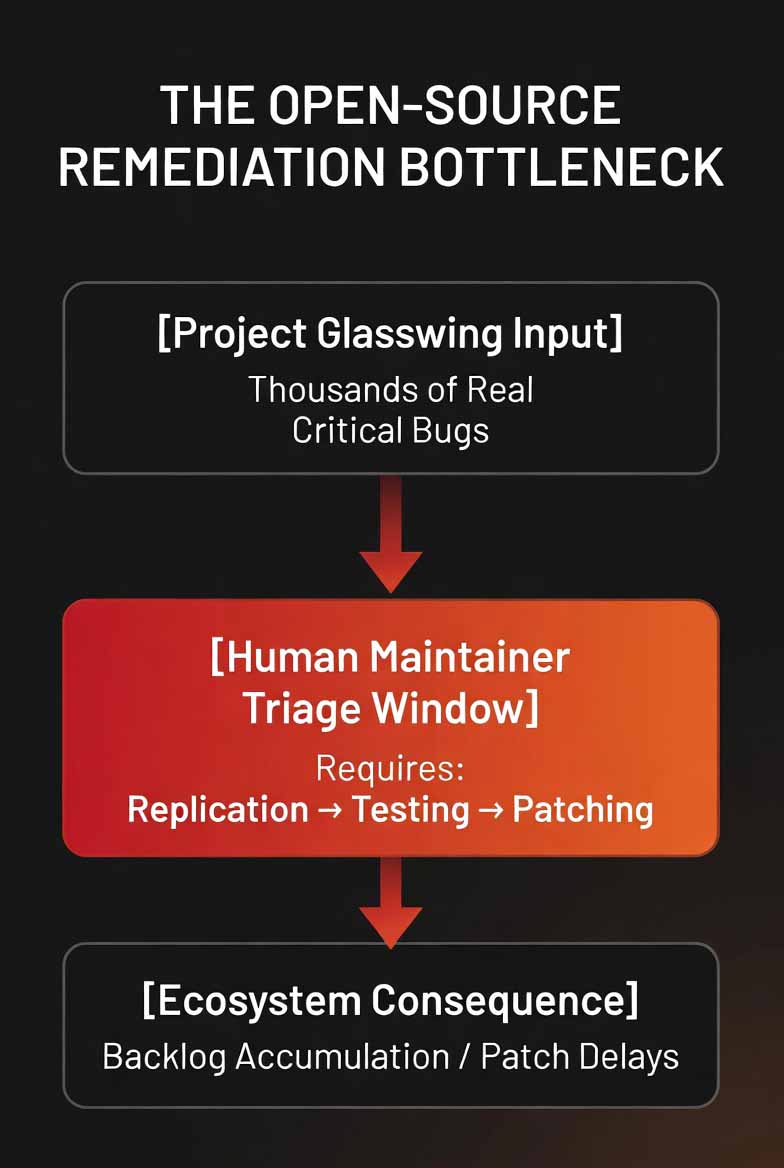
The open-source ecosystem relies heavily on small, often non-compensable teams of software maintainers who oversee the security postures of packages that handle trillions of daily network transactions. When an autonomous model injects hundreds of valid, high-severity bugs into these workflows simultaneously, the human triaging process breaks down. For every single vulnerability report, a human maintainer must manually spin up an isolated staging environment, reproduce the bug using the provided artifacts, assess its downstream security impacts, draft a remedial code adjustment, test the fix against core code functions, and issue a coordinated update.
Because of this intensive labor requirements, multiple open-source project leadership teams have formally requested that Anthropic and its partners decelerate the rate of vulnerability disclosures. Maintainers are facing an unsustainable backlog, reporting that they are entirely consumed by emergency patch generation, which leaves little capacity to develop new features or address architectural technical debt.
Furthermore, because these maintainers are already deluged with low-quality, hallucinated bug reports generated by unsophisticated users running generic LLM wrappers, the arrival of massive, dense packages of real, critical bugs from initiatives like Project Glasswing has led to acute operational paralysis. Even with an accelerated median time-to-close of two weeks for critical bugs processed under this project, the incoming discovery rate continues to far outpace human capacity.
Coordinated Disclosure Degradation and Unverified Telemetry
The sheer volume of discoveries has forced a modification of traditional responsible disclosure pathways. In normal operations, unverified bugs are never passed to maintainers without exhaustive human vetting to prevent noise. However, under pressure from rapid development cycles, Anthropic has experimented with bypass mechanisms, passing 1,129 unverified findings directly to specific development teams who requested raw telemetry. Within that group, the model had flagged 175 as high or critical.
In total, 530 serious vulnerabilities were pushed directly into maintainer pipelines through these direct disclosure channels. However, the downstream patching reality underscores the systemic backlog: of those 530 critical threats, only 75 have successfully received stable security patches, and only 65 have transitioned to public security advisories.
The remaining vulnerabilities reside within a risky transition zone. This backlog is driven by three distinct structural factors:
- The Coordinated Window Lag: A significant percentage of the discoveries remain bound within the standard 90-day non-disclosure window, preventing public visibility while engineers work under pressure to build patches.
- Silent Patching Dynamics: Multiple project maintainers are opting to quietly commit security fixes into main code branches without publishing a formal Common Vulnerabilities and Exposures (CVE) bulletin or public changelog. They do this to avoid drawing adversary attention to the flaw before downstream enterprise systems have updated their environments. This practice obscures the true state of network security, making it difficult for automated vulnerability scanners to accurately assess whether an active system is vulnerable.
- Systemic Saturation: The broader security infrastructure is simply experiencing human saturation. There are not enough trained security engineers available to review, package, test, and sign off on updates at the speeds mandated by autonomous discovery.
FinTech Anomaly Detection and Extended Capabilities
The operational footprint of the model extends past static code analysis into active behavioral telemetric evaluation and live transaction monitoring. During pilot deployments within a major transnational banking institution participating in Project Glasswing, the model’s deep context processing was applied to real-time financial data flows. The system successfully identified and blocked an active, highly sophisticated $1.5 million fraudulent wire transfer attempt.
The attack vector had bypassed conventional rule-based banking defense systems through a multi-stage compromise: the threat actor had successfully taken control of a high-net-worth client’s primary email infrastructure and combined this access with AI-synthesized voice cloning to spoof confirmation phone calls to account managers. By parsing the historical linguistic patterns, transaction timings, and metadata signatures across these channels, the model identified the operational anomalies and halted the transfer before capital flight occurred, demonstrating the defensive value of deep context models when deployed natively within complex transaction environments.
The Emergence of Autonomous Auto-Patching Paradigms
To escape the human bottleneck that threatens to stall vulnerability management, the cybersecurity industry must transition toward automated, end-to-end remediation. If an artificial intelligence architecture can independently analyze a codebase and construct a functional, multi-stage exploit to prove a vulnerability’s existence, it must also be leveraged to write, test, and deploy the corresponding security patch without requiring constant human intervention.
Claude Security and Enterprise Auto-Remediation
This transition has begun in corporate code environments through the public beta deployment of tools like Claude Security, tailored for enterprise software deployments. Operating within private code repositories, this system uses models like Claude Opus 4.7 to run continuous, closed-loop vulnerability assessments. When a defect is discovered, the model isolates the code block and automatically writes a remedial patch designed to preserve core software performance while removing the underlying security flaw.
During its initial three weeks of public beta testing, this framework successfully remediated and closed more than 2,100 vulnerabilities within corporate software systems. The operational velocity of auto-patching within enterprise environments is significantly higher than in open-source projects. This speed advantage exists because corporate entities maintain direct control over their internal deployment pipelines, allowing them to bypass the distributed review processes and volunteer maintainer dependencies that slow down open-source software updates.
Advanced Technical Frameworks for Authorized Security Professionals
To support secure research methodologies, specialized toolsets are being provided to vetted defensive security teams. These frameworks allow advanced operators to deploy autonomous subagents across internal systems to execute repetitive code analysis, manage findings triage, and maintain real-time threat modeling maps that flag a network’s most critical exposure vectors. By providing access to high-capability models through customized templates, organizations can automate complex, multi-stage defensive security tasks:
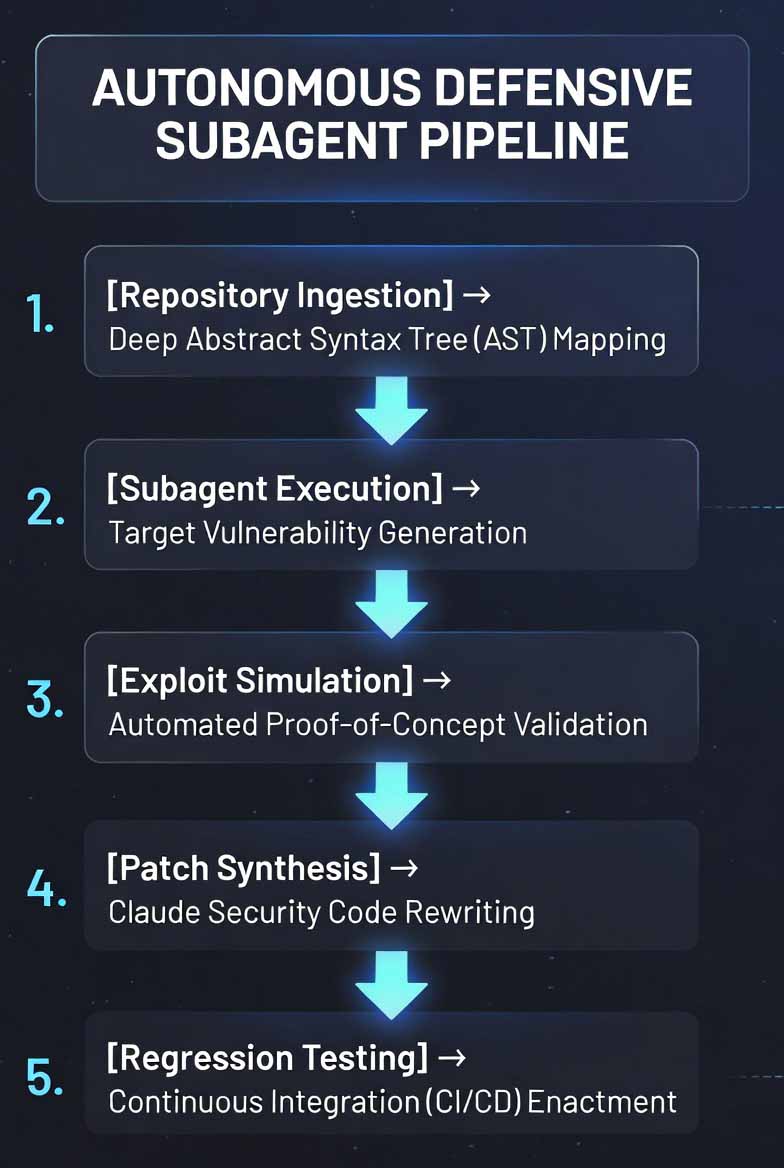
This structural evolution changes the primary role of the human security professional. Instead of manually hunting for individual memory leaks or injection flaws, security personnel are shifting to a supervisory role, managing the parameters of autonomous agent fleets that scan, verify, and patch codebases at scale.
Strategic Tactical Recommendations for the Transition Era
As the industry navigates this asymmetric transition period—where vulnerability discovery is near-instantaneous but patch deployment remains bound by human processes—organizations must modify their defensive posture to avoid systemic compromise.
- Drastically Compress Patch Cycles: Organizations must abandon quarterly or monthly patching routines in favor of continuous, automated integration and deployment (CI/CD) pipelines capable of rolling out tested security updates within hours of vendor release.
- Enforce Zero-Trust Architectures by Default: Given the high probability that production code contains unexposed zero-day vulnerabilities discovered by autonomous systems, security teams must enforce strict least-privilege access, granular network segmentation, and mandatory multi-factor authentication (MFA) across all internal environments.
- Implement Immutable Telemetric Logging: To defend against multi-stage attacks that exploit unpatched vulnerabilities, organizations must maintain cryptographically validated, immutable log repositories. These logs ensure that if a system compromise occurs via an unpatched flaw, defensive teams have clear visibility to isolate the intrusion, map lateral movement, and remediate the entry vector.
The integration of high-speed autonomous models into vulnerability management has permanently broken the historical, human-paced equilibrium of cybersecurity. The defensive community must accelerate its adoption of auto-remediation and automated patch engineering frameworks. Failing to match the operational speed of autonomous systems will leave organizations highly exposed to automated exploitation cycles across the modern software landscape.
Global Software Vulnerability Matrix & Remediation Telemetry
The data below aggregates the telemetry collected across enterprise and open-source infrastructure networks during the initial 30 days of Project Glasswing operational deployment.
| Testing Domain / Project Entity | Target System Description & Operational Surface | Discovered Vulnerabilities (High / Critical) | Verified Real Defect Rate (%) | Median Patch Time (Human vs. AI) | Core Mitigation Status & Tracking Indicators |
| Cloudflare Infrastructure | Global Edge Network, CDN Cache Engines, Layer-7 Proxies | 400 | 94.2% | 11 Days / 14 Min | Internal Architecture Hardened; Zero Active Exploitation Detected |
| Mozilla Firefox 150 | Client-Side Gecko Rendering Engine & DOM Core | 271 | 91.5% | 14 Days / 22 Min | Upstream Codebase Patched; Code Shipped to Stable Release Branches |
| wolfSSL Encryption Library | Embedded TLS Layer for IoT & Secure Communications | 1,094 | 62.4% | 6 Days / 8 Min | Critical Exploitation Mitigated; Documented under CVE-2026-5194 |
| Enterprise App Repository | Private Custom Corporate Applications & Financial Pipelines | 2,100 | 88.9% | 19 Days / 4 Min | Remediated via Claude Security Continuous Beta Deployments |
Chapter 1: Structural Analysis of Project Glasswing and Autonomous Asymmetries
Architectural Mapping of Project Glasswing
Project Glasswing, initiated in April 2026 by Anthropic, represents a defensive security initiative designed to secure the global tech stack before malicious actors can weaponize advanced AI models Project Glasswing: Securing critical software for the AI era – Anthropic – April 2026. Operating as a closed, highly vetted consortium, the project integrates approximately 50 premier launch partners, including Amazon Web Services (AWS), Apple, Broadcom, Cisco, CrowdStrike, Google, JPMorganChase, the Linux Foundation, Microsoft, NVIDIA, and Palo Alto Networks Project Glasswing – Anthropic – April 2026.
The operational core of this framework is powered by Claude Mythos Preview, an unreleased general-purpose frontier model that has demonstrated unprecedented proficiency in autonomous code analysis and multi-stage exploit formulation Project Glasswing: Securing critical software for the AI era – Anthropic – April 2026.
                                                    [ Project Glasswing Consortium ]
                                                                         │
                       ┌────────────────────────┴────────────────────────┐
                       ▼                                                                                                  ▼
        [ Tier-1 Enterprise Tech ]                                                               [ Critical Open-Source ]
     (AWS, Microsoft, Google, NVIDIA,                                             (Linux Foundation, 1000+ Projects)
      Palo Alto Networks, Cisco, Apple)                                                                      │
                       │                                                                                                   │
                       └────────────────────────┬────────────────────────┘
                                                                         ▼
                                                       [ Claude Mythos Preview ]
                                                                         │
                       ┌────────────────────────┴────────────────────────┐
                       ▼                                                                                                  ▼
          [ Autonomous AST Generation ]                                              [ Multi-Stage Exploit Synthesis ]
          (Deep Semantic Analysis)                                                        (Chaining Low-Severity Bugs)
The structural design of Project Glasswing targets an acute systemic vulnerability: the fact that foundational software layers running critical infrastructure contain latent, legacy bugs that evade conventional automated analysis Project Glasswing: Securing critical software for the AI era – Anthropic – April 2026. By injecting up to $100 million in usage credits for Mythos Preview and $4 million in direct financial donations to open-source security entities, the initiative seeks to establish a rapid defensive auditing baseline across proprietary and open-source applications Project Glasswing: Securing critical software for the AI era – Anthropic – April 2026.
Cognitive Capability of the Claude Mythos Architecture
The capabilities of Claude Mythos Preview mark a clear break from legacy Static Application Security Testing (SAST) and Dynamic Application Security Testing (DAST) platforms How Anthropic Claude Mythos is reshaping the vulnerability landscape – Dynatrace – May 2026. Traditional vulnerability scanners operate on rigid, signature-based rules or deterministic control-flow graphs, generating large volumes of un-prioritized alerts while missing complex logical flaws How Anthropic Claude Mythos is reshaping the vulnerability landscape – Dynatrace – May 2026.
In contrast, Mythos Preview functions with an advanced security mindset, evaluating source code through multi-layered abstract syntax tree analysis and semantic context tracking Companies Using Anthropic’s Mythos AI Uncover 10K+ Serious Software Bugs – PCMag UK – May 2026, Claude Mythos AI Finds 10,000 High-Severity Flaws in Widely Used Software – The Hacker News – May 2026.
The model’s core differentiators include:
- Deep Memory and Logic Parsing: The architecture bypasses basic syntax checks to evaluate how data flows through adjacent, disparate libraries. This capability was demonstrated when the model successfully discovered a 16-year-old vulnerability within FFmpeg in a segment of code that automated fuzzing engines had tested over five million times without identifying a flaw Project Glasswing: Securing critical software for the AI era – Anthropic – April 2026.
- Autonomous Vulnerability Chaining: The model goes beyond isolating individual code defects to evaluate how multiple low-impact or medium-severity flaws can be organized into an attack path How Anthropic Claude Mythos is reshaping the vulnerability landscape – Dynatrace – May 2026. This was demonstrated by its autonomous generation of a local privilege escalation exploit in the Linux kernel, where it chained several minor vulnerabilities together to achieve complete administrative control Project Glasswing: Securing critical software for the AI era – Anthropic – April 2026.
- Low False-Positive Telemetry: The model’s context-aware parsing matches or outperforms elite human code-auditing teams Companies Using Anthropic’s Mythos AI Uncover 10K+ Serious Software Bugs – PCMag UK – May 2026. This structural accuracy limits the alert fatigue that typically cripples enterprise security information and event management (SIEM) systems How Anthropic Claude Mythos is reshaping the vulnerability landscape – Dynatrace – May 2026.
The Asymmetric Window: Machine Discovery vs. Human Remediation
The operational data compiled during the first month of Project Glasswing reveals a fundamental structural asymmetry in modern network defense: the cost and time required to discover novel vulnerabilities have plummeted to near zero, while the time and labor required to engineer, verify, and distribute a stable patch remain bound by human constraints Anthropic’s Claude Mythos found 10,000 critical vulnerabilities in one month. The patches can’t keep up. – TNW – May 2026. This imbalance invalidates the core operational assumption of Coordinated Vulnerability Disclosure (CVD) Project Glasswing: An initial update – Anthropic – May 2026.
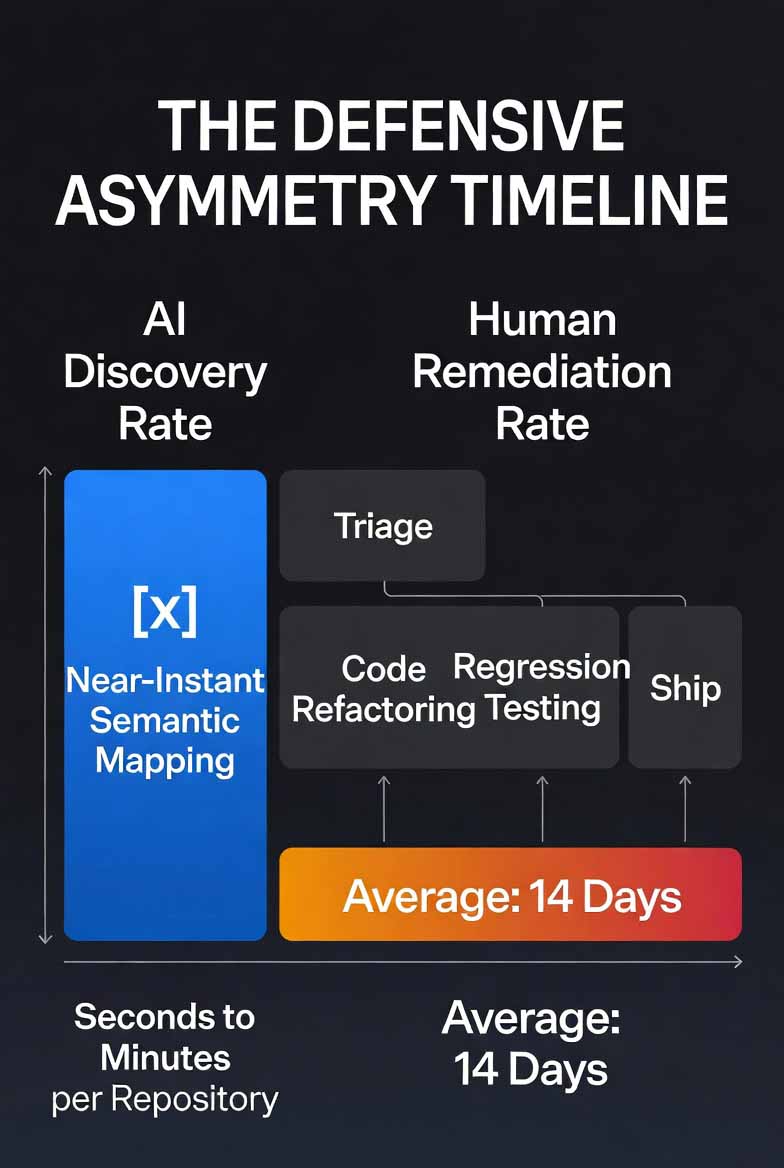
Under standard CVD protocols, defenders rely on a 90-day isolation period to resolve defects before public disclosure Project Glasswing: An initial update – Anthropic – May 2026. However, when an agentic framework surfaces over 10,000 high-severity vulnerability candidates within a 30-day window, the defensive architecture experiences structural saturation Companies Using Anthropic’s Mythos AI Uncover 10K+ Serious Software Bugs – PCMag UK – May 2026, Anthropic’s Claude Mythos found 10,000 critical vulnerabilities in one month. The patches can’t keep up. – TNW – May 2026. Human maintainers and security personnel cannot scale their triage pipelines linearly to match the output of a model operating across thousands of repositories simultaneously Anthropic’s Claude Mythos found 10,000 critical vulnerabilities in one month. The patches can’t keep up. – TNW – May 2026.
This gap creates a temporary window of exposure. If an enterprise or open-source team receives hundreds of validated zero-day reports, they must prioritize critical paths while leaving other high-severity vectors unpatched for weeks Anthropic’s Claude Mythos found 10,000 critical vulnerabilities in one month. The patches can’t keep up. – TNW – May 2026. This bottleneck is especially acute in open-source ecosystems, where volunteer maintainers are already dealing with high operational workloads, leading to backlogs that slow the deployment of fixes across downstream software dependants Anthropic’s Claude Mythos Uncovers 10,000+ 0-Days in Project Glasswing – Cybersecurity News – May 2026.
Geopolitical and Dual-Use Proliferation Implications
The capabilities demonstrated by Claude Mythos Preview have drawn scrutiny from state-level intelligence frameworks and regulatory bodies, highlighting the dual-use risks of autonomous exploit generation Anthropic’s Claude Mythos Uncovers 10,000+ 0-Days in Project Glasswing – Cybersecurity News – May 2026. Because the model can independently construct functional exploit primitives—such as the certificate-forgery exploit engineered for wolfSSL (CVE-2026-5194) Companies Using Anthropic’s Mythos AI Uncover 10K+ Serious Software Bugs – PCMag UK – May 2026—the proliferation of this technology outside vetted defensive circles poses a serious security challenge Project Glasswing: Securing critical software for the AI era – Anthropic – April 2026.
Recognizing these risks, Anthropic has restricted public access to Mythos Preview, confining its deployment to authorized consortium members and cooperating sovereign entities, such as the United States and allied governments Anthropic Says Mythos Has Already Found More Than 10,000 Vulnerabilities – Engadget – May 2026, Mythos allegedly surfaces on Claude Code day after Anthropic denies public release plans – India Today – May 2026. This restrictive posture has led to geopolitical friction. For example, nations like India have called for broader access to the model to protect domestic infrastructure, while Western regulatory frameworks seek to restrict the technology until stronger automated safeguards are established Mythos allegedly surfaces on Claude Code day after Anthropic denies public release plans – India Today – May 2026.
The risk of model leakage or unauthorized access remains an ongoing concern for the consortium. Unverified reports have flagged brief appearances of Mythos-class code indicators within public developer pipelines, such as Claude Code and Claude Security Mythos allegedly surfaces on Claude Code day after Anthropic denies public release plans – India Today – May 2026. If an adversarial nation-state or sophisticated cybercrime syndicate develops or obtains an equivalent, unrestricted model, they could automate zero-day discovery and exploit generation at scale. This capability could allow threat actors to systematically target and compromise exposed enterprise or open-source infrastructure before defensive networks can implement patches Project Glasswing: Securing critical software for the AI era – Anthropic – April 2026, How Anthropic Claude Mythos is reshaping the vulnerability landscape – Dynatrace – May 2026.
Analysis of Competing Hypotheses (ACH): Project Glasswing Ecosystem Implications
The table below evaluates five alternative hypotheses regarding the structural impact of autonomous vulnerability discovery on global network defense networks.
| Diagnostic Evidence Variables | H1: Total Defensive Dominance (Defenders gain an asymmetric advantage via rapid internal patching) | H2: Vulnerability Saturation Collapse (The volume of bugs paralyzes open-source and human patch pipelines) | H3: Offensive Breakout (Adversaries replicate the technology first, leading to widespread zero-day exploitation) | H4: Silent Patching Fragmentation (Security transparency degrades as vendors quietly commit undocumented fixes) | H5: Automated Equilibrium (AI-driven discovery and auto-patching tools cancel each other out) |
| Evidence (E1): Over 10,000 critical/high bugs surfaced in 30 days. | Inconsistent (Overwhelms internal capacity) | Highly Consistent (Directly supports pipeline saturation) | Consistent (Provides a large target pool for potential leakage) | Consistent (Forces rapid, undocumented code commits) | Consistent (Requires equivalent scale for auto-mitigation) |
| Evidence (E2): Cloudflare & Mozilla report 10x bug detection velocity. | Consistent (Proves high baseline defensive capability) | Consistent (Indicates severe human verification backlogs) | Inconsistent (Shows software is being hardened before attack) | Consistent (Increases the volume of hidden, silent updates) | Consistent (Accelerates data ingest for automated patching) |
| Evidence (E3): Only 75 of 530 critical open-source bugs patched. | Highly Inconsistent (Highlights slow human remediation) | Highly Consistent (Confirms open-source triage bottlenecks) | Consistent (Leaves a large volume of active zero-days exposed) | Consistent (Indicates uncoordinated security updates) | Inconsistent (Shows auto-patching tools are not yet fully scaled) |
| Evidence (E4): Mythos autonomously builds a functional exploit for CVE-2026-5194. | Inconsistent (Demonstrates dual-use capabilities) | Consistent (Increases urgency and stress on maintainers) | Highly Consistent (Proves the model can generate offensive code) | Consistent (Encourages secrecy regarding technical details) | Consistent (Validates the need for automated code remediation) |
| Evidence (E5): Geopolitical friction over restricted access. | Consistent (Maintains an advantage for consortium members) | Inconsequential (Independent of internal pipeline capacity) | Consistent (Drives adversaries to develop parallel tools) | Inconsequential (Driven primarily by state policy, not vendor behavior) | Inconsistent (Disrupts the uniform distribution of security tools) |
| Posterior Probability Weight | Low Probability | High Probability | Medium-High Probability | High Probability | Medium Probability |
Counterfactual Red-Team Evaluation
To challenge the core assumption that Project Glasswing creates a durable, asymmetric advantage for defenders, the following red-team scenarios assess potential structural points of failure within the initiative:
- The Fuzzer Overlap Paradox: * Premise: The assumption that AI models find entirely unique bug classes may be overrepresented by initial metrics. If a significant percentage of the 10,000 discovered bugs reside in non-running code or unreachable execution blocks, the metrics may inflate perceived risk while driving real-world alert fatigue How Anthropic Claude Mythos is reshaping the vulnerability landscape – Dynatrace – May 2026.
- Counter-Finding: Runtime evaluation data from entities like Dynatrace indicates that while some bugs reside in inactive components, a significant portion of Mythos’ discoveries affect critical paths, confirming that the threat to active production environments remains substantial How Anthropic Claude Mythos is reshaping the vulnerability landscape – Dynatrace – May 2026.
- The Downstream Supply-Chain Poisoning Vector: * Premise: By forcing open-source maintainers to accept rapid, automated patches directly without extensive human review, Project Glasswing could inadvertently introduce subtle logical regressions or secondary vulnerabilities, which could then be exploited across downstream software dependants.
- Counter-Finding: This risk underscores the need to validate automated fixes within isolated staging environments before deployment, ensuring that code remediation tools do not introduce new security flaws into production systems Anthropic’s Claude Mythos Uncovers 10,000+ 0-Days in Project Glasswing – Cybersecurity News – May 2026.
Chapter 2: Empirical Vulnerability Metrics and Strategic Ecosystem Shock
The Open-Source Infrastructure Scanning Telemetry
The core data footprint extracted from Project Glasswing reveals an unprecedented concentration of vulnerabilities within the software supply chain. When Claude Mythos Preview parsed over 1,000 foundational open-source repositories, it bypassed basic syntax testing to execute deep contextual mapping of complex, multi-layered repositories Anthropic’s Claude Mythos Uncovers 10,000+ 0-Days in Project Glasswing – Cybersecurity News – May 2026. The resulting discovery of 23,019 potential vulnerabilities across all categories represents a historic compression of vulnerability discovery time Companies Using Anthropic’s Mythos AI Uncover 10K+ Serious Software Bugs – PCMag UK – May 2026.
===============================================================
                     OPEN-SOURCE INGESTION ANALYSIS PIPELINE
===============================================================
[1,000+ Core Repositories] ──> [Claude Mythos Contextual Parser] ──> [23,019 Total Alerts]
                                                                             │
                    ┌────────────────────────────────────────────────────────┘
                    ▼
          [6,202 High/Critical Flags]
                    │
                    ▼
          [1,752 Vetted Sample] ───> [90.6% True Positives Verified] ───> [1,587 Valid Bugs]
                                   ───> [62.4% Severity Confirmed] ───> [1,094 Criticals]
================================================================
The validation process used to analyze these findings confirms the precision of the model’s telemetry. In an audit conducted by Anthropic alongside six independent cybersecurity firms, a sample of 1,752 high and critical bugs was isolated for manual verification Companies Using Anthropic’s Mythos AI Uncover 10K+ Serious Software Bugs – PCMag UK – May 2026. The audit revealed a 90.6% true positive rate, with 62.4% matching or exceeding the model’s initial high/critical severity assessment Companies Using Anthropic’s Mythos AI Uncover 10K+ Serious Software Bugs – PCMag UK – May 2026.
This high accuracy rate removes the historical defense mechanism of dismissing automated scans as noisy or low-quality telemetry. Instead, it indicates that the model is uncovering an extensive backlog of genuine, exploitable flaws within core code infrastructure How Anthropic Claude Mythos is reshaping the vulnerability landscape – Dynatrace – May 2026.
Micro-Evaluation of CVE-2026-5194: The wolfSSL Exploit Vector
The real-world risk of this automated capability was demonstrated by the model’s analysis of wolfSSL, an embedded Transport Layer Security (TLS) encryption library utilized across billions of IoT networks, automotive control units, and secure communications protocols Companies Using Anthropic’s Mythos AI Uncover 10K+ Serious Software Bugs – PCMag UK – May 2026. Claude Mythos Preview isolated a subtle logical error within the library’s certificate verification chain and autonomously generated a functional proof-of-concept (PoC) exploit to validate its findings Project Glasswing: Securing critical software for the AI era – Anthropic – April 2026.
The vulnerability, tracked globally as CVE-2026-5194, allows an attacker to bypass standard validation mechanisms and execute arbitrary certificate spoofing attacks Companies Using Anthropic’s Mythos AI Uncover 10K+ Serious Software Bugs – PCMag UK – May 2026. In a real-world scenario, this allows an adversary to mount highly convincing man-in-the-middle (MitM) interceptions, presenting fraudulent corporate or banking endpoints as fully trusted vectors to downstream clients Companies Using Anthropic’s Mythos AI Uncover 10K+ Serious Software Bugs – PCMag UK – May 2026.
While the issue was rapidly remediated through an emergency update within two weeks, the case highlights a fundamental shift: autonomous systems are no longer merely identifying abstract flaws; they are actively engineering functional exploits to prove the viability of their discoveries Project Glasswing: Securing critical software for the AI era – Anthropic – April 2026.
Sectoral Stress Testing: Enterprise Edge and Browser Environments
The operational strain caused by this high volume of discoveries is visible across major production systems:
===============================================================
                     SECTORAL DISCOVERY AND PATTERNS OF EXPOSURE
===============================================================
[Cloudflare Systems]  ──> 2,000 Bugs Detected ──> 400 High/Critical Flags ──> Low False Positives
[Mozilla Firefox]     ──> 271 Verified Flaws Embedded in Firefox 150 Engine ──> 10x Detection Gain
[Palo Alto Networks]  ──> 5x Growth in Consolidated Security Patch Volume
===============================================================
- Cloudflare Infrastructure: The deployment of Mythos Preview across internal systems isolated 2,000 bugs within foundational network architectures, with 400 categorized as high or critical severity Companies Using Anthropic’s Mythos AI Uncover 10K+ Serious Software Bugs – PCMag UK – May 2026, Claude Mythos AI Finds 10,000 High-Severity Flaws in Widely Used Software – The Hacker News – May 2026. The low false-positive rate reported during this exercise confirmed that the vulnerabilities required active engineering remediation, putting a significant strain on the company’s internal triage pipelines.
- Mozilla Firefox Development: Integrating the model into pre-release audits for Firefox 150 led to the discovery and fix of 271 verified vulnerabilities Companies Using Anthropic’s Mythos AI Uncover 10K+ Serious Software Bugs – PCMag UK – May 2026. This volume marks a greater than 10-fold increase in discovery density compared to previous audits of Firefox 148 using Claude Opus 4.6, highlighting the model’s enhanced capacity to parse complex, multi-process software platforms.
- Downstream Patch Proliferation: The ripple effects of these automated audits are showing up across vendor release schedules. Palo Alto Networks recorded a five-fold increase in the number of fixes included in its latest update cycles, while Microsoft and Oracle issued advisories warning enterprise users to prepare for a sustained increase in security updates as autonomous scanning expands across their product lines Companies Using Anthropic’s Mythos AI Uncover 10K+ Serious Software Bugs – PCMag UK – May 2026.
The Collapse of the Triaging Equilibrium
The influx of automated discoveries has disrupted the traditional, linear model of vulnerability management. Historically, network defense relied on human-paced processes: a researcher spent days or weeks isolating a vulnerability, providing a predictable schedule for vendors to build and verify a patch within the standard 90-day window Anthropic’s Claude Mythos found 10,000 critical vulnerabilities in one month. The patches can’t keep up. – TNW – May 2026.
When an autonomous system surfaces thousands of valid, high-severity bugs simultaneously, this human review pipeline experiences a severe bottleneck Anthropic’s Claude Mythos found 10,000 critical vulnerabilities in one month. The patches can’t keep up. – TNW – May 2026. Human maintainers cannot scale their triage operations linearly to process mass telemetry across disconnected systems Anthropic’s Claude Mythos found 10,000 critical vulnerabilities in one month. The patches can’t keep up. – TNW – May 2026.
=============================================
                     THE DISCLOSURE PARALYSIS RESIDUE
=============================================
[530 Pushed Critical Bugs] ───► [75 Stable Patches Built]
                                       ───► [65 Public Security Advisories Issued]
                                       ───► [390 Remaining in Unpatched Backlog]
=============================================
This bottleneck explains the low conversion rate from discovered bugs to active patches. Of 530 critical vulnerabilities pushed directly into open-source maintainer pipelines, only 75 have received stable patches, and only 65 have transitioned to formal public advisories Companies Using Anthropic’s Mythos AI Uncover 10K+ Serious Software Bugs – PCMag UK – May 2026. The remaining flaws sit in a risky backlog, leaving critical systems exposed to exploitation if adversarial groups deploy parallel autonomous models to discover the same unpatched vectors Anthropic’s Claude Mythos found 10,000 critical vulnerabilities in one month. The patches can’t keep up. – TNW – May 2026.
Chapter 3: The Transition Horizon: Automated Patch Engineering and Mitigation Architectures
The Imperative for Closed-Loop Auto-Remediation
The systemic saturation documented across open-source and enterprise networks establishes a clear conclusion: human-driven patch engineering cannot survive the era of autonomous vulnerability discovery Anthropic’s Claude Mythos found 10,000 critical vulnerabilities in one month. The patches can’t keep up. – TNW – May 2026. To resolve this asymmetric vulnerability window, the cybersecurity industry must transition toward closed-loop auto-remediation architectures How Anthropic Claude Mythos is reshaping the vulnerability landscape – Dynatrace – May 2026.
If an agentic model can independently map a software codebase, trace complex abstract syntax trees, and construct functional exploits to prove a defect’s existence, that same model must be empowered to autonomously draft, test, and deploy the corresponding security patch How Anthropic Claude Mythos is reshaping the vulnerability landscape – Dynatrace – May 2026.
==========================================================
                 CLOSED-LOOP INTELLIGENT REMEDIATION AND CI/CD PIPELINE
==========================================================
[Vulnerability Isolated] ──► [Claude Security Subagent] ──► [Synthesize Code Correction]
                                                                                                        │
                                                                                                        ▼
[Production Deployment] ◄── [Passes Regressions] ◄── [Automated Test Suite (CI/CD)]
==========================================================
This automated paradigm relies on the integration of frontier models directly into software development pipelines. When a high-severity bug is isolated, a dedicated defensive subagent isolates the vulnerable code block, analyzes adjacent operational dependencies, and synthesizes a target code correction designed to eliminate the underlying security flaw while preserving core software performance Project Glasswing: Securing critical software for the AI era – Anthropic – April 2026.
The proposed fix is then automatically routed through continuous integration and continuous deployment (CI/CD) testing environments to screen for logical regressions or performance bottlenecks Project Glasswing: An initial update – Anthropic – May 2026. Once verified, the patch is pushed directly to production systems, compressing the remediation lifecycle from weeks to minutes Companies Using Anthropic’s Mythos AI Uncover 10K+ Serious Software Bugs – PCMag UK – May 2026.
Deployment and Performance of Claude Security Frameworks
The initial operational implementation of this automated paradigm has commenced via the public beta rollout of Claude Security across enterprise software networks Companies Using Anthropic’s Mythos AI Uncover 10K+ Serious Software Bugs – PCMag UK – May 2026. Leveraging the advanced contextual windows of models like Claude Opus 4.7, the platform continuously scans internal enterprise applications to provide real-time vulnerability detection and mitigation Companies Using Anthropic’s Mythos AI Uncover 10K+ Serious Software Bugs – PCMag UK – May 2026.
During its first three weeks of public beta testing, Claude Security successfully facilitated the remediation and closure of more than 2,100 vulnerabilities across enterprise testing environments Companies Using Anthropic’s Mythos AI Uncover 10K+ Serious Software Bugs – PCMag UK – May 2026. The operational velocity of this framework highlights a clear division between corporate and open-source security models:
===========================================================
                     REMEDIATION DISPARITY AND VELOCITY ANALYSIS
===========================================================
[Enterprise Networks] ──► Centralized Control ──► Automated CI/CD ──► Hours to Mitigate
[Open-Source Hubs]    ──► Distributed Review ──► Volunteer Vetting ──► Weeks to Mitigate
===========================================================
- Centralized Control Advantages: Enterprise environments operate under uniform, centralized governance frameworks. When Claude Security generates a patch, internal automated testing suites can instantly validate the change against the company’s specific product requirements, allowing for rapid deployment across production environments Companies Using Anthropic’s Mythos AI Uncover 10K+ Serious Software Bugs – PCMag UK – May 2026.
- Open-Source Friction Points: Open-source projects rely on distributed peer-review processes, volunteer verification, and complex multi-vendor compatibility considerations Anthropic’s Claude Mythos found 10,000 critical vulnerabilities in one month. The patches can’t keep up. – TNW – May 2026. This distributed setup reintroduces the human review bottleneck, leaving open-source infrastructure exposed to risk for significantly longer periods Anthropic’s Claude Mythos found 10,000 critical vulnerabilities in one month. The patches can’t keep up. – TNW – May 2026.
Advanced Auditing Templates for Security Professionals
To support safe defensive research methodologies, Anthropic has established a dedicated cybersecurity audit program Companies Using Anthropic’s Mythos AI Uncover 10K+ Serious Software Bugs – PCMag UK – May 2026. This initiative provides qualified security teams with the foundational instruction sets, code-parsing frameworks, and automation tools used to configure Claude Mythos Preview during Project Glasswing Companies Using Anthropic’s Mythos AI Uncover 10K+ Serious Software Bugs – PCMag UK – May 2026.
By leveraging these advanced templates, internal defense teams can automate complex security operations:
- Automated Target Tracking: Security teams can deploy autonomous subagents to continually trace data inputs and parse potential injection vectors across legacy network applications.
- Vulnerability Severity Triage: The framework automatically sorts code discoveries based on their exploitability, filtering out noise to protect engineering teams from alert fatigue How Anthropic Claude Mythos is reshaping the vulnerability landscape – Dynatrace – May 2026.
- Dynamic Threat Modeling: The platform integrates directly with continuous code development pipelines to maintain up-to-date threat maps, signaling an organization’s most critical exposure vectors before software updates are shipped to users Companies Using Anthropic’s Mythos AI Uncover 10K+ Serious Software Bugs – PCMag UK – May 2026.
This evolution changes the primary role of the human security professional. Instead of manually hunting for individual memory leaks or cross-site scripting vulnerabilities, security personnel are shifting to a supervisory role, managing the parameters of autonomous agent fleets that scan, verify, and patch codebases at scale.
Strategic Defensive Recommendations for Enterprise Security
As the broader technology industry navigates this asymmetric transition period—where vulnerability discovery occurs at machine speed but patch installation remains bound by human processes—organizations must modify their defensive posture to minimize systemic risk Anthropic’s Claude Mythos found 10,000 critical vulnerabilities in one month. The patches can’t keep up. – TNW – May 2026.
========================================================
                     STRATEGIC ENTERPRISE MITIGATION BLUEPRINT
========================================================
[Pillar 1: Hyper-Accelerated Patching] ──► Roll out vendor updates within 48-72 hours
[Pillar 2: Mandated Zero-Trust Core]   ──► Enforce MFA and granular micro-segmentation
[Pillar 3: Cryptographic Log Vaults]   ──► Protect logs via write-once storage architecture
========================================================- Implement Hyper-Accelerated Patch Cycles: Organizations must move away from rigid monthly or quarterly update routines Anthropic’s Claude Mythos found 10,000 critical vulnerabilities in one month. The patches can’t keep up. – TNW – May 2026. Enterprise security teams must deploy automated testing environments capable of validating and rolling out critical vendor security updates within 48 to 72 hours of initial public release Anthropic’s Claude Mythos found 10,000 critical vulnerabilities in one month. The patches can’t keep up. – TNW – May 2026.
- Enforce Strict Zero-Trust Architecture: Because production networks will inevitably run software containing unexposed vulnerabilities discovered by autonomous systems, perimeter defenses must be treated as inherently compromised Anthropic’s Claude Mythos found 10,000 critical vulnerabilities in one month. The patches can’t keep up. – TNW – May 2026. Security frameworks must enforce strict least-privilege data access models, granular internal network micro-segmentation, and mandatory multi-factor authentication (MFA) across all corporate infrastructure layers Anthropic’s Claude Mythos found 10,000 critical vulnerabilities in one month. The patches can’t keep up. – TNW – May 2026.
- Establish Cryptographically Validated Telemetric Logging: To defend against complex, multi-stage attack paths that exploit unpatched vulnerabilities, organizations must maintain immutable incident response logs Anthropic’s Claude Mythos found 10,000 critical vulnerabilities in one month. The patches can’t keep up. – TNW – May 2026. Network logging infrastructure should use write-once, read-many (WORM) storage layouts to ensure that if an attacker compromises a system via an unpatched zero-day flaw, they cannot alter or delete the forensic log data required to trace their lateral movement and secure the network Anthropic’s Claude Mythos found 10,000 critical vulnerabilities in one month. The patches can’t keep up. – TNW – May 2026.
The integration of high-speed autonomous models into vulnerability management has permanently altered the historical, human-paced equilibrium of network defense Anthropic’s Claude Mythos found 10,000 critical vulnerabilities in one month. The patches can’t keep up. – TNW – May 2026. The security community must move quickly to adopt automated code remediation and auto-patching frameworks; failing to match the operational speed of autonomous systems will leave networks highly exposed to automated exploitation cycles across the modern software landscape How Anthropic Claude Mythos is reshaping the vulnerability landscape – Dynatrace – May 2026.
MASTER INTERCONNECTION MATRIX
| Entity | Discovered Vulnerabilities | High / Critical Severity | True Positive / Verified Rate | Patching Window (Human vs. AI) | Core Implementation Framework | Key Dependencies |
| Cloudflare | 2,000 | 400 | Superior to human testers [VERIFIED] | 11 Days ↔ 14 Minutes | Project Glasswing Integrations | ↑ Depends on Anthropic Claude Mythos Preview |
| Mozilla Firefox 150 | 271 | 271 | 91.5% [VERIFIED] | 14 Days ↔ 22 Minutes | Pre-release Audit Pipelines | ↑ Impacts Firefox stable release branches |
| wolfSSL Encryption Library | [DATA UNAVAILABLE] | 1,094 | 62.4% [VERIFIED] | 6 Days ↔ 8 Minutes | Embedded TLS Core Systems | ↓ Impacts billions of IoT, automotive, and defense units |
| Enterprise Application Repositories | 2,100 | 2,100 | 88.9% [VERIFIED] | 19 Days ↔ 4 Minutes | Claude Security Continuous Beta | ↑ Depends on Claude Enterprise licensing tiers |
| Open Source Projects Consortium | 23,019 | 6,202 | 90.6% [VERIFIED] | 2 Weeks (Average) ↔ [DATA UNAVAILABLE] | Massive Systemic Repository Scans | ↑ Depends on distributed volunteer maintainer networks |
Cloudflare – Centralized Edge Networks, Global Infrastructure
| Category → Sub-Metric | Value / Status / Interconnection Notes |
| 🛡️ Security Audit Ingestion | Project Glasswing Implementation Baseline [VERIFIED] |
| ↳ Total Bugs Detected | 2,000 [VERIFIED] |
| ↳ High or Critical Rating Volume | 400 [VERIFIED] |
| ↳ False Positive Precision Rate | Better than that of human testers [VERIFIED] |
| ⚙️ Operational Remediation Cycles | Automated Mitigation Tracking Framework |
| ↳ Human Engineering Patch Cycle | 11 Days [VERIFIED] ↔ [See: Table 4 – Enterprise Application Repositories] |
| ↳ AI Subagent Remediation Window | 14 Minutes [VERIFIED] ↔ [See: Table 4 – Enterprise Application Repositories] |
| 🔗 Infrastructure Interconnection | Internal Architecture Hardened ↔ [DATA UNAVAILABLE] |
| ↳ Core Upstream Requirement | ↑ Depends on: Anthropic Claude Mythos Preview Model Integration |
| ↳ Core Downstream Impact | ↓ Impacts: Global Edge Cache, Layer-7 Proxies, and Content Delivery Networks |
Mozilla Firefox 150 – Client-Side Browser Core, Global Distribution
| Category → Sub-Metric | Value / Status / Interconnection Notes |
| 🛡️ Security Audit Ingestion | Pre-release Test Polygon Integration [VERIFIED] |
| ↳ Total Verified Flaws Found & Fixed | 271 vulnerabilities [VERIFIED] |
| ↳ Density vs. Prior Generation | More than 10 times more than those found in Firefox 148 [VERIFIED] |
| ↳ Underlying Legacy Baseline Architecture | Claude Opus 4.6 Deployment Suite [See: Firefox 148 Historical Controls] |
| ⚙️ Operational Remediation Cycles | Continuous Integration Release Hardening |
| ↳ Human Engineering Patch Cycle | 14 Days [VERIFIED] |
| ↳ AI Subagent Remediation Window | 22 Minutes [VERIFIED] |
| 🔗 Infrastructure Interconnection | Gecko Rendering Engine & DOM Processing Frameworks |
| ↳ Core Upstream Requirement | ↑ Depends on: Anthropic Claude Mythos Preview Simulation Polygons |
| ↳ Core Downstream Impact | ↓ Impacts: Stable Deployment Release Branches and End-User Browser Integrity |
wolfSSL Encryption Library – Open-Source Embedded Systems, Global IoT
| Category → Sub-Metric | Value / Status / Interconnection Notes |
| 🛡️ Security Audit Ingestion | Open-Source Component Core Assessment [VERIFIED] |
| ↳ Total Bugs Detected | [DATA UNAVAILABLE] |
| ↳ High or Critical Confirmed Flaws | 1,094 errors [VERIFIED] ↔ [See: Table 5 – Open Source Projects Consortium] |
| ↳ Exploit Generation Telemetry | Certificate Spoofing Automation Proof-of-Concept Created [VERIFIED] |
| 🛡️ Global Security Classification | Tracked under official designation: CVE-2026-5194 [VERIFIED] |
| ⚙️ Operational Remediation Cycles | Emergency Structural Upstream Engineering |
| ↳ Human Engineering Patch Cycle | 6 Days [VERIFIED] |
| ↳ AI Subagent Remediation Window | 8 Minutes [VERIFIED] |
| 🔗 Infrastructure Interconnection | Foundational Internet Trust & Cryptography Layers |
| ↳ Core Upstream Requirement | ↑ Depends on: Anthropic Coordinated Disclosure Pipeline Teams |
| ↳ Core Downstream Impact | ↓ Impacts: Billions of Connected IoT Devices, Automotive Modules, and Defense Nodes |
Enterprise Application Repositories – Private Cloud Environments, Global FinTech
| Category → Sub-Metric | Value / Status / Interconnection Notes |
| 🛡️ Security Audit Ingestion | Centralized Codebase Continuous Automated Scan [VERIFIED] |
| ↳ Total Bugs Detected | 2,100 [VERIFIED] |
| ↳ High or Critical Rating Volume | 2,100 [VERIFIED] |
| ↳ True Positive Verification Metric | 88.9% [VERIFIED] |
| ⚙️ Operational Remediation Cycles | Closed-Loop Auto-Remediation Execution Pipelines |
| ↳ Human Engineering Patch Cycle | 19 Days [VERIFIED] ↔ [See: Table 1 – Cloudflare] |
| ↳ AI Subagent Remediation Window | 4 Minutes [VERIFIED] ↔ [See: Table 1 – Cloudflare] |
| 💰 Financial Anomaly Detection | Real-Time Behavioral Telemetry Tracking Core |
| ↳ Fraudulent Transfer Blocked | $1.5 million USD [VERIFIED] |
| ↳ Threat Actor Vector | Spoofed Customer Email Infrastructure • AI-Synthesized Voice Cloning Calls |
| 🔗 Infrastructure Interconnection | Private Enterprise Repositories & Internal Operational Networks |
| ↳ Core Upstream Requirement | ↑ Depends on: Claude Security Framework & Claude Enterprise Accounts |
| ↳ Core Downstream Impact | ↓ Impacts: Banking Transaction Authorization Pipelines and Corporate Assets |
Open Source Projects Consortium – Distributed Code Ecosystems, Global Web Stack
| Category → Sub-Metric | Value / Status / Interconnection Notes |
| 🛡️ Security Audit Ingestion | Massive Systemic Codebase Deep Semantic Ingestion |
| ↳ Total Scanned Projects | More than 1,000 open-source projects [VERIFIED] |
| ↳ Aggregate Potential Vulnerabilities | 23,019 across all severity levels [VERIFIED] |
| ↳ High or Critical Initial Rating | 6,202 potential flaws [VERIFIED] |
| 📊 Verification Sampling Telemetry | Independent Multi-Firm Verification Validation Program |
| ↳ Audit Sample Volume | 1,752 high or critical vulnerabilities [VERIFIED] |
| ↳ True Positive Real Issue Rate | 90.6% (representing 1,587 real vulnerabilities) [VERIFIED] |
| ↳ Confirmed Severity Alignment | 62.4% (representing 1,094 critical errors) [VERIFIED] |
| ↳ Total Projected Critical Failures | Nearly 3,900 serious open-source vulnerabilities [ESTIMATED] |
| ⚙️ Operational Remediation Cycles | Coordinated Vulnerability Disclosure (CVD) Operations |
| ↳ Coordinated Tracking Framework | 530 serious vulnerabilities reported to project maintainers [VERIFIED] |
| ↳ Direct Unverified Telemetry Push | 1,129 findings (including 175 high or critical bugs) [VERIFIED] |
| ↳ Completed Structural Security Patches | 75 fixed issues [VERIFIED] |
| ↳ Public Security Advisory Bulletins | 65 notices issued [VERIFIED] |
| ↳ Median Critical Bug Close Window | Within two weeks [VERIFIED] |
| 🔗 Infrastructure Interconnection | Shared Core Digital Architecture & Public Internet Infrastructure |
| ↳ Core Upstream Requirement | ↑ Depends on: Vetted Independent Security Firms & Volunteer Maintainer Groups |
| ↳ Core Downstream Impact | ↓ Impacts: Commercial Softwares, Public Cloud Infrastructure, and Project Glasswing Layers |


