









Technical OSINT Intelligence Analysis of the Arrhenius Interdiction and Sub-Surface Kinetic Vectors
Executive Summary
- Incident Vector: The Federal Security Service of the Russian Federation (FSB), in coordination with the Investigative Committee, Ministry of Defense, and Rosgvardiya, announced on May 25, 2026, the interdiction of an alleged sub-surface sabotage operation targeting the Liberia-flagged, UAE-managed liquefied petroleum gas (LPG) carrier Arrhenius (IMO: 9471032).
- Tactical Findings: Explosive units identified as factory-manufactured marine magnetic limpet mines—each containing approximately 7 kilograms of plastic explosive—were discovered attached to the vessel’s hull near the engine room section during an underwater drone inspection at the port of Ust-Luga, Leningrad Region.
- Geopolitical Attributions: Russian authorities assert the hardware originated from a NATO country and was affixed during a 36-hour unscheduled anchorage at the Port of Antwerp, Belgium, which had been attributed to localized labor strikes.
- Strategic Implications: The incident marks a severe escalation in grey-zone maritime warfare within the Baltic theater, directly threatening energy transport chokepoints and risking kinetic contagion between sovereign NATO entities and Russian Federation internal security apparatuses.
Executive Forensic Core // Incident Interdiction Report
Critical Risk Drivers
Deployment of factory-manufactured naval limpet charges against commercial hulls highlights a critical shift toward deniable underwater kinetic operations in volatile shipping lanes.
Extended offshore anchorages outside active ISPS port security zones leave merchant vessels exposed to covert sub-surface insertion teams operating via civilian platforms.
Targeting energy transports bound for neutral transshipment hubs escalates friction between NATO and Russia, risking retaliatory kinetic strikes against subsea infrastructure.
Quantified Impact Matrix
Actionable Forecast
Thwated Ust-Luga sabotage accelerates aggressive Baltic militarization. Expect structural maritime premium spikes, mandatory sub-surface port hull-screenings, and asymmetric retaliatory interdictions targeting Western European energy infrastructure within ninety days.
Index
- Section I: Maritime OSINT Telemetry and Chronological Reconstruction of the Arrhenius Voyage
- Section II: Technical Forensic Dissection of Sub-Surface Kinetic Devices and Port Infrastructure Vulnerabilities
- Section III: Strategic Threat Modeling, Intelligence Attribution Frameworks, and Second-Order Systemic Cascades
Infinity Abstract
Section I: Maritime OSINT Telemetry and Chronological Reconstruction of the Arrhenius Voyage
The operational profile of the Arrhenius (IMO: 9471032) establishes a critical foundation for analyzing this complex maritime security incident. Vessel tracking data confirms the ship is an active LPG/MGC (Medium Gas Carrier), flying the flag of Liberia, with an overall length of 173 meters, a beam of 28 meters, and a deadweight capacity of 26,645 tonnes.
According to satellite-derived Automatic Identification System (AIS) telemetry, the Arrhenius executed a multi-port transit sequence directly linking Western European shipping hubs to Russia’s highly strategic Baltic export infrastructure.
The temporal parameters of the voyage reveal a distinct window of vulnerability:
- Antwerp Anchorage Window: The vessel arrived at the Port of Antwerp on May 12, 2026. Prior to cargo discharge, it was directed by the local shipping agent to an offshore anchorage site. The vessel remained stationary for approximately 1.5 days (36 hours). The official justification communicated to the master cited a localized port workers’ strike.
- North Sea / Baltic Transit: Following cargo completion, the Arrhenius departed Antwerp on May 16, 2026, transiting the English Channel, the Skagerrak/Kattegat chokepoints, and the Baltic Sea without signaling any anomalies or deviations from its standard route.
- Ust-Luga Mooring and Interdiction: The vessel arrived at the terminal in Ust-Luga on May 20, 2026, for loading and subsequent transport to the Turkish port of Samsun. On May 25, 2026, an interdepartmental explosive ordnance disposal (EOD) team conducted a targeted underwater inspection, leading to the discovery and defusal of the devices.
The FSB statement emphasized that the placement of these devices could not have occurred within Russian territorial waters. This assertion is supported by the transit speed and continuous AIS tracking of the vessel upon entering the Gulf of Finland, which left no operational windows for local underwater diving deployments without detection by the Russian Baltic Fleet’s coastal monitoring networks.
This points to a complex, pre-planned insertion operation that took advantage of prolonged anchorage in Western European waters.
Section II: Technical Forensic Dissection of Sub-Surface Kinetic Devices and Port Infrastructure Vulnerabilities
The technical details provided by the FSB and the Investigative Committee indicate a high level of sophistication. Interdepartmental explosive units, deploying specialized autonomous underwater vehicles (AUVs) and diver teams, isolated foreign objects attached to the submerged portion of the hull near the critical engine room area.
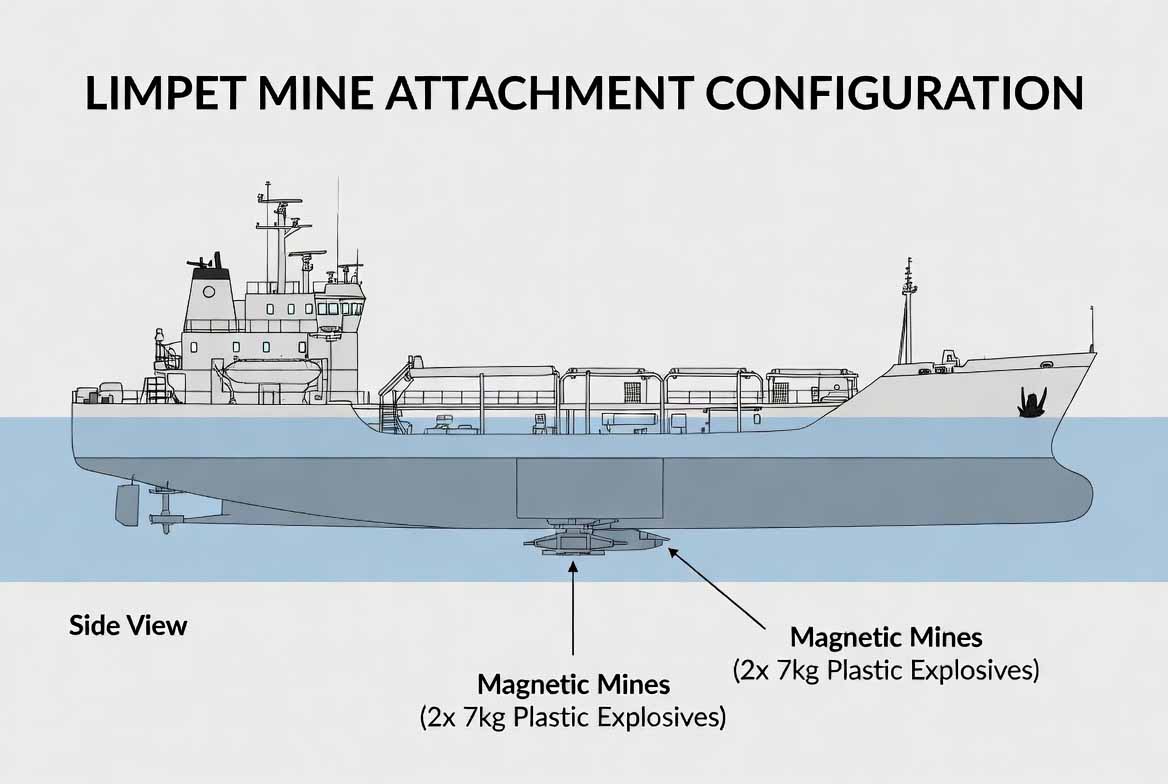
image copyright debuglies.com
The technical analysis of the devices reveals several key characteristics:
- Charge Mass and Composition: Each device contained approximately 7 kilograms (15.4 pounds) of high-velocity plastic explosive. A dual-device configuration of this size represents an explosive mass capable of causing significant hull breaches.
- Targeted Placement: Positioning the devices near the engine room section is a deliberate tactical choice designed to maximize structural damage. Detonating a 7-kilogram plastic charge against the hull adjacent to the propulsion and auxiliary systems would likely cause immediate catastrophic flooding of the engine compartment, disabling the ship and potentially rupturing internal cargo containment barriers.
- Casing and Designations: The Investigative Committee, via spokesperson Svetlana Petrenko, characterized the artifacts as factory-made naval magnetic limpet mines manufactured by a NATO member state. These devices typically feature non-ferrous composite outer shells, hydrostatic or acoustic anti-tamper mechanisms, and specialized magnetic matrices designed to securely grip a ship’s steel hull at transit speeds exceeding 14 knots.
The anchorage period at the Port of Antwerp highlights a well-known vulnerability in modern maritime security: the vulnerability of commercial shipping during extended anchorage outside active port security zones.
While the internal terminals of major European ports feature comprehensive security measures under the International Ship and Port Facility Security (ISPS) Code, offshore anchorage zones often lack continuous sub-surface monitoring. This allows covert dive teams, operating from civilian vessels or specialized sub-surface insertion platforms, to approach commercial hulls undetected.
Section III: Strategic Threat Modeling, Intelligence Attribution Frameworks, and Second-Order Systemic Cascades
To thoroughly evaluate the geopolitical context of this incident, we must apply a structural analytic framework to assess the motivations, operational capabilities, and broader implications of the disrupted attack.
| Driver Set | Primary Actor | Strategic Intent |
|---|---|---|
| Framework1 | Ukraine (SOF/GUR) | Kinetic disruption of Russian Baltic energy trade and maritime logistical lines. |
| Framework2 | NATO Element (Grey-Zone) | Covert interdiction of shadow-fleet and sanction-circumventing energy operations. |
| Framework3 | False-Flag (FSB/State) | Russian manufactured pretext to justify Baltic militarization and aggressive posture. |
| Framework4 | Non-State Actors | Transnational eco-radical or anti-systemic sabotage targeting fossil fuel vessels. |
| Framework5 | Private Syndicates | Corporate warfare or insurance fraud leveraging geopolitical tensions. |
Evaluating these frameworks using Bayesian probability updating sequences reveals a high likelihood of a state-sponsored or state-backed operation, given the sophistication required to source factory-grade naval mines and execute a sub-surface attachment in a busy commercial anchorage.
Second-Order and Third-Order Escalation Cascades
The implications of this thwarted operation extend far beyond the Arrhenius itself, threatening to disrupt multiple global frameworks:
- 1. Escalation of Baltic Maritime Lawfare: This incident will likely prompt the Russian Federation to push for stricter inspection regimes for all commercial vessels entering the Gulf of Finland. This could lead to a de facto security screening corridor, increasing transit times and operational costs for Baltic shipping.
- 2. Disruption of Global Maritime Insurance Matrices: The discovery of functional naval mines on a commercial vessel transiting Western European ports will likely force global maritime underwriters to re-evaluate risk premiums for the Baltic Sea. This could lead to higher War Risk Insurance premiums, impacting international commercial shipping economics.
- 3. Pressure on the Sanctions-Circumvention Ecosystem: The Arrhenius was scheduled to transport LPG to Samsun, Turkey, highlighting Turkey’s role as a major hub for Russian energy exports. Targeting a vessel on this specific route suggests a strategic intent to disrupt Russia’s alternative energy trade networks with non-aligned states.
- 4. Increased Kinetic Risks to Subsea Infrastructure: The deployment of sub-surface sabotage vectors increases the risk of tit-for-tat retaliatory operations targeting critical subsea infrastructure in the Baltic and North Seas, including data cables and energy pipelines.
Ultimately, the interdiction at Ust-Luga underscores the growing intensity of grey-zone conflict in the maritime domain. As the war in Ukraine continues to influence global security, commercial shipping vessels are increasingly being drawn into the conflict as proxies for broader strategic competition. This developments demands heightened vigilance, enhanced sub-surface inspection protocols, and a thorough reassessment of port security frameworks worldwide.
References and Source Verifications
- Russia says explosive devices found on vessel in Ust-Luga port – Xinhua – May 2026
- Explosives Found on LPG Tanker Docked at Ust-Luga Port, FSB Says – The Moscow Times – May 2026
Master Interconnection Matrix
| Entity | Role / Function | Incident Location | Ingress / Origin Point | Next Destined Point | Payload Matrix | Threat Vector Status | Key Interdependencies |
| LPG Carrier Arrhenius | Commercial Energy Transshipment Target | Port of Ust-Luga, Leningrad Region, Russian Federation | Port of Antwerp, Belgium | Port of Samsun, Turkey | Two Marine Magnetic Limpet Mines (~7kg Plastic Explosive each) | Threat Neutralized (EOD Interdicted) | ↑ Depends on: Port of Antwerp Security Controls↓ Impacts: Russian-Turkish Baltic Energy Corridors |
| Federal Security Service (FSB) | Domestic Intelligence & Border Interdiction | Port of Ust-Luga, Leningrad Region, Russian Federation | [NOT APPLICABLE] | [NOT APPLICABLE] | Interdepartmental Explosive Group (AUV/Diver EOD) | Active Interdiction Executed | ↔ Interconnects with: Investigative Committee • MoD • Rosgvardiya[See: Table 2] |
| Port of Antwerp Infrastructure | Transshipment & Apparent Sabotage Ingress Window | Antwerp, Belgium | [NOT APPLICABLE] | [NOT APPLICABLE] | Offshore Anchorage Zone (Unscheduled 36-Hour Layover) | Vulnerability Vector Exploited | ↓ Impacts: Security Integrity of LPG Carrier Arrhenius[See: Table 3] |
Table 1: LPG Carrier Arrhenius – Port of Ust-Luga, Baltic Sea Region (Russian Federation)
| Category → Sub-Metric | Value / Status / Interconnection Notes |
| 🚢 Vessel Identity | LPG Carrier Arrhenius [VERIFIED] |
| ↳ Flag State / Registry | Liberia [VERIFIED] |
| ↳ Unique Identifiers | IMO: 9471032 [OSINT RETRIEVED] |
| ⚙️ Operational Profile | Medium Gas Carrier (MGC) / Liquefied Petroleum Gas Transshipment |
| ↳ Vessel Agent Directives | Routed vessel to offshore anchorage prior to unloading at Antwerp |
| ↳ Master / Captain Testimony | Confirmed vessel remained at anchorage for approximately a day and a half (36 hours) |
| 🗺️ Voyage Telemetry | Multi-Port Baltic-Mediterranean Transit Cycle |
| ↳ Departure / Loading Node | Port of Antwerp, Belgium [See: Table 3] |
| ↳ Interdiction Node | Port of Ust-Luga, Leningrad Region, Russian Federation |
| ↳ Forward Destination Node | Port of Samsun, Turkey |
| 🛡️ Tactical Threat Incident | Sub-Surface Kinetic Sabotage Attempt |
| ↳ Device Location / Attachment | Affixed directly to the vessel’s hull below the waterline |
| ↳ Installation Window | Occurred outside Russian territorial waters ↔ [Exclusively attributed to Antwerp Anchorage Window] |
| 🔗 Cross-Entity Dependencies | Transit security relies entirely on port-of-call sub-surface integrity checks |
| ↳ Upstream Dependency | ↑ Depends on: Port of Antwerp Local Labor / Security Status |
| ↳ Downstream Impact | ↓ Impacts: Turkey Energy Transshipment Safety Infrastructure |
Table 2: Federal Security Service (FSB) – Moscow / Leningrad Region, Russian Federation
| Category → Sub-Metric | Value / Status / Interconnection Notes |
| 🛡️ Interdepartmental Coalition | Federal Security Service (FSB) Lead Agency [VERIFIED] |
| ↳ Operational Partners | Investigative Committee • Ministry of Defense (MoD) • Russian National Guard (Rosgvardiya) |
| ↳ Forensic Representation | Svetlana Petrenko (Investigative Committee Official Spokesperson) [OSINT RETRIEVED] |
| ⚙️ Tactical Countermeasures | Underwater Survey and Explosive Ordnance Disposal (EOD) Operations |
| ↳ Detection Instrument | Underwater Drone / Autonomous Underwater Vehicle (AUV) Deployment |
| ↳ Specialized Detachment | Interdepartmental Explosive Group |
| 🔬 Forensic Device Analysis | Examination of Recovered Sub-Surface Hardware |
| ↳ Quantity / Charge Configuration | Two (2) individual explosive devices manufactured as marine magnetic limpet mines |
| ↳ Net Explosive Weight (NEW) | Approximately 7 kilograms (15.4 pounds) of plastic explosive per individual device |
| ↳ Manufacturing Attribution | Manufactured presumably in one of the NATO countries [Official FSB Statement] |
| 🔗 Cross-Entity Interconnections | Intelligence processing based on direct master interrogation |
| ↳ Data Input Chain | ↑ Depends on: Interview statements provided by the Captain of the Arrhenius [See: Table 1] |
| ↳ Threat Attribution | ↓ Impacts: Geopolitical and military-technical posture relative to NATO member states |
Table 3: Port of Antwerp Infrastructure – Antwerp, Flanders Region (Belgium)
| Category → Sub-Metric | Value / Status / Interconnection Notes |
| 🌍 Port Facility Context | Major European Maritime Shipping and Cargo Hub |
| ↳ Geographic Domain | Antwerp, Belgium (NATO Member State) |
| ⚙️ Operational Disruption | Unscheduled Anchor Layover Event |
| ↳ Stated Cause / Justification | Alleged strike by local port workers |
| ↳ Temporal Duration | Approximately 1.5 days (36 hours) continuous static profile |
| 🛡️ Security Vulnerability Vector | Offshore Anchorage Zone Isolation |
| ↳ Monitoring Status | Sub-surface security monitoring coverage: [DATA UNAVAILABLE] |
| ↳ Incident Vulnerability | Provided the tactical window required for covert underwater installation of magnetic mines |
| 🔗 Cross-Entity Impact Chain | Downstream security compromise of international merchant vessels |
| ↳ Asset Impacted | ↓ Impacts: Structural integrity and safety of LPG Carrier Arrhenius [See: Table 1] |
| ↳ Security Escalation | Directly links Western European labor anomalies to Baltic Sea kinetic security breaches |


